Rebuilding Place in the Urban Space

"A community’s physical form, rather than its land uses, is its most intrinsic and enduring characteristic." [Katz, EPA] This blog focuses on place and placemaking and all that makes it work--historic preservation, urban design, transportation, asset-based community development, arts & cultural development, commercial district revitalization, tourism & destination development, and quality of life advocacy--along with doses of civic engagement and good governance watchdogging.

Tuesday, June 26, 2018

To accelerate commercial district improvement you have to do more than build the one shiny new thing
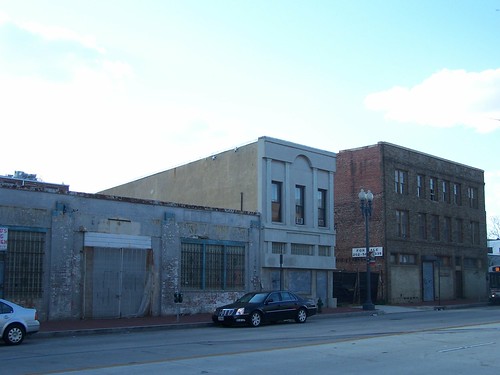
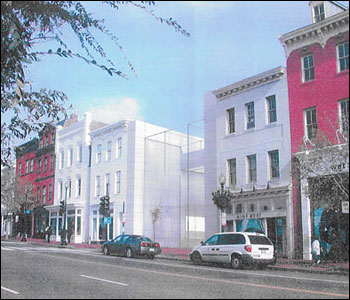
1200 block 9th Street NW, west side1200 block of 9th Street NW, three years after the DC Convention Center opened.

The DC Convention Center opened in 2003 and c. 2005, I wrote a couple pieces about how while building the Convention Center was important, if they wanted the neighborhood commercial district around the center "to show well" simultaneous with the opening, there needed to have been a specific program created to invest in the storefronts and businesses located in the adjacent commercial district (on 9th Street mostly).

Otherwise the process is "trickle down" improvement and it can take decades.

That didn't occur, and it took 8 or more years before you finally started seeing a difference on 9th Street, and part of that was facilitated by the addition of a convention center hotel, a Marriott, at Massachusetts Avenue and 9th Street as well as the redevelopment of the O Street Market as a mixed use project spanning from 7th to 9th Streets ("O Street Market: Symbol of violence becomes a marker for D.C.'s resurgence," Washington Post)--so that's three projects not one.

This piece from 2015 references the earlier blog entries, "The time to plan for retail in and around the Convention Center was long before it opened in 2003 and certainly before 2015."

Kennedy Street streetscape project.  Last summer, I meant to write about Kennedy Street NW where the city has been doing a streetscape reconstruction project, but instead of calling it a streetscape project, they called it a revitalization project.  But merely renaming the process didn't make it so.
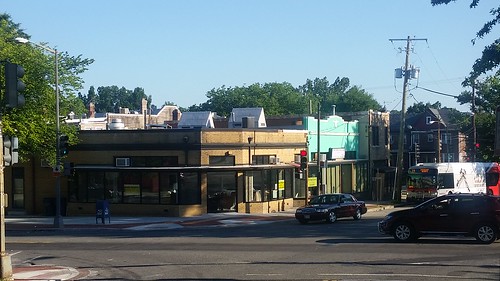
Facade improvement program, 300 block of Kennedy Street NWThe façade improvement program for these buildings was coordinated by the Emory Beacon of Light (Church) Community Development Corporation.

During part of the reconstruction, a set of buildings at 3rd Street underwent a façade renovation and for the most part looked much better afterwards. I figured it was a deliberate, simultaneous project to increase the velocity and economic return on the streetscape project, but it happened to be coincidental.
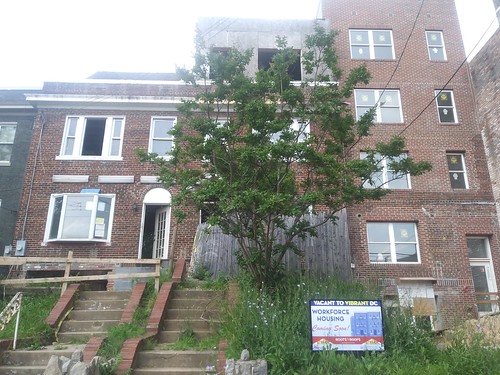
Disinvested buildings on Kennedy Street NWBuildings languishing on Kennedy Street, 2018.

But it made me realize how much more success would come about from such projects -- which are investments -- if there were wrap around or complementary investment-improvement programs designed to facilitate and accelerate overall improvement in a purposeful manner, rather than a trickle down approach.

This was around the time I was writing the series of articles about the Purple Line light rail project in Suburban Maryland, and how a "complementary transit network improvement program" is in order not only to make the Purple Line more successful, but to make the transit network more successful.

-- "Setting the stage for the Purple Line light rail line to be an overwhelming success: Part 2 | proposed parallel improvements across the transit network," March 2017

Transformational Projects Action Planning.  Now I call this approach "Transformational Projects Action Planning," and I argue that with specific big projects, the TPAP approach needs to be undertaken so that a "complementary" investment program is formed to increase the likelihood and speed of success of the big project, such as for the Purple Line light rail program.

-- "Minneapolis Super Bowl: Urban Revitalization and Transformational Projects Action Planning," February 2018
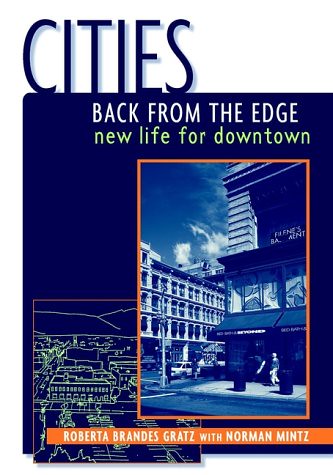
Cities Back from the Edge by Roberta GratzIf you have only time to read one book on urban revitalization, Cities Back from the Edge might be the best, clearest, and most straightforward.

Note that Jane Jacobs, and what I think of as a primer based on her writings, Cities Back from the Edge by Roberta Gratz, called this program of expecting one big splashy building to totally revitalize a place "projects planning," and she criticized the belief that one big project, such as a convention center, stadium etc. was in and of itself enough to spark a broad and deep revitalization of a community.

Barracks Row, 8th Street SE, Capitol Hill.  Unlike Kennedy Street, although technically the project has just finished, the streetscape reconstruction of 8th Street SE in Capitol Hill around 2002 is a rare successful example of property and business owners responding independently to a streetscape project by investing in their businesses and accelerating  significant and visible positive improvement in the commercial district.

In trying to figure out why the streetscape program worked so well, whereas in many other cases that doesn't happen, I figured out it was because while the commercial district had been lagging economically, it was embedded in a very successful residential neighborhood--Capitol Hill--and the business people understood they could get more business by investing simultaneously with the street improvement projects.

Languishing commercial districts with residential neighborhoods that also are lagging need a deeper and broader revitalization investment program in order to succeed.  A one shot project like a streetscape program isn't usually enough.

The Bolling Building on Dudley Square incorporates the facades of three historic buildings and is the headquarters for the school system.  Photo by Anton Stassl for the Architectural Record.

Bolling Municipal Building, Dudley Square, Roxbury, Boston.  This comes up in today's Boston Globe, "In Dudley Square, battered storefronts undermine the progress," which discusses Dudley Square and how despite the $100 million new city building, the commercial district still lags because of disinvested buildings and empty storefronts.  From the article:
Directly across from Boston’s new Bolling Municipal Building is an ugly rebuttal to the years of hard work and the $100 million-plus that activists and city officials have poured into Dudley Square: a grim row of vacant stores.

Out front is one long unbroken run of rusting metal grates, beat-up signs, and decaying paint, while the area around back is littered with crushed beer cans, pillows, women’s lingerie, and signs of squatters. Down Washington Street are several more vacant storefronts.

“It’s depressing to see,” Annette Hill Green, head attorney at the Donald E. Green law offices in a neighboring, well-kept building. “It doesn’t create the vibrancy you would like to see in a commercial district.”

Long a busy crossroads, Dudley Square received a boost when the city’s school department relocated to the Bolling Building. Officials are now trying to woo restaurants and other businesses to add more life to the area after work hours, and a developer is pushing to build a tower there.
Had some other monies been allocated for investing in nearby properties during the construction period for the new building, likely the results would be different.  But instead of doing a focused building by building approach to revitalizing the Square, Councilmembers are pushing a special tax on vacant properties.

Typically, over time such taxes do end up getting the properties sold to more motivated developers, but that too is a long process that can take a decade or more.
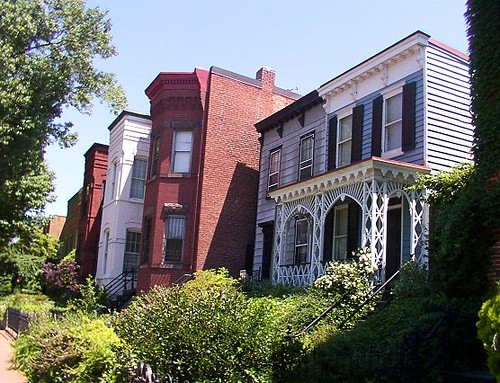
Capitol Hill Rowhouses, Washington, DCThe average price for a house in much of the Capitol Hill residential district exceeds $1 million.

Lessons from Barracks Row.  In "Systematic Neighborhood Engagement" (2007), I wrote about what I figured out from the successful results on Barracks Row (slightly edited):

An approach I use is based on work done for HUD in the 1970s, and used by most jurisdictions around the country. It's pretty basic, you assess neighborhoods based on whether the neighborhoods are:

1. Healthy
2. Transitioning
3. Emerging
4. Distressed.

based on a set of evaluative criteria.

I think this works for communities with at least 30-50,000 population and higher. (I think the researchers contracted by HUD came up with 5 categories. Philadelphia uses 6. DC 4--although they don't necessarily use the same terms to classify neighborhoods. Charles Buki uses 3 categories. But I think 6-8 is probably the best, because you can have high or low sub-stages within each stage.)

But, you need to do three other things when conducting the analysis, which most places (including DC) don't do:

1. Evaluate separately and simultaneously the commercial district and the residential parts of the neighborhood -- your ability to move the commercial district up the ladder is dependent on the density and economic capacity of the residential district. (And with regard to traditional community development strategies-- building more housing doesn't usually work because more housing for lower income people, while laudable, doesn't build the economic capacity of the neighborhood.  You need both a broader range of housing as well as a strengthening of the base of microenterprises employing neighborhood residents and the commercial district, see the Community Economic Development Handbook by Temali.)

2. You can also use the general criteria to evaluate places block-by-block as well, to help develop more focused strategies for specific needs, to move individual properties and blocks forward in a concerted way.

3. Overall, cities should develop differentiated policies for "different" places based on this approach, applied to a categorization of subdistricts and separately for the blocks and buildings within the subdistrict.

Point (3) is crucial and the cause of most failures in government policies and programs. By creating one size fits all programs, and not really understanding the nuances and details of a place and the levers at your disposal, failure is much more likely or at least, success takes two or three times longer.

E.g., emerging and distressed commercial districts aren't likely ready for street furniture given a preponderance of vandalism, and need more assistance in developing community and organizational capacity compared to healthy districts, or those in later stages of transition.

Similarly, even with large investments, it's much harder to move distressed commercial districts up the ladder when the residential neighborhood is also distressed.

… speaking of credit, Rachel MacCleery, the then Ward 6 Transportation Planner now at ULI, and I figured this out together, that commercial districts and residential areas need to be separately and simultaneously evaluated, in order to figure out the likelihood of success.

We were trying to figure out why the investment in streetscape improvement "worked so quickly" on Barracks Row -- 8th Street SE.

Most people don't really understand that the success there isn't merely a function of the investment, but in the overall condition and economic capacity of the greater neighborhood.
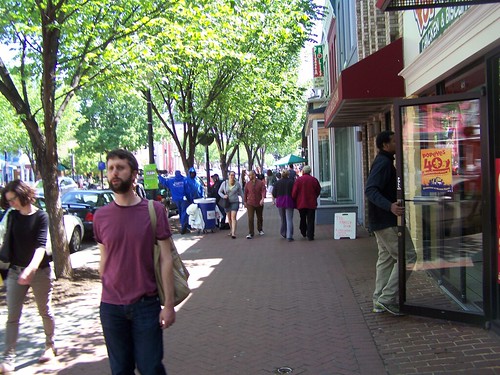
People out on a Sunday on 8th Street SE, Barracks RowBecause much of the property in our commercial districts has absentee ownership, improvement in commercial districts tends to lag improving residential areas, unlike the impact of residential improvement on other building owners (see Building Neighborhood Confidence and Understanding Neighborhood Change both by Rolf Goetze, for more insight into this process).

While the Barracks Row commercial district was "emerging," it was embedded in a residential district that is "Healthy."  

The streetscape investment was the cue to the business and property owners to reposition and invest so that the commercial district could catch up to the economic conditions of the healthy residential district within which it is embedded.

In such a situation not a lot of additional public investment is needed.  Along the lines of Goetze, the public investment in the streetscape was enough of a cue to spur "neighborhood confidence" on the part of the business owners to invest, and they did.

But when both the residential and commercial districts are lagging, e.g., Emerging/Emerging, etc., more complementary investment needs to be made simultaneous with the big projects otherwise it can take a decade or two to see the results from "trickle down" improvements.  And that's even the case in cities like Boston or Washington where the overall economic health is quite high.

Reeves Center.  The Boston situation reminds me of what I call "The Reeves Center Myth."

Many people in DC argue that the Reeves Center government building at 14th and U Streets NW is an example of a successful revitalization effort.

While it's true the building replaced an open air drug market that developed on the site after the buildings there had been destroyed in the 1968 riots, the building was constructed in 1986, and revitalization didn't become noticeable until 20 years.  In the meantime and afterwards, retail in the building mostly failed and tenants failed to pay their rent to the city.

And the area immediately around the center continued to languish until other new developments elsewhere in the district came about, driving improvements to the blocks at the intersection.

The lesson is that connection to a block and a district is necessary in order to foster improvements across the district.  Inwardly-focused developments don't trigger ancillary revitalization.

One building isn't enough.

Urban design and the Waterfront Metrorail buildings.  Another example, but positive, is the redevelopment at the Waterfront Metrorail station.  Around the station, a large office building and inwardly focused shopping mall had been constructed during the urban renewal era, and as part of the project they cut off 4th Street SW so that it was no longer a through street connecting directly to the Northwest Quadrant, the largest section of the city.
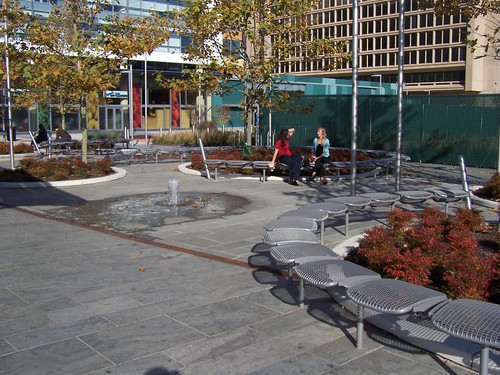
Southwest Waterfront Metro Station plaza, Washington, DCPlaza around the Waterfront Metrorail station.  The building at the upper left of the photo is the side elevation of the Safeway supermarket.

When the site was redeveloped, the street was reconnected, smaller footprint buildings with a more mixed use character (including housing) were constructed in their place, and the ground floor plane was specifically designed to engage and activate the street.

It's an example of the essentiality of connection as opposed to disconnection when investing in revitalization.

Here, local government agencies did lease a goodly amount of office space, to help seed the success of the new development.  But unlike Reeves Center or other examples elsewhere in the city, the buildings were designed to connect to, extend and activate the street, rather than to reject it.

Conclusion.  First, subdistricts need to be evaluated in a detailed and nuanced fashion in order to craft successful revitalization plans. These examples demonstrate that a more detailed approach is required, focused on the characteristics of what the real estate industry calls submarkets.

So the Capitol Hill submarket is different from the Anacostia submarket or the Kennedy Street submarket. Lessons can still be shared across districts with different conditions, but it is only knowing about those difference that commonalities can be discerned.

Second, new buildings that are supposed to be augurs of revitalization need to be designed in ways that connect to and activate the street, rather than disconnect from it. The Reeves Building is an example of disconnection. Boston's Bolling Building is better than urban renewal, but still isn't enough.

Third, most often a single building or a streetscape reconstruction on its own isn't enough to spark broader revitalization, unless the conditions of the commercial and residential districts are highly favorable.

Generally, complementary "transformational projects action plans" need to be developed façade improvement programs, business development grants, technical assistance, and other initiatives are usually needed to foster allied investment in private properties and to facilitate improvement across the district beyond the new project.

And surprisingly even seemingly very successful submarkets like Dupont Circle need "intervention" and support in the face of competition from other districts within the city and the metropolitan area ("Dupont Circle, a place steeped in history, gets a new look and new investment," Washington Post). Again, this comes down to a subdistrict approach focused on fundamentals. While Dupont Circle is more successful than Kennedy Street, it faces a different set of competitors that provide different challenges.

Just because a place like Dupont Circle is better off comparatively speaking to an impoverished area doesn't mean that plans, implementation organizations, and investment programs aren't required.

Other districts in the same situation include Alexandria ("Alexandria businesses discuss opportunity, competition at The Wharf," Alexandria Times), Takoma Park vis a vis Silver Spring, etc.

Labels: , , , ,

Friday, May 04, 2018

Strong real estate markets need more public protections, not fewer: entry of CVS into DC's Mount Pleasant neighborhood

The other day, I came across a piece written last fall by Alex Baca, now in the bike share biz but formerly a bicycling advocate and journalist at the Washington City Paper, about a markets oriented urbanism talk in Cleveland.  Her article is quite good, and makes a bunch of points about the real estate market and the narrow range of urbanism straight up real estate development usually supports.

-- "Against Corporate Urbanism In the Heartland"

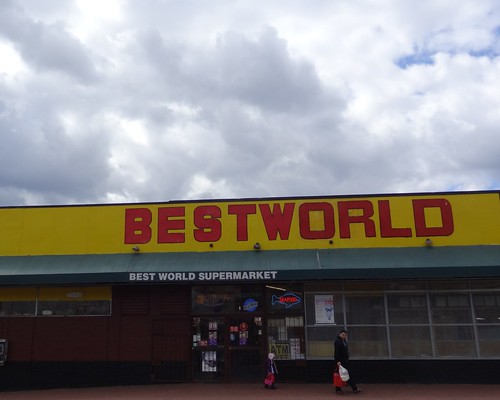
BestWorld
The site eyed by CVS in Mount Pleasant.


The Post reports ("A CVS store might be coming to the neighborhood. These D.C. residents are trying to stop it") on concerns in the Mount Pleasant neighborhood about the possibility of CVS, one of the nation's two largest pharmacy chains, opening a store in their neighborhood commercial district, Mount Pleasant Street, even though there is already an independent pharmacy on the block, and two CVS stores nearby, on 14th Street in Columbia Heights, and on Columbia Road in Adams Morgan. 

Previously the neighborhood unsuccessfully opposed a Subway sandwich shop.  From the article:
In the latest battle pitting Mount Pleasant against chain stores and big-box brands, nearly 2,000 residents have signed an online petition opposing the latest perceived threat to the neighborhood’s folksy, mom-and-pop spirit: CVS.

The pharmacy, which is exploring opening a store on the Northwest Washington neighborhood’s main street, would be an “eyesore” and “completely out of scale,” the petition says.

Residents opposed to the CVS worry about a pharmacy across the street that has served the community for more than 35 years and the locally owned supermarket in the building that CVS is eyeing. They’re also worried about what a CVS in this idiosyncratic neighborhood might bring: more chains, less character, a washing away of who they are.
The problem with a petition is that it has no standing in zoning or building regulations. It's an example of how people don't understand what "petition to redress grievances" means in the context of land use policy ("Historic Preservation Tuesday: Saving buildings vs. "the right to petition to redress grievances," 2015).

Interestingly, yesterday I received my latest issue of the trade magazine Chain Drug Review.  Outside of the three largest chains in the US, most of the regional chains that are left in this business have fewer than 100 stores.

The Mt. Pleasant story tweaks my memory on a bunch of things.

1. Probably in 2003, I submitted testimony on the community development plan and priorities of the DC Dept. of Housing and Community Development. Partly this was in response to their funding of a lousy project by the H Street Community Development Corporation, which demolished the oldest remaining historic buildings on the corridor for some ersatz box--one floor in the place of two- and three-story buildings--for some chain stores.

This was about one year after DC had created the Main Street commercial district revitalization initiative (I was one of the leaders that created such a program on H Street NE--now considered one of the most successful urban revitalization examples in the city and nation).

In already learning from our experience, one of the points I made was that when a Main Street designation is created, there should be a standard set of design and development guidelines that go into effect as part of the program.  At the time I was influenced by the San Diego Main Street/commercial district revitalization program, and the North Park Main Street program had created both Development Guidelines and Design Guidelines, with the aim of satisfying neighborhood priorities.

These documents are now out of date and I didn't know as much then as I do now, but they seemed revelatory back then.

-- North Park Development Guidelines, adopted September 1997 (they might seem out of date now, but think about the time and context in which they were created)
-- North Park Main Street Design Guidelines

Most historic districts create these kinds of guidelines as a way to manage change and to provide guidance and predictability wrt decision-making. They are based on the period of architectural significance of the area and the architectural styles that were then prevalent and the type of building and how it was designed to perform its use--commercial buildings were designed differently from houses.

DC doesn't really do this, except through zoning, unless the commercial district is historically designated.  But the process of creating more detailed requirements outside of the historic preservation regulation process is daunting and there isn't a lot of help and support from the various DC government agencies.

For example, H Street did develop a set of zoning requirements, as part of the planning process for the revitalization program, but they weren't super detailed, because the area isn't a historic district, and the Zoning Commission doesn't put a lot of stock into "design requirements" within zoning regulations.

Even without a specific commercial district revitalization organization for a particular district, there should be protections and reviews in place to ensure the maintenance of the best possible commercial district. 

Development and design guidelines for commercial districts should be a minimum requirement and a basic element of zoning and planning regulations for a community.

2. Business Revitalization District designation as another framework for design review.  Once I got heavily involved in local land use issues in DC, the first major national conference I attended was the National Trust for Historic Preservation annual meeting, in Cleveland in 2002.

One of the many things I learned about was Cleveland's "Business Revitalization District Overlay" zoning, which mandated extra-normal design review in districts targeted for improvement.  The point of the design review was to ensure the coordination of projects and to reduce the risk of bad design negatively impact the value of adjoining properties and limiting the positive impact of public investment in those communities. From the webpage:
Certain proposals for construction, exterior alterations, building demolitions or signs in the City of Cleveland must undergo a process known as "design review." The City established this process as a policy to ensure that any visual changes to buildings or open spaces will enhance the architectural character of Neighborhood Commercial Districts.
DC, the only places that are subject to local design review as a matter of course are areas designated as historic districts, although local projects can be subject to federal design review if they are in or impact the federal interest area of the city.

3. Formula retail. Some communities, but not very many, have zoning restrictions concerning the opening of chain retail in their cities.

•  It may be for most every retail category, like in San Francisco,
•  or more focused on so-called big box stores, through big box review ordinances.
•  In Laguna Beach, California, they have a retail zoning categorization for what they call "neighborhood serving businesses."

The thing is that you need to have these provisions in place before a chain store comes calling, not after. That being said, I recall reading a study by the Community Land Use and Economics Group found that healthy traditional commercial districts have chain stores in their overall retail mix, upwards of 15% .

DC does have certain use restrictions, but they aren't particularly wide ranging.  The three that come to mind, but they don't apply everywhere, mostly just in commercial districts like the one in Mt. Pleasant are:
  • no automobile-oriented "drive through" type establishments
  • extra review for gas stations but they can still happen
  • extra review for fast food establishments but they can still happen.
Districts with extra regulations like 17th Street in Dupont Circle or Cleveland Park usually set a percentage of space limit on restaurants.

If an outright ban is too hard, at the very least I am in favor of conditional use permitting processes.

I fell in with some people who were interested in this vis a vis Dupont Circle, and they thought that they could get CM Jack Evans to move such legislation forward ("Formula retail restrictions and other planning and zoning techniques," 2007).

No such luck, and in fact since then, national real estate investment trusts have become more heavily involved in that district, Cleveland Park, and other areas of the city ("Problematic outcomes as real estate investment trusts buy more "high street" retail real estate," 2015), making such incursions all the more likely.

Conclusion.  As I write repeatedly, without remedies already existing in the law, it's very difficult to win land use advocacy battles ("Without remedies there's nothing you can do: historic preservation in Chicago and DC," 2014).  You certainly can't do it with a petition.

The really sad thing about all of this is that again, you need these kinds of zoning review processes in place before the developer or chain store comes calling, not after. 

It is a travesty that the Office of Planning hasn't worked to put such provisions in place, leaving neighborhoods pretty naked when it comes to having a minimum amount of input into retail developments in neighborhood commercial districts.

(This is also an issue with liquor licenses. I argue that rather than only categorizing and regulating licensing by type of use--bar, restaurant, etc., it should also be congruent with land use type, e.g., micro district within a neighborhood, commercial district by a Metrorail station but still in a neighborhood, downtown or in a regionally serving commercial district, etc.)

=====
This item isn't really related to the Mt. Pleasant matter.

4. Funding for commercial district revitalization initiatives.  San Diego also separates the organizational form of a commercial district revitalization effort--there it can be either a Main Street type somewhat grassroots program involving the community or a more traditional property owner oriented "business improvement district" from the funding mechanism, a supplemental tax on commercial property in the defined district.  (In DC, we only allow BIDs to have property tax supplements.)

So Main Street efforts always beg for funding while BIDs don't.

Labels: , , , , ,

Tuesday, March 19, 2013

One option for Alexandria's Del Ray neighborhood, but it might be too late: a formula retail overlay

Some communities, but not very many, have zoning restrictions concerning the opening of chain retail in their cities.

•  It may be for most every retail category, like in San Francisco,
•  or more focused on so-called big box stores, through big box review ordinances.
•  In Laguna Beach, California, they have a retail zoning categorization for what they call "neighborhood serving businesses."

The thing is that you need to have these provisions in place before a chain store comes calling, not after.

Today's Examiner has a piece, "Del Ray residents fight to keep Walgreens out," about the Del Ray neighborhood in Alexandria, and how some residents are not in favor of the possible coming of a Walgreens pharmacy-convenience store to a site that would necessitate moving out 5 independent retailers currently located there.

Rather than an outright ban, I am in favor of conditional use permitting processes.  And I think it's reasonable to include such a zoning regulation in traditional/neighborhood commercial districts.  In fact, the process of creating Main Street type commercial revitalization initiatives should include a set of zoning provisions that support the program, traditional streetscapes, etc.

That being said, I recall reading a study by the Community Land Use and Economics Group found that healthy traditional commercial districts have chain stores in their overall retail mix, upwards of 15% .

Ironically, although we only see this in big cities, Walgreens, through their acquisition of Duane-Read, the New York City based pharmacy retailer, is doing some of the most innovative "pharmacy" retail in the US, with stores in Manhattan, Brooklyn, Chicago, and San Francisco including features such as a specialty finance publications (on Wall Street), cosmetics counters, sushi bar, and draft beer on tap.

According to the DCist, in "Walgreens Upgrades From Drug Store to 'Experience'," the new Walgreens opening at 7th and H Streets NW in Downtown DC will be one of these tricked out pharmacies, with 

  • "A nail bar offering professional manicures"
  • "Expert eyebrow shaping and grooming services"
  • "Self-serve frozen yogurt dispensers and toppings for unlimited options"
  • "A juice and smoothie bar"
  • "An Upmarket Café offering a barista preparing fresh brewed premium coffee and espressos"
  • "Walgreens’ new, virtually-enhanced pharmacy."

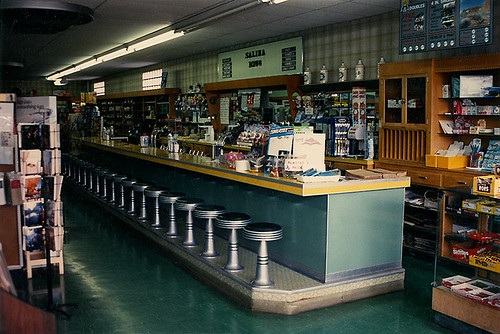
Salina Drug StoreImagine if in Del Ray, Walgreens would bring back the old style soda fountain--which is not an element in any of the new Walgreens/Duane-Read store innovations, but historically the firm was a big innovator in this arena.

In that case, it would be possible for a chain store to bring innovation to a neighborhood, even if usually the process is one of standardization.

In any case, having a conditional approval zoning process would provide the opportunity for more input into the result, it wouldn't necessarily mean an outright denial, although it could.

Labels: , , , ,

Sunday, November 28, 2010

Developers using social media to fight opponents

is an AP story that happened to run in the Richmond Times-Dispatch.

Obviously, using any and all techniques at your disposal is what any type of advocate does. The article mentions one particular social media initiative that has generated developer response, Don't Big Box Carytown, in Richmond, Virginia.

Note that I have written about Carytown in the past and I consider it one of the best traditional commercial districts between Philadelphia and Richmond (it trumps most traditional shopping districts in the DC region, although Alexandria and 14th Street do better with furnishings).

The Carytown anti-development initiative is interesting, because it is against the entry of a Whole Foods Market, which most every neighborhood seems to want (along with Starbucks and/or a Trader Joes).

A Whole Foods Market attracts thousands of customers each day, building the kind of customer traffic that most commercial districts seemingly desire.

It's also interesting because just yesterday Suzanne and I were talking about commercial district revitalization issues, and I mentioned how it took me a few years (about five) to get a more nuanced understanding of how the right kind of chains can be included within traditional districts in ways that are sensitive to the district and help the district succeed. Although Kennedy Smith, the former director the National Main Street Center, points out that in thriving districts, chains don't number more than 20% of the total stores.

This is because these stores are well known, get advertising and other marketing support, draw in customers who in turn shop in other stores in the commercial district, and the chain stores can help to round out and extend the mix of stores in the district.

Other articles:

-- "Carytown Meeting Regarding Big Box Store: All signs point to Whole Foods replacing old Verizon building" (WTVR-TV, CBS6)

-- Carytown business community thinks outside the box" from Richmond BizSense

-- "Carytown group neutral on Verizon building" from the Richmond Times-Dispatch, about the Carytown Merchants Association not taking a position on the project, other than stating that land use proposals should be congruent with the master plan for the area


People might point to this discussion and ask "why aren't you supportive of a Walmart on Georgia Avenue when you are saying that people in Carytown ought to be happy to get a Whole Foods Supermarket? Aren't you being hypocritical?"

There is a big difference.

First and foremost, the Carytown commercial district is thriving, but even so, all traditional commercial districts need to continue to refresh and keep current what they offer. The customer demographic of Carytown jibes well with a Whole Foods supermarket (plus there are already two large grocery stores there, a Kroger and a Ukrops-Martins, as well as the Ellwood Thompson Local Market, a natural foods store which is stoking the opposition--this company is supposed to open a store in Columbia Heights, but it appears as if it may not according to the Washington City Paper and other media).

It's the classic argument of how an "anchor" store in a commercial district attracts customers who in turn shop in the rest of the district.

The issue with the Walmart on Georgia Avenue in DC is that it won't be integrated into the urban fabric in a manner that complements and strengthens the other retail on Georgia Avenue.

Not to mention the Walmart business model which is not supportive of the anchor store concept. Walmart's business model intends to capture up to 100% of the customer dollar, leaving no room for spending at other stores. Sure, they are doing marketing support programs for local retail in urban areas, to reduce the level of opposition to their entry, but their business model remains unchanged.

I saw an article about how Walmart is reaching out to their vendors to do joint purchasing, in order to reduce production costs. If Walmart were to make their buying and operating systems available to local commercial districts as part of the "community benefits" package of their entry, maybe I'd feel differently about their entry--which I am resigned to by the way, I just want their entry to be way better managed, so that the Georgia Avenue commercial district is strengthened, not weakened further.

Labels: , , , ,

Friday, November 26, 2010

Small Business Saturday (for holiday shopping)


Is an initiative launched by American Express Open to promote holiday shopping at locally owned businesses. It makes sense to do this on a day separate from "Black Friday" (today) -- the day after Thanksgiving when big retail chains do special promotions with blowout prices and extremely early opening hours (e.g., Kohls opened at 3am).

It's almost impossible for small businesses and traditional commercial districts to counter-program against that and they shouldn't even bother, because it's difficult to get any business.

Instead of fighting it, it makes sense for smaller retail businesses to counter program but on a different day, and use it to emphasize your "unique selling proposition" -- more intimate experience, shorter lines, no chaos, unique goods, etc.

Labels: , ,

Thursday, February 05, 2009

Historic preservation builds value, and is central to DC's competitive advantage as a unique place for residents and visitors

Yes Georgetown needs more customer traffic. Yes, Georgetown needs to constantly improve its retail offer, because it competes with other regional destinations, ranging from Arundel Mills, which has a proposal to add a slots gaming parlor (see "Slots Near Mall Warily Welcomed: Arundel Mills Proposal Seen as Economic Aid" from the Washington Post), to the National Harbor in PG County, to Reston, Tysons Corner, Montgomery Mall, Alexandria, and a myriad number of other commercial destinations within the region.

And regardless of the fact that Georgetown is one of the pre-eminent retail destinations in the city, albeit serving visitors and people from other jurisdictions more than DC residents, policy choices for Georgetown, including tax incentive financing to attract retailers such as Barneys or Nordstroms, must be considered within the regional context rather than only being considered by comparing Georgetown to other retail districts in the city proper.

At the same time, Georgetown's competitive advantage must be vigilantly maintained at the same time it must be strengthened and appropriately extended. Georgetown's competitive advantage rests upon the vitality of the street environment, particularly the first floor or ground floor experience, and the historic built environment, dating mostly from the 1800s.

Given that the shopping mall is in serious decline, as written about in the New York Times, "Our Love Affair With Shopping Malls Is on the Rocks" and even in Greater Greater Washington, "Back to the Future in Commercial Real Estate," a commercial district like Georgetown is well positioned going forward, but given how Georgetown, at least in the core, is increasingly a chain retail experience (see "Baby’s Got Me Locked Up in Chains" from Georgetown Metropolitan), its future must always be carefully considered. See "Now, Big-Name Retail Chains Will Take the Other Boroughs, Too," from the New York Times about concerns over outdoor commercial districts being reproduced in the equivalent of chain store malls in New York City.

I have written about these issues as they relate to Georgetown a number of times in the past:

-- Is there a link between historic designation and chaining up of retail in neighborhood commercial districts?
-- Authenticizing Inner Harbor and maybe thinking about authenticity and Georgetown DC
-- Suburbanizing the City
-- Why it's okay to give tax increment financing to department stores but you still need to think long and hard about where you put your money
-- The hot real estate market Downtown and Georgetown

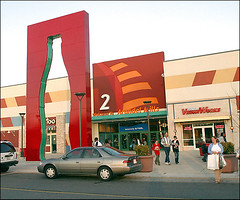
Coke machine entrance-logo, Arundel Mills Mall, Maryland
Using design within the built environment to support and promote specific brands and brand identity marketing objectives at Arundel Mills Mall, Maryland. Photo Credit: By Craig Herndon -- The Washington Post.

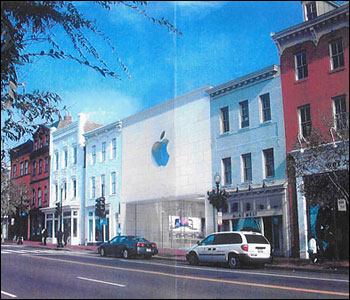
With the Apple Store question, we get into some tough issues. DC Government economic development officials are running scared. Developers are dropping projects (see "Poplar Point Developer Pulls Out Of Project: Company Cites Risks Of Economic Climate" from the Post) and too often, DC isn't considered to be in the running for various trophy headquarters projects (see "Hilton Hotels Checking In To Stay in Fairfax County: Virginia Lures Company With $4.6 Million Incentive" from the Post). So this is a trophy project that Government officials want to snare in order to communicate far and wide that DC is a hospitable place to do business.

At the same time, typically business people are wimps about demanding very much from other businesses. They are all about "incentives" and rarely about making demands. (My joke is that developers want the quid, but not the pro quo.). This goes for DC Government officials too. The core of the Georgetown commercial district defines that neighborhood and the city, and to let it be reproduced through a bunch of corporate branding initiatives would over time significantly diminish the competitive advantage of the commercial district.
Anatomy of a Main Street building (cropped)
Image from the Illinois Historic Preservation Agency.

Where Paris is so concerned about the diminishment of the quality of the experience on the Champs Elysées that they prevented the international chain H&M from opening a store there, see "Champs Elysées Risks Losing its Soul" from Der Spiegel, it appears from the Post article that Deputy Mayor Neal Albert is as eager as a St. Bernard:

Today, Apple returns for a fourth round with the Old Georgetown Board, as the panel is known, this time with a drawing that is virtually identical to the first. The encounter is so fraught with uncertainty that Mayor Adrian M. Fenty's office has offered to give the computer company advice on how to handle the board and asked to see its latest rendering before the meeting.

"I don't want the Old Georgetown Board having to have the perfect design torpedo a very good product," said Neil O. Albert, the deputy mayor for planning and economic development. If Apple is held up again, Albert added, "we will step in and work with both parties to make sure it gets passed."

The reality is that this is part of the give and take of working with businesses who want to do what they want with no oversight, and the iterative process of working not just with zoning regulations (which demand very little for the most part) but with the historic context.

It is typical, especially with relatively intransigent developers of which there are many, to go back and forth a number of times before a mutually agreeable result is obtained. In fact, if I only cared about money, I see an incredibly lucrative profit opportunity in selling my services to developers to deal with historic preservation and public participation issues concerning pre-planning to get the best and fastest possible result. (Note that companies like Abdo Development are very good about this. They understand that the more time they put into upfront community building and information gathering, the faster it is on the back end to get zoning approvals and permits.)
Design 2, Apple Store, Georgetown
The all glass design #2 shows a definite "screw you" response to the initial concerns expressed by the Old Georgetown Board. (USCFA image.)

Design 3, Apple Store, Georgetown
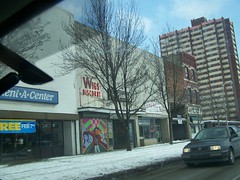
Design 3 for the Apple Store uses a style typical in the 1950s and 1960s in commercial districts that thought if they redesigned their facades to look like shopping malls that they could better compete and attract business. This idea has been repudiated for about 20 years. (USCFA image.)

Penn Avenue commercial strip, East Liberty, Pittsburgh
Panelized upper stories of storefronts on the Penn Avenue commercial strip, East Liberty, Pittsburgh.

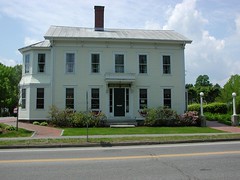
If a community sets a tone where they demand quality, in the long run, quality is what they get. McDonald's was one of the first chains to "roll over" and build a locally appropriate to the architecture store in Maine many years ago. Apple is certainly capable of doing the same. And in the long run, Georgetown and Apple will be stronger for it.
McDonalds, Freeport, Maine
McDonalds, Freeport, Maine. Source unknown.

Regarding this broad issue of appropriate design and chain stores, there are many resources. Some of the best are:

-- The Art of Placemaking: Interpreting Community Through Public Art and Urban Design by Ronald Lee Fleming
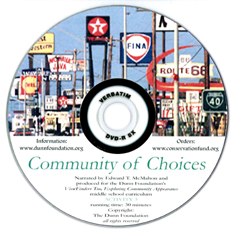
-- Community of Choices (DVD) The Conservation Fund

-- Adam Gopnik wrote in the New Yorker, in the piece "Gothamitis" that:

It is the sense that the city’s recovery has come at the cost of a part of its identity: that New York is safer and richer but less like itself, an old lover who has gone for a face-lift and come out looking like no one in particular. The wrinkles are gone, but so is the face. This transformation is one you see on every street corner in Manhattan, and now in Brooklyn, too, where another local toy store or smoked-fish emporium disappears and another bank branch or mall store opens. For the first time in Manhattan’s history, it has no bohemian frontier. Another bookstore closes, another theatre becomes a condo, another soulful place becomes a sealed residence. These are small things, but they are the small things that the city’s soul clings to.

... Only twenty-five years ago, a walk from Tribeca to SoHo and the Lower East Side would show as many kinds and classes—rich, aspiring, immigrant—as it had a century before; now that walk is likely to show only the same six stores and the same two banks and the same one shopper.

New York, as generations have been taught by the late Jane Jacobs, is a self-organizing place that fixes itself. But let the additional truth be told that though the life of the block is self-organizing, the block itself that lets life happen was made by the hand of a city planner. As the Mayor said, and knows, what we want the city to look like in 2030 will depend on the rules we make now.


The first time I visited Washington,was with my family when I was 14. Walking through the streets of Georgetown at night, with the positive street activity, and the "old" buildings (back then I didn't know you called such buildings "historic")--I was charmed and captivated. In fact, I ended up sending my SAT scores to Georgetown University (although I never applied there) as a result of that trip, and seeing the city for the first time. I am sure that the trip--the historic built environment that I saw--is why I live here today.

At the same time we are consumers of the city environment, we are the stewards of its future, and a focus on the quick buck and cheap design (hey, do you remember the Apple Lisa computer?) is about the farthest away from the concept of sustainability that I can imagine.
Community of Choices DVD

Labels: , , ,

Tuesday, December 02, 2008

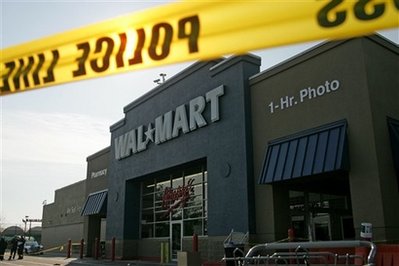
Yes, Walmart is bad

Wal Mart Death
Nassau County Police examine the front of the Wal-Mart in Valley Stream, N.Y., Friday, Nov. 28, 2008, after a temporary Wal-Mart worker died after a throng of eager shoppers broke down the doors and trampled him moments after the Long Island store opened early Friday for day-after-Thanksgiving bargain hunting, police said.(AP Photo/Ed Betz)

Stacy Mitchell, of the New Rules Project, and author of the Big Box Swindle, has released a paper challenging the conclusions of a pro-Walmart journal article published in an economics journal. See "Major Flaws Uncovered in Study Claiming Wal-Mart has not Harmed Small Business."

Her article is quite good, and makes some important points even beyond pointing out the methodological errors in the original study:

-- while the U.S. population has increased significantly, the number of independent retail businesses has not increased at the same rate
-- retail chains continue to capture an inordinate share of total retail sales
-- more "retail" space in traditional commercial districts is likely being converted from retail to non-retail use.

This is timely because I have been pondering and been meaning to write about this blog entry, "Creative destruction from Wal-mart’s arrival," from All About Cities, which reports on a Canadian study that has a similar finding, that Walmart isn't all bad, that their entry into various retail markets improves the quality of what is offered by the surviving stores.

It's true that a lot of independent retailers could do a much better job and that the entry of Walmart to their market leads to changes, good and bad. But one point that the Canadian study seems to miss is that while business may increase for other stores in the immediate or nearby area where the Walmart locates, this usually comes at the cost of loss of sales in other commercial districts in the greater retail trade area served by the store.
Clear cutting
Clear cutting, Flickr photo by talaakso.

The entry of chain stores often has an impact on a traditional commercial district comparable to clear cutting a forest. For various reasons, single store operations aren't able to price products competitively vis-a-vis (inter)national retail companies with tremendous buying power and global supply chains.

As a result of national chaining of retail generally, not just Walmart, a large number of categories, in particular convenience goods categories such as apparel, food, pharmacy, housewares, often hardware, etc., become uncompetitive as far as local retailers are concerned, and increasingly, these categories end up not being represented in traditional commercial districts, except at the specialty goods level and higher price points.

This leads to big gaps in the type of retail categories represented in local commercial districts, which become lopsided and narrow as a result, and more dependent on specialty retail and on attracting market segments outside of the local area (i.e., tourists).
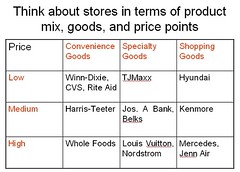
Retail mix: type of goods and price points
This is a graphic I invariably include when I write retail-commercial district assessment plans for communities, although I change the "brands" included to reflect stores located within the region being studied. The "chaining up" of retail has eliminated various price points and categories from many traditional commercial districts, especially those with limited population.

Another factor that appears to be ignored is the negative impact on other aspects of the local economy, by the displacement of local purchases in favor of national sourcing. For example, often Walmart doesn't advertise in local newspapers. And they don't purchase goods and services (i.e., accounting, legal, printing, etc.) locally compared to locally owned retail stores. This has a negative effect on business maintenance within the local retail trade area and reduces the breadth of services available.

Neither journal article gets these issues, instead repeating the kind of advice contained in the book "Up Against the Wal Marts" about shifting the store's product mix towards items and price points that Walmart doesn't carry.

Although the problem with this "strategy" is that over time, Walmart continues to add more product lines and a greater variety of products and price points, further constraining the ability of other stores to compete within a Walmart store's retail trade area. Walmart now has some upscale stores, such as in Plano, Texas.
Organic Lemons, Walmart
A display of organic lemons is shown at a new upscale Wal-Mart store, Tuesday March 21, 2006, in Plano, Texas. The new store, complete with organic fruits, microbrewery beer, fine wine and cheese and plasma TVs, is set to open its doors Wednesday. (AP Photo/Amy Conn-Gutierrez)

I have written before about how Walmart's retail strategy is to capture ideally 100% of the retail expenditure of a consumer. Their success comes at the failure of satellite commercial districts and various stores. But it's true that the prices are low. OTOH, who really is making the money from the sale? While China gains, the U.S. economy loses, especially in terms of being able to manufacture goods in the United States.
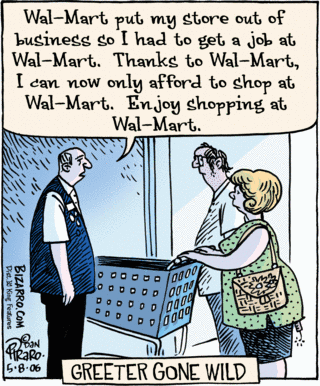
Bizarro, 5/8/2006, Walmart
Bizarro comic, 5/8/2006.

Labels: , , , ,

Friday, April 27, 2007

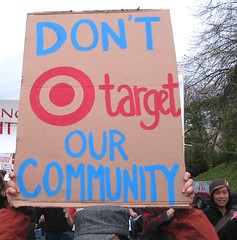
Seattle protest against a large neighborhood-threatening development

These photos are from the Pooshkin blog and the related Flickr account of irooshka.

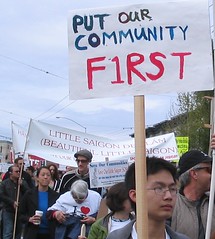
Protest in Little Saigon, Seattle

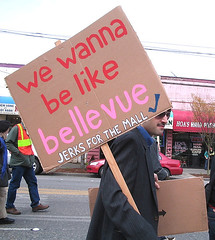
Protest in Little Saigon, Seattle

Protest in Little Saigon, Seattle

Protest in Little Saigon, Seattle

Labels: , ,