Rebuilding Place in the Urban Space

"A community’s physical form, rather than its land uses, is its most intrinsic and enduring characteristic." [Katz, EPA] This blog focuses on place and placemaking and all that makes it work--historic preservation, urban design, transportation, asset-based community development, arts & cultural development, commercial district revitalization, tourism & destination development, and quality of life advocacy--along with doses of civic engagement and good governance watchdogging.

Monday, November 24, 2025

Zohran Mamdani is the next NYC Mayor: what that means for progressive politics

UP to election day on November 4th, conservative Democrats, Republicans ("New York Republicans Unite in Attacking Mamdani," New York Times) and the editorial pages of the Wall Street Journal and newly decidedly right wing editorial pages of the Washington Post were up in arms about the possibility of a "socialist Muslim" becoming mayor of the US's largest city.  The Times was equivocal but resigned.

The New York Post of course was pretty shrill.

Note that there are or have been some great Muslim mayors in big cities ("The Meaning of a Muslim Mayor," The Nation).  

Naheed Nenshi in Calgary--termed out, now leader of the New Democratic Party at the provincial level ("Nenshi's former aides see an eerily similar story in New York City mayoral candidate Zohran Mamdani," National Post, "Naheed Nenshi leaves behind a historic legacy as Calgary mayor," Toronto Globe & Mail).

Sadiq Khan in London ("London’s Mayor Says Mamdani’s Victory Mirrors His Own," New York Times, "Muslim mayor, Jewish voters, Trump rage. London’s lessons for Mamdani.," Washington Post).

Mamdani won pretty decisively ("Mamdani wins New York City mayoral race, in a historic victory for progressive," NPR).  Mamdani victory speech.

Trump, after having called him a communist, met with him this week and spoke well of him ("Trump-Mamdani meeting marked by surprising moments of praise. Here are 9 memorable quotes," CBS News, "Mamdani, Trump’s expected slugfest turns into a lovefest as president says socialist will make NYC ‘greater than ever before’," New York Post).  

The Business Development Board of Palm Beach County is funding a campaign to advertise in New York City with hopes of drawing interest from New York-based businesses and industries. These efforts include advertisements that call on businesses to “break up” with New York. (Courtesy/Business Development Board of Palm Beach County)

South Florida communities have placed billboard ads in NYC seeking to recruit fearful businesses and residents ("Palm Beach County leaders launch campaigns to poach New York-based businesses," Ft. Lauderdale Sun-Sentinel, "Those NYC billboards sent a message, just the wrong one, to Miami Beach residents Read more at: https://www.miamiherald.com/opinion/editorials/article312950849.html," Miami Herald), but for the most part, there are far more reasons to stay in NYC ("New York’s Golden Handcuffs: Why the City Has a Special Hold on the Rich," Bloomberg, " Wealthy Buyers Say, ‘Mamdani Who?’ Some are underbidding with the hope of a real-estate panic — but not having much luck," Curbed) than to live in South Florida.

Many conservatives fear that Mamdani will be successful ("Mamdani’s Surreal and Shrewd Pragmatism," New York Times).  From the New York Magazine article "Zohran Mamdani’s Next Act":

We had nearly a year of discussion and debate before voters gave the go-head to Mamdani’s core four promises: freeze the rent, expand early education, make buses fast and free, and open one government-owned grocery store in each borough to help ease New York’s endemic hunger problem. “The residents of the city have spoken, and it’s been very clear, and they’ve done it in amazing numbers, and their response to the Mamdani campaign is that this has to happen,” Dean Fuleihan, a veteran government manager who will be Mamdani’s first deputy mayor, told me. “So I don’t see it as a question of choice.”

Progressives are happy ("A Socialist in the White House," The Nation).  I do fear some of his platform is a bit unrealistic.  Like government run grocery stores. 

But if he can make headway in general, it will be great for revitalizing the Democratic Party-progressive agenda (" How Mamdani built an ‘unstoppable force’ that won over New York," "Mamdani’s victory is a rebuke to the failed strategies of the Democratic party," "Improbable victory for city’s first Muslim mayor offers new playbook for fight against Trump," Guardian, "Zohran Mamdani and the politics of trying," Boston Globe), "Will Mamdani’s Victory Advance a Solidarity Economy in New York City?," "How New York City Mayor-Elect Mamdani Is Bridging Climate Preparedness to Kitchen Table Concerns," NonProfit Quarterly).

However an op-ed in the Post suggests that a contrast between the more centrist "bread and butter" political agenda by the new SF mayor and Mamdani's progressive agenda will be interesting ("Let the natural experiment in Democratic governance begin"). Also see, "Tensions between renters and homeowners challenge Mamdani housing plan," Washington Post.

Labels: , ,

Monday, July 28, 2025

Urban and suburban politics/voting: NYC :Democratic Socialist Zohran Mamdani and homogeneity in US politics that leans to the center right

:In general, it's said that metropolitan areas vote progressive and that rural areas don't. A key example is how Oakland County, Michigan went from Republican to Democrat, but in a process that took decades.

But wrt urban areas that's a bit facile.  Typically, cities tend to be more left/progressive than the suburbs.  It means that there is a greater chance to elect left candidates in the city over the suburbs.

The press has been full of coverage about this in terms of the win in the primary by Zohran Mamdani, who trounced Andrew Cuomo, former governor.   Before election day personages like Michael Bloomberg and Bill Clinton endorsed Cuomo. 

Similarly, there are examples of a few more elected House members being more progressive, among them Alexandra Ocasio-Cortez, in NYC.  What I think the left misses in these wins is that the voter makeup is key, AOC is about urban districts with a lot of left leaning voters, not so much about a left lean to politics overall.  Which is why a majority of the candidacies affiliated with Justice Democrats, the group that supported AOC, fail.

The New York case reminds me of Toronto and London.  In both cities, at times, depending on how the suburban tranche of residents votes, you can get conservative mayors, like Ford or Johnson, instead of more lefty ones like Chow and Khan.  Cuomo captured the more "suburban" segment of the electorate, Mamdani the urbanists.

Blue, Cuomo: 36.4%.  Red, Mamdani, 43.5%.

I've written about this in DC, "DC as a suburban agenda dominated city" (2013) more in terms of about policy being somewhat biased towards automobility, but not in terms of electoral politics as the city leans left.  Policy-wise it's not quite akin to the same dynamics of cities with both large urban and suburban contingents.

In writing about how Baltimore and St. Louis should merge with their respective counties to develop more "heft", this is an issue.  In both places the suburbs have more population, and could out vote candidates supported by residents in the city proper.

In Louisville-Jefferson County, Kentucky, this has been less of an issue.

Pollster Nate Cohn "agrees" with my take about differentiation ("What Democrats Can Learn From Mamdani's Victory," NYT):

Of all these changes, the most obvious one is that the Democratic electorate has simply moved farther to the left. Over the last few years, this hasn’t always been obvious. To many, the last presidential election seemed to mark a new rightward turn in the culture, including among the young voters who had powered the ascent of progressives. Looking even further back, progressives mostly seemed to stall after Mr. Sanders’s breakthrough in 2016, including in New York City.

... With Mr. Mamdani’s victory, progressives finally have another visible breakthrough. While it might be tempting to attribute this to his personal strengths and Mr. Cuomo’s weakness, much of the change can simply be attributed to today’s much more progressive electorate. ... It’s important to note that just because Democrats are moving to the left doesn’t mean the electorate is overall.

... Mr. Mamdani’s campaign was different. He focused on the cost of living. By talking about the prices of chicken and rice, groceries, rent and buses, he spoke much more directly to the concerns of ordinary people than he would have if he had campaigned on a Green New York Deal or Medicare for all of N.Y.C. Yes, he sometimes pushed a few buzzy ideas, like free buses and government-owned grocery stores, but even these were pretty prosaic by the vibey standards of Abolish ICE or Free College. He may support those things, but it wasn’t what he was known for. This is probably a reason he fared better in many of the working-class neighborhoods than previous progressive candidates. 

Mainstream Democrats might struggle to make such a clear affordability pitch. Usually, Democrats try to address affordability problems through subsidies, but subsidies put upward pressure on prices and could contribute to inflation. The federal budget deficit and high interest rates also make it more challenging for Democrats to propose ambitious spending initiatives.

Democrats seem unlikely to co-opt much of the left’s agenda. Many Democratic opinion leaders are skeptical of price controls, government-owned enterprises and other measures, even though they might poll well. Ms. Harris supported cracking down on price gouging, for instance, but she didn’t campaign in a full-throated way on these issues, perhaps in part because so many party elites were skeptical of these initiatives. 

Taken together, the Mamdani victory suggests there’s an opportunity for progressives. Their ranks have continued to grow in recent years, at least within the Democratic electorate, even though it hasn’t always seemed like it. Affordability and Israel give them new opportunities and put mainstream Democrats in a challenging spot. It still won’t be easy for progressives to win, especially in an area without a thriving left-wing community. But it’s not 2015 or 2019 anymore, either. There are new voters, new technologies, new issues and new opportunities.

This touches on what I call homogeneity versus hetereogeneity in local politics and governance, just as we have the same fealty to an automobile-centric land use and transportation planning paradigm, which provides little room for communities to have a transit or bike centric paradigm instead.

Also, surprisingly the Wall Street Journal, but inadvertently (:How Democratic Failure Made Mamdani":

The Democratic establishment is upset about socialist Zohran Mamdani’s victory in this week’s New York City Democratic mayoral primary. But Mr. Mamdani couldn’t have done it without the establishment’s help—to wit, the failure of big-city Democratic governance.

Chicago, Los Angeles, San Francisco—all are run by Democrats, and all are wracked by crime, homelessness and a punishing cost of living. New York City is another example, and Mr. Mamdani capitalized on voter frustration.

Local Progress is a national organization supporting progressive candidates at the local level ("This Group of Politicians Just Put Forward a Platform Progressives Can Embrace," The Nation)..

Ranked choice voting,  Another element in the victory was ranked choice voting.  People can rank up to five candidates, and the candidate with the lowest number of votes is eliminated, redistributing the votes to other candidates.  This process is repeated until one candidate has over 50% of the vote.

In the campaign, progressive Brad Lander vowed to vote for Mamdani second, and there was a campaign for people to not rank Cuomo from second to fifth.  Many people preferred Lander as he is still left leaning but has a lot of practical experience in improving communities as an organizer and within government ("This Is Brad Lander’s New York," NYT).

Unease of the center right.  The New York Times, in its editorial on the race, "Our Advice to Voters in a Vexing Race for New York Mayor," did not make an endorsement, but weren't too into a progressive agenda. 

The first comment:

New York needs a mayor who understands why the past decade has been disappointing. Crucial to that understanding is an acknowledgment that a certain version of progressive city management has failed, in New York and elsewhere. This version emerged in the latter stages of Barack Obama’s presidency, when some Democrats decided that he had been too cautious and adopted a bolder liberalism. At the municipal level, this liberalism was skeptical of if not hostile to law enforcement. It argued that schools needed more money and less evaluation. It blamed greedy landlords for high rents, instead of emphasizing the crucial role of housing supply.

I actually agree with the criticism, e.g., "defund the police" should have been "rearticulate public safety delivery"--you need police but a lot of functions they perform they're not the right fit (The End of Policing).  And that can be extended across the board, overreach is a big problem.  NYT puts it like this:

A more promising approach to city leadership is certainly not a local version of the current Republican agenda, which slashes valuable government programs, opposes accountability for police departments and disdains some basic civil rights. The answer instead is a more effective and thoughtful liberal governance, in which city leaders use empirical evidence and effective management to achieve results.

Their opinion on Mamdani

Unfortunately, Mr. Mamdani is running on an agenda uniquely unsuited to the city’s challenges. He is a democratic socialist who too often ignores the unavoidable trade-offs of governance. He favors rent freezes that could restrict housing supply and make it harder for younger New Yorkers and new arrivals to afford housing. He wants the government to operate grocery stores, as if customer service and retail sales were strengths of the public sector. He minimizes the importance of policing.

Most worrisome, he shows little concern about the disorder of the past decade, even though its costs have fallen hardest on the city’s working-class and poor residents. Mr. Mamdani, who has called Mr. de Blasio the best New York mayor of his lifetime, offers an agenda that remains alluring among elite progressives but has proved damaging to city life.

If this perception is reality, we're doomed.  Better instead to have a progressive politics that gets things done.  If the Republicans in Oklahoma City ("Change isn't usually that simple: The repatterning of Oklahoma City's Downtown Streetscape" [2021]) an be national best practice in local government, why not NYC?  Why not progressive agendas more generally? ("Can Mamdani’s Energetic Campaign Be a Blueprint for Democrats?," NYT).

Nova Schultz on the steps of SF City Hall during International Overdose Awareness Day on Aug. 31, 2023.  Photo: Thomas Hawk

There's no question though that the "extreme" left version of local politics in Seattle, San Francisco, and Portland hasn't always worked out to the better.  Drug decriminalization abetted disorder in many ways.  A contingent of anarchists in Seattle and Portland didn't help.

All three cities have more moderate Mayors today.

Also see "Is a Mamdani repeat coming to the Midwest? A democratic socialist is getting a boost in Minnesota," Washington Post.  This was an issue in Seattle for awhile, which had a very left City Council including a representative from Socialist Alternative.  As some of the policies failed, the center right has re-shifted the Council, and Kshama Sawant decided not to run for reelection.

Minneapolis also has/had an SA member of City Council, if I remember correctly.

Pushback by the center-right.  Just like the Justice Democrats inadequately parse the electorate, the center-right which dominates the Democratic Party isn't too happy about a shift to the left, even in pockets like a handful of House Districts or city mayor elections judging by the comments about Mamdani ("New Yorkers Vote to Make Their Housing Shortage Worse," "NYC Mayoral Primary Is Latest Blow to Democratic Establishment: while Republicans see another chance to label the party as extreme," Wall Street Journal).

Typical of the sentiment, Florida City Boca Raton is marketing for "New York businesses" ("Boca Raton spent $70,000 on Times Square advertisement to lure New York businesses," Fort Lauderdale Sun-Sentinel) because the city's becoming "socialist.".  They are failing to recognize that many business owners in NYC are okay with the current direction.  That compared to NYC, Boca Raton is the outsider.

Homogeneity in politics trickles down to the local level in the US.  Unlike the UK, which is able to stomach one city, Bristol, being run by the Green Party, or Canada, which forbids national parties from being affiliated with local parties, leaving Vancouver and Montreal to have left-leaning governments, the US wants homogeneity both in party (Republican, Democrat, or nonaffiliated) and policy (low taxes, real estate development, etc.).

Socialists in Milwaukee. Twin Cities PBS did a documentary on the period of Socialist control in Milwaukee ("America's Socialist Experiment") which went from 1910 to 1960..  It was pragmatic and successful, but still progressive elements in the Democratic Party preferred Democratic candidates.  This was true elsewhere during the New Deal too, wrt progressive Republicans like George Norris of Nebraska or Marriner Eccles in Utah.  They did plenty to support the New Deal, but it wasn't enough to get FDR's endorsement.

Still it's an example from history that heterogeneity in local politics can work out.


Labels: , , , ,

Sunday, March 31, 2024

Chicago has elected local school councils

 It was very controversial in the 1960s, when New York City introduced local school councils, but I don't think they were elected.  For a variety of reasons, they didn't last long.

Many school systems have formal councils that bring parents, teachers and school officials together on a committee that isn't powerful, that deals with "school transformation."

For decades, in Chicago, the Mayor runs the school system.  As a book pointed out, if that doesn't communicate that Mayoral control isn't the solution, nothing does.

They are moving to a hybrid school board, half appointed by the Mayor, and half elected, starting this fall ("Chicago’s first school board elections mean crash course time for voters, candidates," Chicago Sun-Times).

Modeled after Chronicle of Higher Education, a newspaper for higher education, that we used to subscribe to and read at the University of Michigan student government, Education Week provides the same type of in depth and feature coverage of K-12 education.  

I've never seen a public library that subscribes.  Most teachers don't know about it.  Plus there are other publications like Radical Teacher, blogs and other online resources, etc.

But separately, not unlike how DC has Advisory Neighborhood Commissions that weigh in on matters before the DC Government that touch on specific geographies of the city, and are comprised of elected Commissioners representing a specific geography called a Single Member District, it turns out that Chicago elects local school councils too ("There’s another important election in April. It’s for local school councils, a force for parent empowerment," CST).

LSCs act as mini-school boards and are composed of parents, teachers and neighbors. They have the power to hire and fire principals, take actions to support academic progress and approve budgets. The creation of LSCs goes back to the reform movement under the late Mayor Harold Washington. In 1989, the first LSC election was held; 17,256 people ran for seats, and 6,000 were elected. LSCs received a lot of attention then for empowering parents and being a unique tool of democracy in the nation.

Robinson emphasized the power that LSCs hold over budgets and school improvement plans. “Is there something in your school you’re not happy with? Old textbooks or not enough toilet paper?” she asked. “LSCs can help create change to get the school what they need. I say your voice matters. I’ve come across parents who feel like they don’t matter and can’t make change.”

I asked Pauline Lipman, an education professor at the University of Illinois Chicago who has long studied LSCs, about the challenges in recruiting people to run for election. She pointed to the demobilization of parents and communities. “The disinvestment of neighborhood schools and the establishment of choice and markets in education has really disconnected people from their neighborhood schools,” Lipman said.

Selective-enrollment schools are emphasized in the district, and they draw students from outside neighborhood boundaries. Charter schools don’t have LSCs. So the attachment to neighborhood schools has waned, she said.

Now they have a hard time getting enough candidates.  

While I don't know for sure, I bet like DC's ANCs, there's very little investment in board development, providing technical assistance etc.  

I mean how could the schools advocacy publication Catalyst, which was focused solely on Chicago's schools, go out of business ("Linda Lenz, founding editor of Catalyst Chicago, dies at 77 | Technical assistance for local schools advocates") if there were serious technical assistance provided to Chicago's LSCs.

In my writings on ANCs I've made this point frequently, about the need for technical assistance and a training structure (the Calgary Federation of Communities might be the best current model) and also that the opportunity to treat and leverage ANCs as a network is ignored.  

-- blog entry on technical assistance for land use organizations, "Framingham Massachusetts creates Citizen Participation Officer position" (2018)

I've suggested a small stipend too, and there isn't a stipend for the LSCs.  I found out in Salt Lake City that city committee members get $30 per meeting.  It's not much, but it's something.

FWIW, I do plan on writing a proposal to the Salt Lake City Library about creating a technical assistance program for civic groups, modeled after some of the programs and resources discussed in the above blog entry.

Labels: , , , , ,

Tuesday, December 05, 2023

Summit County (Utah) Community Planning Lab as an example of civic engagement and best practice technical assistance

The second cohort of the county's Community Planning Lab wrapped up last month after the class spent weeks learning about urban development and design, planning and zoning, public engagement, affordable housing, transportation, land use and more.  Photo: David Jackson, Park Record.

An article, "Community Planning Lab projects offer solutions to Summit County’s problems," in the Park Record discusses Summit County's relatively new Community Planning Lab initiative.  From the article:

The Community Planning Lab was launched in the spring of 2023 as a way to inspire county residents, community leaders, business owners and other stakeholders who are interested in learning about how local policy decisions are made to become involved in shaping the future of the community. The course requires at least three and a half hours of work each week. Alumni of the program have gone on to serve in positions on the Snyderville Basin Planning Commission and the Eastern Summit County Planning Commission as well as run for elected office.

I have a bunch of entries on providing technical assistance to community groups and citizens involved in local civic affairs, with the aim of getting them to "do a better job" in representing themselves and their ideas. 

Citizen engaged planning practice.  (These are just some examples.)  What distinguished the Minneapolis Neighborhood Revitalization Program program is that it was citizen-led.  

Neighborhood groups had to come together to come up with and implement a program of community improvements.  The city developed a capacity building and training infrastructure to support it.

In DC, a great example is community-initiated urban design improvement planning by the Bloomingdale Civic Association in their Bloomingdale Village Center Project, which stepped in amidst the failure of the DC Office of Planning and Department of Transportation to pursue transformational planning approaches despite the hundreds of thousands of dollars spent on community planning.

In Calgary, where neighborhood recreation centers are run by community organizations, the Federation of Calgary Communities provides technical support and an extensive schedule of training classes for community groups, including having urban planners on staff to assist neighborhoods dealing with difficult problems and new development  ("Community association planning committees a hidden gem?," Calgary Herald).

-- 2023-2024 Workshop Schedule

The Seattle Department of Neighborhoods sponsors a variety of programs where citizens undertake community projects with financial and training support from the city.  Unlike DC's "constituency service" programs by Councilmembers and the Mayor's Office, these initiatives are designed to support DIY self-help efforts driven independently of elected officials.  While out of date in terms of current programs, the book Neighbor Power describes the first couple decades of the program.

-- "Building civic engagement systematically: Seattle's Department of Neighborhoods," 2022

Models for technical assistance and capacity development

  • Decades ago, there was an organization called the Nonprofit Support Center, which provided training in a number of cities, including DC.
  • Dallas Public Library has an Urban Information Center with special information and publications on urban issues.
  • The Massachusetts Citizen Planner Training Collaborative is a statewide training program for members of planning and zoning boards, but this concept can be extended to civic engagement more generally 
  • The 1970-1980s Citizen Involvement Training Project at the University of Massachusetts Amherst produced training materials and workshops 
  • The Asset Based Community Development Institute, now at DePaul, produces a wide variety of community organizing workbooks and other materials
  • The Project for Public Spaces produced a workbook, now in a second edition, called How to Turn A Place Around, which they also offered as a workshop.  It's a great model for urban design focused workshops for neighborhoods that can also be used as civic engagement training.
  • Community Design Centers were a 1960s and 1970s initiative to provide urban design assistance to neighborhoods.  Funded by HUD, and typically based at universities, many communities still are served by such programs, as well as urban design studio programs for architecture and planning schools.
  • The Chicago Bungalow Association is a great example of a historic preservation initiative focused on stabilizing neighborhoods through historic preservation.
  • Park Pride, the city- and county-wide park support organization in Atlanta, sponsors an annual conference for park professionals and advocates (they need to do more to get park advocates to participate), which is a great way to communicate best practices and build the knowledge-base of the park community.  They also have a small grant program for friends of parks groups.
  • Participatory Budgeting initiatives.  Don't happen very often, but in places where money is set aside for each council district to fund community programs, not unlike Salt Lake City's citizen initiated CIP program, see "Salt Lake City Capital Improvement Program process allows for citizen initiated projects," but programs too, a few Councilmembers are distributing the funds by creating citizen committees that make the decisions
  • Park People in Toronto produces a number of workbooks on engaging citizens through park activities.  Park People also sponsors a national conference.  Unfortunately, PP has reorganized their website and the old workbooks are impossible to find:
                -- How-to Host a Campfire in the Park
                -- Adopt-a-Park-Tree-Manual
                -- How to Host a Picnic in the Park
                -- How to Connect with Nature in the Park

The Summit County Community Planning Lab is another model program to add to this list.

DC.  To me, a classic failure to do this kind of work to result in significant improvements in civic participation are DC's Advisory Neighborhood Commissions, which get little in the way of help.  

-- "Setting up DC's Advisory Neighborhood Commissions for success," 2022

There are 46 bodies, set up to cover part of a Ward.  Commissioners are elected to represent Single Member Districts.  The bodies get a bit of money for administration and community grants, and weigh in/are consulted on matters before DC government bodies.

For awhile GWU did a program like the Community Planning Lab, mostly for ANC commissioners, but I didn't think it reached very far.

-- "(Even more on) ANCs (Advisory Neighborhood Commissions in DC)," 2010

DC and non-citizens.  DC recently passed legislation to allow non-citizens to participate in local elections, including running for office.  I think that's reasonable.  Residents who are not citizens still have a stake in local matters.  The Washington City Paper has an article, "Abel to Run," about Abel Amene, who intends to run for an ANC seat in Ward 4.

Los Angeles: it can be difficult to integrate non-English speakers and non-citizens into local oversight bodies.  LA created a system of Neighborhood Councils in response to an effort by residents in the San Fernando Valley to secede.  NCs are like DC's ANCs and NYC's Community Boards, although NYC's CB members are appointed, not elected.

Like DC's Office of the ANC, the unit tasked with supporting NCs, the Department of Neighborhood Empowerment, doesn't seem to be doing very well ("Neighborhood Councils Are Supposed To Be The People’s Voice In LA Government, But Members Say The System Is Broken," LAist). 

There's an interesting article, "Mired in overdose crisis, MacArthur Park struggles to revive Neighborhood Council," in the Los Angeles Daily News, about the difficulty one NC has functioning in the MacArthur Park neighborhood.  From the article:

The MacArthur Park Neighborhood Council stopped meeting earlier this year after only one person ran for one of its 17 empty seats. An attempt to revive the body at an Oct. 25 meeting yielded eight members in total, still not enough for a quorum, which requires nine. 

The neighborhood council members say there are several barriers standing between residents and the council, including language challenges, government mistrust, a communal sense of helplessness, safety concerns walking to meetings and a lack of time to devote to meetings. At the same time, the neighborhood council members know that the low-income, majority Latino community located near Downtown Los Angeles direly needs city resources and support.

The area has many issues due to rampant drug dealing and resulting disorder.  In fact, they could benefit from an initiative I suggested for Salt Lake's Ballpark neighborhood, an on the ground police and social work initiative to better address drug use, the unhoused, and disorder.

-- "Creating 'community safety partnership neighborhood management programs as a management and mitigation strategy for public nuisances: Part 3 (like homeless shelters)," 2020

At the same time, it's obvious the NC poses interesting issues about the need to communicate in both English and Spanish at meetings, and ways to engage people who might not be citizens.  From the article:

Machado, who has been on the neighborhood council for around six years, says she has found it tough to recruit members to the panel for several reasons. “Maybe it’s because they don’t feel like they’re getting services from the city, maybe the rents are too high and they have to work (during neighborhood council meetings) and maybe they think there’s nothing that we have done to address homelessness directly,” she said. 

Some residents also feel unsafe walking to meetings, which take place after dark, she added. Gabriel Owens-Flores, a new neighborhood councilmember, said that residents’ economic status often limits their political participation.

... Many undocumented community members are also fearful of doing anything that puts them in contact with government authorities, Owens-Flores added. 

More than 56% of the MacArthur Park’s residents are foreign born, according to census data, and the community provides a lifeline to many immigrant families. It is home to a gorgeous park, and provides essential affordable housing, food, clothing and services in a city that can be oppressively expensive.

Jose Galdamez, City of Los Angeles Neighborhood Empowerment Advocate, leads a swearing-in ceremony for the new members of the MacArthur Park Neighborhood Council on Wednesday, October, 25, 2023. (Photo by Axel Koester, Contributing Photographer)/i>

At the same time, residents have positive ideas on what is needed, but need more help than is typically provided to a neighborhood or a neighborhood council.  From the article:

Residents who attended the Oct. 25 neighborhood council meeting had lots of ideas about what the city could do to help. 

Machado wants to distribute binders with Spanish language resources for people facing evictions. Bryant is calling for community trainings on how to use Narcan spray to reverse opioid overdoses. Alex Schoenner, another councilmember, envisions hiring park ambassadors to offer resources to people experiencing homelessness and keep an eye out for safety issues. 

But the council can’t take any action until it attracts enough members to make a quorum. Its inaction also translates into a financial loss for the community. At the end of the 2022 to 2023 fiscal year, the MacArthur Park Neighborhood Council had to give more than $16,000 in unspent funds back to the city. 

Jose Galdamez, the city representative for the MacArthur Park Neighborhood Council, said the city is trying new outreach strategies to recruit members. They include sending mailers to residents; tabling at community events; and distributing fliers at schools, businesses and places of worship.

Interesting issues.  There are solutions.  But typically cities aren't providing the level of technical assistance and support necessary for citizen-initiated responses to be successful.

Labels: , , , ,

Wednesday, November 08, 2023

Elections

 I'm finally learning not to prognosticate too much.  

Virginia.  It's nice to see Democrats pick up the State House in Virginia and keep the Senate.  A Republican won the governorship in 2021 and that was a shock although Ralph Youngkin ran a better campaign than former Governor Terry McAuliffe along with lower Democratic turnout.  In the 2017 and 2019 elections, I thought Democratic wins in Virginia presaged a lot more.  While Biden won in 2020, the rest of the ballot didn't do so well for Democrats.

Youngkin was a big time private equity guy before his election, like Mitt Romney.  Youngkin's "compassionate MAGA" (as opposed to GWB's compassionate conservatism) went over well with pundits and donors--many of whom touted him as a potentially late entrant Republican alternative to Trump.  The election results seem to reduce that likelihood significantly.

Richmond, Virginia.  The casino referendum lost again, even though it had the support of most elected officials and stakeholders like unions and the NAACP ("Richmond voters reject a casino for the second time," NBC12).

While I tend to be against casinos, maybe one in Richmond would be okay, because of Virginia's "weird" separation of cities and counties financially, and Richmond needs a big money push as it has lots of needs, and lacks access to the funds of a county.  Too bad Richmond and Henrico and Chesterfield Counties can't merge.

I haven't been to Baltimore lately, but in a comment on an article I said the area around football stadiums tend to be bad, and someone countered "not Baltimore" with a casino and now additional attractions.  Maybe for secondary cities like Baltimore and Richmond, casinos, in some situations, are acceptable.  But probably better located places, unlike say Springfield, Massachusetts.

Seattle.  Over the past 8 years, Seattle has elected lots of supra progressive politicians.  Two elections ago, business interests pumped in lots of money especially against Kshama Sawant who led the drive to tax big corporations, which eventually was passed, the Socialist Alternative representative, and made little headway, progressives ruled.  Last election after the debacle of CHOP/CHAZ, a more center candidate won as Mayor and a more law and order type as district attorney.  

This year with the continued public safety problems and the slow return of office workers to Seattle's Downtown which has had significant negative impact with lots of retail closures including a signature grocery store, and other retailers leaving the city allegedly because of crime, some of the more progressive councilmembers decamped, and it appears that a bunch of the more progressive candidates will lose--although this isn't assured as late ballots still to be counted tend to run more progressive ("Seattle is the most progressive city no more," Seattle Times).

Pennsylvania.  This year elected lots of Democrats to positions in Philadelphia suburbs and the city--where Working Families Party knocked off a couple of Republicans.  Philadelphia, like DC, reserves a couple of seats for non-Dominant parties.  In Democratic places, that's presumed to be Republicans, although in DCnow it's fake Democrats, Democrats who call themselves independents.  I'd rather it be Working Families.  A Democrat won Allegheny County (Pittsburgh) Executive, although I think Pittsburgh and the County should merge.  And for the Pennsylvania Supreme Court too.

-- "Pennsylvania’s blue wave offers Democrats hope for 2024," Philadelphia Inquirer

Andy Beshear was re-elected Governor in Kentucky, a red state, although Republicans won the Governorship in Mississippi--not really a surprise although he faced some difficulties, and a couple weeks ago in Louisiana.  And the referendum putting abortion as a right in the Ohio Constitution won, which the Republicans opposed.

TransportationThere were a few initiatives. This year, not just yesterday (just like the Louisiana electtion was not yesterday).  The big push will be next year.

Trump versus Biden poll.  These wins make me feel better about the recent polls that Trump is leading Biden in swing states.  It's a year to the election and apparently a lot of people haven't been paying attention or they are closet authoritarians.  

-- "Republicans closely resemble autocratic parties in Hungary and Turkey – study," Guardian
-- "Study: Republican control of state government is bad for democracy," Vox

Biden and the economy.  OTOH, food prices remain high, as do gas prices, although the latter are starting to drop, and I think that influences people a lot, as well as all the news coverage on Biden's age, and the purported recession that doesn't exist.  

Of course, the Federal Reserve's raising of interest rates has had a huge impact on the real estate market--residential mortgage rates have doubled and housing sales lag significantly.  And the commercial real estate market is tanking because of work from home, but the CRE market likely isn't top of mind the way housing sales are.

Conclusion.  In blue and "mixed" states, governance matters.  In some red states, governance  doesn't matter so much, but women's rights do.

Labels: , , ,

Wednesday, June 07, 2023

Yard sign, Person running for District Six Council in Salt Lake using traffic safety as a campaign issue

Some months ago, in my greater neighborhood a child walking home from school was killed crossing an intersection ("Salt Lake City girl struck, killed in crosswalk near elementary school," Salt Lake Tribune).  

Like some of the recent traffic deaths in DC ("A tragic crash shows the importance of enforcing the rules of the road," Washington Post), I surmise that this was 100% driver error.  

There were no design or visibility issues at the intersection.  The driver says he didn't see her, but in reality I think "I didn't see her/him" really means "I didn't bother looking."

In any case, the problem is negligent or reckless driving, less about road design.  In response to the death, apparently the city transportation department is going to do enhanced sidewalk crossings along one of the major arterials serving the elementary school.  But the real issue is how to prevent bad drivers from driving.

Anyway, I was surprised to see a challenger to the District 6 incumbent using traffic safety as a campaign issue, on yard signs and his website.  I just wonder how real the concern is.  Not that Taymour Semnani isn't interested, but will his focus be substantive?

Salt Lake City recently installed enhanced crosswalk crossings, using a brick motif, at a side street entrance on Westminster Avenue, serving Dilworth Elementary School.


Of course, to me, one of the biggest issues in Salt Lake is the failure to have a systematic "Safe Routes to School" program to encourage walking and biking to school.  

Salt Lake has open enrollment, so a lot of kids don't live near the schools they attend, and are driven.  On the other hand, a lot of schools, especially on the east side are well embedded in neighborhoods, and experience high rates of walking and cycling to school, even if it isn't formally supported.

So this increases the potential for conflict with motor vehicles, since the vast majority of trips here are completed by car.  The best way to address this is through SRTS programs.

Walk and Bike to School initiatives as a way to do urban design improvements in a neighborhood.  While I argue that transportation agencies should be planning for "walkable communities" not pedestrians ("Planning for place/urban design/neighborhoods versus planning for transportation modes: new 17th Street NW bike lanes | Walkable community planning versus "pedestrian" planning," ), the improvements that come from developing safe routes to schools also serve neighborhoods.

-- "Wednesday is National Walk and Roll to School Day," 2022 
-- "Why isn't walking/biking to school programming an option in Suburban Omaha? | Inadequacies in school transportation planning," 2022

Note that such programs should also address night time activities ("Night-time safety: rethinking lighting in the context of a walking community," 2014).

School Walk and Bike Routes: A Guide for Planning and Improving Walk and Bike to School Options for Students, Washington State Department of Transportation
-- Safe Routes to School program, Washington State Department of Transportation
-- City of Tacoma SRTS program, including SRTS Action Plan.  

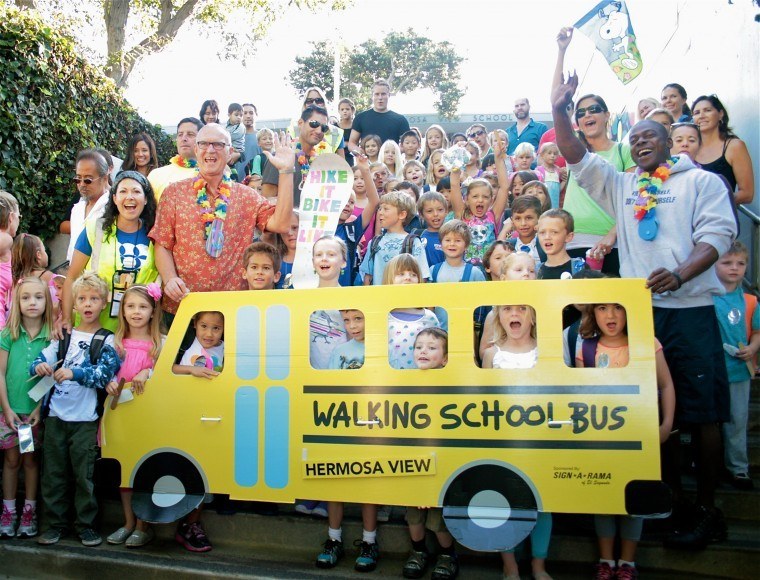
Walk and bike to school activities can also be a way to engage residents who don't have children, in supporting "bike buses" and "walking school buses."

But if kids aren't neighborhood residents, they aren't going to be walking or biking.

Bike bus at Rose Park Elementary.  Note that during Bike Month (last month, I didn't get around to writing about it), a parent on the city's west side organized a "bike bus" for her neighborhood school ("Salt Lake woman organizing ‘bike bus’ method as new transportation for school kids,"  Fox13, "Salt Lake woman organizing ‘bike bus’ method as new transportation for school kids," Utah Public Radio).

Mayor Erin Mendenhall joined them!

Labels: , , , ,

Monday, April 03, 2023

Paris votes to ban electric scooters

Photo: Alamy.

From "Parisians vote to ban rental e-scooters from French capital by huge margin," Guardian:

Parisians have voted to rid the streets of the French capital of rental electric scooters, with an overwhelming 90% of votes cast supporting a ban, official results show.

Paris was a pioneer when it introduced e-scooters, or trottinettes, in 2018 as the city’s authorities sought to promote non-polluting forms of urban transport.

But as the two-wheeled vehicles grew in popularity, especially among young people, so did the number of accidents: in 2022, three people died and 459 were injured in e-scooter accidents in Paris.

In what was billed as a “public consultation” voters were asked: “For or against self-service scooters?”

I think in the US, which is car dominated when it comes to mobility, high numbers of the electorate would vote against sustainable mobility measures--bicycling, transit (some cities vote in favor, others vociferously against), trails (Hamilton County/Cincinnati voted against a trail measure a few years ago), pedestrian improvements. 

Reckless driving.  With electric scooters, part of it is perception that many of the riders ride in a deliberately dangerous fashion.  I know I see that myself, and I can't believe how fast they will ride, given the reality that road condition can make riding at higher speeds dangerous.

A major spark for the backlash against scooters was the death of a pedestrian on the sidewalk, after being hit by an electric scooter ("Paris police search for two e-scooter riders after pedestrian killed," Guardian). But there have been a number of deaths and many injuries, not just in Paris, but across France.

Poor parking.  But probably the biggest issue is how so many users don't park scooters in a way that is respectful of public space. ("Electric scooters have ruined Paris – we can't let London be next," Telegraph, 2019).  From the article:

Normally, anything that combats the notorious traffic congestion on the streets of Paris deserves applause. The city was a pioneer in public bike-rental schemes when it launched Vélib’ in 2007, beating London by five years. You can now get electric versions, and the dockless bike revolution that swept across most major cities has hit Paris too.

But pedal power requires a bit of effort – even on an e-bike – so the next step to make life easier for commuters was to bring in little electric scooters, which the American operator Lime did in the summer of 2018. While I still can’t get over the sight of grown-ups riding these things that look better powered by small children, I had to admit the scooters – known as trottinettes – made sense if you want to whizz around the city with relative ease. They’re known as “free-floating”, meaning you can pick up and drop off where you please by using an app. But what I wasn’t expecting was the bedlam that descended on the streets of Paris.

On my latest visit in October, I was taken aback by the sheer number of scooters lying abandoned in the streets. In front of the Louvre, the Eiffel Tower, along crowded streets, on bridges, thrown into the Seine – hundreds were just dumped unceremoniously once users finished their journey, or had their journeys curtailed by a flat battery. They almost had the appearance of a city-wide art installation – a pathos invoked by what looked like giant toys discarded here and there. I wouldn’t be surprised to see an Instagram hashtag of “forgotten scooters in picturesque places”.

Getty Images, 2021.  Scooters parked in the public space in Paris.

How do you get people to follow rules?  I think this is one of the unintended problems of sharing programs like scooters, seated electric scooters (Revel sharing in NYC and San Francisco), and perhaps even bikes (although less so), in that people join and use the mode without necessarily having to demonstrate they know how to use the device safely.

Paris introduced rules after the introduction, in response to the problems.  Later so did France more generally ("Electric scooters: France introduces new rules to 'restore tranquillity'," BBC) but apparently that wasn't enough.  The national rules include:

  • Riders must be at least 12 years of age
  • Riding on the pavement will be prohibited unless in designated areas, and then at walking speed only
  • Only one rider will be allowed per device, and no mobile phone use will be allowed
  • Users cannot go against the traffic flow and must use cycle paths where available
  • Riders will not be allowed to wear headphones while on their scooter
  • By next July, the scooters' top speed will be capped at 25km/h
  • Users riding on permitted faster roads must wear a helmet and high-visibility clothing
  • E-scooters will be banned completely on country roads

 Rules are one thing.  You need compliance.

It's unfortunate, because electric scooters can be a part of urban mobility solutions that shift the mobility paradigm away from dominance by the automobile ("We review the swiftest way to see the Paris sights — by e-scooter," Times of London).

What about the US?  Paris has 15,000 scooters.  There are so many fewer in the US, that the impact is minimal.  Although there is no question that scooters are often poorly parked, even when parking areas are provided. 

While a goodly number of the trips are trasnportational, perhaps even a majority are more about recreation ("What the e-scooter industry hasn't figured out about Santa Monica: It's recreation not transportation," 2018).

In Salt Lake, I noticed that Spin has a few scooter stations, but maybe that's a function of an agreement with the University of Utah, since I've only seen such stations on their campus.  And the number of slots is minimal. 

Referenda should be held only during regular elections.  WRT the vote in Paris, it's not like a referendum that is part of a general election ballot, it's a voluntary vote, and that is likely to draw opponents who are not a more random sample of the electorate.  Personally, I believe such votes should only be taken during general elections from the standpoint of fairness.

Sustainable mobility framework.  This entry,"Further updates to the Sustainable Mobility Platform Framework" (2018) aims to create a master "mode" framework for sustainable mobility.  It's augmented by additional information in the various comments, which needs to be compiled into an updated entry.

What are now called "micromobility" services--bicycles, electric bicycles, scooters, electric scooters, skateboards, etc.--are a subset.

Revel pivots to EV infrastructure promotion.  In mentioning Revel above, I've been out of touch.  Originally they were created to provide shared mopeds, first in NYC, then expanding to other cities like Washington and Miami.

Since then they've dropped most cities, except for New York and San Francisco, and they've pivoted adding other electricity-based mobility services, electric cars functioning as taxis (Bollore tried this in Paris and other cities in North America and it wasn't sustainable), and installing high quality electric charging infrastructure.

Labels: , , ,

Thursday, October 20, 2022

Toronto Star "Can't We Do Better" series: Rampant Municipal Management Failure #3

--  "Public housing administration as a measure of government (in)competence"
--  "Rampant management failure #2: DC area Metrorail (Washington Area Metropolitan Transit Authority)"

======  

The Toronto Star is running a series of articles in advance of the Mayor and City Council election this,  Monday October 24th, called "Can't We Do Better?" on the various way that the city government's execution of basic services is failing.

The incumbent of the last 8 years, John Tory, is likely to win.  Maybe he wouldn't if Toronto had ranked choice voting.  He's presided over Toronto's decline in the quality of city services, building on the underfunding agenda of his predecessor Rob Ford, and touts the city's low tax rate and his ability "to get things done." 

In a Star article about a proposal by the Mayor to institute stricter metrics for park operations without adding funding, there is a great quote:

Matlow also took aim at the mayor’s approach to funding park amenities. “After he’s broken the toilet, he’s pretending to be the plumber,” he said.

It's more pathetic when your Deputy Mayor says "we have a problem" ("‘There’s a feeling that the city doesn’t care anymore’: Neighbourhoods, services slipping into ‘decline,’ warns Toronto’s deputy mayor").

Toronto deputy mayor Denzil Minnan-Wong, a key member of Mayor John Tory’s administration for the past eight years, is warning of a “slow decline in the quality and maintenance and repair of our neighbourhoods” due to “neglect.”

“I think there’s a feeling that the city doesn’t care anymore and it’s not doing the core services that it used to provide but we’ve come to rely on,” Minnan-Wong said in an interview. “That slow decline is making neighbourhoods look rundown.”

Minnan-Wong, who is not seeking re-election, called to congratulate the Star on its “Can’t We Do Better?” series, saying he agrees with many concerns raised over deteriorating city services and a lack of action on them by city hall.

And typical, not taking responsibility for the problem. 

Minnan-Wong, considered one of the most conservative members of council, said funding to boost service levels and reverse the decline shouldn’t automatically come from a tax hike, arguing the city must first find “efficiencies” within.

“There needs to be a discussion about the general state of our neighbourhoods. There is a slow decline in the quality of maintenance and repair,” he said.

After awhile, getting less means you do less ("Tax Trouble: How Toronto’s low tax rate measures up against the rest of the province and what it means for city services").  Efficiencies only go so far ("It pains me to say it, but there’s a $1-billion hole in Toronto’s finances — and few options to fill it"). 

The thing about mediocrity is, after a while, you just come to accept it as the status quo. Which means the neighbourhoods that used to be well-kept and well taken care of are no longer kept and taken care of.

“People accept the garbage cans aren’t fixed, that graffiti won’t be painted over, that spaces are going to continue to be abandoned. That laneways in communities, weeds are growing everywhere and the asphalt is all cracked and heaving.

Labels: , , , , , , ,

Thursday, October 06, 2022

Gil Penalosa is running for Mayor of Toronto

Gil is the brother of Enrique Penalosa, who was Mayor of Bogota, who initiated the Ciclavia program--open streets--and implemented the TransMilenio high capacity bus rapid transit system.  Under his brother Gil was the city parks commissioner, and later he created the international pro-urbanism group 8-80 Cities.

He has a pro-public space, pro sustainable mobility based campaign.  But there are a couple dozen candidates, along with the incumbent John Tory.  

Gil is not likely to win, but perhaps he can shape the discussion towards public investment ("Gil Penalosa says he wants to be mayor to make ‘Toronto for everybody.’ Is anyone listening?," Toronto Star). From the article:

The thread running through Penalosa’s campaign is that Toronto is a good place to live, but its timid leadership has held it back. To join the ranks of great global cities like Paris, London or New York, he argues, Toronto needs a bold mayor.

Tory has shown a “lack of vision and action” on pressing issues like the housing crisis that is “almost shameful,” Penalosa said in an interview. “He’s been there for eight years, and you cannot even think of one significant project he has done.”

Penalosa’s view of Toronto’s place in the world is informed by his extensive international career. He was born into a prominent middle-class family in Bogota, Colombia, and earned a master of business administration from UCLA in 1984. From 1995 to 1998 he served as parks commissioner of Bogota, where he led the development of more than 200 public parks, and helped expand the city’s Ciclovía car-free streets program into an event that’s since been emulated around the world.

He relocated to Canada about 20 years ago and founded the advocacy group 8 80 Cities, based around the idea that streets and other infrastructure should be designed to accommodate citizens from eight to 80 years old, not just able-bodied adults.

The Toronto Star article campaign, "Can't we do better?," is focused on the years of under- and dis-investment by the government in the city's network of civic assets and infrastructure. 

 John Tory is committed to his low taxes pledge, but it comes at a cost ("Why is the Toronto Public Library facing service cuts? Ask John Tory," "Cities big and small are funding open streets. Doing so in Toronto should be an election issue," Star).

Labels: , , , , ,

Saturday, June 25, 2022

Gas tax holiday versus free transit: policy versus politics

Earlier in the week I got into an argument with a friend, a teacher, who made the point that renewal of the child tax credit ("Joe Manchin is choking off one of America’s best anti-poverty programs," Washington Post) would have a lot more impact on people than a gasoline excise tax holiday ("Oil dependence | The US as a Petro-state and gasoholic," "Will Biden's Gas Tax Holiday Make a Difference?," New York Times).

I was pretty spirited, making a couple points:

1.  As a "transportation planner" obviously I think a gas tax holiday is a mistake, because it "defunds" transportation improvements, and frankly the federal gas tax should be much higher and indexed to inflation anyway--it hasn't been raised in 30 years ("How the gas tax could help pay for a $1 trillion infrastructure proposal," Washington Post).


Editorial cartoon, Mike Luckovich, Atlanta Journal-Constitution

2.  But that given the President is being blamed for inflation and high gas prices ("Wonking Out: Lies, Damned Lies and Gasoline Prices," NYT), even though the entire world is experiencing inflation and high gas prices in the same way, and the primary reason for high gas prices in the US is not "Biden not approving that pipeline" but reduction in the supply of refinery capacity ("US May Never Build New Refinery Even With Surging Gas Prices, Chevron CEO Says," Bloomberg), he "needs to do something to show he cares and 'feels the pain'" of the average citizen ...

ESPECIALLY AS THE MIDTERM ELECTIONS APPROACH AND VIRTUALLY EVERY PREDICTION IS THAT THE DEMOCRATS WILL LOSE THE HOUSE FOR SURE AND PROBABLY THE SENATE.

3.  I explained to her about Senators Sinema and Manchin who are functioning as Republicans and are holding back the achievement of any significant Democratic Party initiatives, and how even if the child tax credit "is more important" Biden can't get it passed without Sinema and Manchin.  That's reality. 

Not policy purity.  So he has to do what he can.  And I can be a purist, or I can be pragmatic.

Which is why I find this point by transit advocates, "Suspend transit fares instead of the gas tax, climate advocates tell Biden" as reported by the Washington Post, equally frustrating.

Similarly, it's fair to say that I am a fervent proponent of transit.

BUT THE MIDTERMS ARE COMING.

ALMOST 83% OF TRIPS IN THE UNITED STATES ARE MADE BY CAR.  

2.5% OF TRIPS ARE MADE BY TRANSIT.

Total Trips, National Household Travel Survey, 2017
Private Vehicle    
Transit Walk Other*
82.6% 2.5%10.5% 4.4%

 * Other includes biking.  Source: pages 30/31.

HOW MUCH EFFECT ON PEOPLE'S VOTING DECISIONS ARE WE GOING TO GET FROM FREE TRANSIT, IN A NATION WHERE MOST PEOPLE HAVE ZERO USE OF AND MINIMAL EXPERIENCE WITH TRANSIT?

Sure I think we should have free transit, but the politics of it, in a nation that is so dominated inextricably with automobility and automobile dependence to the point where people aren't even capable of recognizing it, are impossible.

I understand and appreciate the pureness and zealotry of advocacy, but what's more important:

- free transit now versus a gas tax holiday

or 

- the Democrats not getting totally destroyed in the midterm elections?

======

Because our mobility system is so automobile dependent, most people can't substitute one form of mobility for another, say transit for a car, because the transit network--especially outside of historical legacy cities--isn't particularly wide or deep.

I consider myself fortunate to have lived in DC for 32 years, where a dense sustainable mobility network exists--at least in the center city--so that I could experience the reality that it is possible to live without being car dependent.

-- "What matters isn't "transit oriented development": what really matters is compact development and integrating transportation and land use," 2011
-- "Further updates to the Sustainable Mobility Platform Framework," 2018 
-- "DC is a market leader in Mobility as a Service (MaaS)," 2018

Labels: , , , , ,

Friday, May 13, 2022

Takoma Park resident vows to vote against all local public officials this fall, because of the failure of the Purple Line light rail, but the failure is because of the Governor, who is termed out

Rick Scheer of Takoma Park writes in a letter to the editor of the Washington Post:

Those of us who live, work or shop in east Silver Spring have mostly concluded that the Purple Line project is something between a major disappointment and a total fiasco. Based on the interviews in the May 8 Metro article “Maryland Purple Line construction will resume in August, officials say,” I’m now leaning toward fiasco. 

We’ve been suffering from torn-up streets, unfinished tunnels and bridges, and other public eyesores for more than two years, and ongoing work to move utility lines for the project routinely causes local traffic snarls. 

Officials said that with the new contract, work would commence this spring. I learned from the article that they really meant late summer. Even that work is focused on the Purple Line’s end points in Bethesda and Prince George’s County. The road-widening efforts affecting east Silver Spring are not scheduled until spring 2023, a full year from now, assuming the effort ixxxs on schedule (ha!). And this construction will be wildly disruptive, so say the new project managers. 

In all local elections this November, for me the Purple Line will be the primary ballot consideration. I plan to hold all local officials accountable for this fiasco, and not a single incumbent will get my vote.

But the Purple Line fiasco is all a result of the Executive Branch of the State Government, specifically the Republican Governor, Larry Hogan, and his directives to the State Department of Transportation.  

Scheer will be punishing the wrong people. It's all Hogan's fault. 

No local officials at the city and county level, and even the State Senators and Representatives have anything to do with it.

First Hogan delayed the Purple Line with another review when he first got elected.  This led to delays with the Federal Transit Administration approving funding. 

Then the Republican emphasis on pushing the selection of a public private partnership to do the project, including providing some financing:

-- "Purple Line moves forward," 2017
-- "A Purple Line update: the downside of "Public Private Partnerships" -- they are contracts, not partnerships," 2017
-- "Public-private "partnerships" aren't partnerships but contractual relationships," 2017 

The partnership picking a less suitable construction group. 

The state being unwilling to renegotiate certain elements of the contract when costs rose and then the construction company quitting as a result.  And needing to find a new construction group.

-- "Sometimes you have to wonder if transit/transit projects are being deliberately screwed up to make transit expansion almost impossible," 2022

The various lawsuits etc. 

But Republican Governor Hogan is termed out.  He can't be punished at the ballot box.  He's the one who needs to be held accountable, but there is no accountability.

I understand Scheer's frustration.  I first read about the concept of the Purple Line in a cover story in the Washington City Paper in December 1987.  It will be almost 40 years before the first segment, from Bethesda to New Carrollton, comes to fruition.

No planning is underway for any of the other segments.  At this rate it will take more than 100 years to bring it to fruition.

Labels: , , , , , ,