Rebuilding Place in the Urban Space

"A community’s physical form, rather than its land uses, is its most intrinsic and enduring characteristic." [Katz, EPA] This blog focuses on place and placemaking and all that makes it work--historic preservation, urban design, transportation, asset-based community development, arts & cultural development, commercial district revitalization, tourism & destination development, and quality of life advocacy--along with doses of civic engagement and good governance watchdogging.

Friday, January 26, 2024

Government grants are complicated and often beyond the capacity of small organizations to manage

This article, " ‘The EPA needs to humble itself’: why some US non-profits are turning down agency funds," in the Guardian makes a good point that government grants come with a variety of requirements that often exceed the capacity of nonprofits to manage and comply with.  

I joked on a grant I ran that was via the Federal Historic Preservation Fund, that if you don't do it right, you end up in Leavenworth.  DC Government grants were similarly problematic with lengthy reporting requirements, and allowed them to cancel grants with two weeks notice.  In Baltimore County, the county found it wasn't worth applying for Safe Routes to Schools money because of the reporting requirements.  They figured it was cheaper to just spend their own money on sidewalk and other improvements.  

This is true with a lot of government related grants to property owners for commercial district revitalization work, especially facades, or a program in SF to help business owners whose properties are damaged from vandalism but gives paltry amounts ("San Francisco restaurants grapple with vandalism," San Francisco Chronicle).  

Elements of a facade of a historic commercial building  

City of Creedmoor, North Carolina

The grants are relatively small, and the application and reporting procedures are onerous.  When I worked on a facade program in Takoma DC, the Main Street group actually did most of the applications and project management, making the program work for the businesses.

Earlier, in a facade program in Brookland, we screwed up, because some work was performed before the grants were awarded, and therefore, couldn't be reimbursed, abetted by the slowness of the grant process.

That's the kind of assistance that often needs to be provided.  But isn't.  Although, understandably with larger federal grants, there are a lot of provisions wrt accountability, bidding, etc., that the public demands.

From the article:

Local advocates wanted to monitor the air quality outside the school to help administrators figure out the safest times to let the kids play outside. “Most of these sites are completely unmonitored,” said Micah Parkin, the executive director of the non-profit 350 Colorado. 

She applied for an Environmental Protection Agency (EPA) grant aimed at helping communities monitor their own air quality and was thrilled when her organization was selected to receive roughly $500,000. 

But Parkin and her colleagues quickly ran into hurdles. The EPA wanted her team to hold a competitive bidding process to find a local partner, even though 350 Colorado had already identified one: the air-quality monitoring firm Boulder Air. They also demanded financial information that Parkin said would require 350 Colorado to overhaul its accounting and reporting procedures. These processes required time and resources that 350 Colorado, with an annual budget of under $1m, simply didn’t have. 

In late 2023, after months of conference calls and untold amounts of paperwork, Parkin and her board made the difficult decision to turn down the money. “I kept saying: ‘Let’s just get this done – come on, people.’” she recalled. “But it became clear to me that there was no end in sight.”

...Near Denver, the community organization Cultivando also turned down a half-million dollar grant to monitor pollution in a largely Hispanic community near a petroleum refinery. The group had previously found high levels of radioactive particles and PM2.5, which is associated with increased incidence of respiratory problems, among other problems. 

Cultivando had planned to hire Boulder Air, the same air-quality consulting firm that Colorado 350 intended to work with. But like Colorado 350, Cultivando wasn’t equipped to carry out the competitive bidding process required before they sign on Boulder Air, executive director Olga Gonzalez said. 

“I was actually shocked that they didn’t know more” about how community-based organizations operate, she said. “The EPA needs to really humble itself and think about what it means to partner with community-led efforts.” 

Labels: , ,

Thursday, October 20, 2022

Toronto Star "Can't We Do Better" series: Rampant Municipal Management Failure #3

--  "Public housing administration as a measure of government (in)competence"
--  "Rampant management failure #2: DC area Metrorail (Washington Area Metropolitan Transit Authority)"

======  

The Toronto Star is running a series of articles in advance of the Mayor and City Council election this,  Monday October 24th, called "Can't We Do Better?" on the various way that the city government's execution of basic services is failing.

The incumbent of the last 8 years, John Tory, is likely to win.  Maybe he wouldn't if Toronto had ranked choice voting.  He's presided over Toronto's decline in the quality of city services, building on the underfunding agenda of his predecessor Rob Ford, and touts the city's low tax rate and his ability "to get things done." 

In a Star article about a proposal by the Mayor to institute stricter metrics for park operations without adding funding, there is a great quote:

Matlow also took aim at the mayor’s approach to funding park amenities. “After he’s broken the toilet, he’s pretending to be the plumber,” he said.

It's more pathetic when your Deputy Mayor says "we have a problem" ("‘There’s a feeling that the city doesn’t care anymore’: Neighbourhoods, services slipping into ‘decline,’ warns Toronto’s deputy mayor").

Toronto deputy mayor Denzil Minnan-Wong, a key member of Mayor John Tory’s administration for the past eight years, is warning of a “slow decline in the quality and maintenance and repair of our neighbourhoods” due to “neglect.”

“I think there’s a feeling that the city doesn’t care anymore and it’s not doing the core services that it used to provide but we’ve come to rely on,” Minnan-Wong said in an interview. “That slow decline is making neighbourhoods look rundown.”

Minnan-Wong, who is not seeking re-election, called to congratulate the Star on its “Can’t We Do Better?” series, saying he agrees with many concerns raised over deteriorating city services and a lack of action on them by city hall.

And typical, not taking responsibility for the problem. 

Minnan-Wong, considered one of the most conservative members of council, said funding to boost service levels and reverse the decline shouldn’t automatically come from a tax hike, arguing the city must first find “efficiencies” within.

“There needs to be a discussion about the general state of our neighbourhoods. There is a slow decline in the quality of maintenance and repair,” he said.

After awhile, getting less means you do less ("Tax Trouble: How Toronto’s low tax rate measures up against the rest of the province and what it means for city services").  Efficiencies only go so far ("It pains me to say it, but there’s a $1-billion hole in Toronto’s finances — and few options to fill it"). 

The thing about mediocrity is, after a while, you just come to accept it as the status quo. Which means the neighbourhoods that used to be well-kept and well taken care of are no longer kept and taken care of.

“People accept the garbage cans aren’t fixed, that graffiti won’t be painted over, that spaces are going to continue to be abandoned. That laneways in communities, weeds are growing everywhere and the asphalt is all cracked and heaving.

Labels: , , , , , , ,

Wednesday, October 19, 2022

Rampant management failure #2: DC area Metrorail (Washington Area Metropolitan Transit Authority)

Nothing new here:

-- "What to do about DC area Metrorail?," 2022
-- "Sometimes you have to wonder if transit/transit projects are being deliberately screwed up to make transit expansion almost impossible," 2022
-- "A tenure of failure doesn't deserve encomiums: Paul Wiedefeld, WMATA CEO," 2022
-- "WMATA is pathetic: of course it belongs to "the public"," 2022
-- "DC area transit commission board member thinks he has a brilliant idea on how to fund Metrorail: sales taxes ," 2022

But recent coverage ("Metro makes case for funding as regional leaders point to federal government," Washington Post) on how WMATA needs more financial support given ridership drop offs due to covid, but also accentuated by massive management and operational failures, reminds me of one of my learnings through observation about WMATA and government.  

It's best to line up support and funding, when you're wildly successful.

It's really hard when you're failing.

From the article:

Metro’s prospects for replacing hundreds of millions of dollars in fare revenue that vanished during the pandemic appeared to be waning as stimulus money runs dry, particularly as weary elected officials watch the agency struggle during a year-long train shortage.

In recent days though, Metro has escalated its sense of urgency in finding more revenue, trying to make the case to regional leaders that it can’t move forward alone. The transit agency took the first step this month, saying it will increase enforcement of fare evasion to stanch a $40 million leak — a move that eased tensions with political leaders who were hesitant to offer more money.

Some of those same local leaders are responding with a plan of their own: Convince the federal government, whose workforce is Metro’s largest customer base, to subsidize the system’s operational costs. Unlike the local and state jurisdictions that fund Metro, federal money goes only to the agency’s capital budget but not to its separate operating budget — a distinction local officials have long said is inequitable.

Good luck with that.

WMATA should have lined up multiple and steady sources of revenue--like sales taxes and other sources--when it was new, shiny, and successful, basically, in the late 1970s and throughout the 1980s, as the system opened and expanded.

-- "Funding WMATA by a regional sales tax," 2017

Also see, "Creativity Helps Rochester's Transit System Turn a Profit," New York Times (2008). The director then, Mark R. Aesch, later wrote a book about his experience there, Driving Excellence: Transform Your Organization's Culture -- And Achieve Revolutionary Results.  It's worth a read.

The article discusses how the Regional Transit Service in Rochester New York developed "partnership" funding agreements with schools, colleges, and businesses to provide financial support beyond farebox revenue, to support mutual agreed upon objectives.

RTS did this when they were successful, so that when the 2008 recession hit, they were well placed to operate and survive financial setbacks that crippled other transit authorities who were not as well situated.

But it is also a management failure of local government.  Admittedly, oversight-wise, WMATA has a hard slog, as the State of Virginia, State of Maryland, and DC are "co-owners" now alongside the federal government.   They all have to agree on major decisions.  And the State governments can vary wildly on their support.  For example, one reason there are tolls on I-66 is to indirectly encourage DC-based businesses to relocate to Virginia to avoid tolls.

Plus at the county/DC scale, different jurisdictions have different goals for the service.  DC and Arlington County have a much more transit-centric planning paradigm than the others, who see transit as more about getting their residents to and from their jobs in the city.

Northern Virginia elected officials and stakeholders tend to be reasonably forward (not necessarily visionary) about the role of transit in the success of their communities, especially Arlington and Fairfax Counties--the latter because they think it can repattern land use along the Silver Line.

DC officials don't seem to get how the city's competitive advantage as a sustainable mobility-centric community ("DC is a market leader in Mobility as a Service (MaaS)," 2018, "Transportation and Urban Form: Stages in the Spatial Evolution of the American Metropolis," "Planning for place/urban design/neighborhoods versus planning for transportation modes: new 17th Street NW bike lanes | Walkable community planning versus "pedestrian" planning," 2021) is built upon high frequency heavy rail transit service.

Since I got involved in urban revitalization I've argued that DC had five competitive advantages: 

1. historic architecture
2. urban form (urban design) dating from the walking and transit city eras of urban development, therefore supporting walkability, transit, and biking
3. historicity and identity (the nexus of people, historic architecture, and urban design)
4. a transit-centric mobility infrastructure that frees people from dependence on the automobile
5. the steady employment engine of the federal government

And that they need to be all over Metrorail and Metrobus in terms of management and oversight.  (For more than a decade I suggested that DC create a Transportation Commission, comparable to the Zoning Commission, to provide greater opportunities for oversight and involvement, both for elected and appointed officials, and citizen members. And that the WMATA Board should be elected.)

Just like DC's public housing fiasco, where 25% of the units are uninhabitable, the massive failures of Metrorail could have been avoided through the execution of sound management, accountability systems, and constant, ongoing oversight.

It's an asset and risk management failure of massive proportions.

=========

From "Funding WMATA by a regional sales tax":

26 ways to tax to fund transit
(Based on the report, Big Move Implementation Economics: Revenue Tool Profiles, produced for Metrolinx Toronto by AECOM and KPMG)

• Auto Insurance Tax
• Car Rental Fee
• Carbon Tax (including Low/No Carbon Zones in center cities)
• Cordon/Congestion Charge
• Corporate Income Tax
• Development Charges/Impact Fees
• Driver’s License Tax
• Employer Payroll Tax (Versement Transport)
• Fare Increases
• Fare Surcharges (There is a fare surcharge to use the SFO Airport via the BART system; "BART cuts surcharge for SFO workers," San Francisco Chronicle; Boston's Logan Airport is considering surcharges for passenger drop off and pickup to encourage use of transit, "Dropping off a friend at Logan? It could cost you," Boston Globe)
• Fuel Tax
• High Occupancy Tolls
• Highway Tolls
• Hotel & Accommodation Levy (Hawaii is about to approve this type of tax to help fund the commuter rail system in Honolulu, "After reaching deal, lawmakers to meet for special session on Honolulu rail funding," Hawaii News Now)
• Income Tax
• Land Transfer Tax
• Land Value Capture
• New Vehicle Sales Tax
• Parking Sales Tax
• Parking Space Levy
• Property Tax
• Sales Tax
• Tax Increment Financing (Special Assessment Districts)
• Utility Levy
• Vehicles Kilometers/Miles Traveled Fee
• Vehicle Registration Surcharges (this is allowed in Washington State, through what is called a Transportation Benefits District, and in the Puget Sound, a Regional Transit Authority fee for Sound Transit)

Labels: , , , , , , ,

Public housing administration as a measure of government (in)competence

 DC received a scathing report from HUD about the failures in managing the city's public housing stock of 8,000 units, 25%--2,000-are vacant because most are uninhabitable ("D.C. Housing Authority’s leadership is failing, HUD report says," Washington Post).  From the article:

A damning, 72-page report the agency authored portrays a housing authority in disarray and at risk of defaulting on its agreement with the federal government. Auditors catalogued 82 findings of deficiencies that DCHA must make substantial progress on within three months or risk escalating actions by HUD, which delivered its findings to DCHA in recent days.

The sweeping findings detailed in the report, a copy of which was reviewed by The Washington Post, reveal dangerous conditions at properties that form one of the last lines of defense for District residents who cannot afford homes, including violence, lead-paint hazards, out-of-code plumbing, water damage and mold. A DCHA maintenance foreman told HUD evaluators that emergency work orders are not addressed at night due to safety concerns. Prospective tenants turn down units for fear of crime, the report states.

HUD noted that DCHA’s occupancy rate is the lowest of any large public housing authority in the nation, with one in four of its roughly 8,000 physical units vacant. The vacancies result in fewer people housed and millions of dollars every year in forgone income, the report said. It attributed the issue to management failure and said the vacancies have accelerated the agency’s steadily deteriorating financial condition.

The City Council is worked up about it ("D.C. Council votes for $8 billion Medicaid contracts, housing overhaul," Post).  And the leader of the DCHA board says they're working on it ("We already are working on making the D.C. Housing Authority better," Post).

Ironically, under the Williams Administration--1998-2006--the resuscitation of the DC Housing Authority was one of the city's great accomplishments, and the director, Michael Kelly, was even detailed by HUD to help fix failing authorities in Philadelphia and New York City.

What happened in the intervening 16 years?  ("DC Housing Authority Director Resigns, Post).  

Note that a couple years ago under the previous board chair, also appointed by Mayor Bowser, DCHA was tied up in a conflict of interest matter by the then President of the board, who steered contracts to his girlfriend ("D.C. Housing Authority Board Chair Neil Albert Will Resign," Washington City Paper).  The funny thing was the "girlfriend" was eminently qualified.  And successful enough that she didn't need the work.   All he needed to do was disclose and recuse and it would have been legal.  But he didn't.

How are these multiple failures not an indictment of the capacity of the DC Government to manage and act?  ("HUD report on D.C. public housing should outrage and embarrass residents," opinion column by Colbert King, Post).  From the article:

The U.S. Department of Housing and Urban Development’s scathing report on management and operational shortcomings in the D.C. Housing Authority has documented more than 80 deficiencies ranging from inadequate management to lack of knowledge of a host of basic housing functions to 220 contracts awarded in violation of DCHA procurement policy. The unearthed defects and failures are so serious that without immediate remedial action, HUD has threatened to declare the District in default of its federal contract. D.C. residents have every reason to be outraged and embarrassed by this latest government fiasco.

Among the glaring weaknesses cited was the leadership of the DCHA’s executive director, Brenda Donald. Donald, who earns a salary of $275,000, “has no experience in property development, property management or managing federal housing programs,” the audit notes. During the HUD review, Donald accepted the need for HUD-supplied training for herself and staff on critical functions of housing programs. That speaks volumes.

HUD also found a DCHA workforce lacking in the capacity to perform even the most basic financial, procurement and housing-related functions. The agency, HUD said bluntly, is failing “to provide decent, safe, and sanitary housing opportunities for residents in violation of program requirements.”

At the heart of the problem is abysmal financial and operational oversight — a searing indictment of D.C. leadership, since the DCHA’s 13-member Board of Commissioners is dominated by Mayor Muriel E. Bowser’s six D.C. Council-approved appointees and her chief of staff and deputy mayor for planning and economic development, John Falcicchio, who is an ex officio member.

John Kotter’s Eight Step Model for Leading Change

It definitely shows lack of accountability and no sense of urgency to act-2,000 units could house at least 4,000 people.  

 One of the points I make these days is boards need to have as part of their monthly reports, lists of open items.  In the case of DCHA, the number of vacant units needs to be an element of such reporting and monitoring.  

(When I was a student "activist" at the University of Michigan, I read the monthly Regent Board Meeting packet, which was the equivalent of a looseleaf folder, as many as 1,000 pages.  One of the items was a listing of all open litigation.  The way the Board reports were organized there, listing plan versus actual, and the various open items for action in many areas is a model.)

I know that technically, DC Housing Authority is a quasi-independent agency.  But it is not truly independent.  The board is appointed by the mayor and city council.  The employees are considered DC Government employees.  The agency reports to the mayor.

It's also a failure of elected officials to not see themselves as "asset managers" and "risk managers."

-- "Town-city management: "We are all asset managers now"," 2015
-- "Municipal Natural Assets Planning Initiative, British Columbia," 2018

What's up?

Performance dashboards.  I've been thinking about them a lot lately.  For example, I think that the Orange County Register dashboard on covid is best practice, and a model for how local media can present and track data.

In the summer we visited a rural area of Montana, and the kindling box for the fireplace in the cabin we were in was full of previous year's issues of the Bozeman Daily Chronicle and some farming publications.  Of course, I skimmed them all.  

And the farming section of one (although it might have been a different paper, for Idaho) had good graphics on the water levels in various reservoirs.  But the data, presented as easily understood graphics, needs to be made more widely available, beyond those involved in agriculture.

I was thinking that such a graphic needs to be built into an online water availability dashboard in the State of Utah, which faces serious drought, but it turns out as a whole the state has the lowest cost of water and a middling track record for conservation ("For Mormons, a perfect lawn is a godly act. But the drought is catching up with them," Guardian).

Similarly, an online dashboard for a public housing authority, also made available to citizens, should have data on the number of unavailable units, overall, and by building, with the budgeted/expected percentage, which I think should be less than 5%, and the length of time each unit is out of service.

Labels: , , , , , , , ,

Tuesday, February 16, 2016

"Great Cities Do Big Things"

is the title of Austin Mayor Steve  Adler's second "State of the City" speech, which he'll be giving tomorrow.

Related to my point that "World-class cities don't just take, they give" in terms of how they model innovation and vision and in turn inspire other communities to strive for improvement and adopt better and best practice, the Austin American-Statesman reports on tomorrow's "State of the City" speech by Austin Mayor Steve Adler. The speech is titled "Great Cities Do Big Things."

In the spirit of accountability and evaluation, the paper reports ("What happened to the Austin savings bond, other Mayor Adler ideas?") on the status of the ideas and proposals from last year's speech. From the article:
In his first State of the City speech last year, Mayor Steve Adlerfloated various new ideas aimed at relieving the stresses that have accompanied Austin’s economic prosperity and rapid growth, including traffic congestion and the rising cost of living, most acutely felt by low-income and working-class residents.

We spoke with Adler — who said last week that he’s trying to cut down a roughly 40-page draft of his second State of the City speech, scheduled for Tuesday, titled “Great Cities Do Big Things” — to gauge the progress of some of last year’s big ideas. ...
Mayor Steve Adler’s State of the City speech starts at 7 p.m. central time, Tuesday at the Zach Theatre, 202 S. Lamar Blvd. Seats can be reserved online or in person at the mayor’s office at 301 W. Second St.

To watch a live stream of the speech, go to statesman.com or austintexas.gov/atx
The main ideas from 2015:

- a unified agenda for transit
- dedicated transit lanes on highways
- a fund in reserve to tap to maintain property (housing and civic-public sphere related) affordability
- creating an "Austin savings bond" program to support local investments controlled locally
- financing energy efficiency upgrades
- rewarding good landlords

====
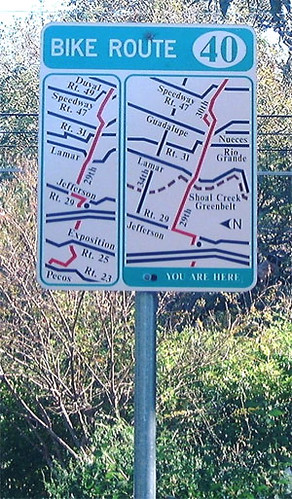
Bicycle Route 40 sign, Austin TexasAt one time, I don't know if they still do it, Austin produced bike map signage for en-route use on their bicycle routes.  I came across a photo of this sign on the Internet a number of years ago.

Besides being the state capital and home to the University of Texas and a great deal of IT business, Austin has many programs and initiatives relevant to great cities and best practice urban revitalization.  Some that come to mind are:

- a focus on locally owned retail including commissioning studies (Economic Impact Analysis: A Case Study--Local Merchants vs. Chain Retailers) and requiring local retailer recruitment and nurturing as part of new development such as in the Second Street District
- placemaking and community economic development initiatives such as the Liveable City organization
- the "Keep Austin Weird" campaign,
- the Austin Independent Business District, AustinIBIZ, program
- a plan and program to support "local music" as music is one of the defining elements of the city's culture and has grown into a key aspect of the city's identity and economic development program (Austin Music People trade group)
- including the ever-growing South by Southwest event
- but I argue some of these efforts have grown out of the "Austin City Limits" television broadcast for decades on PBS, showing how such programs, when they work, can be incredibly beneficial anchors for cultural and economic development
- the city was an early pioneer in collecting and communicating substantive metrics on how agencies are functioning in terms of preferred outcomes
- including maintaining high quality data on crashes and accidents involving pedestrians and bicyclists
- and in developing "campuses" linking various city agencies synergistically to serve lower income communities (see the 2006 blog entry, "Public assets: public school buildings used for more than school")
- and a county-wide taxing district for health services (although this is probably a program that is state-developed and operates in other regions of Texas too)
- the bike route map signage shown above

Labels: , , ,

Tuesday, August 18, 2015

MBTA does something along the lines of what I suggested wrt WMATA, by splitting out "jobs"

In the ongoing discussion about WMATA's problems, I've discussed how MBTA in Greater Boston is undergoing simultaneously a similar kind of pileup of management and operational failiures--although there it was precipitated by six feet of snow and many years of underfunding of maintenance and equipment which all came to a head.  (I've also discussed how in Greater Toronto and to some extent, Chicago, there are ongoing discussions about better ways of coordination and integration at the regional scale.)

I am leery about the WMATA transit system being successful at hiring "a savior" ("Virginia tells Metro to accelerate search for a general manager," Washington Post) because the new CEO will have to somehow fix all the planning, financing, and oversight issues that emanate from the jurisdictions (DC, MD, VA and to some extent, the Federal Government) that "own" the system, which are distinctly different problems from but also shape the operational failures of the WMATA system.

Independent of the operational failures, I don't those problems are easily fixed, but if they remain unfixed, WMATA stays broken.

In the intermediate run, I believe that WMATA needs to hire a great operator to take over the Metrorail system, and fix its rampant operational failures and broken organizational culture.

In the meantime, WMATA ought to "take its time" hiring a GM, and ideally, should focus on rebuilding the regional consensus on transit and all the components of such a consensus--planning, operations, network definition, financing, etc.

MBTA has done something along these lines, hiring three key people.

But all this has come about AFTER--granted, produced pretty quickly and politically--an analysis of the transit system's problems.  We don't have that yet for WMATA, except for some reports from the Federal GTransit Administration and the National Transportation Safety Board.

-- Back on Track: An Action Plan to Transform the MBTA |Submitted by the Governor’s Special Panel to Review the MBTA
 
From the Metro Magazine article, "MBTA leadership team divided into 2 positions":
MassDOT announced Brian Shortsleeve will serve as the Chief Administrator for the Massachusetts Bay Transportation Authority (MBTA), working alongside the newly appointed Fiscal and Management Control Board (FMCB). Interim GM Frank DePaola will continue in his current role focusing solely on operations and Jeff Gonneville, a 14-year veteran of the MBTA, will serve as the permanent Chief Operating Officer.

Given the immense reforms underway at the MBTA, Secretary Stephanie Pollack has divided the T’s leadership into two positions in accordance with the recommendations of the Governor’s MBTA Special Review Panel. The chief administrator will focus on the fiscal health of the organization, enabling the general manager to focus on improving service for customers.
WMATA's current cash flow problems are the result of poor financial controls, which led the Federal Transit Administration to stop advancing funds to the agency before projects were finished. Now WMATA gets reimbursement only after work has been performed. From "Gov.'s MBTA legislation includes 3-year fiscal control board":
The legislation, An Act for a Reliable, Sustainable MBTA, would establish a Fiscal Management and Control Board (FMCB) and Chief Administrator to oversee operations and finances through 2018, create capital plans, introduce reporting and audit requirements and lift procurement restrictions for the MBTA. Together the FMCB and Chief Administrator would be charged with establishing a safe, reliable, financially sound and sustainable customer-oriented public transit system.
It's much harder to pull this  off for WMATA, because unlike most transit systems, WMATA involves three separate "states" and the Federal Government, meaning Congress has to vote favorably, all must act in a coordinated fashion to take similar action. 

By contrast, MBTA's service operate solely within the State of Massachusetts, and the state, not local jurisdictions in Greater Boston, run the service ("Operational apples and oranges: Comparing Boston, D.C. rail systems," Post).

And as I have written, the DC area jurisdictions aren't taking responsibility for their contributions to the crisis.  The Massachusetts report identified nine main problems:

1. Unsustainable Operating Budget
2. Chronic Capital Underinvestment
3. Bottleneck Project Delivery
4. Ineffective Workplace Practices
5. Shortsighted Expansion Program
6. Organizational Instability
7. Lack of Customer Focus
8. Flawed Contracting Process
9. Lack of Accountability

In the DC context, I would add at least two others, (1) a failure to separate transit planning from transit operations and a failure in planning transit comprehensively at the metropolitan and regional scales and (2) failures in board/jurisdictional oversight and accountability, separate from the "Lack of Customer Focus" and "Lack of Accountability" to the Governor.

However, note that the MBTA analysis was commissioned by the Governor, who has his own agenda. 

So the conclusions in the report likely are different in many respects from what independent, objective transportation analysts would have recommended. Not that they are objective, but among others, MassCommute, the state's association of transportation management associations and the Conservation Law Foundation identified many gaps in the report's analysis and recommendations, which includes budget cuts not increases.

Note that MBTA's problems aren't solely of its own making (and neither are WMATA's). 

The state saddled MBTA with a lot of debt from the Big Dig.  And the service footprint keeps getting expanded while the operating budget continues to shrink in real terms.  And they haven't been able to get the money they need to invest in new equipment. 

And the snows MBTA experienced last winter would have crippled most transit systems running most of their service above-ground--by contrast, because of winter snow conditions, Montreal's subway system was designed with no above-ground sections.  Therefore, Montreal's subway service always runs regardless of weather conditions.

Labels: , , , , ,

Wednesday, October 02, 2013

Dealing with corruption in DC's charter schools: moving towards a solution

The ANC6A e-list is discussing the allegations of corruption--misuse of funds--at the Options Charter School, a school that focuses on the education of special education students. The amount of money provided to educate special education students is much higher than the per student payments for regular students, providing a significant revenue stream subject to abuse.  See "Options Public Charter School officials diverted millions" from the Washington Post.

Charter schools were created in the mid-1990s by Congress, then controlled by Republicans, who saw DC as a great place to reshape and somewhat privatize the local public school landscape.

DC couldn't really do much about it, and frankly, a goodly number of people thought that the charter school option was potentially a good thing, because of the general dysfunction of the DC Public School system, especially its central administration, while the "Growth Machine" thought charter schools would be a good thing too, to help retain as residents those families who had the option of "voting with their feet" and moving out of the city to have better schooling options (The Homevoter Hypothesis: How Home Values Influence Local Government Taxation, School Finance, and Land-Use Policies).

Others did raise the scepter of privatization and the potential for abuse, but mostly it was believed that the people who would get involved in charter schools would have honorable motives.

Back then I too thought that charter schools were worth considering, because of the problems with the traditional schools.  The DC Public Charter School Board was created to oversee charter schools,  and an advocacy group, Friends of Choice in Urban Schools, was created to support them, provide training to people interested in opening schools, etc.

However, given the general failure of the "reform" efforts at DCPS--despite how much conservative educational organizations and the Washington Post editorial page argue to the contrary--I don't criticize any of those parents who choose charter schools because they want the best for their children.

But now I am no longer in favor of charter schools, because they dissipate social and community capital, and consign the traditional public school system to failure except for the students from middle and upper income areas of the city. 

The "success" of charter schools is dependent on the continued failures of DCPS, especially the central administration, which continues to make decisions that wreck local schools.  If there wasn't a parallel charter system, all the parents and stakeholders would be united on righting that sinking ship.

Still, with regard to the Options debacle,what is more fascinating is that corruption continues to happen.   After the abuse in the 1990s, the DC School Board gave up its authority to approve charters, leaving the function solely to the PCSB.

Apparently the leader of the school was making over $200,000/year, which is more than a Congressman and more than any DC school principal, and approaches the amount paid to the Chancellor (an amount that is too much as it is because DC's school system is so small).

The PCSB doesn't provide much oversight, and in fact, the former CFO of the PCSB jumped ship to work at Options, as clearly it was a better financial opportunity.

Other misuse of authority occurs, but it isn't illegal, because there are inadequate controls and regulations about self-dealing.  For example, I am aware of a charter school whose transportation needs are met by a for profit business that happens to be owned by the leader of the school. But such a practice should be barred by ethics guidelines and other controls. Etc.

This is a general problem with privatization, the opportunity for financial abuse and misuse, and the fraction (admittedly, it is not everyone) who avail themselves of the opportunity that is presented.

Just as I have argued that the city could support ANCs better by providing what I call networked services, such as financial accounting and disbursement, I think there is an easy way to stop the abuse.

Since the bulk of charter schools budgets are paid for by the city, accounting and disbursement systems for charter schools should be run through the city's financial and accounting system (although that has problems too, as we all know). 

• There should be limits on how much administrators can be paid. 
• There should be restrictions on opportunities for administrators and/or board members from being able to sell services to the school through separate corporations that they control.
• There should be a review procedure for contracts to ensure that there isn't self-dealing or other impropriety.

All of these kinds of controls exist for DC Public Schools.  Charter schools should be subject to the same controls.

Either they are public schools or they aren't.

Labels: , , , , , ,

Saturday, March 30, 2013

Unlike in DC, school test cheating administrators are being criminally charged in Atlanta

For the most part, DC has swept the test cheating that occurred during the Chancellorship of Michelle Rhee under the rug, likely because it interferes with the false narrative that the "reform" program in the DC Public Schools has been successful.  See "Michelle Rhee: Reformer, Zealot, Both or Something Else?" from PBS and "‘Frontline’ raises questions about test-score tampering under Rhee" from the Washington Post--which has mostly let this cover up go unwritten.

Right:  Noyes Elementary School in DC (image from USA Today), ground zero for DCPS test cheating.

Only because the paper's education columnist is married to the USA Today editor who led the investigative reporting endeavor with regard to Atlanta, although allegations of cheating in Atlanta were first raised by the local newspaper, the Atlanta Journal-Constitution, and DC ("When standardized test scores soared in D.C., were the gains real?") + the PBS show, has coverage of this bobbed up in the paper from time to time.

Meanwhile, in Atlanta, authorities didn't sweep the newspaper's investigation under the rug, they did their own investigation, which led to the criminal indictment of the former superintendent as well as 34 other administrators, principals, and teachers.  See "Ex-Schools Chief in Atlanta Is Indicted in Testing Scandal" from the New York Times, "Grand jury indicts about 3 dozen educators in Atlanta Public Schools cheating scandal from the Associated Press, and the "Cheating our Children" series from the Atlanta Journal-Constitution.

From the NYT article:

During his 35 years as a Georgia state investigator, Richard Hyde has persuaded all sorts of criminals — corrupt judges, drug dealers, money launderers, racketeers — to turn state’s evidence, but until Jackie Parks, he had never tried to flip an elementary school teacher. ...

In the fall of 2010, Ms. Parks, a third-grade teacher at Venetian Hills Elementary School in southwest Atlanta, agreed to become Witness No. 1 for Mr. Hyde, in what would develop into the most widespread public school cheating scandal in memory.

Ms. Parks admitted to Mr. Hyde that she was one of seven teachers — nicknamed “the chosen” — who sat in a locked windowless room every afternoon during the week of state testing, raising students’ scores by erasing wrong answers and making them right. She then agreed to wear a hidden electronic wire to school, and for weeks she secretly recorded the conversations of her fellow teachers for Mr. Hyde.

In the two and a half years since, the state’s investigation reached from Ms. Parks’s third-grade classroom all the way to the district superintendent at the time, Beverly L. Hall, who was one of 35 Atlanta educators indicted Friday by a Fulton County grand jury.

Dr. Hall, who retired in 2011, was charged with racketeering, theft, influencing witnesses, conspiracy and making false statements. Prosecutors recommended a $7.5 million bond for her; she could face up to 45 years in prison.

During the decade she led the district of 52,000 children, many of them poor and African-American, Atlanta students often outperformed wealthier suburban districts on state tests.

Those test scores brought her fame — in 2009, the American Association of School Administrators named her superintendent of the year and Arne Duncan, the secretary of education, hosted her at the White House.

And fortune — she earned more than $500,000 in performance bonuses while superintendent.

On Friday, prosecutors essentially said it really was too good to be true. Dr. Hall and the 34 teachers, principals and administrators “conspired to either cheat, conceal cheating or retaliate against whistle-blowers in an effort to bolster C.R.C.T. scores for the benefit of financial rewards associated with high test scores,” the indictment said, referring to the state’s Criterion-Referenced Competency Test.

In Georgia, special prosecutors were appointed to investigate, and they did with the result that, according to the Times, "on June 30, 2011, state investigators issued an 800-page report implicating 178 teachers and principals — including 82 who confessed to cheating."   (The report is accessible via this article, "Here's the state's full report about the Atlanta schools cheating scandal," from Creative Loafing, Atlanta's alternative free weekly newspaper.)

In DC, the city's Inspector General did a desultory report that mostly ignored various allegations. Michelle Rhee was lucky to get out, because in DC, chances of what happened in Georgia, where the now retired Schools Superintendent ended up being criminally charged, are next to nil.

So much for accountability and transparency.  (In reality, in DC, test scores have not risen at all, and gaps between well off students and impoverished students have increased, since the "reforms" introduced by former Chancellor Michelle Rhee.)

And the Post perhaps has rested too long on the accolades they received from the Watergate Investigation

Labels: , , , , ,

Monday, March 11, 2013

School daze: DCPS edition

The Monday Post regular feature on education by Jay Mathews, "Arguing about school reforms that go nowhere," features Stanford Professor Larry Cuban's research on "reform," which shows for the most part, reform means change but not improvement.  From the column:

Cuban identifies what he considers three positive outcomes of the last three decades of reforms inspired by the view that schools should follow business practices. They are:

1.“Hastening the shift from defining school effectiveness as the level of resources that go into schooling children and youth to exclusive concentration on outcomes.” We stopped judging schools by how much they spent per student and how credentialed their teachers were, and started looked at test scores and graduation rates. This hurt trust in Cuban teachers, but says on balance it was better to focus on what schools were doing that raised student performance.

2. “Tapping nontraditional pools for new teachers and administrators.” Alternative routes to teaching and supervising were provided by mid-career programs and intensive college recruitment, giving university education schools some competition.

3. “Increasing parental choice of public schools—charters, magnets and portfolios of options.” This has a downside, he says. The new competition does not appear to have improved regular schools. But dissatisfied parents now have choices that don’t require them to pay tuition.

Cuban sees hope in the growth of schools that emphasize teacher creativity and collaboration. As always, he warns that those of us who think we know how to fix the black box of classroom learning that we just haven’t been paying attention.

As it relates to DC Public Schools, I have written a few hundred entries on K-12 education matters over the years. 

Since the "reform" effort commenced under Mayor Adrian Fenty (2007-2010), for the most part, all but the already existing successful schools (which tracks household income) have been consistently wrecked.

DCPS school enrollment for the K-12 grades has shrunk by 15% since Michelle Rhee was Chancellor.  Shrinkage continues under Kaya Henderson, albeit with a slight uptick in 2012 compared to 2011.

Published reports showing enrollment increases are based on the inclusion of DC's mandatory Pre-K program, which consistently shows growth--why shouldn't it, it's cheaper ("free") than daycare.
Despite this year's showing of slight increases in student enrollment, for the most part the student population continues to decline, with scalar declines once children reach 6th grade, and then again over the entire four years of high school.

My frustration with "reform" in DC is threefold.

(1) the charter school movement (+ vouchers) has spread organizational, financial, and community capital too thinly across the school universe.  In retrospect, it would have been better for the school system for it to have adopted innovative practices, rather than see the charter schools cream off both innovation and motivated parents.  On the other hand, I don't begrudge anyone seeking a better education for their children than what they expected they could get from DCPS.

(2) Mayoral control means a disconnection of accountability.  DC City Council lacks the ability to provide adequate oversight.  And it's not like the people in charge of the schools have been particularly great.

(3) The real issue with "poor" school performance for low income children is mostly due to poverty.  There are proven methods for dealing with that (see for example Montgomery County) but the DCPS "reform" program has instead focused on testing students and mostly blaming teachers for being unable to overcome poverty through teaching, even though research demonstrates that 15% of a student's ."success in school is attributable to "teacher inputs."

See "When ‘Unequal’ Is Fair Treatment" from Education Week. From the article:

When Jerry D. Weast became the superintendent of the Montgomery County, Md., public schools in 1999, he spent the summer poring over student-achievement results and demographic trends. Then he created a map to illustrate what he’d found.

The map divided the suburban district, just outside the nation’s capital, into two distinct areas, which he dubbed the “red zone” and the “green zone.” Most poor, minority, and English-language learners lived in the red zone, an urbanized core that was attracting a growing immigrant population. The green zone was predominantly white, affluent, and English-speaking. Academic performance closely mirrored the demographic trends, with the lowest-performing schools overwhelmingly concentrated in the red zone.

Without swift and deliberate action, the district faced the prospect of becoming split in two, divided by opportunity. To Mr. Weast, the solution was obvious. Montgomery County needed a differentiated strategy that funneled extra attention and resources to schools in the red zone, while increasing academic rigor for everyone.

“There’s this American thing about treating everybody equal,” he explained recently. “Our theory was, the most unequal treatment is equal treatment.”


By failing to set up a similar program--and note all the charter schools lauded across the US do provide special resources and programs that target the impact and repercussions of poverty--of course DC Public Schools are going to continue to decline to the point where the "traditional" public schools will only be operating in the high income areas where the schools (because the material and the matériel are superior) are successful already and in the most impoverished areas, where the charter schools don't want to operate.

Labels: , , , , ,

Friday, February 03, 2012

More Connecticut communities looking at municipal option for utility delivery

After the debacle of October's freak winter snowstorm which paralyzed parts of the Northeast for days, and had hundreds of thousands of Connecticut residents without electrical power for as much as 10 days, the fallout cost the president of Connecticut Power & Light his job and now the issue has been taken a step further as the Connecticut State Legislature is holding hearings about how communities can go about creating their own local utilities. See "Groups mull over idea of more community-owned utilities" from the New Haven Register.

When Montgomery County Councilman Phil Andrews floated a similar idea with regard to Pepco and Montgomery County, due to the rampant service failures experienced there, local newspapers (the Gazette opinion columnists, Washington Examiner) excoriated the idea. See "Press piling on Montgomery County's utility dreams."

Labels: , , , ,

Friday, November 18, 2011

More on electric utility companies

This is an issue in the DC-Maryland region because the major power company operating around DC, Pepco (Potomac Electric Power Company) has an abysmal record for maintenance over the past few years, and as a result, the company, and therefore its customers, experience far more power outages, for longer periods of time, compared to the customers of the best operating electric utility companies elsewhere in the U.S.

It's also led to a proposal in Montgomery County, Maryland, for the county to take over the infrastructure and business of electric power distribution there--a proposal which hasn't gone over well in the media and the business community.

With the unexpected snow storm in late October, the northeastern part of the U.S. got stomped by snow, and millions of people experienced electric power outages, especially in Connecticut. Unlike with the debacle with Pepco (which is benefiting newspapers because Pepco continues to buy newspaper ads to communicate with their customers), the failure to execute appears to have cost the leader of Connecticut Light and Power his job. See "CL&P President and COO Jeffrey Butler resigns in wake of storm outages" from the New Haven Register.

Labels: , ,

Tuesday, September 29, 2009

Accountability and WMATA

(reprinted due to some weird problem with links)

WMATA farecard

While I am inclined to give the benefit of the doubt to John Catoe, the General Manager of the WMATA system, despite all the recent problems the system has been experiencing, because the reality is that most of the system's problems--lack of oversight, inadequate leadership, inadequate funding, the weird relationship with the federal government, bickering between the jurisdictions, a militaristic organizational culture begat from the first manager, who was a General from the Army Corps of Engineers, and a lack of significant systematic regional transportation planning--predate his tenure. He inherited these problems.

But he did just get his contract extended for three years. See "Catoe's Contract Renewed In Show of Broad Support‎ " from the Washington Post.

On the other hand, the lady bus driver who hit a jogger, but didn't kill her, was fired. See "Sources: Metro Bus Driver Ran Light, Hit Jogger" from Fox5.

So what lesson does that send about accountability when 9 people die and 70+ people are injured as a result of a subway train accident?

If the bus driver was fired (and maybe she shouldn't have been driving a bus given her other driving issues and previous accidents), does that mean that many many people will be fired from the Rail Operations Division, once the National Transportation Safety Board findings and report are released, reviewed, considered, and responded to by WMATA management and the Board of Directors?

Labels: , ,

Thursday, March 19, 2009

Honest employees are really important, but no less important that accountable, robust systems

The Post's editorial, "A Whistle Heard," gets it 100% wrong today in the conclusion:

It is clear from how this scheme was said to be structured that the District still has some way to go in improving its system of checks and balances to prevent theft and fraud. Nothing is more effective than having workers willing to blow the whistle on wrongdoing.

The #1 course of action is to have strong independent contracting and procurement regulations. That's by far the most effective policy that can and should be in place.

The fact that OCTO, the Office of the Chief Technology Officer, is able to let contracts for up to $500,000 with no checks--an amount five times larger than normal contracting guidelines adhered to by other agencies of the DC Government--should have been a red flag years ago.

But the Post has always been in the camp of whoever has control of this office.

The lesson should be pretty clear: allowing for exceptions to contracting procedures creates an environment that can abet abuse and fraud.

But yes, it's better to have honest employees than dishonest employees, sure.

Labels: , ,

Tuesday, January 15, 2008

Accountability is something new in DC

While the City Government still has some housecleaning to do about the scandal in the Tax Office, a number of people have been fired over it. Mayor Fenty has also fired a number of Child and Family Services employees as a result of the recent tragedy of the four children allegedly killed by their mother. See "Fenty Fires 6 In Girls' Deaths," from the Post.

It's a new day in the city with this kind of action. In the past, mostly people would just get transferred to other jobs, without much penalty. See "Principal Problem In DC Schools: No Accountability," from the Washington Post, published in 2004, about a principal who lied about credentials. Eventually she was transferred from this school, but my understanding is that she still works for the DC Public Schools.

Labels: ,

Wednesday, January 02, 2008

Snow removal and perfect information


More snowplow army
Originally uploaded by haute negro
From the Baltimore Sun:

Residents can track snowplows

Howard County residents can track the progress of snowplows by visiting the county's home page and clicking on the snowflake icon. A snow-tracker map will show location of plows, untreated roads, salted roads and plowed roads. The maps are to be updated every 15 minutes.

Each county snow vehicle is equipped with a global positioning device to allow residents to track its real-time progress during a storm.

Residents can also call 410-313-2900 for information on maintenance efforts.

Link to Howard County Snow Tracker

Labels: , , ,