Rebuilding Place in the Urban Space

"A community’s physical form, rather than its land uses, is its most intrinsic and enduring characteristic." [Katz, EPA] This blog focuses on place and placemaking and all that makes it work--historic preservation, urban design, transportation, asset-based community development, arts & cultural development, commercial district revitalization, tourism & destination development, and quality of life advocacy--along with doses of civic engagement and good governance watchdogging.

Wednesday, September 03, 2025

New Abundance Elected Network Kicks Off With 115 Elected Official Members Across 31 States

Publisher website.

This is from their press release.  As I mentioned in a recent blog entry, I haven't yet read the book, just a bunch of well written reviews both positive and negative. In any case, moving away from a no tax austerity-scarcity  neoliberal approach to urban areas is a good thing.

-- Abundance Elected Network

Abundance Elected Network Will Connect and Empower Leaders Nationwide – And Give Them The Tools To Create Change 

The Abundance Elected Network, a program of the Abundance Network launched today with over 120 local elected officials across 31 states. 

The big number of geographically diverse initial members - ranging from Mayors to Council Members and more - shows the importance and hunger for a network of likeminded elected officials that are on the cutting edge of some of the most important issues facing communities today. 

The network is launching the broad national network, a nationwide fellowship program, an intelligent AI assistant designed exclusively for local elected officials and strong partnerships with important organizations.

“These electeds didn't just pick up the Abundance book and become curious, they are already taking tough votes in their communities, with the scar tissue and NIMBY shrapnel in their bodies to prove it. This is a courageous set of local leaders working in pursuit of abundance in their communities” said Giselle Hale, Managing Partner of the Abundance Network.

The Abundance movement has already transformed the conversation about how to create more affordability and improve people's lives and now a nationwide non-partisan non-profit - the Abundance Elected Network - is going to accelerate it.

... The Abundance Elected Network is going to help local leaders find support and ideas, while also helping them accelerate their work across the country. Whether it’s housing, clean energy, healthcare, transportation and more, these leaders are going to be able to draw on the best ideas from places and leaders across the country and bring them to their own communities. 

This new network is going to help elevate that work even further by tackling a critical challenge: ensuring local elected officials are equipped to deliver real, positive change in their communities. Recognizing that local leaders are closest to the people and best positioned to implement impactful policies, the Abundance Elected Network is building a powerful movement of results-driven elected officials that are going to be able to call on each other for help, support and ideas.

Here is what the Abundance Elected Network will work:

  • Broad, nationwide reach
  • Knowledge base and abundance bot
  • Policy research made simple
  • Expert peer connections
  • 24/7 Trusted Advisor
  • Strong Partnerships
  • Fellowship training program

Labels: , , , ,

Wednesday, October 02, 2024

Newark and Mayor Ras Baraka

Is the subject of a good article in the New Yorker, Ras Baraka's Reasonable Radicalism.  Particularly interesting points are (1) dealing with activist roots and running a city, (2) dealing with police as a safety measure and more broadly in public safety, and (3) he's running for Governor of New Jersey.  Plus his activist pedigree as a son of Amiri Baraka.

WRT (1), this is always a challenge for activists, standing for something but also being able to work within government systems to get things done.  He seems to be particularly good at this.

I always forget that he had been a school principal, which probably helps a lot.

Labels: , ,

Friday, April 10, 2020

Does the pandemic mean that urbanism is dead?

An empty Times Square.  Photo: Joshua Bright, New York Times.

There are many pieces making the point directly or indirectly that cities make a great platform for epidemics, such as the Counterpunch article, "Paradigm shift by pandemic."    Point 10 includes "moving to a more distributed population."

Looking at what's happening in Greater New York City, Detroit, Chicago, etc., or what happened in Wuhan, you can make that case.

It doesn't have to be.

Hong Kong, Taiwan (Taipei), Singapore, and South Korea (especially Seoul) demonstrate that the issue isn't cities per se but having robust public health and health care systems backed by strong surveillance and response systems ("Taiwan Saw The Coronavirus Coming," Foreign Policy; "Response to COVID-19 in Taiwan: Big Data Analytics, New Technology, and Proactive Testing," Journal of the American Medical Association).

Toronto Star photo.

Clear need to invest in public health infrastructure.  While before the covid19 pandemic the US was rated as the nation most able to respond to such an event, current events prove such a response is dependent on political leadership that cares about government and able public administration, which the Trump Administration does not.

Failures definitely occurred around surveillance--monitoring the globe for potential problems--although recent reporting indicates this wasn't the case ("Intelligence report warned of coronavirus crisis as early as November," ABC News), the issue was response.

A few days ago I thought I had a great original idea, of rebuilding the US public health "system" along the lines of the agriculture extension system, which links universities ("land grant colleges") and the US Department of Agriculture in an integrated system developing and disseminating research and best practice knowledge, delivered through a technical assistance program organized to reach farmers and stakeholders within regions and states, county by county.

After all, the federal government already has the building blocks for this within the Department of Health and Human Services, such as the US Public Health Service (headed by the "Surgeon General"), the CDC, and units of various agencies like the National Institutes of Health, the Food and Drug Administration, etc., alongside a robust set of public health graduate schools (+ medical schools) in most states.

Image: SPH Analytics.

Within states, counties and large cities have public health departments, which carry out a variety of responsibilities around what is called "population health."

Based on the disaster of response to covid19, obviously, the federal and state/local public health agencies need to be better integrated.

Unfortunately, there is a "natural experiment" underway, both within the US ("Did Ohio get it right? Early intervention, preparation for pandemic may pay off" and "The coronavirus was spreading. The parties went on. Now comes the pain," Washington Post) and globally ("Italy, Pandemic’s New Epicenter, Has Lessons for the World," New York Times; "Lessons from Italy's Response to Coronavirus," Harvard Business Review), demonstrating the difference between effective and ineffective responses and the number of deaths that could be avoided by early and fast response.

It turns out that the concept of creating a somewhat similar system is laid out in the Affordable Care Act, but it's never been funded or explored in any detail.

And the idea was more about supporting primary care rather than integration on the public health side of the health care system ("Cooperative Extension as a Framework for Health Extension: The Michigan State University Model," Academic Medicine. 2017 Oct; 92(10): 1416–1420).

The difference is crucial.  Traditional health and wellness care focuses on the health of individuals, while public health focuses more broadly on the population as a whole.  So maybe my idea is subtly different from the concept in the ACA.


Differentiated response by states and cities/counties.  Another natural experiment is occurring within states and the difference in action between governors and local executives (mayors and county executives).  For example in New York State, the Governor has been quicker to act than the Mayor of New York City, and the City of New York now has the most deaths from the pandemic of anywhere in the US, irrespective of the fact that NYC is the nation's largest city.

One of the first major moves towards stay at home was the San Francisco Bay Area, where six counties (technically San Francisco is a city-county) made a joint declaration to shut down most services and for people to stay at home ("San Francisco Bay Area Nears Total Shutdown to Stop Virus," Bloomberg).  As a result, Northern California has a much lower rate of infection and death compared to other metropolitan areas.

(Ohio preceded this, but they aren't quite so visible, media-wise.  See "Did Ohio get it right? Early intervention, preparation for pandemic may pay off," Post).

San Francisco has 10 deaths from covid19.  Granted NYC is 10-11x bigger, but it has over 5,000.

Labels: , , , ,

Monday, November 03, 2014

Analytical myopia by politicians and the DC mayoral election

I had intended last week to write a scathing piece about Muriel Bowser, the Democratic candidate for Mayor, about her analytical myopia, an incredibly simplistic approach to complex issues, and a belief that any sort of development is "progress" and if you express any sort of opposition, even considered and measured, "you're against progress."

But then I realized that's an affliction common to most of DC's elected officials, even her opponent David Catania (e.g., his stand on ticketing parents for a child's truancy or absence from school--see "Criminalizing truancy versus creating focused programs to address truant behavior").

But I will give a couple examples regardless.

Any business is good business

1.  The first is Walmart.  I wrote about Walmart's entry into DC last week, and the predicted negative impact on businesses in the area around the store and how the city didn't engage in any mitigation of the potential for problems.  (I didn't mention that the city made the likelihood of business failure worse by removing parking adjacent to those businesses, in order to facilitate traffic movement to and from the Walmart store.)

Campaign sign on a bus.  

When people criticized Walmart for various reasons, around the point that low prices come at great costs that are paid for by the public in other ways, Councilmember Bowser's response made opposition a class issue, commenting that critics had the luxury of being able to shop in Virginia and other places.

A couple days after the blog entry, a bakery across the street from Walmart announced it was closing.  (Although I am the first to admit that the location is terrible, regardless of Walmart's presence.)

2.  The second has to do with liquor licenses.  Discussion about liquor licenses at long time establishments in Takoma and my Manor Park neighborhood made me realize that the city's method of differentiating between types of licenses--restaurants, taverns, clubs, etc.--is inadequate because what matters just as much is where the business is located (e.g., within housing districts), the nature of the business district (neighborhood or "regionally" serving), Metrorail access, ability to accommodate traffic, etc.

These other elements should shape how what the business can do with regard to hours of operation and entertainment, including the presentation of music.

While 11 years ago I was an opponent of "the overconcentration of liquor stores" in neighborhoods like H Street NE or Georgia Avenue NW because of the often debilitating impact of single sales on neighborhoods because of how the products were typically consumed, I have never been an opponent of the sales of alcoholic beverages in restaurants and taverns--and I believe that limiting sales because of proximity to religious institutions (typically open a couple of hours/week on Sundays when most such beverage-selling businesses aren't even open) or schools (most alcohol sales and consumption occurs when schools are closed) is spurious, because for the most part, restricting sales or not there is no real impact on schools or churches from such sales.

See "The sales of alcoholic beverages in cities" and the 2005 blog entry, "Local involvement is so much fun," which counters opposition to expansion of inside consumption of alcoholic beverages in restaurants and taverns on H Street NE, which is now one of the city's leading entertainment districts.

But a little one block commercial district surrounded by blocks and blocks of housing is decidedly different from regionally-serving entertainment and commercial districts like Georgetown, Downtown, Adams-Morgan, or H Street, and should be treated differently.

Of course in my greater neighborhood, these issues are more complicated because they are termed as newcomers often white, organized against long-time black-owned businesses.

What the issues have to do with are hours of operation, the intended audience, amplification of music, proximity to residences, and general management of the business.  In either case, I had no problems with the businesses operating, selling alcohol, or presenting music, but with the hours of operation for both the sales of alcohol and how late music could be presented.

A tavern surrounded by houses shouldn't be presenting loud music after midnight...

To make a long story short, Councilmember Bowser's position on these matters hasn't been to work with these businesses to make sure that the way they operate fits within the community, it's to accuse the "opponents" (who aren't against the businesses) as being "against progress."

Interestingly, I was filing yesterday and put away an editorial from over the summer from the Falls Church News-Press ("Editorial: Productive Vs. Non- Productive Growth") which made the point that most proponents of "the market economy" never acknowledge that some elements of the market economy work better than others or may be inappropriately applied in other instances.

That is a concept that is foreign to Muriel Bowser.

Reputation for great constituent services is countered by lack of follow through and failure to understand individual problems may result from systemic process failure

3.  My general complaint about Councilmember Bowser's approach to constituent services is not that her office doesn't do it--although the two issues I brought to her attention have never been "solved" to my satisfaction--one still exists 6 years later, and the other was resolved in an environmentally inappropriate manner ("Another example of DC Government's failure to engage in sustainability practice")--it's that she and her colleagues fail to realize that constituent service is a great opportunity for identifying the need for structural/process changes in government practice, rules, regulations and laws and then working to make those changes, to improve outcomes for all.

Instead, everything is a one-off, the problems don't get rectified systemically, and just pop up again and again in the ward and elsewhere in the city, providing new opportunities to seem helpful and engaged.

Conclusion: David Catania is probably a better urban mechanic

The lack of capacity to look at matters in terms of a bigger picture isn't a quality that you want in a mayor, even if recently deceased former mayor of Boston Tom Menino derided vision and in turn was often criticized as being the "urban mechanic" of the city...

From the Boston Globe article, "Thomas M. Menino, Boston's longest serving mayor, dies at 71":
Thomas Michael Menino, who insisted a mayor doesn’t need a grand vision to lead, then went on to shepherd Boston’s economy and shape the skyline and the very identity of the city he loved through an unprecedented five consecutive terms in City Hall, died Thursday. He was 71 and was diagnosed with advanced cancer not long after leaving office at the beginning of this year. 
“Visionaries don’t get things done,” he once said, crisply separating himself from politicians who gaze at distant horizons and imagine what might be. Leaving to others the lofty rhetoric of Boston as the Athens of America, he took a decidedly ground-level view of the city on a hill, earning himself a nickname for his intense focus on the nuts and bolts of everyday life: the urban mechanic.
Muriel Bowser isn't Tom Menino, or at least, she hasn't proven to be that great of an urban mechanic, despite claims to the contrary.

The kinds of initiatives her opponent David Catania has taken on, such as expanding health insurance to the poor, and keeping a hospital open "East of the River," are the results of a more engaged "urban mechanic," even if he too has issues of his own, including analytical myopia.

Labels: , , , ,

Wednesday, July 23, 2014

Show us the data! DC Government metrics (and comparing DC's presentation to the City of Los Angeles)

DC's Department of Transportation is not happy that an infrastructure investment campaign website for the White House says that 95% of DC's roads are in poor condition.

There's no question that the White House data is wrong, as a bicyclist I have a pretty good sense of road quality.  While there are many high quality roads in the city in terms of pavement quality, there are many roads in seriously poor condition--which can be hyper dangerous for bicyclists, compared to the ride capabilities of a typical motor vehicle.

DDOT counters the White House with a statement based on data using an industry standard measurement system, the Pavement Condition Index (PCI), that says 75% of DC's roads are in fair, good, or excellent condition. See their blog entry, "Three-Quarters of District Roads Are in Fair to Excellent."

First, fair grades, generally considered to be from 26% to 50% aren't considered passing grades.

Second, DDOT isn't providing access to the underlying data, except for summary data, which at least through 2010, doesn't support the DDOT statement, except for the fact that DDOT includes "fair" grades now, when the grades for "good" and "excellent" for most of the city's roads (1016 miles out of 1030) didn't top 58% as of 2010.

I've been meaning to write about this general topic, because of my frustration with the DDOT Dashboard.

While two of the buttons do a great job on providing access to a great deal of information, the other four do not. (I first wrote about this in 2010, in "DC DDOT transportation access portal doesn't really say anything.")

One of the "other four" buttons concerns road pavement quality.  It lists a summary quality score of 64%, but the only data provided to support the claim is four years old, and doesn't back up the claim if you do a calculated weighted average of the reported data.

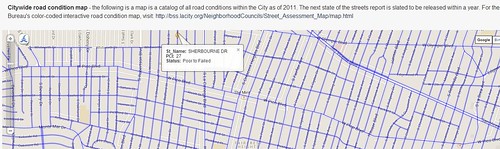
On the other hand, the City of Los Angeles has a very good metrics webpage, much better than DC's, and for road pavement quality data too.

You can even drill down within the Los Angeles data on a block by block basis, which is far more useful than the data presented by DDOT.

This comes up too, because for awhile there, I was thinking about running for Ward 4 position on DC City Council, figuring that Muriel Bowser will win the Mayoral election, and that I might have a shot in a special election, because the voting conditions are much different than normal, where I would have no chance.

Anyway, I decided not to do it (meeting with people reminded me how much I dislike the people who are into campaigns, plus other people, even those who hold or have held elective office told me it's very difficult to "move a Council to better decision making" and that I could have more effect doing other things), but I had been developing an ideal ward-focused Councilmember platform, and one of the elements would be developing and publicizing ward-specific metrics, including road pavement quality, sidewalk gaps, bike path pavement quality, litter survey data, etc.
Pavement condition measurement on a street in Los Angeles
Pavement condition measurement for a particular street in Los Angeles, from the City of Los Angeles Performance Metrics website.

(That ward-specific platform is only in outline form now.  I will expand it into a position paper of some sort.)

Labels: , , , ,

Tuesday, May 10, 2011

On the end of the mayoralty of Richard Daley, Mayor of Chicago

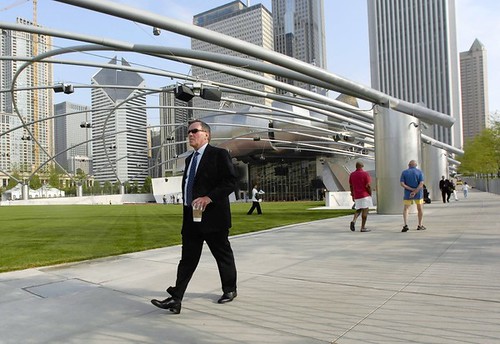
Mayor Richard Daley tours Millennium Park the morning of the grand opening, the first time the park was open to the public.
Mayor Richard Daley tours Millennium Park the morning of the grand opening, the first time the park was open to the public. Chicago Tribune photo, July 16, 2004.

For 22 years, Richard Daley has been the Mayor of Chicago. In "A mayor who left his mark on Chicago's cityscape: Love him or hate him, Daley made no little plans," the Chicago Tribune's architecture critic gives his assessment. (Also see "For Daley, democracy in doses," "Will Chicago think big after Daley?," and "Daley the Builder leaves unfinished business.") As Kamin writes:

Some of Daley's mega-projects, like the Klingon meets Parthenon mismatch that is the renovation of Soldier Field, are permanent scars. Others, like Millennium Park, are sheer triumphs.

But whether you hated or loved what Daley was doing, this much never changed: He was always doing something. An "idea a minute" guy, the billionaire Lester Crown called him the other day.

Kamin says these were Daley's shining moments:

•Millennium Park — When Daley looked down on the ugly commuter railroad tracks in the northwest corner of Grant Park from the high-rise office of his dentist in 1997, the wheels for what would become his greatest design triumph started turning. ...

•The Museum Campus — It was one of Daley's predecessors, Jane Byrne, who floated the idea of forming an uninterrupted, pedestrian-friendly green space for Chicago's three natural sciences museums. But it was Daley who actually carried out the heroic urban planning act of shifting northbound lanes of Lake Shore Drive west of Soldier Field, creating a vast greensward between the Field Museum and the Shedd Aquarium.

The 1998 opening of the Museum Campus taught a broader lesson: If we want to move highways to create more humane cityscapes, we possess both the ability and the artistry to do so.

•The Greening of Chicago — Early in his tenure, Daley was a kind of Martha Stewart, prettying up the cityscape with trees and flowers. But he grew beyond being a mere beautifier and became a leading advocate of greening cities to combat global warming. According to city officials, he oversaw the planting of more than 600,000 trees, the construction of more than 85 miles of landscaped medians and the building of more than 7 million square feet — more than any other city in America — of planted roofs. ...

•Upgrading Infrastructure — Daley didn't just build roads and bridges. He built infrastructure that sought to uplift its surroundings.

From the 1996 revamp of State Street, which turned a cold and colorless bus mall into a pedestrian-friendly streetscape, to the 2002 rebuilding of Wacker Drive, which tweaked the road's configuration to make way for new parkland and a river walk, Daley's transportation projects reminded us that a road or a bridge should be more than a passageway.

•Saving Landmarks — Daley's leadership in one historic preservation crisis was exemplary. In 1996, after aldermen stripped 29 buildings and historic districts, including Ludwig Mies van der Rohe's 860-880 North Lake Shore Drive apartments, of temporary landmark status, Daley pushed the City Council to safeguard 28 of the threatened sites. Subsequently, the Cook County Board enacted a package of property-tax breaks for owners of landmark buildings.

But there were failures, including the rebuilding of Soldier Field, and its loss of status as a national historic landmark, and the parking meter lease deal, as well as mixed results on a number of fronts.

Still, just Millennium Park alone is a major triumph that is rare amongst American cities.

WGN-TV, the Chicago-based superstation available on many cable and satellite television systems, has a special on Daley, "Make no Little Plans," this Saturday, May 14th, at 10:30pm Eastern Time.

Labels: , , , , , ,

Wednesday, May 04, 2011

The police need a plan too...

Image by James Burns Design.

I am not sure what to make of Councilman David Catania's initiative to create a Mayor-Union commission to analyze the DC police department's staffing issues. See Examiner columnist Harry Jaffe's column, "D.C. cop "emergency" commission doomed to fail."

This came about because the force is shrinking--the normal loss of officers is about 150 officers/year and for whatever reason, the police department stopped recruiting and training new officers. People seem to be shocked that with normal attrition and a failure to recruit and train new officers, the department is shrinking.

Uh, it seems pretty obvious what they should do. But I am not sure the Mayor or the Union is up to picking the right people to figure out what to do.

For one, even though Jaffe (and most other journalists) always get quotes from the Fraternal Order of Police Union chair Kristopher Baumann as a credible source, I find it odd that these days, when unions are demonized for being self-interested, that somehow, police officer unions seem to get a free pass on the question of self-interest.

As we planners say, there ought to be a plan. Does the police department have one? I imagine the union solution will be a lot more pay, better pensions, earlier retirement (and hey I agree that they police officers do have difficult jobs). But I don't see how that solves the fact that the department hasn't been doing recruiting and training a class of new officers each year.

Labels: , , , ,

Wednesday, April 20, 2011

Interesting article about the need for countervailing institutions/civil society

Gulf Oil Spill Survival
This Wednesday, April 13, 2011 picture shows an oil tar ball at Fourchon Beach in Port Fourchon, La. Tar balls and oil are still in abundance on the Louisiana coast a year after the Deepwater Horizon oil spill. (AP Photo/Dave Martin)

On the anniversary of the failed oil platform in the Gulf of Mexico, the BP Macondo oil platform, the New Orleans Times-Picayune has an article, "For many in Louisiana, the real disaster of 2010 wasn't the oil spill but the drilling moratorium," about the impact one year later.

Historian Douglas Brinkley opines that the reason that the Louisianan environment is so degraded is because the power structure is well-integrated with the oil and gas industry, and that the dearth of a significant local and state-based environmental movement means that there are few checks and balances on the industry. From the article:

he problem in Louisiana, said Rice University historian Douglas Brinkley, who is writing a book on the history of the environmental movement, is that there is no countervailing political pressure in the state.

"I'm looking at all 50 states -- and the most abused ecosystem is this ragged boot of Louisiana," Brinkley said. But there has never been an effective environmental movement in Louisiana, he said, to call out the state's political leadership when it toes industry's line.

With the world watching the BP disaster, some observers wonder if the Louisiana delegation overplayed its hand. I was struck by it at the time, how much of their focus was on getting the drilling started again," said Norman Ornstein, a scholar of Congress at the American Enterprise Institute.

Obviously, Ornstein said, there were reasons to worry about losing even more jobs in a perilous economy and after suffering the loss of jobs in fishing and tourism as a result of the spill. And there were concerns that the industry's enemies in Congress and the environmental movement would seek to use the disaster to try to shut down drilling altogether.

But their single-minded fervor to resume drilling even amidst the "massive devastation" seemed off, said Ornstein, who said it called to mind the devotion of the Michigan delegation to the auto industry as it rode to ruin.


This is relevant to cities on at least two dimensions:

1. Many cities don't have a diverse legislature, so policy and direction tends to be one-sided

2. Some cities (such as DC), have a pretty weak "civil society," and lack strong local organizations that successfully push good government and related agenda items, building a stronger environment for accountability, fairness, and transparency.

What has happened in Louisiana vis-a-vis the oil, gas, and chemical industries, happens in those cities and counties, just with different industries and different, but still well-connected, people.
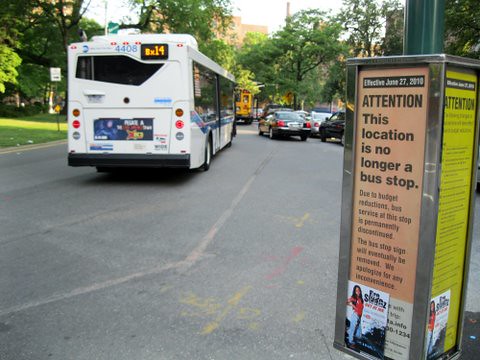
No_Longer_Bus_Stop
Image: Transportation Nation.

Labels: , , , , ,

Wednesday, January 12, 2011

Musings on New York's mayors

New York Magazine has a couple interesting articles. "Bloomberg’s Blind Spot" discusses the blinders that often accompany technocracy and various governmental failures under Mayor Bloomberg. From the article:

Each of us has a blind spot, a hole in our vision where the light-gathering retina connects to the optic nerve. Politicians have other kinds of blind spots—pet projects, favored benefactors—and, in a bureaucracy as large as New York’s, they can breed trouble. Ed Koch started programs that were then used by Democratic Party bosses for patronage hires; 100,000 fraudulent welfare recipients took advantage of John Lindsay’s faith in the War on Poverty.

As a partyless billionaire who pays for his own campaigns, Mayor Bloomberg has no obligations to doctrine or donors, but he has a different kind of failing—a failing that’s just enabled one of the largest scandals of his administration, with four consultants arrested for allegedly misappropriating almost $80 million from the CityTime program to digitize the municipal payroll. And in a way, the project fits an established Bloombergian pattern: ambitious restructuring efforts whose technocratic idealism gives way to old-fashioned unsupervised governmental inefficiency.


Interestingly, I think that DC's Mayor Williams had an element of the same idealism which got him into trouble as well. Mayor Williams expected his agency appointees to employ technocratic idealism and carry out improvements, without his always defining how they should do it (not unlike the article in Food & Wine about cooking from recipes as technical documents versus "recipes" as guides--"Become an Intuitive Cook: Thomas Keller's Cooking Lessons"). Many times, they didn't go about their work the way he intended.

The second article, "The Greatest Mayor: “How Would Dinkins Have Done, Had He Come After Giuliani?” Being a larger-than-life character helps. But so does keeping the streets plowed," is a roundtable discussion to determine "the best mayor of New York City," although it focuses only from pre-WWII (Fiorello LaGuardia) to the present. It's an interesting read.

Labels: , , , , , ,

Tuesday, December 14, 2010

DC DDOT transportation access portal doesn't really say anything

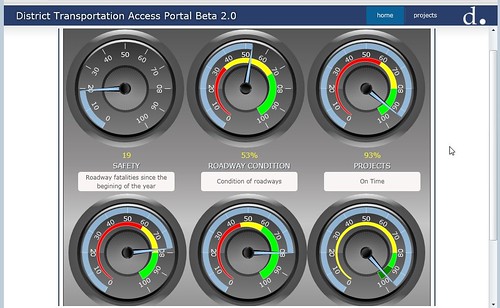
DDOT Transportation Access Portal, screen shot
One of the problems with all the hype about Web 2.0 is that people too often focus on the attractive graphics, and not the depth and breadth of what is provided. Some apps are great. Some apps seemingly pump out and disclose data, but communicate little of substance.

Such is with the heralded DC Transportation Access Portal.

By publishing only a gross number/statistic, and not providing a way to drill down deeper into the data, little actionable information is provided.

In the DDOT TAP only one of the six buttons, projects (the other five are safety, roadway condition, transit, finance, and customer service), allows the ability to drill down for additional information.

What it provides is a start. It could be great, but there is no question that the data for active DDOT construction projects, organized by Ward, is incomplete. I know it's incomplete because on 3rd Street NW there has been a sidewalk and roadway improvement program going on (I have been meaning to write about it), funded by ARRA, and it isn't listed.

Plus there is an issue of quality of the finished project. For the most part, the ones I've seen are good. But there are other issues.

Still, this is a model for what should be happening with each of the other buttons. For example, with the roadway conditions button, you ought to be able to drill down into a master database of road condition information for every block of every street on which the data has been collected.

With safety, since one of the buttons is for traffic fatalities, there is no way to drill down to three different additional layers of vehicle fatalities, pedestrian fatalities, and bicyclist fatalities--actually the data should be for accidents overall, not just fatalities.

This information is collected, it's just not disclosed. And if there are places where multiple accidents occur, then it is likely that there are potential "countermeasures" that can be employed to address structural/design problems that may contribute to fatalities. That's the purpose of the FHWA Pedsafe and Bikesafe programs--used for analysis of particular types of categorizable accidents, with proposed responses.

DCist and GGW have been mapping this information, but it isn't actionable...

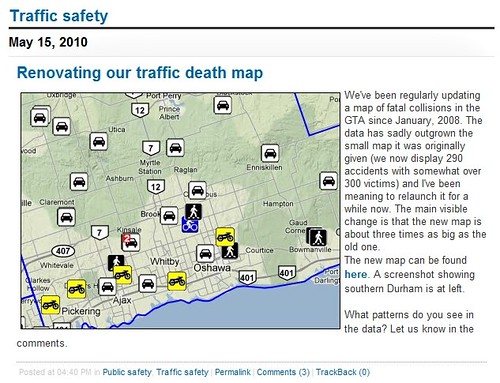
In the past I wrote about an online mapping project that was conducted by the Toronto Star ("Mapping bicycle-car and pedestrian-car accidents"). Sadly, they have discontinued the project, but it was quite pathbreaking, and a model for what DDOT could be doing with its dashboard, and for "Apps for Democracy" as well -- more data of significance and less fluff and hype.

-- Toronto Bike Accident Map, 2008

Toronto Star traffic death map

FWIW, I have been writing about this issue, the disclosure of information to the public, measurements and metrics, for longer than I have been blogging. Below is something I wrote in themail in 2004:

What Gets Measured Gets Done
Richard Layman, rlaymandc@yahoo.com

In the classic business book In Search of Excellence, the authors coined the famous phrase "what gets measured gets done" to refer to companies that outperform their peers because of a greater focus on what matters. Of course, being sure that organizations focus on what matters is always a problem, as is a focus on accountability. Today's Austin American-Statesman talks about how the City of Austin updates 4,000 different performance measures weekly, from library circulation statistics to how the city is meeting its goals, and it posts this data to the city website. This is an expansion of their public communication of such data, which since the mid-1990s had been published quarterly. (See http://www.ci.austin.tx.us/budget/eperf/index.cfm for the website.)

Similarly, the Citistat program in Baltimore is a finalist in Harvard's Ash Institute annual program highlighting governmental innovation. The program is written about by syndicated columnist Neal Peirce. Citistat marries data tracking and analysis with accountability for improvement, comparable to the CompStat program initiated by Jack Maple and William Bratton in NYC, a program which led to big change in policing strategies and tactics, and a concomitant reduction in crime. Peirce quotes Mayor O'Malley stating that “success comes only with constant and intense executive pressure, plus relentless follow-up with departments.”

I looked at the government services section of http://www.dc.gov, but I haven't been able to locate similar data sets. We need them

Labels: , ,

Saturday, July 31, 2010

United Nation's World Urban Campaign

Deserves a mention of its own:

United Nation's World Urban Campaign

From the webpage:

The World Urban Campaign is a platform for public, private and civil society actors to elevate policies and share practical tools for sustainable urbanization. The success of the Campaign will be measured by more sustainable urban policies at the national level and increased investment and capital flows in support of those policies. For this reason it focuses on providing governments and partner networks with an advocacy instrument to articulate a shared vision for a better urban future and to advance the urban agenda within their respective constituencies.

This applies as much to organizations of the urban poor as it does to associations of local authorities, business forums, youth associations, media outlets, professional associations, women’s groups, Parliamentarians, ministerial conferences, and inter-governmental bodies. The Campaign in this way seeks to position sustainable urbanization as a priority issue of the international community and as a national policy priority for individual member States.


I read an article recently about how Harvard Law School is changing their curriculum in three significant ways. One is to incorporate a recognition that law is global, not just from the standpoint of "international law" and relations between countries, but in a globally-connected world, the understanding of law has to be broader, less focused on court decisions and more about institutions and practices.

The same goes for cities. Knowing what happens in cities in other places only strengthens your practice at home.

Labels: , ,

Wednesday, June 16, 2010

Brookings report on metropolitan trends

The title of the article from Smart Planet, "Brookings: five waves of change will reshape US cities in the 2010s," says "cities" but the report is really about metropolitan areas as a whole.

The report: The State of Metropolitan America

The trends:

Growth and outward expansion: “Between 2000 and 2009, [metro areas] grew by a combined 10.5 percent, versus 5.8 percent growth in the rest of the country. But they continued to spread out, too, as their less developed, outer areas grew at more than three times the rate of their cities and inner suburbs.”

Population diversification: “The United States population is today one-third nonwhite, and those groups accounted for 83 percent of national population growth from 2000 to 2008. Immigration continues to fuel our growth, too, and now nearly one-quarter of U.S. children have at least one immigrant parent…. Large metropolitan areas will get there first, as their under-18 population had already reached majority non-white status by 2008.”

Aging of the population: “Large metro areas are in some ways aging faster than the rest of the nation, experiencing a 45 percent increase in their 55-to-64 year-old population from 2000 to 2008. As a result, their single-person households are growing more rapidly as well, especially in suburban communities that were not designed with these populations in mind.”

Uneven higher educational attainment: “More than one-third of U.S. adults held a post-secondary degree in 2008, up from one-quarter in 1990, helping to propel our economic growth. But younger adults, especially in large metro areas, are not registering the same high levels of degree attainment as their predecessors. Moreover, the African American and Hispanic groups projected to make up a growing share of our future workforce now lag their white and Asian counterparts in large metro areas on bachelor’s degree attainment by more than 20 percentage points.”

Income polarization: “By 2008 high-wage workers in large metro areas out-earned their low-wage counterparts by a ratio of more than five to one, and the number of their residents living in poverty had risen 15 percent since 2000.”

Labels: , , , ,

Tuesday, February 09, 2010

Not sure what I think about this re the WMATA General Manager position

Doug Duncan, former county executive for Montgomery County Maryland, and a one-time candidate for Governor of the State of Maryland, has thrown his hat in the ring to be the General Manager of the Washington Metropolitan Area Transit Authority according to this report, "Duncan reportedly considers Metro head position" in the Baltimore Sun.

While I agree that Mr. Duncan is an excellent administrator and understands politics, and he had ultimate authority over the Montgomery County RideOn bus service, one of the most successful suburban bus systems in the U.S., so he has some direct transit experience, I think that the past year's issues with systems and safety problems with the subway system have proved the necessity of having a top executive that has a deep background in fixed-rail transit services.

Were a politician to be hired to be the GM, a supra-strong #2 executive with deep experience in rail would have to be hired simultaneously. But I would rather that deep rail experience be considered the most important qualifier for the position, not politics.

We don't know what the National Transportation Safety Board is going to recommend, once they release their report on the June crash that killed 9. As the variety of safety-related worker deaths over the past year have proven, there are serious systemic and process issues within the system management and culture that have to be addressed.

Were I in charge, I'd likely recommend an overhaul of the top management of the rail division (meaning that a lot of people would be fired).

Of couse, after the NTSB hearings later this month we'll know which direction the transit system will have to move.

Labels: , , , , ,

Thursday, May 01, 2008

Quote of the day

this time from the Seattle Times, from "Saving Waldo Woods: a test of Seattle leadership," an op-ed piece by David Miller, about the expansion of Seattle's urban forest:

Every great city reaches a tipping point where strong leadership is required, and where mere initiatives and agendas are turned into visible policy actions.

Labels: , , ,

Monday, February 04, 2008

Hmm. Ahead of the curve?

I didn't watch the Super Bowl because I'm not really interested in sports. I did watch the four songs by Tom Petty and the Heartbreakers.

Eearlier in the day I read a piece in the Seattle Times about how a local community, Renton, Washington, was going to air during the Super Bowl a commercial promoting the city. I have to say that I found that interesting and I was thinking about watching the game just for that. See "Renton uses Super Bowl ad to boost image."

Instead I saved time because the commercial is on the City of Renton website.

I'd say "ahead of the curve," the theme of the ad, is really missed opportunity.

It gets back to thinking about your audience in terms of the way that Lauffer suggests in Marketing for not-for-profit organizations, in terms of input, throughput, and output publics.

Input publics give you resources. Throughput publics are your employees and stakeholders, the people who do the work. Output publics are to whom your efforts are directed.

This is a "throughput public" ad. It has absolutely no meaning to anybody who doesn't already know what Renton is or does or what its unique selling proposition is. Having a Seattle-area comic reprise his riff on the city, from a local television show that few people ever saw, falls dead.

Clearly governments are a great potential market for strategic communications consulting, except that the people involved don't understand how badly they need the services.

Labels: , ,

Thursday, January 31, 2008

Harvard Business Review/Learning from Mistakes


Harvard Business Review
Originally uploaded by ecentor

In an earlier blog entry on Arlington, rg comments thusly:

Excellent post. In terms of Arlington's mistakes, what I also like about Arlington is that they learn form their mistakes. Yes, Rosslyn sucks, but Arlington did not go and build more Rosslyns. In contrast, it seems like DC repeats many mistakes over and over and never learns. Mind you, my thinking on this is just anecdotal, but it's an interesting contrast.

I have been meaning to mention that the February issue of Harvard Business Review has four excellent articles:

• a case study on a hotel company creating an overarching branding strategy (my sum up, do it when the brand has value, but not when it doesn't, i.e., does "Westfield Shoppingtown" really have any meaning, isn't it just another mall?);

• "The New Leader's Guide to Diagnosing the Business" (I am working on creating similar templates for commercial districts);

• "The Founder's Dilemma" about start up organizations and the dilemma between control and success (running the show or bringing in other people with the necessary skills to grow the organization) -- this is a big issue in nonprofit organizations, and was outlined in the stages of organizational growh and developing organizational subsystems chapters in the class Social Psychology of Organization a long out of print textbook that is supposed to be revised and reprinted; AND

• "The Experience Trap" which states "as projects get more complicated, managers stop learning from their experience. It is important to understand how that happens and how to change it." (Similarly, also see the work by Chris Agyris about organizational change.)

I was really struck by the last article, that people just accept that there are going to be "problems" without really trying to figure out why problems arise, if they are a result of a faulty process or system, not just something that happens. And to change the process.

[This is what gets me in trouble in my work. People aren't comfortable challenging processes. And they think when you challenge processes that you are challenging people.]

I am not technically trained, but the process of six sigma defect reduction seems to be relevant to organizational processes whether or not you are engaged in manufacturing. The work of of Juran and/or Deming is equally applicable.

Labels: ,

Tuesday, January 29, 2008

Quote of the day

(I spent much of today in Arlington at the launch of their Car Free Diet program, and then stopping at various points between Rosslyn and Brookland taking photos or talking to people such as at Rosslyn Renaissance/Rosslyn BID. Because I am going to a farmers conference tomorrow--in relation to foodways and farmers markets and recruiting farmers--in Pennsylvania, I am not likely to blog for a couple days. I have a lot to blog about in terms of my experiences in Arlington, but I don't know when I'll get around to having that much time to write...)

"Unless you tackle the whole of the problem, rather than part of the problem, ultimately you're not going to get anywhere."
-- Ewan Hunter, Hunter Foundation (he is not related to the namesake of the organization) from the Chronicle of Philanthropy, 1/10/2008

This quote is relevant to Arlington. I mentioned before Charles Landry's point that world class cities don't just take from the world, they give back too. I mentioned Paris' Velib bikesharing program as an example of this. Paris wasn't the first city to do bike sharing, but the scale of their launch and the publicity it garnered has accelerated take up of the idea in many other places in the world. That's an example of giving back as part of being world class, what maybe could be called "generativity" based on Erikson's Life Cycle Theory.

In the DC region, Arlington might be the only true world class municipal jurisdiction. They don't just beat on their chest and say they're great, like DC does. They have vision, they have values, they execute programs in high quality best practice fashion (more about that later) in concert with their values and they get results.

Now, DC actually has more walkers, bicyclists, and transit users than does Arlington. I'm not saying that Arlington just gets better press. DC has a better urban design that is more conducive to mode shift. My joke though is just think if DC marketed mode shift and incorporated transportation demand management into planning, how much better we could do.

Arlington isn't perfect. Super-sized buildings along Wilson Blvd. and in Rosslyn make the quality of the pedestrian experience somewhat hit or miss. Urban design on the first and second floors still needs some work.

But the way Arlington executes programs for transit, walking, biking, fitness, and the environment are best in class. They are comprehensive, deep, and outcomes-oriented, and capable of being evaluated.

The thing today featured talks by the Arlington County Board Chair, Walter Tejada, as well as County Councilmember Jay Fisette, and the County Manager, Ron Carlee, stopped by for awhile too (he didn't speak). Maybe it just rang true to me because I don't hear these particular elected officials speak that often (I have heard CM Fisette before, we shared a dais at a presentation once), but I was impressed with the content--I repeat--the content. Too often we don't have elected officials in the city with that level not just of knowledge, but concern from the heart, and values, not just political calculations. (And speaking of great Arlington County elected officials, I didn't even see Chris Zimmerman, who is probably the best elected official in the region when it comes to transportation and mobility issues.)

Labels: , , , , ,

Tuesday, January 15, 2008

Learning from Bilbao

according to an article from the Independent, "Guggenheim lost £4.5m in art sale," about an investigation into the use of public monies in purchasing a sculpture for the Guggenheim Museum, the Basque State Parliament has a "Tribunal of Public Spending" to investigate the use of public monies, when spending is called into question.

Sounds like an idea that needs to be taken up elsewhere...

Labels: , ,

Wednesday, January 02, 2008

Snow removal and perfect information


More snowplow army
Originally uploaded by haute negro
From the Baltimore Sun:

Residents can track snowplows

Howard County residents can track the progress of snowplows by visiting the county's home page and clicking on the snowflake icon. A snow-tracker map will show location of plows, untreated roads, salted roads and plowed roads. The maps are to be updated every 15 minutes.

Each county snow vehicle is equipped with a global positioning device to allow residents to track its real-time progress during a storm.

Residents can also call 410-313-2900 for information on maintenance efforts.

Link to Howard County Snow Tracker

Labels: , , ,

Monday, December 24, 2007

Accountability

Unkempt city park bench
Unkempt city park bench. Photo by Baltimore Sun reader Robert Wray.

The San Francisco Chronicle (ChronicleWatch), the Toronto Star ("Read more Fixers," "Fixer's Guide to Getting Things Done"), the Philadelphia Daily News, and the Baltimore Sun (Watchdog archive) each have a regular watchdog column that focuses on municipal activities--not embezzlement, but more on quality of life issues.

Plus, the Chronicle has a column by Phillip Matier and Andrew Ross that covers more serious "screw ups" and abuses of the system (Matier and Ross page).

I remember the Sun doing an investigative story where reporters called in anonymously ten different problems in city parks. They went back 2 or 3 months later to discover that maybe 8 or 9 of the 10 problems remained uncorrected, and they did a big piece on it, taking (I think) two full pages inside the front section following the jump.

The Washington Post did something similar for a brief period, in the Thursday District Extra section, but they haven't done so for many years.

A column like this is important, because it shows often disconnected officials that people are paying attention, that outcomes matter.

Too often, I don't think this is the case in DC, and I wish that the Post would run a similar feature once again.

See "Filthy park bench sullies Baltimore's slogan," in the Baltimore Sun.

Replacing a city park bench
City Department of Transportation worker Floyd Arrington replaces the slats of a bench at Patapsco Avenue and Annapolis Road. (Sun photo by Kenneth K. Lam / December 3, 2007)

Labels: , , ,