Rebuilding Place in the Urban Space

"A community’s physical form, rather than its land uses, is its most intrinsic and enduring characteristic." [Katz, EPA] This blog focuses on place and placemaking and all that makes it work--historic preservation, urban design, transportation, asset-based community development, arts & cultural development, commercial district revitalization, tourism & destination development, and quality of life advocacy--along with doses of civic engagement and good governance watchdogging.

Wednesday, September 03, 2025

New Abundance Elected Network Kicks Off With 115 Elected Official Members Across 31 States

Publisher website.

This is from their press release.  As I mentioned in a recent blog entry, I haven't yet read the book, just a bunch of well written reviews both positive and negative. In any case, moving away from a no tax austerity-scarcity  neoliberal approach to urban areas is a good thing.

-- Abundance Elected Network

Abundance Elected Network Will Connect and Empower Leaders Nationwide – And Give Them The Tools To Create Change 

The Abundance Elected Network, a program of the Abundance Network launched today with over 120 local elected officials across 31 states. 

The big number of geographically diverse initial members - ranging from Mayors to Council Members and more - shows the importance and hunger for a network of likeminded elected officials that are on the cutting edge of some of the most important issues facing communities today. 

The network is launching the broad national network, a nationwide fellowship program, an intelligent AI assistant designed exclusively for local elected officials and strong partnerships with important organizations.

“These electeds didn't just pick up the Abundance book and become curious, they are already taking tough votes in their communities, with the scar tissue and NIMBY shrapnel in their bodies to prove it. This is a courageous set of local leaders working in pursuit of abundance in their communities” said Giselle Hale, Managing Partner of the Abundance Network.

The Abundance movement has already transformed the conversation about how to create more affordability and improve people's lives and now a nationwide non-partisan non-profit - the Abundance Elected Network - is going to accelerate it.

... The Abundance Elected Network is going to help local leaders find support and ideas, while also helping them accelerate their work across the country. Whether it’s housing, clean energy, healthcare, transportation and more, these leaders are going to be able to draw on the best ideas from places and leaders across the country and bring them to their own communities. 

This new network is going to help elevate that work even further by tackling a critical challenge: ensuring local elected officials are equipped to deliver real, positive change in their communities. Recognizing that local leaders are closest to the people and best positioned to implement impactful policies, the Abundance Elected Network is building a powerful movement of results-driven elected officials that are going to be able to call on each other for help, support and ideas.

Here is what the Abundance Elected Network will work:

  • Broad, nationwide reach
  • Knowledge base and abundance bot
  • Policy research made simple
  • Expert peer connections
  • 24/7 Trusted Advisor
  • Strong Partnerships
  • Fellowship training program

Labels: , , , ,

Wednesday, February 12, 2020

Polling questions on local issues

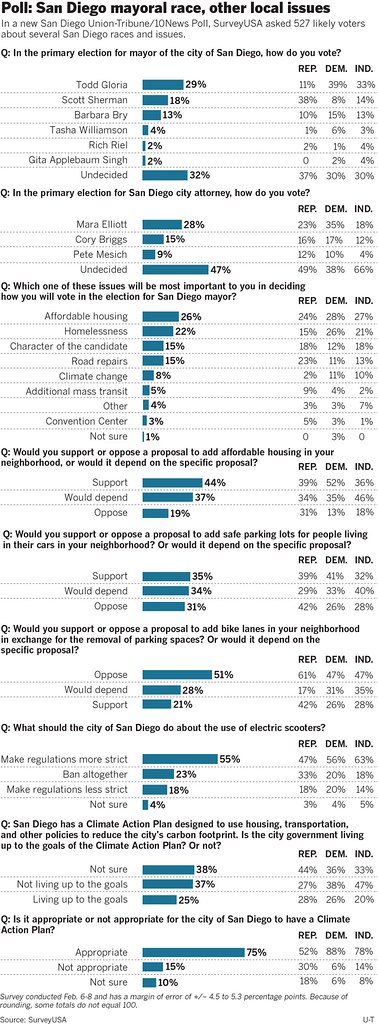
From time to time I've gotten calls concerning polling for local elections.  But they don't tend to ask many interesting questions outside of who you support for particular offices.  A poll conducted by the San Diego Union Tribune ("Poll shows Gloria, Sherman continue to lead Bry in San Diego mayor’s race") for this year's primary election went beyond candidates, asking questions about:

-- affordable housing in your neighborhood
-- would you support bike lanes at the cost of parking
-- financing a new convention center
-- etc.

Pretty interesting.
Election poll questions, San Diego


Labels: , , , ,

Friday, July 07, 2017

Local progressive politics: locally (DC-area) and nationally

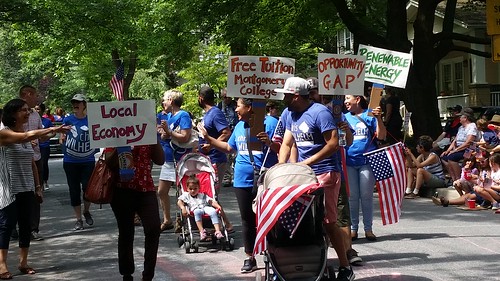
The Takoma Park, Maryland Fourth of July Parade is always fun, so we try to attend.  Our next door neighbors have friends who live on Maple Avenue--right on the parade route--so we usually have a place to stand that's shaded.

This year's participation was heavy with political candidates including Kevin Kamenetz--running for Governor--and many people running for Montgomery County positions--new term limits go into effect with the next election cycle so the County Executive position is up as well as four Councilmember positions, as well as State Senators and Representatives, along with Congressman Jamie Raskin, who lives in Takoma Park, and was elected in 2016.

I was surprised by the signs carried by the "Team Wilhelm" contingent promoting teacher Chris Wilhelm's campaign for Montgomery County Council because they espoused a pretty progressive platform, which is unusual in a County Council race, let alone the average center city election.
Chris Wilhelm for Montgomery County Council, featuring an overtly progressive campaign agenda, at the Takoma Park Maryland July Fourth Parade

Campaign planks for focusing on boosting the local economy, free community college tuition--only San Francisco has enacted that, renewable energy, and addressing the "opportunity gap" stick out.

2.  The New York Times has an article about how Republican State Governors and Legislatures are working to restrict the ability of cities to enact progressive legislation ("Blue Cities Want to Make Their Own Rules. Red States Won't Let Them"). 

This appears to be a fellow traveler action alongside the ongoing campaign by pro-business organizations such as ALEC, the American Legislative Exchange Council, to limit progressive action at the state level ("Exposing ALEC: How Conservative-Backed State Laws Are All Connected," The Atlantic) by passing state laws that preempt local government regulation and actions.


3. The Nation has reintroduced their ‘Cities Rising’ reporting series on progressive action--termed "pockets of resistance"--across the country at the local government level.

-- Press Release
-- The Nation's ‘Cities Rising’ webpage

So far, articles cover climate change actions by cities, the quest to close Rikers Island jail in New York City, and Missoula Montana's successful acquisition of the local water utility.

Of course,  The Nation has covered opportunities for progressive local government for a long time, such as:

-- "The Rise of the Progressive City," 2014
-- "Meet the Group of Feisty Urban Progressives Who Want to Transform the Country One City at a Time," 2014. This article introduces us to Local Progress, "the national local municipal policy network" linking progressive locally elected officials from across the country
-- "'All Resistance Is Local': A Plan of Progressive Action for the Trump Years," 2016

Labels: , , , ,

Tuesday, July 05, 2016

The downside of requiring city residence for municipal employees: self-interest can capture government operations

Washington Post Saturday columnist Colbert King laments in his most recent piece, "Washington, D.C., is run by people who don't even live here," that the majority of people employed by the City of Washington don't live in the city, that employing DC residents on the part of the local government would be a step forward in terms of dealing with un- and under-employment within the city.

While my preference would be for city employees to be city residents, especially because the city captures income taxes from residents, a reflexive preference for city residents as government employees can be problematic.

1.  Residents as government employees may vote in their personal economic interest.  City residents vote in city elections and city government employees voting can end up voting their own interests, rather than the interests of the city as a whole.

This was a real problem when Marion Barry was mayor and so many city residents were on the city government payroll -- DC had more government employees per capita than any other local government in the US, which contributed to the city's bankruptcy in the mid-1990s.

Related concerns include employee unions (although not necessarily comprised of city residents) can be big donors to campaigns, earning the fealty of councilmembers voting for better than average wages or pensions.

This can be fiscally irresponsible, which is increasingly evident as cities across the country face bankruptcy, high costs of pensions and an inability to fully fund them, spiraling health insurance costs, etc.

2.  Hiring under-qualified workers.  Particular residents may be underqualified but hired anyway, because of an overall preference to hire locally.  While this helps the unemployment rate it doesn't necessarily contribute to a better functioning government.

This was a real issue in the high government employee numbers during the various Barry Administrations.  I remember going to my first local community government meeting in 1987 or 1988, and a representative from the DC Department of Public Works was barely intelligible.  He wore a nice suit, but made no sense when he spoke.

3.  Parochialism and mediocrity.  Similarly, a bias for local residents as government employees can encourage parochialism and mediocrity in terms of perspectives, visions, and capabilities.  It can be good to mix things up.

I always find it interesting that many land use and transportation planners in area jurisdictions like Montgomery and Arlington Counties live in DC.  The advantage of multiple roles is that can help those communities be more progressive while aiding the knowledge of local residents.

=======
Ward 9.  For years, the "problem" that Mr. King writes about, DC government employees living in the suburbs has been a running joke in terms of how Prince George's County is referred to as Ward 9 -- DC has eight wards or political districts -- because so many DC Government employees live there. Parochialism doesn't necessarily fade when you cross to the other side of the DC-county line.

The suburban-urban divide within the city.  And people who live in the suburbs might not care all that much or have the right center city urban perspective about working on issues while working for DC.

Then again, I argue that as it is, DC is shaped towards suburban thinking ("DC as a suburban agenda dominated city")  on account of how the "Outer City" dominates the city's political agenda, as 10 of the city's 14 elected officials other than Attorney General live in the Outer City.  The others live in the original "L'Enfant" city, which is the most urban part of the city.

Labels: , , , , ,

Sunday, March 01, 2015

Seattle Councilmember Kshama Sawant's policy approach as an illustration of what I call the issue continuum

My first job in DC was for a consumer group that had Nader lineage (the founders denied that the group was a "Nader group" although all had met while working for consumer advocate Ralph Nader and split off on their own). I mostly did what I called "thinking level staff support," although I was considered part of the "program staff," even though I didn't work on policy.

One of the things I figured out while working there, although it was through observation, it wasn't something that the organization taught to its staff people.

Basically, you need to treat an issue as a continuum of positions, with a variety of policy/proscription points. I prefer to think of it as a kind of scatter plot, with the most conservative position on the far left of the line, and the most progressive position on the far right of the line, and all sorts of positions, all over the map, in between.
Scatter Plot - Issue continuum
This scatter plot illustrates the issue continuum concept.

I learned that the best way to get the most movement towards the most ideal outcome was to stake out the hard core, toughest, most progressive position.

You do this because in the end, you get much more movement towards the ideal, in comparison to being willing to compromise early and staking out a lesser position.

To get the change in legal, legislative, and regulatory positions, usually there is a lot you have to give up.  But the end result is far better than if you caved earlier.

Relatedly, I have a line about this:

When you ask for nothing, that's what you get. When you ask for the world, you don't get it, but you get a lot more than nothing.

You need people and organizations out there willing to stake out the harder core position in order get a better result.

The world is better as a result. Even if you personally are still disappointed, seeking more.

2.  Not being in Seattle, I only hear about Socialist Alternative Council Member Kshama Sawant from the Seattle Times (a somewhat conservative newspaper) and the alternative weekly, The Stranger.

Obviously, she's very interesting, because no other major city in the US has a socialist councilmember (we're not the UK where hard core Councilmembers are the norm and party affiliation is the key defining element for political and policy control).

(The Stranger has a funny parody advice column seemingly authored by Councilmember Sawant, which is a fun read.)

There is a lot of talk out there that she is too hard core, "isn't having that much impact" because she's "so out there," and she won't be successful in getting re-elected--the city is moving mostly to a district based Council system, away from at-large--even though she lives in Capitol Hill, considered the city's most liberal area.

But the Seattle Times has an interesting analysis piece, "Socialist Kshama Sawant: Action-now approach gains influence," which illustrates the point I make about staking out hard core positions along an issue's continuum of policy positions, in order to get much more movement towards it in terms of final outcome. From the article:
The Indian-born former computer engineer and community-college instructor, who knocked off incumbent Richard Conlin in 2013 under the banner of the Socialist Alternative Party, has rapidly become one of the council’s most influential members. 
“Without a doubt, Kshama has moved the council in a new direction,” said Councilmember Nick Licata. “More progressive. More sensitive to social and economic justice. The other members are inclined to go there, but Kshama is pushing them. Kshama has made things happen that never would have happened before.” 
Skeptics say the council member wields limited power. She rarely casts a swing vote, and some of her ideas, such as her push to revamp Seattle City Light’s electricity-rate structure, have flopped. 
But the bully pulpit, not the legislative sausage factory, is where Sawant is most effective and where her star power is an asset. The same week as the Chamber conference, a poll showed Sawant had the most name recognition on the council.

It also indicated how polarizing she is: Sawant had the council’s second-highest favorable rating and, at the same time, the highest unfavorable score. Sawant’s supporters praise her for bucking “The Seattle Process,” while her detractors roll their eyes at her righteous rhetoric and claim her approach does more harm than good.
As progressive as Seattle's elected officials are, having a hard left Councilmember means that the Council is forced to address social and economic issues that in most places, end up getting if not ignored, get dealt with in a pretty cursory way.

That distinguishes Seattle from most of the other major cities across North America.

Labels: , , , , , ,

Wednesday, November 12, 2014

Global cities don't just take, they give

The entry below is a reprint from the Urbanophile blog and not because it starts out by mentioning me.

Given that we've just had an election in Washington, DC with the victory by Muriel Bowser, who is now one of only three women mayors of large US cities ("Muriel Bowser win makes D.C. biggest U.S. city with women in 3 top jobs," Washington Times), recently in Toronto, where John Tory is now mayor and should help to bring some stability to municipal politics and governance there, and the municipal election is this upcoming Saturday in Vancouver, BC ("Vancouver's election just got interesting," Toronto Globe & Mail), where the momentum is now favoring the challenger, it's worth thinking about this broad question of what is a global city, how do leaders in global cities act, and how do they make their own city better while simultaneously contributing to the art and practice of city making.

(Note that in Canada, Calgary's mayor, Naheed Nenshi, is considered amongst the best and most impressive in North America.  See "Calgary mayor makes us look like rednecks" and 'Canada's mayor' sees the city positively" from the Toronto Star.)

On this broad note, last year the Boston Globe ran an interesting series of articles about exemplary actions in particular areas by other cities, as a kind of advice for incoming Mayor, Martin Walsh.

-- Greg Cook: Learn from how Chicago does culture 
-- Melissa Massello: Gen Xers can live larger in Lone Star State
-- Dante Ramos: Six ideas Boston should emulate
-- Edward L. Glaeser:> What Greater Boston can teach the rest of the world<

More recently, the Toronto Globe & Mail has an article about the High Line and its lessons, "The High Line effect: Why cities around the world (including Toronto) are building parks in the sky," while a piece in the Sacramento Bee about public art, "Sacramento airport's big red rabbit means business – really," mentions a piece by Blair Kamin in the Chicago Tribune, "Millennium Park: 10 years old and a boon for art, commerce and the cityscape," about Millennium Park and its social and economic impact. The economic impact numbers come from a study by Texas A&M< and DePaul University.
------------
Originally published:  April 28th, 2013

I had an interesting conversation about Washington, DC with Richard Layman a few months back. One of his observations, rooted in Charles Landry’s, was that great global cities don’t just take, they give. To the extent that Washington wants to be a truly great city, it needs to contribute things to the world, not just rake in prosperity from it.

Affecting the world, often for good but unfortunately sometimes for bad, is a unique capability that global cities have because they are the culture shaping hubs of nations and world. When an ordinary city does something, it can have an effect to be sure. But things that happen in the global city are much more likely to launch movements.

For example, Chicago did not invent the idea of doing a public art exhibit out of painted cow statues. I believe they copied it from a town in Switzerland. But when Chicago did it, it inspired other cities in a way that Swiss town did not. In effect, ordinary cities influence the world usually by influencing a global city, which then influences the world. Often it is the global city that gets the credit although the actual idea originated elsewhere. Thus the role of the global city is critical. But we shouldn’t assume that all ideas originate there or that other cities can’t profoundly influence the world.

We might also think of bicycle sharing, which was around in various forms for quite a while. But it was the launch of the massive Paris Vélib’ system in 2007 (which according to Wikipedia was inspired by a system in Lyon) that made bicycle sharing a must have urban item the world over.

Similarly it was the High Line in New York that has every city wanting to convert elevated rail lines into showcase trails. New York is really the city that made protected bike lanes the new standard in the United States as well.

Beyond simple urban amenity type items, global cities can also launch profound cultural and social transformations. A few examples.

The first is from Seattle, a sort of semi-global city. It was in such a depressed state in the 1970s that someone put up a billboard that’s still pretty famous: “Will the last one leaving Seattle please turn out the lights?” Yet in Seattle there was a coffeehouse culture that spawned a movement out of which came Starbucks which literally revolutionized coffee drinking in America and event pioneered the entirely new concept of the “third place.”

A lot of people like to attribute the emergence of Seattle as a player to Microsoft moving there from Albuquerque in the late 1970s. However, I think the coffee example shows that there were interesting things already happening in Seattle long before that. It was a proto-global city waiting for a catalyst.

Another example would be the emergence of rap music out of New York City. Or house music from Chicago.

Or consider the 1963 demolition of Penn Station in New York in 1963. The wanton destruction of this signature structure horrified the city and led to the adoption of its historic preservation ordinance. This was not the birthplace of historic preservation in the United States, but this demolition played a key role in bringing historic preservation to the fore, not just locally but nationally.

Lastly, the Stonewall Riots in 1969 clearly played a signature role in the gay rights movement in America. Many pride parades today are scheduled to fall on the anniversary of the event.

Who knows what might have happened with coffee in America without Seattle. But I think it’s clear that both the historic preservation and gay rights movements would have emerged at some point anyway regardless of what happened in New York. However, the events in New York clearly provided a sort of ignition and acceleration.

How many historic buildings in America were saved because Penn Station was lost? (Think about how many might have been destroyed had the historic preservation movement emerged later).

Think about a state like Iowa where gay marriage is legal. How many people in Iowa 40+ years ago had any idea that an obscure incident in New York City would ultimately transform the social conventions of the rural heartland?

I think this shows the power of the global city. I’m sure that there are things happening underground in New York and elsewhere that right now that we don’t know anything about yet that will ultimately transform our world 10, 20, or 30 years down the road. It’s crazy to think about.

------- end of Urbanophile entry -------

p.336.  (italics in the original)

To be a 'creative city for the world' or to be 'creative for your city' highlights how a city can (or should) project a value base or an ethical foundation in encouraging its citizens, businesses, and public institutions to act.  By acting in this manner the way a city operates and the results it achieves act as role models to inspire others. .....

Creativity for the world or for your city gives something back; it is a creativity that generates civic values and civility.

Labels: , , , , ,

Wednesday, January 01, 2014

New Year's Post #1: Defining mediocrity up and the 2014 elections in DC

These days, DC ought not to be such a bad place to be an elected official.  The population continues to grow, DC now has a population of 646,000 ("[National] Population gains at near-historic lows," Washington Post); crime isn't such a big problem; the real estate market is reasonably strong although not perfect because of a diminishing role in the federal government's place in the market; and the city is in a pretty good place financially, although most of its loan capacity has been encumbered--it helps that DC is the only city in the US that collects and keeps 100% of the "state" income tax.

That being said, DC is no city on a hill.  Plenty of politicians have been brought down by corruption over the past few years and DC doesn't really stand out as a special example for other cities to emulate, with an exception or two on particular programs (like bikeshare).

When everyone's party affiliation is Democrat, there is no platform or party discipline.  I read an article about Massachusetts after Scott Brown was elected to the Senate that made the point that because the state is dominated by Democrats, everyone who wants to win runs for elective office as a Democrat, but the reality is that the issue positions are all over the map and encompass for some people what would be Republican positions, although my lesson from the story is more about the dearth of a basic position or platform.

DC has the same problem.  It's a city-state even though it isn't recognized legally as a state.  For the most part, DC can do what it wants, with some limited oversight from and restrictions by the federal government, which waxes or wanes depending on which party is in office--generally the Republicans like to use DC for political points so that's why we have such a strong charter school movement here (put in place as a deal between the Newt Gingrich Congress and President Clinton), Sen. Shelby put a death penalty sentencing proposal on the local ballot, etc.

But at the local level, it means that because of the dominance of liberal sentiment, as expressed by affiliation with the Democratic Party, there is no "party discipline" and no real platform. 

Candidates for office running as Democrats are more about creating and maintaining personal fealty than they are developing an overall platform and a progressive agenda, as opposed to a putting together a variety of incremental positions.  Basically they produce a grab bag o' stuff as opposed to a platform.

Image from Unpunk.

So suffice it to say that I am bored by the 2014 election.  It could get shaken up some by a strong independent run for Mayor to challenge the Democratic winner from the way too early primary in April, but I am not holding my breath.

I have a couple of pieces from the last two years which are evergreen when it comes to the topic of improving DC governance and politics.

1.  "Continued musing on restructuring DC's City Council (mostly)," discusses a broad number of systemic changes that I propose to increase democracy and openness in local government.  As Matthew Frumin said in the special election campaign last year, the Home Rule Charter is going on 40 years old and it's time to review where we are and where we've been.

Summary recommendations

1.  Increase the number of wards.
2.  Increase the number of councilmembers
3.  Move the legislature to part-time service and reduced pay
4.  Reduce the size of councilmember staff
5.  Increase the research capacity of local government
6.  Institute term limits for elected officials.
7.  Change the date of the primary election to extend the electioneering period.
8.  Institute ranked choice voting for local elected officials.
9.  Institute additional campaign finance limits for local elections.
10. Create an elected public advocate/ombudsperson.
11. Reconstitute a school board with oversight over pre-K to 12 public education, traditional and charter schools.
12. Build civic capacity and infrastructure.

Since the City Council voted to move the popularly elected Attorney General election to 2018 ("D.C. Council votes to delay first election of an attorney general," Post), counter to what citizens voted for, we need to add this to the list as well.  There is a move to put it back on the 2014 ballot ("DC Council needs to get the DC attorney general election right," and "Delaying election of attorney general makes a mockery of democracy,"  Post--note that the Post editorial page has continually espoused the wrong position on this issue) although I would be content to put it on the 2016 ballot, which is what I had proposed years ago, that the AG be elected in the non-Mayoral election cycle.

Note that an alternative to ranked choice voting would be runoff elections and non-party segregated primaries.  The way it works in Seattle, local elections are non-partisan, and the top two vote getters for Council races continue on to the general election ballot. 

2.  Given the so-called rise of progressivism at the city level, given the election of Bill de Blasio as Mayor of New York City and maybe even the election of Kshama Sawant, Socialist Alternative candidate, to the Seattle City Council ("Kshama Sawant's Brash Style Catapulted Her to Victory: Will It Also Be Her Demise?," Stranger), etc., I find the agenda-less local Democratic Party to be a big problem and a lost opportunity--in other words, if DC wants to become a legally recognized state, we should start acting like one, and function at a high level both in terms of governance and the general political structure.

This 2012 post, "Repositioning cities (at least on the coasts) for greater political prominence, and a city-first agenda," discusses local parties in Vancouver, BC and Montreal, and their respective platforms.  Similarly, in 2013, most candidates for Mayor and Borough Chair in New York City had defined platforms rather than a grab bag o' stuff that we content ourselves with in DC.

-- Bill de Blasio, campaign website issues section
-- Julie Menin, candidate for Manhattan Borough Chair 
-- Anthony Weiner, Mayoral candidate, "Keys to the City" plan (actual documents no longer online, but ideas, 121 in total, accessible through the webpage for specific issue areas)

The "defining mediocrity up" point has to do with how I think of DC, because it is the national capital, defines anything it does, regardless of true worthiness, as "world class."  It's a corollary to Daniel Patrick Moynihan's writings about "defining deviance down."

Note that the Tommy Wells website is decent on issue positions.  Muriel Bowser's website is not.  Jack Evans doesn't list new issue positions, but lists his involvements and initiatives in terms of legislation and programs for 13 different issue areas.  The website for the Vince Gray re-election campaign has no content.

Interestingly in a first, at least that I can recall, there is an anti-Vincent Orange website, excoriating his positions and way of participating in politics.  He still doesn't seem to have a website up.

3.  I don't think having an agenda would be enough for a second party, either the Statehood-Green Party or the Republican Party, to break through and become a credible alternative, unless the legislature expanded, through a doubling of the representatives in each ward (one elected every two years for a four-year term), an increase in the number of wards, and limits on campaign spending.

Labels: , , , ,