Rebuilding Place in the Urban Space

"A community’s physical form, rather than its land uses, is its most intrinsic and enduring characteristic." [Katz, EPA] This blog focuses on place and placemaking and all that makes it work--historic preservation, urban design, transportation, asset-based community development, arts & cultural development, commercial district revitalization, tourism & destination development, and quality of life advocacy--along with doses of civic engagement and good governance watchdogging.

Tuesday, August 06, 2019

Today's local elections in Seattle: the clash between progressive and business interests

I've been more closely involved in DC politics and civic affairs for about 20 years.  In all that time, business interests have never been successful at running candidates against more avowedly progressive Councilmembers.

Election after election they tried to pick off Phil Mendelson, although now maybe he's been cowed, because he seems to be a more outward proponent of a Growth Machine agenda.  In the recent election cycle, they went after Elissa Silverman, who won pretty decisively too.

Example of an anti-leftist mailer in the 2019 Seattle Council election.  Photo: Amy Radil, KUOW/NPR, "Anti-Kshama Sawant fliers aimed at unseating 'populist left' Seattle Council."

Seattle's Council is noteworthy for its leftist bent, culminating in Kshama Sawant, a member of the Socialist Alternative Party.  She was first elected at large in 2013, then for the Capitol Hill area seat once the Council moved to a mix of at-large and district seats in 2015, and she is up for re-election today.

She has five opponents ("There are five candidates challenging incumbent Kshama Sawant in District 3," Seattle Times).

Most interestingly, there is hundreds of thousands of dollars in PAC money being spent by business interests ("Going negative, nasty in bid to 'flip' Seattle City Council" and "Big bucks from business boost Seattle City Council candidates," Seattle Post-Intelligencer; "Is Amazon taking revenge on the Seattle socialist who took on the retail giant?words," Guardian) to defeat her and other candidates deemed too left.

From the SPI:
The latest figures from Seattle Records and Elections underline the point: There is a serious effort underway to "flip" what has been a left/progressive/activist city council in the Emerald City. With four open seats, 2019 is the year to do it.

The Civic Alliance for a Sound Economy (CASE), political arm of the Seattle Metropolitan Chamber of Commerce, has supported District 3 candidate Egan Orion with $107,405 of spending. District 3 includes Central Seattle, Capitol Hill, Madison Park and Madrona.

Orion is the business-backed candidate for the seat held by council incumbent Kshama Sawant. CASE has put $77,875 behind Philip Tavel, challenging city council incumbent Lisa Herbold in District 1 (West Seattle-South Park).

A third big outlay, $80,105, has gone to back Mark Solomon in District 2 (Southeast Seattle). Solomon is a crime prevention coordinator for the Seattle Police Department. The favorite in the race has been Tammy Morales, community organizer with the Rainier Beach Action Coalition, who almost beat retiring Council member Bruce Harrell in 2015.
Sawant pushed the $15 minimum wage, rent control, and the concept of a head tax on large corporations, including Amazon.  Although the Council passed the tax, later they reversed.  Communicating its displeasure, Amazon has since announced the move of a large division to suburban Bellevue ("Amazon details plan for Bellevue expansion," ), which will result in the movement out of Seattle of 8,000 direct jobs and many indirect jobs.

(Be careful Arlington County...)

Although opposition to Sawant is complicated.  Some councilmembers prefer another member not because of her leftist politics but because they claim she is almost impossible to work with ("Lorena Gonzalez and Teresa Mosqueda On Why They Endorsed DeWolf Over Sawant," The Stranger).

Interestingly, The Stranger article discussing Sawant's tenure illustrates a point I make all the time, that when you stake out a hardcore position you get a lot more movement towards it, then you would if you had picked a less difficult easier position along what I call the "Issue Continuum" (although it turns out that a couple years after I developed this concept, but never wrote about it, an analyst in Michigan made a similar observation, which is now called the "Overton Window," "How the politically unthinkable can become mainstream," New York Times).

It will be interesting to see what happens. Compared to DC-based efforts I can recall, by contrast the amount of money sloshing around in the Seattle elections is truly astonishing. The CASE group -- Civic Alliance for a Sound Economy -- has raised $888,000 ($200,000 from Amazon) which vastly exceeds the amount of money that goes into a typical ward election here. Although Councilmember Sawant is successful at raising money from across the country, from people who support her progressive position on the Council.

But given how many opponents Sawant has, likely she will win a plurality, and move on to the general election -- the top two vote getters automatically are on the ballot for the general election. Her likely opponent will be progressive Zachary DeWolf, who has picked up the support of the labor unions who once supported Sawant.

Labels: , ,

Tuesday, July 05, 2016

The downside of requiring city residence for municipal employees: self-interest can capture government operations

Washington Post Saturday columnist Colbert King laments in his most recent piece, "Washington, D.C., is run by people who don't even live here," that the majority of people employed by the City of Washington don't live in the city, that employing DC residents on the part of the local government would be a step forward in terms of dealing with un- and under-employment within the city.

While my preference would be for city employees to be city residents, especially because the city captures income taxes from residents, a reflexive preference for city residents as government employees can be problematic.

1.  Residents as government employees may vote in their personal economic interest.  City residents vote in city elections and city government employees voting can end up voting their own interests, rather than the interests of the city as a whole.

This was a real problem when Marion Barry was mayor and so many city residents were on the city government payroll -- DC had more government employees per capita than any other local government in the US, which contributed to the city's bankruptcy in the mid-1990s.

Related concerns include employee unions (although not necessarily comprised of city residents) can be big donors to campaigns, earning the fealty of councilmembers voting for better than average wages or pensions.

This can be fiscally irresponsible, which is increasingly evident as cities across the country face bankruptcy, high costs of pensions and an inability to fully fund them, spiraling health insurance costs, etc.

2.  Hiring under-qualified workers.  Particular residents may be underqualified but hired anyway, because of an overall preference to hire locally.  While this helps the unemployment rate it doesn't necessarily contribute to a better functioning government.

This was a real issue in the high government employee numbers during the various Barry Administrations.  I remember going to my first local community government meeting in 1987 or 1988, and a representative from the DC Department of Public Works was barely intelligible.  He wore a nice suit, but made no sense when he spoke.

3.  Parochialism and mediocrity.  Similarly, a bias for local residents as government employees can encourage parochialism and mediocrity in terms of perspectives, visions, and capabilities.  It can be good to mix things up.

I always find it interesting that many land use and transportation planners in area jurisdictions like Montgomery and Arlington Counties live in DC.  The advantage of multiple roles is that can help those communities be more progressive while aiding the knowledge of local residents.

=======
Ward 9.  For years, the "problem" that Mr. King writes about, DC government employees living in the suburbs has been a running joke in terms of how Prince George's County is referred to as Ward 9 -- DC has eight wards or political districts -- because so many DC Government employees live there. Parochialism doesn't necessarily fade when you cross to the other side of the DC-county line.

The suburban-urban divide within the city.  And people who live in the suburbs might not care all that much or have the right center city urban perspective about working on issues while working for DC.

Then again, I argue that as it is, DC is shaped towards suburban thinking ("DC as a suburban agenda dominated city")  on account of how the "Outer City" dominates the city's political agenda, as 10 of the city's 14 elected officials other than Attorney General live in the Outer City.  The others live in the original "L'Enfant" city, which is the most urban part of the city.

Labels: , , , , ,

Sunday, May 08, 2016

The "conservative" platform for cities: the recent London mayoral campaign

For years I've been meaning to write a piece about what a Republican agenda for cities would look like, and how much intersection there might be with a "progressive" agenda.  After all, it was Fiorello LaGuardia who said that there is no Republican or Democratic way to pick up trash...

Bloomberg's New York: Class and Governance in the Luxury City by Julian Brash.  Review from Open the City blog.

One example would be New York City under Michael Bloomberg, who had a pro-city agenda especially on transportation, and favored the traditional "reform" effort in K-12 education and Mayoral control of schools, and pro-development.

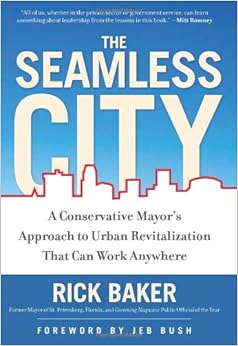
Rick Baker, Republican former Mayor of St. Petersburg, Florida, wrote a book, The Seamless City: A Conservative Mayor's Approach to Urban Revitalization that Can Work Anywhere (book review), about his experience and approach as a two-term mayor of that city. Governing Magazine named him Mayor of the Year in 2008. From the article:
Baker created a position for a deputy mayor in charge of Midtown, a low-income, African-American neighborhood, and filled it with Goliath Davis, the city's first black police chief. They brought a new library, theater, post office, health center and college campus to the area, spurring shopping centers and private retail chains to move in as well. While poverty and drug abuse remain high there, violent crime has dropped and dozens of businesses have opened up.

Baker has paid close attention to other, better-off neighborhoods as well. But his most widely noticed achievement may lie in expanding the city's overall infrastructure of parks, bike trails, public swimming pools and playgrounds — St. Petersburg is on course to have a playground within a half-mile walk of every home in the city. "The reason people are here is because of the quality of life of the city," Baker says. "Everything we do, we should be advancing that quality of life to make people like it even more."

One part of the civic infrastructure on which Baker has lavished special attention isn't even the city's: The public schools are run by the Pinellas County School Board. Unwilling to spend scarce time and political capital on trying to gain control of the city's schools, Baker instead has used the mayoralty to muster civic attention to improving them. He has raised more than $11 million in donations; overseen the awarding of more than 750 college scholarships to low-income students; recruited corporate partners for every public school in the city; created a fund to reward principals whose schools perform well on the state's grading system for schools; created a loan program for teachers who want to buy homes in St. Petersburg; and recruited 1,000 mentors for students — including himself. "We've gotten spoiled with what he's been able to do," says Terry Boehm, president of the Pinellas Education Foundation. "He's going to be a tough act to follow."
I have written that DC's Democratic Party has a weak platform and gets away with it ("Special election redux: Part 2" and "Repositioning cities (at least on the coasts) for greater political prominence, and a city-first agenda"), because the majority of residents are Democratic in affiliation and aren't likely to vote for non-Democratic candidates, regardless in large part, of their positions--if any--on most issues.

That's why the mayoral election in London was so interesting--the election was Thursday and the Labour candidate, Sadiq Khan, won decisively ("What Labour can learn from my victory: we can’t ignore what voters want," Guardian), succeeding Boris Johnston, one of Britain's most popular Conservative elected officials and a leading journalist.

While the Conservative candidate for mayor, Zac Goldsmith, was rightly excoriated for impugning his Labour opponent's Muslim heritage as the primary reason to vote Conservative, his "Action Plan for London" appears to have been a lot more detailed and pro-urban than the average platform of candidates running as Democrats for political office in major US cities, with obvious exceptions, such as policies toward labor unions.

As an example, the Transportation element is far more direct and specific and focused on expanding transit service than any comparable elected official's candidacy platform, not just in DC, but in the metropolitan area.

Better TransportThis matters as an example especially in the DC area in terms of how the local governments have the Metrorail system has been allowed to decline precipitously over the past 15 years ("Metro sank into crisis despite decades of warnings," Washington Post)--it's hard to believe that the system can be worse today than it was the day that 9 people died in the Fort Totten crash in 2009, but it is ("Metro To Announce Major Months-Long Rehab Effort Affecting Most Riders: Plan to include rush hour single-tracking and station closures," WAMU-FM/NPR).

Zac Goldsmith even signed on as favoring the London Cyclist Campaign's Mayoral election advocacy agenda for bicycling, Sign for Cycling 2016  I can't see a Republican candidate doing that.

(Remember how Mayor DeBlasio suggested eliminating the public spaces on Broadway?--a signature accomplishment of Janette Sadik-Khan and the Bloomberg Administration--as a way to crack down on crime issues associated with people dressed up as cartoon characters and aggressively seeking donations.)

Note that Mayor Khan's campaign Manifesto is even more detailed and expansive than Goldsmith's, including the section on transportation.  The Green Party's manifesto is also impressive.  Same with the Liberal Democrats.

Although maybe it's necessary for these platforms to be more detailed from the outset because unlike in the US system, where there is a multi-month lag between the general election and the assumption of office, in the UK, it's virtually immediate.

The election was Thursday and Sadiq Khan and the members of the London Council were sworn in today and take office immediately ("Sadiq Khan sworn in as new London mayor," BBC).

In any case, to move cities forward in the context of state and national politics, much more detailed agendas are required, as well as a key focus on the agenda, rather than personalities, religious affiliations, etc.

There needs to be a rigorous debate on what that agenda should be.  Both Mayor Baker and Mayor Bloomberg invested in civic infrastructure, more than the typical Democratic mayor, although it can be argued, as Brash does in his book, that the benefits of that agenda in New York City disproportionately benefited the well off.  The challenge is to equalize the benefits and to focus more efforts on the successful alleviation of poverty so that less of a city's budget is spent on keeping the impoverished poor rather than improving their circumstances.

Also see the past blog entries "Outline for a proposed Ward-focused (DC) Councilmember camp" (2014) and "Ideal Mayoral/City Council candidate campaign agenda," (2012).

Labels: , , , ,

Monday, October 26, 2015

Mayoral elections of note

1.  A few weeks ago I wrote about elections in Phoenix, where anti-light rail candidates lost out to a pro-light rail candidate.

2.  In Charleston, South Carolina, Mayor Joseph Riley, perhaps the nation's best mayor when it comes to urban design issues, is stepping down after 40 years in office.  His basic speech on the value of urban design and paying attention to beauty and aesthetic qualities is linked in the right sidebar.

There are seven candidates running.  I doubt any compares to Mayor Riley in terms of placemaking.

The Charleston City Paper's "After Riley series" has 15+ articles covering the responses of the candidates to various questions including "Question #2: How would you work with others to lead a regional conversation?," "Question #6: What would you do to create more equitable housing and real estate?," and "Question #3: What U.S. city is 'doing it right?'."

Frankly, the full list of questions is a good start for any city organization or newspaper aiming to provide deeper coverage of the urban issues at question during an election.

Interestingly, apparently younger demographics are motivated to vote because of strictures on nightlife ("Younger voters, riled by nightlife curbs, look to mayoral election," Charleston Post & Courier).  It will be interesting to see if it has an impact on the final results.  From the article:
When city officials floated curbing late-night bars on the peninsula last year, young people erupted like a well-shaken Pabst Blue Ribbon. ...

“The businesses on upper King Street have really drawn the attention of the youth in Charleston,” said John Barry, a 23-year-old West Ashley resident who attended a mayoral forum last month for the first time. “This will be my first time voting because I’ve never felt like I would be directly connected to it. And I think that the decision made by Charleston in November will really lay the framework for how we evolve as a city in the years to come.”

Ignited by the moratorium and looking to have a say in deciding Charleston’s first new mayor in 40 years, young people have registered to vote, held concerts to draw attention to city issues and participated in public forums. And Charleston’s mayoral hopefuls say they are specifically targeting the 18- to 35-year-olds.
-- Charleston Post & Courier Local Politics coverage

3.  Yesterday, local elections were held across Colombia.  Enrique Peñalosa ran again for Mayor in Bogotá, and he was leading in the polls ("Ahead Of Bogotá Mayor Election, Corruption, Security, Transit Are Top Concerns As Candidates Vie For Colombia's Second-Highest Political Post," International Business Times.  He was mayor about 24 years ago, and had ran unsuccessfully for other offices, including President, and again for mayor, from time to time in the intervening years.

Yesterday, he was vindicated, winning the post.

Peñalosa has come to international acclaim because of his implementation of the TransMilenio bus rapid transit (although the idea was first laid out by his predecesor Antanas Mockus), the creation of Ciclavias, Sunday events that closed major thoroughfares to motor vehicle traffic, in favor of biking, walking, and community festivals, and other public space initiatives.

Despite what in the US would be seen as progressive projects, in Colombia, Peñalosa is considered to be politically conservative ("Bogota's New Mayor: Iron Fist with a Green Thumb?," TeleSUR), because of his strategies concerning crime and his associations with right wing positions and people on the internal peace process ("What is at stake in the Colombian peace process," BBC).

Like the efforts of Mayor Riley, mayors in Bogotá have been quite important in demonstrating the value of linking citizenship and quality of life and placemaking.  Former Mayor Antanas Mockus calls this "citizenship culture."

Public escalator in Commune 13, Medellín.  AP photo by Luis Benavides.

In Medellín, they use the term "social urbanism" to describe the same kind of process ("'Social urbanism' experiment breathes new life into Colombia's Medellin," Toronto Globe & Mail; "Medellín's 'social urbanism' a model for city transformation," Mail & Guardian, South Africa) and the city has been incredibly successful in reducing the murder and crime rates.

This has been facilitated through expansive social and civic investments in impoverished neighborhoods, ranging from aerial trams and escalators ("Medellín slum gets giant outdoor escalator," Telegraph) for topographically challenged areas, more schools, and "Library Parks," new neighborhood civic centers featuring libraries/community centers, plazas, and open spaces ("Medellín, Colombia offers an unlikely model for urban renaissance," Toronto Star).
As of July, six candidates were vying for the office of mayor ("Who wants to be mayor of Medellín?," Colombia Reports).

For people who complain about municipally-run utilities, in Medellín profits from the municipal utility pay for these and other civic investments.

4. Earlier in the month, in Memphis, incumbent A.C. Wharton was defeated by a white candidate ("Councilman edges incumbent for Memphis mayor; set to become city's 1st white mayor in decades," Associated Press).

While I was surprised, likening it the shock of Mike Duggan being elected Mayor of Detroit in 2013, where the city is almost 90% African-American, the reality is that AC Wharton has been a fixture in area politics for decades and given Memphis' continued decline, people were seeking change ("Analysis: As wildly competitive Memphis mayoral election nears, here’s how it unfolded," Memphis Commercial Appeal).

A few years ago, former Mayor Wharton, to deal with financial problems and segregation issues in the city schools, dissolved the city school system, forcing its merger with the more successful separate county school system.  In 2014, six cities in the county created school systems separate from the consolidated city-county system.

5.  Although similarly, in Philadelphia's May primary, a white candidate, Jim Kenney, won the Democratic primary, and given the overwhelming Democratic electorate, he is likely to win the General Election ("The Next Mayor - Coverage of the 2015 Philadelphia mayoral race," Philadelphia Inquirer) in the first week of November.

6.  Nashville had its primary election in August ("As Nashville voters head to polls Thursday, contrasts with Memphis' mayoral election emerge," ) and its runoff election in September, which pitted progressive Democrat Megan Barry against conservative David Fox, with Barry winning decisively ("Barry Beats Fox to Become First Woman Mayor," Nashville Scene); "Megan Barry elected Nashville mayor," Nashville Tennessean) to become the first woman mayor of the merged county-city government.

By contrast with Memphis, Nashville's top of mind issues concern rapid growth.  Nashville is also part of a combined city-county, giving the center city more economic heft, while Memphis is not.

7.  Other big city Mayoral elections held this November include Columbus, Ohio, Indianapolis, Salt Lake City, and San Francisco ("5 challengers to SF mayor push grassroots democracy," SF Chronicle).

Salt Lake's progressive mayor Ralph Becker faced a rough primary and according to polls, the election is too close to call ("Becker and Biskupski spar in Salt Lake City mayoral debate," Salt Lake Tribune).

8. Interestingly, the elections in Philadelphia and Salt Lake City pit a man against a woman (in Philadelphia, the female candidate is Republican, which was the case in Phoenix as well). The same was true with the runoff election in Nashville.  Apparently, female candidates were particularly successful in Nashville's Metro Council elections also.

Labels: , , ,

Thursday, May 28, 2015

Not being a Democrat isn't a compelling argument to vote Republican in municipal elections (in DC or anywhere)

The Washington City Paper Loose Lips column has a piece, After a Leadership Shake-Up, the D.C. GOP Tries to Get One Council Seat," about the local Republican Party gearing up again in a bid to be relevant.

I think they are misguided and misread the situation, not unlike what Janan Ganesh's recent piece ("Labour's analysis paralysis blights a party of clever fools") in the Financial Times discusses, ripping the Labour Party for not understanding why they failed in the recent election, believing that it was lack of big ideas, rather than being "too left" with an inadequate candidate for prime minister, even though for the most part he rallied during the campaign, doing better on the stump than what was expected.

Just being "a Republican" isn't enough of a difference to be meaningful to DC voters, even if we aren't happy with the agenda-less dominance of the majority party. Most of us living in cities are "progressive." We aren't looking for "oppositional politics" out of some theoretical position that favors "competition." We do want alternatives, hopefully. It's just that being anti-government isn't the kind of position that is likely to have much relevance.

Plus, Congressional Republicans have little interest in the kinds of issues that matter to cities--their brand is sullied as far as municipal politics are concerned--so I don't see how local Republicans working with crazy Congressional Republicans is a useful alliance for Republicans desiring success at the local level.

It's tough to be successful against "the hegemon," but for Republicans to be successful running for City Council, they have to have a stellar urban-appropriate agenda. Catania proved in a special election, running against the old guard, that a non-Democrat could have a chance.

These days an urban-appropriate conservative agenda might not be John Lindsay, who was quite liberal and would be completely out of place in today's Republican Party, but maybe someone like Nelson Rockefeller. But practical city focused issues aren't what interests the kind of people who call themselves Republicans now, in all likelihood--the kind of people who want to pursue political office at whatever level.

Rep. Mike Turner (Dayton), a Republican, is former mayor of Dayton, Ohio. I heard him speak about 10 years ago. I was impressed. He seemed to have a good sense of the issues present in cities. And as a mayor in a Rust Belt city that was losing headquarters companies (like NCR), industry (GM had a bunch of plants in the area), and military functions (Wright-Patterson AFB), he couldn't be ideologically driven, he had to address the facts on the ground and respond appropriately.

Local Republicans ought to reach out to people like him if they want to come up with a path for success in municipal politics in DC or most other big cities. Similarly, Greg Ballard, Mayor of Indianapolis is Republican too, and another potential resource, if local Republicans really want to make a valiant, knowledge-infused effort.

Similarly, the Tories in the UK--the government is incredibly centralized--have a devolution agenda giving more power to cities/localities. (It's interesting, there, because they don't have a history of elected mayors, the left is against this kind of devolution, in many cases, like Manchester.)

I haven't gotten around to reading The Seamless City: A Conservative Mayor's Approach to Urban Revitalization that Can Work Anywhere by Rick Baker, the Republican former mayor of St. Petersburg, Florida, who won with 70% of the vote in a city predominated by a Democratic electorate, but it's around the house somewhere.

The webpage says the approach covers:

  • How maintaining basic amenities, like running water, requires constant vigilance—and sometimes tough decisions on the part of city leadership
  • Why a vibrant downtown is essential to attract businesses and create jobs · Why the most effective leadership is servant leadership
  • How to find and implement the most effective solutions to a city's most challenging problems
  • Why city government needs to regard the city as a seamless whole, with no section underserved or overlooked

Even so, it'd have to be an incredibly compelling candidate to be successful as a Republican in Washington, DC.

Comparable to how David Clarke could be city council chair when the city was majority black. He had great civil rights credibility (Clarke was a Democrat but the analogy is relevant).

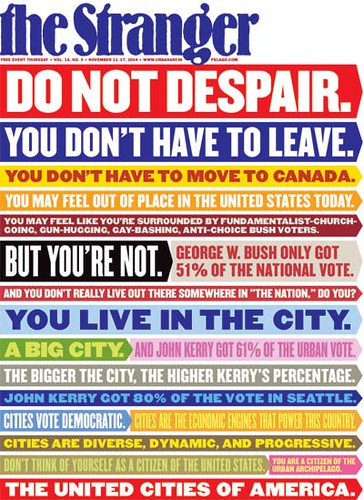
2004-11-11-cover, The StrangerThe 2008 local Republican agenda was decent.  FWIW, the 2008 urban agenda proposed to the National Republican Party by the DC Republican Party is an acceptable read, even if I am not hyped on the emphasis on choice, cutting taxes (e.g., Tax Holidays are mostly stupid, property taxes are low, sales taxes are about the same as other jurisdictions), rather than making existing governmental institutions highly functioning.

Fred Siegel's ideas about the three ways cities go back also provides grist for a Republican agenda for local government.  Fred Siegel is the author of The Future Once Happened Here, which I think is an important book on the decline of major cities.  He's considered to be conservative, although he describes himself as a "small government Democrat."  From "3 ways cities go bad," Arizona Republic, 2009:
Siegel believes there are three fundamental ways in which big cities go bad. The first is to lose control of order and civility in their public space - the streets, sidewalks and parks. This was an essential part of New York's deterioration and subsequent crime epidemic and the primary element of its recovery. ...

The other two ways big cities go bad, according to Siegel, are interrelated: control of city politics by municipal unions and an economy that becomes too much government-driven and too little privately-driven ...

All municipal politics tend to be an insiders' affair, characterized by small-turnout elections dominated by groups with a stake in the outcome - neighborhood associations, the cultural community, downtown-development interests and city workers.

When municipal unions dominate the mix, in essence choosing their bosses, fiscal discipline becomes impossible. And once government overhead passes a critical point, the only way to create space for private-sector growth is to shrink government, a virtually impossible task once city unions dominate elections.

The result is what Siegel has called an "entitlement economy," where opportunity depends on political decisions, not private initiative
In tight economic times, I think any thinking progressive is going to be concerned with these issues, and will be responsive to candidates who offer alternatives.

Labels: , , ,