Rebuilding Place in the Urban Space

"A community’s physical form, rather than its land uses, is its most intrinsic and enduring characteristic." [Katz, EPA] This blog focuses on place and placemaking and all that makes it work--historic preservation, urban design, transportation, asset-based community development, arts & cultural development, commercial district revitalization, tourism & destination development, and quality of life advocacy--along with doses of civic engagement and good governance watchdogging.

Friday, July 07, 2017

Local progressive politics: locally (DC-area) and nationally

The Takoma Park, Maryland Fourth of July Parade is always fun, so we try to attend.  Our next door neighbors have friends who live on Maple Avenue--right on the parade route--so we usually have a place to stand that's shaded.

This year's participation was heavy with political candidates including Kevin Kamenetz--running for Governor--and many people running for Montgomery County positions--new term limits go into effect with the next election cycle so the County Executive position is up as well as four Councilmember positions, as well as State Senators and Representatives, along with Congressman Jamie Raskin, who lives in Takoma Park, and was elected in 2016.

I was surprised by the signs carried by the "Team Wilhelm" contingent promoting teacher Chris Wilhelm's campaign for Montgomery County Council because they espoused a pretty progressive platform, which is unusual in a County Council race, let alone the average center city election.
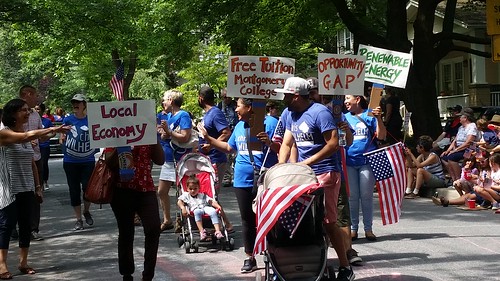
Chris Wilhelm for Montgomery County Council, featuring an overtly progressive campaign agenda, at the Takoma Park Maryland July Fourth Parade

Campaign planks for focusing on boosting the local economy, free community college tuition--only San Francisco has enacted that, renewable energy, and addressing the "opportunity gap" stick out.

2.  The New York Times has an article about how Republican State Governors and Legislatures are working to restrict the ability of cities to enact progressive legislation ("Blue Cities Want to Make Their Own Rules. Red States Won't Let Them"). 

This appears to be a fellow traveler action alongside the ongoing campaign by pro-business organizations such as ALEC, the American Legislative Exchange Council, to limit progressive action at the state level ("Exposing ALEC: How Conservative-Backed State Laws Are All Connected," The Atlantic) by passing state laws that preempt local government regulation and actions.


3. The Nation has reintroduced their ‘Cities Rising’ reporting series on progressive action--termed "pockets of resistance"--across the country at the local government level.

-- Press Release
-- The Nation's ‘Cities Rising’ webpage

So far, articles cover climate change actions by cities, the quest to close Rikers Island jail in New York City, and Missoula Montana's successful acquisition of the local water utility.

Of course,  The Nation has covered opportunities for progressive local government for a long time, such as:

-- "The Rise of the Progressive City," 2014
-- "Meet the Group of Feisty Urban Progressives Who Want to Transform the Country One City at a Time," 2014. This article introduces us to Local Progress, "the national local municipal policy network" linking progressive locally elected officials from across the country
-- "'All Resistance Is Local': A Plan of Progressive Action for the Trump Years," 2016

Labels: , , , ,

Tuesday, July 05, 2016

The downside of requiring city residence for municipal employees: self-interest can capture government operations

Washington Post Saturday columnist Colbert King laments in his most recent piece, "Washington, D.C., is run by people who don't even live here," that the majority of people employed by the City of Washington don't live in the city, that employing DC residents on the part of the local government would be a step forward in terms of dealing with un- and under-employment within the city.

While my preference would be for city employees to be city residents, especially because the city captures income taxes from residents, a reflexive preference for city residents as government employees can be problematic.

1.  Residents as government employees may vote in their personal economic interest.  City residents vote in city elections and city government employees voting can end up voting their own interests, rather than the interests of the city as a whole.

This was a real problem when Marion Barry was mayor and so many city residents were on the city government payroll -- DC had more government employees per capita than any other local government in the US, which contributed to the city's bankruptcy in the mid-1990s.

Related concerns include employee unions (although not necessarily comprised of city residents) can be big donors to campaigns, earning the fealty of councilmembers voting for better than average wages or pensions.

This can be fiscally irresponsible, which is increasingly evident as cities across the country face bankruptcy, high costs of pensions and an inability to fully fund them, spiraling health insurance costs, etc.

2.  Hiring under-qualified workers.  Particular residents may be underqualified but hired anyway, because of an overall preference to hire locally.  While this helps the unemployment rate it doesn't necessarily contribute to a better functioning government.

This was a real issue in the high government employee numbers during the various Barry Administrations.  I remember going to my first local community government meeting in 1987 or 1988, and a representative from the DC Department of Public Works was barely intelligible.  He wore a nice suit, but made no sense when he spoke.

3.  Parochialism and mediocrity.  Similarly, a bias for local residents as government employees can encourage parochialism and mediocrity in terms of perspectives, visions, and capabilities.  It can be good to mix things up.

I always find it interesting that many land use and transportation planners in area jurisdictions like Montgomery and Arlington Counties live in DC.  The advantage of multiple roles is that can help those communities be more progressive while aiding the knowledge of local residents.

=======
Ward 9.  For years, the "problem" that Mr. King writes about, DC government employees living in the suburbs has been a running joke in terms of how Prince George's County is referred to as Ward 9 -- DC has eight wards or political districts -- because so many DC Government employees live there. Parochialism doesn't necessarily fade when you cross to the other side of the DC-county line.

The suburban-urban divide within the city.  And people who live in the suburbs might not care all that much or have the right center city urban perspective about working on issues while working for DC.

Then again, I argue that as it is, DC is shaped towards suburban thinking ("DC as a suburban agenda dominated city")  on account of how the "Outer City" dominates the city's political agenda, as 10 of the city's 14 elected officials other than Attorney General live in the Outer City.  The others live in the original "L'Enfant" city, which is the most urban part of the city.

Labels: , , , , ,

Saturday, July 28, 2012

More mendaciousness about school reform: Joel Klein

Joel Klein, former chancellor of the New York City Public Schools, put on the job by Mayor Michael Bloomberg to improve scholastic performance, but more focused on interpreting the school reform agenda in terms of demonizing teachers, has an op-ed in the Wall Street Journal, "New York's Charter Schools Get an A+," where he calls out the success of charter schools there.

But his argument is flawed and misdirected.

1.  Klein says that when people point out poverty as a key problem in improving student performance that they are making excuses for not trying to improve scholastic performance.

2.  But really they are saying, deal with the impacts of poverty on students, otherwise you won't yield much in the way of substantive improvement in scholastic performance by lower income students ("the achievement gap").

3.  Klein calls out the achievement of the Success charter schools, where students "are performing at tthe same level as NYC's gifted and talented schools..."

4.  But he fails to acknowledge that part of the program in those schools is acknowledging poverty and its impact on students and addressing the impacts in ways that enhance the student's ability to learn.

5.  And he ignores the fact that most of the prominent efforts in "school reform" (NYC and Washington, DC in particular) are mostly focused on demonizing teachers (and teachers unions, sometimes justifiably) rather than addressing how poverty shapes underlying persistent achievement gaps and coming up with programs of support and development selectively targeting students, families, teachers, principals, and schools as necessary.

Basically, the school reform effort as articulated by Klein generally is to address poverty by "improving" teachers, rather than simultaneously improving teaching AND addressing poverty, educational deficits, etc.  Evaluation systems for teachers advocated by the "reform" movement are designed in ways that mostly ignore poverty and expect that exceptional teachers can always overcome this and any other problem that individual students might have.

Labels: , , , , , , ,

Saturday, June 16, 2012

Non-paid citizens as providers of civic services

In commercial district revitalization, there are two basic models for organizing revitalization programs--staff driven (for a community development corporation, a business improvement district, or a government agency) or volunteer driven augmented by professional staff (the Main Street Approach).

In places with a lot of resources, the staff driven approach has the ability to be properly funded.  In smaller places, the ability to generate significant operational funds is much less likely, so you need citizen involvement in order to leverage resources.

At the level of local government, especially when there are unions, there are limited opportunities for citizens to be involved as volunteers.  Usually collective bargaining agreements forbid the use of voluntary or non-union labor to fill a function covered by positions in the union.

This will change in many places, out of financial necessity.  Going forward, in an environment when citizens aren't willing to increase their property taxes, and with real estate less likely to escalate, and in places where the local population and tax base is shrinking, there will be fewer resources available to communities.

So if people want to still have libraries and parks and other services, it may well be that residents have to step up and provide some of the person hours necessary to offer the service.
Map, state park installations in Sonoma County, California
Here are some examples.  The Sacramento Bee reports in "Unique nonprofit coalition keeps state parks open in Sonoma," about how a group of nonprofit organizations have stepped in to maintain various state parks in the county, as they are being abandoned by the State of California.  The state is closing parks, to save less than $30 million per year, not even a rounding error in the budget  ("" from the Los Angeles Times).

In Vallejo, California, a city still in bankruptcy proceedings, after significant budget and staff cuts, residents are providing more assistance for service provision.  See "Vallejo, Calif., once bankrupt, is now a model for cities in an age of austerity" from the Washington Post.  From the article:

“We’re trying to be more innovative and risk-taking,” Brown said. “It’s something we’ve been forced to do, but it’s turning out to be a really positive experience for the city.”

The police went high-tech, investing $500,000 in cameras across the city that allow officers to monitor a larger area than they could before. The department deputized citizens to participate in law enforcement by sharing tips on Facebook and Twitter.

Gomes, whose husband is a retired police officer, focused on public safety. The couple went neighborhood to neighborhood setting up e-mail groups and social media accounts so people can, for instance, share pictures of suspicious vehicles and other information. “There have been countless cases where ordinary people have stopped crimes this way,” Gomes said.

The number of neighborhood watch groups jumped from 15 to 350. Citizen volunteers came together monthly to paint over graffiti and do other cleanup work.

A comparable example, but not involving local government, is how residents in Timberlake, South Carolina found themselves having to buy the golf course and clubhouse, in order to maintain the golf club feature of their neighborhood, after the developer went out of business.  To do it on a cost-effective basis, residents are doing a lot of the maintenance work themselves.  See "Golf club members go from saving pars to saving a course " from the New York Times.  From the article:

Slinging a pickax under a blazing sun as he dug a hole behind the ninth green at Timberlake Country Club, Michael Kletter, 68, conceded that this was not the golf-course retirement life he had envisioned.

"No, I didn't dream of manual labor," Kletter, a transplanted New Yorker who is a member of the club, not its maintenance crew, said as he planted a 6-foot fern. "But the recession changed everything. The golf course was in danger of closing. It's not a golf community without a golf course. We had to do something."

So Kletter joined about 300 other Timberlake members in a consortium that bought the financially distressed country club outside Columbia, S.C. But to make the arrangement work, the members did something that would have been unheard of five years ago: They agreed to do much of the work to operate and maintain the club.

On a recent hot, weekday morning, about 35 members were on the course raking bunkers, planting grass, trimming tee boxes, weeding, digging holes for new bushes and even brandishing chain saws in a work crew that felled three ailing 50-foot trees.

Dnd something I learned in Baltimore County, when I worked in the planning office there...  In Baltimore County, programming at parks and recreation sites isn't provided by people who work for the County Department of Recreation and Parks.  Services are provided and mostly funded by  volunteers through Recreation and Parks Councils that are organized and funded by residents.  The facilities are grouped into 45 spatial units, overseen by the respective Recreation .  This happened in the 1970s, in the face of budget cuts back then.  Harford County has been moving towards that model, after seeing it work in Baltimore County.

Note I do think there are some equity and capacity issues that remain unaddressed.  The DRP doesn't provide much in the way of training resources to the committees, no Park Pride conference like in Atlanta or the Events 101 festival management training that is provided in Fairfax County, Virginia.  And low income areas find it much harder to raise monies and other resources, while the committees in higher income areas have no problem raising hundreds of thousands of dollars annually.

It will be interesting to see how this develops over time.

Labels: , , , , ,




