Rebuilding Place in the Urban Space

"A community’s physical form, rather than its land uses, is its most intrinsic and enduring characteristic." [Katz, EPA] This blog focuses on place and placemaking and all that makes it work--historic preservation, urban design, transportation, asset-based community development, arts & cultural development, commercial district revitalization, tourism & destination development, and quality of life advocacy--along with doses of civic engagement and good governance watchdogging.

Monday, July 28, 2025

Urban and suburban politics/voting: NYC :Democratic Socialist Zohran Mamdani and homogeneity in US politics that leans to the center right

:In general, it's said that metropolitan areas vote progressive and that rural areas don't. A key example is how Oakland County, Michigan went from Republican to Democrat, but in a process that took decades.

But wrt urban areas that's a bit facile.  Typically, cities tend to be more left/progressive than the suburbs.  It means that there is a greater chance to elect left candidates in the city over the suburbs.

The press has been full of coverage about this in terms of the win in the primary by Zohran Mamdani, who trounced Andrew Cuomo, former governor.   Before election day personages like Michael Bloomberg and Bill Clinton endorsed Cuomo. 

Similarly, there are examples of a few more elected House members being more progressive, among them Alexandra Ocasio-Cortez, in NYC.  What I think the left misses in these wins is that the voter makeup is key, AOC is about urban districts with a lot of left leaning voters, not so much about a left lean to politics overall.  Which is why a majority of the candidacies affiliated with Justice Democrats, the group that supported AOC, fail.

The New York case reminds me of Toronto and London.  In both cities, at times, depending on how the suburban tranche of residents votes, you can get conservative mayors, like Ford or Johnson, instead of more lefty ones like Chow and Khan.  Cuomo captured the more "suburban" segment of the electorate, Mamdani the urbanists.

Blue, Cuomo: 36.4%.  Red, Mamdani, 43.5%.

I've written about this in DC, "DC as a suburban agenda dominated city" (2013) more in terms of about policy being somewhat biased towards automobility, but not in terms of electoral politics as the city leans left.  Policy-wise it's not quite akin to the same dynamics of cities with both large urban and suburban contingents.

In writing about how Baltimore and St. Louis should merge with their respective counties to develop more "heft", this is an issue.  In both places the suburbs have more population, and could out vote candidates supported by residents in the city proper.

In Louisville-Jefferson County, Kentucky, this has been less of an issue.

Pollster Nate Cohn "agrees" with my take about differentiation ("What Democrats Can Learn From Mamdani's Victory," NYT):

Of all these changes, the most obvious one is that the Democratic electorate has simply moved farther to the left. Over the last few years, this hasn’t always been obvious. To many, the last presidential election seemed to mark a new rightward turn in the culture, including among the young voters who had powered the ascent of progressives. Looking even further back, progressives mostly seemed to stall after Mr. Sanders’s breakthrough in 2016, including in New York City.

... With Mr. Mamdani’s victory, progressives finally have another visible breakthrough. While it might be tempting to attribute this to his personal strengths and Mr. Cuomo’s weakness, much of the change can simply be attributed to today’s much more progressive electorate. ... It’s important to note that just because Democrats are moving to the left doesn’t mean the electorate is overall.

... Mr. Mamdani’s campaign was different. He focused on the cost of living. By talking about the prices of chicken and rice, groceries, rent and buses, he spoke much more directly to the concerns of ordinary people than he would have if he had campaigned on a Green New York Deal or Medicare for all of N.Y.C. Yes, he sometimes pushed a few buzzy ideas, like free buses and government-owned grocery stores, but even these were pretty prosaic by the vibey standards of Abolish ICE or Free College. He may support those things, but it wasn’t what he was known for. This is probably a reason he fared better in many of the working-class neighborhoods than previous progressive candidates. 

Mainstream Democrats might struggle to make such a clear affordability pitch. Usually, Democrats try to address affordability problems through subsidies, but subsidies put upward pressure on prices and could contribute to inflation. The federal budget deficit and high interest rates also make it more challenging for Democrats to propose ambitious spending initiatives.

Democrats seem unlikely to co-opt much of the left’s agenda. Many Democratic opinion leaders are skeptical of price controls, government-owned enterprises and other measures, even though they might poll well. Ms. Harris supported cracking down on price gouging, for instance, but she didn’t campaign in a full-throated way on these issues, perhaps in part because so many party elites were skeptical of these initiatives. 

Taken together, the Mamdani victory suggests there’s an opportunity for progressives. Their ranks have continued to grow in recent years, at least within the Democratic electorate, even though it hasn’t always seemed like it. Affordability and Israel give them new opportunities and put mainstream Democrats in a challenging spot. It still won’t be easy for progressives to win, especially in an area without a thriving left-wing community. But it’s not 2015 or 2019 anymore, either. There are new voters, new technologies, new issues and new opportunities.

This touches on what I call homogeneity versus hetereogeneity in local politics and governance, just as we have the same fealty to an automobile-centric land use and transportation planning paradigm, which provides little room for communities to have a transit or bike centric paradigm instead.

Also, surprisingly the Wall Street Journal, but inadvertently (:How Democratic Failure Made Mamdani":

The Democratic establishment is upset about socialist Zohran Mamdani’s victory in this week’s New York City Democratic mayoral primary. But Mr. Mamdani couldn’t have done it without the establishment’s help—to wit, the failure of big-city Democratic governance.

Chicago, Los Angeles, San Francisco—all are run by Democrats, and all are wracked by crime, homelessness and a punishing cost of living. New York City is another example, and Mr. Mamdani capitalized on voter frustration.

Local Progress is a national organization supporting progressive candidates at the local level ("This Group of Politicians Just Put Forward a Platform Progressives Can Embrace," The Nation)..

Ranked choice voting,  Another element in the victory was ranked choice voting.  People can rank up to five candidates, and the candidate with the lowest number of votes is eliminated, redistributing the votes to other candidates.  This process is repeated until one candidate has over 50% of the vote.

In the campaign, progressive Brad Lander vowed to vote for Mamdani second, and there was a campaign for people to not rank Cuomo from second to fifth.  Many people preferred Lander as he is still left leaning but has a lot of practical experience in improving communities as an organizer and within government ("This Is Brad Lander’s New York," NYT).

Unease of the center right.  The New York Times, in its editorial on the race, "Our Advice to Voters in a Vexing Race for New York Mayor," did not make an endorsement, but weren't too into a progressive agenda. 

The first comment:

New York needs a mayor who understands why the past decade has been disappointing. Crucial to that understanding is an acknowledgment that a certain version of progressive city management has failed, in New York and elsewhere. This version emerged in the latter stages of Barack Obama’s presidency, when some Democrats decided that he had been too cautious and adopted a bolder liberalism. At the municipal level, this liberalism was skeptical of if not hostile to law enforcement. It argued that schools needed more money and less evaluation. It blamed greedy landlords for high rents, instead of emphasizing the crucial role of housing supply.

I actually agree with the criticism, e.g., "defund the police" should have been "rearticulate public safety delivery"--you need police but a lot of functions they perform they're not the right fit (The End of Policing).  And that can be extended across the board, overreach is a big problem.  NYT puts it like this:

A more promising approach to city leadership is certainly not a local version of the current Republican agenda, which slashes valuable government programs, opposes accountability for police departments and disdains some basic civil rights. The answer instead is a more effective and thoughtful liberal governance, in which city leaders use empirical evidence and effective management to achieve results.

Their opinion on Mamdani

Unfortunately, Mr. Mamdani is running on an agenda uniquely unsuited to the city’s challenges. He is a democratic socialist who too often ignores the unavoidable trade-offs of governance. He favors rent freezes that could restrict housing supply and make it harder for younger New Yorkers and new arrivals to afford housing. He wants the government to operate grocery stores, as if customer service and retail sales were strengths of the public sector. He minimizes the importance of policing.

Most worrisome, he shows little concern about the disorder of the past decade, even though its costs have fallen hardest on the city’s working-class and poor residents. Mr. Mamdani, who has called Mr. de Blasio the best New York mayor of his lifetime, offers an agenda that remains alluring among elite progressives but has proved damaging to city life.

If this perception is reality, we're doomed.  Better instead to have a progressive politics that gets things done.  If the Republicans in Oklahoma City ("Change isn't usually that simple: The repatterning of Oklahoma City's Downtown Streetscape" [2021]) an be national best practice in local government, why not NYC?  Why not progressive agendas more generally? ("Can Mamdani’s Energetic Campaign Be a Blueprint for Democrats?," NYT).

Nova Schultz on the steps of SF City Hall during International Overdose Awareness Day on Aug. 31, 2023.  Photo: Thomas Hawk

There's no question though that the "extreme" left version of local politics in Seattle, San Francisco, and Portland hasn't always worked out to the better.  Drug decriminalization abetted disorder in many ways.  A contingent of anarchists in Seattle and Portland didn't help.

All three cities have more moderate Mayors today.

Also see "Is a Mamdani repeat coming to the Midwest? A democratic socialist is getting a boost in Minnesota," Washington Post.  This was an issue in Seattle for awhile, which had a very left City Council including a representative from Socialist Alternative.  As some of the policies failed, the center right has re-shifted the Council, and Kshama Sawant decided not to run for reelection.

Minneapolis also has/had an SA member of City Council, if I remember correctly.

Pushback by the center-right.  Just like the Justice Democrats inadequately parse the electorate, the center-right which dominates the Democratic Party isn't too happy about a shift to the left, even in pockets like a handful of House Districts or city mayor elections judging by the comments about Mamdani ("New Yorkers Vote to Make Their Housing Shortage Worse," "NYC Mayoral Primary Is Latest Blow to Democratic Establishment: while Republicans see another chance to label the party as extreme," Wall Street Journal).

Typical of the sentiment, Florida City Boca Raton is marketing for "New York businesses" ("Boca Raton spent $70,000 on Times Square advertisement to lure New York businesses," Fort Lauderdale Sun-Sentinel) because the city's becoming "socialist.".  They are failing to recognize that many business owners in NYC are okay with the current direction.  That compared to NYC, Boca Raton is the outsider.

Homogeneity in politics trickles down to the local level in the US.  Unlike the UK, which is able to stomach one city, Bristol, being run by the Green Party, or Canada, which forbids national parties from being affiliated with local parties, leaving Vancouver and Montreal to have left-leaning governments, the US wants homogeneity both in party (Republican, Democrat, or nonaffiliated) and policy (low taxes, real estate development, etc.).

Socialists in Milwaukee. Twin Cities PBS did a documentary on the period of Socialist control in Milwaukee ("America's Socialist Experiment") which went from 1910 to 1960..  It was pragmatic and successful, but still progressive elements in the Democratic Party preferred Democratic candidates.  This was true elsewhere during the New Deal too, wrt progressive Republicans like George Norris of Nebraska or Marriner Eccles in Utah.  They did plenty to support the New Deal, but it wasn't enough to get FDR's endorsement.

Still it's an example from history that heterogeneity in local politics can work out.


Labels: , , , ,

Monday, May 30, 2022

Community facilities: it's not just building them, it's making the program better when you do so

will sent me this piece, a WTOP story ("Major funding dedicated to new sports complex, revamped facilities in DC") about how Washington will be investing over $300 million in community recreation facilities over the next the 6 years.

From summer programs to renovated recreational centers and a brand new sports complex, there will be new or upgraded facilities coming to all eight wards in the District. It’s part of a $365 million investment expected to happen over the next six years within Mayor Muriel Bowser’s budget for Fiscal Year 2023.

It reminds me of a piece I wrote about this in 2008, "Prototyping and municipal capital improvement programs," and how building more isn't enough, we should also build better in terms of making facilities more useful, by widening the range of facility elements to support more types of activities.  From the entry:

DC built a slew of recreation centers during the Williams Administration.

While it's great that many facilities were built and that the array of facilities was improved, at the same time an opportunity was lost to rethink recreation centers.

Should they have been transformed into community centers?

Could other functions have been added?

Would that have required the construction of a different type of building?

And should the facilities have been planned in terms of achieving broader program/city objectives, not just within neighborhoods?

For example, I don't think any recreation center has an indoor track. Every neighborhood doesn't need an indoor track, but certainly couldn't a couple have been constructed as part of a citywide planning and capital improvement program?

Most of the new recreation centers are one floor. If they had an additional floor, other programs could be offered, such as more structured adult education programs, or the inclusion of art programs and studio space. Etc.

Probably they could have/should have built one facility first as a test, and then had anybody and everybody "tear it apart," criticize, compliment, and bring up ideas for improvement.

Then they could have modified the construction plans, incorporated these ideas into the other facilities, without having built them all roughly at once.

And just like there are regional malls and super-regional malls, a couple of the facilities should have been designated "super-regional" recreation centers with even more enhanced facilities, such as the Thomas Jefferson Recreation Center in Arlington County, which has a exposition center/indoor track and a theater-auditorium (which also houses a resident theater company).

But without testing, and expecting otherwise constrained patterns of government thinking, these kinds of changes aren't likely to result, without a big planning-charrette-experimentation phase preceding the massive construction phase.

This 2009 piece, "Provision of public services and recreational centers," suggests planning facilities within a city at a minimum of three scales:

  1. City-wide; 
  2. Sub-city districts (in DC, you could do this by quadrants, the city has four, or by Wards, the city has eight, although the boundaries change after each Census, by "Cluster, the city has defined 39, or by "Areas," in the most recent Comprehensive Plan, 10 areas with fixed boundaries were defined, and replaced ward-based sub-plans); and  
  3. Neighborhoods.

Similarly, my piece "Neighborhood libraries as nodes in a neighborhood and city-wide network of cultural assets," isn't just about "neighborhood libraries," but about community serving facilities, and repositioning neighborhood libraries as community cultural centers.  The entry lists dozens of best practice examples, albeit mostly from the US and Canada, on how to do this.

The entry also discusses how many decades ago, the Baltimore County parks department and the school system created a joint program where the parks department would invest in recreation and other facilities within schools so they could be "overbuilt" and used by the community as well, including gyms, auditoriums, etc.

Note that neighborhood schools can be repositioned in part as community cultural centers too, although I haven't fully defined the concept ("Schools #2: Successful school programs in low income communities and the failure of DC to respond similarly").

FWIW, now I call this broader approach to facilities planning/developing a network of civic assets as "transformational projects action planning," where you leverage projects big and small in two ways, to:

(1) push vision and revolutionary practice forward within a particular project

(2) move other related projects forward simultaneously, resulting in greater success overall.

Sadly, most facility planning initiatives aren't particularly visionary, and too often, communities hire consultants that are local which they celebrate, but often they've hired firms with limited subject knowledge and experience on the type of facility being planned (e.g., consultants who haven't worked on libraries, developing master plans for libraries, etc.).

I will say that Salt Lake City and County have some interesting examples of creative facility development.

The County has a couple of co-located facilities, such as the combination Millcreek Senior Center, Cafe, Recreation Center, Library, which we use all the time, the central library with both indoor and outdoor conference and special event facilities, and the Sorensen Multi-Cultural Center in Salt Lake City's westside.

For example with the Millcreek Senior Center, by contrast DC builds separate facilities, so that the fitness and other facilities can't be used by other segments of the population, although yes some facilities are specific to seniors, but others are shared.  

Salt Lake City's libraries have meeting and other facilities, the Central Library takes this further ("building review"), and the program for youth is branded Youth City, and offers a wide range of programs complementing the recreation centers (which even in the city are run by the county).

Labels: , , , , ,

Tuesday, July 05, 2016

The downside of requiring city residence for municipal employees: self-interest can capture government operations

Washington Post Saturday columnist Colbert King laments in his most recent piece, "Washington, D.C., is run by people who don't even live here," that the majority of people employed by the City of Washington don't live in the city, that employing DC residents on the part of the local government would be a step forward in terms of dealing with un- and under-employment within the city.

While my preference would be for city employees to be city residents, especially because the city captures income taxes from residents, a reflexive preference for city residents as government employees can be problematic.

1.  Residents as government employees may vote in their personal economic interest.  City residents vote in city elections and city government employees voting can end up voting their own interests, rather than the interests of the city as a whole.

This was a real problem when Marion Barry was mayor and so many city residents were on the city government payroll -- DC had more government employees per capita than any other local government in the US, which contributed to the city's bankruptcy in the mid-1990s.

Related concerns include employee unions (although not necessarily comprised of city residents) can be big donors to campaigns, earning the fealty of councilmembers voting for better than average wages or pensions.

This can be fiscally irresponsible, which is increasingly evident as cities across the country face bankruptcy, high costs of pensions and an inability to fully fund them, spiraling health insurance costs, etc.

2.  Hiring under-qualified workers.  Particular residents may be underqualified but hired anyway, because of an overall preference to hire locally.  While this helps the unemployment rate it doesn't necessarily contribute to a better functioning government.

This was a real issue in the high government employee numbers during the various Barry Administrations.  I remember going to my first local community government meeting in 1987 or 1988, and a representative from the DC Department of Public Works was barely intelligible.  He wore a nice suit, but made no sense when he spoke.

3.  Parochialism and mediocrity.  Similarly, a bias for local residents as government employees can encourage parochialism and mediocrity in terms of perspectives, visions, and capabilities.  It can be good to mix things up.

I always find it interesting that many land use and transportation planners in area jurisdictions like Montgomery and Arlington Counties live in DC.  The advantage of multiple roles is that can help those communities be more progressive while aiding the knowledge of local residents.

=======
Ward 9.  For years, the "problem" that Mr. King writes about, DC government employees living in the suburbs has been a running joke in terms of how Prince George's County is referred to as Ward 9 -- DC has eight wards or political districts -- because so many DC Government employees live there. Parochialism doesn't necessarily fade when you cross to the other side of the DC-county line.

The suburban-urban divide within the city.  And people who live in the suburbs might not care all that much or have the right center city urban perspective about working on issues while working for DC.

Then again, I argue that as it is, DC is shaped towards suburban thinking ("DC as a suburban agenda dominated city")  on account of how the "Outer City" dominates the city's political agenda, as 10 of the city's 14 elected officials other than Attorney General live in the Outer City.  The others live in the original "L'Enfant" city, which is the most urban part of the city.

Labels: , , , , ,

Tuesday, September 01, 2015

Could a corrupt political system be a legitimate defense when a city sues a contractor for winning a contract through bribery?

========
An anonymous contributor alerted me to this Bloomberg Businesswek article, published yesterday, "Stop bribery by legalizing it." So this article is being republished with a new time.
========


Chicago is known for its "pay-to-play" culture, capricious and arbitrary land development approval system (Chicago Tribune article on aldermanic privilege, "Neighborhoods for sale"), various examples of misuse of funds for private benefit (e.g., the "Hired Truck" scandal), and poor decision-making concerning contracting such as the long term lease deals of their parking meter system and city-owned public parking structures, where the city left at least $1 billion on the table in the favor of the lessees ("Chicago's ongoing debacles: parking and governance" and "A lesson to cities that they need to be very careful when leasing assets to public private "partnerships"").

In one particular case, where a commercial property owner sued for not being able to develop because they refused to pay off an alderman, the court ruled that clearly this system was in fact legal because it is ensconced in how the city operates concerning land use.

Anyway, the City of Chicago is one of the plaintiffs suing a red light camera firm--since fired--which got the contract to operate in the city because of bribes.  See the Chicago Tribune article "Chicago sues red light camera firm for $300 million."

The city is suing for the amount they paid out to the company, about $134 million, and are seeking punitive damages, which increases the total amount they are seeking.

Granted the contract was let during the Daley Administration, but I think the defendants could argue that while what they did was wrong, that's the way things work in Chicago.

Which of course is not a legal defense likely to win.

But in any case, it doesn't seem "fair" for companies forced to be corrupt to participate in a political system being penalized by the creators and maintainers of the corrupt system for doing what was expeccted of them.

-- "The system of corruption: when you don't understand "systems", of corruption or anything else, you don't understand outcomes"
-- "The travelogue of the world's Corrupt Cities includes DC, what does that say about us?"

From the description of the book Corrupt Cities: A Practical Guide to Cure and Prevention:
Corrupt Cities is a practical guide to assist in the diagnosis, investigation and prevention of various kinds of corruption. Bringing together both a conceptual and practical framework, the publication is designed for citizens and public officials, especially at the municipal level. The approach presented discourages more controls, more laws and more bureaucracy, while focusing on systematic corruption and its preventive measures. It encourages consideration of the economic costs of corruption, rather than moral or ethical factors, as the driving force behind anti-corruption efforts. It also emphasizes that "fighting corruption should not be considered an end in itself, but an orienting principle for reforming urban administration."
The arguments put forth are supported by examples of anti-corruption strategies, particularly from Hong Kong and La Paz. The publication also includes practical tips to adapt these strategies to difficult scenarios, for example, in cities/communities characterized by political indifference, bureaucratic inertia, and where citizen support may exist but is yet to be mobilized.
Ironically, coming back on the plane I was talking with a college student sitting next to me. She is studying business, at a university in Michigan. I opined that there is something to be said for "competition" in government, given how the oligopolistic "Democratic" control of municipal government in DC leads to terrible behaviors and actions. I didn't even know about this most recent example that decisively proves my point.

Labels: , , , , ,

Sunday, March 01, 2015

Seattle Councilmember Kshama Sawant's policy approach as an illustration of what I call the issue continuum

My first job in DC was for a consumer group that had Nader lineage (the founders denied that the group was a "Nader group" although all had met while working for consumer advocate Ralph Nader and split off on their own). I mostly did what I called "thinking level staff support," although I was considered part of the "program staff," even though I didn't work on policy.

One of the things I figured out while working there, although it was through observation, it wasn't something that the organization taught to its staff people.

Basically, you need to treat an issue as a continuum of positions, with a variety of policy/proscription points. I prefer to think of it as a kind of scatter plot, with the most conservative position on the far left of the line, and the most progressive position on the far right of the line, and all sorts of positions, all over the map, in between.
Scatter Plot - Issue continuum
This scatter plot illustrates the issue continuum concept.

I learned that the best way to get the most movement towards the most ideal outcome was to stake out the hard core, toughest, most progressive position.

You do this because in the end, you get much more movement towards the ideal, in comparison to being willing to compromise early and staking out a lesser position.

To get the change in legal, legislative, and regulatory positions, usually there is a lot you have to give up.  But the end result is far better than if you caved earlier.

Relatedly, I have a line about this:

When you ask for nothing, that's what you get. When you ask for the world, you don't get it, but you get a lot more than nothing.

You need people and organizations out there willing to stake out the harder core position in order get a better result.

The world is better as a result. Even if you personally are still disappointed, seeking more.

2.  Not being in Seattle, I only hear about Socialist Alternative Council Member Kshama Sawant from the Seattle Times (a somewhat conservative newspaper) and the alternative weekly, The Stranger.

Obviously, she's very interesting, because no other major city in the US has a socialist councilmember (we're not the UK where hard core Councilmembers are the norm and party affiliation is the key defining element for political and policy control).

(The Stranger has a funny parody advice column seemingly authored by Councilmember Sawant, which is a fun read.)

There is a lot of talk out there that she is too hard core, "isn't having that much impact" because she's "so out there," and she won't be successful in getting re-elected--the city is moving mostly to a district based Council system, away from at-large--even though she lives in Capitol Hill, considered the city's most liberal area.

But the Seattle Times has an interesting analysis piece, "Socialist Kshama Sawant: Action-now approach gains influence," which illustrates the point I make about staking out hard core positions along an issue's continuum of policy positions, in order to get much more movement towards it in terms of final outcome. From the article:
The Indian-born former computer engineer and community-college instructor, who knocked off incumbent Richard Conlin in 2013 under the banner of the Socialist Alternative Party, has rapidly become one of the council’s most influential members. 
“Without a doubt, Kshama has moved the council in a new direction,” said Councilmember Nick Licata. “More progressive. More sensitive to social and economic justice. The other members are inclined to go there, but Kshama is pushing them. Kshama has made things happen that never would have happened before.” 
Skeptics say the council member wields limited power. She rarely casts a swing vote, and some of her ideas, such as her push to revamp Seattle City Light’s electricity-rate structure, have flopped. 
But the bully pulpit, not the legislative sausage factory, is where Sawant is most effective and where her star power is an asset. The same week as the Chamber conference, a poll showed Sawant had the most name recognition on the council.

It also indicated how polarizing she is: Sawant had the council’s second-highest favorable rating and, at the same time, the highest unfavorable score. Sawant’s supporters praise her for bucking “The Seattle Process,” while her detractors roll their eyes at her righteous rhetoric and claim her approach does more harm than good.
As progressive as Seattle's elected officials are, having a hard left Councilmember means that the Council is forced to address social and economic issues that in most places, end up getting if not ignored, get dealt with in a pretty cursory way.

That distinguishes Seattle from most of the other major cities across North America.

Labels: , , , , , ,

Tuesday, February 17, 2015

Everything you need to know about urbanism in four blog posts from Larry Littlefield

I was reading an entry on the NYC transportation blog Second Avenue Sagas about the proposed AirTrain to LaGuardia Airport in response to a not very informative press release from NYC's Global Gateway Alliance--business advocates for the city's airports--about transit connections to the world's 30 busiest airports, and some of the comments were by Larry Littlefield, the back and forth patter congratulated him on a letter he had published in the Economist, so I dug a bit deeper into his oeuvre.

He appears to be an investment analyst, maybe a couple years older than I. Lives in Brooklyn. He focuses a lot on urban economics, the real dynamics of the housing market, and municipal finances, especially pension liabilities (in fact, his reasoning reminds me a lot of blog commenter charlie). His blog is called Saying the Unsaid in New York.

These four posts are the rough equivalent to reading Cities in Full by Belmont, but much more dark.

His writings make me appreciate more that DC proper is an outlier in that its economic future is rosier than most cities--because we are a true city-state.  Even if Congress controls some of the city's destiny, having control over most of the tax revenue stream (with the exception that we can't tax nonresident income earned in the city) puts DC ahead of most others.  Although, we still have the municipal worker pension overhang in the city and in the transit system, which will handcuff the city quite a bit still, especially as we can only grow our revenue streams intensively, not by annexation.

1. "The (New) Urban Crisis"

2.  "Can The Urban Archipelago Be Recreated?"

3. "How Then Shall We Live: Housing in the Wake of Generation Greed

4. "How Then Shall We Live: Transportation in the Wake of Generation Greed"

FWIW, the section of his blog, Helpful Background and Greatest Hits, is even more dark. We're f*ed. And maybe it's better I don't have kids, as it's that generation who are stuck with the consequences of what they're being left by the previous generations--what Mr. Littlefield calls "Generation Greed" and  the policies and practices they have begat, to their financial benefit now but at a mortgaging fo the future.

It's not just about crony capitalism, but pensions, housing policies that supported suburban development, and other policies that supported automobile dependence, etc., which happened to be sustainable only in the immediate conditions after World War II, when the US emerged, temporarily but we didn't know that at the time, as the globe's richest country.

Labels: , , , , , ,

Monday, October 27, 2014

Today is the Mayoral election in Toronto

The likelihood is that John Tory, a more traditional candidate will win as all four of the major local newspapers endorsed him over Olivia Chow, Doug Ford, and other candidates ("There's no excuse to skip this Toronto campaign-season finale," Globe and Mail).

Christopher Hume, the urban design writer for the Toronto Star, suggests that Olivia Chow would be a better choice, because while transit was perhaps the biggest agenda item ("Transit tracks high as voter priority but platforms underwhelm," Star) during the campaign (other than Rob Ford and the Ford Nation), dealing with poverty and inequality is perhaps one of the city's most serious issues going forward.

Toronto's municipal politics have been insane for the past four years with the election of suburban resident Rob Ford as Mayor.  He junked the "Transit City" expansion initiative of the previous government--although it turns out in a weak mayor system he didn't have that power--and on transit and most other issues, including his false statements that billions of dollars of waste present in government would allow for significant tax reductions, and government move towards standstill.

Over the past couple years, Ford was implicated in drug use, and he took a leave of absence for a stay in rehabilitation.  He was running for reelection, but then was diagnosed as having cancer, so he stepped out of the campaign for Mayor and asked his brother Doug to run in his place.

Suburban-urban divide.  Interestingly, the election of Rob Ford shows one of the problems that can come from the merger of center city and suburban jurisdictions into a consolidated "center city" as the suburban electorate tends to be larger than the number of residents in the center city.

In the case of Toronto and London, the suburbs vote Conservative and the inner city votes progressive ("Life after Ford: A City As Divided As Ever," Toronto Globe and Mail).  Although note that the outer suburbs and cities, not part of Toronto's consolidated city, are expected to vote for candidates affiliated with the Liberal Party ("Red wave of mayors expected to sweep across 905 cities," Globe and Mail).

From the article
Mr. Ford’s simplistic promises to fight for taxpayers, run city hall like a business, and “stop the gravy train” struck a chord with many voters. If he had a history of off-kilter behaviour and ugly rants, many voters were too fed up to care. Mr. Ford took 47 per cent of the vote, easily besting second-place George Smitherman, a former Ontario deputy premier, who took 36 per cent. “People took the biggest hand grenade they could find and they threw it,” says pollster Darrell Bricker, chief executive of Ipsos Public Affairs.

Their anxieties and frustrations have not gone away. Toronto is, by almost any measure, a fantastically successful city. ... But as it grows, Toronto is changing, and not everyone is happy about it. Established, older residents in the car-dependent suburbs see their way of life under threat amid all the chatter about the evils of the automobile and the virtues of urban density. New immigrants often find it hard to get a foot on the first rungs of the economic ladder. Young couples despair of ever owning a house in a market where a narrow Victorian on a treed downtown street can go for more than a million dollars. People everywhere fume about the congested roads and crowded subways, buses and streetcars.
Would allowing local municipal political parties help Toronto?  At the local level, Ontario doesn't allow for the formation of municipal political parties ("Province urged to allow municipal political parties," National Post). In other provinces the rule is that provincial and federal parties can't have municipal affiliates.  Instead, locally focused parties can be created and are distinct from national and provincial parties.

Montreal and Vancouver are known for having particularly active and municipally-focused parties. And while local politics isn't necessarily perfect in those cities (Montreal went through a massive pay-for-play bribery scandal recently) by contrast in Toronto, it's a free for all.

Having local parties would be less worse than the current practice of political disaggregation and disorganization.

Labels: , ,

Monday, October 14, 2013

Keeping DC government open in the face of the federal government shutdown

Left: Sarah Palin delivers remarks as veterans, their families and supporters hold a rally at the World War II Memorial.  Bill O’Leary: The Washington Post.

Despite all the posturing by Republicans like Sarah Palin and Ted Cruz over the closure of Federal parks and museums and all the dissembling (a fancy word for "lying") over the discussion that the National Park Service is being mean, over requiring payment by states to open and operate otherwise shut down federal parks, there is a reason that such agencies are closed:

The Antideficiency Act.

This law makes it illegal for Federal Agencies to spend money that hasn't been appropriated.  But the law is structured to make individual employees responsible for breaking the law, subject to fines and imprisonment.

Since the Federal Government doesn't have a budget for FY2014, agencies can't spend money, at least not legally, despite all the lies and posturings (e.g., "DEAN: Sorry! Your national parks do not belong to you" and "PRUDEN: The cheap tricks of the game" from the Washington Times).

DC's municipal  budget is subject to the approval of Congress

Because of how the District of Columbia was created within the Constitution as a federally-controlled political district separate from a state, for legal purposes, DC is treated as an agency of the federal government.

Even though 60% to 80% of the city's budget is generated by local revenues such as income, sales, and property taxes, the city's annual budget still requires approval by Congress, and spending this money is subject to the Antideficiency Act.

The city is slated to run out of money already appropriated and usable (the Reserve Fund) sometime this week.

It has been delaying payment of other obligations, such as to the local transit authority, WMATA, and to contractors, in turn forcing those organizations to lay off 50% or more of their staffs and stop providing services.

I am not a lawyer, but if the City Government officials truly believe that DC is worthy of "being a state," then I probably would argue for continuing to operate and spending locally generated money, even if Congress hasn't approved the local budget 

Changing the fiscal year.  In response to the current impasse, Councilmember David Grosso has put forth a creative idea ("Grosso Pushes Bill to Change Fiscal Year with Focus on D.C. Autonomy"), that the city should change its fiscal year to start in July, thereby putting the approval into a different issue cycle and removing the city from being one of the pawns in struggles between the Republicans and Democrats.

Referendum to eliminate the provision requiring Congress to approve the local budget.  This is an issue that has been festering for awhile, and was the subject of a local referendum calling on Congress to give up its requirement of having to approve the city's budget each year ("D.C. Budget Autonomy Advocates Still Looking for Congressional Approval" from Roll Call and "House Republicans say D.C. budget autonomy referendum doesn't change law" from the Washington Post).

What about the 14th Amendment?  My argument would be that there is a conflict of laws within the Constitution as it relates to the operation of DC as a residential city.  The Constitution makes DC a federal district, subject to the laws governing other "federal agencies."

But I don't think that the writers of the Constitution intended for the municipal government in DC to not be able to uphold its responsibilities as a local government in face of Congressional inability to pass a budget.

The 14th Amendment clause calls for "equal protection under the law."  
Section 1. All persons born or naturalized in the United States, and subject to the jurisdiction thereof, are citizens of the United States and of the State wherein they reside. No State shall make or enforce any law which shall abridge the privileges or immunities of citizens of the United States; nor shall any State deprive any person of life, liberty, or property, without due process of law; nor deny to any person within its jurisdiction the equal protection of the laws.
While this clause was written to guide action by states, conceptually the clause has been extended so that "state action" has been interpreted to pertain to how the "federal government" acts as well,  especially with regard to civil rights.

Why shouldn't this interpretation be brought to bear on the issue of spending DC's local funds, especially as the budget approval by Congress is for the most part, a mere formality.

It should be argued that the Constitution offers conflicting guidance ("conflict of laws") concerning the operation of DC government as it relates to its ability to conduct local services, and the Courts should rule against continued application of the Antideficiency Act to matters concerning DC's local budget.

Labels: , , ,

Tuesday, May 07, 2013

Municipal contract corruption: the response is fixing the problem not eliminating oversight

Both the Washington Post ("Curtail D.C. Council power over contracts") and Councilman David Grosso ("Pol protests D.C. Council contract vote" from the Washington Examiner) are wrong about what the problem is with government contracting in the city.

The Post and Councilman Grosso argue--CORRECTLY I MIGHT ADD--that the requirement that all government contracts over $1 million be approved by City Council sets up the possibility for contract steering and other problems.

They say then that City Council shouldn't have the authority to approve contracts. (Note that Councilman Jack Evans is fine with limiting oversight also.)

2.  But that only works if we know that the contracting process by the Executive Branch is completely and fully fair.  We already know that isn't the case.

There are many examples of contracting improprieties with every one of the city's Mayors, Marion Barry especially but there have been problems with most Administrations since, even at times, Anthony Williams.  Mayor Fenty was particularly bad in terms of contract steering and manipulating the contracting process with nonprofit instrumentalities controlled by DC government agencies.

And of course there are thousands of examples of such problems all around the country.  So giving the Executive untrammeled authority over contracting (cf. "absolute power corrupts absolutely") is hardly the proper course of action.

book cover, Corrupt Cities: A Practical Guide to Cure and Prevention by Robert Klitgaard, H. Lindsey Parris3.  The DC Council is equally bad in that it is exempt from the rules for contracting openness--there is no requirement on Council to have an open tender process/public RFPs.  That's an issue with the no-bid contract--seeking private funds to pay for it, making it even worse--to a law firm to do "education research" for the Council Education Committee (see "Catania hires law firm to help craft D.C. school legislation" from the Post).

4.  The solution isn't less openness and less transparency and less oversight (this pretty much is the Post editorial response to just about any problem with local government--more authoritarianism, not less), but more.

The response then should be to structure the Contract Approval Process in a way that keeps the openness and transparency and reduces the discretion.

5.  Probably the response is (1) a public notice on all contracts as part of the DC Council Agenda process; (2) which are approved in an up or down vote; (3) with the ability to pull out particular contracts through a specific process and procedure.

There are problems with this approach too.  It would be similar to the DC City Council Disapproval Resolution process--but like the filibuster, this process now is set up to aid the Councilmember who initiates the Resolution in extracting extranormal concessions (usually on unrelated matters) from the Executive.

---------------
From "Corruption" by Shliefer and Vishny:

This paper presents two propositions about corruption. First, the structure of government institutions and the political process are a very important determinant of the level of corruption. In particular, weak governments which do not control their agencies would lead to ultra-high corruption levels. Second, the illegality of corruption and the need for secrecy make it much more distortionary and costly than its sister activity, taxation. These results may explain why in some less developed countries, corruption is so high and so costly to development.

While the paper is focused on so-called third world countries, I think it's fully relevant to municipal governments, which often operate with significantly less oversight than is sometimes warranted (see "Five ex-officials from Bell,  California, convicted in corruption trial" from Reuters about Bell, California and "SEC says Harrisburg, Pa., misled bond investors" from the AP about Harrisburg, PA -- but these are just a couple of examples, there are many).

Shliefer and Vishny extended their arguments in a book, The Grabbing Hand: Government Pathologies and their Cures. A review in the Economist states that the book is important because

There is no comparably elaborated body of thought based on the idea that governments are, like individuals, rational and self-interested—in other words, that they are chiefly concerned with winning power, exercising power and hanging on to power. ...

Messrs Shleifer and Vishny are trying to put that right. They believe their “grabbing hand” model is a distinctive alternative both to the “helping hand” (market-failure correcting) model of mainstream thinking and to the invisible-hand paradigm of the public-choice school. It is certainly closer to the second than to the first. But what divides it from the invisible-hand approach is its prescriptive content—its emphasis on tilting the balance of political costs and benefits in order to bring public and private interests into closer alignment, leading, they hope, to better (but not always less) government.

The point with regard to setting up better processes and systems for contracting is to put checks on the power, not to increase power and the ability to be corrupt by removing checks on that power.

Other resources:

-- past blog entry, "More on DC ethics and corruption: intrinsic vs. extrinsic behavior"
-- Corrupt Cities: A Practical Guide to Cure and Prevention (pdf)
-- Chicago and Illinois, Leading the Pack in Corruption, University of Illinois Institute for Government and Public Affairs.  Note that according to this report, DC is one of the most corrupt "states" in the US.

Labels: , , , , , ,

Tuesday, April 23, 2013

Today's DC Special Election

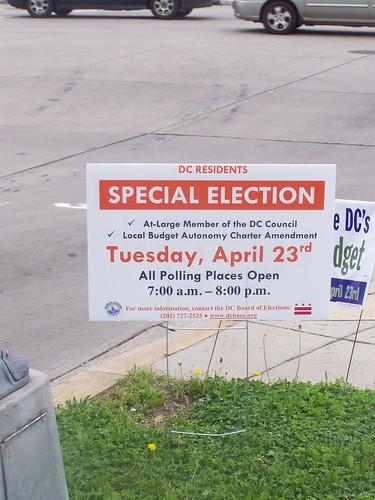
DC Special Election yard signThere are two items on the ballot to vote for.  Not that my opinion matters so much or carries much weight (this blog is the equivalent of the New York Herald Tribune maybe in terms of influence with the chattering classes, but not the masses), but I should have written about this last week when it might have made more difference.

Conclusion

1.  Vote in favor of the initiative
2.  Vote for Matthew Frumin for Council (but that isn't a strategic vote and maybe that means either Patrick Mara or Anita Bonds wins)


Discussion

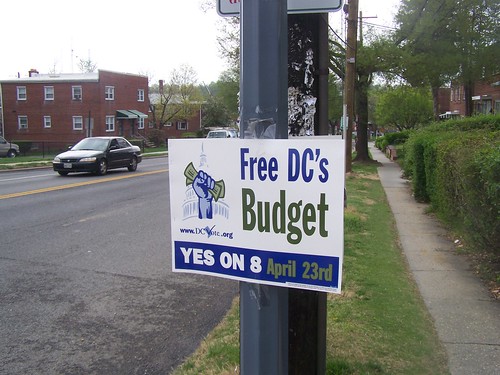
DC Initiative on budget election signInitiative to give DC control over its locally generated budget.  The easy one is an initiative referendum that proposes that DC's self-generated public revenue not be subject to Congressional approval.  Congress has to sign off on the vote, if it passes, and there is no guarantee that it will do so.

Because DC was created as the federal district for the National Capital, technically, everything that "DC as a federal government agency" does is subject to Congressional approval.  Which provides great opportunities for Congresspeople to grandstand, to impose laws and restrictions on DC and DC residents as a political gesture.

And when the Federal Government shuts down, so does the DC Government, which means even the Eastern Market public food market.

This change, if approved, would allow DC to take care of its own business, by restricting Federal oversight to those functions of the city that truly are part of the Federal interest.

So vote yes.

Entry sign for Washington DC on New Hampshire Ave. NEAbout 18 months of the term of a DC Council At-Large position.  The second vote is much harder.  It's to fill the unexpired term of one of the DC At-Large City Council positions, which became open with Phil Mendelson became the Council Chair (because Kwame Brown, the previous Council Chair resigned after pleading guilty to forging bank documents--a charge that came out of an investigation of campaign financing issues for his campaign).

There are six main candidates, four running as Democrats, Anita Bonds, Matthew Frumin, Elissa Silverman, and Paul Zukerburg; one as a Republican, Patrick Mara; and Perry Redd for DC's "third party," the Statehood-Green Party (from the beginning of Home Rule, DC had a third party, the Statehood Party, with its primary platform plank being Statehood for DC--there were representatives on Council for many years from that party; as the Party waned in influence, it merged with the local Green Party affiliate).

For the most part, what matters to me most about DC Council candidates is their stand on what we might call "urbanism," which for me, for the most part, concerns development, smart growth, transit, schools, poverty amelioration and reform, and historic preservation and placemaking.

Most of the candidates talk about affordable housing and jobs.  But I don't think they understand very well the underpinnings of how to address either in substantive ways.  And frankly, I've written far more detailed blog entries about "what should be done" than that espoused by any of the candidates except maybe for Perry Redd.

While there are dozens of related entries, probably the most succinct is this one, the "Ideal Mayoral/City Council candidate campaign agenda: Getting Our City's S*** Together," written after I had a nightmare about sharing an office with Councilman Vincent Orange, and because I couldn't fall asleep, I wrote the entry, with these planks:

- Overall vision
- Quality of life of DC residents
- Economic Development
- Transit
- Participatory Democracy
- Restructuring DC's government political structures to reduce corruption
- Schools Reform
- Health and Wellness
- Poverty Reduction.

I admit it doesn't cover "affordable housing" and "jobs" per se except in the context of addressing poverty in substantive ways.  Although I am fine with new housing production, affordable housing requirements, etc., the reality is that we need to improve how we do things to make it work better (one element of this, the sales and marketing process for AH units, is something I will be writing about, based on an interview I'll be doing with David Mayhood, the proprietor of the region's largest condo sales agency).

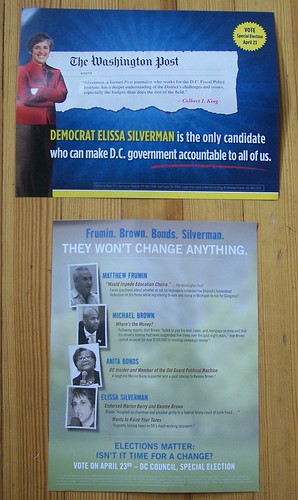
political literatureSo who should you vote for?

I always get stuck here because my radical tendencies favor "doing the right thing," and not always being strategic.  Because there are so many candidates, the people with the most name recognition are the most likely to win, especially because the election turnout is likely to be extremely low.  Candidates will need at least 10,000 votes...

Anita Bonds, a many decade political functionary, and Patrick Mara, a younger Republican who has run two city-wide campaigns and a School Board campaign in Wards 1 and 2, probably have the most name recognition.

Republicans

The establishment: the Post, Examiner columnist Jonetta Rose Barras, and many business interests have endorsed Republican Patrick Mara, in large part because they see DC's elected officials as too pro-government and anti business, and because of the Democratic Party dominance of the local political structure, which because of a "lack of party competition" has experienced many ethical failures.

Some people argue that having an elected Republican in DC Government helps DC in being able to reach out to Republican members of Congress--this matters some because of how Congress ultimately has oversight and theoretical control of local issues (as outlined in the previous section of this entry).

Mara came to political prominence because of a Tea Party like initiative to knock off the one Republican on Council, Carol Schwartz, who was seen as too liberal, practically a Democrat, especially because of how she moved legislation through Council requiring that DC businesses provide sick leave to ill residents.  That right there is a knock against Patrick Mara.

He won, but lost in the General election.  He ran again and lost.  And then he won a race for the "District 1" School Board.  While he doesn't show much of a platform, his main push for his candidacy in terms of local issues is on education--although with the change to school governance in the city, the "School Board" doesn't deal with specific K-12 education issues, except in terms of setting very very very very broad requirements.

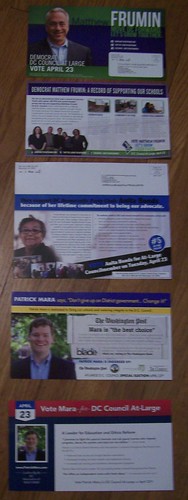
More DC political literatureI tossed a bunch of the political literature that I've gotten, but then I started saving it.  I got at least three mailings from Patrick Mara and two from Matthew Frumin, but then they knocked on my door and I gave them my name, especially as he had been mentioned to me by a former teacher at Wilson High School as a good candidate.

As much as I would like to see more and better competition within the local political structure, the failure to present a substantive platform, and his support of people like John McCain and Mitt Romney as Republican candidates for President make me leery of supporting him.

There are Republicans, not here but elsewhere, who make a strong case for a Republican interpretation of local governance for big cities.  Of course, there is New York City, and the mayoral terms of both Rudolph Giuliani and Michael Bloomberg.  So much has been written about them but it's tricky.  Guiliani, as a former District Attorney was very prominently involved in local civic affairs.  And Bloomberg is so damn wealthy. Both are kind of outliers, so it's hard to make sweeping generalizations of their relevance to governance in other cities

Although Bloomberg disagrees clearly, since his philanthrophic organization is funding a program initiative, the Mayors Challenge, for cities in the hinterlands to do programs and act more like how he has).

Rick Baker was mayor of St. Petersburg, Florida, and even wrote a book, Seemless City, on his experience there.  Mike Turner, now a Congressman, was mayor of Dayton, Ohio and clued into issues like disinvestment, commercial district revitalization, population decline, etc.  And Indianapolis is probably the poster child for a Republican run "city," actually a consolidated city-county (Marion County) government, has mostly been run by Republicans, including Stephen Goldsmith, who has written many books on the subject, and the current pro-bicycling mayor, Greg Ballard.

So far, Patrick Mara hasn't done anything to rise to this level.  Maybe that's too high a bar for me, but at least the local Republicans could lay out a platform that reaches for these heights.  A "platform" that mostly advocates for the Republican alternative without providing any specifics isn't much of a platform.  (cf. "Lack of appetite for conservative senator" from the Post.)  Especially when the default positions are pretty anti-progressive.

And the reality of being the "odd man out" in local politics is that a "Republican" Councilman, in and of himself, is probably not enough of a force to change very much, especially without a platform, support institutions (in NYC it's the Manhattan Institute) and policy papers.  (Then again, the local Democratic Party doesn't do that either.)

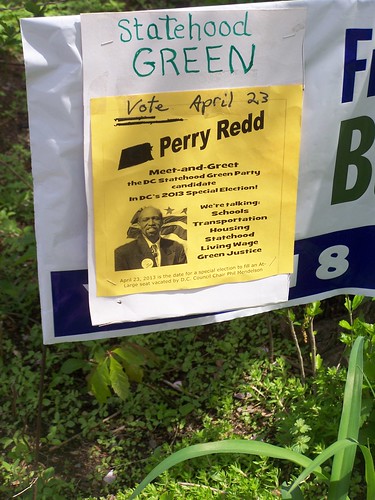
Support Perry ReddStatehood-Green

Perry Redd is probably the strongest candidate for the impoverished, calling for an end to school closures proposed , and full rights for ex-criminals.  While most of his agenda isn't my priority, he's probably my #2 choice, solely from the standpoint of mixing things up.  

He definitely would provide a different political perspective on Council, one that is not supportive of  what are termed neoliberal, market-oriented policies.  But the bulk of his agenda would be more like that of the so-called social justice agenda espoused by Marion Barry during his many terms as mayor (see the books Dream City by Jaffe and Sherwood and Between Justice and Beauty by Gillette).

Since I never voted for Marion Barry, and the modern City of Washington has been shaped by and still executes much of this agenda, I have no desire to support the provision of even more of it, since it isn't working very well as it is.

Democrats

There are five Democrats on the ballot, but one, Michael Brown, a former Councilman defeated last fall, pushed a new candidacy forward for awhile and then dropped out.

Anita Bonds is chair of the DC Democratic Party and a longtime fixture of DC Government and Marion Barry.  She was appointed to fill the expired term that became open.  Under her leadership of the Party, the party hasn't held elections so most of the Committee members of the "DC Democratic Party" are serving beyond their term of office.  That doesn't bode well.

But neither does her long time association with DC politics and DC government.  If you think that DC government isn't working very well, it hardly makes sense to elect more of the same.

Paul Zukerburg's primary campaign plank is legalizing marijuana.  While the libertarian side of me believes in drug legalization (even though at the same time I don't believe in drug consumption), and using the monies spent in that aspect of "the war on crime," on treatment and poverty reduction, it's hardly the most important element of local policy.

So the choice comes down to Matthew Frumin or Elissa Silverman.  

Lotsa younger people and Greater Greater Washington have endorsed Elissa Silverman, given her past work as a journalist for the Washington City Paper (where for a number of years she wrote the Loose Lips column of local political commentary) and a brief stint at the Washington Post and her current work as a policy analyst for the DC Fiscal Policy Institute, a division of the Center on Budget and Policy Priorities, and the foremost nonprofit organization in DC advocating for the impoverished.

The City Paper endorsed Elissa, as you might imagine.

While I like the work that DCFPI does, especially their advocacy against financial support for professional sports teams and the often tooeasy provision of tax abatements and other supports for development, what pains me is that they (like everybody else) have provided no deep, detailed alternative policies and programs for dealing with poverty other than spending more money.

And during the campaign Silverman, probably pandering to upper income residents happy with the way things are right now (in the city zoning changes that can have some marginal impact on residential density and parking supply have got some people up in arms), said a bunch of things about development and zoning that I found troubling.

Matthew Frumin is no radical.  And he's yet another lawyer (his specialty is international trade, working for large corporations), but...

Matthew Frumin has lived in the city for 30 years or so and his three children attended/attend DC schools.  He was a leader in the citizen side of the rebuilding and expansion of Wilson High School.  He has been an ANC Commissioner for three terms, and has shown leadership on development and growth issues, including on reductions of parking requirements in new developments proximate to the subway.

So of all the candidates, save Anita Bonds, he's actually been a pretty committed civic activist, not just being involved, but as a leader, and he has gotten things, good things, done.

Like everyone else, he advocates for more affordable housing and more jobs.  But interestingly, while he doesn't have a special plank on transit, he does advocate for significant investment and reinvestment in local infrastructure, and to his way of thinking that includes transit.  So that's an urbanism plus.

On smart growth type issues, including accessory dwelling units, he's probably the best candidate.

But there is another element to his experience that is "unsurpassed" amongst the candidates and I think this differentiation gives him a special quality that is very interesting and worth adding to Council

For many years he's served as a volunteer election observer overseas, to ensure fairness and inclusion of all participants in the election-democratic-voting process.

Given how monopolistic local politics is in DC, and how because of the monopoly there is a great deal of impropriety and corruption (the Growth Machine writ large), having someone with a great deal of experience dealing with political and civic participation in very difficult and contentious circumstances could give the city a leg up going forward in how it could restructure local politics, governance, and civic participation and capacity building systems locally.

Rather than the half-assed actions we seem to prefer and be comfortable with.

So vote for Matthew Frumin.

(I don't know how well the other campaigns have been organized and where they focused their resources, but I did experience a door-to-door canvasser from the Frumin campaign, but not from anyone else, although I have received a bunch of mailed campaign literature from the campaigns.)

But since Frumin and Silverman (and a soupcon of Mara supporters) are likely going after the same pool of voters, neither one may have enough support on their own.  That might mean Anita Bonds or Patrick Mara wins.

That would be bad, but I don't see how either one is such a big foot (unlike say Ted Cruz, see "Scary Cruz control" from the Post) that they would make that much difference on Council for the next 18 months, and maybe we still have the opportunity for a new, better Councilmember for the 2014 election.

Labels: , , ,

Wednesday, March 20, 2013

Chicago's ongoing debacles: parking and governance

1.  I wrote almost one year ago ("A lesson to cities that they need to be very careful when leasing assets to public private "partnerships"") about the continuing debacle of Chicago's long term lease of its parking garages and parking meters to a for profit consortium.

The consortium sued the city because it allowed a competing privately-owned parking garage to open.  I opined that such a provision in the contract was unenforceable--to require zoning to favor one property owner over another in a contract with a municipality strikes me as illegal.

I didn't realize the contract calls for arbitration, not the courts, to settle disputes.  And according to "City of Chicago hit with $57.8 million tab over parking garage snafu" in the Chicago Sun-Times, arbitrators have ruled in favor of the consortium, which will cost the city almost $60 million.

I guess the city can be happy with the judgement, since it's a lot less than the $200 million that the private consortium was seeking.

2.  In the meantime, parking rates go up this year, to $6.50 per hour on the street in the Chicago Loop.  See "Chicago parking meter rates to rise again in 2013" from the Chicago Tribune.  (Image above: Chicago Tribune.)

3.  I think that this is the fallout from the financial desperation faced by most cities and counties.  Falling revenues, big costs from deferred maintenance and rising pension obligations, and limited sources for new revenues.

So they sign multi-year contracts for items like street furniture-advertising contracts or consider leasing monetizable assets such as parking lots and garages.  (Cincinnati is in the process of doing the latter as well.  See "City responds to restraining order on parking plan" from WLWT TV. Indianapolis did a couple years ago, and Sacramento has talked about it as a funding source for a new basketball arena.)

Oh, and doing speed camera and red light camera deals with firms that fund the installation and share the revenue.  See "Red-light camera firms get heat over tickets" from USA Today.

If there were state ("In I-Bank Debate, States Provide Successful Model," New York Times) and national infrastructure banks (The Case for a National Infrastructure Bank | Brookings Institution), operating somewhat like the Bank of North Dakota or the Federal Farm Credit Banking system, where local governments could do fairer financing deals, the kind of debacle that Chicago will be in for the many decades remaining on the long term lease of its parking assets could be avoided.

Of course, Illinois' state finances are so screwed up that their ability to create a state-level infrastructure bank is minimal.

4.  The cover story, "Why Chicago’s Spineless City Council Just Can’t Say No: Nearly two years after Rahm barreled into office, aldermen are still rubber-stamping everything he wants. Here’s why the trend is so troubling for Chicago’s citizens" of the April issue of Chicago Magazine is on the Chicago City Council and discusses why it is so weak, even though Chicago's charter actually lays out a weak mayor-strong council form of government.

The integration of the Democratic Party Machine into City Government through Mayoral Power has built the current system.  Manipulation of the budget and direction of projects to Aldermanic districts where the Mayor has control, selection of committee chairs, and bottling up critical legislation in the committees of loyal Alderman keeps things the way they are.

One of the complaints in the article is that fundamental oversight--such as for the original parking garage and meter leases--is missing and the costs to the citizenry over the lack of accountability is significant.

Labels: , , , ,

Sunday, December 30, 2012

Big money, ethics violations, etc. in city government

The San Francisco Bay Guardian had a story, "The plutocrat," about a Silicon Valley financier, Ron Conway, throwing his money and influence around to make, in his eyes, SF more "business friendly."  Not unlike how a lot of the conservative super PACs mostly wasted their money in the presidential election, mostly his money went for naught, at least in the most recent election cycle.

But that doesn't mean he and other like-minded peers don't have extra-normal influence.  See "Ed Lee's cronies powerful, critics say" and "Ron Conway: SF mover and shaker" from the San Francisco Chronicle.

Given that they are motivated and have the resources and staying power and focus to maintain efforts on achieving their agenda, they're still in the game.

What's interesting to me and obvious of course is how the "Growth Machine" is operative in the same manner across the universe of cities.  But the coverage of how "the system" works is very localized and perhaps less useful because of the hyper-local focus.

What's dissatisfying is that we don't build knowledge networks across cities and apply the knowledge and awareness to make the system(s) work better.

2.  So in today's Post, columnist Colbert King writes, "What to expect in 2013," about his 2013 predictions including that two DC elected officials--he doesn't name them but likely he means Ward 1 Councilmember Jim Graham (his involvement in lottery shenanigans combined with real estate development shenanigans made this week's New York Times, "Fired, but firing back over dealings in Washington") and Mayor Vincent Gray.  He also predicts that Chief Financial Officer Gandhi will resign over various management failures, and that there might be some improvements in ethics-related oversight.

3.  I'm thinking that for the most part, the ethics infrastructure in the city is pretty weak and this is where looking at other cities could be useful.  In Toronto, they have a broader range of ethics-related infrastructure than we do in DC. This has been discussed quite a bit in the local press in the context of the conflict of interest charges that were brought against Mayor Rob Ford, and the decision by the presiding judge that the Mayor was in fact guilty.

From "The mayor made his choices" in Now Magazine:

While it’s too early to declare the Ford era truly over, it has taught us a few things. One of the most important is the need for the accountability officers (lobbyist registrar, integrity commissioner, ombudsman and a strengthened auditor general) whose positions were established because of recommendations over 10 years ago by Justice Denise Bellamy, who presided over the probe into the computer leasing scandal.

DC's auditor general and the CFO office's auditor ("Ex-D.C. worker: Agency 'quarantined' audits," Post) seem weak.   We don't have an independent ombudsperson position.  I guess the new board of ethics, combined with the elections board, have integrity functions.

4.  It remains to be seen how in 2014, the addition of an elected local Attorney General (although the federal government will still handle most criminal cases through the US Attorney General's office, which is a vestige of Washington's place as the "federal city") will begin to change the political infrastructure towards ethics.

5.  Sadly, the Boss TV show was not renewed for a third season. See "Starz Cancels Kelsey Grammer's 'Boss' After Two Seasons" from Hollywood Reporter. Too bad it wasn't on HBO, likely then it would have not been cancelled.

----------

-- World Bank book, Corrupt Cities: A Practical Guide to Cure and Prevention.

-- "The system of corruption: when you don't understand "systems", of corruption or anything else, you don't understand outcomes," a previous blog entry about the local media's inability to recognize the "system" of corruption in the city, rather than looking at each incident as somewhat disconnected from everything else.

Labels: , , , , , ,

Wednesday, November 07, 2012

McKinsey Center for Government’s anthology Government designed for new times

Keep forgetting to blog about this new resource, which is global in its coverage.

-- Government designed for new times, McKinsey Center for Government

Labels: , , , , ,

Tuesday, August 21, 2012

The Boss, Kelsey Grammer, Starz TV Show

The second season of Boss, a tv show on the Starz network about municipal governance, power and corruption that is set in Chicago, premiered last Friday.  Kelsey Grammer plays Tom Kane, Mayor of Chicago.  He is truly awesome in the role.

The show broadcasts at 9pm on Fridays, with a number of encore repeats during the succeeding week.  The first episode of the second season is also viewable online on the website.

- Boss webpage, Starz
- "The 'Boss' returns, for better and worse," Chicago Tribune

Labels: , ,

Friday, August 03, 2012

Not sure this is a good idea: electing "police and crime commissioners" in England and Wales

(Except for London.)  See "Labour announces police commissioner candidates: Seven former ministers including Lord Prescott are among 41 Labour candidates for police posts in November elections" from the Guardian.  The concern is that the positions and policing get (more) politicized if the leaders of the service are elected, and that maybe the concern for professionalism is downgraded.

In May, voters in 9 large English cities defeated proposals to begin to elect mayors.  Bristol did vote in favor of electing a mayor, and another community, Doncaster, voted in favor of retaining the mayor as the top elected official in their community. See "Cities vote against having elected mayors" from the Guardian and "Nine cities reject elected mayors" from the BBC.

Labels: , , , , , ,

Wednesday, June 20, 2012

Electing a charter commission

Generally, with big planning efforts like a Comprehensive Plan or the Zoning Rewrite, you have an oversight-steering-coordinating committee.  In DC, these committees are appointed by the Mayor and the various Councilmembers.  And let's face it, the Committee members are more oriented to maintaining things than they are to promoting change, especially those people representing the real estate industry.

Sacramento is putting the question of a Charter Revision Commission on the ballot this fall (Sacramento City Council OKs charter commission ballot measures")
from the Sacramento Bee) and interestingly, the members of the Commission would be elected, not appointed.

Of course, I suppose you have to have money to get elected, and that favors monied interests, but still, it's an interesting example of democracy.

Especially in terms of how I argue that after 30+ years of  DC's "Home Rule Charter," it's time for a review in terms of how the Council is set up, how voting works, whether or not the charter commissions (Zoning) work well enough or need to be modified (I think we need a Transportation Commission too and a Planning and Parks Commission as well), an evaluation of Advisory Neighborhood Commissions (which would likely figure out that one, without a capacity building infrastructure they don't work very well, and two, that certain administrative functions could and should be provided on a networked basis), etc.

Labels: , , , , ,