Rebuilding Place in the Urban Space

"A community’s physical form, rather than its land uses, is its most intrinsic and enduring characteristic." [Katz, EPA] This blog focuses on place and placemaking and all that makes it work--historic preservation, urban design, transportation, asset-based community development, arts & cultural development, commercial district revitalization, tourism & destination development, and quality of life advocacy--along with doses of civic engagement and good governance watchdogging.

Sunday, December 20, 2015

DC streetcars move to simulated service: passenger service expected within a couple months: DC streetcars part 1

Just after I listed the ongoing trials and tribulations of DC's launching of streetcar service as #6 in the "Top DC area transportation stories of 2015, "the city transportation department announced that the streetcars were going to start simulated service ("DC Streetcar Pre-Revenue Operations Scheduled to Begin December 16, 2015," press release), the last testing step before beginning operation.

This testing phase will last 21 days, followed by evaluation and further approvals.

This led to a spirited discussion of the issue in a private e-mail group, and it's worth pulling out some of the points.

Almost there... A streetcar sits on the rails along H Street NE near the intersection with 4th Street in Washington. (Eva Russo/For The Washington Post)

It sure is taking a long time.  While the streetcar has been a debacle, planning started in 2003, not 2000. The city didn't make a commitment til 2005, when they agreed to install tracks in the street as part of the streetscape reconstruction. That didn't happen for a few more years. Still, they bobbled the program many times over the years, especially by not designing the power infrastructure in advance of the streetscape reconstruction.

Right: development map along the Cincinnati streetcar route.  I wish I had the ability to produce quality graphics.  No one has created a similar graphic rendition along the H Street streetcar route, development announced, underway, or soon to be announced that is directly attributable to the streetcar is approaching $750 million.

Cincinnati.  It's ironic that the Cincy program will go operational 4 years from start of construction. They are in testing mode now, although they aren't committing to revenue operation til 9/2016. The reason it's ironic is the manager of the effort in Cincinnati was John Deatrick, the former chief engineer for DC's Department of Transportation. He also spearheaded "around the turn of the century" a systematic repaving program for the alleys.

Seattle.  DC and Seattle started streetcar planning at the same time, in 2003. Their first line went operational in 2007. Their second line is just about operational now--delays are due to problems on the streetcar manufacturing side, otherwise the line would already be in service.

That says a lot. I don't know about the launch of the new line in Seattle, but the first line was launched successfully because they hired the same firm that did the launch of and (still) operates the Portland Streetcar.

DALLAS--302 on Trinity River Bridge IBFlickr photo of the Dallas streetcar on the Trinity River Bridge by Peter Ehrlich.  

The testing and safety requirements are the same for all streetcar operators.  The fault in getting it operational isn't the fault of regulations from FTA and others, it's almost completely and entirely failures by DC Government, primarily DDOT, but more recently a lack of commitment from elected officials (and therefore, the city's business community is indifferent too). Note that the Dallas streetcar went to revenue operation last year, after only 6 weeks from receipt of the vehicles.

In response to streetcars vs. buses, vs. trams/light rail vs. heavy rail, etc.  There is a place for streetcars in the transit network. I was re-reading a piece I wrote last year, and I have to say, it's damn good [it is reprinted in the next entry]. It discusses the place of the streetcar in a city like DC as transit, not just economic development, but focused on intra-district mobility.

FWIW, I was a super strong proponent for a long time. Now I think it's a distraction, that DC should have focused on the separated blue line, given the limited resources. That being said, there are equity issues, it's better to improve transit service for the transit dependent, etc.

Will ridership increase in streetcars over bus?  The thing about the expectation of a ridership increase of 40% of streetcar over bus, the reality on H St. might be different. The H St. buses already get between 14K and 15K daily riders. I don't see 4-5K new daily riders because of streetcar (especially because they won't be run at the same frequency). I don't think there are that many trips capable of capture.

No Sunday service.  .. not to mention that DDOT announced the streetcars will not run on Sundays.

That to me indicates that as a transit service, it's not being taken fully seriously.  From the Washington Post article "District says streetcars starting final dry run but still need safety sign off":
A spokesman for the District Department of Transportation said Tuesday that when the doors open to the public, streetcars will run six days a week, with no passenger service after 2 a.m. on Sundays. The city had already rolled back the frequency of daily service, which officials say will run every 15 minutes instead of every 10 minutes.

“Going with six days provides a recovery day for the system. We’ll have a day we can perform track and vehicle maintenance without impacting service,” said DDOT spokesman Terry Owens, adding that officials think such an arrangement “will enhance the reliability” of the 2.2-mile line. “We want to deliver a system that’s safe, sustainable and makes efficient use of our resources. It’s a more conservative approach. But we will always have the option of expanding the days of operations.”
With regard to the streetcar running in mixed traffic: yes, streetcars (and buses) should be prioritized, but we already know that thinking in DC is backwards as it relates to sustainable mobility (walking, biking, transit).

Likely the majority of trips in the city are conducted by sustainable modes, but the mobility priorities of the city do not recognize it (as I wrote before, DC's politics are dominated by the greater automobile-centricity of the outer city). That's an impetus behind my annual "maintenance of way" post for winter weather in the context of the walking-transit-biking city--if the city is pro-sustainable mobility, why do snow clearance practices privilege the motor vehicle?

DC's implementation problems hurt the case for streetcars and transit elsewhere. One of the participants (a railroad planner in the south) wrote:
this project is being hailed by all the anti-rail critics as an example of what could happen to "X" community if "X" community pursues this type of project. Of course, if you believe the Republicans, no one in the hinterlands of the USA believes Washington can do anything right anyhow.
I responded:

The other thing because it is taken so long in DC (I used to promote streetcar service in DC by saying "why wouldn't you want to be the first place for modern streetcar to be implemented on the East Coast?" but Atlanta beat us to it by more than one year) and because of how rail is like fairy dust in bringing out all the opponents, including the latent automobility proponents -- by latent I mean they live in the city and so you'd think they would be predisposed to support transit, but it seems not to be the case -- it makes it f*ing hard and poisons the entire issuespace for transit.

Do people criticize streetcars in part because of how they have been associated with Portland and its reputation as a green-progressive-alternative place?  Image: Portland.

I wonder if it's worth it.  How many of these kinds of articles and editorials in the local newspaper (e.g., "Another wasted year for D.C.’s streetcar to nowhere," Washington Post) can transit withstand?

It's easy for media to jump on the bandwagon and criticize transit, considering how dependent they are on the automobile industry for advertising revenue.

But it's sick for me to be pushed to thinking that it would have been better not to do streetcars because the city wasn't up to the challenge of being able to implement it, that it's easier to drop it.

It's not just DC. It's Arlington with the streetcar, although there it was people in North Arlington who already have subway not caring about improving transit access and equity for south arlington. And then all the b.s. in Montgomery County/Chevy Chase with their opposition to light rail, which almost, but not quite scuttled LR there.

But other areas benefit greatly from streetcar, so DC shouldn't be an outlier.  Besides the streetcar examples of Dallas, Portland, Seattle, Salt Lake City, San Francisco (which is creating a "new" heritage streetcar line, the E Embarcadero line, with new track and some light rail routing and it will enter full-time service next year), and Seattle, all of which are comparable to DC, I forgot to mention Tucson.
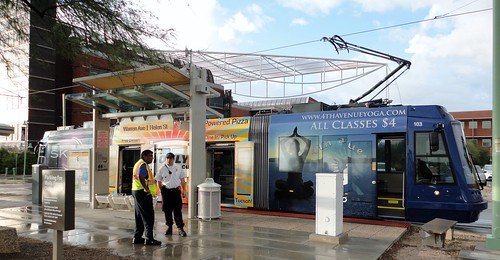
Tucson Sun Link StreetcarTucson Sun Link streetcar.  Flickr photo by Larry Synerson.

Tucson.  According to a suburban town engineer I met a conference a couple months ago, the Tucson streetcar has been electric already (it's been operating for 15 months or so) in terms of resuscitating and repositioning Downtown Tucson as an exciting place to be, to invest, to live, etc.

Orange County, California is moving forward with a streetcar in Santa Ana although of course there is opposition.

But when I first learned about the OC Streetcar project, it made me think of streetcars as an important "priming" and (re)positioning device--not that this is a new realization--for communities not capable of supporting heavy rail, streetcar service is a way to help communities reposition for economic and residential activity in the 21st century vis a vis sprawl,.

This is comparable to the piece I wrote in Spring 2011 making the point that people focused on "the Silver Line and Dulles access" missed the point, it was really about making more of Fairfax County and now Loudoun County relevant in terms of 21st century expectations of how to live, work, and get around.

Fairfax didn't care all that much about the airport, but about making more of its property eligible for federal leasing, attracting TOD, shifting mobility primacy from the car, at least in the Silver Line catchment area, etc.

Orange County has Metrolink railroad commuter service, but it will never get light rail probably, and never ever will get heavy rail.  Streetcar is a way for cities like Santa Ana in Orange County to remain relevant and competitive in the context of transit expansion in Los Angeles County.

FWIW, a lot of the area in Fairfax County that is poorly served by transit generally and heavy rail specifically, especially automobile-dependent industrial space/office space, is in bad shape. There are eminent REITs deeding properties back to their mortgage holders, etc. In. Fairfax. County. in 2014/2015.

Little Rock/North Little Rock is another example. There, the recent I-30 expansion proposals aimed to destroy a necessary bridge for the streetcar ending service in the eastern section of the line and the State Department of Highways and Transportation did not propose taking responsibility for replacing it (like what happened to the Seattle Waterfront streetcar which lost its maintenance yard due to the Seattle Art Museum sculpture garden, and the SAM wasn't required to replace it, and they junked the line).

Negative public response appears to have forced them to change their plans, to keep the full streetcar line in operation.

Heritage streetcar at River Market in North Little Rock.

(Tacoma , Washington also has streetcar service, but it hasn't been particularly successful at spurring revitalization.  I haven't seen the city or the service, so I can't offer scintillating analysis on why this is so.  In large part it's because increasingly, agglomeration benefits connote to locating in Seattle.  One example is how a large firm, Russell Investments, relocated to Seattle, when it had been the shining example of business success in Tacoma.)

MAJOR REALIZATION FROM THE THREAD.  H Street is the only area in Washington DC outside of catchment areas served by Metrorail stations that is experiencing the construction of buildings taller than 4 stories. It's pretty clear this is because of the streetcar.  More on this two posts from now.
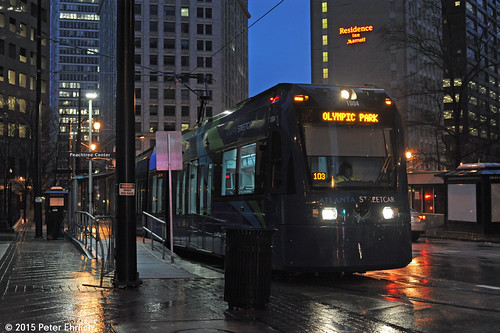
ATLANTA--1004 lv Peachtree Center IB
Atlanta streetcar leaving Peachtree Center at night.  Flickr photo by Peter Ehrlich.

Labels: , , , , , ,

Sunday, October 19, 2014

A further note on the lack of support for critical analysis within communities

Applying the theories of "positive illusions" and "optimistic bias" to local political and economic elites:  Besides the piece I wrote yesterday about "the failure of the Coast Guard headquarters to spur economic revitalization 'East of the River'," which is something I predicted 8 years ago when it was first touted, while doing some filing this morning and re-reading/skimming of stuff I've clipped as I go along, I came across a mention of "positive illusions" and "optimistic bias" theories, spurred by an article in the Chronicle of Philanthropy about how top officials of foundations don't have a lot of experience being criticized since they're handing out money, and people don't want to limit their chances of being recipients.
"Positive illusions" are unrealistically favorable attitudes that people have towards themselves or to people that are close to them. Positive illusions are a form of self-deception or self-enhancement that feel good, maintain self-esteem or stave off discomfort at least in the short term. There are three broad kinds: inflated assessment of one's own abilities, unrealistic optimism about the future and an illusion of control. 
"Optimistic bias is commonly defined as the mistaken belief that one's chances of experiencing a negative event are lower (or a positive event higher) than that of one's peers."
While most of the work on these theories focuses on individual behavior and action, I would argue that there is opportunity within the field to apply these theories to institutions, which are comprised of individuals applying their personal view to external settings and situations, and community action.

Although you could argue that's what Growth Machine and Urban Regime theories do, and maybe positive illusions theory is a good underpinning theory for insight into why local political and economic elites act in the ways that they do.

There is at least one book, Overconfidence and War: The Havoc and Glory of Positive Illusions, that applies positive illusions theories at the scale of nations.  The author argues that:
states are no more rational than people, who are susceptible to exaggerated ideas of their own virtue, of their ability to control events, and of the future. By looking at this bias--called "positive illusions"--as it figures in evolutionary biology, psychology, and the politics of international conflict, this book offers compelling insights into why states wage war
I think it's fair to say that individual political and economic actors believe that they are more able and more successful and more correct than their peers and citizens.

In fact, even before I wrote the other piece, as I was coming home from the Metro yesterday morning, a neighbor stopped me on the street to discuss a recent agency action affecting the little one block commercial district in our neighborhood.  Among other things,concerning the matter he described past interactions with our Councilmember, who is running for mayor, as "like many people who work for government who don't really listen but after you say something, they instruct you on 'how things really work or are.'"

It's that kind of thinking, but to be fair to her, it's gone on along time.

E.g., I remember being shocked during the Bush Administration reading something in the New York Times Magazine about how the people running government create their own reality. From Ron Suskind, “Without a Doubt,” New York Times, 17 October 2004:
In the summer of 2002, after I had written an article in Esquire that the White House didn't like about Bush's former communications director, Karen Hughes, I had a meeting with a senior adviser to Bush. He expressed the White House's displeasure, and then he told me something that at the time I didn't fully comprehend -- but which I now believe gets to the very heart of the Bush presidency. 
The aide said that guys like me were ''in what we call the reality-based community,'' which he defined as people who ''believe that solutions emerge from your judicious study of discernible reality.'' I nodded and murmured something about enlightenment principles and empiricism. 
He cut me off. ''That's not the way the world really works anymore,'' he continued. ''We're an empire now, and when we act, we create our own reality. And while you're studying that reality -- judiciously, as you will -- we'll act again, creating other new realities, which you can study too, and that's how things will sort out. We're history's actors . . . and you, all of you, will be left to just study what we do.''
This kind of thinking and belief is what is going on at all levels of government, and like Aaron Renn discusses in his piece in Urbanophile, communities keep the faith by not scanning externally all that much or by having circumscribed understandings of what is happening elsewhere.

For example, I went to a great conference on housing matters (I will be writing it up), and I was talking with a low level person from HUD manning their information booth, and when I mentioned that I work on "urban revitalization" she told me about a report that HUD recently did with the Urban Institute called Retail in Underserved Communities,.

It happens that I am familiar with that report, and more importantly, have on the ground experience with two of the three case studies in the report (one from Pittsburgh and the other from DC).

I told her that the cases are outliers and for the most part the situations are un-extendable to weak market distressed communities elsewhere as both are more about highly successful urban neighborhoods running out of land to develop and therefore moving on to immediately adjacent land that happens to be available and located in a "distressed area" (not unlike the "One Over Neighborhood" approach of the Live Baltimore urban residential recruitment organization, see "In search of the next hot neighborhood").

In fact they are classic examples of older ideas of urban redevelopment when the only value possessed by distressed communities is land able to be assembled and redeveloped for another another purpose.

Manifest destiny or "reproduction of space" by highly resourced economic elites is not ground up urban revitalization helping the impoverished.

And unless distressed neighborhoods are immediately proximate to some of the most successful neighborhoods in their region, they aren't going to be able to make the case to Whole Foods, Trader Joe's, and others, using the examples presented.

Etc.

Labels: , , , , , ,

Friday, October 17, 2014

Critical analysis and critical analysis of retail, communities, etc.

Urbanophile has a piece, "Creating a Culture of Honest Critique," about how the Dallas Morning News has hired an architecture critic, in association with the University of Texas at Arlington, to up the level of critical analysis for the paper and the architecture beat. The critic, Marc Lamstetter, started off with a serious critique of the new George W. Bush Presidential Center and Library, and apparently the bracing review has ruffled feathers.

Aaron goes on to discuss what we might call the cheerleader issue and how most communities aren't comfortable with hard core critical analysis.  He focuses on "small towns" but I think this is an endemic problem regardless of the size of a community.

I call what I do critical analysis" but most people seem to take it as "(personal) criticism" and they don't like it.  And elected officials in particular prefer to shoot the messenger rather than dealing with message.

2. Along with the cheerleading thing, lately I have noticed advocacy organizations recommending to their members that they don't criticize elected officials, who for the most part, support their positions, as elected officials believe that they are doing all that they can, and that should be respected, rather than focus on the negatives of compromise, stalling, and sub-standard efforts and realization.

Image from Waymarking.com.

That's why I was surprised to see this piece in yesterday's New York Times, "A Whole Town in Colorado Pushes to Improve Its Customer Service," about Steamboat Springs, Colorado, and its initiative on improving the customer service quality of local businesses, in response to "average" ratings on the survey question "How likely is it that you would recommend us to a friend or colleague?"  Analysis of the data found low scores concerning quality and service at local stores and restaurants.

A couple years ago, I wrote a piece ("Speaking of unsatisfactory visitor experiences: the breakfast at Hotel Harrington sucks") that suggested that local convention and visitors bureaus should do "mystery shopper" surveys of local establishments, to provide businesses with third party "objective" evidence about the quality of service, and the need to improve.

This is because many businesses catering to tourists--this is a problem in cities like DC or even Gettysburg, Pennsylvania--are comfortable providing bad service or food knowing that most customers won't be coming back anyway.

3. Relatedly, I argue about the difference between uniqueness and exceptionalism in communities.

All places are unique. But most places function similarly based on various elements and characteristics. That's why I am able to compare places, make recommendations, write plans, etc. But as long as people focus on uniqueness and are unwilling to compare, too often they end up embracing mediocrity and improvement takes a long time to happen, if it ever does. See "Chauvinism, mediocrity, and robust systems" from 2008.

Labels: , , , , , ,

Tuesday, May 07, 2013

Municipal contract corruption: the response is fixing the problem not eliminating oversight

Both the Washington Post ("Curtail D.C. Council power over contracts") and Councilman David Grosso ("Pol protests D.C. Council contract vote" from the Washington Examiner) are wrong about what the problem is with government contracting in the city.

The Post and Councilman Grosso argue--CORRECTLY I MIGHT ADD--that the requirement that all government contracts over $1 million be approved by City Council sets up the possibility for contract steering and other problems.

They say then that City Council shouldn't have the authority to approve contracts. (Note that Councilman Jack Evans is fine with limiting oversight also.)

2.  But that only works if we know that the contracting process by the Executive Branch is completely and fully fair.  We already know that isn't the case.

There are many examples of contracting improprieties with every one of the city's Mayors, Marion Barry especially but there have been problems with most Administrations since, even at times, Anthony Williams.  Mayor Fenty was particularly bad in terms of contract steering and manipulating the contracting process with nonprofit instrumentalities controlled by DC government agencies.

And of course there are thousands of examples of such problems all around the country.  So giving the Executive untrammeled authority over contracting (cf. "absolute power corrupts absolutely") is hardly the proper course of action.

book cover, Corrupt Cities: A Practical Guide to Cure and Prevention by Robert Klitgaard, H. Lindsey Parris3.  The DC Council is equally bad in that it is exempt from the rules for contracting openness--there is no requirement on Council to have an open tender process/public RFPs.  That's an issue with the no-bid contract--seeking private funds to pay for it, making it even worse--to a law firm to do "education research" for the Council Education Committee (see "Catania hires law firm to help craft D.C. school legislation" from the Post).

4.  The solution isn't less openness and less transparency and less oversight (this pretty much is the Post editorial response to just about any problem with local government--more authoritarianism, not less), but more.

The response then should be to structure the Contract Approval Process in a way that keeps the openness and transparency and reduces the discretion.

5.  Probably the response is (1) a public notice on all contracts as part of the DC Council Agenda process; (2) which are approved in an up or down vote; (3) with the ability to pull out particular contracts through a specific process and procedure.

There are problems with this approach too.  It would be similar to the DC City Council Disapproval Resolution process--but like the filibuster, this process now is set up to aid the Councilmember who initiates the Resolution in extracting extranormal concessions (usually on unrelated matters) from the Executive.

---------------
From "Corruption" by Shliefer and Vishny:

This paper presents two propositions about corruption. First, the structure of government institutions and the political process are a very important determinant of the level of corruption. In particular, weak governments which do not control their agencies would lead to ultra-high corruption levels. Second, the illegality of corruption and the need for secrecy make it much more distortionary and costly than its sister activity, taxation. These results may explain why in some less developed countries, corruption is so high and so costly to development.

While the paper is focused on so-called third world countries, I think it's fully relevant to municipal governments, which often operate with significantly less oversight than is sometimes warranted (see "Five ex-officials from Bell,  California, convicted in corruption trial" from Reuters about Bell, California and "SEC says Harrisburg, Pa., misled bond investors" from the AP about Harrisburg, PA -- but these are just a couple of examples, there are many).

Shliefer and Vishny extended their arguments in a book, The Grabbing Hand: Government Pathologies and their Cures. A review in the Economist states that the book is important because

There is no comparably elaborated body of thought based on the idea that governments are, like individuals, rational and self-interested—in other words, that they are chiefly concerned with winning power, exercising power and hanging on to power. ...

Messrs Shleifer and Vishny are trying to put that right. They believe their “grabbing hand” model is a distinctive alternative both to the “helping hand” (market-failure correcting) model of mainstream thinking and to the invisible-hand paradigm of the public-choice school. It is certainly closer to the second than to the first. But what divides it from the invisible-hand approach is its prescriptive content—its emphasis on tilting the balance of political costs and benefits in order to bring public and private interests into closer alignment, leading, they hope, to better (but not always less) government.

The point with regard to setting up better processes and systems for contracting is to put checks on the power, not to increase power and the ability to be corrupt by removing checks on that power.

Other resources:

-- past blog entry, "More on DC ethics and corruption: intrinsic vs. extrinsic behavior"
-- Corrupt Cities: A Practical Guide to Cure and Prevention (pdf)
-- Chicago and Illinois, Leading the Pack in Corruption, University of Illinois Institute for Government and Public Affairs.  Note that according to this report, DC is one of the most corrupt "states" in the US.

Labels: , , , , , ,

Sunday, December 30, 2012

Big money, ethics violations, etc. in city government

The San Francisco Bay Guardian had a story, "The plutocrat," about a Silicon Valley financier, Ron Conway, throwing his money and influence around to make, in his eyes, SF more "business friendly."  Not unlike how a lot of the conservative super PACs mostly wasted their money in the presidential election, mostly his money went for naught, at least in the most recent election cycle.

But that doesn't mean he and other like-minded peers don't have extra-normal influence.  See "Ed Lee's cronies powerful, critics say" and "Ron Conway: SF mover and shaker" from the San Francisco Chronicle.

Given that they are motivated and have the resources and staying power and focus to maintain efforts on achieving their agenda, they're still in the game.

What's interesting to me and obvious of course is how the "Growth Machine" is operative in the same manner across the universe of cities.  But the coverage of how "the system" works is very localized and perhaps less useful because of the hyper-local focus.

What's dissatisfying is that we don't build knowledge networks across cities and apply the knowledge and awareness to make the system(s) work better.

2.  So in today's Post, columnist Colbert King writes, "What to expect in 2013," about his 2013 predictions including that two DC elected officials--he doesn't name them but likely he means Ward 1 Councilmember Jim Graham (his involvement in lottery shenanigans combined with real estate development shenanigans made this week's New York Times, "Fired, but firing back over dealings in Washington") and Mayor Vincent Gray.  He also predicts that Chief Financial Officer Gandhi will resign over various management failures, and that there might be some improvements in ethics-related oversight.

3.  I'm thinking that for the most part, the ethics infrastructure in the city is pretty weak and this is where looking at other cities could be useful.  In Toronto, they have a broader range of ethics-related infrastructure than we do in DC. This has been discussed quite a bit in the local press in the context of the conflict of interest charges that were brought against Mayor Rob Ford, and the decision by the presiding judge that the Mayor was in fact guilty.

From "The mayor made his choices" in Now Magazine:

While it’s too early to declare the Ford era truly over, it has taught us a few things. One of the most important is the need for the accountability officers (lobbyist registrar, integrity commissioner, ombudsman and a strengthened auditor general) whose positions were established because of recommendations over 10 years ago by Justice Denise Bellamy, who presided over the probe into the computer leasing scandal.

DC's auditor general and the CFO office's auditor ("Ex-D.C. worker: Agency 'quarantined' audits," Post) seem weak.   We don't have an independent ombudsperson position.  I guess the new board of ethics, combined with the elections board, have integrity functions.

4.  It remains to be seen how in 2014, the addition of an elected local Attorney General (although the federal government will still handle most criminal cases through the US Attorney General's office, which is a vestige of Washington's place as the "federal city") will begin to change the political infrastructure towards ethics.

5.  Sadly, the Boss TV show was not renewed for a third season. See "Starz Cancels Kelsey Grammer's 'Boss' After Two Seasons" from Hollywood Reporter. Too bad it wasn't on HBO, likely then it would have not been cancelled.

----------

-- World Bank book, Corrupt Cities: A Practical Guide to Cure and Prevention.

-- "The system of corruption: when you don't understand "systems", of corruption or anything else, you don't understand outcomes," a previous blog entry about the local media's inability to recognize the "system" of corruption in the city, rather than looking at each incident as somewhat disconnected from everything else.

Labels: , , , , , ,

Tuesday, January 31, 2012

Detailed criticism of IFF study of DC public schools

I haven't read the report yet (Quality Schools, Every School, Every Child, Every Neighborhood), so I haven't felt comfortable commenting, although it is true that based on the dictum in Graham Allison's Essence of Decision that "where you stand depends on where you sit," the fact that the Illinois Facility Fund is a real estate organization focused on charter schools enablement leads to the supposition that they will draw certain conclusions.

The Teachers and Parents for Real Education Reform blog has criticism of the current report, as well as previous entries about the process. See "IFF Study Released to Criticism of Research Methodology."

From the entry:

The IFF report’s methodological problems can be summarized as follows:

• The researchers created a zero-sum game in which schools are divided into four “Tiers” based on how much better or worse their DC-CAS scores are from the mean score. Each school is deemed to have “performing seats” or “non-performing seats” depending on whether students’ DC-CAS scores are higher or lower than the mean. Under this methodology, there will always be winners and losers relative to other schools.

• When schools are compared, no account is made of the socio-economic background of the students or the number of special education students, or English language learners among them. Differences in DC-CAS scores are compared under an assumption that students are all equally equipped and supported to do well. The differences in achievement and whether the trend is upward, downward or stationary is credited entirely to the school.

• Within each of 39 neighborhood clusters, when schools get different DC-CAS results, the researchers assume that the students are the same and therefore, the difference is a credit to the school. No attempt is made to look at possible differences in socio-economic background of the students who select one school over another, which might be different than the neighborhood overall. ...

• The researchers acknowledged that standardized test scores are not the best way to measure the quality of a school, and they wished they had other ways describe differences in quality, but used the only measure that they had at their disposal. Notwithstanding their admission, this study is the most extreme example of reducing the quality of a school only to its test score we have ever encountered. No other factors were used. Most reputable research examining school improvement efforts, for example that of the highly esteemed Consortium on Chicago Schools Research, has never taken this reductionist approach.

• The IFF researchers failed to consider recent history in DCPS, before making their recommendations. The track-record of school turnarounds in DCPS [by charter school organizations and others] since 2008 has been an embarrassment. Outside management firms have been brought in to run Dunbar, Anacostia, and Coolidge high schools. Two have abandoned their partners. None of them have achieved significantly better results. School consolidations have led to explosive results at Hart MS and elsewhere. The national report card for national charter chains has not been good. In other words, there is no silver bullet contained in changing the management of schools. Nevertheless, the folks at IFF are wedded to this recommendation as their bias. It will be resisted in DC for good reason.

• The IFF also seems to ignore the national research that shows a mixed track record of school turnarounds and national charter chains, and overwhelming national research that demonstrates that standardized test scores tend to mirror the socio-economic background of the students taking the test. It is one thing to make every effort to counter this reality with programs and strategies that mitigate the effects of poverty. It is quite another to structure a study premised on the assumption that any difference in test scores is the result of good or bad teaching alone, or as they term it – “performing seats.” The simplistic design of this study flat-out ignores the national research and it promotes an unfair and punitive set of assumptions in response to the data.

Labels: , , , ,

Friday, October 14, 2011

Local government contracting: the grass debacle

In the papers for the last week has been a bunch of thundering by the Washington Post about grass cutting no less.

Under the Fenty Administration, they decided it made more sense (and they were right) to have a master lawn cutting contract for DC Govt. facilities, rather than for each agency to do their own contracting.

The city allowed the contract to be awarded either for the whole city or for a select number of subdistricts based on wards.

There are lots of problems with support of local business and jobs development in government contracting. I don't think it's intentional, not exactly, but the problems exist nonetheless.

1. Depending on how the contracts are worded, they have many difficult provisions that often require advancing significant sums of money (an article about a fraud in yesterday's Examiner mentioned in passing that the proposed contractor needed to put $615 million in an escrow account to prove that his relatively small business could perform--that's a lot of money even for the largest contractors)

2. Not to mention fees, licenses, costly legal advice, etc;

3. Lots of time required to complete the proposal;

4. And usually on hyper-short deadlines (e.g., I am working on a response to a $40 million RFP that has less than a 5 week response period--and it requires local partners, partners certified as disadvantaged businesses, being licensed in that state, insurance and bid bond certifications, voluminous economic disclosure requirements for each partner-contractor and those relationships take time to execute besides, plus all the actual response in words to the various requirements, not to mention very specific document preparation requirements).

The main contractor on this grass cutting bid is based in Baltimore and uses zero DC residents on the job. The secondary contractor is DC-based (but that may be in name only).

The Post says that what matters most is the lowest cost. And they mention how the secondary contractor has friends in high places in the city, which may be influencing what's happening with the project.

I think the Post is right to be concerned about contract steering, but wrong to ignore cui bono -- who benefits.

With DC's high unemployment rate and the relatively low skill requirements for cutting grass, this contract is a perfect way to employ under-skilled DC residents who need work.

At the same time the Post could have done a better job thinking (and then writing) about how the local government contracting process works.

If you want local employment, you need there to be local businesses. But local governments, as stated above, usually structure contracts in ways that make it very difficult for local business owners to win contracts and for local residents to be employed. (Plus as discussed the other day, governments, like other large institutions, tend to be more comfortable dealing with other large organizations, which pertains to contracting as well.)

Slicing up the grass cutting contract into smaller pieces actually is a good thing, if you want to foster local employment and business development. It's a way for smaller businesses to be competitive and to develop.

Think of it in terms of trash collection. A small company would have a hard time executing trash collection services for the entire city of Washington. But if the contract were divided into 3 or 4 pieces, small companies could compete.

The other way, only two major companies can successfully compete for this business--Waste Management and Republic (which purchased the company which purchased BFI)--and they are companies that operate on a national scale.

At the same time, you need to build the technical assistance and support capacity to nurture and develop smaller businesses and relationships, and you have to focus constantly on the contracting process to ensure that not only is it fair and transparent, but it isn't unbearably onerous.

Shockingly, in "Spending D.C. money in D.C.," Washington Examiner columnist Jonetta Rose Barras gets the issue exactly right, right on every dimension that the Post got wrong. From the article:

In a city where the unemployment rate in some communities is as high as 20 percent, a debate over whether a grass-cutting contract to a Baltimore firm should continue is an important public policy discussion. Unfortunately, Mayor Vincent Gray didn't prompt it directly. Rather, it was instigated mostly by the Washington Post, which has published multiple editorials about the administration's effort to discontinue its contractual relationship with Lorenz Lawn and Landscaping.

Lorenz is one of two companies sharing more than $2 million in lawn mowing business. The other firm -- Community Bridges Inc. -- is a certified District-based, minority, disadvantaged company; that designation won it preferential points. Still, Lorenz was hired to cut grass in six of the city's eight wards. CBI was chosen for the other two wards. ...

By his actions, [Mayor] Gray was raising legitimate questions: How can he get more residents employed? Should the city spend its contracting dollars only with District-based companies that hire District residents? Under such circumstances, can the city get the best bang for its buck? ...

Confession: I shop almost exclusively in the District. I like spending my money where I live -- where my tax dollars are likely to circulate to help my neighbors, to build critical public institution and to make the city a better place.

There's no reason the government can't make a similar decision -- particularly when elected officials have invested millions of dollars in the city's community college and career-focused high schools. They have argued they want to grow a work force that could satisfy the needs of existing companies. They also want to expand the number of successful small businesses, which experts have documented are responsible for creating many new jobs.

It seems logical, then, that Gray would more closely examine -- and possibly reallocate -- contracting dollars.

But, as Cheh said, "He has to operate in the open and he has to articulate his goals for everyone to understand."

Labels: , , , ,

Wednesday, July 29, 2009

Corrupt Cities: A Practical Guide to Cure and Prevention

In a previous comment thread, EE mentioned this book as a useful resource for dealing with the culture of corruption in DC. Through Google Books, the entire text is online here: Corrupt Cities: A Practical Guide to Cure and Prevention.

Chapter 3, "Corruption as a System" starts on page 31. As it says on page 32:

Corruption equals monopoly plus discretion of public officials minus accountability.

Chapter 3 describes the system; Chapter 4 is on diagnosis of specific corrupt systems and situations; Chapters 4 and 5 are on overcoming bureaucratic resistance to honesty; and Chapter 5 is on creating a sequenced plan of action to heal corrupted systems, rupture a culture of cynicism, build political momentum and transform city government.

I have always found the public programs where everyone reads the same book to be a bit wanting.

-- "ONE BOOK" READING PROMOTION PROJECTS (Center for the Book, Library of Congress)

For example, I have thought that cities ought to start off with a book like Cities Back from the Edge: New Life for Downtown, in order to explain how urban revitalization works best (although DC doesn't really follow that model).

Clearly, Corrupt Cities: A Practical Guide to Cure and Prevention is another book that needs to be in the rotation...
Money Faucet #2

Labels: , , , , , ,

Friday, January 02, 2009

Take a (virtual) walk in Jane Jacobs' neighborhood

Through this thread in the Wired New York website. There are a couple dozen great photos of West Greenwich Village.
West Greenwich Village, New York City
West Greenwich Village, image from Wired New York.

Relatedly, Barack Obama seems to understand some of Jane Jacobs, judging by this youtube video of a campaign event in Toledo, Ohio (when I was bored in Ann Arbor sometimes I would drive, yes I used to have a car, to an all night diner near the airport in Toledo).

My concern about the stimulus is that we should slow down, and take the time to invest in projects that will truly add to the nation's and metropolitan region's ability to compete and grow. Rather than just focus on projects that are "shovel ready." You see, once we commit to this money in FY 2009, there is a good chance that there won't be more money available to invest in projects that aren't just spending money now, but investing in substantive ways in our future.

E.g., I'd rather spend $80 million on streetcars in Philadelphia and Washington, DC, than on loading docks for the Philadelphia Museum of Art. See "Phila. seeks federal funds for list of projects" from the Philaelphia Inquirer.

Click here for a list of all the projects submitted by members of the US Conference of Mayors.

Labels: , ,

Federal gasoline excise tax

The reason that the Federal Government creates independent commissions is because they are able, generally, to say things and make recommendations that politicians, fearing if they make hard choices that they will increase the likelihood of defeat in the next election, won't make.

The Defense Base Closure and Realignment Commission (BRAC) is a perfect example. So seemingly, is the National Surface Transportation Infrastructure Financing Commission, a 15-member panel created by Congress.

One of the problems with these kinds of commissions is that they tend to have membership drawn equally between Democrats and Republicans, and at some point, ideology colors the final recommendations and the ability to reach consensus. (As Steve Burghardt says in the sadly out-of-print Organizing for Community Action, consensus isn't all it's made out to be. Sometimes, you have to buck up and do the right thing.)

Last year they came out with a report, The Path Forward: Funding and Financing Our Surface Transportation System (downloadable from their website), focusing on the nation's transportation priorities in advance of the next Transportation appropriations and authorization bill next year. Note that somewhere I read recently that all of the increases in funding for transportation over the past few years went to Congressional earmarks for transportation. Obviously, many of these projects were and are worthy. Many are not.

I was disappointed that the failed to make recommendations about the creation of a true national railroad transportation vision and network.

Now, according to press reports, such as "Panel Urges 50% Gas Tax Increase" from USA Today, they are recommending up to a 40 cent increase, phased in over five years, to the federal gasoline excise tax.

When even conservative columnist Charles Krauthammer, in "At $4, Everybody Gets Rational," recommends an immediate significant increase in the gas tax, this is disappointing, and fails to leverage the ability of commissions such as this to make tough recommendations that can always be ameliorated in the give and take and push and pull of politics.

From "Panel Urges 50% Gas Tax Increase" in Time Magazine:

A study by the Transportation Research Board of the National Academies estimated that the annual gap between revenues and the investment needed to improve highway and transit systems was about $105 billion in 2007, and will increase to $134 billion in 2017 under current trends.

-----------
Two things.

1. It's appropo at the beginning of the new year to repeat a line I have:

When you ask for nothing, that's what you get. When you ask for the world, you don't get it, but you get a lot more than nothing.

2. Which is based on something I learned a couple decades ago while working at the Center for Science in the Public Interest, a consumer group with Nader lineage (which CSPI tried to disavow). I learned this through observation, it wasn't something that the organization taught to its staff people.

Basically, you need to treat an issue as a continuum of positions, with a variety of policy-proscription points. I prefer to think of it as a kind of scatter plot, with the most conservative position on the far left of the line, and the most progressive position on the far right of the line, and all sorts of positions, all over the map, in between.
Scatter Plot - Issue continuum
My sense of what I call the issue continuum.

I learned that the best consumer groups stake out the hard core, toughest, most progressive position.

You do this because in the end, you get much more movement towards the ideal, than if you were willing to compromise early, often, and far more conservatively.

It means that you never win. Because there is always plenty that you end up giving up.

But the end result, at the time, is far better than if you caved earlier.

It's why I tend to stake out much harder core positions, and criticize easy compromise, and wimpiness.

Some people and organizations have to stake out the harder core position in order get a better result. But the world is better as a result. Even if you personally are always disappointed, and seeking more.

Labels: , , , , ,

Wednesday, October 22, 2008

How we know that DC is totally, completely, and unequivocally screwed

PH2005080901873.jpg
Washington Post photo.

Because the Mayor says the most important priority for the city with regard to transit is moving the WMATA headquarters from downtown to Anacostia.

See "D.C. Mayor Adrian Fenty says moving Metro top priority." from the Washington Business Journal.

Meanwhile, the city doesn't really have a comprehensive transportation plan.

Meanwhile, the city doesn't have a commitment to transportation demand management.

Meanwhile, the city hasn't committed to funding streetcar expansion.

Meanwhile, the city isn't addressing the need to build a separated blue line subway to add capacity and redundancy in the center city.

But yep, we want to move the WMATA headquarters, which is located in a place roughly convenient to 5 subway lines with a little bit of walking, to a place with access to one subway line. It is unlikely that the profit from selling the site will generate enough money to build a new headquarters. So what is the benefit? And who benefits? In short, is DC really that much better off with another downtown office building for law firms?

This is called dis-agglomeration -- if there were such a word.

agglomeration economies: economic geography suggests that firms (organizations) in the same industry may be drawn to the same locations because proximity generates positive externalities or 'agglomeration effects.'

In this case, firms are government agencies and it makes sense to place them close together. It also makes sense to locate such organizations in places where there are more transit connections, not fewer.

But in DC, for the most part, we have teflon politics. The future doesn't look good.

Labels: , , , ,

Monday, October 20, 2008

Giving technocracy an even worse name

Gary Imhoff writes in the introduction to themail:

Another laudatory article about Chancellor Michelle Rhee was published last week: Clay Risen’s “The Lightning Rod,” in the November Atlantic Monthly. However, as the article’s title indicates, Risen already sees some of the problems Rhee is creating. Although Risen is clearly cheering for Rhee, he calls her “controversial” and gives an almost fair hearing to her critics.

Most importantly, he understands what is at stake in Rhee’s and Fenty’s dictatorial stance toward public education, and frames the argument well in his last paragraph: “It is to answer a basic question about the nature of urban governance, a question about two visions of big-city management. In one, city politics is a vibrant, messy, democratic exercise, in which both the process and the results have value. In the other, city politics is only a prelude, the way to install a technocratic elite that can carry out reforms in relative isolation from the give-and-take of city life.

Rhee’s tenure will answer whether these two positions are mutually exclusive — and, if they are, whether public-school reform is even possible.” Fenty and Rhee see themselves as part of that technocratic elite, isolated and above having to respond to the democratic mob over whom they rule, and not to be questioned or challenged by citizens or their representatives on the city council. Risen’s question answers itself; of course the two positions he describes are mutually exclusive, and lasting reform of any public agency can only be brought about through a democratic process in which citizens are full participants.

--------------
Hey, I am big on technocracy. But when you do it, you can't screw it up, you have to have a deep and wide fundamental understanding of the subsystems, processes, structures, culture, and issues that shape the system you are trying to change-innovate-transform.

Almost by definition, if "technocracy" is focused on fixing people rather than on building robust and resilient systems that support and strengthen the people who do the work and receive the services, it isn't technocratic, because it isn't system based. Therefore it is more than likely to fail.

My observation (and I don't have children) is that the changes in the school system thus far are on trying to hire "superstar" teachers and principals who then must work without any fundamental support structure for either the school or the classroom. Even the most able people cannot succeed without structure and support (see the factors leading to job dissatisfaction as discussed in Herzberg's Motivation-Hygiene Theory).

Some of the most interesting successes in education today, in Montgomery County, Maryland's Title I schools, and the Region 5 District in New York City covering parts of Brooklyn and Queens, under Superintendent Kathleen Cashin, show the necessity of building strong systems and processes that support principals, teachers, and students at many levels.

From the New York Times article, "Bucking School Reform, a Leader Gets Results," about Dr. Cashin:

Where Mr. Klein insists that school administration must be reinvented to reverse generations of failure by generations of educators, Dr. Cashin, a product of the old system, insists she can get results with a clear instructional mission, careful organization and a simple strategy of every educator’s being supported by an educator with more experience.

According to the article "Staff Investment Pays Dividends in Md. District" from Education Week, 3% of the annual budget for the Montgomery County School System is spent on staff development, including hiring, because "investing in choosing the right people and providing them with the right kind of training builds a shared culture of language, goals, and methods" focused on achieving outcomes. A followup article published earlier this year, "When "Unequal" Is Fair Treatment," demonstrates the effectiveness of this complete approach, highlighting MCPS success in achieving high outcomes from lower income schools.

What we need is a superstar "system" that supports and develops people--principals, teachers, support and resource teachers and staff, children, and parents--at all levels. Until we get that type of approach, Chancellor Rhee and Mayor Fenty are likely to fail, giving us technocrats an even worse reputation.

Labels: , ,

Thursday, September 04, 2008

Privatization, outsourcing, and the government

I have to admit, there are things that a government agency may not do as well as a private business, which has the concern about profits and competition as motivators to be responsive. Not that it always works. There can be a complacency when there isn't much competition or with a particular way of doing business that may have been successful for a long time.

But because of hurricanes, again people are pointing out the success of Walmart in distributing needed products, distribution that can work better than FEMA or state agencies.

The reality is that this is a no brainer. Walmart's core competency, their entire business model, rests on premier logistics, distribution systems, and supply chain management. They do this every hour of every day. They have to be good at it. If they aren't, Target or other companies will take advantage of their missteps.

Post-disaster supply chain management by FEMA just isn't that robust. It likely won't ever be, because compared to a 24/7/365 global supply chain (likely to become less global as transportation costs increase due to increases in oil prices), it isn't called upon to perform often enough. Frankly, even the military's distribution, logistics, and supply chain management systems are impacted by needing appropriations etc. from Congress (i.e., the problem with needing to "armor-up Humvees to protect from IEDs and lags in getting money and equipment).

Maybe it should be contracted out.

Similarly, I had an e-talk with a colleague in Cincinnati, who questioned my support of streetcars wrt their consideration there. She said, "are they all that important if it's just a matter of getting white people to ride, when they won't ride the bus?"

So I started talking about choice riders etc.

But later I was thinking about this in terms of how transit service is conceptualized. Is public transit supposed to be a service of last resort for people who don't own cars? Or is public transit supposed to be a system to enhance mobility by reducing the need and demand for automobiles, supporting urban economic development, reducing traffic and congestion, and getting _very large numbers of_ people to places effectively and efficiently.

For a lot of places, government provision of services are focused on providing service to people without other choices.

Maybe that inalterably impacts how service is provided?

Anyway, a couple weeks ago I had the tv on and came across the very tail end of an episode from a couple years ago of Gordon Ramsey's Kitchen Nightmares. The last couple images of the show showed buses from the Brighton & Hove transit system. One had a "shop local" message on the back of the bus. The other, I'm not sure, but I think it was about late night service hours for the bus system.

So I looked up photos of B&H buses on the web and found out a few things:

1. Buses are painted for specific routes.
2. With route numbers, and information on primary destinations along the route, and frequency of service.
3. They have a nice campaign for marketing riding the bus.
4. The system is privately owned, although it does receive public subsidies. (This is typical of the provision of bus service in the UK, and was typical of certain types of transit service in the U.S. for many years, until by the 1970s most privately owned public transit systems finally went bankrupt.)

But I wonder if because they are a privately owned system, they have a greater orientation to customer service and marketing, because it helps them make more money (and reduces the amount of money needed for subsidy)?

Real time bus information sign, Brighton & Hove, UK by you.
Real-time bus information signs.

Brighton_M95WBW Mike Penn
Promotion of all day rider passes.

Brighton_and_Hove_Regency_Route_Scania_OmniDekka
Painting scheme is bus-specific, listing primary destinations and service frequency. (Note that I know that the 38B Ballston-Rosslyn-DC Metrobus does this too, although not service frequency, and so does the Potomac Yards Metrobus, maybe the 9A, as does the Downtown Circulator.)

http://i194.photobucket.com/albums/z3/coryk8/LadyMarmaladeontheBus.jpg
Local band, Lady Marmalade, featured in the "I ride the bus" campaign.

Labels: , , ,

Wednesday, August 27, 2008

Now that's mixed use

The Gazette reports on library planning for Silver Spring, in "Adults, teens discuss wish list for library." According to the article:

The proposed library would be at the corner of Wayne Avenue and Fenton and Bonifant streets. The 66,000-square-foot site will most likely feature the multi-story library, affordable housing units and a station for the Purple Line, which is slated to run through the property.

A public transit station and a public library and... Impressive.

Meanwhile, DC just can't seem to figure out how to make mixed use, and the achievement of multiple objectives from one piece of property, a reality.

MontCo isn't perfect. They aren't putting a bicycle station in the Sarbanes Silver Spring "Transit" Center, although they are providing connections to bicycle trails.

Labels: , , , , ,

Tuesday, August 19, 2008

New Orleans...

when I was there a couple years ago, someone referred to the city as the northernmost Caribbean city. Maybe that's why it doesn't run so well... remember that line about DC, "northern charm and southern efficiency"?

Karen Gadbois is a New Orleans activist focused on preventing the unnecessary demolition of damaged historic buildings, as well as proper management of city resources dealing with rehabilitation of houses damaged as a result of Hurricane Katrina.

Her blog, Squandered Heritage (the name is based on a great series of articles from the Chicago Tribune on historic preservation and demolition in Chicago), is where she tracks these issues.

Last Wednesday, her efforts made the National section of the New York Times, in "Amid Ruined New Orleans Neighborhoods, a Gadfly Buzzes." Her blog entry "No Transparency, No Recovery" covers the topic, waste and fraud in a city-managed "housing rehabilitation" program. Reminds me of community development corporations in DC...

From the article:

Taking their cues from Ms. Gadbois, WWL [a local television station] and The Times-Picayune [newspaper] have documented business connections between the program’s former director, Stacey Jackson, and some of its contractors, one of whom was the mayor’s brother-in-law. The reports showed houses that were supposedly fixed up at the taxpayers’ expense but in fact were untouched, contractors who billed the city for gutting work that was actually done by church volunteers, “remediated” houses that were then demolished and poor and elderly residents mystified at turning up on the city’s list of those supposedly helped. Some of the houses did not belong to the poor and the elderly at all, but were actually owned by businessmen or landlords.

-----------
(Over the past couple years I have provided some e-consulting to Karen and some of her colleagues.)

Labels: , , , ,

Friday, August 15, 2008

DC Government to Hold First “Truck Touch” Event Sat., Aug. 16 at RFK,


DC Garbage truck
Originally uploaded by rllayman
From email:

Mayor Invites Public to Come Out and Explore City Vehicles

DC government will hold its first “Truck Touch” event Saturday, August 16, 2008, from 10 am to 4 pm at RFK Stadium, Lot 7. Mayor Fenty invites the public to come out and climb aboard the nearly 30 vehicles—including fire, trash and dump trucks; one-stop mobile health and employment vans; and a police helicopter and a harbor patrol boat—used to provide vital city services. This is a free event.

The event will feature vehicles from the Departments of Employment Services, Health, Parks and Recreation, Public Works, and Transportation; Fire and Emergency Management Services, the Homeland Security and Emergency Management Agency, the Metropolitan Police Department, and the Water and Sewer Authority.

Labels: ,

Wednesday, August 13, 2008

Speaking of the Growth Machine

there is a new blog,Tenleytown RFP, concerning the redevelopment of the Tenleytown Library and the adjoining Janney Elementary School across the street from the Tenleytown Metro Station on upper Wisconsin Avenue NE.

Fun reading.

Labels: , , , , ,

Monday, August 11, 2008

Chauvinism, mediocrity and robust systems

About 4 or 5 years ago, I evinced interest in creating a "Jane Jacobs book group," which I never got around to getting off the ground. But I got some indications of interest and one person commented that by comparison to NYC, DC is an "immature" city, without the kind of built environment that typified Manhattan, the place that Jane Jacobs wrote about in Death and Life of Great American Cities.

I replied frostily, stating that DC, especially downtown, had that kind of building stock at one time, but most of it was destroyed--reproduced--in the process of rebuilding downtown in the 1980s and 1990s into larger buildings with a limited number of entrances. (The riots didn't help. They led to a destruction of the base of independently owned retail.)
DCDOWNTOWN.jpg
Downtown DC in the 1940s. Original source unknown.

But in some respects DC is an immature city, one where a fervent narcissistic focus and a rampant belief in a uniqueness that limits comparison to other places and practices allows for a redefiniton of mediocrity as superiority, and a continued focus on people rather than the development of robust processes and systems that can function beyond individuals, and deliver excellence.

(For some influences on my thinking, consider Moynihan's paper "Defining Deviance Down" and the discussion by Wanda Corn in The Great American Thing: Modern Art and National Identity, 1915-1935 where she makes the point that focusing on uniqueness means that work cannot be compared.)

Certainly, the failure in the Tax Office with regard to the property tax scan is an example.

But so is the failure of controls, systems, and processes in the DC Government Summer Jobs Program for students. This has always been a program more focused on patronage than results--students getting paychecks became lifelong supporters of Marion Barry, without understanding that jobs are about providing effort and attendance in return for pay.

No wonder a lot of people in DC have a hard time understanding how employment works, and why some segments of the population experience high unemployment. (See "Fenty Faces Backlash From Problems in Youth Jobs" from the Post.)

There is a delicious irony of Marion Barry calling for an investigation of the failure of this year's program to properly pay and supervise participants. Doesn't the failure of the DC Government start with his ascension to the Mayoralty?

It doesn't help that the same people let the public school system decline precipitously, again, in favor of access to the system as a source of contracts and jobs, and a lack of concern about quality outcomes, in this case, highly and well-educated students. (Home rule started with a popularly elected school board. This preceded the Home Rule Charter, and a popularly elected Mayor and City Council.)

Note that for all the talk about Chancellor Rhee and Mayor Fenty and the school system and "reform," the fact remains that personnel decisions and actions remain arbitrary and capricious--at least based on the view of many of the people who are losing their jobs as principals and/or teachers--seemingly a matter of connections and loyalty rather than about merit and quality.

It may be a long time before DC Government is focused on performance rather than the ability to control contracts and give people well-paying jobs. Even under the Fenty Administration. Although there was a fair amount of progress under the Williams Adminsitration.

From "Won't Get Fooled Again" by The Who:

I'll tip my hat to the new constitution
Take a bow for the new revolution
Smile and grin at the change all around me
Pick up my guitar and playJust like yesterday
Then I'll get on my knees and pray
We don't get fooled again

The change, it had to come
We knew it all along
We were liberated from the foe, that' all
And the world looks just the same
And history ain't changed
'Cause the banners, they all flown in the next war ...

There's nothing in the street
Looks any different to me
And the slogans are replaced, by-the-bye
And the parting on the left
Is now the parting on the right
And the beards have all grown longer overnight
-------------
Speaking of which, today is the deadline for registering to vote to be able to vote in the 2008 election primaries in DC.

Chauvinism-parochialism is very much evident in local planning and capital improvements. Much of DC planning is focused on wards, and city-wide planning, especially with regard to capital improvements, doesn't seem to exist.

I think about this in terms of the creation of recreation centers all over the city, while failing to designate some of these centers as "regional" facilities with enhanced facilities and capabilities.

Similarly, every ward seemingly has to have its own Office of Aging-managed "senior wellness center."

Since these facilities are used mostly during the day, when recreation centers are barely used, why not have had the Office of Aging and the Department of Parks and Recreation do joint facilities planning?

Do we really need a Ward 4 Senior Wellness Center on Kennedy Street, less than 2.5 miles from the Ward 1 Senior Wellness Center (under construction) on the 3500 block of Georgia Avenue?

And there are plenty of recreation centers surrounding these facilities.

(Note that I attended a meeting about the Ward 6 Senior Wellness Center in December 2001. It's still under construction. Meanwhile, it is within a few blocks from the Sherwood Recreation Center, and three under-utilized DCPS school buildings--Wilson Elementary, Ludlow-Taylor Elementary, and the Prospect Learning Center.)

Labels: , , , ,

Monday, July 28, 2008

"Community" chipper and log splitting

Instead of branches and yard waste and trees downed as a result of storms ending up in the traditional waste stream, shouldn't they go into a separate operation where they can be chipped/created into mulch?

--------------
We are in the process of acclimating to our new house, and are still working towards creating a vegetable garden as well as a compost pile. This weekend we took down a "shrub" that through a few decades of lack of maintenance grew into about a 20 foot high shrub of at least 9 feet in diameter.

I could just take all the branches to the dump. But that isn't what I'd like to do. And there is far too much for a compost pile, even if we had one.

I don't know if DC has what we might think of as a community "chipper" but we should. Including at the dump, where it would then be a great way to reduce the the waste stream.

For about a year, I lived in Mt. Rainier, and there, Mondays are bulk trash and yard waste day. I presume that the yard waste is separately streamed and mulched.

Any ideas?

After a storm around the first week of June, a number of trees were downed in my new neighborhood. I will say that the city dealt with the problems--blocked roads, etc.--pretty quickly.
Tree chipping
But I got to thinking, after seeing a small log splitter at a friend's house in Rockville (she is a ceramicist and so she needs a lot of wood to fire her kiln), that the city could also go around and make usable wood/a revenue stream out of what might merely be thought of as trash. Image from Kaiser Tree Preservation Company. Our friend came out with her chain saw and helped us take down the aforementioned "shrub."

Labels: ,

Wednesday, July 23, 2008

I'm shocked, shocked...

Union Station, Washington, postcard
Greater Greater Washington reports in more depth about the hearing initiated by Delegate Norton on Union Station, in "Norton berates Union Station reps over photography, intermodal plans." It's also covered in today's Post, in "Photographers Detail Difficulties Shooting Facility: Group Complains of Interference."

I find it funny that people, including Delegate Norton, are just noticing that Union Station, for the most part, has little oversight. That's the way that Congress set up the quasi-government entity to take it over.

Organizational structure is destiny. Fred Kent of Project for Public Spaces has a line something like this:

If you design places for cars and traffic, you get cars and traffic. If you design places for people and activity, you get people and activity.

Well, if you design organizations to have little oversight, and no responsibilities to the greater public, you get organizations with little oversight, insulated and disconnected from the public they are supposed to serve.

And you can tell that the Union Station Revitalization Corporation doesn't care all that much about historic preservation and architecture, or they wouldn't have built such an ugly parking structure on the back of an incredibly beautiful building.

At a hearing years ago, I referred to the first part of the garage as "prison architecture" and said that the proposal for the extension (now built) was an improvement only by comparison, looking more like "cheap public housing."

Union Station barely noticed that last year was the 100th anniversary of its opening. Although they do try to leverage the historic nature of the building in terms of its marketing.
Union Station cooperative ad
"Shop where history lives."

For one, I'd have a set of historical-cultural information markers and a wayfinding system, especially to explain how to use transit. And a visitors information center--20+ million people go through Union Station each year. Etc.

But there's almost no way for these kinds of proposals to be made-pushed, under the current setup. And because they don't have to be too responsive to the public, they don't think about it on their own anyway.

Then there is the whole intermodal issue. Yes, inter-city buses should be run out of Union Station. They aren't. Because Union Station isn't really accountable, they didn't have to address it. Sure the people who ride traditional Greyhound buses are poorer, etc., but that doesn't mean that they shouldn't be served. (Of course, the bus station could have been incorporated into the New York Avenue station instead, but that's another missed opportunity.)
Practical Information
For information about the history of Union Station, check out Bill Wright's dissertation, which is incredibly well-written and broken up into easily readable chapters.

Labels: , , ,