Rebuilding Place in the Urban Space

"A community’s physical form, rather than its land uses, is its most intrinsic and enduring characteristic." [Katz, EPA] This blog focuses on place and placemaking and all that makes it work--historic preservation, urban design, transportation, asset-based community development, arts & cultural development, commercial district revitalization, tourism & destination development, and quality of life advocacy--along with doses of civic engagement and good governance watchdogging.

Monday, May 19, 2025

Operation Progress, Los Angeles

In the Rolling Stone article about the Community Safety Partnership, they mention an unrelated initiative by one of the police officers who finally tired of his "warrior policing" approach, and focused on developing relationships with promising students, and mentoring them and providing scholarships and then support for the students while they're in college. 

That cop was John Coughlin, and his program, Operation Progress ("Transforming lives in Watts," "‘Operation Progress’ finds unlikely success matching LAPD mentors with students," Angelus), would change almost everyone it touched, including Tionne. It plucked kids by the hundreds from the projects in Watts, granted them tuition-paid, private educations, then sent them to top-tier colleges around the country on full-ride scholarships. It would surround those kids with tutors and mentors, lavish them with shopping sprees and paid internships. It would partner with billionaires and nonprofits to lift tweens and their younger siblings out of squalor, and slowly but surely begin to empty the pond of future Bloods and Crips.

I've written about my ideas about a place-based CSP approach to public safety and revitalization in DC's poor neighborhoods here, "Social urbanism and equity planning as a way to address crime, violence, and persistent poverty: (not in) DC," (2021).

This would be a good added piece to the neighborhood-based place-focused investment program..  One of the problems potentially achieving students have is peer group pressure to not put effort into school.   Having dozens of graduates of a program like Operation Progress spread throughout a community would provide counter-pressure to peer group efforts to denigrate schooling and achievement.

This could create a critical mass of residents focused on improvement and breaking the cycle of poverty.

Labels: , , , , ,

Tuesday, November 21, 2023

An insight from my brother on societal supports and social infrastructure

 I hadn't seen my brother, who lives in Florida, for many many years.  He came to see me, all too briefly, when I was in the hospital two weeks ago.

As men do, we didn't express dying love for each other, we just talked about stuff.

One of the points he made is that why are so many state governments focusing on legalizing drugs ("How America got high as a kite," Financial Times).  For the money, and sometimes, theoretically, to be able to focus on helping people instead of criminalizing them, although the Oregon initiative isn't really working ("Oregon Decriminalized Hard Drugs. It Isn't Working," ) and it seems that the Portugal policy too has diminishing returns ("Portugal's drug decriminalization faces opposition as addiction multiplies," Washington Post).

I had no idea until a couple years ago, that the death rate from overdoses is significantly higher than that from murders or car accidents.  

We talked about legalizing drugs as a form of anesthetization.  This is called by some economists, sociologists and health researchers, "Deaths of Despair."  It and covid are contributing to the US's decline in lifespan ("Life expectancy in U.S. is falling amid surges in chronic illness," Washington Post).

He said instead of legalizing drugs we should be investing in people.  We didn't talk about national health care.  He mentioned investing in arts programs for people, for expanded educational opportunities, for investments in civic assets.

What Eric Klinenberg calls Social Infrastructure.  And how I write about social urbanism.

Of course, he's right.

Labels: , , , , , , , , ,

Thursday, August 11, 2011

Why SNAFU and FUBAR are SOP (in DC)

While looking at some old entries in relation to schools reform, which is relevant to the issue of whether or not to build a new middle school in Ward 3, while many schools in other wards have massive underutilization (not to mention all the former DCPS school buildings that have been converted into "public" charter schools), I came across this entry, which is especially relevant to the issue, and public administration and city management generally.

This entry is reprinted from May 22, 2009
----------------

A week or two ago someone wrote a letter to the Post objecting to the use of the term "fubar" in a Doonesbury comic strip, because they believe that the F word used in the term is an expletive. Actually, the original term was "fouled up beyond all recognition," and similar to the term "snafu," situation normal, all fouled up. Although yes, people use the other F word interchangeably in either of these terms.
Extract from the book cover, The F Word: How we learned to swear by feminism
Extract from the cover image of the book The F Word: How we learned to swear by feminism.

Although I used to joke when I was the Main Street Manager in Brookland that "flawed" was the other F word.

Anyway, close readers of this blog know that I focus incessantly on structures, processes, and systems rather than personalization and the heroic savior to guide urbanism and good and sound government. My thinking about systems gets stronger and stronger--about the need to build robust but flexible processes, rather than focus on individualistic thinking, to ensure better hopefully robust and resilient outcomes.

I find the Washington Post frustrating because it--remember that it is a fresh edition every day, and that seemingly cancels out everything else that had been written before--does not focus on systems but for the most part, treats today as if nothing else had happened before, and that if negative results occurred yesterday, they won't occur today because the incorrect behavior was an aberration and won't be repeated.

This is particularly true with the columnists such as Marc Fisher. His column yesterday, "Getting Through to Kids, If Council Stays Out of Way," exhibits why both the newspaper and local municipal government are "fubar," because they don't really understand the process of change.

I came across this book, Change: Principles of Problem Formation and Problem Formation in the late 1970s or early 1980s, and together with The Social Psychology of Organizations, and other readings in organization behavior and civic engagement (especially publications produced by the Citizenship Involvement Training Project at the University of Massachusetts Amherst), my approach to change and innovation was set. (Along with working for a consumer group that had Nader lineage in the late 1980s and other involvements.)

The issue that Marc Fisher writes about is pretty simple. City Council wants a new "problem student resolution" program that is now managed separately from the school system to be rolled into the DC Public School System. The Deputy Mayor for Education, Victor Reinoso, does not believe in doing this, because:

Council members want the school system to take over START, but Reinoso argues that in government and business alike, innovation tends to come from outside core structures -- from Bell Labs, not the phone company. "This is moving forward in large part because it's apart from the school system," Reinoso argues.

While Victor is right that this occurs, rather than figure out why the DCPS system is dysfunctional and correct that, he would rather develop an innovative program outside of the system.

I have written plenty about dysfunctional government agencies, the dearth of a transformational thinking framework towards the reconceptualization of programs and service delivery, and so much about the schools specifically, including insights from the field of "positive deviance," which works to identify highly functioning sections of otherwise dysfunctional organizations and work to migrate and expand those clusters of excellence.

Neither seems to be too concerned about the lack of focus on identifying why dysfunction occurs within the school system and how to rectify the dysfunction.

In short, this is the fundamental issue, one that most of the stakeholders including the Executive and Legislative Branches of DC Government, parent, and other educational advocacy organizations, seem to be ignoring and/or otherwise missing.

Fisher writes:

D.C. START is intended to attack the too-common belief among teachers that many kids who come from troubled homes cannot be held to high standards. "The hope is that we will chip away at the wall that some teachers have built around themselves in terms of low expectations," Reinoso says. "As they start to see troubled kids become better-behaved, teachers will regain their faith that kids can change and succeed."

BUT THE ISSUE ISN'T the "belief among teachers that many kids who come from troubled homes cannot be held to high standards".

THE ISSUE IS FOCUSING ON THE PROBLEM BEHAVIOR, WHY IT OCCURS, AND HOW TO CHANGE IT, SO THE PROBLEMS DON'T CONTINUE TO OCCUR.

It's a systems approach, but neither Marc Fisher nor Victor Reinoso seem to recognize this.

A failure to focus on organizational behavior and culture overall, but from the standpoint of how organizations behave (social psychology of organizations) and how culture is maintained, created, and improved (change and how problems are formulated and resolved) leads to the all too common result of expecting things to change while performing the same kinds of activities. Also see the work of Chris Argyris, such as Knowledge for Action: A Guide to Overcoming Barriers to Organizational Change. And I frequently mention the work of Everett Rogers on innovation, something I also read in college, but not for a class.

By focusing on systems, why problems occur, and focusing on changing the conditions that lead to the problems, beneficial and systematic change will occur.

But not understanding this means that SNAFU and FUBAR are SOP (Standard Operating Procedure), and that any positive change is likely to be a fluke.

It's important to learn the right lesson from positive change. Too often, and this is a perfect example, practitioners lack the perspective to formulate hypotheses and theories, thereby generating meta-learning which can be applied in other settings.

In short, I am a big fan of Otto Bismarck's quote:

Fools learn from experience. I prefer to profit from the experience of others.

Instead, most "learning" is running in place, and systems are seemingly substantively improved, but outcomes remain the same, despite all the time, money, and effort expended. So, in
159679418v5_350x350_Front

it remains

oval%20snafu
DC image from Cafe Press.

Labels: , , , ,

Monday, February 14, 2011

What part of due process is hard to understand?

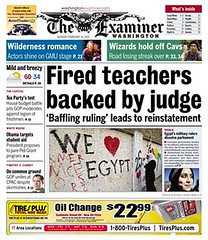
Today's Washington Examiner story "Fired teachers backed by judge" on the recent arbitrator's ruling calling for the reinstatement of teachers fired by Michelle Rhee, when she was in charge of DC Public Schools, has the tone of incredulity.

If you have ever been fired from a job--by people who were more enamored of their power than fairness- as I have been, more than once (note that it is b.s. about the value of "telling truth to power")-you can understand why due process is an important concept. But there is no fairness clause for firing--unless it's part of a union contract or you work for the government, as generally, because government agencies are under the authority of the U.S. Constitution, workers have a few more protections.

DCPS didn't follow the procedure called for in the Union contract. If Michelle Rhee wanted to fire the people so bad, _and she had cause_, all she needed to do was follow procedure.

Obviously, no one wants to retain as employees people who aren't fit for the job. That's the point of a probationary period, where the employer has the option of not continuing employment for people who are deemed to be unsatisfactory. The Examiner article discusses cause, but at the level of hearsay.

Labels: , , , ,

Friday, January 21, 2011

(Urban) Economic development is multifaceted and complicated

There are many facets to urban economic development--it's not one dimensional, but because it is complicated, and complication doesn't lend itself to politics, doing multifaceted economic development at the local level doesn't usually happen in the way that I think it should be done.

Generally, the profession has a dialectic between focusing on people (education, knowledge development) and industries. Industrial recruitment is usually the big focus, which most often comes with big tax breaks and other incentives, such as how the State of Virginia and Fairfax County bested other local jurisdictions with regard to the recruitment of the headquarters for the Hilton Hotel Corporation ("Hilton Hotels Checking In To Stay in Fairfax County" from the Post) which had decided to relocate to the region because it has become the primary "business cluster" for the industry, as Marriott, Choice, Starwood, and other companies are based in the area. (Similarly, Northrup Grumman is moving to the region to be closer to its major client, the Department of Defense, rather than to be closer to its major manufacturing facilities.)

Focusing on people -- education and workforce development -- takes a long time, plus people don't always stay after so much has been invested in them.

E.g., someone like me got a great education (well, at least I learned how to think for myself, I'm not sure how that's paid off...) at the University of Michigan, and because I was a state resident, the cost of my education was heavily subsidized by state appropriations and donations by then successful Michigan-based businesses like the auto industry, but I left Michigan to try my hand at policy work at the national level, leaving no gain to the Michigan economy (other than people reading the blog and working to implement best practices there).

Workforce development is hard because industries change (how many textile workers are there in the South, or Massachusetts these days, compared to China?), and because globalism is for the most part destroying U.S. manufacturing, as businesses become even larger and able to serve multiple markets from a reduced number of locations, and because the ongoing pressure to minimize labor costs means that plants tend to relocate to lower cost countries.

But manufacturing in the U.S.--automobiles in Detroit; steel in Cleveland and Pittsburgh; goods in Brooklyn, Trenton, Philadelphia, Baltimore, Chicago; ships in New York, Philadelphia, Baltimore, Portland, and Los Angeles; etc.--was for decades the primary source for relatively high wage low knowledge jobs in our nation's cities. ("When Work Disappears: New Implications for Race and Urban Poverty in the Global Economy" by William Julius Wilson.)

The industry that is managing to stay in the U.S. is highly knowledge intensive. Plus, even straight up manufacturing is increasingly capital and knowledge intensive--meaning that a plant typically isn't the source of thousands and thousands of jobs at a plant, but of 50-200 jobs. Unless it is for something like car manufacturing (e.g., the Volkswagen plant in Chattanooga.)

Over the past 50 years, as manufacturing has left cities, and as locally headquartered businesses have been acquired and the headquarters consolidated and relocated to major headquarters cities such as New York City, municipal economic development has refocused more on real estate development and "office jobs." Construction jobs can be a good source of employment for the less educated, unless for a variety of reasons the less educated are also severely disconnected and dis-socialized and therefore unemployable.

Another thread has been the community development movement, which for the most part focused on developing new housing for poor people. While I think this is important, it wasn't enough in and of itself to revivify local economies. See "The Myth of Community Development" by Nicholas Lemann from the January 9, 1994 issue of the New York Times Sunday Magazine. And since I think this hasn't been much of an "economic development" strategy, the fact that this area is Victor Haskins' primary area of expertise is worrisome, if impolitic to say (see "Quick Scan: DMPED Pick Knows Affordable Housing, Wall Street" from the Washington City Paper).

The real estate focus comes from the fact that business-wise, cities are hollowing out. Molotch's "Growth Machine" thesis:

A city and, more generally, any locality, is conceived as the areal expression of the interests of some land-based elite. Such an elite is seen to profit through the increasing intensification of the land use of the area in which its members hold a common interest. An elite competes with other land-based elites in an effort to have growth-inducing resources invested within its own area as opposed to that of another. Governmental authority, at the local and nonlocal levels, is utilized to assist in achieving this growth at the expense of competing localities. Conditions of community life are largely a consequence of the social, economic, and political forces embodied in this growth machine. The relevance of growth to the interests of various social groups is examined in this context, particularly with reference to the issue of unemployment.

is being updated by other scholars who are focusing on how cities are becoming "entertainment machines" (paper) and tourist destinations ("Evaluating Urban Tourism" by Fainstein and Goldstone), and the local housing market is distorted by the presence of an active market of second/third/fourth home buyers (supergentrification concept by Loretta Lees; "A sister city flourishes," from the New Orleans Times-Picayune) and even less of a place where things are made.

Office jobs typically involve higher education and the rote jobs are being shuffled out of city centers to peripheral locations often outside of the city (Jersey City, Hoboken, New Carrollton,e tc.) because of higher rents.

I bring this up because Mayor Gray has chosen his Deputy Mayor of Planning and Economic Development, and Victor Hoskins is to be tasked with refocusing "DMPED" (the Office of the Deputy Mayor for Planning and Economic Development) towards workforce development, rather than the facilitation of real estate development. See Former Md. housing secretary tapped for key D.C. economic development post" from the Washington Post.

I guess I'd say that a well-balanced economic development program for cities includes a focus on more generally making the city attractive and then on implementation. One of my desires some day is to write a journal article on the difference between municipal "economic development" and "building the local economy" because the latter is more focused on building the overall economic ecosystem, while the former is more focused on specific projects. Economic development elements in typical land use master plans aren't as expansive and as nuanced as they need to be. IMO anyway.

David Engwicht is not the first person to make the point that cities were created to facilitate exchange, after all this is a basic tenet of urban economics. But he also makes the point in terms of transportation efficiency, that cities were created to facilitate exchange and to minimize the need to travel.

And as I have pointed out, the city's spatial organization was created during the era of the Walking City, which results in an overall urban form where walking, transit and biking are optimized, and therefore should continue to be strengthened as a continuing source of competitive advantage vis-a-vis ever traffic engorged suburbs ("Washington area tied with Chicago for traffic congestion, study finds" from the Washington Post).

Plus walkability and transitability likely supports the maintenance of relatively high property values and the continued strength of both the commercial and residential property markets in the city (as well as Arlington County, which shares similar characteristics along the Wilson Blvd. corridor in particular).

Making the city attractive and successful economically requires a multifaceted strategy:

People (workforce) development
- high quality education at all levels (K-12, college, and post-graduate)
- workforce training and development
- creative class/knowledge economy development

Mobility (and other) Infrastructure
- prioritizing transit development, intensification, and extension
- placemaking/livability/quality of life/complete streets
- other infrastructure (water, waste removal, etc.)

Hygiene factors (my interpretation of the application of Frederick Herzberg's motivation theories to urban planning)
- functioning municipal government agencies
- public safety

Business/Sector development
- commerce and retail development and attraction
-- individual business development and recruitment, entrepreneurship development
-- development and attraction of industrial sectors (including leveraging the industrial sector development capacity of local universities and research institutions comparable to how the biotechnology sector in Montgomery County developed out of the National Institutes of Health or how military-related businesses locate near the Pentagon and other military installations)

Place development (real estate development and revitalization)
Thematic focus on destination development and management
- arts and culture/history
- entertainment
- tourism development and management
- programming and management entities (Business Improvement Districts, Main Street programs, merchants associations, community development corporations, etc.)
Geographic focus
- Commercial locations (primarily)
-- downtown/central business district
-- submarket commercial districts
-- industrial areas
-- waterfront
- Residential neighborhoods (primarily)

All this is dependent on tax and other revenue generation, sound municipal financing strategies, quality contracting and procurement procedures, etc.

So I have to say that I am somewhat concerned about how Mayor Gray intends to change DMPED's focus. Does it just exchange one unbalanced perspective for another? From the Post article:

The search for a planning and economic development chief may have been complicated because of uncertainty about how the job will change under Gray. He said repeatedly during his mayoral election campaign that he would like to expand the deputy mayor's role beyond management of real estate projects to include workforce development responsibilities.

From "Gray picks Victor Hoskins for economic development" in the Washington Business Journal:

During the campaign for mayor, Gray said his economic development strategy would focus more on workforce development — putting people to work — than classic construction-based economic development. His platform keyed on driving development and jobs east of the Anacostia River.

“Magnificent new office and residential buildings in a few emerging neighborhoods are positive statements of belief in the District’s economy, but the benefits of these developments have not reached our most distressed neighborhoods to provide living wages and economic opportunity," Gray said in his economic development platform.


While I am the first to say that the concept and plan for economic development in the city needs/needed to change, changing the focus to be mostly on workforce development, while extremely important, may be just as limiting as the previously dominant focus on real estate development.

In the thread in the GGW article "Run the Anacostia streetcar on MLK Avenue" I said some pretty strong things about neighborhood revitalization, about how in cities, transit generally is the best public investment there is, that streetcars likely would significantly help rebalance that sub-economy, and that if people don't want it, then the city should walk away despite the evident need, because you have to focus your resources and help people who want to help themselves.

I also wrote about this in the blog entry, "New Years post #7: Anacostia and sustainable economic development and revitalization" which was in response to a Post article, "D.C.'s Ward 8 pins its hopes for economic improvement on Mayor-elect Gray" and quotes within it.

Economic improvement can't just be produced with the waving of a magic wand. And it takes even longer if your primary focus is on "workforce development" because it can take decades to rebuild your workforce's capacity and capabilities, especially if they are extremely underdeveloped at present.

My #1 economic development priority for the City of Washington, DC

FWIW, in terms of mobility infrastructure and infrastructure generally, the #1 economic development priority that I would focus on in terms of the city's long term economic health would be the development and construction of the separated blue line subway, to expand the capacity of high quality transit service serving the central business district--which will run out of capacity in the next decade, and to extend the subway service footprint in the city (adding 6-7 stations, including service to Georgetown and H Street and the Spingarn and RFK Stadium campuses, allowing for more intensive redevelopment in many areas of the city).

That's focused on maintaining the relevance of the central business district in DC as a place to conduct business in the regional commercial landscape, where Downtown DC competes with Arlington County, Fairfax County, Alexandria, Silver Spring, Bethesda, New Carrollton, Prince George's Plaza, and other commercial submarkets within the region.

Without downtown, which generates close to 20% of the city's tax revenues, the rest of the city will languish, because the money won't be there to do other things.

But at the same time, I am not advocating what would be considered a "trickle down" strategy of hoping that ancillary development to downtown development would spread to and assist other parts of the city.

There needs to be a coordinated strategy for each of the subprograms of a complete economic development strategy and plan for the city.
Proposed changes for the WMATA system, 2001 (separated blue line)
Proposed changes for the WMATA system, 2001 (separated blue line). Washington Post graphic.

Labels: , , , , , , ,

Tuesday, December 14, 2010

Since we're talking about more public information on transit...


One thing that neither the Office of Planning nor the Department of Transportation do is a lot of what we might call "informed" public outreach. Sure there are tons of public meetings, so many that I am overwhelmed. And as the entry from yesterday discusses, often public meetings aren't really good venues to get informed.

DC's public libraries could be used as venues for displays on land use and transportation planning issues. For example, with the streetcars, there ought to be displays in libraries serving the areas where the streetcars are supposed to go. The same goes with "urban" design and placemaking, and the difference between urban and suburban land use paradigms.

I guess I never got around to blogging about a display about plans for light rail in Montreal. Some of Montreal's public libraries are augmented with added "cultural center" facilities. This was the case with the library in Frontenac, which also had a display on the proposed light rail line for Montreal.

Of course, when we were there, an old man came up to us and asked us if we believed in streetcars. He said cars were better...

------
Images are from boards about the proposed light rail in Montreal as displayed at the Frontenac Library and Cultural Center, Montreal.

Labels: , , , , ,

Saturday, October 23, 2010

Diane Ravitch review of "Waiting for Superman" from the New York Review of Books

See "The Myth of Charter Schools."

From the review:

There is a clash of ideas occurring in education right now between those who believe that public education is not only a fundamental right but a vital public service, akin to the public provision of police, fire protection, parks, and public libraries, and those who believe that the private sector is always superior to the public sector. Waiting for “Superman” is a powerful weapon on behalf of those championing the “free market” and privatization. It raises important questions, but all of the answers it offers require a transfer of public funds to the private sector. The stock market crash of 2008 should suffice to remind us that the managers of the private sector do not have a monopoly on success.

Labels: , , , , ,

Tuesday, October 19, 2010

1/3 of the story isn't the full story: crossing guard pay and walk to school programs

Crossing guard pay headline cover image, Washington Examiner, 10/19/2010
The Examiner writes a pretty narrow story today concerning school crossing guards, making it out as if the crossing guards are making a mint of money at the public expense. See "Being a Montgomery County crossing guard has its benefits - $40 per hour."

It's a surprisingly complicated issue.

In the last post, I discussed police departments and pedestrian and accident analysis, but I didn't get into the details about some of my learnings about the issue. What I used to say was that "police officers aren't planners, and that's not their fault, but they do need our help."

Because they don't know they aren't planners, without awareness of the need to bring planners and transportation engineers into the equation when it comes to accident analysis and countermeasure selection, that area of expertise tends to not be part of the analytical system and approach towards traffic safety improvement. (Of course, this is an area where guidance from the FHWA in terms of the national traffic safety program and how it could be restructured would be very helpful.)

There is a similar issue with crossing guards. The way it works, crossing guards are paid for and managed by police departments, not the local school system. (This should change, but that's another issue too.) When the police department can't fill the crossing guard position--which is usually the case in most places because the hourly wage is low and the hours are short so most jurisdictions never have enough crossing guards--they are forced to have the shift covered by sworn police officers. While this has some benefits, for the most part, it takes police officers away from other service duties.

So the Examiner article doesn't discuss this, and how, by paying higher wages, Montgomery County is able to fill most of its crossing guard positions and they don't have to use police officers for unfilled shifts.

That isn't the case in Baltimore County.

At one of the planning advisory committee meetings, we were discussing walk to school efforts and how to expand the number of schools promoting and the number of students participating in walk to school efforts, and the police department representative present at the meeting interjected, and explained to us "the problem" from "their perspective," not ours.

This is from the draft plan that I submitted, although the final text in the posted draft may differ slightly:

The plan advisory committee learned that one of the barriers to expanding walk to school efforts concerns the supply of available crossing guards. School crossing guards are managed by the Police Department, not by the School District. Funds to pay school crossing guards come from the Police Department budget. Because it is part-time work (10 hours/week) for relatively low wages, the Department has a difficult time keeping the 273 required positions filled. For each empty position, sworn police officers fill in, diverting officers from patrol and other duties. The Police Department ends up in the position of discouraging walk to school efforts, because it can’t meet current demand for crossing guards let alone additional demand generated by new walk to school efforts, which would mean that even more police officers are needed to cover school crossing guard functions.

(In Baltimore County, they pay under $15/hour.) The Police Department ends up in the position of discouraging walk to school efforts, because it can’t meet current demand for crossing guards let alone additional demand generated by new walk to school efforts, which would mean that even more police officers are needed to cover school crossing guard functions.

I am using the word "discourage" nicely. They actually tell principals to convert walk to school areas to school bus service zones, in order to reduce the demands on the sworn police officers.

This was the related recommendation in my draft (which was excised from the posted draft):

Address the issue of school crossing guard pay and other incentive programs that will strengthen retention of school crossing guards to reduce demands on other Police Department personnel for school crossing guard coverage. Ensure that when additional crossing guard positions are required, funding is provided to cover the increased cost.

We found this out because, unlike in most bicycle and pedestrian planning efforts, I reached out to the police department and got the traffic safety and traffic enforcement divisions to participate in our planning advisory committee. Plus the accident analysis section of the Crime Analysis section of the police department's research division provided us data that we asked for with regard to pedestrian and bicycle accidents across the planning area (actually they provided it for the entire county, but I was tasked with a planning effort for only 1/2 of the urban area of the county, about 110 square miles). Some planning efforts get and analyze this information, many do not.

I am surprised that Baltimore County has demands for more crossing guards than Montgomery County (177 according to the Examiner article) and Fairfax County (64 according to the Examiner article). But it is a big school district (110,000 students), just as Montgomery County (130,000 students) and Fairfax County (175,000 students) are large, but Baltimore County is physically larger than either county (Baltimore County is about 640 square miles).

But I imagine that the Baltimore County Police Department wishes they could pay what Montgomery County is paying. They kept asking for more money to address the issue, but it kept getting denied, and they are always in the position of never having enough crossing guards, and constantly directing police officer details from other duties to serve as crossing guards.

The issue comes down to walking to school vs. being bused to school. Higher wages for crossing guards ensures the success of walk to school programs. Sure this comes at a cost. It means you don't have to buy and operate as many school buses, find school bus drivers (another problem comparable to the problem of finding and retaining school crossing guards), or buy as much diesel fuel.

A new school bus costs about $75,000. Diesel fuel costs close to $3.00/gallon. For a variety of reasons, it makes more financial, health, and transportation sense to direct resources to walk to school programs rather than busing students to school.

In an odd way, the Examiner article, by not telling the whole story, is advocating for buying school buses and diesel fuel and for school bus drivers rather than crossing guards. It's as if they are on the take from a school bus manufacturing company...

And it's very disconcerting that Montgomery County Councilmember Marc Elrich accepts the narrative of the story as stated, rather than digging more deeply into the story. From the article:

Of the millions of dollars devoted to crossing guards, 45 percent of the funding is for group insurance plans.

"Wow, that's incredible," Councilman Marc Elrich, D-at large, said upon learning of the ratio. "If everything is on the table -- as we have been saying with our budget problems -- this certainly has to be in the discussion."

Police say they hire the "most qualified" people for the positions, but current crossing guards admit that job placement is mostly tied to personal connections.

Yes, the how the people get the jobs issue needs to be addressed if it isn't an open and fair process, but in most respects, the issue shouldn't be how much people are paid. It's either that or the school bus and police officer details. The amount of money spent wouldn't necessarily be reduced, if anything, it would increase.

Resources:

-Helping Johnny Walk to School (report)

-National Center for Safe Routes to School

-The Safe Routes to School National Partnership

- The State of Washington guide, School Walk and Bike Routes: A Guide for Planning and Improving Walk and Bike to School Options for Students

- White House Task Force on Child Obesity

Labels: , , , ,

Saturday, October 16, 2010

School reform daze

http://www.greatgreenbaby.com/wp-content/uploads/2009/04/blocks2.jpg
For the most part, too much has been going on, and there is too much to try to assimilate to try to write something comprehensive about the state of school reform in DC, over the hand wringing in many quarters over Michelle Rhee.

Mostly, a lot of people have written a lot of stupid stuff, such as Terry Lynch ("The end of school reform in the District" in the Post) and this letter to the editor in the Post, "Rhee's defeat: Sad but no surprise" plus Post editorials.

The fact is, how many of us change positively at the threat of whips, chains, and loss of employment. If you're interested in how successful organizational change works, there are many resources. Maybe some of the best work on why the whips and chains approach doesn't work comes from Chris Argyris.

But there are some good pieces about how urban education reform should work, how the "manifesto" ("How to fix our schools: A manifesto by Joel Klein, Michelle Rhee and other education leaders") published in last week's Post is pretty much bunk, including:

- "How to fix our schools" by Richard Rothstein of the Economic Policy Institute. It focuses on how 1/3 of student achievement is impacted by in-school experiences, and 2/3 has to do with life outside the school setting (home, etc.)

- "It is as simple as that," an opinion piece by Robert Vinson Brannum in the online Examiner, this piece was a shocker, well argued, from someone who I often find to be somewhat inconsistent. The article makes good points about the groundwork laid by then Superintendent Janey, and how much of this groundwork was then discarded.

- Larry Cuban's piece in the Washington Post Answer Sheet blog, "Rhee in D.C.: The myth of the heroic leader." Larry Cuban is a professor at Stanford, with a great deal of classroom and school administration experience.

- Actually, Valerie Strauss' Answer Sheet blog in the Post is excellent. It's too bad her writing rarely makes it into the hard copy edition of the paper. Why is that? It's probably the best education analysis that occurs under the rubric of the Post and it never makes it into the paper--sort of like how the Washington Post Writers Group sells the Neal Peirce column on state and local policy, urban politics and revitalization in particular, an incredibly important topic which is undercovered in the paper and should be included along with Valerie Strauss.

Labels: , ,

Tuesday, September 07, 2010

For all the talk about education by the Washington Post and the current election cycle...

For example these op-eds, "Weast's legacy reaches far beyond Montgomery " about Montgomery County, this about DC "Tough reforms, tougher politics ," and this terrifying story about the arbitrary and capricious personnel practices of the DC Public Schools, "D.C. teacher's transfer seems like revenge," all from the Post, you'd think that the Washington Post could run a special back to school section annually--I mean, they can do a section on the all-metro high school athletes for the fall, winter, and spring sports sections.

I was in Louisville in 2004 for a conference, and I discovered that the Louisville Courier-Journal runs a special back to school issue of their weekly neighborhoods section--the Post eliminated the zoned county/city news sections last year--every year.

This is the one for 2010.

The Post could really step it up here. But they don't.

At the same time, they could sponsor a multi-jurisdictional First Day Festival, which would be pretty interesting. See "First Day Festival awash in fun" from the Charleston (SC) Post and Courier.

The fascinating thing too about yesterday's op-eds is that while Michelle Rhee is lionized by the Washington Post and the national media as a great reformer, the likelihood is really that her "efforts" will fail because unlike the efforts in Montgomery County, they are not systematic and structured, but really more about personalized experiences that in too many cases rely on happy accidents rather than interconnected and robust structures, processes, support systems for teachers, students, families, schools, principals, and neighborhoods.

I don't understand why the national best practice example of school improvement in Montgomery County is deemed by the Washington Post to be for the most part irrelevant to the issue of public school education "reform" in Washington, DC.

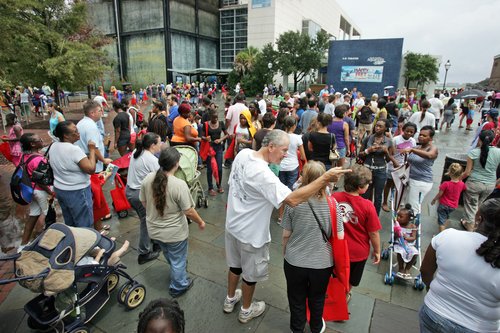
Charleston's First Day Festival, Liberty Square, 2010
Charleston's First Day Festival is an effort to get children and parents excited and ready for the school year. Sandwiched between morning and late afternoon showers, thousands of people came to Liberty Square on Sunday for free school supplies and free admission to the South Carolina Aquarium.

Charleston First Day Festival, 2010
Photos by Wade Spees, Charleston Post-Courier. Volunteer Tylaja Penny, a rising 7th grader at Jerry Zucker Middle School of Science, volunteered to hand out supplies and her t-shirt reinforced the purpose of the day.

Labels: , ,

Tuesday, April 27, 2010

School improvement program presentations in DC

Across the U.S., all levels of government including most local governments, don't do improvement ("reform"), especially of large institutions such as school systems, and harvesting of best practices very well.

Last week, I did a presentation at Towson University, and so I was poking around the college bookstore afterwards, and I came across a couple tomes on what really works in K-12 education, when it comes to significant improvements in classroom instruction and student outcomes. Of course, I can't imagine anyone in the DC Public Schools administration has ever read these or similar books. Instead they seize on whatever magic bullet-koolaid that they believe in, be it getting rid of the current teachers and hiring young new teachers, or charter schools, or whatever.

So I am intrigued (but won't be able to go) by this parent presentation next week:

The Capitol Hill Public School Parent Organization will present a proposal for improving middle schools on Capitol Hill at the May 4 NLPNA meeting, 7:30 p.m. at Lane Memorial CME, corner of 14th and C streets NE. All are welcome!

I am curious as to what they have to say, if they take a best practices approach, etc.

(While I have no idea what the future holds for me as a bicycle and pedestrian planner in Baltimore County as I am on a term appointment, one of the ideas in the plan is to develop best practice pedestrian and bicycle education programming for both middle schools and high schools. Last weekend, I did a workshop for parents interested in walk to school programs in their neighborhood, for their local middle school, and I was idly thinking of how it could be one of the demonstration sites...)

Of course, if you do believe that school improvement is possible with the current regime, you might be interested in this presentation tonight.

From email:

Invitation to Parents
What Does Good Teaching and Learning Look Like?

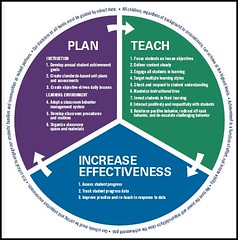
This fall, DCPS introduced a new Teaching and Learning Framework to clearly outline what the District believes solid instruction looks like. Join DCPS leadership, classroom teachers and other staff to learn and talk about effective teaching and learning. DCPS’ new Teaching and Learning Framework is based on research, best practices, and input from more than 500 DCPS teachers—and it provides clear values and plain language so that principals, teachers, and parents can have a common understanding about what should be happening in every DCPS classroom.

Learn about the framework, how it affects your child, and its relationship to IMPACT, our new teacher evaluation system at the Ward 5 meeting on Tuesday, April 27, 2010 from 6:30-8 p.m. at McKinley High School (151 T St. NE).
DCPS Teaching and Learning Framework diagram
Diagram from the cover, DCPS Teaching and Learning Framework document.

Labels: , , ,

Friday, April 09, 2010

Seattle creates international high school

From the Big Blog of the Seattle Post-Intelligencer:

Seattle Public Schools Superintendent Maria Goodloe-Johnson on Thursday named Chief Sealth High School the district's first international high school.

Last year, Concord Elementary and Denny Middle schools, both in the same West Seattle attendance areas as Sealth, were named international schools. The addition of Sealth means that West Seattle students can attend international schools through the grades.

International schools provide immersion in foreign languages. The district says they also integrate "global perspectives into daily learning, with an emphasis on multicultural literature, world economics, global health and arts, music, dance and drama from around the world.
"Students will also learn about a variety of cultures and countries using an international social studies curriculum that explores current challenges and issues facing the world community. The mission of the international education program is to educate and prepare all students with the cultural competence and skills to achieve in a global community and economy."


-----
My idea of about 6-7 years ago, of creating an arts cluster of schools in the H Street neighborhood of NE DC had an element of this. One of the "arts" emphases was to be international language and culture--along with English language as well as media--so that each of the elementary schools in the cluster would focus on a different language, as well as programs in the visual and performingarts.

Labels: ,

Friday, March 12, 2010

More schools

Gosh, I wrote that blog entry the other day about schools and systems, but didn't get to last Sunday's New York Times Magazine until my commuting time on the train yesterday. The cover story, "Building a Better Teacher," is exactly on the topic of how to train teachers to be great teachers.

The article has two different threads, the work of Doug Lemov, now of the school charter organization Uncommon Schools, on identifying the framework of what comprises excellent teaching/classroom management more generally (he has 49 factors, and is publishing a book on his method next month), as well as identifying subject-specific teaching frameworks, such as in math. On the latter, the article features the work of people at the Michigan State University College of Education, as well as a professor at the University of Michigan School of Education.

Labels: , , , , ,

Wednesday, March 10, 2010

Schools brief

Harry points us to this article in yesterday's New York Times, "Pressed by Charters, Public Schools Try Marketing," which discusses how to be competitive with charter schools for student enrollment, public schools in Harlem are taking up marketing. The only thing about "marketing imagination" is that unimaginative people think marketing is just about selling. It's also about ensuring that you have great products to sell in the first place.

With regard to social and/or "nonprofit" or government marketing, these past blog entries might be of interest:

- (Ir)rational planning
-- Social Marketing the Arlington (and Tower Hamlets and Baltimore) way
-- Disruptive innovation (once again) and Bods/Cuerpos

Readers know that lately I have taken up the idea that "culture" is in fact constructed. It is a system and structure and set of processes. But what we frequently describe as culture is described that way out of an inability to explain and analyze what is going on, because the system functions so much different from our own experience.

I noticed at the newsstand last night that Newsweek has a cover story about the most important thing to do to fix American education is "fire bad teachers." ("Why We Must Fire Bad Teachers")

Why We Must Fire Bad Teachers
Now, I agree that bad teachers need to go, but I do think that a lot of bad teaching is also "constructed" just as is good teaching. In fact you can apply my thinking about the motivation-hygiene theories of Frederick Hertzberg to good versus bad systems, structures, and processes.

This is from an entry from 2005:

.... Again, I would reiterate that building community capacity (social environment) and the physical environment must be addressed simultaneously. Perhaps one of the difficulties in studying the impact of the broken windows theory has something to do with a point made by Frederick Herzberg in his "motivation-hygiene theory" of organization behavior and development -- he says that you need to have structure (hygiene theory) to function. If you have it you don't necessarily function "better" but if you don't have it, there is "dissatisfaction" and great dysfunction.

The subhead of the Newsweek article justifies firing bad teachers because "In no other profession are workers so insulated from accountability."

So from the standpoint of (not) understanding systems here are the issues:

1. the difficulties of the requirements of the profession (if you have ever given a presentation to a class of children, you begin to have an understanding of how tough keeping the attention of children is--imagine doing so day-in and day-out for 180 days/year)

2. the failures of most school systems to adequate create and maintain professional development and support systems at 4 levels:

- for principals and school and instructional leadership
- for teachers in the classrooms
- for students
- for families

3. the failure of key community actors (including unions which focus not on professionalization as much as they do on "economism" or maximizing the benefits for workers) to focus on maximizing the quality of educational outcomes, and instead focus on maximizing job and contract opportunities that derive from the school system

Marion Orr's Black Social Capital: The Politics of School Reform in Baltimore, 1986-1998 discusses this issue.

I finally bought that book to own and read fully, along with Howard Gillette's Between Justice and Beauty: Race, Planning, and the Failure of Urban Policy in Washington, D.C., in response to the latest debacles in the city over Marion Barry, and his maximization of the use of personal service employment contracts and Council earmarks, the latter of which are abused by other Councilmembers, but not to the same degree.

Anyway, the Newsweek article states:

Yet in recent years researchers have discovered something that may seem obvious, but for many reasons was overlooked or denied. What really makes a difference, what matters more than the class size or the textbook, the teaching method or the technology, or even the curriculum, is the quality of the teacher. Much of the ability to teach is innate—an ability to inspire young minds as well as control unruly classrooms that some people instinctively possess (and some people definitely do not). Teaching can be taught, to some degree, but not the way many graduate schools of education do it, with a lot of insipid or marginally relevant theorizing and pedagogy. In any case the research shows that within about five years, you can generally tell who is a good teacher and who is not.

While this is true, that it takes five years probably to tell who is a good teacher and who isn't, imagine what could happen if the systems were in place to focus on training, developing, strengthening, and extending those factors which lead to successful outcomes?

Getting rid of teachers who are "bad" after five years will definitely have some marginal positive outcome on school and educational quality. But so much more can be accomplished by focusing on the overall system in place, rather than blaming everything on failed "cogs."

This is the same problem in terms of understanding crime and problem oriented policing. The reason that research didn't find a positive correlation between crime reduction and policing was because of how police officers were being deployed--in scout cars, responding to calls. The issue wasn't lack of personnel, the issue was in how the personnel were deployed and utilized. AND THE RESEARCHERS NEVER STOOD BACK AND CONSIDERED THAT QUESTION, OF WHETHER OR NOT HOW POLICE OFFICERS WERE BEING DEPLOYED WAS THE BEST WAY TO ADDRESS CRIME.

William Bratton, as police commissioner in New York City, turned the question around.

By changing the management and operational structure of the police department, starting off by analyzing crime data at the neighborhood level (rather than the entire jurisdiction), and then deploying officers in response to specific needs and trends, getting them out of scout cars, and taking what we might call "gateway" crimes seriously (having guns, jumping subway turnstiles, etc.) which ultimately interdicted many criminals, crime has been significantly reduced, especially in New York City, where the "new" techniques were perfected.

The same kind of reworking the system and structure of K-12 education needs to occur in order to have the same kinds of positive changes that have been experienced in other systems, like public safety in New York City.

Instead, we are still focused on band-aids, with various stock approaches--decertifying unions, creating charter schools, blaming teachers, vouchers--being profferred by various interests, without a deep and fundamental rethinking of the entire process.

I guess that doesn't make for a good cover story.

Labels: , , , , ,

Friday, January 29, 2010

One education story we aren't reading in the national press

http://www.press.uchicago.edu/Images/Chicago/9780226078007.jpeg
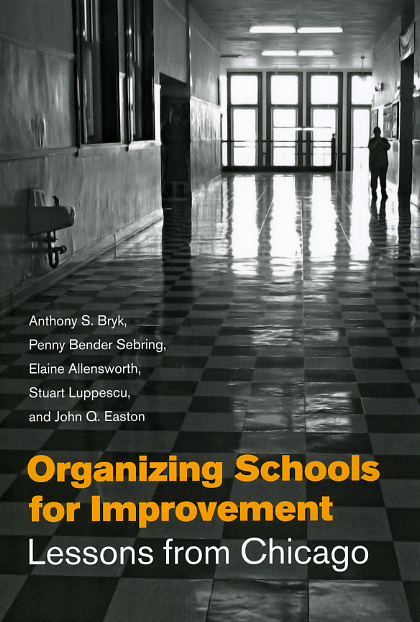
Earlier this week, Education Week published a story, "Scholars Identify 5 Keys to Urban School Success," (registration required for access) about the new book Organizing Schools for Improvement: Lessons From Chicago. From the University of Chicago Press website:

The authors of this illuminating book identify a comprehensive set of practices and conditions that were key factors for improvement, including school leadership, the professional capacity of the faculty and staff, and a student-centered learning climate. In addition, they analyze the impact of social dynamics, including crime, critically examining the inextricable link between schools and their communities. Putting their data onto a more human scale, they also chronicle the stories of two neighboring schools with very different trajectories. The lessons gleaned from this groundbreaking study will be invaluable for anyone involved with urban education.

These factors are:

1) Strong principal leadership that focuses on instruction and is inclusive of others in the work, as opposed to our current, top down leadership that dictates to principals instead of trusting them to lead.

2) A welcoming attitude toward parents and a formation of connections to communities.

3) Development of professional capacity—treating teachers like professionals and giving them good professional development and collaboration time.

4) A safe, welcoming, stimulating, and nurturing environment for all students.

5) Strong instructional guidance and materials, not forced curricula

When all five of these supports were working in tandem, the Consortium on Chicago School Research (the group doing the study from which the book was published) found that schools improved.

The ironic finding of their study, compared to what's going on in DC, is that trust and stability are key in promoting real and sustainable improvements in schools, particularly in schools with high levels of nonschool factors influencing attainment (particularly poverty). Chancellor Rhee has proven over and over again that building a shared culture of trust and stability are not part of her program.

(Not to mention that it's not about charters, vouchers, or various other flavors of the week.)

There was a symposium on the release date of the book.

- Download the slides from January 14 symposium
- Handouts: The Essential Supports
- Handouts: Truly Disadvantaged Schools
- Handouts: Supplemental Information

Labels: , ,

Internal censorship at the Washington Post

In the blog entry, "Censorship at WaPo," retired teacher Guy Brandenburg compares the sanitized version of a blog entry written by Bill Turque, the Post's DC K-12 education writer, to his original entry, which had pointed criticism of the Post editorial board's overtly sweetheart relationship with Chancellor Rhee.

It's just as bad an exercise of judgment as the recent hullabaloo over the attempt to create sponsorship opportunities for salon meetings with key editors and writers ("The Media Equation - A Publisher Stumbles Publicly at The Post" from the New York Times).

I haven't read the Columbia Journalism Review for awhile, but an analysis of the media's mostly hagiopic coverage of Rhee, particularly the national media, would be a great cover story.
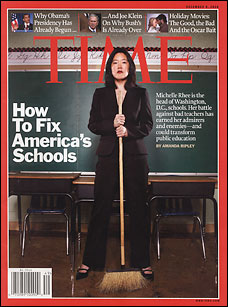
Michelle Rhee Makes Time Magazine cover
As for this incident, it will definitely make the Darts and Laurels column features about egregious errors (and great jobs) in journalism, if someone submits it. (When I worked at the Center for Science in the Public Interest, I got an item in the D&L column, over a magazine that was soliciting advertising to support an issue that was going to include an article criticizing the organization's position on focused programs marketing alcohol to minority groups. CSPI was against this type of marketing. The magazine preferred the advertising revenues.)

In the late 1980s, one of the first things Michael Moore did that had national exposure was write a piece for CJR on the Flint (Michigan) Journal and its ultra-cozy relationship with General Motors and the Mott Foundation, and on projects they espoused (a number of which failed miserably) for the city.

CJR influences the media and has a national position of authority that far exceeds its paid circulation.

Labels: ,

Sunday, January 17, 2010

Moving the arts high school to the Union Station neighborhood of DC

Today's Post reports in "Ellington arts school might be moved out of D.C.'s Ward 2," of an idea to relocate the city-wide arts high school to a site adjacent to Union Station in DC, which is also adjacent to the H Street neighborhood.

This reminds me of an idea I first laid out in 2003 or 2004 in the context of H Street Main Street, back when I was involved in it, building on an idea first expressed by Vanessa Ruffin, we suggested that the idea of an "arts district" "on" H Street should also be extended "within" the neighborhood. It's the difference between arts as only an activity of consumption vs. actually producing art. (I gave a presentation on this subject last summer at the Literary Managers and Dramaturgs of the Americas conference--"Art, culture districts, and revitalization".)

That led to an idea for creating an arts oriented cluster of public schools serving the greater H Street neighborhood. Arts could include visual, performing, media, and language (both English and foreign language and culture). Each of the schools could specialize in a different language, building on the idea of strength in French at JO Wilson Elementary.

(The schools I mentioned back then were JO Wilson Elementary, Ludlow-Taylor Elementary, Wheatley Elementary, Miner Elementary, Maury Elementary, maybe Stuart-Hobson Middle School--already part of the Capitol Hill Arts Cluster and a "museum-oriented" school, Gibbs Elementary. But I didn't mention a specific high school.)

And there could be artists in residence on the various campuses. While it's too late now, the idea was also that the old school building on the Miner campus (now used as an office building by the police department), as well as the Old Eng. Co. 10 and Precinct 9 buildings (both slated for redevelopment as a small set of condominiums, although there is plenty of such inventory and plans for housing like this in the neighborhood already) could have been converted to arts related uses. (At the time, many arts groups including the Washington Glass School, were displaced because the creation of the Nationals Baseball Stadium eliminated a number of low cost facilities that were used by artists, including the Washington Sculpture Center.)

With the Ellington School in the greater neighborhood, this idea could be revisited (albeit not by me).

As for having an active school at Logan (for a long time the building was used for professional development, and then as a school facility serving other schools undergoing renovation, and it was the neighborhood's largest African-American school before desegregation, and was the largest neighborhood school in the area until it was closed, with a capacity of more than 1,000 students), I am a big fan of believing that DC public facilities should be located proximate to high-capacity transit. A "city-wide" school next to Union Station, vs. a school being located in a far part of the city only accessible by a couple bus lines seems like a winner to me.

Labels: , , , ,

Tuesday, December 01, 2009

A very measured editorial on charter schools, not from the Washington Post, but from the Los Angeles Times

Unlike the cheerleading on the editorial pages of the Washington Post for both charter schools and for Chancellor Rhee's "reform" efforts with the DC Public School system, the Los Angeles Times has an incredibly nuanced editorial about charter schools, what they do, why some programs are successful, and how jumping from some examples to a national policy is a big stretch. See "Charter schools hold promise, but they're no magic bullet."

Labels: , ,

Wednesday, November 04, 2009

More on (Maryland) Walk to School

At a regional bike and pedestrian committee meeting, I was somewhat derisive of the description of an about to be launched research project in the State of Maryland to determine barriers to walking and biking at the school level.

I said it's really quite simple. (I learned this because one of the schools in the county is a national best practice example of a walk to school program, whether or not they have won any awards. But they do this with almost no support from the school district, even though the county Department of Public Works has assisted them with physical improvements. While the Federal Safe Routes to School program does have grant monies available, the County doesn't like to participate in the program because they believe that the voluminous reporting requirements take more time than the money is worth.)

Have the State Department of Education and the state school funding mechanisms require and support balanced transportation/mobility planning at the level of the school district.

There are 24 school districts (each county, plus Baltimore City) in the state. In the five largest school districts (Baltimore City, Montgomery, Prince George's, Baltimore County, Anne Arundel) there are 875 schools and centers (about 2/3 are elementary schools). Does it make sense to deal with each school individually, creating 875 individualized walk to school programs, or to mandate that the central transportation office within each of the _five_ school districts, has to plan for this, providing services and programs to each of the schools in the district?

The answer, if you are a systems thinker, should be obvious.

Until today, I thought that Seattle Public Schools was absolutely amazing because they have walk to school maps for every elementary school and a district-wide School Traffic Safety Committee.

It turns out that this is a requirement mandated by the State of Washington for all school districts in the state. See the School Administrator's Guide to School Walk Routes and Student Pedestrian Safety by the Washington Traffic Safety Commission and the Washington State Department of Transportation.

It's an amazing document. From the manual:

Who is responsible for developing school walk routes?

In Washington State, school districts are responsible for developing a walking route for each elementary school in their district where children walk to and from school. Walk routes are often developed as part of a comprehensive student pedestrian safety plan and are best addressed by building community partnerships between school administrators and local public works agencies, local law enforcement agencies, legislative representatives, school-parent organizations, parents, and students. Working collaboratively with community partners ensures that any pedestrian safety concern can be addressed by a variety of solutions.

The manual discusses the various administrative laws, how the State Legislature changed the funding authorizations for "hazardous walking conditions" away from bus service and towards improvements such as signage, sidewalks, crossing guards, and the like--improvements that also served the neighborhoods beyond the schooling function, and a whole lot more.

Similarly, the Bear Valley School District in Boulder, Colorado, working in part with the very progressive City Transportation Department, Go Boulder, has people in the school transportation department tasked with developing and supporting walk to school and bike to school programs (Safe Routes to School Program), complemented by others who support the school bus transportation program. But it's a school district level function within the Transportation Department, not some ad hoc thing pursued by each school individually.

If you want successful programs, build the systems necessary to yield excellent outcomes, as efficiently and as simply as possible. Don't rely on the good will of individuals.

Labels: , , , ,

Monday, October 12, 2009

"What's your solution?" vis-a-vis K-12 school improvement in DC

Toy blocks
----------------
Slightly revised with an additional point, inserted at #2, and an addendum.
----------------

Jay Mathew's blog column in the Post, "D.C. School Protestors--What's Your Plan?," has engendered some discussion on a local school list. My response:

This though is a typical response of people with establishment thinking. That you can't criticize something unless you offer an alternative.

1. I usually counter that a good analysis of the problem(s) is good enough in itself. That people who identify the problems aren't always the ones prepared to offer the solution.

2. But the reality is, in this case, that there are plenty of solutions.

Sadly, in my opinion anyway, the "anti-Rhee" contingent is organized in its "anti-ness" but not in offering real, fundamental alternatives. I have commented on this over the years, but I guess the comments weren't seen as important enough to consider by people with more of a horse in the fight. (I don't have children. And I deal with a bunch of urban-related issues, so fixing the schools isn't my only interest.)

To me it would be relatively simple to offer an alternative:

1. Focus on building robust systems, structures, and processes to build excellence within the school system in every dimension, rather than on a belief that individuals will magically be able to succeed against all odds in a system that is dysfunctional. (And note that currently the school system's management is generating much of the dysfunction.)

a. hire a superintendent focused on improving the system as a whole. (Someone like Andres Alonso see the profile from the Baltimore Sun, or Anthony Alvarado, or the subdistrict superintendent in NYC, Kathleen Cashin--see "Bucking School Reform, a Leader Gets Results" from the New York Times.)

b. But the superintendent has to be focused on speed. DC's former superintendent Clifford Janey, seems to be doing a bang up job in Newark, bringing the community to focus on school improvement for a system that likely is doing even more badly than many of DC's schools. See "Newark Schools Chief Seeks Unified Solutions" from the New York Times.

Maybe the one thing that Sup. Janey learned between DC and Newark is the necessity for more speed to keep the elected officials happy. Sadly, it seems as if people mistook his deliberativeness as avoidance behavior, and so the response was to replace him with someone with a bias for speed but little interest and demand for deliberativeness, plans, etc.

2. Transparent, open, and fair decisionmaking rather than arbitrary and capricious practices, especially for personnel (i.e., the principal firings, the teacher firings, the RIFs of union representatives, etc.) and especially looking at parents, residents and other stakeholders as part of the solution rather than only as hindrances.

(Granted many DC advocates are problematic, but only by modeling quality behavior can you change the system. For an example, see this article from the Gazette, about model teaching, "'Old-School Type' Teacher Is All Business at Suitland.")

3. Expand, using positive deviance theories, the programs that are already working well, i.e., Montessori schools, certain bilingual programs like Oyster, cluster school concepts such as the Capitol Hill Cluster Schools.

4. Develop a deep and thorough system of professional development to support teachers and principals. (Using the Mongtomery County MD public schools system, among others, as a model. See for example, "When ‘Unequal’ Is Fair Treatment," from Education Week.)

5. Develop a strong, deep and wide system to support children within the school setting when they need additional assistance. (This is the complement to the MCPS focus on professional development, a focus on the children and providing and executing individual learning plans for students.)

6. Develop a strong, deep and wide system to support families outside of the school setting, but within it also, in order to bring about total focus on improving the family, support of the child, and building what I call the community's capacity, ability and readiness to learn. (There are many examples of this. First Day programs, etc.)

7. Robust summer school programs, consideration of year round schooling, adding length to the school year.

8. Consideration of cooperative (work + school) programs at the high school level to help reduce the drop out rate, deal with the need for some children to make money, show the link between schooling and work, etc.

Two points....

1. This past week, I went to a presentation on improving the suburbs, held at the Urban Land Institute (I am working in a suburban Maryland county for the next year on pedestrian and bicycling planning, so I have to pay more attention to the suburbs). And a presenter commented (in discussing schools issues) that in Montgomery County, drop out rates for "minorities" were roughly comparable to the drop out rates for whites. (I haven't checked out the data for myself.) That says something about how they've been re-working their school system to provide add'l necessary resources to student populations that have traditionally been failed by the dominant paradigms in teaching.

2. On Weds. I went to a school in the county where I am working that is known for its walk to school programs (a school district outside of London, UK used them as a model for developing a systemwide program although ironically the county doesn't have a county-wide walk to school program), which were initiated by two parents, with strong support from the principal. I spent almost three hours there!

The principal is amazing. I was blown away by her discussion of instructional leadership generally, her talk of "the schoolhouse" and the school community, and of course, her focus--even though she didn't call it that--on what I think of as site based transportation demand management, focused on getting children into classrooms safely and quickly, so that as much time is brought to bear on instruction.

It was a privilege to be able to talk with her, and the parents who started the walk to school initiative. I took many pages of notes...

I don't feel like I hear much about "instructional leadership" and focus on the overall environment here in DC in the context of urban school reform, or just basic improvement.

My notes are at the office, but one of the things that she said was something like, "when you come into a new school [as the principal] you don't change things, you're one person. You work with the teachers and the parents to improve on what's already working, and to improve what isn't working well." (She was much more succinct.)

And she commented how, as she's now been at the school for five years, on how they are just getting to the point where the teachers are getting to the point where they are able to work with each other in focused ways to improve the curriculum and teaching plans in very specific ways, that improvement is a process, and not a quick one either.

The focus on the quick fix, and on the individuals (teachers) rather than the system as a whole and the organizational culture is telling. We are screwed here.

Ironically, it seems like the only good writing in the Washington Post on organizational management, systems, and culture is in the Sports section about the dismal situation of the Washington Redskins. In "Toxicity Seeps Downward Through Redskins "Sally Jenkins writes:

Stability works; instability doesn't. ... Why doesn't Snyder seem to know all this? Why do the Redskins continually make the same management mistakes? One possible answer is they suffer from something called "toxic management." Denial and refusal to accept criticism are classic hallmarks of it, and so is shifting blame to others.

Toxic management is not just a term; it's a pathology, and experts have written books about it. The leader in the field is Roy Lubit, a member of the faculty of the Mount Sinai School of Medicine in New York, and the author of "Coping with Toxic Managers and Subordinates." According to Lubit, toxic managers are "rigid, aggressive, self-centered."

They're also divisive. Some of the indicators: bullying of subordinates, impulsivity, inability to concentrate and moodiness. Also: a record of grievance filings by employees, customer complaints and high staff turnover. Toxic managers actually prefer tension to stability, because it's a demonstration of their personal power. ...

According to Lubit: "Toxic managers divert people's energy from the real work of the organization, destroy morale, impair retention, and interfere with cooperation and information sharing. Their behavior, like a rock thrown into a pond, can cause ripples distorting the organization's culture."
------------------
In a nutshell, DC politics and municipal management is a classic example of toxicity, not to mention going for the quick fix and thinking because you might be knowledgeable about an elephant's foot, that you can fix the whole elephant.

I wish I could say that this is to be expected that after only 30 years of home rule, that the city is still developing its institutions.

But there is no excuse to be developing sound management structures in the city as if there was a vacuum, that the city developed independently of every other locality in the rest of the U.S....

Furthermore, given all the money that the city has, relatively speaking, compared to other jurisdictions, this is a crime and a travesty.

I was in Silver Spring yesterday, so I picked up a copy of the Silver Spring Voice, a community newspaper. The October issue, not yet online, features an appreciation-obituary of Dan Parr. He worked on "downcounty" issues in Montgomery County, so for the most part his activities--being a co-founder of the Takoma Park Food Co-op, leading the effort to rebuild Montgomery Blair High School, working on campaigns to get progressives elected to Montgomery County Council, and then working in municipal and then state government--were not on my radar, my being focused on the District of Columbia.

The article's discussion of how Parr organized a campaign to get the school rebuilt, recognizing that "downcounty" was losing out to "upcounty" in terms of resources and programs provided by Montgomery County to its various geographies, and how a declining and deteriorating school made improvement of downcounty, especially Silver Spring and its commercial district, almost impossible, was both moving as well as an apt example of how to bring about fundamental change in DC--know what you want, and campaign in every way to make it happen.

Labels: , ,