Rebuilding Place in the Urban Space

"A community’s physical form, rather than its land uses, is its most intrinsic and enduring characteristic." [Katz, EPA] This blog focuses on place and placemaking and all that makes it work--historic preservation, urban design, transportation, asset-based community development, arts & cultural development, commercial district revitalization, tourism & destination development, and quality of life advocacy--along with doses of civic engagement and good governance watchdogging.

Thursday, April 21, 2016

Tortured logic in development law case?

The Washington Post editorialized ("Dear Labor Department: Give up on meddling with CityCenterDC already") in favor of a recent federal court decision on wage rates on for profit construction projects involving DC Government owned land (that is, land owned by the citizens of the City of Washington).

Over the last 10 years, DC has initiated development of various parcels through multi-decade leases.

The city still owns the property, usually planned how it would be developed (it sure did with CityCenterDC and helped to find a financier), sought proposals for development, chose a developer and entered into a contract to develop the land and collect "payments in lieu of taxes" on the land since technically the land isn't subject to property tax since it is owned by the city.  Usually these contracts and projects involve city-provided funds and inducements as well.

How can these not be city-involved "undertakings" thereby justifying the triggering of the Davis-Bacon Act and the higher wage rates the act imposes?

CityCenterDC shopping ad, Washingtonian Magazine, 2/2016

One line in the Post article seems to indicate to me very clearly that this is a city undertaking, and therefore the holding--I AM NOT A LAWYER--may well in fact be "wrong."
At stake for the District was far more than the estimated $20 million in additional CityCenterDC costs taxpayers would have been on the hook for because of the federal regulations requiring reimbursement to the developers.
But the Post doesn't explain why "federal regulations" require that the city reimburse the developers for the higher wage rates, so maybe I'm wrong.

If I am right that it has to do with the underlying contract between DC and the developer than I am right that it very clearly is a city undertaking.

Then again, the Federal Court of Appeals which covers DC is considered to be conservative and like the Supreme Court under Chief Justice Roberts, quite pro-business.

A Home Rule based counterargument.  For a counter-interpretation see "Davis-Bacon CityCenterDC Case" from the Labor & Employment Law blog.from the ShepherdMullin law firm.

Note that DC is a special case because DC is considered a federal agency by the Federal government and therefore it is subject to federal laws like the Davis-Bacon Act.  Other cities are not subject to its provisions, unless the project uses federal funds.

So you can argue that on matters not involving federal action, local DC actions shouldn't be subject to federal laws that wouldn't apply to other cities as a matter of course.

But the Post editorial wasn't basing its arguments on Home Rule.  It was arguing an anti-labor, lower wages position.

Reading the blog entry, I'd argue that the Department of Labor used the wrong arguments--they should have argued along the lines of my paragraphs two and three above, that the property is owned by the city and ultimately controlled by the city, not that the public benefits from the end result of the privately constructed development. As long as the city is subject to Davis-Bacon provisions, if it's city property that the city still controls, it's a city undertaking. (However, from a legal standpoint, I don't know if this element of property control is interpreted differently by the Courts as it relates to long term leases.)

And the city should have argued a Home Rule position, that local undertakings shouldn't be subject to the Davis-Bacon Act, only local undertakings involving federal funds, like transit or road construction.

Likely then the Court would have come to the same decision, but with a far more logical argument.

As public-private partnerships between government and the private sector, should past legal interpretations be revisited?  According to the ShepherdMullin piece:
Judge Jackson’s decision questions a number of the Administrative Review Board’s findings, but it ultimately rests on a rejection of the Administrative Review Board’s conclusion that CityCenterDC is a public work. She reasoned that the “text, history, and purpose of the Davis-Bacon Act reveal that Congress used the term ‘public work’ in its traditional sense: work that is either funded by public dollars or used by the public, and usually both.”
What is the definition of a "public work" when the private sector becomes much more intertwined with the development, delivery, management, and lease of public buildings and projects?

Labels: , , ,

Sunday, October 19, 2014

A further note on the lack of support for critical analysis within communities

Applying the theories of "positive illusions" and "optimistic bias" to local political and economic elites:  Besides the piece I wrote yesterday about "the failure of the Coast Guard headquarters to spur economic revitalization 'East of the River'," which is something I predicted 8 years ago when it was first touted, while doing some filing this morning and re-reading/skimming of stuff I've clipped as I go along, I came across a mention of "positive illusions" and "optimistic bias" theories, spurred by an article in the Chronicle of Philanthropy about how top officials of foundations don't have a lot of experience being criticized since they're handing out money, and people don't want to limit their chances of being recipients.
"Positive illusions" are unrealistically favorable attitudes that people have towards themselves or to people that are close to them. Positive illusions are a form of self-deception or self-enhancement that feel good, maintain self-esteem or stave off discomfort at least in the short term. There are three broad kinds: inflated assessment of one's own abilities, unrealistic optimism about the future and an illusion of control. 
"Optimistic bias is commonly defined as the mistaken belief that one's chances of experiencing a negative event are lower (or a positive event higher) than that of one's peers."
While most of the work on these theories focuses on individual behavior and action, I would argue that there is opportunity within the field to apply these theories to institutions, which are comprised of individuals applying their personal view to external settings and situations, and community action.

Although you could argue that's what Growth Machine and Urban Regime theories do, and maybe positive illusions theory is a good underpinning theory for insight into why local political and economic elites act in the ways that they do.

There is at least one book, Overconfidence and War: The Havoc and Glory of Positive Illusions, that applies positive illusions theories at the scale of nations.  The author argues that:
states are no more rational than people, who are susceptible to exaggerated ideas of their own virtue, of their ability to control events, and of the future. By looking at this bias--called "positive illusions"--as it figures in evolutionary biology, psychology, and the politics of international conflict, this book offers compelling insights into why states wage war
I think it's fair to say that individual political and economic actors believe that they are more able and more successful and more correct than their peers and citizens.

In fact, even before I wrote the other piece, as I was coming home from the Metro yesterday morning, a neighbor stopped me on the street to discuss a recent agency action affecting the little one block commercial district in our neighborhood.  Among other things,concerning the matter he described past interactions with our Councilmember, who is running for mayor, as "like many people who work for government who don't really listen but after you say something, they instruct you on 'how things really work or are.'"

It's that kind of thinking, but to be fair to her, it's gone on along time.

E.g., I remember being shocked during the Bush Administration reading something in the New York Times Magazine about how the people running government create their own reality. From Ron Suskind, “Without a Doubt,” New York Times, 17 October 2004:
In the summer of 2002, after I had written an article in Esquire that the White House didn't like about Bush's former communications director, Karen Hughes, I had a meeting with a senior adviser to Bush. He expressed the White House's displeasure, and then he told me something that at the time I didn't fully comprehend -- but which I now believe gets to the very heart of the Bush presidency. 
The aide said that guys like me were ''in what we call the reality-based community,'' which he defined as people who ''believe that solutions emerge from your judicious study of discernible reality.'' I nodded and murmured something about enlightenment principles and empiricism. 
He cut me off. ''That's not the way the world really works anymore,'' he continued. ''We're an empire now, and when we act, we create our own reality. And while you're studying that reality -- judiciously, as you will -- we'll act again, creating other new realities, which you can study too, and that's how things will sort out. We're history's actors . . . and you, all of you, will be left to just study what we do.''
This kind of thinking and belief is what is going on at all levels of government, and like Aaron Renn discusses in his piece in Urbanophile, communities keep the faith by not scanning externally all that much or by having circumscribed understandings of what is happening elsewhere.

For example, I went to a great conference on housing matters (I will be writing it up), and I was talking with a low level person from HUD manning their information booth, and when I mentioned that I work on "urban revitalization" she told me about a report that HUD recently did with the Urban Institute called Retail in Underserved Communities,.

It happens that I am familiar with that report, and more importantly, have on the ground experience with two of the three case studies in the report (one from Pittsburgh and the other from DC).

I told her that the cases are outliers and for the most part the situations are un-extendable to weak market distressed communities elsewhere as both are more about highly successful urban neighborhoods running out of land to develop and therefore moving on to immediately adjacent land that happens to be available and located in a "distressed area" (not unlike the "One Over Neighborhood" approach of the Live Baltimore urban residential recruitment organization, see "In search of the next hot neighborhood").

In fact they are classic examples of older ideas of urban redevelopment when the only value possessed by distressed communities is land able to be assembled and redeveloped for another another purpose.

Manifest destiny or "reproduction of space" by highly resourced economic elites is not ground up urban revitalization helping the impoverished.

And unless distressed neighborhoods are immediately proximate to some of the most successful neighborhoods in their region, they aren't going to be able to make the case to Whole Foods, Trader Joe's, and others, using the examples presented.

Etc.

Labels: , , , , , ,

Friday, October 17, 2014

Critical analysis and critical analysis of retail, communities, etc.

Urbanophile has a piece, "Creating a Culture of Honest Critique," about how the Dallas Morning News has hired an architecture critic, in association with the University of Texas at Arlington, to up the level of critical analysis for the paper and the architecture beat. The critic, Marc Lamstetter, started off with a serious critique of the new George W. Bush Presidential Center and Library, and apparently the bracing review has ruffled feathers.

Aaron goes on to discuss what we might call the cheerleader issue and how most communities aren't comfortable with hard core critical analysis.  He focuses on "small towns" but I think this is an endemic problem regardless of the size of a community.

I call what I do critical analysis" but most people seem to take it as "(personal) criticism" and they don't like it.  And elected officials in particular prefer to shoot the messenger rather than dealing with message.

2. Along with the cheerleading thing, lately I have noticed advocacy organizations recommending to their members that they don't criticize elected officials, who for the most part, support their positions, as elected officials believe that they are doing all that they can, and that should be respected, rather than focus on the negatives of compromise, stalling, and sub-standard efforts and realization.

Image from Waymarking.com.

That's why I was surprised to see this piece in yesterday's New York Times, "A Whole Town in Colorado Pushes to Improve Its Customer Service," about Steamboat Springs, Colorado, and its initiative on improving the customer service quality of local businesses, in response to "average" ratings on the survey question "How likely is it that you would recommend us to a friend or colleague?"  Analysis of the data found low scores concerning quality and service at local stores and restaurants.

A couple years ago, I wrote a piece ("Speaking of unsatisfactory visitor experiences: the breakfast at Hotel Harrington sucks") that suggested that local convention and visitors bureaus should do "mystery shopper" surveys of local establishments, to provide businesses with third party "objective" evidence about the quality of service, and the need to improve.

This is because many businesses catering to tourists--this is a problem in cities like DC or even Gettysburg, Pennsylvania--are comfortable providing bad service or food knowing that most customers won't be coming back anyway.

3. Relatedly, I argue about the difference between uniqueness and exceptionalism in communities.

All places are unique. But most places function similarly based on various elements and characteristics. That's why I am able to compare places, make recommendations, write plans, etc. But as long as people focus on uniqueness and are unwilling to compare, too often they end up embracing mediocrity and improvement takes a long time to happen, if it ever does. See "Chauvinism, mediocrity, and robust systems" from 2008.

Labels: , , , , , ,

Saturday, April 23, 2011

Ads and sponsorship of public assets


The Baltimore Business Journal had an article, "Baltimore to explore selling sponsorships to city's assets," (and this response by Baltimore Sun columnist Rob Kasper, "Playing the name game with municipal property") about how the City of Baltimore is considering seeking sponsorship monies from name placement on public assets.

The New York Times had an article, "This Yellow Space for Rent," about ads on school buses and other public properties.

Times are getting even more desperate for local government finances, which leads to these kinds of initiatives.

Labels: , ,

Friday, July 16, 2010

How not to build support for municipal unions...

See "Hamden mayor painting the town clean (video)" and "Union files grievance on Hamden mayor's graffiti removal (video)" from the New Haven Register.

Hamden Mayor Scott Jackson paints over graffitti at on underside the Rt 15 overpass located at Wintergreen ave near Carbonella Dr. 07/12/10 VM Williams/Register

Labels: , , , ,

Saturday, November 28, 2009

"Parking, parking, parking" and "Driving, driving, driving"

Urban scenes at eye level, Part Two
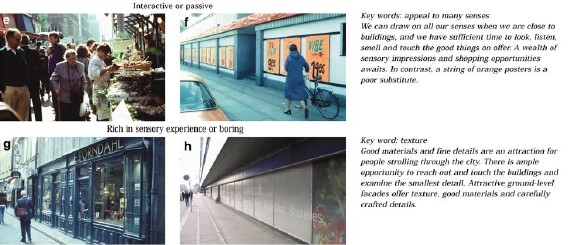
Urban scenes at eye level, Part Two, Jan Gehl, Close Encounters with Buildings

For those of us who grew up watching the Brady Bunch on television, we remember the competition on the show between the middle and older sisters, Jan and Marcia, and Jan's lament that everything was about Marcia -- "Marcia, Marcia, Marcia."

I have a similar kind of response when listening to what I would consider whining by automobilists about the demands for what I consider to be overaccommodation.

"Parking, parking, parking" (a/k/a "privilege, privilege, privilege")

The proposed new Silver Spring library is across the street from a huge parking structure. Now there is a debate between the pro-urban design (against) and the pro-automobilist (for) over whether or not there should be a "skywalk" connecting the garage directly to the library.

Since active urban spaces have active ground floors, we urban design types think that just as how people go to the ground floor of the garage to exit to the stores, restaurants, cinemas, and other destinations in the area around the parking garage, that library patrons should do the same.

But Robert Oshel disagrees in his letter to the editor, "Silver Spring library design lacks parking," in the Gazette, demanding dedicated parking specifically for the library, or baring that, a skywalk.

Ironically, one of the examples Jane Jacobs uses in Death and Life of the Great American City to illustrate the concept of "mixed primary use" is having arts and culture uses located in central business districts and how the parking demands for these uses can be accommodated by the garages that during the day support the office buildings, that building dedicated parking facilities is a waste of money and space compared to using the same facilities for more hours of the day for a multiplicity of uses. (She was writing about Pittsburgh's downtown versus the development of a cultural center in the Oakland neighborhood.)

Skywalks are not great for cities. A graduate student did her thesis on skyways, finding them to be antithetical to great urbanism. See "University of Utah student compiles report on skybridges" from the Salt Lake City Deseret-News. From the article:

Hill, a graduate student at the University of Utah, is completing a master's degree in urban planning and is preparing to begin a Ph.D program. For nearly a year she researched skybridges in urban settings and compiled her findings in a 43-page report titled "Preserving Life of the Street."

"I felt like someone needed to speak up and say, 'This isn't the right concept for our Main Street,"' she said. "Someone needed to gather a body of information to say, 'This is a bad move. Let's come up with another option."'

Hill cites several sources supporting her conclusion that skybridges hinder street-level pedestrian activity and promote segregation and separation. "Planning and design professionals are all standing up and saying that skybridges don't work in this setting," she said.

Anyway, to be fair and equal, Mr. Oshel and others who make the same arguments need to advocate for all library users, including transit users, and should demand that transit users trips to the library be absorbed by the library too.

Labels: , , , ,

Tuesday, November 10, 2009

Another example of co-located public facilities in Arlington County

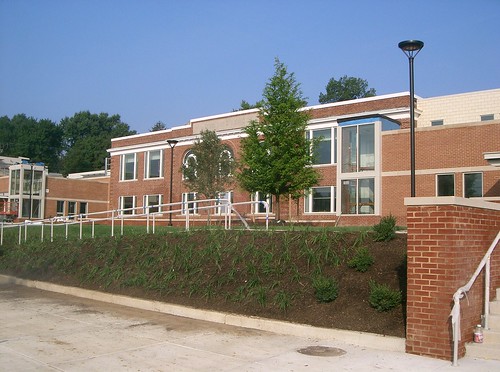
New Reed/Westover Building by Arlington Public Library.
Flickr image from Arlington Public Library

Arlington just had the dedication for a new combined library-elementary school. See "Official Launching of Dual Building" from the Connection Newspapers.

I believe that co-location makes a lot of sense, maximizing the use and utility of public assets.

It's something DC does not do.

From the article:

The new $22.5 million facility, which attaches a new community library building to a fully reconstructed elementary school on a key corner location along Washington Boulevard, won praise from speakers at the dedication ceremony in the center’s front plaza.

"We absolutely got the design right," said Sally Baird, chair of the School Board. "This is an outstanding building, and it will serve the community for generations and generations to come."

Arlington Public Library Director Diane Kresh highlighted the new library’s amenities, including 20 public access computer terminals (where the old library had fewer than a half dozen), 10,000 additional items in the collection, and a spacious layout — triple the size of the old building — filled with natural light flooding in from surrounding high windows. The public will also have access to two meeting rooms, and high-quality video projection available for multi-media presentations.

"We’ve created something synergistic and special, an expansion of the village core," Kresh said. She had particularly high regard for the structure’s placement close to the corner of its plot, directly across McKinley from the post office, and a stone’s throw from local businesses, street parking, and the street life of the Westover community along Washington Boulevard. Kresh predicted the building will create a social destination away from the responsibilities of work or home: a "third place," in New Urbanist parlance.

"I see it being a focal point for community life," she said. "The fact that it’s right here on the corner is going to make a huge difference." County Manager Ron Carlee agreed. "This is how you create smart growth in locations where you don’t have a subway stop right on top of you."

When you have limited resources, each dollar the government spends should be spent with an eye towards maximizing the simultaneous achievement of multiple objectives. Oftentimes, single use public facilities do not accomplish this.

- MEMORANDUM OF UNDERSTANDING BETWEEN ARLINGTON COUNTY AND ARLINGTON PUBLIC SCHOOLS REGARDING THE REDEVELOPMENT OF THE REED SCHOOL AND THE WESTOVER LIBRARY

Labels: , , , ,

Saturday, October 17, 2009

DC Open Government Forum, public event Wednesday October 21st

See their webpage.
-----
But DC also needs a stronger civic culture, one focused on accountability and excellence rather reveling in mediocrity.

NYC's Independent Budget Office, the quality reports produced by the City Auditor in Seattle, or the independent reports produced by the Municipal League of King County (Seattle) (e.g., "Review of Metro Transit") are examples of organizations that provide independent objective analysis.

Sure groups like the DC Fiscal Policy Institute, the DC Appleseed Center, and organizations like Brookings, the Urban Institute, and others produce reports on DC, but they all have axes to grind or are a little too close to power (Brookings, Urban Institute, Alice Rivlin) to question the Growth Machine too closely.

Plus groups in NYC like the Municipal Arts Society, Transportation Alternatives, the Citizens Union Foundation, and the Center for an Urban Future have so much more heft than equivalent groups in DC.

(If I ever do get the Citizens Planning Coalition relaunched, the idea is to have a combination of these four groups, plus some aspects of the Open Society Institute, as well as an action/research focus.)

Plus, publicly disclosed government data collection and evaluation systems, such as Baltimore's CitiStat program, or the more than one decade (I think) that the City of Austin, Texas has been making their agency evaluation information public.

-- City of Austin Performance Measures Database

DC evaluates agencies. But it is hard to find the data, or to know how objective and meaningful are the measures and metrics.

Plus I would like to see the City benchmark its performance against other agencies in the region and nationally.

Labels: , , , , , , ,

Sunday, August 30, 2009

Volunteer for National Public Lands Day, Sept. 26

From the AP story:

Some 130,000 volunteers are expected to spend National Public Lands Day, September 26th, working in parks, beaches and wildlife reserves to build trails, remove garbage and pull up invasive plants.

Many locations are also offering crafts, kid's activities, barbecues and campouts.

The event is a program of the National Environmental Education Foundation.

------

(We have "public lands" in cities too.)

Labels: , , , ,

Wednesday, July 15, 2009

A clustering approach to the management of civic assets

From Chapter 5: Recommendations of the Public Space Master Plan of the Arlington County (VA) Department of Parks, Recreation and Cultural Resources:

Recommendation 1.5 –
Develop a “Clustering Philosophy”

Clustering involves establishing service area boundaries that include a group of parks and/or facilities and treating them as a single unit of service rather than individual spaces. Within the cluster, overall community needs for individual components such as playgrounds, tennis courts, athletic courts, arts and cultural amenities, picnic shelters, sports fields, indoor programming space and other desired components is met without duplicating them in each individual space. To develop this clustering philosophy the County should:

- Determine the service areas for each cluster. Review current service levels and determine areas that are under-served and well served.
- Based on service level, determine where to reduce duplication of services without reducing the overall quality of service provided to the community.
- Identify where new replacement or additional components will be constructed and include them in the Capital Improvement Plan.

---------------
... I am preparing a presentation Friday, on arts-based urban revitalization for a conference on theatre and playwriting.

The idea behind my presentation isn't that "arts are beautiful" and the best way to promote revitalization, but how to better support the development, support and strengthening of artists and organizations and the creative economy--to support the creative ecosystem, across multiple artistic disciplines, and how to place artists and organizations strategically to better represent their interests in the context of what Sharon Zukin in Loft Living: Culture and Capital in Urban Change) called the "artist mode of production" where the arts and artists are used to convert (reproduce) low value (often abandoned industrial) property into high value commercial and residential property, and get displaced/priced out in the process.

Of course, the displacement effect is most likely to occur in places like DC and New York City, which are relatively strong real estate markets. In cities like Pittsburgh or Baltimore, for the most part, artists and arts organizations don't have to worry about displacement, because the real estate markets there are relatively weak.

While I won't likely discuss these examples specifically, interestingly there is a big difference amongst communities in Maryland that have state-designated Arts & Entertainment Districts. Some are oriented to fostering consumption of goods and services, while others, such as Station North and Highlandtown in Baltimore, are more focused on supporting arts production.

(In the study I worked on for Cambridge, Maryland, there are a few pages of bullet points on how to reposition their "arts and entertainment district" more towards production and the development of the creative impulse. It's not nearly as detailed as say the Channel District Arts Plan from Tampa, but given the scope and budget, it covers a lot of ground in a couple pages.)

(Similarly, Highlandtown's Creative Alliance at The Patterson Theater support artists and artists organizations much more than say, the Atlas Performing Arts Center in DC, which is more focused on presenting theater and other performances. The Patterson Theater also presents performances...)

However, focusing on the development of artistic centers--support and capacity development entities--and rethinking how artistic organizations need to work together to develop and share and maximize the value of audiences as well as how to develop and strengthen their broader networks still pertains, regardless of the quality of the real estate market.

Papers from The Reinvestment Fund and the Social Impact of the Arts Project at Penn have been particularly valuable in moving my ideas from previous blog entries such as:

-- Arts-based revitalization, community building, network strengthening, commodification, and Artomatic
-- More Arts Displacement
-- Arts vs. arts-plus for commercial district revitalization
-- Cultural resources planning in DC: In the land of the blind, the one-eyed man is king
-- More on (DC's) Cultural Infrastructure
-- You Gotta Have Community Building

to a stronger, deeper, and wider framework based on a differentiation of the types of arts-based revitalization strategies that are out there, and how for the most part these strategies are focused on enhancing the (real estate) value of place, and less about strengthening artists and arts organizations. Types of arts districts:

- Arts Districts oriented to large presenting institutions (a museum district or theater district)
- Cultural Compounds (i.e., Kennedy Center)
- Arts and Entertainment Districts
- Downtown (and other urban) Districts
- Cultural Production Centers.

Arlington is a leader of course, in their arts incubator concept, which pulls many of these concepts together. From the website:

A county government reorganization in 1986 established a Cultural Affairs Division as part of the newly created Department of Parks, Recreation and Community Resources. A year later the county appointed a citizens' advisory committee to help division staff determine the direction of arts development in the county; a modest investment in cultural facility renovation was made and a Commission for the Arts was formed. A new policy was developed that made it possible for any Arlington artist or arts organization--amateur or professional--to be supported by the county through a competitive grants process.

The division's mandate was changed from serving the needs of a small number of non-professional artists and arts organizations to serving the cultural needs and interests of the entire community. By adding professional artists to the mix, the new division's administrators sought to bring higher quality, greater quantity and a wider range of arts offerings to the area. They hoped to shape a program that would attract artists--from inside and outside the community--who could respond more effectively to the interests of Arlington's diverse population.

In 1990, an Arts Incubator utilizing the new policies and facilities was established. A cost-effective strategy for providing what artists and arts organizations need to create and present their work, the program centers on a way of thinking rather than a way of spending, on reimagining an assortment of untapped government resources such as underused public- and private-sector space. This approach yields substantial dividends: although the county's grants program is small--$98,000 in 1997--the annual savings in rent to organizations using county-subsidized spaces exceeds $400,000.

As a result of the Arts Incubator program, the number of arts groups in Arlington grew from 11 to 25 between 1990 and 1996. The number of arts events increased over 500 percent--from 200 to 1,300--during the same period, while the area's arts audiences increased threefold. (The county's annual arts audience is now almost twice its population.) It is estimated that the local arts industry has gone from generating $1 million to $5 million annually.

The 6 principles for replication:

1. Generate Support For the Arts
2. Seek Out Untapped Resources
3. Connect Arts Support to Community Benefit
4. Maximize Resources Through Creative Sharing
5. Adopt a Flexible Approach to Arts Support
6. Enable Artistic Risk Taking

Labels: , , , ,

Parking prices holding steady, survey says

According to the Associated Press story printed in the Richmond Times-Dispatch. The short article states:

The economy is in distress and people are driving less, but that’s not affecting garage parking prices, according to a recent study. U.S. parking-garage owners and operators have managed to hold rates near last year’s levels, according to the survey conducted by real estate services company Colliers International. Monthly parking rates fell a modest 0.9 percent to an average of $154.23. Daily rates rose 1.2 percent, or 18 cents, to an average of $15.96 a day.

----------
While not an exact analogue, this puts into perspective the $15/year that DC charges for a residential parking permit.

Labels: , , ,

Tuesday, July 14, 2009

Naming civic assets


http://blog.tilos.hu/malestripshow/Happybirthdaymonroe.jpg
Marilyn Monroe singing Happy Birthday to President Kennedy...

I think it's a bad idea to rename places after people who are living. At the very least, time and reflection is a good thing. I know that plenty of places have been named after John F. Kennedy, post-assasination. (Or places after donors who later become "disgraced.")

Still, I can't help but think of all the b.s. (women, anti-Cuban plots, Vietnam--whether or not you believe that he wouldn't have escalated the war) that came out afterwards, every time I see a place named in honor of John F. Kennedy. Or how I would think about justification of torture and the creation of an unnecessary war in Iraq were I to happen by the George W. Bush Elementary School in Stockton, California.

Just as I would be skeptical of naming schools and public parks after George W. Bush during his adminstration, I am not so quick to want to jump and do this for the park at 14th and Girard (Obama Park is suggested by the Friends group, according to the Columbia_heights e-list) or for an elementary school in Prince George's County (see "School board approves Barack Obama Elementary name" from the Gazette)

Labels: ,

Wednesday, July 08, 2009

More on the Hine Development (Capitol Hill, DC)

Correction -- from a comment to the blog:

That turns out to be incorrect. The Deputy Mayor’s office will take the next step in the evaluation phase (not the selection phase) early next week, likely issuing a request for Best and Final Offers (BAFO) to more than one of the bidders. The BAFO process is expected to take a few weeks, after which the Deputy Mayor’s office will review and evaluate the revised proposals, before announcing a final selection."

-------------------------------------------
Therefore this is revised...
-----------------------------

This morning there was a presentation of the various Hine School site redevelopment proposals to "business and professional groups" on Capitol Hill, at a meeting sponsored by the Capitol Hill Business Improvement District, the Capitol Hill Association of Merchants and Professionals (CHAMPS) and Barracks Row Main Street.

The presentations of the four finalists are online (listed alphabetically) here:

- DSF/StreetSense/Menkiti Group
- National Leadership Campus/Western Development Group
- Seven Penn Partners
- Stanton-EastBanc Part I, Part II

Note that public comments are due by the close of business on Friday June 10th.

Now 3 of the 4 proposals are in my opinion, fine -- DFS, 7 Penn Partners, and Stanton-Eastbanc all have decent proposals, while I believe that the DFS and Stanton proposals are better than the 7 Penn proposal, any one of the proposals will do well by the neighborhood, the business community, and Eastern Market.

The National Leadership Campus is an interesting idea, but is more focused on city-national interests in supporting nonprofit development, and not so much on Capitol Hill. It would be a fine addition to the city, but in a different location. At another public meeting, Washcycle and I were kicking around ideas from mine (on the parking lots at Fort Totten or at the Armed Forces Retirement Home campus, post streetcar or separated yellow line transit service) or his, on the land that Catholic University owns west of Harewood Road adjacent to their campus, or somehow closer to the Brookland Metro Station.

It would be worrisome if this plan were picked.

My general problem with the process is that it has proceeded without a master plan for the Eastern Market area, and so some "bad ideas" got included as part of the required conditions for the RFP. Here's something that I wrote as part of an email:

My biggest problem with the whole process has been centered on the reality that "an RFP isn't a plan." There needs to be a master plan for the area, and while Councilmember Wells' process for developing a community vision was very good, it was still ultimately limited, and missed key factors.

E.g., why there is to be public open space on this site makes little sense to me, given that there are four underfunctioning public spaces within 1.5 blocks of the site--the Metro Plaza across the street, the allied green space between 8th and 9th north of Pennsylvania Ave., Turtle Park, and Seward Square. This will merely create a well programmed public space that will compete with and trounce the other spaces.

While it is great that Stanton proposes extensive space for Shakespeare Theater, I wish that a master plan would have determined the best way to meet cultural needs overall and set community priorities. E.g., I advocate that arts uses should be re-sited away from North Hall and that North Hall should be converted to food uses, in order to extend the variety of foods available at Eastern Market, and allow its competitive position to be shaped to better meet demands for greater variety as well as new competition (i.e., Harris Teeter, etc.).

And I think there should have been more direction and a better plan for realizing parking on this site. I am well aware of the Lexington market allied parking structure in Baltimore and there are a variety of parking scenarios that could have been developed but won't be because there is no master plan.

Furthermore, a transportation management district should be created in Capitol Hill in order to reconcile and make congruent all the various mobility issues, which include the matter of parking, but should not be limited to the consideration of parking, nor the use of parking as the lens within which to view all possible mobility issues.
----------
And so, a once in a generation opportunity will not be fully realized...

Labels: , , , ,

Tuesday, June 02, 2009

Having fun with DC development

Moneypile

1. Besides the funding trough that City Council provides developers looking for tax breaks, see Mike Neibauer's article in the Examiner, "Union Station tax break would cost city millions."

2. The Examiner's Jonetta Rose Barras is derisive of liberal activists seeking better oversight of DC publicly owned property and restrictions on sales. See "Conspiracy theorists should get real."

One of the things that occasionally "distresses" me about journalists is that I understand when a typical practitioner or activist doesn't understand the system or the "meta" of how and why things happen. But journalists should. And they, especially columnists, have the opportunity to explain it.

But like Barras, they rarely take the opportunity to do so.

The reality of the "conspiracy" that the activists charge city politicos with, the charge that Barras is derisive of, is that it's merely business as usual. As Harvey Molotch writes in the seminal paper, "City as a Growth Machine: Toward a Political Economy of Place":

A city and, more generally, any locality, is conceived as the areal expression of the interests of some land-based elite. Such an elite is seen to profit through the increasing intensification of the land use of the area in which its members hold a common interest. An elite competes with other land-based elites in an effort to have growth-inducing resources invested within its own area as opposed to that of another. Governmental authority, at the local and nonlocal levels, is utilized to assist in achieving this growth at the expense of competing localities. Conditions of community life are largely a consequence of the social, economic, and political forces embodied in this growth machine.

As long as people fail to examine this system, they will continue, whether they are journalists or activists, to not understand what's going on.

3. I think it's really interesting that the Washington Business Journal reports, in "D.C. narrows list of developers for Stevens Elementary School," that one of the rejected proposals for the use of Stevens Elementary School in the Foggy Bottom neighborhood, was a partnership including DC heavy hitter developers and the Capitol Hill Business Improvement District, to house and train homeless adults.

Pretty interesting. Maybe the Foggy Bottom Association should have promoted a similar use at one of the schools in Capitol Hill.

Out of site (sight), out of mind.

4. Even more delicious is the interest of the Washington Convention Center Authority, see "Washington Convention Center Authority wants to finance hotel" also from the WBJ, to provide 100% financing for a convention hotel across from the Convention Center.

Now, while I happen to agree that the city needs such a hotel adjacent to the center in order for it to remain competitive, especially given the voracious competitiveness of the National Harbor in nearby Prince George's County (e.g., see "Disney Buys Land for Future Resort Hotel at National Harbor" and "Grand Vision for National Harbor Takes Form" from the Post), 100% financing should, but I wonder if it will, completely change the deal.

If the "developers" are getting 100% municipal financing, then they should just manage the construction for a fee, and walk away. DC should then contract with Marriott, just like any other property owner, for management of the hotel property.

Interesting too that one of the "developers," used to work for Marriott, spearheading the project.

In the last real estate recession (late 1980s/early 1990s), national companies like Trammell Crow and local developers such as Oliver Carr, to keep people employed, switched to managing construction projects on a fee for service basis.

If the city provides complete financing for the Convention Center hotel, Quadrangle Development and any partners should do the same thing, except maybe some, but small, ownership percentage for the land.

Labels: , , , ,

Friday, March 13, 2009

Interesting Washington Post video story

On Mayor Fenty (DC) and DC and development. The video features a topping out ceremony at the rebuilding of the old Southwest DC Waterfront Mall as well as a protest about the property development policies of the administration.

The video story feels incomplete to me, but is still worth watching.


It's an interesting conundrum that any mayoral administration faces. The bulk of a city's revenue (and most cities rely on property taxes, DC is unusual in that it fully controls its income tax revenue stream) comes from property taxes. And property taxes for office buildings (and industrial sites and shopping malls--at least in the old days) generate far more revenue than residential properties.

Plus, commercial properties typically take less money to service than residential properties, especially residential properties with children. The typical figures bandied about is that for every $1 of commercial property tax, a city has a profit of 45 cents, while a typical single family residential property costs $1.20 for every $1 of residential property tax revenue that is received. (Multiunit residential properties cost about 85 cents to service for each $1 of property tax revenue.)

So it is a constant dance to generate enough property revenue, to keep the commercial interests happy, while ameliorating residential interests, and improving neighborhoods, when improving neighborhoods costs more money than is generated by increased property and income tax revenues.

Labels: , , , , , ,

Friday, March 06, 2009

A request for proposals isn't a plan

Is a point I make time after time, with regard to projects in DC, especially those involving government-owned (which is really "people-owned") land and buildings. A solid plan needs to be in place, and it is a mistake believing that a couple of community meetings and a short positioning brief will suffice.

I won't claim that the Visioning process I helped conduct in DC's West End is the best possible example of what to do (follow up sessions were needed to make it fully complete) but it did try to do three very important things:

1. Considering each of the area's civic assets (mostly locally owned, but including certain key federally controlled assets) in a coordinated and connected fashion;

2. Coming up with a framework to consider neighborhood priorities in the context of what would otherwise be individual proposals to develop specific parcels/civic assets;

3. Providing residents and civic associations with the context necessary to consider proposals to (re)develop parcels/assets individually as well as within the broader neighborhood context.

In that neighborhood there are two schools (an expanded Francis and a deaccessioned Stevens Elementary), a fire station, a police department facility, the West End branch of the public library, the recreation center adjoining Francis, and Washington Circle, which is managed by the National Park Service (plus the issue of streets, sidewalks, mobility and transportation), plus the proximity of Rock Creek Park and the presence of George Washington University. Plus the Foggy Bottom subway station and complementary bus routes.

Other processes I've witnessed (particularly around the Hine School site on Capitol Hill) are a bit more chaotic, because sufficient ground rules weren't set at the beginning over how to balance multiple stakeholder interests (DC residents "versus" assets such as Eastern Market) and broader concerns that I usually term citywide interests, plus the problem that generally occurs because I believe that city planning processes encourage people to consider "everything" in ways that too often don't make sense. I.e., you can't make every parcel in the city provide "open space."

And that process mentioned, but inadequately considered the area's civic assets: Eastern Market; Rumsey Natatorium; Southeast branch of the DC Public Library; the Eastern Market Metro plaza and associated green space between 8th and 9th Streets north of Pennsylvania Avenue; the Old Naval Hospital; and two private but civic assets, Friendship House and the Capitol Hill Arts Workshop; not to mention broader planning concerns around connecting Eastern Market and 7th Street to the retail interests on 8th Street (Barracks Row Main Street) and the 600 and 800 blocks of Pennsylvania Avenue.

Last Saturday's Post (as I am back in DC I am slowly working my way through back issues of the paper) had a column by Roger Lewis on this broad issue, "Southeast D.C. Project Asked Too Much of the Private Sector," where he states:

Asking the private sector to plan and carry out the redevelopment of large, publicly owned tracts of land might seem like a good idea, but it can be the wrong idea. Sometimes cities themselves must do the work and shoulder the responsibility for planning new neighborhoods.

I would change the second sentence to this

Cities themselves must do the work and shoulder the responsibility for planning new neighborhoods and new uses for "old" sites, and for the coordination of the use of civic assets and the delivery of public services. (More on this last point in a future blog entry.)

For the most part, it's ridiculous to expect profit-making developers to do anything other than try to maximize their profits. That's fine. It doesn't make developers bad people. Let's just recognize what they do best, and what the planning process is supposed to do simultaneously, provide a planning framework and process that mediates the desires of developers and the needs of the city and citizens in a mutually beneficial manner.

WRT the Lewis article, he goes on to write:

But the boldest element was a very expensive piece of infrastructure: a three-block-long deck spanning Interstate 295 to visually and functionally unite historic Anacostia and a redeveloped Poplar Point. ...

The company's withdrawal illuminates the fallacies of the District's Poplar Point strategy. Given the economic climate, the developer was asked to predict, promise and risk too much. It was unrealistic to demand a visionary program and plan whose feasibility was questionable from the outset and then expect the developer to provide all the financing.

Now the process is back to square one, or perhaps square two -- some previous or ongoing work may prove useful. For example, an environmental impact study, required as a condition for conveying the federal land to the District, is underway and should be completed.

But the city should not conduct another competition. It should prepare and adopt its own framework plan of streets, blocks, civic spaces, parks and key public facilities. This is the kind of plan for the city that Pierre L'Enfant created at the end of the 18th century, and it's a planning tradition that should continue.

Because it establishes the pattern and character of the public realm for generations, an urban framework plan must embody a long-term vision. It must incorporate design criteria and guidelines governing the form of development -- building mass and height, density and streetscape design -- and flexibly accommodate many land uses.

With such a plan, private and public investments can produce projects block by block, street by street, parcel by parcel. Inevitably, market and financial conditions, not preconceived schedules, determine the pace and type of development.

You know the Burnham quote, "make no small plans..."

But the hidden point in what Lewis wrote is important too. In the economic environment that lies before us, it's more likely for smaller projects to be built than larger ones (it will be easier and less risky to raise smaller amounts of money, to lease up smaller projects, etc.), and for "master" projects to build (be built) over longer time periods rather than all at once.

Incremental is the key word here. So incremental planning strategies have to be in place to ensure that out of incremental development comes coordinated quality where the overall urban form that results is greater than the sum of the parts. (Another side of the "complete places" concept that I am developing.)

Having the infrastructure and plans in place, and urban design and transportation demand management guidelines that result from plans in place at the outset as new projects are undertaken will produce better individual projects which in turn contribute better to the overall urban form that is created.

That is the possible silver lining in the economic problems we have now.

The trick is to ensure that the elected officials in the city understand this. For the most part, they don't.

For the most part, DC's elected officials don't see or understand the economic value of quality architecture and urban (rather than suburban) design. For the most part, they espouse the philosophy that any development is good development, and requirements demanding quality are seen as impediments.

Speaking of this view, a design was finally approved for the Apple Store in Georgetown. According to the photo that accompanies the article, the first floor design and window treatment respects the rhythm and style that characterizes traditional (historic) retail architecture.

I was troubled by how DC's Deputy Mayor for Planning and Economic Development had inserted himself into the process after earlier failures of Apple to get their way. Instead, the Deputy Mayor should have said that it is important for retail architecture to respect and complement historic architecture, respecting and extending the vitality of the street experience that is fundamental and foundational to Georgetown's competitive position within the regional retail landscape.

Despite the involvement of the Deputy Mayor, because there is a review process (Old Georgetown Board) in place, using historic preservation and urban design guidelines to make judgements and decisions about the projects that come before them, a better decision was made in the end, rather than caving in to Apple because they are a desired tenant and bad (or less good) development is better than no development.

(This is a case where the Deputy Mayor fails to understand the city's leverage--people want to locate here, even in today's sputtering economy, at least in certain prime locations, and that shouldn't be forgotten. When you have something to sell, something that is in demand, don't underprice, don't leave money on the table because you are so concerned that you won't make the sale.)

Labels: , , , , , ,

Tuesday, February 24, 2009

"Passion, invention and joy are actually possible in public buildings" ...

if they were built a long time ago. Not today, usually, when the buildings are value engineered, satisficed, "over programmed," and not focused enough on thinking about how people use the spaces and how buildings contribute to urban form beyond the confines of the lot on which the building sits.

It's always fun to read coverage of DC issues in other places. The Boston Globe architecture writer has a piece on the new Capitol Visitors Center, "Architecture highs and lows in D.C.."

The review starts with this:

If you're an architect who doesn't have a single bright idea, here's what you do. Impress everyone by spending $621 million. Make every room twice as big as it needs to be. Finally, slather every available surface with a thick, gooey coat of warm-toned marble.

Labels: , , ,

Wednesday, August 27, 2008

Now that's mixed use

The Gazette reports on library planning for Silver Spring, in "Adults, teens discuss wish list for library." According to the article:

The proposed library would be at the corner of Wayne Avenue and Fenton and Bonifant streets. The 66,000-square-foot site will most likely feature the multi-story library, affordable housing units and a station for the Purple Line, which is slated to run through the property.

A public transit station and a public library and... Impressive.

Meanwhile, DC just can't seem to figure out how to make mixed use, and the achievement of multiple objectives from one piece of property, a reality.

MontCo isn't perfect. They aren't putting a bicycle station in the Sarbanes Silver Spring "Transit" Center, although they are providing connections to bicycle trails.

Labels: , , , , ,

Wednesday, August 13, 2008

Speaking of the Growth Machine

there is a new blog,Tenleytown RFP, concerning the redevelopment of the Tenleytown Library and the adjoining Janney Elementary School across the street from the Tenleytown Metro Station on upper Wisconsin Avenue NE.

Fun reading.

Labels: , , , , ,

Monday, August 11, 2008

Chauvinism, mediocrity and robust systems

About 4 or 5 years ago, I evinced interest in creating a "Jane Jacobs book group," which I never got around to getting off the ground. But I got some indications of interest and one person commented that by comparison to NYC, DC is an "immature" city, without the kind of built environment that typified Manhattan, the place that Jane Jacobs wrote about in Death and Life of Great American Cities.

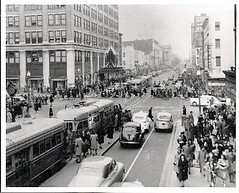
I replied frostily, stating that DC, especially downtown, had that kind of building stock at one time, but most of it was destroyed--reproduced--in the process of rebuilding downtown in the 1980s and 1990s into larger buildings with a limited number of entrances. (The riots didn't help. They led to a destruction of the base of independently owned retail.)
DCDOWNTOWN.jpg
Downtown DC in the 1940s. Original source unknown.

But in some respects DC is an immature city, one where a fervent narcissistic focus and a rampant belief in a uniqueness that limits comparison to other places and practices allows for a redefiniton of mediocrity as superiority, and a continued focus on people rather than the development of robust processes and systems that can function beyond individuals, and deliver excellence.

(For some influences on my thinking, consider Moynihan's paper "Defining Deviance Down" and the discussion by Wanda Corn in The Great American Thing: Modern Art and National Identity, 1915-1935 where she makes the point that focusing on uniqueness means that work cannot be compared.)

Certainly, the failure in the Tax Office with regard to the property tax scan is an example.

But so is the failure of controls, systems, and processes in the DC Government Summer Jobs Program for students. This has always been a program more focused on patronage than results--students getting paychecks became lifelong supporters of Marion Barry, without understanding that jobs are about providing effort and attendance in return for pay.

No wonder a lot of people in DC have a hard time understanding how employment works, and why some segments of the population experience high unemployment. (See "Fenty Faces Backlash From Problems in Youth Jobs" from the Post.)

There is a delicious irony of Marion Barry calling for an investigation of the failure of this year's program to properly pay and supervise participants. Doesn't the failure of the DC Government start with his ascension to the Mayoralty?

It doesn't help that the same people let the public school system decline precipitously, again, in favor of access to the system as a source of contracts and jobs, and a lack of concern about quality outcomes, in this case, highly and well-educated students. (Home rule started with a popularly elected school board. This preceded the Home Rule Charter, and a popularly elected Mayor and City Council.)

Note that for all the talk about Chancellor Rhee and Mayor Fenty and the school system and "reform," the fact remains that personnel decisions and actions remain arbitrary and capricious--at least based on the view of many of the people who are losing their jobs as principals and/or teachers--seemingly a matter of connections and loyalty rather than about merit and quality.

It may be a long time before DC Government is focused on performance rather than the ability to control contracts and give people well-paying jobs. Even under the Fenty Administration. Although there was a fair amount of progress under the Williams Adminsitration.

From "Won't Get Fooled Again" by The Who:

I'll tip my hat to the new constitution
Take a bow for the new revolution
Smile and grin at the change all around me
Pick up my guitar and playJust like yesterday
Then I'll get on my knees and pray
We don't get fooled again

The change, it had to come
We knew it all along
We were liberated from the foe, that' all
And the world looks just the same
And history ain't changed
'Cause the banners, they all flown in the next war ...

There's nothing in the street
Looks any different to me
And the slogans are replaced, by-the-bye
And the parting on the left
Is now the parting on the right
And the beards have all grown longer overnight
-------------
Speaking of which, today is the deadline for registering to vote to be able to vote in the 2008 election primaries in DC.

Chauvinism-parochialism is very much evident in local planning and capital improvements. Much of DC planning is focused on wards, and city-wide planning, especially with regard to capital improvements, doesn't seem to exist.

I think about this in terms of the creation of recreation centers all over the city, while failing to designate some of these centers as "regional" facilities with enhanced facilities and capabilities.

Similarly, every ward seemingly has to have its own Office of Aging-managed "senior wellness center."

Since these facilities are used mostly during the day, when recreation centers are barely used, why not have had the Office of Aging and the Department of Parks and Recreation do joint facilities planning?

Do we really need a Ward 4 Senior Wellness Center on Kennedy Street, less than 2.5 miles from the Ward 1 Senior Wellness Center (under construction) on the 3500 block of Georgia Avenue?

And there are plenty of recreation centers surrounding these facilities.

(Note that I attended a meeting about the Ward 6 Senior Wellness Center in December 2001. It's still under construction. Meanwhile, it is within a few blocks from the Sherwood Recreation Center, and three under-utilized DCPS school buildings--Wilson Elementary, Ludlow-Taylor Elementary, and the Prospect Learning Center.)

Labels: , , , ,