Rebuilding Place in the Urban Space

"A community’s physical form, rather than its land uses, is its most intrinsic and enduring characteristic." [Katz, EPA] This blog focuses on place and placemaking and all that makes it work--historic preservation, urban design, transportation, asset-based community development, arts & cultural development, commercial district revitalization, tourism & destination development, and quality of life advocacy--along with doses of civic engagement and good governance watchdogging.

Thursday, February 16, 2012

Men and women and their housing preferences: Trulia Survey

See "For The Love Of Real Estate: Ahead of Valentine's Day, Trulia surveyed Americans across the country to see how much real estate and dating choices intertwine" from the Trulia Insights blog and "Romance & Real Estate: How Your Housing Situation Affects Your Love Life" from Time Magazine.

... I'd like to see a detailed study about housing preferences according to different types of neighborhoods, a la the New Urban Transect, and types of housing.

Labels: , , , ,

Sunday, November 20, 2011

Not blockbusting but a similar technique

Blockbusting was how, post-integration, realtors would rile up a community to get white homeowners to sell once a black family moved in the neighborhood, and in turn would sell the houses to other black family, accelerating outmigration from the center city. (Blockbusting in Chicago, from the Encyclopedia of Chicago History; White flight, from Wikipedia)

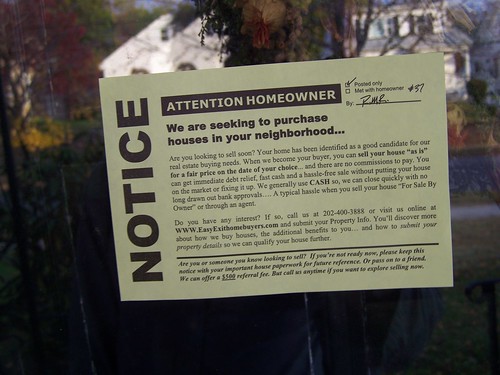
Not blockbusting but might as well be

This "notice" I found on my door the other week is likely a more modern version of the same kind of bottom feeding by real estate interests.

Labels:

Saturday, October 01, 2011

More real estate coverage of urbanism as a desirable place to live

Today's Post Real Estate section continues to explore "the option of urbanism" as it features the Shirlington section of Arlington County, Virginia in the weekly neighborhood feature, "Where We Live: Walkable, dog-friendly Shirlington."

From the article:

“Every day I am grateful for my commute,” said Chovanec, who can leave her apartment shortly before she is due at work and still have time to grab breakfast on the way. She can also up pick up groceries and run other errands without driving.

“We essentially don’t use our car all week,” she said. “We sometimes wonder if we need it.” Chovanec’s penchant for walkability isn’t unusual. It’s what draws many residents to this three-block strip off Interstate 395, southwest of the Pentagon.

It hasn’t always been that way. Fifteen years ago, Shirlington was a mostly deserted shopping center kept barely alive by a few good restaurants, a movie house specializing in independent films and a now-defunct catalogue retailer. Despite the seemingly ideal location at the mouth of a major highway, many businesses were put off by the absence of steady foot traffic. Those that did open tended to shutter quickly.

Things began to change in 2000 when Arlington County reached an agreement with Federal Realty Investment Trust to reinvent the shopping center and turn it into a neighborhood where people could live, work and find entertainment without getting into their cars. Today, Shirlington Village’s approximately 2,000 residents live in five rental buildings and one 11-story condo building.


The article goes on to discuss how the County co-located the Signature Theatre there, in an addition to the County Library.

It doesn't discuss lack of fixed rail transit, but does discuss bus service, and Arlington County opened an enhanced bus terminal in Shirlington a few years ago. Shirlington is obviously accessible via freeway, but is about 5 miles away from the Crystal City Metro Station, and about 2.5 miles from Columbia Pike, which will have streetcar service.

It does pose an interesting question, if enhanced bus service would be seen as attractive by such residents, and would be used. But the area needs more population to be able to support that kind of service.

Anyway, stories like this one and the one mentioned earlier in the week, in the blog entry, "Is real estate reporting changing somewhat towards walkability (and bikeability)," demonstrate that at least in the Washington region, times are changing--at least somewhat.

------
P.S. In the previous entry, there are very good comments (but I can't reply because of some weird software glitch). They commented on the point about center city vs. suburb in terms of "competition" for people who want urbanism.

I agree with Dan Reed that until the center cities get their schools together, it will be hard to compete for families (then again, it's costly to educate schoolchildren...).

Spookiness makes many (as always) interesting points--it happens that he lives in the neighborhood featured in the story--including those about access, lack of fixed rail transit access, and flaws in the original spatial organization of the community.

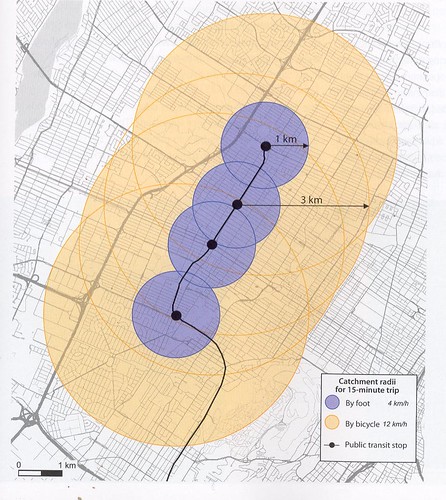
If you think about my mobility shed concept (See "Updating the mobilityshed / mobility shed concept" from 2008) how can people's accessibility and mobility be enhanced effectively in these situations?

Well, I'd say biking can make a big difference in terms of extending the range of non-autmobile-based accessibility and mobility, depending on the ability to integrate neighborhood/district trail systems and provide ways to cross barriers such as freeways.

It definitely would in last week's example of Warwick Village in Alexandria. It's 1.9 miles from the neighborhood to the closest subway stop. That's an easy bike ride. So there is a lot of latent opportunity within the suburbs to increase bike use--if we can figure out how to deal with those pesky arterials...
Catchment area of public transit stops for pedestrians and cyclists
Catchment area of public transit stops for pedestrians and cyclists. p. 135, Planning and Design for Pedestrians and Cyclists: A Technical Guide, produced by VeloQuebec.

Labels: , , , ,

Wednesday, September 28, 2011

Is real estate reporting changing somewhat towards walkability (and bikeability)

According to Christopher Leinberger's The Option of Urbanism: Investing in a New American Dream, 60% of people are willing to live in walkable places, but most of the available housing market is focused on traditional suburban car-dependent housing.

The increased in-migration to center cities and towns in inner ring suburbs indicates that more people are looking for places that are no so car-dependent.

I haven't done a full-blown "content" analysis, but the regular feature in the Saturday Real Estate section of the Washington Post seems to be changing somewhat and acknowledging this somewhat, in terms of how it describes neighborhoods in terms of their access to biking trails and transit, as well as walkability. Last week's feature, "Where we Live: Warwick Village," about the Warwick Village neighborhood in Alexandria had multiple paragraphs on the walkability element--more writing about this factor than any of the features that I remember even over the past two years.


From the article:

“I thought I wanted the suburban dream,” he said. “I hated it.” Foley, a chef, didn’t like having to drive everywhere, and he didn’t like spending his weekends mowing his lawn and tending to a house that felt too big. After about five years, he sold the house in Springfield and moved back to Warwick Village. ...

“We love the neighborhood,” he said. “You can walk to everything . . . and something about the townhouse setup seems to encourage neighborliness. You see people sitting on their front steps talking.” ...

The neighborhood, which spreads over 12 hilly streets, is just a few miles south of Washington and an easy commute downtown by bus and Metro. It also borders the trendy Del Ray neighborhood. Mount Vernon Avenue — Del Ray’s lively main street, lined with shops and restaurants — is about a 10-minute walk away. Residents can also walk to five neighborhood parks, two farmers markets and other amenities.


Still, center cities can't take their competitiveness on these factors for granted. Leinberger says that 70% of the demand for walkable neighborhoods will be met by suburban communities.

Labels: , , ,

Tuesday, September 08, 2009

Negative impacts from "the market economy" and the "local" real estate market

Harry Jaffe of the Washington Examiner waxes poetically over the sale of a DC office building for a high price to German investors, in "Foreign investors still buying chunks of downtown."

There are at least four negative aspects of Washington's Central Business District no longer being a local market:

1. Prices for properties are driven by factors having little to do with the local market;

2. This drives up prices for space, especially for retail space on the ground level, pricing all but the most profitable uses out of the Central Business District, impacting independent retailers and startup businesses the most;

3. The reproduction of the CBD into a national-international market trickles down and impacts other submarkets throughout the city especially Capitol Hill (the Louis Dreyfus Group is a big player there), Georgetown, and Friendship Heights in turn increasing prices there, and having negative impacts on the development of a local economy;

4. At the same time, the property tax assessment methodology employed by the DC Office of Tax and Revenue is shaped by the reproduction of the downtown office market, so that all commercial properties across the city get valued as if they can be office buildings purchased by international investors and pension funds, further increasing prices and in turn having negative impact on the development of independent retailers and startup and innovative businesses.

For more on point #4, see:

- Testimony -- Historic Neighborhood Retail Business Property Tax Relief Act (2006)
- A solution for the overtaxing of properties in neighborhood commercial districts (2009)
- Displacement of retail businesses through increasing property tax assessments (2005)
- Forcing Displacement by the disconnection of tax assessment models from public policy goals (2005)
- Globalization of the DC real estate market catches neighborhood commercial districts up in the wake (2006)
- Avoiding the real problem with DC's property tax assessment methodologies (2007)
- The hot real estate market Downtown and Georgetown (2007)
- Even more on commercial property tax assessment policies (2007)
7b31024128a0f79fd3767010.L._SL500_AA240_.jpg

Labels: , , , , ,

Tuesday, June 02, 2009

Having fun with DC development

Moneypile

1. Besides the funding trough that City Council provides developers looking for tax breaks, see Mike Neibauer's article in the Examiner, "Union Station tax break would cost city millions."

2. The Examiner's Jonetta Rose Barras is derisive of liberal activists seeking better oversight of DC publicly owned property and restrictions on sales. See "Conspiracy theorists should get real."

One of the things that occasionally "distresses" me about journalists is that I understand when a typical practitioner or activist doesn't understand the system or the "meta" of how and why things happen. But journalists should. And they, especially columnists, have the opportunity to explain it.

But like Barras, they rarely take the opportunity to do so.

The reality of the "conspiracy" that the activists charge city politicos with, the charge that Barras is derisive of, is that it's merely business as usual. As Harvey Molotch writes in the seminal paper, "City as a Growth Machine: Toward a Political Economy of Place":

A city and, more generally, any locality, is conceived as the areal expression of the interests of some land-based elite. Such an elite is seen to profit through the increasing intensification of the land use of the area in which its members hold a common interest. An elite competes with other land-based elites in an effort to have growth-inducing resources invested within its own area as opposed to that of another. Governmental authority, at the local and nonlocal levels, is utilized to assist in achieving this growth at the expense of competing localities. Conditions of community life are largely a consequence of the social, economic, and political forces embodied in this growth machine.

As long as people fail to examine this system, they will continue, whether they are journalists or activists, to not understand what's going on.

3. I think it's really interesting that the Washington Business Journal reports, in "D.C. narrows list of developers for Stevens Elementary School," that one of the rejected proposals for the use of Stevens Elementary School in the Foggy Bottom neighborhood, was a partnership including DC heavy hitter developers and the Capitol Hill Business Improvement District, to house and train homeless adults.

Pretty interesting. Maybe the Foggy Bottom Association should have promoted a similar use at one of the schools in Capitol Hill.

Out of site (sight), out of mind.

4. Even more delicious is the interest of the Washington Convention Center Authority, see "Washington Convention Center Authority wants to finance hotel" also from the WBJ, to provide 100% financing for a convention hotel across from the Convention Center.

Now, while I happen to agree that the city needs such a hotel adjacent to the center in order for it to remain competitive, especially given the voracious competitiveness of the National Harbor in nearby Prince George's County (e.g., see "Disney Buys Land for Future Resort Hotel at National Harbor" and "Grand Vision for National Harbor Takes Form" from the Post), 100% financing should, but I wonder if it will, completely change the deal.

If the "developers" are getting 100% municipal financing, then they should just manage the construction for a fee, and walk away. DC should then contract with Marriott, just like any other property owner, for management of the hotel property.

Interesting too that one of the "developers," used to work for Marriott, spearheading the project.

In the last real estate recession (late 1980s/early 1990s), national companies like Trammell Crow and local developers such as Oliver Carr, to keep people employed, switched to managing construction projects on a fee for service basis.

If the city provides complete financing for the Convention Center hotel, Quadrangle Development and any partners should do the same thing, except maybe some, but small, ownership percentage for the land.

Labels: , , , ,

Thursday, April 16, 2009

A solution for the overtaxing of properties in neighborhood commercial districts

Art in (vacant) store windows, H Street, H Street Festival
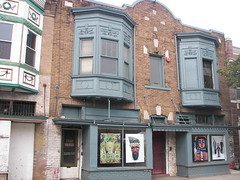
Should a rowhouse type building used for retail purposes in a neighborhood commercial district (this building is on H Street NE) ...

Create a more nuanced property tax classification system, which treats office buildings in places like downtown, NoMA, Dupont Circle, the West End, M Street SE, etc., differently from commercial buildings used for retail in places like Capitol Hill, Brookland, Takoma, etc.

The current classification system doesn't do this. There are three types of property: residential, commercial, and vacant, and the commercial property classification has two tranches, for properties worth more or less than $3 million.

What happens is that the process, weighted towards buildings in the Central Business District, and a market that is not local, but one with national and international actors, treats all property, in effect, as if it could be downtown office buildings.
---------
I had a letter in the Washington Post about this a couple years ago:

Tax Policy Hurts D.C.'s Local Businesses,

A July 20 Metro Article ["Feeling the Pinch of D.C.'s Prosperity: Small Businesses Cry Out for Relief From Rapid Rise in Property Taxes"] inadequately explained why tax assessments are rising for small commercial property owners in the District.

Regardless of buildings' locations and use, the D.C. Office of Tax and Revenue values [all] commercial buildings as if they could be converted into downtown office buildings. If the purpose is to turn the entire city over to office buildings and retail chains, then this property tax assessment methodology is working.

The market for downtown property is not local; it involves national and international developers, lenders, and portfolio investors. The market for small-footprint buildings in neighborhood commercial districts is local--in terms of property owners, investors, tenants, sales potential and rents. The solution is simple: differentiated tax assessment methods. The legislative focus on property tax abatements or tax caps fails to address this fact.

As a result, locally owned businesses will continue to close or relocate to the suburbs, while more and more of the retail identity and uniqueness of the District is lost and the city's retail landscape becomes reshaped into yet another mall, albeit outdoors, featuring national brands.
------------------

And note that DC's small building footprints for commercial property, in this case office buildings, and the constant demand for space by businesses willing to pay high prices in return for convenient access to the federal government -- law firms, lobbyists, certain trade associations, etc. -- mean that most other uses will be crowded out. (It's an economics-based reason for considering lifting the building height limit.)

This results in the overvaluation for tax purposes of commercial property outside of the ever expanding "Central" Business District (+ Georgetown and Friendship Heights).

As a result, asking prices for rents in neighborhood commercial districts 60% to 100% higher than what the rents should be, based upon the revenue potential of the building in use as a retail business (this is calculated on the basis of gross revenue/sales per square foot).

And it's why for the most part, most neighborhood commercial districts continue to be unsuccessful. They can't retain and/or develop quality businesses, because the underlying economics of the business model don't work--for the most part--because assessments and rents are too high.

I have been writing about this since 2005. See:

- Displacement of retail businesses through increasing property tax assessments
- Forcing Displacement by the disconnection of tax assessment models from public policy goals
- Globalization of the DC real estate market catches neighborhood commercial districts up in the wake
- Avoiding the real problem with DC's property tax assessment methodologies
- The hot real estate market Downtown and Georgetown
- Even more on commercial property tax assessment policies
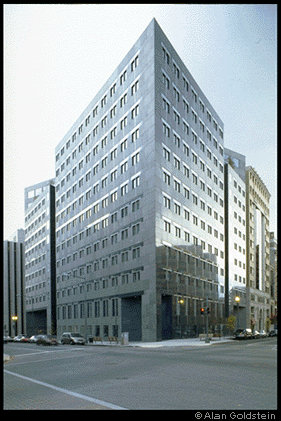
A DC office building
pay property taxes on the same basis as a commercial office building in the city's Central Business District?

Labels: , , , , ,

Thursday, November 13, 2008

The real estate market is all about submarkets

As MZ points out in a comment in an earlier entry...

1. The Financial Times Weekend Home section has a big feature on Petworth as part of its weekly focus on changing urban neighborhoods around the world, "A Capitol Investment" (registration required). It's an interesting read only in how it sheds light on the process of neighborhood change. But yes Ward 1 and Ward 4 neighborhoods are changing, just as are many of the other neighborhoods in the city that are close to the center and enjoy subway station access. (And it reads the same as other articles describing this phenomenon, such as "Renovation Frustration" from the Express about Judith Matloff and her experience as a white woman rehabbing a house in Harlem.)

2. The Post real estate section has "Post-Election Trends," a not very good article about how the Obama Administration change won't effect the Washington metropolitan real estate market.

Of course it won't have much impact on the entire almost 7,000 square mile region. But it will affect a handful of submarkets where Democrats are more likely to live, including Capitol Hill and Georgetown in DC, and probably Arlington and maybe Alexandria in Virginia, and potential Bethesda and Takoma Park in Montgomery County.

Given the slightly weak real estate demand we are experiencing in the city, which has brought housing prices down from stratospheric top prices, but still finds that base prices are relatively high in in-demand neighborhoods in the core, and reduced prices farther out from the core (such as Petworth), even a slight increase in demand can have a stabilizing effect.

Labels: ,

Sunday, June 08, 2008

How the center cities get dissed

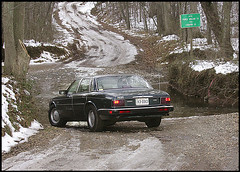
Jaguar Off-roading in Loudoun-Prince William Counties, Virginia
Photographer: Tracy A. Woodward/Washington Post. Traffic along unpaved Braddock Rd and Peach Orchard Rd in Southern Loudoun County, VA. Commuting cars traveling along dirt roads (Braddock Rd and Peach Orchard Rd) in southern Louduon County. This is Ed Taylor, a realtor from Centreville, VA, cautiously driving his Jaguar on Peach Orchard Rd crossing Bull Run Stream. This is the dividing line as the sign says, Entering Prince William County leaving Loudoun County.

The region (hopefully) anchored by the center city is named after the center city, i.e., "Washington" or "Cleveland" or "Detroit."

This MSN real estate article, "30-city real-estate outlook," has this to say about "Washington":

Some prices don't start to bottom out until early 2010," he says. But in key markets where the rate of appreciation accelerated faster than household income growth — such as many cities in California and Florida, as well as Phoenix, Las Vegas and Washington, D.C. — he expects prices to drop by 20% or more.

But it is referring to the Washington Metropolitan Region, not to the Center City. DC proper is being painted with the broadbrush of housing declines that are particularly pronounced in the nether areas of the region.

Real estate is all about micro-markets. Commercial real estate brokers refer to submarkets, i.e., for the DC office market, Downtown is a submarket, so is NoMA, Dupont Circle, Union Station, M Street SE, etc. It works the same way for neighborhoods. And the real estate market in most DC neighborhoods is strong. (Of course it wasn't always this way.) So far.

Sure, top prices have declined. Stratospheric appreciation rates are less likely. Houses stay on the market longer. And there are foreclosure and short sale properties on the market. But fortunately, the real estate market in the center city of Washington, DC remains strong, even in the face of difficulties in outlying areas. And of course, other than the subprime meltdown specifically, part of the reason for weakness in the outlying markets in the region plays to the strengths of the center city: high gasoline prices in the region are countered by walkable neighborhoods served by transit and being relatively close to work in the core of the region, which will only increase (fuel) demand for center city property, and should work to strengthen the ability of the core of the region to retain businesses--although this may help Arlington County even more than DC. Who would have thought that the Navy's leaving Crystal City could actually lead to long term strengthening of the Crystal City submarket?
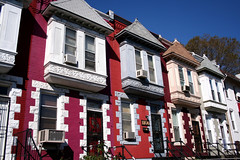
Rowhouses on 8th Street NE (by Gallaudet University), Washington DC
Rowhouses on 8th Street NE near Gallaudet University. Photo by Frozen Tropics.

Labels: , ,

Wednesday, April 16, 2008

Housing Market issues #1

Most people in DC know that the subprime mortgage crisis is impacting the city less than the suburbs, particularly compared to the exurbs. However, there are still many foreclosure and short sale properties on the market in the city.

In the process of looking for a house, and balancing the preferences of my girlfriend and myself, it makes me think anew about the difference between house shopping in the suburbs vs. the city. Many people don't really understand this. Maybe I wouldn't either, if I hadn't experienced at least two other market "crashes" and two other market "booms," and observed the process of neighborhood change in the H Street NE, Capitol Hill East, and other neighborhoods in the core of the city, especially those with transit access. (And it can be really difficult to discuss this with family members who have lived in the suburbs for decades and decades.)

The market for residential property in DC proper is impacted particularly by four factors:

1. Participation in the market by people buying second (or third or fourth...) houses (this stokes demand and prices extranormally);

2. The still positive trend supporting urban living (confirmed by research by Christopher Leinberger and the Brookings Institution, which states that 30% of people prefer urban housing; 40% prefer the suburbs, and 30% don't care either way);

3. Demand for historic building stock, which by definition is in limited supply, since the housing people want the most in this category tends to be at least 70 years old; and

4. Transit, particularly subway rather than bus, access and/or closer-in locations.

A 5th factor concerns the presence of in-neighborhood retail and other amenities, meaning that Capitol Hill, Dupont Circle, etc., have a higher and constant demand than Deanwood, even though all have subway stations.

(Those of us who can't afford housing in the best locations replete with amenities move to places with great houses but lacking amenities. Then we clamor for amenities to come to our neighborhoods...)

Of course, this is built upon the foundational somewhat constant demand generated by the presence of the federal government.

So, crappy, at least what I would consider to be butchered, houses, are still selling, if they are well-located and close to transit. But good houses, or even better ones, but ones needing some work maybe, are still on the market, especially if they are in areas where the transit access is bus-based rather than subway, and/or in areas that aren't replete with retail amenities.

But it's not crazy demand. I saw a 2,400 s.f. rowhouse (this is twice the size of the typical rowhouse in the H Street NE neighborhood) in upper NW, with most of its original wood unpainted, original garage still present in the basement, incredible linen closet built ins upstairs, the kitchen needs some work, $380,000. But it's not remotely close to an area like the "Atlas District." Still on the market. (We bought a different place. But I really liked this one.)

And houses in great condition and location haven't gone down in price, and they don't stay on the market that long. E.g., houses in Capitol Hill are selling and Capitol Hill keeps expanding east and north in terms of demand for housing and heightened prices. Improvements along H Street drive demand north. Improvements along Pennsylvania Avenue drive demand east. Can you imagine what will happen in the Potomac Avenue Metro area once the Harris Teeter finally opens next month?

I suppose to most of the people who read this blog, this is pretty obvious. But this kind of obviousness isn't being covered in the typical media stories about the issue.

Labels: , ,

Friday, February 22, 2008

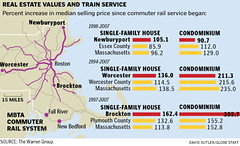
Real Estate Values and Train Service, Boston suburbs

From "New rail service to Hub called economic boon: Three cities point to rise in real estate values," in the Boston Globe.
Real Estate Values and Train Service, Boston suburbs
Boston Globe graphic.

Labels: , , ,

Tuesday, October 09, 2007

Revitalization without displacement (nee gentrification)

There were a couple sessions about this at the National Trust conference, featuring experiences from St. Paul and Macon, Georgia. I attended a conference about the Trust's Preservation Development Initiative a couple years ago, where these two organizations presented (the reports for most of the PDI projects are still available online). So I saw this stuff before. And the Macon project in particular is quite impressive, involving as a partner Mercer University, which made significant investment in distressed neighborhoods bordering the campus (which of course, is why they were motivated to invest, similar to how the University of Pennsylvania was compelled to invest in University City, in order to maintain the viability of the university).

But my response is pretty simple. It's easy to have revitalization without displacement in a weak real estate market experiencing little in the way of in-migration.

It's much harder, if not impossible, in markets where there is a great deal of demand, such as DC, Manhattan, Brooklyn, Center City Philadelphia, San Francisco, etc.

Unless people are willing to live in different types of housing and likely not single family houses, and if nonprofit organizations and/or municipalities make portfolio investments in apartment buildings, condominiums, and co-operatives, in order to maintain the affordability of affordable housing in otherwise high-demand markets.

Labels: , , ,

Monday, June 25, 2007

A brief lesson in "incentivizing" supermarkets and department stores

For many years I thought it was disgusting that big corporations like Macy's got big incentive payments to open up department stores. In 2003, I heard a presentation by Robert Gibbs at the Congress for the New Urbanism conference in DC, and that made me change my tune.

What this is really about is anchors. The point about anchors is that they spend a fair amount of money on advertising to draw in customers. Anchors, as part of shopping centers or districts, draw in customers who also patronize other stores--spending money elsewhere.

As a result, they demand and receive below normal rents. For example, on H Street NE, Harris-Teeter wanted to pay under $15/s.f. to lease at 300 H St. NE. (The property owner said no way.) That is probably less than 25% of what will be the prevailing lease rate for the rest of the space.

In a shopping center, a price like that doesn't matter, because the rates of other tenants are adjusted accordingly, to cover the sweetheart rate. But Steuart Development doesn't own any other property on H Street. Other property owners and businesses will benefit from a new anchor like Trader Joes, Harris-Teeter, etc. Therefore, the originating property owner asks for incentives to help subsidize the cost of attracting desired retail businesses to the city.

I've written about this in terms of the Wal Mart philosophy, which is directed towards capturing 100% of your typical consumer dollar (other than on high ticket goods like automobiles)--in theory and practice Walmart can sell you everything, from clothes to food to prescription drugs to furniture to sporting goods to electronics. They don't want you spend money with anyone else.

See the old blog entry "Retail tax incentives don't always provide 'enough bang for (the) buck.'"

The issue is that you have to ensure that the deal is mutually beneficial.

So back to the current hullaballoo about Nordstroms wanting an incentive payment to locate in Georgetown. See "Some Question Nordstrom Financing," from today's Post.

The reason this is justifiable is because:

1. Nordstroms will spend a lot of money on advertising
2. Which will attract a lot of customers to Georgetown
3. Who won't spend all their money in Nordstroms
4. Or in stores leasing from Herb Miller.

Therefore much of the benefit goes to other stores and property owners, who aren't paying to subsidize the buildout and low rents/square foot that Nordstroms is likely demanding.

Now, initially the Hines people were hoping to attract Nordstroms to the Old Convention Center site. That would have been better from broader city economic development objectives.

But the reality is that retailers don't feel that it is their business to help revitalize downtowns or neighborhood commercial districts. They just want to make money. It is a tricky balance to achieve those multiple objectives. Given the agglomeration effect reflected in the Reilly Law of Retail Gravitation, good places tend to get better, and average places stay average, and under-stored places stay under-stored.

{Note to everyone who says "you should get a Starbucks..." Starbucks considers 8th and D Street SE, on Barracks Row, a stone's throw from the Eastern Market subway station, a distressed area. So if they consider that a distressed area, how do you think they think about places like H Street NE, Deanwood or North Capitol Street?}

Now Elizabeth can comment about the incentive provided to Trader Joes...

From "Commerz in the 'hood... (aka "Commerce as the engine of urbanism") ":

Last night I went to a presentation by Alex Wall, author of a recent book about Victor Gruen. To Wall, the story of VIctor Gruen is really about "commerce as an engine of urbanism," and it turns out there was a lot more to Gruen than I realized, even though as a child I was a patron of his very first shopping center in a Detroit suburb...

A big thing is the narrative, "the story" told by the commercial district. (Gruen's ideas have since been extended in the 1970s by James Rouse and in the 1980s by Jon Jerde--Citywalk in LA, and even Disney, although Disneyland was created at the same time as Gruen began developing shopping centers and his increased prominence on the national scene. Gruen was familiar with and interacted with Disney; Wall claims that Disneyland was Walt Disney's organized response to Southern California sprawl.)

Wall's book seems worth reading and will likely have as much impact on my thinking as some of the chapters in the Harvard Guide to Shopping. In particular that book's chapter on women which states "a history of shopping is really a history of women"... reinforced my thinking about the importance of the fact that upwards of 80% of retail transactions are conducted by women and if women don't feel comfortable in a (the) (H Street) commercial district they won't shop there and it won't succeed (unless somehow it can become a "men-only" shopping district anchored by stores like Bass Pro or Cabela's--the "beyond" big box sized sporting goods behemoths primarily shopped in by men).

This relates to the Reilly Law of Retail Gravitation which focuses on measurable indicators--the number and mix of stores in particular shopping destinations. The Law is that with factors being roughly equal (travel, etc.) people will choose the shopping center/option that is better (more and more interesting stores, variety of product selection, etc.). Obvious huh? In the urban context especially, factors that people mull over when deciding between shopping destinations include comfort and perceptions of safety, physical condition of the commercial district, etc.

This is why I joke about Main Street principles #9 and #10 (there are officially only 8 principles)--knowing what you have (or not) and being honest about it; and making the hard choices you need to make in order to improve.

As long as a particular urban commercial district is deficient compared to nearby shopping alternatives, it won't be able to attract new customers, until it starts providing some decent options. That's why I always write about the importance of restaurants, places like Banana Cafe on 8th Street SE, which seeded revitalization by attracting patrons to the corridor despite its negatives, and the existence of few other retail options, because of relatively inexpensive but decent enough food in a comfortable enough atmosphere.

A new carryout, or even a sit-down fast food place like Cluck-U will not change the offer in the commercial district in a substantive way, and the commercial district will continue to languish.

As I have said many times before, businesses want to make the most money, for the least investment, with the fewest problems. (There are other factors, granted, but I won't bore you with the details.)

Also see:
-- Concentration and connection are key concepts for urban revitalization
-- Why would marginal, convenience businesses expect an uptick in business from proximity to an Ikea.

Labels: , , ,

Monday, February 05, 2007

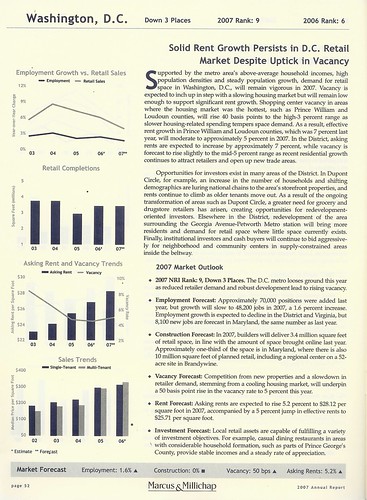
Washington DC real estate market according to Marcus & Millichap

Washington DC real estate market according to Marcus & Millichap

Labels: , ,