Warning: this is a very long post. But important.
----------------
I went to Tuesday's
Green Building Expo, which was put on by the DC Department of Consumer and Regulatory Affairs, the municipal agency that includes the building and zoning regulatory function of the city.
The expo is an element of DCRA's programming around DC's
Sustainability Plan. I also think it's a great step forward to do this kind of program, which brings together small and large businesses, government officials, staff, etc.
There were opening and keynote presentations (the presentation by famed developer Jonathan Rose was disappointing because it was cut off so that Mayor Gray could speak--I like Mayor Gray but on this topic he says the same stuff over and over, and most people at the conference likely heard a similar speech at some time in the recent past), and a bunch of break out sessions on important topics ranging from Stormwater regulations to the job training elements of the Green Economy, plus some exhibits by DC agencies, nonprofits like Community Forklift, and businesses, such as solar energy providers.
DC's Sustainability Program sets an audacious goal: making DC the nation's most sustainable city by 2032
The
Sustainability Plan is a city initiative pushed by Mayor Vincent Gray, who went to a Mayors conference and was taken back by the progress of various cities on greening. He came back, motivated to change, and calling for DC to be the "healthiest, greenest, and most livable city in the US" by 2032 (20 years after the Plan document was created).
Green roof, construction code, energy efficiency, and stormwater requirements are part of the Sustainability Plan and regulatory practice
DC has one of the "tougher" regulations around for both green "roofs" -- DC actually focuses on "green area ratio" so it's not just roofs -- and stormwater regulations. Meeting these requirements the least expensive way has been a significantly driving force on the part of developers and building managers. These efforts pre-date the Sustainability Plan, and in turn, undergird it.
So DC already has made more progress on these dimensions than most other communities. And it's accelerated by the fact that DC is one of the most active commercial real estate markets in the US, so there is far more construction here than elsewhere, which then makes DC the #1 US city in terms of the realization of new green construction projects, such as buildings certified by the LEED program from the US Green Building Council.
The major point of discussion at the conference is the dawning of the city's new
Green Construction Code, where DCRA committed to skipping a code update cycle (cities and counties in the US mostly adopt, with some localization, building codes produced by the
International Code Council) and adopting green building and energy requirements that are more forward and "stringent" than what is prescribed in the current code cycle (
2012 International Building Code®).
DCRA is proud of this effort, and the Code will go into effect pending City Council approval, which is expected by January. Simultaneously, other city agencies are moving forward on their respective responsibilities for implementing various elements of the
Sustainability Plan.
DCRA's commitment to repositioning its building regulation function as world class
DCRA is upgrading
its website and informational materials for the building regulation function (influenced in part by Chicago's work in this area) and
Rabbiah Sabbakhan, the Chief Building Official for the agency, is committed to having DCRA's building regulation and permitting system be world class, which is a pretty amazing goal, considering the functional level of most DC government agencies (e.g., education, the fire department, etc.).
When you aim to change, being behind can be an opportunity
DC, having a lot of park land (most of it under federal control), a decent transit system, being urban so it uses less energy per capita than suburban jurisdictions, and with a high rate of trips by sustainable means, does rank highly, number eight, on the list of North American's Greenest Cities, according to the
Green City Index compiled by the Economic Intelligence Unit for the German systems corporation Siemens.
But I would argue that much of this, other than the green building effort, is the result of legacy decisions made as long ago as 1790, starting with the walkable and transit-centric urban design of the core of the city by Pierre L'Enfant.
What about practices that the city needs to engage in now?, if it truly wants to be "the healthiest, greenest, and most livable city" in the US, North America, or the world.
I am struck by the relevance of
the writings of Alexander Gerschenkron to the achievement of this goal, vis-a-vis other cities in the US and what they are doing, and how the criteria for being number one are a moving target, because simultaneously other cities will continue to move forward and improve present practices and present best practices--the criteria and expectations for "number one" continue to rise.
Today, the  what we might call the "extended" "L'Enfant City" at DC's core covers 3 of DC's 8 political districts. And outside the core, resident households tend to rely on the automobile as their primary transportation mode.
Gerschenkron argued that developing economies have the "
economic advantage of backwardness" because as they industrialize they can adopt the latest technologies without being encumbered by sunk costs and investments in older technologies.
For example, Toyota could develop new practices and technologies not being encumbered by older practices and investments (see the obituary "
Eiji Toyoda, Promoter of the Toyota Way and Engineer of Its Growth," from the
New York Times). Over time, this allowed Toyota to leapfrog and surpass General Motors, to become the world's largest automaker.
The analogy for municipal government is that DC, lagging significantly on many elements of sustainability practice--at least when compared to leading adopters such as US cities like Portland, Oregon, Seattle, and San Francisco, and European cities like Copenhagen--has the advantage of being able to leapfrog and adopt new practices that have already been tested and perfected elsewhere.
-- European
Sustainable Cities initiative
Can DC Government be innovative?
I joke that being the National Capital, the problem with DC Government is that the "federal government has trickled down and shaped little [local] government in its image." DC government processes can be pretty slow to improve (witness continued problems at the DC Office of Tax and Revenue).
As John Friedmann argues in
Planning in the Public Domain, government is mostly about system maintenance, not change. That goes double for DC Government. It's very "bureaucratic" and not oriented to capturing and codifying best practice, even though the reality is that there are many examples of one-off best practices around the city.
It's often two steps forward and one back though, in creating big agencies or having conflicting policies (one policy promotes car sharing, another looks at car sharing companies as a revenue source, other policies promote sustainable mobility, yet the city refuses to apply the most basic economic principles to dealing with parking demand amidst limited supply, etc.).
 Friedmann's book is about developing a radical planning process, focused on quicker response and change, rather than the more glacial improvements that we are accustomed with. My design method based "action planning" approach is another alternative. See "All the talk of e-government, digital government, and open source government is really about employing the design method." (This isn't new to Friedmann of course, Max Weber's classic writings on government bureaucracy are the foundation of the academic discipline of organizational sociology.)
Based on the sessions from yesterday's Expo and statements there by DC government staff people and the consultants they have on retainer, I see some "real problems" that hinder attainment of the "stretch goal" that Mayor Gray and the Sustainability Plan have set, even though the agencies are working hard to implement various recommendations and actions deriving from the plan.
Sustainability goals are easy to achieve when the private sector has the economic motivation to act with alacrity
The goals of the
Sustainability Plan work well for functions that are heavily influenced by regulations, the profit motive, and involve actions by large actors with money, capacity and motivation.
For big buildings, especially newly constructed projects, any alternatives to paying high energy costs, or big stormwater remediation charges, are welcomed. Such actors will spend the money and are motivated to do green roofs, install district energy programs, do energy retrofittings, etc., because there is no question that they will make more money and/or save more money overall--by doing so.
The pr and other benefits--including higher tenant retention rates (see "
Community benefits agreements and energy considerations")--are a bonus.
How do you change individual behavior?
Sustainability goals are a lot harder when the locus of action is much smaller, like an individual person, a particular household, a neighborhood, a group that uses a park and leaves its mostly recyclable "trash" as litter or throws it away, a person who believes that transit, walking, biking, and car sharing aren't real alternatives to driving, etc.
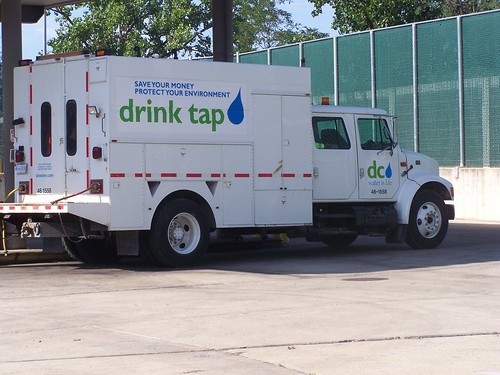
To change behavior, what is required is a combination of social marketing, education and programming, "campaigns," branding (like how DC Water and Sewer Authority is now DC Water) and integrating program delivery systems with the message--this is the approach I call "Action Planning."
The Sustainability Plan needs to take this element up in a more concerted fashion. The topic is deserving of an entire blog entry itself.
Pre-dating the Sustainability Program, the DC Department of the Environment has developed and implemented the "
River Smart Home" program which offers training workshops (we went to the one on indigeneous plantings) and various programs (like supporting the installation of rain barrels) to stoke behavior change at the household scale.
Programs like "
Car Free Day," "
Lights Out Hartford," Arlington County's "Car-Free Diet" ("
Social Marketing the Arlington (and Tower Hamlets and Baltimore) way,"), and Baltimore's LiveBaltimore resident attraction program are examples of integrated behavior change campaigns.

Concerted outreach is important too.
This entry, "
Community building and civic engagement activities," mentions
a mobile display on urban sustainability by the Montreal Urban Ecology Center. We saw it at the Frontenac Farmers Market (we went there because I wanted to see the display on the proposed light rail system, which was up at the public library).
That being said, DC Government is promoting the Sustainability Initiative at street festivals like the H Street Festival and other events.
Don't under-appreciate the importance of outreach. My picking up the Sierra Club's report "
Restore the Core" at Adams-Morgan Day in 1999 and reading it was a key element in triggering my direct involvement in local civic affairs and urban revitalization.
Can DC Government itself change how it operates?
At the same time, DC government itself operates in ways that are not very green, and it appears to be much harder for some of the agencies to acknowledge this and change how they operate.
For example, while DC is funding a "pilot program" to test composting, many North American cities are already doing a wide range of composting programs--Seattle and San Francisco have been doing curb collection of compostable materials for many years, Takoma Park, Maryland is testing it now, Montgomery County, Maryland has one of the nation's leading "yard trim" waste reduction programs--so is it really necessary to have a small pilot program on how to do it?
Shouldn't it be possible to jump forward and adopt new practices that have already been demonstrated elsewhere? (See "
Urban composting redux.")
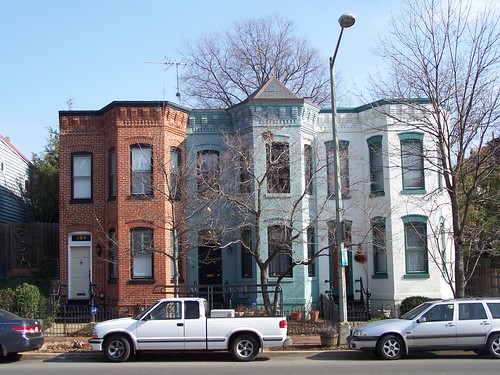 Most DC rowhouses are 15 to 30 feet wide.
Why I say "it comes down to chickens" (see "
An update on Block Supported Agriculture") is because despite the fact that many US cities allow chickens as part of urban agriculture initiatives, the proposed changes to DC's zoning code with regard to chickens make 95% of DC households ineligible, because the requirement will be that a coop has to be 50 feet from every lot line, meaning that to have legal chickens your lot needs to be about 110 feet wide.
Cleveland changed their zoning requirements in 2008, to have a 5 feet setback from the side lot line, and 18 inches from the back lot line. People I know with chickens in Seattle and Salt Lake City place their coop at the back of the property.
This chicken coop in the Seattle neighborhood of Ballard is tucked in the corner of the lot, against the back alley.
Even Cleveland isn't perfect, they require that there be 800 square feet on the lot per chicken, which if such a requirement were in place in DC, would make most rowhouses ineligible, because rowhouse lots are just under 800 square feet.
In any case, Cleveland needs to learn too, because you only need about 300 s.f. to support up to 5 chickens.
Setting a limit on the size of flocks based on a range of lot sizes is reasonable, but not set with some minimum s.f. per chicken that is just an arbitrary number as it is currently in Cleveland, say 4 for a typical rowhouse lot in an R4 zone, 5-10 for single family detached in R1 districts, depending on lot size, etc., would be a more reasonable approach. The point is to be intelligent about requirements, not stupid. No roosters in any case.
In Gerschenkronian terms, if you're not benchmarking practices and regulations against the cities that are the most creative and making policy decisions accordingly with the desire to move forward significantly, then even with incremental changes, it's more likely you're falling further behind the best-in-class cities.
(This by the way is the problem with GM vis-a-vis Toyota. Toyota, because of their "
Toyota Production System," an approach focused on eliminating waste from all processes, they are so far ahead of American auto companies that incremental improvements aren't enough to catch up, let alone jump ahead of the line in terms of world class performance.)
DC is not homogeneous and needs to fine-tune sustainability policy and practice to particular areas and conditions
One way to move forward more quickly is to acknowledge that for the purposes of sustainability there are at least twelve different vectors, not "One City." Each of these segments (and they are not necessarily mutually exclusive) should be addressed with differentiated policies and practices, in order to achieve significant take up of the
Sustainability Plan's goals and objectives.
DC is a city that is:
1. urban at the core;
2. and suburban outside of the core (see "
DC as a suburban agenda dominated city," plus the New Urban Transect is a good visual guide of the difference in spatial conditions across a community);
3. enjoying a robust real estate market with a great deal of newly constructed commercial and residential buildings;
4. comprised of predominately older building stock, including thousands of residential buildings dating from 1930 or earlier;
5. comprised of many big buildings, commercial and residential, especially in Downtown and the city's core, but not exclusively;
6. comprised of many small buildings;
7. comprised of many large property owners, companies like Hines, Vornado, Brookfield, Douglas Development, Akridge, JBG, etc. (see "
Yes, much of DC's commercial real estate market is comprised of national and international actors");
8. comprised of thousands of small-scale commercial and residential property owners and less well off nonprofit owners;
9. majority middle class and upper class, with new residents generally better off;
10. the home of a significant number of the extremely impoverished, which is often multi-generational;
11. predominately made up of residents in multiunit apartments;
12. still full of single family house and flat dwellers, who tend to dominate local political discourse.
In terms of achieving sustainability practices, DC is doing very well on the big buildings, new buildings, and large companies vectors.
What about the other 9 segments + the 13th vector of how the City Government itself operates various functions, such as parking policy and regulations or waste collection?
Differentiating policies and actions within the Sustainability Plan
DC needs to fine-tune implementation in at least four dimensions:
1. Setting up differentiated programs more attuned to spatial and density variances across the city's neighborhoods, wards, and commercial districts.
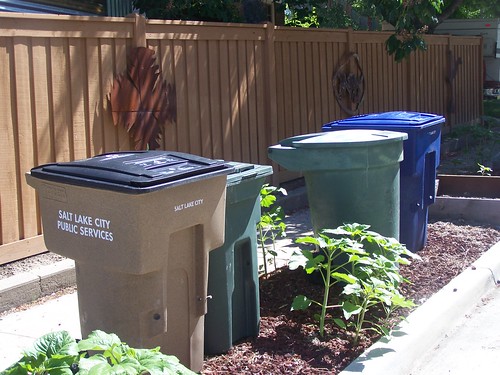 Salt Lake City has four types of collection media for solid waste. They collect paper, plastic, and metal in blue cans, have separate rectangular bins for glass (which only recently they began collecting), while trash is collected from green cans, and yard waste is put into the largest can size, which is colored brown. Once a year they schedule an annual bulk trash pick up day also. And they are fine with people going ahead of them and "picking" out stuff that they can use themselves.
In DC, the biggest difference in residential housing stock is between houses that are attached--mostly blocks of rowhouses but also duplexes and triplexes, which also tend to be on much smaller lots, versus houses that are detached, which tend to be on larger lots, at least compared to rowhouses (our lot, a double lot for our neighborhood, is about 50 feet wide).
I live in the outer city. Lots on my block generate a great deal of "
yard trim"--grass, leaves, branches, fallen trees--which most people just put in "the trash", whereas in rowhouse neighborhoods few houses generate much "yard trim" at all. DC has trash bins and recycle bins, and doesn't have a separate system for yard trim reduction and collection (except for the removal of leaves from the street gutters in late fall).
In "
A way for DC to begin adding yard waste collection as a separate element of waste collection and reduction programming," I suggested that for waste collection purposes, DC DPW should treat the outer city different from the core. Start with diverting and separating yard trim. Don't worry about it for the entire city, just focus on those areas of the city where interdiction would make a big difference.
Likely there are many other opportunities within DC practices which would allow the Sustainability Plan to be fine tuned, based on intra-city differences in spatial patterns, building type, density, etc.
2. Change how DC Government benchmarks its policies and regulations against the nation's leading cities with the aim of adopting best and leading practices, rather than being content with making changes that still lag best practice
This was discussed above and is self-explanatory. Instead of patting ourselves on the back about the number of LEED buildings, which is largely a function of DC's strong real estate market and timing, not government policy, we should focus on areas where our practice can significantly improve, and where we are nowhere near best practice, and take steps to make fundamental changes.
Poultry legalization is one and waste reduction is another, I am sure that there are many dozens of other opportunities for significant improvement in regulatory acceptance of sustainability practices and/or agency operational practice.
3. Think bigger and more creatively -- if you want to be #1 in the U.S. you have to be truly innovative
I tout the "design method" over the "rational planning method" for most types of urban planning because it results in transformational practice.
If you want to be the healthiest (see past blog entries "
Disruptive Innovation Once Again" and "
When the problem is defects in the structure of "the market", financial incentives won't do much good: Maryland's health enterprise zones"), greenest, and most livable city in the US, you've got to be incredibly creative and ahead of what other cities are doing, rather than being mostly content with following.
One of the panelists in the last session talked about the pre-eminent importance of urban agriculture, and touted how a 100,000 s.f. hydroponic greenhouse is being constructed in Anacostia ("
Mayor Gray Launches District's Largest Hydroponic Greenhouse" DC press release).
That's cool, I will admit it's better practice. Maybe it is new to DC, but it's hardly transformational. There is nothing new or disruptive about hydroponic greenhouses.
While officials tout all the green roofs in the city, what if instead of just capturing water and maybe supporting some beehives ("
NPR Has Bees on Its Roof, but Isn't in It for the Honey,"
Washington City Paper), how about if we farmed on the roofs of commercial buildings instead?
 This Walmart won't be growing food on the roof.
The new Rouse Supermarket in New Orleans has a greenhouse on its roof. There are some rooftop greenhouses in Brooklyn. And many supermarkets are looking into the practice ("
Montreal Greenhouse Operator Eyes US Cities,"
Supermarket News).
This is called "building integrated agriculture."
What if we farmed on the top of Giant Supermarket's new store on Wisconsin Avenue NW--local supermarket operator Rouses does this at their newest store in New Orleans, across from the Washington National Cathedral, or the new single use (NOT MIXED USE) Wal-mart on Georgia Avenue NW or on the top of an office building downtown?
Note that
Bread for the City, a community health clinic and food security organization on 7th Street NW in the Shaw neighborhood has been growing vegetables on its roof for a few years now.
DC is a city with only 39 square miles of developable land. It could add 5+ square miles to its land mass by growing food on roofs instead of being content with the relatively passive green roof method. How cool would that be? How innovative would it be? (Although the Institute for Local Self Reliance pushed a similar idea for the roofs of Adams-Morgan rowhouses back in the early 1970s.)
--
Building Integrated Agriculture: Opportunities for Urban Controlled Environment Agriculture, New York Center for Sustainable Engineering
Right: Photo, Financial Times. Caption: Going with the flow: Marcelino Blackburn tends his fish farm in Jones Town, Kingston.
Or, not on roofs, in Jamaica, they are doing aquaculture in low-income neighborhoods as an economic development and social inclusion method ("
Jamaican youth take up pet projects,"
Financial Times).
Yesterday's
Washington Post food section has an article saying that improvements in cultivation methods make farm-raised fish more competitive with wild-caught foods in terms of taste and nutritional value. From the FT article:
In the slums on Jamaica’s south coast, far from the glitzy tourist resorts of the north shore, the nascent industry of ornamental fish farming is offering young urban entrepreneurs a chance to escape poverty, end a cycle of violence and be part of a $4bn global market.
Urban fish farmers clustered in the outskirts of Kingston, the capital, are competing increasingly with long-established industries in Singapore, Malaysia and even Spain to send tiny fish around the world. Aquarium keeping is one of the world’s most popular hobbies, with Jamaica’s fish destined mostly to be displayed in tanks in the US, the world’s largest importer.
Doing aquaculture in Ward 8 as an economic development initiative would be truly best practice!
Last year, a house in Petworth grew corn in their front yard. A neighbor a couple blocks away from us lets squash grow across his front lawn. We grow vegetables and strawberries in our front yard. A house on 4th Street SE grows basil and tomatoes in the treeboxes in front of his house, and gets enough basil to make a bunch of pesto. Etc.
If you do any gardening, you get an appreciation for how difficult growing food is, and for the scale of the industry--one jalape
ño plant might produce 10 peppers, and a supermarket needs hundreds of jalape
ño peppers every week--and what is required to stock a supermarket on a weekly basis.
The DC Department of Parks and Recreation has hired a community gardening coordinator and they are creating 32 new community gardens. I think that's awesome, and it is a result of the Sustainability Plan. But the scale of agriculture production from community gardens, despite the importance of community building and other benefits and the importance to individual houses, is pretty small.
Or what about urban orchards? There is a lone, very old persimmon tree at the Coolidge Recreation Center, and mulberries by Brooks Mansion (some cultures, not in the US typically, consume mulberries). But we could do so much more with fruit trees.
These are just some top of my head ideas on urban agriculture. And there are many many such creative opportunities in so many other areas that could definitely up DC's sustainability game.
(Another big one is recycling in multiunit buildings, and commercial trash hauling--DC doesn't provide service to such buildings, and in small commercial districts many haulers operate, losing opportunities for efficiency and synergy, and generating many more large vehicle trips than would be necessary if there were a better system.)
4. Setting up realizable solutions for small properties and small-scale owners.
In terms of assisting small-scale property owners with maintenance of small multiunit housing buildings, I outlined a method of capacity building and support that would be relevant. See "
Deeper thinking/programming on weak residential housing markets is required: DC example, Anacostia."
That's a model of focusing programs according to more particular demographics and segments of sustainability take up.
Many cities have energy and sustainable expos and programs for residents. DC does do a bit of this, through the Sustainable Energy Utility and even programs by the Office of the People's Counsel.
Targeted programs for historic residential properties like what Chicago has done with their Bungalow and Energy Expo, or the
Old House Fair by the Preservation Alliance of Greater Philadelphia, etc. would be a logical next step.
Another example is Buffalo's
Green Development Zone initiative, which does energy efficiency upgrades for small properties, mostly in low income neighborhoods. It's a money saving initiative for residents, as well as a small jobs development program. A program like this would work well with small properties and in low income areas.
Demonstrating best practice, demonstrating change
In the Q&A portion of the wrap up session of the Expo, some people raised the importance of demonstrating change, demonstrating best practice, through visible initiatives.
Andrew Simmons, a retail and real estate consultant, suggested using the concept of "eco-revelatory design" where you are very deliberate in how you build, interpret, and present best practices to demonstrate DC sustainability practices and improvements in ways that can shape future actions and behavior. The conceptual term and body of work is new to me, even though it seems to have been around for 15-20 years.
Solar Panels on the White House during the Carter adminstration. Source: Jimmy Carter Library.
Andrew talked about how the green roof on Chicago's City Hall, initiated by then Mayor Richard Daley in 2001 was a signature event locally and nationally in terms of making green roofs visible, not just as a concept but as something real, and that other cities should pay attention.
The since-cancelled tv show, "The Boss," which was set in Chicago, featuring Kelsey Grammer as the Mayor, frequently showed the Mayor having private talks with key aides up on the green roof (see below) of City Hall ("
Departed 'Boss' also showcased--and understood--the power of Chicago's architecture" from WBEZ Radio).
While the Chicago City Hall roof has restrictions on who can be up there, today, more public buildings have green roofs that the public can experience.
For example, the Salt Lake City main branch of the Public Library has a green roof and beehives--the Mayor gives away honey as gifts to visiting personages--which the public are free to enjoy. An added benefit is great views of the city.
Andrew suggested that the Wisconsin Avenue Giant Supermarket could have a green roof that would be visible from the tower of the Washington Cathedral (I riffed on that idea above) as a great promotional opportunity, and he mentioned that the soccer stadium in Freiburg, German has solar panels that are very prominent and visible in broadcasts from the stadium, and in turn communicate Freiburg's branding as Germany's leading "Solar City."
Remember how President Carter put solar panels on the roof of the White House, although President Reagan had them removed? Clearly that's an early example of the concept.
--
Special Issue, Eco-Revelatory Design,
Landscape Journal, 1998
-- "
Eco-Revelatory Design,"By Nurgül Konaklı Arısoy,
"Advances in Landscape Architecture", edited by Murat Özyavuz
-- "
Ecological Design, Urban Places, and the Culture of Sustainability," SPUR San Francisco
Similarly, in "
Testing changes to zoning with demonstration projects," I wrote about how to deal with opposition and fear of change, we could create pilot projects and demonstrations to test new ideas and projects.
 Right: if you look at this photo in larger size, you will see a yard sign with information about the installer. The house is located on Van Buren Street NW in Greater Takoma.
People are doing this with solar energy and panels on their houses.
But the challenge is to demonstrate, legally, practices that are currently "illegal" or that need to be shown that they can work at some reasonable scale.
We could definitely do that with poultry husbandry, with demonstration projects in the core and the outer city. One thing we could test would be what are the appropriate maximum numbers based on a range of lot sizes. There could be a demonstration project to demonstrate the addition of accessory dwelling units in different neighborhood types, like how Seattle piloted changes in ADU policy in Southeast Seattle.
The same goes for composting, with yard trim reduction, etc., but doing it in visible ways, say doing curb collection composting in one particular neighborhood or even an entire ward.
Building capacity of residents to do their own projects
I write a lot about the relative weakness of civil society in DC, the lack of capacity building programs and infrastructure, and how neighborhood engagement programs by elected officials are focused more on building fealty to the officials and less on building the capacity of citizens to act on their own.
In fact, my earliest "criticism" of the DC sustainability planning initiative was the contrast with other communities, like Baltimore City, Baltimore County (both Baltimore City and County have created Sustainability Commissions to oversee their projects), and Arlington County (e.g.,
Arlingtonians for a Clean Environment), where sustainability planning has been a way to re-engage citizens in local civic affairs, in part by getting them to see environmental, land use, and transportation planning issues from new and different perspectives.
--
The Commission on Sustainability, Baltimore City
Note that the local chapter of the Sierra Club and the DC Environmental Network have been stalwart local advocacy organizations very active in the city for many years. But for the most part, those organizations have as members the people most motivated and committed to the environment.
Sustainability planning offers a way to engage people who are not the zealots.

The new community gardening initiative by DPR is a step forward. And they intend to expand it into invasive weed removal programs (note that I wrote in 2006 about how Baltimore City's Recreation and Parks Department has an active program in that area).
Obviously, the RiverSmart Homes program is great too. And how DC Water promotes water from the tap instead of buying bottled water and sets up misting tents at street festivals.
But there are other models. In bike promotion, the City of Toronto supports the creation of what they call
Bicycle User Groups, and Transport for London has a small grants program (up to £5,000) to fund events or start projects which promote the benefits of cycling (
Community cycle grants).

In New York City and Chicago, some councilmembers allocate funding to community projects based on resident-involved participatory budgeting practices, where the citizens--not the elected official--decide their priorities and make funding decisions. See "
Missing the point on constituent service/ discretionary funds available from legislators."
I also like the
Sprout Fund in Pittsburgh, which has a small grants program:
Sprout Seed Awards are modest financial awards that support community-based projects and strategic initiatives. These low-threshold projects are leveraged into high-impact results that affect grassroots communities throughout the City of Pittsburgh, Allegheny County, and Southwestern Pennsylvania communities in Fayette and Greene counties.
Apparently there is the DC
Diverse City Fund, but I don't know much about it. (And Greater DC Cares, a volunteer matching organization, declared bankruptcy and went out of business last week.)
And the Asset-Based Community Development Institute has an old
publication,
City-Sponsored Community Building: Savannah’s Grants for Blocks Story, about a small grants program in Savannah focused on supporting small, ground-up initiatives for community improvement. From the description:
This guide tells the story of how the City of Savannah sponsored an enormously successful small grants program called Grants for Blocks, which enabled residents of Community Development Block Grant (CDBG) neighborhoods to initiate and implement their own neighborhood improvement projects. It illustrates how the program generated a positive impact in Savannah neighborhoods by providing a simple mechanism for local people to become involved with their neighbors, to develop and improve relationships with the city, to acquire and utilize new skills, and to take an active role in building their own dreams and visions for their community.
In DC, some ANCs do give grants to fund neighborhood initiatives. But there isn't the same sense of focus and scale and attention to long term capacity building for independent citizen acdtion.
The Sustainability Plan initiative can be used as a way to move the city government's orientation more towards the enablement rather than the suppression of civic action. Sustainability planning can provide a path for "little government" to be more creative and less bureaucratic.
Conclusion
I think the aspirations of the DC
Sustainability Plan are truly great and ambitious. The achievement of just one of the goals--making the Anacostia River swimmable and fishable by 2032--would be a signature achievement for any community.
At the same time, it shouldn't be just about aspirations or achieving goals where the economics make achievement an almost certain thing.
Next steps
• To truly achieve the goal of being the greenest city, it's necessary to challenge current practices and work to implement transformational practice and disruptive innovation.
• And it's necessary to reach in deeply and work with those segments that normally are either very hard or difficult to reach or to achieve success with and come up with the programs, policies, and initiatives that will succeed.
• Benchmark against superlative cities, not average ones. Figure out why some practices succeed wildly and why others are much harder to succeed.
Then, maybe achieving the distinction of being the US's "healthiest, greenest, and most livable city" by 2032 might be possible.
The US needs a "Green Capital" promotion program
Finally, and this is beyond the purview of DC, the US should develop a program comparable to the
European Green Capital program of the European Union.
The program was conceived in 2006, in recognition of the impact of cities/urban areas on the natural environment, and to call attention to those cities “that are leading the way with environmentally friendly urban living.”
The first two cities designated were
Stockholm, Sweden in 2010, and
Hamburg, Germany in 2011.
Maybe that's the next step for the EPA "Smart Growth" program.
Labels: change-innovation-transformation, development and construction, green-environment-urban, organizational behavior, sustainability, sustainable land use and resource planning, sustainable transportation