Rebuilding Place in the Urban Space

"A community’s physical form, rather than its land uses, is its most intrinsic and enduring characteristic." [Katz, EPA] This blog focuses on place and placemaking and all that makes it work--historic preservation, urban design, transportation, asset-based community development, arts & cultural development, commercial district revitalization, tourism & destination development, and quality of life advocacy--along with doses of civic engagement and good governance watchdogging.

Monday, May 04, 2020

Just a reminder that what are called "public private partnerships" are contracts, not partnerships

-- "Design-Build Team Makes Decision to Leave Maryland Purple Line Rail Project," Engineering News-Record

The State of Maryland signed a contract with a group of various firms to design, build, operate,  maintain and partly finance the forthcoming Purple Line light rail line in Suburban Maryland.  In turn, the group created a separate subsidiary to construct the line.

Washington Post graphic showing the route of the line.

There are various disputes between the State and the consortium over delays and changes that result in greater costs and who is responsible for paying.

Because negotiations up to now haven't resulted in resolution, the construction firm has given notice per the contract to walk away.

Um, despite all the happy talk about "public private partnerships," in normal circumstances, that's not how "partnerships" are supposed to work.

Although this is not new.  The reality is that these are contractual agreements, and very hard to change once underway.  And as contracts, there is little interest in flexibility and changes and improvements once the construction is underway.

From "The Theory and Practice of Infrastructure Public-Private Partnerships Revisited: The Case of the Transportation Sector":

PPPs are widely promoted based on a narrative of improved collaboration between different stakeholders. By aligning the interests of the multiple parties to encourage closer and more productive working relationships, it is argued that public-private partnerships support innovative project designs and deliver value for money by better controlling project risks. Despite the promises, however, relationships between the various partners in PPPs have often turned from collaborative to confrontational, threatening the success of the project.

This is reality. And as a result, I think it's better to call these kinds of arrangements contracts, not partnerships.


I was trying to hook up with one of the teams that bid on this project. They didn't win. And the experience led them to abandon future efforts on such large scale projects (although the firm remains one of the nation's largest construction firms).

One of the problems with projects like this is that they are so few and far between (the same goes with manufacturing passenger transit vehicles of all types) that it's hard to build economies of scale.)

And early on in the post-bid acceptance process, I learned there was no room for innovative station area planning and development, etc., because "it's not in the contract."

-- "A Purple Line update: the downside of Public Private Partnerships" -- they are contracts, not partnerships," 2017
-- "It's not like transit "outsourcing" I mean "public-private partnerships" are necessarily smooth sailing," 2018

Which is one of the reasons why my brilliant writings around the Purple Line will have no effect.

-- "Revisiting the Purple Line (series) and a more complete program of complementary improvements to the transit network," 2019

-- Setting the stage for the Purple Line light rail line to be an overwhelming success: Part 1 | simultaneously introduce improvements to other elements of the transit network
-- Part 2 |   the program (macro changes)
-- Part 3 |   influences
-- Part 4 |   Making over New Carrollton as a transit-centric urban center and Prince George's County's "New Downtown"
-- PL #5: Creating a Silver Spring "Sustainable Mobility District"
-- Part 6 |  Creating a transportation development authority in Montgomery and Prince George's County to effectuate placemaking, retail development, and housing programs in association with the Purple Line
-- Part 7 | Using the Purple Line to rebrand Montgomery and Prince George's Counties as Design Forward

-- PL #5: Creating a Silver Spring "Sustainable Mobility District"
Part 1: Setting the stage
Part 2: Program items 1- 9
Part 3: Program items 10-18
Part 4: Conclusion
Map for the Silver Spring Sustainable Mobility District
(Big Hairy) Projects Action Plan(s) as an element of Comprehensive/Master Plans
Creating the Silver Spring/Montgomery County Arena and Recreation Center

Labels: , , , , ,

Thursday, July 26, 2018

Village Voice makes the point that signaling upgrades rather than the Second Avenue Subway would have made the most difference for problems on the Lexington Avenue Line (4/5/6)

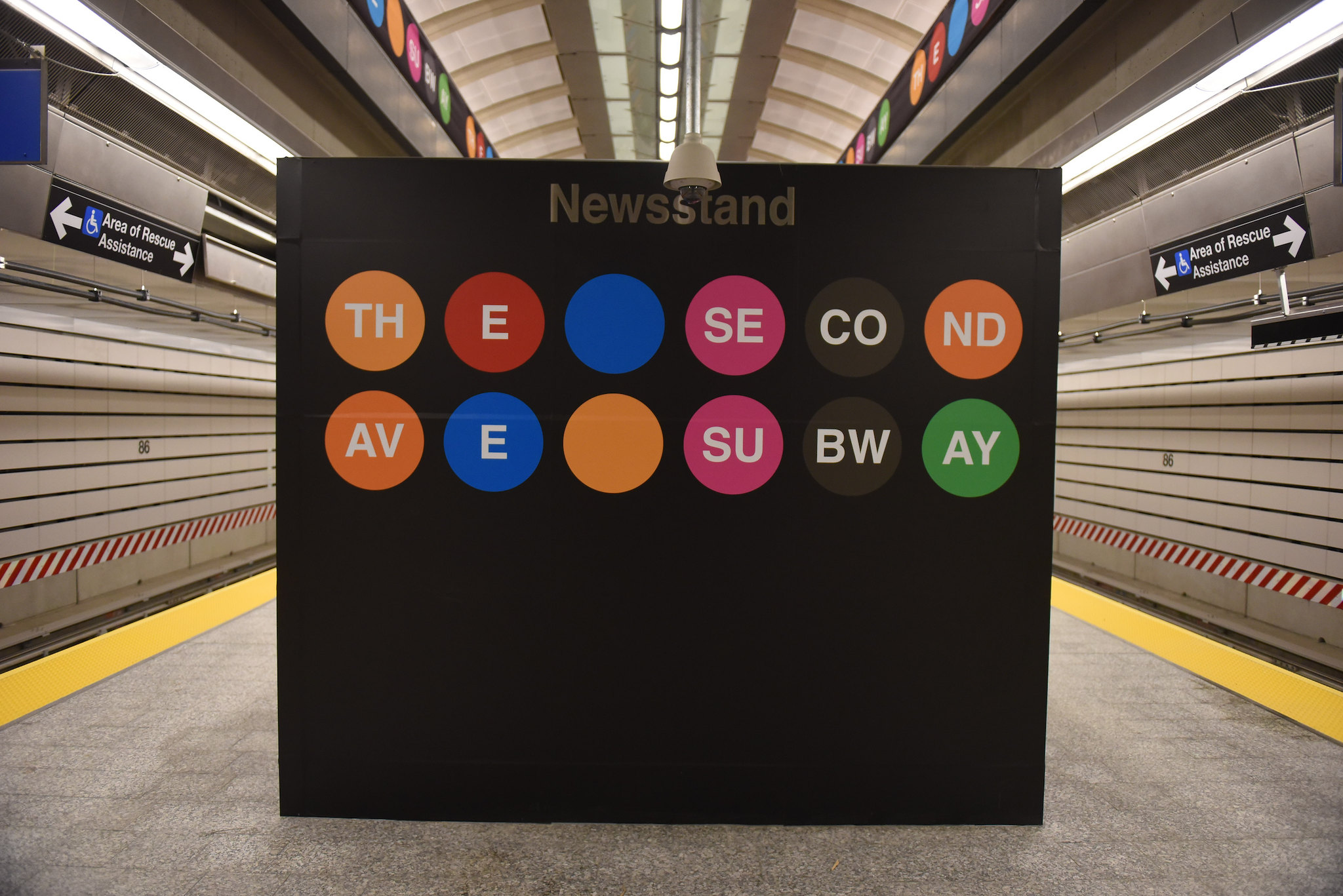
86th Street Second Avenue Subway StationWhile those of us into train-based transit are most likely always going to push for extensions of existing lines as well as new lines, the Village Voice points out that investments in signaling improvements on the 4/5/6 Lexington Line would have cost a lot less and had a lot more impact building the so far very truncated Second Avenue Subway.

-- "Maybe We Didn't Need the Second Avenue Subway"

From the article:
With last week’s release of station-by-station ridership figures for 2017, we can finally learn the impact this long-awaited subway extension had on the system. As it turns out, the Second Avenue Subway is undoubtedly a benefit, but at $4.5 billion for just the three stations built so far, a very expensive one. And the stats also tell us much more about the problem the line was built to solve — and raise the question of whether that $4.5 billion would have been better spent elsewhere.

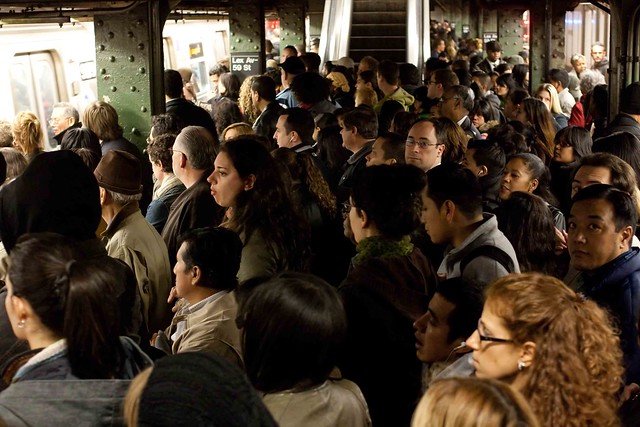
287/365 I hate the subwayThe Second Avenue Subway’s primary reason for existence was to lighten the load on the overburdened 4/5/6 Lexington Avenue line, the busiest subway corridor in North America … This was a worthy goal, and to some degree, the new line accomplished this: The five Lexington Avenue stops closest to the subway extension — 96th Street, 86th Street, 77th Street, 68th Street–Hunter College, and Lexington Avenue–59th Street — saw 17,377,828 fewer swipes into those stations last year, or about 47,600 per day.

Meanwhile, the three new Second Avenue Subway stations experienced almost 21.7 million trips last year, or just a hair shy of 60,000 per day. After factoring in large ridership changes at other nearby stations — the Lexington Avenue–63th Street F/Q station saw a 1.3 million bump in trips, while the Fifth Avenue–59th Street N/R/W had 560,000 fewer — the total change in ridership after the Second Avenue line opened nets out to just a hair more than 5 million additional subway riders in 2017, or about 14,000 per day. …

18.MTA.AstorPlace.NYC.30March2017We know now that the Second Avenue Subway could not possibly have been the most cost-effective way to relieve crowding on the Lexington Avenue line. That would be upgrading the signals to Communications-Based Train Control, or CBTC. One of the first lines Byford wants to tackle is, in fact, the 4/5/6 from 149th Street–Grand Concourse in the Bronx to Nevins Street in Brooklyn. Doing so would allow the MTA to run trains much more efficiently, increase capacity, and turn those ghost trains into real trains. 
This project alone would provide a benefit to Lexington Avenue line orders of magnitude greater than the Second Avenue Subway for a fraction of the cost.
While I don't always agree with the argument that it's better to forgo expansions and extensions in favor of "fixing what we have" because sometimes certain kinds of extensions and additions can improve throughput and network reliability as well as access (for example, this photograph of a c. 1989 NYC Subway map tells the story of a missing connection in the system, the need to connect one line the last 1500 feet to two othersy reduced throughput until the connection was made in 2001), this kind of question:
how to achieve maximum throughput?
is the most important one to ask. And it needs to be answered in an objective way.

More generally, the argument for the Second Avenue Subway is reasonable, in terms of its full and complete eventual routing, which will serve other areas of the city that are underserved.

But in this case, construction of the Second Avenue Subway should have been pursued separately rather than positioning it as a congestion reduction measure for the Lexington Avenue Line.

=====
The problems with transit service in DC are different from Boston and different from NYC.

The problems in NYC are five fold:

1.  An increase in demand
2.  Antiquated signaling systems ("Meet the century-old technology that is causing your subway delays")
3.  Old cars which are more likely to break down.
4.  A decrease in operating speed for trains.

The last problem wasn't acknowledged by the system, until the Village Voice broke the story a few months ago ("The trains are slower because they slowed the trains down").

In each situation--DC, NYC, and Boston--what happened is that a system that had been at equilibrium experienced some sort of exogenous shock which exceeded the capacity of the equilibrium state to function normally.

With DC it was the failure to invest in maintenance and signaling problems leading to crashes combined with the Silver Line extension.  With Boston--disinvestment combined with snowpocalypse.  In NYC, increased ridership.

Labels: , , , , ,

Tuesday, April 04, 2017

Design for maintenance:or what to do when award-winning architecture makes for a suboptimal user experience

Photo: WAMU/Tayla Burney.

The Commission on Fine Arts and the American Institute of Architects have criticized WMATA, the Washington Metropolitan Area Transit Authority, for painting the "ceiling" walls of the transit station in Union Station ("Why Painting the Union Station Metro Cheapens an Architectural Masterpiece," Washington City Paper; "Metro’s Effort To Create A Brighter Station Is Met With ‘Brutal’ Opposition," WAMU/NPR).

The internal structure of the underground sections of the WMATA Metrorail system was designed so that each part--the station vault and platform area--was designed as one element of an integrated whole constructed from unpainted, patterned concrete.

The design, by the architect Harry Weese, is heralded. But the material used, concrete, doesn't age well, and especially from the standpoint of the perception of safety within the station, t makes it hard to properly light the stations (because the concrete "absorbs" much of the light).

I've written ("Transit, stations and placemaking: Stations as entrypoints into neighborhoods") about the Weese design before, focusing more on how it is designed to put distance between riders and the system and this distance shapes WMATA's attitude toward placemaking:
The key issue is that architecturally, the WMATA system evinces all the problems I excoriate in writing about starchitecture.

For the most part, starchitecture are more like art and sculpturein that the design of the site(s) and building(s) purposely disconnects and holds at arms length the community and the built environment that lies beyond the boundaries of the site.

-- Docomo webpage on the architectural design of the WMATA system
-- the section of this WMATA case study on architecture covers the issues too, from Metro Cincinnati

Yes, Harry Weese designed the station interiors to be very specific and with a design consistent across the system, with vaulted tunnels, etc. ("Harry Weese, 83, Designer Of Metro System in Washington," obituary, Washington Post).  But the stations were never designed to connect to and enhance neighborhoods or the community outside of the station.  Inside, despite the vaulting they are dark, the concrete looks dingy, etc.

Still, this self-referential internally-focused architectural attitude shapes WMATA's placemaking culture to this day.  In short, there isn't much of a placemaking culture, a recognition that transit stops and stations have a role to play in quality of life.
But the design is also problematic from the standpoint of what I call"design for maintenance."

Not unlike Dan Kiley's famous park space in Tampa, which was overdesigned to a point beyond the capability in expertise and funding typical for a local government agency ("The Life and Death of a Masterpiece: What went wrong with a 1988 park by the late Dan Kiley, and what can we learn from its imminent demolition?), the stations are dark, often dank, and dingy," Landscape Architecture, April 2004).

Not to mention, the vaulting ended up costing more money to build because a much greater volume needed to be excavated to enable the effect.

Note that the WCP article disagrees with my take.  From the article:
On a more visceral level, what can beat the sensation of descending into the cool, dim Metro on a blazing 100-degree day? The white tiles of the New York subway try to distract us from the knowledge of being underground, but D.C.’s Metro wants us to embrace that and enjoy it as a subterranean place apart. There is a reason that Instagram and Flickr are full of moody black-and-white photos of Metro stations: People love them as they are. (More frequent trains would be nice, however.)

Yes, WMATA needs to fix dark spots and general light levels in many stations—but slapping on some paint is a crude way to do it. Smart architectural lighting designers armed with LEDs can solve this problem. Metro leaders: Stop whitewashing Harry Weese’s masterpiece.
Maybe LED lighting can solve the problem, but it will end up having the same effect of eliminating the "moodiness," as can be seen in examples of stations that are well lit, such as the Farragut West Station pictured at right (Wikipedia photo).

OTOH, it is easier and cheaper to replace lighting than it is to constantly repaint the ceiling, which becomes necessary once the surface is painted.

Design for maintenance installs materials and creates process designs that minimize the cost and time required to maintain places to a "state of good repair."

In any case, as with the Kiley Garden in Tampa, I think it's reasonable for design professionals to evaluate the effectiveness and relative success of the Weese design.

I find the Weese design wanting on practical dimensions--the slippery surface of the platform tiles when wet is another major flaw-- even if it works as sculptural architecture and at a distance--not unlike how City Beautiful era architecture and public sculpture was designed to exalt the power and authority of the state.

It would be useful for the professions to acknowledge this and make some recommendations for improvements, although the lighting point as made by the City Paper's new architecture critic, .Amanda Kolson Hurley, who already appears to be a great addition to the city's corps of cultural critics.

Bergen Street Station, Brooklyn.  Photo: Subway Nut.

Tile.  Note that there is a reason that subterranean spaces put a premium on high quality lighting and why highly reflective tile -- "subway tile" -- is used in many subway systems.  DC's going a different direction hasn't proven to be a superior practice by comparison.

Some examples include prevalent use of tile in stations on the New York, London, Hamburg, Seoul, and Berlin subway systems.

Use of tile as an artistic medium and light reflective surface on both the walls and floors of the Barcelona Metro system.

The need for design oversight in transportation agencies. I have written for some time that transportation agencies need to have a "chief urban design architect," to address how transportation infrastructure functions as architecture and urban design, and should be a positive contribution to civic architecture.

Relatedly, I have mentioned recently how Transport for London has "design managers" for various "lines of business," such as the "London buses."

And how VIA, the transit agency in San Antonio, has an urban design unit and manager ("VIA urban planner wants to build a better San Antonio," San Antonio Express-News). It definitely shows. Compare VIA's Centro Transit Station to either the Silver Spring Transit Center or the Takoma Langley Crossroads Transit Center.

It comes to me that I have never come across a WMATA official tasked with such responsibilities.
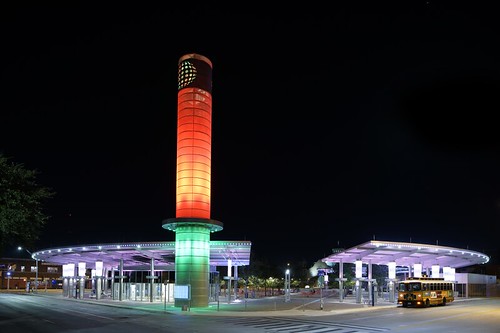
Bill FitzGibbons, _Centro_Chroma_Tower_image_5mb-960x640
Artist Bill FitzGibbons designed the "tower of light," called "Chroma Tower," at the Centro Transit Station in San Antonio.  While FitzGibbons has executed many public art commissions across North America, he happens to live in San Antonio.

Relevant previous entries

-- "DC's bad urban design as it relates to trnasportation inrastructure"
-- "Transportation Infrastructure and Civic Architecture #3: Rhode Island Avenue Pedestrian Bridge to the Metrorail station"
-- "Transit stations as an element of civic architecture/commerce as an engine of urbanism"
-- "Takoma Langley Crossroads Transit Center: A Critical Evaluation"

Labels: , , , ,

Wednesday, October 26, 2016

Re: Docket B16-03, Proposed changes to Metrorail operating hours

WMATA has two big issues right now, their proposal to cut service hours ("Plans for Metrorail contraction in the face of London Night Tube expansion") and dealing with next year's budget deficit ("Can WMATA's death spiral be staunched?").

Docket B16-03: concerns the former. Written comments were due yesterday. This is what I submitted. The addition to the text below is only the different proposed options. I was motivated to post these comments in response to the GGW post, "Prince George's County leaders join the chorus to keep late night rail service" (in part because of Alex B's comment, which dovetails the argument in points #1 and #2).

I decided not to submit voluminous comments.

=======
For the most part I am not supportive of the Metrorail proposals for significant cutback in service hours, which have been offered in response to an identified need for more time for maintenance.

First, irrespective of the current SafeTrack program, WMATA has not provided a convincing argument for why it needs significantly more time to conduct maintenance operations when compared to peer transit systems.

For example, the MBTA system runs from about 5:15am to just after midnight on weekdays, til 1 am on Saturdays, and from about 6:15am to just after midnight on Sundays. The TTC runs from about 6am to 1:30am Monday through Saturday, but with an 8am start on Sundays. The CTA provides 24-hour subway service on the Blue Line and about 21 hours of service daily on the other lines, with a start between 4am and 5am on most lines, with a slightly later start on Sundays.

Ironically, WMATA's proposal for service hour cutbacks is occurring at the same time that London is going to 24 hour weekend service on a number of its Tube Lines.

Second, relatedly and furthermore, various inspection reports from FTA indicate that the Metrorail system is extremely inefficient and suboptimal in terms of scheduling and performing maintenance work. Rather than penalize riders for the system's operational inefficiencies, Metrorail should focus attention on better use of maintenance resources and use the time that is currently provided in the schedule for revenue service.

Before WMATA takes the action of cutting back on service, instead this question should be asked and answered:

What is it about WMATA Metrorail operations that makes it unable to perform adequate maintenance in the same amount of time by comparison to peer systems?

If it is the case that objectively Metrorail needs more time for maintenance, then it would be reasonable to consider the current proposals. But so far, Metrorail/WMATA have not adequately made the case, only that the number of hours available for maintenance has been reduced (from 44 to 33) since the adoption of late night service hours on weekends.

Third, regarding the specific proposals, #1 is closest to adequate except that it includes as permanent the dialing back of later service on Fridays and Saturdays. However, the proposed Sunday closing time of 10pm is deleterious and should remain at the current time of approximately midnight.

Previous late hours Metrorail service profile

Mon-Thu: 5:00 a.m. - midnight
Fri: 5:00 a.m. - 3:00 a.m.
Sat: 7:00 a.m. - 3:00 a.m.
Sun: 7:00 a.m. - midnight

WMATA has put forward four different options for reductions in service:

Proposal # 1
Mon-Thu: 5:00 a.m. - midnight
Fri: 5:00 a.m. - midnight
Sat: 7:00 a.m. - midnight
Sun: 7:00 a.m. - 10:00 p.m.

#1 -- good/adequate in that service goes to at least midnight, Monday through Saturday, but bad in that Sunday service is proposed to end at 10pm.

Proposal # 2
Mon-Thu: 5:00 a.m. - 11:30 p.m.
Fri: 5:00 a.m. - midnight
Sat: 7:00 a.m. - midnight
Sun: 7:00 a.m. - 11:30 p.m.

#2 -- is bad because it proposes ending Mon-Thursday and Sunday service before midnight.

Proposal # 3
Mon-Thu: 5:00 a.m. - 11:30 p.m.
Fri: 5:00 a.m. - 1:00 a.m.
Sat: 7:00 a.m. - 1:00 a.m.
Sun: 8:00 a.m. - 11:00 p.m.

#3 -- is better than adequate because it proposes ending Friday and Saturday night service at 1am, but it fails in that it proposes a one hour later start and a one hour earlier closure for Sundays.

Proposal # 4
Mon-Thu: 5:00 a.m. - midnight
Fri: 5:00 a.m. - 3:00 a.m.
Sat: 9:00 a.m. - 3:00 a.m.
Sun: Noon - 11:00 p.m.


#4 -- would be the best proposal if it didn't provide for significantly later start for weekend service, at 9am on Saturday, and noon on Sunday. However the proposal for service til 3am on Friday and Saturday is laudable. But it is also a negative that it is proposed to cut Sunday service to 11pm.

Fourth, the service schedules as proposed seem to indicate that WMATA/Metrorail is choosing to abdicate transit service vision in terms of providing the means for residents to adopt a sustainable mobility lifestyle with a foundation of high quality transit service throughout the day, complemented by walking, bicycling, bike sharing, car sharing, and delivery services.

Instead, the organization is focusing primarily on its role as a commuter transit service on weekdays.

The competitive advantage of Washington, DC specifically and the Washington Metropolitan area more generally as a place to live and to locate and conduct commerce and government activities is based on a rich transit infrastructure that allows for efficient conduct of trips that are time and cost effective.

This competitive advantage presupposes a transit service that provides frequent service for much of the day, comparable to systems in NYC and Chicago. Instead, the headways between Metrorail trains have significantly degraded, especially in the evenings and are to the point of deplorability on weekends.

In fact, because of the significant decline in frequency of service as well as various unplanned service interruptions, in this particular household, Metrorail is no longer our first choice for non-work trips. Instead, we choose one way car sharing as a matter of course, especially because the cost of a trip is equal or cheaper to the cost of two Metrorail fares WRT transit service during the week, my wife tends to prefer bus over Metrorail because of higher reliability, while I choose to cycle.

Fifth, related to point one that "WMATA has not provided a convincing argument for why it needs significantly more time to conduct maintenance operations when compared to peer transit systems," Metrorail's service quality degradation has long since destroyed the trust that once existed between the agency and riders in terms of faith in the system to operate well and with rider interests in mind.

The frequent service breakdowns, structural failures (e.g., the fire at L'Enfant Plaza which killed a rider, not just because of equipment failures but failures by Metro personnel including the Transit Police and the Rail Operations Center) and inadequate explanations by Metrorail personnel have cut the bind that once tied riders and operators together.

Since 2009 and the Fort Totten crash which killed nine people I have suggested* that it is necessary for WMATA to rebuild the metropolitan/regional consensus about the value of the transit system and its context WMATA also had this opportunity this year, on the occasion fo the 40th anniversary of the start of Metrorail service, but it has not done so.

Now that the inadequacies of WMATA's current system of finance have been laid bare in the face of increased financial demands for maintenance tied with other cost increases and a decline in fare revenue across the board, WMATA is finding it difficult to raise additional funds from the jurisdictions. Were the regional consensus rebuilt, WMATA would find that the necessity of changing the funding structure would be better understood and there would be greater support on the part of elected officials and residents for doing so.

(It could be argued that the Metro Forward process was an attempt to reconstruct the regional consensus was such an attempt, but I disagree because the proposals were satisficed significantly to ensure suburban support, and a path forward on new financing was not proposed.)

* See attached

Sixth, the discussions of cutting back late night service indicates the more general failure of WMATA to not have planned for a 24-hour transit network anyway in terms of providing network breadth, depth, and redundancy.

In the face of the proposed cutback on the hours of Metrorail service, the indicator of interest in creating a more formal night network as presented in the related planning documents is a step in the right direction but it is not a full blown proposal,

It appears to be inadequate to the overall need generally and in the face of the proposed cutbacks. Furthermore, the planning documents do not offer a commitment on the part of WMATA to undertake such service, only an indication to explore the need.

While the reality is that the TPB should be the primary and lead transit planner for metropolitan transit needs that is not the case in practice, and by default WMATA is that planning agency.

With regard to late night transit service, cities such as Chicago, San Francisco, and Toronto have long offered extensive night transit networks comprised of bus and/or streetcar service, either in addition to or as a substitute for heavy rail service.

In the present day, currently the San Francisco Bay region is working to better provide and coordinate late night service across jurisdictions, to the point where they have constructed an integrated transit map for late night service. This would be a better model for WMATA and riders than what has been currently offered.

The SF late night transit map is offered as Attachment 2 (posted here instead).


ATTACHMENT 1

From "St. Louis regional transit planning initiative as a model for WMATA," November 2009.

The DC region needs to embark on a wide ranging metropolitan transit (re)planning public process to restore trust in and a common understanding of the WMATA transit system

After the accident in June, which killed 9 people and injured many others, and the continuing problems with safety, financial problems, lack of a regularized funding system, lack of appropriate regulatory oversight, not to mention problems with how the organization is led from the top (both the Board of Directors and top management), it seems reasonable to have a similar kind of regional transit planning exercise here.

Not only would this restore trust in the WMATA system in the DC region, by building a sense that WMATA is accountable to riders, it would also rebuild a regional understanding of what the system is capable of and how it should expand.

It has been 40+ years since the WMATA Metrorail system was first conceived and 33 years since parts of the system began opening. It's time for an assessment/reassessment.

This ought to be preferred over the grab bag of extension proposals in Virginia and Maryland (with little consideration of the impact on the current system) that the system faces currently.

WMATA only sees the world in terms of subway and bus. So the planning process needs to be broader and deeper, focused on transit generally, not just on WMATA operations as they are set up now.

At the same time, such a process should consider truly regional transit planning (which means including railroad service as an option), and the scope of the study should be broad, rather than overly-circumscribed and limited.

WMATA, in conjunction with the Transportation Planning Board of the MWCOG and the local jurisdictions, as well as MARC and VRE and other appropriate state authorities in Maryland and Virginia as well as DC, should launch a planning process similar to that of St. Louis, to come up with a metropolitan transportation plan that allows for transit services to be delivered where they need to be, but one that uses the most appropriate means (heavy rail, light rail, street car, passenger railroad, different types of bus service) to do so.

It should look at funding issues as well as heavy rail expansion where appropriate. That means not just extending transit service outward, but intensifying transit service at the core as well.

Such a planning process should also consider questions of leadership, management, and oversight. As well as funding.

It's the only way to build a truly regional understanding and commitment to transit for the Washington metropolitan region. Without such a planning process, I think we're destined for a lot more of the same incremental and discoordinated transportation planning that we have today.

Labels: , , , , ,

Sunday, October 09, 2016

Plans for Metrorail contraction in the face of London Night Tube expansion

Discussion of WMATA's proposals to cut back on Metrorail's operating hours is interesting because of how world class transit systems like the London Underground subway are expanding weekend overnight service at the same time ("Night Tube service a 'great success' after opening weekend attracts more than 100,000 passengers"  and "The Night Tube brings fun and economic gain," London Evening Standard; and "What impact has the Night Tube had on Stratford," Newham Recorder).

Or how in the face of special events like Major League Baseball playoffs, WMATA is not planning to extend service to accommodate ballgame attendees ("Without late Metro, Nats' first World Series could get embarrassing," Washington Post) while the TTC and GO commuter rail in Toronto extended overnight service to accommodate the city Nuit Blanche program ("Extended GO, TTC hours and road closures in effect for Nuit Blanche," CTV News) and the South Shore commuter rail in Chicago is adding late night service for Cubs playoff games ("South Shore adds train for Cubs' night playoff games," AP). ... SF Giants playoff games don't need special services, at least within San Francisco, because the MUNI system already provides overnight service.


Mayor Siddiq Khan riding the first Night Tube train, holding a copy of the London Evening Standard.

This past Friday, Night Tube service was extended to a third line ("Jubilee line Night Tube service starts this Friday," London Evening Standard) and plans are to extend service to additional lines later this fall and next year.

Interestingly, WMATA is not treating the service reduction proposals as a formal "docketed" process.  Maybe because it doesn't involve fares, they can get away with avoiding the process they use normally, which involves multiple public hearings.

They are seeking input through a variety of methods, and have set a deadline of 5:00 p.m. on Tuesday October 25th to respond. Public feedback will be provided to Metro's Board of Directors in December 2016 as part of the final decision process.

-- Email written comments to writtentestimony@wmata.com
-- Provide feedback to staff in person at various Metrorail stations. Click for a list of dates, stations and times
-- Attend an open house on Thursday, October 20, 2016 (anytime between noon and 9:00 p.m.) and public hearing (anytime between 12:30 and 10:00 p.m.) at Metro Headquarters, 600 5th St NW, Washington DC

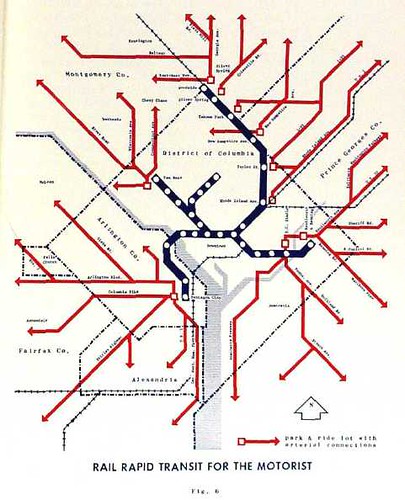
One of the plans for the Washington Subway, 1965An early graphic showing options for the Metrorail system.

DC Council is likely to pass a resolution opposing cutbacks in late night service on weekends ("Political Pressure Builds On Metro To Bring Back Late-Night Service," WAMU/NPR) because of the impact on night life and worker mobility needs ("This hurts': DC restaurants brace for work on Metro," Washington Post).

Reductions in weekend service, late night and on Sundays. I don't think I like any of WMATA's service hour reduction proposals.

The proposals, cutting back late night service on Friday and Saturday, and severely cutting back on Sunday hours, both early and late, support all the various criticisms in the past--criticisms that previously I rejected--that WMATA's primary interest is providing service to commuters Monday through Friday, rather than providing the foundational transit services that support adoption of a sustainable mobility platform and lifestyle.

Yes, commuter service was why Metrorail was created, but because of there being so many Metrorail stations in the core of Washington, the city has been able to develop a different, more monocentric, service profile despite the original intentions.

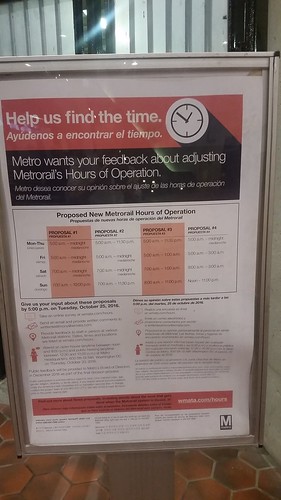
20161007_192221.jpg

Previous late hours Metrorail service profile

Mon-Thu: 5:00 a.m. - midnight
Fri: 5:00 a.m. - 3:00 a.m.
Sat: 7:00 a.m. - 3:00 a.m.
Sun: 7:00 a.m. - midnight

WMATA has put forward four different options for reductions in service:

Proposal # 1
Mon-Thu: 5:00 a.m. - midnight
Fri: 5:00 a.m. - midnight
Sat: 7:00 a.m. - midnight
Sun: 7:00 a.m. - 10:00 p.m.

Proposal # 2
Mon-Thu: 5:00 a.m. - 11:30 p.m.
Fri: 5:00 a.m. - midnight
Sat: 7:00 a.m. - midnight
Sun: 7:00 a.m. - 11:30 p.m.

Proposal # 3
Mon-Thu: 5:00 a.m. - 11:30 p.m.
Fri: 5:00 a.m. - 1:00 a.m.
Sat: 7:00 a.m. - 1:00 a.m.
Sun: 8:00 a.m. - 11:00 p.m.

Proposal # 4
Mon-Thu: 5:00 a.m. - midnight
Fri: 5:00 a.m. - 3:00 a.m.
Sat: 9:00 a.m. - 3:00 a.m.
Sun: Noon - 11:00 p.m.


Map of proposed overnight bus service expansion. WMATA.

Moving towards an overnight transit network. Seemingly, in response to criticism here ("Night and weekend transit/subway service: Metrorail edition," "London 24 hour weekend Underground service launches tonight" and "Slight revisiting of the issue of overnight transit service: San Francisco") and elsewhere, WMATA is also proposing improvements to overnight bus service, providing an overview of some options, but as of yet they have not formulated a specific program.

The concept, while a good start, does not rise to the level of Night Owl overnight transit programs in cities like San Francisco and Toronto.

Commenters in discussion threads on posts at GGW have made particularly good suggestions for improvements over those depicted in the map above.

SF Bay overnight transit service map

Noteworthy GGW comments:

-- Justin suggests extending the 30s bus to Bethesda at all times and to Rockville when the Red Line is closed;
-- John 2 states that Connecticut Avenue needs a late night bus service separate from Wisconsin Avenue (on this blog, commenter Tom Quinn has made the same point)
-- kk suggests that a separate overnight Metrorail service with limited frequency could be developed that would provide rail service without seriously impinging on the ability to provide maintenance
-- MHKarns points out the need to integrate service from suburban transit providers in this plan (comparable to the Late Night Service Map for the SF Bay area)
-- previous GGW comments have been appended to the blog entry Night and weekend transit/subway service: Metrorail edition"

Lack of trust.  There are three strains of thought concerning the proposals.  One is that WMATA needs more maintenance time and rather than let the system decline further, we need to buck up and accept the service cutbacks.

The other is that WMATA is not being honest, and that the cutbacks don't make sense because other comparable systems seem to manage providing late night service and providing maintenance.

Concerns about truthfulness also arise because of how FTA says that WMATA is not managing maintenance very well, wasting time and resources, and accomplishing a lot less than they could ("In scathing report, FTA blasts Metro track maintenance program," Post).

Finally, the other concern is that "temporary" needs for increased time for maintenance are being used to push through permanent reductions in service.

Labels: , , , , ,

Friday, August 19, 2016

London 24 hour weekend Underground service launches tonight

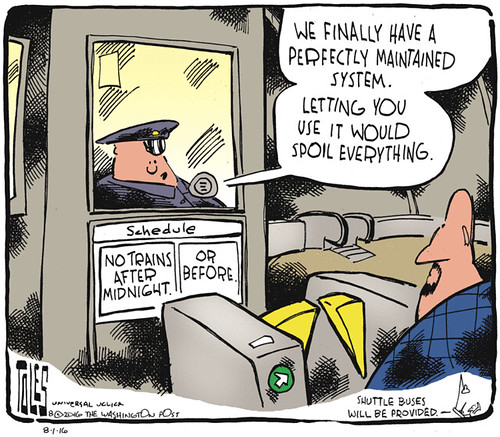
Tom Toles editorial cartoon, 8/1/2016, night service
Tom Toles, editorial cartoonist for the Washington Post, cartoon on the proposal to cut Metrorail weekend service hours.

In "Night and weekend transit/subway service: Metrorail edition," we discussed the suggestion by WMATA's general manager to close Metrorail earlier on weekends, to provide more time for maintenance.

 After I wrote that piece, I came across discussion of the same issues in San Francisco, where under the auspices of the Metropolitan Transportation Agency, the local jurisdictions have organized a "Late Night Transit Working Group" and they are working to provide coordinated 24-hour transit service throughout the San Francisco Bay region. See "Slight revisiting of the issue of overnight transit service: San Francisco."

Metro-Land was a real estate promotion guidebook produced by the Metropolitan Railway of Greater London to promote living in the various housing developments served by the line. 

"Metro-Land' is the term coined by the Met to refer to the new suburbs that grew in northwest London as a direct result of the developing railway line."

A past entry, "DC as "Metro-Land" vs. constrained transit planning," discusses transit as a conveyance for commuters versus an enabler of sustainable mobility and urbanity.

The Metrorail proposal for service cutbacks raises the issue of the need and demand for 24-hour transit service and the fact that there isn't a metropolitan scale plan for such.

As mentioned in the first two pieces cited above, after a few years of planning, the London Underground is introducing 24-hour weekend service on some lines, with plans to extend this service to other lines.  The intent was to start this program last year, but it took more than one year to negotiate an agreement with the labor unions to be able to launch the service.

Anyway, the service launches tonight.

See

-- "London’s Night Tube is finally open; here’s everything you need to know," Lonely Planet
-- "London's 24-hour Tube = $101 million economic boost," CNN
-- "London gets a 24-hour Tube at last," The Economist
-- "Night Tube to drive up London house prices near late-night lines," Independent
-- "Night Tube: London's best clubs, bars and restaurants open long after midnight," Independent
-- "Here are four ways London will benefit from the night tube," City A.M.
-- "London's night-time economy could be worth £43bn and an extra 115,000 jobs," City A.M.
-- "Night Tube finally arrives today: Here's everything we know," City A.M.
-- "RMT union backs Night Tube - and its members - after having striked on pay," City A.M.
-- "Countdown to a non-stop capital: London goes 24-hour," Guardian

From The Economist:
IT HAS taken an age to leave the platform, but on August 20th, shortly after midnight, London’s first night-time Tube train will at last pull out of Brixton station. So after years of dithering, the city will catch up with the likes of New York, Sydney and Berlin, with a 24-hour service on the Underground.

Initially, London’s effort will be limited to just two of its 11 Tube lines, and only on the weekends. Eventually five lines will stay up all night, with trains running about every ten minutes. Businesses and London’s mayor, Sadiq Khan, argue that the night-time Tube will give a welcome boost to an economy still anxious about the consequences of Brexit.

It should be a boon to shift-workers and clubbers alike. According to research undertaken for London First, a lobby group, 723,000 people work nights in London. Many are in relatively low-paid jobs, such as catering and nursing, and face long journeys home to the suburbs. Until now they have had to rely on night buses, usage of which has increased by 170% since 2000. Transport for London, which runs the Tube, expects to carry another 200,000 people per night when the new service is fully up and running, on top of the half-million who already use the Tube after 10pm on Fridays and Saturdays.
Recommendations for Night Transit Service in the DC Metropolitan area:

Recommendations
(New recommendation #6)

1. If Metrorail cuts back weekend hours, the WMATA transit agency should create a companion night owl bus service.

2. WMATA should create a Night Owl bus service along the route of the Metrorail system anyway. The proposed cutback on Metrorail hours should be the impetus for the creation of a system of overnight bus service for the metropolitan area.

[The study for extending overnight weekend service for the London Underground predicts that the average trip will be from 20 minutes to one hour faster compared to other modes.]

3. Overnight service within the suburban jurisdictions would have to be provided, complementing the metropolitan-scale overnight bus service paralleling the Metrorail station network.

4. The overnight bus routes parallelling the Metrorail network should allow "flag stops" so that riders can get off the bus between Metrorail stations, so that they can alight closer to their final destination.

5. WMATA should provide Night Owl bus services for the region's airports, operating when Metrorail service is unavailable to National Airport and Dulles, and later than the current B30 service to BWI Airport, which ends between 10 pm and 11 pm most nights. This service could be staged from Union Station.

6. The Transportation Policy Board should create a Late Night Transportation Working Group to coordinate late night transit planning across the metropolitan area and across jurisdictional borders. A combined map of late night transit services should be created.

Note that this is a matter of network breadth, depth, level of service, and level of quality, and as I have discussed in "Without the right transportation planning framework, metropolitan areas are screwed, and that includes the DC area," this should be planned at the metropolitan scale, by the metropolitan planning organization, independent of transit operators.

Adding night bus service to complement the Night Tube.  Note that Transport for London, planning integratively, is adding new bus routes to complement the new Night Tube service, "Night Tube service: Eight new night bus routes to launch to coincide with 24-hour Underground start date," London Evening Standard. Although they are adjusting current night bus services in response, and could cut services going forward depending on how much ridership shifts to the Tube.

Security.  More transit police will be added to provide coverage for overnight service hours also ("London's night tube to get 100 extra police as 24-hour service begins," Guardian).

Both are examples of planning broadly for most elements of service expansion, rather than responding after the fact.

Night transit service map for the San Francisco Bay area

Labels: , , , , ,

Thursday, August 11, 2016

Slight revisiting of the issue of overnight transit service: San Francisco

In my comments on the National Park Service trails plan, in response to the recommendation that NPS join a proposed working group for trails to be initiated by the Washington Area Bicyclist Association, I said that while WABA should be commended for the idea, the proper course of action would be for the Metropolitan Washington Transportation Policy Board--the federally designated transportation planner for the region--to handle this function, that it should be official, rather than something nice for jurisdictions to participate in.
Tom Toles editorial cartoon, 8/1/2016, night service
Tom Toles, editorial cartoonist for the Washington Post, cartoon on the proposal to cut Metrorail weekend service hours.

As mentioned in the cited post, 24-hour weekend rail service starts on parts of the London Underground beginning August 19th.  Photo: Corbis.

The same goes for overnight transit service.  I wrote about this a couple weeks ago ("Night and weekend transit/subway service: Metrorail edition") in response to the proposal by WMATA to close earlier on the weekends, including a short night on Sundays.

Recommendations
(New recommendation #6)

1. If Metrorail cuts back weekend hours, the WMATA transit agency should create a companion night owl bus service.

2. WMATA should create a Night Owl bus service along the route of the Metrorail system anyway. The proposed cutback on Metrorail hours should be the impetus for the creation of a system of overnight bus service for the metropolitan area.

[The study for extending overnight weekend service for the London Underground predicts that the average trip will be from 20 minutes to one hour faster compared to other modes.]

3. Overnight service within the suburban jurisdictions would have to be provided, complementing the metropolitan-scale overnight bus service paralleling the Metrorail station network.

4. The overnight bus routes parallelling the Metrorail network should allow "flag stops" so that riders can get off the bus between Metrorail stations, so that they can alight closer to their final destination.

5. WMATA should provide Night Owl bus services for the region's airports, operating when Metrorail service is unavailable to National Airport and Dulles, and later than the current B30 service to BWI Airport, which ends between 10 pm and 11 pm most nights. This service could be staged from Union Station.

6. The Transportation Policy Board should create a Late Night Transportation Working Group to coordinate late night transit planning across the metropolitan area and across jurisdictional borders. A combined map of late night transit services should be created.

In the interim, GGW published an op-ed, co-authored by the president of the Downtown DC Business Improvement District, in the Washington Post, "Ending Metro's late-night service is a bad deal for DC and the region."

The East Bay Times has an article, "Expanded All Nighter bus service sees some gains, but demand still lagging," about the state of overnight transit service between the East Bay and San Francisco.

BART has been helping to fund this service, and has to decide by the end of next year on whether or not to renew it.

Separately, the SF MUNI system has an overnight Owl service which serves most of the city.  They added two routes a few months ago.   SFMTA is in the midst of a review of their services, and the Metropolitan Transportation Commission has convened a Late Night Transportation Working Group to bring the agencies together to coordinate services.  Recently, they've joined in on a marketing effort to bring greater attention to the available services.

Among other elements of the campaign are some killer maps showing all the available services on one combined map.

Late night transit service as an economic development strategy.  Both San Francisco (NightLifeSF: Resources to Support San Francisco's Nightlife and Entertainment Industry) and London consider late night transit service as an element of the night time economy.  According to the Telegraph ("Night Tube start date revealed: 24-hour London Underground trains to begin in August"), night service will add £360 million to the local economy.

Labels: , , , , ,

Thursday, July 28, 2016

Night and weekend transit/subway service: Metrorail edition

=====
I haven't written anything about WMATA's "Safety Surge,"called SafeTrack, the systemwide program for focused track maintenance improvements, resulting in the closure of parts of the system for days at a time, because I just can't get my head around how the region has let the system degrade and get to this point. I've written plenty about the general problems, which more than suffices.

The economic success of the city, but the metropolitan area too, is at risk because the city's competitive advantage is tightly bound with a robust and reliable high frequency, high capacity transit system--specifically subway service. It supports residential and business choices, and facilitates mobility and reduces the impact of automobile traffic in significant ways.

For DC residents, as neighborhoods add population and more local amenities are developed as a result, and with other mobility options -- bus, streetcar, bike, car share, some of the degradation of Metrorail has less impact on day to day quality of life.

But longer term, the city is less competitive, something that the suburbs probably don't care all that much about.

I don't feel like elected officials fully understand what is at stake with Metrorail's failures.
======

Yesterday, the Washington Post reported ("Metro general manager proposes permanent end to late-night service") that Paul Wiedefeld, WMATA's General Manager, is suggesting that late night hours on the Friday and Saturday be eliminated, and that Sunday's closing time should be dialed back to 10 pm, to provide more time for system maintenance.

Many comments on the Greater Greater Washington entry on this issue suggests that the proposal is based on the original development of the Metrorail system being focused on daytime commuter services of getting people to and from work -- mostly for suburban residents -- rather than serving intra-jurisdictional travel, especially in DC and Arlington, or non-work or "leisure" trips in the evening and on weekends.

Degradation of the quality of weekend ridership leads to ridership losses. I thought it was funny how the Metrorail spokesman was quoted in the article saying that weekend late night ridership is way down from earlier highs.  Of course it is, weekend service/nighttime service sucks--I mean has significantly degraded over the past few years.

For example, last summer we went to MoCo Ag Fair with the little girl next door.  We got on the train around 9 pm (it was Sunday) at Rockville and we waited between 30 and 45 minutes for the train to leave.  An experience or two like that and you start not using Metrorail at all on the weekends.  That's kind of where we are on the weekends.  We are very thankful for the existence of Car2Go.

Revisiting past comments on the need for an additional track for service redundancy.  The Post article includes this paragraph:
Metro is a two-track system, which means it cannot perform regular maintenance without shutting down one or both tracks. By contrast, the New York City subway can operate 24 hours a day because it has four tracks, allowing crews to take one set of tracks out of service while trains continue to run on nearby tracks.
I have gone back and forth in comments on threads on GGW and here arguing that the design of the Metrorail system was flawed from the outset, because a two track system lacks redundancy:

-- "Redundancy, engineered resilience, and subway systems: Metrorail failures will increase without adding capacity in the core," 2016
-- "WMATA's recent apology and the real problem that isn't their fault: lack of redundancy, bad design," 2013

about how the industry "rule of thumb" that only hyper-large systems with many millions of daily passengers need additional tracks is misguided, that systems with greater than 700,000 riders, like WMATA, needed at least an additional track to maximize service uptime, especially as the system ages and more maintenance of the infrastructure is required, plus train cars fail more.

Conventional wisdom continues to argue, in the face of all the problems with Metrorail, that the two-track system was the right choice.  (Note that I recognize this is a theoretical discussion now, because the system would have to be completely rebuilt to add tracks to the existing configuration, although it is possible to rebuild and add lines, in order to reduce inter-lining.)

Especially with train failures, which because of how most of the lines inter-line, a failed train acts like a virus spreading its failure across multiple train lines, degrading service for everyone.  Instead of spreading like a virus, being able to shunt a non-functioning train to a third track for removal from the system isolates the problem.

Additional tracks enable extended hours of service. I have been planning to write a piece on planning for late night economies and transit will be an element of the piece.

But the new proposal to cut back weekend service -- which will hurt the nightlife economy in the city and that may play into the preferences of the suburban "partners" who "share" management of the Metrorail system with DC -- also illustrates that subway systems like Metrorail probably needed an additional track and less inter-lining in order to be able to extend service hours, especially later at night, or to offer 24 hour service (something that the London Underground will be doing starting this year, on some lines).

Providing 24 hour transit service versus providing 24 hour subway service.  For years, I have argued that there should be transit service along the Metrorail system when it is closed (Night moves: the need for more night time (and weekend) transit service, especially when the subway is closed").

Overnight transit service map, Toronto.

Other cities have "Nite Owl" or late night bus service, operating when their rail transit system is closed.  This includes Toronto, San Francisco, Chicago, and London, among others.

This is also an issue with transit service to the region's airports, which don't have 24 hour metropolitan transit service ("More on transporation to DC area airports").

Note that DC does have almost 24-hour service on some of its major bus lines, but the suburbs don't.  That means we should be distinguishing between DC and the suburbs in terms of consideration of the provision of overnight transit service when the Metrorail system is closed.  Even within DC, parts of the city have way better overnight transit service than others.

-- Night bus map London
-- Night bus map Hamburg
-- Night subway map, New York City
-- Seattle best practice review of overnight bus services (not absolutely definitive)
-- "New, expanded bus routes to provide ‘reliable’ overnight, weekend service," Toronto Star, 5/24/2015
-- Night Tube webpage, Transport for London
-- "Night Tube start date revealed: 24-hour London Underground trains to start in August," London Daily Telegraph

Recommendations

1.  If Metrorail cuts back weekend hours, the WMATA transit agency should create a companion night owl bus service.

2.  WMATA should create a Night Owl bus service along the route of the Metrorail system anyway.  The proposed cutback on Metrorail hours should be the impetus for the creation of a system of overnight bus service for the metropolitan area.

Note that GGW had a post on this issue  a couple months ago ("Let's learn from how Montreal does night bus service"). Comments by Mark DeLoatch and kk are particularly relevant to this recommendation in how such routes could be created, in part from existing services.

Note that this really should be a TPB/Metropolitan Planning Organization function.  WMATA should be the operator, not necessarily the primary transportation planner.

As an example, the easiest line to put into place Night Owl service would be the Red Line.  For Montgomery County Maryland, two DC bus routes start in Silver Spring, and the 30s line starts at Friendship Heights, on the city-county border.

The 30s bus should be extended to Bethesda anyway instead of stopping at the DC-Maryland border, comparable to how the Georgia Avenue and 16th Street lines continue to the Silver Spring Transit Center instead of terminating at the border, traveling more than one mile into the county.  These lines could easily be extended northward to provide overnight service alongside the western leg (30s) on Wisconsin Avenue/Rockville Pike and eastern leg (S or 70s) along Georgia Avenue of the Red Line.

It's harder for other lines, but is doable.

3.  Overnight service within the suburban jurisdictions would have to be provided, complementing the metropolitan-scale overnight bus service paralleling the Metrorail station network

4.  The overnight bus routes parallelling the Metrorail network should allow "flag stops" so that riders can get off the bus between Metrorail stations, so that they can alight closer to their final destination.

5.  WMATA should provide Night Owl bus services for the region's airports, operating when Metrorail service is unavailable to National Airport and Dulles, and later than the current B30 service to BWI Airport, which ends between 10 pm and 11 pm most nights.  This service could be staged from Union Station.

Overnight transit service map, DC Capital Transit system, 1946

Labels: , , , , ,

Sunday, February 21, 2016

National Engineering Week and sustainable mobility and urban design/placemaking

While people in the sustainable transportation field often complain about "unenlightened" engineers, the fact remains that civil engineering is fundamental to transportation engineering--without roads, bridges, and sidewalks, let alone fixed rail transit systems and railroads, or piers for ferries, boats, and ships--getting about quickly would be almost impossible, even if traffic engineers generally are more focused on facilitating the movement of motor vehicles at the expense of other forms of "traffic" such as pedestrians and bicyclists.

National Engineers Week, founded by the National Society of Professional Engineers in 1951, starts today and lasts through February 27th.  There are many professional engineering organizations that address transportation engineering matters.

Two of the most prominent are the Institute for Transportation Engineers, "famous" for their manual on recommended parking requirements in association with new development, and the American Society of Civil Engineers, which publishes an annual report card on the quality of the nation's infrastructure.

-- American Infrastructure Report Card | Society of Civil Engineers
-- InfrastructureUSA
-- State by state reports, American Infrastructure Report Card

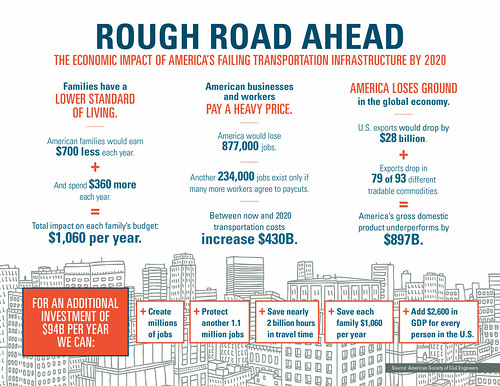
rough-road-infrastructure-infographic
ASCE infographic.

Mostly people think about traffic engineering in terms of traffic signal timing and what they perceive are significant delays ("To Fight Gridlock, Los Angeles Synchronizes Every Red Light," New York Times).

National Engineers Week should be seized by the sustainable mobility profession as an opportunity to present engineering-related information and concepts from civil and traffic engineering that support sustainable mobility.

The need to integrate placemaking into roadway projects.  In transportation agencies, the Chief Engineer is responsible for overseeing both construction and traffic engineering, but agencies tend to not be too focused on the experiential elements of the finished "product" and how it fits in within the built environment in terms of urban design and placemaking.

In response, the "Complete Streets" approach has been developed, but I don't think it's enough, because Complete Places are more than streets. Complete Streets tend to be infrastructure heavy and can stint on placemaking qualities. See the past blog entry, "Complete Places are more than Complete Streets" as well as the somewhat out-of-date Smart Transportation Guidebook for more discussion of this point.
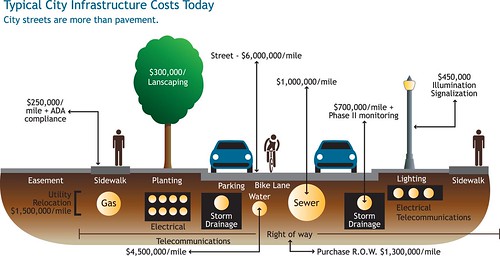
Cost of urban infrastructure
Diagram from the Washington State Department of Transportation.

Create a high-level position in transportation agencies focused on enhancing the placemaking elements of transportation projects.  One of my recommendations for addressing this is for Departments of Transportation to appoint a "Chief Thoroughfare Architect" focused on the experiential quality of the constructed environment.

One way to think of this is how parks planner David Barth suggests that streets should be treated as linear parks.  In any case, likely there aren't enough landscape architects working for transportation agencies.  Also see "DC's bad urban design as it relates to new transportation infrastructure" and "I think this is hideous: metal sculpture on the New York Avenue bridge."

St. Louis pedestrian crosswalk painted in leaves to call attention to its location by the Missouri Botanical Gardens.  Photo by Robert Cohen, St. Louis Post-Dispatch.

In the past couple weeks, media attention has been brought to the experiential quality of streets when St. Louis traffic engineers, relying on guidance from the Federal Highway Administration, stopped supporting the creation of artistic treatments within pedestrian crosswalks ("St. Louis will let crosswalk art that violates federal rules fade." St. Louis Post-Dispatch).

Another way to address this is by calling attention to the concept of "Levels of Quality" balancing the needs of all road users rather than the "Levels of Service" method derived from the Highway Capacity Manual (link to an older edition), which focuses on speeding up the movement of traffic.

-- Level of Quality posters demonstrating LOQ concepts for biking, street elements, street crossing, transit stations, traffic calming, and walking, produced by Dan Burden of Walkable Communities.

Changing roadway materials.  For example, because current practices in roadway construction create streets capable of supporting high speeds by motor vehicle traffic regardless of land use context, I argue that we should construct roadways with materials that support desired traffic speeds congruent with land use context.

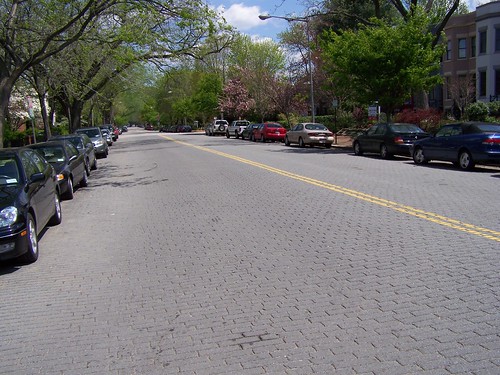
One way to do so is to bring back belgian block materials treatments in cities--although it does cost more--in places that are likely to have a great deal of pedestrian and bicycle traffic, including commercial districts, and around schools, parks, libraries, and other civic assets.

Monument Avenue in Richmond, Virginia is an example of such a street, where the pavement provides visual, aural, and physical cues to drive more slowly.
Belgian block, 900 block, South Carolina Avenue SE
Belgian block remains the primary pavement type on a section of South Carolina Avenue SE in the Capitol Hill neighborhood of Washington, DC.

Bridge design and incorporating pedestrian and bicycle access.  Serving on the Design Oversight Committee for the 11th Street Bridge Project made me think more about treating bridge design in the city as a system ("Anacostia River and considering the bridges as a unit"), rather than dealing with each bridge separately and independent.

As it relates to biking and pedestrian infrastructure, it's important to stress the integration of access for sustainable modes when bridges are constructed.  Generally this is a struggle, because there aren't national standards for such integration, instead discretion is left to state transportation agencies.

Some do a good job of it, others don't, and even within states, there can be inconsistent treatment. For example, the DC area has a number of Interstate Highway bridges that incorporate bike and pedestrian crossings, while Baltimore doesn't.

Nationally, more recently a number of pedestrian-bicycle only bridges have been created, often using bridges that have become obsolete for motor vehicle traffic, for example the Walkway Over the Hudson and the High Bridge ("Pedestrian High Bridge over Harlem River to reopen," Wall Street Journal) in New York and the Walnut Street Pedestrian Bridge in Chattanooga.

Portland recently opened a bridge, Tilikum Crossing, dedicated to sustainable mobility, serving bicyclists, pedestrians, and transit--bus, streetcars and light rail, but not motor vehicles.

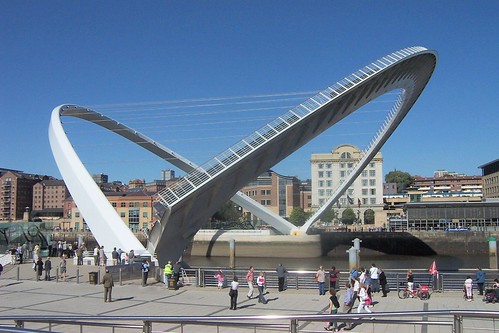
Europe especially has a number of recently constructed pedestrian and bike bridges of advanced design that have been integrated into waterfront revitalization programs such as the Gateshead Millennium Bridge across the River Tyne in England.  These Wikipedia photos show that bridge in both the up and down positions.
Gateshead_millennium_bridge_open

Gateshead_Millennium_Bridge_Down

And inspired by the High Line in New York City, which repurposed a former elevated freight railroad line into a linear park, garden bridges are being created in DC (Can D.C. build a $45 million park for Anacostia without pushing people out?," Washington Post and London, although the London project has been controversial ("London's garden bridge: the end of the road?," Guardian).


This infographic from the New Jersey Institute of Technology on advances in bridge engineering shows us that there is plenty of opportunity to keep things interesting in bridge engineering.

NJIT Online

Labels: , , , , , ,