Rebuilding Place in the Urban Space

"A community’s physical form, rather than its land uses, is its most intrinsic and enduring characteristic." [Katz, EPA] This blog focuses on place and placemaking and all that makes it work--historic preservation, urban design, transportation, asset-based community development, arts & cultural development, commercial district revitalization, tourism & destination development, and quality of life advocacy--along with doses of civic engagement and good governance watchdogging.

Saturday, March 09, 2024

Gaps in Parks Master Planning: Part One | Defining Levels of Service for individual parks

 Gaps in park master planning frameworks


But while I have written a bunch about parks and transportational access, I didn't think to include that as another topic in the series.  The challenge is to ensure that as many parks as possible are accessible by transit.  This, and other forms of accessibility, should be covered in a parks master plan.


While covid kept me somewhat quiescent in terms of civic involvement in Salt Lake after first moving here, eventually I ended up getting involved in parks (and other development matters).  I am on the board of Sugar House Park, which is owned by both the city and county, so it has some interesting intergovernmental issues. 

Working on revitalization in DC, where the National Park Service runs many of the "local" parks, general federal-local government issues, and being on the board of Eastern Market public market for 13 years definitely prepared me for the issues present here.  

-- "Revisiting Trust for Public Land's Park Score® methodology" (2017)
-- "Federal shutdown as another example of why local jurisdictions should have more robust contingency and master planning processes" (2013)
-- "Testimony: Agency Performance Oversight, DC Department of Parks and Recreation" (2012) 

One problem with the board is that the city and county haven't invested in board development, and for the most part over the years, the board has taken a back seat to the executive branch members of the board--there are seven "lay members" and one each from city and county parks.

My background in planning, including parks planning, gives me/the board a knowledge base they didn't have access to before.  

-- "Sounds familiar to me: recommendations from a guy who visited every park in Boston" (2017): 

There is tension between being a more active or a more passive board.  Lack of investment in board development, and real complications in planning and capital budgeting between city and county have led to some problems.

Fortunately there are a couple of other "new members" who are super go getters too.  We have so much to do.  Without them though, I'd just be an old guy yelling into the wind.  But, like my brief planning job in Baltimore County proved I could do great work and work within a system--despite the lack of a degree in planning, I am helping to transform parks practice in Salt Lake City.

One thing that's interesting given how much I advocated for parks in DC and all the parks master plans I've read over the years, is identifying a number of gaps in the master plan frameworks for parks, more generally.  A bunch of items I just didn't think about until I had to.

This seven-part series covers the gaps I've identified so far.

Level of service as a public administration term

The term Level of Service is typically thought of as a transportation term referring to vehicle throughput, functioning of intersections, etc.  

It turns out that there is an International Standard (ISO 55000) for asset management, which defines levels of service as: 

…parameters, or combination of parameters, which reflect social, political, environmental and economic outcomes that the organization delivers.  These parameters might include metrics such as: 

  • Safety 
  • Customer expectations and satisfaction 
  • Quality 
  • Quantity 
  • Capacity 
  • Reliability 
  • Responsiveness 
  • Environmental acceptability 
  • Availability 
  • Cost

Levels of Service defined at the scale of a park system. LOS is a term used in park planning at the scale of the system ("Standards for Outdoor Recreational Areas," American Planning Association) and it's used to measure the amount of space and facilities available to residents at a gross-grained scale. 

Special levels of service demands for business districts and parks. LOS as a term isn't used that often at the micro scale in discussions about "parks conservancies" and business improvement districts, even though providing a LOS higher than a city can typically afford is exactly why such organizations have been created--and they collect special monies to pay for it.  

For either a BID or a conservancy extra services are likely to include security, sanitation, capital improvements and marketing and for BIDs, economic development activities.  

Conservancies and BIDs as special service districts. NYC is well known for its park conservancies, starting with Central Park.  

-- Public spaces/private money: The Triumphs and Pitfalls of Urban Park Conservancies, Trust for Public Land
-- "Creating a Park Conservancy that Fits," NRPA

Discussions for creating a conservancy for Central Park started in the 1970s and came to fruition in the early 1980s.  The city agreed to provide a certain level of personnel and budget, with transfer of active management of the park to the third party nonprofit, which raised additional monies for staff, maintenance and improvements.

New York City has since developed many such groups for parks and and business districts.  Brooklyn's Prospect Park Alliance was created in 1987 and the Madison Square Park Conservancy in 2003.

The Bryant Park Conservancy was created in 1980 and its revitalization is a well known story in planning circles ("Inside the transformation of Bryant Park," New York Daily News, "Splendor in the Grass," New York Times, Bryant Park case study, "Life of Bryant: Bryant Park’s Transformation Into the Center of Midtown" "Lessons from NYC’s Bryant Park must guide James Weldon Johnson Park’s redesign" Jaxson, "A Place Is Better Than a Plan: Revitalizing urban areas is best done through small improvements, not grand designs,:" City Journal, "Bryant Park, NY: Publicly Owned, Privately Managed, and Financially Self-Supporting" Project for Public Spaces)  and is a good model for other communities--although New York City has an advantage because of its great wealth-- because the park is smaller, only 10 acres,  compared to large scale parks like Central Park or Prospect Park.

Criticism of conservancies and BIDs as privatization of the public space and civic commons.  Note that these kinds of initiatives can be controversial both locally and in the academic literature.  These are legitimate criticisms.  At the same time if you want better places, it costs money and this method may be the only way a community can provide the LOS in terms of management, operations, and capital improvements it wants for its key/anchor/signature civic assets.

-- "Stewarding the City as Commons: Parks Conservancies and Community Land Trusts Community Land Trusts " City University of New York Law Review
-- Private Funding of Public Parks Assessing the Role of Philanthropy , Resources for the Future
-- "Our Parks Are Not for Sale: From the Gold Coast of New York to the Venice Biennale," Dissent
--" Looking a Gift Horse in the Mouth: Challenges in Managing Philanthropic Support for Public Services," Public Administration Review
-- "Park (in)Equity," Deconstructing the High Line: Post Industrial Urbanism and the Rise of the Elevated Park

Sugar House Park is a conservancy.  Technically.  But it hasn't created the innfrastructure and capacity to take advantage of this status.  Plus, Salt Lake City, unlike NYC, isn't full of wealth, although there are plenty of philanthropic opportunities that the park can seek out.  

To my way of thinking, from the standpoint of Social Psychology of Organizations, the group is on the cusp of moving from a more ad hoc structure to one that is more organized and active.  (A move from a stage one organization to stage two.)

Uncleared sidewalks from 1300 East to Sugar House Park.

Levels of Service at the scale of an individual park is an issue with Sugar House Park. 

It's an urban park, a regional park serving all of the County, but it's also heavily used by city as well as neighborhood residents.  The neighborhood is pretty densely populated, leading to even higher use.

But the County, which is contracted to maintain the park, and provides key administrative and planning support, mostly doesn't manage parks in center cities, with all the issues that such park locations may have-- security, homelessness (Dealing With Crime and Disorder in Urban Parks, ASU POP Center) and other issues like snow clearance to maintain winter access that are not typical of suburban parks.

Finding the money to provide the necessary level of "extra service" is difficult because we have to get agreement from both the city and the county, and as park systems, because Sugar House Park is simultaneously part of both, and yet separate, not part of either system, this can be a long process.

At the scale of parks master planning, it's important to come up with a LOS typology for individual parks/parks at the micro scale, and provide the desired LOS as needed.

And that's what I'm in the process of trying to do with Sugar House Park.  

"Why is our meager budget earned from pavilion rentals paying for security?" or "why can't the City Public Utilities agency help pay for dredging the pond since it is part of their watershed?" or "why don't we have better snow clearance?" are the kinds of questions that I've been asking and should lead to significant changes over time.

Developing a LOS dashboard.  I don't manage the park.  The County is developing a dashboard for the park system and individual parks, focused on state of good repair.  To address the issue of differentiated level of service requirements, we need a checklist/chart/dashboard.  That's the best way to justify the recommendations, decisions and choices you make, based on demand for quantity and quality of particular services.  It would include items such as:

  • Security services
  • Restroom services
  • Maintenance standards/State of Good Repair
  • Ornamental plantings
  • Lighting (morning, night, winter)
  • Types of street furniture
  • The array of programming offered
  • The type and operation of facilities
  • Special facilities like bike share stations
  • Snow clearance practice
  • Hours of operation


Labels: , , , , , , ,

Saturday, August 26, 2023

How do you make the ground floor of an arena strengthen the area around it, rather than diminish it? | Philadelphia 76ers

The Philadelphia 76ers basketball team (owned by the managing partner of the group that recently bought the Washington NFL football team), released a proposal last year to build a new arena as part of the sputtering Market East shopping center on Market Street, using examples of DC's Capital One Arena and the Barclay's Center in Brooklyn to demonstrate the value of centrally located arenas ("A downtown arena for the Sixers can be a Philly thing, too," Philadelphia Inquirer).

-- "Proposal to build new basketball arena in Downtown Philadelphia," 2022

Much of the opposition has centered around the potentially negative impact on Philadelphia's Chinatown, which may well lose Chinese related businesses and residential buildings as a result of the kind of reproduction of space that is unleashed as a result of such developments ("In Philadelphia, a new threat looms over Chinatown," Washington Post).

Along premier Inquirer urban design writer Inga Saffron argues the proposal will have significant negative effects on the Jefferson Street SEPTA station, which serves regional rail and the Market Street line ("Off track? A Sixers arena at 11th and Market would compromise Jefferson Station").

While not the reason--both outmigration to the suburbs and the earlier creation of the DC Convention Center is why--DC's Capital One Arena certainly hasn't strengthened the presence of Chinese-related community and commerce in what for a long time I have derisively called "Chinablock" in DC.  

Philadelphia's Design Advocacy Group, uniting more than 2,000 professional architects, designers, and planners, has come out against the proposal too, because it argues it will have a deadening effect on Market Street at the ground level ("A large Philly-based group of architects and designers just came out against the 76ers’ arena plan," PI).

Note that when I started out in revitalization work, DAG's Urban Design Evaluation Tool helped me think about how to approach proposals for new development in a systematic and "demanding" fashion.

That's a legitimate argument.  The buildings are big and usually the ground plane is not set up to be vibrant and active, the rents are high for the spaces that exist, and retail businesses focused on events in the building still have to find customers for the other 200-300 days of the year when there isn't anything going on in the arena.

When I've written about new arenas, I tend to focus more on the transportation demand management elements, although "Framework of characteristics that support successful community development in association with the development of professional sports facilities" has a big section on urban design:

Urban Design 

  • centrality of location: Downtown/central business district/waterfront versus outlying locations within a city or suburbs.  Negative examples include the Salt Lake Bees stadium outside of Downtown, with limited redevelopment opportunities; how the Atlanta Braves chose a suburban location for their new stadium, counter to the trend of siting in center cities; the debate in Oakland about a waterfront location versus a new stadium in their current location ("A's plan to build a new waterfront stadium at Oakland's Jack London Square takes big step forward," San Francisco Chronicle), and the location of the Real Salt Lake soccer team in the suburbs instead of the center city.  Positive examples include the waterfront stadium for the San Francisco Giants, the Downtown stadium for the Baltimore Orioles, and the relocation of the Washington Wizards basketball team and Capitals Hockey teams from the suburbs to the City of Washington;
  • size of the facility and its ability to be integrated into the urban fabric (baseball, football, basketball, hockey, soccer), bigger stadiums--football stadiums specifically--are harder to integrate in the urban fabric.
  • isolation or connection: how well is the facility integrated into the urban fabric beyond the stadium site and does it leverage, build upon, and extend the location and the community around it.  The classic example is Wrigley Field in Chicago versus White Sox Stadium ("Expert offers his dream Sox stadium," Chicago Tribune).  Wrigley Field is embedded in its neighborhood, while White Sox Stadium is disconnected from its.  But also in how Oracle Park in San Francisco leverages its waterfront location.
Oracle Park.  Photo: Ron Niebrugge.

 But the reality is that the point, "isolation or connection: how well is the facility integrated into the urban fabric beyond the stadium site and does it leverage, build upon, and extend the location and the community around it" needs to be further developed.

For example, while some arenas have nice public spaces around them--again, overall, minimally used--they don't generate a lot of activation on the ground plane.  This is definitely true of Capital One Arena in DC.

Capital One Arena, 7th Street NW, west facade

Actually, the Design Advocacy Group could be a significant boon on this issue, with impact nationally, if it addressed this issue as a charrette, and came up with a series of recommendations on how best to integrate arena ground planes into the neighborhood outside the arena, in ways that make it very active and vibrant.

Golden 1 Center. Image Credit: Sacramento Kings.  The Sacramento Kings arena is set off from the buildings around it, providing little opportunity for spillover activation.  

Together Credit Union Plaza, Ballpark Village, St. Louis.

A lot of teams now are into the idea of complementary developments to add activity during events, on non-event days, and to generate revenues theoretically to support team revenue needs to be competitive ("A Great Team, an Ambitious Plan and an 'Existential' Issue," New York Times).  From the article:

He generally keeps his distance from the field and clubhouse, focusing on the business of the organization. His priority for now is not a lease extension — Angelos does not like the word lease — but a “public-private partnership” that would reinvent the Camden Yards campus. 

The plans, naturally, would include the usual live-work-play stuff — residences, hotels, shops, restaurants, bars — that modern owners covet. 

But Angelos mentioned several other possibilities: an elementary school located in the warehouse, a health and wellness clinic, internship and mentorship programs for local youth. 

“People will speak about Baltimore like, ‘Wow, Baltimore is cutting-edge,’ which is what they said about Camden Yards,” Angelos said. “If we develop it right, and we include that impactful community program module, we can change the whole brand of Baltimore.” 

While Camden Yards inspired a building wave of stadiums and arenas designed to lift surrounding local businesses (at least in theory), the Atlanta Braves’ complex in suburban Cobb County, Ga., is the new standard. Instead of only profiting from in-ballpark sales, the Braves essentially built their own city — known as the Battery and opened in 2017 — to give them a stake in adjacent properties, too. 

You see it all over: The San Francisco Giants developed the area on the other side of McCovey Cove; the Boston Red Sox built a 5,000-seat music venue at Fenway Park; the Chicago Cubs bought several buildings that border Wrigley Field. But Atlanta is the ideal, and Angelos has visited the Braves’ complex with Maryland’s governor, Wes Moore, and stadium authority officials. 

“The Braves have a couple of things going for them,” Angelos said. “They’ve done very well on the baseball side. They have a really big market, which helps a lot. And then they’ve developed this whole other revenue stream, this whole other business. 

“And if big markets like Boston and Atlanta are doing it, it becomes existential — how are we going to compete and keep pace? Everybody won’t be able to do it. But I think because of what’s here — the brand of this ballpark, this piece of property of 60-odd acres with other land around it that could be accessed, maybe bolted on, with the mass transit you don’t even have in Atlanta, with the great highway systems — we think it’s existential.”

I'm skeptical.  I think they want more money, but with limited guarantees they will invest it in the team.

The Battery Atlanta, a mixed-use development with offices, residences, restaurants and bars, was built next door to the ballpark and attracts customers year round. Photo: Mortenson Construction.

And interestingly, while the Atlanta side project is touted as a national best practice ("New Atlanta Ballpark Considered Model for Royals Coming Downtown," CityScene KC), Kennesaw State University professor J.C. Bradbury, argues it hasn't done much for Cobb County, which provides significant subsidies ("Study finds Cobb residents are paying $15 million dollars to run Truist Park home of Atlanta Braves," Atlanta News First, "Reply to Zimbalist: 'Report on the Fiscal Impact of Truist Park and the Battery'," Social Science Research Network).

Mutual benefit should be the outcome of so-called "public private partnerships."

Good for the team, bad for the County?  It doesn't make sense to me that the high cost of sports income for owners and players should be subsidized by local and state government.

Labels: , , , , , ,

Sunday, January 29, 2023

Washington Post editorializes about Purple Line cockups, fails to attribute them to Larry Hogan

The Purple Line is a great lesson for me in how long projects take to achieve from conceptualization to realization.  

I first read about the idea--intended at the time to be heavy rail--in December 1987, shortly after I had moved to Washington, DC, as a cover story in the Washington City Paper.  40 years later!!!! a section of it, maybe about 25% will have been built, and zero planning for extension is underway.

The concept: graphic by the Sierra Club Metro DC chapter, c. 2000 
 
 The section underway is from Bethesda to New Carrollton.  Washington Post graphic.

 Given that it will take this long for one section ...

The Washington Post has an editorial, "The Purple Line is in the news again — for the usual reasons," about continued failures with the Purple Line light rail project in Montgomery and Prince George's County Maryland, which means it won't open until 2027.  From the article:

As The Post’s Katherine Shaver reported, the start date for the 16-mile light-rail link between Montgomery and Prince George’s counties could slide another seven months, into mid-2027 — or about five years after the completion target of March 2022. The culprit for this latest glitch is the relocation of utility lines. ...

... when its administrators blunder through years of bad contracting and project-management decisions. Those decisions have bloated what was to be a five-year project with almost $2 billion in construction costs into a nearly 10-year, $3.4 billion undertaking. The lowlights include a shortsighted effort by former governor Larry Hogan to pinch pennies on construction costs; timeline-extending litigation from NIMBY groups and others; and a rupture in 2020 of the Purple Line’s public-private partnership in which the original construction team abandoned the project, delaying it by more than a year and adding nearly $1.5 billion in costs.

While the Post does attribute some of the delay to former Governor Hogan, it's basically his fault, although there was a lawsuit simultaneous with part of it.  

Hogan threatened to shut the program down as soon as he came into office--and he did cancel a similar effort in Baltimore (which the new Governor wants to revive, 8 years later).  And came up with the design-finance-build program to get some of the money to build it.  But this added great complexity.  And a general unwillingness by both sides to act as partners ("A Purple Line update: the downside of Public Private Partnerships" -- they are contracts, not partnerships," 2017), ended up with the original contractor bailing out, leading to even more delays.

But the Post thinks Hogan would make a decent President ("Larry Hogan won over Democrats in Maryland. Could he do it nationwide?").  When, Hogan sucked on most of the issues that matter to urbanites, especially transit (+ spending $8 million on covid tests from South Korea that didn't work).

The Post is acting like the Takoma Park resident who wrote a letter to the editor stating he'd be voting against all the politicians in office because of the failures in building the Purple Line, even though all the failures are basically the fault of the former Governor, not local elected officials, not state legislators.

-- "Takoma Park resident vows to vote against all local public officials this fall, because of the failure of the Purple Line light rail, but the failure is because of the Governor, who is termed out" (2022)

Labels: , , , ,

Thursday, May 19, 2022

The Growth Machine in Anaheim, California gets socked with a corruption probe

Urban Fortunes: The Political Economy of Place is the book which expands the original argument first laid out by Professor Harvey Molotch in the journal article "The City as a Growth Machine."

Growth Machine theory is from urban sociology and posits that local political and economic elites, despite intra-elite competition, are overall unified in terms of the commitment to an economic growth agenda centered on real estate development and land use intensification.

Political science has a similar theory, called Urban Regime.  I think GM is better on the overall explanation of why local elites do what they do, while UR is better at explaining at how it operates.  

Where GM theory is particularly insightful on various elements of the land use intensification agenda, from Downtown revitalization to sports stadiums and arenas, conference centers, and in particular, the role of local media--fully dependent of the success of the local region for its own success, being dependent on advertising revenues generated primarily from sales to local businesses--in cementing this agenda.

As I said, UR theory is best for explaining how the Growth Coalition works.  In the paper, "Now What? The continuing evolution of Urban Regime analysis," political science Professor Clarence Stone writes:

An urban regime can be preliminarily defined as the informal arrangements through which a locality is governed (Stone 1989). Because governance is about sustained efforts, it is important to think in agenda terms rather than about stand-alone issues. By agenda I mean the set of challenges which policy makers accord priority. A concern with agendas takes us away from focusing on short-term controversies and instead directs attention to continuing efforts and the level of weight they carry in the political life of a community. Rather than treating issues as if they are disconnected, a governance perspective calls for considering how any given issue fits into a flow of decisions and actions. This approach enlarges the scope of what is being analyzed, looking at the forest not a particular tree here or there. [emphasis added, in this paragraph and below] ...

By looking closely at the policy role of business leaders and how their position in the civic structure of a community enabled that role, he identified connections between Atlanta's governing coalition and the resources it brought to bear, and on to the scheme of cooperation that made this informal system work. In his own way, Hunter had identified the key elements in an urban regime – governing coalitionagendaresources, and mode of cooperation. These elements could be brought into the next debate about analyzing local politics, a debate about structural determinism.

I've written about this in a bunch of blog entries about other communities, as well as about DC:

-- ""Columbus Way" merely another example of "Growth Machine/Urban Regime" theory," 2019
-- "Minneapolis growth machine," 2015
-- "If you don't know urban political theory, it's likely that you don't understand local land use: St. Louis: DC; etc.," 2012
-- "Smaller town revitalization planning: No, Thomas Friedman is not a sage," 2018
-- "The Growth Machine needs to be subtle when it comes to elections | Voters need to see some benefits," 2020

Graphic from "Public-Private Partnership Model Used in the Taipei Central Station Project Research," Mou Chung Tseng, National Taipei University.

Usually, it's pretty much out in the open, in that groups like the chamber of commerce and other organizations--in DC the Federal City Council ("THE DISTRICT'S POWER BEHIND THE SCENES: Washington Post-connected business group wields influence over city's legislative agenda," and "The DC Lobby," The Common Denominator)--are the organized growth coalition, which includes leaders of major locally-based corporations, real estate developers, bankers, university presidents, media leaders, etc.  

In NYC you have REBNY, the Real Estate Board of New York and the Partnership for New York City as the leads, with plenty of other groups in a secondary position.  Plus business improvement districts (which often have ex-government officials as leaders), etc.

Elected officials are more "fellow travelers," not so much stated "card carrying" members of the group.  But aligned and integrally involved ("Meet the Lobbyists, Developers, and Insiders On Bowser’s ReOpen DC Committees," Washington City Paper).

Anaheim has its "growth coalition" too, centered around Disneyland first and foremost as well as professional sports operations, especially the Anaheim Angels baseball team and stadium.

But unlike in other places, apparently the group operates more "secretively" and has involved the sharing of confidential city information with business interests, putting it more into the zone of corruption rather than mutual cooperation ("Secret retreats and a powerful ‘cabal’: Corruption probe reveals who really runs Anaheim," Los Angeles Times).

Hence the probe.

Note that DC has corruption issues too.  See:

-- "Managing the brand promise of cities in the face of corruption," 2019
-- "Wow: Revisiting DC's Corruption Caucus," 2019

Labels: , , , , , , ,

Friday, May 13, 2022

Takoma Park resident vows to vote against all local public officials this fall, because of the failure of the Purple Line light rail, but the failure is because of the Governor, who is termed out

Rick Scheer of Takoma Park writes in a letter to the editor of the Washington Post:

Those of us who live, work or shop in east Silver Spring have mostly concluded that the Purple Line project is something between a major disappointment and a total fiasco. Based on the interviews in the May 8 Metro article “Maryland Purple Line construction will resume in August, officials say,” I’m now leaning toward fiasco. 

We’ve been suffering from torn-up streets, unfinished tunnels and bridges, and other public eyesores for more than two years, and ongoing work to move utility lines for the project routinely causes local traffic snarls. 

Officials said that with the new contract, work would commence this spring. I learned from the article that they really meant late summer. Even that work is focused on the Purple Line’s end points in Bethesda and Prince George’s County. The road-widening efforts affecting east Silver Spring are not scheduled until spring 2023, a full year from now, assuming the effort ixxxs on schedule (ha!). And this construction will be wildly disruptive, so say the new project managers. 

In all local elections this November, for me the Purple Line will be the primary ballot consideration. I plan to hold all local officials accountable for this fiasco, and not a single incumbent will get my vote.

But the Purple Line fiasco is all a result of the Executive Branch of the State Government, specifically the Republican Governor, Larry Hogan, and his directives to the State Department of Transportation.  

Scheer will be punishing the wrong people. It's all Hogan's fault. 

No local officials at the city and county level, and even the State Senators and Representatives have anything to do with it.

First Hogan delayed the Purple Line with another review when he first got elected.  This led to delays with the Federal Transit Administration approving funding. 

Then the Republican emphasis on pushing the selection of a public private partnership to do the project, including providing some financing:

-- "Purple Line moves forward," 2017
-- "A Purple Line update: the downside of "Public Private Partnerships" -- they are contracts, not partnerships," 2017
-- "Public-private "partnerships" aren't partnerships but contractual relationships," 2017 

The partnership picking a less suitable construction group. 

The state being unwilling to renegotiate certain elements of the contract when costs rose and then the construction company quitting as a result.  And needing to find a new construction group.

-- "Sometimes you have to wonder if transit/transit projects are being deliberately screwed up to make transit expansion almost impossible," 2022

The various lawsuits etc. 

But Republican Governor Hogan is termed out.  He can't be punished at the ballot box.  He's the one who needs to be held accountable, but there is no accountability.

I understand Scheer's frustration.  I first read about the concept of the Purple Line in a cover story in the Washington City Paper in December 1987.  It will be almost 40 years before the first segment, from Bethesda to New Carrollton, comes to fruition.

No planning is underway for any of the other segments.  At this rate it will take more than 100 years to bring it to fruition.

Labels: , , , , , ,

Sunday, April 17, 2022

Real estate intermediation as a hindrance to further projects: Amtrak seeks to "condemn" the retail lease at Washington Union Station

Real estate development is complicated, involving land, buildings, uses, construction, finance, and ownership. It is typical for projects large and small to be divvied up in various ways--parking operations outsourced, retail operations separately managed, certain buildings, especially hotels, being sold off, etc.

What happens then is the loss of the sense of a "common interest" and common goals.  Instead the various interests have and pursue their own interests.

It's the parking lot operator at 700 Pennsylvania Avenue SE being uninterested in providing special parking rates to crafts vendors at Eastern Market, because when they bought the rights to the parking operation, that wasn't built into the contract.

Or trying to sell a bike parking concept to an multi building mixed use retail and apartment development, but one of the buildings was sold off and the new owner wasn't interested, and to work, the concept needed to be applied to the entire project.

Or how department stores at shopping malls own their sites separate from the malls.  So Lord and Taylor at White Flint fought the developer's plans to redevelop the area ("Jury awards $31 million to Lord & Taylor in White Flint dispute," Washington Post).  They were successful, because the original contract had a very static definition of how the property was to operated.

And this isn't limited to for profit operations.  It's a problem especially with "public-private partnerships" between governments at various scales and private interests operating as contractors.

JFK Airport, with some terminals privately owned and others not, has problems of coordination and service quality as a result ("Privatizing (Dulles and National) Airports," 2018).  

Similarly, the City of Chicago, by selling off parking operations and city-owned parking structures under 99 year leases to raise short term capital ("A lesson to cities that they need to be very careful when leasing assets to public private "partnerships"," 2012), has created problems as well.

The State of Maryland's PPP to build the Purple Line ended up with one concessionaire abandoning the project and the state having to find a new construction "partner" with the end result of a four year delay in the project ("New construction contract for Maryland's Purple Line signed," Post).

And of course, sports stadiums and arenas ("I’ve studied stadium financing for over two decades – and the new Bills stadium is one of the worst deals for taxpayers I’ve ever seen," The Conversation).

In short, these aren't partnerships, but contracts, and when interests are "intermediated"--split up and out over multiple parties--when circumstances change it can be very difficult if not impossible to get the various interests to agree to act "together" and revise how they operate in order to create better outcomes.

How Union Station operates today is much different from when it first opened in 1907, when trains were the primary form of long distance transportation in the United States.

This is the case with Union Station in Washington, DC.  Amtrak wants to add significantly to the operation there, making it into a new and much bigger hub on the Northeast Corridor service ("Amtrak moves to seize control of Union Station," Post).  

Union Station is unusual is that it is the only train station in the country owned by the US Department of Transportation, a result of the bankruptcy of Pennsylvania Railroad.  Because it's owned by USDOT, I've argued that the station should be treated as a testbed for best practice.

The station further declined as passenger rail travel declined.  An attempted revival of the station for the Bicentennial didn't have much traction, but USDOT has assigned operation of the station to the Union Station Revitalization Corporation, and the station reopened in the late 1980s as a train station and retail center ("A grand station offers a model for Philadelphia," Philadelphia Inquirer).  At some point after the reopening, to raise fund, USRC sold a 99 year lease to operate the retail side of the station.  

People walk through Union Station in Washington, July 25, 2012. Amtrak, the U.S. passenger rail service, plans a $7 billion expansion of Washington, D.C.'s Union Station with the goal of making it a high-speed rail and commercial hub, Amtrak said on Wednesday. The proposal calls for doubling the number of trains that can be handled at the crowded site, the second-busiest Amtrak station in the country. REUTERS/Jonathan Ernst ("Amtrak plans $7 bln upgrade of Washington, DC, station").

Since then the lease was re-sold to and is now held by Ashkenasy Acquisition Corporation, a firm which has developed a "specialty" in owning these kinds of "festival marketplace" assets.  

The problem is that in multiple instances Ashkenasy has run these assets into the ground, such as the ruination of Harborplace in Baltimore ("Judge takes Baltimore's Harborplace out of owner's control, paving way for possible sale," Baltimore Sun).

From the Post article:

Amtrak’s filing makes the case that acquiring leasing control will allow the railroad to repair the train tunnel “so that safety and stability are maintained.” Completing that project soon is critical to replace structurally deficient beams, girders and columns, said the railroad, and avoid collapse, which would have significant effects on train travel. 

Amtrak said it also plans to expand ticketing and waiting areas, improve accessibility and passenger flow, and add more passenger amenities while increasing capacity to meet future demand. Amtrak said that it “lacks both the space and control to make much needed improvements” at Union Station, which carries more than 5 million rail passengers annually and is a top stop in the Northeast Corridor, the backbone of the nation’s passenger rail system. The station was designated a historic landmark by the District in 1964 and listed in the National Register of Historic Places in 1969.

Amtrak, arguing that Ashkenasy is not willing to work with them to accomplish improvements, calls instead for a "condemnation" of the lease through eminent domain.  If successful, they will have to buy out the lease.  

Festival marketplaces share characteristics with big train stations. Interestingly, "festival marketplace" type spaces are not just places like South Street Seaport in Manhattan, Faneuil Hall in Boston, Harborplace in Baltimore, but also train stations like Union Station in DC, and Penn and Grand Central Stations in New York City.

This is especially true in European and Asian cities where train stations are hubs of retail and community activity beyond the strict function of transportation.  Stations like Saint Pancras and many others in London, Gare de Lyon in Paris, the Hamburg Hauptbahnhof, etc. are great examples

Train stations are a form of business improvement districts, even if under a single owner's control.  And such spaces need a lot more "partnership" and cooperation between various interests than typical real estate assets.  

This is why "business improvement districts" have been created in various places, to provide extranormal services, creativity, and promotion than could be provided by any one particular interest.

A great book I am two years behind in reading, Learning from Bryant Park, offers a lot of insight into these issues and how to best manage multifaceted public spaces like parks, business districts, and train stations.

Another issue is public planning processes can be needed in private ownership situations.  I wrote about this extensively in terms of Reston Town Center and paying for parking.

Conclusion.  Disintermediating ownership interests in complex property development and management can be extremely problematic in the long term, as operating conditions and goals and objectives change over time, and contractual relationships are not flexible enough to allow for changes in how these relationships work financially and operationally.

It's easier probably to keep the ownership in house, even if you contract out certain operations, so that changing the terms of the relationship isn't so difficult it means a trip to court. 

=====

Southeast Corridor not on the table.  WRT Union Station, it's a shame that Amtrak isn't using the revitalization and expansion of Union Station as the way to leverage the creation of higher speed service further south (see "More need for redundancy/"hardening" in the DC area rail transit system: Amtrak's temporary shutdown of service south of DC").

These extensions would contribute to the creation of a Southeast high speed rail corridor complementing the Northeast Corridor, conceptualized as an extension of the existing rail assets. 


Labels: , , , , ,

Thursday, January 13, 2022

Sometimes you have to wonder if transit/transit projects are being deliberately screwed up to make transit expansion almost impossible

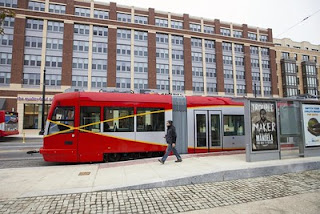
1.  DC streetcar.  I've often made the point that DC and Seattle started "streetcar planning" at the same time in 2003.  Seattle's streetcar line opened in 2007.  DC's in 2016.  

In fact, in 2016, Seattle opened its second streetcar line, on First Hill.  Work is underway to connect the two lines, and further extend the streetcar, which complements light rail and bus modes within the city.

DC's failures in streetcar planning contributed to Arlington's decision to drop its parallel streetcar effort in 2014 ("5 years later, battle scars over Columbia Pike streetcar are still healing," Sun Gazette/Inside NoVA).  If only Arlington was near Seattle.

It certainly helped opponents to the Purple Line light rail program in Suburban Maryland.

And the failures of DC in planning for and implementing the streetcar is often held up by opponents to streetcar and light rail projects elsewhere as an example of failure, incompetence, and by extension, the likelihood of failure of in their own communities ("A streetcar not desired," Politico, 2014).

In fact, I've since made the point that planning and transportation officials have a duty to not fail as part of their overall professional responsibility, because of how their failures can have unintended negative impacts elsewhere.

Since these failures, DC has decided to not extend the streetcar west to Georgetown ("D.C. drops plan to extend streetcar line to Georgetown," Washington Post), crippling its potential to be useful, although they are willing to extend it eastward.  

Planning for other lines has long since ended, making the line a one-off making the mode generally un-useful ("DC and streetcars #4: from the standpoint of stoking real estate development, the line is incredibly successful and it isn't even in service yet, and now that development is extending eastward past 15th Street NE," 2015).

Ironically, even as a failure, the streetcar has shaped as much as $1 billion in new development on the H Street NE corridor, and further extending development up Bladensburg Road and beyond 14th Street to Benning Road.

I guess not.

2.  Suburban Purple Line light rail project, Montgomery and Prince George's County, Maryland.  This project has been going on for a couple decades all told.  It was junked during the Republican Ehrlich Administration (2003-2006) in favor of a toll road.  Then it was revived under Democratic Governor Martin O'Malley (2007-2014).  Then new at the time Republican Governor Hogan threatened to eliminate it once again (2015), but at the expense of a similar project in Baltimore ("Five years later, many across Baltimore bitterly lament Gov. Hogan’s decision to kill the Red Line light rail," Baltimore Sun).

But the Republican Governor, eager to have the private sector fund it, created a "Public-Private Partnership" to partly finance, design, engineer, build, and operate it.  Disputes over cost overruns led the construction group to bail out.  

(I tried to get a job with one of the bidders.  But they lost, and the experience was so bad they decided to shut down the unit of the corporation that was to bid on similar projects across the country.)

Now Maryland has found a new construction "partner" but the line will be delivered more than 4 years later than initially planned ("Purple Line will open 4½ years late and cost $1.4 billion more to complete, state says," Washington Post).

The ongoing debacle of the Purple Line certainly doesn't help the arguments of proponents of transit.

Maybe that's what Governor Hogan planned all along? (After all, he prefers high occupancy toll road projects, expanding freeways, "County officials say Maryland governor made ‘empty’ threats to get toll lanes plan approved," Washington Post).

How's that partnership working out with the private sector?

... recently I saw an article recently making the point that in privatization and outsourcing we redefine transactions as partnerships.

3.  DC area Metrorail (Washington Metropolitan Area Transit Authority) and the failure to proactively deal with faulty wheels.  I haven't written about this even though it's been a problem for months because it's just so depressing.  

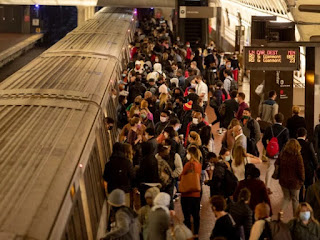
The Metrorail Safety Commission ordered WMATA to pull 60% of its train fleet on Sunday, October 17, 2021, leading to long delays Monday morning. yrone Turner/WAMU/DCist

The tragic thing is they knew about the problem, had frequent derailments, but kept letting it slide, until they were forced to take the trains out of service ("WMATA Experiences Continued Delays Following Train Derailment, Inspection," Georgetown Hoya, "Metro 7000-series safety problems 'could have resulted in a catastrophic event'," WAMU/NPR), "Washington Metro Pulls Most Train Cars From Service After Derailment," New York Times) so many that on most lines they operate fewer than 3 trains per hour, making transit completely unusable as a single train has capacity of about 1,200 to 1,800 passengers.

WTF?  WTF!

It makes the "service" completely unusable.  Forcing people to drive, to buy car even..

4.  WMATA is systematically failing.  Worse, the derailments are merely one and the latest problem in a long list of severe safety failures, evidence of ongoing systematic failure:

As they say, the fish rots from the head. 12+ years of systematic failure ought to have consequences.

Much of the top management should be canned.

=======

All of these incidents remind me of the discussion in the Asimov Foundation book series, in the discussion about the decline of the Empire, the inability of people to manage and operate things:

Mallow goes spying at a Siwellian power plant, noting that it is atomically powered (atomic power is the benchmark of technical civilisation in the Empire) but that the technicians – the tech-men – don’t actually know how to maintain it.

Note that despite funding problems which will lead to severe delays in building out the system, Sound Transit continues to expand the Seattle area light rail system, with the newest extension just having opened in October.  Each expansion results in significant increases in ridership.

And Seattle's new Climate Pledge Arena includes free transit use (except ferries) with tickets for hockey and women's basketball games, and other ticketed events, like concerts.

Streetcar in Tucson is seen as successful ("PLANNING PROFESSOR ARTHUR C. NELSON SHARES ANALYSIS AND LESSONS FROM DEVELOPMENT AROUND TUCSON’S SUN LINK MODERN STREETCAR," University of Arizona).  Same in Cincinnati--despite some construction issues, and Kansas City.

Oklahoma City 's streetcar opened in 2018 and seems to be supported ("Development, rather than ridership, a measure of success for Oklahoma City streetcar," Daily Oklahoman).

But the failures seem to garner a lot more attention.

Labels: , , , , , ,

Monday, May 04, 2020

Just a reminder that what are called "public private partnerships" are contracts, not partnerships

-- "Design-Build Team Makes Decision to Leave Maryland Purple Line Rail Project," Engineering News-Record

The State of Maryland signed a contract with a group of various firms to design, build, operate,  maintain and partly finance the forthcoming Purple Line light rail line in Suburban Maryland.  In turn, the group created a separate subsidiary to construct the line.

Washington Post graphic showing the route of the line.

There are various disputes between the State and the consortium over delays and changes that result in greater costs and who is responsible for paying.

Because negotiations up to now haven't resulted in resolution, the construction firm has given notice per the contract to walk away.

Um, despite all the happy talk about "public private partnerships," in normal circumstances, that's not how "partnerships" are supposed to work.

Although this is not new.  The reality is that these are contractual agreements, and very hard to change once underway.  And as contracts, there is little interest in flexibility and changes and improvements once the construction is underway.

From "The Theory and Practice of Infrastructure Public-Private Partnerships Revisited: The Case of the Transportation Sector":

PPPs are widely promoted based on a narrative of improved collaboration between different stakeholders. By aligning the interests of the multiple parties to encourage closer and more productive working relationships, it is argued that public-private partnerships support innovative project designs and deliver value for money by better controlling project risks. Despite the promises, however, relationships between the various partners in PPPs have often turned from collaborative to confrontational, threatening the success of the project.

This is reality. And as a result, I think it's better to call these kinds of arrangements contracts, not partnerships.


I was trying to hook up with one of the teams that bid on this project. They didn't win. And the experience led them to abandon future efforts on such large scale projects (although the firm remains one of the nation's largest construction firms).

One of the problems with projects like this is that they are so few and far between (the same goes with manufacturing passenger transit vehicles of all types) that it's hard to build economies of scale.)

And early on in the post-bid acceptance process, I learned there was no room for innovative station area planning and development, etc., because "it's not in the contract."

-- "A Purple Line update: the downside of Public Private Partnerships" -- they are contracts, not partnerships," 2017
-- "It's not like transit "outsourcing" I mean "public-private partnerships" are necessarily smooth sailing," 2018

Which is one of the reasons why my brilliant writings around the Purple Line will have no effect.

-- "Revisiting the Purple Line (series) and a more complete program of complementary improvements to the transit network," 2019

-- Setting the stage for the Purple Line light rail line to be an overwhelming success: Part 1 | simultaneously introduce improvements to other elements of the transit network
-- Part 2 |   the program (macro changes)
-- Part 3 |   influences
-- Part 4 |   Making over New Carrollton as a transit-centric urban center and Prince George's County's "New Downtown"
-- PL #5: Creating a Silver Spring "Sustainable Mobility District"
-- Part 6 |  Creating a transportation development authority in Montgomery and Prince George's County to effectuate placemaking, retail development, and housing programs in association with the Purple Line
-- Part 7 | Using the Purple Line to rebrand Montgomery and Prince George's Counties as Design Forward

-- PL #5: Creating a Silver Spring "Sustainable Mobility District"
Part 1: Setting the stage
Part 2: Program items 1- 9
Part 3: Program items 10-18
Part 4: Conclusion
Map for the Silver Spring Sustainable Mobility District
(Big Hairy) Projects Action Plan(s) as an element of Comprehensive/Master Plans
Creating the Silver Spring/Montgomery County Arena and Recreation Center

Labels: , , , , ,

Friday, May 01, 2020

DC Growth Machine update

I've written a lot about the "Growth Machine," which is a school of thought in urban sociology concerning the organization of local political and economic elites in favor of a pro-growth, real estate focused agenda.

Graphic from "Public-Private Partnership Model Used in the Taipei Central Station Project Research," Mou Chung Tseng, National Taipei University. 

Harvey Molotch's paper, "City as a Growth Machine: Toward a Political Economy of Place," published in 1976, and later expanded into the book Urban Fortunes: Towards a Political Economy of Place, serves as the foundation for this theory.

-- ""Columbus Way" merely another example of "Growth Machine/Urban Regime" theory," 2019
-- "Minneapolis growth machine," 2015
-- "If you don't know urban political theory, it's likely that you don't understand local land use: St. Louis: DC; etc.," 2012
-- "Smaller town revitalization planning: No, Thomas Friedman is not a sage," 2018

Urban Regime theory is the political science equivalent.  I think GM is better for explaining why they do what they do, and UR is best on the how. 

In the paper, "Now What? The continuing evolution of Urban Regime analysis," political science Professor Clarence Stone writes:
An urban regime can be preliminarily defined as the informal arrangements through which a locality is governed (Stone 1989). Because governance is about sustained efforts, it is important to think in agenda terms rather than about stand-alone issues. By agenda I mean the set of challenges which policy makers accord priority. A concern with agendas takes us away from focusing on short-term controversies and instead directs attention to continuing efforts and the level of weight they carry in the political life of a community. Rather than treating issues as if they are disconnected, a governance perspective calls for considering how any given issue fits into a flow of decisions and actions. This approach enlarges the scope of what is being analyzed, looking at the forest not a particular tree here or there. [emphasis added, in this paragraph and below] ...

By looking closely at the policy role of business leaders and how their position in the civic structure of a community enabled that role, he identified connections between Atlanta's governing coalition and the resources it brought to bear, and on to the scheme of cooperation that made this informal system work. In his own way, Hunter had identified the key elements in an urban regimegoverning coalition, agenda, resources, and mode of cooperation. These elements could be brought into the next debate about analyzing local politics, a debate about structural determinism.
Where GM theory is particularly insightful on various elements of the land use intensification agenda, from Downtown revitalization to sports stadiums and arenas, conference centers, and in particular, the role of local media--fully dependent of the success of the local region for its own success, being dependent on advertising revenues generated primarily from sales to local businesses--in cementing this agenda.

(This paper, applying UR theory as an analytical lens for understanding an infrastructure project in Turkey is pretty interesting, "Evaluation of Urban Decisions in the Context of Urban Regime
Theory: The Case of Konya Courthouse Project
," International Journal of Engineering Inventions 6:9 [2017].)

In DC, the Federal City Council is the "governing coalition" described in UR theory ("THE DISTRICT'S POWER BEHIND THE SCENES: Washington Post-connected business group wields influence over city's legislative agenda" and "The DC Lobby," The Common Denominator).

The Washington City Paper has a brief piece ("Meet the Lobbyists, Developers, and Insiders On Bowser's ReOpen DC Committees") looking at the membership on Mayor Bowser's "ReOpen DC" initiative for planning and coordinating the reopening of DC's economy in the time of pandemic.

That's a good update of the GM membership list, alongside people participating in the Federal City Council, DC Chamber of Commerce, the Washington Board of Trade, the Greater Washington Partnership, and similar organizations.

Labels: , , , , ,

Sunday, March 10, 2019

UK local governments selling off public assets in face of austerity-driven budget cuts

I have mentioned from time to time how local governments in the UK have been devastated by cuts to their budgets by the national government, justified by austerity, or the non-Keynesian approach to macroeconomic fiscal policy focused on reducing government expenditures and deficits rather than expanding the economy in the face of economic downturns.

Arguably, a justification for austerity derives from neoliberalism and its ideological position that government action and spending is always inferior to the market.

From the Guardian article "Neoliberalism's 'trade not aid' approach to development ignored past lessons: Neoliberal development policy was radical and abstract, but its uncompromising approach proved dangerous in the real world":
Neoliberalism is often used today as shorthand for any idea that is pro-market and anti-government intervention, but it is actually more specific than this. Above all, it is the harnessing of such policies to support the interests of big business, transnational corporations and finance. It seeks not so much a free market, therefore, as a market free for powerful interests.
Similarly, the flip side of this is a focus on outsourcing government functions to the private sector and private financing, both of which have been shown to be more expensive and often less successful than if these functions were handled by government.

-- "Failure of outsourcing in Great Britain," 2018
-- "How part-privatising the UK probation system backfired," Financial Times

UK austerity is also in the news, with claims that cuts in budgets for policing have contributed to a rise in crime more generally ("UK Police Are Stretched by Austerity," New York Times) and more recently, knife crime ("K Knife Crime Rises. Are Budget Cuts to Blame?," NYT).

UK local governments have experienced cuts in budgets up to 60% and that combined with the double whammy of also being financially responsible for elder care, this has driven many governments to bankruptcy, but also selling off property.

The problem is exacerbated by restrictions on local taxation, especially taxation of residential property, which is undertaxed.

The Guardian reports ("Great British sell-off: how desperate councils sold £9.1bn of public assets") on a study of this phenomenon conducted by the Bureau for Investigative Journalism and HuffPost UK.

The article discusses putting up various civic assets up for sale such as the Stretford Public Hall in Trafford and the Moseley Road Baths in Birmingham.

Both these buildings ended up being taken over by community nonprofit initiatives, with support from the nonprofit Locality and their Save Our Space campaign. From the article:
“Part of the problem is a lot of councils don’t have policies in place to think about alternatives to selling off properties to the private sector,” says Tony Armstrong, Locality’s CEO. “Councils are under a huge amount of pressure, and we definitely sympathise with them, but when they look at plugging these budget holes in the short term, once they’ve done that, they can’t do it again - and these places are lost forever.”

In a period of austerity, non-profit making services are “just seen as a drain”, Armstrong says.

“It probably sounds like jargon, but we talk about this concept of ‘social infrastructure’. It’s common sense really, but what brings communities together is the common experiences that we share, and a big part of that is the tangible, physical places where we get together.”
Also see these past Guardian articles:

-- "These squares are our squares: be angry about the privatisation of public space," 2017
-- "Britain's cash-strapped councils and the great Civic Centre sell-off," 2017
-- "Councils forced to sell off parks, buildings and art to fund basic services," 2018
-- "In the frame: two radically different plans for civic art collections," 2019

This is an issue for local government in the US, not so much with public buildings and park space, although it does happen, but with services and infrastructure, such as Chicago's disastrous long term lease deals for its public parking structures and parking meters. The city was driven to make a fast deal because they needed money to plug a $2 billion budget deficit.

-- "Financial engineering for municipalities," 2011
-- "A lesson to cities that they need to be very careful when leasing assets to public private "partnerships"," 2012
-- "Chicago's ongoing debacles: parking and governance," 2013

This also comes up with outsourcing and similar kinds of deals concerning speed cameras, parking meter revenue collection, etc.

At the federal level, outsourcing is a big deal, and hyper problematic, from the management of "camps" to house undocumented immigrants ("Are US immigrant child detention centers "concentration camps"?," Quartz) to privatized prisons (Private Prisons in the United States, The Sentencing Project)

Labels: , , , , , , ,