Rebuilding Place in the Urban Space

"A community’s physical form, rather than its land uses, is its most intrinsic and enduring characteristic." [Katz, EPA] This blog focuses on place and placemaking and all that makes it work--historic preservation, urban design, transportation, asset-based community development, arts & cultural development, commercial district revitalization, tourism & destination development, and quality of life advocacy--along with doses of civic engagement and good governance watchdogging.

Thursday, January 27, 2022

A tenure of failure doesn't deserve encomiums: Paul Wiedefeld, WMATA CEO

WRT the encomium, maybe Wiedefeld did the best he could do.  But it's not enough.

====

Almost two weeks ago, I wrote about how transit failures in the DC metropolitan area don't just have negative impact on transit within that area, but nationally, as transit opponents use failures in one place as justification for opposition for transit creation in other communities.

-- "Sometimes you have to wonder if transit/transit projects are being deliberately screwed up to make transit expansion almost impossible"

WMATA, the Washington Metropolitan Area Transit Authority, operator of the Metrorail subway/heavy rail system serving DC, Northern Virginia, and Montgomery and Prince George's Counties in Maryland, has been in failure mode for more than ten years.  

Brochure, February 2000

Part of it wasn't the system's fault per se, but the failure of board members and jurisdictions to fund necessary quantum system maintenance as the system aged--they were warned.  In the 1990s, system planners warned leaders and stakeholders that this would be required in the coming years.

But nothing was done until the system started failing.

Since 2009 the system has been in perpetual crisis, when a signals failure resulted in a train crash killing 9 people--and the crash was "merely" the denouement after multiple signal failures over preceding years that fortunately hadn't resulted in death, but weren't seen as an indicator of system failure.  

But the problems haven't stopped, system service degradation as a repercussion of the system failure, tunnel fan failures (abetted by inspection failures) leading to another death, operational failures of various types, and over the past few months, a failure to address derailment/wheel problems in the 7000 series of cars which resulted in 748 cars being taken out of service, and the Metrorail system basically grinding to a halt.

Although WMATA did respond to the signals failures and need for substantive overhaul by creating the SafeTrack program to execute various system improvements (although at short term cost of closing sections of the system while repairs were made).

But the failure of the 7000 series cars is an illustration that the problems in WMATA operations go far beyond "a state of good repair."  The problems are structural, systemic.

Just after I wrote the piece, the CEO of WMATA announced his forthcoming retirement ("Metro’s general manager to retire after six years as top executive") and a few days later the Washington Post editorialized that he's great and restored the capacity, confidence, and the ability of the system ("Paul J. Wiedefeld’s tenure at Metro").

I don't think the writers ride the system much.

Wiedefeld is an experienced airport manager, but I think his tenure at WMATA demonstrates the necessity of a highly experienced rail transit professional to run the system.  

Just like his predecessor, a super experienced bus administrator, demonstrated the need for a highly experienced rail transit professional to run the system. 

(And maybe commenter charlie is right that we can't expect WMATA to run both rail and bus service excellently, that buses will always be second to rail.  See "Reviving DC area bus service: and a counterpoint to the recent Washington City Paper article," 2019).


I think this headline from a WTOP radio story is more accurate.  

At best the system is in stasis, with a repeated track record of failure over the past 10+ years, and rebuilding the confidence in transit and the consensus of the importance of transit is key.

The subway had been key to DC and Arlington County's resurgence, including residential and business attraction, and significant reductions in automobile traffic.

DC especially should be worried, not only about covid and its impact on the qualities that make urban living attractive, but about the likelihood of Metrorail recapturing its capacity to be successful.

Conclusion: What is to be done?

1.  Fix WMATA.  The first order of business is to hire top notch executives to run the system, people with experience in heavy rail, high volume transit service.  And then overhaul the agency from top to bottom.

-- "Getting WMATA out of crisis: a continuation of a multi-year problem that keeps getting worse, not better," 2015
-- "More on Redundancy, engineered resilience, and subway systems: Metrorail failures will increase without adding capacity in the core," 2016
-- "Reviving DC area bus service: and a counterpoint to the recent Washington City Paper article," 2019

Note that the first two entries were written at the outset of Wiedefeld's appointment, and I wouldn't say that WMATA is more stable and effective compared to 2015.

In Philadelphia, NBC10 is running a survey on the quality of the local transit service there ("SEPTA Riders: Tell Us What It's Like to Take Public Transit").

2.  Rebuild the regional consensus about the value of transit.  In 2009 after the crash, and in 2014, I suggested that the region needed to rebuild its consensus on the importance and value of transit.

-- "St. Louis regional transit planning process as a model for what needs to be done in the DC Metropolitan region,"
-- "WMATA 40th anniversary in 2016 as an opportunity for assessment"

This need is even greater now.  

3.  Create a regional transport association to plan, manage, and deliver transit and mobility services.  Also, I've argued that the metropolitan area/region should reconfigure how it manages, plans, and operates transit, along the lines of the German VV model.

By default WMATA is the main transportation planner and it shouldn't be.  

-- "Don't over focus on "fixing" the WMATA Compact. Instead create a new Regional Transit Compact, of which WMATA is one component," 2017
-- "The answer is: Create a single multi-state/regional multi-modal transit planning, management, and operations authority association," 2017
-- "Route 7 BRT proposal communicates the reality that the DC area doesn't adequately conduct transportation planning at the metropolitan-scale," 2014

Although in the US, I've argued that such associations need to have a more expansive membership, and include for profit providers when appropriate ("Another example of the need to reconfigure transpo planning and operations at the metropolitan scale: Boston is seizing dockless bike share bikes, which compete with their dock-based system," 2018), airports ("Transportation demand management gaps, Salt Lake City International Airport and car sharing," 2021), and even highway operators ("Washington Post letter to the editor on repair-related closure of Rockville and Shady Grove Stations and corridor management," 2021).

-- "DC is a market leader in Mobility as a Service (MaaS)," 2018

4.  Elect the Board of Directors.  And that WMATA's board should be popularly elected, and treated as members of local government systems ("Why not elect DC's representatives to the WMATA transit agency board?," 2019, "Should DC's representatives to the WMATA Board be popularly elected?," 2014).  Eg., DC's elected board members to WMATA should serve on DC Council's transportation committee as ex officio members, and on a city transportation commission if one existed (item 9, "How I would approach organizing the DC master transportation planning process and plan," 2013)..

But this should be extended to the entire board, and include the representatives from Maryland and Virginia too (Virginia jurisdictions in the WMATA Compact mostly have transportation commissions already. Rockville, a part of Montgomery County, does also.)

5.  Fix funding.  I have also written that it was unfortunate that when the system was successful, the jurisdictions didn't come together and vote for permanent sales taxes to fund the system (""Let's Talk" -- What to do when your transit authority needs more money?: Washington region edition," 2014).  Now with the system's repeated failures, not to mention Republican Governors in Maryland and Virginia, it's almost impossible to believe that this could be accomplished.

6.  Expand and intensify the transit system.  You can't have a transit city without continuing to expand and intensify the system.  But WMATA only cares about Metrorail, and to some extent regional bus service.  That's why a transport association is key.

WMATA isn't interested in other modes, be they streetcars, light rail, railroad passenger services, etc.   For example, the light rail Purple Line will be run by the Maryland Transit Administration (as is the Takoma Langley Crossroads Transit Center) because WMATA wasn't interested.  (To extend the point made by Ted Levitt about GM in the book Marketing Imagination--WMATA isn't a transit/transportation "agency" but an operator of heavy rail and bus services.)

-- "Update to the Paul J. Meissner produced integrated high capacity transit map for the Washington metropolitan area," 2017
-- "One big idea: Getting MARC and Metrorail to integrate fares, stations, and marketing systems, using London Overground as an example," 2015
-- "A new backbone for the regional transit system: merging the MARC Penn and VRE Fredericksburg Lines," 2015
-- "Setting the stage for the Purple Line light rail line to be an overwhelming success: Part 2 | proposed parallel improvements across the transit network," 2017
-- "Using the Silver Line as the priming event, what would a transit network improvement program look like for NoVA?," 2017
-- "A "Transformational Projects Action Plan" for a statewide passenger railroad program in Maryland," 2019
-- "A "Transformational Projects Action Plan" for the Metrorail Blue Line," 2020
-- "Metrorail shutdown south of AlexandriaNational Airport would have been a good opportunity to promote ferry service," 2019 (speaking of ferry service, "Ferry to D.C.? New analysis underway," Inside NoVA; note fwiw, there have been ferry studies off and on since 1992)
-- "Will buses ever be cool? Boston versus the Raleigh-Durham's GoTransit Model," 2017

-- Georgetown Gondola proposal (which isn't necessary with a separated blue or silver line)

WMATA has come up with some ideas of its own for Metrorail expansion ("The Blue Line Could Go to National Harbor One Day," Washingtonian), and they're better than previous iterations, but not expansive enough.

=====

What's a transport association?  In 1960, transportation planners in Hamburg realized that transit riders didn't care who provided what service, whether it was a bus, subway, train, or ferry in the core of the city or in the suburbs, that riders wanted an efficient and inter-connected set of transit services that was logically and comparatively easy to use.

At the time they started--and it took five years to get the organizations to agree to work together--it took as many as seven different providers and fares to get from one end of the region to the other.

-- HVV, Hamburg Transport Association
-- "HVV Celebrated 50 Year Anniversary, City of Hamburg
-- "Verkehrsverbund: The evolution and spread of fully integrated regional public transport in Germany, Austria, and Switzerland," Ralph Buehler, John Pucher & Oliver Dümmler, International Journal of Sustainable Transportation (2018)
-- Transport Alliances - – Promoting Cooperation and. Integration to offer a more attractive and efficient Public Transport, VDV, the association of German transportation associations. (NOTE: clicking on the link triggers a file download.)

The city planners organized the transit providers into a single association and began the process of integrating services, schedules, and fares, and creating a separate planning and coordination system. Who offered what service was determined by who could do it best--in any case, transit planning was separated from transit operations.

Two agencies, Hamburg Hochbahn (subway and bus) and Deutsche Bahn/S-Bahn (commuter railroads) provide the bulk of the service, and a third, HADAG, ferry services. But 30+ operators provide services within the system, mostly bus, but also exurban rail services--the City-State of Hamburg is a partial owner of many of these services.

Labels: , , , , , , ,

Thursday, January 13, 2022

Sometimes you have to wonder if transit/transit projects are being deliberately screwed up to make transit expansion almost impossible

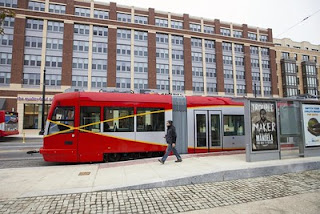
1.  DC streetcar.  I've often made the point that DC and Seattle started "streetcar planning" at the same time in 2003.  Seattle's streetcar line opened in 2007.  DC's in 2016.  

In fact, in 2016, Seattle opened its second streetcar line, on First Hill.  Work is underway to connect the two lines, and further extend the streetcar, which complements light rail and bus modes within the city.

DC's failures in streetcar planning contributed to Arlington's decision to drop its parallel streetcar effort in 2014 ("5 years later, battle scars over Columbia Pike streetcar are still healing," Sun Gazette/Inside NoVA).  If only Arlington was near Seattle.

It certainly helped opponents to the Purple Line light rail program in Suburban Maryland.

And the failures of DC in planning for and implementing the streetcar is often held up by opponents to streetcar and light rail projects elsewhere as an example of failure, incompetence, and by extension, the likelihood of failure of in their own communities ("A streetcar not desired," Politico, 2014).

In fact, I've since made the point that planning and transportation officials have a duty to not fail as part of their overall professional responsibility, because of how their failures can have unintended negative impacts elsewhere.

Since these failures, DC has decided to not extend the streetcar west to Georgetown ("D.C. drops plan to extend streetcar line to Georgetown," Washington Post), crippling its potential to be useful, although they are willing to extend it eastward.  

Planning for other lines has long since ended, making the line a one-off making the mode generally un-useful ("DC and streetcars #4: from the standpoint of stoking real estate development, the line is incredibly successful and it isn't even in service yet, and now that development is extending eastward past 15th Street NE," 2015).

Ironically, even as a failure, the streetcar has shaped as much as $1 billion in new development on the H Street NE corridor, and further extending development up Bladensburg Road and beyond 14th Street to Benning Road.

I guess not.

2.  Suburban Purple Line light rail project, Montgomery and Prince George's County, Maryland.  This project has been going on for a couple decades all told.  It was junked during the Republican Ehrlich Administration (2003-2006) in favor of a toll road.  Then it was revived under Democratic Governor Martin O'Malley (2007-2014).  Then new at the time Republican Governor Hogan threatened to eliminate it once again (2015), but at the expense of a similar project in Baltimore ("Five years later, many across Baltimore bitterly lament Gov. Hogan’s decision to kill the Red Line light rail," Baltimore Sun).

But the Republican Governor, eager to have the private sector fund it, created a "Public-Private Partnership" to partly finance, design, engineer, build, and operate it.  Disputes over cost overruns led the construction group to bail out.  

(I tried to get a job with one of the bidders.  But they lost, and the experience was so bad they decided to shut down the unit of the corporation that was to bid on similar projects across the country.)

Now Maryland has found a new construction "partner" but the line will be delivered more than 4 years later than initially planned ("Purple Line will open 4½ years late and cost $1.4 billion more to complete, state says," Washington Post).

The ongoing debacle of the Purple Line certainly doesn't help the arguments of proponents of transit.

Maybe that's what Governor Hogan planned all along? (After all, he prefers high occupancy toll road projects, expanding freeways, "County officials say Maryland governor made ‘empty’ threats to get toll lanes plan approved," Washington Post).

How's that partnership working out with the private sector?

... recently I saw an article recently making the point that in privatization and outsourcing we redefine transactions as partnerships.

3.  DC area Metrorail (Washington Metropolitan Area Transit Authority) and the failure to proactively deal with faulty wheels.  I haven't written about this even though it's been a problem for months because it's just so depressing.  

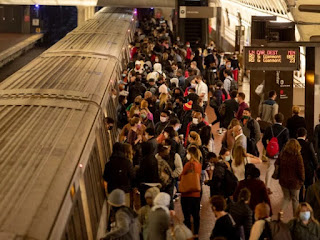
The Metrorail Safety Commission ordered WMATA to pull 60% of its train fleet on Sunday, October 17, 2021, leading to long delays Monday morning. yrone Turner/WAMU/DCist

The tragic thing is they knew about the problem, had frequent derailments, but kept letting it slide, until they were forced to take the trains out of service ("WMATA Experiences Continued Delays Following Train Derailment, Inspection," Georgetown Hoya, "Metro 7000-series safety problems 'could have resulted in a catastrophic event'," WAMU/NPR), "Washington Metro Pulls Most Train Cars From Service After Derailment," New York Times) so many that on most lines they operate fewer than 3 trains per hour, making transit completely unusable as a single train has capacity of about 1,200 to 1,800 passengers.

WTF?  WTF!

It makes the "service" completely unusable.  Forcing people to drive, to buy car even..

4.  WMATA is systematically failing.  Worse, the derailments are merely one and the latest problem in a long list of severe safety failures, evidence of ongoing systematic failure:

As they say, the fish rots from the head. 12+ years of systematic failure ought to have consequences.

Much of the top management should be canned.

=======

All of these incidents remind me of the discussion in the Asimov Foundation book series, in the discussion about the decline of the Empire, the inability of people to manage and operate things:

Mallow goes spying at a Siwellian power plant, noting that it is atomically powered (atomic power is the benchmark of technical civilisation in the Empire) but that the technicians – the tech-men – don’t actually know how to maintain it.

Note that despite funding problems which will lead to severe delays in building out the system, Sound Transit continues to expand the Seattle area light rail system, with the newest extension just having opened in October.  Each expansion results in significant increases in ridership.

And Seattle's new Climate Pledge Arena includes free transit use (except ferries) with tickets for hockey and women's basketball games, and other ticketed events, like concerts.

Streetcar in Tucson is seen as successful ("PLANNING PROFESSOR ARTHUR C. NELSON SHARES ANALYSIS AND LESSONS FROM DEVELOPMENT AROUND TUCSON’S SUN LINK MODERN STREETCAR," University of Arizona).  Same in Cincinnati--despite some construction issues, and Kansas City.

Oklahoma City 's streetcar opened in 2018 and seems to be supported ("Development, rather than ridership, a measure of success for Oklahoma City streetcar," Daily Oklahoman).

But the failures seem to garner a lot more attention.

Labels: , , , , , ,

Tuesday, February 05, 2019

WMATA service and fare changes for FY2020

WMATA has done extensive communication about proposed fare and service changes for FY2020, printing a brochure with a survey in English and five other languages, and collecting these results at stations, and online survey and comment forms.

... one problem I do have with the new methods is that they are now anonymous, unless you choose to identify yourself.

Comments are due today by 5pm.
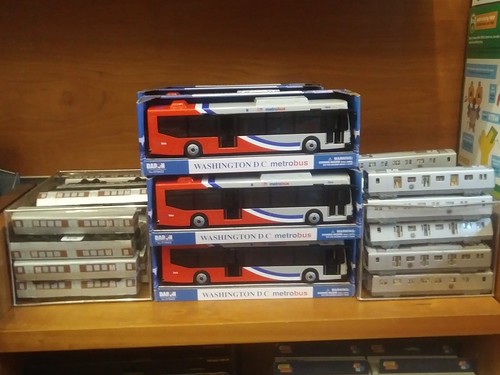
WMATA train car and Metrobus toys
Anyway, by and large, the proposed changes are excellent:
  • changing Yellow Line service to Fort Totten all the time
  • reducing the price of the 7-day bus pass
  • adding free bus service to the 7-day rail pass
  • a flat Metrorail fare of $2 for weekends (which is kind of like something I've suggested in the pass, based on special evening and/or weekend fare programs in Melbourne, Hamburg, and Montreal)
One I am indifferent to:
  • making all Red Line trains end at Glenmont
And one I have serious reservations about:
  • expand weekday peak service times, changing the hours of peak service to 5am to 10am -- 30 additional minutes -- in the a.m. and from 3pm to 8:30 pm in the evening -- 90 additional minutes.
1. It's not that I don't favor more frequent service.

2.  It's that in the past, WMATA has charged peak service fares during these time periods, while at the "shoulders" of each period providing less than frequent service.

3.  Charging more for less service is unreasonable.

4.  For WMATA to add peak service fares, by extending rush periods in the morning and evening, they should be required to guarantee they will provide additional service.

Labels: , , , , , , ,

Friday, November 16, 2018

Retiring SF MUNI CFO Sonali Bose appears to be a dream hire from the standpoint of transit riders

The San Francisco Chronile reports ("Muni CFO Sonali Bose departs, creating another challenge for SF’s transit agency") on the retirement of Sonali Bose, the Chief Financial Officer of the SF MUNI transit system, one of the most highly used city-only transit systems in the US.  From the article:
The woman who doubled the budget of the San Francisco Municipal Transportation Agency — replacing the junked buses of the past with a splashy new fleet — is heading out the door, creating a new challenge for an agency that is struggling to gain public trust. ...

Some call her a political fixer: the rare transit bureaucrat who urged her allies to chair commissions and lined up votes for the policies she wanted. Others deem her a truth-teller: the woman in a blazer and a cotton dress who gamely criticized mayors and department heads when she thought they made bad decisions. Most people praise her for fixing the budget of a $1 billion agency that was in disarray before she arrived.

Sonali Bose was inspired to “get into (SFMTA) and figure out what the hell is going on” after buses passed her while she waited at a stop one day in 2003. Photo by Lea Suzuki / The Chronicle

“When I walked in, I went, ‘Whoah,’” Bose, 60, said. “It was 2006, and the agency was starved of talent and resources. The budget was about half what it is today.”

Over the next 12 years, she raised the SFMTA’s credit rating to be the highest of any transit agency in the country. She oversaw a new parking program that adjusts rates at meters and garages to match demand. She helped fund the biggest increase in Muni bus and rail service that San Francisco has ever seen and increased the revenue from the agency’s advertising contracts from $400,000 to $30 million. ...

“She wasn’t just a CFO — she was this tireless, in-your-face advocate for the SFMTA,” said Supervisor Aaron Peskin, chair of the Transportation Authority, the body that makes decisions on sales tax spending and some projects.

“She was the kind of person who would text me in the middle of a Transportation Authority meeting, either berating me or provoking new thoughts,” Peskin said. “She did not allow her behavior to be boxed in politically or financially.”

He and others called Bose a “guiding force” who fought relentlessly to improve the financial situation at the SFMTA, and who saw results.

Labels: , , , ,

Friday, March 17, 2017

Interesting transit map #1: NYC Subway system underground service network

Winter weather wreaks havoc on above-ground transportation systems.

I have argued in the past that it would have been worth building more of the Metrorail system underground to ensure that it would function in bad winter weather.

At the time the system was built, that didn't seem necessary, but as Global Warming makes weather more unpredictable and violent, circumstances may be changing (not that we can go back and rebuild the system).

Of course, DC is not Montreal, which has a fully underground subway system which functions in all weather conditions.  (In fact, I am a bit skeptical of the proposed multi-line light rail system there, because it won't necessarily be resilient in the face of big winter snows.  See "Caisse's REM light-rail project: 3 stations added to proposed route through Downtown Montreal," Montreal Gazette.

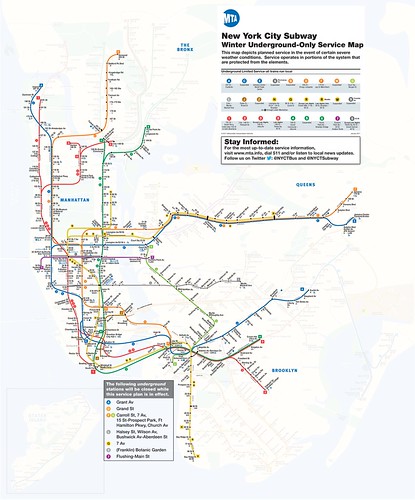
While this past week we got some snow which bollixed things up a bit, it was 1/3 to 1/4 of the amount of snow that fell in NYC.  In advance of the storm, MTA announced that the subway system would shift to underground only operations, and they published a map showing that network.
NYC Subway 2017 Winter Underground Subway Service Map

Labels: , , , ,

Tuesday, January 26, 2016

Fully underground subway systems are more resilient

The Metrorail heavy rail transit system is a mix of underground and above-ground sections.  In the worst winter weather conditions, in the past they have hunkered down and only run the part of the system that is fully underground, within DC (although some sections in the suburbs are also underground, primarily the Orange Line in Arlington County, Virginia).

The last couple storms, including the one this past weekend, they have shut down the entire system for a time, not even running the underground section, because of fears that potential power outages could strand trains and riders.

The underground portion of the Metrorail system that can run during major snow events.  Map graphic by Peter Dovak for Greater Greater Washington.

I am not criticizing WMATA for shutting down, even though it turned out we didn't have widespread power outages (likely because the snow was soft and powdery).

You can try to keep the system running for as long as possible but on the backside, it means more downtime as the system works through the recovery period.

With an anticipatory shutdown, there is more uptime overall.

Still, with the benefit of hindsight, it's unfortunate that more parts of the system weren't built underground.

For example, if the section of the Red Line from Union Station to Silver Spring (between Silver Spring and Wheaton actually) had been built underground, then the entire east leg of the Red Line could operate during the worst of winter storms.

Light snow on Metrorail tracks in the median of Rte. 7 in Fairfax County, when the system was under construction.  Photo by Chuck Samuelson, Dulles Corridor Metrorail Project.

Similarly, the new Silver Line segment in Fairfax County was built above-ground and in aerial sections for great lengths.  In the snowstorm--at least 20 inches in most places, and more than 2 feet in others--It turned out to be the most vulnerable section of the system and will be the last to be fully operational as the system reopens.

Too bad that winter-time resilience wasn't one of the factors considered in the debate over whether or not to build the Silver Line underground ("Rail Tunnel Debate Raises Larger Issue," Washington Post, 2006).  It would have cost much more, true, but would have been able to operate in adverse conditions.

STM in Montreal is the best example in North America of building a heavy rail system completely underground, which they did in part because the city experiences some of the worst winter weather conditions on the continent.   As a result, the Montreal heavy rail system is much more resilient than heavy rail systems like DC's.

The system has 68 stations over 40 miles of track and mostly operates within the City of Montreal, although there are two extensions outside of the city, to Laval and Longueuil. The system has about 1.25 million riders daily.

-- Using public transit in winter | Société de transport de Montréal

Ironically, because the system was built entirely underground and train cars are not exposed to weather--rain, snow, or sun--the cars were not built to be weatherproof.  (That means no air conditioning either.)

Two lessons for transit system design engineering derived from hindsight concerning the Metrorail system. (1) Fully underground systems are more resilient in adverse winter weather conditions. (2) Two track systems--one in each direction--lack redundancy, at least one additional track would allow for express service and more efficient operations when tracks or trains are not functioning.

Labels: , , , , ,

Tuesday, August 18, 2015

MBTA does something along the lines of what I suggested wrt WMATA, by splitting out "jobs"

In the ongoing discussion about WMATA's problems, I've discussed how MBTA in Greater Boston is undergoing simultaneously a similar kind of pileup of management and operational failiures--although there it was precipitated by six feet of snow and many years of underfunding of maintenance and equipment which all came to a head.  (I've also discussed how in Greater Toronto and to some extent, Chicago, there are ongoing discussions about better ways of coordination and integration at the regional scale.)

I am leery about the WMATA transit system being successful at hiring "a savior" ("Virginia tells Metro to accelerate search for a general manager," Washington Post) because the new CEO will have to somehow fix all the planning, financing, and oversight issues that emanate from the jurisdictions (DC, MD, VA and to some extent, the Federal Government) that "own" the system, which are distinctly different problems from but also shape the operational failures of the WMATA system.

Independent of the operational failures, I don't those problems are easily fixed, but if they remain unfixed, WMATA stays broken.

In the intermediate run, I believe that WMATA needs to hire a great operator to take over the Metrorail system, and fix its rampant operational failures and broken organizational culture.

In the meantime, WMATA ought to "take its time" hiring a GM, and ideally, should focus on rebuilding the regional consensus on transit and all the components of such a consensus--planning, operations, network definition, financing, etc.

MBTA has done something along these lines, hiring three key people.

But all this has come about AFTER--granted, produced pretty quickly and politically--an analysis of the transit system's problems.  We don't have that yet for WMATA, except for some reports from the Federal GTransit Administration and the National Transportation Safety Board.

-- Back on Track: An Action Plan to Transform the MBTA |Submitted by the Governor’s Special Panel to Review the MBTA
 
From the Metro Magazine article, "MBTA leadership team divided into 2 positions":
MassDOT announced Brian Shortsleeve will serve as the Chief Administrator for the Massachusetts Bay Transportation Authority (MBTA), working alongside the newly appointed Fiscal and Management Control Board (FMCB). Interim GM Frank DePaola will continue in his current role focusing solely on operations and Jeff Gonneville, a 14-year veteran of the MBTA, will serve as the permanent Chief Operating Officer.

Given the immense reforms underway at the MBTA, Secretary Stephanie Pollack has divided the T’s leadership into two positions in accordance with the recommendations of the Governor’s MBTA Special Review Panel. The chief administrator will focus on the fiscal health of the organization, enabling the general manager to focus on improving service for customers.
WMATA's current cash flow problems are the result of poor financial controls, which led the Federal Transit Administration to stop advancing funds to the agency before projects were finished. Now WMATA gets reimbursement only after work has been performed. From "Gov.'s MBTA legislation includes 3-year fiscal control board":
The legislation, An Act for a Reliable, Sustainable MBTA, would establish a Fiscal Management and Control Board (FMCB) and Chief Administrator to oversee operations and finances through 2018, create capital plans, introduce reporting and audit requirements and lift procurement restrictions for the MBTA. Together the FMCB and Chief Administrator would be charged with establishing a safe, reliable, financially sound and sustainable customer-oriented public transit system.
It's much harder to pull this  off for WMATA, because unlike most transit systems, WMATA involves three separate "states" and the Federal Government, meaning Congress has to vote favorably, all must act in a coordinated fashion to take similar action. 

By contrast, MBTA's service operate solely within the State of Massachusetts, and the state, not local jurisdictions in Greater Boston, run the service ("Operational apples and oranges: Comparing Boston, D.C. rail systems," Post).

And as I have written, the DC area jurisdictions aren't taking responsibility for their contributions to the crisis.  The Massachusetts report identified nine main problems:

1. Unsustainable Operating Budget
2. Chronic Capital Underinvestment
3. Bottleneck Project Delivery
4. Ineffective Workplace Practices
5. Shortsighted Expansion Program
6. Organizational Instability
7. Lack of Customer Focus
8. Flawed Contracting Process
9. Lack of Accountability

In the DC context, I would add at least two others, (1) a failure to separate transit planning from transit operations and a failure in planning transit comprehensively at the metropolitan and regional scales and (2) failures in board/jurisdictional oversight and accountability, separate from the "Lack of Customer Focus" and "Lack of Accountability" to the Governor.

However, note that the MBTA analysis was commissioned by the Governor, who has his own agenda. 

So the conclusions in the report likely are different in many respects from what independent, objective transportation analysts would have recommended. Not that they are objective, but among others, MassCommute, the state's association of transportation management associations and the Conservation Law Foundation identified many gaps in the report's analysis and recommendations, which includes budget cuts not increases.

Note that MBTA's problems aren't solely of its own making (and neither are WMATA's). 

The state saddled MBTA with a lot of debt from the Big Dig.  And the service footprint keeps getting expanded while the operating budget continues to shrink in real terms.  And they haven't been able to get the money they need to invest in new equipment. 

And the snows MBTA experienced last winter would have crippled most transit systems running most of their service above-ground--by contrast, because of winter snow conditions, Montreal's subway system was designed with no above-ground sections.  Therefore, Montreal's subway service always runs regardless of weather conditions.

Labels: , , , , ,