Rebuilding Place in the Urban Space

"A community’s physical form, rather than its land uses, is its most intrinsic and enduring characteristic." [Katz, EPA] This blog focuses on place and placemaking and all that makes it work--historic preservation, urban design, transportation, asset-based community development, arts & cultural development, commercial district revitalization, tourism & destination development, and quality of life advocacy--along with doses of civic engagement and good governance watchdogging.

Friday, April 25, 2025

Impact of proposed transit cuts at SEPTA/Philadelphia presented in graphically compelling ways

With WFH and the ending of special grant programs from the Biden Administration ("Public transit agencies eye service cuts as pandemic aid runs out," Marketplace/NPR), coupled with the Trump Administration's pro-car bias, virtually every transit agency is facing financial exigency in future  budget cycles ("Metra, CTA and Pace warn of possible 40% service cuts starting in 2027," NBC Chicago, "What to know about possible PRT cuts and how to make your voice heard," Pittsburgh Post-Gazette) , often with pleas like in Philadelphia ("No more excuses — Harrisburg Republicans must find a way to fully fund SEPTA," Philadelphia Inquirer) and the SF Bay, for state bailouts.

Process for considering transit service cuts in Pittsburgh

WFH has totally messed up transit agency budgets, shifting the most use from morning and evening commute to primary business districts, to use spread out during the day, across the system, further increasing costs alongside revenue decreases.  DC for example has lost about 250,000 train riders from pre-covid highs.

The Reddit Philadelphia has included entries on what budget cuts would to do to SEPTA's, the regional transit agency for Philadelphia, service network, and I thought they've had some good graphics to illustrate the changes.

-- SEPTA budget cut fact sheet

  Proposed cuts to the current rail system ("SEPTA prepares for major service cuts," Trains Magazine).

Current ail transit system

The Delaware Valley Regional Planning Commission ("Regional planners calculated the impact on traffic if SEPTA cuts happen. It’s really bad," Inquirer) did a study of the impact the proposed cuts will have on motor vehicle traffic congestion.


From the article:
SEPTA is facing a $213 million annual structural deficit due in part to pandemic-related ridership reductions and inflationary pressure on labor and materials costs. (Fare evasion doesn’t help matters, costing from $30 million to $68 million yearly, according to SEPTA projections.)

The transit agency released a $1.65 million operating budget on April 10 that included a doomsday scenario of service cuts, along with an average fare increase of 21.5% across the board. In all, up to 55 bus routes would be eliminated, five Regional Rail lines shut down, and 66 stations closed. Other routes and lines would see reduced frequency of buses and trains.
At least one of the SEPTA trolley routes serve the suburbs.  This is in Media, Pennsylvania. 
Those cuts would occur in two phases, this fall and on Jan. 1, without new state subsidies, the transit agency says. If the full menu were enacted, all rail services would stop at 9 p.m. across the SEPTA network early next year.
From the standpoint of "those who don't know history are doomed to repeat it, some Pennsylvania Republicans are recommending privatization ("Idea to privatize SEPTA floats around the State House amid funding crisis," Fox29).  The proposal focuses on bus services, not the entire system.

There's a reason that with few exceptions, privately run transit systems were acquired by local and state governments to maintain service.  They were unprofitable from a fare standpoint, especially in that many of the "spillover benefits" of transit aren't captured by the transit operator.

Note that plenty of public transit agencies outsource operations of some or all of their transit services to the private sector.  Sometimes it works, sometimes it doesn't.  Since the operator isn't responsible for investments in transit infrastructure, that's often skipped over.  Privatization is no panacea.

Impact on property values.  Another report ("SEPTA cuts could lead to drop in property values around Regional Rail lines," WHYY/NPR, Economic Impact Analysis: SEPTA Service Cut Proposal Due to Lack of Funding) points out that property values will drop in areas that get less service at a cost of .  This is another example of a "spillover benefit," improved property values, just one of multiple positive economic development impacts not being captured by a transit agency.


Impact on special event population.  SEPTA promotes transit service to sports events like Eagle football games and concerts ("Taylor Swift's Eras Tour helps boost Philadelphia's economy," ABC6).  Philadelphia will host ceremonies commemorating the 250th anniversary of the signing of the Declaration of Independence, and World Cup soccer.  

Severe cuts to transit will significantly impact the ability of visitors to move around the city ("Philly mostly ready for 2026 … except for that little SEPTA problem," WHYY/NPR).

Streetcar service to ATT Park in San Francisco. SF Chronicle photo.

Impact of graphic design in government communications.  Note that the presentation of these issues with great graphics is an illustration of the power of good graphic design and the use of the design method by government agencies.

-- "All the talk of e-government, digital government, and open source government is really about employing the design method," (2012)
-- "PL #7: Using the Purple Line to rebrand Montgomery and Prince George's Counties as Design Forward," (2017)
-- "Design as city branding: transit edition," (2012)
-- "City (and university) branding: brand deposits; brand withdrawals; brand destruction," (2012)
-- "Georgetown: A subtle but important difference between branding and identity-positioning," (2010)
-- "Identity ≠ branding or Authenticity is the basis of identity," (2007)
-- "The taxi livery debacle as a lead in to a broader discussion of the importance of "design" to DC's "brand promise," (2012)
-- "Illustration of government and design thinking: Boston's City Hall to Go truck," (2013)
-- "(DC) Neighborhoods and commercial districts as brands," (2012)

Labels: , , , , , , ,

Thursday, August 10, 2023

Lies, damn lies, and misleading data: bus service (DC Circulator)

When I went to college there was a book "famous" in economics called Lies, Damn Lies, and Statistics, about the manipulation of data.

In reporting on transit ridership, I am bothered when they don't report ridership by bus line or day of the week, but "by the year."  

There was a reddit entry about this on the Alexandria bus system, touting 5 million riders last year, a system high, without discussion of daily data.  It turns out they have about 10,000 riders during a typical weekday, on 12 bus lines. Probably most of the ridership is on the King Street line, which connects the King Street Metrorail station to Old Town.

This comes up with the DC Circulator.  For years they haven't been reporting data by bus line--there are six.  Obviously it's because most of the lines have minimal ridership.   This is from a blog entry, "Semi-reprint: Methodology for determining transit expansion" from 2014:

DC Circulator ridership per day
High and low service months (2013 data)

RouteRidership PeakMonthRidership LowMonth
Georgetown-Union Station6,600June5,500February
Woodley Park-McPherson5,060February4,000November
Union Station-Navy Yard1,700July900November
Rosslyn-Dupont Circle2,750July2,550October
Potomac Ave.-Skyland1,650September1,150November


I had no idea that the ridership of these various bus lines was so pathetic. I knew they were bad mostly, but I had no idea how low the ridership is--other than the fact that I look at every Circulator bus that I pass and judge the amount of ridership on that particular bus, and most cases, except Downtown-Georgetown and sometimes on 14th Street, the number of riders appears to be minimal.

2. Circulator expansion is a form of what I call political bus service, provided to assuage business or neighborhood groups, but not really justifiable on a cost basis, because it gets minimal ridership.

Circulator bus at a stop on 14th Street NW.  

The reason this matters is that besides "branding" the most significant element of Circulator service is frequency, ideally every 10 minutes.  

But to justify that level of service cost-wise, you need high ridership, [ideally] 9,000 to 12,000.

DC's highest used buslines provided by Metrobus provide service as frequent as every 6-8 minutes during peak times, and have from 15,000 to 20,000 daily riders.

Even though DDOT makes information about the services available, they are not subject to the same budgetary pressures as the transit services offered by Metro, because the Metro budget process is much more public because their fare and route system is subject to federal regulations about how changes can be implemented, while locally-provided services don't have the same requirements.

So they evade real scrutiny.

3. This is why for many years I have advocated for the creation of an objective set of service metrics and standards for locally-provided transit service, so that decisions about what to offer or to not offer can be made in an objective, non-political, cost effective manner.

===========

I threw up my hands about the Circulator years ago, calling it "political bus service"--created to assuage particular neighborhood groups, not because it's needed ("Throwing up my hands and the "Anacostia" "Circulator"," 2010).

The fact is that public services ought to be offered where they are used, although breadth--offering services where they wouldn't otherwise be available--is an important criterion too.  The thing is, most Circulator bus lines duplicate in some ways Metrobus service.

Anyway, Greater Greater Washington has an article on the Circulator ("The DC Circulator's electrification dilemma"), saying that the city shouldn't cut back services in order to pay for electric buses, that reducing bus service is a different way of contributing to greenhouse gas emissions.  It turns out, introducing electric buses and cutting three lines might actually be the way to get rid of the minimally used services.

The Circulator bus service has six lines.  With 5.7 million riders in a year pre covid, that's an average of 2,735 riders per line per day.  That's pathetic for a city that pre-covid, had multiple Metrobus lines with ridership between 12,000 and 28,000 each day during the week.

But now total ridership is almost 1/3 of that level, so it's fewer than 1,000 daily riders per line.

Note: all transit systems are screwed ridership-wise these days, given the impact of work from home on ridership.  Most systems have less than 50% of pre-covid ridership, although there are a couple of exceptions.

So I understand the dilemmas of transit planning in that environment.  On the other hand, it's all the more reason to discontinue services that are not only minimally used, but duplicated by other services.

====

Here in Salt Lake City, a local sustainable mobility group advocated for a dedicated bus lane on a street with only four lanes, for a bus line with fewer than 2,400 riders per day.  That's crazy.

I am reminded about a section in one of the books I read about the Vietnam War, that the US kept reporting battle victories duly written about in the New York Times, but a journalist mapped each battle, and noticed that each one was that much closer to Saigon, indicating that actually the US/ARVN were losing territory.  

Labels: , , , , , ,

Tuesday, July 11, 2023

Seattle, All Star Baseball Game, free transit throughout the city and metropolitan area

 Just the other day, "Desperate times sometimes lead to a more marketing-oriented guise: WMATA/Metrorail | Bonus: WMATA's financial crisis," discussed special event transportation, and how WMATA in DC provided free transit starting the evening of July 4th, to facilitate movement to and from fireworks displays.

Yesterday and today are the primary days of activities around the Baseball All Star Game, which this year is in Seattle.  According to The Center Square ("Seattle public transit free Monday and Tuesday for MLB All Star game"):

This fare-free period applies to the following services in the region; 

  • Access Paratransit 
  • King County Water Taxi, Metro and RapidRide Buses
  • Metro Flex on-demand Services 
  • Sound Transit Link light rail 
  • Seattle Streetcars 
  • Kitsap Transit Buses 
  • Kitsap Fast Ferry
Notably excluded from the free fare period for the region are Pierce Transit, Community Transit, and the Seattle Center Monorail, which will continue to charge riders on July 10 and 11.

In February, Utah Transit Authority provided free transit days around the NBA All Star Game, and for an outdoor music festival in May. 


Labels: , , , , , ,

Tuesday, July 04, 2023

Desperate times sometimes lead to a more marketing-oriented guise: WMATA/Metrorail | Bonus: WMATA's financial crisis

First, in the early years of the blog I wrote a lot of pieces about transit marketing and doing a better job of it.  Now a goodly amount of that is encapsulated in "Branding's (NOT) all you need for transit" (2018), but old pieces like "Making Transit Sexy" (2005), make the point too, less sophisticatedly.

Second, during the 2008 crash, I got an email from an activist in response to all the budget and service cuts faced by transit systems.  She said, why can't transit systems be like the system in Rochester, New York ("Creativity Helps Rochester's Transit System Turn a Profit," New York Times), which gets a significant amount of financial support from institutions, who recognize the impact of transit on their organizational community.  That money provides a base level of support independent of fare revenues and government appropriations.

My response was you don't develop such relationships in crisis, but when times are good, and hopefully, those relationships and funding streams can survive exogenous shocks.

WMATA is in financial crisis because of the decline of transit ridership due to telecommuting ("Metro says funding increase needed to avoid catastrophic cuts," Washington Post) but also its financing structure ("Next Stop: Fiscal Cliff  | Inherent Flaws in Metro's Funding Model Are Steering It Right Into A Financial Crisis," Washington Business Journal -- note that I disagree with some of the major points made in the article).  

WMATA's been in organizational crisis for almost 15 years, and even without that crisis, I argued in 2009 before the train crash that it needed to rebuild the metropolitan consensus on transit, which needed to be rebuilt anyway because it was about 40 years after the initial development of the system ("Getting WMATA out of crisis: a continuation of a multi-year problem that keeps getting worse, not better," 2015).

As revenues have dropped because of the service crisis, WMATA has finally introduced a variety of fare innovations.  They still pale compared to systems like London Underground and Melbourne, but for the DC area, they are a step forward.

I was shocked to read in today's Post that this evening, starting at 5pm, Metrorail and Metrobus will be free, to support people going to and from the fireworks.  From the article:

Metro rides are free after 5 p.m. Tuesday 

Officials suggest taking Metro to get to the Mall. Starting at 5 p.m. on the 4th, Metro will offer free transit to access celebrations throughout the D.C. area. The waived fare will be in effect until the rail system closes at midnight, but applies to all rail, bus and paratransit services. Customers will not need a SmarTrip card during those seven hours. The agency will begin increasing service after 4 p.m. to accommodate crowds. 

Officials say the increased service is meant to mitigate some delays and detours near the Mall that are expected because of road closures. Red Line trains will operate every six minutes, while Blue, Orange and Silver line trains will arrive every 12 minutes. Trains on the Green and Yellow lines will arrive every eight minutes from open to close. 

“Metro will be celebrating Independence Day the best way we can — by providing frequent service to help customers get to the festivities around the region and back home safely,” Metro General Manager Randy Clarke said in a statement.

That's not unlike what I've suggested for the Inauguration ("Should transit on Inauguration Day be free?," 2013/2016) and other super special events ("Washington Cherry Blossom Festival and event transit," 2023).

It's probably too little too late.

All the pundits say the biggest problem is the lack of a regularized funding source, like property tax or sales tax ("DC area transit commission board member thinks he has a brilliant idea on how to fund Metrorail: sales taxes," 2022; "Metrolinx Toronto: 25 potential tools to fund transit-transportation infrastructure," 2013).  And absolutely that it is a key issue.  

But like 2008 and the example of Rochester New York transit, the time to create a regularized funding stream for WMATA was in the late 1970s and early 1980s when the system was opening and expanding and ran great.  Crisis is a crappy time to ask for money, especially when your service quality is declining.

Note that every transit system in the country pretty much has the same problem of loss of revenues.  Few systems have recovered more than 50% of their pre-covid ridership.  

California just provided a big bailout to SF MUNI and BART as an example.  But the DC area's funding for transit is split between three states and each has different motivations, making doing the right thing difficult.

From "DC area transit commission board member thinks he has a brilliant idea on how to fund Metrorail: sales taxes":

1.  Crisis is a bad time to ask for money.  

2.  The three jurisdictions controlling WMATA, Maryland, Virginia, and DC, disagree on the purpose of transit.  

3. The best time to ask for regularized funding is when you're successful.  

Rebuilding the regional consensus about transit.

Transit financing

My solution: Step 1: creating a regional transport association.

Step 2: Separate planning from budgeting.  

Step 3: Fix the Funding.  Yep, it needs to be done, but not just for Metrorail, for all of the regional transit services. 

Step 4: WRT WMATA, declare force majeure, and contract out operation of the heavy rail system to Hong Kong's MTR.  Start over.  

Step 5: Reconfigure bus service in the metropolitan area.

Labels: , , , , , ,

Wednesday, September 30, 2020

Commercial real estate market decline and central city business districts in the face of the pandemic

The Financial Times reports ("Destruction of value in US real estate revealed") that properties severely affected by a decline in business as a result of the pandemic are seeing a minimum 25% reduction in value.  

Even signature properties like the Palmer House Hotel in Chicago are going into foreclosure ("Palmer House foreclosure points to industry's trouble," Chicago Sun-Times), and well-funded property firms like Brookfield are letting weak properties go into foreclosure, and they have no interest in trying to fix them ("Brookfield and Namdar plan to hand over keys to struggling malls," The Real Deal), preferring to spend their money and attention on stronger sites.

Disney has laid off 28,000 employees at Disneyland in California and Disney World in Florida.

The Washington Post ("The pandemic has devastated downtown D.C. Some fear the damage is permanent") and the New York Times ("We're at War: New York City Faces a Financial Abyss") have articles about the difficulties faced by central business districts, how many of the service businesses located there will fail before people are able to return--presuming that a vaccine will make it possible for people to go back to the office in large numbers, and the economic fallout that this will have on local governments, facing a drop off in property, sales, and income tax revenues.

Relatedly, most transit systems are in dire financial straits, because of the loss of ridership ("Public Transit Officials Fear Virus Could Send Systems Into Death Spiral," New York Times).

Labels: , , , , , ,

Wednesday, March 20, 2019

One big lesson from the failure of the Gwinnett County MARTA Referendum

Justin Hart, an opponent of Gwinnett's MARTA contract, holds a 'Vote No' sign as cars drive past the polling precinct at the Collins Hill library branch Tuesday. (Gwinnett Daily Post Staff Photo: Curt Yeomans)

It seems as if the no votes have it, about 55% no and 45% yes.  Not terrible for the pro-transit forces but a defeat just the same.

When you have funding referenda in "off-elections," that is, outside of the more typical primary and general election cycle associated with elections for state and federal offices, the electorate tends to be more conservative and is more likely to vote against tax increases.

-- "Gwinnett MARTA referendum has failed," Atlanta Journal-Constitution

So (1) getting the election cycle right and (2) having enough time to build support are the two key factors, especially in regions where the automobility paradigm is so dominant.

Cars drive past a 'Vote Yes' sign put up by pro-MARTA group Go Gwinnett on West Pike Street in Lawrenceville on Tuesday. (Staff Photo: Curt Yeomans). "Gwinnett back at square one after MARTA rejected in key vote," Gwinnett Daily Post.

For whatever reason the decision was made to not have the election last fall in the general election cycle.

Rather than have a special election, they should have waited two years for the next general election cycle.

Labels: , , , , ,

Tuesday, March 19, 2019

Today there is a transit referendum in Gwinnett County (Greater Atlanta)

When the compact was developed for the MARTA heavy rail transit system in Greater Atlanta, most suburban counties, including Gwinnett, opted out.  So the rail and bus system mostly serves Fulton and DeKalb Counties, except that in 2014 Clayton County voted to join.

While Clayton County didn't have much of a transit system or service before joining MARTA, Gwinnett Couny has developed its own transit system in the interim, although there is no rail service and limited connections to other counties.

At the time of the vote in 1971, it was pretty typical for suburbs to be against regional transit out of fear of the other, especially center cities and what were perceived as predominately African-American populations.

Frankly, this is still a problem, such as in Suburban Detroit, where elected officials in Macomb and Oakland Counties haven't favored taxes for regional transit ("Hackel on regional transit efforts: Macomb voters "don't want this thing'," Michigan Public Radio)..

Chris Hahn, who confronted an intruder in his home near the Cromwell rail stop. Photograph: JM Giordano for the Guardian.

And even in Anne Arundel County outside of Baltimore, some residents are still agitating for closure of light rail stations which they see associated with crime derived from Baltimore ("Addicts, crooks, thieves’: the campaign to kill Baltimore's light rail," Guardian).

To their credit, local and state officials haven't been supportive. From the article:
The Hahns had moved to the working/middle-class suburb seeking a quiet, safe environment away from the crime and strife of Baltimore, 10 miles away. But, like many in the neighbourhood, they say the city’s woes have seeped into the area via public transport. Specifically, they believe criminals are coming into the suburbs by light rail.

Data does not bear that out, but that hasn’t stopped some residents from campaigning for the service, which started 25 years ago, to be reduced. The Hahns have just returned from a protest demanding the closure of a light rail stop around the corner from their home – a stop activists have linked to an increase in crime in the area.
(When I worked in Baltimore County, that's when I first heard the term "Loot Rail," where it was said that people from Baltimore would take the light rail to Lutherville to steal from the big box stores near by.)

Transit funding in Georgia has been problematic.  The state has a disproportionate role, and state-initiated votes in the past were put forward on too accelerated of a time frame to be able to succeed ("Failure of the transit-roads sales tax measure in Metro Atlanta") as was the case in 2012

Now, counties have the ability to set votes on a longer time frame.  And over the last two directors of the MARTA system, elected officials have become more comfortable with transit, recognized that transit is important in attracting business ("Atlanta hopes transit expansion could be edge in Amazon HQ2 hunt," Atlanta Journal-Constitution)) and have had their fears assuaged that the "monies will be wasted."

GoGwinnett is a pro-transit advocacy initiative.

The Atlanta Journal-Constitution has been running a series of articles on the Gwinnett vote for the past few months.  The depth of coverage reiterates the value of local media.

-- Gwinnett MARTA referendum coverage, AJC
-- Pro and con coverage, Gwinnett Forum

By late tonight, we'll know what happens.

===========

From "Here’s a voice against Gwinnett ever joining up with MARTA," Gwinnett Forum:
The first vote I ever cast was against MARTA. And the last rapid transit vote I cast in 1990 was against MARTA. And the next vote I cast will go against MARTA.

Friends ask, “Why would we want to be like DeKalb and Fulton?” I say we already are, but what they’re really saying is, “We don’t want to be like Atlanta.” How do I know? Well, the second letter in MARTA stands for “Atlanta.” And the last time I looked at a map of Gwinnett, nowhere did I find a city called by that name.

Gwinnett has long resisted any merger, association, or jurisdiction with the big city to our south. Why are we starting now? Our commissioners know MARTA won’t solve our traffic problems. Has it solved DeKalb’s? Or Fulton’s? The answer is no.

Consider this: Gwinnett County has a population of nearly a million strong. Why aren’t we dictating to Atlanta what we want instead of it dictating to us what it thinks we need?

Given the virulence of the automobility lobby, oil and car manufacturing interests and the Sprawl Lobby, it's probably more amazing than we realize when transit referenda do pass.

Labels: , , , , ,

Tuesday, February 05, 2019

WMATA service and fare changes for FY2020

WMATA has done extensive communication about proposed fare and service changes for FY2020, printing a brochure with a survey in English and five other languages, and collecting these results at stations, and online survey and comment forms.

... one problem I do have with the new methods is that they are now anonymous, unless you choose to identify yourself.

Comments are due today by 5pm.
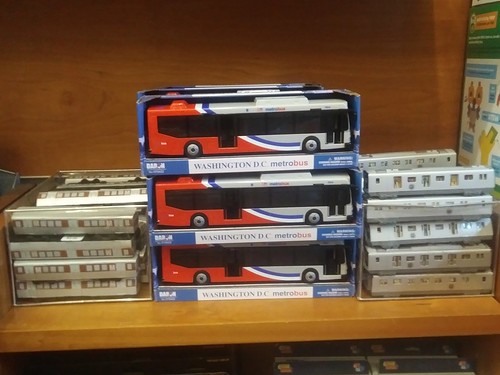
WMATA train car and Metrobus toys
Anyway, by and large, the proposed changes are excellent:
  • changing Yellow Line service to Fort Totten all the time
  • reducing the price of the 7-day bus pass
  • adding free bus service to the 7-day rail pass
  • a flat Metrorail fare of $2 for weekends (which is kind of like something I've suggested in the pass, based on special evening and/or weekend fare programs in Melbourne, Hamburg, and Montreal)
One I am indifferent to:
  • making all Red Line trains end at Glenmont
And one I have serious reservations about:
  • expand weekday peak service times, changing the hours of peak service to 5am to 10am -- 30 additional minutes -- in the a.m. and from 3pm to 8:30 pm in the evening -- 90 additional minutes.
1. It's not that I don't favor more frequent service.

2.  It's that in the past, WMATA has charged peak service fares during these time periods, while at the "shoulders" of each period providing less than frequent service.

3.  Charging more for less service is unreasonable.

4.  For WMATA to add peak service fares, by extending rush periods in the morning and evening, they should be required to guarantee they will provide additional service.

Labels: , , , , , , ,

Thursday, May 17, 2018

DC proposes ride hailing tax of 6%: It's not enough--car share users pay 10%

The Washington Post reports that DC ("D.C. Council would hike tax on Uber and Lyft more than Mayor Bowser"), like other cities are considering or have instituted ("Council Passes Ride-Share Tax to Fund Transit, CTA Announces $23M in Cuts, Reforms," Streetsblog Chicago; "Uber, Lyft taxi rides into Manhattan get slapped with a new surcharge," The Drive) a tax on ride hailing. 

DC charges a "gross receipts tax" of 1% on these services now.  This is not a per trip tax.  The Mayor proposed a raise to 4.75%, while the City Council is aiming for a 6% tax.

It's reasonable to regulate and tax to shape more desirable outcomes. Ride hailing imposes costs on transit by capturing riders, and also increases traffic congestion.

-- "When Calling an Uber Can Pay Off for Cities and States," New York Times
-- "The false promise of ride hailing as a pro-city transportation mode," 2018
-- "Public fees/taxes/charges on ride hailing trips," 2018

As new mobility services come into play, taxation and regulation may vary compared to legacy services, often in ways that are seemingly less fair to users of the new modes.

DC imposes higher taxes on car share users.  For example, as a car share user in DC, it seems unfair that each trip comes with a 10% local tax charge when we are already paying a good chunk of the minute or hourly use fees indirectly to the city for licensing and access to street parking.

By comparison, DC car owners pay a minimal annual registration fee (from $72 to $155, depending on the weight of the car) and if they live in an area of the city requiring residential parking permits, a $35/year fee.

-- "Car share users are getting abused by the cities that ostensibly support car sharing as a form of sustainable mobility," 2016

Considering the impact of ride hailing services on transit and congestion, of course the rides should be taxed.  And they shouldn't be taxed at a rate less than what car share users are forced to pay, when research shows that each car in a car sharing system ends up "removing" 7 to 11 cars, thereby reducing demand on parking inventory, rather than increasing demand for road space, like ride hailing.

Labels: , , , , ,

Monday, February 19, 2018

What can Suburban Atlanta and Greater Detroit learn from Virginia's Fairfax and Loudoun Counties

Detroit area transit planning.  I have been meaning to write about the initiative in Greater Detroit, after a failed referendum in 2016, to create a multi-county transit district. 

The QLine streetcar on Woodward Avenue passes under the People Mover near Grand Circus Park.  Photo: David Guralnick, Detroit News.

Besides various bus services in the region, which includes Washtenaw County where the University of Michigan is located, to boost support for transit, Detroit has a people mover system ("Making the case for intra-city (vs. inter-city) transit planning," 2011) and a recently opened streetcar on Woodward Avenue which I have not written about at all, but is very interesting because much of the funding for it came from local foundations ("Detroit charts a public-private path to its future, with streetcars," Christian Science Monitor).

(Note that a lot of the pundit discussion--do a Google article search--on the Detroit streetcar is pretty flawed, calling it a failure. In fact, flawed discussion of transit in Detroit and generally on intra-district vs. inter-city scales spurred me to write the intra-city transit piece in the first place.)
I-75_congestion, Oakland County
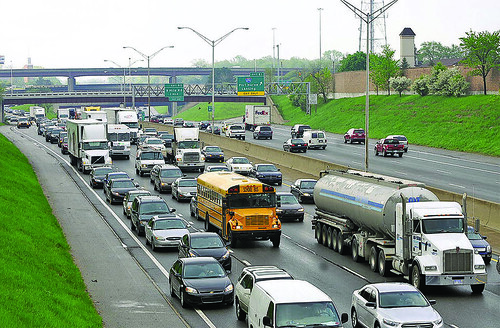
I-75 in Oakland County, Michigan.  Photo: Crain's Detroit Business, "I-75 plan opens transportation rift: Business planners, mass transit backers differ on 20-year freeway widening project." Circa 2003, Oakland County Executive Patterson kicked the City of Ferndale out of the county's Main Street commercial district revitalization program because the city opposed the widening of I-75.


After seeing a headline of a story ("Hackel: Let's not rush to create "obsolete" regional transit in southeast Michigan," Michigan Public Radio) quoting Macomb County Executive Mark Hackel (his brother, now a judge lived across the hall from me my sophomore year in college), I was thinking that in a situation where your transit system is mostly going to focus on bus service, what should a 21st century bus system look like? In short, Mr. Hackel was making a reasonable point.

Nevertheless, his thinking is flawed because he's still thinking individual mobility and cars instead of sustainable mobility and transportation system management.  From the article:
Macomb County Executive Mark Hackel says there’s no reason to build any system that relies on buses, suggesting those systems will soon be “obsolete.”
Instead, Hackel favors letting the auto industry and its new technology, especially autonomous vehicle developments, lead the way.
What should a 21st century bus-based transit system look like?

Cars are inefficient consumers of space.  Mobility systems focused on personal mobility conveyance--a car like vehicle--won't have much impact on congestion and will in fact create more congestion because they increase personal vehicle miles traveled and reduce the use of mass transit ("Your Uber Car Creates Congestion. Should You Pay a Fee to Ride," New York Times)

But bus rapid transit lines and system service redesigns aren't always game changers.  Concerning the design of a design forward bus-based system, I think it's fair to say despite what people argue, bus (rapid transit) vehicles "designed to look like trains" and high quality bus shelters are no longer enough to reposition bus service as a premium service in a mobility paradigm that preferences automobility ("Improving bus service overall vs. reversing falling Metrobus ridership," 2018), especially in a region like Detroit, which is the most automobilized of any US metropolitan area other than California and Texas.

Perhaps the way to think about it is that BRT programs and schedule and footprint reconfigurations only accomplish so much in terms of adding riders.

According to the designers, Studio Hill Design Ltd., the bus livery and typefaces chosen for the ART -- Albuquerque Rapid Transit -- bus line reference 1950s styles in an aim to reference the design of buildings along Route 66.

... even though BRT systems in Albuquerque (ART), Cleveland (HealthLine), Connecticut, and Mississauga (Mi-Way) are a quantum leap forward in design and operation compared to the legacy bus systems that serve most communities.

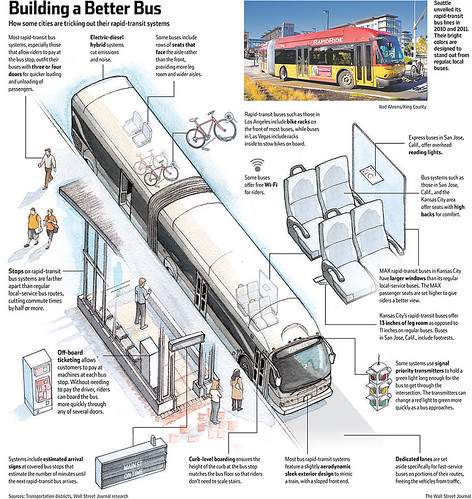
Building a better bus, graphicWall Street Journal graphic.

I have outlined many of the issues with bus-based systems in these entries:

-- "Making bus service sexy and more equitable," 2012
-- "Will buses ever be cool? Boston versus the Raleigh-Durham's GoTransit Model," 2017
-- "Route 7 BRT proposal communicates the reality that the DC area doesn't adequately conduct transportation planning at the metropolitan-scale," 2016
-- "Thinking systematically about bus transit service improvements: spurred by Columbia SC, Edmonton AB, and Baltimore," 2017
-- "Takoma Langley Crossroads Transit Center: a critical evaluation," 2016.

To work, a transit system needs to be anchored by the development of a transit-first land use and transportation planning paradigm:

-- "Comments on Proposed EYA Development at Takoma Metro Station, Washington DC," 2006

and operationalized through what I first called the mobility shed and transit shed but now call the sustainability mobility platform, including microtransit, car sharing, and other types of services:

-- "Updating the mobility shed concept," 2008
-- "Free access to cargo bikes/e-cargo bikes as part of a mobility hub/sustainable mobility platform," 2017
-- Car share users are getting abused by the cities that ostensibly support car sharing as a form of sustainable mobility," 2016

Still mulling over Detroit, I saw more articles ("Patterson speech draws line in the sand between suburban counties and Detroit" and "Leave Brooks Patterson, Oakland County out of regional transit plans," Detroit Free Press) about how communities in Northern Oakland County (see "The rise of Oakland County is built upon Detroit's fall," 2014) aren't interested in participating.  (And I remember the story that made national news a couple years ago about a guy in Detroit using transit and walking more than 20 miles each day to get to and from his job in Oakland County, because of lack of an integrated transit system in Wayne and Oakland Counties.)

Atlanta.  A similar conversation has been occurring in Metropolitan Atlanta for all of the decade. After a failed transportation referendum in 2012 ("Failure of the transit-roads sales tax measure in Metro Atlanta"), the region continues to grapple with the need for transit/congestion management and how to go about accomplishing it, with the same kinds of animus and fear in the Detroit area about race and the center city vis a vis the suburbs. Atlanta though has heavy rail through the MARTA system, but its potential has always been crippled by the fact that Cobb and Gwinnett Counties opted out of the system from the very beginning.
More recently, the transit system has been successful at engaging these counties, although Keith Parker, the general manager who pulled off this wizardry, last year left the system for another job ("Keith Parker puts us back on track," Atlanta Magazine; "MARTA GM: 'Build, connect, innovate taps bright future," Marietta Daily Journal).

AJC photo of a MARTA train.

However, the recruitment of large business headquarters operations to Atlanta and/or MARTA-adjacent locations, and the talk that Atlanta is out of consideration for landing Amazon's HQ2 because so much of the metropolitan area isn't served by heavy rail -- means that the counties with limited transit service are reconsidering the car-centric approach.

Like with Northern Oakland County, some Northern communities in Fulton County seem to want to opt out even in the face of being less able to attract businesses going forward ("The issue: what is the right solution for North Fulton transit?," Atlanta Journal-Constitution), and despite the fact that the county passed a sales tax for transit and transportation improvements. From the article:
Johns Creek Mayor Mike Bodker said the only sensible choice to handle congestion and avert high-density development “is one that does not involve the investment in light or heavy rail.” Bodker also was skeptical of the improved bus service.

Newly elected Roswell Mayor Lori Henry said bus rapid transit would worsen congestion on Roswell Road, and a right-of-way for buses was nonexistent on Holcomb Bridge.
The statements appear to be counter to our understandings about transit and the impact on congestion (when you have the right density and tight links between activity centers and residential areas). I mean, in a big city like Washington, I can "Idaho Stop" through major intersections at rush hour--because both the urban design of the city and the heavy rail anchored transit system captures a significant amount of the mobility demand--within the city 57% of people get to work by transit, walking, and biking.
Atlanta, Interstate 75
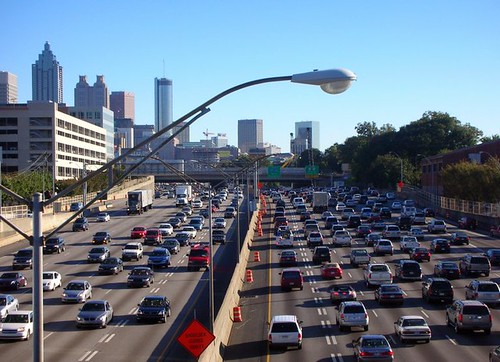
Interstate 75, Atlanta. Photographer unknown.

And certainly, the Atlanta method of having highways with as many as 24 lanes is not reducing congestion.  (The Detroit area too is focused on freeway widening rather than sustainable mobility.  See "MDOT: I-94 expansion will cost $3 billion through 2036," Crain's Detroit Business).

Northern Virginia. I think Northern Virginia's heavy rail extension of the Silver Line is a particularly relevant example to both Detroit and Atlanta, although Detroit's situation is different as they have limited recent experience with rail transit, while Greater Atlanta has MARTA even if many counties are not served by it.

It's really hard to lay the groundwork for moving to a transit centric or transit balanced mobility paradigm when your metropolitan area is car-centric. 

Even in areas with a great deal of experience with transit, such as the Washington area, development of new methods and modes such as streetcar and light rail, can be incredibly contentious.

The Silver Line expansion.  I am particularly proud of a piece I wrote about this in 2011, "Short term vs. long term thinking: transit, the Washington Examiner, Fairfax/Loudoun Counties vs. DC," because of its fundamental insight that the Silver Line heavy rail "extension to Dulles Airport" wasn't so much about providing airport access as it was repositioning and "reproducing" land use in the 21st Century around transit and more intensified land use (also see "Without the right planning "controls" you can't stop change: Loudoun County and rail service in Northern Virginia").

However, the difficulty of the applicability of the Silver Line example has to do with the fact that it is an example of polycentric transit system development in the arguments of Steve Belmont in Cities in Full--a five mile distance between many of the stations means that you don't get the same kind of intensification compared to places with a denser network of transit stations.

But it becomes transit adjacent and way more "transit rich" than places without fixed rail transit systems. 

And the way that Fairfax County's office market is being reshaped, away from car-centric office parks to transit-adjacent locations is a demonstration of the change in preference for such locations ("Silver Line reshaping office market in Fairfax County").

The real question is: what should metropolitan mobility look like in the 21st century?  Both Atlanta and Detroit need to work through that question.

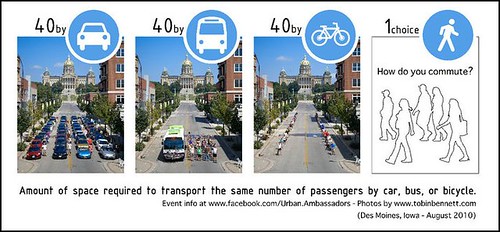
The space demands of automobility are significantly greater than sustainable modes.
Amount of space required to transport the user the same number of passengers by car, bus, or bicycle

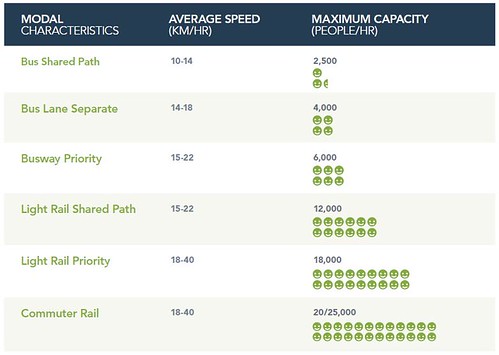
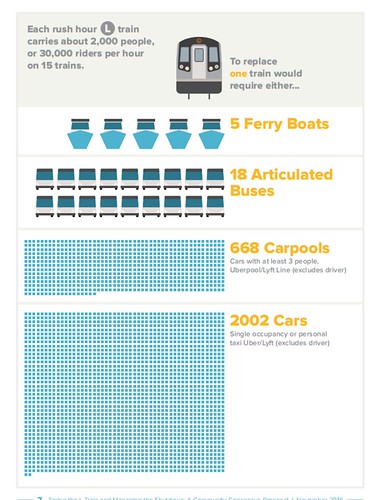
Mass transit moves significantly more people per lane of traffic.  Maximum motor vehicle throughput on a freeway is 2,200 vehicles/hour.  It's significantly less on arterials in suburbs and cities.
Transit Mode Capacity diagram, Auckland Transit study
Image from an Auckland transit planning process.

Transit in New York City moves great numbers of people. (Image: Regional Plan Association.)
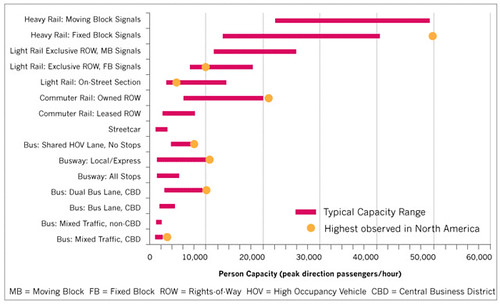
Capacity of different transit modes

Person-capacity ranges for various transit modes.
person-capacity ranges for various transit modes
Adapted from TCRP Report #100: Transit Capacity and Quality of Service Manual – 2nd Edition, 2003, pages 1-21

Despite all the talk about autonomous vehicles, etc., I think mass transit of various sorts, complemented by microtransit and other forms of sustainable mobility, makes the most sense in terms of moving lots of people.

It won't work though if activity isn't concentrated.

As far as autonomous vehicles are concerned, eventually they can make microtransit and what I call tertiary transit subnetworks--intra-neighborhood and intra-district transit based around transit station hubs--much more realizable by reducing labor costs.

But people aren't thinking things through about autonomous vehicles and personal trips.  Just because you need less space to park cars, because autonomous vehicles can be used throughout the day, doesn't mean that vehicle miles traveled is reduced, it may in fact, increase.  So that means no substantive reduction in vehicle trips, in congestion, in road lanes required, etc.

=====

Note that while many major corporations are locating near transit in Greater Atlanta, the Atlanta Braves chose to relocate to a location in the Cumberland District of Cobb County, which has no substantive transit connections ("The Braves' New Ballpark Is An Urban Planner's Nightmare," Deadspin).
.

Labels: , , , , , , ,

Tuesday, November 08, 2016

A few transit referenda I'm watching

I've taken on a new project so it's hard to find time to write about everything I'd like to be blogging about, including even national politics or the latest issues with WMATA, as well as testimonies and other submissions.

But we can't avoid today's election.  IN San Francisco, to encourage voting, the Zipcar car sharing service is offering free reservations for this evening, from 6pm to 10pm ("Zipcar offers free vehicles in Bay Area to get out the vote," San Francisco Chronicle).

According to the American Public Transportation Association,  there are 45 transit ballot proposals across the country, with a total spend of $200 billion. NPR ("On November Ballots: $200 Billion For Transit, Roads, Buses") and the Center for Transportation Excellence cover the transit "all" of the measures.  These are the ones that interest me.

1591 MTA Expo Line Santa Monica Sta 20160513 AKWLA MTA Flickr photo.

- Measure M in Los Angeles County is a transit expansion program which would authorize an increase in sales taxes and an indefinite extension of the current dedicated sales tax.  It requires a supermajority so it is very difficult to pass.   (It has failed once already.)

Some parts of the County feel they will be disserved by the program, so the vote may not succeed.

-- "Why these southeast L.A. cities are banding together to fight Measure M, the transportation tax," Los Angeles Times

Recent expansions, especially to Santa Monica, have given the agency even more visibility recently. The "subway to the sea" extension is adding significantly to ridership.

- Sound Transit 3 in the Puget Sound provides for expansion of transit there, mostly light rail, but also streetcar, rapid bus, and other transportation improvements.  They are coming off a "high," recent light rail expansions, especially within Seattle, have led to a doubling of light rail ridership.

New Link Rail stations have large scale public art works.  Capitol Hill Station, Sound Transit photo.

But even with the success, people criticized the agency for expensive publicity activities around the expansions, and the local newspaper tends to be not as pro-Growth Machine when it comes to taxes, unlike most other newspapers, which understand the value of rail transit to real estate development, which is the primary economic engine at the city-county scale (cf. "Developers are building more around Metro" and "Metrorail's true value could lead to a badly needed funding fix," Washington Post).

-- "Sound Transit puts $54 billion light-rail plan on ballot," Seattle Times
-- "Reject Sound Transit 3 and demand a better plan," Seattle Times

It is a multi-jurisdictional ballot measure, so it is harder to pass, because some of the areas such as Seattle, are much more transit-positive than other areas.

- Measure RR in the San Francisco Bay would pay for rehabilitation -- not expansion -- for the Bay Area Rapid Transit commuter rail-subway system.  It's noteworthy because it's a repair "bond," and is situationally comparable to the financial needs of the Washington area's Metrorail system, where because it is multi-state, it's much harder to take similar action.  It also requires a supermajority for passage.

-- "Yes on Measure RR: The Bay Area can't work without BART, San Francisco Chronicle
-- "BART's future on line: Can transit system gain voters' trust?," San Francisco Chronicle
-- "Past decisions haunt BART as it seeks voter OK for $3.5 billion bond," San Francisco Chronicle
-- "Vote no on Measure RR: $3.5 billion BART infrastructure bond," San Francisco Chronicle

Interestingly, like here, some question whether the agency has the capacity to carry out the proposed program ("Politicians, citizens doubt Measure RR can fix BART," KGO-TV/CBS

- Proposition J in San Francisco would dedicate funds to transit improvement -- many people in San Francisco complain that the city's Municipal Transit Agency, because it generates revenue, is saddled with other programs and costs that aren't fully related to the agency's mission.

But the ballot measure includes funding for homelessness, and another measure, Proposition L, calls for more involvement in the MTA by the Board of Supervisors.

- Wake County, North Carolina transit sales tax.  I have been meaning to write about how the transit agencies in the Raleigh-Durham region are developing an incredibly intricate "integration" program where the individual agencies are still independent but increasingly coordinated.  They are a national model of best practice that needs to be closely considered by other metropolitan areas.

For example, all but one of the agencies uses the same branding program ("Go Transit" and a shared graphic communications framework, with different colors adopted by the different agencies), with mostly integrated fare media including a multi-agency pass system, A SINGLE CALL CENTER PROVIDING CUSTOMER SERVICE FOR ALL OF THE TRANSIT AGENCIES, and transportation demand management initiatives organized under the same branding system.
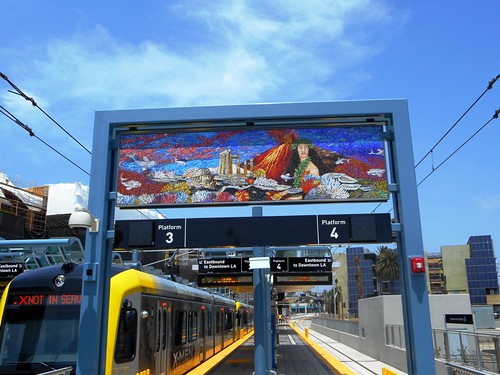
They have a transit referendum on the ballot to fund various projects ("Wake adopts transit plan, will seek voter approval of half-cent sales tax," Raleigh News & Observer). Given the bifurcated nature of politics in the State of North Carolina these days, it will be interesting to see what happens with this measure, and other election results there.

-- Detroit area transit referendum. Detroit used to control a regional streetcar system, but the system was shuttered over time, as the automobile reigned supreme in the local mobility paradigm. Detroit and the counties ran their own transit systems, with the counties especially Oakland seeing transit as something for poor people, and not wanting to fund transit as a way to keep Detroiters from moving there.

But over the past couple years the State Government has forced the consolidation of transit services through the creation of regional transit agencies and funding referenda.

While putting a measure on the ballot failed initially ("Plan for Metro Detroit transit millage fails," Detroit News), it made it eventually, after various machinations focused on placating Oakland and Macomb County ("Metro Detroit will get to vote on transit funding after all," Michigan Radio/NPR). Hopefully those compromises won't make for a bad process.

While for all intents and purposes, Washtenaw County, with progressive Ann Arbor and an existing transit service anchored by Ann Arbor, is not super integrated with the "Detroit area"--Wayne, Oakland, and Macomb County--it was forced to be integrated with the other counties.  This might help the measure pass.

Separately, Detroit is readying a new streetcar line on Woodward Avenue ("First M-1 Rail streetcar arrives in Detroit," Crain's Detroit Business) scheduled for service next year, and already has a intra-city People Mover system Downtown ("Making the case for intra-city transit planning").

====
Other election matters are also very interesting and terrifying. I have a couple of half written pieces about that. Of course, the national election, what will happen with the Senate, whether or not Democrats will pick up seats in the House of Representative. Whether people like John Mica will stay in office or L. Brooks Patterson, County Executive in Oakland County, Michigan, and some other ballot measures here and there.

We will know tomorrow and throughout the week.

Labels: , , , ,

Friday, October 28, 2016

Why doesn't WMATA monetize air rights of station entrances?

I could write a long post about this but it isn't really necessary.  There are a number of instances where Metrorail station entrances abut buildings, but for whatever reason it doesn't appear as if WMATA was at all interested in entertaining offers for incorporating the air rights above the space into the adjoining project.

There are a couple exceptions, involving public projects.  The Washington Convention Center rises over the Mount Vernon Metrorail Station on 7th Street.  So does the Park Place Apartment Building on the west side of the Georgia Avenue-Petworth Metrorail station.  The latter project was built on land formerly owned by WMATA.

U Street Metrorail Station entrance, 1200 block. Image from Google Maps.

By contrast, station entrances on U Street, on 7th Street at S Street NW, 8th and P Street NW, and in Columbia Heights, are distinctly separate from the private buildings constructed adjacent to the respective stations.

In each of these instances, had the air rights been incorporated, not only could WMATA generate additional revenue from a long term lease of the air rights, but the city would generate more revenues in property taxes, commercial and personal income taxes (from employees or residents) and sales tax (from retail spaces) and depending on the nature of the project, could accommodate more residents.

Park Place Apartments.  The west side station entrance is at the far right of the photo, in the "black section" to the left of the farthest right section of the building.

The entrances would also be weather protected, like the one at the Park Place Apartments, were they incorporated into buildings.

For example the block around the 8th and P Street NW entrance is comprised of affordable housing, and had the Metro station air rights been incorporated into the current project, more housing could have been provided.

7th and S Streets NW entrance to the Metrorail station
Building at the 7th Street NW-Shaw Metrorail station, 7th Street NW

Channing Phillips apartments, including a newly constructed section, on 7th Street NW across from the Watha T. Daniel Public Library and adjacent to the P Street station entrance in the upper left of the photo.
New construction apartments, Channing Phillips Building, 7th Street NW, Shaw neighborhood, DC

Flickr image of the Highland Park Apartments at 14th and Irving Streets NW by Alice Crain.
Highland Park Apartments at Columbia Heights Metro

Labels: , , ,

Saturday, October 22, 2016

Seattle Times special feature on Sound Transit/Puget Sound transit tax referendum

One of 2016's major transportation stories is how the short extension of the Link light rail line in Seattle to Capitol Hill and the University of Washington has resulted in a doubling of light rail ridership there, from around 30,000 daily riders, to more than 60,000 daily riders.

It's proof that with the right conditions of density and in-demand destinations, transit service can be very effective.

This fall, Sound Transit has a big tax referendum, called Sound Transit 3 (ST3) on the ballot to continue the expansion of the transit system, primarily beyond Seattle.

The Seattle Times, not known for its support of tax referenda, has a nice graphically-oriented feature on the referendum, with a map of the system and the proposed extensions, information on cost and revenue sources, a listing of pros and cons (not particularly deep) and related articles.

-- ST3: What you'd pay, what you'd get, Seattle Times

The feature is a good model for how government agencies of all types--not just transit agencies--might want to up their game in terms of communicating about tax proposals, benefits, costs, etc.

Although Sound Transit has produced a very good website related to the referendum on their own.

-- Sound Transit 3 referendum webpage

Although were it produced by a government agency, rather than a newspaper, I'd also include live links to more information for each of the sections.  Which is what the ST3 website does do.

Labels: , ,

Saturday, February 13, 2016

In 2009 I wrote that WMATA's regulatory oversight needed to be significantly improved, US DOT says the same in 2016

After the Fort Totten crash in 2009, which resulted in 9 deaths and many injuries, reported first by the Frederick News-Post, it was determined that the crash resulted from the inter-mixing of signaling equipment from different vendors--the equipment wasn't guaranteed for inter-operability.

It turns out that decades before, the BART system in the San Francisco Bay region had similar problems, but because of safety regulation by the California Public Utilities Commission, it was addressed, and redundant safety controls were implemented within the signaling system.

The Post also reported on the Tri-State Safety Committee, a regulatory body with no enforcement authority, which was created by DC, Maryland, and Virginia to oversee Metrorail.

In 2009, I suggested that to build accountability into the regulatory and oversight process for Metrorail, DC, Maryland, and Virginia merely had to come together and invest regulatory authority into the TSSC.

See "Missing the real issue about WMATA," July 27, 2009, and "Will nine deaths lead to a better governance, oversight, and management system for WMATA? Or not?," August 11, 2009.

They didn't.  And earlier this week, the US Department of Transportation said it would begin withholding a portion of funding to WMATA until the lack of regulatory oversight was corrected ("Federal funding for D.C., Va., Md. at risk due to lack of progress on Metro oversight," Washington Post).

From this week's Post article:
Late last year, Foxx transferred safety oversight of Metro’s rail operations to the FTA with the understanding that it would be temporary — until the three jurisdictions could develop a compact to create an oversight agency. The move was made after federal officials determined that the agency charged with the task, the Tri-State Oversight Committee (TOC), was woefully inadequate for the job.

But Foxx said federal officials recently learned from the Metropolitan Washington Council of Governments that the jurisdictions “do not expect to pursue final legislative action in 2016” to establish a safety oversight agency.

“This news was unexpected and disappointing,” Foxx wrote in the letter. ...

Some of the region’s leaders said Monday that they are taking steps to move Metro to a culture of safety but that they, too, are frustrated with the situation — and with the U.S. Transportation Department for pointing the finger at the District, Maryland and Virginia when the federal government also has a seat at the table to help solve Metro’s problems.

“While the nation awaits the FTA’s rules on state safety oversight entities, [the Washington Metropolitan Area Transit Authority] has an oversight structure in their board of directors where the federal government can actually be helpful,” Bowser spokesman Michael Czin said. “Unfortunately, the federal government’s appointees, including the previous chairman, were obstacles to reform in 2015.”
As discussed in the reprints below, these issues date most recently to 2009, but clearly had been present earlier, and long before the Federal Government received the authority to appoint board members in 2010 ("GSA Appoints Director and Alternate Director to Metro Board," press release), and in any case, it is DC, Maryland and Virginia that are empowered to act to cure the defect of lack of regulatory oversight at the state/multi-state scale, not the federal government, which only stepped in recently because of a failure to act by the states in the face of continuing problems.

-- State Safety Oversight Program, Federal Transit Administration
-- Rail Transit Safety Action Plan, Federal Transit Administration, 2006.  From the document:

Top Ten Priorities
The following priorities have been identified for FTA’s Safety Action Plan:
• Priority Number 1: Reducing Collisions with Other Vehicles
• Priority Number 2: Reducing Collisions with Pedestrians and Trespassers
• Priority Number 3: Improving Compliance with Operating and Maintenance Rules
• Priority Number 4: Reducing the Impacts of Fatigue on Transit Workers
• Priority Number 5: Reducing Unsafe Acts by Passengers in Transit Stations
• Priority Number 6: Improving Safety of Transit Workers
• Priority Number 7: Improving Safety for Passengers with Disabilities
• Priority Number 8: Removing Debris from Tracks and Stations
• Priority Number 9: Improving Emergency Response Procedures
• Priority Number 10: Improving Safety Data Acquisition and Analysis

======
Reprint from Will nine deaths lead to a better governance, oversight, and management system for WMATA? Or not?, August 11, 2009

A few weeks ago I wrote an entry commenting that the focus on WMATA not having a dedicated funding stream misses the real point about overall governance, management, and oversight.

The fact that BART in the San Francisco Bay region is overseen by the California Public Utilities Commission, while WMATA has no real regulatory oversight is troubling.

The Post editorializes about this today, in "Unsafe, Unaware, Unscrutinized: Is Metro's lack of effective oversight contributing to its safety problems," in response to Sunday's article about the equivalent of a voluntary oversight board with no authority, the Tri-State Oversight Committee, in the Sunday paper, "Subway Safety Panel Foiled by Constraints: 12-Year-Old Oversight Committee Has Little Influence."

It might not be so bad if absolute excellence was demanded throughout the organization. It's not.

I think it's clear that getting rid of the engineering and construction people (partly in 2003, and then after the current General Manager came on board, see "Metro to Cut Construction Staff to Help Close Budget Gap" from March 2007 and "Improved Safety and Service Are Focus of Reorganization, Chief Says" from April 2007, from the Post) likely has removed a level of expertise within the organization concerning rail operations.

Recent failures in the S-Bahn system in Berlin--none of the failures led to casualties!!!!--resulted in wholesale change in the management of the transit system. See "Safety Issues Ground Hundreds Of Berlin S-Bahn Trains" from the German radio network NDR. From the story:
The executive management of S-Bahn Berlin was asked to resign this past week: included among the casualties are Tobias Heinemann (chief officer), Thomas Prechtl (head of finance), Olaf Hagenauer (personal director) and just recently hired technical director Peter Büsing.

Allegedly the company ignored a safety directive issued by the EBA, the German equivalent of the U.S. [Federal Railroad Administration], after the May 1st incident in Berlin-Kaulsdorf station. The EBA required that the company perform a repetitive inspection of all wheels of similar design as the failed wheel every seven days. The company assured the EBA that it would comply with the new safety directive, but an audit by the EBA on the 29th of June determined that the company had mostly ignored the safety directive.
The problems with WMATA have led Maryland's MTA to back off from saying that the Purple Line would be integrated into the WMATA transit system and managed and operated by WMATA after it is constructed. See the Dr. Gridlock column from Sunday, "Purple Line and Metro: Will They Work Together?," versus the letter from then Maryland Secretary of Transportation Porcari to the Town of Chevy Chase from May 2008 , which stated:
2. The fare and transfer policy for this corridor has not yet been established. The MTA views the Purple Line and Metrorail system as part of an overall system of transit service in the Washington area. Future policies, should the Purple Line be constructed, are expected to reflect that view and include the use of modern fare collections methods such as Smartcards. Therefore, the report’s assertion regarding full transit fares for both systems in calculating the cost of a transfer is a policy decision that cannot be assumed;
which can be construed to imply that WMATA would end up integrating this light rail line into its transit system, comparable to how after the Dulles corridor (Silver Line) extension is constructed not by WMATA but by the State of Virginia it will be integrated into the WMATA subway system.

Not now, or at least not while WMATA's management capabilities are called into question. (And remember the concerns expressed by the Federal Transit Administration over the expansion of the system via the Silver Line, versus WMATA focusing on current operations, "Feds Slam Dulles Rail Project" from the Dr. Gridlock Get There blog.)
=======
Reprint: Missing the real issue about WMATA, July 27, 2009

The Washington Post editorialized, in "A Broken Metro‎," once again about how all of the Washington Metropolitan Area Transit Authority's problems have to do with the lack of a dedicated funding stream.

Nothing could be further from the truth, as the newspaper's own reporting ought to be communicating to us.

Here are the issues with WMATA:

- general vision and leadership
- the governance structure (members appointed to the board by the various jurisdictions that are members of the WMATA Compact--but too many of them have overly constrained worldviews about what they are doing and who they truly represent)
- the lack of a real system of regulatory oversight*
- funding of current operational deficits**
- funding of capital improvements***
- management of the organization
- operation of the organization
- how the organization treats and serves riders.

* The article in the Post about how BART has a redundant train control system to ensure that all trains are accounted for on the system at all times off-handedly mentioned that BART is under the oversight of the California Public Utilities Commission. See "Sister Transit System Took Steps to Counter Hazard: BART Saw Circuit Problem At Center of Metro Probe."

From the article:
Shortly after BART started operating in 1972, it installed a backup system. Initial tests of the main train protection system failed to detect the presence of a train in a few instances, according to Mike Healey, a longtime BART spokesman who retired in 2005. A subsequent 1972 BART accident involving a train that mistakenly received a command to double its speed instead of slowing down, sending the train off track and into a parking lot, was the catalyst "to have some redundancy to back up the primary train protection system," Healey said...

Willard Wattenburg, an electrical engineer and inventor retired from the University of California at Berkeley, said intermittent failures were frequent on BART in the early 1970s. Wattenburg analyzed BART's initial design for the California Public Utilities Commission, which regulates transit systems, and crafted some corrections. BART officials at the time said the failures were flukes, but regulators insisted on the design changes.
This used to be the case for the old streetcar system, which was overseen by the DC Public Service Commission.

There needs to be a joint [regulatory] commission, with appointees from DC, MD, and VA, to oversee the system and ensure that it meets the highest operational[-safety] standards.

** Dedicated funding is important but is more focused on managing annual operating budgets. The cost of providing transit is greater than farebox and other revenues. Therefore, funds are provided by the member jurisdictions of the WMATA "Compact" to make up the difference.

*** While the annual appropriations include some money for capital improvements, it's never enough, especially when it comes to system expansion, or replacing large amounts of rolling stock.

Dedicated funding gets at just a little bit of the issues that are in play with WMATA generally.

We can argue that the accident is an indicator of a far bigger systems failure than the circuit system.

That's what we should be coming to realize as we are learning about the systematic failures of this system and the neglect of dealing with it--something that predates General Manager John Catoe.

See "Investigators: Metro equipment at crash problematic for 18 months," "Investigators examining glitches around system" AND ESPECIALLY THIS STORY "Metro operator: Recent crash failure echoes 2005 near-miss" from the Examiner.

Labels: , , , , , , ,