"A community’s physical form, rather than its land uses, is its most intrinsic and enduring characteristic." [Katz, EPA] This blog focuses on place and placemaking and all that makes it work--historic preservation, urban design, transportation, asset-based community development, arts & cultural development, commercial district revitalization, tourism & destination development, and quality of life advocacy--along with doses of civic engagement and good governance watchdogging.
Thursday, July 14, 2022
Uber: criminal?
Uber app (many years ago).
Ride hailing has never really made sense as a business. The people who serve as taxi drivers tend to have limited work choices which is why they did/do type of work.
It wasn't particularly remunerative but it paid the bills. But the costs (car, gas, labor, maintenance) were expensive enough that it wasn't a good competitor to public transit.
Uber (and Lyft and others) inserted themselves (intermediaries) between rider and driver to capture a significant portion of the transaction. Making it even less profitable for drivers.
And they lowered the ostensible cost of the trip through venture capital subsidization, driving traditional taxi companies out of business.
Making it easier for them to reduce reimbursement rates to drivers, who had few alternatives since local providers were now out of business.
These firms evaded regulation, but were able to mobilize their customers as advocates and pay for campaigns to support what they were doing, making it difficult for elected and appointed officials to challenge their narrative. (If they even had the understanding to be able to do so, they'd lose. Mostly.)
And they did this at the expense of the success of public transit as well as adding to traffic and congestion even while arguing they did the opposite.
Although one thing that was brilliant from ride hailing was the creation of a unified (inter/)national mass market for "taxi" type trips.
Before the rise of the app you had to know who was the taxi provider in every city and contact them to get a ride, unless you hailed a cab on the street or went to a taxi stand. Plus, without an app it was more sticky and less efficient.
The app even built in payment capabilities. No more finding cash or using your credit or debit card. It was all built in.
With Uber and Lyft, one app worked not only across the US, but in most countries across the globe.
Hailo had an office in the U Street district of DC.
A startup called Hailo tried to do this for taxi companies independently of firms like Uber, but they didn't have the capital and ability to compete--plus many taxi companies were technologically laggard and didn't understand they ought to jump on the Hailo bandwagon.
Superforecasting/Don't Believe the Hype and 1 million robo taxis, Uber/Lyft trips 1/5 the current cost, and the Boring Company's tunnels or "Cities and mass transit versus personal transit"
At a Little Free Library I came across an "Instaread" (like the back in the day "Cliffs Notes" on the book Superforecasting by Tetlock and Gardner, which was quite interesting. While I wouldn't call myself a superforecaster, I do constantly seek new information and experiences to better hone my analysis and understandings as they relate to transportation and urban revitalization.
Coming across some recent "forecasts" by businesses and stock analysts and the general hype that has accompanied them for some time, I just can't believe how much money must be sloshing around in the capital markets, to fund concepts that are not necessarily nonsensical, but are disconnected from "the market" or "how things work" in practice.
As far as cities and transportation go, there are three elements to keep in mind.
First, the road network (miles of roadway and number of lanes) is pretty much fixed (unless you add tunnels). In turn this puts a limit on the number of vehicles which can be accommodated. (Zurich is one of the few cities that takes this to the logical endpoint, by "metering" how many vehicles can enter the city. See , which means that there is only so much capacity for vehicles.
The advantage of a (40 foot_ bus over a car is that while it takes up the space of three cars it carries up to 60+ people while the three cars carry 3-5 people. Heavy rail does even better in dedicated above-ground or underground service, carrying tens of thousands of people per hour.
Various images produced that show people throughput by mode illustrate the point.
This graphic shows corridors, so the "mixed traffic" mode it is referring to is freeway driving, which doesn't correspond to driving within cities, where lane capacity ranges from 600 to 1,500 cars per hour (the latter on fast moving very wide arterials and one way streets), less than a freeway, because there are many more intersections crossing the street.
Second, limited road capacity means that the more cars you have, the fewer number of people you can move through a constrained system.
Ride hailing doesn't substitute for a transit vehicle, which can carry 60 or more people at one time, it substitutes from a single occupant automobile vehicle. It doesn't improve throughput even if it reduces the number of owned cars and the number of cars that are parking in on-street or off-street parking.
The third element concerns market demand, and whether or not there is enough demand to sustain a working business model. Transit/shared vehicle users are clustered in the largest center cities. Most of the rest of the US is car dependent, and people drive a lot and long distances. To get to the point of sustainable market demand may not happen in my lifetime, and hopefully I still have 30+ years to live.
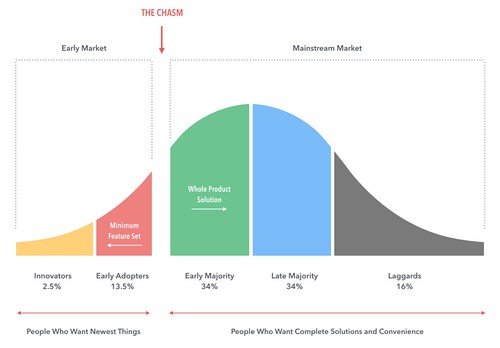
In the book Diffusion of Innovations, Everett Rogers explained the "take up" of new technologies and ways of doing things. It takes some time before the amount of use reaches level that make business operations economic.
Building on this work, Geoffrey Moore has written many books on the trough in business after innovators and early adopters have taken up new technologies, and before late adopters. In the book Crossing the Chasm: Marketing and Selling High-Tech Products to Mainstream Customers he terms this trough, "the chasm." From Wikipedia:
Moore begins with the diffusion of innovations theory from Everett Rogers, and argues there is a chasm between the early adopters of the product (the technology enthusiasts and visionaries) and the early majority (the pragmatists). Moore believes visionaries and pragmatists have very different expectations, and he attempts to explore those differences and suggest techniques to successfully cross the "chasm," including choosing a target market, understanding the whole product concept, positioning the product, building a marketing strategy, choosing the most appropriate distribution channel and pricing.
"Visionaries" include financiers and stock market analysts, and like with Chinese free floating bike share, scooters, and the like, they are "touts," not necessarily independent analysts.
While concepts such as shifting from ownership to fractional use have been around for awhile (e.g., "timeshares") and in sectors now ranging from clothes to travel stays to car sharing substituting for car ownership and taxis, the idea is that the cost of fractional use renting should be less than what one pays to own and/or operate and maintain the items. For some of these markets, they don't need a "mass market," because they can charge premium prices.
Given the present cost structure, for ride hailing to work, people will have to be willing to pay more than the alternatives (transit, car ownership). That's not how you make a mass market.
Note that I think the metrics are off in the CB Insights analysis, but their segmentation of the mobility market by trip length is the way to go. And the headline should be "Disrupting The Car... [in a handful of cities]."
Note that as the cost to purchase an automobile continues to rise, and if capital supporting car leasing shrinks somewhat, the cost curve can shift, for some segments of the market, to ride hailing and other alternatives.
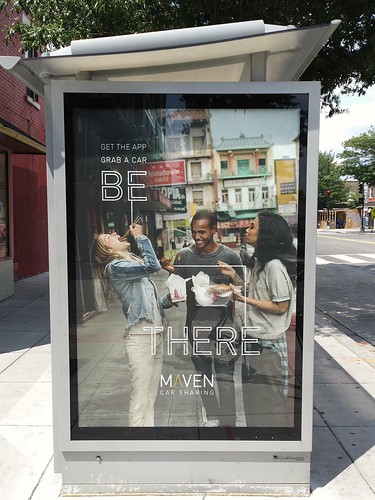
Maven ad in a DC bus shelter.
In the meantime, Uber and Lyft don't forecast moving to profitable operations anytime soon and car sharing companies are merging (BMW and Daimer now jointly operate ShareNow) and GM's Maven has just downsized significantly ("GM's Maven exits show tough road for mobility," Automotive News). From the article:
General Motors and other automakers envision bringing in significant profits from alternative ownership models such as car-sharing and subscription programs. Someday.
But for now, such mobility services are generally big money losers. And executives are increasingly discovering that they don't have the stomachs to let those businesses hemorrhage so much cash while they wait for technology and demand to reach the point where the services help the bottom line instead of hurt it.
GM, after expanding its Maven mobility brand to 17 metropolitan markets in the U.S. and Canada since January 2016, last week announced a "shift in strategy" that included exiting eight U.S. cities to concentrate on areas with "the strongest current demand and growth potential," the company said.
An op-ed in the Financial Times jokingly described venture capitalists funding Uber and Lyft as "transportation philanthropists" since each trip is heavily subsidized and users don't pay the real cost--irrespective of the constant pressure on reducing driver earnings to lower costs. (Although note, Maven is a late entrant to the market.)
Obviously, Elon Musk has to keep up interest in Tesla to stoke the stock. But that doesn't make a market.
Tesla Model 3 in a city setting.
This has two elements. The first is demand for "taxis/ride hailing vehicles." Data I saw from the University of Minnesota said that the base cost for an automated vehicle are likely to be $1 per mile, which doesn't include a profit margin for the operator.
Given the type and number of trips people make and the cost of gas, most people aren't going to find switching from owning a vehicle to paying per use to be cost effective, especially given the average car is driven 12,000 miles/year, and the cost to own and operate a vehicle is about $9,000 year.
Longer suburban trips are going to be more expensive. And cities don't have the road capacity to sustain a switch from transit to the car. As Jane Jacobs said once when asked 'why aren't there enough roads?', she responded "you're asking the wrong question. The right question is why are there so many cars?"
The second is the ability of autonomous vehicles to be used legally. While the demand "for taxi rides" is in the city, the easiest place for AVs to work is on limited access freeways. But AVs are far away from being approved for use in mixed traffic.
UBS says the cost of ride hailing trips will plummet by 80%
According to Business Insider, investment bank UBS, in a research report, claims that in 10 years, ride hailing trip costs will decline by 80% because of robocars, making the trip cost competitive with transit.
I think the important thing is to distinguish between variable trip costs and the additional cost of buying/leasing and maintaining the vehicle.
This article, "Cost-based analysis of autonomous mobility services," from Transport Policy (64:1 2018) argues that driver wages makes up 88% of the cost of a typical trip. Although these costs don't include the overhead of "access to app" charges and profit margins.
And the current model, relying on independent contractors to provide vehicles, offloads the cost of maintaining large vehicle fleets to the drivers.
Irrespective of the cost per trip dropping or not, as discussed above, the transportation system in cities doesn't have the capacity to expand to accommodate significantly more trips by motor vehicle. Taking on that burden will be significant.
But the UBS simulations didn't consider another factor: per trip "sales" taxes.
For example, to encourage sustainably modes, gasoline excise taxes are very high in European countries, and the cost of a gallon of gas ranges from $6 to $8 dollars.
Slap a $5 or more ride tax on what would be a $2 ride hailing trip as a transportation system management fee and we have little to fear.
Boring Company Tunnels
While I do think we need to consider underground tunnels as an option in more places, as a way to shift commuter traffic from city-serving streets:
“It’s a car in a very small tunnel,” Michael McLaughlin, Virginia’s chief of rail transportation, told members of the Commonwealth Transportation Board’s public transit subcommittee...
But as a significant capacity enhancer, mostly Musk is talking about using these tunnels as fast tracks for single cars, or for small shuttles, such as for the project just approved in Las Vegas ("Elon Musk Company To Build Las Vegas People Mover," Engineering News Record).
That doesn't add very much capacity to the transportation system, especially with his idea for connecting the tunnels to the surface through elevators, which will significantly reduce throughput.
How to increase the average hourly pay for ride hailing drivers...
Ride hailing is basically taxi driving but in your own car that isn't painted to look like a taxi, but paying a huge proportion of the fare to the company providing the software application.
Like taxi driving, when you factor in the costs (depreciation, gas, repairs) and the fact that a lot of the time you're on the road without a fare, in the end it doesn't pay that well.
DC charges a "gross receipts tax" of 1% on these services now. This is not a per trip tax. The Mayor proposed a raise to 4.75%, while the City Council is aiming for a 6% tax.
It's reasonable to regulate and tax to shape more desirable outcomes. Ride hailing imposes costs on transit by capturing riders, and also increases traffic congestion.
As new mobility services come into play, taxation and regulation may vary compared to legacy services, often in ways that are seemingly less fair to users of the new modes.
DC imposes higher taxes on car share users. For example, as a car share user in DC, it seems unfair that each trip comes with a 10% local tax charge when we are already paying a good chunk of the minute or hourly use fees indirectly to the city for licensing and access to street parking.
By comparison, DC car owners pay a minimal annual registration fee (from $72 to $155, depending on the weight of the car) and if they live in an area of the city requiring residential parking permits, a $35/year fee.
Considering the impact of ride hailing services on transit and congestion, of course the rides should be taxed. And they shouldn't be taxed at a rate less than what car share users are forced to pay, when research shows that each car in a car sharing system ends up "removing" 7 to 11 cars, thereby reducing demand on parking inventory, rather than increasing demand for road space, like ride hailing.
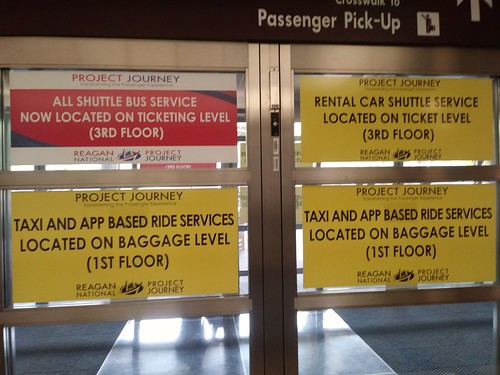
Information about the reorganization of ground transportation service delivery at National Airport, Virginia. National Airport has shifted its shuttle buses to the departures deck of the airport, and ride hailing services are using the "basement" deck use the deck outside of baggage claim.
Chicago, DC and NYC ("When Calling an Uber Can Pay Off for Cities and States," New York Times), and many airports have or are aiming to assess fees on ride hailing services to fund transit and other transportation infrastructure. This comes as research demonstrates that:
1. Use of ride hailing services comes the expense of public transit ("Study: Ride-Sharing Decreases Public Transit Use," Government Technology) and increases the number of car trips made and car trips on the road;
Uber has reacted in Rhode Island, by refusing to serve people at TL Green Airport, in response to the imposition of service fees on ride hailing there ("Life without Uber: T.F. Green passengers adjust to new reality," Providence Journal). The article includes a chart listing the pick up/drop off fees charged to ride hailing services at 15 different airports. From the article:
Other passengers used Lyft, which recently reached an agreement with the airport to have the pickup fee reduced to $5. Or they got into waiting taxis, at double the price of a ride-share vehicle to get to Providence.
The dispute began last summer, when the airport corporation increased the pickup fee from $3 to $6, saying it needed to recoup revenue from rental car fees and long-term parking that had decreased because more people were using ride-sharing companies. Uber cried foul, saying Green’s $6 pickup fee was the highest in the country.
Airport corporation spokesman William J. Fischer countered that since there is no drop-off charge, Green is “right in line” with other airports that charge both ways.
For example: The airport in Orlando charges $5.80 for pickups; Atlanta charges $3.85 for pickups; both airports in Chicago charge $5.50 each way; Detroit, $5.50 each way and Boston’s Logan Airport $3.25 for a pickup.
Interestingly, in Reclaiming our cities and towns: better living with less traffic, David Engwicht argued that there should be additional "taxes" on private automobiles as a kind of "reparations" for the costs they imposed on society including on making public transit less effective.
That's relevant to the concept of imposing additional fees on ride hailing trips, because of how their venture capital subsidized fares--below cost--impose costs on other modes.
Note that this book laid the foundation for creating what we now call "transportation demand management."
The false promise of ride hailing as a pro-city transportation mode
=====
Reprinted from Monday with new date because of the addition of the experience with parking in San Diego. I meant to write about it, but I forgot. It's very interesting.
======
Except for one thing, measurable impact on demand for parking as reported by Ace Parking of San Diego, there really isn't anything new here, as I have written many times about these issues already. But it's nice to sum it up. The SD item is the new #1, and the other points have been renumbered.
In a September email buried deep in an environmental report, Ace Parking CEO John Baumgardner laid out the ugly truth facing the parking business. At San Diego hotels serviced by Ace Parking, overnight parking has declined 5 percent to 10 percent. At restaurant valet stands, business is down 25 percent.
And, most dramatically, nightclub valets are seeing a 50 percent drop off.
Homegrown Ace Parking — one of the largest parking companies in North America and also a fixture in San Diego’s political and business scene — is feeling the impact from Uber and Lyft, the wildly popular ride-sharing services that allow people to leave their cars at home.
For consumers, the bright side may be lower parking prices. In downtown San Diego, city planners are looking at the decline as they update parking guidelines — which could lead to changes in how much future parking is built.
Will parking companies go away? “Is this an existential threat to my business model? Or, is there a way to pivot and continue to provide a necessary service?” said Keith Jones, the third-generation managing partner of the Ace Parking empire, in a recent interview.
Jones likes to talk about “journey management.”
“Ace is hyper-focused on integrating new technology within our parking operations so we help consumers and cars,” he said. “We are pushing the parking and transportation industry to be connected in a way that makes parking smart.”
I like the point about shifting to "journey management."
Drivers make a median hourly profit of $3.37 before taxes, the study found.
The report said that drivers incur a median cost of $0.30 per mile and that nearly a third of drivers incur expenses exceeding their revenue. At tax time, the standard mileage deduction could mean that there is untaxed revenue in the billions of dollars for these drivers.
This shouldn't be a surprise. Taxi driving is mostly resorted to by people with limited options. Having to pay a good chunk of your earnings off the top to the software firms that run the service reduces margins.
Someone who’s interested in driving for any of these on-demand services, but doesn’t own a vehicle, can rent an electric Chevy Bolt through Maven Gig starting at $229-a-week. The weekly price includes insurance, maintenance, and electric vehicle charging. There is no membership fee.
Maven first launched its gig worker product in 2016 in San Diego and San Francisco. Since then, it has been introduced in Los Angeles, Boston, Phoenix, Washington, DC, Baltimore, and Detroit. Maven says its customers have logged 170 million miles driving for various on-demand apps.
What’s different here is how closely Maven says it will be working with the city of Austin to ensure there’s an adequate electric car-charging infrastructure in place for drivers to use this service.
A study by the Boston-based Metropolitan Area Planning Council found 42 percent of trips taken via ride-hailing services in Boston would have been completed on public transit had the option not been available. Another 12 percent of people would have walked or biked. Plus, most people use ride-hailers end-to-end, rather than mixing the service with other modes of transport.
4. Ride hailing use is induced by venture capital subsidies which makes the cost of a ride less than actual cost ("You're not paying enough for Uber," Boston Globe). From the article:
A new study of 944 Boston-area passengers by the Metropolitan Area Planning Council shows that ride-hailing apps are adding to vehicular traffic; people are using them for lots of trips that they otherwise would have made by transit or bike.
This isn’t just happening because Uber and Lyft offer efficient service. It’s because the fares that customers pay don’t come close to covering the ride-hailing companies’ costs — much less the external costs to society of drawing more passenger cars into an already congested road network. ... In 2015, according to one transportation consultant, Uber passengers were paying only 41 percent of the cost of each ride.
7. Transit consultant Jarrett Walker argues that there is less than meets the eye with microtransit ("Microtarnsit: What I think we know," Human Transit blog). The key point is the cost of labor to run a vehicle, and the ratio of passengers to drivers. The fewer the passengers, the more costly the service. He makes the point as I have that microtransit isn't new, in terms of either being an on demand service or contracting it out, and having an app doesn't make scalar changes to the mode.
David Aragon, an operation manager and one of the drivers for Free Ride Everywhere Downtown (FRED) waits at a local apartment building for his next pick up in the downtown area. (Nelvin C. Cepeda / San Diego Union-Tribune).
... speaking of San Diego, I do think there is a place for microtransit along the lines of the FRED e-shuttle operating in the Downtown ("Revisiting stories: FRED Downtown shuttle in San Diego," 2017) and supporting "park once, visit many places" consumption within the district.
Again, not much new, and typical of firms aiming to make a good deal of money from government contracting (like Electronic Data Systems, the firm founded by H. Ross Perot, which had preponderate amount of business from state governments for IT systems).
Location: Salt Lake City, UTAH (UT), United States
I am an urban/commercial district revitalization and transportation/mobility advocate and consultant. I was a principal in BicyclePASS, a bicycle facilities systems integration firm, based in Washington, DC. Now I'm in Salt Lake City for family reasons. Urban economic competitiveness is dependent on efficient transit and mixed use, compact places. Therefore, I end up writing a lot about mobility and urban design. I still own a house in DC, so I write a lot about Washington, DC issues. I try to write so that "universal lessons" are evident in the entries, regardless of the place.
.jpg)