Rebuilding Place in the Urban Space

"A community’s physical form, rather than its land uses, is its most intrinsic and enduring characteristic." [Katz, EPA] This blog focuses on place and placemaking and all that makes it work--historic preservation, urban design, transportation, asset-based community development, arts & cultural development, commercial district revitalization, tourism & destination development, and quality of life advocacy--along with doses of civic engagement and good governance watchdogging.

Thursday, July 14, 2022

Uber: criminal?

Uber app (many years ago).

Ride hailing has never really made sense as a business.  The people who serve as taxi drivers tend to have limited work choices which is why they did/do type of work.

It wasn't particularly remunerative but it paid the bills.  But the costs (car, gas, labor, maintenance) were expensive enough that it wasn't a good competitor to public transit.

Uber (and Lyft and others) inserted themselves (intermediaries) between rider and driver to capture a significant portion of the transaction. Making it even less profitable for drivers.

And they lowered the ostensible cost of the trip through venture capital subsidization, driving traditional taxi companies out of business. 

Making it easier for them to reduce reimbursement rates to drivers, who had few alternatives since local providers were now out of business.

These firms evaded regulation, but were able to mobilize their customers as advocates and pay for campaigns to support what they were doing, making it difficult for elected and appointed officials to challenge their narrative.  (If they even had the understanding to be able to do so, they'd lose. Mostly.)

And they did this at the expense of the success of public transit as well as adding to traffic and congestion even while arguing they did the opposite.

124,000 files from Uber were leaked to the Guardian and they found that "Uber broke laws, duped police and secretly lobbied governments, leak reveals."

It's merely proof for what I had been writing on and off for years.

-- "Misunderstanding Uber, Taxi regulation and what we might call the "Overground Economy"," 2013
-- "App based ride services and creative destruction and plain old destruction," 2014
-- "The false promise of ride hailing as a pro-city transportation mode," 2018
-- "What a terrible idea: deregulating taxi fares in DC for mobile-based hails," 2014
-- "Taxi fares in DC and not planning," 2011
-- "DC and taxis: need for a comprehensive plan,"2012
-- "Taxis," 2011

Although one thing that was brilliant from ride hailing was the creation of a unified (inter/)national mass market for "taxi" type trips.  

Before the rise of the app you had to know who was the taxi provider in every city and contact them to get a ride, unless you hailed a cab on the street or went to a taxi stand. Plus, without an app it was more sticky and less efficient.

The app even built in payment capabilities.  No more finding cash or using your credit or debit card.  It was all built in.

With Uber and Lyft, one app worked not only across the US, but in most countries across the globe.

Hailo had an office in the U Street district of DC.

A startup called Hailo tried to do this for taxi companies independently of firms like Uber, but they didn't have the capital and ability to compete--plus many taxi companies were technologically laggard and didn't understand they ought to jump on the Hailo bandwagon.  

Hailo didn't last long ("Hailo Shuts Down: How Taxi Drivers Sabotaged a Golden Opportunity and Handed Uber and Lyft the Keys," Frommers, 2014).

That's the advantage of "disruptive innovation," you just do it, rather than trying to convince existing firms to join up.

Guardian has many stories based on the leaked documents.

-- "The Uber Files

Labels: , , , , , ,

Tuesday, April 08, 2014

What a terrible idea: deregulating taxi fares in DC for mobile-based hails

=============
Originally posted on April 7th, but significantly revised and reposted on April 8th
=============

See the press release "Grosso and Cheh introduce legislation deregulating fares for taxis dispatched through mobile applications." From the press release:
Last Friday, Councilmember David Grosso (I-At Large) and Councilmember Mary Cheh (D-Ward 3), Chair of the Committee on Transportation & the Environment introduced legislation that makes significant enhancements in safety and consumer protections for mobile dispatch and ridersharing services passengers by mandating them to (1) perform background checks on their drivers; (2) maintain commercial insurance for drivers; and (3) establish and maintain zero-tolerance policies for drugs and alcohol. Additionally, the legislation seeks to enhance fair and equitable competition between Transportation Network Applications Companies (e.g. Lyft and Sidecar), mobile-dispatch services (e.g. Uber and Hailo), and taxicabs by deregulating the fares for taxicabs dispatched through mobile applications.
-- B20-0753: "TRANSPORTATION NETWORK SERVICES INNOVATION ACT OF 2014"
-- past blog entry, App based ride services and creative destruction and plain old destruction
--  past blog entry, Misunderstanding Uber, Taxi regulation and what we might call the "Overground Economy
-- past blog entry, Taxi fares in DC and not planning
-- past blog entry, DC and taxis: need for a comprehensive plan
-- past blog entry, Taxis

Apparently the main impact is to legalize "surge pricing," the Uber practice which raises prices to 6-8 times greater than the standard rate, in times of high market demand.  See "Proposal would allow DC cabs to embrace 'surge pricing'" from the Washington Post.

I think this is a terrible idea for many reasons.

Mobile dispatch services aren't fundamentally different from other types of hails.  Despite all the blather, getting a taxi by using a mobile phone isn't a significantly different process from using a land-line telephone or accessing a webpage by desktop, laptop, or tablet computer.  It doesn't justify offering a deregulated service.  Riders (consumers) deserve the normal common carrier regulatory protections afforded to consumers that come from regulation.

What can be different is the type of car and quality of the service as "car service" is often an upgraded service compared to traditional taxis.  The biggest thing that services like Uber illustrate is that there is room for two types of taxi service, regular and premium.  Traditionally, "black car" or livery services have been available in cities as an upgraded service compared to traditional taxis.

In New York City, taxis aren't dispatched in response to calls, they are exclusively obtained through street hails.  Livery cabs were a response for people who wanted the security of calling for "car service" for a specific trip.  (Now livery cabs can be dispatched through a "street hail" but only at specific livery cab stands.)

Services like Uber "democratize" the availability of upscale taxi or livery services.

The proposal creates unequitable competition not equitable competition: if you're going to deregulate, deregulate everything.  Allowing one form of taxi service to charge a lot more (or theoretically, less) doesn't create an equal playing field, it preferences the under-regulated service. Since taxi companies have to meet the same requirements--insurance, background checks on drivers, etc.--why not just deregulate all the services?  I don't agree with that position, but I don't see any justification for a portion of "taxi and dispatch services" being regulated and another portion being unregulated.

Uber pricing can appear to be arbitrary.   The biggest problem with Uber now is that trip pricing appears arbitrary and capricious both for regular fares (see "The Uber Hangover: That Bar Tab Might Not Be the Only Thing You’ll Regret in the Morning" from New York Magazine) and in times of high market demand, when Uber imposes what they call "surge pricing" which they justify as an inducement for drivers to work. 

From the New York Magazine article "Here’s How Uber Should Fix Its Surge Pricing Problem":
Over the weekend, it snowed in New York, and a lot of New Yorkers tried to take Uber cars home from their night activities. Those New Yorkers got upset when the Uber cars cost seven or eight times as much as normal, because of the company's dynamic "surge pricing" scheme, whereby it gets more drivers to come out on the road during busy times by making rides much more expensive.
What is the justification for stratospheric pricing of rates as much as 8 times normal pricing?  I don't think there is any, other than allowing people to spend money conspicuously (also see "limo surfing").  Note that The Economist Magazine disagrees, see "Free exchange: Pricing the surge," suggesting some changes to how Uber charges drivers, but mostly favoring the idea of surge pricing despite critics like me complaining about price discrimination.

On the other hand, allowing surcharges for high demand evenings like New Year's Eve could be worth considering more generally (for regular taxes too).

Solution One: set up a separate set of regulations.  NYC doesn't deregulate livery cabs, in fact they have an extensive set of regulations governing their service and operation (rules page, NYC Taxi and Limousine Commission).  DC should be no different.

Solution Two: set up separate rate tiers.   In NYC, for taxis there are four rate tiers for taxi  service: regular; service to LaGuardia, JFK, and Newark International Airports; and service to Westchester and Nassauc counties.  Rather than deregulate rates for mobile dispatch services, create a separate rate tier for livery cabs, and an additional rate tier for times of high market demand.

This is one more example of needing a taxi and ridesharing element within a master transportation plan.  Councilmembers come up with a lot of crazy a** proposals.  Some of that could be reduced--although they'd be likely to ignore recommendations--by having a transportation master plan.

Other forms of taxi service innovation are more important and are being neglected.  The biggest dearth of service occurs in the outlying part of the city and the poorer neighborhoods.  Uber and similar services are mostly for higher income riders, but can be expected to improve service coverage in the outer city somewhat. 

Ridesharing programs like Lyft or Sidecar do allow for the shifting of some types of underground economy activities to what I called the overground economy, but the people offering gypsy cab services in poor neighborhoods aren't likely to be inclined "to go legit."

Other forms of innovation include shared taxis or jitneys ("The (Illegal) Private Bus System That Works," Atlantic Cities; "Ending the Jitney Menace," Newark Star-Ledger).  Such innovations aren't being pursued at the moment.

NYC's Boro Taxi as an initiative to expand service in underserved areas.  To add service to the city outside of Manhattan's core, New York City added a "second class" of taxi service called "Boro Taxis," that operate primarily in the boroughs outside of Manhattan, although they can also pick up riders north of 110th Street in Manhattan.  (Mostly this was a conversion of livery cabs.)

These taxis are colored green, as opposed to the standard yellow of the traditional medallion taxis, which can pick up a fare anywhere in NYC, but tend to operate in Manhattan and certain parts of Brooklyn and to a lesser extant Queens.

The Boro taxis can't pick up fares at the airports or in the "Manhattan exclusionary zone" south of 110th Street.

-- "With Street-Hail Service Set to Expand, Some Drivers Are Skeptical," New York Times
-- Boro Taxi Market Study, NYC Taxi & Limousine Commission

Cab sharing.  When DC cabs were on the zone system, drivers used to be allowed to pick up multiple unrelated fares along the way.  When the traditional meter system was introduced, this was disallowed and is the biggest reason why taxi cab driver income is down.

Cab sharing is also a better use of scarce resources.   NYC allows cab sharing only from a few specific points (such as LaGuardia Airport).  Reinstituting the legality of cab sharing can increase driver income and increase service to underserved areas.

Labels: , , , , , ,

Sunday, February 02, 2014

App based ride services and creative destruction and plain old destruction

I've argued before that e-commerce ride service applications like Uber aren't some revolutionary business, but (1) a better version of taxi dispatch service and (2) but also a form of premium taxi service, (3) in a service system that hadn't offered a form of premium taxi service before.

Uber has argued, successfully in some cases, that they are so revolutionary that they shouldn't be regulated like a traditional taxi service, while I argue that the e-commerce enabled platform doesn't justify an exception from this form of dispatch service being treated as a "common carrier" with all the regulatory requirements that are designed to protect the public interest.

This law review note, "Is a Taxicab Company a Common Carrier?," University of Pennsylvania Law Review and American Law Register , Vol. 66, No. 1/2 (Dec., 1917) , pp. 71-73, almost 100 years old, summarizes the basic definition.  Interestingly, the article discusses a case where the courts ruled a taxi company wasn't a common carrier, and therefore not liable for the impact of an accident which injured a passenger.  That wouldn't be how it would be ruled today.

This is the last paragraph of the note:
Both on principle and by analogy to hack and transfer companies, taxicab companies operating from stands on the street or otherwise holding themselves out to serve the public should be held to be common carriers in all instances.

Common carrier law is definitely the issue in a lawsuit against the company in San Francisco, where a family was hit by an Uber-related vehicle driven by someone paying more attention to his smartphone for fares and not the street.  One person died.  See "Uber faces lawsuit over girl's death in S.F." from the San Francisco Chronicle.

Uber claims that they aren't a taxi service, and that drivers are independent contractors and they shouldn't be liable. Plus if a driver is "waiting" for Uber fares but not actually engaged in a trip, the company claims that means that Uber isn't responsible for the actions of the driver anyway. 

I don't see how that will hold up.

2.  Separately, in "App-based ride services lure drivers from S.F. cab companies," the San Francisco Chronicle reports that SF cab companies are losing drivers to dispatch services like Uber. 

I had speculated ("Misunderstanding Uber, Taxi regulation and what we might call the 'Overground Economy'") that this will end up reducing the overall level of taxi service available in a community--not that there aren't problems with taxi service as it is currently provided.  Seems like this is beginning to happen. 

3.  I will say that I do find the idea of creating premium taxi services interesting, as well as a tariff schedule of higher pricing justifiable.  I don't think that Uber's surge pricing model is fully justifiable.

4.  One advantage of Uber type services is that they are more likely to be willing to pick up fares in areas of the city that are underserved.  But there is no guarantee.  So dealing with providing access to taxi service in underserved areas is something that still needs to be addressed.

Uber is for the well-off and/or smartphone-enabled, it's not about access and equity.

Labels: , , , , , ,

Tuesday, August 27, 2013

Misunderstanding Uber, Taxi regulation and what we might call the "Overground Economy"

Most of DC's taxi companies haven't been at the forefront of technology adoption and many offer spotty service.

Arlington's Red Top Cab has been far ahead of DC companies in terms of reliable service and use of web-based reservation systems.

And of course, there are the general problems of lack of taxi availability outside of the core of the city.

Which is why if you live outside of the core--taxi service is pretty reliable in the core, street hailing generally works, etc.--if you have to get to the airport, you probably call Red Top, rather than a DC company, because of bad experiences in the past.

So bad-unreliable service on the part of DC taxi companies has created a hole in the market for new services.  (The DC Council has stepped in and passed legislation requiring a variety of improvements and if not improvements, changes, such as requiring all cars to be painted in a common livery scheme.)

 2.  The Post has an editorial, "One too many cabs for DC's Taxi Commission," about the DC Taxi Commission and Uber, and says that the Commission is worthless.  That may be, but the issues are more nuanced than most anybody is capable of "unpacking."

The reason that you regulate taxi services is to protect the common interest, to ensure that companies treat all customers equally, to ensure that the vehicles are operated and maintained properly ("Cabby Had Violations Before Crash in Midtown" from the New York Times), etc.

Like most regulatory functions of government, regulation of transportation services developed in response to bad practices and behaviors on the part of companies providing the services.  A whole area of law developed around these services being deemed "common carriers," providing services to all.

Regulation and the regulatory process is not supposed to be some kind of socialism attempt to control private industry.  It protects the public from transgressions and failures, and to ensure equal treatment of all potential customers.  (Granted, the regulatory process can and is often gamed, and government isn't known for pushing innovation through regulatory processes.)

There are a number of components to providing taxi service:

- having a vehicle if you are an individual or a fleet of vehicles if you are operating a branded taxi service
- getting tested and licensed
- offering taxi dispatch services (calling by whatever means, phone/web/mobile)
- versus "bumping the curb" and relying on street hails
- providing high quality customer service
- providing augmented service (e.g., accepting credit cards, having information screens, video screens, etc., in the cab).

Some of DC's taxi companies are dispatched based, others are not.

Uber, relying on mobile commerce taxi dispatch services, argues that it is a "social economy" or "collaborative consumption" type offering, but it isn't.  It's just a taxi dispatch service.

Using the verve of mobile commerce, it argues it should be regulated differently from taxi services that involve owning vehicles, that somehow using a phone app instead of a phone call to hail a cab means that it should be treated outside of the traditional regulatory system that has developed to oversee taxi service.

There is no compelling argument for why this should be the case. 

3.  The regulatory system should provide:

 for taxi operators
- a testing regime for drivers
- an application and monitoring service over the companies and individuals licensed to offer taxi services
- a system of inspection for vehicles and general operations

for customers
- a system to handle and rectify customer complaints

in general
- a set of customer service standards and metrics
- a benchmarking-research function to ensure that DC taxi services are best-in-class (cf. "Pr. George's cabbies complain about pick-ups at Gaylord National," Post, about how National Harbor is offering its own taxi service because they claim that PG County taxis are substandard)
- a system for ensuring vehicle and service quality (inspections, inspectors, including operation at all times of day and days of the week)
- a system for being able to innovate and offer new services (also see the recent blog entry "Testing changes to zoning with demonstration projects").

On such criteria, it's fair to say that DC's taxi regulation function is flawed.  The function should be subsumed within DC's Department of Transportation.  As I have commented before ("DC and taxis: need for a comprehensive plan"), DC's Transportation Element in the Comprehensive Plan doesn't even mention taxis once.

4.  There should be nothing to prevent the unbundling of taxi dispatch services from the ownership of a taxi service company brand.  Uber could be organized in that manner. But still regulated.

5.  I have been thinking about various mobile applications designed to facilitate ride sharing from individuals instead of using "taxis" or the use of vehicles owned by individuals rather than by car rental or car sharing corporations (either for profit or nonprofit).

I was at some conference some time in the last year, and Robin Chase, founder of Zipcar, discussed the first type of service (her company is called BuzzCar).  Her idea is that this is a way for people to make money from an asset they own that is not being used.  It is a form of collaborative consumption.  But it's not likely to have a massive effect on the market, because most people are more comfortable conducting such transactions through more traditional corporate entities.

Image: Greg Gilbert / The Seattle Times.  Sylvester Bush drives for Lyft, a ride-sharing service that launched in Seattle in April. His vehicle carries a pink mustache, just as vehicles of other Lyft drivers do. 

In other cities, there are the "Moustache Cars," offered by a competitor to BuzzCar, where people actually drive the cars, and do it to make some money on the side.  The service is called Lyft, and it operates in Seattle.  We didn't ride it.

As we were leaving the city, the Seattle Weekly had a cover story on the topic, "The New Fight for Seattle's Fares" (also see "Ride-share cars: illegal, and all over Seattle" from the Seattle Times).

While reading it, I thought of both Robin Chase's speech and seeing the cars, and thinking--but with one big exception--about how it puts into the open what previously might have functioned as part of the underground economy in cities like New York and New Jersey's "dollar vans" ("The (Illegal) Private Bus System That Works," Atlantic Cities; "Ending the Jitney Menace," Newark Star-Ledger) and in low income communities where it is common in areas with poor taxi service for people in a neighborhood to "sell rides" and to operate sort of like taxis.

You could call it a conversion of the taxi element of the Underground Economy to what we might call the Overground Economy, which is taxable.

6.  But there is a big but... it won't effect that part of the market because these vehicles aren't operating in the low income areas that suffer from inadequate public transit and taxi service ("Thompson slams Weiner cab stance," Queens Chronicle; "Court Upholds Mayor Bloomberg's Outer Borough Taxi Plan," Wall Street Journal).   Instead, these "ride sharing" services are operating in high income areas.

And because the motivations for these car owners operating as a sideline using slack resources, they will drive whether or not there is "enough demand" for taxi services.  This is great for consumers probably because it is a constant downward pressure on rates.

(This is a similar side of the problem in DC posed by the fact that immigrants, who often have reduced job opportunities, seek out taxi jobs because there are reduced barriers to entry, which ends up increasing supply of taxis beyond what might normally be equilibrium.  This has negative impact on service.)

But in terms of making taxi operation profitable for individual "hacks" it's not so good, as the SW article discusses.  If you can't make a living at driving a taxi, the quality of the service is likely to decline, just as it has in so many other areas of the economy, as wage growth has been negative.

7.  And Uber, Lyft, and other mobile commerce dispatch services are using a kind of neoliberal commentary about "collaborative consumption" or the "social economy" to obfuscate what is really happening and what is at stake.

Which is a different issue from regulatory authorities and the ability of these entities to support and encourage innovation and service quality, while at the same time protecting the public interest, and working to ensure that the "transportation system" works well overall.

Labels: , , , , , ,

Wednesday, June 19, 2013

Public space and electric charging

I have written before about how policy in the DC Public Library System and the Chicago Cultural Center forbids patrons from connecting a digital device to an electric outlet.

Similarly, last November, in Sarasota Florida a homeless man was arrested for plugging his cellphone into an outlet at a public park ("Homeless man arrested for charging phone in park," Sarasota Herald-Tribune).

Meanwhile, in some airports there are specially created electric outlet stations. Samsung (press release has done this at 13 airports, as well as on college campuses and other major public buildings.  And many libraries do have enlightened policies about the use of electrical outlets.

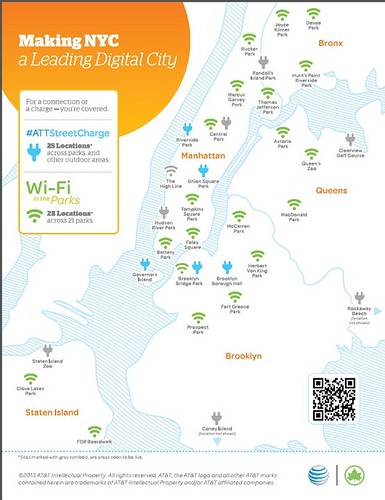
In New York City, AT&T, in association with the City, is introducing 25 solar-powered charging stations in public spaces including parks and beaches.  (press release)

The system is called AT&T Street Charge.

It was done in part to build resiliency in the face of storms and power outages.


Map of locations for AT&T Street Charge chargers
AT&T Street Charge

Labels: , , , , ,

Sunday, September 02, 2012

"Tattling" as a mobile application

The "Catch-em" mobile application will allow users to report bad drivers.

Of course, as discussed before, police departments/traffic safety programs have to set up a system to at least communicate with the likely perpetrators of bad driving incidents, so that they know that there can be consequences, even if just opprobrium from what they do.

In Howard County, the police department does send letters to people who have been reported to them as driving unsafely. See the past blog entry, "Howard County Police Department Best Practice on Aggressive Driving."

Catch em is based on an Israeli product called Nirsham.  From "App would let Utahns tattle on bad drivers: Catch-em -- Crowdfunding to decide which U.S. city becomes testing ground" in the Salt Lake Tribune:

Goldman said his company works with large fleets — such as trucking companies, large retail chains or even pizza delivery stores — to report problems with their drivers.

It also reports to police. Goldman said images are first uploaded to its website where the public can vote whether what is shown is illegal and dangerous. If the vote is primarily "yes" over a week, it has a "team of experts" view photos and report it to the appropriate police agency.

The app allows pedestrians to capture images manually to report problems from their phones. For drivers, phones can be put in cradles on the dashboard — and the app will keep a 20-photo history of what is happening in front of them.

Frankly, I don't like the way this is set up, almost as a kind of game. It's interaction for the sake of interaction because in my opinion anyway, I don't see how the interaction adds substantive value. There doesn't need to be "interaction" to vote on whether or not incidents are unlawful, and the time to vote adds unnecessary delay.

But the ability to systematic capture and report incidents is a good one.  And I think that rewarding the state that provides the most commitments to fund the development of application with the testing phase is a good idea.

Labels: , , ,