Rebuilding Place in the Urban Space

"A community’s physical form, rather than its land uses, is its most intrinsic and enduring characteristic." [Katz, EPA] This blog focuses on place and placemaking and all that makes it work--historic preservation, urban design, transportation, asset-based community development, arts & cultural development, commercial district revitalization, tourism & destination development, and quality of life advocacy--along with doses of civic engagement and good governance watchdogging.

Thursday, May 17, 2018

integrating payment systems in the Sustainable Mobility Platform

There is an article, "D.C. Metro's New App May Need a Pre-Launch Update," on CityLab, about WMATA's forthcoming phone-based payment system, and the author makes the point that by "merely transporting" the current card-based SmarTrip contactless fare payment and stored value system to an e-commerce app, it may be less innovative because it's not likely to include payment capabilities for modes not currently part of the payment system.

This is an interesting point that's been a concern for a long time, dating to c. 2001, triggered by the launch of (for profit) car sharing, followed by dock-based bike share a few years later. 

Sustainable mobility platform/TaaS and MaaS.  As the types of mobility (modes) available become broader and more diffuse, and the discussions of what I call the sustainable mobility platform but in the trade is referred to as transportation as a service/mobility as a service (TaaS/MaaS) it's deserving of more attention, as it raises some interesting issues.

-- The rise of mobility as a service, Deloitte

Unless the IT and access systems are designed from the outset to be compatible, it's difficult to have an integrated fare card that works on local transit as well as car sharing and/or bike sharing. 

But I am not sure that is as big an issue as I thought, because there are various standards systems that ensure access and interoperability.

More importantly, more mobility providers, including the car sharing firm Car2Go and all the new dockless bike and scooter providers, don't use card-based access systems, doing everything through phone-based applications.

Plus, firms operating programs on a multi-city footprint probably see it as a waste of time to integrate payment systems into local fare media programs when people are paying directly through their apps, linked to a credit/debit card or bank account.
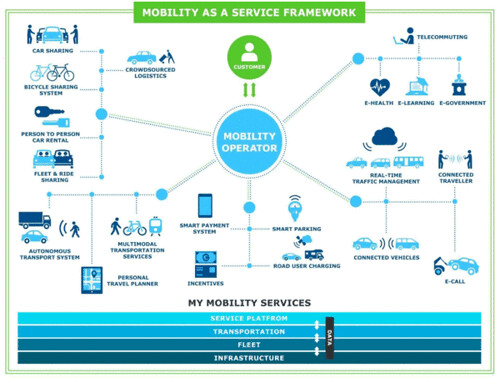
Mobility as a service platform
Finland Ministry of Transport and Communications graphic.

Regional transit fare payment systems.  With a few exceptions, like Greater New York City, by now most major metropolitan areas with multiple transit agencies have developed an integrated fare card system.
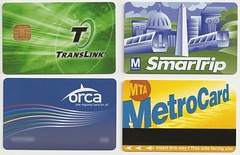
Transit CardsExamples include SmarTrip in DC, the Oyster Card in London (the first major example actually), the Orca Card in the Puget Sound region, etc. where it is set up as a master fare card that works across transit agencies in a defined region.

At the time, it was a great accomplishment for transit agencies to pull this off. 

Because most metros have a primary transit agency and a number of secondary systems, usually the primary transit agency takes the lead on creating a fare card payment system for its own use, and then opens up the platform to other agencies.  In some areas like San Francisco, the lead was taken by the area transportation planning agency.

Aren't necessarily usable on all forms of local transit.  But most of these fare collection systems don't cover every service.

In most places, railroad commuter trains aren't included. For example, in the DC and Baltimore region, while the SmarTrip card works in Baltimore and the CharmCard works in DC (actually the CharmCard is merely a branded SmarTrip card), it only works on bus and subway in the DC area, and bus, subway and light rail in Baltimore.  It doesn't work on railroad commuter services.

AND (which is a massive failure), SmarTrip cards can't be used on the bus between Dulles Airport and the Wiehle-Reston Metrorail station, even though the service is run by the Metropolitan Washington Airports Authority, a public agency.

By contrast in both the San Francisco and Puget Sound regions, the fare card systems work on railroad trips, as well as ferries.  In other places, railroad passes may provide free access to certain local transit services.  That is the case with MARC railroad monthly passes, and the Metrolink system in Greater Los Angeles.

Access to nonprofit mobility services that aren't traditional transit: bike sharing/car sharing.  With a couple exceptions, mostly in Montreal, access to car sharing and bike sharing hasn't been integrated in contactless fare media systems.  The bike sharing program in LA has been integrated into the TAP card system for access, but payment is separate from the stored value system used for transit.

The major exception is Montreal's STM transit system, where the Opus card can be used to access Bixi stations as well as card readers for cars in the Communauto car sharing program.  I think the difference is that both are local systems and the transit agency saw the value in integration.

What happens when for profit businesses enter the mix?  The problem with the thesis of the CityLab article is that for profit businesses engaged in transportation--car sharing, dockless bike and scooter sharing, taxis, etc.--may not be interested in participating in local transit fare media systems, especially when they operate on a national scale.

A dockless bike share bike from Lime Bike.

They're likely to see the cost of developing software integration applications for dozens of different transit fare collection systems as being greater than the benefit.  Similarly, they're not likely willing to pay collection and transfer fees, which are likely to be significant.  For them it's a lot easier for you to just use their phone-based app.

(Similarly, it's why firms develop specific e-commerce apps to better control their interaction with customers, rather than rely on web browser access.)

How to integrate for profit transportation service providers into the planning and operations mix? Regular readers know that in places like the DC area, with a balkanized set of transit agencies, I advocate the creation of collaborations equivalent to the "transport associations" of Germany. 

-- "The answer is: Create a single multi-state/regional multi-modal transit planning, management, and operations authority association," 2017
-- "Will buses ever be cool? Boston versus the Raleigh-Durham's GoTransit Model," 2017

These pan-metropolitan organizations integrate planning and operations into one body, provide integrated services and fare collection systems, regardless of what agency provides the service.  Note that Transport for London and the transit agencies in Greater Paris operate similarly.

But how do you integrate for profit entities into the mix?  Many transit agencies are working with ride hailing programs like Uber and Lyft on "microtransit" services.  Mostly, dockless systems have been more a matter of being foisted on local communities.

Theoretically, from a planning and operations standpoint, if the planning and transit operations paradigm was shifted to the German transport association model, it would be possible to bring the for profit sustainable mobility providers to the table.

I'd argue that the licensing regime for new mobility services should require participation in a metropolitan transport association coordinating and planning body.  But the problem is multi-fold. 

1. Most places don't have transport associations even though they have required transportation planning organizations--transport associations integrate planning and operations.

2.  The planning systems that exist aren't set up to deal very well with non-government entities. 

3.  The planning systems are often jurisdiction specific and don't function well at the metropolitan scale.  This is a problem even for government provided services like bike share that aren't transit.

4. For profit entities are competitive market-based organizations out to maximize their success and economic returns at the expense of others, without regard to the impact on parts of or the whole of the sustainable mobility platform.

Parking and tolling as another example.  Like traditional bike share, even though public parking and tolling systems are run by public agencies, their payment systems aren't integrated into one master fare, mobility access, and payment system. 

I did see an article a few years ago that a tolling organization in Texas proposed moving towards that kind of system.

EZ Pass is an interesting model because it operates on a multi-state scale covering dozens of metropolitan areas.

Would it make a lot of difference if transit media fare payment systems operated on a comparable basis, beyond that of even a metropolitan area?

Information versus payment.  Because most people are comfortable using debit card based payment systems, I no longer think that integrated payment systems with transit fare cards as the base are that important. 

The key with the sustainable mobility platform/TaaS/MaaS is integrating the modes at least in terms of information and awareness.  Yes, there is "consumer pain" at the outset of creating an account for a particular service, but after that initial touchpoint, access and payment isn't much of an issue.
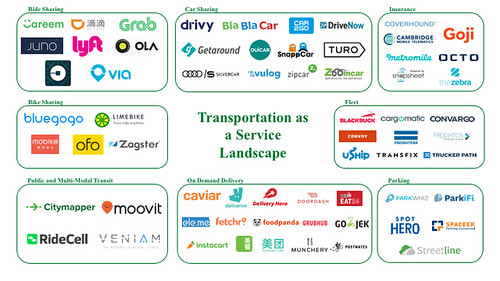
Transportation as a service landscape
Image from "The Road to Transportation-As-A-Service," Nokia Growth Partners.

Labels: , , , , , , , ,

Wednesday, March 07, 2018

The false promise of ride hailing as a pro-city transportation mode

=====
Reprinted from Monday with new date because of the addition of the experience with parking in San Diego.  I meant to write about it, but I forgot.  It's very interesting.
======

Except for one thing, measurable impact on demand for parking as reported by Ace Parking of San Diego, there really isn't anything new here, as I have written many times about these issues already.  But it's nice to sum it up.  The SD item is the new #1, and the other points have been renumbered.

1.  The San Diego Union-Tribune reports ("Ace Parking says Uber, Lyft have cut parking business up to 50% in some venues") on analysis by Ace Parking, the major private parking firm operating in San Diego, a company that is also active in other markets including DC, of the impact of ride hailing services on their parking business.  From the article:
In a September email buried deep in an environmental report, Ace Parking CEO John Baumgardner laid out the ugly truth facing the parking business. At San Diego hotels serviced by Ace Parking, overnight parking has declined 5 percent to 10 percent. At restaurant valet stands, business is down 25 percent.

And, most dramatically, nightclub valets are seeing a 50 percent drop off.

Homegrown Ace Parking — one of the largest parking companies in North America and also a fixture in San Diego’s political and business scene — is feeling the impact from Uber and Lyft, the wildly popular ride-sharing services that allow people to leave their cars at home.

For consumers, the bright side may be lower parking prices. In downtown San Diego, city planners are looking at the decline as they update parking guidelines — which could lead to changes in how much future parking is built.

Will parking companies go away? “Is this an existential threat to my business model? Or, is there a way to pivot and continue to provide a necessary service?” said Keith Jones, the third-generation managing partner of the Ace Parking empire, in a recent interview.

Jones likes to talk about “journey management.”

“Ace is hyper-focused on integrating new technology within our parking operations so we help consumers and cars,” he said. “We are pushing the parking and transportation industry to be connected in a way that makes parking smart.”
I like the point about shifting to "journey management."

2.  Most people driving ride hailing vehicles make less than minimum wage according to an MIT study ("MIT study reveals sad reality for majority of Uber, Lyft drivers: Median income far below minimum wage," WCVB-TV). From the article:
Drivers make a median hourly profit of $3.37 before taxes, the study found.

The report said that drivers incur a median cost of $0.30 per mile and that nearly a third of drivers incur expenses exceeding their revenue. At tax time, the standard mileage deduction could mean that there is untaxed revenue in the billions of dollars for these drivers.
-- The Economics of Ride-Hailing: Driver Revenue, Expenses and Taxes, MIT Center for Energy and Environmental Policy Research

NOTE THAT UBER DISPUTED THIS STUDY AND THE RESEARCHER RE-RAN THE NUMBERS. NOW HE SAYS THE FIGURE IS $8.55 HOUR WHILE UBER'S NUMBER IS $13.05.  See "Uber drivers per hour profit revised in disputed MIT study," San Jose Mercury News.

This shouldn't be a surprise.  Taxi driving is mostly resorted to by people with limited options.  Having to pay a good chunk of your earnings off the top to the software firms that run the service reduces margins.

Interesting, GM's Maven car sharing program is offering a high cost e-vehicle rental for people offering ride hailing services ("Maven Gig, GM’s car-sharing service for Uber and Lyft drivers, comes to Austin: Just in time for SXSW," GM Verge blog), after Uber made the decision to get out of the rental business because it was a money loser. From the article:
Someone who’s interested in driving for any of these on-demand services, but doesn’t own a vehicle, can rent an electric Chevy Bolt through Maven Gig starting at $229-a-week. The weekly price includes insurance, maintenance, and electric vehicle charging. There is no membership fee.

Maven first launched its gig worker product in 2016 in San Diego and San Francisco. Since then, it has been introduced in Los Angeles, Boston, Phoenix, Washington, DC, Baltimore, and Detroit. Maven says its customers have logged 170 million miles driving for various on-demand apps.

What’s different here is how closely Maven says it will be working with the city of Austin to ensure there’s an adequate electric car-charging infrastructure in place for drivers to use this service.
3.  Ride hailing reduces the use of transit. ("Ride-hailing is pulling people off public transit and clogging up roads," Technology Review). From the article:
A study by the Boston-based Metropolitan Area Planning Council found 42 percent of trips taken via ride-hailing services in Boston would have been completed on public transit had the option not been available. Another 12 percent of people would have walked or biked. Plus, most people use ride-hailers end-to-end, rather than mixing the service with other modes of transport.
4.  Ride hailing use is induced by venture capital subsidies which makes the cost of a ride less than actual cost ("You're not paying enough for Uber," Boston Globe). From the article:
A new study of 944 Boston-area passengers by the Metropolitan Area Planning Council shows that ride-hailing apps are adding to vehicular traffic; people are using them for lots of trips that they otherwise would have made by transit or bike.

This isn’t just happening because Uber and Lyft offer efficient service. It’s because the fares that customers pay don’t come close to covering the ride-hailing companies’ costs — much less the external costs to society of drawing more passenger cars into an already congested road network. ... In 2015, according to one transportation consultant, Uber passengers were paying only 41 percent of the cost of each ride.
5.  Ride hailing is a form of "inducing demand" and therefore increases congestion ("Studies are increasingly clear: Uber, Lyft congest cities," Associated Press).

6.  Chicago has instituted a fee per trip on ride hailing, which they use to fund sustainable mobility improvements ("Emanuel says Uber, Lyft fee hikes will pay for better transit cameras," Chicago Tribune; "Emanuel claims ride-hailing industry costing Chicago taxpayers $40 million per year," Chicago Sun-Times).

This seems like a reasonable mitigation measure.

7.  Transit consultant Jarrett Walker argues that there is less than meets the eye with microtransit ("Microtarnsit: What I think we know," Human Transit blog). The key point is the cost of labor to run a vehicle, and the ratio of passengers to drivers. The fewer the passengers, the more costly the service. He makes the point as I have that microtransit isn't new, in terms of either being an on demand service or contracting it out, and having an app doesn't make scalar changes to the mode.

David Aragon, an operation manager and one of the drivers for Free Ride Everywhere Downtown (FRED) waits at a local apartment building for his next pick up in the downtown area. (Nelvin C. Cepeda / San Diego Union-Tribune).


... speaking of San Diego, I do think there is a place for microtransit along the lines of the FRED e-shuttle operating in the Downtown ("Revisiting stories: FRED Downtown shuttle in San Diego," 2017) and supporting "park once, visit many places" consumption within the district.

8.  Meanwhile Uber takes aim at medical transportation ("Uber, Lyft try solving one of medicine's biggest problems: getting people to medical appointments," Chicago Tribune).

Again, not much new, and typical of firms aiming to make a good deal of money from government contracting (like Electronic Data Systems, the firm founded by H. Ross Perot, which had preponderate amount of business from state governments for IT systems).

Labels: , , , , , , , ,