=========
Update and re-dating from Thursday
Mobike announced they are leaving the DC market too ("
Mobike becomes second dockless bike operator to pull out of DC," Washington Post). While I was somewhat derisive of the claim by ofo that without scale they couldn't function, Mobike made the same point and it is legitimate. That 400 bikes isn't enough to cover an entire city, especially when they are required for equity reasons to cover the entire city, but most of the demand is in the core.
Also, mattxmal shares with us a great piece ("
The Scooter Wars will be a bloodbath — and Uber will win," Recode) by the CEO of the former Sidecar ride hailing business, which was unable to compete with Uber, and so the company sold its assets to GM. He makes the point that with modes like e-scooters, companies like Uber have an advantage because of the ability to use the same app and share users, the point I made in this piece, "
I finally figured out why mobility services are buying other mobility services: they're acquiring customers already familiar with smart mobility," but also the fleet of drivers to pick up scooters and re-charge them as well as to redistributed freshly charged scooters the next day.
The article provides some links to articles which discuss the economic model of the businesses ("
How to understand the financial levers in your business," TechCrunch about Bird).
Although to me, these articles indicate it's not a business deserving of big valuations. And I do think he's wrong in arguing that his company lost out to Uber because of Uber's aggressiveness, rather than their superior capitalization. It was both, sure, but without money you're out of the game.
========
1.
Parking as mobility. I need to keep augmenting my
Sustainability Mobility Platform framework, although it's tough, with yes, even parking ("
Still paying full retail for downtown parking? The car next to you might be getting a better deal,"
Boston Globe). From the article:
Transforming “parking” into “mobility” sounds like a marketing gimmick — like KFC dropping the “fried.” But when you talk to enough industry players, you understand that letting people reserve spots ahead of time, or pointing them to areas where on-street parking is likely available, will drive mobility by reducing the number of cars circling in search of parking. One study in SoHo in New York City found that 28 percent of cars on the road were cruising for metered parking. …
In the Back Bay, Cornelius Hurley, a professor at Boston University School of Law, uses the SPOT app to rent a space he owns behind his condo. Charging $3.50 per hour, he and his wife have earned a couple of thousand dollars over the past two years. He’s also become friendly with two renters, and, as an environmentally conscious person, he’s had the satisfaction of knowing he’s taking at least one circling car off the street — all with very little risk and effort, he noted.
IT and telecommunications through an app like SPOT does allow for some generation of "free money" by otherwise making monetizable a slack asset.
Also see "
Ace Parking says Uber, Lyft have cut parking business up to 50% in some venues,"
San Diego Union-Tribune.
 GeekWire photo by Nat Levy.
2.
In Seattle, Drive Now is integrating access to car sharing vehicles as well as ride hailing within one program/one app. The ride part is called Reach Now Ride ("
BMW's Launching an Uber Competitor in Seattle,
WIRED. ; "
Testing BMW’s Uber and Lyft rival, ReachNow Ride: Candy, fancy water and a ‘Do Not Disturb’ button," Geekwire).
Because the parents of Car2Go and ReachNow have merged the services, it will be interesting to see if the services will remain independent, cross-fertilize each other, etc.
3.
Car2Go has launched in Chicago as of yesterday. Unlike in DC, you won't be able to park a car at a parking meter and leave it without paying, because of how the City of Chicago leased off its street parking for 75 years to a hedge fund.
If Car2Go is to get "free access" to street meters, they'll have to negotiate a separate agreement. Right now cars are park-able in residential spaces, through an agreement with the City of Chicago.
One-way car share is a key element of creating a multi-layered MaaS environment in cities.
Interestingly, the rate is 25% cheaper than in DC for the small SmartCars-- 29 cents/minute, where it is 41 cents in DC. I surmise it has to do with paying less money for access to street spaces.
Plus, some Alderman shrunk the pilot area by excluding their districts out of a fear the cars would compete for spaces, even though the research finds that the cars "add to inventory" by supporting households that reduce car ownership.
4.
GM's Maven car sharing program is giving GM car owners and lessees the ability to do peer-to-peer car sharing ("
GM now lets car owners rent out their vehicles to make money,"
USA Today). Getaround is an independent service that does the same thing. This is interesting. It does provide a means for people to make some money from an otherwise "stranded asset."
GM takes 40% of the revenue. From the article:
The service, Peer Cars, allows those who own or lease a 2015 model or newer GM vehicle to list their vehicles on the Maven app for rent to others when the owners aren't using the cars. The owner keeps 60 percent of the revenue from renting the car and Maven gets the rest.
The income's likely to be marginal and to appeal to only a small segment of the market, but that the capability is being offered is pretty significant.
5.
Ofo is dialing back on dockless bike share. In an article ("
Ofo is the first to pull out of the District") in the
Washington Post, ofo blames DC for not being agreeable, that they need thousands of bikes to be successful, and the pilot program was limited to 400 bikes.
I think the complaint about DC was more comparable to Ivanka Trump claiming that she is now devoting her time to public policy and so her fashion brand was a distraction and therefore she's shutting it down, rather than because of declining sales.
Ofo is exiting markets all around the world ("
Ofo's big wobble shows the Chinese bike-sharing bubble has burst," BusinessInsider, registration required). Other companies are shuttering or dialing back as well.
Again, access to bikes, for the most part, isn't the limiting factor in biking as transportation. It's a willingness to bike for transportation. Since a lot of people don't take biking seriously, without a willingness to cycle regularly, there isn't much of a business for dockless human powered bicycles, especially on the part of frequent users.
6.
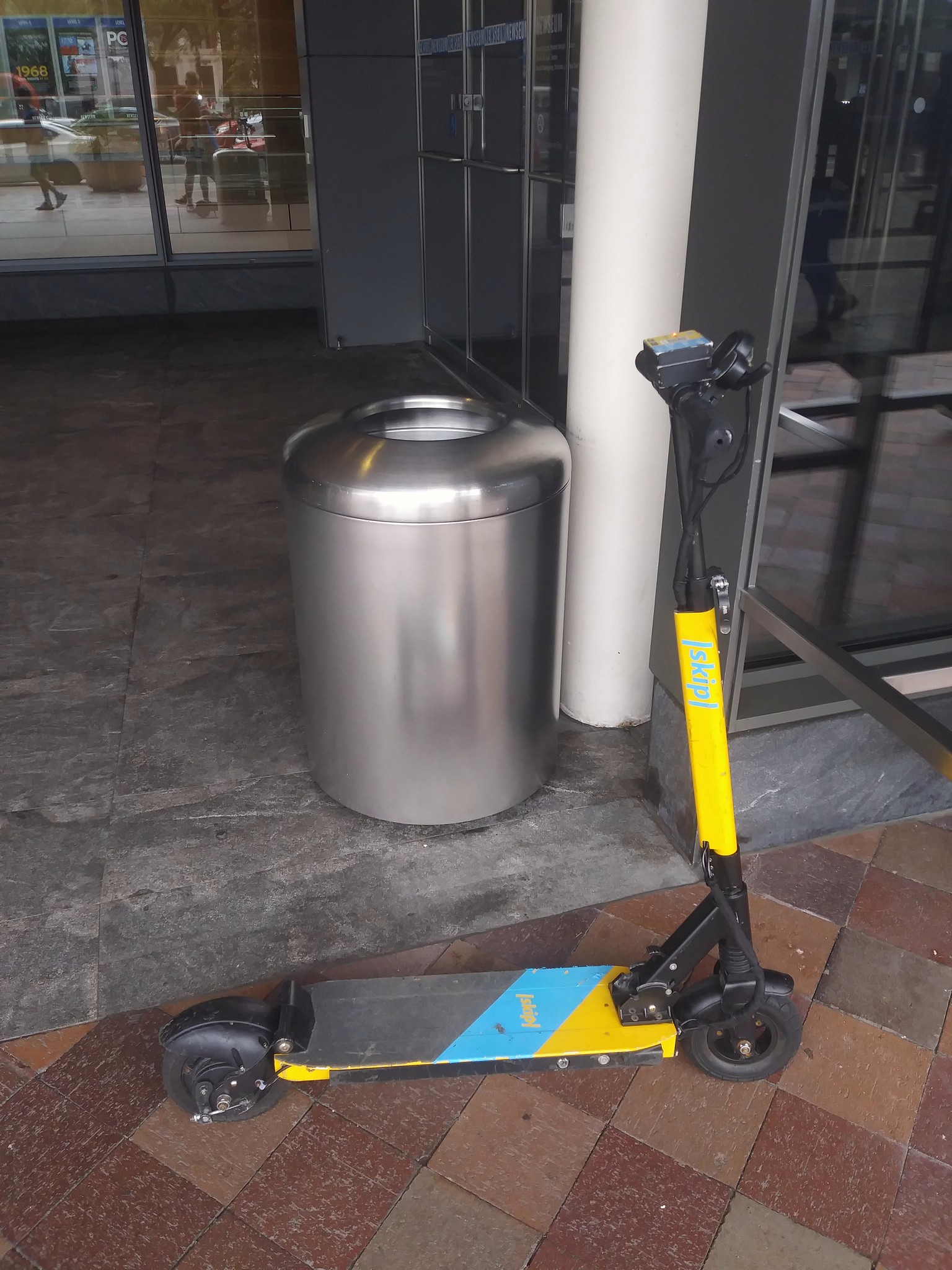
Dockless e-scooters and e-bikes more likely to have legs. They serve trips either faster or longer or both, and seem more sleek and modern than human powered bikes.
Likely this segment of the dockless market may be able to succeed, even as the industry consolidates, while the marketing of dockless regular bicycles will fall by the wayside. Even so, it's likely to remain a niche business not justifying the huge inflow of venture capital to the segment.
From the
Baltimore Sun article "
“Bird electric scooters have landed in Baltimore. Now the city is trying to figure out how to regulate them":
Bird bills itself as a “last mile” scooter rental service, offering a solution for traveling routes that are too short to drive but too long to walk. The machines can be rented, using a mobile app, for $1 to start plus 15 cents a minute.
Drew Bassini, 23, works for Morgan Stanley in Harbor East. “I’m on my lunch break so, as opposed to walking or riding my bike, it’s preferable to get there quickly and not expend too much energy,” he said. “A scooter can get me from point A to B quicker.”
The shiny new scooters have quickly proved a popular mode of transport downtown. Jeremy Collins, 23, said he now sees more scooters than bikes.
“I think it’s great and much needed, especially for a city trying to rebrand as a world-class city,” Collins said. “Baltimore really needs to work on mobility and getting around, and the scooters offer a low-cost, easy-to-use way of doing that.”
Someone wrote a letter to the editor complaining ("
Scooters annoy already"), while the paper editorialized in favor ("
Bird scooters — Baltimore's latest invasive species").
7.
Greater dockless bike share success in smaller Chinese cities. Lacking transit options, and with much less car ownership penetration, dockless bike share use is skyrocketing outside of China's big cities ("
How HelloBike is beating Mobike and Ofo in China's smaller cities,"
South China Morning Post).
This model isn't likely to be successful in the US because such places aren't particularly dense and average trip distances are long.
That being said, I've thought for awhile that states could take a systematic approach to bike sharing for larger cities and use the same system across multiple in-state markets. E.g., port the bike sharing system in Salt Lake City to Park City, Ogden, Logan, etc.

8.
The Eno Center for Transportation releases report on taxing ride hailing services,
Taxing New Mobility Services: What’s Right? What’s Next?.
As a car share user, I do resent that ride hailing trips, at least in DC, are taxed at a lower rate. While the raised the issue of taxing ride hailing trips as a way to "provide parity" compared to taxis, they didn't consider the MaaS environment more broadly.
From the report:
There are four main questions cities and states are trying to answer when they levy taxes and fees on TNCs. Some reflect a rational nexus between the fee charged and the needs created and benefits incurred by the service. But that is not always the case.
1. Can TNC taxes and fees offset negative effects of urban congestion?
2. Should TNC taxes and fees fund infrastructure and public transit investment?
3. Can TNC taxes and fees provide parity with traditional taxi services?
4. Should TNC taxes and fees create funding streams for regulatory costs and community needs?
Seems like the answers to all these questions ought to be yes, with the expansion of question #3 to include taxing parity across mobility services more generally.
Labels: bicycle and pedestrian planning, parking and curbspace management, sustainable mobility platform, sustainable transportation, transportation planning, urban design/placemaking
.jpg)
.jpg)


.webp)
.webp)


.jpg)