Rebuilding Place in the Urban Space

"A community’s physical form, rather than its land uses, is its most intrinsic and enduring characteristic." [Katz, EPA] This blog focuses on place and placemaking and all that makes it work--historic preservation, urban design, transportation, asset-based community development, arts & cultural development, commercial district revitalization, tourism & destination development, and quality of life advocacy--along with doses of civic engagement and good governance watchdogging.

Monday, May 13, 2024

WMATA's latest bus improvement program

is discussed by WTOP, "Metro’s future of bus service could bring new routes and end some familiar stops."  

When I first saw coverage I thought, "what about the 2017" initiative, although granted it was before covid.  And when thinking about writing about it, I remembered a bus initiative back in 2006 too.  But of course, conditions have changed greatly since then.

WRT bus service improvement see:

-- "Making bus service sexy and more equitable," 2012
-- "Will buses ever be cool? Boston versus the Raleigh-Durham's GoTransit Model," 2017
-- "Route 7 BRT proposal communicates the reality that the DC area doesn't adequately conduct transportation planning at the metropolitan-scale," 2016
-- "Reviving DC area bus service: and a counterpoint to the recent Washington City Paper article," 2019

From the article:

With additional funding, Webster said the new bus network could bring 30-minute frequency for most routes, 30 new routes that would increase connections with Metrorail stations and a regionwide 24-hour bus network, which would provide overnight connections to the region’s airports.

San Francisco Bay overnight transit map.

And with that I had to laugh.  I've been suggesting that for at least 12 years.

-- "Overnight transit service," 2012
-- "Night moves: the need for more night time (and weekend) transit service, especially when the subway is closed," 2013
-- "Night and weekend transit/subway service," 2016
-- "Overnight transit service: San Francisco," 2016

The 2013 entry states that bus service should be provided to airports when Metrorail is closed.  Also see:

-- "To and from origin stations can be difficult: More on the Silver Line and intra-neighborhood transit (tertiary network)," 2022
-- "More on airport-related transit/transit for visitors," 2013
-- "To get people who have mobility choices to choose transit, they have to know it exists," 2007

The points in this entry, although ostensibly about light rail, are really about the value of a transit network, and by extension the value of the transit network as a 24 hour service.

-- "Manhattan Institute misses the point about the value of light rail transit connections to airports | Utility and the network effect: the transit network as a platform," 2020

Related is the blog entry "Branding's NOT all you need for transit" (2018) which discusses transit as a "design product"

ensuring that each and every element within the system of providing transit and mobility services is designed to be effective, efficient, successful, powerful and connected.

DC has a long way to go for that, which is why I suggest a German style "transport association" be created to integrate the services.

-- "WMATA and MWCOG announce new joint transit initiative | Could a regional "transport association" be on the horizon, or just a transit bailout?," 2024

At some point, I wrote that it would be easy to provide transit service to National Airport overnight by extending the bus service on 14th Street.  And that a late night bus network needs to include Union Station in DC as a primary node.

========================

FWIW, in the Purple Line series ("Setting the stage for the Purple Line light rail line to be an overwhelming success: Part 2 | proposed parallel improvements across the transit network," 2017), I made a bunch of recommendations wrt bus service, although I'm glad some of the improvements will happen before 2028, when the Purple Line opens.

9.  Provide integrated bus arrival and departure information screens at Metrorail, Light Rail, and MARC stations.

10.  Bus service in certain corridors between DC and Maryland should be extended and/or frequency increased to better link these areas to the new light rail service.

Many of the area's bus services terminate at the city-state line, although there are some exceptions. DC and Maryland should commit to bus service improvements in advance of the PL launch.

11.  Montgomery County bus system improvements with the launch of the Purple Line and bi-directional service on the MARC Brunswick Line should include launch of planned Bus Rapid Transit services.   

12.  Rearticulate, rebrand, and reposition-extend the Prince George's County TheBus bus transit service. Change the name of the service and the graphic design of the bus livery.

They have the same opportunity for rearticulation with their complementary local transit system. Currently, TheBus system is the least well developed of the suburban transit agencies ("By choosing coverage over frequency, Prince George’s caps what its buses can accomplish," GGW).

But they are now working on improving the system, with a Transit Transformation initiative they launched last fall.

13.  Consider a redesign and rebranding of the the metropolitan area's bus systems into an integrated framework, comparable to that of GoTransit in the Raleigh-Durham area.

This has been discussed in depth here, "Will buses ever be cool? Boston versus the Raleigh-Durham's GoTransit Model."  This gives a  deadline for launch.

From the presentation ("The Sign Design Society Event: Defining a City," designworkplan) by Ivan Bennett, Design Manger for London Buses:

One reason other systems have failed is the lack of continuity. London bus stops extend beyond central areas and cover all routes in Greater London. Ivan indicated that passengers do not just want information about where they are travelling from, but when they get there, they need the same consistently presented information. People need information near their homes and local areas, not just in the centre of the city.

15.  Set the opening of the Purple Line as the deadline for the implementation of a full-fledged integrated Night Owl bus network for the DC metropolitan area.

DSC0574719.  WMATA should upgrade its Metrorail station bus shelters.

Another aspect of the balkanized transit system in the DC area is that every jurisdiction has a different program for bus shelters--what Ivan Bennett, product design manager for the London bus program, calls "a lack of continuity."

Metrobus isn't responsible for shelters in the various jurisdictions, although WMATA does have bus shelters on the grounds of many Metrorail stations outside the core. 
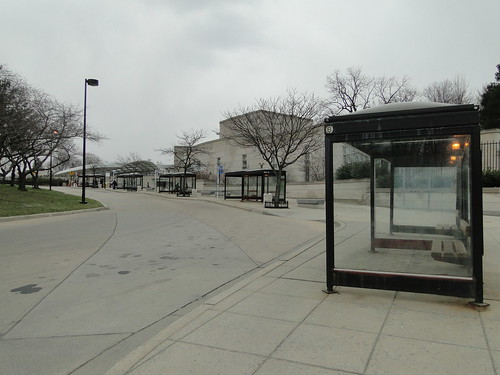
Bus shelters at the Medical Center Metrorail Station. 

Unfortunately, the Metrorail station shelters are dowdy, don't incorporate real-time arrival and departure information, could include advertising as a revenue stream, etc.

Why not use the launch date of the Purple Line as an inducement and deadline for an overhaul of the Metrorail bus shelters across the station network?

 ... although this doesn't address the fact that in an integrated bus service branding system across the jurisdictions, ideally, there would be a common set of transit shelters and amenities across the transit network.

-- Transit Waiting Environments, for the Greater Cleveland Rapid Transit Authority
-- From Here to There: A creative guide for making public transport the way to go, EMBARQ
-- Rethinking the Suburban Bus Stop, Airport Corridor Transportation Association, Pittsburgh
-- First/Last Mile Strategies Study, Utah Transit Authority

The Kansas City Streetcar Smart City "City Post" digital kiosks include a real-time tracker application for the streetcar service ("No need to wonder where streetcar is: Kiosks now offer tracker maps," Kansas City Business Journal). Photo: Andrew Grumke. 

Labels: , , , , , ,

Monday, December 04, 2023

Super design forward buses in Mexico: Irizar ie tram

Merida city in Mexico is creating a new bus rapid transit system ("IE tram system brings to Merida a whole different means of transportation," Yucatan Times, "Yucatan's Electrifying IE-TRAM Project," Mexico Business News), and as part of it, they're using Irizar ie tram bus vehicles, produced by the Irizar company in Turkey, which look more like fixed rail transit vehicles than buses.

While the specifications on the website only show a 40 foot long bus, images also show an extended version in the articulated bus form.


In "Making bus service sexy and more equitable," as a way to position bus service as a high quality servivce, I suggest that cities like Washington should switch to double deck buses, made famous by London, but used in many cities in Europe especially, but also Las Vegas and Ottawa, Ontario.  The Vegas and Ottawa buses are pretty dowdy looking, while Luxembourg puts them to shame.


The Irizar ie tram is a worthy option as a way to reposition the image of bus transit.

Also see:

Labels: , , , , , , , ,

Tuesday, July 25, 2023

Bus stops as neighborhood focal points and opportunities for placemaking

1.  Boston is promoting digital library access at 20 bus stops ("Borrowing books on the bus? It’s happening in Boston," Boston Globe).

It's not particularly pathbreaking.  Libraries in places like Orange County, California and Calgary have put in book lending stations at transit stations in their communities for more than a decade.

2.  But once again, it raises the issue of how to make bus stops more than perfunctory places within a neighborhood and community.  See past blog entries:

-- "Pathetic not revelatory: Quality of bus stop study in San Francisco," 2021
-- "Bus shelters as social spaces, as potential vectors for virus: Seoul's new anti-covid bus shelter," 2020

Project for Public Spaces has a report on the topic, Destination Station: Transforming Bus Stops through Community Outreach.

3.  Utah has invested in bus stops, but given the heat and sun in the summer months, the fact that a majority of stops have zero provision for shade is a problem.  And not providing a shelter doesn't work out so great in the winter either.

There are three bus stops--no shelters--alongside Sugar House Park for which I am on the board, and I hope that we can work with the Utah Transit Authority to put shelters in, and at at least two of the locations, to incorporate greenery.

Transit shelter next to a fence/golf course, E. Spring Street, Long Beach, California, 
with bougainvillea growing on top of the shelter

A few years ago, there was a public art project with one bus shelter in Everett, Massachusetts that did something similar ("Everett tried to make a bus stop pretty," Boston Globe).  But only for three days.

Rendering of “Felipe Baeza: Unruly Forms,” which will be presented by Public Art Fund next month on more than 400 JCDecaux bus shelters and street furniture throughout New York, Chicago, Boston in the United States, and Mexico City, León, Querétaro in Mexico.  Image: Public Art Fund, NY

4.  The New York Times has an article on a bus shelter public art project, "Watching for the Bus Stop Gallery."  From the article:
Starting Aug. 9, the artist, whose home base is Brooklyn, will be giving people something to think about during their own public transportation journey, or purgatory as the case may be. As part of a Public Art Fund program designed to reach people where they live or commute, Baeza will have eight of his mixed-media, collagelike paintings reproduced on some 400 JCDecaux bus shelters in New York, Boston and Chicago as well as Querétaro and Léon in Mexico. They will also appear on digital kiosks and newsstands in Mexico City.... 

And his paintings for the project — fantastic, ritualistic images of human bodies in different stages of transformation or regeneration — touch on the power of mobility. Speaking from a small office-like studio at the Getty, where he had a nine-month residency ending in June, Baeza called his subjects “unruly forms” or “fugitive bodies” who don’t conform to norms or abide by laws. Some seem to be morphing into sea creatures or mythic birds; others are on the cusp of flight.

I especially like the leveraging of digital ad networks across cities.  

I proposed something like that, although within communities, as point #10, "Create a digital community and transit information network for Silver Spring, employing kiosks and mobile applications" in "PL #5: Creating a Silver Spring "Sustainable Mobility District" | Part 3: Program items 10-18" (2018).

Labels: , , , , , , ,

Friday, July 07, 2023

Upholstered cushions affixed to a wall bench by a bus stop on wall by a bus stop on Hackney Road (Bethnal Green/Shoreditch, London) upholstered by the trainees in the Shoreditch Design Rooms upholstery program


Reddit photo. 

Labels: , , ,

Saturday, January 28, 2023

Some transit matters in Utah

1.  Poor transit to ski resorts in Salt Lake County.  During covid, the Utah Transit Authority had a hiring freeze, which now means that they don't have enough drivers and are cutting service as a result.  One of the services cut, partly because they don't have enough drivers with the experience to drive in serious snow and mountain/canyon conditions, is the UTA Ski Bus service, which serves Big and Little Cottonwood Canyons, home to four popular ski resorts.

So the County Tourism Office, Visit Salt Lake, has contracted with a private operator to provide additional service ("New ski shuttle to launch in Cottonwood canyons this week," Salt Lake Tribune).  It's $10 round trip, which seems reasonable.  Although equity based options should be made available too.  From the article:

The “Cottonwood Connect” ski shuttle will provide passengers $10 round-trip rides to either Alta and Snowbird in Little Cottonwood Canyon, or Brighton and Solitude in Big Cottonwood Canyon, on a first-come, first-serve basis beginning Thursday morning.

Service will run on Thursdays, Fridays, Saturdays and Sundays, as well as holidays, through April 16. Reservations must be made online in advance.

Riders can choose from 11 different locations for morning pickup — such as the Highland Park park-and-ride, or the Cottonwood Hyatt Place hotel. Then, they can select their ski resort destination, along with a time slot for return from the slopes.

A full list of stops and routes for the service are on the Visit Salt Lake website, here Cottonwood Connect.
But this should be a basic function of the local transit authority and it is damning that they can't pull it off.

2.  Especially since the Utah Department of Transportation's study of Little Cottonwood proposes gondola service.  I am fine with it.  But that doesn't mean that there aren't serious planning failures in the process.

-- Little Cottonwood Canyon EIS
-- The Gondola Works (website of proponents) 

A yard sign in the lot of an opponent to the gondola.

But they didn't propose it as part of an overall transportation demand management approach, and many quarters are opposed--which I don't really understand since gondolas are an exciting mode as part of a full range of transit options, especially in topographically challenged areas. 

Although legitimate criticism can be made that the process hasn't been conceptualized or handled very well.  

For example, it only proposes winter service, even though the Canyon is utilized just as much in the spring, summer and fall.  And there's talk that riding the gondola would cost $200 which is insane. 

3.  Recreation Transit District concept.  The failure to have a full TDM approach not just to Little Cottonwood Canyon but to Big Cottonwood and other outdoor recreation destinations, I have prepared an outline for the creation of what I call a "recreation transit district" in Salt Lake County to provide service to various recreational sites across the county.  FWIW, the Ski Bus service only runs in winter, while the canyons are used year round, and most recreational sites across the county aren't served by transit. 

From a transportation demand management and equity perspective, you shouldn't be required to have a car to be able to recreate.

I first wrote up the proposal in June, in response to a road project in Millcreek Canyon, and it uses a variety of recreational transit examples including Seattle, Colorado ("8 Ways to Get to the Mountains This Winter Without Driving Yourself," 5280), and Utah's own Park City, which has an extensive in city transit system serving all the ski resorts, and is free. And how Greater Seattle's Crystal Mountain Ski Resort has an extensive TDM program including free bus service ("Crystal Mountain is taking on parking woes with a shuttle. Our reporter took the bus to ski," Seattle Times).  But it needs an update.

But there are more opportunities to submit it, as there are two other ongoing studies, a transit study for Big Cottonwood Canyon, and the Tri-Canyons Trails Master Plan access study by the US Forest Service, which controls most of the lands in Big and Little Cottonwood Canyons and Millcreek Canyon.

Both have public comment and/or public meetings happening currently.

Photo taken on a bad air day in August 2021.

4.  Free transit proposal. In 2022, transit on UTA (train, light rail, streetcar, bus) was free in the month of February (Free Fare February Final Report, UTA).  Previously, there had been free days here and there, usually associated with days where air quality was particularly bad.

But free transit for entire month got people wanting it to be free all the time.  Apparently the Utah Legislature is considering a proposal to test this for one year, perhaps in the next fiscal year ("Free transit for a year has to get past the Utah Legislature first," KUER/NPR).

Interestingly, transit in Park City (Park City Transit) and Summit County (High Valley Transit) and Cache County/Logan, where Utah State University is, is run independent of UTA, which provides transit in the Salt Lake Valley in multiple counties, is already free.

5.  Free transit during the period around the NBA All Star Game.  I've written in the past about how for example, on Inauguration Day in DC, transit should be free ("Should transit on Inauguration Day be free?," 2013/2016), and how transit use is built into the ticketing process for some sports arenas ("Seattle Kraken expansion hockey team sets new standard for transit benefits in transportation demand management: free transit with ticket," 2019).  

For the period associated with the NBA All Star Game in Salt Lake, from February 12th to February 21st, UTA transit will be free, which is pretty cool ("UTA to have 10 zero-fare days for NBA All-Star game," ABC4).

6.  High Valley Transit steps up and takes over a bus route from Salt Lake to Park City that UTA severely truncated.  In another boneheaded move that sacrifices transit network breadth, the Utah Transit Authority changed the route of the SLC-PC Connect bus, Salt Lake City to Park City, eliminating all the stops in Salt Lake City, and re-routing it to a Park and Ride Lot in Millcreek, next to I-215, because of driver shortages ("In a major move, UTA to sharply cut back bus service in three counties, and it’s going to affect skiers," Salt Lake Tribune).  

As it was the bus started at the Salt Lake Central transit station, not the Airport, which meant it had minimal opportunity to capture transit trips from the Airport to Park City.

Shockingly, Summit County recognized this was not beneficial to them, and took over the route ("New commuter bus route from SLC to Park City rolls out this weekend," KPCW/NPR).  One problem is the original UTA bus service used the big inter city buses with plenty of room for luggage and bike racks on the front.  I'm not sure the HVT bus is the same, although I haven't taken it yet so I don't know for certain.

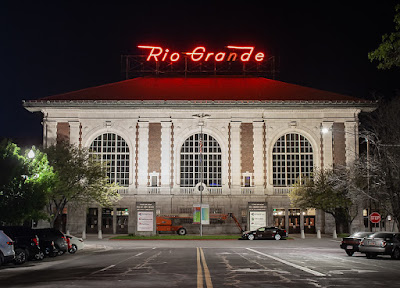
7.  Rio Grande Depot/Rail Undergrounding Proposal.  I went to a presentation a few days ago about a citizen plan to recenter train service on the historic Rio Grande Station.  

Flickr photo by Terry Redeker.

The railroad tracks were relocated a couple blocks behind the station around 2000. to a pretty gnarly set of platforms and a intermodal transit facility that doesn't have the grandeur or centrality of the rail station.

It's a pretty interesting idea, and would require relocating the railroad tracks underground and the light rail tracks closer.  It would repattern the land use significantly, allowing for significant build out opportunity of more than 50 acres.  

It could also refocus attention on transit as a legitimate mode, and recenter Salt Lake City's competitive advantages in part around transit.

-- Rio Grande Plan

I will be writing about this separately.

Flickr photo by Peter Ehrlich.

8.  Mayors initiative to extend passenger rail service to Boise and Las Vegas.  UTA has a decent commuter line, from Provo to Ogden, called the Frontrunner.  Ideally, it would be extended in both directions, to Southern Utah, and north to Logan.

Last year, the mayors of Salt Lake and Boise came together on an initiative to reconnect the cities by railroad ("A Utah train to Idaho? Salt Lake, Boise leaders are working to restore old service," KSL-TV; "Train corridors proposed connecting Boise, Las Vegas to Salt Lake City," Fox13).  Similarly, service could be extended to Las Vegas, where it could then connect to Los Angeles.

How they see the service being restored, although there should be a stub line to Logan, Utah, home to Utah State University.

In one way, it would merely restore services that once existed, service from Los Angeles to Salt Lake via Las Vegas, and service from Salt Lake to Idaho, Portland, and Washington.  Those trains were cancelled in 1999.

It should be pursued as a next step in the Rio Grande Plan.  And is basically along the lines of how I argue rail transit service should be organized in the US ("Two train/regional transit ideas: Part 1 | Amtrak should acquire Greyhound") modeled after Japan.

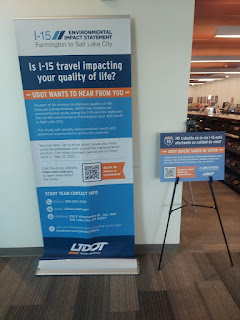
10.  Not transit per se, but the Utah Department of Transportation wants to widen I-15 through Salt Lake City ("UDOT unveils details on new $1.6B widening of I-15 through SLC," Building Salt Lake). 

-- UDOT releases transportation alternatives for I-15 from Farmington to Salt Lake City

 Given that Frontrunner parallels it, it's an impressive example of the failure to undertake multimodal corridor management.  As David Engwicht, the creator of the concept of transportation demand management realized, if you reduce the number of motor vehicles, you don't have to widen roads.

This piece has links to past entries concerning corridor management.

-- "Washington Post letter to the editor on repair-related closure of Rockville and Shady Grove Stations and corridor management" (2021)

Labels: , , , , , , ,

Friday, November 04, 2022

Valley Regional Transit (Boise): Pollution Solution marketing thrust | Transit is/as the Pollution Solution

The transit agency in Boise is positioning its ongoing shift to electric buses as the "Pollution Solution" although this is more about the switch to electricity from diesel.


But I think that the idea of transit as "the" "Pollution Solution" vis a vis motor vehicles and the reality that most trips are of one person is a great marketing positioning regardless of the fuel source.

-- Great cartoon-based brochure, Pollution Solution, Valley Regional Transit

Labels: , , , , , ,

Friday, September 23, 2022

Distinctive bus shelter at the entrance to Utah State University, Logan

The reason that I find this interesting is because when I did the bicycle and pedestrian plan for Western Baltimore County many years ago, one of the recommendations was that University of Maryland Baltimore County respectfully recognize that students use the local MTA bus system, and provide on campus shelters and related facilities.

At that time, they didn't provide any shelters at all, so students had to wait outside in the sun and cold. I seem to recall rolling through the campus a few years ago and seeing shelters, but I could be misremembering.

That's why I was a bit surprised about this shelter.  It's not just a shelter, it announces that it is on the campus of the university, it's large not small, it's much more substantial than a typical transit agency bus shelter. It's branded with the University's logo, etc.

It definitely is an illustration of my point that bus shelters are "marketing touchpoints" of transit systems ("Arlington County's bus shelters and a public realm framework of quality ," 2013), and if bus shelters are crappy that communicates very clearly that the community doesn't value transit.  

Although in this case, it is a marketing touchpoint for the University more generally, not just wrt transit.

Labels: , , , , , ,

Friday, February 04, 2022

UK National Bus Strategy | National Planning Strategies

More than ten years ago, I came across the then iteration of the German National Bicycle Plan (Switzerland has one too, but not in English).  (Similarly, in 2010 I came across the then Provincial bike plan for Quebec and was equally impressed--I came across a summary document at a public museum in Montreal.)

This image from the German plan, conceptualizing bicycling as a system, made a big impression on me.

It made me realize that we don't really have National Transportation Plans in the US for biking, walking, transit (bus, local rail, railroads), ports, etc.

Same with the new Bus Back Better: National Bus Strategy for England document.

Instead, in the US, we say that the various forms of sustainable mobility are important, have funding programs, publish a lot of great material (e.g., the Federal Highway Administration produces scads of great resources on walking and bicycling), but laws and regulations don't require the provision of such infrastructure, mostly they say it's good to do, but provide various outs, and make it comparatively easy to fund roads and much harder to fund sustainable mobility projects.

That's why I say people miss the point about why they do it in the Netherlands and not here (e.g., "why can't we be like Copenhagen?" or even "why can't we be like Portland?").  

It's not because Dutch planners and engineers are more enlightened, it's because it's national policy to prioritize sustainable mobility.  It's not an option for them in planning and design and implementation, it's a requirement.  

And the national government ensures that other laws and policies and regulations are congruent with that requirement.  

For example, gas excise taxes of many dollars per gallon, car purchase taxes equal to 100% of the value of the car, insurance regulations that prioritize bicyclists and pedestrians as more vulnerable, difficult processes for getting driver's licenses, etc.

UK centralized government and transportation planning.  From a planning perspective, I think the system for England is "flawed" (the other f word).  The government is extremely centralized, to the point that many planning approvals are done at the level of the national government.

National government laws pretty much have privatized transit across the UK, with just a couple of exceptions, in London bus and rail and Liverpool's rail , because the systems were difficult to break up.  Although the continued (pre-covid) success of those forms of transit in those places basically prove that privatization on steroids doesn't work very well for transit.  

(In the UK, privatization doesn't just extend to the operation of a local "transit system" but individual services, down to the bus route or service depot. Multiple operators may run different services on the same routes.)

Plus, the failure of privatizing the UK's railroad passenger services ("How the end of the rail franchise system will affect Britain's trains," Guardian).

UK planning policy.  But from a planning policy perspective, since I got involved in this c. 2000, I was really impressed by their various national planning guidance policies, memos, publications, etc.  

Granted the Conservative governments wrecked all that, but I thought it was "a good idea" to have national authoritative guidance on what to do.

US planning policy in an idealized world.  Like we should have National Planning Guidance memos in the US that prioritize sustainable development, sustainable mobility, etc., and in particular National Planning Guidance plans for biking as transportation, walking, local bus systems, local rail programs (heavy rail, light rail, streetcar), railroad services at multiple scales for passenger service, inter-city bus services, and especially freight (railroad versus trucking), shorter versus longer distance trip planning (trains versus planes)/airports, ports--one of the reasons that we are in the midst of a supply chain and logistics problem in the US is because we don't have a national plan for this, etc.

-- "The (Meta) Regional Transit Network," 2008

Basically, such documents would outline the goals and objectives for planning, laws, regulation, and funding.  And state, multi-state, regional, metropolitan, and local plans would have to be congruent with the National Planning guidance.

New UK bus program strategy.  Basically, I'd argue that the Conservative Government and particularly the Prime Minister Boris Johnson, are pretty much pulling the wool over people's eyes when they argue they are concerned about "levelling up" the North compared to London and the South (Levelling Up the United Kingdom policy paper), the new Bus Back Better: National Bus Strategy for England document is interesting in that it says bus transit is important and it would be a good model for a "National Bus Local Transit Strategy for the US."

(cf. "Report from transit advocates calls for improved, coordinated bus service for D.C. region," Washington Post versus my 2019 entry, "Reviving DC area bus service: and a counterpoint to the recent Washington City Paper article.")

While it's probably put out there more because the government would rather promote buses instead of more expensive local rail transit, it does lay out a groundwork for a national strategy.

However, because they won't junk their privatization agenda, calling for reintegration of local transit  into a unitary system instead of the balkanized set of competing services that exists today means that there will be plenty of waste and poor service as a result.

Labels: , , , , ,

Friday, August 06, 2021

Pathetic not revelatory: Quality of bus stop study in San Francisco

Bloomberg CityLab reports that "better bus stops can boost transit ridership" ("Mapping the Best and Worst Bus Stops in San Francisco").  From the article:

The results of Moran’s in-person census of 2,964 stops, forthcoming in the Journal of Public Transportation, reveal that the likelihood a San Francisco bus rider gets to sit down, stay out of the rain and even board directly from the curb heavily depends on geography. 

Across San Francisco, only about a third of bus stops had shelter and seating, Moran found. A similar amount was also blocked by on-street parking, often forcing riders to weave through parked cars and board in the street. Signage varied widely in type and legibility — the most common kind was paint on a metal pole — while 11% of stops appeared to lack legible signage entirely.

How is this revelatory in 2021?  I think it's pathetic.  This ought to have been known for decades.  Granted the article is about a study by a PhD student, not by local planning and transit agencies, or the  Metropolitan Transportation Commission, the overarching transportation planning body for the San Francisco Bay.  And you shouldn't "shoot the messenger" but still.

One of the DC bus shelters before the Clear Channel contract.

This is probably the most dangerous bus stop I've seen
on Liberty Avenue in the Strip District section of Pittsburgh

Bus service as a system: transit stops are but one element | mode planning versus experience planning.  Because of the balkanization of transit services and operators in the Washington, DC area, I've come to be very much focused on the value of the network. As well as the gaps in planning that result from the lack of coordination and integration.  Although the study referenced by CityLab is only of San Francisco, not other transit agency service areas in the San Francisco Bay.

"Reviving DC area bus service" from 2019 is the most recent sum up with links to past entries.

More and more I am thinking about how transportation planners tend to focus on "mode" rather than quality, experience, and place.  It's not new, but my depth of appreciation for this reality has changed.

Definitely they need people focused on the quality of the experience, which instead is sorely lacking.  If the BYU football team can do it ("Meet the BYU football equipment manager with a Ph.D.," Salt Lake Deseret News), so can transit agencies.  From the article:

... He graduated from BYU in 2014 with a degree in recreational management: experience design.

I've argued that transportation departments should have "chief thoroughfare architects" in addition to "chief [traffic] engineers, and lauded how San Antonio's VIA transit agency has an urban design unit ("VIA urban planner wants to build a better San Antonio," San Antonio Express News). VIA takes a more experience oriented approach to the design of transit stations and shelters, signage and wayfinding systems, and the inclusion of public art.

Design forward presentation of transit information, 
Stone Oak Park and Ride Transit Center, San Antonio

Focusing on the DC area bus service as a network.  In "Improving bus service overall vs. reversing falling Metrobus ridership," these were the major points:

1. The impact of the sustainable mobility platform on use of mass transit services.

2. Is the pool of transit dependent riders shrinking? And in the face of this loss of ridership, given that bus service is relied upon by the transit dependent (people without cars), is this demographic group shrinking, in the areas where the Metrobus service pattern is dominant?

3. The DC area bus transit "network" is not perceived as a system: it is illegible.

4. Reposition bus service as a premium (design) product.

5. Rearticulate and reconfigure bus transit across the metropolitan area into one integrated system.

6. Make provision of dedicated bus transitways (and traffic signal prioritization for buses) a priority.

7. Create a overnight transit network at the metropolitan scale.  ("Night owl service.")

8. Don't forget bus services when creating HOT Lanes.

9. Rearticulate long distance commuter bus services too.

My bus learning process.  When I first moved to DC, Metrorail was still pretty new and bus was an afterthought.  I had some experience riding buses in Ann Arbor, both the city bus system, which charged fares, and the University bus service, which was free but mostly went to places I didn't need to go.

In DC, one of my then partner's colleagues rode the bus, and she introduced us to the Metrobus service, as a complement to the subway.  And I soon figured out that depending on where you were and where you needed to go, bus could be faster.

Once I started focusing on urbanism in earnest, around 2000, I paid closer attention to all elements of city living, especially transit.

Going to conferences in other cities, looking to save money, I would use transit there, take a bus or rail from the airport to the city core, etc.  If you know how to use one transit system pretty well, you can pretty much figure out how to use other systems.

Thinking about "transit waiting environments" systematically.  At the National Trust for Historic Preservation conference in 2002, I learned about the Kent State University Urban Design Center in Cleveland, a student design studio for architecture and planning students, doing projects in the metropolitan area, especially Cleveland.

In 2004, for the Greater Cleveland Regional Transit Authority, they released Transit Waiting Environments: An Ideabook for Better Bus Stops, which laid out a typology for transit stop improvements, based on use.  (I ended up using the framework as the basis for recommendations on transit stop improvements in the bicycle and pedestrian plan I did in Baltimore County in 2010.)  At the time it seemed revelatory.

Transit's publics.  In 2005, in "Making Transit Sexy" I wrote:

A long time ago, I read the book Strategic Marketing for Not-For-Profit Organizations by the U of Michigan Social Work professor Armand Lauffer. One of the concepts that has stuck with me over the years is that organizations have three publics: 

1. The input public that provides the organization with resources; 

2. The throughput public that does the work of the organization; and 

3. The output public to whom the organization's activities are directed. 

Transit marketing, promotion, and publicity has at least two different segments of "output publics" -- (1) the people who are interested and involved in the planning issues around transportation and (2) the people that "consume" transit services. 

 DC's DDOT website is really about the first segment, while Arlington County's Commuter Page is about promoting transit usage. Frankly, the former group, the citizens and other stakeholders interested and involved in the planning issues around transportation should really be considered part of the "throughput public" anyway... Both publics need information, but we are not serving the transit consumers very well

In 2006, I argued for a differentiated set of shelter types as part of the then new DC bus shelter contract, including a form more appropriate for historic districts, but the majority opinion in public meetings supported a unified, more modern design ("DC Bus shelter planning").

DC's Clear Channel bus contract | transit stops and shelters as marketing touchpoints.  In late 2005, DC signed a big contract with Adshel/Clear Channel for new shelters.

At one of the first public meetings in 2006, I made a point that was surprisingly new to the DDOT project manager, "bus shelters are the primary and most prominent 'marketing touchpoints' for transit," and that the quality of the transit waiting environment communicated how much--positive or negative--the community values transit, and also that the stops and shelters marketed to everyone passing by, not just to riders.

Not every DC bus stop has a shelter, even on highly used routes.  Here, a shopping cart has been turned on its side to provide seating.

More recently, I've argued that there should be a program of "creatively" augmenting bus stops with shelters and seating worked into the physical environment, such as sitting benches as part of existing stone walls, etc.

Product design and usability.  Later I learned to think more systematically about "street furniture" and about applying "product design"--London was the pioneer--"usability," and web design's focus on the "user experience" as approaches to transit system design ("Branding's (NOT) all you need for transit," "World Usability Day and urban planning"). 

Wall Street Journal graphic based on the EMBARQ report.

And yes, all through this period (2004-2021) there have been reports, studies and experiments with  transit stops and transit marketing and how to improve, such as:

-- From here to there: creative guide for transit marketing, EMBARQ
-- "Jurong bus stop makes waiting fun, Straits Times, Singapore
-- "Bus shelters as social spaces, as potential vectors for virus: Seoul's new anti-covid bus shelter" (blog)

Graphic from Straits Times, on the experimental bus stop in Jurong.

This is distinct from thinking about transit stations, which as buildings, get a lot more attention, e.g., "Transit, stations, and placemaking: stations as entrypoints into neighborhoods" and "Revisiting the review of the Takoma Langley Transit Center" or the SEPTA report Modern Trolley Station Design Guide and the various train station publications by Network Rail.

Rendering of an Albuquerque Rapid Transit bus stop, with special crosswalk treatment.

Introduction of bus rapid transit lines is often used to rebrand the stops, street furniture, wayfinding and branding of those bus lines, but it usually isn't carried across to the transit system as a whole.  

But one problem is that these full rebrands are costly and the cost is frequently seized upon for criticism by anti-transit forces.

Merseytravel, the transit authority in Liverpool, uses the color yellow as a brand identifier, and this is extended to bus shelters.  (Although not the buses, as the service was privatized by the national government years ago, and is balkanized and chaotic as a result.)

One problem: individual jurisdictions tend to be responsible for bus stops, not the transit agency.  In most places, individual jurisdictions, not the transit agency, are responsible for transit stops, unless they are on transit agency property.  

From a usability and design standpoint this is a real problem, because stops and shelters can be incredibly inconsistent from place to place, where riders need consistency and to be able to "read the system" as a unitary and understandable product.  (This is especially true, because outside of major cities, most Americans don't have a lot of experience with transit.)

Night time/lighting | Hot and cold weather.  Most systems don't adequately plan for night time use, by augmenting lighting to improve safety.  Some places, like Calgary, Minneapolis, and Montreal, provide shelters that work better in winter, even with heating.  And in Phoenix, some bus shelters have misters, to cool the air in summer.

Bus stop safety is a big issue too. Among others, Professor Anastasia Loukaitou-Sideris of UCLA has studied this ("On Bus Stop Crime," Access Magazine). 

When transit agencies have rail and bus modes, do they treat bus service like an unfavored child?  When you talk to planners in the bus side of WMATA, operators of Metrobus and Metrorail in Greater Washington, DC, it's very clear that WMATA is more focused on subway (rail) service, and treats bus as a secondary service ("Reviving DC area bus service: and a counterpoint to the recent Washington City Paper article").  This happens a lot.

There are "transit geek" books on typefaces and maps, but not so many, especially by the geeks, on transit as a "design product" and the issue of usability.

London's design and usability centric approach to transit was developed around the Underground (subway) because at the time, the agency wasn't responsible for bus service.  Rather than treating the design principles differently according to mode, the same product design approach was extended to other modes, as they became responsible for them.  

The product design guide for Transport for London isn't mode specific: Underground; bus; tram; light rail; water taxi; and Overground all use the same basic concepts, and the modes are treated as a complementary and integrated set of services.

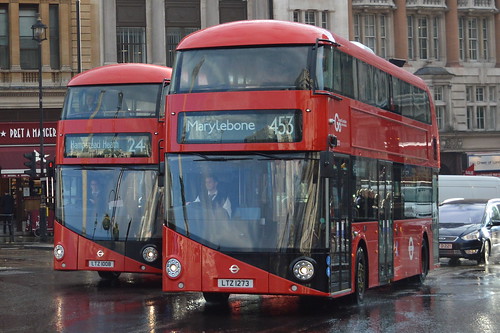
And of course, London's distinctive red double deck buses are as equally distinctive as their Underground service ("Making bus service sexy and more equitable.")

London buses, Flickr photo by Hendra Lee.

Red is the defining color of London's buses.
Red is incorporated into the system's bus shelters and other elements.

What about bus only agencies?: transit service versus social service.  When an agency only has bus service, ideally they endeavor to make it great.    And there are a number of transit agencies that  do so to the best of their ability, such as VIA in San Antonio, the transit system in Lancaster, Pennsylvania, Rochester, New York ("Creativity Helps Rochester's Transit System Turn a Profit," New York Times) etc.

But because even bus exclusive transit agencies are often seen as a social service--providing mobility options for people who can't afford to own a car--rather than a transit service, even they are likely to stint on the quality of the waiting environment (" The real reason American public transportation is such a disaster," Vox).

Some places are investing in bus stop improvements.  One is Salt Lake City.  Rather than a systematic program across the metropolitan area, the  transit stop improvements in Salt Lake City are being funded by the city, which a few years ago passed a tax initiative, Funding the Future, aimed at improving bus service.

Seattle was a pioneer in, first with Bridging the Gap, now Move Seattle, which includes specific bus route improvements initiatives, but not a general improvement to bus stops. 

Other communities have programs focused more on access to rail stations such as the First/Last Mile Access Study for the Utah Transit Authority, the Bicycle and Pedestrian Access Improvements Study for WMATA , etc.

In my writings on the Purple Line light rail project in Suburban Maryland), a number of recommendations called for bus route, shelter, and station improvements as a complementary program, with the idea of leveraging the new transit infrastructure as a way to drive improvements across the entire transit network.

Conclusion.  It's not that the SF study flabbergasts me.  It's that Bloomberg treats the finding as "news" or at least "new."  

Given how the US is a car-centric place ("The Petro States of America," Businessweek), I suppose I shouldn't be surprised that many transit systems don't invest in the quality of the transit waiting environment. 

Like in the DC area, each jurisdiction in the Raleigh-Durham metro has its own bus agency, plus a cross-jurisdictional regional agency, functioning more like WMATA.  While the agencies are separate, over time they've come to collaborate closely, to save money and provide better service.

More recently, they came up with a unified graphic design for their buses, using colors to differentiate agencies, to create a more unified and legible network.

All transit systems should be endeavoring to "design their system as a product" with a focus on a high quality "customer" experience.

Ideally, what would come out of the article in the Journal of Public Transportation ("Are Shelters in Place?: Mapping the Distribution of Transit Amenities via a Bus-Stop Census of San Francisco") is that Metropolitan Planning Organizations, the area planning agencies tasked by the federal government for area-wide transportation planning, should make bus service improvement a priority:

  • Treat the bus service system as a network, regardless of the operators
  • Focus on creating a legible system, incorporating product design, usability, and user experience design approaches
  • Systematically study stops and stations as an MPO responsibility and come up with a metropolitan-scale improvement program, based on a family of related designs for stops, shelters, and stations.
  • Encourage metropolitan areas to create initiatives like Move Seattle and Salt Lake City's Funding Our Future as a way to fund transit network improvements, with a special focus on stops and shelters.
  • For areas with multiple agencies, adopt a unified graphic design system for liveries, using the Go Transit model in Raleigh-Durham ("Will buses ever be cool? Boston versus the Raleigh-Durham's GoTransit Model").
Other concepts that should be integrated into a rider experience-focused approach are:

Labels: , , , , ,

Sunday, September 29, 2019

What Richmond can't teach DC about bus services

I am looking forward to receiving a review copy of the recently published Better Buses, Better Cities from Island Press.

In Sunday's paper, the Washington Post local opinions page has reprinted an article ("What Richmond can teach Washington about transit") which I feel like I read in Greater Greater Washington already.  And a similar piece ran as an article in the Washington City Paper.

Another piece in the Sunday paper, "The bus — yes, the bus — is key to fixing our transportation woes;," is by Robert Puentes, who chairs the advisory committee for WMATA's Bus Transformation Project.

The project and the conclusions in the op-ed aren't much different from what I've recommended in various posts for many years.

And I still argue for double deck buses as an obvious and definitive rebranding tool.
LT8 (LTZ 1008) and LT273 (LTZ 1273)

Las Vegas has used double deck buses as part of the special branding for its Deuce bus service on the Strip.  From the Las Vegas Review-Journal article "Tina Quigley, CEO of Southern Nevada transportation agency, to retire":
It all started with her first day on duty with the RTC in 2005 when Quigley helped unveil the Deuce buses on the Strip, a day she remembers fondly.

“We had a parade of Deuce vehicles up and down the Strip, and it was clear to me that this was something very new and exciting as it related to transportation,” Quigley said. “Bringing in those double-deckers — it’s hard to think of a bus as being sexy, but these were some sexy vehicles. As they paraded around the Strip and I saw the excitement and the coverage and subsequently the ridership that came along with that, I was hooked in realizing that how you present transit and create transit in a way that it is desirable and attractive really reframes the national conversation on transit.”
The Deuce

Although the Deuce buses ought to have a much more vibrant color scheme.

More cities than just London have deployed such buses.  They are common across the UK and in Hong Kong.  More transit agencies are using them across North America, although none in a large scale way.

I responded to the original entry in a blog post.

-- "Reviving DC area bus service: and a counterpoint to the recent Washington City Paper article"

The DC area has plenty of lessons to learn from other areas, but the Richmond experience with changes to its service network and the introduction of bus rapid transit isn't particularly noteworthy.

GRTC Pulse Richmond BRT
Pulse bus and station in Downtown Richmond.  Photo by BeyondDC.

The DC area has at least 1.2 million transit trips daily; Richmond, 30,000.  How much can Richmond teach us?  Note that the Post headline should read "What Richmond can teach Washington about bus service."

First, the DC area crushes the Richmond area in terms of "transit" usage overall including the number of "bus" riders.

On an average day, the DC area has about 600,000 subway trips, and at least 600,000 bus trips.  That's a minimum of 1.2 million daily transit trips.

Last year I wrote about a great marketing program for the Richmond transit agency, focused on the economic value of transit service.  Richmond Times-Dispatch photo.

Richmond has about 30,000 daily bus trips.

That's just a tad more than the ridership of DC's 70s Metrobus line, which runs between Silver Spring and Downtown DC.

That Richmond has experienced large percentage increases in bus usage is a function of a low base of riders, not some world changing move forward in best practice.

The problem is not that we need to do what Richmond is doing and we aren't.  We are.  We're just not doing it enough.

[Although, to be fair, except for integration, customer service and branding elements, the DC area is ahead of many jurisdictions in that bus to bus transfers are free across the different agencies, which use the same transit fare card system (using the same card isn't unique, but having free transfers across systems is relatively unique). And bus fares are relatively low.]

And I have written about that extensively.

The recommendations (with details and references to past blog entries and other links in the August response):

1. The Metropolitan Planning Organization, not the various transit agencies, should be the primary transit planner, setting master requirements for network breadth, network depth (frequency and levels of service), and levels of quality.

2. Contract with transit agencies to provide this level of service.

3. Define the transit network in terms of networks first at the Metropolitan; Suburban: and Center City scales; and then primary; secondary; and tertiary networks within them, which is particularly relevant to bus service.

4. To best provide service, the DC area should create a German style transport association to better plan and deliver all transit services in a more integrated fashion.

5. The bus services should be integrated better in terms of branding and support, using the model of the services in Raleigh-Durham, North Carolina, where they provide one call center providing information for all the services, have integrated schedules, a common branding system,, etc.

6. There should be a night network and other improvements, like dedicated transitways, better transit information, etc. (Dedicated transitways are expanding in DC.)

But some systems have increased ridership in the face of decline
. Among the exceptions, there are four that are outliers: Columbus, Ohio; Las Vegas; Richmond, Virginia; and Seattle.

Guess what, it's not rocket science.

Free transit.

More service.

Defined high frequency lines (usually a form of bus rapid transit).  Note that DC proper has a sub-network of seven high frequency lines that have about 15,000 to 25,000 total riders on each line.

A unified brand is the big lesson from Richmond. Richmond's Pulse BRT service advantage is that it is the only rapid bus program in Greater Richmond. By contrast the DC area has at least seven different initiatives. So instead of one brand to focus on, we have a polyglot. I argue that there should be one unified brand for BRT and/or your "high frequency bus network."

Expanding the rail network leads to increases in bus ridership.

Labels: , , , , ,