Rebuilding Place in the Urban Space

"A community’s physical form, rather than its land uses, is its most intrinsic and enduring characteristic." [Katz, EPA] This blog focuses on place and placemaking and all that makes it work--historic preservation, urban design, transportation, asset-based community development, arts & cultural development, commercial district revitalization, tourism & destination development, and quality of life advocacy--along with doses of civic engagement and good governance watchdogging.

Monday, May 13, 2024

WMATA's latest bus improvement program

is discussed by WTOP, "Metro’s future of bus service could bring new routes and end some familiar stops."  

When I first saw coverage I thought, "what about the 2017" initiative, although granted it was before covid.  And when thinking about writing about it, I remembered a bus initiative back in 2006 too.  But of course, conditions have changed greatly since then.

WRT bus service improvement see:

-- "Making bus service sexy and more equitable," 2012
-- "Will buses ever be cool? Boston versus the Raleigh-Durham's GoTransit Model," 2017
-- "Route 7 BRT proposal communicates the reality that the DC area doesn't adequately conduct transportation planning at the metropolitan-scale," 2016
-- "Reviving DC area bus service: and a counterpoint to the recent Washington City Paper article," 2019

From the article:

With additional funding, Webster said the new bus network could bring 30-minute frequency for most routes, 30 new routes that would increase connections with Metrorail stations and a regionwide 24-hour bus network, which would provide overnight connections to the region’s airports.

San Francisco Bay overnight transit map.

And with that I had to laugh.  I've been suggesting that for at least 12 years.

-- "Overnight transit service," 2012
-- "Night moves: the need for more night time (and weekend) transit service, especially when the subway is closed," 2013
-- "Night and weekend transit/subway service," 2016
-- "Overnight transit service: San Francisco," 2016

The 2013 entry states that bus service should be provided to airports when Metrorail is closed.  Also see:

-- "To and from origin stations can be difficult: More on the Silver Line and intra-neighborhood transit (tertiary network)," 2022
-- "More on airport-related transit/transit for visitors," 2013
-- "To get people who have mobility choices to choose transit, they have to know it exists," 2007

The points in this entry, although ostensibly about light rail, are really about the value of a transit network, and by extension the value of the transit network as a 24 hour service.

-- "Manhattan Institute misses the point about the value of light rail transit connections to airports | Utility and the network effect: the transit network as a platform," 2020

Related is the blog entry "Branding's NOT all you need for transit" (2018) which discusses transit as a "design product"

ensuring that each and every element within the system of providing transit and mobility services is designed to be effective, efficient, successful, powerful and connected.

DC has a long way to go for that, which is why I suggest a German style "transport association" be created to integrate the services.

-- "WMATA and MWCOG announce new joint transit initiative | Could a regional "transport association" be on the horizon, or just a transit bailout?," 2024

At some point, I wrote that it would be easy to provide transit service to National Airport overnight by extending the bus service on 14th Street.  And that a late night bus network needs to include Union Station in DC as a primary node.

========================

FWIW, in the Purple Line series ("Setting the stage for the Purple Line light rail line to be an overwhelming success: Part 2 | proposed parallel improvements across the transit network," 2017), I made a bunch of recommendations wrt bus service, although I'm glad some of the improvements will happen before 2028, when the Purple Line opens.

9.  Provide integrated bus arrival and departure information screens at Metrorail, Light Rail, and MARC stations.

10.  Bus service in certain corridors between DC and Maryland should be extended and/or frequency increased to better link these areas to the new light rail service.

Many of the area's bus services terminate at the city-state line, although there are some exceptions. DC and Maryland should commit to bus service improvements in advance of the PL launch.

11.  Montgomery County bus system improvements with the launch of the Purple Line and bi-directional service on the MARC Brunswick Line should include launch of planned Bus Rapid Transit services.   

12.  Rearticulate, rebrand, and reposition-extend the Prince George's County TheBus bus transit service. Change the name of the service and the graphic design of the bus livery.

They have the same opportunity for rearticulation with their complementary local transit system. Currently, TheBus system is the least well developed of the suburban transit agencies ("By choosing coverage over frequency, Prince George’s caps what its buses can accomplish," GGW).

But they are now working on improving the system, with a Transit Transformation initiative they launched last fall.

13.  Consider a redesign and rebranding of the the metropolitan area's bus systems into an integrated framework, comparable to that of GoTransit in the Raleigh-Durham area.

This has been discussed in depth here, "Will buses ever be cool? Boston versus the Raleigh-Durham's GoTransit Model."  This gives a  deadline for launch.

From the presentation ("The Sign Design Society Event: Defining a City," designworkplan) by Ivan Bennett, Design Manger for London Buses:

One reason other systems have failed is the lack of continuity. London bus stops extend beyond central areas and cover all routes in Greater London. Ivan indicated that passengers do not just want information about where they are travelling from, but when they get there, they need the same consistently presented information. People need information near their homes and local areas, not just in the centre of the city.

15.  Set the opening of the Purple Line as the deadline for the implementation of a full-fledged integrated Night Owl bus network for the DC metropolitan area.

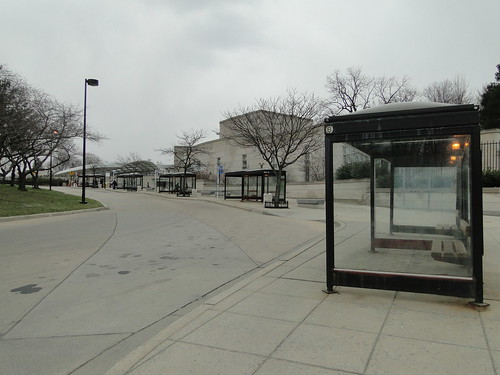
DSC0574719.  WMATA should upgrade its Metrorail station bus shelters.

Another aspect of the balkanized transit system in the DC area is that every jurisdiction has a different program for bus shelters--what Ivan Bennett, product design manager for the London bus program, calls "a lack of continuity."

Metrobus isn't responsible for shelters in the various jurisdictions, although WMATA does have bus shelters on the grounds of many Metrorail stations outside the core. 
Bus shelters at the Medical Center Metrorail Station. 

Unfortunately, the Metrorail station shelters are dowdy, don't incorporate real-time arrival and departure information, could include advertising as a revenue stream, etc.

Why not use the launch date of the Purple Line as an inducement and deadline for an overhaul of the Metrorail bus shelters across the station network?

 ... although this doesn't address the fact that in an integrated bus service branding system across the jurisdictions, ideally, there would be a common set of transit shelters and amenities across the transit network.

-- Transit Waiting Environments, for the Greater Cleveland Rapid Transit Authority
-- From Here to There: A creative guide for making public transport the way to go, EMBARQ
-- Rethinking the Suburban Bus Stop, Airport Corridor Transportation Association, Pittsburgh
-- First/Last Mile Strategies Study, Utah Transit Authority

The Kansas City Streetcar Smart City "City Post" digital kiosks include a real-time tracker application for the streetcar service ("No need to wonder where streetcar is: Kiosks now offer tracker maps," Kansas City Business Journal). Photo: Andrew Grumke. 

Labels: , , , , , ,

Wednesday, October 16, 2019

New York's 14th Street, San Francisco's Market Street (and Toronto's King Street): When major cities adopt innovative practice it makes it easier for other cities to do something similar

Following up on last week's entry, "Speaking of "Just Do It": A 14th Street bus transit mall for Manhattan," on the introduction of a highly visible transit-prioritized street in New York City.


Many years ago, I heard Charles Landry, author of books such as The Creative City: A Toolkit for Urban Innovators and The Art of City Making, speak and I thought I heard him say something like "Great cities don't just take, they give" -- providing examples of best practice and innovation that other cities can learn from and adopt/adapt on their own.

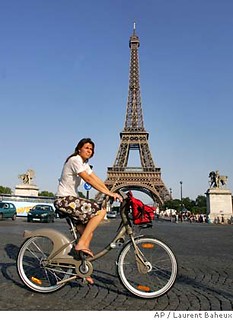
Velib at the Eiffel TowerParis and bike share.  A particularly good example is Paris and bike share.  They weren't the first city to do bike share, hardly.  But they were the first to do bike share at a large scale, with an initial deployment of hundreds of stations and more than 20,000 bikes.

It electrified not only cyclists but city leaders all over the world and it significantly increased the take up and deployment of bike share in cities all over the wrold.

It turns out he didn't exactly say that and Aaron Renn of Urbanophile credits me with making this point.

Toronto prioritizing transit on King Street.  A more recent example is Toronto prioritizing King Street for streetcar service.

It came with a fair amount of controversy, and while streetcar throughput has improved significantly and ridership increased by X%, some businesses did lose patronage and sales -- although in that case, I argued it is because the city failed to develop a parking wayfinding and validation system to complement the changes.

Wikipedia photo.

From the Toronto Star article "Latest King St. pilot data shows higher ridership, shorter commutes":
New data released on the King St. pilot project shows overall ridership was up 11 per cent during May and June.

According to the new numbers released Wednesday, ridership rose by 35 per cent during the morning commute and by 27 per cent during the afternoon rush hour.

Travel times have also been reduced by approximately 4 to 5 minutes, according to the city. This is in each direction during the afternoon commute for the slowest streetcar travel time. Average travel time during the midday also improved by 2 minutes.

The data also shows transit has become more reliable in the downtown core, with 85 per cent of streetcars arriving within four minutes during the morning commute. ...

The project has attracted controversy, especially from local business owners such as Al Carbone, owner of Kit Kat restaurant at King and John Sts., who called on Tory back in January to reverse it “immediately.” He said revenue for some establishments dropped by half.

However, according to the release, “Customer spending on King St. since the pilot began has seen a slight growth (0.3 per cent) from the average rate of spending over the same months from the year before.”
Dedicated transitways aren't a new urban design treatment. Dedicated transitways aren't new--many cities had them in the 1970s and 1980s -- but as city centers declined as a loci for shopping and pedestrian movement, many cities dropped them.

Even so, smaller cities like Portland, Denver, and Minneapolis not only introduced "transit malls" where bus service was prioritized (Portland later added light rail) and automobile traffic banned, but have continued to invest in and improve these spaces.

Still, the concept of more cities adopting dedicated transitways as a method of improving transit service -- the speed of vehicles -- in recognition that it's more important to focus on moving lots of people more quickly rather than facilitating the movement of a person or two in every car, and that high use bus and streetcar lines move significantly more people more efficiently has been pushed forward not by the great examples of Portland, Denver, and Minneapolis, but of King Street.

New York City's 14th Street.  Pushed forward originally because the L subway line was scheduled to be closed for 18 months for repair and rehabilitation, New York City has moved forward with a "pilot" of its own -- making a central section of 14th Street in Manhattan a transit priority street, with most motor vehicle traffic being banned.

Despite all the clamor of all the likely negative effects, traffic on other streets didn't come to a standstill and bus movement has improved significantly ("Cars Were Banned on 14th Street. The Apocalypse Did Not Come" and "Riding the Bus on the New 14th Street," New York Times.
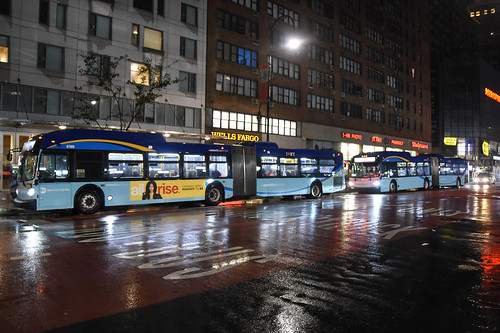
14th Street Manhattan dedicated transitway, at night
Seth Gottfried, New York Post


It helps that Manhattan has a robust grid-based street network, so there are many other options for drivers other than 14th Street.

And while the city was initially somewhat diffident about stating whether or not what happens on 14th Street would lead to the creation of other transitways elsewhere, now they are being more declarative about the concept.  Not that the New York Post is happy about it ("14th Street is only the beginning for NYC car bans, top transit official says").

San Francisco votes to ban motor vehicles from Market Street
. Like King Street, San Francisco's Market Street is a major and central thoroughfare and spine in the core, and a major route for both streetcars and buses. In fact, historically at one point it had four streetcar tracks, which is one of the only examples I've come across where streetcar traffic was so heavy.
Market Street, San Francisco, vintage postcard, showing four tracks for streetcars
(It wasn't unusually for a street to have more than two tracks when part of the street was used for another route, but usually this was for a short section, while the Market Street double trackage was for a significant distance.)

Yesterday, the transit agency board in San Francisco moved to make Market Street a transit prioritized street also ("SFMTA votes to restrict private vehicles from Market Street in bid to make area safer," San Francisco Chronicle).

The Better Market Street Project will make sustainable mobility (not just buses and streetcars but cyclists and pedestrians too) the priority on a two mile section of the street.

Incremental change.  While I argue above that Toronto set the stage for New York and San Francisco, that may be overstating the case.  SF and New York City have been recent leaders in creating dedicated lanes for surface transit, albeit in corridors that remain open to motor vehicle traffic.

Moving from mixed trnasitways to dedicated transitways can be seen as but an incremental step forward, but still a quantum jump in practice.

And Brooklyn's Fulton Street Mall has been a transit mall since the 1970s ("The Fulton Street Mall: Retail Success on NYC’s Original Transitway," Streetsblog). And outside of Manhattan, the transit and pedestrianized Fulton Street district has remained a successful retail center that draws crowds and higher than normal rents.
Before and After in Times Square, pedestrian-placemaking
Before and after, Times Square.  NYC DOT photo.

Other initiatives that transitways build on include "road diets," initiatives in New York City (which also triggered adoption of the practice elsewhere) to shift road space to pedestrian uses in Times Square and along Broadway in Manhattan (and then in other places around the city), creating and extending bikeway networks, and reducing the amount of space dedicated to parking, for parklets, bicycle sharing stations, dedicated bikeways (cycletracks), and other uses.

Long process.  And all of these projects take a long time.  Toronto first proposed the King Street initiative in 2007, but it was not until 2017 that they were able to do it.  New York City has considered transit priority streets for quite awhile, and past initiatives did not move forward.  San Francisco has been working on speeding up transit on Market Street for a long time also.

Each of these cities deserve a lot of credit for making key streets transit priority in the face of intense opposition from businesses, residents, the automobile lobby, and other stakeholders.

Other benefitsCanada's Atmosphere Fund argues that the benefits of transit priority streets are considerable and greater than mobility throughput, including:

1. Improved public health
2. Vibrancy & accessibility
3. Economic prosperity

Labels: , , , , , ,

Monday, October 07, 2019

Speaking of "Just Do It": A 14th Street bus transit mall for Manhattan

The New York City newspapers have articles about the short distance dedicated transitway that is being created on part of 14th Street, between 3rd and 9th Avenues, in Manhattan.  Not only will there be a "dedicated lane," for the most part, passenger cars will be "banned" as well.

Sign explaining the changes in association with the 18 month pilot program.  New York Post photo by James Messerschmidt.

This project was originally proposed when the L line subway was going to be closed 18 months for repairs.

-- ""RPA/Transit Riders Alliance proposal to respond to the L Subway shutdown includes a dedicated transitway on 14th Street in Manhattan," 2016

Curbed New York goes further, recommending banning cars from Manhattan ("It’s time to ban cars from Manhattan: New York City’s traffic woes have reached a tipping point, and banning cars is the solution"). Among other points, it states that only 22% of households in Manhattan own cars, but the surface mobility system privileges the movement of cars.

But even though plans have changed for the L Line, so that subway line remains operational while being repaired, the City Department of Transportation is going ahead with the proposal, which had been held up by a lawsuit.

-- 14th Street Transit & Truck Priority Pilot Project brochure, NYC DOT

While the New York Post article is pretty shrill ("The 14th Street car ban begins tomorrow — here’s what you should know"), referring to the initiative as a "car ban," befitting its pro-car editorial slant, another shrill NYP article ("De Blasio’s ‘busway’ plan for 14th Street is a nightmare set to unfold") inadvertently makes the point that to be most effective, the "car ban" should be extended further, especially through an area full of construction projects.

While the text doesn't really cover it, the headline of a New York Daily News article ("As city kicks cars off most of 14th St., fate of future street redesigns hangs in the balance") makes the point that the success or failure of this 18-month pilot will impact similar initiatives elsewhere in the city.

Recently, I picked up a bunch of books, many dating to the 1970s and some originally published overseas, on pedestrian zone initiatives, including what are called transit malls -- transit malls are dedicated to bus transit and may or may not have pro-pedestrian elements.

(Bus) Transit Malls.  In the US, today, the most prominent transit malls are 16th Street in Denver, Nicollet Mall in Minneapolis, and the transit mall on 5th and 6th Avenues in Portland, Oregon.  While these streets concentrate bus service, the Denver and Minneapolis bus malls also have a separate bus-mall-only bus that is free, basically an intra-district bus service.c

-- "Making the case for intra-city (vs. inter-city) transit planning," 2011

Even more so than 16th Street in Denver, the Nicollet Mall is intended to be an active pedestrian district, which is tough because of how the retail and entertainment sectors are organized, but they continue to invest in this, including a recognition of the need for special treatments at night.

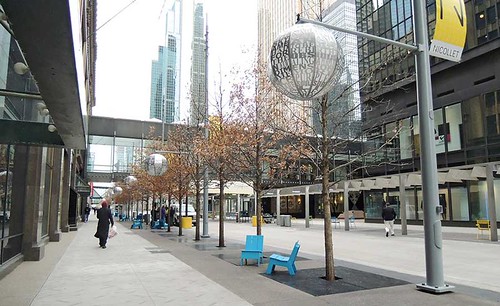
Nicollet Mall, Minnesota, after redesign
Nicollett Mall after a redesign including new sidewalks, nearly 250 trees, LED lighting, 12 bus shelters and the city’s largest public art display outside of the Minneapolis Sculpture Garden, as well as new street signage, point-of-interest signs and totem maps.  Photo by Justin Gese.

The problem with transit malls is by concentrating bus service, they are great for bus service, but the quality of the pedestrian experience isn't so great, because buses are big and noisy.

A Streetcar Transit Mall: King Street, Toronto.  More recently, Toronto has made a key section of King Street, a streetcar "mall."

In terms of its capture of total trips, the King Street streetcar is an outlier, where 75% of the mobility throughput (65,000 people) on the corridor is by streetcar and 25% by cars (20,000 vehicle trips), with such a high percentage of the throughput being captured by transit.

I know that on many of DC's primary bus routes, transit as a proportion of the passenger throughput isn't quite as high, but is still above 40%, which is very good.

King St. has changed to more pedestrian and TTC friendly with cars only allowed to go a single block along the street before having to turn off.  (RICHARD LAUTENS / TORONTO STAR).  The TTC announces the King Street streetcar prioritization project on vehicle livery for the streetcar line.

Shawn Micaleff, a columnist for the Toronto Star, has a piece on the King Street initiative, "King St. pilot project does what big cities around the world are doing," writing:
One of my earliest memories of feeling frustrated in Toronto was riding a streetcar. The streetcars themselves were fine: elegant street ships sailing the city’s rail network like an electric nervous system.

What was confounding was that one lone car turning left, often just carrying one driver, could hold up an entire streetcar filled with dozens of people, sometimes up to 130 or over 200 people, depending on if it was a short or long streetcar. Other times there were just too many cars on the road to allow quick passage of a mass transit vehicle.

Something seemed out of whack. How could this be? Was there no political courage in this new city of mine to give vehicles carrying many people a quicker passage? My newcomer’s naïveté was soon corrected.
I think this is one of the most important surface transportation initiatives right now in North America ("A transit miracle on King St. shows how it can work," Star), because despite the headline of the Micaleff column, the fact of the matter is that most cities are not prioritizing transit in this way, because the electorate continues to be car-centric, so that elected officials don't have the cover to be able to pursue transit prioritization on city streets.

The world hasn't yet come to an end.  According to Crain's New York Business ("Buses cruise 14th Street on first day of traffic experiment"). From the article:
The first day of the city's busway experiment on the crosstown street zipped buses along to the point drivers had to slow down to keep to their schedules, The Wall Street Journal reported.

The MTA's acting head of bus operations told the Journal the agency might have to shorten its schedules if the pace continues. That's quite a shift from a report earlier this year on the M14 route's reliability, which found only about half its buses typically arrived on time.
But the NYP thinks the world has come to an end, such as how an Uber driver had to pick up a customer around the corner, not on 14th Street ("14th Street car ban begins, causing headaches for motorists).

A new restriction on cars along 14th Street is meant to speed up public buses along a major crosstown route.Credit: Natalie Keyssar for The New York Times.

According to the New York Times ("Cars All but Banned on One of Manhattan’s Busiest Streets"), this only impacts 21,000 vehicles/day, which isn't a whole lot. From the article:
Buses cruised along without getting trapped behind cars.

Thousands of riders used to being late to work or for appointments were suddenly early.

On Thursday, New York City transformed one of its most congested streets into a “busway” that delighted long frustrated bus riders and transit advocates but left many drivers and local businesses fuming that the city had gone too far.

Passenger cars, including taxis and Ubers, were all but banned from 14th Street, a major crosstown route for 21,000 vehicles a day that links the East and West Sides of Manhattan.

It was New York’s most ambitious stand yet against cars since the first pedestrian plazas were carved out of asphalt more than a decade ago.
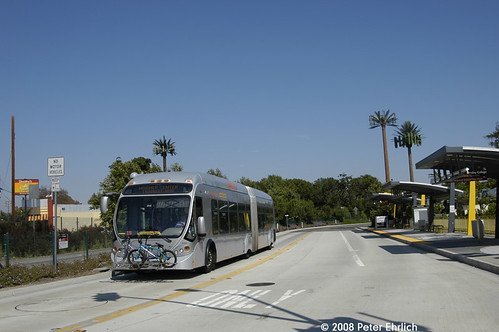
Bus rapid transit transitways.  Mostly outside of city centers are dedicated transitways for bus service, serving various bus rapid transit programs, including Pittsburgh, Eugene, Oregon, Connecticut, the San Fernando Valley Orange Line, even the short Metroway dedicated busway between Alexandria and Arlington in Virginia, etc.
LOS ANGELES--9203 appr Valley College Station OB

Herron Station Inbound P1

Transitways were more common in the 1970s and 1980s.  But I didn't know that dedicated transitway networks were much more common in the 1970s and 1980s, as part of various initiatives to promote transit and the continued relevance of inner cities as major employment centers.

-- "We had bus lanes a half century ago and we can again," PlanIt Metro (WMATA, Washington), 2014

As automobile usage continued to grow and transit ridership dropped significantly, these transitway networks were discontinued, in DC, Philadelphia ("Did Philadelphia make a terrible mistake getting rid of the Chestnut Street Transitway," Philadelphia Inquirer), and elsewhere.
Chestnut Street Transitway, Philadelphia, postcard

 From the PI:
For many Philadelphians, it is an article of faith that the bus-only Transitway was a major policy fail that nearly killed shopping on Chestnut Street. But from the vantage of 2018 (as well as the back of a traffic-moored 42 bus) that narrative seems as outdated as tie-dye and bell-bottoms.

Opened in 1975, the Transitway transformed the 12 busiest blocks of Chestnut Street — from Sixth to 18th — into a corridor that prioritized pedestrians and buses over cars. Because it was a product of the ‘70s, when cities were struggling to compete with suburban shopping, the Transitway was really an urban mall in transit clothing, featuring elaborately paved sidewalks, lots of pedestrian seating, and futuristic traffic lights called “Transitrons.”

Even though the city was mainly interested in simulating a suburban shopping experience, the corridor was still a transit-rider’s dream. In its original incarnation, buses cruised in both directions. Maybe the most futuristic thing about the Transitway was that you could get from one end of Center City to the other in under 15 minutes.

Yet, within a few years of its creation, merchants turned against the project. The Transitway was blamed for everything from dirty sidewalks to unruly teenage behavior, especially after the Easter Parade got out of hand in 1985 and shop windows were broken. Based on news clips from the time, it’s striking how much the complaints resemble those that would be leveled later against the Gallery, another disgraced ‘70s retail experiment.
Therefore creating a transit prioritized surface street in Manhattan is a big deal.  New York City already has a large number of dedicated bus lanes, called Select Bus Service.  But like in most places, these are exclusive lanes as part of a street that has other lanes dedicated to regular traffic.

-- Select Bus Service, NYC DOT

What is happening on 14th Street is different.  Regular passenger car traffic is now excluded, so they are on the way to developing a bus transit mall, except that taxis/ride share vehicles (and this is not uncommon) and delivery vehicles still have access.

That New York City is creating a highly visible bus priority transitway on 14th Street is noteworthy.  It will be highly prominent, and if successful (although NYC has other preconditions supporting success not necessarily possessed in the same way by others) it will make it easier for other transit agencies to promote and deploy similar initiatives.

(Like the Select Bus Service, DC is slowly expanding a new network of bus transitways. See "DC's downtown bus lanes aren't temporary after all," WTOP-radio).

How to make the 14th Street bus mall an even bigger deal: bi-articulated buses.  In the piece I wrote in 2016 about this, which was originally a response to the planned closure of the L subway line, I suggested that like in Europe, it would be transformational to deploy bi-articulated buses.

I've seen them in operation on the bus mall in Hamburg's pedestrian district ("Monckebergstraße transitway in Hamburg, Germany and bi-articulated buses," 2014)

The 14th Street bus mall "pilot" would be an even bigger deal if they could use 80' bi-articulated buses.  Or even just get a chance to demonstrate them.
Bi-articulated bus, Spitalerstrasse, Hamburg, Germany
Bi-articulated bus, on 
Mönckebergstraße in the Spitalerstraße pedestian district, Hamburg, Germany. 

Spitalerstrasse transit mall, Hamburg, Germany

But the FTA and the FHWA don't allow bus vehicles of this length on public streets in the United States.  (On freeways, some states allow similar length truck and trailer tandems.)

Labels: , , , , , ,

Friday, October 04, 2019

Revisiting the Purple Line (series) and a more complete program of complementary improvements to the transit network

======
Addition, May 6th, 2020

Re-reading the paragraph below:

In 2017, I did some of my best writing ever, partly spurred by interaction with Paul Meissner, who did a "fantasy" transit map for me, as well as a current systems map, but including both subway and railroad services, on the Purple Line.

I failed to acknowledge blogreader Ed Drozd. After my Purple Line piece on a program, which mentioned creating "sustainable mobility corridors" on streets like Fenton Avenue in Silver Spring, he asked me to define what I meant more fully.

At first, my response was likely to have been somewhat rote, but I made a bunch of "site visits" and started thinking more broadly. That led to the multi-part series on Silver Spring as an innovation district and sustainable mobility district.

I thank him for spurring me on.

=====
This is being republished with the addition of a fourth point on the general network, that opportunities to leverage the new transit infrastructure as a way to drive the creation of "hubs" and centers is being missed in Prince George's County specifically, using New Carrollton as an example, but with a link to "Missing a great chance to create a transit hub: New Carrollton," by Alex Block/City Block.

It was published in January but I just came across it.
=====

Wikipedia image.

The Purple Line light rail program is building a 21 station, 16 mile line which will connect both legs of the Red Line Metrorail, the north leg of the Green and Yellow Lines, and the eastern end of the Orange Line, along with connections to all three MARC commuter lines.

Purple Line to open a small section in late 2022.  It was recently announced that due to construction delays, the line will open in two phases, with a short section in 2022 just so they can say they opened in 2022, and the rest of the system in 2023,  ("Purple Line will open in two phases, with first part in Prince FGeorge's, state says," Washington Post). From the article:
Rather than open the full Purple Line a year late, Maryland transit officials said Thursday that they will open it in two phases, with the first segment carrying passengers in Prince George’s County in late 2022 and the rest opening the next year.

While the 16-mile light-rail line was scheduled to open in March 2022, officials said construction delays mean the full line couldn’t open until at least April 2023.

Project officials said they want passengers to ride at least part of the line by the end of 2022.

The length and exact location of the first segment hasn’t been determined, but it will include a two-mile test track being built along Veterans Parkway (Route 410) between New Carrollton and Riverdale Road, state transit officials said.
In 2017, I did some of my best writing ever, partly spurred by interaction with Paul Meissner, who did a "fantasy" transit map for me, as well as a current systems map, but including both subway and railroad services, on the Purple Line.

Integrated rail transit map for the Washington DC Metropolitan area, including the Purple Line light rail routing

Conceptual Future integrated rail transit service network for the Washington DC National Capitol Region. Design by Paul J. Meissner.  Concept by Richard Layman and Paul Meissner.

I wrote a many part series based on the concept that when developing new transit infrastructure it makes sense to drive complementary improvements across the transit network, to make both the existing network and the new expanded network more successful.

So the idea then is about a "transit network improvement program" which is "complementary" to the introduction of new transit infrastructure.

So this was a proposal for "the" Complementary Transit Network Improvement Program that should have been created in association with the Purple Line.

The article series

-- Setting the stage for the Purple Line light rail line to be an overwhelming success: Part 1 | simultaneously introduce improvements to other elements of the transit network
-- Part 2 |   the program (macro changes)
-- Part 3 |   influences
-- Part 4 |   Making over New Carrollton as a transit-centric urban center and Prince George's County's "New Downtown"
-- PL #5: Creating a Silver Spring "Sustainable Mobility District"
-- Part 6 |  Creating a transportation development authority in Montgomery and Prince George's County to effectuate placemaking, retail development, and housing programs in association with the Purple Line
-- Part 7 | Using the Purple Line to rebrand Montgomery and Prince George's Counties as Design Forward

Within the list of items, #20 was "Create "sustainable mobility" corridors in Silver Spring (and other places), complementing the new PL," and reader Edward Drozd asked me to expand the concept.

At first it was going to be reasonably simple, but doing field visits over a couple months, it became a much bigger idea, repositioning the core of the Silver Spring conurbation as a "sustainable mobility" district/innovation district, and a multi-part series.

-- PL #5: Creating a Silver Spring "Sustainable Mobility District"
Part 1: Setting the stage
Part 2: Program items 1- 9
Part 3: Program items 10-18
Part 4: Conclusion
Map for the Silver Spring Sustainable Mobility District
(Big Hairy) Projects Action Plan(s) as an element of Comprehensive/Master Plans
Creating the Silver Spring/Montgomery County Arena and Recreation Center

WRT the general program of "complementary network improvements" that I outlined, one is starting to be implemented, but only one.

Here's the full list which reflects one addition included in the later post, "A Purple Line update: the downside of "Public Private Partnerships" -- they are contracts, not partnerships (+ a Penn Line infill station):
  1. Change the WMATA Metrorail map so that it includes the Purple Line and regional railroad services
  2. Integrate the Purple Line light rail line into the Metrorail fare system
  3. Integrate MARC fares into the SmarTrip/ CharmCard fare media system
  4. Introduce bi-directional passenger rail service between DC and Frederick on the MARC Brunswick Line
  5. Consider charging DC-Montgomery County trips on a bi-directional Brunswick Line using the Metrorail/Purple Line tolling/fare schedule. That would treat mileage from railroad trips in the context of a complete (linked) trip on railroad+subway+light rail as a single fare
  6. The White Flint Sector Plan calls for an infill MARC station. Plans to build that station should be accelerated as part of this proposal
  7. Build an infill train station in DC on the Penn Line, serving the New York Avenue corridor
  8. Provide integrated train arrival information screens at Metrorail, Light Rail, and MARC stations
  9. Provide integrated bus arrival and departure information screens at Metrorail, Light Rail, and MARC stations
  10. Bus service in certain corridors between DC and Maryland should be extended and/or frequency increased to better link these areas to the new light rail service
  11. Montgomery County bus system improvements with the launch of the Purple Line and bi-directional service on the MARC Brunswick Line should include launch of planned Bus Rapid Transit services
  12. Rearticulate, rebrand, and reposition-extend the Prince George's County TheBus bus transit service. Change the name of the service and the graphic design of the bus livery
  13. Consider a redesign and rebranding of the metropolitan area's bus systems into an integrated framework, comparable to that of GoTransit in the Raleigh-Durham area
  14. Set the opening of the Purple Line as the deadline for the integration of the MARC Penn Line and VRE Fredericksburg Line into one combined railroad passenger service
  15. Set the opening of the Purple Line as the deadline for the implementation of a full-fledged integrated Night Owl bus network for the DC metropolitan area
  16. Create a cheap weekend pass to use the local transit network, especially Metrorail
  17. Incorporate quantum improvements in bicycle facilities across the mobility network in association with the launch of the Purple Line
  18. Rearticulate transportation demand management programming and services in conjunction with the PL launch, including a single network of "customer information centers"
  19. WMATA should upgrade its Metrorail station bus shelters
  20. Create "sustainable mobility" corridors in Silver Spring (and other places), complementing the new PL.
But over time, I realized I missed a few items.

Meta-network improvements

In the original series I deliberately didn't include items outside of improving existing program and services within the footprint of the DC area transit network.  So I didn't include more planning-related items, or items outside of DC, but still relevant.
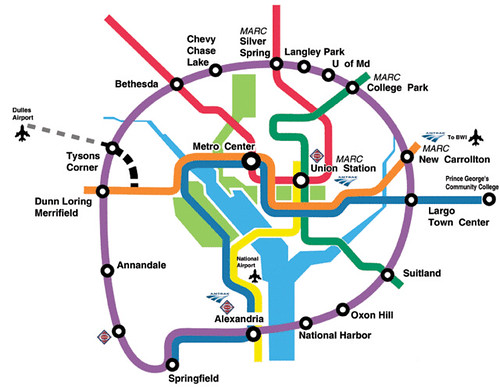
Purple Line Map  DC MetroOriginal Purple Line concept as rendered by the Metro DC chapter of the Sierra Club.

1. Expansion planning for the Purple Line on the south.  I didn't include beginning expansion planning for the Purple Line, at the very least southwest from New Carrollton to connect to the Blue/Silver Lines at Largo Town Center, the Green Line at Suitland, and even the Yellow/Blue Lines across the Potomac River in Alexandria.

2. Expansion planning for the Purple Line on the north As well as planning for extension on the northwest from Bethesda to Virginia.

Light rail at Penn Station, BaltimoreBaltimore Light Rail train at Penn Station.

3. New vehicles for Baltimore Light Rail.  At the same time, Maryland MTA should have used the contract with the Purple Line train vehicle provider to provide upgraded transit vehicles for the Baltimore Light Rail, which is pretty clunky (pictured at right).

By contrast, CAF Urbos light rail vehicles that will be used for the Purple Line are quite attractive, and replacing the light rail vehicles in Baltimore could have a transformative effect on rail transit planning there (also see "From the files: transit planning in Baltimore County." 2012).
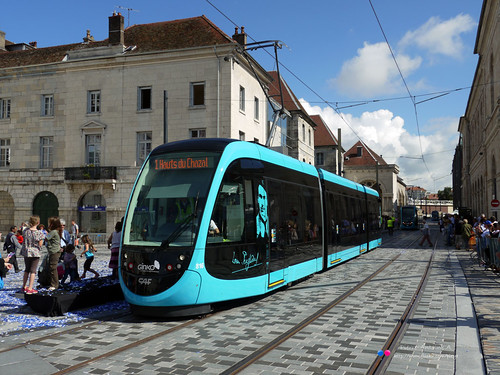
CAF Urbos 3 - Ginko 816

Local stuff that I missed

Silver Spring
These items are relevant to the Silver Spring series, although Item #2 in the general list, "Create an inter-city bus waiting station on the ground level of the Silver Spring Transit Center;" could be in either list.

The only movement on any of the items in the original list is that the area is moving forward on creating some type of business improvement district mechanism.

1. Extend the Ellsworth Avenue Pedestrian Mall to the Metrorail Station.  I wrote a piece in 2018 about extending the pedestrian district from Ellsworth Avenue between Georgia Avenue and Fenton Street west to the Silver Spring Metrorail Station, ideally anchored by a Boscovs Departmenet Store in the redeveloped Discovery HQ ("Making "Downtown Silver Spring" a true open air shopping district by adding department stores").

Wiesbaden Germany Pedestrian Zone
Spine of the Wiesbaden Germany Pedestrian Zone.  From Pedestrian Zones: Car-Free Urban Spaces, published by Braun, page 93.

I know this is a bit of a stretch, but department stores can still thrive in certain situations, and I believe that Silver Spring is one such place.

Expanding on the pedestrian district there would be a model best practice for the DC area.  Note that as it is, this pedestrianizing district is one of the only ones in the DC area that anchors night-time activity, something I've meant to write about for a couple years.

2. Pedestrianizing part of Fenton Street.  I should have suggested some pedestrianizing (but still with transit) of Fenton Street, at a minimum from Colesville Road to Wayne Avenue.  Bus access would still be maintained.
2009 03 10 - 2752 - Silver Spring - Fenton St at Ellsworth Dr

3.  Add an Upper level exit from the Silver Spring Metrorail Platform.  A group of people in Silver Spring are advocating for exits from the platform to the southeast area of the station complex without having to go to the ground floor to exit.

It turns out WMATA has studied this back in 2014, more in terms of integrating the PL platform into the station complex ("Study Recommends New Mezzanine to Connect Red/Purple at Silver Spring," PlanIt Metro),   But it would both better connect the PL platform to the Metrorail platform, as well as provide a connection from the Metrorail platform to the surface above.

WMATA believes this would end up being the most used entrance/exit for the station.

4.  Add at least one children's playground to the urban core.  My thinking has evolved on accommodating families, especially little kids with lots of energy ("Keeping Cities from Becoming “Child-Free Zones”," Governing Magazine).

While Downtown Silver Spring has a small splash park, and in the winter an ice rink, that's not enough.

Inspiration Playground, Bellevue, Washington.

While the district doesn't need to develop a full-fledged focus on families, as it is more adult-focused, having a couple small playgrounds would help to expand the range of amenities provided for other demographics.

5.  A brief follow up to the proposal for rooftop fields, Item #8 in Creating the Silver Spring/Montgomery County Arena and Recreation Center." In June 2019 I wrote about the new rooftop court for the Washington Kastles professional tennis team ("Revisiting stories: rooftop recreation and sports facilities in cities").  It shows it can be done.

Additions to the general program of "Complementary Transit Network Improvements" as proposed in association with the development of the Purple Line light rail program

Ft. Lauderdale Sun-Sentinel photo.

1. Intra-district shuttle services within the catchment area of the individual light rail stations.  The discussion in the Silver Spring series, "Item #5: Rearticulate parking services on Fenton Street/across the Silver Spring Triangle to accommodate cycletracks/removal of street parking," includes a form of intra-district transit shuttles, there using electric vehicles to move people from parking to destinations, etc.

This concept needs to be extended to mobility sheds of the individual light rail stations, to provide a way for people to get to and from the stations without having to drive.

-- "Updating the mobilityshed / mobility shed concept," 2008

The diagram below illustrates the idea, although the catchment area is illustrated for bicycling and walking.  Transit extends the shed further outwards.
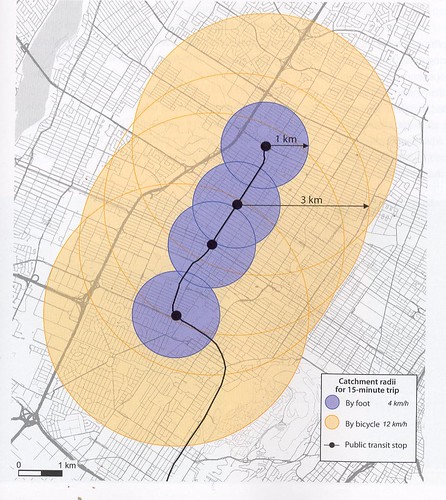
Catchment area of public transit stops for pedestrians and cyclists
Catchment area of public transit stops for pedestrians and cyclists.  p. 135, _Planning and Design for Pedestrians and Cyclists: A Technical Guide, published by VeloQuebec.

A lot of transit agencies are now hyped on this concept, re-termed "microtransit" and there are various examples being piloted by transit agencies across the country.

Lyft, Uber, Via and other firms offer to be the contractor for these services, and they have been the impetus for developing such services in many places.

But the concept has been around for decades, just not integrated in a structured way into the transit delivery framework, although the Montreal transit system has called it taxi collectif and offered it for decades, and it operates on the edges of their system.

This  Ft. Lauderdale Sun-Sentinel article is very good about how the small electric shuttles work and tend to be funded, "They're like Uber but free: New electric shuttles popping up all over South Florida."  This piece describes the microtransit shuttle program in a community in Orange County, California ("OC Flex program makes getting around Aliso Viejo easier," Orange County Register).

And the success of a program in Colorado ("Popularity of an on-demand service surging for a Colorado Agency," Metro Magazine), where 25% of the ridership moves to and from a transit station and two major office complexes.

But there are a great number of other examples. 
While the programs have small vehicles which are open to the elements and have a maximum capacity of 6-8 people, there is a 15 person enclosed vehicle that is reasonably priced.

2.  Create an inter-city bus waiting station on the ground level of the Silver Spring Transit Center.  This point has many influences, including seeing all the people stand outside waiting for the various MTA commuter buses on Colesville Road, close to the intersection with East-West Highway, west of the Silver Spring Metrorail Station.

WRT the Silver Spring Transit Center which I have reviewed separately ("Multiple missed opportunities in the creation of the Silver Spring Transit Center" and "Updating my review of the Silver Spring Transit Center") I realize now that inter-city bus services, including long distance commuter buses, plus the transit information center and restrooms, plus visitor services which are not currently provided, should be accommodated by building an extension outward from the existing footprint, on Colesville Road, on the opposite side of the Metrorail station.

Instead they are provided in a section of the center set way back within the SSTC on the second floor, and inter-city buses get a bay on the second floor.  But it would be a lot better for them if they didn't have to deviate too much from Colesville Road.

The area where such a facility could be placed is shown on the above photo, with the red box.  Although right now this entire area is blocked off for the construction of the Purple Line.

One model for how to do this is the main bus station for the Charlottesville transit system.  It's on two levels.

The upper floor serves the pedestrian mall, and that's where the visitor center is.

The ground floor serves the bus system, and has a waiting room and restrooms.  (I don't have a good photo.)  It doesn't have a coffee shop/cafe, one could be included.

The Merseyrail system has information centers that double as convenience stores, not with full cafe functions, but they sell coffee and sundries.  (The machine that produces the coffee does a good job.)  That could be a model for how to do it here.

3.  Adding a new MARC service to the I-270 corridor.  In other pieces, I think I have suggested a MARC line in the I-270 corridor. 

And frankly, you can't build a new line in the timeframe of the Purple Line construction process, which is less than five years.  Maybe this needs to be in a separate category, as a long term complementary transit network improvement, since it can't be finished within the same time frame as the PL.

Nevertheless, it needs to be considered in the context of corridor management ("Maryland HOT lane study versus "corridor management"") and transportation demand management.

Instead, because the private sector will pay for it, Governor Hogan wants high occupancy toll lanes ("Hogan toll lanes on lower I-270 first," Washington Post) and is even open to the idea of a monorail ("A Montgomery developer has a plan to ease traffic on I-270: Build a monorail and "Monorail advocates say Maryland officials will consider it for I-270," Washington Post) which doesn't make a lot of sense.  (The High Road Foundation has been created to promote a monorail in the I-270 corridor.)

But not transit.  Even though the capacity of transit vehicles as a line, either for bus or rail, is much higher than a HOT lane, which probably has a maximum throughput of 2,200 vehicles per hour per lane.

The monorail proposal is a service from Frederick to Shady Grove Metrorail Station.

I think the distance between the I-270 corridor and the existing Metropolitan Branch railroad line is far enough to justify another railroad line, for transportation demand management purposes.  It could be constructed as cut and cover, under the freeway traffic lanes, and would have to be electrified.

It could provide direct service to Bethesda which MARC doesn't do and even underground along the Wisconsin Avenue corridor into Georgetown and Arlington County and Tysons, Virginia, which would make it a positive addition to the transit network, expanding service to areas not currently served.

Yes, it wouldn't be cheap to construct. Not so much the part under the freeway, but the parts getting to and from the freeway right of way.

The Alameda Rail Corridor serving the Ports of Los Angeles and Long Beach and the Reno Retrac project are examples of building below grade troughs for railroad service. The Alameda trough isn't covered, but the Reno project is, with "lids" ("Opposed early on, ReTRAC trench is fulfulling its promise," Northwest Nevada Business Review) comparable to how decks over freeways are being constructed for parks like the Klyde-Warren Park in Dallas ("How Klyde Warren Park Was Built," D Magazine) or the Capitol Crossing development in DC which was constructed by building a deck over I-395 adjacent to Massachusetts Avenue.
Reno Retrac project

More recently, the State has decided to defund the Corridor Cities Transitway ("Maryland cuts funding for Corridor Cities Transitway," Post) and a comment on the Post article made the point that anything that doesn't support HOT lanes, the state isn't too concerned about.

4.  The opportunity to build broader hubs is likely missed |  New Carrollton as an example of falling flat on leveraging transit infrastructure to drive broader improvements.  #4 in the series, "Making over New Carrollton as a transit-centric urban center and Prince George's County's "New Downtown"," is but a slight revision of a piece I first wrote in 2014.

I just happened across a January 2019 piece, "Missing a great chance to create a transit hub: New Carrollton," by Alex Block/City Block, which addresses this in a more detailed way in terms of the connections between the different modes, as well as leveraging the urban design elements.

When I first wrote the New Carrollton piece, a PG-based blogger responded, making the point that the "New Downtown" should be Largo Town Center, since PG County has been locating agencies there.

But that's bad advice.  For the most part, there is nothing "urban" or Downtown-like (see "The 20 Ingredients of an Outstanding Downtown," Roger Brooks International) about Largo Town Center, and that's true of all the PG County facilities that are being sited there.  They are each separate, disconnected properties.

New Carrollton has the opportunity to be made over.  And it would behoove Prince George's County to do so.  Although this kind of vision is beyond their capacity.

-- Putting the Urban in Suburban: Art and Business of Placemaking, Canada
-- Reinventing Suburban Business Districts, Urban Land Institute
-- Reinventing America's Suburban Strips, Urban Land Institute
-- Revitalizing Suburban Downtown Retail Districts, Delaware Valley Regional Planning Commission (Greater Philadelphia)

Labels: , , , , , , ,

Sunday, September 29, 2019

What Richmond can't teach DC about bus services

I am looking forward to receiving a review copy of the recently published Better Buses, Better Cities from Island Press.

In Sunday's paper, the Washington Post local opinions page has reprinted an article ("What Richmond can teach Washington about transit") which I feel like I read in Greater Greater Washington already.  And a similar piece ran as an article in the Washington City Paper.

Another piece in the Sunday paper, "The bus — yes, the bus — is key to fixing our transportation woes;," is by Robert Puentes, who chairs the advisory committee for WMATA's Bus Transformation Project.

The project and the conclusions in the op-ed aren't much different from what I've recommended in various posts for many years.

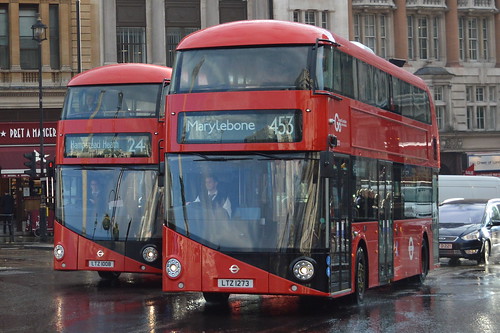
And I still argue for double deck buses as an obvious and definitive rebranding tool.
LT8 (LTZ 1008) and LT273 (LTZ 1273)

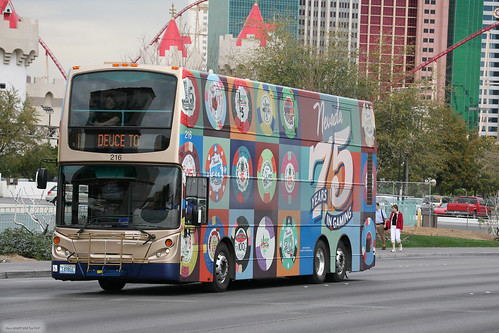
Las Vegas has used double deck buses as part of the special branding for its Deuce bus service on the Strip.  From the Las Vegas Review-Journal article "Tina Quigley, CEO of Southern Nevada transportation agency, to retire":
It all started with her first day on duty with the RTC in 2005 when Quigley helped unveil the Deuce buses on the Strip, a day she remembers fondly.

“We had a parade of Deuce vehicles up and down the Strip, and it was clear to me that this was something very new and exciting as it related to transportation,” Quigley said. “Bringing in those double-deckers — it’s hard to think of a bus as being sexy, but these were some sexy vehicles. As they paraded around the Strip and I saw the excitement and the coverage and subsequently the ridership that came along with that, I was hooked in realizing that how you present transit and create transit in a way that it is desirable and attractive really reframes the national conversation on transit.”
The Deuce

Although the Deuce buses ought to have a much more vibrant color scheme.

More cities than just London have deployed such buses.  They are common across the UK and in Hong Kong.  More transit agencies are using them across North America, although none in a large scale way.

I responded to the original entry in a blog post.

-- "Reviving DC area bus service: and a counterpoint to the recent Washington City Paper article"

The DC area has plenty of lessons to learn from other areas, but the Richmond experience with changes to its service network and the introduction of bus rapid transit isn't particularly noteworthy.

GRTC Pulse Richmond BRT
Pulse bus and station in Downtown Richmond.  Photo by BeyondDC.

The DC area has at least 1.2 million transit trips daily; Richmond, 30,000.  How much can Richmond teach us?  Note that the Post headline should read "What Richmond can teach Washington about bus service."

First, the DC area crushes the Richmond area in terms of "transit" usage overall including the number of "bus" riders.

On an average day, the DC area has about 600,000 subway trips, and at least 600,000 bus trips.  That's a minimum of 1.2 million daily transit trips.

Last year I wrote about a great marketing program for the Richmond transit agency, focused on the economic value of transit service.  Richmond Times-Dispatch photo.

Richmond has about 30,000 daily bus trips.

That's just a tad more than the ridership of DC's 70s Metrobus line, which runs between Silver Spring and Downtown DC.

That Richmond has experienced large percentage increases in bus usage is a function of a low base of riders, not some world changing move forward in best practice.

The problem is not that we need to do what Richmond is doing and we aren't.  We are.  We're just not doing it enough.

[Although, to be fair, except for integration, customer service and branding elements, the DC area is ahead of many jurisdictions in that bus to bus transfers are free across the different agencies, which use the same transit fare card system (using the same card isn't unique, but having free transfers across systems is relatively unique). And bus fares are relatively low.]

And I have written about that extensively.

The recommendations (with details and references to past blog entries and other links in the August response):

1. The Metropolitan Planning Organization, not the various transit agencies, should be the primary transit planner, setting master requirements for network breadth, network depth (frequency and levels of service), and levels of quality.

2. Contract with transit agencies to provide this level of service.

3. Define the transit network in terms of networks first at the Metropolitan; Suburban: and Center City scales; and then primary; secondary; and tertiary networks within them, which is particularly relevant to bus service.

4. To best provide service, the DC area should create a German style transport association to better plan and deliver all transit services in a more integrated fashion.

5. The bus services should be integrated better in terms of branding and support, using the model of the services in Raleigh-Durham, North Carolina, where they provide one call center providing information for all the services, have integrated schedules, a common branding system,, etc.

6. There should be a night network and other improvements, like dedicated transitways, better transit information, etc. (Dedicated transitways are expanding in DC.)

But some systems have increased ridership in the face of decline
. Among the exceptions, there are four that are outliers: Columbus, Ohio; Las Vegas; Richmond, Virginia; and Seattle.

Guess what, it's not rocket science.

Free transit.

More service.

Defined high frequency lines (usually a form of bus rapid transit).  Note that DC proper has a sub-network of seven high frequency lines that have about 15,000 to 25,000 total riders on each line.

A unified brand is the big lesson from Richmond. Richmond's Pulse BRT service advantage is that it is the only rapid bus program in Greater Richmond. By contrast the DC area has at least seven different initiatives. So instead of one brand to focus on, we have a polyglot. I argue that there should be one unified brand for BRT and/or your "high frequency bus network."

Expanding the rail network leads to increases in bus ridership.

Labels: , , , , ,

Tuesday, August 27, 2019

Reviving DC area bus service: and a counterpoint to the recent Washington City Paper article

-- "What Lessons Can D.C. Glean From Richmond's Bus Overhaul?"

(Metrobus, especially in DC, already does the things that Richmond implemented.)

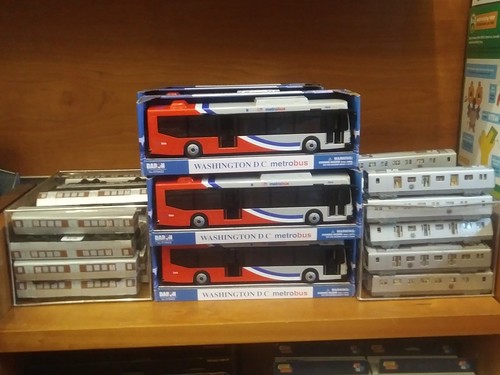
WMATA train car and Metrobus toysBus service is the DC area is balkanized.  Cross-jurisdictional services are provided primarily by Metrobus, the bus unit of WMATA, the Washington Metropolitan Area Transit Authority, which runs the Metrorail system, which dominates the agency.

Intra-jurisdictional services are mostly provided by jurisdiction-specific agencies, with the exception of DC and to some extent Prince George's County, Maryland, where a majority of bus service (in terms of number of riders) is provided by Metrobus.

Metrobus service is contracted and paid for by the jurisdictions, and sometimes jurisdictional policy decisions result in disconnections within "the bus service network."

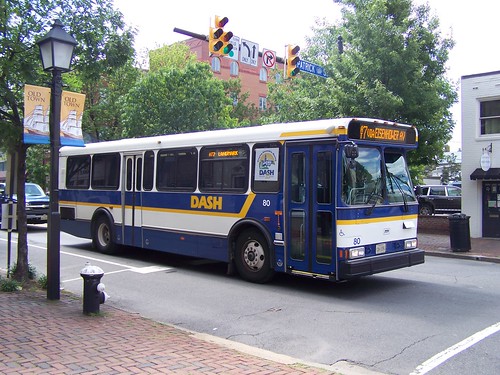
Alexandria Dash busFor example, Maryland Mass Transit Administration, which ultimately makes the decisions about service, pretty much refuses to fund/authorize bus services that cross the DC border, although there are some exceptions.

As an example, this is why the 30s buses stop at Friendship Heights on the DC-Maryland border, rather than continue to Bethesda or further north.

Simultaneous with the recent failures of Metrorail, which have resulted in a loss of about 15% of daily ridership, bus service has also declined significantly, but slightly less, at 12%.

This makes sense, because many daily journeys involve legs on both subway and bus, and a drop off of Metrorail ridership means a concomitant drop in bus ridership.

Every 10-15 years, WMATA does a big bus study.  Previously this had been done in the early part of the 2000s), and the most recent is the "Washington Area Bus Transformation Project," which makes a number of recommendations for improvement.

In various writings I have recommended:

1.  The Metropolitan Planning Organization, not the various transit agencies, should be the primary transit planner, setting master requirements for network breadth, network depth (frequency and levels of service), and levels of quality.

2.  Contract with transit agencies to provide this level of service.

-- "Without the right transportation planning framework, metropolitan areas are screwed, and that includes the DC area," 2011
-- "Metropolitan Transit Planning: Towards a Hierarchical and Conceptual Framework," 2010
-- ""Route 7 BRT proposal communicates the reality that the DC area doesn't adequately conduct transportation planning at the metropolitan-scale," 2016

3.  Define the transit network in terms of networks first at the Metropolitan; Suburban: and Center City scales; and then primary; secondary; and tertiary networks within them, which is particularly relevant to bus service.

-- "The meta-regional transit network," 2009

4.  To best provide service, the DC area should create a German style transport association to better plan and deliver all transit services in a more integrated fashion.

-- "The answer is: Create a single multi-state/regional multi-modal transit planning, management, and operations authority association," 2017

Design scheme for Go Transit bus systems in the Raleigh-Durham region
In Raleigh-Durham, all but one of the bus systems have rebranded as "Go Transit" i.e., GoRaleigh, GoTriangle, etc. with a common design for livery, signage, etc., but each system uses a different color.

5.  The bus services should be integrated better in terms of branding and support, using the model of the services in Raleigh-Durham, North Carolina, where they provide one call center providing information for all the services, have integrated schedules, a common branding system,, etc.

-- "Making bus service sexy and more equitable," 2012
-- "Will buses ever be cool? Boston versus the Raleigh-Durham's GoTransit Model," 2017
-- "Branding's not all you need for transit," 2018

6.  There should be a night network and other improvements, like dedicated transitways, better transit information, etc. (Dedicated transitways are expanding in DC.)
-- "Night and weekend transit/subway service," 2016
-- "Overnight transit service: San Francisco," 2016
-- "Night moves: the need for more night time (and weekend) transit service, especially when the subway is closed"," 2013

Alexandria's wayfinding system includes some great signs about transit options, placed on the Waterfront and at King Street Metro.
Wayfinding sign for Alexandria at the King Street Metro station

Poster promoting new rider-friendlier transit pass product pricing, WMATA/Metrorail, DC area✺ To be fair, except for integration, customer service and branding elements, the DC area is ahead of many jurisdictions in that bus to bus transfers are free across the different agencies, which use the same transit fare card system (using the same card isn't unique, but having free transfers across systems is relatively unique).

✺ Bus fares are "relatively" cheap at $2 or less. (Although some systems elsewhere are even cheaper.  But many are more expensive.)

✺ And effective in FY2020, which started in July, WMATA significantly reduced the price of various pass products, and with some of the Metrorail passes, bundled in bus service, when previously and rigorously, WMATA has required separate fares for each mode.

✺ Plus, because Maryland MTA is one of WMATA's funders, they use the same transit fare card system in Greater Baltimore, which means that the transit fare cards interoperate between DC and Baltimore.

✺ While I argue that the Metrobus designs are dowdy, they are improving and updating bus stop signage and schedule information.  Plus phone-based schedule information is very helpful.

Nationally, bus ridership is in decline
. Bus ridership rose significantly during the recession, aided in part by high gas prices.  As the economy has improved and gas prices have dropped significantly, bus ridership has dropped overall, somewhat less than 2%.

-- "APTA: Public transit ridership down in 2018," Smart Cities Dive
-- "Who's on Board 2019, TransitCenter

But in the DC area specifically, ridership has novedived.  But in some areas, bus ridership has risen.

Redesigning bus networks as a national trend.  Over the past few years, many bus systems, including Houston, Richmond, Philadelphia, and others have reorganized their bus service, often using the services of Jarrett Walker and Associates (Jarrett also blogs at Human Transit and has a book of the same name).

-- "Improving bus service overall vs. reversing falling Metrobus ridership," 2018

Where I use the terms "network breadth" and "network depth", he calls this coverage versus ridership, although he is focusing on total usage, making the point that you ought not to criticize a transit service for providing "coverage" (breadth) and then complain about low ridership.

What he does is pretty straightforward, he puts into place a defined "high frequency network" and tries to reduce the need for transfers between lines.

Many cities have done this already, but many haven't or they haven't defined it (DC in particular has a high frequency network but it isn't defined as such).

But most all of these big redesigns haven't resulted in much increase in ridership.

But some systems have increased ridership in the face of decline. Among the exceptions, there are four that are outliers: Columbus, Ohio; Las Vegas; Richmond, Virginia; and Seattle.

Guess what, it's not rocket science.

Free transitColumbus (a bus exclusive system) has increased ridership significantly because as part of a transportation demand management initiative, they gave free (FREE!!!!!!!!!) transit passes to Downtown workers ("Enrollment now open for free Downtown bus pass program," Columbus Underground).

More service, defined high frequency lines (usually a form of bus rapid transit)Seattle has one of the biggest bus systems in the US, and for a large system, it's one of the only ones that added significant ridership.  Why?  They added service.

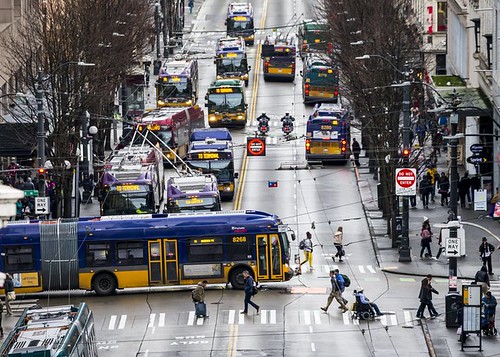
Lots of King County Transit buses on Third Avenue, SeattleSeattle Times photo.

Interestingly, King County had wacked political requirements on bus service, which required providing equal investment in extra service in the less populated county for every investment in Seattle.

So Seattle residents passed a levy for Seattle-specific service and bus line expansion.

-- Levy to Move Seattle, Seattle SDOT
-- Best Practices in Transit, Seattle Urban Mobility Plan, 2009
-- King County Metro Service Guidelines
-- King County Metro Accountability Center

Richmond is a bus exclusive system.  Their story isn't particularly scintillating for big metropolitan area, but there are still some lessons.  Not only did they redefine their network a la Jarrett Walker, they created a highly visible bus rapid transit line called The Pulse, and they used this introduction to do some rebranding of the transit network.
Richmond Pulse BRT
Related to what they did with the Pulse line, something I recommend as part of the creation of new transit services is the creation of a  complementary program of transit network improvements to drive ridership improvements across the transit network:

-- "Setting the stage for the Purple Line light rail line to be an overwhelming success Part 1 | simultaneously introduce improvements to other elements of the transit network," 2017
-- "Using the Silver Line as the priming event, what would a transit network improvement program look like for NoVA?," 2017

Whereas most of these big bus network redesigns have resulted in minimal improvements, just a couple percentage points, the Richmond redesign has resulted in a 17% increase in ridership.

But that's on a small base, because their transit network has been pretty weak.  (It's still crippled by limited interest on the part of the abutting counties to participate in the transit system.)

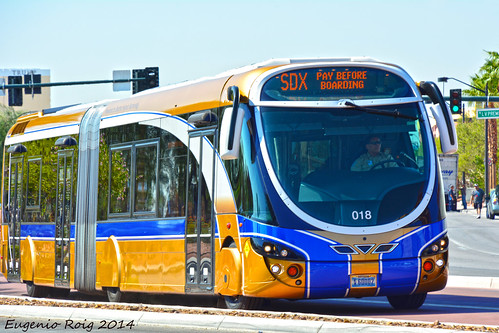
Making transit service more sexy.  When going through some trade magazines I hadn't read, I came across an old article about the bus system in Las Vegas, and the then director made the point that attractive buses are necessary to be able to compete with other mobility services, and their introduction of double deck buses resulted in double digit increases in ridership, and significantly greater revenues, greater than the cost of the service.

-- "Using the Purple Line to rebrand Montgomery and Prince George's Counties as Design Forward," 2017

The Strip & Downtown Express (aka the SDX). Las Vegas Public Bus Transportation.

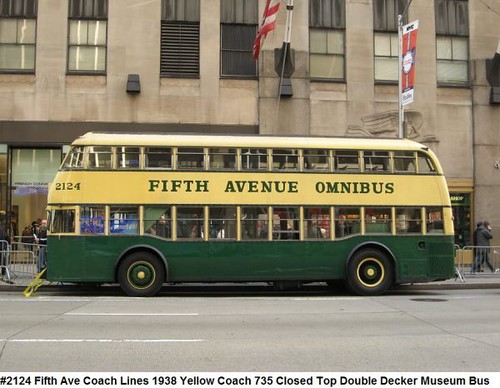
The double deck bus line serves the Strip, and it's a premium service, not unlike how before the MTA, there was a double deck bus service on Fifth Avenue in Manhattan (although that was more about demand).
IMG_8277 copie


Fifth Avenue Double Deck Omnibus (Bus), built by Yellow Coach Company

What the City Paper article missed.  The City Paper suggests that the DC area could learn from what they did in Richmond.  I suppose it's possible.  If only as a reminder of what to do.

For the Bus Transformation Study, I said it would be interesting to analyze the area's high performing bus routes as case studies and use that information as a way to improve under performing lines.

The problem with looking at Richmond is that DC and the DC area for the most part already does the things that Richmond introduced as a new program.  While there are always lots of opportunities for improvement, there is a high frequency network which is quite good, at least in DC.

Although a comparable high frequency network ought to be in place in Maryland and Virginia, and there should be more cross-jurisdictional services, especially along arterials connecting Maryland and DC.

The other problem is that in the areas where transit is most effective, especially in DC's core it's also where other competitive mobility services are offered -- car sharing, bike sharing, dockless scooters, now mopeds too -- plus ride hailing (Uber and Lyft), all of which are drawing customers away from bus (and rail).  (Although some studies find a positive association between bike sharing and rail transit ridership.)

-- "DC is a market leader in Mobility as a Service (MaaS)," 2018

But a major lesson from Richmond in terms of the Pulse BRT service is that you should probably have one unified brand for BRT and/or your "high frequency bus network."

By contrast, the DC area has many: (1) MetroExtra -- limited stop but not BRT; (2) Metroway, a BRT service in Alexandria and Arlington; (3) PikeRide, a branded bus service on Columbia Pike in Arlington; (4) REX, a branded bus service on Richmond Highway; (5) RideOn Extra, a limited stop service in Montgomery County; (6) a separately planned BRT system for Montgomery County; (7) a separately planned BRT line on Leesburg Pike in Fairfax County; etc.

(Sometimes there are advantages to backwardness, a la Gerschenkron's Economic backwardness in historical perspective.)

Other examples of differentiated and clear branding are Metro in Los Angeles' branding of rapid (red) and local (orange) buses, and how MARTA in Atlanta is rebranding as ATL ("MARTA is about to become The ATL. What do you think of the new bus design and logo?," Georgia Sun).

But sure, the DC area needs to (1) better define and integrate the bus network; (2) rebrand the bus agencies and redesign bus livery; (3) market the hell out of it; (4) systematically improve the service; (5) including shifting to double deck buses and other types of design forward buses; (6) defining and providing a night bus network; etc.

And that could probably result in double digit increases in ridership.

Expand the rail network to increase bus ridership. But the biggest thing would be to not only get Metrorail "Back to Good," it would be to expand and intensify Metrorail service, to make it and the transit network more useful, by increasing both its breadth and depth. Bus service complements and extends the subway and (eventually) light rail network.

-- "Redundancy, engineered resilience, and subway systems: Metrorail failures will increase without adding capacity in the core," 2016

Conceptual Future integrated rail transit service network for the Washington DC National Capitol Region. Design by Paul J. Meissner.  Concept by Richard Layman and Paul Meissner.
Conceptual Future integrated rail transit service network for the Washington DC National Capitol Region. Design by Paul J. Meissner. Concept by Richard Layman and Paul Meissner.

Improving bus ridership in the DC area. These were the points I made in "Improving bus service overall vs. reversing falling Metrobus ridership," 2018:

1. The impact of the sustainable mobility platform on use of mass transit services.

2. (As the area improves economically) Is the pool of transit dependent riders shrinking?

3. The DC area bus transit "network" is not perceived as a system/it is illegible.

4. Reposition bus service as a premium (design) product.

5. Rearticulate and reconfigure bus transit across the metropolitan area into one integrated system.

6. Make provision of dedicated bus transitways (and traffic signal prioritization for buses) a priority.

7. Create a overnight transit network at the metropolitan scale.

8. Don't forget bus services when creating HOT Lanes.

9. Rearticulate long distance commuter bus services too.


========
Primary Strategies from the Bus Transformation Study:

1. Customer focused.

2. Prioritizing buses on roads.

3. Frequent, reliable, convenient bus service.

4. Balancing the responsibilities of local and regional providers.

5. Streamlining back office functions and sharing innovation.

6. Transforming and incorporating changes in bus service.

Umm, wow.

Labels: , , , , ,