Rebuilding Place in the Urban Space

"A community’s physical form, rather than its land uses, is its most intrinsic and enduring characteristic." [Katz, EPA] This blog focuses on place and placemaking and all that makes it work--historic preservation, urban design, transportation, asset-based community development, arts & cultural development, commercial district revitalization, tourism & destination development, and quality of life advocacy--along with doses of civic engagement and good governance watchdogging.

Monday, May 13, 2024

WMATA's latest bus improvement program

is discussed by WTOP, "Metro’s future of bus service could bring new routes and end some familiar stops."  

When I first saw coverage I thought, "what about the 2017" initiative, although granted it was before covid.  And when thinking about writing about it, I remembered a bus initiative back in 2006 too.  But of course, conditions have changed greatly since then.

WRT bus service improvement see:

-- "Making bus service sexy and more equitable," 2012
-- "Will buses ever be cool? Boston versus the Raleigh-Durham's GoTransit Model," 2017
-- "Route 7 BRT proposal communicates the reality that the DC area doesn't adequately conduct transportation planning at the metropolitan-scale," 2016
-- "Reviving DC area bus service: and a counterpoint to the recent Washington City Paper article," 2019

From the article:

With additional funding, Webster said the new bus network could bring 30-minute frequency for most routes, 30 new routes that would increase connections with Metrorail stations and a regionwide 24-hour bus network, which would provide overnight connections to the region’s airports.

San Francisco Bay overnight transit map.

And with that I had to laugh.  I've been suggesting that for at least 12 years.

-- "Overnight transit service," 2012
-- "Night moves: the need for more night time (and weekend) transit service, especially when the subway is closed," 2013
-- "Night and weekend transit/subway service," 2016
-- "Overnight transit service: San Francisco," 2016

The 2013 entry states that bus service should be provided to airports when Metrorail is closed.  Also see:

-- "To and from origin stations can be difficult: More on the Silver Line and intra-neighborhood transit (tertiary network)," 2022
-- "More on airport-related transit/transit for visitors," 2013
-- "To get people who have mobility choices to choose transit, they have to know it exists," 2007

The points in this entry, although ostensibly about light rail, are really about the value of a transit network, and by extension the value of the transit network as a 24 hour service.

-- "Manhattan Institute misses the point about the value of light rail transit connections to airports | Utility and the network effect: the transit network as a platform," 2020

Related is the blog entry "Branding's NOT all you need for transit" (2018) which discusses transit as a "design product"

ensuring that each and every element within the system of providing transit and mobility services is designed to be effective, efficient, successful, powerful and connected.

DC has a long way to go for that, which is why I suggest a German style "transport association" be created to integrate the services.

-- "WMATA and MWCOG announce new joint transit initiative | Could a regional "transport association" be on the horizon, or just a transit bailout?," 2024

At some point, I wrote that it would be easy to provide transit service to National Airport overnight by extending the bus service on 14th Street.  And that a late night bus network needs to include Union Station in DC as a primary node.

========================

FWIW, in the Purple Line series ("Setting the stage for the Purple Line light rail line to be an overwhelming success: Part 2 | proposed parallel improvements across the transit network," 2017), I made a bunch of recommendations wrt bus service, although I'm glad some of the improvements will happen before 2028, when the Purple Line opens.

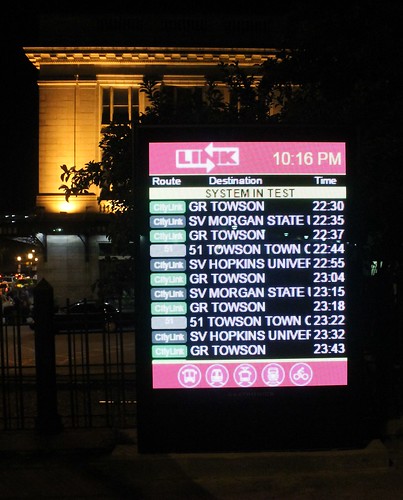
9.  Provide integrated bus arrival and departure information screens at Metrorail, Light Rail, and MARC stations.

10.  Bus service in certain corridors between DC and Maryland should be extended and/or frequency increased to better link these areas to the new light rail service.

Many of the area's bus services terminate at the city-state line, although there are some exceptions. DC and Maryland should commit to bus service improvements in advance of the PL launch.

11.  Montgomery County bus system improvements with the launch of the Purple Line and bi-directional service on the MARC Brunswick Line should include launch of planned Bus Rapid Transit services.   

12.  Rearticulate, rebrand, and reposition-extend the Prince George's County TheBus bus transit service. Change the name of the service and the graphic design of the bus livery.

They have the same opportunity for rearticulation with their complementary local transit system. Currently, TheBus system is the least well developed of the suburban transit agencies ("By choosing coverage over frequency, Prince George’s caps what its buses can accomplish," GGW).

But they are now working on improving the system, with a Transit Transformation initiative they launched last fall.

13.  Consider a redesign and rebranding of the the metropolitan area's bus systems into an integrated framework, comparable to that of GoTransit in the Raleigh-Durham area.

This has been discussed in depth here, "Will buses ever be cool? Boston versus the Raleigh-Durham's GoTransit Model."  This gives a  deadline for launch.

From the presentation ("The Sign Design Society Event: Defining a City," designworkplan) by Ivan Bennett, Design Manger for London Buses:

One reason other systems have failed is the lack of continuity. London bus stops extend beyond central areas and cover all routes in Greater London. Ivan indicated that passengers do not just want information about where they are travelling from, but when they get there, they need the same consistently presented information. People need information near their homes and local areas, not just in the centre of the city.

15.  Set the opening of the Purple Line as the deadline for the implementation of a full-fledged integrated Night Owl bus network for the DC metropolitan area.
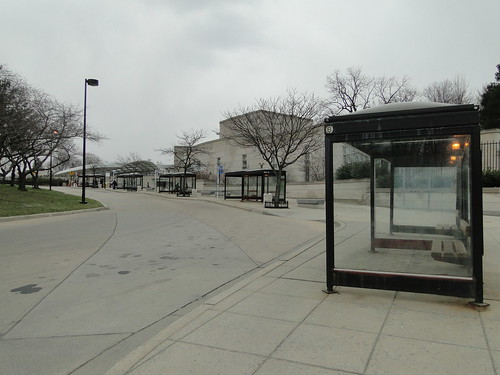
DSC0574719.  WMATA should upgrade its Metrorail station bus shelters.

Another aspect of the balkanized transit system in the DC area is that every jurisdiction has a different program for bus shelters--what Ivan Bennett, product design manager for the London bus program, calls "a lack of continuity."

Metrobus isn't responsible for shelters in the various jurisdictions, although WMATA does have bus shelters on the grounds of many Metrorail stations outside the core. 
Bus shelters at the Medical Center Metrorail Station. 

Unfortunately, the Metrorail station shelters are dowdy, don't incorporate real-time arrival and departure information, could include advertising as a revenue stream, etc.

Why not use the launch date of the Purple Line as an inducement and deadline for an overhaul of the Metrorail bus shelters across the station network?

 ... although this doesn't address the fact that in an integrated bus service branding system across the jurisdictions, ideally, there would be a common set of transit shelters and amenities across the transit network.

-- Transit Waiting Environments, for the Greater Cleveland Rapid Transit Authority
-- From Here to There: A creative guide for making public transport the way to go, EMBARQ
-- Rethinking the Suburban Bus Stop, Airport Corridor Transportation Association, Pittsburgh
-- First/Last Mile Strategies Study, Utah Transit Authority

The Kansas City Streetcar Smart City "City Post" digital kiosks include a real-time tracker application for the streetcar service ("No need to wonder where streetcar is: Kiosks now offer tracker maps," Kansas City Business Journal). Photo: Andrew Grumke. 

Labels: , , , , , ,

Friday, September 10, 2021

Gambling as an urban race to the bottom: Richmond; DC

Alfred C. Liggins III, CEO of Urban One, in Richmond on Aug. 11. (Julia Rendleman/The Washington Post) 

I wrote about this recently ("Casinos as economic development: destination versus casual visitation" and "More sports and revitalization: Pimlico Race Course in Baltimore") but the ongoing the process to approve the creation of a casino in Richmond Virginia ("A Black-owned casino bets on a Black neighborhood in the former capital of the Confederacy," ) brings up some interesting issues about access and "equity" because the operator chosen to create a casino if approved in this November's referendum is Alfred Liggins, a prominent African-American businessman based in the DC area, who leads the Urban One broadcast business--radio stations focused on black demographics and the TV One cable channel--which grew out of the WOL-AM station in DC (when I first moved to DC in 1987 their studio was at the end of the block on H Street, it had a window so you could see the DJ booth).

With the exception of Native American-run casinos, most are run by large corporations led by white people.  Isn't it a matter of equity for African-American business interests to get a piece of the action?

-- "Building supportive ecosystems for Black-owned US businesses," McKinsey
-- "$290 BILLION WOULD BE CREATED IN BLACK WEALTH IF THE REVENUE GAP BETWEEN BLACK AND WHITE BUSINESSES WAS EQUAL," Black Enterprise Magazine

Springfield Massachusetts casino as an analogue.  But as pointed out in the previous pieces, the average city doesn't benefit much from this.  I think Richmond is similar to Springfield, Massachusetts--Richmond has more residents, both are within a couple hours of major cities, have some train service, and a number of attractions.

An event outside the MGM Casino brings people to the streets of Springfield.

While Springfield claims significant impact even though the casino has only been open for a couple years and was more recently affected by the pandemic ("TWO YEARS AFTER MGM SPRINGFIELD OPENED, ECONOMIC BENEFITS NOTED BUT NO INCREASE IN PROBLEM GAMBLING DETECTED," U Mass Amherst) I wonder how much will really happen?

OTOH, I guess if the casino is part of a wide ranging revitalization program, maybe it would be different, and maybe that's the case in Springfield.  But I wouldn't expect much there, or in Richmond.  From the Worcester Daily Voice article "Did Springfield Cash In? See How Much Visitors To MGM Have Spent Locally":

The Donahue Institute estimated that MGM visitors accounted for $66.3 million in new, off-site spending at local restaurants, shops, grocers, fuel stations, and more. “One of the big findings we have is that 61.7 percent of patron spending was new to the state and would not have occurred had it not been for the casino,” said Thomas Peake senior research analyst at the UMass Donahue Institute in a statement. ...

However, when MGM was selling Springfield on the casino, developers said MGM would create 3,000 new jobs and generate $35 million in revenue per month. The casino peaked in its first full month of operations at just under $27 million and has averaged only around $21.5 million ever since, according to CalvinAyre.com.

(Another example is the touted benefits for Richmond from being the practice site for the Washington Redskins.  Not much happened.  "VCU report: City won't recoup investment on Redskins training camp deal until at least 2023," Richmond Times-Dispatch -- use printfriendly).

The biggest problem is that the business model for "gaming" isn't designed to share customers with other venues.  They want 100% of the time and money of gamblers, outside of spending money on gas, they don't want you to leave the premises and spend money elsewhere.  That makes it hard for a "gaming" use to be multiplicative in terms of the multiplier effect and spillover economic benefits.

I wrote about this in terms of Walmart ("Jumping in bed with the devil--it's hot, but will you survive the heat?," 2006), the same points pertain.

The problem with Wal-Mart isn't so much that it is a behemoth store. The problem is their business model, which appears to be designed to capture as much as 100%* of the average customer's retail expenditure dollars. That doesn't leave much room, even crumbs, for other businesses. (* or more than 100% if you consider credit cards...)


Gambet DC: DC's sports gambling app
. Another Post article, "D.C.'s sports betting app keeps underperforming, with lots of finger-pointing about what’s to blame," discusses the relative lack of success of a DC branded and controlled sports gambling app.  

The pitfalls are pretty obvious. (1) taking a larger cut than competitive apps. (2) there being lots of competitive websites. (3) apps for gambling for profit entities fully focused on gambling are likely to always outpace and be more exciting than "a government sponsored app" produced by a contractor.

The Gambet DC website looks like a government website.

And as is too common in city economic arguments for gambling, great success is touted while the results are significantly less buoyant.  The city initially projected revenues of $22 million annually, then the forecast shifted downward to $6 million annually.  But revenue is less than $50,000 per month.

Some types of revenue generation aren't really worth pursuing.


versus

The DC Auditor made suggestions for improvement ("D.C. auditor offers ideas for improving the city’s sports betting app," Post), but how do you create "verve" in a city agency?

-- D.C. Sports GamblingFails to Meet Expectations, DC Auditor

FWIW, I think DC Lottery created a great commercial promoting DC neighborhoods as part of a past promotion, which I thought was a way better ad promoting "visiting DC" than the ads by Destination DC ("City branding versus identity | Branding versus Urban Strategy").  


So maybe they have the potential to become much more customer-facing, as they are with lottery tickets.  Clearly those aren't the people in charge of Gambet DC.

Labels: , , , , ,

Tuesday, October 22, 2019

Because I misread this, I thought it was a big deal. It wasn't and it proves the point I made in 2014 about the need for Montgomery and Prince George's County to create a Purple Line focused community development corporation

Hampshire Village in Langley Park.

I guess my eyesight is going because when I first saw this Washington Post article headline, "JPMorgan Chase commits $5 million to combat gentrification along the Purple Line," I read million as billion.  First I thought it was a big deal, at $5 billion.  But $5 million for "fighting gentrification" in a rail corridor that will have 20 stations over 16 miles is a drop in the barrel. From the article:
A major national bank has committed $5 million to nonprofits to support affordable housing and small businesses threatened by development expected to follow the Purple Line being built in Washington’s Maryland suburbs.

The award by JPMorgan Chase, announced Tuesday, is the largest grant so far for efforts to combat gentrification that could displace residents along the 16-mile route of the light-rail linelinking Bethesda in Montgomery County and New Carrollton in Prince George’s County.

The investment, spread over three years, aims to help preserve or create 1,000 affordable homes, according to a draft news release obtained by The Washington Post.
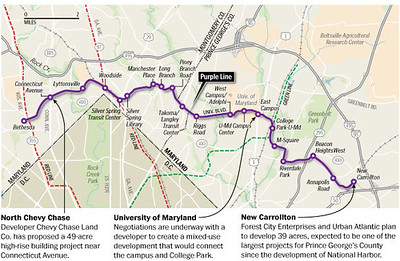
Purple Line routing and station map

And that's the point I made going to conferences on the Purple Line sponsored in 2014 by the University of Maryland National Center for Smart Growth.

-- "To build the Purple Line, perhaps Montgomery and Prince George's Counties will have to create a "Transportation Renewal District" and Development Authority"
-- "Quick follow up to the Purple Line piece about creating a Transportation Renewal District and selling bonds to fund equitable development"


Victoria Crossing apartments, Langley Park.

Although it turns out I made the same point in 2009.  (Although changes to the google and blogger search functions make it virtually impossible to find the link at the moment.)

This point later was the foundation of a related concept, the creation of tax increment financed "public improvement districts" for transit station catchment areas as a matter of course.  PIDs are a pretty common technique, but are not often integrated into transit line development programs.

-- "Public improvement districts ought to be created as part of transit station development process: the east side of NoMA station as an example," 2016

 And of course, I restated it as part of the 2017 series on focused leveraging of the Purple Line infrastructure program to drive economic development and transportation improvements more broadly:

 -- "Part 6 |  Creating a transportation development authority in Montgomery and Prince George's County to effectuate placemaking, retail development, and housing programs in association with the Purple Line"

Basically, you need an entity that can buy, hold, finance, intensify, and build if necessary housing and commercial property in the Purple Line corridor, if you want to accomplish multiple objectives that are sometimes counter to each other, such as growth vs. limitations on displacement; growth of rent asking prices (seen as a benefit from the standpoint of real estate ownership) vs. maintenance of low rents, etc.


Creating a Bi-County Redevelopment Authority with bonds (tax increment financing) sold "against" a Transportation Renewal District comprised of the catchment area of the Purple Line light rail line in Montgomery and Prince George's Counties, Maryland

1. The idea is to create a companion "Revitalization District" that wraps around the newly created transportation infrastructure, and create a "Tax Increment Financing" program to raise a very large fund, which could increase significantly the velocity of revitalization, and to purposefully fund the kinds of equitable development activities espoused by the Purple Line Corridor Coalition.
Subareas, Purple Line Transit Corridor, Montgomery and Prince George's Counties, Maryland

2. Rather than creating a variety of micro-TIF districts for various projects, this proposal is for a large single fund, but with a detailed program facilitating projects at various scales and locations, but using the large tax district as a way to realize projects across all parts of the catchment area, including areas where current demographics and economic conditions wouldn't normally support financing for such projects.

3.  Originally I did not foresee using TRD monies to fund the construction of transit infrastructure per se, but to fund new property development by both for profit and nonprofit entities, property acquisition to maintain long term affordability, civic infrastructure, and community improvement programs of various types.

Now I would include transit network improvements as eligible for funding, and would even consider using a portion of the revenue stream to fund the actual construction of the Purple Line specifically.

4.  The lessons from DC and Portland's use of an Urban Renewal District to fund some of the local match for its Yellow Line light rail is that it takes 30-40 years to see fully the impact of the transit line on ancillary investment, so the TRD needs to be set up to last a long time--typically an urban renewal district's funding is for a 20 year period and then ceases, although Portland has a process for extending the period.

5. Recognizing that new development results in new costs for existing systems like emergency services and schools, "all" of the forecasted increase in property taxes should not go to the TRD, some of the stream should be reserved and fund such services.

6.  Action plans would need to be created, along with the right accountability mechanisms and marketing systems, along with some flexibility to respond to changes in market conditions, circumstances, and opportunities as they development.  A supra-prescriptive plan isn't the right course, but a set of "transformative projects" should be part of the program (see "(Big Hairy) Projects Action Plan(s) as an element of Comprehensive/Master Plans"--now I am calling such plans, "Transformational Projects Action Plans").

Labels: , , , , , , ,

Friday, March 08, 2019

International Women's Day 2019 and cities/urban planning

Theo Moudakis editorial cartoon for the Toronto Star, 3/7/2018.


Reprinted but updated from last year.

Friday March 8th is International Women's Day.  The month of March is Women's History Month.

Women as planners and architects. From the standpoint of labor within the urban planning profession, on the land use planning side women make up a larger and larger proportion of the planning workforce, although directorships tend to be dominated by men.

Although maybe the DC area is an exception given that plenty of articles opine about the need for more women in the profession ("Urban Planning Needs More Women," Rooflines).

There are major exceptions, for example Jennifer Keesmaat was the planning director for the City of Toronto, Ellen McCarthy and Harriet Tregoning were directors of planning in DC, and Amanda Burden was the Planning Commissioner for the City of New York ("Social Planner," New York Magazine) while Janette Sadik-Khan was the Transportation Commissioner.  Sadik-Khan was succeeded by Polly Trachtenberg.

The transportation profession tends to be dominated by men still, as it is heavily engineering based, but that is changing too. 

I know that women are transportation directors in Baltimore, Pittsburgh -- DC's former associate director of transportation planning, Karina Ricks, Philadelphia, Portland, and New York City among others.  (Although Baltimore's transportation commissioner, a former director of transportation in DC, seems to be getting flak.)

There aren't too many women running the largest transit agencies, although plenty of women are in high positions in those agencies, and hold positions across the profession.  Lately, Southern California's Metrolink has appointed a woman as CEO ("Metrolink Board Names Stephanie Wiggins as Chief Executive Officer").

The architecture profession remains dominated by men ("Challenged to change their industries' faces," Daily Journal of Commerce; "Where are the women in architecture?," Austin American-Statesman) although the landscape architecture field has plenty of women practitioners.   

One of the special interest sections of the American Planning Association is Planning and Women and the Women's Transportation Seminar is a professional development organization for women working in the transportation field.

Women and the history of the planning profession.  One of the strands from which the planning profession in the US was birthed was out of women-initiated "good government" and "good places" initiatives in a time when women still didn't have the right to vote.

Land use planning and architecture.  Some argue that the principles of land use planning are designed to favor men ("If women built cities, what would our urban landscape look like," Guardian).  From the article:
In a classic 1980 essay called What Would a Non-sexist City Be Like?, the American urbanist Dolores Hayden called for centres that would “transcend traditional definitions of home, neighbourhood, city and workplace”. Since then, others have taken up the argument that a woman-friendly city would be more porous, the divisions between home and work less rigid, so that domestic work is acknowledged as a productive activity, and carers (of children, disabled relatives and older people) are less excluded from economic life. In any case, such divisions are often artificial, with women in developing-world cities undertaking economic activity that has too often been ignored.
The presence of women as an indicator of safety in the public space.  For years I have been strongly influenced by points made in writings about safety in public spaces and how the number of women out and about can be seen as an indicator of success or failure.  John King, urban design writer for the San Francisco Chronicle wrote about this ("Great architecture, clean streets, culture -- it must be Minneapolis") in discussing Minneapolis as an example of his ten principles about how to make cities great:
Women know best. The first night in Minneapolis, I dined at Cafe Brenda on walleye and wild rice, which, with blueberry muffins, constitute the trifecta of local cuisine. A stroll past sleepy blocks of warehouses evolving from red-light district to residential neighborhood led me to the banks of the Mississippi. Walking along grassy parkland toward the Falls of St. Anthony, I had the place to myself -- except for one woman jogging casually past me toward the horizon.

When a city feels safe enough that a woman jogs along, alone, at dusk ... somebody is doing something right."
The presence of women as an indicator of what works and what doesn't in managing public spaces ha been discussed over the years in various writings on New York City's Bryant Park.

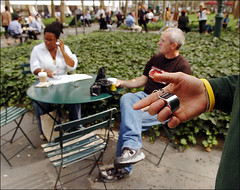
The New York Times  New York Region  Image.jpgKeith Bedford for The New York Times. A man and a woman: Minding the gender gap in Bryant Park.

From the 2005 New York Times article "Splendor in the Grass":
It was lunchtime at Bryant Park, and thousands of office workers were gathered beneath the emerald veil of trees. Ever since the park was renovated 13 years ago, it has been a remarkable space, and one of its most remarkable aspects is that the number of men and women is about equal, a balance that is carefully monitored as a barometer of the park's health. In 1980, when the space was rife with drug dealers and other scurrilous sorts, the ratio of men to women was about 9 to 1, said Dan Biederman, president of the Bryant Park Restoration Corporation.

But when the park reopened in 1992, the comfort level of women was seen as key to its resurgence, which is why the park's designers paid special attention to accouterments that appeal to women, like bathrooms with full-length mirrors, kiosk food and flowerbeds.

These days, the male-to-female ratio is just about even. And with this balance comes the possibility of triangulation, which Mr. Biederman defines with scientific precision as the tendency of an external stimulus to prompt strangers to interact. "If there's enough triangulation from things in the park," he said, "then people who don't know each other will break down and talk to each other."
Transit, women and safety.  Around the world women are harassed, even killed, in transit, India being particularly notorious.  In a number of places, women-only taxi services have been created to provide safe transit.

In the US, such services haven't fared too well. 

SheTaxis, a women-focused taxi service in Greater New York City, modeled after the service in Mexico City ("Mexico launches fleet of pink cabs - driven by women, for women," New York Daily News) which was launched in 2009, launched in 2014 ("New Service Offers Taxis Exclusively for Women," New York Times).

SeeJaneGo, a ride hailing service catering to women, operating in Orange County, California, shuttered in 2018 ("See Jane Go, a ride-hailing service for women, by women, says farewell," Orange County Register).

In response to public safety issues, Mexico City has dedicated cars on its subway system for women although similar cars in Beijing don't seem to be working too well ("China's Women-Only Subway Cars, Where Men Rush In," New York Times), although such cars have existed in Tokyo since 1912 ("I used the women-only train carriages in Tokyo, for good reason – and I'd welcome them in the UK too," Independent).

Professor Anastasia Loukaitou-Sideris of UCLA has authored a number of papers on bus stop safety.  Many transit agencies have introduced anti-harassment programs.

-- Hollaback! is an organization that addresses street harassment issues
-- Hot Spots of Bus Stop Crime, Prof. Anastasia Loukaitou-Sideris, UCLA
-- Geography of Transit Crime, Loukaitou-Sideris et al., UCLA
-- Transit Security: A Description of Problems and Countermeasures, FTA

Restroom equity.  One long standing issue is restroom access.  Women tend to take longer to use restroom facilities, but more facilities for women tend to not be provided.  Some cities and states have been changing laws to address this ("'Potty Parity': Equal Wait Time for Men's and Women's Restrooms," Time Magazine).

Cover image: Wheels of Change: How Women Rode the Bicycle to Freedom (With a Few Flat Tires Along the Way), by Sue Macy.

Women and bicycling.  There are many initiatives around promoting bicycle use by women.  One of the earliest was by the Association of Pedestrian and Bicycle Professionals (Women Cycling Project).   Now many local and state bicycle and alternative transportation organizations have women access initiatives.

The Race Pace chain of bicycle shops in Greater Baltimore has had for many years a sub-store called Bella Bikes dedicated to women's cycling, within their Ellicott City location.   

Women and political power. While there is no doubt that men are a majority of the holders of elected office at all levels across the United States ("Why Does the US Still Have So Few Women in Office?," The Nation), increasingly, women are winning elections for mayor in cities around the country.  DC's Muriel Bowser is one such example, but there are many others, including Houston, Salt Lake City, and in 2017, Seattle and Montreal.  More and more women are being elected to City Councils, etc.

Post the Trump victory, many more women are running for political office at all levels ("A year after the Women's March, a record number of women are running for office, will they win?," Washington Post; "More Than Twice As Many Women Are Running For Congress In 2018 Compared With 2016," NPR).

And a signpost of this movement was the midterm national election, where a great number of women of a diversity of race and politics were elected to the U.S. House of Representatives, although generally this was more a case of Democratic Party members over Republicans ("Banner Year for Female Candidates Doesn't Extend to Republican Party," New York Times).

Gender budgeting.  In 2017, the Economist ran a provocative editorial, "Why governments should introduce gender budgeting," building on an earlier article, "Why national budgets need to take gender into account."

From the editorial:
At its simplest, gender budgeting sets out to quantify how policies affect women and men differently (see article). That seemingly trivial step converts exhortation about treating women fairly into the coin of government: costs and benefits, and investments and returns. You don’t have to be a feminist to recognise, as Austria did, that the numbers show how lowering income tax on second earners will encourage women to join the labour force, boosting growth and tax revenues. Or that cuts to programmes designed to reduce domestic violence would be a false economy, because they would cost so much in medical treatment and lost workdays.

As well as identifying opportunities and errors, gender budgeting brings women’s issues right to the heart of government, the ministry of finance. Governments routinely bat away sensible policies that lack a champion when the money is handed out. But if judgments about what makes sense for women (and the general good) are being formed within the finance ministry itself, then the battle is half-won.
By not looking at the differential impacts of policy in terms of gender, bias is structured into outcomes.

Labels: , , , , , ,

Tuesday, June 19, 2018

BaltimoreLink bus system redesign, one year later

The Baltimore Sun has a long piece, "One year of BaltimoreLink bus system: Ridership bounces back, reliability still falls short," evaluating the quantum scale changes to the Baltimore-area bus system one year later.

For many, the changes have lengthened trip times.

The reorganization was organized into what I term primary and secondary transit subnetworks.

-- Metropolitan Mass Transit Planning: Towards a Hierarchical and Conceptual Framework

The primary network is CityLink--color coded high frequency routes offering 24 hour service; complemented by a secondary network of neighborhood-based routes called Local Links, connecting neighborhoods to multiple CityLink services.

Note that during the Ehrlich Administration MTA created a network of limited stop faster routes called the QuickBus, which was the genesis of the new CityLink network, although focused on Baltimore City as opposed to longer city-suburban routes, like the QuickBus 48 route on York Road to Towson.

09a.BusStop.493.BaltimoreMD.11July2017According to the launch website, the system has added bus traffic signal prioritization on some routes, dedicated busways on some streets, better facilities, improvements in signage and real-time schedule displays, and connections to a richer set of "last mile connections" like bike share and car share.

The changes came with bus livery redesign, new logos, and cross-marketing of the new system on light rail and subway cars.

Immediately after the changes, ridership dropped by almost 25%.  Ridership returned to the buses over time and now it's 1% fewer riders than before the change.

Given that overall transit ridership is down 5% nationally, attributed to the rise in ride hailing services as well as cheap gasoline, maybe that's a victory.

It's hard to tell if the changes have made for a better transit system.
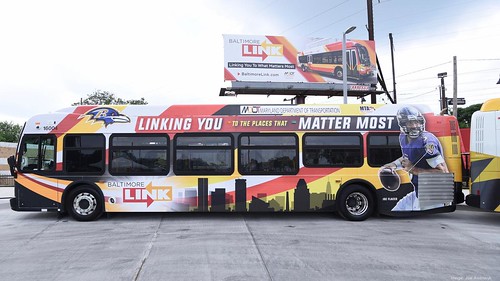
BaltimoreLink bus and billboard, West Baltimore transfer center, Smallwood Street
BaltimoreLink launched in June 2017 with a ribbon cutting ceremony at the new West Baltimore transfer center on Smallwood Street.  Joe Andrucyk/Maryland Government.


Given that a lot of these massive overhauls of route structures for transit systems don't seem to result in significant ridership gains (see the January 2018 entry, "Improving bus service overall vs. reversing falling Metrobus ridership"), I wonder if we are focusing on the wrong things.

But what are the right things?

I have to acknowledge that maybe repositioning and rebranding bus service as premium, by switching to double deck buses, might not be enough. Although in London and other UK cities it works just fine, and more people ride buses in London on a daily basis than the entire railroad system in the UK.

-- "Marking bus service sexy and more equitable," 2012
-- Will buses ever be cool? Boston versus the Raleigh-Durham's GoTransit Model," 2017

The two main points of the first entry are:

1. bus service can be repositioned as a premium service by using double deck buses, which are seen as cool.

2. Introducing new buses and repositioning bus transit needs to be complemented with a series of other improvements to the provision of the service--I outlined eight categories of improvements (which is why the entry is way too long).

• Improve bus transit waiting environments
• Improve bus transit marketing
• Create a priority bus lane network in the core of the city
• Add Night Owl bus service along subway lines during the hours that the subway service doesn't run
• Improve wayfinding and transit information
• Augment on-board bus announcements and information on schedules, signage, etc., with landmark and destination information
• Create "Mobility" stores as part of transportation demand management programming
• Incorporate neighborhood history, public art elements, and transportation history interpretation into bus shelters

But MTA has incorporated many of these improvements into the BaltimoreLink program.

I think another point is pricing and other incentives. For example, in Columbus, Ohio they are introducing free transit passes to downtown workers as a transportation demand management measure ("Downtown Columbus parking issues getting partial fix as workers getting free COTA passes," Columbus Business First).  That would get more choice riders onto buses.

But it's not like MTA doesn't provide a number of incentive programs for discounted transit passes, such as to colleges and employers.  And the cost of a "day pass" to ride area transit (bus, subway, light rail) is cheap, $4.20/day.

Although to increase ridership but not farebox revenue, they could introduce "capping," so that low income riders paying daily for a day pass would stop paying daily once they've reached a payment equal to a monthly pass ($72).

London has capping and Edmonton is thinking about it ("Thinking systematically about bus transit service improvements: spurred by Columbia SC, Edmonton AB, and Baltimore," 2017).

David Blair, a candidate for County Executive in Montgomery County, suggests converting RideOn, one of the nation's more successful suburban bus systems, to free, given that the farebox revenue isn't that significant, about $21 million/year ("Who is Montogmery County executive candidate David Blair?," Washington Post)--that's less than a rounding error in the overall county budget.

(In Orlando, with the "new" commuter rail system, they spend more money on the cost of collecting fares than they make in fares, "SunRail ticket revenue is less than ticketing expense," Orlando Sentinel.)

I think it comes back to density, proximity of activity centers, and the relative efficiency of transit. If transit is reasonably efficient and cost effective, especially if you have to pay for parking, or the city is dense like most core center cities, you can get higher ridership. Otherwise, transit is more of a social service--at least bus service is--and your ability to grow the service is constrained.

In the Metropolitan City Era, 1920-present (Transportation and Urban Form: Stages in the Spatial Evolution of the American Metropolis," Peter Muller), where the mobility system has been built to preference if not require a car, it's difficult for transit to compete.

=======
I am behind in writing about my UK trip, but a couple pieces will focus on transit in Liverpool and London.

Merseytravel still runs the rail commuter system, but not buses, although the mobility system shares some branding and infrastructure, which Merseytravel still plans for and markets.  Some of what they do is simple, but it extends branding across transit infrastructure in visible ways.  It's a lesson for US transit systems.

Note that with regard to my past writings, holding up the creation of the London Overground rail system as a way to better integrate railroad services into the Transport for London system:

-- "One big idea: Getting MARC and Metrorail to integrate fares, stations, and marketing systems, using London Overground as an example," 2015

the reality on the ground is even more pronounced.  What a model!

You have to flash your card at a reader, but they don't use gates, although to continue your trip on the Underground, at the end of your trip you go through gates. That's what needs to be done for MARC in terms of integrating with transit systems in the DC and Baltimore areas.

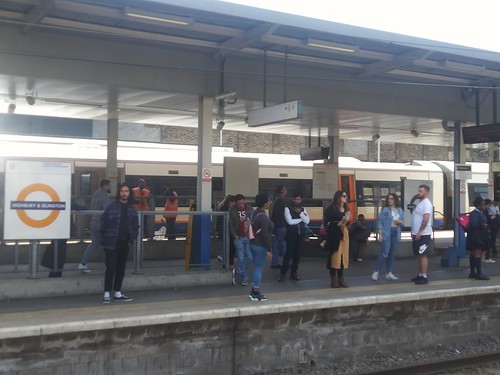
London Overground platform, Highbury & Islington Station
London Overground platform at Highbury & Islington, where it connects to the Underground.  There is a coffee kiosk on the platform, which operates during the day.

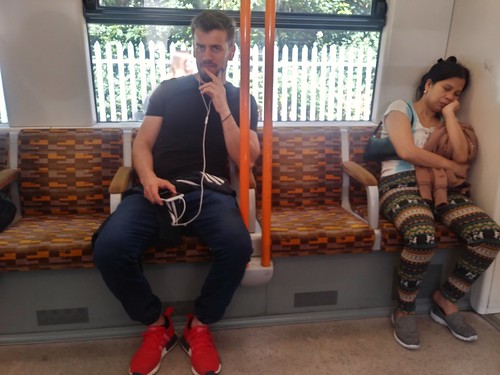
Orange is the color of the London Overground, just like red is the color of the bus system. Orange is used as an accent color on the trains and in the stations, such as the color of handrails on stairways or in trains, within the Overground roundel, etc.

People on a London Overground train

Labels: , , , , , ,

Wednesday, March 07, 2018

International Women's Day 2018 (and cities/urban planning): Thursday March 8

Theo Moudakis editorial cartoon for the Toronto Star, 3/7/2018.


Reprinted but updated from last year.

Women as planners and architects. From the standpoint of labor within the urban planning profession, on the land use planning side women make up a larger and larger proportion of the planning workforce, although directorships tend to be dominated by men.  Although maybe the DC area is an exception given that plenty of articles opine about the need for more women in the profession ("Urban Planning Needs More Women," Rooflines).

There are major exceptions, for example Jennifer Keesmaat was the planning director for the City of Toronto, Ellen McCarthy and Harriet Tregoning were directors of planning in DC, and Amanda Burden was the Planning Commissioner for the City of New York ("Social Planner," New York Magazine) while Janette Sadik-Khan was the Transportation Commissioner.  Sadik-Khan was succeeded by Polly Trachtenberg.

The transportation profession tends to be dominated by men still, as it is heavily engineering based, but that is changing too. 

I know that women are transportation directors in Baltimore, Pittsburgh -- DC's former associate director of transportation planning, Karina Ricks, Philadelphia, Portland, and New York City among others.  (Although Baltimore's transportation commissioner, a former director of transportation in DC, seems to be getting flak.)

There aren't too many women running transit agencies, especially large ones.

The architecture profession remains dominated by men ("Challenged to change their industries' faces," Daily Journal of Commerce; "Where are the women in architecture?," Austin American-Statesman) although the landscape architecture field has plenty of women practitioners.   

Women and the history of the planning profession.  One of the strands from which the planning profession in the US was birthed was out of women-initiated "good government" and "good places" initiatives in a time when women still didn't have the right to vote.

One of the special interest sections of the American Planning Association is Planning and Women and the Women's Transportation Seminar is a professional development organization for women working in the transportation field.

Land use planning and architecture.  Some argue that the principles of land use planning are designed to favor men ("If women built cities, what would our urban landscape look like," Guardian).  From the article:
In a classic 1980 essay called What Would a Non-sexist City Be Like?, the American urbanist Dolores Hayden called for centres that would “transcend traditional definitions of home, neighbourhood, city and workplace”. Since then, others have taken up the argument that a woman-friendly city would be more porous, the divisions between home and work less rigid, so that domestic work is acknowledged as a productive activity, and carers (of children, disabled relatives and older people) are less excluded from economic life. In any case, such divisions are often artificial, with women in developing-world cities undertaking economic activity that has too often been ignored.
The presence of women as an indicator of safety in the public space.  For years I have been strongly influenced by points made in writings about safety in public spaces and how the number of women out and about can be seen as an indicator of success or failure.  John King, urban design writer for the San Francisco Chronicle wrote about this ("Great architecture, clean streets, culture -- it must be Minneapolis") in discussing Minneapolis as an example of his ten principles about how to make cities great:
Women know best. The first night in Minneapolis, I dined at Cafe Brenda on walleye and wild rice, which, with blueberry muffins, constitute the trifecta of local cuisine. A stroll past sleepy blocks of warehouses evolving from red-light district to residential neighborhood led me to the banks of the Mississippi. Walking along grassy parkland toward the Falls of St. Anthony, I had the place to myself -- except for one woman jogging casually past me toward the horizon.

When a city feels safe enough that a woman jogs along, alone, at dusk ... somebody is doing something right."
The presence of women as an indicator of what works and what doesn't in managing public spaces ha been discussed over the years in various writings on New York City's Bryant Park.

The New York Times  New York Region  Image.jpgKeith Bedford for The New York Times. A man and a woman: Minding the gender gap in Bryant Park.

From the 2005 New York Times article "Splendor in the Grass":
It was lunchtime at Bryant Park, and thousands of office workers were gathered beneath the emerald veil of trees. Ever since the park was renovated 13 years ago, it has been a remarkable space, and one of its most remarkable aspects is that the number of men and women is about equal, a balance that is carefully monitored as a barometer of the park's health. In 1980, when the space was rife with drug dealers and other scurrilous sorts, the ratio of men to women was about 9 to 1, said Dan Biederman, president of the Bryant Park Restoration Corporation.

But when the park reopened in 1992, the comfort level of women was seen as key to its resurgence, which is why the park's designers paid special attention to accouterments that appeal to women, like bathrooms with full-length mirrors, kiosk food and flowerbeds.

These days, the male-to-female ratio is just about even. And with this balance comes the possibility of triangulation, which Mr. Biederman defines with scientific precision as the tendency of an external stimulus to prompt strangers to interact. "If there's enough triangulation from things in the park," he said, "then people who don't know each other will break down and talk to each other."
Transit, women and safety.  Around the world women are harassed, even killed, in transit, India being particularly notorious.  In a number of places, women-only taxi services have been created to provide safe transit.

In the US, such services haven't fared too well. 

SheTaxis, a women-focused taxi service in Greater New York City, modeled after the service in Mexico City ("Mexico launches fleet of pink cabs - driven by women, for women," New York Daily News) which was launched in 2009, launched in 2014 ("New Service Offers Taxis Exclusively for Women," New York Times).

SeeJaneGo, a ride hailing service catering to women, operating in Orange County, California, shuttered in January ("See Jane Go, a ride-hailing service for women, by women, says farewell," Orange County Register) although the website is still active.

Professor Anastasia Loukaitou-Sideris of UCLA has authored a number of papers on bus stop safety.  Many transit agencies have introduced anti-harassment programs.

-- Hollaback! is an organization that addresses street harassment issues
-- Hot Spots of Bus Stop Crime, Prof. Anastasia Loukaitou-Sideris, UCLA
-- Geography of Transit Crime, Loukaitou-Sideris et al., UCLA
-- Transit Security: A Description of Problems and Countermeasures, FTA

Cover image: Wheels of Change: How Women Rode the Bicycle to Freedom (With a Few Flat Tires Along the Way), by Sue Macy.

Women and bicycling.  There are many initiatives around promoting bicycle use by women.  One of the earliest was by the Association of Pedestrian and Bicycle Professionals (Women Cycling Project).   Now many local and state bicycle and alternative transportation organizations have women access initiatives.

The Race Pace chain of bicycle shops in Greater Baltimore has had for many years a sub-store called Bella Bikes dedicated to women's cycling, within their Ellicott City location.   

Women and political power. While there is no doubt that men are a majority of the holders of elected office at all levels across the United States ("Why Does the US Still Have So Few Women in Office?," The Nation), increasingly, women are winning elections for mayor in cities around the country.  DC's Muriel Bowser is one such example, but there are many others, including Houston, Salt Lake City, and in 2017, Seattle and Montreal.  More and more women are being elected to City Councils, etc.

Post the Trump victory, many more women are running for political office at all levels ("A year after the Women's March, a record number of women are running for office, will they win?," Washington Post; "More Than Twice As Many Women Are Running For Congress In 2018 Compared With 2016," NPR).

Gender budgeting.  Last year, the Economist ran a provocative editorial, "Why governments should introduce gender budgeting," building on an earlier article, "Why national budgets need to take gender into account."

From the editorial:
At its simplest, gender budgeting sets out to quantify how policies affect women and men differently (see article). That seemingly trivial step converts exhortation about treating women fairly into the coin of government: costs and benefits, and investments and returns. You don’t have to be a feminist to recognise, as Austria did, that the numbers show how lowering income tax on second earners will encourage women to join the labour force, boosting growth and tax revenues. Or that cuts to programmes designed to reduce domestic violence would be a false economy, because they would cost so much in medical treatment and lost workdays.

As well as identifying opportunities and errors, gender budgeting brings women’s issues right to the heart of government, the ministry of finance. Governments routinely bat away sensible policies that lack a champion when the money is handed out. But if judgments about what makes sense for women (and the general good) are being formed within the finance ministry itself, then the battle is half-won.
By not looking at the differential impacts of policy in terms of gender, bias is structured into outcomes.

Labels: , , ,

Sunday, November 19, 2017

Revisiting stories: double deck buses as a modern solution for rebranding bus service for choice riders

As a child, I'm sure I had a Matchbox toy of the Routemaster bus.  Matchbox continues to produce copies of the current version of the bus.

For a long time, I've argued that one way to reposition and rebrand bus-based transit service would be to shift to double deck buses.

-- "Making bus service sexy and more equitable," 2012
After all, the iconic Routemaster bus in London is an image known the world over.

In the early part of the last century, both double deck streetcars and buses were common in dense cities, even in New York City.

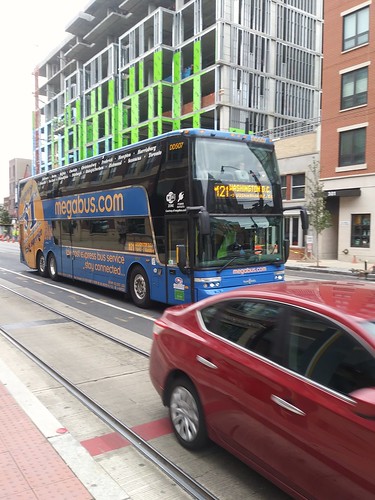
Megabus double deck bus on H Street NE, Washington, DC, on the way to Union StationMegabus double deck bus on H Street NE, Washington, DC, on the way to Union Station.

Today, double deck buses are used widely throughout the UK, not just in London, but not so much in North America, except in tourism applications and some high ridership inter-city bus routes, such as between DC and New York City.

According to the Wikipedia page, double deck buses are deployed in many European cities outside of the UK and Ireland, and in Asia, in particular Hong Kong.

In North America, for regular transit service, Ottawa, Ontario has the largest fleet of such buses, while the GOBus system in Ontario (GO = Government of Ontario) is the largest, with service dedicated to long distance commuting routes rather than inter-city transit like in Ottawa. 

A few double deck buses are deployed in various communities in the US, such as in the Puget Sound region of Washington State and Las Vegas, where Community Transit has the largest fleet providing commuter service between Snohomish County and Seattle.

The New York City Transit Museum still has one of the Yellow Coach double deck buses in its museum fleet.

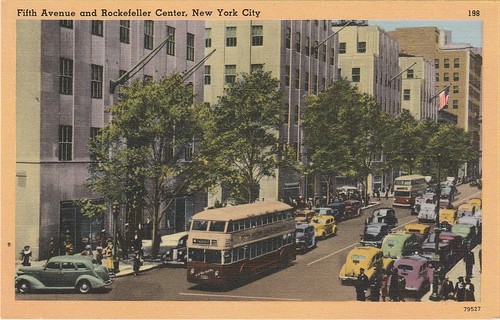
Charlie shares with us an article ("Bus Stop Classics: 1934-38 Yellow Coach Model 720/735 “Double Decker” – the Queen of Fifth Avenue," CurbsideClassics) he came across about double deck bus service on Fifth Avenue in New York City. 

This particular article discusses the bus that was used on the route for about 20 years, until the mid-1950s.

The highly used bus line on Fifth Avenue is discussed in voluminous detail in this piece from the Coachbuilt website, and has many images of earlier double deck buses that had been in service on the route.

The Coachbuilt website focuses on companies that built "coaches," not just buses but limos, taxis, etc. For example, the geographical listing for Michigan has entries for more than 150 companies.

It's an incredibly voluminous site.  The author aims to produce a book titled the Encyclopedia of American Coachbuilders.
Vintage postcard showing double deck buses on Fifth Avenue in New York CIty
Vintage postcard showing double deck buses on Fifth Avenue in New York City

Labels: , , , , , ,

Tuesday, March 07, 2017

International Women's Day, Wednesday March 8th, and urban planning

(This is mostly a reprint from last year.)

Women as planners and architects. From the standpoint of labor within the urban planning profession, I have noticed on the land use side increasingly women make up a larger and larger proportion of the planning workforce, although directorships tend to be dominated by men.  Although maybe the DC area is an exception given that plenty of articles opine about the need for more women in the profession ("Urban Planning Needs More Women," Rooflines).

There are major exceptions, for example Jennifer Keesmaat is the planning director for the City of Toronto, Ellen McCarthy and Harriet Tregoning were directors of planning in DC, and Amanda Burden was the Planning Commissioner for the City of New York ("Social Planner," New York Magazine) while Janette Sadik-Khan was the Transportation Commissioner.  Sadik-Khan was succeeded by Polly Trachtenberg.

The transportation profession tends to be dominated by men still, as it is heavily engineering based, but that is changing too.

The architecture profession remains dominated by men ("Challenged to change their industries' faces," Daily Journal of Commerce; "Where are the women in architecture?," Austin American-Statesman) although the landscape architecture field has plenty of women practitioners.   

Women and the history of the planning profession.  One of the strands from which the planning profession in the US was birthed was out of women-initiated "good government" and "good places" initiatives in a time when women still didn't have the right to vote.

One of the special interest sections of the American Planning Association is Planning and Women and the Women's Transportation Seminar is a professional development organization for women working in the transportation field.

Land use planning and architecture.  Some argue that the principles of land use planning are designed to favor men ("If women built cities, what would our urban landscape look like," Guardian).  From the article:
In a classic 1980 essay called What Would a Non-sexist City Be Like?, the American urbanist Dolores Hayden called for centres that would “transcend traditional definitions of home, neighbourhood, city and workplace”. Since then, others have taken up the argument that a woman-friendly city would be more porous, the divisions between home and work less rigid, so that domestic work is acknowledged as a productive activity, and carers (of children, disabled relatives and older people) are less excluded from economic life. In any case, such divisions are often artificial, with women in developing-world cities undertaking economic activity that has too often been ignored.
The presence of women as an indicator of safety in the public space.  For years I have been strongly influenced by points made in writings about safety in public spaces and how the number of women out and about can be seen as an indicator of success or failure.  John King, urban design writer for the San Francisco Chronicle wrote about this ("Great architecture, clean streets, culture -- it must be Minneapolis") in discussing Minneapolis as an example of his ten principles about how to make cities great:
Women know best. The first night in Minneapolis, I dined at Cafe Brenda on walleye and wild rice, which, with blueberry muffins, constitute the trifecta of local cuisine. A stroll past sleepy blocks of warehouses evolving from red-light district to residential neighborhood led me to the banks of the Mississippi. Walking along grassy parkland toward the Falls of St. Anthony, I had the place to myself -- except for one woman jogging casually past me toward the horizon.

When a city feels safe enough that a woman jogs along, alone, at dusk ... somebody is doing something right."
The presence of women as an indicator of what works and what doesn't in managing public spaces ha been discussed over the years in various writings on New York City's Bryant Park.

The New York Times  New York Region  Image.jpgKeith Bedford for The New York Times. A man and a woman: Minding the gender gap in Bryant Park.

From the 2005 New York Times article "Splendor in the Grass":
It was lunchtime at Bryant Park, and thousands of office workers were gathered beneath the emerald veil of trees. Ever since the park was renovated 13 years ago, it has been a remarkable space, and one of its most remarkable aspects is that the number of men and women is about equal, a balance that is carefully monitored as a barometer of the park's health. In 1980, when the space was rife with drug dealers and other scurrilous sorts, the ratio of men to women was about 9 to 1, said Dan Biederman, president of the Bryant Park Restoration Corporation.

But when the park reopened in 1992, the comfort level of women was seen as key to its resurgence, which is why the park's designers paid special attention to accouterments that appeal to women, like bathrooms with full-length mirrors, kiosk food and flowerbeds.

These days, the male-to-female ratio is just about even. And with this balance comes the possibility of triangulation, which Mr. Biederman defines with scientific precision as the tendency of an external stimulus to prompt strangers to interact. "If there's enough triangulation from things in the park," he said, "then people who don't know each other will break down and talk to each other."
Transit, women and safety.  Around the world women are harassed, even killed, in transit, India being particularly notorious.  In a number of places, women-only taxi services have been created to provide safe transit.
She Taxis, a women-focused taxi service in Greater New York City, modeled after the service in Mexico City ("Mexico launches fleet of pink cabs - driven by women, for women," New York Daily News) which was launched in 2009, launched in 2014 ("New Service Offers Taxis Exclusively for Women," New York Times).

Professor Anastasia Loukaitou-Sideris of UCLA has authored a number of papers on bus stop safety.  Many transit agencies have introduced anti-harassment programs.

-- Hollaback! is an organization that addresses street harassment issues
-- Hot Spots of Bus Stop Crime, Prof. Anastasia Loukaitou-Sideris, UCLA
-- Geography of Transit Crime, Loukaitou-Sideris et al., UCLA
-- Transit Security: A Description of Problems and Countermeasures, FTA

Cover image: Wheels of Change: How Women Rode the Bicycle to Freedom (With a Few Flat Tires Along the Way), by Sue Macy.

Women and bicycling.  There are many initiatives around promoting bicycle use by women.  One of the earliest was by the Association of Pedestrian and Bicycle Professionals (Women Cycling Project).   Now many local and state bicycle and alternative transportation organizations have women access initaitives.

The Race Pace chain of bicycle shops in Greater Baltimore has had for many years a sub-store called Bella Bikes dedicated to women's cycling, within their Ellicott City location.   

Women and political power. While there is no doubt that men are a majority of the holders of elected office at all levels across the United States ("Why Does the US Still Have So Few Women in Office?," The Nation), increasingly, women are winning elections for mayor in cities around the country.  DC's Muriel Bowser is one such example, but there are many others, including Houston and Salt Lake City.  More and more women are being elected to City Councils, etc.

Gender budgeting.  A few weeks ago, the Economist ran a provocative editorial, "Why governments should introduce gender budgeting," building on an earlier article, "Why national budgets need to take gender into account."

From the editorial:
At its simplest, gender budgeting sets out to quantify how policies affect women and men differently (see article). That seemingly trivial step converts exhortation about treating women fairly into the coin of government: costs and benefits, and investments and returns. You don’t have to be a feminist to recognise, as Austria did, that the numbers show how lowering income tax on second earners will encourage women to join the labour force, boosting growth and tax revenues. Or that cuts to programmes designed to reduce domestic violence would be a false economy, because they would cost so much in medical treatment and lost workdays.

As well as identifying opportunities and errors, gender budgeting brings women’s issues right to the heart of government, the ministry of finance. Governments routinely bat away sensible policies that lack a champion when the money is handed out. But if judgments about what makes sense for women (and the general good) are being formed within the finance ministry itself, then the battle is half-won.
By not looking at the differential impacts of policy in terms of gender, bias is structured into outcomes.

Labels: , , ,