Rebuilding Place in the Urban Space

"A community’s physical form, rather than its land uses, is its most intrinsic and enduring characteristic." [Katz, EPA] This blog focuses on place and placemaking and all that makes it work--historic preservation, urban design, transportation, asset-based community development, arts & cultural development, commercial district revitalization, tourism & destination development, and quality of life advocacy--along with doses of civic engagement and good governance watchdogging.

Monday, March 23, 2026

Why Disneyland should be taxed more: Anaheim Transportation Network to shut down because of ongoing deficits

Bus riders take Anaheim Regional Transportation (ART) buses shuttles from the Toy Story parking lot to the Disneyland Resort on Thursday, January 29, 2026, in Anaheim, CA. The Anaheim Transportation Network’s board voted Wed. Jan. 28 to “wind down” operations, with the last day of shuttling planned for March 31. The bus system moves 8 million riders a year around the resort area. (Photo by Jeff Gritchen, Orange County Register/SCNG)

The bus service in Anaheim, Anaheim Transportation Network, transports people between major destinations in the city including Disneyland and the Convention Center.  It has about 22,000 riders per day, 8 million per year.  It also provides an electric shuttle called FRAN--free rides around the neighborhood--and EVE, a van shuttle to and from John Wayne Airport in Santa Ana.

Your ride to Disneyland.  Not anymore.  A sign marks a stop at Great Wolf Lodge for an ART bus, Anaheim Resort Transportation, in Anaheim, CA on Wednesday, May 7, 2025. (Photo by Paul Bersebach, Orange County Register/SCNG)

It has been funded by fares and other revenues, with a persistent deficit covered by the cities tourism special district, which collects taxes on hotel stays.

That's not enough, and the service is shutting down ("With a shut-down deadline looming, Anaheim Transportation Network has buses and property to disperse," Orange County Register).  

City punts.  Elected officials lack vision, sound familiar?*  Last year, faced with the possibility of the system shutting down, the city figured it wasn't important enough to come up with other funding to maintain the service ("Anaheim looks at takeover of resort bus system that’s facing budget challenges," OCR).

The city of Anaheim last year considered taking over the struggling transportation network, in hopes of solving the agency’s financial troubles without asking hoteliers to pay more. But officials said earlier this year the city was no longer interested in the move.

... “We know there’s a need for a service,” Lyster said. “We want to do a study to look at whether there could be an advantage to putting this under the city umbrella that might make it cost-effective.”

... More than 70% of the transportation provider’s operating costs go toward labor, Kotler said. Fare increases would likely lower the number of people who choose to use the buses since the service is competing on cost with rideshare services and families who might choose to park at the resort. ATN charges $4 for a one-way fare and less for children and seniors.

“We believe that if fares were to increase, we would lose a large percentage of our passenger market to the rideshare companies,” Kotler said. “So, we have to be very careful about how we approach the fare policy … We feel that the fares need to stay at the current level.”

* DC just shut down its streetcar ("Eight big-picture lessons from the DC Streetcar," "How DC’s mayor and council chair thwarted every effort to better the streetcar," GGW). 

DisneyForward is not Transit Forward.  Disney has a huge expansion program underway, called DisneyForward, and they weren't required to include transportation demand management planning as an element of the project ("Disneyland doesn't have transportation demand management planning requirements," 2023).

One of ATN’s major routes is a line from a Disney parking lot to the theme parks’ gates.

====

When the magic fades.

Transportation Demand Management Plans for Amusement Parks.  Not dissimilarly, Disney World in Orlando shut down the branded Disney Express bus service from Orlando Airport and other locations.  In part they said this was because of the increased use of ride hailing services like Uber and Lyft.

Amusement parks/resorts, like stadiums, arenas and casinos ought to be required to have transportation demand management plans and fund transit as part of their operation .  Of course, in Florida, Disney's land district is legally separate from the counties there.  

Nonetheless, as a local government, it should be required to participate in a German style transport association, bringing together area jurisdictions and transit operations to plan and deliver transit in an integrated fashion.

-- "The answer is: Create a single multi-state/regional multi-modal transit planning, management, and operations authority association," 2017
-- "Verkehrsverbund: The evolution and spread of fully integrated regional public transport in Germany, Austria, and Switzerland," International Journal of Sustainable Transportation, 2018

Orange County Transportation Authority does a lot of things--runs Metrolink, toll roads, cross-jurisdictional buses (at least one line makes it to CSU Long Beach), paratransit, and a fare media card usable on its buses and some of the city bus systems.  

It also provides some funds at least to some jurisdictions for intra-city transportation, like in Laguna Beach, through Measure M, a county wide sales tax for transportation--not just transit--projects.  They did pay for some things for Anaheim, I am not sure for buses.  The justification for transit funding is primarily congestion management.

Labels: , , , , , ,

Tuesday, January 07, 2025

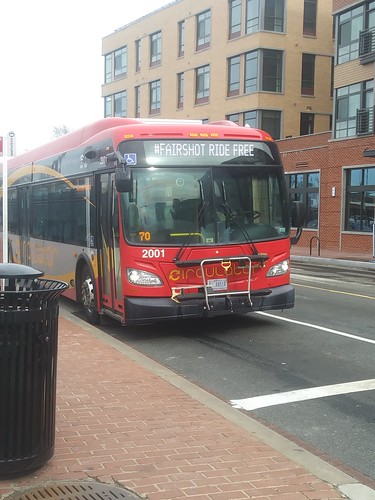
DC Circulator service shuts down

The service shut down with the new year ("Round and round one last time: The final day of the D.C. Circulator," Washington Post).

I was a fan of the original, a comfortable more sporty red and silver Van Hool bus.  And the service from Downtown to Georgetown/Rosslyn and eventually around the National Mall ("New DC Circulator route serving National Mall reminds us that we are neglecting connections from west to east and fail to adequately connect Georgetown to the National Mall") made theoretical sense.


Later, because people wanted the sporty red and silver buses to serve their neighborhoods, various additional lines were added.

But ridership, in reality was abysmal.

-- "Lies, damn lies, and misleading data: bus service (DC Circulator)," (2023)
-- "Throwing up my hands and the "Anacostia" "Circulator"," (2010)

For years they hadn't been reporting data by bus line--there are six.  Obviously it's because most of the lines have minimal ridership.   This is from a blog entry, "Semi-reprint: Methodology for determining transit expansion" from 2014:

DC Circulator ridership per day
High and low service months (2013 data)

RouteRidership PeakMonthRidership LowMonth
Georgetown-Union Station6,600June5,500February
Woodley Park-McPherson5,060February4,000November
Union Station-Navy Yard1,700July900November
Rosslyn-Dupont Circle2,750July2,550October
Potomac Ave.-Skyland1,650September1,150November

I had no idea that the ridership of these various bus lines was so pathetic. I knew they were bad mostly, but I had no idea how low the ridership is--other than the fact that I look at every Circulator bus that I pass and judge the amount of ridership on that particular bus, and most cases, except Downtown-Georgetown and sometimes on 14th Street, the number of riders appears to be minimal.

This year the city decided to cancel the Circulator overall out of budget concerns.  I don't remember the exact number, but it cost a fair amount, needed many millions for new equipment and had a maximum farebox revenue of about $2 million.

The benefit-cost relationship was way out of wack.

Of course, most transit advocates wanted to keep the service ("The Circulator’s death doesn’t have to leave riders, workers stranded. Transfer services to WMATA," GGW).  By comparison, high ridership Metrobus lines in DC, at least before the pandemic, was 12,000 to 30,000 riders per day.

Labels: , ,

Friday, November 24, 2023

Regional and multi-state inter city bus transportation. Thanksgiving is a time of big travel.

 This was in the Thanksgiving entry, but should be separated out.

==========

One overlooked segment in regional transportation planning is inter-city bus service/travel. 

Blog entries

Resources
-- "Building a better bus hub at Union Station," Washington Post, 2011
-- "The Navigator: Greyhound, leaving passengers out in the cold," Washington Post Travel Section, 2014
-- Intercity Bus Program Strategic Direction Report, Texas Department of Transportation, 2019
-- "Emergent Curbside Intercity Bus Industry: Chinatown and Beyond," Transportation Research Record, 2009
-- "The Curbside Bus Industry: A New Era of Bus Travel, masters thesis by Eileen Collins The Chaddick Institute for Metropolitan Development at DePaul University in Chicago has done a fair amount of research as well, in part focusing on the Midwest. -- Intercity Bus Research webpage
-- The Return of the Intercity Bus: The Decline and Recovery of Scheduled Service to American Cities, 1960 - 2007

Greyhound is the major US company, and over the last ten years it's been owned by foreign firms.  The previous owner sold off the real estate--many inner city terminals are big and worth a lot as redevelopment opportunities.  

Abandoned Greyhound bus terminal in Oakland, California.  Many stations were built during the era of art deco architecture and have wonderful details.

As terminals close, buses stop on the street, people queue outside with no protections.  Professor Joseph Schweiterman of DePaul University is rare in that he tracks this form of transportation and he wrote about it for MSNBC News ("Thanksgiving is a stressful time to travel. Why it may get worse for these passengers.").  

From the article: 
The past few months have been tough for many passengers using bus stations and curbside spots across the country. Amid a worsening bus station crisis, some city officials have become downright hostile to the key service because of perceptions that it causes theft, loitering and loss of neighborhood aesthetics. While dozens of airport terminal improvements are providing new conveniences for flyers, and as new federal dollars flow for train upgrades, more and more riders of intercity buses are, quite literally, being left out in the cold. 

... On Greyhound, the bus travel giant that reaches more U.S. cities than any other line, stations with spacious and climate-controlled waiting rooms have been shuttered in Charlottesville, Virginia, Cincinnati and Columbus, Ohio; Erie and Philadelphia, Pennsylvania; Knoxville, Tennessee; Louisville, Kentucky; Portland, Oregon, and Tampa, Florida. This has forced lines to move to curbside spots or more remote locations separated from downtown. Greyhound and its partners have suspended service entirely from two state capitals, Jackson, Mississippi, and Little Rock, Arkansas, because of their inability to find workable stations. Concern is high that Greyhound stations in Chicago; Charlotte, North Carolina; Cleveland; Dallas, and Kansas City, Missouri, could be the next to go. 

This crisis is unfolding as intercity bus lines more broadly seem to be enjoying a post-pandemic bounce... More people ride intercity buses than trains, but the lack of high-quality station arrangements raises questions about the mode’s future opportunities.

Three factors are at the root of the crisis. Many municipal governments, once allies, have adopted aggressive not-in-my-backyard stances toward intercity buses, fueled by the perception that bus stations may be unsafe places that generate criminal activity. Adding to this problem, dozens of stations came into the fold of a private real-estate holding company...

Meanwhile, many City Halls appear indifferent, highlighting the lack of clout bus travelers have in policymaking. ... Meanwhile, many City Halls appear indifferent, highlighting the lack of clout bus travelers have in policymaking.

Common sense dictates that intercity bus lines start using public transit terminals with around-the-clock security, restrooms and indoor waiting areas. The federal government has made giving intercity bus lines “reasonable access” to these facilities a funding requirement.
What to do about bus rider customer experience.  Note in my typology on the transit network at multiple scales ("Reprint (with editing): The Meta-Regional Transit Network," 2009), a commenter had to point out to me that I failed to include buses.  I have written about this from time to time, including problems with the set up at DC's Union Station, by comparing it to Toronto and Montreal ("Union Station bus terminal, DC," 2011).

Great 1950s brochure on the Port Authority Bus Terminal in NYC.  Flickr photo by Karen Yang (also see the brochure cover and back panel.)

There are a few examples I've come across where inter city buses are incorporated into existing public transit stations, although it isn't always done well.  DC's Union Station, Charlottesville, even the Silver Spring Transit Center are examples.  Hatmburg's bus terminal is adjacent to the main train station.  In Liverpool they have a separate intercity bus station, a number of blocks away from the main train station  and adjacent local public bus station, and but it's run by the local transit authority.  In Essen, the inter city buses stage at the back of the station.  (That's where I first saw bike racks placed on the back of intercity buses.)

One way to build stronger support for this, at least in core metropolitan areas, where commuter bus service exists, is to include better services for both commuter bus passengers and inter city bus passengers.  Similar to the decline in amenities and customer experience for inter city bus, commuter buses tend to use the public transit shelter infrastructure.
 
A start would be to require center cities to include provisions for inter city bus transit and services into local transportation plans, and for states to have equivalent plans.

Colorado may be the national leader, as it has created a statewide inter city bus transportation program called Bustang (with a derivative called Snowstang for ski service).  I don't know how it works though at the nexus of street, bus, terminal, and passengers.  And the state is still served by for profit bus services.  

Union Station Denver's underground bus terminal is used by public transit buses, I don't think inter city bus.  Design wise it's a great example of how a bus terminal can be integrated into transit stations.  Although this rendering is more lively than the actual.


SOM press release, 2014

When Greyhound was last up for sale, I suggested that Amtrak buy it ("Two train/regional transit ideas: Part 1 | Amtrak should acquire Greyhound," 2021).  Amtrak does provide some inter city bus service, called Amtrak Thruway, to fill in access gaps to its route network, even in outstate Maryland.

Labels: , , , ,

Tuesday, March 19, 2019

Revisiting "Should surface transit be free?" given DC's announcement the Circulator bus service will be free

D.C. Circulator busAt the Mayor's State of the City address, she announced ("Bowser proposes commercial tax increase to pay for affordable housing," Washington Post) that the DC Circulator bus service will now be free.  From the article:
She announced that the city would permanently eliminate the $1 fare on the popular D.C. Circulator bus system, after experimenting with free rides in February and March. “For working people, it adds up,” Bowser said, noting that she has been stopped in the store checkout line and at dinners by people who gushed about the free bus rides. The free rides cost the city about $250,000 a month, officials said.
Last December, Luxembourg announced it will make transit free ("Luxembourg to become first country to make all public transport free").  That blog entry discusses various free transit initiatives, such as:

Talinn, Estonia has had free transit for a number of years.  A handful of cities--Calgary, Pittsburgh, and Salt Lake City--still have free transit zones in their Downtowns as a congestion reduction measure. A number of resort communities also provide no cost transit service as a congestion management tool.

Baltimore has a free Circulator service as well, which is designed to provide intra-city transit especially in the core and highly visited zones, to complement the inter-city regionally oriented service profile of the bus system serving the city and abutting counties ("Charm City Circulator's new operator has not trained all drivers, faces persistent bus shortage," Baltimore Sun).

It's paid for by a tax on parking, but that hasn't generated enough revenue and so they've had to make up funding with other sources.

Recently, workers in Downtown Columbus have been given access to free bus passes as a congestion measure.

Here and there are various particular free bus services, including Circulators of various sorts. Salt Lake City has a free bus line to the State Capitol (Route 500 - State Capitol Free Fare Zone, which extends outside of the city's free fare zone.

Photo: Jesse Acosta, WBUR-FM/NPR, "MBTA Begins Early-Morning Bus Service Pilot Program."

Boston City Councillors suggest one route be converted to free fare. Just last week, two Boston councilmembers proposed that a specific bus route be turned into a free service ("Two Boston city councilors want to make the Route 28 Bus free," Boston Globe). From the article:
Boston City Councilor Michelle Wu, one of the outspoken advocates in the charge against the price hike, says it’s time for the “next step:” a public discussion on how to ultimately make one of the busiest bus routes in the city, free of charge.

The Route 28 Bus, making stops between Mattapan and Ruggles Station, carries around 12,000 riders on weekdays. The majority of passengers are low-income residents without cars and almost half don’t have a driver’s license, Wu told her fellow councilors this week. ...

“This would be a measure that would also ensure people have no barriers to access that economic opportunity corridor,” Wu said during a meeting Wednesday, where she and Councilor Kim Janey filed their request for a hearing on the proposal. “This is the route I think we need to have the conversation about.”
While what Mayor Bowswer has done or what Boston councillors are proposing are nice things to do, I don't necessarily think it's the right thing to do.

As rich as it is, DC still has more things it would like to do than it has money a/k/a limited financial resources and constraints. Therefore, it makes sense to direct those resources in ways that have the greatest return and impact.

Most of the Circulator bus routes in the city are what I call political bus service. From a usage standpoint, they don't experience particularly high ridership. But most neighborhoods want the service because the cost of the fare (until the speech) is half that of regular Metrobus service.

The bus lines that have the highest ridership are in the core, and like the Baltimore routes are designed to provide intra-city coverage that the trunkline Metrobus lines don't really do. But most of those riders can afford to pay for the service.

One of the downsides of congestion-management focused free transit service is that the beneficiaries tend to be the well off, because they are the ones working white collar jobs in the core (although there are also service jobs too).

I wrote about some of these issues a little over two years ago, "Is making surface transit free the best transit investment DC can make?." The rest of this post is drawn from that, but revised.

How the city provides bus service. Basically, DC has four types of bus service.

(1) high frequency service on major arterials, like the bus service on 16th Street NW (S bus) or H Street-Benning Road (X bus), serving major activity centers and transit stations, and usually not extending beyond DC's borders, with the exception of the 70s bus line, which terminates in Silver Spring;

(2) neighborhood-to-neighborhood bus service between various activity centers and transit stations (like the 62 bus between Takoma and Petworth Stations or the H8 bus which goes from Mount Pleasant to the Columbia Heights Metrorail Station then to the Brookland Metrorail Station and then to the Rhode Island Metrorail Station);

(3) the Circulator service downtown and in some neighborhoods; and

(4) private shuttle services between subway stations and campuses, mostly for the universities like Georgetown and Howard, the Washington Hospital Center, although many federal government agencies run shuttle services too.

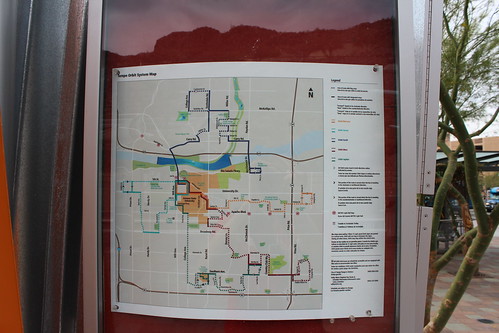
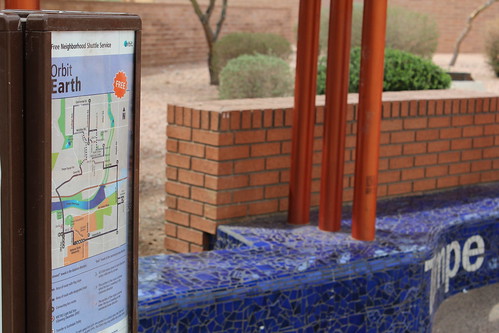
Orbit MapMap, Tempe Orbit intra-neighborhood bus service.  

To better serve the differing needs of communities, based on transit station proximity, density, and need, I have argued that the city needs to redefine how it provides transit, including the provision of intra-neighborhood service in certain neighborhoods.

I've written about this too in the context of my various "transportation wish lists," ("Transportation Wish List: 2015 edition, part one, the original list" and "Part two, new ideas").

The fact is that outside of the service in Downtown and that serving the National Mall during tourist season, for the most part Circulator bus routes duplicate service provided by existing Metrobus routes.

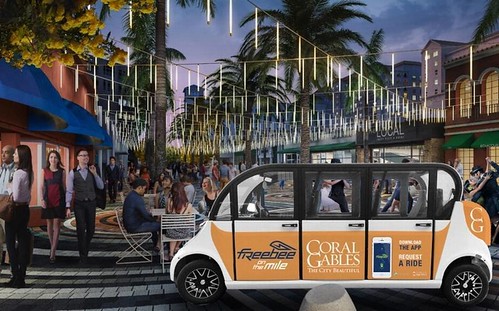
Freebee shuttle (tertiary transit), Coral Gables, Florida, Miami-Dade CountyRendering, intra-neighborhood Freebee Shuttle, Coral Gables, Florida.

While I no longer think that DC's transit planning priority should be making surface transit free, the decision by Mayor Bowser should spur us to think about what outcomes do we want from the city transit network and its surface component. and how and what kinds of investments should DC be making concerning improvements in surface transit service.

Free transit is expensive. As an intellectual exercise, I think it's worth considering free transit. But as an op-ed in Planetizen shows ("Why Is Fare-Free Transit The Exception Rather Than The Rule?") it works in places where overall there isn't that much demand for transit, and in small, constrained places, such as in resort towns. In larger cities, where transit is heavily used, the cost is considerable and difficult for local government budgets to absorb.

Whereas most communities do not have free transit service for primary and secondary routes, some cities like Tempe and Scottsdale in Arizona or the Town of Friendship Heights in Maryland have free intra-neighborhood services that move people from neighborhoods to activity centers and transit stations, but these services complement the broader transit network.

San Francisco considered it (but they have refused to release the final report), but found the increase in the amount of equipment required was beyond the budget. See "Free ride? Fat chance: Muni fares will stay," San Francisco Chronicle.

Note that the free weekly in the Vancouver, BC region, had a nice series on free transit. See "No Fares! Series," Tyee.

Are there better investments we could make in bus transit over making Circulator buses free?

In the metropolitan area, DC generally has the highest ridership buses (although one of those lines originates in Silver Spring, Maryland) with multiple lines having daily ridership between 13,000 and 22,000 riders.  But just because we have many high ridership lines it doesn't mean the system is perfect.

The original piece lists seven points.  But from the standpoint of providing free transit specifically, there are only two points that really matter.  Making these changes rather than making the DC Circulator bus routes free would have a lot more and more focused impact.

1.  Discounting transit for low income residents.  Rather than providing free transit to a lot of people who have the means to pay for it we should be prioritizing subsidizing transit service for people of limited means.

I am embarrassed to say that in my various "Transportation Wish Lists" I never listed this as a priority. 

(Although, it should be funded as a social service measure rather than a cost to the transit system, and separately and as an addition to monies for the transit system currently appropriated by the jurisdictions.)

While WMATA provides discounted fares for seniors, but not on a means-tested basis, and both DC and Montgomery County provide free or reduced price transit passes for schoolchildren, the DC area does not have a systematic program reducing the cost of transit for the impoverished.

The subsidized fare program offered by SF MUNI is called the Lifeline Pass, and it's half the cost of a regular monthly pass (their regular fare monthly pass is still very very cheap compared to peer systems), and people must be income qualified to be able to get the pass.

King County Metro in Seattle has a similar program. Hubway, Boston's bike share program has a similar framework for their low income access program.

More and more cities are creating such programs including Calgary, Denver ("Denver Approves Low-Income Discount for Transit Riders," NextCity), Halifax, Nova Scotia, Minneapolis ("Metro Transit will offer $1 fare for low-income riders," St. Paul Pioneer Press), Portland, Oregon ("Low Income Fares Begin," Portland Observer)), Lincoln, Nebraska and Los Angeles County, etc.

New York City Council pushed Mayor De Blasio to create a similar system, although it won't include single rides, only week and monthly passes.

Edmonton pay as you go and capping for low income riders.  However, Edmonton has proposed that could create the equivalent of a "pay as you go" capping feature for low income riders, which is the method I'd recommend implementing.

For low income riders who can't afford to buy a monthly pass in advance, the "rate capper" will work over the course of an entire month, and once a rider pays in fares the equivalent of the cost of a monthly pass, the discounted price of the pass -- and "free" travel for the rest of the month kicks in ("New smart cards for Edmonton Transit boast a 'social justice' edge," Edmonton Journal).
From the article:
People with steady jobs and good paycheques are the most likely to buy a monthly pass. They have cash on hand at the beginning of the month.

Those who might need their last nickel just to keep the lights on are the most likely to pay cash for every trip. It means they pay $3.25 per ride, more money for the same service.

That’s one reason Ken Koropeski is excited about Smart Fare.

With a card and an online account, the system can track how many times a person uses transit during a 30-day period, said Koropeski, director of special projects for Edmonton Transit. No one would have to commit to a monthly pass on Day 1. Instead, the system could automatically track use and once the rider hits that monthly maximum, all other rides are free.

“When you have capping, it has inherent benefits for people with low income,” said Koropeski.
Rather than spending $3 million making the Circulator free better that we spend $3 million on low income transit passes.

2.  Create intra-neighborhood transit (bus) services so that people can get to and from local services, commercial districts, schools, libraries, and to and from transit stations without having to drive. This includes delivery services of "freight" such as groceries.

In various writings, I call this "tertiary" service/tertiary transit network (based on the Arlington County framework in their transportation plan, which defines a primary and secondary transit network).  And it's not like we don't have a form of this now, at least within the city. Most neighborhoods have access to some bus service, although many people may not use it because it is circuitous or because they feel that the bus service is beneath them.

Orbit EarthThere are many models for what I consider intra-district transit service: including various tourist oriented transit services in places like Savannah or Laguna Beach; the Tempe In Motion bus services in Tempe, Arizona, which serves residents; the Baltimore Circulator which complements metropolitan bus service to Downtown by MTA with intra-district bus service; the FRED service of electric mini-shuttles in Downtown San Diego, Santa Monica, Anaheim, and various communities on Long Island and in and around Miami.

While I no longer recommend making all surface transit free, I do see the value in making tertiary network transit services free. That would take people to and from major transit stations, commercial districts, supermarkets, etc., and home, but wouldn't be free for outside of the neighborhood travel. See "Intra-neighborhood (tertiary) transit revisited because of new San Diego service," for a more complete discussion.

======
Other items from "Is making surface transit free the best transit investment DC can make?
  • Double deck buses as a repositioning device
  • Creating a system of priority bus lanes
  • Add Night Owl bus service on subway routes during the periods when the system is closed
  • Line extensions/creations.  One example would be the extension of the 30s line from its terminus at Friendship Heights on the DC/Maryland border northward to at least Friendship Heights.  Another would be service on Connecticut Avenue and Rhode Island Avenue that is more comparable to the trunkline services on major arterials such as 14th or 16th Streets, H Street, or Georgia Avenue.  Both of these services should extend some distance into Maryland
  • Other improvements.  An extensive list of other improvements, such as to bus stop waiting environments, is discussed in the entry "Making bus service sexy and more equitable."
Plus

Labels: , , , , , , ,

Tuesday, June 19, 2018

BaltimoreLink bus system redesign, one year later

The Baltimore Sun has a long piece, "One year of BaltimoreLink bus system: Ridership bounces back, reliability still falls short," evaluating the quantum scale changes to the Baltimore-area bus system one year later.

For many, the changes have lengthened trip times.

The reorganization was organized into what I term primary and secondary transit subnetworks.

-- Metropolitan Mass Transit Planning: Towards a Hierarchical and Conceptual Framework

The primary network is CityLink--color coded high frequency routes offering 24 hour service; complemented by a secondary network of neighborhood-based routes called Local Links, connecting neighborhoods to multiple CityLink services.

Note that during the Ehrlich Administration MTA created a network of limited stop faster routes called the QuickBus, which was the genesis of the new CityLink network, although focused on Baltimore City as opposed to longer city-suburban routes, like the QuickBus 48 route on York Road to Towson.

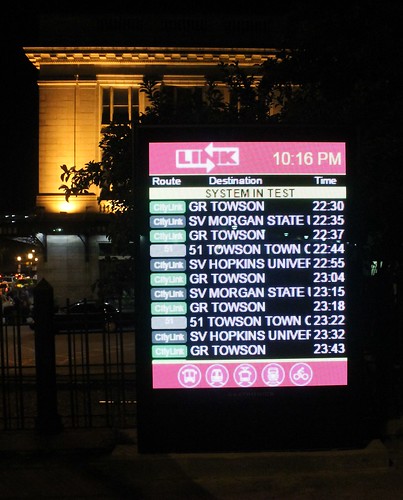
09a.BusStop.493.BaltimoreMD.11July2017According to the launch website, the system has added bus traffic signal prioritization on some routes, dedicated busways on some streets, better facilities, improvements in signage and real-time schedule displays, and connections to a richer set of "last mile connections" like bike share and car share.

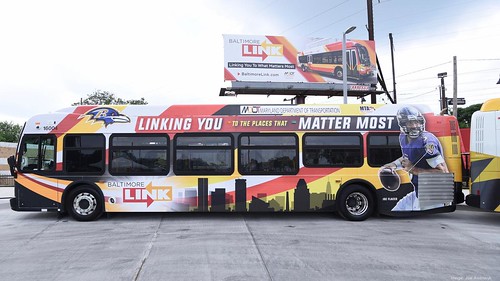
The changes came with bus livery redesign, new logos, and cross-marketing of the new system on light rail and subway cars.

Immediately after the changes, ridership dropped by almost 25%.  Ridership returned to the buses over time and now it's 1% fewer riders than before the change.

Given that overall transit ridership is down 5% nationally, attributed to the rise in ride hailing services as well as cheap gasoline, maybe that's a victory.

It's hard to tell if the changes have made for a better transit system.
BaltimoreLink bus and billboard, West Baltimore transfer center, Smallwood Street
BaltimoreLink launched in June 2017 with a ribbon cutting ceremony at the new West Baltimore transfer center on Smallwood Street.  Joe Andrucyk/Maryland Government.


Given that a lot of these massive overhauls of route structures for transit systems don't seem to result in significant ridership gains (see the January 2018 entry, "Improving bus service overall vs. reversing falling Metrobus ridership"), I wonder if we are focusing on the wrong things.

But what are the right things?

I have to acknowledge that maybe repositioning and rebranding bus service as premium, by switching to double deck buses, might not be enough. Although in London and other UK cities it works just fine, and more people ride buses in London on a daily basis than the entire railroad system in the UK.

-- "Marking bus service sexy and more equitable," 2012
-- Will buses ever be cool? Boston versus the Raleigh-Durham's GoTransit Model," 2017

The two main points of the first entry are:

1. bus service can be repositioned as a premium service by using double deck buses, which are seen as cool.

2. Introducing new buses and repositioning bus transit needs to be complemented with a series of other improvements to the provision of the service--I outlined eight categories of improvements (which is why the entry is way too long).

• Improve bus transit waiting environments
• Improve bus transit marketing
• Create a priority bus lane network in the core of the city
• Add Night Owl bus service along subway lines during the hours that the subway service doesn't run
• Improve wayfinding and transit information
• Augment on-board bus announcements and information on schedules, signage, etc., with landmark and destination information
• Create "Mobility" stores as part of transportation demand management programming
• Incorporate neighborhood history, public art elements, and transportation history interpretation into bus shelters

But MTA has incorporated many of these improvements into the BaltimoreLink program.

I think another point is pricing and other incentives. For example, in Columbus, Ohio they are introducing free transit passes to downtown workers as a transportation demand management measure ("Downtown Columbus parking issues getting partial fix as workers getting free COTA passes," Columbus Business First).  That would get more choice riders onto buses.

But it's not like MTA doesn't provide a number of incentive programs for discounted transit passes, such as to colleges and employers.  And the cost of a "day pass" to ride area transit (bus, subway, light rail) is cheap, $4.20/day.

Although to increase ridership but not farebox revenue, they could introduce "capping," so that low income riders paying daily for a day pass would stop paying daily once they've reached a payment equal to a monthly pass ($72).

London has capping and Edmonton is thinking about it ("Thinking systematically about bus transit service improvements: spurred by Columbia SC, Edmonton AB, and Baltimore," 2017).

David Blair, a candidate for County Executive in Montgomery County, suggests converting RideOn, one of the nation's more successful suburban bus systems, to free, given that the farebox revenue isn't that significant, about $21 million/year ("Who is Montogmery County executive candidate David Blair?," Washington Post)--that's less than a rounding error in the overall county budget.

(In Orlando, with the "new" commuter rail system, they spend more money on the cost of collecting fares than they make in fares, "SunRail ticket revenue is less than ticketing expense," Orlando Sentinel.)

I think it comes back to density, proximity of activity centers, and the relative efficiency of transit. If transit is reasonably efficient and cost effective, especially if you have to pay for parking, or the city is dense like most core center cities, you can get higher ridership. Otherwise, transit is more of a social service--at least bus service is--and your ability to grow the service is constrained.

In the Metropolitan City Era, 1920-present (Transportation and Urban Form: Stages in the Spatial Evolution of the American Metropolis," Peter Muller), where the mobility system has been built to preference if not require a car, it's difficult for transit to compete.

=======
I am behind in writing about my UK trip, but a couple pieces will focus on transit in Liverpool and London.

Merseytravel still runs the rail commuter system, but not buses, although the mobility system shares some branding and infrastructure, which Merseytravel still plans for and markets.  Some of what they do is simple, but it extends branding across transit infrastructure in visible ways.  It's a lesson for US transit systems.

Note that with regard to my past writings, holding up the creation of the London Overground rail system as a way to better integrate railroad services into the Transport for London system:

-- "One big idea: Getting MARC and Metrorail to integrate fares, stations, and marketing systems, using London Overground as an example," 2015

the reality on the ground is even more pronounced.  What a model!

You have to flash your card at a reader, but they don't use gates, although to continue your trip on the Underground, at the end of your trip you go through gates. That's what needs to be done for MARC in terms of integrating with transit systems in the DC and Baltimore areas.

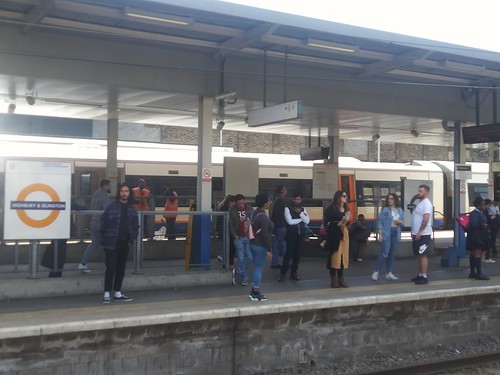
London Overground platform, Highbury & Islington Station
London Overground platform at Highbury & Islington, where it connects to the Underground.  There is a coffee kiosk on the platform, which operates during the day.

Orange is the color of the London Overground, just like red is the color of the bus system. Orange is used as an accent color on the trains and in the stations, such as the color of handrails on stairways or in trains, within the Overground roundel, etc.

People on a London Overground train

Labels: , , , , , ,

Sunday, November 19, 2017

Revisiting stories: double deck buses as a modern solution for rebranding bus service for choice riders

As a child, I'm sure I had a Matchbox toy of the Routemaster bus.  Matchbox continues to produce copies of the current version of the bus.

For a long time, I've argued that one way to reposition and rebrand bus-based transit service would be to shift to double deck buses.

-- "Making bus service sexy and more equitable," 2012
After all, the iconic Routemaster bus in London is an image known the world over.

In the early part of the last century, both double deck streetcars and buses were common in dense cities, even in New York City.

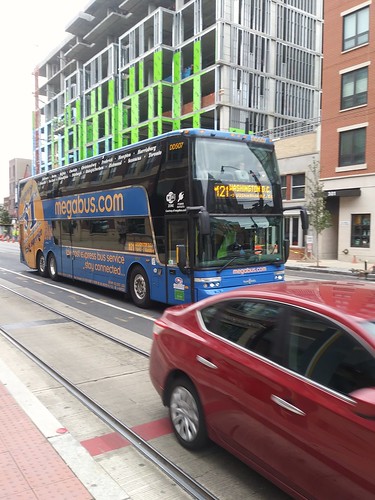
Megabus double deck bus on H Street NE, Washington, DC, on the way to Union StationMegabus double deck bus on H Street NE, Washington, DC, on the way to Union Station.

Today, double deck buses are used widely throughout the UK, not just in London, but not so much in North America, except in tourism applications and some high ridership inter-city bus routes, such as between DC and New York City.

According to the Wikipedia page, double deck buses are deployed in many European cities outside of the UK and Ireland, and in Asia, in particular Hong Kong.

In North America, for regular transit service, Ottawa, Ontario has the largest fleet of such buses, while the GOBus system in Ontario (GO = Government of Ontario) is the largest, with service dedicated to long distance commuting routes rather than inter-city transit like in Ottawa. 

A few double deck buses are deployed in various communities in the US, such as in the Puget Sound region of Washington State and Las Vegas, where Community Transit has the largest fleet providing commuter service between Snohomish County and Seattle.

The New York City Transit Museum still has one of the Yellow Coach double deck buses in its museum fleet.

Charlie shares with us an article ("Bus Stop Classics: 1934-38 Yellow Coach Model 720/735 “Double Decker” – the Queen of Fifth Avenue," CurbsideClassics) he came across about double deck bus service on Fifth Avenue in New York City. 

This particular article discusses the bus that was used on the route for about 20 years, until the mid-1950s.

The highly used bus line on Fifth Avenue is discussed in voluminous detail in this piece from the Coachbuilt website, and has many images of earlier double deck buses that had been in service on the route.

The Coachbuilt website focuses on companies that built "coaches," not just buses but limos, taxis, etc. For example, the geographical listing for Michigan has entries for more than 150 companies.

It's an incredibly voluminous site.  The author aims to produce a book titled the Encyclopedia of American Coachbuilders.
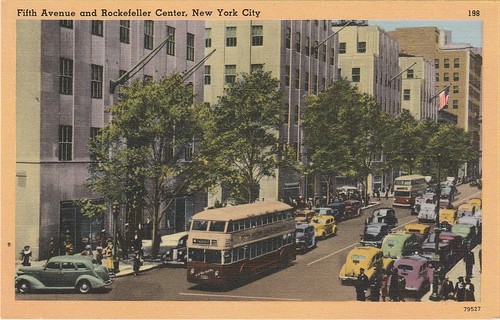
Vintage postcard showing double deck buses on Fifth Avenue in New York CIty
Vintage postcard showing double deck buses on Fifth Avenue in New York City

Labels: , , , , , ,

Monday, November 13, 2017

Prioritizing sustainable mobility in Toronto, Chicago, and Los Angeles

Nationally, transit ridership is down--although problems with transit service in New York City are a result of very large increases in ridership ("Surge in Ridership Pushes New York Subway to Limit," New York Times). This is attributed to cheap gasoline prices, some service cuts by transit agencies in response to budget problems, and the rise of ride hailing services ("Ride-Sharing Decreases Public TransitUse," Government Technology).

Chicago.  Earlier in the week, Chicago's Active Transportation Alliance released a report, Back on the Bus: Speeding Up Chicago's Buses, about ways to improve bus ridership, which as in many cities across the country, has been dropping ("As buses slow and ridership sinks, advocates look for ways to lure commuters back," Chicago Tribune).

The report makes a number of recommendations on service improvements--nothing about fares--to speed throughput, as most research demonstrates that the time spent traveling is the main decision point concerning mode choice, along with cost.
• Dedicated bus lanes – Create a network of Transit Priority Streets, as outlined in the Chicago’s Complete Streets policy, including at least 50 miles of dedicated bus lanes and other on-street infrastructure to give crowded buses priority;
• Traffic signal improvements – Move buses more smoothly through busy intersections by changing signal timing or using technology that gives buses an extended green light to get through intersections;
• Faster boarding – Allow riders to pay their fare at the bus stop before boarding and enter the bus through the front or rear doors

Recommended actions:

(1) Create a plan for Transit Priority Streets with 50 miles of new bus lanes
(2) Create effective ways to enforce bus-only lanes
(3) Incentivize purchase of multi-day passes
(4) Establish a new local dedicated revenue stream to fund transit improvements and expansion
(5) Push for more data sharing and analysis of ride-hailing trips
Chicago priority bus lane
Chicago has begun implementing priority bus lanes downtown, although this is a rendering.

Los Angeles.  I found the approach by Chicago's advocates interesting (and I have to say, ATA is one of the best sustainable mobility advocacy groups in the US) because during the same week that ATA released their report, there was an op-ed ("L.A.'s dwindling transit ridership isn't hard to fix. Make riding the bus cheaper and more convenient") in the Los Angeles Times about solutions for the decline in bus ridership in Los Angeles.

The writers argue the primary issue is investment in rail transit at the expense of bus service and high fares.  I don't necessarily agree.

First, of major U.S. cities, LA's individual trip fares are the cheapest (excepting DC's Circulator buses, which cost $1 per ride), and the cost of a weekly or monthly pass compares favorably to the lowest cost pass products in San Francisco and New York City, which are among the lowest priced nationally.

Second, it's hard to see how investment in light rail and subway services cripples bus service in Los Angeles specifically. 

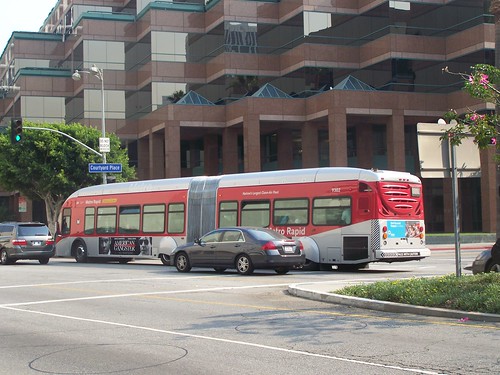
Metro Rapid bus on Wilshire Blvd. (Mid-Wilshire), Los Angeles
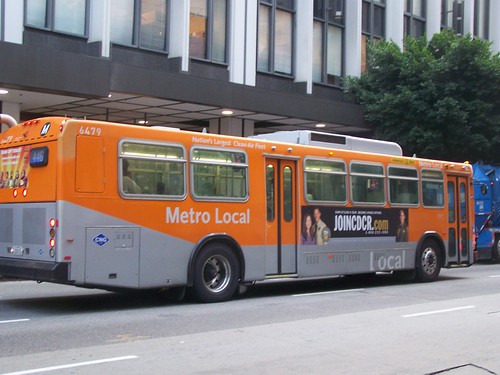
In creating rapid bus lines, LA Metro was an early adopter of creating different graphic treatments for rapid (red) and local (orange) buses.

As an outsider, the investments in bus service by LA Metro are impressive, not just in terms of low cost fares, but in terms of the quality of vehicles, branding, creation of high quality transfer stations (El Monte Transit Center), and support of biking as a complementary mode--LA Metro runs the LA bike sharing system, and is the only major city transit agency to do so and their bike hubs are national best practice ("L.A. officials encourage bicycle commuting, safety during Bike Week," Los Angeles Daily News).

Metro Local Bus, Wilshire Blvd., Los AngelesThe biggest problem is the dispersal of jobs around the region, making bus transit trips to and from work less efficient.

That's why comparatively speaking, while having ridership between 9,000 and 20,000 on many of the system's bus lines, Chicago's bus lines have higher ridership, even though Los Angeles has much greater population.

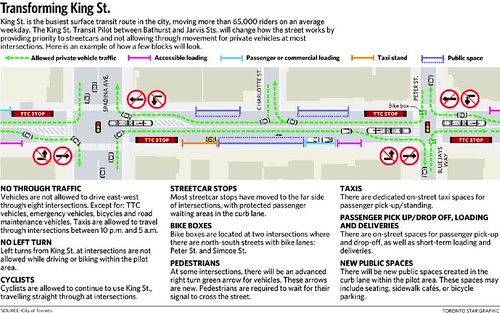
Toronto. The Toronto Star is reporting ("Street overhaul that puts transit first set to launch on King St.") on how that city is about to embark on one of North America's most prominent initiatives in prioritizing transit use over motor vehicles, by making through driving impossible on King Street--the location of the city's most heavily used streetcar line--while taxis and bicycles can make through trips too. Although, at this point it's not permanent, but a pilot test, lasting one year.  From the article:
Once the project is operational motorists will be prohibited from driving straight through the length of the pilot area. Instead, drivers will be channelled into right turn lanes at most signalized intersections and be compelled to turn off of King. That should allow streetcars to pass through the centre lane uninhibited. Additionally, on-street parking will be removed to make way for loading zones, taxi stands, and new public spaces.

City staff believe giving streetcars the right-of-way will allow for the more efficient movement of people downtown, because the majority of those who use King are transit riders. The 504 King streetcar carries 65,000 people every weekday, but is often stuck in traffic behind the 20,000 drivers who use the street.
Because Toronto is one of North America's largest cities, this is a big deal, probably the most prominent example of the creation of a sustainable mobility prioritized street. Perhaps this can happen more now, elsewhere, depending on the level of success.
Traffic changes coming to King Street, Toronto

What to do? The reality is that it's true that choice riders--people who are not transit dependent--prefer rail. Plus, rail tends to support complementary real estate development and adoption of a sustainable mobility lifestyle at greater rates than bus transit, which means that as a public investment it has much greater economic return.

Chicago's advocates make the point that investing in bus is cheaper. From the CT article:
It is important to make buses appealing because they are less expensive and better for the environment than cars, the report said. And improving bus service is cheaper and easier than adding more rail routes — the cost of expanding the Red Line from 95th Street to 130th Street is estimated at more than $2 billion.

“Of all the available options, the bus is one of, if not the most, efficient and affordable,” said Kyle Whitehead, government relations director for the Active Transportation Alliance and an author of the report.
The cost to create improvements to bus service is cheaper, no question. But it doesn't necessarily result in the kinds of broader changes in land use and mobility choice that we are seeking. Plus, without relatively short distances between residential and employment centers and other destinations, it's slow, which reduces considerably the opportunity to capture ridership.

Chicago has 33 bus routes with 9,000 to 19,000+ riders, and 5 routes with more than 20,000 ridersLA has many dozens of routes with comparable ridership

By contrast, DC proper has a few routes with high ridership--12,000+ to 25,000 daily riders--which tend to be "point-to-point" lines running on major arterials serving major destinations and employment centers, and usually Downtown (the 90s buses do not serve Downtown, but the other high ridership routes do--30s on Wisconsin-Pennsylvania Avenues, 50s on 14th Street, S on 16th Street, 70s on Georgia Avenue--it's worth a research project to figure out why Rhode Island Avenue doesn't have the same potential).

That being said, we should definitely work towards making the improvements, especially in dedicated transitways on high-use corridors, that improve bus service in significant ways.

Also see "Making bus service sexy and more equitable" (2012) and "The need for a double decker bus vs. streetcar comparison study" (2014).

But definitely in the case of Los Angeles County, the solution that will lead to a significant increase in bus transit ridership is a lot more complicated than lowering already comparatively low fares or shifting resources from rail expansion (which is a capital expenditure, not operations).

Labels: , , , , , ,

Friday, June 23, 2017

MTA Baltimore running online ads promoting the BaltimoreLink service

I mentioned Baltimore's reconfiguration of its bus network earlier in the week ("Thinking systematically about bus transit service improvements"). While online today I noticed a clickable ad (obviously generated by cookies, since the website I was looking at was for an Indiana newspaper).

When you click on it, it takes you to a website, which while not graphically forward, provides you with information about new routes, by asking you to enter the number of the route you used to ride

There are at least two versions of the ad.  I didn't get a screenshot of the version that more directly uses the Baltimore CityLink name and logo.

When I worked for Baltimore County's Office of Planning, until I got "my Baltimore bike," I used to ride the bus up Greenmount Avenue/York Road to Towson for work. The line had the 48 QuickBus limited stop route (once we made the trip in 19 minutes!) and the 8 local route.

According to the website, it's now the CityLink Red route.

Labels: , , ,

Tuesday, June 20, 2017

Thinking systematically about bus transit service improvements: spurred by Columbia SC, Edmonton AB, and Baltimore

Charging ports on new buses in Columbia, SC.  Photo: Tim Dominick, Columbia State newspaper.

The Columbia State reports ("This new Columbia ride is smoother, has Wi-Fi and lets you pay with an app") on new buses at the local  transit agency, the Central Midlands Regional Transit Authority, operating as Comet.  Getting new buses tends to be ordinary, not really newsworthy. 

But the new buses added to the fleet offer significant advances in on-board amenities and fare collection, so are an upgrade in terms of customer service too.

The buses have free to use wifi and charging ports, along with security cameras, and IT capabilities to capture real-time data about performance. The data will be used by transit operators to improve service, but will also be made available to riders, using an app called TransLoc (I think that's the app is used by the Go Transit services in Raleigh-Durham too).

Plus the fareboxes are outfitted to accept smartphone payment apps!

Wifi has been made available on buses for awhile, but for transit agencies, it's still a new service.  I haven't heard of charging ports being offered on buses, nor have I come across many examples of smartphone-enabled payment options at the farebox, so these are significant improvements.

The new buses are being paid for by a county sales tax add-on for transportation, which has been levied since 2012. It pays for transit (bus) and road improvements and expansion of a trail network.

A framework for bus service improvement.  It makes me realize while I discuss in so many ways how to improve bus service in the 2012 entry "Make Bus Service Sexy and More Equitable," a more robust framework is required to outline bus service improvements in a more systematic way.

This also comes up in the DC area as starting on Sunday June 25th bus fares increase simultaneously with many service cutbacks ("It's about to get more expensive to ride the bus," Washington Post).  And yesterday the Maryland Transit Administration launched its new BaltimoreLink reconceptualization of transit service in the Baltimore area ("Some bumps in the road for bus riders as BaltimoreLink hits city streets," Baltimore Sun).

Note that I haven't gotten around to reading this article from McKinsey, "The expanding role of design in creating an end-to-end customer experience."

Amenities inside the bus.  The changes in Columbia make me realize that I haven't thought about this enough in terms of improvements to the transit rider experience "inside the bus."  The 2012 entry mentions having bus system maps on the bus and maybe better accommodations for strollers/packages. But that's about it.

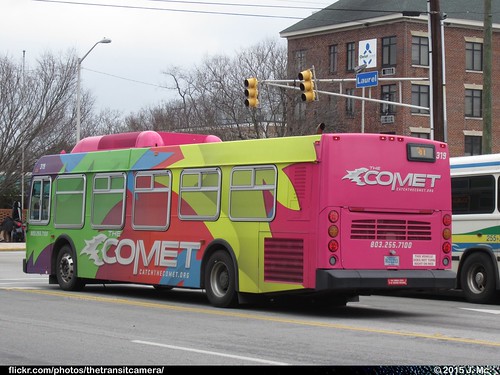
Branding-identity improvements.  The Columbia transit system, called the Comet, has a design forward bus livery and transit stop signage.   Transport for London has "product design managers" for the different "lines of business" such as "bus service."

-- "The Sign Design Society Event: Defining a City," designworkplan
-- Product design guidelines, Transport for London

From the presentation by Ivan Bennett, Design Manger for London Buses:
One reason other systems have failed is the lack of continuity. London bus stops extend beyond central areas and cover all routes in Greater London. Ivan indicated that passengers do not just want information about where they are travelling from, but when they get there, they need the same consistently presented information. People need information near their homes and local areas, not just in the centre of the city.
Central Midlands RTA 319

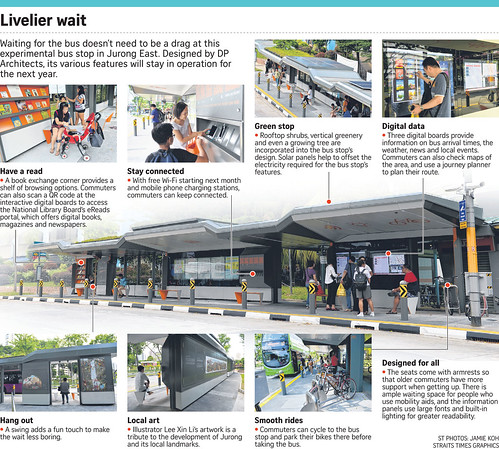
Bus shelter/bus stop improvements/bus transit stations. Many past entries discussed bus shelters but there are newer developments in bus shelters outside of public art expression and more along the lines of broader urban design and placemaking improvements to communities such as in the Jurong district of Singapore ("Jurong bus stop makes waiting fun,"Straits Times).

Features in the Jurong experimental bus stop, Singapore

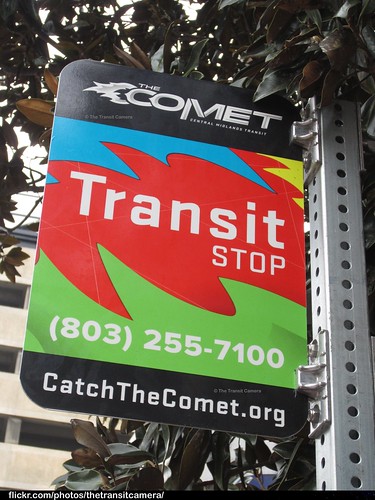
Most transit stop signage is pretty dull.  The COMET system extends their "not boring" bus livery design to the signage at bus stops.
Central Midlands RTA Bus Stop Sign

Transit stations are another element of the mix, and exist at various sizes. In the DC area, there are a handful of bus-only transit stations.  Many rail transit stations also function as significant transfer points to bus service.

Fare equity.  I am embarrassed that most of my earlier entries on "transit wish lists" and the like didn't address making lower cost transit pass options for lower income households.  Many areas have special youth passes (DC and Montgomery County Maryland among them, more recently San Francisco, "Free Muni for low-income youth starts Friday," San Francisco Chronicle).

And San Francisco has had for awhile a specially priced transit pass for low income residents called the Lifeline Pass--it's half the price of the regular monthly pass.  More recently, Seattle has introduced a similar program called ORCA Lift, although it is per ride, but about half the cost of a regular fare ("Seattle Cuts Public Transportation Fares For Low-Income Commuters," NPR). 

The one thing I say about such fare pricing is that there should be funds provided locally for this subsidy, separate from the general appropriations for "transit service."

Edmonton Transit is introducing a new fare media system that like the Oyster card system in Greater London, can calculate "maximum fare costs for riders." London does it for riders who don't have weekly or monthly passes, but based on the cost of a daily transit pass.

In the case of Edmonton, for low income riders who can't afford to buy a monthly pass in advance, the "rate capper" will work over the course of an entire month, and once a rider pays in fares the equivalent of the cost of a monthly pass, the pass -- and "free" travel for the rest of the month kicks in ("New smart cards for Edmonton Transit boast a 'social justice' edge," Edmonton Journal).
From the article:
People with steady jobs and good paycheques are the most likely to buy a monthly pass. They have cash on hand at the beginning of the month.

Those who might need their last nickel just to keep the lights on are the most likely to pay cash for every trip. It means they pay $3.25 per ride, more money for the same service.

That’s one reason Ken Koropeski is excited about Smart Fare.

With a card and an online account, the system can track how many times a person uses transit during a 30-day period, said Koropeski, director of special projects for Edmonton Transit. No one would have to commit to a monthly pass on Day 1. Instead, the system could automatically track use and once the rider hits that monthly maximum, all other rides are free.

“When you have capping, it has inherent benefits for people with low income,” said Koropeski.
While the transit agency is adding the capability of "capping" to their fare media system, Council approval must be obtained before the program can be implemented.

Urban design and access improvements. The VIA transit agency in San Antonio incorporates urban design thinking into its strategic planning unit.

According to Christine Vina ("VIA urban planner wants to build a better San Antonio," San Antonio Express-News):
I don’t consider VIA “a bus company.” It’s a transit agency that connects people with places through sustainable transportation options. But that’s too long for a business card.

VIA’s Strategic Planning Division, for example, analyzes the projected transit needs of the community over the next five to 25 years and develops projects that respond to the need for transportation alternatives. This allows people to reduce their vehicle travel, and increase their options for living, working and playing — which provides the opportunity for an enhanced quality of life.

As an architect and urban planner, I manage VIA’s joint development and public art programs, so I’m fortunate to be able to work as a liaison to creative architects, landscape architects, planners, artists and developers who we contract with to design and build our capital projects. Through good design, we increase the value of the role our facilities play in contributing to the built environment.
Northgate Transit Station, Edmonton.  Photo by Tom Braid.

People are complaining in Edmonton that they have some great new transit stations, but the stations don't do much in the way of changing the mobility paradigm towards sustainability, that the stations extend the automobility paradigm because while they might look nice (public art treatments) access requires walking across many lanes of traffic, etc. ("Edmonton bus terminals fall short for pedestrians, says mayor," Edmonton Journal).  That's a matter of urban design and access.

Maps, schedules, real-time information, etc.  We can't forget the need to have printed products as well as online apps, real-time data at stations and stops, etc.  Many of these items are covered in my "critique" of the then newly opened akoma Langley Crossroads Transit Center from December 2016.

Transit network breadth and depth.  While listed last, this is the most important element.  I argue that network breadth, network depth, level of service (LOS) and level of quality (LOQ) standards and expectations should be produced by the area's "Metropolitan Planning Organization" separate from the transit agency or agencies.  That would mean the service footprint and standards would be set independently.

The King County Metro Transit (Washington State) Service Guidelines are a good model.

This is important because too often decisions are "satisficed" because of budget limitations.  That's an issue in the DC area, as service declines in Metrorail have resulted in lower ridership for both the rail and bus systems, which has reduced "farebox revenue" further stressing the system's finances.

But service cuts when not done judiciously, can further result in ridership declines.

Transit network legibility: differentiating between express; local; and high-frequency service.  Bus systems should reconfigure their service footprint every so often.  By defining the type of service--technically bus rapid transit is a form of high frequency service, but with limited stops, so it's a hybrid of express and high-frequency, but usually charged at a regular fare--and creating the right set of routes, ideally maximum ridership is achieved, accomplishing breadth, frequency, service, and quality goals and objectives.

A number of bus systems are implementing changes such as Richmond ("City to rethink GRTC routes, largely unchanged since trolley days," Richmond Times-Dispatch) and Baltimore. From the Baltimore Sunarticle:
Some people balked at the confusing changes, while others welcomed them. Everyone enjoyed the free rides being offered for the system's first two weeks. ...

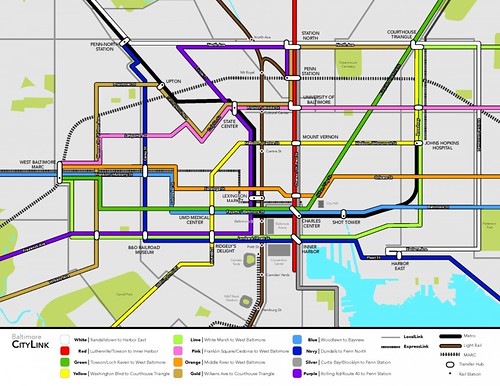
BaltimoreLink is based around a dozen color-coded, high-frequency CityLink routes running every 10 minutes through downtown Baltimore, connected to less frequent LocalLink and weekday ExpressLink commuter buses.

The overhaul, the first re-routing of the system in decades, is designed to modernize routes and connect buses to where people go, whether it's jobs, entertainment or other transit. In addition to redesigning the routes, wrapping the buses in the Maryland flag colors and unveiling 5,000 new bus stop signs, the MTA added bus-only lanes and traffic-light sensors aboard buses to shorten red lights and extend green ones to get the buses more quickly through traffic congestion.
baltimore-transit-plan
New transit service map for the City of Baltimore.

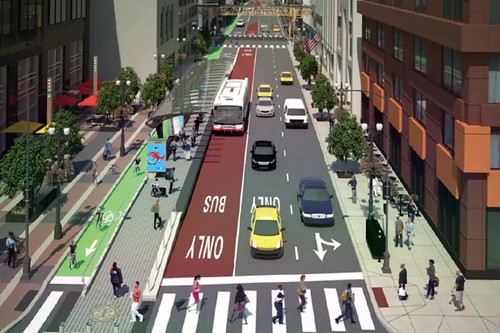
Transit prioritization on roadways.  As integrated into the new BaltimoreLink service, exclusive transitways, traffic signal control, and other methods help transit buses (and streetcars/light rail) move more quickly and better balance transit vehicles recognizing that they carry many more people. 

Exclusive bus lane in Downtown Baltimore.  Baltimore Sun photo.

Also see "MTA officials pull all-nighter for 3 a.m. launch of $135 million BaltimoreLink bus route overhaul" and "New MTA head Kevin Quinn: 'We're ready for launch' of BaltimoreLink," Baltimore Sun.

For example, in DC it has been a struggle to develop bus exclusive lanes, but on streets like 16th Street, Georgia Avenue, and H Street, buses carry 40% to 50% of the total people throughput.  On Georgia Avenue and H Street, about 300 bus runs move 15,000 people trips, while 20,000 motor vehicles move 20,000 to 25,000 people.

Toronto is prioritizing streetcar service on King Street--the line has 65,000+ daily riders--but not without some controvery ("Ford's costly streetcar study will just reveal the obvious," Toronto Star). 

Minneapolis is introducing urban design improvements to the Nicolett Transit Mall ("Nicollet Mall likely to reopen this fall after two years of work," Minneapolis Star-Tribune).

-- Nicolett Mall Project

Bus rapid transit, to meet the definition, is supposed to have exclusive rights of way.

Transit network: intra-district service.  I write about what I call the "tertiary" transit network of service within neighborhoods.  Other intra-district service like Circulators can be part of the primary or secondary transit networks of a community or metropolitan area ("Making the case for intra-city (vs. inter-city) transit planning").

While I tout the Tempe Orbit service as the premier example of intra-district multi-neighborhood bus service ("Earth Day and Intra-neighborhood transit"), Edmonton is discussing this kind of service in the context of providing better service to seniors ("Four ways to keep Edmonton seniors walking from transit." Edmonton Journal), albeit with a fare upcharge.  From the article:
Community buses

If the bus service focuses on main streets and express routes, transit officials say service inside neighbourhoods should focus on key destinations for people with mobility challenges. They’ll design a sample route to present to the urban planning committee with the larger changes June 7.
That will be critical, said Walters. Some residents in Lendrum were upset last September when service cuts to Routes 55 left them with no way to get to the neighbourhood strip mall.

But transit officials returned to ask residents which destinations are most important. The new changes, set to be rolled out this coming September, will reduce service to once an hour but cover more of the neighbourhood. It’s a good example of what’s possible.

In the future, a community bus ticket might cost extra because it’s a niche service requiring extra resources per rider, said Walters. But research out of the University of Alberta suggests many seniors are willing to pay, they just need the option.

“We’re encouraging these people to stay in their homes,” said Walters. “We need to have transportation options when they can no longer drive their own private vehicle.”
And I've discussed micro-transit services, particularly shuttles, as part of mobility services in commercial districts, aimed at getting people to park in parking structures so that street right of way can be used for purposes other than car storage ("Intra-neighborhood (tertiary) transit revisited because of new San Diego service").

Equity of access. Another element of transit service is equitable access. Outside of major cities, transit service is seen more as a form of social services for people who can't afford to own a car rather than as a preferred mobility choice and a way to manage optimal use of the road network.

Where services go, providing access to employment opportunities and other destinations, hours of operation, etc., may all involve questions of equity. The Federal Transit Administration has a process called Title VI to guide consideration of these matters by transit agencies.

Sometimes this is about providing service to suburban locations from cities, sometimes it has to do with whether or not a desired destination like a shopping center, will allow on-site access to transit vehicles, but most often it comes up with fares and service hours.

With regard to fares, I don't think that transit agencies should have to "keep fares low" in ways that harm the system's ability to be funded. But I do think that the "social service" function of transit--fares--as discussed above, needs to be funded from different sources than "transit," in recognition of the function and its importance.

WRT BaltimoreLink, note that some transit advocates and organizations argue that the new service footprint doesn't do enough when considered on equity grounds in terms of providing increased access to jobs. See the op-ed, "Is BaltimoreLink really better? Show us the data," from the Baltimore Sun.

Labels: , , , ,