Rebuilding Place in the Urban Space

"A community’s physical form, rather than its land uses, is its most intrinsic and enduring characteristic." [Katz, EPA] This blog focuses on place and placemaking and all that makes it work--historic preservation, urban design, transportation, asset-based community development, arts & cultural development, commercial district revitalization, tourism & destination development, and quality of life advocacy--along with doses of civic engagement and good governance watchdogging.

Thursday, September 16, 2021

Change takes for(&*())ever: Repatterning suburban development and Gwinnett County, Georgia

ABC photo by Byron Small.

I'm on a list where someone sent this article, "Planning firm with transit expertise selected to lead Gwinnett Place revitalization" from the Atlanta Business Chronicle, about the redevelopment planning for a decrepit mall, and I didn't think it was particularly interesting, although I guess it's new and special in Gwinnett County.  From the article:

The years-long dream of transforming the former Gwinnett Place Mall into a modern retail center and transit hub is one step closer to reality. The Gwinnett Place Community Improvement District (CID) selected planning firm Vanasse Hangen Brustlin, Inc. (VHB) to lead the revitalization strategy and craft a master plan for the site, which has seen decades of decline. 

The redevelopment of Gwinnett Place reflects a trend of mall owners across the country reinvesting in or reimagining their retail spaces. It also comes as Gwinnett braces for massive population growth. The county is projected to reach 1.5 million residents by 2040, surpassing Fulton County. 

In April, the project received $275,000 in grants from the Atlanta Regional Commission’s Livable Centers Initiative. The funding will go toward redeveloping the mall and studying how the county could turn it into a hub for bus rapid transit along Satellite Blvd.

My initial reaction was no big deal, but (1) I suppose any step forward towards repatterning in the suburbs should be celebrated. 

(2) But how does this ever go from one off initiatives at a particular decrepit place to a regularized program across a community or county?  ("Extending the "Signature Streets" concept to "Signature Streets and Spaces"," 2020)

I am a city person, so I don't track suburban stuff as much as I should, except in the DC area and I am beginning to get a handle on the Super Sprawl of the Salt Lake Valley. 

(3) Is there any suburban jurisdiction that has a real ongoing program of repatterning away from sprawl?  

It's almost impossible because  automobile centric land use and transportation planning is the dominant planning and development paradigm.  Little outposts of urbanism don't have much effect on the whole.

(4) I know about the Montgomery County effort in White Flint and they are for intensification but I wouldn't call it a regularized countywide program. Same with Tysons Corner in Fairfax County, Virginia. 


(3) It's not like this concept of repatterning suburban business development towards walkability and mixed use is new stuff, the relevant "Ten Steps" publications by the Urban Land Institute are 15 to 20 years old. THAT'S OLD. The White Flint and Tysons efforts are approaching 15 years old.


2.  Bus rapid transit is not light rail on wheels.  But it's better than regular bus.  And maybe better than a traffic-engorged commute.  Another thing the article says is how great BRT is ("'If we can do BRT, we should': How public transit could transform suburban Atlanta malls"):
Gwinnett County residents, like many other suburban communities, want alternatives to spending long commutes in their cars, said Joe Allen executive director of the Gwinnett Place CID. The future BRT system will include permanent stations and dedicated lanes, he told Atlanta Business Chronicle in August. "It’s really going to be light rail but with rubber tires,” Allen said.
A short BRT line is under development in Atlanta ("MARTA on schedule with Summerhill BRT in Downtown ATL," Saporta Report).

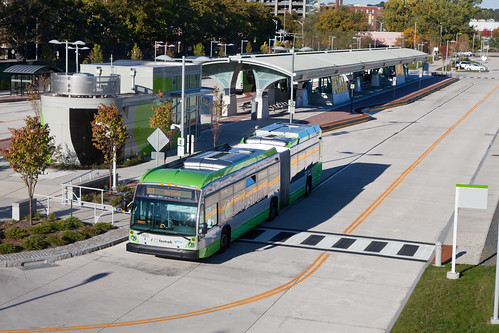
Fancy bus shelters for Atlanta's BRT.


WRT the article: BRT isn't faster than light rail usually, even with dedicated lanes.  It is cheaper.  But ridership is usually significantly less.  And bus service, even BRT, doesn't seem to have a lot of multiplier effect when it comes to land use development and intensification.

But I think it's fine as one element in a complete network of transit services.

Labels: , , , ,

Sunday, September 29, 2019

What Richmond can't teach DC about bus services

I am looking forward to receiving a review copy of the recently published Better Buses, Better Cities from Island Press.

In Sunday's paper, the Washington Post local opinions page has reprinted an article ("What Richmond can teach Washington about transit") which I feel like I read in Greater Greater Washington already.  And a similar piece ran as an article in the Washington City Paper.

Another piece in the Sunday paper, "The bus — yes, the bus — is key to fixing our transportation woes;," is by Robert Puentes, who chairs the advisory committee for WMATA's Bus Transformation Project.

The project and the conclusions in the op-ed aren't much different from what I've recommended in various posts for many years.

And I still argue for double deck buses as an obvious and definitive rebranding tool.
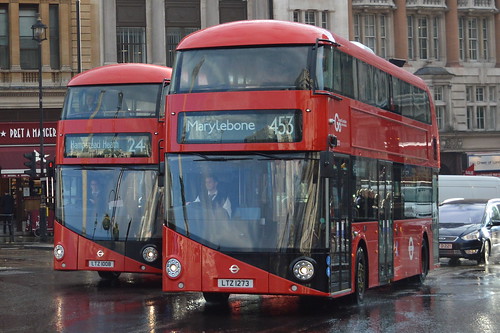
LT8 (LTZ 1008) and LT273 (LTZ 1273)

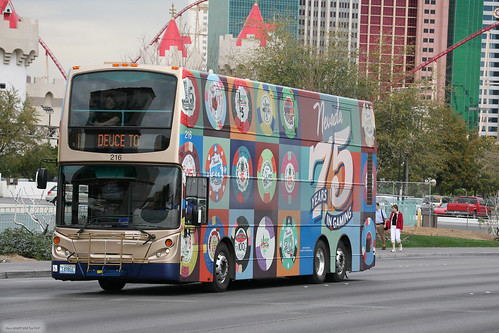
Las Vegas has used double deck buses as part of the special branding for its Deuce bus service on the Strip.  From the Las Vegas Review-Journal article "Tina Quigley, CEO of Southern Nevada transportation agency, to retire":
It all started with her first day on duty with the RTC in 2005 when Quigley helped unveil the Deuce buses on the Strip, a day she remembers fondly.

“We had a parade of Deuce vehicles up and down the Strip, and it was clear to me that this was something very new and exciting as it related to transportation,” Quigley said. “Bringing in those double-deckers — it’s hard to think of a bus as being sexy, but these were some sexy vehicles. As they paraded around the Strip and I saw the excitement and the coverage and subsequently the ridership that came along with that, I was hooked in realizing that how you present transit and create transit in a way that it is desirable and attractive really reframes the national conversation on transit.”
The Deuce

Although the Deuce buses ought to have a much more vibrant color scheme.

More cities than just London have deployed such buses.  They are common across the UK and in Hong Kong.  More transit agencies are using them across North America, although none in a large scale way.

I responded to the original entry in a blog post.

-- "Reviving DC area bus service: and a counterpoint to the recent Washington City Paper article"

The DC area has plenty of lessons to learn from other areas, but the Richmond experience with changes to its service network and the introduction of bus rapid transit isn't particularly noteworthy.

GRTC Pulse Richmond BRT
Pulse bus and station in Downtown Richmond.  Photo by BeyondDC.

The DC area has at least 1.2 million transit trips daily; Richmond, 30,000.  How much can Richmond teach us?  Note that the Post headline should read "What Richmond can teach Washington about bus service."

First, the DC area crushes the Richmond area in terms of "transit" usage overall including the number of "bus" riders.

On an average day, the DC area has about 600,000 subway trips, and at least 600,000 bus trips.  That's a minimum of 1.2 million daily transit trips.

Last year I wrote about a great marketing program for the Richmond transit agency, focused on the economic value of transit service.  Richmond Times-Dispatch photo.

Richmond has about 30,000 daily bus trips.

That's just a tad more than the ridership of DC's 70s Metrobus line, which runs between Silver Spring and Downtown DC.

That Richmond has experienced large percentage increases in bus usage is a function of a low base of riders, not some world changing move forward in best practice.

The problem is not that we need to do what Richmond is doing and we aren't.  We are.  We're just not doing it enough.

[Although, to be fair, except for integration, customer service and branding elements, the DC area is ahead of many jurisdictions in that bus to bus transfers are free across the different agencies, which use the same transit fare card system (using the same card isn't unique, but having free transfers across systems is relatively unique). And bus fares are relatively low.]

And I have written about that extensively.

The recommendations (with details and references to past blog entries and other links in the August response):

1. The Metropolitan Planning Organization, not the various transit agencies, should be the primary transit planner, setting master requirements for network breadth, network depth (frequency and levels of service), and levels of quality.

2. Contract with transit agencies to provide this level of service.

3. Define the transit network in terms of networks first at the Metropolitan; Suburban: and Center City scales; and then primary; secondary; and tertiary networks within them, which is particularly relevant to bus service.

4. To best provide service, the DC area should create a German style transport association to better plan and deliver all transit services in a more integrated fashion.

5. The bus services should be integrated better in terms of branding and support, using the model of the services in Raleigh-Durham, North Carolina, where they provide one call center providing information for all the services, have integrated schedules, a common branding system,, etc.

6. There should be a night network and other improvements, like dedicated transitways, better transit information, etc. (Dedicated transitways are expanding in DC.)

But some systems have increased ridership in the face of decline
. Among the exceptions, there are four that are outliers: Columbus, Ohio; Las Vegas; Richmond, Virginia; and Seattle.

Guess what, it's not rocket science.

Free transit.

More service.

Defined high frequency lines (usually a form of bus rapid transit).  Note that DC proper has a sub-network of seven high frequency lines that have about 15,000 to 25,000 total riders on each line.

A unified brand is the big lesson from Richmond. Richmond's Pulse BRT service advantage is that it is the only rapid bus program in Greater Richmond. By contrast the DC area has at least seven different initiatives. So instead of one brand to focus on, we have a polyglot. I argue that there should be one unified brand for BRT and/or your "high frequency bus network."

Expanding the rail network leads to increases in bus ridership.

Labels: , , , , ,

Tuesday, August 27, 2019

Reviving DC area bus service: and a counterpoint to the recent Washington City Paper article

-- "What Lessons Can D.C. Glean From Richmond's Bus Overhaul?"

(Metrobus, especially in DC, already does the things that Richmond implemented.)

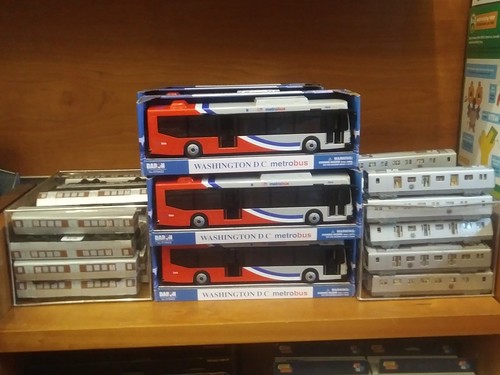
WMATA train car and Metrobus toysBus service is the DC area is balkanized.  Cross-jurisdictional services are provided primarily by Metrobus, the bus unit of WMATA, the Washington Metropolitan Area Transit Authority, which runs the Metrorail system, which dominates the agency.

Intra-jurisdictional services are mostly provided by jurisdiction-specific agencies, with the exception of DC and to some extent Prince George's County, Maryland, where a majority of bus service (in terms of number of riders) is provided by Metrobus.

Metrobus service is contracted and paid for by the jurisdictions, and sometimes jurisdictional policy decisions result in disconnections within "the bus service network."

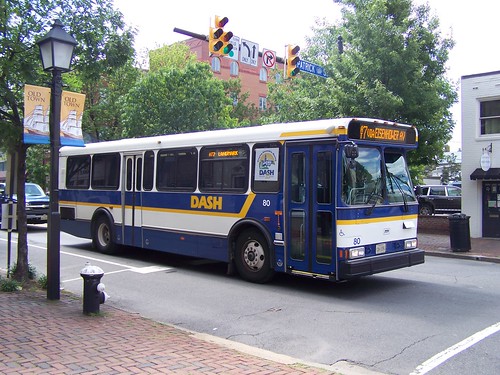
Alexandria Dash busFor example, Maryland Mass Transit Administration, which ultimately makes the decisions about service, pretty much refuses to fund/authorize bus services that cross the DC border, although there are some exceptions.

As an example, this is why the 30s buses stop at Friendship Heights on the DC-Maryland border, rather than continue to Bethesda or further north.

Simultaneous with the recent failures of Metrorail, which have resulted in a loss of about 15% of daily ridership, bus service has also declined significantly, but slightly less, at 12%.

This makes sense, because many daily journeys involve legs on both subway and bus, and a drop off of Metrorail ridership means a concomitant drop in bus ridership.

Every 10-15 years, WMATA does a big bus study.  Previously this had been done in the early part of the 2000s), and the most recent is the "Washington Area Bus Transformation Project," which makes a number of recommendations for improvement.

In various writings I have recommended:

1.  The Metropolitan Planning Organization, not the various transit agencies, should be the primary transit planner, setting master requirements for network breadth, network depth (frequency and levels of service), and levels of quality.

2.  Contract with transit agencies to provide this level of service.

-- "Without the right transportation planning framework, metropolitan areas are screwed, and that includes the DC area," 2011
-- "Metropolitan Transit Planning: Towards a Hierarchical and Conceptual Framework," 2010
-- ""Route 7 BRT proposal communicates the reality that the DC area doesn't adequately conduct transportation planning at the metropolitan-scale," 2016

3.  Define the transit network in terms of networks first at the Metropolitan; Suburban: and Center City scales; and then primary; secondary; and tertiary networks within them, which is particularly relevant to bus service.

-- "The meta-regional transit network," 2009

4.  To best provide service, the DC area should create a German style transport association to better plan and deliver all transit services in a more integrated fashion.

-- "The answer is: Create a single multi-state/regional multi-modal transit planning, management, and operations authority association," 2017

Design scheme for Go Transit bus systems in the Raleigh-Durham region
In Raleigh-Durham, all but one of the bus systems have rebranded as "Go Transit" i.e., GoRaleigh, GoTriangle, etc. with a common design for livery, signage, etc., but each system uses a different color.

5.  The bus services should be integrated better in terms of branding and support, using the model of the services in Raleigh-Durham, North Carolina, where they provide one call center providing information for all the services, have integrated schedules, a common branding system,, etc.

-- "Making bus service sexy and more equitable," 2012
-- "Will buses ever be cool? Boston versus the Raleigh-Durham's GoTransit Model," 2017
-- "Branding's not all you need for transit," 2018

6.  There should be a night network and other improvements, like dedicated transitways, better transit information, etc. (Dedicated transitways are expanding in DC.)
-- "Night and weekend transit/subway service," 2016
-- "Overnight transit service: San Francisco," 2016
-- "Night moves: the need for more night time (and weekend) transit service, especially when the subway is closed"," 2013

Alexandria's wayfinding system includes some great signs about transit options, placed on the Waterfront and at King Street Metro.
Wayfinding sign for Alexandria at the King Street Metro station

Poster promoting new rider-friendlier transit pass product pricing, WMATA/Metrorail, DC area✺ To be fair, except for integration, customer service and branding elements, the DC area is ahead of many jurisdictions in that bus to bus transfers are free across the different agencies, which use the same transit fare card system (using the same card isn't unique, but having free transfers across systems is relatively unique).

✺ Bus fares are "relatively" cheap at $2 or less. (Although some systems elsewhere are even cheaper.  But many are more expensive.)

✺ And effective in FY2020, which started in July, WMATA significantly reduced the price of various pass products, and with some of the Metrorail passes, bundled in bus service, when previously and rigorously, WMATA has required separate fares for each mode.

✺ Plus, because Maryland MTA is one of WMATA's funders, they use the same transit fare card system in Greater Baltimore, which means that the transit fare cards interoperate between DC and Baltimore.

✺ While I argue that the Metrobus designs are dowdy, they are improving and updating bus stop signage and schedule information.  Plus phone-based schedule information is very helpful.

Nationally, bus ridership is in decline
. Bus ridership rose significantly during the recession, aided in part by high gas prices.  As the economy has improved and gas prices have dropped significantly, bus ridership has dropped overall, somewhat less than 2%.

-- "APTA: Public transit ridership down in 2018," Smart Cities Dive
-- "Who's on Board 2019, TransitCenter

But in the DC area specifically, ridership has novedived.  But in some areas, bus ridership has risen.

Redesigning bus networks as a national trend.  Over the past few years, many bus systems, including Houston, Richmond, Philadelphia, and others have reorganized their bus service, often using the services of Jarrett Walker and Associates (Jarrett also blogs at Human Transit and has a book of the same name).

-- "Improving bus service overall vs. reversing falling Metrobus ridership," 2018

Where I use the terms "network breadth" and "network depth", he calls this coverage versus ridership, although he is focusing on total usage, making the point that you ought not to criticize a transit service for providing "coverage" (breadth) and then complain about low ridership.

What he does is pretty straightforward, he puts into place a defined "high frequency network" and tries to reduce the need for transfers between lines.

Many cities have done this already, but many haven't or they haven't defined it (DC in particular has a high frequency network but it isn't defined as such).

But most all of these big redesigns haven't resulted in much increase in ridership.

But some systems have increased ridership in the face of decline. Among the exceptions, there are four that are outliers: Columbus, Ohio; Las Vegas; Richmond, Virginia; and Seattle.

Guess what, it's not rocket science.

Free transitColumbus (a bus exclusive system) has increased ridership significantly because as part of a transportation demand management initiative, they gave free (FREE!!!!!!!!!) transit passes to Downtown workers ("Enrollment now open for free Downtown bus pass program," Columbus Underground).

More service, defined high frequency lines (usually a form of bus rapid transit)Seattle has one of the biggest bus systems in the US, and for a large system, it's one of the only ones that added significant ridership.  Why?  They added service.

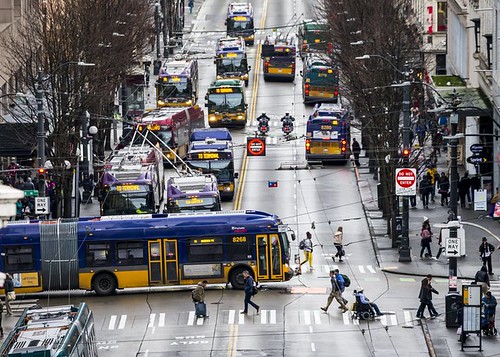
Lots of King County Transit buses on Third Avenue, SeattleSeattle Times photo.

Interestingly, King County had wacked political requirements on bus service, which required providing equal investment in extra service in the less populated county for every investment in Seattle.

So Seattle residents passed a levy for Seattle-specific service and bus line expansion.

-- Levy to Move Seattle, Seattle SDOT
-- Best Practices in Transit, Seattle Urban Mobility Plan, 2009
-- King County Metro Service Guidelines
-- King County Metro Accountability Center

Richmond is a bus exclusive system.  Their story isn't particularly scintillating for big metropolitan area, but there are still some lessons.  Not only did they redefine their network a la Jarrett Walker, they created a highly visible bus rapid transit line called The Pulse, and they used this introduction to do some rebranding of the transit network.
Richmond Pulse BRT
Related to what they did with the Pulse line, something I recommend as part of the creation of new transit services is the creation of a  complementary program of transit network improvements to drive ridership improvements across the transit network:

-- "Setting the stage for the Purple Line light rail line to be an overwhelming success Part 1 | simultaneously introduce improvements to other elements of the transit network," 2017
-- "Using the Silver Line as the priming event, what would a transit network improvement program look like for NoVA?," 2017

Whereas most of these big bus network redesigns have resulted in minimal improvements, just a couple percentage points, the Richmond redesign has resulted in a 17% increase in ridership.

But that's on a small base, because their transit network has been pretty weak.  (It's still crippled by limited interest on the part of the abutting counties to participate in the transit system.)

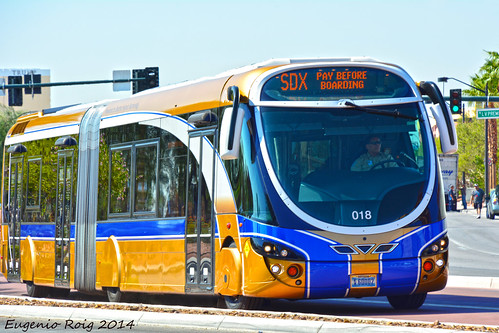
Making transit service more sexy.  When going through some trade magazines I hadn't read, I came across an old article about the bus system in Las Vegas, and the then director made the point that attractive buses are necessary to be able to compete with other mobility services, and their introduction of double deck buses resulted in double digit increases in ridership, and significantly greater revenues, greater than the cost of the service.

-- "Using the Purple Line to rebrand Montgomery and Prince George's Counties as Design Forward," 2017

The Strip & Downtown Express (aka the SDX). Las Vegas Public Bus Transportation.

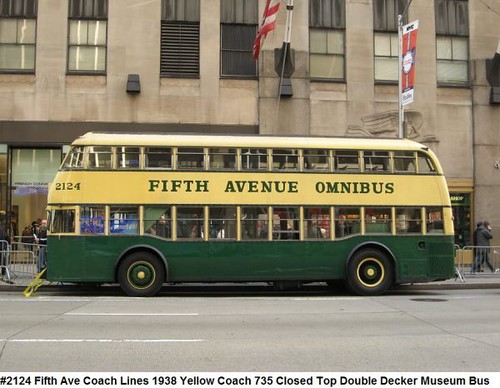
The double deck bus line serves the Strip, and it's a premium service, not unlike how before the MTA, there was a double deck bus service on Fifth Avenue in Manhattan (although that was more about demand).
IMG_8277 copie


Fifth Avenue Double Deck Omnibus (Bus), built by Yellow Coach Company

What the City Paper article missed.  The City Paper suggests that the DC area could learn from what they did in Richmond.  I suppose it's possible.  If only as a reminder of what to do.

For the Bus Transformation Study, I said it would be interesting to analyze the area's high performing bus routes as case studies and use that information as a way to improve under performing lines.

The problem with looking at Richmond is that DC and the DC area for the most part already does the things that Richmond introduced as a new program.  While there are always lots of opportunities for improvement, there is a high frequency network which is quite good, at least in DC.

Although a comparable high frequency network ought to be in place in Maryland and Virginia, and there should be more cross-jurisdictional services, especially along arterials connecting Maryland and DC.

The other problem is that in the areas where transit is most effective, especially in DC's core it's also where other competitive mobility services are offered -- car sharing, bike sharing, dockless scooters, now mopeds too -- plus ride hailing (Uber and Lyft), all of which are drawing customers away from bus (and rail).  (Although some studies find a positive association between bike sharing and rail transit ridership.)

-- "DC is a market leader in Mobility as a Service (MaaS)," 2018

But a major lesson from Richmond in terms of the Pulse BRT service is that you should probably have one unified brand for BRT and/or your "high frequency bus network."

By contrast, the DC area has many: (1) MetroExtra -- limited stop but not BRT; (2) Metroway, a BRT service in Alexandria and Arlington; (3) PikeRide, a branded bus service on Columbia Pike in Arlington; (4) REX, a branded bus service on Richmond Highway; (5) RideOn Extra, a limited stop service in Montgomery County; (6) a separately planned BRT system for Montgomery County; (7) a separately planned BRT line on Leesburg Pike in Fairfax County; etc.

(Sometimes there are advantages to backwardness, a la Gerschenkron's Economic backwardness in historical perspective.)

Other examples of differentiated and clear branding are Metro in Los Angeles' branding of rapid (red) and local (orange) buses, and how MARTA in Atlanta is rebranding as ATL ("MARTA is about to become The ATL. What do you think of the new bus design and logo?," Georgia Sun).

But sure, the DC area needs to (1) better define and integrate the bus network; (2) rebrand the bus agencies and redesign bus livery; (3) market the hell out of it; (4) systematically improve the service; (5) including shifting to double deck buses and other types of design forward buses; (6) defining and providing a night bus network; etc.

And that could probably result in double digit increases in ridership.

Expand the rail network to increase bus ridership. But the biggest thing would be to not only get Metrorail "Back to Good," it would be to expand and intensify Metrorail service, to make it and the transit network more useful, by increasing both its breadth and depth. Bus service complements and extends the subway and (eventually) light rail network.

-- "Redundancy, engineered resilience, and subway systems: Metrorail failures will increase without adding capacity in the core," 2016

Conceptual Future integrated rail transit service network for the Washington DC National Capitol Region. Design by Paul J. Meissner.  Concept by Richard Layman and Paul Meissner.
Conceptual Future integrated rail transit service network for the Washington DC National Capitol Region. Design by Paul J. Meissner. Concept by Richard Layman and Paul Meissner.

Improving bus ridership in the DC area. These were the points I made in "Improving bus service overall vs. reversing falling Metrobus ridership," 2018:

1. The impact of the sustainable mobility platform on use of mass transit services.

2. (As the area improves economically) Is the pool of transit dependent riders shrinking?

3. The DC area bus transit "network" is not perceived as a system/it is illegible.

4. Reposition bus service as a premium (design) product.

5. Rearticulate and reconfigure bus transit across the metropolitan area into one integrated system.

6. Make provision of dedicated bus transitways (and traffic signal prioritization for buses) a priority.

7. Create a overnight transit network at the metropolitan scale.

8. Don't forget bus services when creating HOT Lanes.

9. Rearticulate long distance commuter bus services too.


========
Primary Strategies from the Bus Transformation Study:

1. Customer focused.

2. Prioritizing buses on roads.

3. Frequent, reliable, convenient bus service.

4. Balancing the responsibilities of local and regional providers.

5. Streamlining back office functions and sharing innovation.

6. Transforming and incorporating changes in bus service.

Umm, wow.

Labels: , , , , ,

Thursday, April 19, 2018

Revisiting stories: 2005 BRAC and Fort Belvoir transit + disconnected BRT transit planning in the DC metropolitan area

1. In 2005, I wrote about the military Base Reconciliation and Closure program, and how the federal government was making changes in facilities which would create massive changes in transportation demand, without taking any responsibility for addressing this.

-- "Military Base Relocation"

One of the changes was increasing the number of agencies located at Fort Belvoir in Fairfax County, which is not quite 10 miles from the end of the Yellow Line Metrorail Line station at Huntington.

In 2011, the Post ran an article ("Study: Pentagon should pay for transportation improvements necessitated by BRAC") about a study that said the Federal Government should pay for the transportation infrastructure costs BRAC would impose on the region. From the article:

The Defense Department has shirked responsibility to pay for hundreds of millions of dollars in transportation improvements required as it transfers thousands of workers to Fort Belvoir, Fort Meade and the National Naval Medical Center in Bethesda, according to a congressionally mandated study released Monday.

At the time I made the point that BRAC, deliberately or not, was about promoting sprawl, that making Fort Belvoir a bigger regional military center increases car trips because it's not well connected to the current transportation infrastructure.

Do you really need a congressional study to determine if you move lots of jobs from a concentrated place with highly developed alternative transportation modes, to places that are farther out in the region(s), inducing longer trips, to places where the presence of efficient non-automobile based transportation modes are limited, without investing significantly in new transportation infrastructure that there will be problems?

Or are that many people unaware about how things work in real life?

Why then weren't plans executed to extend the Yellow Line, as is suggested in the Metrorail future vision expansion planning graphic produced by Paul J. Meissner?
Conceptual Future integrated rail transit service network for the Washington DC National Capitol Region. Design by Paul J. Meissner.  Concept by Richard Layman and Paul Meissner.
Conceptual Future integrated rail transit service network for the Washington DC National Capitol Region. Design by Paul J. Meissner. Concept by Richard Layman and Paul Meissner


2. A couple years ago I wrote about how three different BRT development programs: WMATA with Metroway; Fairfax with Route 7, and Montgomery County, Maryland's extensive proposals; prove that the DC area doesn't do integrated transportation planning because instead of one common system for bus rapid transit, with unified branding, station design, etc., each is unique.

-- "Route 7 BRT proposal communicates the reality that the DC area doesn't adequately conduct transportation planning at the metropolitan-scale," 2016
-- Nikitas, Alexandros and Karlsson, MariAnne (2015) "A Worldwide State-of-the-Art Analysis for Bus Rapid Transit: Looking for the Success Formula." Journal of Public Transportation, 18 (1)

Photos by Dick Ulliano, WTOP.

These stories are now linked, as Fairfax County is planning a BRT line connecting the Huntington Metrorail Station to Fort Belvoir ("Plan for Richmond Highway includes widening, bus rapid transit system," WTOP).

Hopefully Fairfax County will use the same branding, station design, and ticketing system for both lines, as according to their recent presentation, they have not moved into the detailed design phase for the system (see photo below).


====
Bus rapid transit best practice.  I like the branding system created for the ART Bus Rapid Transit system in Albuquerque, New Mexico.

-- ART branding, Studio Hill Design Ltd.

Although that system is having problems launching, problems with buses etc.

For more discussion about BRT and regional transit planning, see "What can Suburban Atlanta and Greater Detroit learn from Virginia's Fairfax and Loudoun Counties."

And the WSJ recently published an article saying that buses are the future for urban transit ("The Next Big Thing in Urban Transit: Fast-Bus Systems").  They are, but in smaller metropolitan areas.

Plus, this article ("What could BRT look like in Tampa Bay? Three examples") in the Tampa Bay Times made me realize we sometimes fail to distinguish between center city BRT services such as the Wilshire Line in Los Angeles or the HealthLine in Cleveland and more suburban and longer distance routes such as the not quite 10 mile long Connecticut Fastrak line connecting New Britain and Hartford.

CT Fastrack bus rapid transit system runs in its own guideway in Hartford, Connecticut. The system opened in 2015.
CT Fastrak station. CDOT photo.

Although as I keep pointing out, switching to double deck buses would make a huge branding difference ("Making bus service sexy and more equitable," 2012).

I came across Sydney's B-Line buses today, looking for more information on Sydney's Cross-City Tunnel (thanks Nigel).

I sure wish I could score some of these cardboard models of buses produced by Transit Graphics of Australia.


Labels: , ,

Sunday, November 19, 2017

Revisiting stories: double deck buses as a modern solution for rebranding bus service for choice riders

As a child, I'm sure I had a Matchbox toy of the Routemaster bus.  Matchbox continues to produce copies of the current version of the bus.

For a long time, I've argued that one way to reposition and rebrand bus-based transit service would be to shift to double deck buses.

-- "Making bus service sexy and more equitable," 2012
After all, the iconic Routemaster bus in London is an image known the world over.

In the early part of the last century, both double deck streetcars and buses were common in dense cities, even in New York City.

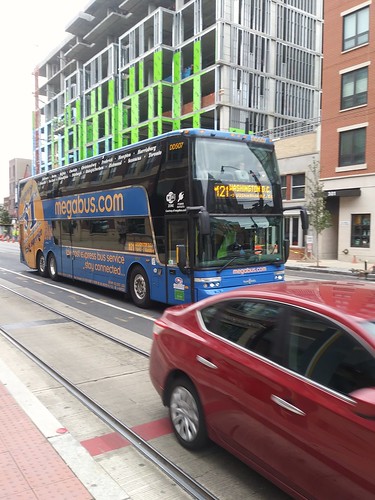
Megabus double deck bus on H Street NE, Washington, DC, on the way to Union StationMegabus double deck bus on H Street NE, Washington, DC, on the way to Union Station.

Today, double deck buses are used widely throughout the UK, not just in London, but not so much in North America, except in tourism applications and some high ridership inter-city bus routes, such as between DC and New York City.

According to the Wikipedia page, double deck buses are deployed in many European cities outside of the UK and Ireland, and in Asia, in particular Hong Kong.

In North America, for regular transit service, Ottawa, Ontario has the largest fleet of such buses, while the GOBus system in Ontario (GO = Government of Ontario) is the largest, with service dedicated to long distance commuting routes rather than inter-city transit like in Ottawa. 

A few double deck buses are deployed in various communities in the US, such as in the Puget Sound region of Washington State and Las Vegas, where Community Transit has the largest fleet providing commuter service between Snohomish County and Seattle.

The New York City Transit Museum still has one of the Yellow Coach double deck buses in its museum fleet.

Charlie shares with us an article ("Bus Stop Classics: 1934-38 Yellow Coach Model 720/735 “Double Decker” – the Queen of Fifth Avenue," CurbsideClassics) he came across about double deck bus service on Fifth Avenue in New York City. 

This particular article discusses the bus that was used on the route for about 20 years, until the mid-1950s.

The highly used bus line on Fifth Avenue is discussed in voluminous detail in this piece from the Coachbuilt website, and has many images of earlier double deck buses that had been in service on the route.

The Coachbuilt website focuses on companies that built "coaches," not just buses but limos, taxis, etc. For example, the geographical listing for Michigan has entries for more than 150 companies.

It's an incredibly voluminous site.  The author aims to produce a book titled the Encyclopedia of American Coachbuilders.
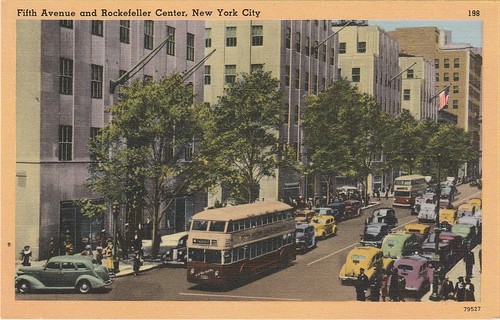
Vintage postcard showing double deck buses on Fifth Avenue in New York CIty
Vintage postcard showing double deck buses on Fifth Avenue in New York City

Labels: , , , , , ,

Thursday, June 08, 2017

Neighborhood-scaled mural in Bogotá

Photo by Ricardo León Jatem.


I am on the e-list of the Mayor of Bogotá, Enrique Peñalosa, because he is well known as a world leader in local government innovation.

His latest e-letter mentioned a "neighborhood-scaled" mural project in the Los Puentes neighborhood (colonia).

Houses are built into the hillside with "outward-projecting" facades that can be treated as a single canvas, which is what the street artist group, Ink Crew, along with Franco de Colombia, decided to do ("‘El Rio de la Vida’: 213 fachadas de Los Puentes convertidas en el mural más grande de Bogotá," Cartel Urbano).

The work is called "The River of Life," and is painted across 213 houses. Residents were involved in creating the work.

=====
Note that the e-letter also announced changes to the TransMilenio bus rapid transit system, which in some respects has been paralyzed by success and the need for funding for growth.  Even so, it is a best practice example of BRT programs.

-- "After 15 Years of Moving People, Here’s What Bogotá’s BRT Should Do Next," CityFix, 2015
-- "How have recent bus reforms changed accessibility in Bogotá?," World Bank, 2017

Transmilenio was introduced by Mayor Peñalosa in a previous term (although we rarely learn the plan was developed by his predecessor, Antanas Mockus). Similarly, under Mayor Peñalosa the city's pre-existing Ciclava program was re-energized, leading to the development of "Open Streets" programs around the world ("Reclaiming the streets in Bogota," BBC).

Both programs are an example of "world cities" giving to the world, not just taking.

The city also introduced restrictions on automobile use (which people got around by having two cars, one with an even-numbered license plate, the other with an odd-numbered license plate) and began penalizing people for parking in what were supposed to be public spaces.

Gil Peñalosa, the Mayor's brother, is an international consultant with a program, 8 80 Cities, working to bring programs similar to those of Bogotá to other communities.  The name of the program, 8 80 Cities, reflects the belief that cities should be accessible to everyone, from 8 years of age to 80 years of age.

Labels: , , , , , ,

Thursday, January 26, 2017

Will buses ever be cool? Part Two: Infographic on improving bus service from U California Institute for Transportation Studies


-- Institute of Transportation Studies, University of California
-- Access Magazine, ITS

Labels: , , , , , , , ,

Saturday, January 21, 2017

Will buses ever be cool? Boston versus the Raleigh-Durham's GoTransit Model

"Will buses ever be cool?" is the title of an article in the Boston Globe, which discusses the Better Buses campaign of Boston's Livable Streets Alliance, a sustainable mobility advocacy group.  From the article:
Stacy Thompson wants buses to be cool. It might seem like a long shot, but she’s not alone.

Public transportation advocates have long lobbied the Massachusetts Bay Transportation Authority for better bus service, with varied success. Now, they’re trying another approach: giving the humble bus an image makeover in hopes of boosting its popularity and, perhaps, its perceived status.

“Buses are not the second-class citizens of the transit system,” said Thompson, executive director of Livable Streets Alliance, a local transportation advocacy group. “They can be awesome, and they should be fun.”

The alliance launched a “Better Buses Week” initiative in the fall with a session called “Making Buses Sexy,” and the Barr Foundation in the coming weeks will encourage people to share photographs from buses in a social media campaign called “Beauty and the Bus.”
I have many posts on this topic, dating to 2005, and a too comprehensive post on this topic, "Making bus service sexy and more equitable," dating to 2012.
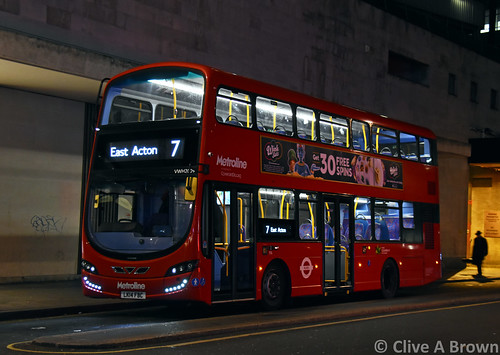
DSC_0996wLondon bus, Flickr photo by Clive Brown.

The basic concept is to disruptively rebrand bus service by using a different kind of bus, complemented by a wide variety of other upgrades to the service and amenities package surrounding bus service.

Because of the popularity of the double deck bus in London, and throughout the UK, I figure the best way to do this is to shift to the double deck bus.

(In North America such buses are used by tourist transit services and a few transit agencies.  Ottawa, Ontario has the largest fleet of double deck buses in traditional transit service.)

Later I suggested given anti-transit, I mean anti-streetcar people say we don't need streetcars, just better bus service, that we should truly test a high quality bus service, using double deck buses versus streetcar service, to see if making bus service great, which includes:
  • double deck buses
  • a great design scheme
  • high quality shelters and stations
  • great marketing and wayfinding information
  • reliable and frequent enough service
  • that is efficient in getting people to their destination
would get the same kind of ridership bump that typically is associated with streetcars ("The need for a double decker bus vs. streetcar comparison study").

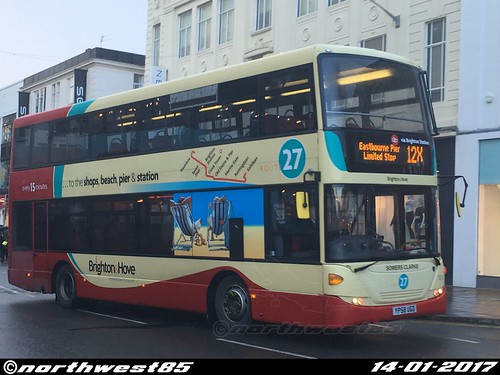
I like how the buses in the Brighton & Hove system are branded with the route of the bus.
704

In DC, it would be relatively easy to shift to double deck buses, because for the most part, utility wires and traffic signal infrastructure doesn't go across the roads--except on side streets. Although there would be a problem accommodating such vehicles in bus garages.

It would be harder in the suburbs because their utility wire and traffic signal infrastructure is different.

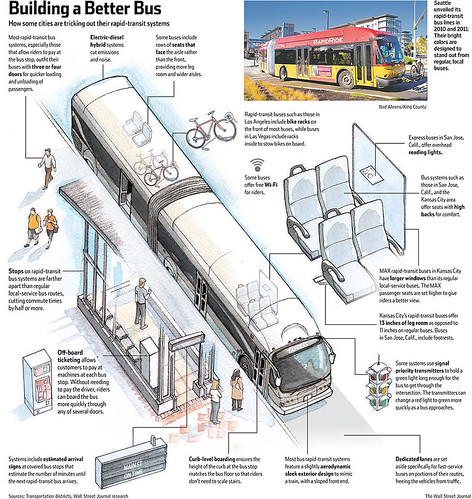
Bus rapid transit positioning as the model.  One of the ways bus rapid transit systems aim to reposition their service vis-a-vis traditional bus service is through design, design forward shelter and station infrastructure, marketing, wayfinding materials, and fast, frequent service.
Building a better bus, graphic
Wall Street Journal graphic.

But why should we limit such "amenities" to premium bus service?

In most places, traditional bus service, as a legacy system, is in dire need of a reboot.

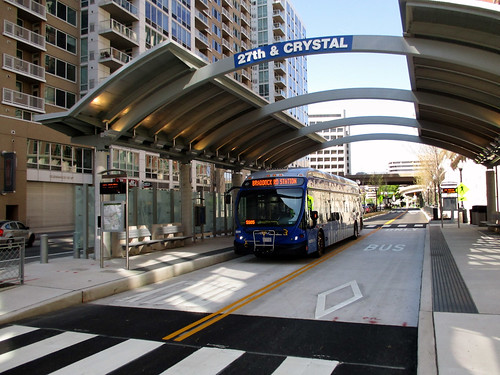
Metroway bus stop, Arlington County, Virginia.  Flickr photo by BeyondDC.
27th & Crystal station

Raleigh-Durham and GoTransit.  For years I have argued transit/transportation planning in the DC metropolitan area is sub-optimal, that we don't really plan at that scale, that by default WMATA (Metrorail and Metrobus) is the planner, and for the most part, network breadth and frequency of service is satisficed in favor of year-to-year vagaries of the annual budget.

-- "Metropolitan Mass Transit Planning presentation
-- "Route 7 BRT proposal communicates the reality that the DC area doesn't adequately conduct transportation planning at the metropolitan-scale"

In September, I came across an article about the rebanding of transit in Cary, North Carolina ("Cary's Buses Switching Names, Offering Free Rides," Cary Citizen) which clued me into the fact that this rebranding is part of a larger effort.

Across the Research Triangle region, the transit agencies there--Triangle Transit provides service across jurisdictions, while the major jurisdictions (Raleigh, Cary, Chapel Hill) each have intra-city transit services also--have been developing an integrated form of collaborative service delivery for over a decade.

So I sought out and interviewed David Eatman, the transit administrator for the City of Raleigh, who was kind enough to speak to me at length about the transit program there.

The level of transit service integration includes:

- coordinated schedules
- one single call center 485-RIDE (in DC, each transit agency has its own set up/phone number to provide information), as well as an integrated mobile product that includes information from all the transit agencies
- a common fare media product
- a regional transit pass charging one price for use of all or any of the transit services (the DC area does have a regional bus pass, but it is not well marketed; it's easier for Baltimore to do this because they do not have multiple agencies providing services and information, whereas in the DC area at least nine different agencies provide bus service)
- joint purchasing
- transportation demand management services across jurisdictions (in the DC area, the MPO provides some services across jurisdictions and in Baltimore, and individual agencies, especially Arlington County, deliver additional programs)

And more recently:

- the introduction of a common brand, GoTransit, with a common design scheme, differentiated by assigning different primary colors to each agencies.  Thus far, only the Chapel Hill Transit agency hasn't shifted to the GoTransit brand.  Each agency is sub-branded, such as Go Cary for the Cary system, Go Raleigh, and Go Triangle, for the regional transit agency, Triangle Transit.

This integration process has been going on for a long time and has been a three-stage process.

The area is covered by two different transit planning organizations (metropolitan planning organizations sanctioned by the US DOT) and 12 municipalities.

There had been interest in reducing costs, so integrating the services had been studied beginning in the 1990s.  That was the regional study and consolidation consideration phase.

The  decision was made not to consolidate, but to go forward together, by collaborating and coordinating to an extremely high degree, but on a voluntary basis. This hinged on an unwillingness to give up unique identities, while recognizing the reality of being part of a larger region.

The analogy many people used was of the college sports teams.  The schools have individual identities, but at the same time are part of a strong conference, the Atlantic Coast Conference.  People can be proud of both their school and team as well as the history and prominence of the ACC as a coordinating league.

The third stage is unified branding and further development of the services.  One reason that they moved to a common design and brand is that citizens were sometimes confused about differently branded buses seemingly serving the same areas, and believed, incorrectly, that the services were inefficient and wasting money.  The agencies also were in favor of a stronger visual identity, and a forward and colorful design.

The area is looking to build a light rail line, and in November citizens voted in favor of a regional sales tax for transit.

The "GoTransit" brand has been extended across the services provided by the agencies, although most of the services provided at the metropolitan scale are performed by Triangle Transit.  GoLive is the integrated transit information app which includes transit information for university-bus services as well as the regional transit service from Greensboro.
transit%20ambassador
GoSmart is the brand for transportation demand management.  The GoPass is the discounted/free transit pass offered to students and staff by universities and to employees by participating employers.. GoTogether is the marketing campaign promoting sustainable mobility and transit use, while GoAmbassador is the sub-brand for their transit volunteer program.

In short, transit service coordination and branding in the Raleigh-Durham region is a model example of best practice, demonstrating that multiple agencies can build and deliver better and seamless services to riders by working together.

Systems with multiple modes like in the DC area (train, subway, various forms of bus, streetcar; in Boston, ferry service and light rail too) might argue that it's easier to integrate in Raleigh-Durham because thus far, they only provide bus services.

But judging by how bus service in London is provided by multiple operators under the London Transport "brand," or how transport associations in Germany's metropolitan areas coordinate service delivery across multiple modes and communities, I don't think that operation of multiple modes is a significant barrier to service integration.  Also see "One big idea: Getting MARC and Metrorail to integrate fares, stations, and marketing systems, using London Overground as an example."

Common transit infrastructure design.  I doubt though, that the transit agencies in the Triangle area of North Carolina have settled on a single model for bus shelters and stations.  That is an issue in the DC area too.

I have discussed elements of this in terms of transportation infrastructure as an element of civic architecture, making these points:

1. Transit infrastructure brands transit
2. Transit stops and stations are key marketing touchpoints
3. Transit stops and stations should better integrate within neighborhoods
4. Transit stops and stations should, when practical, interpret and present transportation-transit history
5. Transit vehicles can be an element of city/urban design and branding
6. Transit vehicles can be an element of transit marketing

Because DC is a large city by comparison, there is interest on the part of large advertising companies like Clear Channel (which has the contract), JCDecaux, Cemusa, and others to provide transit shelters in return for being able to place and sell advertising on the structures.

In 2005, DC signed a long term contract with Clear Channel, and the city has upgraded the shelters across the city.  Meanwhile, the other jurisdictions, and WMATA have different standards, shelters, etc.  Some are better than others.

DC's old bus shelters are comparable to the shelters still used today at Metrorail stations
Luxury bus stop

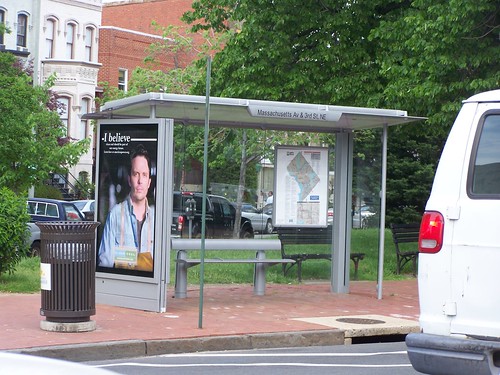
Current DC bus shelter
DC bus shelter

Montgomery County Maryland bus shelter, Wikipedia photo
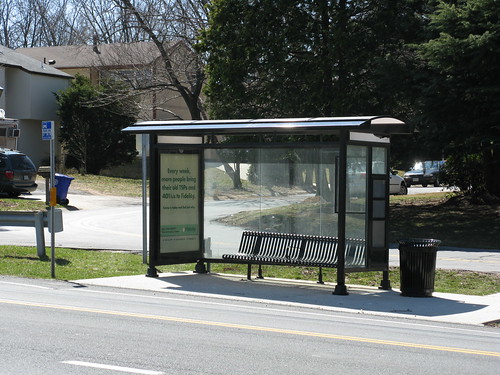
Montgomery County Maryland bus shelter, Laytonia_-2008_03_17_-_EB_Bus_Shelter

It would be optimal to build a common transit shelter system at the metropolitan scale so that "surface transit" would read the same way across the metropolitan area, regardless of what city or county you're in.  Much of the analysis in my recent review of the new Takoma Langley Crossroads Transit Center is relevant to this general point.

This also came up in Arlington, where citizens revolted against what they thought was an overly expensive program for new bus shelters ("Arlington County's bus shelters and a public realm framework of quality").

MBTA Silver Line bus station.  Photo by Steve Pinkus.  One problem I have with these shelters is that they are open to the elements, which is no fun in bad weather.  The stations typically include kiosks with route maps and sometimes interpretation boards on cultural history.
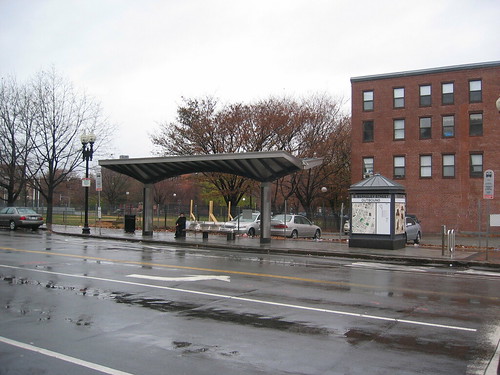
Bus shelter, Silver Line, Boston

Conclusion.  Boston doesn't have the same issue of polyglot and discoordinated branding and services that is the case in DC which has a separate service for most of the separate jurisdictions.
By contrast, like in Baltimore, all of the transit services are provided by one agency, the MBTA.  The problem is that bus service is a legacy service and in desperate need of a reboot--and its branding lags the train and subway services.

MBTA did that kind of reboot with their Silver Line bus rapid transit service ("Silver Line: 10 years of history, changes," Boston Globe, and "The Silver Line Expansion Is a Rare Bright Spot for the MBTA," Boston Magazine; Boston Silver Line Washington Street Bus Rapid Transit (BRT) Demonstration Project Evaluation, FTA), but those ideas haven't migrated to regular bus service.

That's the kind of quantum change that needs to be considered by most transit agencies.

The Raleigh-Durham model of coordination is one that is relevant to transit agencies and metropolitan areas whether or not they have one transit agency or several.

The learning is that riders hanker for a seamless service and that agencies can change and reposition legacy services to do this, if they are willing and committed to doing so.

Recommendations

1.  If there are multiple agencies: coordinate and collaborate.
2.  Develop and implement a common branding system.
3.  Develop and implement a common system of transit infrastructure.
4.  If it is a single (but legacy) system: rethink; reboot; reposition; rebrand

Boston's newer transit stations incorporate some design thinking that is quite forward, but as a whole the system hasn't been rebranded. Image by the SubwayNut. The tagline reads: "America's first subway and the best way to get around Boston."

For other elements of a high quality surface bus network, see "Is making surface transit free the best transit investment DC can make?."

Labels: , , , , , , , ,

Monday, December 19, 2016

Is making surface transit free the best transit investment DC can make?

In Greater Greater Washington, DC Councilmember David Grosso suggests that DC should take control of bus service within the city and make it free.


Note that while the title of the piece is "Let’s take back DC’s buses and make them free," technically DC Government never had control over the bus system.

It was privately run, then went bankrupt, and WMATA took it over while they were still building the first segment of Metrorail, before the subway system even began operating.

I wrote a paper on integrating transportation and land use planning in 2007 and one of the things I discussed was the possibility of making surface transit in the city free.
One of the models was the "Fareless Square" in Portland, Oregon which provided free transit of all types (light rail, streetcar, bus) in the Downtown area, to discourage people from operating motor vehicles.  (But that service ended because of budget cutbacks, although Salt Lake City still has a similar service.)

However, note that cost isn't the biggest barrier to transit use more generally, although it is a barrier for people of limited means.

While I think that Downtown free transit services are justifiable on the basis of transportation demand management goals, there are equity issues raised about providing free transit to people who can afford to pay for it.

How the city provides bus service.  Basically, the city has four types of bus service. (1) high frequency service on major arterials, like the bus service on 16th Street NW (S bus) or H Street-Benning Road (X bus), serving major activity centers and transit stations, and usually not extending beyond DC's borders, with the exception of the 70s bus line, which terminates in Silver Spring;

(2) neighborhood bus service between various activity centers and transit stations (like the 62 bus between Takoma and Petworth Stations);

(3) the Circulator service downtown and in some neighborhoods; and

(4) private shuttle services between subway stations and campuses, mostly for the universities like Georgetown and Howard, the Washington Hospital Center, although many federal government agencies run shuttle services also.

To better serve the differing needs of communities, based on transit station proximity, density, and need, I have argued that the city needs to redefine how it provides transit, including the provision of intra-neighborhood service in certain neighborhoods.

I am hoping to track down data that can help us zero in on where such services might be useful (see by contrast a similar study that was done for Baltimore, "Larry Hogan’s “BaltimoreLink” Fails to Deliver for Transit Riders," Streetsblog).

I've written about this too in the context of my various "transportation wish lists," ("Transportation Wish List: 2015 edition, part one, the original list" and "Part two, new ideas"), which I suppose I'll update sometime after the beginning of the year.

While I no longer think that DC's transit planning priority should be making surface transit free, the proposal by Councilmember Grosso should spur us to think about what outcomes do we want from the city transit network and its surface component. and how and what kinds of investments should DC be making concerning improvements in surface transit service.

Free transit is expensive. As an intellectual exercise, I think it's worth considering free transit. But as an op-ed in Planetizen shows ("Why Is Fare-Free Transit The Exception Rather Than The Rule?") it works in places where overall there isn't that much demand for transit, and in small, constrained places, such as in resort towns. In larger cities, where transit is heavily used, the cost is considerable and difficult for local government budgets to absorb.

Whereas most communities do not have free transit service for primary and secondary routes, some cities like Tempe and Scottsdale in Arizona or the Town of Friendship Heights in Maryland have free intra-neighborhood services that move people from neighborhoods to activity centers and transit stations, but these services complement the broader transit network.

San Francisco considered it (but they have refused to release the final report), but found the increase in the amount of equipment required was beyond the budget. See "Free ride? Fat chance: Muni fares will stay," San Francisco Chronicle.

Note that the free weekly in the Vancouver, BC region, had a nice series on free transit. See "No Fares! Series," Tyee.

Instead we should be discussing how DC can invest in improving its bus transit system

In the metropolitan area, DC generally has the highest ridership buses (although one of those lines originates in Silver Spring, Maryland) with multiple lines having daily ridership between 13,000 and 22,000 riders.  But just because we have many high ridership lines it doesn't mean the system is perfect.

Here are some ideas.


Double deck bus in Blackpool which prominently markets the bus service as cool--"I'm on the bus."  Image from the Mattybuzz blog.

1.  Double deck buses as a repositioning device. In the entry "Making bus service sexy and more equitable," I suggest using double deck buses, at least on certain routes, as a way to rebrand transit service as hip and forward. After all, a key element of how we think about London (part of its brand) are the distinctive double deck buses there.

Double deck buses are used extensively in the UK and Asia, but not so much in North America, although Ottawa, Ontario uses double deck buses extensively, and some other systems use the buses on a limited basis.

2. Creating a system of priority bus lanes.  In the core of the city and on the major arterials, more people are moved more efficiently on buses than they are in motor vehicles. The use of traffic lanes should be reorganized to prioritize bus service and speed it up.

Red painted bus lane on Georgia Avenue NW, DC
Bus lanes on Georgia Avenue NW.

Note that since the time this was written, DC has done a form of priority bus lane on Georgia Avenue around Howard University and is going to do it, some day, maybe, on 16th Street NW.

There are a couple ways to do this.

One, such as in Minneapolis with the Nicolett Transit Mall or the 16th Street pedestrian and transit mall in Denver, is to eliminate other motor vehicle traffic by the creation of a transit mall.  But transit-exclusive malls can be pretty uncongenial and are not necessarily recommended.

The other is to create a set of prioritized bus lanes, even to the extent of providing curbs and other separators, with the traditional road network.  Doing this in London, along with other improvements to pedestrian crossings, installation of safety cameras, and enforcement, found that waiting times for passengers reduced by about 33%; ridership increased by 20%, and reduction in trip time variability for both buses and motor vehicles.

Winter from a Nicollet Mall SkywayNicolett Transit Mall.

A priority lane network, especially east-west, where the bulk of the transit service is provided, should be created to the extent possible, in Downtown DC especially.

-- Draft Bus Priority Treatment Guidelines, Metropolitan Washington Council of Governments
-- Shared-Use Bus Priority Lanes on City Streets: Case Studies in Design and Management, Mineta Transportation Institute, San Jose State University (includes case studies from many cities such as London, Paris, Los Angeles, and New York City)

3.  Create intra-neighborhood transit (bus) services so that people can get to and from local services, commercial districts, schools, libraries, and to and from transit stations without having to drive. This includes delivery services of "freight" such as groceries.

In my transportation and land use paper, I call this "tertiary" service/tertiary transit network (based on the Arlington County framework in their transportation plan, which defines a primary and secondary transit network).  And it's not like we don't have a form of this now, at least within the city. Most neighborhoods have access to some bus service, although many people may not use it because it is circuitous or because they feel that the bus service is beneath them.

There are many models for what I consider intra-district transit service: including various tourist oriented transit services in places like Savannah or Laguna Beach; the Tempe In Motion bus services in Tempe, Arizona, which serves residents; the Baltimore Circulator which complements metropolitan bus service to Downtown by MTA with intra-district bus service; the FRED service in Downtown San Diego (a similar service already runs in Santa Monica).  TIM and Baltimore Circulator focus more on servicing residents, as do the neighborhood circulators in DC.

While I no longer recommend making all surface transit free, I do see the value in making tertiary network transit services free. That would take people to and from major transit stations, commercial districts, supermarkets, etc., and home, but wouldn't be free for outside of the neighborhood travel. See "Intra-neighborhood (tertiary) transit revisited because of new San Diego service," for a more complete discussion.

4. Add Night Owl bus service on subway routes during the periods when the system is closed.  This issue has come up more recently in the face of late night service cutbacks on Metrorail. For decades, other transit systems have offered formal "Nite Owl" or late night bus service, operating when their rail transit system is closed.

This includes Toronto, San Francisco, Chicago, and London, among others ("Slight revisiting of the issue of overnight transit service: San Francisco."

An integrated map of all the late night bus services available in the San Francisco Bay Area has been created.

Late night service is also an issue with the region's airports, which don't have 24 hour metropolitan transit service ("More on transportation to DC area airports").

Note that DC does have almost 24-hour service on some of its major bus lines, but the suburbs don't.

That means we should be distinguishing between DC and the suburbs in terms of consideration of the provision of overnight transit service when the Metrorail system is closed.  Still, even within DC, parts of the city have way better overnight transit service than others.


Inset from a 1946 Capital Transit map.

Note that the old Capital Transit system had a similar program in the 1940s and 1950s and presumably thereafter, mixing both streetcar and bus service.

5.  Discounting transit for low income residents.  Rather than providing free transit to a lot of people who have the means to pay for it we should prioritizing subsidizing transit service for people of limited means.

While WMATA provides discounted fares for seniors, but not on a means-tested basis, and both DC and Montgomery County provide free or reduced price transit passes for schoolchildren, the DC area does not have a systematic program reducing the cost of transit for the impoverished.

I am embarrassed to say that in my various "Transportation Wish Lists" I never specifically listed this as a priority.  The subsidized fare program offered by SF MUNI is called the Lifeline Pass, and it's half the cost of a regular monthly pass (their regular fare monthly pass is still very very cheap compared to peer systems), and people must be income qualified to be able to get the pass.

King County Metro in Seattle has a similar program. Hubway, Boston's bike share program has a similar framework for their low income access program.

I am in favor of creating such a program, but it should be funded locally, not by the transit system, and separately and as an addition to monies for the transit system currently appropriated by the jurisdictions,

6.  Line extensions/creations.  One example would be the extension of the 30s line from its terminus at Friendship Heights on the DC/Maryland border northward to at least Friendship Heights.  Another would be service on Connecticut Avenue and Rhode Island Avenue that is more comparable to the trunkline services on major arterials such as 14th or 16th Streets, H Street, or Georgia Avenue.  Both of these services should extend some distance into Maryland.

7.  Other improvements.  An extensive list of other improvements, such as to bus stop waiting environments, is discussed in the entry "Making bus service sexy and more equitable."

Labels: , , , , , , , ,