Rebuilding Place in the Urban Space

"A community’s physical form, rather than its land uses, is its most intrinsic and enduring characteristic." [Katz, EPA] This blog focuses on place and placemaking and all that makes it work--historic preservation, urban design, transportation, asset-based community development, arts & cultural development, commercial district revitalization, tourism & destination development, and quality of life advocacy--along with doses of civic engagement and good governance watchdogging.

Tuesday, September 08, 2026

Interesting story on the Encore Casino in Everett, Massachusetts, across the Mystic River from Boston

Photo: The Encore Boston Harbor casino was bathed in the warmth of the setting sun as it towered over the streets of Charlestown from its location in Everett. John Tlumacki/Globe Staff ("Encore was built to be a destination. It became something else," Boston Globe).

Casinos are promoted pretty much the same way.  Lots of permanent jobs.  Lots of tourism and visitors from other places spending their money.

The reality is that outside of Las Vegas, casinos mostly draw upon local residents and significant new streams of revenue aren't created.

From the article:

... “Encore” shimmering in gold script at its top like a $2.6 billion monument to the idea that everything in its glow, including the hardscrabble city of Everett, would be transformed.

That was the promise of owner Wynn Resorts, when it opened seven years ago. The casino would replace a contaminated industrial waterfront that had sat empty for a century, create thousands of union jobs, generate millions in tax revenue, and build a luxury destination that would bring visitors to a long-overlooked corner of Greater Boston to stay, eat, and, of course, gamble.

Encore has delivered spectacularly on several of those promises, but the sheer ambition of some of them also highlights how many things this project was expected to be.

A dockmaster at Encore Boston Harbor helped to tie off the boat in 2019. Customers can take a free water taxi from Boston to Encore every 30 minutes.David L. Ryan/Globe Staff/David L Ryan, Globe Staff

Revenue at Encore has remained relatively stable over the past two years, roughly around $210 million a quarter. But it’s becoming less profitable: Once around $62 million to $63 million a quarter two years ago, adjusted operating profit declined to $50.5 million in the first quarter of this year, before rebounding somewhat to $56.1 million in the second. Still, Encore posted the largest decline in profit among all Wynn properties in the second quarter.

After winning a hotly contested license to build Greater Boston’s only casino in 2014, Wynn executives promised a destination that would attract travelers from around the world, with high-quality dining and nightlife and entertainment “unlike anything the region has ever seen.” It wasn’t just marketing talk; it’s partly why they prevailed, with state gaming officials weighing the broader boost it would bring to the region’s economy.

Today, Encore is indeed lavish, if largely self-contained. It has become a major regional casino. But has it become the destination it was supposed to be? That might depend on where you look.

Casinos are businesses that don't want to share customers.  This last point is key.  Casinos are built to keep their patrons inside as long as possible.  They want 100% of the consumer spend.  They don't want to share customers with other businesses.  Therefore such facilities aren't so great at building up an area beyond the four walls of the building.

Just like stadiums and arenas (except in Las Vegas--"5 years later, Raiders in Las Vegas ‘a home run for the NFL’," Las Vegas Review-Journal, and Japanese tourists going to LA to see Shohei Otani--"The Shohei Ohtani Economy: A two-mile ride to Dodger Stadium, for $85," Los Angeles Times), most customers are local, and the money they spend ends up being shifted from other forms of entertainment.  It's not new spending.
But if high-rollers and tourists have their place, most of Encore’s players are local, according to former executives. For all of Wynn’s ambitions to create an international destination, its bread-and-butter clientele — as is the case with most casinos outside of Las Vegas — consists largely of people who can drive there.

“It’s a place for middle-class people to have an upper-class experience,” said Michele Baker, 58, of Brookline, who often turns to Encore’s posh hotel rooms for a staycation.

... “Why would you go to Everett” for those things when Boston already has them, said Raymond Pineault, the former president of Connecticut’s Mohegan Sun Casino. “I don’t know what their expectations were, but I wouldn’t say it’s the international destination they were hoping for. It’s a nice regional casino.”

Most of the time, new casinos have competition.
And Encore faces tough competition: Long-established tribal casinos in Connecticut with so many amenities that gambling feels almost like an afterthought. New casinos in New Hampshire. Two others in Rhode Island. And the explosion of sports betting, which generated nearly $755 million of gross gaming revenue in Massachusetts in 2025.
In-city casinos usually lack the amenities of a destination like a city with multiple casinos (Las Vegas) or a resort.
But unlike Foxwoods and Mohegan Sun — not to mention Las Vegas casinos — Encore lacks the sort of amenities that draw non-gamblers and multiday visitors. With little available land, there’s no golf course, pool, or shopping mall. Nor is there a theater or arena for major concerts or big comedians to perform; state law, designed to protect nearby concert venues, prohibits Encore from operating on-site entertainment facilities of between 1,000 and 3,500 seats.

As for retail, options are few: a gift shop called “The Drugstore,” a Wynn women’s clothing boutique, and a watch store. At least one storefront is empty and available on the ground floor.
Photo: John Tlumacki, Boston Globe.

Broader revitalization is a slow process. 
As I write elsewhere with sports, and it's just as true with casinos and resorts, if you want broader development you need a plan ("Framework of characteristics that support successful community development in association with the development of professional sports facilities").  And some places, whether or not you have a plan, might not have the right preconditions to improve.
But, the broader transformation of Everett remains a work in progress. Encore has helped spur development beyond its campus, including the proposed New England Revolution soccer stadium across the street. But much of the surrounding area remains industrial. Other projects are still in the works.
... “Encore needs to evolve into becoming much more of an all-around Boston-area entertainment resort,” said John Boyd, principal of gaming consulting firm The Boyd Company. “Rather than: just casino plus restaurants plus hotel.”

In other words, to truly succeed, it needs to become a regional destination. When asked how that’s going, a company spokesman offered a pointedly local answer: Wynn “is proud to call Everett home.”
A charter bus for Encore Boston Harbor picked up passengers on Essex Street, a block from Chinatown, in February. John Tlumacki/Globe Staff

Asians drive casino revenues on the East Coast
.  Earlier this year, the Globe ran a great series about the impact of gaming and the Encore Casino on the Asian community ("Casinos in Massachusetts/New England deliberately target Asians").

Labels: , , , , ,

Tuesday, March 24, 2026

Casinos in Massachusetts/New England deliberately target Asians

 (There's a reason gaming in Macao has been so successful. And why there are really good Asian restaurants in Las Vegas.)

Traditional lion dancers paraded through a large crowd and a sea of slot machines at the Encore Boston Harbor casino during a Lunar New Year celebration. (John Tlumacki/Globe Staff)

A long time ago, when discussing the "Chinese buses" the inter-city buses operated from Chinatown to Chinatown in the Mid-Atlantic--dropping bus ticket prices significantly compared to traditional inter-city buses and Amtrak--a commenter made the point that these services got their start taking Chinese workers and patrons to casinos.

The Boston Globe has a three part series about how casinos there deliberately target Asians.  That as a result the Wynn Encore Casino in Everett across the river from Boston, is the most successful casino in the US outside of two in Las Vegas.

Of course, how these casinos target Asians is but a microcosm of how casinos target market segments with a propensity to gamble. Ever growing lines of credit offered by casinos can drive people to ruin. Others are wealthy and losses are merely the cost of entertainment.  

In terms of urban development, I don't favor casinos, but it's the case of "everybody's doing it" we ought to just to be on an equal playing field.  That's why cities like Chicago and New York are adding casinos--NYC to be able to compete with Atlantic City and tribal casinos and against other cities for conventions; Chicago to compete for conventions.

-- "How casinos in New England are exploiting Asian communities for profit"
-- "Within the confines of Boston’s Chinatown, there are dozens of illegal gambling parlors. What is the city doing about it?"
-- "In Greater Boston’s Asian communities, gambling can build social ties — and fuel addiction. Here’s how residents are fighting back"

Labels: , , ,

Sunday, January 07, 2024

Building a local economy versus "economic development": Online Gambling

One of my complaints in urban revitalization is that the average city, including DC, treats any new economic activity as "economic development," and all economic development is positive, when some activities are "better" than others in terms of income, tax revenues, spillover development, the economic multiplier effect, and how much of the money recirculates locally versus is siphoned off to headquarters cities.

The economic multiplier is defined as:

... a multiplier broadly refers to an economic factor that, when increased or changed, causes increases or changes in many other related economic variables. In terms of gross domestic product, the multiplier effect causes gains in total output to be greater than the change in spending that caused it. (Investopedia)

This is a big issue with sports events.  They are touted for their local effects on the economy, especially small businesses, but mostly they benefit airlines, hotels, and rental car companies--most of which aren't local, so the money spent doesn't end up in the host city for very long.  Although there are some benefits on food and drink, and for employment of people who put on the related events around the spectacles.

I have been following this for a lot of years.  Pre-event press coverage touts the benefits in superlative terms.  Post-event coverage focuses on how local businesses didn't benefit.  

Formula 1 grandstand, Las Vegas.  

A current example is the Formula 1 Grand Prix in Las Vegas ("‘F1 Fooled Us’: $4 Million Losses Served by Las Vegas GP Makes Local Business Owners Hit Back," "“Tons of Other Businesses Suffered”: F1 Fans Lash Out After MGM Resorts Announces Historic Revenue From Las Vegas GP," Essentially Sports).

Big corporations benefited.  But small businesses did not.

Gambling.  But I mention this because of a study referenced in the Guardian, "Gambling boom detrimental to New Jersey economy, report says."  From the article:

New Jersey, which led the charge for mobile sports betting’s legalization, has received hundreds of millions of dollars in taxes from the sector. But economists cautioned that the cost of higher problem gambling rates could be “roughly equal” to the state’s takings. 

In a report seen by the Guardian, they estimated economic output, jobs and wages have been knocked by New Jersey’s digital gambling surge – calling into question industry claims that legalization can provide a boon to states nationwide. 

The research, commissioned by the Campaign for Fairer Gambling, found that $2.4bn spent by people gambling online in New Jersey in 2022 “decreased New Jersey’s economic activity by about $180m”. 

Had the same amount of money been spent on another activity, like shopping or dining, NERA Economic Consulting estimated that significantly more would have been paid out in wages, which employees would have then spent on other parts of the economy.

Economic development versus building a local economy.  Online gambling is a perfect example of the difference between the two.  ED says economic activity increased.  BALE says that the net economic benefit was diminished because gambling is a less productive economic activity than others.

Unfortunately, economic impact studies are usually conducted by the proponents, not an independent organization, and cities, especially elected officials, aren't particularly skilled at digging into the claims from a more nuanced perspective.

Labels: , , , , ,

Wednesday, November 22, 2023

Learning from Las Vegas: Round 2 | Planning for Activation and Transformational Projects

Learning from Las Vegas is a famous book in architecture studies about post modern architecture

WRT my point about governments doing things and charlie's counter that mostly it's not about governance but growth independently of the local government, even in blue states, there's a great article, "From Sin City to America’s sports capital: Las Vegas is transforming itself again. What do the glitz of Formula One and the Super Bowl mean for the city’s future – and for the workers building it?," in the Washington Post about how Las Vegas is leveraging sports as another way to further activate the city, by keeping adding attractions.

The Sphere, created by Madison Square Garden Company, is an entertainment venue just east of the Las Vegas Strip. (Bob Leal/Courthouse News)

In the past few years the Raiders NFL team moved there, The Sphere attraction opened ("The Sphere mesmerizing Las Vegas months before opening," Courthouse News Service), and the Oakland A's baseball team just got approval to follow the Raiders ("The Oakland A's are relocating to Las Vegas after MLB owners approve the move," NPR).

Around six years ago, the Las Vegas Golden Knights hockey team launched, in an arena that was built by the private sector before there was a commitment by the NHL.  This past summer, the team won the Stanley Cup.

Williams driver Alexander Albon, of Thailand, drives during the final practice session for the Formula One Las Vegas Grand Prix auto race, Friday, Nov. 17, 2023, in Las Vegas. (AP Photo/John Locher)

Then there's Formula 1.  Not my thing, but it's the thing for enough people, especially rich people.  

The Post article is great about how it came about (also see "Tickets, times, transportation and community outreach among issues F1 must fix in Las Vegas," AP).

There's a great sentence about LV being the city that always says yes. 
It's related to my point about transformational projects action planning including a willingness to take advantage of opportunities that present themselves, that work within the framework of a creative master plan, about taking advantage of serendipity.

But it's also relevant to my point about how destinations usually need constant refreshment and management to remain interesting and relevant.  

Wrt hotels, LV is the king of building, demolition and rebuilding of constantly larger hotel-casino projects.

This is an issue with Baltimore's Harborplace on the Inner Harbor ("Initial plans for Harborplace to include residential tower and retail, commercial space," WBAL-TV).  

What does a Louisiana seafood restaurant concept have to do with the Chesapeake region?

It was cool in the beginning, then became a place mostly housing chain establishments.  The Baltimore riots didn't help.  

Nor did the company that bought it (and lost it through foreclosure) which owns/ed similar types of "festival marketplaces" ("Rouse and Festival Marketplaces" from Merchant of Illusion: James Rouse, America's Salesman of the Businessman's Utopia) but really doesn't know how to run them except through imposing homogeneous retail, taking away anything special about the property.

A new owner of Harborplace aims to revive the site.  But the problem with capitalism is that other property owners elsewhere in the city, like Canton, continue to invest in making their places great, making it that much harder for Harborplace to compete--although it has a waterfront location, which should trump any other location.  

But at the end of the day, the problem is not unlike that faced by Eastern Market or H Street in DC--there are lots of alternative destinations.  Like many other cities, Baltimore has too much in the way of developable space, making it hard to focus.

Similarly, other festival marketplaces like Faneuil Hall in Boston and the South Street Seaport in New York City ("Seaport District reinvents itself with dining, shopping and a dose of history," NY1 News) have the same issues of the need for refreshment.  Over time, local visitorship drops off.  And those places have a lot more visitors and residents than Baltimore.

Note that scale wise, the Fremont District, different from the big hotel-casinos on the strip, with more older buildings and a more human scale, is probably more analogous to festival marketplaces than the LV Strip or adding super large scale attractions ("A new tourist destination to revitalize a declining downtown," UNLV thesis).

U2's residency at the Sphere is incredibly successful ("U2's First Batch of Shows at the Sphere Generated Nearly $110 Million in Ticket Sales," Billboard.)

Bono, The Edge, Adam Clayton and Bram van den Berg of U2 perform during opening night of U2:UV Achtung Baby Live at Sphere on Sept. 29, 2023 in Las Vegas. Kevin Mazur/Getty Images for Live Nation

From the article:
U2 wrapped the first leg of the U2:UV Achtung Baby Live at Sphere residency on Nov. 4 with unprecedented box-office results. According to figures reported to Billboard Boxscore, U2’s 17 Sphere shows in Las Vegas grossed $109.8 million and sold 281,000 tickets. 

Opening night at Sphere was Sept. 29. U2 played another show the next night, 12 more in October and three in the first week of November. The gross and attendance figures average out to $6.5 million and 16,500 tickets per show. The average ticket price across all shows was $390.97. 

U2 is scheduled to play eight more shows in December, kicking off on Friday night. There are 11 more dates lined up between Jan. 26 and Feb. 18. The 19 shows on the books could generate another $120 million, pushing the residency to about $330 million in less than five months. Only Dion’s A New Day… would remain ahead in terms of all residencies in Boxscore history.

The only thing is few bands can pull this off.  U2 is one.  Although LV has tons of successful concert residencies.  They tend to be in much smaller spaces, and much less multimedia intensive.

Conclusion.  Even though Las Vegas has gambling, big conventions, and almost 40 million visitors per year, it doesn't take its position in the leisure, hospitality, convention, and gaming business for granted.

When it comes to destination development and management, Las  Vegas is a city of constant redevelopment and reinvention  ("Robert Lang, who helped reshape Southern Nevada’s economy, dies at 62,"Las Vegas Review-Journal). 

It is an outlier when it comes to urban management, which in Las Vegas is a "partnership" between the private sector, the city and other nonprofits like the tourism board, the State more generally, as well as the Nevada Gaming Commission.

Labels: , , , , , , ,

Friday, September 10, 2021

Gambling as an urban race to the bottom: Richmond; DC

Alfred C. Liggins III, CEO of Urban One, in Richmond on Aug. 11. (Julia Rendleman/The Washington Post) 

I wrote about this recently ("Casinos as economic development: destination versus casual visitation" and "More sports and revitalization: Pimlico Race Course in Baltimore") but the ongoing the process to approve the creation of a casino in Richmond Virginia ("A Black-owned casino bets on a Black neighborhood in the former capital of the Confederacy," ) brings up some interesting issues about access and "equity" because the operator chosen to create a casino if approved in this November's referendum is Alfred Liggins, a prominent African-American businessman based in the DC area, who leads the Urban One broadcast business--radio stations focused on black demographics and the TV One cable channel--which grew out of the WOL-AM station in DC (when I first moved to DC in 1987 their studio was at the end of the block on H Street, it had a window so you could see the DJ booth).

With the exception of Native American-run casinos, most are run by large corporations led by white people.  Isn't it a matter of equity for African-American business interests to get a piece of the action?

-- "Building supportive ecosystems for Black-owned US businesses," McKinsey
-- "$290 BILLION WOULD BE CREATED IN BLACK WEALTH IF THE REVENUE GAP BETWEEN BLACK AND WHITE BUSINESSES WAS EQUAL," Black Enterprise Magazine

Springfield Massachusetts casino as an analogue.  But as pointed out in the previous pieces, the average city doesn't benefit much from this.  I think Richmond is similar to Springfield, Massachusetts--Richmond has more residents, both are within a couple hours of major cities, have some train service, and a number of attractions.

An event outside the MGM Casino brings people to the streets of Springfield.

While Springfield claims significant impact even though the casino has only been open for a couple years and was more recently affected by the pandemic ("TWO YEARS AFTER MGM SPRINGFIELD OPENED, ECONOMIC BENEFITS NOTED BUT NO INCREASE IN PROBLEM GAMBLING DETECTED," U Mass Amherst) I wonder how much will really happen?

OTOH, I guess if the casino is part of a wide ranging revitalization program, maybe it would be different, and maybe that's the case in Springfield.  But I wouldn't expect much there, or in Richmond.  From the Worcester Daily Voice article "Did Springfield Cash In? See How Much Visitors To MGM Have Spent Locally":

The Donahue Institute estimated that MGM visitors accounted for $66.3 million in new, off-site spending at local restaurants, shops, grocers, fuel stations, and more. “One of the big findings we have is that 61.7 percent of patron spending was new to the state and would not have occurred had it not been for the casino,” said Thomas Peake senior research analyst at the UMass Donahue Institute in a statement. ...

However, when MGM was selling Springfield on the casino, developers said MGM would create 3,000 new jobs and generate $35 million in revenue per month. The casino peaked in its first full month of operations at just under $27 million and has averaged only around $21.5 million ever since, according to CalvinAyre.com.

(Another example is the touted benefits for Richmond from being the practice site for the Washington Redskins.  Not much happened.  "VCU report: City won't recoup investment on Redskins training camp deal until at least 2023," Richmond Times-Dispatch -- use printfriendly).

The biggest problem is that the business model for "gaming" isn't designed to share customers with other venues.  They want 100% of the time and money of gamblers, outside of spending money on gas, they don't want you to leave the premises and spend money elsewhere.  That makes it hard for a "gaming" use to be multiplicative in terms of the multiplier effect and spillover economic benefits.

I wrote about this in terms of Walmart ("Jumping in bed with the devil--it's hot, but will you survive the heat?," 2006), the same points pertain.

The problem with Wal-Mart isn't so much that it is a behemoth store. The problem is their business model, which appears to be designed to capture as much as 100%* of the average customer's retail expenditure dollars. That doesn't leave much room, even crumbs, for other businesses. (* or more than 100% if you consider credit cards...)


Gambet DC: DC's sports gambling app
. Another Post article, "D.C.'s sports betting app keeps underperforming, with lots of finger-pointing about what’s to blame," discusses the relative lack of success of a DC branded and controlled sports gambling app.  

The pitfalls are pretty obvious. (1) taking a larger cut than competitive apps. (2) there being lots of competitive websites. (3) apps for gambling for profit entities fully focused on gambling are likely to always outpace and be more exciting than "a government sponsored app" produced by a contractor.

The Gambet DC website looks like a government website.

And as is too common in city economic arguments for gambling, great success is touted while the results are significantly less buoyant.  The city initially projected revenues of $22 million annually, then the forecast shifted downward to $6 million annually.  But revenue is less than $50,000 per month.

Some types of revenue generation aren't really worth pursuing.


versus

The DC Auditor made suggestions for improvement ("D.C. auditor offers ideas for improving the city’s sports betting app," Post), but how do you create "verve" in a city agency?

-- D.C. Sports GamblingFails to Meet Expectations, DC Auditor

FWIW, I think DC Lottery created a great commercial promoting DC neighborhoods as part of a past promotion, which I thought was a way better ad promoting "visiting DC" than the ads by Destination DC ("City branding versus identity | Branding versus Urban Strategy").  


So maybe they have the potential to become much more customer-facing, as they are with lottery tickets.  Clearly those aren't the people in charge of Gambet DC.

Labels: , , , , ,

Monday, July 26, 2021

Casinos as economic development: destination versus casual visitation

A Wall Street Journal article ("Chicago Casino Would Be a Costly Bet, Gambling Operators Say") on the process of creating a casino in Chicago, as well as recent coverage in the Baltimore Sun ("Developers hope South Baltimore entertainment district could spur tourism, casino after coronavirus pandemic") about the city's desires to create an "entertainment district" anchored by the Horseshoe Casino makes it important to distinguish the characteristics behind "gaming" as a sustainable economic development strategy.

From the Sun:

The four-block, mostly industrial stretch, known as the Warner Street corridor, could draw hundreds of thousands of visitors annually, officials said. It also might re-energize the casino, where revenue is off by about a third since 2016, amid slowing business and in the wake of the pandemic. 

Plans for the district include a 4,000-seat concert hall called The Paramount and the addition of a Topgolf driving range. At the same time, a new, outdoor iteration of Hammerjacks, the storied Baltimore nightclub and concert hall, will open nearby as a tailgating and events venue as early as this fall. 

The entertainment district may feature additional retail and dining options and a hotel once completed, those affiliated with the project said.

According to the WSJ, Chicago leaders want to capture monies spent at casinos in Indiana and elsewhere in Illinois, and would direct expected revenues of $200 million/annually to underfunded pension funds. 

Playing slots in Las Vegas.  Photo: L.E. Baskow, Las Vegas Review-Journal.

Destination versus casual gambling.  It comes down to what we might call destination gambling, typified by Las Vegas, where people go and spend a number of days versus casual gambling, where people go for a day or an evening.  Generally, destinations attract higher income demographics who spend a lot more money.

With casual gambling there are few spillover economic development opportunities, and since unless there are super strong community benefits requirements, most of the money made at the facility is repatriated to distant headquarters cities of the gaming companies (mostly in Las Vegas).

I don't think there are many examples of casual gambling places being super great economic development vehicles.  They might do okay, and generate some additional development and entertainment activity, but they aren't transformational.

Although one exception can be Native American related facilities like Mohegan Sun in Connecticut, although with the expansion of gaming in other states, revenues are down ("Facing increasingly crowded Northeast markets, Foxwoods and Mohegan Sun look overseas to grow," Hartford Courant).

Another way to think about casual gambling is that it is but one entertainment option out of many: movies; a meal; a concert; a sports event; etc., and it is more a "substitution" of one type of consumption for another, unless a significant number of patrons come from outside the metropolitan economy.

Atlantic City, which outside of Nevada is the only city that has tried to reposition around gambling as a destination, with multiple casinos, has never been successful in developing its place as a destination comparable to Las Vegas, where people spend multiple days ("How Casinos Failed Atlantic City and Why They're Still Part of Its Future," The Street, Atlantic City casinos needs to adopt 'Las Vegas model' to survive" and "Can A Non-Gaming Model Work For Atlantic City Casinos As It Does In Las Vegas," Atlantic City Press).

Destination gaming supports the development of other economic activity, especially retail, but also entertainment in other ways (concerts, etc.).  By contrast, AC's attempt at developing destination retail, a shopping center by Taubman Centers, one of the nation's leading mall developers, failed spectacularly ("Luxury Mall Hits the Wall," WSJ).

Maryland.  Maryland has opened a bunch of casinos.  The state gets a large proportion of the revenue ("Maryland casinos are doing better than before the pandemic," WTOP-radio).  Three are in urban areas, three in outlying areas of the state.  The outlying locations generate comparatively low revenue.

The most successful is in Suburban Washington, although the facility in Anne Arundel County, Maryland Live!, run by the Cordish Entertainment Group does reasonably well.  Baltimore has a casino too, which opened a few years after Maryland Live!  

Once the casino opened in Prince George's County, revenues dropped in Baltimore and Anne Arundel, although the Arundel facility still does pretty well, while Baltimore lags significantly.

What should city priorities be in the "entertainment economy"?  When I used to work in hospitality, there would be non-sports restaurants trying to do programming around special events like the Super Bowl, or independent retail vis a vis Black Friday, which is dominated by national chains.  Mostly their efforts don't pan out, because people are attracted to the main providers, not secondary participants.

With gambling, I guess it's "everybody's doing it so we might as well do so."  (Sports betting is another element and can be incorporated into stadiums and arenas without expecting it to be a separate revitalization lever.)

But expecting it to do something remarkable for a city--when you think gambling, Las Vegas (or Reno and Lake Tahoe secondarily) is top of mind, not Baltimore, Prince George's County, Boston, Springfield, Philadelphia, etc.-- is a stretch.

This is true for horse racing ("More sports and revitalization: Pimlico Race Course in Baltimore") and gaming, unless you can make it a destination anchor as opposed to one choice out of many other entertainment choices.

======

Gambling addiction and people of limited means spending their money on such are other issues.

Labels: , , , ,

Saturday, May 22, 2021

More sports and revitalization: Pimlico Race Course in Baltimore

======== 
Republished on Saturday May 22nd. Originally published Monday May 11th. 

Republished because of the publication of an article, "Can Horse Racing Survive?," in the 5/24/2021 issue of New Yorker Magazine, about the horse racing industry. 

It makes the point that in the last few decades, with the expansion of casino gambling across the US, there were only casinos allowed in Nevada, now there are 1,000 casinos nationally, betting on horses has dropped by 50%, although some tracks have repositioned by becoming "racinos," with betting on horses as well as more traditional casino "games." 

As a result, horse racing tracks have closed across the country. The article discusses Pimlico, and how the owners offloaded the risk of running the track onto the State of Maryland through the provision of almost $400 million in state funds for the renovation of the facility. In return, they've agreed to expand the racing calendar. 
========

In this May 15, 2020, file photo, a crew works on putting up a platform near the main entrance at Pimlico Race Course in Baltimore. Pimlico, which opened in 1870, is set to be rebuilt over the next two-plus years. Photo: Julio Cortez/AP

The Baltimore Sun/Washington Post ("Pimlico’s real winner could be the surrounding Baltimore neighborhood") and AP ("Optimism rising about future of Pimlico with rebuild looming") have stories on the eve of the Preakness horse race this Saturday, about how the newly rehabilitated Pimlico Race Course, after a $375 million investment by the state, could help to spark the potential revitalization of the surrounding Park Heights community, which has been distressed for decades.

Last year, it happens I wrote about Pimlico as a revitalization augur ("Will redeveloping Pimlico really make much of a difference for Baltimore/Park Heights?").  Although I had intended to write the piece a year earlier.

In part the entry reprints an op-ed by revitalization professional Michael Seipp, who at the time was the Executive Director of Baltimore's Southwest Partnership.  

He made the point that at 10 events per year, even with a few more events, Pimlico Race Course doesn't justifying $375 million in state funds for revitalization, when there are so many other competing projects, all with better return on investment.   

Yes the competing Laurel Race Course about 30 miles away in the suburbs isn't particularly charming and lacks the history of Pimlico, but it's better situated for mobility especially.  

Park Heights Avenue.  Photo: WBFF-TV.

And the reality is that (1) there isn't enough interest to support two race courses so close to each other.  

(2) Race courses don't offer much in the way of ancillary business activity to support community revitalization ("A Black Neighborhood's Complicated Relationship with the Home of the Preakness," The Undefeated).  From the article:

In Northwest Baltimore’s Park Heights neighborhood, more than 100,000 people are expected to gather Saturday to watch the 144th Preakness Stakes at the rundown Pimlico Race Course. 

However, few residents of this depressed, low-income and largely black community will be attending the second leg of thoroughbred racing’s Triple Crown. But for generations, they have made extra cash allowing race fans to park on their front lawns and selling cooked food or trinkets from their stoops. Corner stores and carryout spots have charged fans anywhere from $5 to $20 just to use the bathroom. Even the drug dealers clean up on Preakness Day. 

“The white folks come up here once a year to gamble and get drunk. Some of them come across the street and buy a little weed or some crack. The police just sit there and don’t do nothin’ because they get paid off by the corner boys to look the other way,” said 51-year-old Ray Johnson, who grew up in the neighborhood. “When the race is over, they get outta here before it gets dark. They don’t give a f— about this neighborhood until the next year.”

Sports-related development framework and horse racing.  I hadn't thought of my proposed "Framework of characteristics that support successful community development in association with the development of professional sports facilities" being applicable to horse racing, but for more traditional team sports.  But it turns out to be just as relevant.  (Demonstrating the robustness and value of the framework.)

Evaluating Pimlico in terms of that framework, looking at the primary categories and the elements within each:

  • Urban design and development
  • Programming
  • Transportation
  • City-wide benefits
  • Neighborhood benefits

Photo: Steve Helber/AP.

it pretty much fails at every level.  

At 120 acres it's an underutilization of land as a resource.  There aren't ways to build a thriving commercial district around it.  Programming is limited.  Transit opportunities are limited.  City-wide benefits are limited.  Neighborhood benefits are miniscule.

But it will support the state horse racing industry.  Which doesn't help Baltimore much.

Transit.  Because of the fact that racing draws spectators from a super wide area, it doesn't lend itself to transit as the primary mode people get to and from events, the way that it does with ATT Park in San Francisco, Capitol One Arena and the Nationals Stadium in Washington, Madison Square Garden and Barclays Center in New York City, etc.

Transit options at other race courses.  Although, the Laurel Race Course does have a stop on the MARC Line.  The Belmont Race Course is served by the Long Island Railroad and the Acqueduct Race Course in Queens, New York is served by the A Subway line.  In Greater Boston, the former Suffolk Downs Race Track was served by two stations on the MBTA Blue Line.  Arlington Park is served by Metra railroad service in Greater Chicago.

Suspension of racing at Laurel creates a longer season at Pimlico in 2021.  Interestingly, because of issues with the track at Laurel, racing there has been suspended and shifted to Pimlico, so that does provide more events and more activity.

Photo: The Undefeated.

The more events, the greater potential, but it doesn't change the reality that there is minimal ancillary business activity associated with attendance at racing events, and even what there is supports a very narrow range, mostly restaurants, and bars at that.  

Even so, WRT food and beverage the race course itself aims to do most of the selling, providing some employment opportunities, but not business opportunities.  (They could have created a set up where community businesses run the food service operation, but that would divert a significant source of revenue away from the race course.)

People aren't interested much in buying goods, unless they are team related (jerseys etc.), because they don't want to lug them around.  If people stay in hotels, most of the profits are repatriated elsewhere (this is a problem with events like All Star Games and Super Bowls).

Conclusion.  The longer racing season will be a good experiment to see if a longer season makes a difference to revitalization opportunities in Park Heights.  But I don't expect it will make much difference.

Labels: , , , , , ,

Monday, February 11, 2019

Atlantic City (NJ) Press series on "Reinventing Atlantic City"

In the past, I've written about newspapers doing ongoing series on community revitalization issues, from the "Rethinking Philadelphia" series in the Philadelphia Daily News to special pull-out sections in the Camden (NJ) Courier-Post.  More recently, the Chicago Tribune had a series around planning, calling out the city's planning history and Daniel Burnham.

The Press of Atlantic City is running a similar series called "Reinventing Atlantic City."  This article from the series, "Art is a tool in the fight against blight: How can A.C. see more of it?," includes links to past articles in the left sidebar.

Unfortunately, the running head/link for the series doesn't return a list of articles.

With the decline in the financial viability of newspapers, it's much harder for newspapers to commit to this kind of coverage, so it should always be lauded when it occurs.

Although interestingly, this article in today's paper, "How weather favors Las Vegas vs. Atlantic City," isn't part of the series.

Nor these previous articles, "Atlantic City casinos needs to adopt 'Las Vegas model' to survive" and "Can A Non-Gaming Model Work For Atlantic City Casinos As It Does In Las Vegas."

Labels: , , ,

Thursday, September 22, 2016

Yet another example of failures in metropolitan transportation planning: no transportation demand management requirements for casinos in Maryland

Washington Post photo.

The MGM National Harbor Casino will be opening soon in Prince George's County.

According to the Washington Post ("MGM National Harbor could more than double traffic in southern Prince George's"):
Vehicle traffic to National Harbor could more than double when MGM National Harbor opens later this year, according to projections, exacerbating a growing congestion problem in southern Prince George’s County where new development has added thousands of commuters in recent years.

If projections hold true and up to 20,000 daily visitors frequent the gaming resort, there could be backups in the local and regional road network with heavier volumes on Interstate 95 around the Woodrow Wilson Bridge on the Maryland-Virginia border. ...

As many as 90,000 vehicles enter National Harbor during an average week, according to the developer, and that number could rise to 180,000 when the $1.4 billion gaming resort opens in December, Digby said. Traffic during the weeks following the opening is likely to be especially heavy, officials say. ...

Besides daily commuters, National Harbor, which has become a top entertainment hub, already attracts thousands of visitors every week, and special events there have created miles-long backups. Residents and community leaders fear that the additional casino traffic could overwhelm the road system.
The article also reports that some "bare minimum" road improvements to the tune of $10 million, will be delivered as the project opens.

The Massachusetts counter-example

Traffic study requirements in Springfield.  By comparison, the casino projects in Massachusetts had to submit transportation studies as part of their initial bid, and the winners at each site are required to develop and execute a wide ranging transportation demand management plan.

-- Traffic Impact and Access Study MGM Springfield, City of Springfield

Monies for transit improvements in addition to road improvements in Boston.  For the casino in Everett on Boston Harbor and across the water from Boston, the Wynn Resorts firm has to invest a minimum of $36 million in improvements to Sullivan Square and Rutherford Avenue, which will be the major entryway across the Mystic River to the casino ("The lowdown on Sullivan Square," Commonwealth Magazine).

This was required because it is expected that 60% of traffic to and from the casino will go through Sullivan Square. Interestingly, the plan also has a penalty per car when the plan's traffic levels are exceeded. From the article:
The Massachusetts Gaming Commission is requiring the Las Vegas developer to spend $10.9 million on projects addressing the immediate traffic impact of the casino and to set aside $25 million for long-term improvements. The company also has to pay a fee of $20,000 for every car coming to the casino via Sullivan Square that exceeds agreed-upon levels, with a maximum penalty of $2 million a year.
Boston Globe coverage discusses the commitments to transit improvements.  According to "State transportation officials drop objections to Wynn casino", the casino developers have:
agreed to contribute nearly $7.5 million over 15 years to Orange Line subsidies, to increase the frequency of the trains.
As well as ("Wynn Resorts offer to bolster Orange Line"):
... shuttle buses to pick people up at the Malden Center and Wellington stations and rely on existing MBTA buses to connect with the Sullivan Square station.

There’s also the possibility of a pedestrian bridge over the Mystic [River] linked to the new Assembly Square T stop: Wynn has agreed to spend up to $250,000 to help study the bridge’s feasibility.

The footbridge could be built over the Amelia Earhart dam, alongside a railroad bridge that crosses the Mystic, or as a standalone structure.

Wynn is also proposing to help pay for changes to improve the flow of MBTA buses at the Sullivan Square T stop, but it’s the plan to help pay for operating costs that makes Wynn’s plan so unusual.

Wynn’s operating subsidies would be aimed at mitigating the clog caused by extra passengers on Orange Line trains once the casino opens, and at providing more general late-night service during the week.
Most developers will only do what is required of them by law and regulation.  It's interesting that MGM will do a transportation demand management plan when it is required, and won't when it isn't. It's pretty common for developers to not commit to best practice as a matter of course, not building best practice into their SOP/standard operating project when they build projects, because the SOP is merely to respond to what's required, and only in extraordinary circumstances might they go beyond the bare minimum of what is required.

States should require TDM in their casino licensing RFP response and award process.  The lack of transportation demand management requirements for the National Harbor development has been an ongoing problem ("Transportation demand management requirements for large developments and the MGM National Harbor Casino as an example of why this is absolutely necessary;" "Eight years and one casino later, a bus line from Alexandria to National Harbor," Post). For example, it means that transit service to and from the site is inadequate, and the site developer has little interest in making extranormal investments for transit.

MPOs ought to be on the lookout for casinos.  Although it is incredible that this most basic requirement isn't in the Prince George's County planning and building regulation framework.  Metropolitan transportation planning organizations, in the DC area the Transportation Policy Board, and in Greater Baltimore the Baltimore Metropolitan Council, should have recommended to the state and local jurisdictions that TDM requirements be included in the casino licensing and development process.

Note on the Baltimore City Horseshoe Casino. While I don't think that extranormal transportation planning was required for this casino, it is located near I-95 and a light rail stop, and because it is in the city, it's served by regular MTA bus lines.  But the information on transportation options for the casino on its website is nonexistent.

Labels: , , , ,

Thursday, March 12, 2015

Transportation demand management requirements for large developments and the MGM National Harbor Casino as an example of why this is absolutely necessary

==================================

Revised slightly with the Bilbao example below, so "reprinted".

==================================

Clearly, TDM requirements aren't taken seriously in Prince George's County, where the under construction MGM Grand Casino is arguing against accommodating public transit bus services on the site ("MGM National Harbor says public buses won't have access to casino site," Washington Post).

According to the US Census, using data from the 2013 American Community Survey (via the Census Reporter website, pictured at right), 17% of Prince George's County residents use transit to get to work--not that employees at the Casino will be exclusively from that County.

The Prince George's County's Master Land Use Plan prioritizes transit as a mobility option and choice.  Land use and transportation decision making should have fealty to this priority.

The article provides details about employee work trips to other destinations on the site.

For example, 10% of employees of the Gaylord National Harbor Resort use transit.

And it quotes transit advocates as saying that MGM is reneging on commitments made during the planning process.

The decision on providing transit access to the National Harbor site shouldn't be exclusively the decision of the developer and tenants of the site.

It is a public policy choice and decision.

MGM National Harbor Casino and the Peterson Companies, developers of the site, are out of line.

But they have been for awhile ("At National Harbor, commuting is a daily trial for service workers," Post) and the siting of such a major destination "shouldn't" have been allowed without significant upgrades to the non-automobile transportation network there.

The real problem is Prince George's County's continued failure to synchronize land use and transportation planning.   The problem is PG County's transportation and land use planning failures, of which National Harbor is but an (albeit prominent) example.

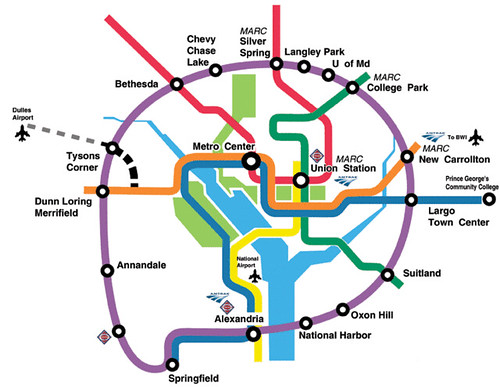
Separately from current "Purple Line planning" the County should have prioritized development of light rail between Suitland Metrorail Station to Alexandria (which is a link as part of a complete Purple Line anyway).
Purple Line Map  DC Metro
The original full circumferential Purple Line proposal would provide a light rail transit connection for National Harbor.

Once the Guggenheim Museum Bilbao opened, even though they already had subway service, the City realized they needed to improve surface transit and decided to do so with "a tram" which they built the first leg from time of conceptualization to opening in less than 4 years. (It helps that they have a train car manufacturer in the Basque Country, and some argue it was a form of self-dealing.) The system continues to be expanded and now the Basque Country is building trams in other cities.

-- paper, Return to the Rails: The Motivations for Building a Modern Tramway in Bilbao Spain

PGC could have been gutsy and moved something like that forward, creating an urban renewal district (like what Portland did for the yellow line) to fund and build it and they'd have some high quality transit service now.

The need for a transportation financing and management district for the National Harbor district.  If PGC intends for National Harbor to become an edge city of a type, a kind of new "town center" for Southern PG County, then they have to treat it differently from the standpoint of transit and mobility.

And that shouldn't be solely a financial responsibility of the NH developers and tenants, although they should pay towards it.

It's analogous to what I just wrote, "parking lot district" vs. "transportation management district" on Bethesda.

There needs to be a TMD created for National Harbor and a tax on development there to pay towards it and funding should be supplemented by other county sources, out of the idea that they are building a new activity center for the southern county.

There are transportation demand management plans for casinos in other jurisdictions.  The Institute of Transportation Engineers has various papers on casinos and TDM.  But with the rise of more in-city and in-county casino locations, it would be useful to compile new data for casino settings outside of the major casino agglomerations in Las Vegas and Atlantic City.

Springfield, Massachusetts.  Ironically,  the master plan proposal for an MGM casino in Springfield, Massachusetts is much more focused on connecting to other revitalization efforts in the Downtown core, where the facility is to be constructed.

See "MGM 1st with Springfield casino details, 1st in Western Massachusetts with $400,000 application fee" from the Springfield Republican.

The transportation plan section of the proposal commits to the creation of a transportation demand management program and the hiring of a transportation coordinator, accommodates public transit, proposes a casino shuttle bus, improvements to bus shelters in the vicinity of the project, employee ride sharing (van pooling, etc.), car sharing, suggests paying for transit home in unexpected circumstances, etc.   

According to the document:
The TC or TMO will be responsible for:
 Posting and distributing announcements
 Holding promotional events to encourage ridesharing, using public transit, bicycling, and walking
 Monitoring the program and assisting in the evaluation
 Providing transit schedules and information about program services
 Coordinating on-site sales of transit passes
 Managing transit subsidy programs for employees
 Coordinating rideshare and carpool programs and coordinating with employees to offer preferential parking for participants
 Coordinating with PVTA and MassRIDES to implement TDM programs and improve transit mode share
The Rivers Casino is the upper left of this photo, immediately adjacent to the Allegheny Light Rail Station in Pittsburgh.  Image from Subchat

Pittsburgh.  The Rivers Casino is one of the sponsor-funders of free transit from Downtown to their Northside Pittsburgh location via the light rail system's North Shore Connector.

The casino was required to develop and execute a transportation demand management plan as part of the licensing agreement with the state.

Although the initial plan did not suggest the creation of the North Shore extension to the light rail, which had been discussed for many years, and the extension also serves baseball and football stadiums located there.

Las Vegas.  The Las Vegas Monorail has various financial issues, but does connect various casinos within the city, including the MGM Grand.  The system is supposed to be extended from the last stop, the MGM Grand, to the airport.

Casinos in Maryland are regulated by a state agency and commission: Transit advocates should file a complaint with the agency.  While it doesn't surprise me that Prince George's County didn't protect its interest on this matter--after all, National Harbor has been resistant to providing high quality transit access from the outset, transit advocates should also file complaints on this matter with the regulator of casinos in Maryland:
... with a copy of the complaint to the State of Maryland Department of Planning.  I would think that the failure to accommodate transit could be construed as a violation of state planning requirements concerning "priority funding areas" and smart growth regulations.

I don't track what the agency does in great detail, but they did provide recommendations concerning transportation and the Baltimore casino.

My sense is that MGM could come around, based on their activities in other cities such as Detroit or Springfield, Massachusetts, but they are probably taking their anti-transit cues from the master developer of the site, Peterson Companies.

Labels: , , ,

Wednesday, October 23, 2013

Extranormal business considerations and the Penn National casino proposal in Prince George's County

Left: locations of the three proposals for a casino in Prince George's County, Maryland, which abuts Washington, DC.  Washington Post graphic.

Wow.

Penn National, which proposes a casino location at a less desirable facility in Prince George's County, the Rosecroft Racetrack, as opposed to the Growth Machine desired location of National Harbor, has offered to give all of the profits to Prince George's County, in order to win the bid.

See "Penn National: 100 percent of casino profits will go to Prince George's County during first 15 years" from the Washington Business Journal. and "Casino bidder offers hundreds of millions in profits to Prince George’s hospital, teachers" from the Washington Post.

It's a brilliant gambit.

Obviously they propose this because of cross-subsidies available to them from their broader portfolio, how a National Harbor casino would affect their overall profitability, and because it is a way to keep out and lower the profits of a competitor (not unlike how in its heyday, KMart "overstored" the Detroit area--its home base--to keep competitors at bay).  See "The enemy of my enemy is my friend: casino edition (a/k/a "mutally assured destruction")."

Image:  Scott Wykoff, WBAL radio.

Although the justification is to keep the racetrack going with the extra revenue stream ("Penn National Gaming Inc. makes pitch for casino at Rosecroft Raceway," Washington Business Journal).

Penn National proposes that PG County use the money to fund a system of public health clinics (actually I suggested that such a system be paired with a new county hospital system, see past blog entries "Disruptive Innovation Once Again" and "When the problem is defects in the structure of "the market", financial incentives won't do much good: Maryland's health enterprise zones"), pensions for teachers, and funding to community organizations located specifically within the Council District where the racetrack is located.

What I would recommend instead that if PG County and the State Casino Board selects this bid, that instead PG County come up with its own priorities.  This is the course I recommend generally with regard to what are called proffers or community benefits.  See "Community Benefits Agreements (revised)" and "Social infrastructure (community benefits)."

And as much as I think National Harbor is gross, it probably makes more sense to put a casino there ("MGM unveils details of proposed $800 million National Harbor," Springfield Republican, Massachusetts).

Instead, PG County should seek a counter offer from that group which would probably be financially similar, and use the money to pay towards high capacity transit connections, such as an extension of the Purple Line light rail from Alexandria to New Carrollton.
Purple Line Map  DC Metro
Sierra Club concept diagram, Purple Line light rail system, Washington Metropolitan Area.  The leg from Bethesda to New Carrollton is currently being designed and is expected to break construction within 2 years.

That being said, casinos generally are gross and reliant on revenues from people who ought to be spending their money on other things.  But proximity to DC will probably make a PG County casino a winning proposition.

If the county uses the revenues wisely, they could benefit.  Although it's not a sure thing.  See "What to make of casinos as an "urban revitalization" method and detroyer?" and "Casinos in Atlantic City may be a losing proposition."

And if it is not part of a project that strengthens connections and intensify within the county then the desired goals and objectives will not be attained.  See "Can enclave development "save" Prince George's County?"

Labels: ,