Rebuilding Place in the Urban Space

"A community’s physical form, rather than its land uses, is its most intrinsic and enduring characteristic." [Katz, EPA] This blog focuses on place and placemaking and all that makes it work--historic preservation, urban design, transportation, asset-based community development, arts & cultural development, commercial district revitalization, tourism & destination development, and quality of life advocacy--along with doses of civic engagement and good governance watchdogging.

Saturday, January 25, 2025

Timeshares in center cities for City Break tourism: Chicago

City break tourism is a form of cultural heritage tourism where people visit cities to experience their urban-ness.  These tourists tend to stay longer and spend more money and are less inclined to be there to attend sports events etc.

Who knew?  Hilton Grand Vacations, a timeshare company, has a set of city properties that aren't resorts or vacation destinations (like Park City, Utah or Sedona, Arizona).  They have one in Chicago according to Crain's Chicago Business, "Timeshares take off in Streeterville as interest in downtown slowly recovers."

HGV bought the six-story block of 122 rooms on the top floors of the 26-story hotel in 2019. Crain’s reported at the time that Hilton was paying $54.5 million and would renovate the 122 rooms into 78 studios and one-bedrooms. 

The building is a few blocks’ walk from North Michigan Avenue in one direction and Ohio Street Beach and Navy Pier in another. All around are restaurants, cultural amenities like the Museum of Contemporary Art and the Chicago Children’s Museum, and riverwalks on the north and south sides of the river. It is, in other words, a prime location for out-of-towners to stay when they want to take in the best of the city.

While the downtown condo market slowly recovers from the pounding it took in the early 2020s, a different form of ownership has quietly bloomed in Streeterville. Hilton Grand Vacations Club has sold nearly 2,900 timeshares for its Chicago location, the top six stories of a Doubletree Hotel on Ohio Street, according to Chicago Cityscape, which tracks construction and sales in the city. The shares sold for a combined total of about $126.6 million, which amounts to a significant investment in vacation stays downtown.

Timeshares, where owners buy shares that give them a specified amount of time in the property each year, is very different from condo ownership, where the owner has full-time ownership of the real estate. Compared to a condo, a timeshare demands a far smaller investment. Shares at the Hilton Grand Vacation Club Chicago Magnificent Mile, 300 E. Ohio St., sell for between $20,500 and $70,000, according to the sale documents, while the lowest-priced Streeterville condos listed for sale are in the $150,000 range and the average is $566,000.

Photo: Benjamin B. Braun, Pittsburgh Post-Gazette.

Similarly, the converted into apartments train station in Pittsburgh, the Pennsylvanian, is now making some of its room "short term stays" a la AirBnb ("A different track: Part of Downtown’s Pennsylvanian to be available for short-term stays," Pittsburgh Post-Gazette).

So long as it's managed and not to many units are taken off the traditional rental market, I think this is a great way to experience the city, the urban experience, if you don't have much experience with it.  I imagine if the was fully rented, the management wouldn't be doing short term rentals.

Years ago, we stayed at a bed and breakfast in Petersburg, probably 2008. It was across the street from a luggage factory that had been abandoned for decades but was being redeveloped into housing.  

I suggested to the proprietors that they approach the company and create an option for short term stays so people could get a sense for if they wanted to live there.

It turns out this many years later, the project still hasn't been done ("Waukeshaw bags former Petersburg luggage factory for $3M," Richmond BizSense).  But the building stock looks really cool, still.

Visitor accommodations planning.  In past entries, I've argued that cities need to create accommodations plans with a wide range of types of housing and price points, to maximize visitation and tourist spend.

Labels: , ,

Wednesday, November 22, 2023

Learning from Las Vegas: Round 2 | Planning for Activation and Transformational Projects

Learning from Las Vegas is a famous book in architecture studies about post modern architecture

WRT my point about governments doing things and charlie's counter that mostly it's not about governance but growth independently of the local government, even in blue states, there's a great article, "From Sin City to America’s sports capital: Las Vegas is transforming itself again. What do the glitz of Formula One and the Super Bowl mean for the city’s future – and for the workers building it?," in the Washington Post about how Las Vegas is leveraging sports as another way to further activate the city, by keeping adding attractions.

The Sphere, created by Madison Square Garden Company, is an entertainment venue just east of the Las Vegas Strip. (Bob Leal/Courthouse News)

In the past few years the Raiders NFL team moved there, The Sphere attraction opened ("The Sphere mesmerizing Las Vegas months before opening," Courthouse News Service), and the Oakland A's baseball team just got approval to follow the Raiders ("The Oakland A's are relocating to Las Vegas after MLB owners approve the move," NPR).

Around six years ago, the Las Vegas Golden Knights hockey team launched, in an arena that was built by the private sector before there was a commitment by the NHL.  This past summer, the team won the Stanley Cup.

Williams driver Alexander Albon, of Thailand, drives during the final practice session for the Formula One Las Vegas Grand Prix auto race, Friday, Nov. 17, 2023, in Las Vegas. (AP Photo/John Locher)

Then there's Formula 1.  Not my thing, but it's the thing for enough people, especially rich people.  

The Post article is great about how it came about (also see "Tickets, times, transportation and community outreach among issues F1 must fix in Las Vegas," AP).

There's a great sentence about LV being the city that always says yes. 
It's related to my point about transformational projects action planning including a willingness to take advantage of opportunities that present themselves, that work within the framework of a creative master plan, about taking advantage of serendipity.

But it's also relevant to my point about how destinations usually need constant refreshment and management to remain interesting and relevant.  

Wrt hotels, LV is the king of building, demolition and rebuilding of constantly larger hotel-casino projects.

This is an issue with Baltimore's Harborplace on the Inner Harbor ("Initial plans for Harborplace to include residential tower and retail, commercial space," WBAL-TV).  

What does a Louisiana seafood restaurant concept have to do with the Chesapeake region?

It was cool in the beginning, then became a place mostly housing chain establishments.  The Baltimore riots didn't help.  

Nor did the company that bought it (and lost it through foreclosure) which owns/ed similar types of "festival marketplaces" ("Rouse and Festival Marketplaces" from Merchant of Illusion: James Rouse, America's Salesman of the Businessman's Utopia) but really doesn't know how to run them except through imposing homogeneous retail, taking away anything special about the property.

A new owner of Harborplace aims to revive the site.  But the problem with capitalism is that other property owners elsewhere in the city, like Canton, continue to invest in making their places great, making it that much harder for Harborplace to compete--although it has a waterfront location, which should trump any other location.  

But at the end of the day, the problem is not unlike that faced by Eastern Market or H Street in DC--there are lots of alternative destinations.  Like many other cities, Baltimore has too much in the way of developable space, making it hard to focus.

Similarly, other festival marketplaces like Faneuil Hall in Boston and the South Street Seaport in New York City ("Seaport District reinvents itself with dining, shopping and a dose of history," NY1 News) have the same issues of the need for refreshment.  Over time, local visitorship drops off.  And those places have a lot more visitors and residents than Baltimore.

Note that scale wise, the Fremont District, different from the big hotel-casinos on the strip, with more older buildings and a more human scale, is probably more analogous to festival marketplaces than the LV Strip or adding super large scale attractions ("A new tourist destination to revitalize a declining downtown," UNLV thesis).

U2's residency at the Sphere is incredibly successful ("U2's First Batch of Shows at the Sphere Generated Nearly $110 Million in Ticket Sales," Billboard.)

Bono, The Edge, Adam Clayton and Bram van den Berg of U2 perform during opening night of U2:UV Achtung Baby Live at Sphere on Sept. 29, 2023 in Las Vegas. Kevin Mazur/Getty Images for Live Nation

From the article:
U2 wrapped the first leg of the U2:UV Achtung Baby Live at Sphere residency on Nov. 4 with unprecedented box-office results. According to figures reported to Billboard Boxscore, U2’s 17 Sphere shows in Las Vegas grossed $109.8 million and sold 281,000 tickets. 

Opening night at Sphere was Sept. 29. U2 played another show the next night, 12 more in October and three in the first week of November. The gross and attendance figures average out to $6.5 million and 16,500 tickets per show. The average ticket price across all shows was $390.97. 

U2 is scheduled to play eight more shows in December, kicking off on Friday night. There are 11 more dates lined up between Jan. 26 and Feb. 18. The 19 shows on the books could generate another $120 million, pushing the residency to about $330 million in less than five months. Only Dion’s A New Day… would remain ahead in terms of all residencies in Boxscore history.

The only thing is few bands can pull this off.  U2 is one.  Although LV has tons of successful concert residencies.  They tend to be in much smaller spaces, and much less multimedia intensive.

Conclusion.  Even though Las Vegas has gambling, big conventions, and almost 40 million visitors per year, it doesn't take its position in the leisure, hospitality, convention, and gaming business for granted.

When it comes to destination development and management, Las  Vegas is a city of constant redevelopment and reinvention  ("Robert Lang, who helped reshape Southern Nevada’s economy, dies at 62,"Las Vegas Review-Journal). 

It is an outlier when it comes to urban management, which in Las Vegas is a "partnership" between the private sector, the city and other nonprofits like the tourism board, the State more generally, as well as the Nevada Gaming Commission.

Labels: , , , , , , ,

Monday, April 03, 2023

Adaptive reuse of a high school to a concert space in Portland, Oregion: Revolution Hall

A friend just visited Portland and she and her friends attended a concert, and hung out on a rooftop deck, in a venue that had once been Washington High School, now called Revolution Hall.

Laying the groundwork.  Most cities aren't capable of a willingness to entertain such an idea.  Portland is "exceptional" in that it does.  But I attribute this in large part to the groundbreaking approach of the McMenamin brothers ("Vision and Versatility: The Story of McMenamins," Spirited Magazine, "Preservation Brotherhood," Chicago Tribune, 2004).

First, they started buying movie theaters like the Baghdad Theater on Hawthorne Avenue, and added brewpub functions to help them survive.  In the process they've helped to preserve neighborhood embedded cinemas across the city.

From that they moved to taking on other historic buildings in the city, focusing on tavern and food related operations.  From "The McMenamin Brothers," Northwest Travel and Life):

“I’ve always gone with what just feels good,” says Mike McMenamin, 64, the senior of the two.

Few business plans get very far with a “what feels good” engine behind it. Mike’s laid-back persona belies the astute business savvy within. It turns out what feels good to Mike and Brian feels good to a lot of people, not only those who share their boomer generation, but younger guests as well.

“We sell an experience,” Brian says. A McMenamins property is a destination, not just a place you bed down for the night or grab a meal. The “experience” Brian refers to is unique to McMenamins. And the devil is in so many detail.

... Armed with inspiration, the brothers went into business together in the early ‘80s. McMenamins was born. It has since grown to include nine hotels (with two more in the wings), dozens of pubs and restaurants, movie theaters, spas, music venues, a coffee roaster, and a winery, brewery, cidery and distillery.

“We always try to reach out and be part of the community,” says Brian. This is the offspring of an implicit karma philosophy of doing the right thing. For the McMenamin brothers, it’s not amassing an empire that matters, it’s that each property, each venue is a part of the community where it resides—in the community, for the community.

Kennedy School.  The second key element is the example of Kennedy School, also involving the McMenamins, which has been converted into a bed and breakfast, the Kennedy School Hotel, with a brewpub-restaurant and special event facilities ("From Portland, cues for Philly school-building reuse," WHYY/NPR).  From the article:

A lesson in creative thinking

Neighbors had successfully campaigned to have the Kennedy School historically designated, but several attempts to find an appropriate redevelopment failed. The McMenamins, developers of hotels, brewpubs and entertainment venues in Oregon and Washington, won city approval for their proposal.

It took creative financing, but more importantly, creative thinking. As a result, The Kennedy School‘s 57-room hotel may be not be the weirdest thing in Portland, but it is among the most unique.

The school remains a vital community gathering point by offering public meeting space and through events. The auditorium is now a movie theatre, with weekly matinees and infant-friendly showings; lectures and community events are held in the old library and classrooms; weddings happen in the former gymnasium.

Start with a plan.  I use this case as an example of the difference between issuing a Request for Proposals versus creating a master plan first.  With an RFP, you're at the mercy of the respondents, with a plan, you lay the groundwork for possibilities--hopefully, because a plan can also constrain possibilities--and a community consensus for what can be done.

Portland did a plan for Kennedy School first.  And only after the plan was finished and adopted did they issue an RFP.

-- Kennedy School Master Plan, Portland

And McMenamins was the winning respondent to the subsequent RFP.

They've since gone on to do similar and even more innovative projects across the Pacific Northwest.

Conclusion.  At the same time, the McMenamins have created a/the space in cities like Portland, but also in adjoining states, for the consideration of creative and innovative adaptive reuse projects, that wouldn't normally be considered by most communities, especially for old school buildings still located within neighborhoods.

Their idea of "community citizenship," that the building will remain in the community and they need to be responsive in part to be good neighbors, is also atypical of many developer-operators.

McMenamins has also motivated other organizations to take on similar kinds of projects, and be successful at it.

(Note this argument about the importance of "laying the groundwork" for innovation was also made in an entry about urban design improvements in Downtown Oklahoma City, see "Change isn't usually that simple: The repatterning of Oklahoma City's Downtown Streetscape.")

Labels: , , , , , , ,

Wednesday, February 24, 2021

Applying the civic tourism approach to low income urban areas as an economic development strategy: Albany; Anacostia/DC; Baltimore; etc.

On an e-list we were discussing Albany, New York, which you would think would be a successful place, since it's a state capital.  It's not.  

An impoverished section of Albany, New York. Photo: Denis Tangney, Jr. / Getty Images.  From "Why Justice in Design Is Critical to Repairing America," Architectural Digest.

One of the elements I mentioned is the architectural richness of historic residential building stock in the core that ought to be an incredible asset, but isn't.  

Someone else blamed its state on the fact that it is mostly home to low income households.  

Instead of being critical it got me thinking about mutual aid and community economic development and entrepreneurship approaches that could help the community rebuild its economic well being.

Based on a whole bunch of examples, it occurred to me that one way to help improve the microeconomies of such neighborhood would be to apply "new" models for tourism, integrating them into one initiative.  

I was also influenced by a recenet NHK episode in the series "Connecting People in the Pandemic", featuring Minami Shintaro, the operator of a guest house in Seto City, Aichi Prefecture in Japan, and how he works to connect visitors to businesses in the local community, especially to craft producers, like of ceramics, for which the city is known.

Although the idea isn't necessarily new such as the 2006 Washington Post article on the Leimert Park neighborhood of Los Angeles, "Los Angeles's Black Pride" (place details).

Airbnb type rentals are a way to generate revenues for houseowners, revenues that can be used to improve properties.  More visitors to the neighborhood can in turn support local businesses, from coffee shops to tour guides ("For Black tour guides in Savannah, the historical is personal," Washington Post).

Gentrification?  People may complain this is "gentrification" but the problem these neighborhoods have is lack of demand, and often hundreds of vacant properties.  Displacement isn't the issue.  Lack of economic demand and a need to generate economic activity at the scale of the neighborhood and individual households is the issue. 

However, it's important to note that the way I conceive of this, it's a ground up initiative, supporting local residents and business owners, with the assistance of government, philanthropic and community organizations.  

It's not about economically well off businesses and people parachuting in, claiming they're "helping" and capturing the majority of the benefit, such as what happened in the Boyle Heights community of Los Angeles ("Good-Bye to All That: Boyle Heights, Hotbed of Gentrification Protests, Sees Galleries Depart," ARTnews, "Gentrification Protesters in Los Angeles Target Art Galleries," New York Times).

The Leimert Park initiative was a venture of community organizations and businesses.

And there has been complaints about Airbnb properties in low income neighborhoods, including DC ("Airbnb Has Made Housing More Expensive In Some Parts Of D.C., New Research Paper Finds," WAMU-FM/NPR).  Again, I am proposing a ground up initiative focused on community economic development and self help, not on programs benefiting nonresidents.

Resources.  A great tool that has been supplanted by newer editions, but I think is great, is the Tourism Destination Assessment Workbook produced for Nova Scotian communities and the Downtown and Business District Economic Development from the University of Wisconsin Extension's Center for Community and Economic Development.  

The out of print Tourism Development Handbook is excellent and worth tracking down.

Civic Tourism.  In 2005 I was introduced to the concept of Civic Tourism, as discussed in the book by Dan Shilling.  I even went to a conference on it in Prescott, Arizona.  

The idea is to refocus tourism from the big spectacle focused places (Disney, etc.) towards smaller place-based tourism, heritage tourism (historic buildings and sites) and communities.

Bike tourism/Route Verte and Pennsylvania Trail Towns.  Many rural communities promote bike-related tourism.  If not races, they create tour routes, publish maps and brochures, and pay for a wee bit of marketing in cycling publications.

Route Verte is a provincial-wide trail system in Quebec, and the complementary program VeloHospitality supports bicyclists along the route, with lodging, restaurants and services, so that cyclists can participate without having to use an automobile.

The Great Allegheny Passage Trail which connects to the C&O Canal Trail, links Washington, DC to Pittsburgh.  The Trail Towns program supports bike-related tourism and hospitality services along the route, stoking economic development in small places that have few options.

Urban bike tourism.  Speaking of urban areas, I've thought that DC and Maryland should do something similar with communities, including DC's Anacostia, neighborhood, Hyattsville, etc., along the Anacostia River Trail Network, which extends from Southeast DC to Greenbelt, Maryland, with extends with connections north towards Baltimore and west into Montgomery County.

Related to urban bike tourism, Velo Quebec, the provincial bike advocacy group, has an office fronting a major public park in Montreal, with a cafe and travel operation.  Add a repair shop and it would be a great hub for urban bike tourism support.

Food Tourism.  Promoting local food systems and ventures is another way to promote micro local economic development.  

A couple good books on the subject are The Town that Food Saved: How One Community Found Vitality in Local Food and Food Town, USA Seven Unlikely Cities That are Changing the Way We Eat, published by Island Press.

-- "Can Food Bring Back Struggling U.S. Cities?," US News & World Report

In the city, there are ways to do informal food presentations too, not unlike how in Havana, people have restaurants in their houses, called paladares ("sTHE UNTOLD STORY OF HAVANA’S CLANDESTINE RESTAURANTS" Parts Unknown TV Show).  

Cottage food operations are being legalized in more US cities, there are the special event "restaurant events" in people's homes, like this at one time in Los Angeles ("Prodigy," New Yorker Magazine).  

There was a place in DC that did this, only open in the evenings some nights a week, in a storefront on 7th Street NW, I think it was called Seasonal Table.  We went once, and it was cool.  I've encouraged my old next door neighbor to do this, as he is a maestro of Brazilian churrascaria.

The City of Helsinki agreed to sanction an idea of advocates called Restaurant Day, where on one day, anyone can do pop up food activities ("On Restaurant Day in Helsinki, Anyone Can Open an Eatery, Anywhere," Atlas Obscura) even if they are unlicensed.  From the article:

Restaurant Day began as a civic protest. In 2011, Helsinki resident Timo Santala wanted to start a mobile bicycle bar, selling drinks and tapas. Frustrated by red tape in a city where everything is highly regulated, he imagined a day where a restaurant could open with no licenses and no limitations. He and his friends came up with Restaurant Day, a food carnival where anyone can open a restaurant, anywhere they want, for a single day. 
In 2012, this Cuban restaurant popped up in downtown Helsinki. 
ROY BÄCKSTRÖM/RESTAURANT DAY 
Helsinki could have turned it into a cash grab, fining hundreds for operating a restaurant without a license. “In the beginning, the authorities and the owners of regular restaurants vocally opposed Restaurant Day,” said Weijo. “However, it attracted such a wide range of participants that opposition was almost impossible.” 
In fact, the city actually came on board. Grasping the appeal of Restaurant Day, Helsinki’s tourism website now features it as an attraction. Which is a pretty extraordinary achievement for an event that deliberately side-steps the law. (It helps that there have been no known instances of food poisoning stemming from Restaurant Day, according to Elisabeth Rundlöf, a marketing manager for the City of Helsinki.)

The idea has spread to many other countries ("Participants’ freedom made Restaurant Day the world's largest food carnival," Aalto University).  

Here, I am saying add this as an element of a community tourism initiative focused on lower income center city communities with  heritage, civic, and food elements, aimed to support the development of microenterprise.

A variant of food tourism is agritourim, falthough that is rural-focused on farms, wineries and such.

An aerial shot of the Wynwood Walls.  Photo by Will Graham. Image courtesy of Wynwood Walls.

Public Art. Wynnwood in Miami is known for its development of murals as an outdoor art gallery, called Wynnwood Walls ("How the Wynwood Walls Have Shaped Miami's Art Scene," Architectural Digest).

Public art could be an element of this kind of ground up neighborhood revitalization and community economic and microenterprise development initiative.

But it would be a decision that the neighborhood would have to support.

Labels: , , , ,

Thursday, September 27, 2018

World Tourism Day, Thursday September 27th: Airbnb/Short term rentals, "overtourism" and impact on housing supply

-- World Tourism Day website

Given that this year's theme for WTD is "Tourism and the Digital Transformation," it makes sense to address the impact of digital/e-commerce enabling technologies on fractional rentals, to wit, home stay digital platforms like Home Away, Airbnb, and VRBO, which enable people to stay in non-traditional properties--homes and apartments--while traveling.

The thing is that in general I think "sharing services" like Airbnb are fine. Especially because they allow people to stay in real neighborhoods, and experience stays more like how a resident would, rather than a more homogeneous experience within a hotel.

But I wonder if I am not totally objective as a user of such services myself.  E.g., the place I stayed in in Hackney Wick, across from a London Overground station, was awesome.  Same with a basement apartment in the Capitol Hill neighborhood of Seattle.  Etc.

Who rents properties, individuals?  Airbnb, the market leader, was originally created by some apartment dwellers who wanted to rent out space in their apartment to help pay the rent.

Or firms?  But over time, it and similar services have become marketing platforms that in terms of properties with the most frequent use are dominated by professional firms rather than individuals, and are "whole unit" use rather than fractional.

-- The State of Airbnb Hosting: An in-depth analysis of Airbnb and the home sharing industry, LearnAirbnb.com

Hotel opposition over profits, employment.  Plus, hotel workers unions and hotel firms are vociferous opponents, figuring it cuts down on hotel stays and thereby profits and employment ("Airbnb fight is about hotel profits, not workers," Albany Times Union).

My sense is that this impact is minimal, because the type of people using this form of travel are not likely to be a major proportion of the people who normally rent hotel rooms.  The same goes for patrons of bed and breakfast establishments, etc.

Is non-traditional home stay a driver of Overtourism?  Answer: generally no.
 NotionsCapital shares an article with us from the Guardian, "Airbnb and the so-called sharing economy is hollowing out our cities."

Relatedly, there was a piece in the New York Times about "Overtourism" attributing this in part to airbnb.  Earlier they ran a story about how Palma on Spain's island of Majorca has banned airbnb ("To Contain Tourism, One Spanish City Strikes a Ban, on Airbnb)

 Still, I don't think these services are is what is making places like Venice or Barcelona "overtouristed." It's not like the thousands of people who go into those cities from cruise ships are then using Airbnb.

But sometimes the answer is yes because small reductions in housing supply make a big difference in strong markets.  But I think what we've learned from the housing market is that even small and "marginal" changes in supply and demand make a big difference in price and availability, particularly in high demand real estate markets.

These graphics showing the NYC neighborhoods with the highest number of Airbnb rentals and the percentage of the local housing supply dedicated to short term rentals were produced by a student at Pratt Institute.
Neighborhoods with highest number of Airbnb rental properties in NYC

Percentage of local housing supply dedicated to short term rentals

The Airbnb I stayed in, Hackney Wick, London
I can't remember the exact price of my stay in Hackney Wick/London, but it was less than £20 per night and literally, right across the street from the train station.

Combining the impact of housing sharing systems like Airbnb removing housing from the local rental market simultaneous with increases in demand to live in the city can result in significant price appreciation for rental properties.

Therefore, it's reasonable to regulate such short term housing travel arrangements, in high demand markets like  Barcelona ("How Barcelona Is Limiting Airbnb Rentals," CityLab), New York City or San Francisco ("Airbnb's Impact on San Francisco," five-part series, San Francisco Chronicle), etc.

Although according to this graphic produced as part of the study by the NYC Budget Office, the rent appreciation attributed to the impact of the short term rental market was relatively small in most neighborhoods.
nfographic: Airbnb Heats Up Housing Market in NYC neighborhoods | Statista
Source: Statista.

However, many studies do not find a significant impact in various communities such as Denver ("Does Airbnb hurt Denver's rental market? Not much numbers suggest," Colorado Public Radio) or in Australia ("What impact does Airbnb have on Sydney and Melbourne housing markets," SGS Economics and Planning).

Recommendations

1.  Accommodating Airbnb and similar services should be considered both within a comprehensive accommodations element within an overall community's tourism development program and planning initiative and as part of a community housing master plan.

2. In hyper strong residential real estate markets like NYC and SF, depending on the neighborhood, short term rentals may need strict limits and regulation, because shifting even 5% of properties away from residential use will make a big difference in terms of rents, etc.

While I tend to hate the imposition of what I think of as often arbitrary limits through zoning and building regulation process, I would put a ceiling on the number of "whole unit" rentals that can made through sharing services. In DC that would be in places like Capitol Hill, Georgetown, Dupont Circle etc.

I could see a maximum number of 5% of total housing units being able to be let via fractional home stay services.  I would probably start with a low number like 2%, and evaluate it yearly.

3.  Still, weak market neighborhoods in otherwise strong market cities should be treated differently.  E.g. in DC there has been a lot of discussion of airbnb as a force of gentrification in lower income communities like Anacostia, when the reality is that most of the activity is west of the river.  And, increasing visitation and business for local businesses can be seen as an economic plus ("Airbnb: Stays east of the Anacostia River grew 65 percent since mid-2017," CurbedDC).

In any case, all neighborhoods should be regularly monitored as part of housing planning and limits set as needed.

4. It should be illegal to convert apartment buildings to ersatz hotels as some property owners have attempted ("D.C. sues company for allegedly treating rent-control apartments like ‘hotel rooms’," Washington Post.

5. But years ago, I thought apartment management firms should use the idea of a "bed and breakfast" service of a unit or two as a way to let people try a building out.  Why not?

Separately, generally fractional rental of an apartment is a lease violation, but some companies are considering the ramifications of allowing it ("Using Airbnb to your advantage," MultiHousing News).

6. Regardless, all such uses should require licensing and payment of local hotel taxes for each stay.

7. However, I wouldn't put a limit on people doing fractional use rentals--making a room available in their house or apartment when they still occupy it. They should still have to collect the equivalent of hotel taxes.

Labels: , , , , ,

Tuesday, January 27, 2015

Historic Preservation Tuesday: Demolition of church in Federal Hill Baltimore versus more interesting alternatives

Apparently a church was demolished last month in Baltimore's Federal Hill neighborhood.  It will be replaced by three rowhouses.

Obviously, the problem of how to re-use vacant urban churches continues.  And it isn't merely a problem in the US ("Europe's Empty Churches Go on Sale," Wall Street Journal).

Many churches were created to support specific demographic groups most often in tight geographical proximity and as those communities disperse, those churches typically begin a long slow decline as the congregation continues to shrink.

This is accentuated by changes in the nature of worship and new types of churches, not traditional mainline congregations, that people are choosing to join now, which I wrote about here, "Sunday morning: Churches, religion, community and change."

A couple years ago a Baltimore blog, bmoremedia, wrote about the issue of reuse, in "Developers find new uses for sacred spaces."
Although the examples are mostly of creating offices.   DC has similar examples, including the conversion of a church to housing on Capitol Hill.

An out of the box example is the Church Brew Works in Pittsburgh where a church has been converted to a decent brew pub.

That example so concerned the Archdiocese of Milwaukee that when they closed a number of churches, they put restrictions in the deeds of sale to prevent such creations.

It happens that recently while on vacation, we stayed in a building, the Sanctuary Place Inn, that had once been a church.

It is now set up as three different vacation rental units. It's located a couple blocks from Forsyth Park in Savannah's Old Historic District and the space was pretty incredible.  An incomparable experience.

That kind of use is "unique" and helps to extend the variety of accommodations and service options in a place.

On the other hand, it's faster to build and sell and reap the profits of selling three rowhouses in a popular neighborhood experiencing rising property values. Especially when you don't have a bevy of experienced developers who are experienced and ready to take on such projects.

Church Brew Works, Pittsburgh.  Image source.

Portland is fortunate to have the McMenamins group, which doesn't have any church projects under their belt, but many examples of adaptive reuse of institutional facilities (schools, hospitals, etc.) and continued operation of theaters by adding food and beverage service and brew pubs.

Their re-do of the Kennedy School into a bed and breakfast and pub was one of their earlier and best known examples.  They riff quite a bit on the former use.  From their website:
Remember when the worst thing you could imagine was being kept after class? My, how things have changed! At Kennedy School, you'll never want to leave. Here you can have a pint in a classroom, enjoy an aged whiskey and a cigar in detention, enjoy a movie in the old auditorium.... The possibilities here are endless.
Historic Preservation Protections help save buildings, but don't usually support broader uses.

In a historic district like in Savannah or Washington, DC, because of the local preservation laws, it would be very difficult to demolish buildings of any sort, including churches, even if the church use is no longer active.

But because most "residential" historic districts are zoned for residential uses exclusively, it becomes very difficult to adaptively reuse a building for non-residential uses. That is the case in DC, where boutique inns are not considered a matter of right use in residential zones.

V&J Duncan Antique Maps is located on Monterey Square in Savannah, and has been written up in the New York Times.  The Duncans live in the grand house above the store.

Savannah is different. I don't know all the ins and outs, but they have liberal commercial use approval built into the code for the historic district so that commercial uses like renting out units, for traditional rental, or vacation rentals, having commercial uses in your "home" such as a bookstore, is legal, provided people meet the various building and other relevant regulations regarding the use.

For example, vacation rentals are legal, but the accommodations must be licensed, pay local hotel taxes, etc.

"Home-based business" regulations need to be considered in the context of the "new economy" where single use buildings become increasingly difficult to pay for as income declines.


Labels: , , ,

Monday, June 10, 2013

Alexandrians need to learn about the need to create a comprehensive accommodations plan, treating hostels as a full-fledged element

(not that other communities do this either). GGW points us to some coverage of the approval of a "youth" hostel in the Alexandria Patch, "Hostel in Old Town: Affordable Accommodations or Rowdy Roadhouse?" and how some Alexandrians, thinking that hostels are just for hippies, don't approve.

I've argued for some time that cities need to have comprehensive plans that encourage the provision of a wide variety of accommodation types, to meet the demands of various segments of the tourism market. I've stayed in hostels in Philadelphia and Portland myself, and considered doing so in Seattle and Baltimore.

-- 2006 Associated Press story "American hostels have long way to go to catch European counterparts"
-- 2010 Associated Press story, "Redefining hostels"
-- 2010 Associated Press story, "Check out hostels in Baltimore, Harlem, Chicago and Venice Beach"
-- Hosteling International
-- Hosteling International USA
-- Hostel Management website

This blog entry from 2011, "Start with a city-wide accommodations plan: then consider TIF requests comprehensively" addresses the issue and builds on other work I've done.

From the entry:

In commercial district revitalization framework plans I did for Brunswick, GA and Cambridge, MD, one of the recommendations I made for each is that the communities need to develop a broader and complete "accommodations" plan as part of the economic development element of the city's comprehensive/master plan.

I don't think I've ever come across such a component in master/comprehensive plans in the U.S., but it's something that has occurred to me over the years because most communities don't offer a complete array or set of accommodations to visitors. They're certainly not thinking comprehensively about it.

Many cities make the provision of Bed and Breakfast accommodations illegal, even though it can be a good way to make keeping up a massively big house affordable ("Making a home is their business The Chorpitas find rewards in a B&B" from the Philadelphia Inquirer), not to mention it's much more sympatico with ecotourism and experiencing a community more like a local.  There are other issues too, such as the issue of couch surfing through online services like Airbnb raises other zoning related issues.

At least for communities that are tourist destinations, it ought to behoove them to think more comprehensively about this to better meet the needs of various market segments.

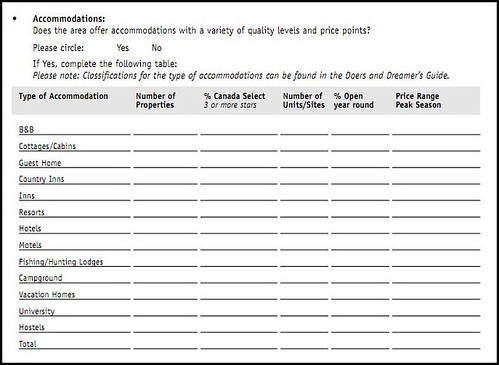
Probably I got the idea because it is laid out as part of the Tourism Destination Areas Self-Guided Workbook assessment and economic development process created by the Province of Nova Scotia in Canada. (I have written about pieces of this idea in the blog as well, such as in "Lower cost travel for the young and creative" and "More phenomenal tourism business development resources" in 2006.)

Accommodations plan worksheet, Tourism Destination Areas Workbook, Province of Nova Scotia
Accommodations plan worksheet, Nova Scotia Tourism Destination Areas Workbook. 

This is pretty simple, but it's more a scoping/current conditions assessment. It's not at the detail of a full-blown economic development plan.

Such accommodations plans should include hotels, motels, conference facilities, bed & breakfast, boutique inns, and depending on the market, hostels and campground facilities, at a variety of price points.

Now I would argue that such plans should also discuss online sales of hotel rooms and tax capture issues (see "How much might Expedia et al owe D.C. for back sales taxes" from the Washington Business Journal) as well as couch surfing/collaborative sharing accommodations and some of the implications involved including zoning (see "NYC Judge Rules Airbnb Rental Is An “Illegal Hotel”" from TIME Magazine.com) and sales tax collection (see "Airbnb is still snubbing SF, even after a NY judge rules it illegal there" from the San Francisco Bay Guardian).

Note that I don't know much about it, but there is a hostel across the street from the Takoma Metro Station in DC, which offers a different experience than the one downtown, but is still transit accessible.  It's called Hilltop Hostel.
Historic Takoma House Tour sign in front of a participating building
I wish they had a nice porch.  They tried to put one on using the facade improvement program that I worked on in 2009, but the city deemed the proposed use ineligible.

Labels: , ,

Monday, January 28, 2013

Not every attempt at crony capitalism succeeds in DC

In DC, some federally owned property has been converted into privately managed commercial income property through long term leases.  These properties generate income for the manager and rental income for the federal government.

While federally owned properties are not normally subject to property tax, DC passed a law which assesses property taxes on buildings used in this fashion.

Today's Post has an article, "Trumps turned down in request for tax relief on Old Post Office Pavilion," about how the city denied the Trump Organization's informal request to get a property tax exemption on the Old Post Office building, which they intend to convert into a hotel.

From the article:

Gray spokesman Pedro Ribeiro said it would be unfair to offer a tax break to the Trumps when they were awarded the project through a competitive bidding process.

“It was never part of the bid proposal that the project would not be subject to the tax,” he said. ...

Federally owned property typically is not subject to local property taxes. In recent years however, District lawmakers — faced with a city filled with un-taxable federal properties — created a possessory interest tax establishing a tax on private entities operating within federal buildings.

The Post mentions Union Station as another property that has tried-unsuccessfully--to get an exemption  from property taxes.

The Post does not mention the Hotel Monaco (pictured right, Wikipedia photo) at 700 F Street NW.  This building is the former main post office for the city, and is owned by the Federal Government.  To the best of my knowledge they do not receive property tax exemptions.

In my previous piece on the Old Post Office issue, "Trump seeks local tax subsidy for conversion of the Old Post Office into a hotel," I mentioned that a recent Wall Street Journal article (Subsidized Hotels: Boon or Boondoggle? Cities Like the Jobs and Taxes Lodging Can Bring. Critics See Oversupply and Unfair Room-Rate Competition) on hotel tax exemptions was seen as a competitive disadvantage for hoteliers paying property taxes in full.

(Surprisingly, the DC government spokesperson quoted in the article used argued a position very much  similar to that from my blog entry.)

Union Station's retail operation is seen as one of the most successful in the city.  Similarly to hoteliers complaining about differential treatment, if the owners of the lease (Ashkenasy Acquisitions, which has purchased similar leaseholds in other cities because they like these types of properties) didn't pay property taxes, this would give them a financial advantage over other commercial property owners leasing out retail space and is unfair.

Labels: , , , , , ,

Thursday, March 29, 2012

Bad Montgomery County policy/law initiative #2: exempting Lockheed Martin's conference center from hotel taxes


Two hotels in Montgomery County, Maryland: the Hyatt Regency Bethesda and the Lockheed Martin Center for Leadership Excellence.

Montgomery County Executive Ike Leggett wants to exempt Lockheed Martin's private conference center from hotel taxes. He argues that it's a private conference center not a hotel open to the public, so it should be exempt. This is seen as an incentive for the company, to help retain their business in the County. See "MontCo executive offers Lockheed Martin $900000 tax break" from the Washington Examiner.

There are two ways to look at this issue:

1. The provision of training and the lodging associated with it.
2. When lodging is provided as part of a public accommodation or a semi-non-public one.

In short, what should be exempt, the activity (a hotel stay) or the way the activity is served (via a private conference center vs. a hotel)?

Plenty of organizations in Montgomery County hold conferences and trainings which require some people to travel to the county and stay in hotels during their stay here.

The only difference between someone going to training at Lockheed Martin is that they stay in a private facility.

Should the activity--all people coming to Montgomery County for training and staying in hotels-- be exempt from hotel taxes during their stay?

If so, then the Lockheed Martin facility should be exempt. But then so should every training-related stay in every hotel.

If the activity is determined to not be exempt from taxation, then the issue becomes what type of facilities should be exempt and what ones shouldn't.

The Lockheed Martin facility is a hotel, with a profit making purpose, just a hotel not open to the general public--but still open, by invitation only, to people not directly employed by the organization--then stays in the facility should be subject to the hotel tax.

End of story.

Labels: , ,

Wednesday, February 29, 2012

Crazy s*** in NYC: Convention Center edition

This artist's rendering provided by the Genting Group shows a $4-billion convention center and casino planned for the Aqueduct Racetrack in Queens.

While generally, like stadiums and arenas for sports teams, convention centers are usually boondoggles, as outlined in the Brookings report "Space Available: The Realities of Convention Centers as Economic Development Strategy" by Professor Heywood Sanders, it's a different situation in tourist and convention destinations like New York City, where the revenue stream from such activities is considerable.

Gov. Cuomo is pushing hard to relocate NYC's main convention site, the Javits Center, to the Aqueduct Racetrack site in Queens. See "Cuomo's $4 billion convention center backed by Bloomberg, and more importantly, a gambling enterprise" from Capital New York, and these stories from the New York Times, "Cuomo Portrays Queens Convention Center Plan as Risk-Free," "Replace Javits With Center in Queens? Too Far From Sights, Convention Experts Say," and "On Trip to Queens, Road-Testing a Plan for Holding Conventions in Queens," and "Survey finds 57% oppose Aqueduct center" from Newsday.

The site is close to JFK Airport, but far from Manhattan--an hour by subway.

But maybe Governor Andrew Cuomo is the new Robert Moses. Moses refused to help build a new stadium in Brooklyn for the Dodgers, instead he wanted a stadium in Queens, as part of the redevelopment of the World's Fair site. So the Dodgers left for Los Angeles, and eventually Moses built his stadium in Queens and got an expansion team, the New York Mets, for the stadium.

Obviously, what is driving this proposal are casino interests, although probably moving the convention center out of Manhattan may be seen as an opportunity to change the labor arrangements, which are onerous.

Doing exhibiting sucks from the standpoint of exhibitors because most convention centers and hotels in big cities are union shops, and everything has to be moved in, and depending on the size of the booth, be set up and taken down by union workers, at union wage rates and minimums. It's particularly expensive in NYC.

The other problem with moving a convention center so centrally located is that it induces trips and reduces the value of existing hotel properties proximate to the current site.

Because of the impact on existing hotels--not the increase in the number of trips--it's unlikely at the end of the day that the convention center will move out of Manhattan, despite Gov. Cuomo's best Robert Moses imitation.

For similar reasons, the new convention center in DC was located in midtown DC, not far from the previous location and close to all the major hotel properties in the core of the city, rather than being moved to an alternative location near New York and Florida Avenues one mile away from the current site, but 3.5 miles away from the Omni Shoreham and Marriott-owned Wardman Park Hotels in Woodley Park and not quite 3.0 miles away from the Washington Hilton on Connecticut Avenue.

The hotel and restaurant interests centered in Downtown and north and west of the central business district refused to allow a relocation that would lead to a significant devaluation of their present location value.

Labels: , , , ,

Monday, January 30, 2012

Talk that the Olympics in London won't have the previously expected economic benefit

Overbooking of hotel rooms by the Olympics organizing committee for use by dignitaries reduced supply and led to price escalation. Release of now unneeded rooms may come too late to reduce prices and get more business.

See "Foreign visitors turn their backs on the Olympics: Overpriced hotels and threats of disruption deter tourists from what was supposed to be a money-spinning showpiece" and "Tourism gold? Olympics set to lose Britain billions: Organisers accused of scaring off visitors by creating damaging spike in hotel rates" from the Independent.

From the second article:

The organising committee for the London 2012 Games, Locog, revealed yesterday that it had over-estimated by a quarter the number of rooms needed by officials, media and sponsors. It has now handed back 120,000 of the total 600,000 nights booked for the sporting event.

The large-scale reservation of rooms in early preparation for the Games has caused increased prices across the capital and has put many regular tourists off visiting this summer.

Tour operators warned last night that a sudden flood of vacant rooms would be too late to boost visitor numbers. Analysis for The Independent suggests up to one million beds will now go unsold over the Olympic period, hitting hoteliers and others working in the tourism industry. One trade association estimated income could slump by up to £3.5bn during July and August.

Premium Tours, a leading sightseeing operator based in London, expects business to decline by one-third this year. Neil Wootton, the managing director, said: "Prices have been so high that tourists are moving elsewhere. Overseas wholesalers who traditionally push London have switched to other cities this year. If the Parisian and Italian hoteliers do their job then the tours may never return to London."

Labels: , ,