Rebuilding Place in the Urban Space

"A community’s physical form, rather than its land uses, is its most intrinsic and enduring characteristic." [Katz, EPA] This blog focuses on place and placemaking and all that makes it work--historic preservation, urban design, transportation, asset-based community development, arts & cultural development, commercial district revitalization, tourism & destination development, and quality of life advocacy--along with doses of civic engagement and good governance watchdogging.

Wednesday, December 04, 2019

Managing the brand promise of cities in the face of corruption

==========
Update: 12/4/2019

The DC City Council did vote, 12-0, to trigger the process of expulsion, which will require a hearing at which Councilmember Evans has the opportunity to make his case, before a final vote ("D.C. Council votes to recommend Jack Evans for expulsion," Washington Post).
===========

Officials and stakeholders as managers of the city's identity and "brand."  In 2005 I wrote a piece about commercial district revitalization making the point that if we think of ourselves as "destination managers" we will make places great for both residents and visitors.

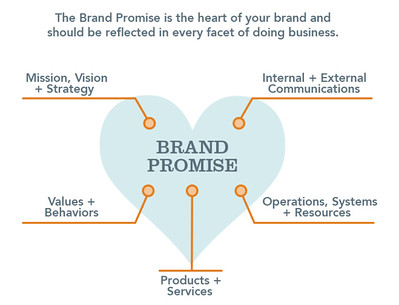
In 2008, I extended this concept to city elected and appointed officials and stakeholders as a community's collective of "brand managers" responsible for the brand promise of a community:

In 2015 I extended this even further, that officials and stakeholders need to see their roles as the managers of a community's assets, and I've been meaning to do this around risk management too, although I have written about that in the context of lawsuits around policing.

Failure as indication of system failures that should be addressed.  For example, Chicago spends many tens of millions of dollars every year in settlements concerning police misconduct. You'd think that elected officials would take that as an indicator of a problem with the police department, and look at the need for management, process, and policing reforms, rather than merely a "cost of doing business."

The "Brand Promise" of a local government should be managed.

Brand Promise
From "Living up to your brand promise," R+M Agency

DC City Council is faced with an equally tough "brand promise" decision over what to do about Councilmemmber Jack Evans, who looks to be guilty of significant ethics violations and misuse of his office to do "consulting work" on the side.

In DC, the Councilmember job is considered part-time, so all but the Council Chairman can have side jobs. Typically the jobs Councilmembers get, outside of teaching, are with companies doing business with the city, and it's what I call "designing conflict in," setting up a structure and process that builds in opportunity for graft, corruption, and the trafficking of confidential information.

The Post has an article, "Most D.C. lawmakers want to boot Jack Evans from committees, but not the council," about how the City Council is torn on what to do: (1) to let the voters decide; (2) to censure him and strip him of all his committee memberships; or (3) to expell him from the Council, which they have the power to do.

From "Brand promise vs. tagline?: what's the difference,," SimpleStrat.

Separately, a recall petition has been filed, although Evans is challenging up to one-third of the signatures, and next year the Ward 2 position is up for reelection anyway, and already six people have filed their intent to run.

But combining the roles of (1) destination managers; (2) brand managers; (3) asset managers; and (4) risk managers, the City Council is all of that for the City of Washington.

They are responsible for communicating the city's values in vision and practice.


I used to get into "arguments" about the brand of Eastern Market, DC's public market, while sitting on the Community Advisory Council for the organization.

The "Inverted Jenny" is probably the most famous stamp printing error for the US Postal Service.

One instance was during the reconstruction of 7th Street SE, we came up with branded manhole covers, and some were received with a typo. For obvious reasons, the manufacturer didn't want them back (too heavy to pay for shipping), and they said we could have them. The decision was made to sell them for fundraising purposes. 

I objected stating that if our brand is valuable, then we should make the hard choice and discard items that have a typo.  Because being error free was more important than making a little bit of money.

I was the only dissenting vote.

Similarly, I would make the argument that each individual business contributes to the collective, the whole of the brand for Eastern Market, and that businesses that don't measure up need to be addressed.  That didn't go over well either.

Manage the brand: Expel Jack Evans.

Jack Evans is one element of the brand of DC City Council.  He is the longest sitting Councilmember.

Councilmembers need to make the tough decision and:

(1) Make Councilmember jobs full-time and banning outside income, with the possible exception of teaching.

(2) Expel Jack Evans.

If the voters want him back, like Adam Clayton Powell, he can run again next year and make his case ("New York voters restore Powell to his congressional seat," Politico).

But the City Council as "brand managers" of the city's brand promise as well as the City Council's brand promise, need to take a stand.

====
I've been doing some research in the Washington Post backfile and came across an article from the 1970s probably about corrupt practices in DC government, and how this doesn't justify statehood, with the response, why should DC be held to a higher standard than existing states.

While I have come around to that position, it doesn't justify not taking a strong stand against corruption and ethics violations.

On that score, DC City Council lags.

Labels: , , , , , , ,

Wednesday, July 17, 2019

Why expertise doesn't matter in politics? | ideology, special interests

Robert Samuelson, the economics columnist for the Washington Post, wrote about the death of "policy entrepreneur" Alice Rivlin as an illustration of the failure of knowledge to drive policy ("America has an enduring cycle of disappointment").

(Separately, there is an op-ed in the New York Times, by principal investigators of a study that looked at whether or not state legislators were interested in systematic polling information about the opinions of their constituents on issues under consideration, "Politicians Don't Actually Care What Voters Want." They found little interest on the part of legislators and limited congruence between the electorate and elected officials.)

Samuelson suggests policy entrepreneurs are failing because:
(1) It may be that the problems they attacked were tougher than expected. Eliminating poverty, combating climate change and controlling health costs are hard tasks individually, let alone together.

(2) Elected politicians, who wielded the real power, found many of these ideas too unpopular. Take climate change. Almost everyone outside the Trump administration (it seems) is against it; but there's little enthusiasm for the actual policies -- higher fossil fuel prices or energy controls -- that might have some effect.

(3) The policy entrepreneurs may have discovered that they aren't as smart as they thought they were. Put differently, they may have exaggerated their understanding of the things they were trying to change.

Whatever the cause or causes, the historical reality is unforgiving. Policy entrepreneurship hasn't and won't disappear. But the hoped-for gains have been conspicuous by their absence. There is an enduring cycle of disappointment. Solutions are rarely equal to problems. It is a sobering legacy.
Yes the problems are hard. Yes ideas are unpopular, sometimes, but that is partly because of poorly dealing with them. And yes, people often have a limited sense of "the problem."

But I think he misses the point.

We've moved from a concept of "positivism" and the development of evidence-based policy and a respect for expertise (although to be fair, for centuries policy and practice has been more about reflecting "positions" on issues, not evidence) to a much more rigid focus on ideology and an ecosystem of special interests -- wealthy funders of organizations and media that support these positions -- that pushes ideologically-based positions regardless of evidence.

Policy and practice should be about achieving "optimality" based on expertise and knowledge. It should also be about "evidence" whenever it can be adequately collected. 

Yes sometimes I feel like the focus on evidence can be misguided even though absolutely, replication in other settings is essential. The issue of "what gets measured gets done" is problematic when you're not measuring the right thing or creating measures is time consuming and difficult. But still, so many programs continue to be developed irrespective of a consideration of past outcomes.

But like with "policy entrepreneurs" maybe not being so smart, a lot of it has to do with problem definition. Like with health care you need to approach the matter in tranches. Health insurance was set up to regularize income for hospitals, not to improve health outcomes. OTOH, the National Health Service in the UK was set up to improve health outcomes.

Separating the provision of health and wellness development, the ability to go to a doctor for simple things as well as for dealing with many diseases that are partially behavior related (heart attack, hypertension, obesity, diabetes, etc.), which are called chronic conditions, requires a different approach (these elements of the health system are called primary care) from how you deal with catastrophic and emergency care needs (cancer, heart attack, accidents, etc.) which are part of the secondary care system.

But by continuing to define "health care" through "health insurance," a fundamental rethinking isn't occurring.

So it is timely that the Center for American Progress has a presentation on Monday, about how this works at the state level.  From email:
Laboratories for Corruption
How Special Interests Are Driving Harmful State Policies


July 22, 2019, 12:00 p.m. - 1:30 p.m. ET

Center for American Progress
1333 H Street NW, 10th Floor
Washington, DC 20005

RSVP

Not in D.C.? Bookmark this link to watch the live webcast

Opening remarks:
Winnie Stachelberg, Executive Vice President, External Affairs

Featured panelists:
State Sen. Dinah Sykes, (D-KS)
Lisa Graves, President, Board of the Center for Media and Democracy; Co-Founder, Documented Investigations
Naomi Walker, Director, Economic Analysis and Research Network at the Economic Policy Institute
Danielle Root, Associate Director of Voting Rights for Democracy and Government, Center for American Progress

Moderator:
Sam Berger, Vice President of Democracy and Government Reform, Center for American Progress

Federalism encourages states to act as "laboratories of democracy," wherein states experiment with untested ideas and policies to gauge their effectiveness and potential value elsewhere. This mantle of states being laboratories for democracy can be used to promote policies that advance the public good. But states can also be used as a testing ground for policies that skew political and economic power toward corporations or billionaires and away from everyday Americans.

Many harmful state policies—such as irresponsible tax cuts, deregulation, and attacks on unions and essential workplace protections—are byproducts of corporate lobbying and conservative special interest groups whose main purpose is to help the rich and powerful exploit and manipulate the lawmaking process.

Please join the Center for American Progress for a discussion on how corporations and special interest groups promote state policies that make corporations and wealthy donors richer, at the public's expense. It will also examine how lawmakers backed by these groups further corrupt democratic processes to maintain power and keep harmful policies in place.

Labels: , , , , , ,

Friday, May 31, 2019

Another example of a failure to do public capital planning in DC: Council votes to stop funding United Medical Center

Yes, cities and counties often have financial problems because of hospitals and providing care to the impoverished.

That's why DC closed DC General Hospital and why Prince George's County has finally successfully off-loaded the Dimensions Health Care system to the University of Maryland Medical System.

Sky View 2
The new UMMS Capital Region Medical Center under construction as of January 2019..

But sometimes, parts of your community can be under-served by other health care actors as a result, and the fact that needs remain means that cities and counties can't be cavalier about closing hospitals when alternative care options aren't present.

-- "A glaring illustration of the need for comprehensive health and wellness planning in DC: Providence Hospital," 2018
-- "Prince George's County's problems as but one more example of the impact of outmigration," 2005
-- "More shenanigans in DC health planning," 2006
-- "Muddled thinking by Steven Pearlstein (Post business columnist," 2006
-- "An indication that there is little respect for planning: Maryland healthcare edition," 2011
-- "When the problem is defects in the structure of "the market", financial incentives won't do much good: Maryland's health enterprise zones," 2013

That's especially true of the part of DC "east of the Anacostia river," where health disparities, because of race and income, are pronounced ("The District's racial and income divide is cutting short the lives of black residents," Washington Post).  From the article:
The District’s latest “health equity” maps shows a city divided by race and income. How well you live, or sometimes whether you live at all, can depend on what side of the line you are on.

On one of the maps, we see that Woodley Park in Northwest Washington is the neighborhood where residents have the longest life expectancy, 89.4 years on average. Residents in the St. Elizabeths neighborhood, in Southeast, have the shortest, 68.2 years.

Woodley Park is wealthy and predominantly white. St Elizabeths is poor and predominantly black. The difference that makes: 21 years of life. “Your zip-code may be more important than your genetic code for health,” says the report that accompanies the maps, which can be found on the D.C. Department of Health website.

The disparities are stark, the consequences appalling. And the cause is no mystery. As the report notes, they are the result of “historical forces that have left a legacy of racism and segregation, as well as structural and institutional factors that perpetuate persistent inequities.”
-- The Social & Structural Determinants of Health, Office of Health Equity, District of Columbia, Department of Health

So I disagree with the Washington Post editorial, "United Medical Center: When will D.C. realize it doesn't belong in the hospital business," in favor of the City Council's original decision to close United Medical Center, which operates "East of the River" in Ward 7 ("United Medical Center will close by 2023," Post).

Note that this decision, was reversed, in later votes, but the appropriation was half of what was requested. This funding gap will accelerate the hospital's decline ("DC Council moves to reduce cuts in funding for struggling hospital," WTOP-radio; "'Spinning its wheels': Lots of money, few bold initiatives in 2020 DC budget," Post).

UMC is the only hospital operating "East of the River."

Note that UMC isn't the only hospital that's had issues.  The university medical school affiliated hospitals (Georgetown, Howard, and GWU) have taken on private partners.  One independent, Sibley, merged into the Johns Hopkins Health System.  Excepting Howard, these hospitals serve high income patients, which is why it was easier for them to land partners.

Providence, is downsizing out of the hospital business, which has impacted Washington Hospital Center, the anchor of the Medlantic system.  Howard University Hospital has had many management and financial issues, but has finally turned the corner in association with a for profit health care management firm ("Howard University Hospital turnaround experts Paladin Healthcare say hospital may make money next year," Washington Business Journal).

In Montgomery County, Holy Cross and Washington Adventist continue to expand and/or relocate to have access to more of MoCo's high income population, although the hospitals fought over WAH's move to a more accessible location deeper into the county, with better proximity to patients from Prince George's and Howard Counties too.

And as mentioned, in Prince George's County, UMMS has taken over Dimensions, and is building a new hospital in Largo, mostly with state support.

Washington Business Journal photo.

UMC provides care in an under-served area of the city.  There have been various initiatives to build a new hospital over the past couple administrations.

But I've argued that the non-public process disserves the city and the needs of the population that the hospital serves.  

And that there is an incredible opportunity to do visionary planning for a new hospital East of the River, complemented by a parallel economic development initiative focused on graduate health education and medical and biotechnological research.

-- "Update on DC's plans to build a new United Medical Center"
-- "Ordinary versus Extraordinary Planning around the rebuilding of the United Medical Center in Southeast Washington DC | Part One: Rearticulating the system of health and wellness care East of the River"
-- "Ordinary versus Extraordinary Planning around the rebuilding of the United Medical Center in Southeast Washington DC | Part Two: Creating a graduate health education and biotechnology research initiative on the St. Elizabeths campus"
-- "Ordinary versus Extraordinary Planning around the rebuilding of the United Medical Center in Southeast Washington DC | Part three: the potential for donations around an expanded program"

Proving my point that lack of public processes creates problems, the proposed fix of building a new hospital affiliated with GWU in return for special privileges for the main GWU hospital in Foggy Bottom, ran into opposition.

And in response, rather than create a new public process and come up with a good solution, or better yet, an innovative-transformational solution, the City Council voted to stop funding the hospital over a four year period and the executive branch issued an RFP with almost zero input from citizens and stakeholders.  

And the likelihood that the city will not get it together enough to plan, fund, and build a hospital in four years means that area will become even more under-served than it is currently.

This points to failures in two areas of planning: both capital planning as I just wrote about but also comprehensive health and wellness planning, an example being that the city lacks a health and wellness master plan.

Community health needs assessments required as part of the ACA.  Plus, I learned when reading about the potential closure of the only hospital in Berkeley, California, that hospitals are supposed to produce "community health needs assessments" as part of the Affordable Care Act ("Questions loom over Sutter Health's community benefit spending," Modern Healthcare). From the web:
The Patient Protection and Affordable Care Act (ACA) added section 501(r) to the Internal Revenue Code which imposes new requirements on 501(c)(3) organizations that operate one or more hospital facilities. Under section 501(r), each hospital facility operated by a 501(c)(3) organization must meet the following four general requirements on a facility-by-facility basis in order for the organization to maintain its 501(c)(3) tax-exempt status:1

- Establish written financial assistance and emergency medical care policies
- Limit amounts charged for emergency or other medically necessary care to individuals eligible for assistance under the hospital's financial assistance policy
- Make reasonable efforts to determine whether an individual is eligible for financial assistance before engaging in extraordinary collection actions
- Conduct a Community Health Needs Assessment and adopt an implementation strategy at least once every three years
(Although I will say the requirements aren't too specific, and the plans I've read are so general as to be practically useless.)

Separately, the City of Berkeley commissioned a study of the impact of the proposed closure of its only hospital:

-- Health Impact Assessment of the Proposed Closure of Alta Bates Medical Center, City of Berkeley
-- "Report: Alta Bates closure would critically impact poor, people of color," East Bay Times
-- "Editorial: Closing hospital may save Sutter money, but cost East Bay dearly," San Francisco Chronicle

According to the study:
The recent Rapid Health Impact Assessment, published by UC Berkeley's Institute of Urban and Regional Development, found that consequences of the hospital closure include:
  • Longer wait times at nearby emergency rooms 
  • Reduced access by the elderly, poor and uninsured  
  • Delays in ambulance transports and potentially increased deaths
Additionally, the study found that closing the community hospital would result in longer wait times at remaining regional emergency rooms, ambulance travel times would be delayed, and emergency responders response time longer.

The study also says among its findings, the "impact on the poor, the uninsured, and people of color who are much more likely to not have a primary care doctor and not seek alternative care" if the hospital closes.
No such assessment likely conducted concerning Providence Hospital.  A comparable assessment should have been produced wrt Providence and the likely impact on Washington Hospital Center.

Washington Business Journal photo.

It's not that Providence shouldn't have been allowed to close, because DC is probably "over-hospitaled".

But Providence's location is less than two miles from Washington Hospital Center, and the part of the city "west of the river" still remains served by five other primary care facilities within the city, plus three facilities in Montgomery County reasonably close to the DC-Maryland line. 

But even so there would be impacts. And these impacts should have been mitigated proactively rather than reactively ("Providence cuts causing ‘dramatic increase’ in MedStar Washington Hospital Center volume," Washington Business Journal).

No such assessment likely conducted concerning United Medical Center. By contrast, east of the river, with the closure of UMC, Howard will be the closest hospital, while others may go to the new hospital in Largo.  And an assessment comparable to that done concerning Alta Bates Medical Center, the only hospital located in Berkeley, California, should have been conducted before the DC City Council decided to stop funding UMC.

What a difference between the editorial page of the Washington Post vs. the San Francisco Chronicle.  The Post focuses on the city's budget and yes, the long term financial negatives of owning a hospital.  The Chronicle focuses on how a large city in its metropolitan area will lose its only hospital and the negative impacts this will have.

What a difference between the City of Berkeley Government and the DC Government.  Berkeley commissioned an impact study of the closure of its only hospital, while without such a study, DC City Council commanded the closure of the city's only hospital east of the river.

Where's the Coalition for Smarter Growth? CSG was very active pushing a Metrorail-centric location for a new hospital in Prince George's County ("Hospital design case studies showcase benefits of urban design and community connections for new Prince George’s Regional Medical Center"). It has been quiescent concerning UMC.

Labels: , , , , , , ,

Tuesday, April 09, 2019

USA Today newspaper and network investigation on special interests writing a significant number of state legislative acts

State Legislatures are notorious for passing legislation putting unfunded mandates on localities and restricting the ability of cities to pass laws.  For example, concerning the environment, smoke free environments, business initiatives, etc.

-- "States Are Blocking Local Regulations, Often at Industry's Behest," New York Times, 2015
-- "Blue Cities Want to Make Their Own Rules. Red States Won't Let Them," New York times, 2017

It's not news that the American Legislative Exchange Council, a pro-business and anti-tax lobby figured out that they could have a lot of impact by focusing on state legislatures.

What is news is the depth of their success, as documented by USA Today in a two-year investigation that includes follow up, state-specific articles published in various Gannett Newspapers across the country.

From "What is ALEC? 'The most effective organization' for conservatives, says Newt Gingrich":
The American Legislative Exchange Council became the nation’s best-known "model"-bill factory over its four decades by providing more than fill-in-the-blank legislation.

The industry-sponsored group has weathered controversy and flourished because it also offers conservative Republican elected officials a social network, access to campaign donors and a blueprint for how to accelerate their political careers.

The networking takes place at ALEC's annual meetings, where the group fetes and entertains lawmakers and their families. Relationships are forged over drinks and dinners, where lawmakers sit alongside conservative luminaries and corporate chiefs.

“What ALEC does is more than provide the model bills, they provide relationships,” said Alexander Hertel-Fernandez, an assistant professor at Columbia University who has studied the influence of ALEC and other conservative groups on state legislatures. “They approach you when you are first elected and build these enduring social connections with you.”

By the end of each ALEC conference, attendees leave motivated to evangelize for conservative policies and equipped with ready-made legislation.
-- "Copy, Paste, Legislate: A visual introduction"--
-- "Used car dealers didn’t want to fix deadly defects, so they wrote a law to avoid it"
-- "Stand your ground, right to work and bathroom bills: 5 model bills that spark controversy"
-- "How we uncovered 10,000 times lawmakers introduced copycat model bills — and why it matters"
-- "What's the solution for model bills? Reveal who wrote them, critics say"

And coverage by other newspapers in the Gannett Newspaper chain includes:

-- "Bills banning local plastic bag regulations use ALEC model," Montgomery Advertiser
-- "Model bills have foothold in Montana Legislature," Great Falls Tribune
-- "Kentucky lawmakers didn't write these bills. But many are now laws," Louisville Courier-Journal
-- "Mississippi leads nation in filing legislation that other people wrote," Jackson Clarion Ledger
-- "Why some Iowa legislation looks a lot like bills crafted by special interest groups," Des Moines Register

For all the complaints about USA Today's origins as "McPaper" ("At 25, 'McPaper' Is All Grown Up," New York Times), these days, like the New York Times, it uses its position as a "national newspaper" to undertake investigations that have implications beyond a particular city or state.

Apparently, the investigation grew out of reporting over the years by the Phoenix-based Arizona Republic concerning the impact of measures of and involvement by ALEC in the state legislature ("Unchaining Democracy in Arizona," Blog for Arizona).

Labels: , , , ,

Sunday, January 06, 2019

What California Governor Jerry Brown has learned

The San Francisco Chronicle conducted a long interview with Gov. Brown at the end of his second stint as Governor, which was leavened after his serving two terms as Mayor of Oakland, California and one as State Attorney General.

Some great points:

1. Some problems can't be solved.  But he said focusing on some issues dear to the Democratic left, such as making housing more affordable and narrowing wealth inequality, would have been a waste of his time and political capital.

“Now, you can always find people who talk about the cost of housing, the gap between the rich and the poor, but this is true in Sydney, Australia. It’s true in London, it’s true all over the world,” Brown said. “Those are challenges people ought to address, but I’d say just looking back at the time I was there, either these things were not as salient as the problems I dealt with, or they weren’t as high a priority as the ones I dealt with.”

It’s always a matter of picking and choosing, of deciding both what needs to be done and what can be done with a governor’s limited resources of time, money and clout, Brown said. And those choices are always going to leave someone upset.

“Not only can’t you make them all happy, but you can’t solve all problems — otherwise, you’d be dead,” Brown said. “As long as you’re alive, you’ve got new issues for tomorrow and next week and next year.”


2. Protesting to preserve privileges.  But eight years as mayor of Oakland starting in 1999 tempered many of those early views. They also showed him how politics worked at the ground level, which shaped many of his views as governor.

“In Oakland, I would see people show up at City Council and protest almost any project, even relatively low height limits that they thought affected the character of the neighborhood,” Brown said. “So, great resistance to change, usually argued in terms of grand environmental or quality-of-life issues that I thought were patently misguided, ill-founded and distorted.”


3. Not all problems deserve to be addressed by laws. In 2011, the governor shocked legislators, including many of his fellow Democrats, when he vetoed a bill that would have required helmets for skiers and snowboarders under 18.

The Legislature was usurping the role of parents, he said in his veto message, adding, “Not every human problem deserves a law.”


4. Legislatures don't solve problems, they write and pass legislation.  Attempting to change that legislative culture wasn’t one of his most successful efforts, Brown admitted.

“The Legislature exists, in their minds, to produce more laws,” he said. “They don’t exist to solve problems, they exist to make laws. Now, they’d like to solve some problems along the way, but the essential functioning of a legislature is lawmaking.” ...

Brown didn’t excuse himself from abetting the wave of legislation, admitting that he often signed bills while shaking his head.

“We have more lawmaking than in any time in human history,” the governor said. “Many of the laws are stupid. Many of them are not warranted. But in order to get along with the Legislature, you’ve got to sign bills that aren’t needed. And you even have to sign bills that you’d prefer not even to have.”

=======
As much as I criticize community development organizations, one of the things Gov. Brown did that hurt revitalization was the elimination of local redevelopment corporations. He did this because they were financed through tax increment financing processes, which diverted revenue from the state, not just other local government entities like schools, and this was at the peak of the Great Financial Crisis, when the State government faced massive revenue shortfalls.

-- "Jerry Brown calls redevelopment agencies futile," SF Chronicle
-- "California bill would bring back redevelopment agencies," San Jose Mercury News

Labels: , , ,

Friday, September 14, 2018

Should small city economic development over minor league baseball and other sports be treated differently from big city cases?

Potomac Nationals move to Fredericksburg.  In the DC region, the Potomac Nationals minor league baseball team affiliated with the Washington Nationals will be moving from Prince William County to Fredericksburg, Virginia, because the team owner couldn't get a deal with the local government and the team had been served notice by its league that it had to develop a new stadium by a certain date ("Fredericksburg approves Potomac Nationals new stadium, Washington Business Journal").

Pawtucket Sox move to Worcester.  Separately, the Pawtucket Sox, affiliated with the Boston Red Sox, after many years of trying to develop a new stadium, in part with state subsidies and loan guarantees, decided to move to Worcester, Massachusetts, because of the inability to get a bill through the Rhode Island State Legislature.  (Technically a bill was passed, but with a provision that made the law a deal killer.)

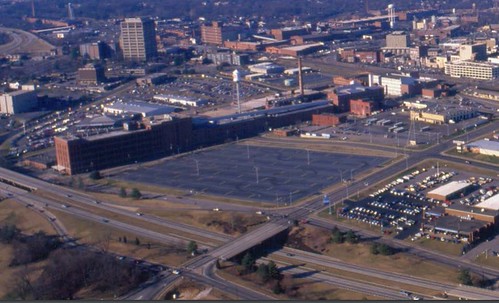
The Diamond, Richmond.  Wikipedia photo.  Compared to Greensboro, the current stadium location is not in the core ofthe city but more on the outskirts.

Richmond's tried for years to build a new minor league baseball stadium.  Richmond, Virginia has been going back and forth for years about building a new minor league baseball stadium too   ("A new baseball stadium is striking out in Richmond," Washington Post; "Editorial: Can big, beautiful RVA arena lead to a new park for the Flying Squirrels?," Richmond times-Dispatch). Among other things, delays led to a loss of one team affiliated with the Atlanta Braves and a gap without a team, before landing a new one.

One of the problems is the complicated political structure in Virginia.  As a city, Richmond is disconnected from counties, and the Richmond Metropolitan Authority funds cross-jurisdictional infrastructure, but it's difficult to get the counties to agree to pay towards a facility wholly within Richmond.

Louisville.  Louisville has a minor league stadium on the waterfront, and it was a key element of the downtown revitalization program there ("Waking Up Louisville's Downtown," New York Times; "A closer look at the ACC baseball tournament – is it really a 'multimillion-dollar gift' to Louisville?," Louisville Courier-Journal).

Fluor Park at the West End, Greenville, SC.  Wikipedia photo.

Greenville, SC.  Greenville is a small city revitalization success story ("Liberty Bridge, Falls Park transformed downtown," Greenville News, "Opening the Gate to a Vibrant Main Street in Greenville, S.C.," New York Times).

It took a few planning iterations before elected officials and stakeholders accepted the idea put forth by planning consultants that instead of hiding a waterfall placed downtown, they should show it off, which they did by removing a road bridge that obscured it.

Once they did, in 2004, the downtown became a destination, and the city continues to build on and extend that success with other elements, including the West End Field minor league baseball park located downtown, which opened in 2006.

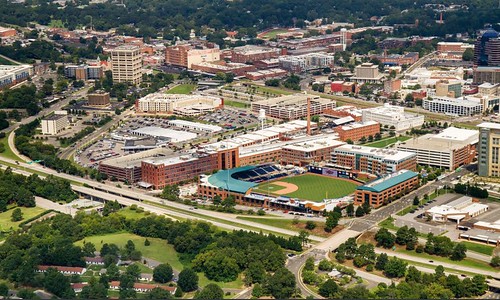
Note how the minor league baseball stadium in Greensboro is embedded in the center of the city. How cool is that?

Greensboro, NC.  What really got me to thinking about this was a few years ago, in an interview with an economic development official in Greensboro, NC (for pieces related to colleges as economic drivers, they do some amazing stuff in Greensboro), we argued for a moment about how his foundation provided $25 million towards a minor league stadium ("How other cities have funded baseball stadiums," Wilmington Star News; "Ballpark money from Bryan fund?," Greensboro - Triad Business Journal).

In retrospect, I think the Bryan Foundation was right and I was wrong ("How other cities have funded baseball stadiums," Wilmington Star-News).

Are minor league stadium matters worthy of deeper academic study?  But since, I've wondered if I was too doctrinaire.  That perhaps community considerations need to be outlined and weighed differently than how I look at it for big cities (see my big city sports facility evaluative framework here).  Just as I argue for a more nuanced look at the issues for cities--all the while angling for the best deal for the community as opposed to the team owner--the same goes for small cities.

When so many smaller communities are "hollowing out," minor league baseball as well as college sports and other events can be important community anchors.  And I remember how a minor league stadium project in Memphis won an award from the Congress for New Urbanism back in 2002, partly because it anchored a new ballpark district, with additional mixed use development.

I think the issue of minor league stadiums in smaller cities is worthy of a separate vein of academic research, separate from that on the impact of professional sports teams in large metropolitan areas, which comprises a majority of the studies in the field.  Note that this is different from spring training sites too.  (In the DC area, there are also minor league teams in Bowie, Frederick, Hagerstown, and Waldorf, Maryland, as well as teams elsewhere in Virginia and Maryland.  The main minor league team for the Washington Nationals is in Harrisburg, Pennsylvania, which is within driving distance.)

Note that isn't just for baseball. Also for soccer ("Louisville City FC stadium isn't only Butchertown project," Louisville Courier-Journal"), and college facilities--Baylor's football stadium used local funds and maybe some of the money for the University of Washington football stadium in Seattle too.

And I also remember issues concerning minor league baseball in Brooklyn and Staten Island, where there are active teams in facilities partly funded by the city and state.  So it can be a bigger city issue also, but usually with special considerations.  Outside of NYC, I don't know of examples of minor league teams also located in the same city alongside major league teams.

Pawtucket.  The Providence Journal has been covering the Pawtucket stadium proposal for years, and in the face of the loss of the team, published an analysis, "How Rhode Island lost the PawSox."

It's a great, thorough piece and it discloses something that I didn't know, that because of problems with previous stadium proposals as well as the loss of millions of dollars of public money on former Red Sox pitcher Curt Schilling's failed video game venture, Senator William Conley, chair of the Senate Finance Committee, decided to hold hearings around the state, the lengthening the process, but to truly gauge citizen sentiment on whether or not to support public funding.

Such a hearing process is almost unprecedented and a real statement of leadership.

At the hearings, 70% were in favor, and in terms of online submitted comments, 60% were in favor.  Conley moved the project forward in the Senate, but key officials in the State House balked, and the project sputtered, leading the team to decamp.

Probably the hearings run by the Senate should have been held jointly with the State House, thereby developing consensus across the Legislature.

According to the article, while Senate participants in the process believed their concerns were addressed and the project had statewide support, House members did not, and because they hadn't run a thorough public process of their own, they believed that a majority of their constituents were opposed.

Interestingly, during the public process a number of interesting proposals were raised, and some were incorporated into the final legislation, such as:
... steering half the annual naming rights, $250,000, to Pawtucket to help keep up with the city’s share of bond payments. The bill also added an assessment on premium tickets for the same reason. And DiPalma liked the team’s added pledge to build 50,000 square feet of commercial development near the park.
Plus, the original deal negotiated by the Governor and the Mayor of Pawtucket got the team up to providing 54% of the cost of the stadium + any overruns, which according to Senator Conley, was significantly higher than was typical for other minor league stadium deals.

With the disagreements among elected officials and a reticence to advocate for it, especially when political opponents criticized support, the legislation wasn't moving in Rhode Island.

Not unlike how I argue that Bilbao was prepared and seized the opportunity, "pouncing" on the Guggenheim when the Austrian city that they approached first backed out ("Why can't the Bilbao Effect be reproduced?"), during the process Worcester approached the team's ownership with a proposal and relatively speaking, unanimous support. From the article:
When the Worcester City Council voted in December of 2016 for Ed Augustus to try to lure the PawSox, he was sure there was no chance.

But as city manager, he was Worcester’s CEO, and his “board” had just given him a mission.

So Augustus chatted about it with Joe Petty, the part-time mayor, and the two were soon wondering if it was worth the time. “Long shot” was an understatement.

“Well,” said the mayor, “give it your best.”
Postcard produced by the Worcester Canal District Association promoting support for moving the Pawtucket team to a new minor league stadium in Worcester.

Once Pawtucket's period of contract exclusivity ran out, Worcester moved forward.  As did many other communities.

But in Worcester, residents favored a stadium as a way to utilize 18 acres of land that was vacant and an eyesore and even developed a postcard campaign to communicate their support ("PawSox move to Worcester started with Gene Zabinski's postcard," Worcester Telegram).

And in the face of the death of the Rhode Island deal, Worcester eventually succeeded ("Worcester and PawSox sign letter of intent to build $90M stadium," Worcester Business Journal), in part because they started more than one year before all the other cities that contacted the team after it was clear that Rhode Island wouldn't provide bond loan guarantees.

=====
One element of the proposed Pawtucket deal needs to be adopted by other communities, charging a higher tax on premium tickets, suites, etc.

Downtown Durham, NC before the addition of a minor league baseball stadium

Downtown Durham, NC after the addition of a minor league baseball stadium

Labels: , , , ,

Tuesday, September 17, 2013

The Living Wage Bill and the 2014 DC elections

It's been reported locally and nationally--especially in the business press---that Mayor Gray vetoed the Large Retailer Accountability Act legislation.  The major provision in the bill was to impose a "minimum wage (including benefits) of $12.50 per hour on stores that have at least $1 billion of sales in the US, and are 75,000 s.f. or larger.

This was seen as a bill specifically directed at Walmart, because the bill has an exclusion for unionized employees, which would end up exempting chain supermarkets like Safeway or Giant.

I wasn't in favor of the bill, not because I think that retailers should be able to pay their employees poorly, but because I think that DC needs to have a much better set of regulations in place for the land use review of big box store projects, to ensure that the projects are well integrated into the urban fabric and to mitigate possible negative effects.  See "Lessons from Walmart's foray," "Walmart: in the city, vs. of the city" and "DC's proposed legislation on large retailers is misguided."

But that wasn't the bill that the Council passed.

I probably am in support of the bill, as a recognition that minimum wages should be higher, and that with the hollowing out of the middle ground in available jobs, "Walmart" or "McDonald's" jobs (fast food workers have been "striking"--they don't have unions--for better pay over the summer, see "Fast-food workers strike for higher pay" from USA Today) are no longer entry jobs, a rung in the ladder of "moving on up" job-wise, they are permanent, especially for less well educated employees.

Just as cities and corporations are going bankrupt because of material changes in how local economies work as a result of the US being connected within a global economy, the world of work is in the process of changing as well.

Living Wage bills are on the agenda of more and more cities.  It's an issue in the Seattle election right now as well ("Seattle mayor wants to block Whole Foods because of its low wages" from Grist Magazine and "Can city stop Whole Foods over pay? Lawyers differ" from KOMO News) and it's even on the ballot in the Puget Sound community of SeaTac ("Appeals court says SeaTac voters can decide on $15 minimum wage" from the Seattle Times).

When travelling abroad, compared to the US, I am always struck by how much more expensive food costs in supermarkets and at restaurants.

It's because employees are paid a living wage (+ taxes are higher on businesses, which pays for national health programs).  In the US, our low food prices come at the expense of labor.

Going forward that may be changing.

The impact on the DC elections.  Mayor Gray will make the case that he vetoed the bill to prevent Walmart from leaving the city, and two of the stores that they propose to build are in lesser served areas of the city (plans for a sixth store fell through more recently, see "For what it's worth"), and they will be large employers.

004Call out quote from the Black Commentator article "Cover Story: A 'Movement' Against Wal-Mart."
 
I have written before that Walmart, typically, treats employees pretty badly ("Piling on City Council") and so it is an issue of "is any job better than nothing?"

As a city, as a community, we should be concerned about the businesses we attract and actively recruit to the city and in turn, the kind of environment and opportunities that these businesses provide to their employees.

Regardless, I think this will be a big election issue in the Mayoral campaign.  I think Gray's veto means that he has already decided that he won't run for re-election.

But, I could be wrong.  Maybe he will run again.  But it's going to be hard for him to not be implicated in election fraud around his successful primary win in 2010.  So maybe that is an influence too.

And he thinks that Walmart is the right choice to define his Mayoralty, for his legacy.

Labels: , , , , , , ,

Sunday, February 17, 2013

Criminalizing truancy versus focused programs to address truant behavior

1.  Anomie, disconnection, poverty, familial dysfunction, etc. is the root of chronic truancy.

2.  Criminalizing the parents of truants, which is the sole focus of the proposed legislation in DC by Councilman Catania ("Under Catania bill, parents could be charged if teen child misses too many school days" from the Post) fails to address the problem of truancy, it just criminalizes the parents.

3.  But charging and convicting dysfunctional parents with a crime doesn't make the parents more functional and better able to take care of their children.

4.  A different and better response would be to develop an enrichment program focused on chronic truants--both the children not going to school and their families.

Today's Chicago Sun-Times has an interesting story, "Program for troubled youths gets presidential visit — and new academic component," about an after-school program focused on troubled youth in Chicago. The program was first oriented to sports and athletics, and while criminal activity by the youth decreased significantly, their academics didn't improve. So they added math tutoring to the program, and their scholastic performance increased quite a bit.

From the article:

Last year, the University of Chicago Crime Lab announced violent-crime arrest rates fell 44 percent among about 800 students who participated in a program called “Becoming a Man — Sports Edition.” ...

While researchers were impressed with the results of the BAM program in the 2009-10 and 2010-11 school years, “we were not turning the F student into a C student or a B student,” said Roseanna Ander, executive director of the University of Chicago Crime Lab.

With funding from the MacArthur Foundation and the Justice Department, the University of Chicago Crime Lab decided to see whether combining math tutoring with the BAM program would spark academic improvements in the students. ...

Twenty-two of them participated in the combination of tutoring and BAM. They saw bigger gains in their grade-point averages, lower absenteeism and fewer course failures than their 32 counterparts who participated only in BAM, Ander said.

Meanwhile, the BAM-only students improved tremendously compared to a control group of at-risk students who weren’t in the program at all. ... “When they’re in an environment with their peers, it’s hard to focus,” said John Wolf of the crime lab. “Put them in an environment that fosters their learning and they want to learn.”

People don't go to school because "they don't like school."

Likely, they don't like school because they're not good at it.

Likely they're not good at reading (and writing) and math, so of course they don't like school.

Criminalizing their dislike doesn't make it go away.  Addressing their ability to read, write, and do arithmetic, combined with other initiatives will combat truancy far more successfully.

A program like the one in Chicago is a good model for a better response.

Labels: , , , ,

Sunday, June 24, 2012

"States rights", block grants, and community development and transportation

The reason that you need federal policies, rules, and regulations for how transportation or community development monies are to be used at the local level is because states, depending on their needs and agendas, may decide to spend the money on something else.

With regard to transportation, upwards of 15% of all trips nationally are made by walking or biking.  While the national percentage of transit trips is low, about 5%, in center cities this percentage can be much higher--in DC, the number is between 30% and 40%, while in New York City the number is even higher.

So you can argue that transportation monies should be spent, depending on the state, upwards of 15% to 30% on walking, biking, and transit.

Of course that's not how it is, most of the money is spent on roads.  Nationally, 1.5% of transportation funds are spent on walking and biking infrastructure (called the "Community Transportation Enhancement Program").

So biking and walking advocates are seriously concerned about provions in the proposed re-authorization of the federal transportation bill to strip out basic requirements to spend a certain percentage of federal transportation monies allocated to the states on walking and biking.  See "House Transportation Negotiators: Cut Funds for Biking and Walking, Then We’ll Talk" from Daily Kos.

Similarly, transit advocates--supported even by Republican lawmakers from transit cities--are fighting reductions in funding for transit infrastructure.  See "House raid on gas-tax fund would devastate mass transit on Staten Island" from the Staten Island Advance.

Anyway, the example of why states should not be given leeway on walking, biking, and transit funding that they claim that they will use responsibility comes to us from Louisiana, where Republican superstar Governor Bobby Jindal has redirected federal funds provided to the State of Louisiana for mitigating the destruction of property and economic activity as a result of Hurricane Katrina, to the funding of 1/2 of one years worth of pre-K education throughout the state. See the Associated Press story "Hurricane recovery money to fund pre-kindergarten."

Of course, this is an example of the misuse of funds for local economic and community development matters too, and an illustration of why funds appropriated to "community development" often don't have the impact that people expected.

(Also see "County officials fight to keep transit funds loophole" from the Ventura County (CA) Star.  In California, counties over 500,000 in population receive a portion of sales taxes that are supposed to be used to fund local transit services.  Ventura County got an exemption, and so they don't spend the money on transit, but on roads.  Since local redevelopment agencies have been dissolved, and these agencies had paid for a wide variety of local government positions and services, the County wants to maintain their authority to use this money for non-transit services.)
 

Labels: , , , , , , , ,

Thursday, March 29, 2012

Bad Montgomery County policy/law initiative #2: exempting Lockheed Martin's conference center from hotel taxes


Two hotels in Montgomery County, Maryland: the Hyatt Regency Bethesda and the Lockheed Martin Center for Leadership Excellence.

Montgomery County Executive Ike Leggett wants to exempt Lockheed Martin's private conference center from hotel taxes. He argues that it's a private conference center not a hotel open to the public, so it should be exempt. This is seen as an incentive for the company, to help retain their business in the County. See "MontCo executive offers Lockheed Martin $900000 tax break" from the Washington Examiner.

There are two ways to look at this issue:

1. The provision of training and the lodging associated with it.
2. When lodging is provided as part of a public accommodation or a semi-non-public one.

In short, what should be exempt, the activity (a hotel stay) or the way the activity is served (via a private conference center vs. a hotel)?

Plenty of organizations in Montgomery County hold conferences and trainings which require some people to travel to the county and stay in hotels during their stay here.

The only difference between someone going to training at Lockheed Martin is that they stay in a private facility.

Should the activity--all people coming to Montgomery County for training and staying in hotels-- be exempt from hotel taxes during their stay?

If so, then the Lockheed Martin facility should be exempt. But then so should every training-related stay in every hotel.

If the activity is determined to not be exempt from taxation, then the issue becomes what type of facilities should be exempt and what ones shouldn't.

The Lockheed Martin facility is a hotel, with a profit making purpose, just a hotel not open to the general public--but still open, by invitation only, to people not directly employed by the organization--then stays in the facility should be subject to the hotel tax.

End of story.

Labels: , ,

Bad Montgomery County policy/law initiative #1: removing density bonuses for building around MARC train stations

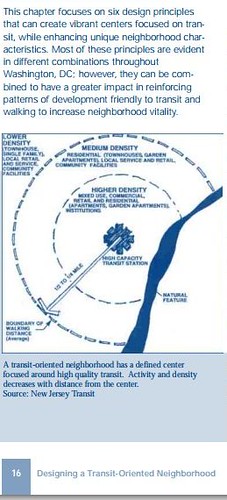
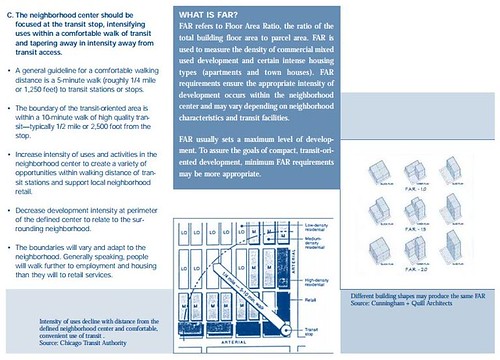
page 17, neighborhood centers
from the out-of-print DC Office of Planning publication, Trans-Formation: Recreating Transit-Oriented Neighborhood Centers in Washington, DC | A Design Handbook for Neighborhood Residents.

While I didn't get quoted in the WBJ article, "Transit-oriented development? Not at MARC stations, bill says," on this subject, I aver my points were far better than what ran in the story, although they needed some polishing, and they were just from email, but we didn't get a chance to talk because I was traveling. (Also see "Growth-limit bills reflect regrets in Montgomery" from the Gazette.)

This was the question:

A pair of Montgomery County council members have introduced legislation that would remove the density bonus points a developer receives if it builds within a mile of a MARC station in a Commercial-Residential Zone. The argument is, the point of transit-proximity benefits is trip reduction, and MARC barely registers as a trip reducer compared to Metro. The legislation emerged from discussion of the Kensington Sector Plan, which has MARC but no Metro, and is in line to be a CR Zone.

Here was my response (now augmented):

In the short run, Councilmembers Leventhal and Elrich are absolutely right.

In fact I have made this point a lot wrt Maryland's plans and promotion for TOD and MARC stations specifically, that they oversell the value of their various railroad stations as TOD, in "What the State of Maryland still doesn't get about smart growth" and Planning for intensity of land use: the question is at what scale are we planning?"

Note the talk about Halethorpe station in the latter entry, which notes that while the station is high use, few of the riders are local, most use the station because of its proximity to the Baltimore Beltway.

With some exceptions like those serving Ft. Meade or New Carrollton or Penn Station, West Baltimore, etc., for the most part the stations are in distant locations, reflecting the very old railroad and traditional "Anglo-American" suburbs commuting station patterns of development (like Philadelphia's Main Line).

HOWEVER, if we think that way, we are dealing with the wrong scale and time frame.

The real question is what if the stations were in fact key elements of active places? WHAT if the MARC Growth and Investment Plan comes to fruition, with maybe not 24/7 service but 18/7 service--including weekends, which aren't served now?

If those are the right questions, then the right answers have to do with how to create the right environment to support 18/7 service on the MARC railroad lines and reposition the service away from an almost exclusively daytime commuter service to and from Washington (and Baltimore), but more like how railroad service in cities like Greater New York, London, Philadelphia, and Paris is but another transportation mode, complementing more local transit service.

MARC will never have the right environment to justify 7 day service not just focused on commuters to DC and Baltimore as called for in the Growth and Investment Plan as long as the majority of stations are little outposts in distant locations--the kind of stations they are today--with limited development around the station.
Brenda Klaunberg, advocating for the train
"We don't need fancy things," says Brenda Klaunberg, a 44-year-old veterinarian who commutes on the MARC Camden line to the National Institutes of Health in Bethesda. "We just want to get on and off." (Baltimore Sun photo by Amy Davis) Dec 21, 2005.

For what it's worth, my ideas on the mobilityshed, transit shed, and "metropolitan mass transit planning," were generated in part wrt the plans under former Governor Ehrlich to close a bunch of MARC stations, and the spirited reaction which successfully warded off closure, even though collectively fewer than 100 people use(d) the targeted stations on a daily basis.

One of the points people made was that station use was limited because there wasn't enough, opining that lack of parking prevented higher use of these low use stations--they're right, there isn't much parking--but the real issue is the fact that the railroad network service pattern as it is today doesn't go to places where people in those distant places are likely to go.

So while I think that Councilmembers Leventhal and Elrich are right in the very short run, the issue is that they are thinking on the wrong time frames--they need to be thinking for the next 3-4 decades, not this one.

If elected officials aren't the ones pushing the right vision for the future than we are in really really really really really bad shape.

Note that the blog entry from the other day, "Transit oriented development can take decades to realize, so two years is too short of a time to be expecting it (Austin Texas)," is another illustration of how development at transit stations need to be considered over very long time frames. In my comments on that piece, I used the now underway "Monroe Market" development in Brookland as another example of how long it takes projects to be created--that one will open about 35 years after the station opened.

-----
Note that the basic ideas aren't different from how trolley/streetcar suburbs were developed in the 1800s and early 1900s, it's just that the scale of development needs to be more intensive now, because sprawl has deconcentrated metropolitan areas so much.

See the discussion of streetcar suburbs from Wikipedia, and the out-of-print DC Office of Planning publication, Trans-Formation: Recreating Transit-Oriented Neighborhood Centers in Washington, DC | A Design Handbook for Neighborhood Residents.
page 18, neighborhood centers
Page 18, Trans-Formation: Recreating Transit-Oriented Neighborhood Centers in Washington, DC | A Design Handbook for Neighborhood Residents.

Labels: , , , , ,

Tuesday, March 20, 2012

Disabled parking policy: yet another example of how not having a master transportation plan means that DC's transportation "policy" is crazy stupid

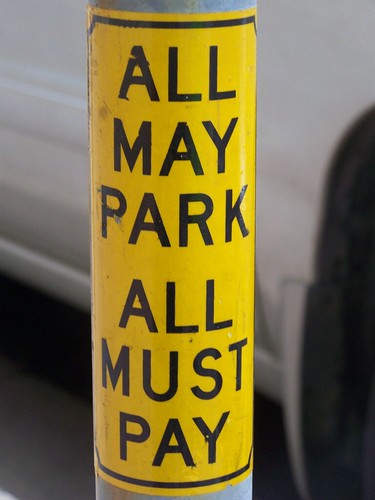
All may Park All Must Pay (Rosslyn)
Decal on a parking meter stanchion in Rosslyn, Arlington County.

From Parking Today Magazine:

If you give something for free, particularly something of rather great value, you can rest assured that there will be those that take advantage. My question is, as has been raised on these pages numerous times in the past, why do we give free parking to handicapped persons? Immediately we have created a black market in handicapped permits. Policing the process is difficult, if not impossible. And spaces that are needed for handicapped persons are filled by nincompoops who don’t need the service. The Handicapped tell me that they want access, not charity.

Recently, the DC Department of Transportation introduced a special "red top" parking meter program to better control parking for the disabled ("D.C. to install more red top meters for disabled people" from the Post).

But the spirited reaction to the loss of privilege--parking anywhere for free--means that the DC City Council is stepping in to rescind the program ("DC Council to consider halting new ‘red-top’ parking meter program for disabled drivers" from the Post).

Parking policies should be set by a transportation master plan, not by whim, and/or in response to the complaints of a few, especially over loss of privilege. (This is my major complaint about so called "performance parking programs" across the city, how we deal with church parking on Sundays--I actually don't have a problem with it, but it should be managed carefully, with proposals for free parking for funerals, with the relatively miniscule price for residential parking permits, etc.)

"Traditionally" disabled motor vehicle users have either been allowed to (1) park for free; (2) without restriction in terms of length of time parked; and/or (3) for an extended period of time.

Across the country, including DC, rampant abuse of disabled parking privileges has been uncovered. For example, the Los Angeles Times has run a series of articles about investigations in handicapped parking permit abuse there, starting with this article from 2011, "Placards can bring a curbside surprise: State DMV cracks down on fraudulent use of disabled parking passes. It's touched a nerve."

From the article:

Fraudulent use of disabled parking placards -- those blue or red badges that allow motorists to park for free or in specially reserved spaces -- has exploded in the last decade, according to state motor vehicle officials. With 1 in 10 California drivers now legally registered to carry the passes, transportation experts say abuse has become commonplace. At any given moment, on any given street, more than a third of the vehicles displaying the tags -- and parking without paying -- are doing so illegally, say officials with the California Department of Motor Vehicles.

More recent articles have involved Steve Lopez, one of the
LA Times' leading columnists, going around with parking enforcement personnel targeting placard abuse. See "It's time for a crackdown on abusers of disabled placards," "A peculiar pattern," and "Cracking down on parking meter cheaters: They use disabled-driver placards that they don't deserve. But thanks to the LAPD and DOT, some of them get the hefty fines they really do deserve."

As Lopez points out, there are so many cheaters that they prevent legitimate handicapped parking permit holders from using handicapped parking.

Where is the outrage over the abuse? The Chicago Sun-Times has reported on similar problems in Chicago. Links to 7 stories on the subject are available within this story.

Chicago Sun-Times video story on illegal use of handicapped parking permits.

So there are two issues. One is massive abuse of the privilege. The other is the revenue loss from providing free parking. (The City of Chicago has been presented with a bill by the parking meter concessionaire of more than $13 million for the cost of providing free handicapped parking, and that's after a credit of more than $5 million. See "Meter company sends city $13.5 million bill for disabled parking from the Chicago Sun-Times.)

More jurisdictions are requiring that disabled patrons pay for parking, even if they are still provided with priority locations and longer periods to park than what would normally be provided.


By providing a framework and goals focused on effective transportation policy and throughput, a master transportation plan is essential in creating an environment where transportation policy is based on robust practice and achievement of goals, rather than more like a taffy pull focused on ameliorating complaints from various interests asked to pay their way.

The Arlington County Master Transportation Plan, specifically the Parking and Curb Space Management Element, is a model for how transportation planning should be done, and demonstrates just how much the DC way of no planning and Council legislative privilege creates a failed environment for intelligent transportation policies and regulations in the city.

From the Element:

Policy 1. Prioritize the use of curb space, matching the various types of uses to the most appropriate locations. In commercial areas and high‐density residential areas, generally consider bus stops, curb nubs, taxi stands, paratransit pickup, short‐term retail and handicapped parking to be the highest priority.

Curb space is owned by the community, and must be managed for the greatest public benefit. Priorities for curb space management are not uniform across the County and will depend on the County’s Land Use Plan and proximate land uses and transportation options. Major transportation nodes such as Metrorail stations or major bus stops (Super Stops, BRT stops and street car stations) are primary organizing factors for curb space. Secondary factors include activity centers (major hotels, shopping centers, and high‐rise residential and commercial buildings) and other nodes of the primary transit network (PTN). However, all of these uses must respect the pedestrian experience. The placement of these elements should be carefully considered to avoid negatively impacting pedestrians and other amenities that help create a high quality urban environment. Appendix A includes three tables that show a hierarchy of curb space uses for High‐Density and Commercial Districts, Medium Density Districts and Low‐Density Districts. ...

Policy 13: Provide travel options for persons with disabilities through reserved access to curb space and dedicated off‐street parking, with enforcement.

Reserved parking for people with disabilities ensures safe and equal access to goods and services. Mobility impaired persons with limited mobility require parking spaces in close proximity to their destinations and therefore should be allotted the parking spaces closest to primary building entrances. ...

At this time no ADA‐standards exist that define what accommodations should be made for accessible on‐street parking spaces. Absent national standards the County utilizes best practices when providing disabled‐reserved on‐street spaces. ...

In 1998, the County, after close coordination with representatives from the disabled community, adopted a policy that ended free use of parking meters by persons with handicapped parking permits. The change removed the chief incentive for fraudulent use of such spaces. In addition, the number of reserved meter handicapped spaces was tripled and the allowable time on those meters was increased to twice the standard time.

-----

It's not surprising that DC is 14 years behind Arlington County with regard to addressing the same issues, DC doesn't have a robust, comprehensive transportation plan.

It could be though that City Council likes it this way, because that means that they can pander to various interests when it suits their needs, especially when it comes to parking, which I liken to the "third rail" of local politics (traditionally social security and medicare make up the "third rail" of national politics).

But still, it's very frustrating, when a better way of doing things is so obvious, and yet despite the obvious, DC prefers to go its capricious, under-planned way.

Labels: , , , , ,