Rebuilding Place in the Urban Space

"A community’s physical form, rather than its land uses, is its most intrinsic and enduring characteristic." [Katz, EPA] This blog focuses on place and placemaking and all that makes it work--historic preservation, urban design, transportation, asset-based community development, arts & cultural development, commercial district revitalization, tourism & destination development, and quality of life advocacy--along with doses of civic engagement and good governance watchdogging.

Friday, February 06, 2026

Neighborhood councils and civic engagement: snow removal as a community building activity

DC has what are called Advisory Neighborhood Commissions, which are grassroots community organizations empowered with the authority to "weigh in" on matters before DC government agencies, such as zoning, planning approvals etc.

Most of them don't work that well because not much is invested in them by the city government in terms of training and technical assistance.  Although some do well because they organize as committees and allow non-elected residents to participate as full members of the committees, expanding the human capital available to the Commission.

Past writings:

-- "National Community Planning Month | Civic Involvement," 2025

-- "DC's Advisory Neighborhood Commissions," (2012)
-- "(Even more on) ANCs (Advisory Neighborhood Commissions in DC)," (2010)
-- "Setting up DC's Advisory Neighborhood Commissions for success," (2022) (lots of links within)
-- ""Networked solutions" for some problems with ANCs in DC," (2011)
-- "Dumb... to fix bad practices, make them democratic instead of just eliminating them," (2012) (also discusses participatory budgeting)

-- "Building civic engagement systematically: Seattle's Department of Neighborhoods," (2022)
-- "Framingham Massachusetts creates Citizen Participation Officer position" (2018)
-- "Gaps in Parks Master Planning: Part Eight | Civic Engagement and Positive Promotion of Democracy," (2024)

-- "Main Street and getting schooled in politics, constituency building, and building support for your program," (2006)

Government versus self-help/DIY | top down versus ground-up solutions.  Note that Neighborhood Councils can create a couple of other problems.  First, they tend to convert every issue to one of "what government should do", reducing the willingness of people to do self-help/DIY.

Not enough engaged citizens to "staff up" multiple neighborhood organizations.  Also, they do what I call "creaming" getting the best possible community members to participate in the Councils.  I think this can come at the expense of maintaining other organizations such as community associations, friends of libraries/parks, schools and PTAs, etc.  

We need more and better participants, and a range of thriving community organizations, not fewer.  

Note that communities like Capitol Hill, Petworth, Adams-Morgan, Mount Pleasant, to some extent Georgetown, and Takoma Park (the Maryland side, which DC residents can be free riders) have a great amount of community identity, with a number of organizations, volunteers, community festivals, community foundations, various public events, etc.

Commissioners representing Single Member Districts.  Years ago I suggested some strategies and tactics for making Commissioners more accountable and active.  One was a stipend, but only if they held four meetings per year (quarterly) in their electoral district.  Later I suggested that one of the four meetings should be a public/outdoor event, like a community cleanup.

Snow clearance as a civic act.  Cities on the East Coast got zapped by the recent snow storm because snow was followed by sleet and a drop in temperature, creating what some are calling "snowcrete."  

The crust is very hard requiring sledgehammers, pickaxes and other non-plastic shovels to break through.

In DC, groups of citizens have self-organized through Reddit and other social media to go out and clear crosswalks--the city has never really taken responsibility for such even though cleared crosswalks are essential for a walking-biking-transit city ("Cities, sustainable mobility users, and snow"). 

Sidewalks and bus shelters too.

This would be a perfect activity to engage residents in the activities of their local Advisory Neighborhood Commission.  


Organized snow clearing events by transit stations, bus stops, schools, libraries, plus crosswalks, etc.  Hot chocolate afterwards?

DC Government does have a volunteer hotline for people willing to shovel snow for people in need.

But I think it could be expanded upon greatly if ANCs were a fulcrum for organizing.

Then again, supporting DIY efforts separate from ANCs is a good thing too.

Labels: , , , , , , , ,

Monday, January 12, 2026

Cities, sustainable mobility users, and snow

Snow clearance is hard, requires planning, and is maddening when you're trying to get around ("Why can’t Toronto remove snow like Montreal? The answers may surprise you," "No wonder it's taking so long to clear the snow, we planned it that way," Toronto Star).

For many years, around December and later I've written entries about snow clearance in cities that claim to prioritize walking-biking-transit. Rather than recap them, here's a list:

-- "Winter snow clearance in the Walking CIty," 2025


-- "A "maintenance of way" agenda for the walking and transit city," 2010
-- "Snow reminds us of the necessity of a "maintenance of way" agenda," 2013
-- "Testimony on the Winter Sidewalk Safety Amendment Act of 2011," 2011
-- "Level of service and maintenance requirements in planning #2: winter maintenance of bike paths," 2012
-- "Night-time safety: rethinking lighting in the context of a walking community," 2014
-- "Planning for Winter Weather," 2015
-- "Cataloging the various failures to remove snow in the walking/transit/bicycling city," 2015
-- "Who knew?: there is a Winter Cycling Federation and annual conference," 2015 
-- "Focusing on what's most important: snow on sidewalks or snow on cars?," 2016
-- "Winter preparedness, planning and the Walking/Biking/Transit City," 2019
-- "Walking City Wintertime: Snow and strollers in Toronto," 2019

People stand at a bus stop near Logan Circle in Washington in 2022. (Amanda Andrade-Rhoades/For The Washington Post)

I haven't been motivated to do so much this year because Salt Lake's Valley, and even the mountains although that's changing, has gotten so little snow that a shovel has been unnecessary.  

Although this photo from the Washington Post keeps reminding me.  

Many of Salt Lake's bus stops are just uncovered benches while Calgary and other cities like Winnipeg ("'If you're waiting for a bus, it is brutal' but should the city invest in heated shelters or service?," CBC) have enclosed bus shelters that are heated in the winter.  

Montreal has a special network of winter cycle paths that they commit to keeping clear after snow storms.  Arlington Virginia has a program promoting winter cycling. Many communities, including DC and Montgomery County for the Capital Crescent Trail, have snow clearance programs for trails.  Minneapolis was one of the first cities to include maintenance of way as an element of its bicycle master plan.  Salt Lake and many cities have a winter Bike to Work Day.

An enclosed shelter at Overlea Boulevard and Thorncliffe Park Drive. Like other aspects of the system, there’s concern that using the new facilities could pose a risk if COVID-19 case peak again in the fall and winter. Steve Russell / Toronto Star.

Toronto has introduced some heated shelters, with the justification that they make it easier for disabled users to use regular transit ("TTC installs 16 new heated and enclosed bus shelters," Toronto Star).

Apparently, Pittsburgh isn't getting a lot of snow, but like my blog entries, the mayor is trying to plan ahead after clearance failures ("Mayor outlines snow removal concerns," "One-third of Pittsburgh's plows were unavailable during weekend snowstorm: 'We have to invest in our fleet'," Pittsburgh Post-Gazette).  

Similarly, the Boston Globe editorializes, "The disappearing snowplow," in support of state legislation providing financial incentives for snowplow operators so that they continue to operate. 

Toronto failed spectacularly with snow clearance last year, and this year doesn't look to be better ("Toronto could make snow clearing significantly better, report finds. But the city says it can’t afford to," Toronto Star, 2025 Winter Storm Response and Winter Maintenance Program Review: Recommendations and Implementation Plan).

According to the new report from Oakville-based consultants Municipal VU Consulting Inc., a system that offers “the fastest cleanup and the highest level of service reliability” would be the most expensive, at $130 million a year, $94.4 million of which accounts for having extra staff and equipment on standby.

Liisa Nisula, an East York resident, struggles with snow-covered sidewalks in the Danforth-Coxwell area in Toronto, Thursday, February 20, 2025. THE CANADIAN PRESS/Eduardo Lima

A lot of the coverage on last year's problems in Toronto focused on how inadequate snow clearance makes it especially hard for the disabled and those with children to get around ("People with mobility issues struggle to navigate sidewalks as cities rush to clear snow," "The magic of the snow is gone. Now we’re left with unplowed streets, dog-yellowed piles and road salt in our hair," Toronto Star). 

Other reports state schools stay closed "longer than they need to" partly because lack of snow clearance makes it hard for kids to walk to school ("Students' choice: Walk in the road or walk on the snow-covered sidewalk," Fox13).

This year, I hope the cities to the east of Utah are doing better on snow clearance for pedestrians, bicyclists and transit users.

=======

Dealing with blizzards can be more than a matter of sustainable mobility, it can be about emergency management more generally and physical safety ("Buffalo Leaders Weren’t Ready for Blizzard That Killed 31, Report Says," NYT).

Five months after a blizzard devastated western New York, killing 31 residents of Buffalo, a report released on Friday cited multiple failures in the ci

Emergency warnings from city officials did not adequately convey how life-threatening the storm would be, the report said. City officials didn’t spread the word about the county’s travel ban for cars quickly enough and didn’t adequately stress the dangers of walking outside. And as the storm raged on, coordination between city, county and state officials became strained.

... The city’s response did not take into account the economic disparities that have existed in Buffalo for decades, they said. Those inequities meant, for instance, that many low-income residents could not afford to stock up on extra food before the blizzard, and as a result, risked driving or even walking out into the snow to get supplies for Christmas dinner.

Labels: , , , , , , , ,

Wednesday, January 08, 2025

Winter snow clearance in the Walking City

A bicycle path cleared of snow in Sweden.  Reddit photo.

I used to write yearly about this, focusing on how the sustainable mobility centric city needs snow removal policies that co-equally privilege walking, biking and transit users, not just the motor vehicle parts of roads.

Moving to Salt Lake City-one of Utah's marketing slogans is "the best snow on earth"--is that ironically it doesn't snow that much in the city.  Most of the city is flat, in the valley.  The northeast sections (I live in part there), do get more snow, but it truly varies--one mile east closer to the mountains gets 2x or 3x the amount of snow we do.  Often, within a couple days the snow melts off our driveway anyway.

Of course, the mountain canyons get much more snow than Salt Lake, have avalanche threats, etc.

The city stays on top of road snow clearance, most households shovel their sidewalks, and I don't know what the city does for separated bike lanes--which aren't close to my house, and these days I am unable to bike anyway.

An intrepid bicyclist riding on a snowy road towards Georgetown, DC.  Reddit photo.

A Reddit thread complains about the quality of snow removal in DC ("Has DC's snow removal gone downhill? "), and it covers some of the same issues that got me writing those posts starting in 2009 (also my experience then working as a bicycle and pedestrian planner for Baltimore County).  

Back then it was Mayor Fenty's Administration that failed.  Surprisingly or not so surprisingly, the Reddit thread focus is on the roads--but then even pedestrians use them, especially when sidewalks aren't cleared.

I did find that my yearly "complaints" about the issue led to year-by-year-improvements.  DDOT even swiped a photo I reprinted from the Boston Globe on the topic.  But I'm not there now... GGW focuses on "snecks" but not the overall problem of snow removal in the Walking-Biking-Transit City ("Snow reveals excess roadway").

The condition of State Line Road following the previous day’s snowstorm on Monday, Jan. 6, 2025. The Missouri side on the right, Kansas side on the left. Dominick Williams dowilliams@kcstar.com  

The Kansas City Star has an article, "Kansas City overhauled its approach to snow removal. Blizzard response shows some payoff," about how the Kansas City Missouri (the Kansas side isn't doing too well with the same snowstorm) has transformed its business processes for staying on top of snow clearance, and it's a good model for other jurisdictions.


-- "A "maintenance of way" agenda for the walking and transit city," 2010
-- "Snow reminds us of the necessity of a "maintenance of way" agenda," 2013
-- "Testimony on the Winter Sidewalk Safety Amendment Act of 2011," 2011
-- "Level of service and maintenance requirements in planning #2: winter maintenance of bike paths," 2012
-- "Night-time safety: rethinking lighting in the context of a walking community," 2014
-- "Planning for Winter Weather," 2015
-- "Cataloging the various failures to remove snow in the walking/transit/bicycling city," 2015
-- "Who knew?: there is a Winter Cycling Federation and annual conference," 2015 -- the upcoming Congress is in Montreal, February 8th-10th, 2017
-- "Focusing on what's most important: snow on sidewalks or snow on cars?," 2016
-- "Winter preparedness, planning and the Walking/Biking/Transit City," 2019
-- "Walking City Wintertime: Snow and strollers in Toronto," 2019

MOW is a term used by railroads.   And "transit city" as an urban form encompasses sustainable modes of transportation--walking, biking, and transit--based on the concepts expressed in "Transportation and Urban Form: Stages in the Spatial Evolution of the American Metropolis" by Peter Muller.

Edmonton: Winter City Strategy, Winter City Design Guidelines.  Given how much of its climate is during winter, Edmonton, Alberta has developed plans to address this.  


The strategy has four elements– Winter Life, Winter Design, Winter Economy, and Our Winter Story.

Labels: , , , , , , , ,

Tuesday, January 03, 2023

A Lime electric bicycle front wheel with the spokes iced up, Salt Lake City | Snow clearance issues and sustainable mobility

In past years, in November or December, I usually write a piece about "maintenance of way" issues concerning pedestrians, transit riders, and bicyclists in the winter.

-- "Snow, winter and the "Sustainable Mobility City"," 2019

I started this in 2010, although during the winter storms of February, when I was writing a bicycle and pedestrian plan for part of Baltimore County, and I was clued into the importance of "maintenance" elements, including deal with snow.

One thing to add is dealing with electric scooter and bicycle sharing programs, typically offered by for profits (and as mentioned, for profit transportation providers tend to not be well integrated into transportation planning, "Revisiting the need for comprehensive transportation planning at the metropolitan and regional scales | For profit services, and White's Ferry, Montgomery and Loudoun Counties").

I've seen a bunch of buried scooters and bikes in the wild.  By contrast the nonprofit GreenBike program, based around hubs or stations, doesn't have the same problem.

This is in the most successful neighborhood commercial district in Salt Lake City.

And like in the 2019 and earlier posts, inadequate snow removal in commercial districts remains a program.

Bike lanes.  While I think a lot of jurisdictions have improved in clearing snow from bike lanes, for those that don't, "Canadian man built this DIY e-bike snow plow to clear bike lanes," 

Sidewalk snow clearance.  More cities are taking responsibility for clearing snow from sidewalks ("More Cities Are Taking Responsibility for Clearing Sidewalks of Snow," Streetsblog).  One such is Winooski, Vermont ("Burlington loans Winooski plows to clear sidewalks after two break during Vermont snowstorm," Burlington Free Press).

Some cities like Salt Lake and even DC are taking responsibility for snow clearance from pedestrian walkways on bridges.

Utah Transit Authority Ski Bus service.  Has been severely cut back ("UTA Ski Bus service to Alta changes again," Salt Lake Tribune).  Part of the problem has been lack of drivers.  But this was exacerbated by an almost two year long hiring freeze during the pandemic.  

One additional problem, Little and Big Cottonwood Canyons are difficult to drive in during snowy conditions, and they only have five drivers rated to drive when conditions are challenging.

Separately, two ski resorts are offering a gas credit for carpoolers, to make up for the drop in bus service ("How to get $50 for carpooling up Little Cottonwood Canyon this winter," KSL-TV).

That's a different kind of winter service issue, but relevant.

Labels: , , , , , , , ,

Thursday, November 18, 2021

"Wide aisle" transit turnstiles to be tested in NYC

"MTA to test new 'wide-aisle' turnstiles at five subway stations," New York Post

MTA photo.

To accommodate luggage, for many years I've suggested that turnstiles and escalators be wider for subway and light rail systems at train stations and airports.

But in terms of improving disability access, it should be universal.

That's what they'll be doing on the New York Subway system, as they plan to install wide aisle turnstiles at 200 stations, about 40% of the system's total.

Labels: , , , ,

Sunday, July 26, 2020

New York Times special section on 30th anniversary of the Americans for Disability Act

-- "The A.D.A. at 30: Beyond the Law’s Promise: This series explores how the Americans With Disabilities Act has shaped modern life for people with disabilities in the 30 years since it was passed."

Labels: ,

Tuesday, July 21, 2020

Interesting idea from Professor Donald Shoup about how to improve house-fronting public spaces

UCLA planning professor Donald Shoup, best known to the more general but planning knowledgeable public for his book The High Cost for Free Parking and his consultation with many communities, starting in Pasadena, on parking, transportation, and commercial district revitalization, wrote this post below in a discussion on the pro-urb e-list. (Reprinted with permission.)

[Interestingly, here, I write that cities should take on the financial responsibility for sidewalks, "A walking (or sustainable mobility prioritized) city should take responsibility for constructing sidewalks, 2016." But this offers a different approach.]

From Professor Shoup:
Most cities need safer sidewalks and more street trees, but many cities can’t or don’t want to pay for them.

One way to solve the finance problem is to require property owners to repair any broken sidewalk or plant any missing street tree in front of their property before they sell the property. This pay-on-exit policy systematically improves all streetscapes in a surprisingly short time at no cost to taxpayers. Owners who sell their property and leave the neighborhood make all the public improvements.

-- "Op-Ed: A big step toward safer sidewalks," Los Angeles Times, 2014
-- "Let a Tree Grow in L.A.," Los Angeles Times, 1996
-- "Fixing Broken Sidwalks, Access Magazine, 2016
-- "Regulating Land Use at Sale: Public Improvement from Private Investment ," Journal of the American Planning Association, 1996
-- "Putting Cities Back On Their Feet," Journal of Urban Planning and Development, 2010
100_1723.JPG
This sidewalk has a section made of rubber, to allow for tree root upthrust.


End of Donald Shoup post.

Conclusion.  I wish that I had known about this concept--many of the articles are from the 1990s--when I was doing the Western Baltimore County Pedestrian and Bicycle Access Plan.  I would have included this as a policy recommendation.

I know for sure it would have never made it out of the internally circulated draft, but it still would have pushed the discourse forward.

Note that this idea should should be extended to include putting in sidewalks where there is a gap in the network.  Astute jurisdictions--this includes Baltimore County but not DC--add easements to lots when plans call for the construction of trails (and presumably sidewalks.

No sidewalk, Catonsville

No sidewalk, Catonsville
Catonsville, Baltimore County, Maryland.


Crumbling sidewalk, 1800 East 1700 South, Salt Lake City
Salt Lake City

That way when they properties get developed, the trail/sidewalk can be added when it's constructed.  (Although typically they provide outs for the developer to avoid doing this.)

But usually this is for commercial properties and large tract new developments, not individual residential properties.


July 26th is the 30th Anniversary of the Americans for Disability Act

Note that this post is pretty timely because this week is the 30th anniversary of when the Americans for Disability Act went into effect. See "Building Accessibility Into America, Literally," New York Times.

Labels: , , , , , , , ,

Tuesday, June 02, 2020

Retractable stairs for outside entrances of historic buildings to provide disabled access

Ramps are often hard to insert into the fronts of historic institutional buildings.  I came across a video of stairs that retract in favor of a lift.  I haven't seen this in operation ever, and I don't know if there are any equivalent installations in the US.

I do think that the Americans for Disabilities Act is more weighted towards providing access options that don't require assistance, which means ramps are the preferred option. (This webpage is focused on the home market, "Wheelchair Ramp or Platform Lift (VPL) – Which is Better?," 101 Mobility).

The UK firm Sesame Access:
designs, builds and installs disabled access wheelchair lifts perfect for listed and graded buildings. The combined blend of retracting steps and bespoke scissor systems allow the lifts to blend seamlessly into the surrounding environment, ensuring they remain invisible before and after use.

Labels: , ,

Friday, November 08, 2019

Snow, winter and the "Sustainable Mobility City"

After a major set of snowstorms in 2010, I started writing an annual piece on what I called "a maintenance of way agenda for the transit city."

-- "A "maintenance of way" agenda for the walking and transit city," 2010
-- "Snow reminds us of the necessity of a "maintenance of way" agenda," 2013
-- "Testimony on the Winter Sidewalk Safety Amendment Act of 2011," 2011
-- "Level of service and maintenance requirements in planning #2: winter maintenance of bike paths," 2012
-- "Night-time safety: rethinking lighting in the context of a walking community," 2014
-- "Planning for Winter Weather," 2015
-- "Cataloging the various failures to remove snow in the walking/transit/bicycling city," 2015
-- "Who knew?: there is a Winter Cycling Federation and annual conference," 2015 -- the upcoming Congress is in Montreal, February 8th-10th, 2017
-- "Focusing on what's most important: snow on sidewalks or snow on cars?," 2016
-- "Winter preparedness, planning and the Walking/Biking/Transit City," 2019
-- "Walking City Wintertime: Snow and strollers in Toronto," 2019

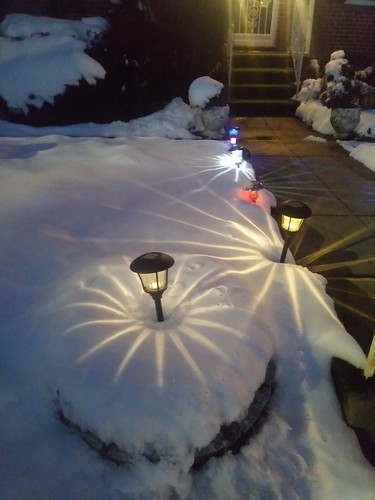
Neat color reflections of walkway lights in the snowMOW is a term used by railroads.   And "transit city" encompasses sustainable modes of transportation--walking, biking, and transit--based on the concepts expressed in "Transportation and Urban Form" by Peter Muller.

Cities still are grappling with reorienting practices of city agencies in favor of sustainable mobility, even though a majority of transportation movement in cities is likely to be by pedestrians and transit riders.

One of my indicators in change in practice was how the Takoma Recreation Center has slowly expanded its sidewalk snow removal practices over the years, something that I tend to comment on in the series of pieces.  Over ten years, now they pretty much remove snow from all the sidewalk around four blocks, which is quite good since originally they did zero clearance from the perimeter sidewalks.

I was really surprised to see the DC DPW director, in this piece the other day from WTOP-radio, "How DC is preparing for this year’s wintry ‘Polar Coaster’," acknowledge as a priority snow clearance from bike lanes, intersections, and bridges, which have been persistent problems over the decades as the snow plow practice "regime" preferences motor vehicle movement. From the article:
“Protecting bike lanes has become a higher priority as more residents use bicycles as an alternative and even primary mode of transportation. The snow teams … are dedicated to keeping the bike paths, bridge deck, sidewalks, [disabled accessible] ramps, intersections and bus shelters clear,” Geldart said.
The article includes a twitter message embed with a video demonstrating a smaller machine used for clearing bike lanes.

Something I had never seen before, DDOT presalting sidewalks on bridges in a pedestrian areaAnd I have noticed, just like with the Takoma Recreation Center, incremental improvements over the years.

E.g., last Janruary I was shocked to see DPW crews salting sidewalks on bridges across North Capitol Street in advance of a snow storm when I was at a meeting in the Bloomingdale neighborhood.

While these are great steps there are always opportunity for improvement.

Past pieces have discussed better practice such as:
  • how Rochester, New York takes the responsibility for clearing snow from all the city's sidewalks
  • how the Minneapolis Bicycle Master Plan has an element on maintenance including winter snow clearance
  • how Holland, Michigan created a system of steam/water pipes under downtown sidewalks to melt snow as it falls
  • Montreal's clearance of snow from a defined winter network of cycle paths, and how some trails, such as the Minuteman Trail in Suburban Boston, the Capital Crescent Trail in Bethesda, and DC's Metropolitan Branch Trail have snow clearance protocols
  • a Winter Cycling Federation links cities across the Northern Hemisphere on snow clearance and bicycling matters
More recently, I learned that:

Labels: , , , , , , , ,

Sunday, February 24, 2019

Walking City Wintertime: Snow and strollers in Toronto

Since 2010, I've written about snow clearance in the context of the Walking City and the creation of a "maintenance of way" agenda that goes beyond prioritization of motor vehicle movement, that is to say, sidewalks and bicycle lanes.

-- "Winter preparedness, planning and the Walking/Biking/Transit City," 2019
-- "A "maintenance of way" agenda for the walking and transit city," 2010 was the first substantive piece, in the face of "snowmageddon" when DC got about 26 inches of snow over about a week through two separate storms
-- "Testimony on the Winter Sidewalk Safety Amendment Act of 2011" 2011
-- Level of service and maintenance requirements in planning #2: winter maintenance of bike paths," 2012
-- "Agenda setting: snow clearance in the walking-biking-transit city," 2014
-- "Planning for winter weather," 2015
-- "Cataloging the various failures to remove snow in the walking/transit/bicycling city," 2015
-- "Who Knew?: There is a Winter Cycling Federation and annual conference," 2015
-- "Focusing on what's most important: snow on sidewalks or snow on cars?," 2016

Ana Bilanovic (right) gets a helping lift from sister-in-law Tamara Protic as they lift Matej, 17 months, over the ice rather than go through a puddle on the sidewalk along Gerrard St. E. (Rick Madonik / Toronto Star)


The Toronto Star has a great article, "Sidewalks turn into an urban obstacle course for parents with strollers," with wonderful photos about the difficulty of getting around while pushing a stroller on sidewalks and crosswalks that aren't adequately cleared of snow.

The photos would be great, featured in billboards and other marketing messages reminding people to shovel their walks, and to be sure they pay attention to intersections, snow along side frontages, walking paths across alleys, etc.
Bahaa Alhaj said he found it particularly difficult to push his two young children around in their stroller this winter. (Jason Miller / Toronto Star).

Of course, this can be a worse problem for the disabled, as these Star articles make cleaer:

-- "Disabled parking spots shouldn’t be dumping grounds for snow"

-- "Just deal with snow? Not so easy for some people"

This photo is from the latter article.
Lene Andersen, who uses a wheelchair for mobility, says getting around in winter weather is a big problem when sidewalks are covered with snow and snow banks block access to the street. Even getting to a grocery store can sometimes be impossible. (DAVID GOVONI)

Labels: , , , , , , , ,

Wednesday, December 05, 2018

President George H.W. Bush

Yes, it bothers me that when past presidents die, most of the media coverage is hagiography and glosses over the bad stuff.  Such is the case with President George H.W. Bush, who among other things used highly racist campaign message and was involved, somehow, with the Iran-Contra affair.

There are some pieces out there saying that yes, President Bush was a gracious person, but that's not enough.

-- "The Media Got George HW Bush Wrong in Life and Death," New Yorker
-- "The Ignored Legacy of George H.W. Bush: War Crimes, Racism, and Obstruction of Justice," The Intercept

WRT transportation, mobility and accessibility, his administration wasn't against transit, the way the current Republican administration is, and he signed the Americans for Disabilities Act, which among other elements, requires that public spaces including streets, sidewalks, and transit, be accessible to the disabled.

-- Introduction to the ADA, ADA.Gov website
-- "Remarks of President George Bush at the Signing of the Americans with Disabilities Act," Equal Employment Opportunity Commission
-- Accessibility, US Department of Transportation

It turns out too that accessibility is helpful to everybody.  People with packages, people crossing streets, bicyclists, people pushing strollers, etc.

While most communities have made progress with this in terms of the sidewalk network, not all transit agencies have, including the New York City Subway system.

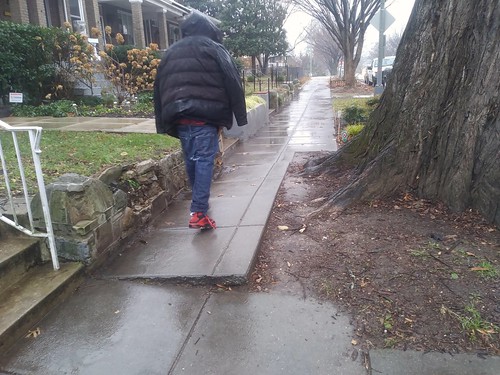
Sidewalk uplift, Kansas Avenue NWSidewalk uplift on Kansas Avenue NW.

Although communities may still miss important aspects.

For example, DC has an extensive program making sidewalks at intersections accessible (a lot of this is upgrading already existing ramps), but for the most part, doesn't address mid-block sidewalk problems, even when doing projects in close proximity.

I think that simultaneously, cities should prioritize mid-block repairs as well as intersection upgrades.

Labels: , , , ,

Tuesday, May 12, 2015

Resident protest against care facility

National Children's Center is a adult day care facility for the profoundly disabled.  It's located a couple blocks from where I live, and doesn't seem to cause any problems.  Like many of these kinds of facilities, apparently there are management and personnel issues, including legal judgments made against the institution.

One successful plaintiff, not happy that NCC keeps appealing, has organized a website and campaign to embarrass NCC into dropping the appeal and paying out the judgment.

This person has convinced a few households around the site to post signs similar to the website and postcards that are posted in coffee shops and other places.

Those households, probably because of their interactions with the organization-site (granted, they do own a house on Rittenhouse Street NW that has probably been vacant for at least one decade), are amenable to his pleas.

Labels: , ,

Tuesday, March 20, 2012

Disabled parking policy: yet another example of how not having a master transportation plan means that DC's transportation "policy" is crazy stupid

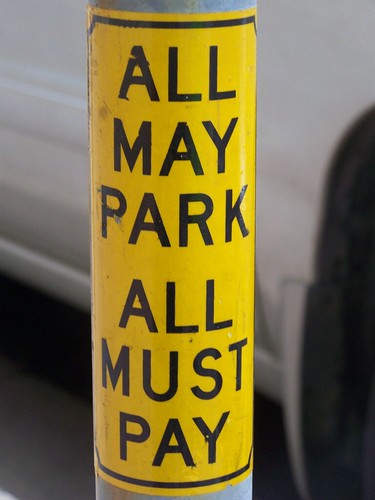
All may Park All Must Pay (Rosslyn)
Decal on a parking meter stanchion in Rosslyn, Arlington County.

From Parking Today Magazine:

If you give something for free, particularly something of rather great value, you can rest assured that there will be those that take advantage. My question is, as has been raised on these pages numerous times in the past, why do we give free parking to handicapped persons? Immediately we have created a black market in handicapped permits. Policing the process is difficult, if not impossible. And spaces that are needed for handicapped persons are filled by nincompoops who don’t need the service. The Handicapped tell me that they want access, not charity.

Recently, the DC Department of Transportation introduced a special "red top" parking meter program to better control parking for the disabled ("D.C. to install more red top meters for disabled people" from the Post).

But the spirited reaction to the loss of privilege--parking anywhere for free--means that the DC City Council is stepping in to rescind the program ("DC Council to consider halting new ‘red-top’ parking meter program for disabled drivers" from the Post).

Parking policies should be set by a transportation master plan, not by whim, and/or in response to the complaints of a few, especially over loss of privilege. (This is my major complaint about so called "performance parking programs" across the city, how we deal with church parking on Sundays--I actually don't have a problem with it, but it should be managed carefully, with proposals for free parking for funerals, with the relatively miniscule price for residential parking permits, etc.)

"Traditionally" disabled motor vehicle users have either been allowed to (1) park for free; (2) without restriction in terms of length of time parked; and/or (3) for an extended period of time.

Across the country, including DC, rampant abuse of disabled parking privileges has been uncovered. For example, the Los Angeles Times has run a series of articles about investigations in handicapped parking permit abuse there, starting with this article from 2011, "Placards can bring a curbside surprise: State DMV cracks down on fraudulent use of disabled parking passes. It's touched a nerve."

From the article:

Fraudulent use of disabled parking placards -- those blue or red badges that allow motorists to park for free or in specially reserved spaces -- has exploded in the last decade, according to state motor vehicle officials. With 1 in 10 California drivers now legally registered to carry the passes, transportation experts say abuse has become commonplace. At any given moment, on any given street, more than a third of the vehicles displaying the tags -- and parking without paying -- are doing so illegally, say officials with the California Department of Motor Vehicles.

More recent articles have involved Steve Lopez, one of the
LA Times' leading columnists, going around with parking enforcement personnel targeting placard abuse. See "It's time for a crackdown on abusers of disabled placards," "A peculiar pattern," and "Cracking down on parking meter cheaters: They use disabled-driver placards that they don't deserve. But thanks to the LAPD and DOT, some of them get the hefty fines they really do deserve."

As Lopez points out, there are so many cheaters that they prevent legitimate handicapped parking permit holders from using handicapped parking.

Where is the outrage over the abuse? The Chicago Sun-Times has reported on similar problems in Chicago. Links to 7 stories on the subject are available within this story.

Chicago Sun-Times video story on illegal use of handicapped parking permits.

So there are two issues. One is massive abuse of the privilege. The other is the revenue loss from providing free parking. (The City of Chicago has been presented with a bill by the parking meter concessionaire of more than $13 million for the cost of providing free handicapped parking, and that's after a credit of more than $5 million. See "Meter company sends city $13.5 million bill for disabled parking from the Chicago Sun-Times.)

More jurisdictions are requiring that disabled patrons pay for parking, even if they are still provided with priority locations and longer periods to park than what would normally be provided.


By providing a framework and goals focused on effective transportation policy and throughput, a master transportation plan is essential in creating an environment where transportation policy is based on robust practice and achievement of goals, rather than more like a taffy pull focused on ameliorating complaints from various interests asked to pay their way.

The Arlington County Master Transportation Plan, specifically the Parking and Curb Space Management Element, is a model for how transportation planning should be done, and demonstrates just how much the DC way of no planning and Council legislative privilege creates a failed environment for intelligent transportation policies and regulations in the city.

From the Element:

Policy 1. Prioritize the use of curb space, matching the various types of uses to the most appropriate locations. In commercial areas and high‐density residential areas, generally consider bus stops, curb nubs, taxi stands, paratransit pickup, short‐term retail and handicapped parking to be the highest priority.

Curb space is owned by the community, and must be managed for the greatest public benefit. Priorities for curb space management are not uniform across the County and will depend on the County’s Land Use Plan and proximate land uses and transportation options. Major transportation nodes such as Metrorail stations or major bus stops (Super Stops, BRT stops and street car stations) are primary organizing factors for curb space. Secondary factors include activity centers (major hotels, shopping centers, and high‐rise residential and commercial buildings) and other nodes of the primary transit network (PTN). However, all of these uses must respect the pedestrian experience. The placement of these elements should be carefully considered to avoid negatively impacting pedestrians and other amenities that help create a high quality urban environment. Appendix A includes three tables that show a hierarchy of curb space uses for High‐Density and Commercial Districts, Medium Density Districts and Low‐Density Districts. ...

Policy 13: Provide travel options for persons with disabilities through reserved access to curb space and dedicated off‐street parking, with enforcement.

Reserved parking for people with disabilities ensures safe and equal access to goods and services. Mobility impaired persons with limited mobility require parking spaces in close proximity to their destinations and therefore should be allotted the parking spaces closest to primary building entrances. ...

At this time no ADA‐standards exist that define what accommodations should be made for accessible on‐street parking spaces. Absent national standards the County utilizes best practices when providing disabled‐reserved on‐street spaces. ...

In 1998, the County, after close coordination with representatives from the disabled community, adopted a policy that ended free use of parking meters by persons with handicapped parking permits. The change removed the chief incentive for fraudulent use of such spaces. In addition, the number of reserved meter handicapped spaces was tripled and the allowable time on those meters was increased to twice the standard time.

-----

It's not surprising that DC is 14 years behind Arlington County with regard to addressing the same issues, DC doesn't have a robust, comprehensive transportation plan.

It could be though that City Council likes it this way, because that means that they can pander to various interests when it suits their needs, especially when it comes to parking, which I liken to the "third rail" of local politics (traditionally social security and medicare make up the "third rail" of national politics).

But still, it's very frustrating, when a better way of doing things is so obvious, and yet despite the obvious, DC prefers to go its capricious, under-planned way.

Labels: , , , , ,