Rebuilding Place in the Urban Space

"A community’s physical form, rather than its land uses, is its most intrinsic and enduring characteristic." [Katz, EPA] This blog focuses on place and placemaking and all that makes it work--historic preservation, urban design, transportation, asset-based community development, arts & cultural development, commercial district revitalization, tourism & destination development, and quality of life advocacy--along with doses of civic engagement and good governance watchdogging.

Tuesday, July 21, 2020

Interesting idea from Professor Donald Shoup about how to improve house-fronting public spaces

UCLA planning professor Donald Shoup, best known to the more general but planning knowledgeable public for his book The High Cost for Free Parking and his consultation with many communities, starting in Pasadena, on parking, transportation, and commercial district revitalization, wrote this post below in a discussion on the pro-urb e-list. (Reprinted with permission.)

[Interestingly, here, I write that cities should take on the financial responsibility for sidewalks, "A walking (or sustainable mobility prioritized) city should take responsibility for constructing sidewalks, 2016." But this offers a different approach.]

From Professor Shoup:
Most cities need safer sidewalks and more street trees, but many cities can’t or don’t want to pay for them.

One way to solve the finance problem is to require property owners to repair any broken sidewalk or plant any missing street tree in front of their property before they sell the property. This pay-on-exit policy systematically improves all streetscapes in a surprisingly short time at no cost to taxpayers. Owners who sell their property and leave the neighborhood make all the public improvements.

-- "Op-Ed: A big step toward safer sidewalks," Los Angeles Times, 2014
-- "Let a Tree Grow in L.A.," Los Angeles Times, 1996
-- "Fixing Broken Sidwalks, Access Magazine, 2016
-- "Regulating Land Use at Sale: Public Improvement from Private Investment ," Journal of the American Planning Association, 1996
-- "Putting Cities Back On Their Feet," Journal of Urban Planning and Development, 2010
100_1723.JPG
This sidewalk has a section made of rubber, to allow for tree root upthrust.


End of Donald Shoup post.

Conclusion.  I wish that I had known about this concept--many of the articles are from the 1990s--when I was doing the Western Baltimore County Pedestrian and Bicycle Access Plan.  I would have included this as a policy recommendation.

I know for sure it would have never made it out of the internally circulated draft, but it still would have pushed the discourse forward.

Note that this idea should should be extended to include putting in sidewalks where there is a gap in the network.  Astute jurisdictions--this includes Baltimore County but not DC--add easements to lots when plans call for the construction of trails (and presumably sidewalks.
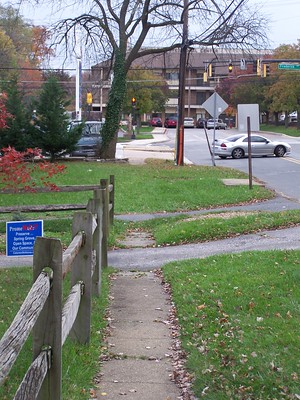
No sidewalk, Catonsville

No sidewalk, Catonsville
Catonsville, Baltimore County, Maryland.


Crumbling sidewalk, 1800 East 1700 South, Salt Lake City
Salt Lake City

That way when they properties get developed, the trail/sidewalk can be added when it's constructed.  (Although typically they provide outs for the developer to avoid doing this.)

But usually this is for commercial properties and large tract new developments, not individual residential properties.


July 26th is the 30th Anniversary of the Americans for Disability Act

Note that this post is pretty timely because this week is the 30th anniversary of when the Americans for Disability Act went into effect. See "Building Accessibility Into America, Literally," New York Times.

Labels: , , , , , , , ,

Wednesday, January 07, 2009

Urban forestry

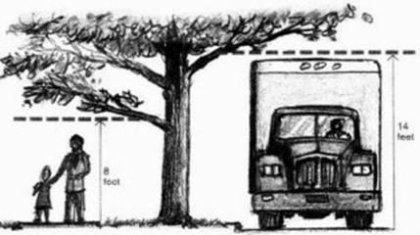
Preferred heights for tree branches for streets and sidewalks
Image from webpage on shade tree planning from South Whitehall Township, Pennsylvania.

Technically, in DC it is illegal for citizens to trim branches of trees in treeboxes, in public space. I will neither confirm nor deny whether or not I have done this. I will say that there are many many many many instances, in neighborhoods and in commercial districts, where lower branches of trees are inadequately trimmed, and this impinges on freedom of movement in public walkways (sidewalks) abutting the treeboxes.

I like better how they go about it in Baltimore: training people to be judicious pruners, rather than forbidding the activity, but at the same time the city "never" gets around to necessary trimming.

From email:

Baltimore City Department of Recreation and Parks and the Parks & People Foundation are sponsoring a Neighborhood Tree Steward Pruning Class. We will spend the beginning of the course inside for a brief overview before going outside for hands on instruction on pruning techniques. This class is free and all are welcome to join. The details are below. If you have any questions, or wish to sign up, please contact me, Elizabeth Concra.

Date: Saturday, 17 January 2009
Time: 10AM-12PM
Place: Carroll Park - field house (directions to follow)

Labels: , , , ,

Thursday, September 04, 2008

Storm-damaged trees to become free firewood ... in Tempe

Actually, I think DPW and DDOT should contract out the removal of downed trees (they do somewhat already), and then have the tree trunks cut up for wood, rather than dumped. And sold. Why bother giving it away for free? Use the revenue for the Urban Forestry Administration. And develop urban tree agriculture industry based on urban trees.

See the article from the Arizona Republic.

Labels: , , ,

Tuesday, October 30, 2007

The positive and economic contribution of trees


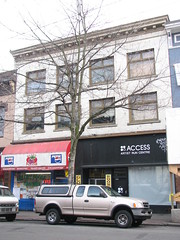
Filion Block - 1889
Originally uploaded by Bob_2006
(Flickr image of the Filion Block in Vancouver BC by Bob KH.)

From email:

New DNR Study Shows Hyattsville' s Trees Benefit The Bay, Save On Energy Bills And Mitigate Global Warming

HYATTSVILLE, MD — The Maryland Department of Natural Resources (DNR) Forest Service recently completed a study of Hyattsville' s 2,900 roadside trees. While the 2.5 sq. mile city has the potential for approximately 7,700 street trees, currently 4,800 potential planting sites remain empty.

"Trees not only mitigate greenhouse gases, improve stormwater quality, lower emissions by reducing energy use and improve air quality, but they do all of these things at the same time," said Michael F. Galvin, DNR Urban Forestry Supervisor. "No other environmental mitigation device provides these multiple benefits, in addition to others like aesthetics and wildlife habitat. Improving the condition and extent of tree canopy in urban areas is vital to community livability as our cities grow."

The total annual value of benefits provided by the trees equals $281,389. Each individual tree contributes $96.30 in annual benefits and $18.53 in annual benefits per capita. The study found that Hyattsville' s roadside trees provide the many valuable ecosystem services to city residents including:

* Stormwater management control by intercepting 10.5 million gallons of rainfall annually at a value of $104,818;
* Energy savings by reducing the needs for heating and cooling by 310 MWh of electricity and 10,625 therms of natural gas annually at a value of $44,944;
* Annual sequestration and reduction of over 1.1 million pounds of carbon at a value of $8,428; and
* Air quality improvement by annual reduction of over 500 pounds of smog (ozone) and 500 pounds of soot (particulate matter) at a value of $2,706.

Eighty-six percent of Marylanders live in urban areas. Residents can help by planting trees and helping to maintain local trees by watering them and mulching around the base.

The study aims to help Hyattsville plan for future tree plantings and develop its Urban Tree Canopy Plan. DNR utilized the USDA Forest Service iTREE software to complete the study.
------------------
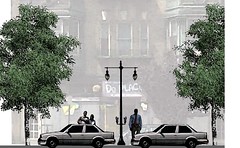
Similar studies have found a positive connection between trees in commercial districts and sales, as well as property values and lease rates. (I wrote about this a couple years ago in the blog. I'll have to dig up a link to this Forest Service software and add it in the blog.) Still, many retail businesses tend to oppose trees, seeing them as blocking views into their businesses. I think we need to remember that one of the things that distinguishes traditional commercial districts from malls is greenery and a connection to the environment. And the trick is to plant trees that grow to a certain height that doesn't obscure views into ground floor stores--meaning the tree canopy should be above 15 feet.
H Street Image 1
Proposed streetscape design for H Street NE, produced by the Michael Baker Corporation for the H Street Streetscape and Transportation Study.

Labels: , , ,