Rebuilding Place in the Urban Space

"A community’s physical form, rather than its land uses, is its most intrinsic and enduring characteristic." [Katz, EPA] This blog focuses on place and placemaking and all that makes it work--historic preservation, urban design, transportation, asset-based community development, arts & cultural development, commercial district revitalization, tourism & destination development, and quality of life advocacy--along with doses of civic engagement and good governance watchdogging.

Thursday, March 09, 2023

DC's crime bill overturned by Congress

 -- "Senate votes to block controversial DC crime bill," CNN

I haven't written a blog entry on this, just comments, and comments on Washington Post article.  While the revision of DC's criminal code, in some quarters the changes were perceived to be more lenient, in the face of a significant rise in the city's murder rate, crime involving guns, car jackings, and continued escalation of youth-involved crime.

I write that for the most part, DC's legislators have it pretty good.  They are a city-state, with control over the tax revenues generated within the city, and for the most part, not having the kind of oversight that is typically performed by State Legislatures, which may be quick to preempt local control in favor of corporate and cultural warfare goals.

But the fact is that Congress does have the final authority on approving local legislation, even though the DC Home Rule Act of 1973 pretty much created local control of local governance.

The city's legislators, many of whom lack substantive experience of cities in the period of the 1970s through the 1990s when many were in serious decline, and had problematic public safety, didn't realize that at times they need to manage the narrative and "manage up.'  In this case, how the law would be perceived in the world of public opinion, and the competition between Republicans and Democrats.

This letter to the editor ("The D.C. Council’s crime bill put statehood further out of reach") expresses it pretty well:

I have supported home rule since moving to D.C. in 1974. I proudly wear my “51” hat. But after a 2020 election when perceptions of being soft on crime hurt many Democratic candidates, the D.C. Council’s tone-deaf response was to enact a law that forces its allies to make a choice between supporting home rule or increasing their own electoral vulnerability. Not surprisingly, they are opting for their own survival.

So, rather than attacking President Biden and Congress for likely blocking the D.C. criminal code reform, the D.C. Council should own this fiasco. It might well happen again with the bill allowing illegal immigrants and other noncitizens to vote in local elections. It’s doubtful the council could have come up with any other bill that is more likely to provoke GOP reaction.

Democrats, who lost control of the House of Representatives in the 2022 election because of crime demonization being particularly effective in Greater New York City, didn't want to be on the wrong side of this issue.  Although there is criticism in some quarters about doing the wrong thing because of politics ("Biden puts reelection over principles with D.C. decision," Washington Post).

When President Biden announced last week that he wouldn't veto a disapproval resolution, the new DC crime bill was toast.

====

FWIW, I find it hard to believe that anyone who lived in DC during the period of great disorder, would ever want a return to those times.  It was terrible, and for me, personally very costly.

My lesson is that the forces of disorder are always pushing, and you cannot yield.

Few people seem to fully grasp that urban revival in the 2000s was sparked by significant public safety improvements.

At the same time, I recognize the problems of police brutality, the carceral state and overpolicing of people of color, warrior policing, etc.

Sadly, the "defund the police" messaging was another lost opportunity to control and shape the narrative, which should have been redefining what public safety means, looks like, and how it is delivered, because criminalization of social problems and having police officers be first responders when they are often not the right choice is not serving American society very well.

-- "The fine line between urban/center city chaos and order," 2020
-- "The opportunity to rearticulate public safety delivery keeps being presented," 2021
-- "Is it too late to change the messaging on "Defund the Police"? How about "Reconstruct Policing"?," 2020
-- "Towards a public safety model that is broader than policing," 2020

Note that my writings on equity and social urbanism come out of a desire to try to break the cycle of urban poverty. Sadly, DC has definitely failed on this dimension.

-- "Social urbanism and equity planning as a way to address crime, violence, and persistent poverty: (not in) DC," 2021

Which came out of my experience on grand jury duty in 2013:

In 2013 I was on grand jury duty.  Each jury had a specialization--ours was drugs and guns mostly, but we still dealt with murders, assaults, and other violent crimes.  

The lesson after three months was that DC spends billions of dollars each year--police, emergency services, health and social services, criminal justice, education, etc., in the communities where crime is persistent--just to keep the neighborhoods and people within them at equilibrium/the same--not to improve.

Labels: , , , , , , , ,

Monday, August 31, 2020

Not in defense of looting

I haven't read the book In Defense of Looting, but NPR just did a feature story, "One Author's Argument 'In Defense Of Looting'."

From the story:
What would you say to people who are concerned about essential places like grocery stores or pharmacies being attacked in those communities?"

"When it comes to small business, family owned business or locally owned business, they are no more likely to provide worker protections. They are no more likely to have to provide good stuff for the community than big businesses.
 It's actually a Republican myth that has, over the last 20 years, really crawled into even leftist discourse: that the small business owner must be respected, that the small business owner creates jobs and is part of the community. But that's actually a right-wing myth."

This is hardly a defense of the looting of a small business.

Kay Jewelers on the corner, burning, 800 block H Street NE, south side, riots of 1968, Washington, DC
8th and H Streets NE, 1968.  Photo: Matthew Lewis, Washington Post.

There is no defense of looting.  I understand anger and frustration and why people get violent.  But that doesn't mean I can find it justifiable.

Especially because while it might make legislators more willing to pass supports and for businesses and institutions to change a little bit, it destroys communities.

In the best of circumstances, it takes many decades for a community to recover, especially its commercial district. Places not so well resourced take even longer and likely never recover.

E.g., the H Street NE neighborhood I lived in in DC, well located--about 1 mile from Capitol Hill and less than 2 miles from Downtown--took not quite 40 years to recover.

The heart of Detroit, which experienced rioting in 1967, is still bombed out. Newark.. Etc.

Asking the right questions about small business and worker supports.  That being said, the "not likely to provide worker protections" is asking the wrong question.

Of course, small businesses, especially retail, aren't likely to provide "worker protections."

Even in the best of circumstances, they can be marginal businesses. Great for the owners, especially in terms of personal wealth building, but not big enough to be able to provide the package of benefits typically offered by larger firms.  (Sometimes associations that a business might join offer insurance and other programs that a business can adopt, but couldn't support on their own.

And it's not like chain retail businesses (Starbucks is an exception) provide a great package of benefits, unless they are unionized, and even then, benefits have been whittled away considerably in response to companies changing wage and benefits packages in response to competition from large nonunionized companies like Walmart.

The question should be, "why is it very difficult for small businesses to offer worker protections and benefits?"

The answer is: because they are microbusinesses without scale. The follow up question should be: "what do we need to do to make it possible for workers at these microbusinesses to receive protections and benefits?"

In Europe, this is less of an issue because the social welfare safety net operates independently of the workplace.

I would argue that we want workers/people to have access to a social welfare safety net, we should create one that works independently of the workplace.

Definitely the need for such became clear because it response to the pandemic and the layoff of millions, people lost not only their paychecks but their insurance (Employment, Income, and Unemployment Insurance during the COVID-19 Pandemic, Urban Institute).

PPP was an attempt, not very elegantly, to use the workplace payroll system to deliver wage support that otherwise would come from a beleaguered unemployment insurance system.

Small businesses and local support.  The other thing is that most economic studies find that small businesses spend money locally and have a greater multiplier effect on the local economy in fostering additional business, while chain businesses do not, because they usually purchase goods and services from vendors not located locally.

As someone said on an e-list, when do you see Walmart or Home Depot sponsor a local kids sports team?

Studies on the economic impact of locally owned businesses have been done for a number of communities and various retail sectors, when it comes to the economic value of chain stores versus locally owned businesses.   The consulting firm Civic Economics has performed these studies around the country.

The National Hardware Retailing Association, the American Booksellers Association, and the American Independent Business Association have commissioned such studies as well.

-- The Multiplier Effect of Local Independent Businesses, AMIBA
-- Study: Shopping Local vs. Amazon Makes Powerful Impact, National Retail Hardware Association
-- Local First and Economic Impact Studies, American Booksellers Association

Opposition to large tax credits for businesses, like FoxConn in Wisconsin, have to do with this kind of analysis too, over how much of the business activity further generates local economic activity.

Years ago, Aaron Renn wrote about how once Anheuser Busch was acquired by a non-US company, they eventually stopped hiring advertising firms based in St. Louis ("St. Louis and the Consequences of Consolidation," New Geography). This process happens in many places associated with business consolidation of banks, department stores and other retail businesses, etc.

Looting as social reparations. Again, I haven't read the book, but the argument is that looting has an element of redress for discrimination and structural racism. Again, I understand this belief, which has been frequently expressed both in the past and currently, in response to looting associated with George Floyd protests. But I don't agree.

Redress is supposed to be societal and such contributions are supposed to be structural and systematic, not an individual taking from someone/a business on their own volition, idiosyncratically.

Although, years ago I wrote a piece making the point that people in poor communities have an anthropological way of thinking about community and business participation and a belief that to locate in the community, they have to pay in. I never took anthro so I don't have the language to describe what I mean completely. Basically that to be part of the community, if you are an itinerant member through a business etc. you have to pay in, a kind of duty/dowry, in order to belong.

So looting can be seen as a kind of redress for the failure to pay in.

-- "In lower income neighborhoods, are businesses supposed to be "community organizations" first?," 2012

The Asian owned business question. And this is very much relevant to the discussions over the years about "Asian-owned stores" in black communities (I remember this being a theme in the "Hill Street Blues" tv show in the 1980s).

It came up a number of years ago in comments by DC's own Marion Barry ("D.C.'s Marion Barry widely rebuked for comments about Asian business owners," Washington Post), but also see this old blog entry about similar comments by Andrew Young, when he was working for Wal-mart, "Andy Young, Mel Gibson, maybe it's something about Los Angeles").

A number of years ago, I happened upon a great book about the Korean/Asian/Black urban retail question, Civility in the City: Blacks, Jews, and Koreans in Urban America, but I never wrote about it.

The book by Jennifer Lee, professor at UC Irvine, is definitely worth reading.

Labels: , , , , , , , ,

Tuesday, August 11, 2020

The fine line between urban/center city chaos and order

There are a couple of pieces, one not quite a screed ("The UWS is falling apart, and lefties seem too woke to care," New York Post) and the Bloomberg Opinion column, "New York and San Francisco Can’t Assume They’ll Bounce Back," about the decline in urban order in the face of rioting, violence and looting around Black Lives Matter demonstrations.

Crime is rising in a number of US cities right now, in particular shootings and murders, but not so much other crimes, and there are a variety of theories for why this is so ("The murder spike in big US cities, explained," Vox).

WRT BLM-related violence, it seems to be perpetrated by a preponderance of whites ("How reckless White allies could lead to the reelection of Trump," Washington Post), but also recognize that some of it is fomented by supremacists seeking to spark disorder and discredit BLM, such as in Minneapolis ("Minneapolis police say 'Umbrella Man' was a white supremacist," Minneapolis Star-Tribune) and Oakland ("Suspect in officers' killings tied to Boogaloo group," Los Angeles Times).

Looting I think was more opportunistic and tended to be a more racially "diverse" phenomenon.  Clearly some groups organized specific forays against businesses, seeing the opportunity.

While I understand the need to seriously reconfigure how we deliver public safety services:

-- "Is it too late to change the messaging on "Defund the Police"? How about "Reconstruct Policing"?," 2020
-- "Towards a public safety model that is broader than policing," 2020

the idea of "defund the police" scares the hell out of me, because I have first hand experience of living with widespread disorder, from 1987 into the early 2000s, living in Washington, DC, when the 1990s were especially terrible because of the crack epidemic, bad policing, and other problems.

I can't provide a full recounting of all the bad experiences with crime that I dealt with during that time, but they include:
  • at least three muggings (I happened to get away each time, although my glasses were broken once and I was punched another time)
  • attempted muggings
  • a crazy assault when I was locking my bike which caused blood and injury (I got the guy arrested and he served time, but the reality is that he was mentally ill)
  • stolen (rental) car
  • multiple stolen bikes or stolen bike parts
  • thefts from my yard
  • thefts of my stuff when at restaurants
  • multiple burglaries of my house
  • rape of my then wife during the commission of a burglary (which led to our divorce, although we might have gotten divorced eventually anyway)
  • etc.
Besides my personal experiences with criminal acts, the neighborhood where I lived was full of disorder, from trash to vacant houses to a major crack distribution area. 

There were at least a dozen murders a year in the neighborhood, some within a block of my house at particularly bad corners or at businesses.  The H Street commercial district was pretty gnarly too, with a lot of crime, vacant properties, street robberies, robberies of businesses, tons of litter etc.

(As a result, community policing matters were some of the issues I aimed to address when I first got involved in neitghborhood issues around 2000.  A few years later, I was featured in a Washington Post article on Labor Day in 2003, about city advocates fighting the overconcentration of liquor stores, the sales of singles, etc.  It's oddly not available online, but is in articles databases.)

So arguing that police have no legitimate role in maintaining order makes no sense to me.

Furthermore, doing some experiments of my own picking up litter, and seeing the impact of nuisance properties led to my fervent belief in the theoretical basis of broken windows theory--that better maintained places are safer than those that aren't.

Obviously, the "Capitol Hill Occupied Protest/Capitol Hill Autonomous Zone" ("The CHAZ Has Become America’s Fascination," Seattle Met) in Seattle was no bed of roses ("Capitol Hill residents and businesses sue city of Seattle for failing to disband CHOP," Seattle Times) even if alt right media blew it out of proportion.

Even in the best of circumstances, some people join in and seek to take advantage of the situation for their own purposes.

Getty Images.  

And the reality is that not everyone is pure of heart.  Some people are evil.  Others have mental health or substance abuse demons that make it difficult for them to function in society, etc.

So we need forces to help us maintain order.  And volunteers don't normally measure up when it comes to dealing with serious disorder.

That traditional police forces need to be much better controlled, trained, and resourced is another issue.

And I am the first to argue that public safety service delivery should be conceptualized much differently from at present:

-- "Crime prevention through environmental design and repeated burglaries at the Naylor Gardens apartment complex," 2013
-- "Los Angeles police department "Community Safety Partnership"," 2014
-- "Night-time safety: rethinking lighting in the context of a walking community," 2014
-- "Crime time re-revisited: a set of programs focused on reducing crime," 2015
-- "The state of "broken windows" versus "problem oriented policing" strategies in 2016: Part 1, theory and practice," 2016
-- "The state of "broken windows" versus "problem oriented policing" strategies in 2016: Part 2, what to do," 2016
-- "Police response to mental health matters," 2016
-- "Who identifies problems and addresses them at the metropolitan scale? No one, at least when it comes to mental health-related police shootings," 2016
-- "Revisiting intimate partner violence/murder," 2017
-- "Seattle Times article on the need for changes to 911 services and emergency response," 2018
-- "Broken windows/collective efficacy: Baltimore; Newark; Grand Junction, Colorado; Pittsburgh; Albany," 2019
-- "Social urbanism and Baltimore," 2019

I wrote this in the second Broken Windows piece from 2016:

One of the problems that many people ascribe to the #BlackLivesMatter agenda is a kind of "nullification" as it relates to crime ("Black Lives Matter should also take on 'black-on-black crime," Washington Post).  To an outsider, it appears as if there is a kind of preconceived notion within the movement that anything "the government" does concerning crime and public safety is anti-Black and moreover, unjustified.

While I can see why many people would have strong reason to believe that, it is in fact a stretch or overstatement.  There is no question that the current paradigm isn't working (past blog entries: "Police misconduct and grand juries: a separate prosecution and grand jury system is necessary," "How police departments become corrupt," and "Police officers aren't always the best placemakers")

But at the same time there is no question that there is crime and it disproportionately impacts low income communities and people of color.

I believe that communities need a strong agenda for dealing with crime while recognizing that the public safety agenda is often built on a racist foundation, and much more resources need to be put towards community improvement, simultaneous with and not subservient to "order maintenance."

Labels: , , , , , , , ,

Monday, July 27, 2020

Towards a public safety model that is broader than policing

I wrote about my reservations with "Defund the Police" as a slogan here, "Is it too late to change the messaging on "Defund the Police"? How about "Reconstruct Policing"?," and more recently about more focused ways of addressing public safety within neighborhoods in the recent entry, "Equity planning: an update," about the approach undertaken in the East Liberty neighborhood of Pittsburgh.

But I have to say, recently reading the book White Fragility I can see why people did react to my comments on "Defunding" in terms of "just listen," even though I bristled at this, since I've been making similar points about policing, based on my experiences in DC (which do include a lot of examples of being a crime victim) for more than 15 years.

In doing some filing, I came across a recent clipping, letters to the editor in the New York Times ("Rethinking the Traditional Police Model"), which get to the crux of the issue.

The first by now retired urban planner and public administrator Subir Mukerjee makes the point that if there were a real "public safety" model, police would be but one element of a complete approach/tool kit. That funding for mental health, schools, affordable housing, and economic opportunities for the disenfranchised would be part of it.

I didn't know ... the second letter, by UC Berkeley Emeritus Professor Malcolm Feeley, mentions that Herman Goldstein, the creator of the "problem oriented policing" approach, made the point that police are hired and trained "to fight crime" but most of their time is spend "solving problems."

(This point was also made to me by a former DC Deputy Police Chief, when I guest lectured to one of his classes at UDC.)

Goldstein called for a more "social services" model rather than the military or warrior model. From the letter:
They spend most of their time solving problems: advising victims of crime, helping people in distress, sorting out arguments, breaking up fights, managing crowds and the like.

His simple but profound message: These are crucial services and integrally related to dealing with crime, so recruit people who want to undertake these activities, and then train them accordingly.

His ideas call for a social services rather than military model. ...
His work led to his receipt of the 2017 Stockholm Prize in International Criminology, which is considered equal to the Nobel Prize within the field in terms of prestige, importance and recognition.

This is his speech, On problem-oriented policing: the Stockholm lecture," Crime Science, 2018.  Professor Goldstein died in January. From the article:
I proposed a new paradigm for reforming the police (Goldstein 1979, 1990). I argued that—in seeking to improve policing—more attention be focused on the substance of policing—on the outcomes of police efforts to deal with the specific problems that comprise their business. I labeled the paradigm “POP”. It called for the police:

• To identify specific problems the public expected them to handle;
• To dig deeply into understanding each problem; and
• To think freshly and creatively about the best possible tailor-made response.

As the police searched for that response, they were urged to place a high value:

• On preventive action;
• On responses that preferably do not depend wholly on the criminal justice system; and
• On alternatives that engaged the community, other public agencies, and members of the private sector having a direct interest in the problem.

The process then called for implementing the agreed-upon response. And the final step called for a strong commitment to assessing the impact of that response, particularly for its effectiveness and fairness.

When such an idea is launched, it is extraordinarily difficult to track its diffusion, to measure its impact, or to gauge its overall effectiveness (see Leigh et al. 1996, 1998; Scott, 2000; Weisburd et al. 2010). Predictably, many early initiatives reflected good intentions, but often lacked a fundamental understanding of the concept...

Despite these gains, I have grown accustomed to viewing successful efforts to implement POP—when carried out in all of its full dimensions—as episodic rather than systematic; as the results of relatively isolated cells of initiative, energy and competence. I view these pockets of achievement as exciting and pointing the way but sprinkled among a vast sea of police operations that remain traditional and familiar. So I feel the need, especially in the current climate in the United States, to guard against exaggerating what is being achieved in POP, especially when related to the magnitude of the still unmet needs in policing. ...


-- Center for Problem Oriented Policing, Arizona State University

Labels: , , , , , ,

Tuesday, May 12, 2015

Resident protest against care facility

National Children's Center is a adult day care facility for the profoundly disabled.  It's located a couple blocks from where I live, and doesn't seem to cause any problems.  Like many of these kinds of facilities, apparently there are management and personnel issues, including legal judgments made against the institution.

One successful plaintiff, not happy that NCC keeps appealing, has organized a website and campaign to embarrass NCC into dropping the appeal and paying out the judgment.

This person has convinced a few households around the site to post signs similar to the website and postcards that are posted in coffee shops and other places.

Those households, probably because of their interactions with the organization-site (granted, they do own a house on Rittenhouse Street NW that has probably been vacant for at least one decade), are amenable to his pleas.

Labels: , ,

Friday, February 21, 2014

DC and a rise in homeless families

A rise in homeless families in DC has drawn a lot of attention, because the increase in demand for emergency housing caught the city unprepared, and some of the families were housed in hotels in Maryland ("Homeless D.C. families are sent to Maryland hotels," Washington Post), which Mayoral candidate and Ward 6 Councilmember Tommy Wells has made a campaign issue ("D.C. Mayor Vincent Gray and challengers, clash over homelessness," Post).

So the response has been to take them out of hotels, and house them in city recreation centers ("DC to put newly homeless families into 2 rec centers," Post).

Mayor Gray has taken heat ("Don't give D.C. Mayor Vincent Gray the power to turn away the homeless," Post) for suggesting that a closer look at eligibility needs to occur ("D.C. mayor asks for emergency legislation to deal with surge of homeless into shelters," Post), that the city is paying for housing for people who aren't really DC residents.

This matter is more complicated than easy sentiments that housing should be provided to all.

-- National Family Homelessness Center

The research from the 1980s and 1990s found that most of the temporary homeless hated it so much they did everything in their power to not have to use public facilities.  Those that tend to remain in the public system have multiple household issues other than financing, ranging from mental health and substance abuse, single parenting issues, physical abuse within extended families, divorce, loss of employment, lack of transportation, etc.

It would be good to do qualitative interviews with a number of the families to get a sense of why they need housing, where they are from (it is true that people do come to DC from other jurisdictions because it can be easier to receive services here), and the nature of their situation, to determine whether the rise in demand is atypical or an indicator of fundamental changes in current conditions shaping the demand for emergency housing on a longer term basis.

I haven't gotten a sense from any of the media coverage on the issue that people are asking these kinds of questions.

This matters because some of the responses ("Gaithersburg woman looks to inspire initiative aimed at ending homelessness: 192-square-foot structure blends small living with large societal view," Gazette) that suggest the problem is just a matter of providing housing are misguided because troubled families typically need more support and assistance than just a roof over their heads in order to improve their situations on a long term basis.

Also see "Small World, Big Idea" from the New York Times.

Labels: , , ,

Thursday, August 04, 2011

Nuanced approaches are really hard

Image: Mixed use development in the Hollywood District of Portland, Oregon. Photo by Lara Swimmer.

In a world where everything is yes/no, the "third way" based on more nuanced approaches are increasingly rare and misunderstood. (My problem, my "ability" to see multiple shades of gray or gradations, actually holds me back in a world that wants simple answers.)

The City Paper criticized people "against" the creation of a proposed homeless shelter operation in "NIMBY Watch: Anacostia Protesting Homeless Women." The "nimbys" responded in a piece in Greater Greater Washington, "Homeless shelter with no retail will hinder Anacostia," which led to another WCP piece, "What I Talk About When I Talk About NIMBYism."

For me the issue is more complicated than calling people "nimbys."

First is the concern that in commercial districts, ground floor space should be used primarily by commercial establishments.

Because for the most part a variety of noncommercial establishments are also considered matter of right uses in commercial zones, commercial users can be crowded out by nonprofits who can outbid for-profit businesses using noneconomic considerations, other funding sources, and the fact that they don't have to pay property taxes.

The fewer the number of spaces in a commercial district directed to retail, restaurants, and attractions, the greater is the reduction in street vitality and the potential for commercial success.

Some commercial districts in the city have additional zoning protections (neighborhood commercial district overlays) that can require that a minimum percentage of ground floor space be directed to retail uses (or maximums for food-related services), but for the most part, these types of protections aren't present generally in the zoning regulations, which are mostly focused on minimum rather than optimal requirements.

Seattle has a more fine grained approach to use requirements in its commercial districts (even if I don't agree with how they classify certain of the uses, such as banks), classifying uses based on their pedestrian traffic generation qualities, mapping all locations within the commercial districts for their street vitality characteristics, and requiring that B and C uses cannot be put in A locations.

DC needs something more like this requirement.

(Similarly, DC needs a more fine grained approach on a block by block basis for design in commercial districts in the city. Opposition to higher buildings at key nodes such as at 8th and Pennsylvania Ave. SE or in Anacostia (see "Why Aren’t These Buildings Taller?" from the City Paper) tends to not acknowledge that nodes (usually at key intersections where major north-south and east-west streets cross) have different design considerations from other blocks within a commercial districts because they are gateways.)

Second, some people have expressed concerns that the proposed building will eliminate historic building stock, which isn't beneficial to the ability of the commercial district to present a unique positioning vis-a-vis other commercial locations in the regional retail landscape.

Being a fervent preservationist, I lean to this position, although in some instances, if considerable new value is created, it can be acceptable ("special merit") to demolish and replace, especially for very ordinary buildings. (I don't know the specifics of the situation with this particular project so I can't comment further.)

Criticizing preservationists for being preservation focused without acknowledging the reasoning behind preservation-based commercial district revitalization is unfair.

Third, some people have expressed concerns that opposition to the social service organization is unfair because they do good work, while others make the over-concentration argument, that having an overconcentration of social service facilities in a particular location makes revitalization difficult.

It happens that I am in favor of the overconcentration argument, for which I was an early proponent of concerning the sales of alcoholic beverages in the city ("Restaurants and liquor licenses--How much is too much on H Street?" from 2005), and I have made a case for this argument as it relates to social service facilities and churches ("Balancing the provision of social services facilities vs. overconcentration and "nimbyism"").

Pointing to an organization's good work as an excuse for ignoring problems with particular proposals should never be supported.

These are tough issues, and reflexively calling "opponents" to a shelter proposal "nimbys" fails to address in a substantive way the actual issues.

I have mentioned in other writings about Anacostia (this entry has back links to many of my best writings on the topic "New Years post #7: Anacostia and sustainable economic development and revitalization") that for all intents and purposes, there isn't a master revitalization plan for the community (the issue of whether or not it would be a creative, innovative plan is another question entirely).

This is but one example of an issue that ought to be addressed in a truly comprehensive and innovative plan.

1. Be that as it may, I do think that Anacostia needs to have overlay zoning for the commercial district requiring a variance process for nonretail use on the first floor, and a special exception process that makes agreements for nonretail use to be granted only for a particular period of time, with mandatory review (see section two of this entry for a discussion of a similar procedure in Laguna Beach, California, "The rest of the story").

2. But really this should be a general requirement in the zoning regulations, not specific to any particular district.

3. Separately, but equally important, there are examples of how government building and social service type uses can be integrated into communities in ways that further retail and commercial district revitalization objectives, although it is relatively rare and very rare in DC.

This should be a required provision for first floor uses of government and social services buildings in mixed use districts.

DC has many examples of bad practice (Reeves Center, H St. Community Development Corp. office buildings on the 600 block of H Street NE, senior housing complexes, such as on 7th St. NW and H Street NE in DC, etc.) where for the most part, either space for retail isn't provided at all, or the space allocated to retail uses is sub sub sub sub sub optimal and ends up being unsuccessful.

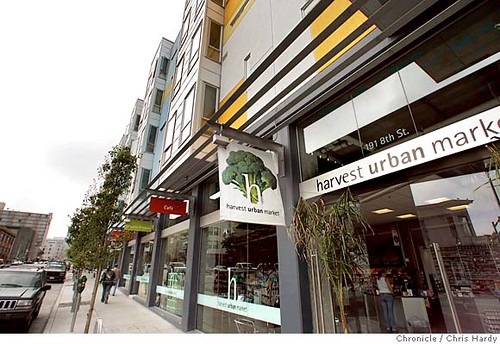
The best practice example that maybe impresses me the most is a project in SOMA in San Francisco, where an affordable housing building has a high quality urban market on the first floor. See "A SOMA complex with a coffee shop and lively mural proves that affordable housing doesn't have to be ugly housing" from the San Francisco Chronicle.
Harvest Urban Market
The housing complex at Eighth and Howard streets is home to 88 small apartments -- and the Harvest Urban Market. Chronicle photo by Chris Hardy.

From the article:

There's an over-enrolled school of thought that claims affordable housing drags a neighborhood down. But the corner of Eighth and Howard streets in San Francisco shows how much brighter the truth can be.

Instead of hunkering behind the bleak walls and tight grates that adorn market-rate lofts nearby, the newest building on the corner opens up with a glassy ground floor containing a grocery store and politically correct cafe (soy protein frittata, anyone?). Upstairs are 88 small apartments -- and a facade where the stucco around the metal bays doubles as a canvas for a four- story-high abstract mural that brings to mind a pastel circuit board.

Even the entrance has style: a small courtyard that announces its presence on Howard Street with a fence that's a collage of thick glass and rusted steel, while maples and palms peek out from inside.


And while not in a distressed/emerging commercial district, the example of the library-housing project in the Hollywood district of Portland is another example of using a public-private partnership to further multiple objectives that support pedestrian activity in commercial districts. See "A living library" from Metropolis Magazine. The ground floor of the building has a restaurant and a library branch, and the three floors above have 47 apartments, of which 19 are affordable.

If projects like these were on the table for Anacostia, I don't think we'd have the opposition that we are seeing at present.

Labels: , , , , , ,

Saturday, June 04, 2011

Balancing the provision of social services facilities vs. overconcentration and "nimbyism"

Today's Post has a letter to the editor, "Embracing community diversity," calling out as nimbyism and anti-social part of a story told within a real estate feature on the Truxton Circle neighborhood in DC ("Truxton Circle reclaims its identity"), of how residents successful opposed "the presence of a new education and training program for Latino youth accompanied by expanded housing opportunities for their families."

While I happen to agree with the letter writer that the program as proposed seemed to make a lot of sense, what I do understand that the letter writer does not, is that residents in the Truxton Circle-Eckington-Bloomingdale area do feel "put upon" because of the presence of a great number of social services facilities already in their neighborhood, from methadone clinics to homeless shelters.

While ADA laws in DC and generally are interpreted to mean that these types of facilities can not be opposed on zoning grounds (which is why opposition in the Ruxton-Riderwood area of Baltimore County to the placement of a small mental health halfway house for people of means within their neighborhood is not likely to succeed, see "Sheppard Pratt completes Ruxton purchase for rehab center" and "Sheppard Pratt facility unfair to Ruxton — or any other neighborhood" from the Baltimore Sun), I do believe that there is a quality of life and "quiet enjoyment" argument that can and should be made in terms of "overconcentration" of such facilities in particular neighborhoods.

The North Capitol Street corridor is likely one such place, given the number of facilities located in the area, from say M Street north to Rhode Island Avenue. Reston in Fairfax County, where the letter writer hails from, probably not so much.

What the ADA law means in practice is that one facility on its own cannot be denied zoning approval, if it meets the general requirements within the zoning category.

Because zoning and building regulations are applied for the most part to individual projects on a case by case basis--singly rather than collectively--there is no question that certain areas can become "dumping grounds" when many such facilities locate in the same area. As a result, I do believe that an overconcentration exception should be able to be made at some point, in terms of the addition of new facilities to particular areas.

Although part of this is a matter of management. For example, for years I lived around the corner from a homeless shelter. When it was used as a transient housing facility, it was a terrible neighbor, and people loitered throughout the neighborhood during the day, until they could go back inside. Later it became (and still is, although I don't live there anymore) a managed facility as part of a multi-stage drug rehabilitation program, and except for occasional ambulances and such, you'd never know (except for the lack of children) that the building was no longer a school and housed people with needs.

The funny thing about that "shelter" is that its presence was frequently used as a chimera to explain bad things in the neighborhood. For example, residents criticizing liquor shops for sales of products most likely to be consumed in the public space were told that this was happening not because of the liquor store, but because of the "homeless shelter." Well, in the drug rehab program, people are not allowed to consume alcohol or they will be kicked out. It wasn't that facility that was causing problems, etc.

Labels: , , , , ,

Thursday, May 26, 2011

Affordable housing vs. supportive housing

From David Smith of Recap Real Estate Advisors (David publishes an e-letter on housing issues, particularly the financing of affordable housing, and is the founder of the Affordable Housing Institute):

Who 'deserves' affordable housing? We justify it in public-policy terms as a haven out of poverty, and yet some people's poverty is more than just monetary, their personal self-sufficiency impaired by unwise life choices, unlucky circumstances, or just a bad roll of the genetic dice. To become more independent, these folks need customized life-skills services delivered in the home, the growing subset of affordable housing known as Supportive Housing. For owners, coordinating these new on-site activities with the routines of normal leasing, management and administration requires newly defined roles and rules of engagement, as explored in this month's State of the Market 38: The Push for Supportive Housing. It begins:

As affordable rental housing resources become more scarce, the market share of them devoted to Supportive Housing (SH) is climbing, as government increasingly pursues homeless-prevention and homeless-mitigation strategies that emphasize permanent housing and community-based solutions, placing ever more responsibility on private actors.

Given the financial incentives, many affordable housing providers are migrating into supportive housing, which is nudging them beyond basic real estate and into new, more service-intensive businesses.

You'll have to write him to get the e-letter.

Anyway, this idea of support systems is one that I extend to other areas, such as civic engagement capacity building, commercial district revitalization, especially the fostering of independent businesses, and the take up of sustainable transportation modes such as biking, walking, and transit.

Labels: , , , ,

Monday, May 04, 2009

A tiresome story that never changes

Parking meter for the needy
Bethesda Urban Partnership photo.

I don't know how many of these stories--about rather than giving money to homeless people, depositing it in duded up parking meters instead, where the money is directed to social service programs--I've read in the last 8 or 9 years. They never work. They hardly generate any money. The success of homeless people in begging is dependent on their making contact with people--direct/eye-to-eye--and our feeling guilty enough about our circumstances to want to give money. Parking meters don't engender the same emotions...

See "Feeding the Meters Helps Bethesda's Needy" from the Post.

From "Metering out kindness" in the Ottawa Citizen, 5/13/2008:

Just why do we have city kindness meters? Is it to salve the consciences of those who don't like to give money to panhandlers? Or is it to actually help the homeless? If it is to aid those on the streets, kindness meters have failed. The devices, old parking meters which were erected so that people could donate money to local charities specializing in the homeless rather than to panhandlers, have been ignored for the most part by residents. Over the past six months, the six meters have generated only $2,200 in donations. A pittance to be sure.

The kindness meters are the type of simple, unthinking solution to extremely complicated matters that don't go anywhere near solving the issue. What they do is give the impression of helping. The drug situation on Rideau and Bank streets is unlikely to be changed by kindness meters. The problems of the homeless might be too big for society to fix. Each person on the street is a huge medical and logistical project. And after spending all that money on drug treatment, housing and mental illness, the cure might not be there. Intervention can fail.

But kindness meters are merely a political photo opportunity giving the facade that the municipality cares about street people. Our politicians have waited too long to deal with the downtown homeless problem until, now, it is being thrust in the faces of residents and tourists alike.

Kindness meters are a symptom of a political system that wants to appear to be addressing the street people problem when, in reality, it is not.

Cities ranging from Athens, Georgia (2003), Boston, Denver, Chattanooga, Montreal (1994), Ottawa, Orlando (1994), Marysville, California (1997), and Baltimore have done this. They raise little money. Also see "Parking meters make a change for needy" from USA Today.

Labels: , , ,