Rebuilding Place in the Urban Space

"A community’s physical form, rather than its land uses, is its most intrinsic and enduring characteristic." [Katz, EPA] This blog focuses on place and placemaking and all that makes it work--historic preservation, urban design, transportation, asset-based community development, arts & cultural development, commercial district revitalization, tourism & destination development, and quality of life advocacy--along with doses of civic engagement and good governance watchdogging.

Wednesday, March 18, 2026

Housing at hospitals as a benefit for longevity for the wealthy, and housing aimed at achieving health equity goals

Hospital adjacent housing for the well off.  A new hospital development in West Palm Beach, Florida will include mixed use retail and housing ("New Good Samaritan Hospital, with luxury housing and retail planned in West Palm Beach," South Florida Sun-Sentinel).  

The new hospital, which Tenet is calling a next-generation Center of Excellence for health care, will be part of a larger, mixed-use project by Easton Street Capital that will include luxury condominiums, rentals, retail and a hotel.

“We will be reimaging the Good Samaritan campus,” said Maggie Gill, group president of Tenet Healthcare. “In partnership with Easton Street Capital, we are redeveloping the site for housing, wellness and health care. This is a well-funded plan to make state-of-the-art health care facilities and technology more accessible to the region.”

...“The focus of the entire campus is a place where you can live, work and receive health care with an emphasis on wellness and longevity,” Gill said. “We think of it as an integrative approach to looking at the person holistically to help them stay healthy.”

... Housing will include rentals for the hospital workforce, as well as luxury condominiums to attract baby boomers seeking easy access to health care, an alternative to senior living. “I want to build longevity living where we’re trying to enhance the health span and the lifespan of the baby boomers,” Crowell said. “We think there will be buyers from around the country who come into this project.”

Also see "Good Samaritan Medical Center in West Palm Beach plans massive redo," Palm Beach Post

I have been somewhat "down" on mixed use proposals like what the Coalition for Smart Growth wanted for the new Prince George's County hospital with the University of Maryland ("University of Maryland could seed a complementary biotechnology and medical education initiative in Prince George's County") because my experience doing some consulting in Pittsburgh was that hospitals pretty much are inward facing places--people don't have much time to eat off campus, shop, etc.  

According to my next door neighbor, a doctor, now, some hospitals even offer private dining facilities with meals prepared by a chef, for physicians.  Try to get them to go to a nearby diner...

However, I have written about the St. Anthony Hospital project in Chicago, which will have housing ("New St. Anthony Hospital to be part of $600 million development at former trade school site in Little Village," Chicago Sun-Times).

Finished affordable housing units for sale in Baltimore with a great interest rate and relatively low cost.

And how Bon Secours Hospital System in Baltimore has developed senior and affordable housing as a part of providing better living facilities for older patients ("Royal Farms, Y of Central Maryland join Saint Agnes' Gibbons Commons project," Baltimore Business Journal. Bon Secours Community Development).  

They have 800 units, plus 147 units in development.  That's a decent amount.

Separately, they are rehabilitating 20 vacant houses and will make them available for sale ("8 things to know: Health system revives 20 vacant West Baltimore homes," Baltimore Business Journal).  

Not a huge project, but given Baltimore's straits, a worthy one, and a risk where others seem to sit back.

Dunn House, Toronto.

And while slightly more oriented to the homeless, there are a couple initiatives in Toronto sparked by hospitals, where they provide housing to chronically homeless or health needy people, in large part because it's cheaper to treat them when they have housing, than when they don't ("This Toronto philanthropist has millions to spend. Here’s why she’s pouring it into the homelessness crisis," "These Toronto hospitals are quietly sheltering homeless patients themselves to avoid discharging them into the cold," "Jason Miles’ addiction cost $260,000 in emergency room, shelter and jail stays. A Toronto hospital’s radical solution: just give him a home," Toronto Star, "Toronto’s University Health Network Takes on the Housing Crisis," Azure).

More on longevity housing projects in Florida ("New condo concept blends real estate and wellness. The goal? Staying young," Sun-Sentinel). 

Florida already has become home to hundreds of medical providers and clinics that promote treatments to slow aging and combat aging-related conditions.

“There is so much interest in it right now,” said Zhe He, director of Florida State University’s Institute for Successful Longevity. Aging, he said, is becoming viewed as a potentially modifiable condition that could be improved with certain interventions. He said that loneliness or social isolation can contribute to aging, so this type of longevity-promoting community environment could in itself have health benefits.

Cromwell said about 300 units in Easton Street Capital’s luxury condominium building will be marketed for $5 million to $25 million each. “The pricing is going to be expensive, but we are also fortunate that the baby boomers have accumulated more wealth than any other generation, and now, as they’re 80, there are two things in their lives that are the most important,” Cromwell said. “One is family and two is living longer because they want to be with their family.”

To help fund the preventive care services, Cromwell said Easton Street Capital plans to sell longevity center memberships. “This allows the general public to come in to access some of these services to cover and drive down the costs to the residents.”

There is two projects, by THE WELL group.

In North Miami-Dade, a condominium with a similar concept is expected to open by the end of the month. THE WELL in Bay Harbor Islands has combined a wellness center with 66 condominium units and some workspace.

Kane Sarhan, co-founder and chief creative officer of THE WELL brand, said the wellness center in the condominium building has a full gym, a bathhouse with a steam room, an infrared sauna, and a cold plunge. There are treatment rooms for IV vitamin therapy and access to functional medicine doctors, hyperbaric oxygen therapy, skin care, acupuncture, physical therapy, and energy work. There is also an organic cafe and grocery store that offers meal programs, and a movement studio for yoga, meditation, and fitness classes.

... Further south in Coconut Grove, THE WELL is underway with a second location: a larger condominium building with 194 residences. The units are larger and more expensive, from $1.5 to more than $10 million, but the concept remains the same — residences combined with 13,000 square feet of fitness and wellness spaces. Like its other locations, the wellness center will include visits with functional medicine doctors, health coaches, nutritionists and massage therapists.

RN Melissa Shaw checked on an IV drip bag for client John Blazo.John Tlumacki/Globe Staff

It will be interesting to see if the "new age-y medicine stuff" which isn't research backed in terms of health benefits will feed into the hospital centric projects ("People are spending hundreds of dollars at IV drip bars in Boston. Are they worth the hype?," Boston Globe).

I had a colonoscopy last week and in talking with the doctor before the procedure, I was talking about people and their belief in things like "detoxing" your liver (I have some liver damage because of the various medicines I take).  We joked about it, and he said he's thought about creating a clinic that caters to that thinking--he'd make a lot of money from it, but he said he couldn't do it ethically.

Health equity and health-housing for the less well off.  The former examples are more about the well off wanting to live longer.  

But why not have housing on hospital campuses for the less well off, as a way to better achieve high ratings when it comes to "social determinants of health"? ("Health equity devolves to cities and states as the federal government cuts taxes for the wealthy").  

Bon Secours, hopefully Focal Point, and various workforce housing initiatives show a way forward, so that such services and benefits may not be limited only to the wealthy.

Labels: , , , , , , ,

Thursday, January 26, 2023

Ending homelessness in King County will cost billions, regional authority says

As I say, we know how to solve the problem of homelessness.  The issue is the money to pay for it, both immediately and ongoing.

-- "Ending homelessness in King County will cost billions, regional authority says," Seattle Times

From the article:

What would it take to end homelessness in King County? More than Seattle and county budgets have ever allocated. And more than double what Gov. Jay Inslee has proposed to address homelessness throughout the entire state. 

The King County Regional Homelessness Authority estimates it would take more than $8 billion in capital costs, up to $3.5 billion in annual operating costs and tens of thousands more units of housing.

Local officials say that these numbers, released this week in the authority’s proposed five-year plan, are likely not far off — but are also likely beyond what they are able to fund.

The draft plan is intended to unite Seattle, King County and 38 other Puget Sound cities under one road map to tackle homelessness. The document comes more than two years into the authority’s existence, and is its first foundational guide to direct policy and budget.


Labels: , , ,

Monday, October 24, 2022

Two words: vacancy tax | NYC: More than 60,000 Rent-Stabilized Apartments Are Now Vacant

The City news website in NYC reports that "More than 60,000 Rent-Stabilized Apartments Are Now Vacant — and Tenant Advocates Say Landlords Are Holding Them for ‘Ransom’."  From the article:

During a worsening housing affordability crisis, New York City landlords are keeping tens of thousands of rent-stabilized units off the market — a phenomenon tenant activists call “warehousing.” 

An internal state housing agency memo obtained by THE CITY shows that the number of rent-stabilized homes reported vacant on annual apartment registrations rose to over 61,000 in 2021 — nearly doubling from less than 34,000 in just a year as the city emerged from COVID lockdown.  ...

The Coalition to End Apartment Warehousing, a collective of tenants and 15 community organizations, has been calling attention to the trend, claiming that landlords are fabricating housing scarcity to manipulate legislative changes in Albany. “Creating fake scarcity to raise prices is not a fair way to run the housing market, and it deprives New Yorkers of needed housing,” coalition members wrote in a recent op-ed.  ...

The Housing Stability and Tenant Protection Act of 2019 (HSTPA) repealed both vacancy bonuses and vacancy decontrol. It also sharply limited how much landlords could pass along the costs of renovations to tenants through rent increases, practices that housing advocates and lawmakers criticized for spiking rents and fueling displacement. 

Prior to 2019, landlords could make a lot of money by emptying out rent-stabilized apartments. HSTPA essentially revoked any financial incentive to do so. ...

But landlords are still legally permitted to keep their rent-stabilized apartments empty indefinitely.

It still has loopholes ("D.C.’s problems with vacant, blighted properties haven’t gone away, residents and officials say," Washington Post), but DC's vacant residential property tax is 5x the regular rate.  It does move properties back into the market. 

And they aren't a universal solution ("Cities Now Use Taxes to Fight Blight. Is It Working?," Governing).  They work better in strong markets, where the demand to develop and the demand to rent are both high.  

In weak markets, vacancy taxes encourage demolition, because of low demand, and demolition generally isn't the best way to move revitalization forward ("Demolition isn't always a solution").

=======

-- "Rents are rising everywhere: with continued supply-demand mismatch, shouldn't renter protections be universal?," 2022

Labels: , , , , , ,

Wednesday, October 19, 2022

Public housing administration as a measure of government (in)competence

 DC received a scathing report from HUD about the failures in managing the city's public housing stock of 8,000 units, 25%--2,000-are vacant because most are uninhabitable ("D.C. Housing Authority’s leadership is failing, HUD report says," Washington Post).  From the article:

A damning, 72-page report the agency authored portrays a housing authority in disarray and at risk of defaulting on its agreement with the federal government. Auditors catalogued 82 findings of deficiencies that DCHA must make substantial progress on within three months or risk escalating actions by HUD, which delivered its findings to DCHA in recent days.

The sweeping findings detailed in the report, a copy of which was reviewed by The Washington Post, reveal dangerous conditions at properties that form one of the last lines of defense for District residents who cannot afford homes, including violence, lead-paint hazards, out-of-code plumbing, water damage and mold. A DCHA maintenance foreman told HUD evaluators that emergency work orders are not addressed at night due to safety concerns. Prospective tenants turn down units for fear of crime, the report states.

HUD noted that DCHA’s occupancy rate is the lowest of any large public housing authority in the nation, with one in four of its roughly 8,000 physical units vacant. The vacancies result in fewer people housed and millions of dollars every year in forgone income, the report said. It attributed the issue to management failure and said the vacancies have accelerated the agency’s steadily deteriorating financial condition.

The City Council is worked up about it ("D.C. Council votes for $8 billion Medicaid contracts, housing overhaul," Post).  And the leader of the DCHA board says they're working on it ("We already are working on making the D.C. Housing Authority better," Post).

Ironically, under the Williams Administration--1998-2006--the resuscitation of the DC Housing Authority was one of the city's great accomplishments, and the director, Michael Kelly, was even detailed by HUD to help fix failing authorities in Philadelphia and New York City.

What happened in the intervening 16 years?  ("DC Housing Authority Director Resigns, Post).  

Note that a couple years ago under the previous board chair, also appointed by Mayor Bowser, DCHA was tied up in a conflict of interest matter by the then President of the board, who steered contracts to his girlfriend ("D.C. Housing Authority Board Chair Neil Albert Will Resign," Washington City Paper).  The funny thing was the "girlfriend" was eminently qualified.  And successful enough that she didn't need the work.   All he needed to do was disclose and recuse and it would have been legal.  But he didn't.

How are these multiple failures not an indictment of the capacity of the DC Government to manage and act?  ("HUD report on D.C. public housing should outrage and embarrass residents," opinion column by Colbert King, Post).  From the article:

The U.S. Department of Housing and Urban Development’s scathing report on management and operational shortcomings in the D.C. Housing Authority has documented more than 80 deficiencies ranging from inadequate management to lack of knowledge of a host of basic housing functions to 220 contracts awarded in violation of DCHA procurement policy. The unearthed defects and failures are so serious that without immediate remedial action, HUD has threatened to declare the District in default of its federal contract. D.C. residents have every reason to be outraged and embarrassed by this latest government fiasco.

Among the glaring weaknesses cited was the leadership of the DCHA’s executive director, Brenda Donald. Donald, who earns a salary of $275,000, “has no experience in property development, property management or managing federal housing programs,” the audit notes. During the HUD review, Donald accepted the need for HUD-supplied training for herself and staff on critical functions of housing programs. That speaks volumes.

HUD also found a DCHA workforce lacking in the capacity to perform even the most basic financial, procurement and housing-related functions. The agency, HUD said bluntly, is failing “to provide decent, safe, and sanitary housing opportunities for residents in violation of program requirements.”

At the heart of the problem is abysmal financial and operational oversight — a searing indictment of D.C. leadership, since the DCHA’s 13-member Board of Commissioners is dominated by Mayor Muriel E. Bowser’s six D.C. Council-approved appointees and her chief of staff and deputy mayor for planning and economic development, John Falcicchio, who is an ex officio member.

John Kotter’s Eight Step Model for Leading Change

It definitely shows lack of accountability and no sense of urgency to act-2,000 units could house at least 4,000 people.  

 One of the points I make these days is boards need to have as part of their monthly reports, lists of open items.  In the case of DCHA, the number of vacant units needs to be an element of such reporting and monitoring.  

(When I was a student "activist" at the University of Michigan, I read the monthly Regent Board Meeting packet, which was the equivalent of a looseleaf folder, as many as 1,000 pages.  One of the items was a listing of all open litigation.  The way the Board reports were organized there, listing plan versus actual, and the various open items for action in many areas is a model.)

I know that technically, DC Housing Authority is a quasi-independent agency.  But it is not truly independent.  The board is appointed by the mayor and city council.  The employees are considered DC Government employees.  The agency reports to the mayor.

It's also a failure of elected officials to not see themselves as "asset managers" and "risk managers."

-- "Town-city management: "We are all asset managers now"," 2015
-- "Municipal Natural Assets Planning Initiative, British Columbia," 2018

What's up?

Performance dashboards.  I've been thinking about them a lot lately.  For example, I think that the Orange County Register dashboard on covid is best practice, and a model for how local media can present and track data.

In the summer we visited a rural area of Montana, and the kindling box for the fireplace in the cabin we were in was full of previous year's issues of the Bozeman Daily Chronicle and some farming publications.  Of course, I skimmed them all.  

And the farming section of one (although it might have been a different paper, for Idaho) had good graphics on the water levels in various reservoirs.  But the data, presented as easily understood graphics, needs to be made more widely available, beyond those involved in agriculture.

I was thinking that such a graphic needs to be built into an online water availability dashboard in the State of Utah, which faces serious drought, but it turns out as a whole the state has the lowest cost of water and a middling track record for conservation ("For Mormons, a perfect lawn is a godly act. But the drought is catching up with them," Guardian).

Similarly, an online dashboard for a public housing authority, also made available to citizens, should have data on the number of unavailable units, overall, and by building, with the budgeted/expected percentage, which I think should be less than 5%, and the length of time each unit is out of service.

Labels: , , , , , , , ,

Saturday, October 01, 2022

No more housing filtration? (at least in big cities)

Filtration is an old concept in urban planning (also called "ecological succession," "invasion-succession theory," or "concentric zone theory").

I thought from the University of Chicago sociologists in the 1920s, but it actually was first posited in the UK.  

It presumes that people with more money move outward from the core.  As they do so they are replaced by people who on a relative basis, have improved their circumstances compared to lower income deciles.

The Toronto Star reports ("Curse of the renter: In some neighbourhoods, not owning a home now costs more than owning one") that renters there are paying more for housing than housing owners in some parts of the city.  From the article:

Homeowners have long outspent renters in Toronto’s census metropolitan area; a decade ago, their average bills were $1,516 per month versus tenants’ $1,043. That trend is still visible in areas like Toronto’s Little Italy, or a large swath of southwest Brampton.

But over the last decade, the gap has been narrowing. Where owners in all areas spent 45.35 per cent more than tenants in 2011, it fell to 38.84 per cent in 2016, and to 30.28 per cent in 2021.

Statistics Canada has noted a countrywide trend, meanwhile, of renters’ bills climbing faster than homeowners. The average tenant in Canada last year paid 17.6 per cent more than they did in 2016. The average homeowner’s bills increased by 9.5 per cent over that period. 

Toronto is home to some more extreme examples, such as the area between Queen Street and Wright Avenue, from Lansdowne to Sorauren avenues. Here, though owners are still paying several hundred dollars more per month — $2,092 to renters’ $1,790 — renters’ bills are growing much faster. From 2016 to 2021, renters’ average bills went up 48.2 per cent, versus just five per cent for owners.

“It’s quite startling,” Majid said. Generally, the area in and around Parkdale has contended with gentrification, she said, and an increase in housing “financialization” as large companies have come in and purchased older rental apartment blocks as investments. In several cases, those companies have applied for above-guideline rent increases, Majid said, requesting Landlord and Tenant Board permission to charge higher rents for reasons such as major repairs.

If older tenants are pushed out by those costs, she said the rents could surge even higher.
The concept of filtration presumes that older properties remain lower cost.


In today's economy properties are being priced as if they are new, regardless of condition, age, etc.  Maybe it's just about the price per square foot, regardless of condition.


This results in part because an increasing share of the rental housing sector is owned and managed by large firms.

And because demand is greater than supply, especially for comparatively lower cost housing.

An urban planner quoted in the article suggests a greater role for the nonprofit social housing sector as a way to counter constant repricing upward.

-- "Rents are rising everywhere: with continued supply-demand mismatch, shouldn't renter protections be universal? ," 2022

Labels: , , , , , , ,

Tuesday, May 03, 2022

Public housing and property values: Alexandria, Virginia as a not generalizable case?

Urban Institute did a study of public housing in Alexandria, Virginia--a super high value housing market, marked by historic housing in the core that is in high demand, and proximate to the public housing there--and said that public housing doesn't reduce property values ("What Does Affordable Housing Do to Nearby Property Values?," Bloomberg).

The public housing is probably maintained better than the typical public housing agency. The properties are intermingled in super high value residential areas, which is atypical.  The article also acknowledges that the public housing in Alexandria doesn't have the poor design and construction values typical of public housing. 

I think the wrong lessons will be drawn from this--people across the country will tout that "public housing" doesn't reduce property values, and this will be used to justify public housing construction in the face of nimby opposition elsewhere.

The real lessons are:

(1) High quality public housing (and actually it's been rebuilt, it had been old and tired) 

(2) that is well managed

(3) built with quality architectural design and construction values

(4) is well located

(5) intermingled in high value residential areas (with access to high quality amenities)

(6) works better, is valued more highly and doesn't impinge on market rate housing values.

The fact is that most public housing authorities are financially strapped, poor property managers of ugly and poorly constructed buildings that are often not well located.

DC would be an interesting case study as well.  Most people don't know that Capitol Hill has the most amount of public housing of most any neighborhood in the city, and the neighborhood is extremely high valued despite the presence and proximity of public housing.

But the public housing that is there tends to be problematic in terms of design and construction value, and association with nuisance behavior and crime.  

For example, Kentucky Courts and Potomac Gardens are on the edge of Capitol Hill. Super problematic, ugly ("Police identify two men fatally shot near Potomac Gardens in Southeast Washington," Washington Post). 

Potomac Gardens

Regardless of their poor condition and crime problems, the demand for nearby high quality historic housing supersedes the nuisance value of the public housing. 

Although that is the case now that the demand for urban living has changed--20 years ago, that wasn't the case ("THE NEIGHBORHOOD SYMBOLIZED D.C. GENTRIFICATION -- THEN SOMETHING WENT VERY WRONG," Washington Post).   The neighborhood needed more residents in order to counter nuisance forces, and that came with the addition of various multiunit housing developments, as well as the continued rehabilitation of formerly vacant properties.  

Plus, once the demand for urban living switched to positive c. 2000, the city experienced greater numbers of higher income households moving into the city, including in Capitol Hill.

During the HOPE6 Clinton years another public housing project, Ellen Wilson Dwellings, was de-socialed, where only 25% of the units remained for low income after reconstruction ("Dream City," 1999, "'Hood winked," 2002, Washington City Paper). 

A different project, located on the other side of the Southeast-Southwest Freeway, the Arthur Capper Dwellings (now called Capper-Carrollsburg) was demolished and rebuilt as mostly as market rate rowhouses with some public housing organized as rowhouse apartments intermingled ("Old D.C. Housing Projects Give Way To New," 2012, WAMU/NPR). 

After.  Photos: JDLand

Before.

Those houses are plenty expensive.  I don't know the quality of the management of the public housing properties.  They seem to be well maintained.  

What's fascinating to me is there's an owners association for the development that precludes membership and participation by tenants in the public housing units--it's the equivalent of "poor doors" in New York City ("The “Poor Door” and the Glossy Reconfiguration of City Life," New Yorker).

Labels: , , , ,

Friday, April 22, 2022

Rents are rising everywhere: with continued supply-demand mismatch, shouldn't renter protections be universal?

The Washington Post has an interactive map where you can see the average rent increase for every county in the US ("Rents are rising everywhere. See how much prices are up in your area").


The media are replete with reports on housing rent increases ("Lack of new construction and corporate landlords contributing to skyrocketing rent," CBS "60 Minutes," "Rent jumped 17% since last year, hitting a new record," CNN, "Rents skyrocket near MBTA stops, new report finds," Boston Globe, "Rents Are Roaring Back in New York City," New York Times), including one instance of a rent increase from year to year of over 100% (" 'Coral Gables Woman Hit With 106% Rent Increase After Property Sold To New Landlord: ‘I Couldn’t Believe It'," ).

Apparently, New Orleanians pay upwards of 60% of household income on rent, and average rent increases are 20%+ ("As rents soar in New Orleans area, friction between tenants, landlords increases," New Orleans Times-Picayune), while some communities face high rates of eviction ("Maryvale is home to rising rents — and many of Phoenix's top evicting apartment complexes," Arizona Republic).

The Post has an article, "Stop blaming millennials for the housing crisis."  Who ever said that millennials are the cause of housing price appreciation? While others believe they will be permanently priced out of owning a house ("Renters are growing pessimistic they will ever own a home as prices keep rising," CNN).

Forbes argues that the supply problem is partly a function of a rise of single person households, which they surmise will drop as people take on roommates to reduce housing cost ("Rising Home Prices And Apartment Rents Will End Soon: The Mystery Of The Missing Roommate").

With the supply-demand mismatch not likely to be slackened anytime soon, all places need some form of renter protections.

For example, Connecticut has created "fair rent commissions" ("As rents rise, Connecticut legislators vote to mandate fair rent commissions in some towns," Hartford Courant).  From the article:

At a time of rising rents, Connecticut legislators voted late Wednesday night to mandate fair rent commissions for all communities with more than 25,000 residents. Currently, the commissions are voluntary, and 24 municipalities statewide already have them, legislators said. The total under the bill would be expanded to 45 communities. 

Democrats said the mandatory commissions are needed now to help renters around the state at a time when many rents are increasing as the coronavirus pandemic continues. 

The commissions would have the power to investigate complaints about rents, convene public hearings, issue subpoenas to force people to appear, and eventually force landlords to lower rents under certain circumstances. The commissions can be created in each municipality through action by the local city council or board of selectmen by July 1, 2023.

Tampa is proposing a 60-day notice for rent increases, but not a cap ("Tampa City Council proposes 60-day notice requirement for rental increases," NewsChannel8).

But more should be done.  I argue in part that controls in rent are justified because limits on housing production create the stage for extranormal rents.

From the previous entry "City Rising PBS SoCal series on gentrification":

1.  Most legacy cities were built out by the 1930s, but since then the nation's population has increased  by 1.5x.  (And communities built out after WWII tend to be built much less densely compared to earlier periods, further restricting housing supply.)

2.  Residents typically fight new development.   Even when new supply is added, typically it's high priced because it's built at today's prices for land, labor, and materials.  And because even with new additions to supply, demand is still unmet, prices for housing don't go down.

3.  So prices rise.

4.  More people want to live in the city, which further drives demand.  And ultimately, people with more money are always able to outbid people with less money.  This raises prices and in later stages of change, pushes displacement.  (Usually in earlier stages of neighborhood change, buildings taken by new residents tended to be vacant, so displacement wasn't an issue.)

5.  Since supply is constrained, it's reasonable to put in rent controls and tenant protections.  When demand is greater than supply, desperate people can be taken advantage of by unscrupulous property owners.

6.  But in return for rent controls, residents must agree to new construction of housing--market rate, accessory dwelling units, infill apartments, etc.

7.  To preserve affordability, governments need to be proactive in terms of purchasing properties, fostering land trusts, cooperatives, and other land tenure forms which prioritize maintaining affordability rather than price escalation.

8.  Ideally, priority for reuse of government-owned land should be 100% affordability, while balancing revitalization and other goals.

9.  Regardless, master planning should include specific planning for "social housing" and allocate lots within the master plan to social housing providers.  (Helsinki does this.  Vienna does a form of this.)


Labels: , , , , , , ,

Thursday, November 18, 2021

Hunger and Homelessness Awareness Week -- November 13th - 21st

-- Hunger and Homeless Awareness Week

The Orange County Register is running articles throughout the week on the topic as it relates to their county.

Past blog entries:

-- "President Biden's Infrastructure Program: Part 1: Homelessness," 2021
-- Associated Press story on homelessness in Western U.S. cities," 2017
-- "One of the "solutions" to the crisis of homelessness is a lot more SRO housing," 2017
-- "One potential solution to the problem of "finding work" for homeless adults," 2017
-- "Another example of the need for social housing organizations to construct social housing at scale," 2019
-- "Creating 'community safety partnership neighborhood management programs as a management and mitigation strategy for public nuisances: Part 3 (like homeless shelters)," 2020

One of the things that bothers me about people's remonstrations about new residential development is that "it isn't affordable."

By definition new housing delivered today is built at today's costs for land, materials, and labor.  How would it not be the most expensive housing available on the market today?

The US developed a system where the private sector is the primary actor building housing.  

As early as the 1930s, the federal government's policy makers recognized that "the market" couldn't build housing for low income segments of the market without subsidy.  But for the most part, elected and appointed officials weren't interested in supporting alternatives to the private sector in general.  And for the most part, subsidies weren't provided, therefore low income/social/affordable housing wasn't constructed.

Planning hindrances to affordability.  Another reason why social housing isn't produced "all that much" is that our planning systems aren't designed to produce it ("Community planning, capitalism, and housing/real estate development," 2020). 

1.  The biggest restriction is on height of buildings.  This causes great opportunity costs as units not built today cost more to build tomorrow.  A lot of conservatives criticize "government" and zoning regulations for causing the problem.  But really such limits are a response to resident fears about density -- nimbyism.  

2.  Sure, there might be "inclusionary zoning" requirements on new construction, where a small set of units of new developments are set aside for lower income segments of the market.

3. The real need is to produce social housing at scale.  Vienna ("Learning from Vienna and from Vienna's Social Housing Model," 2013), Stockholm ("Why Stockholm's 1930s Housing Projects Are Now in High Demand," Bloomberg), Singapore ("Why Singapore Has One of the Highest Home Ownership Rates," Bloomberg), and the UK, among others did this.  Vienna and Singapore still do.  The others not so much.

4.  One way to do this and to have it mixed in within existing communities would be to allocate some lots for multiunit housing to 100% affordable/social housing developments.  Cities like Helsinki do this.

5.  Another restriction usually is the banning of "single room occupancy" buildings, smaller units, often rented by the week or month, with shared bathrooms and limited kitchen facilities.

Yesterday, I came across this postcard, postmarked 1925, featuring the 1800 unit YMCA Hotel in Chicago "for transient men."  The existence of such housing today would go a long way towards addressing homelessness.

I doubt that DC has as many as 1,800 units of SRO housing, while Chicago had that much in a single building!

6.  A simple way to add housing is to encourage accessory dwelling units -- carriage houses, basement apartments, etc. -- as part of existing houses/lots.  For example, DC has the capacity to add 10,000 to 30,000 housing units from such measures.

But too many communities either prevent such housing altogether or impose artificial limits that severely limit supply.  DC is one of the places with arbitrary limits.

Labels: , , , , , , ,

Wednesday, April 14, 2021

President Biden's Infrastructure Program: Part 1: Homelessness

A few months back, I wrote "What should a domestic Marshall Plan/21st Century New Deal look like?," suggesting a bunch of sectors where focused federal government investment could make a big difference.  

Charlie commented that a key element of the New Deal was moving capital from Wall Street to the nation's interior, which was starved of investment capital in general.  This is a huge point.

So I have started reading some books on the New Deal, right now I'm reading The New Deal: A Modern History by LA Times journalist Michael Hiltzik, and The New Deal and the American West.  

There are plenty of journal and other articles as well, both old and new ("Learning From the New Deal—For the Next Recovery," Atlantic Monthly).

There is a lot of criticism of President Biden's proposed program ("Biden Details $2 Trillion Plan to Rebuild Infrastructure and Reshape the Economy," New York Times, "White House Issues State Infrastructure Grades," US News & World Report), and the planner in me would say that there needs to be more serious planning before moving forward, and innovation.

For example, I wrote a bunch of pieces after Obama was elected, suggesting reorganizing federal agencies to better address urban and rural development issues.

-- "How will Obama relate to the District?"

But reading about the New Deal and taking into account the reality of the Republican response to government generally and Democratic proposals specifically: in effect -- "Can't do.  Won't do.  F*** you" -- it's not possible to do this kind of planning because all it does is provide more time for the opposition to organize.

In such cases, planning makes it easier to stymie.  See various writings on the concept of "vetocracy", e.g., "A few steps to overcome American 'vetocracy"," San Francisco Chronicle.

(Which is tragic because it makes it difficult to develop the necessary support base to help ensure ultimate success for the program.)

And sadly, the way that government works now, it's so hard to create a program to begin with, that there isn't the concept that programs can be improved over time, with experience, because it's almost impossible to get enough votes for a "technical modifications" bill.

The process is very bad.

The Interstate Highway System as a counter example.  By contrast, the process by which the federal government "created" the Interstate Highway system took more than 20 years, and it wasn't because of President Eisenhower's experience as a young military officer.

First, there was the development of technical ideas and a campaign for the idea of highways, in part spurred on by the example of Germany.  For example I have a copy of an issue of Fortune Magazine from 1936, with graphics showing how freeways can be designed.

Second, building on such efforts, and Congressional mandates, in 1939, the Bureau of Public Roads released a plan, Toll Roads and Free Roads, for the Interstate Highway System.

Third, in 1944, Congress authorized but did not appropriate funding for the proposed system subsequently refined (Federal-Aid Highway Act of 1944).

Fourth, in 1956, Congress appropriated money to build the system ("Congress Approves the Federal Highway Act," US Senate), recognizing that in those 12 years between authorization and appropriation of funds there was plenty of organizing and lobbying ("Origins of the Interstate System," FHWA).

And this doesn't even count the 25 or so years it took to build the bulk of that system, and funding its maintenance, which is an issue now, both with the failure to increase gasoline excise taxes very much, the effect of inflation on maintenance, funding new projects, and the transition from fossil fuel powered motor vehicles to electric vehicles that don't pay excise taxes on motor fuels.

Biden doesn't have 20+ years to pass an infrastructure bill.  At most he might only have two years.

=====================

Homelessness and affordable housing as infrastructure.  So, WRT "homelessness," last week a HUD press release stated that "HUD ANNOUNCES $5 BILLION TO INCREASE AFFORDABLE HOUSING TO ADDRESS HOMELESSNESS."

But for me, speaking of planning, it sounds more like "same old, same old."  This is the downside of not being able to plan, and having to develop consensus on what to do, when so many different interests have such vastly different opinions and approaches to dealing with the problem.

One key element that is needed is a massive program to build single room occupancy housing in major metropolitan areas, ideally in places with high quality transportation.  At the very least, most major cities need thousands of units of this type of housing, not a few dozen or even hundreds of units,  but thousands.

-- "One of the "solutions" to the crisis of homelessness is a lot more SRO housing," 2017
-- "Another example of the need for social housing organizations to construct social housing at scale," 2019

Granted, I often criticize people for believing the solution to complicated problems is "this one thing."  

I don't believe that building SRO housing is "the one solution that will end homelessness," but lack of such housing, at scale, is a significant reason we have the problem we have.

For the most part, post-war housing and zoning policies made such housing illegal.  Without the right type of housing for a significant segment of the homeless population, obviously it becomes a serious problem.

It will only get worse, because housing will only get more expensive, making it that much more difficult for people on society's margins to be able to get and pay for housing without extranormal public support.

But note, it's not cheap.  

For example, the 148 unit Mark Twain Hotel in Chicago cost $23 million to buy and $20 million to renovate, and ongoing operating subsidies because most of the tenants are extremely low income ("Iconic Mark Twain Hotel Converting to Affordable Housing in Chicago's Gold Coast Historic District," Multifamilybiz, "After nearly $20 million facelift, Near North Side SRO unveiled as affordable housing ‘done right’" Chicago Sun-Times). 

Labels: , , , , , , , , ,

Tuesday, June 23, 2020

Obituary: Joseph Corcoran, housing developer, Boston

Over the past few years, at the end of each year, I try to run a piece featuring obituaries of people who in my opinion are notable to urbanism. I can't claim it's a definitive article. It's just obituaries I've come across in my reading, on listservs, etc. And a good number of the people I wasn't aware of.

Some people deserve to be noted away, and I think that Boston real estate developer Joseph Corcoran is one such person. Even though most of his projects were typical market rate projects, he was committed to providing high quality housing for everyone, and has pushed various initiatives in Massachusetts.

His first major project was pathbreaking, the rebuild of the then unsuccessful Columbia Point public housing development in Boston.

Community pool open to all residents regardless of income, overlooking Boston Harbor.  Photo: Brad Vest.

Now called Harbor Point, it may be the first example of adaptively rebuilding a public housing project to incorporate market rate housing as a way to change the social and economic trajectory of the community.

It was helped by a great location on Boston Harbor--now also home to the JFK Presidential Library.  Goody Clancy, an architecture and planning firm that always impresses me, were the designers of the rebuild.

This is what I wrote for the general obituary entry:

Boston Globe photo.

Joseph Corcoran, Boston real estate developer ("Columbia Point gives way to upscale Harbor Point," Boston Globe, 2015). According to the website of the Boston College Center for Real Estate and Urban Action, which he founded, he:
earned a national reputation by transforming a Boston neighborhood now known as Harbor Point from a crime-ridden housing project into a safe, vibrant mixed-income community that the residents are proud to call home. Joe blazed the trail for mixed-income developments by helping to enact state legislation, chairing the real estate registration board, and founding a nonprofit to revitalize distressed urban neighborhoods. "People don't grow up in poverty," he says, "they grow up in neighborhoods."
This was probably the first example of the rebuild of a "squalid public housing project"--this one was originally called Columbia Point, into a mixed use development that included market rate housing ("Joseph Corcoran Rescued a Squalid Boston Housing Project," Wall Street Journal): "Looking Back at the Success of Harbor Point ," Architect Magazine.

And it was Corcoran who approached HUD about taking on the rebuild, not the other way around.  According to the WSJ:
Completed in 1990 at a cost of more than $250 million, Harbor Point created a neighborhood where lawyers and graduate students lived alongside people qualifying for subsidized rent. They shared swimming pools, a gym and views of Boston’s harbor and skyline.
-- Video interview, Boston Foundation
-- Privately-Funded Public Housing Redevelopment: A Study of the Transformation of Columbia Point (Boston, MA), Institute for International Urban Development

Although some argue that the redevelopment of the site came at a great cost in terms of reduced numbers of housing units available to low income tenants.  The split was about 1/3 low income; 2/3 market rate ("REVITALIZATION OR REPLACEMENT? TWO CASES OF REDEVELOPMENT IN BOSTON: COLUMBIA POINT AND COMMONWEALTH," Joint Center for Housing Studies).


This is the criticism I make generally of the HOPE VI public housing redevelopment initiative launched by the Clinton Administration. Communities were "improved" but a significant amount of low income housing was lost.

And the negative impacts of displacement of the formerly housed residents could be far reaching, such as for Prince George's County, which became the destination for many of DC's families displaced by public housing redevelopment ("Shouldering the Burden," Gazette, 2003).

Recently, I came across an(other) exemplary urban planning initiative by the City of Toronto, Growing Up: Planning for Children in New Vertical Communities. One of the sections of the webpages for the planning documents include case studies.

One is of the St. Lawrence neighborhood. Which is a medium-rise community, built new in the 1970s and reflecting the architecture of the time. It's considered very successful.

One of the things they got right that was totally bobbled by HUD in the US, was the the development of complete communities, with schools, social and community facilities, and retail as part of each building. The ground floors were devoted to non-housing functions -- mixed use -- with housing above.

How cool would it be to have your elementary school on the ground floor of your apartment building?

Schematic/program for the Crombie Park Apartments in St. Lawrence.

For the most part, HUD rules require that public housing be homogeneous developments without retail or other service functions.

They built housing, but not neighborhoods-communities.  Likely this contributed to the "failure" of many public housing projects.


Labels: ,

Sunday, January 26, 2020

City Rising PBS SoCal series on gentrification

A couple years ago, the PBS station KCET-TV produced a short series called "City Rising," about urban change in cities across California.  Last night's episode was on gentrification, showing footage of community organizing interspersed with interviews with academics and activists.

(Since the original production, the station merged with other public television organizations to create the Public Media Group of Southern California, called PBS SoCal.)

One major focus was on Long Beach, which has almost 500,000 residents, but no significant legal protections for renters.


This episode repeated last night on the PBS World Channel--a cable channel devoted to documentaries that many PBS systems carry, but not any of the systems in the DC area.

It made me realize, once again, how the production values of locally produced tv programs by DC-area PBS stations don't measure up to the best PBS stations, especially in terms of the coverage of urban issues, where stations like Chicago's WTTW truly excel.

(PBS Utah too seems to do local productions and interstitial programming that is better by comparison to DC area PBS stations.)

Here's the thing about the episode:

1.  Most legacy cities were built out by the 1930s, but since then the nation's population has increased  by 1.5x.  (And communities built out after WWII tend to be built much less densely compared to earlier periods, further restricting housing supply.)

2.  Residents typically fight new development.   Even when new supply is added, typically it's high priced because it's built at today's prices for land, labor, and materials.  And because even with new additions to supply, demand is still unmet, prices for housing don't go down.

3.  So prices rise.

4.  More people want to live in the city, which further drives demand.  And ultimately, people with more money are always able to outbid people with less money.  This raises prices and in later stages of change, pushes displacement.  (Usually in earlier stages of neighborhood change, buildings taken by new residents tended to be vacant, so displacement wasn't an issue.)

5.  Since supply is constrained, it's reasonable to put in rent controls and tenant protections.  When demand is greater than supply, desperate people can be taken advantage of by unscrupulous property owners.

6.  But in return for rent controls, residents must agree to new construction of housing--market rate, accessory dwelling units, infill apartments, etc.

7.  To preserve affordability, governments need to be proactive in terms of purchasing properties, fostering land trusts, cooperatives, and other land tenure forms which prioritize maintaining affordability rather than price escalation.

8.  Ideally, priority for reuse of government-owned land should be 100% affordability, while balancing revitalization and other goals.

9.  Regardless, master planning should include specific planning for "social housing" and allocate lots within the master plan to social housing providers.  (Helsinki does this.  Vienna does a form of this.)

Labels: , , , ,

Wednesday, October 16, 2019

Author talk, After the Projects: Public Housing Redevelopment and the Governance of the Poorest Americans: Saturday October 19th

From the Metropolitan Studies Center at American University in Washington, DC:

Saturday, October 19, 2019
2:00 PM – 4:00 PM
Mt. Pleasant Neighborhood Library
3160 16th Street Northwest
Washington, DC 20010


Professor Lawrence Vale will talk about his new book After the Projects: Public Housing Redevelopment and the Governance of the Poorest Americans this Saturday. The manuscript examines the deeply-rooted spatial politics of public housing development and redevelopment at a time when lower-income Americans face a desperate struggle to find affordable rental housing in many cities.

This event is part of a series of author talks in connection with the Anacostia Community Museum's exhibition, A Right To The City. It was developed in partnership with American University's Metropolitan Policy Center and the D.C. Public Library.

Book Abstract:
At a time when lower-income Americans face a desperate struggle to find affordable rental housing in many cities, After the Projects investigates the contested spatial politics of public housing development and redevelopment. Public housing practices differ markedly from city to city and, collectively, reveal deeply held American attitudes about poverty and how the poorest should be governed. The book exposes the range of outcomes from the US federal government’s HOPE VI program for public housing transformation, focused on nuanced accounts of four very different ways of implementing this same national initiative—in Boston, New Orleans, Tucson, and San Francisco. It draws upon more than two hundred interviews, analysis of internal documents about each project, and nearly fifteen years of visits to these neighborhoods. The central aim is to understand how and why some cities, when redeveloping public housing, have attempted to minimize the presence of the poorest residents in their new mixed-income communities, while other cities have instead tried to serve the maximum number of extremely low-income households. The book shows that these socially and politically revealing decisions are rooted in distinctly different kinds of governance constellations—each yielding quite different sorts of community pressures. These have been forged over many decades in response to each city’s own struggle with previous efforts at urban renewal. In contrast to other books that have focused on housing in a single city, this volume offers comparative analysis and a national picture, while also discussing four emblematic communities with an unprecedented level of detail.

Labels: , , ,

Wednesday, September 25, 2019

The Washington Post article on displacement in Shaw

It's a heartbreaking article ("D.C.'s gentrification is pushing black people out Shaw").

1829 13th Street NW is a relatively new build--it looks like it dates to the 1960s--in the midst of a great deal of historic housing, with nearby rowhouses worth between $1 and $2 million.

Sanathera Price  has lived at 1829 13th Street NW for 40 years, works for the Social Security Administration, knows her neighbors, etc.

But being in the core of the city, with living in DC now being a popular choice after many decades when it wasn't, properties that once were "affordable" are being upgraded for tenants or owners who can pay a lot more.

Gentrification.  DC has become "gentrified" because there is a greater demand to live here than there is housing supply to accommodate all the people who want to live here.

Why the addition of new housing doesn't reduce prices.  The reason that the addition of new housing isn't slackening prices is not just because (1) by definition new housing is constructed at today's cost of labor, land, and materials, (2) it's also because demand is still greater than supply even with the new additions to supply.

So people with more money bid up and successfully bid for and purchase the housing that exists. In a market economy, people with more money win out. It's not a secret.

Displacement.  For a long time displacement wasn't a big issue in DC, because much of the housing turnover was with the renovation of properties that had been vacant for decades (see "More about contested spaces--gentrification," 2004-2006) that's no longer the case.

How to respond.  To maintain a variety of income groups as residents in the face of a hyper strong real estate market there are two things that need to be done.

1. Build more housing.

2. Protect the affordable housing that exists.

WRT (1) we're not building enough housing. Relatedly, the opportunity costs in lost build out capacity, often in ways that would still be pretty low density, are incredible. Thousands and thousands of units aren't built.

That creates the velocity for displacement, because the inability to meet demand means that Class B and Class C housing is upgraded and sold or rented to higher income residents.

(2) There aren't systematic mechanisms for buying, holding, and maintaining affordable housing at scale. And mostly I mean multiunit dwellings. There are two elements. One is buying buildings, like that apartment building featured in the Post article on Sunday about Shaw.

Once a for profit developer buys a property low in a market that is strong, eventually it will be converted. So the agreement the tenants had ultimately didn't matter.

In my writings about culture matters and planning, where the issues are comparable, I write about "Buy(ing) the M* F* Building Already."

If you're whining about change and displacement and not creating the mechanisms to address the problem in a structural way, you're wasting your time, my time, and everyone else's.

So there needs to be a social housing entity that buys these properties.

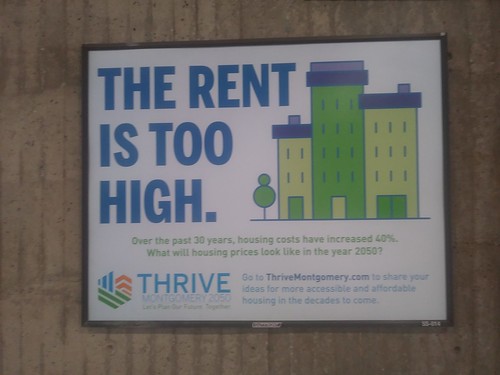
The rent is too high.  Billboard in the Silver Spring Metrorail Station.  Thrive MontgomeryOrganizations like Jubilee do this, but they probably aren't super active acquirers in the way and scale that I am thinking about.

The second thing is community land trusts. I know some have been created in the city, but they are far too late to the game to make much difference.

And the only real successful urban land trust I know about, in Roxbury, Boston, only has about 200 units of housing in their CLT after 25 years. To me that's pretty insignificant.

Other ways to add to the housing supplyADUs.  There should be massive support of the creation of accessory dwellings in the places where they can be developed at scale (both separate units and basement units).

The thing is that it's still expensive to develop such units, as much as $200,000, and the payoff period is 15 years or more, so people have to be altruistically motivated to do so.  Or you can provide incentives and mechanisms for building such units at scale.  In Portland, Oregon, Dweller is a for profit construction organization that focuses on ADUs. 

Two floors being added to an apartment building off Kennedy Street NW (maybe on 9th Street)Intensifying smaller properties into larger properties (e.g., 3 story apartment buildings on Fort Totten Drive could become 6 story buildings).

The building pictured at left, I think is at 9th and Kennedy Streets NW. 

I don't have a problem with intensification, I just want the building facades to be quality, e.g., if the building is brick, the new part should be brick also.

But surgical projects like these could add a lot of housing units.

Single Room Occupancy Housing to deal with the "homeless crisis." It's not clear how many units we have in the city, formally, but it's likely less than 1000 (So Others Might Eat has more than 600 units, but they never returned my calls when I wanted to write about it).

-- "One of the "solutions" to the crisis of homelessness is a lot more SRO housing," 2017

Opportunity costs for not building to reasonable density.  Plenty of buildings aren't built larger either because of zoning restrictions or placation of opposition to development.

The Willow + Maple Apartments are about three blocks from the Takoma Metrorail Station.  Even one more floor would have added 40 units.

And we're not talking skyscrapers.  We're talking two-story buildings that could be four-story.  Four- or five-story buildings that could be six- or seven-stories (like at Fort Totten Metro).

But this comes at a great cost.  Fewer units mean housing costs more.  Fewer units means DC makes less revenue in terms of personal income and sales taxes, property taxes, and commercial income taxes for rented buildings.  It means fewer people to support local commercial districts.  Fewer eyes on the street, etc.

But mostly, it means higher priced housing and more displacement.

Creating implementation organizations to do this at scale: community development corporations.  DC relies on for profit develoeprs to build housing, alongside mostly small community housing organizations.

WRT the Purple Line light rail program and its likely negative impact on maintaining housing affordability in communities like Langley Park, stating that PG and Montgomery Counties needed to create a community development corporation tasked with the responsibility of buying, holding, developing, and funding the maintenance of affordable housing (and other stuff too).

-- "Creating a transportation development authority in Montgomery and Prince George's County to effectuate placemaking, retail development, and housing programs in association with the Purple Line," 2017

The same goes with housing policy in DC. You need implementation organizations that can do it.

Integrating social housing in large scale redevelopment programs.  In writing about revitalization and housing planning initiatives in Europe, I learned that in cities like Helsinki, when they do master planning, from the outset they carve out sites within the project that are allocated to social housing organizations for the creation of new housing that is 100% affordable and complementary to the sites that are allocated to the creation of market rate housing.

One of the things I wanted to try to do was to create a bid team for the redevelopment project at the Armed Forces Retirement Home, to do just that.  But the likelihood of pulling that off was low.  Not just getting for profit developers together, but getting them to agree to give up some of the parcels to social housing.

It's the kind of thing DC should have done with the redevelopment program for Walter Reed, and the Hebrew Home for the Aging on Spring Street NW.

(Although I was super impressed that Empower DC pulled together a team to bid on the Alexander Crummell School site in Ivy City. It was a shame that they did not win.)

Building affordable units in otherwise market rate projects isn't enough.  We need some buildings in such situations that are 100% affordable. And similarly, many city owned properties need to be used for 100% affordable projects.  Maybe not all of them, but definitely more than none.

Tampa, because they don't have enough money to renovate their public housing, is doing some site redevelopment in a similar fashion, but in reverse, allocating space to market rate housing, and using the money for renovation of social housing. (This has been proposed in NYC too, and people are not in favor.)  But they aren't reducing the number of units that already exist, and they are building more social housing units.


Conclusion.  The biggest thing I've learned being involved in this stuff for not quite 20 years is that you need robust plans in place before market interest changes significantly, not after.

It's not like people don't know what best practice is.

Why it's not being effectuated in DC is another issue. Although DC does a bunch of things that help. The Housing Trust Fund, the law that allows tenants of apartment buildings to organize and buy the property if it is put up for sale, etc.

But the scale and velocity of the "problem" is significantly greater than the organizational mechanisms available to address it.

As long as we rely on the market to be the primary developer and operator of housing, we'll continue to be in the position we are in.

Labels: , , , , ,

Thursday, March 28, 2019

Another example of the need for social housing organizations to construct social housing at scale

Yesterday's Washington Post has a disturbing story ("Homeless, living in a tent and employed") about the plight of a homeless couple who are living in a tent on 1st Street NE near Union Station.

They are employed, although in low wage jobs.

When you make little income, you take any housing you can get at a rent you can afford.

They'd been paying rent on an apartment in a substandard building in Prince George's County, but the building was condemned with residents forced to find other housing.

The problem is, a $900 per month apartment is hard to find, especially when 100+ households are thrown back onto the market for housing in a situation like this.

Operating and maintaining low income housing isn't easy. The problem with managing and operating low cost housing is that it isn't cheap either, and after awhile, the properties deteriorate and eventually close after the cost for upgrade or maintenance exceeds the financial capacity of the owner.

I wrote about this a few years ago, suggesting that cities and counties create anticipatory programs to help ward off housing closure:

-- "Tower renewal: The Watergate and Southwest DC, and Toronto," 2011
-- "Deeper thinking/programming on weak residential housing markets is required: DC example, Anacostia," 2012
-- "Receivership is an underutilized tool: Lynhill Condominiums in Prince George's County, Maryland," 2014
-- "The long term potentially negative aspects of condominium buildings as a dominant housing form in cities," 2016

The Toronto Globe and Mail has a related article about how to make "tower communities" more livable, by adding social infrastructure, retail, and other amenities, "Tower Ambitions: how advocates and planners are rethinking high rise tower neighborhoods."

And Vancouver, BC still has a lot of SRO housing, although much of it is substandard and run by property owners who are more interested in milking profits from it ("For low-income residents in Vancouver, a different kind of real estate," Toronto Globe & Mail).

In line with my recommendations for government intervention, the City of Vancouver has produced an SRO Revitalization Action Plan.

Lack of enough housing is a problem. But having enough housing and different types of housing, in particular small apartments, is another issue. The private sector housing production industry is focused on producing the most profitable types of housing. That excludes low income housing, which is why it is subsidized.

But rather than rely on the private sector, it would be better for the social housing sector to be the prime mover in this segment.

And rather than having people live on the street, why not produce more of this type of housing, at scale, in well located places?

At a conference in Portland Oregon in 2005, I was surprised to see existing lower rent SRO housing that was well located, pretty near to Downtown.

I've written a couple pieces about the need for larger scale production of "single room occupancy" apartments, although the Post article demonstrates the need for housing that can accommodate more than one person.

-- "One of the "solutions" to the crisis of homelessness is a lot more SRO housing," 2017

There are related articles from places like Hong Kong ("Hong Kong rents leave some in coffin homes," AP) and London ("London housing crisis: £480 a month for a bed, in a shed" and "The great London property squeeze," Guardian) about lack of housing options leading people to rent spaces in "coffin hotels" etc.

Again, I think this coverage of affordable housing shortages in high cost markets illustrates the need for significantly more and a greater variety of SRO type housing.

Not just microhousing for higher income segments such as WeLiving ("What Life Is Like Inside WeWork's Communal Housing Project," Bloomberg), shared apartments for $2,000+/room ("Inside Common's Newest Co-Living Space In Chinatown, On A Fast Track To Opening," Bisnow), microapartments ("Historic DC mansion gets luxury apartment makeover," WTOP; "Life in a 375-square-foot apartment," Washington Post; "NYC micro-apartments: Success of Kips Bay's tiny studios could to more, developer says," AM New York), etc.

Note that the Kips Bay project referenced in the AM New York article includes affordable units.  From the article:
Billed as an experiment, the city relaxed its rules on minimum apartment-size at Carmel Place to see if micro-apartments could help house the growing singles population and drive down rents. Above nearly 5,000 square feet of donated city land, Monadnock Development constructed 55 micro-units, including eight set aside for homeless veterans and 14 affordable units renting for between $949 and $1,490 a month.
Still expensive for people living on the edge, but it adds more options.  (Although I argue for more SRO housing that is even cheaper to rent, because it's "cheaper" to have people housed than to deal with the social and economic costs of homelessness for the people stuck in that situation and for the cities and counties that have to deal with it.

Why aren't we integrating social housing into new large scale, grayfield developments?  Imagine if the future development over the Union Station railyard included a couple SRO buildings.-

Yes, there are requirements for a percentage of units to be allocated as affordable housing within the new construction of multiunit housing.  This is called "inclusionary zoning."  But usually this produces something like 15% of total units for lower income tranches, when far more than 15% of the population can't afford top priced housing.

But it would have even more effect if entire buildings were planned around a social housing agenda within these kinds of developments, rather than a few units, begrudgingly provided ("'Poor doors' are still creating wealth divide in new housing," Guardian).

Including social housing producers and operators as part of master planning for such large scale redevelopments would be a major change to the paradigm.

Labels: , , , , , , ,