Rebuilding Place in the Urban Space

"A community’s physical form, rather than its land uses, is its most intrinsic and enduring characteristic." [Katz, EPA] This blog focuses on place and placemaking and all that makes it work--historic preservation, urban design, transportation, asset-based community development, arts & cultural development, commercial district revitalization, tourism & destination development, and quality of life advocacy--along with doses of civic engagement and good governance watchdogging.

Friday, February 07, 2020

WPVI-TV Philadelphia series on gentrification "Building it Better Together"

=======
Updated: with links to the final two stories in this week's series
=======

The tv station is running four stories this week about change in Philadelphia primarily, but also its suburbs. 

The series is called "Building it Better Together: Changing Neighborhoods and the Impact of Gentrification."

The first discusses how change is focused on specific neighborhoods.  While in some neighborhoods housing prices have more than doubled, the average price increase in Philadelphia is 9%.  The webpage includes an interactive map showing price increases for every neighborhood in the city.

The piece mentions an advocacy group, the People's Emergency Center, which tracks changes in particular neighborhoods, and has a wide range of neighborhood-focused services, including emergency shelter, and a developer, Ori Feibush, of OCF Realty, who is building apartment buildings across Philadelphia--the one featured in the story actually looked quite good, but a perusal of their website shows many buildings that are modern renditions of rowhouses, which tend to clash significantly with buildings constructed before 1930.


The second story focuses on infill development, and how it is so significantly different in terms of design, and also about how changing neighborhood demographics changes neighborhoods.

It happens there is a thread about the quality of design and whether or not buildings that fit would assuage opposition.  (I happen to think not.  But it would be a lot better regardless.)

WRT design, it's another illustration of the need for design guidelines.  They aren't design guidelines, but many years ago the Philadelphia planning office produced a nice guide on the rowhouse type, the Philadelphia Rowhouse Manual.

Interestingly, the very first entry in this blog is a reprint of an op-ed I got published in the Philadelphia Daily News in 2003, on preservation-based revitalization, which I wrote after attending a conference there.


The third story looks at inward investment in two suburban communities, Ardmore--in Lower Merion Township, which is across the river from the Manayunk neighborhood in Philadelphia, and Phoenixville.


The fourth story features initiatives designed to help lower income households. 


Aaron Clark is a developer, principal of Philly Credit Mechanic.  The firm "flips" and improves properties, but it works with tenants with Section 8 vouchers to improve their credit worthiness and saves some of their monthly rent in an account that they can use to buy a house in the future. 

The Community Justice Land Trust owns and develops property, keeping the land element of development (land + building) permanently affordable.

Congressman Brendan Boyle proposes federal support for lower cost mortgages aimed to renters, to be able to buy in neighborhoods where they've been living, or subsidizing the payment of rent increases.

The story also interviews a spokeswoman from the Women's Community Revitalization Project.

The story says that investment is good, but that negative effects can and should be mitigated so that all people, regardless of income, can benefit.

The story presenter claims they have resources on their website on the topic, but they don't really have much that is useful.


Labels: , , , , ,

Wednesday, September 25, 2019

The Washington Post article on displacement in Shaw

It's a heartbreaking article ("D.C.'s gentrification is pushing black people out Shaw").

1829 13th Street NW is a relatively new build--it looks like it dates to the 1960s--in the midst of a great deal of historic housing, with nearby rowhouses worth between $1 and $2 million.

Sanathera Price  has lived at 1829 13th Street NW for 40 years, works for the Social Security Administration, knows her neighbors, etc.

But being in the core of the city, with living in DC now being a popular choice after many decades when it wasn't, properties that once were "affordable" are being upgraded for tenants or owners who can pay a lot more.

Gentrification.  DC has become "gentrified" because there is a greater demand to live here than there is housing supply to accommodate all the people who want to live here.

Why the addition of new housing doesn't reduce prices.  The reason that the addition of new housing isn't slackening prices is not just because (1) by definition new housing is constructed at today's cost of labor, land, and materials, (2) it's also because demand is still greater than supply even with the new additions to supply.

So people with more money bid up and successfully bid for and purchase the housing that exists. In a market economy, people with more money win out. It's not a secret.

Displacement.  For a long time displacement wasn't a big issue in DC, because much of the housing turnover was with the renovation of properties that had been vacant for decades (see "More about contested spaces--gentrification," 2004-2006) that's no longer the case.

How to respond.  To maintain a variety of income groups as residents in the face of a hyper strong real estate market there are two things that need to be done.

1. Build more housing.

2. Protect the affordable housing that exists.

WRT (1) we're not building enough housing. Relatedly, the opportunity costs in lost build out capacity, often in ways that would still be pretty low density, are incredible. Thousands and thousands of units aren't built.

That creates the velocity for displacement, because the inability to meet demand means that Class B and Class C housing is upgraded and sold or rented to higher income residents.

(2) There aren't systematic mechanisms for buying, holding, and maintaining affordable housing at scale. And mostly I mean multiunit dwellings. There are two elements. One is buying buildings, like that apartment building featured in the Post article on Sunday about Shaw.

Once a for profit developer buys a property low in a market that is strong, eventually it will be converted. So the agreement the tenants had ultimately didn't matter.

In my writings about culture matters and planning, where the issues are comparable, I write about "Buy(ing) the M* F* Building Already."

If you're whining about change and displacement and not creating the mechanisms to address the problem in a structural way, you're wasting your time, my time, and everyone else's.

So there needs to be a social housing entity that buys these properties.

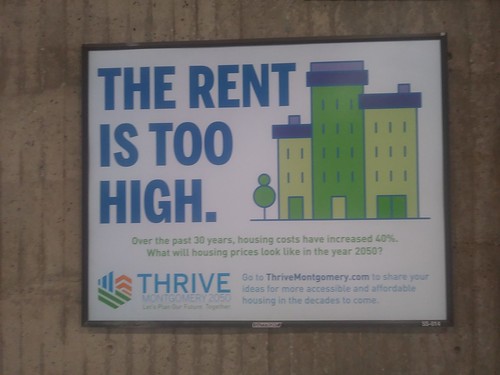
The rent is too high.  Billboard in the Silver Spring Metrorail Station.  Thrive MontgomeryOrganizations like Jubilee do this, but they probably aren't super active acquirers in the way and scale that I am thinking about.

The second thing is community land trusts. I know some have been created in the city, but they are far too late to the game to make much difference.

And the only real successful urban land trust I know about, in Roxbury, Boston, only has about 200 units of housing in their CLT after 25 years. To me that's pretty insignificant.

Other ways to add to the housing supply.  ADUs.  There should be massive support of the creation of accessory dwellings in the places where they can be developed at scale (both separate units and basement units).

The thing is that it's still expensive to develop such units, as much as $200,000, and the payoff period is 15 years or more, so people have to be altruistically motivated to do so.  Or you can provide incentives and mechanisms for building such units at scale.  In Portland, Oregon, Dweller is a for profit construction organization that focuses on ADUs. 

Two floors being added to an apartment building off Kennedy Street NW (maybe on 9th Street)Intensifying smaller properties into larger properties (e.g., 3 story apartment buildings on Fort Totten Drive could become 6 story buildings).

The building pictured at left, I think is at 9th and Kennedy Streets NW. 

I don't have a problem with intensification, I just want the building facades to be quality, e.g., if the building is brick, the new part should be brick also.

But surgical projects like these could add a lot of housing units.

Single Room Occupancy Housing to deal with the "homeless crisis." It's not clear how many units we have in the city, formally, but it's likely less than 1000 (So Others Might Eat has more than 600 units, but they never returned my calls when I wanted to write about it).

-- "One of the "solutions" to the crisis of homelessness is a lot more SRO housing," 2017

Opportunity costs for not building to reasonable density.  Plenty of buildings aren't built larger either because of zoning restrictions or placation of opposition to development.

The Willow + Maple Apartments are about three blocks from the Takoma Metrorail Station.  Even one more floor would have added 40 units.

And we're not talking skyscrapers.  We're talking two-story buildings that could be four-story.  Four- or five-story buildings that could be six- or seven-stories (like at Fort Totten Metro).

But this comes at a great cost.  Fewer units mean housing costs more.  Fewer units means DC makes less revenue in terms of personal income and sales taxes, property taxes, and commercial income taxes for rented buildings.  It means fewer people to support local commercial districts.  Fewer eyes on the street, etc.

But mostly, it means higher priced housing and more displacement.

Creating implementation organizations to do this at scale: community development corporations.  DC relies on for profit develoeprs to build housing, alongside mostly small community housing organizations.

WRT the Purple Line light rail program and its likely negative impact on maintaining housing affordability in communities like Langley Park, stating that PG and Montgomery Counties needed to create a community development corporation tasked with the responsibility of buying, holding, developing, and funding the maintenance of affordable housing (and other stuff too).

-- "Creating a transportation development authority in Montgomery and Prince George's County to effectuate placemaking, retail development, and housing programs in association with the Purple Line," 2017

The same goes with housing policy in DC. You need implementation organizations that can do it.

Integrating social housing in large scale redevelopment programs.  In writing about revitalization and housing planning initiatives in Europe, I learned that in cities like Helsinki, when they do master planning, from the outset they carve out sites within the project that are allocated to social housing organizations for the creation of new housing that is 100% affordable and complementary to the sites that are allocated to the creation of market rate housing.

One of the things I wanted to try to do was to create a bid team for the redevelopment project at the Armed Forces Retirement Home, to do just that.  But the likelihood of pulling that off was low.  Not just getting for profit developers together, but getting them to agree to give up some of the parcels to social housing.

It's the kind of thing DC should have done with the redevelopment program for Walter Reed, and the Hebrew Home for the Aging on Spring Street NW.

(Although I was super impressed that Empower DC pulled together a team to bid on the Alexander Crummell School site in Ivy City. It was a shame that they did not win.)

Building affordable units in otherwise market rate projects isn't enough.  We need some buildings in such situations that are 100% affordable. And similarly, many city owned properties need to be used for 100% affordable projects.  Maybe not all of them, but definitely more than none.

Tampa, because they don't have enough money to renovate their public housing, is doing some site redevelopment in a similar fashion, but in reverse, allocating space to market rate housing, and using the money for renovation of social housing. (This has been proposed in NYC too, and people are not in favor.)  But they aren't reducing the number of units that already exist, and they are building more social housing units.


Conclusion.  The biggest thing I've learned being involved in this stuff for not quite 20 years is that you need robust plans in place before market interest changes significantly, not after.

It's not like people don't know what best practice is.

Why it's not being effectuated in DC is another issue. Although DC does a bunch of things that help. The Housing Trust Fund, the law that allows tenants of apartment buildings to organize and buy the property if it is put up for sale, etc.

But the scale and velocity of the "problem" is significantly greater than the organizational mechanisms available to address it.

As long as we rely on the market to be the primary developer and operator of housing, we'll continue to be in the position we are in.

Labels: , , , , ,

Friday, September 05, 2014

Robberies in Northeast DC and the Code of the Streets: Bad people pay attention and watch

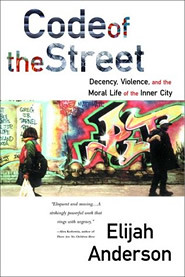
code of the streetsYesterday's Post reports ("D.C. burglaries increase in Brookland, Michigan Park") that "new residents" are concerned about a rise in burglaries that seem to be based on an understanding of when residents are not home.

I have all kinds of experiences of this kind related to when I lived in the H Street neighborhood.  I wrote about it a bunch over the years. And here:

-- Revitalizing places that are contested spaces
-- Historic preservation in low income neighborhoods
-- More on unaffordable housing (Yes, gentrification is part of the program in DC) 
-- Community Preservation and Development
-- One reason why I think the Gentrification word is over- and mis-used
-- Does change mean gentrification? Categorically?.

My joke is that when I moved to "the city" I was young (well, 27 years old) and dumb.

It wasn't until 2001 that I read the book Code of the Streets by Elijah Anderson.

Afterwards I joked that it's too bad I hadn't read such a book before I moved to the city, so that I could have been much better educated and prepared for what I was about to get into.

Other than moving my wallet from my back pocket to my side pocket to reduce the likelihood of pick pocketing, and not using ATMs or buying gasoline at night, I didn't do enough to harden my behavior to protect me from crime.

But today's residents have the advantage of being able to read Code of the Streets or even the "Code of the Streets" article by Anderson from The Atlantic Magazine circa 1994.

Also see this op-ed by Elijah Anderson, "Code of the street is keeping crime alive," from April 2005 in the Philadelphia Inquirer. (No longer available online.) From the op-ed:
In the code of the street, a set of informal rules governs interpersonal public behavior, including violence. The rules prescribe both a proper comportment and the proper way to respond if challenged. They supply a rationale that allows those who are inclined to aggression to precipitate violent encounters in an approved way.

In this setting, there is tremendous jealousy and envy. For a person to "have something" can be seen as disrespecting another; it can be confused with making the other feel small. So if another person has money, material things, or even simply good looks - anything that can be taken as a social good - such possession can be cause for an altercation to settle things.

On the streets, the distinction between street and decent is often irrelevant; everybody knows that if the rules are violated, there are penalties. Knowledge of the code is essential for operating in public. Families with a decency orientation often reluctantly encourage their children's familiarity with it.
2.  Generally, new residents in mixed income areas "are targeted" by those residents (or people affiliated with neighborhood households) with a propensity to commit crimes.

New residents, especially white or Hispanic, stick out in neighborhoods where most residents had been African-American.  So it's easy for people to figure out where the new opportunities are.

In 2006, Courtland Milloy wrote a column ("Violent Robberies Make It Hard to Ignore D.C.'s Vicious Side") where he made the point that the distance in DC between the haves and have-nots is not very big, which creates tremendous opportunity for crime, which waxes as wanes as neighborhoods change.

From the column:
The District has the largest disparity between rich and poor of any city in the country; the well-to-do may be enjoying their wealth too much to really notice. But the geographic distance between the two groups could hardly be smaller, and now there's apparently more resentment to go with the proximity.
I'd "forgotten about this" as then remembered as we were about to move to Manor Park in 2008, and I feared re-experiencing burglaries and street crimes.  For the most part, it didn't happen.  Although cars (we don't have one) seem to get broken into frequently enough, my rear rim was stolen off my bike (which was locked to my front porch), and Suzanne's flip flops were stolen off the porch.

... but other parts of the neighborhood have big enough problems (west of 5th Street and certain streets especially) and we heard of a terrible but sadly funny story of relatively new residents with a hot tub in their yard, very visible, who got "jacked" while in the hot tub one night.  That was in the west of 5th Street area too.  But it's all relative.  There are incidents relating to people being followed from the Metro station, and occasionally there are street crimes.

But I take that as part of living in the city, but any city.

OTOH, one of Suzanne's colleagues lives about one mile away from us, closer to Fort Totten, and they are experiencing the kind of targeting, combined with some bad luck, that I remember from H Street.  At one point they were considering leaving, but I think now they are going to stick it out.

It takes a lot out of you, especially if you aren't really prepared for it happening.  It's why I am not interested in moving to a neighborhood more like what H Street was like 15-20 years ago.

I no longer have the energy and tolerance for the pain and anguish.  But for the most part, I do know better how to protect myself and our household.

Labels: , , , , ,

Thursday, May 16, 2013

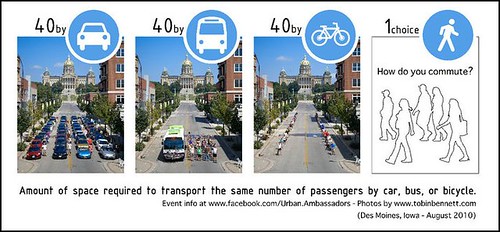
The "war on cars", the "war on bicycling", the war on parking, etc. is actually competition for the use of street and public space

There has been a spirited response in Washcycle/Greater Greater Washington ("Cyclists are special and do have their own rules") to The Atlantic Cities piece, "Cyclists Aren't 'Special', and They Shouldn't Play by Their Own Rules." about how bicyclists need to follow "the rules" in order to be accepted by motor vehicle operators. From the article:

The flip side is that in places like Chicago, they have also been ticketing bicyclists for violating laws. In New York, the Department of Transportation has deployed safety officers on busy bike routes to remind people of the right way to ride. Ticketing blitzes seem to be happening more regularly.

This is what has to happen for things to get to the next level.

Image from the EastsiderLA blog, "Northeast L.A. bike lane battle spreads to business community."

I come down on the side of Washcycle.

My position on differential rules of the road for bicyclists has been discussed here many times, based on both the physics of movement and the physics of traffic volume--bikes are smaller and take less space, but are slower.


It's the way it works in the Netherlands, where motor vehicle operators are required to take more care than is required in the US, based on the reality that motor vehicles are bigger and faster and more dangerous, and therefore operators need to be held to a high level of responsibility for their actions.

I am fine with tickets for bicyclists "blowing through stop signs" when there is oncoming traffic or for riding against traffic (which doesn't happen as much as people say). But otherwise I believe that the Idaho Stop should be legalized first.

But a legalized Idaho Stop and better training for both bicyclists and drivers, and stepped up enforcement against bicyclists (but why not stepped up enforcement and prosecution for motor vehicle operators too?), won't lead the bulk of non-bicyclist motor vehicle operators (and I've been hit by a vehicle with a "I'd rather be biking" bumper sticker) to all of a sudden want to "share the road" with bicyclists.

There may not be a war on cars but there is a battle for how best to mediate between the conflicting and competing demands for the use of scarce space on streets and roadways.

Do we continue to privilege space for motor vehicles, or do we divvy it up better, between bicycling, transit, traffic throughput, car storage, car sharing, etc.?

In cities specifically, where sustainable modes are far more likely to have primacy, this is an increasingly heated discussion.

This is about the contestation of space pure and simple.

-- Change.org petition against bike lanes

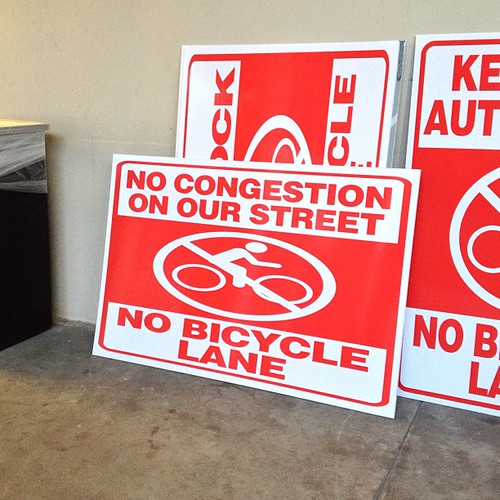
More anti- #bikela signs at Colorado bike lane town hall. #fig4allRight: image of an anti-bicycle lane yard sign from the Flying Pigeon blog, Los Angeles.  "NELA bike lane controversy comes to NCs this week."

The reality is that it's bunk that if all of a sudden bicyclists followed all rules (and if we did, vehicle throughput of all types would be significantly reduced--taking the lane, etc., because face it, bicycles are slower than cars) then motor vehicle operators would miraculously be all right with giving up what they consider to be their "right" of being privileged in the use of streets and public space.

It might not be "a war on cars" (see the City Paper article) but it definitely is a battle over who is using public space--streets and more (especially for low cost or no cost parking).

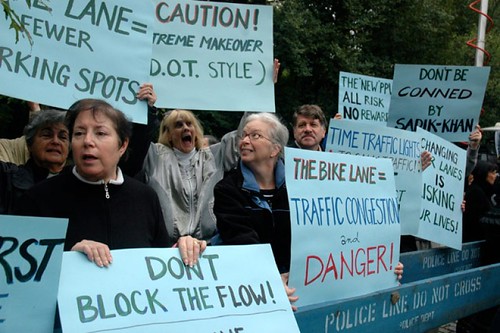
Prospect Park West bicycle lane protestLeft: protest against the Prospect Park West bicycle lane, Brooklyn.  Photo by Zoe Schlanger from The Gothamist.

There is no question that for decades, motor vehicles have enjoyed privileged use of the space, and now that's being challenged.  They don't like it, and this is why the argument is so heated.

The aggravation with bicyclists is over their perceived and real impediment vis-a-vis cars.

The funny thing is that if motor vehicle operators want fewer impediments, they ought to be the foremost advocates for separated infrastructure, instead of being the biggest opponents.
Amount of space required to transport the user the same number of passengers by car, bus, or bicycle

Labels: , , , , , , ,

Thursday, August 16, 2012

Housing segregation in DC: is it more about class than race?

Last week's City Paper has a little article and nice graphic, "Apart and Parcel: What Housing Segregation in D.C. Looks Like."  It says:

The persistence of black-white residential segregation reflects the nation’s inability to fully overcome the legacy of slavery, and it negatively affects education attainment, race relations, and productivity. Despite nearly a century of legal and legislative struggles to integrate our blocks, segregation by race is still the norm in the District.

But I think it's tricky, analyzing housing segregation in the city, which exists, because poverty oftentimes masks race.

In the US, we are not big on economic class as an analytical tool, and too often we consider race as the appropriate analytical substitute.

1.  In DC, the most persistently segregated neighborhoods are either of high or extremely low income.

2.  DC has lots of poor African-Americans, but not many poor White people, but some relatively poor Latinos.  So extremely impoverished neighborhoods in DC are likely to be black dominated, not unlike Detroit, which is almost 90% African-American.

3.  DC neighborhoods with well off residents are likely to be white dominated, not because African-Americans don't have money, but because African-Americans of means have tended to move out of the city, and because more generally, African-Americans, unlike the people who watched the tv show Friends, still don't see the center cities as a premium place to live.  (Also see "Commerz in the 'hood... (aka "Commerce as the engine of urbanism")" from 2006 and "Too early to say what the special election in Ward 5 means: but change is coming regardless" from May.)

Restaurant patio, 11th Street NW, Columbia HeightsLeft: patio, Wonderland Ballroom, 11th Street NW, Columbia Heights.

4.  Segregation is also abetted by the neighborhoods where new residents prefer to live, in the core of the city, places like Dupont Circle, Columbia Heights, H Street, Capitol Hill, Downtown.  (When I told someone high up in DC Government where I lived, s/he was derisive, because it isn't a happening place.)  So white places get whiter.

City neighborhoods on the outskirts of the city tend to be either black or white without a lot of mixing, reflecting residential trends dominant in the 1970s.  Now, African-Americans are mostly leaving the city and whites and Latinos are slowly trickling in, such as in Ward 4, which over the last 10 years lost 10,000 African-American residents, and gained 11,000 whites and Latinos.  See "Gentrification and the 'hood: continued."

This trend will solidify because comparatively speaking, the houses are cheaper in neighborhoods like Petworth and Brightwood than they are in the core, and the price attractiveness will lead to more in-migration of whites and Latinos.  (As I have said before, in my neighborhood, with just a few exceptions, houses that come on the market are sold to white or Latino or mixed race households, not African-American families.)

Labels: , , , , ,

Saturday, August 11, 2012

the right to the city

There is a good Atlantic piece, "The Politics of the Urban Comeback: Gentrification and Culture in D.C.," responding to another whitey is taking over the city/appropriating black culture piece in the Washington Post, "The Brixton: It's new, happening and another example of African-American historical 'swagger-jacking'."

The interesting thing about these perspectives is that while half right, about appropriation of what we can call the "exchange value" of culture or blackness, they are half wrong in that they inadequately provide historical perspective in terms of analyzing the city demographically--e.g., Prince George's County didn't become majority black because of the white conspiracy, but because people of means moved out of the city in great numbers.  
 
For example, the "famous" New York Times Sunday Magazine cover story in 1992, "The New Black Suburbs," which featured Jack and Leslie Johnson in the cover photograph.  I remember reading that piece.

As far as dealing with the more fundamental issue of why so many African-Americans in the city are ill-prepared to compete in the context of a market economy, the articles don't address the problem.

I happened to write something about this last December, in response to a similar article, "Low income, high income, [the housing] market, and the right to the city."  The end of the blog entry discusses some of the policy/programmatic options that could be utilized.

Note that I have speculated that the issue of neighborhood change (with no opinion about whether or not this is good or bad) in Shaw and Anacostia is more a function of achieving a critical mass of new, higher income residents, and is a function of time/access to transit/safety issues, that these neighborhoods are likely to change demographically too, significantly, just at a different pace from areas like Capitol Hill.

Basically it's a challenge to the thesis by Prof. Hyra that Shaw has successfully resisted gentrification.  I counter that his thesis employs too narrow a time frame.

Labels: , ,

Thursday, January 12, 2012

Neighborhood change/gentrification

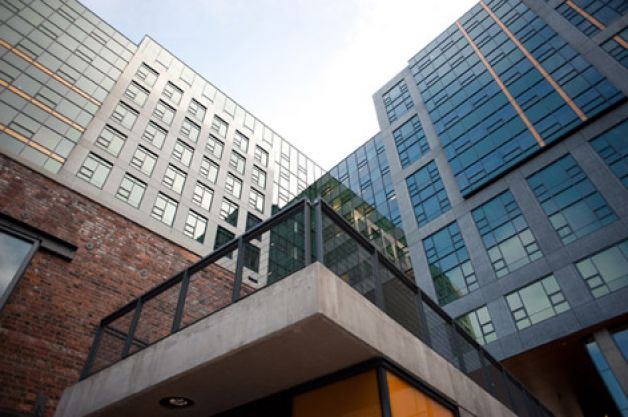
Amazon headquarters, Seattle

The fourth phase of the new headquarters that Vulcan is building for Amazon.com is seen at an unveiling on March 22, 2011 in Seattle's South Lake Union neighborhood. Elliot Suhr/seattlepi.com.

When I write about "gentrification" I make the point that the issue is really about neighborhood change, and that the "new people" are different from the "old people" and that these differences aren't always economic or racial, but can include differences in educational attainment, where you work, etc.

The South Lake Union neighborhood in Seattle is in a long term redevelopment process, not unlike the old urban renewal ideals but with better design, initiated by co-founder of Microsoft Paul Allen, and his Vulcan Realty Group. See "Vulcan completes most of new Amazon headquarters: Developer touts plan for taller buildings elsewhere in South Lake Union" from the Seattle Post-Intelligencer. The streetcar initiative in Seattle was pushed forward to support the intensification of this neighborhood. (South Lake Union streetcar case study, Reconnecting America.)

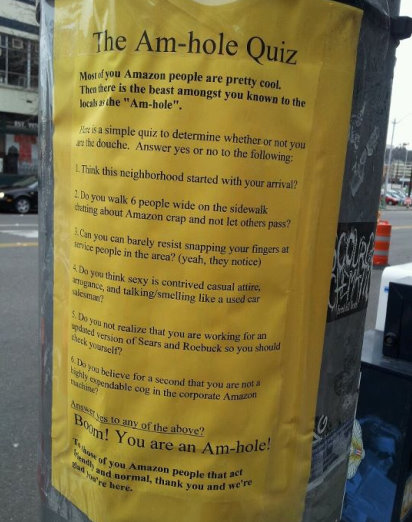
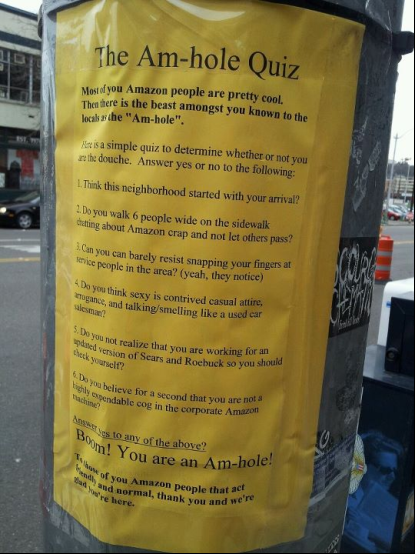
Apparently, not everyone is with the program, according to this piece, "Hey, ‘Am-hole!’ South Lake Union calls out Amazon employees," from the SPI, which describes and pictures a flyer posted around the neighborhood, with criticism of the behavior of workers from Amazon.com's headquarters complex--illustrating the complexity of thinking about and dealing with neighborhood change.
amhole, protest flyer against Amazon workers, Seattle
Photo via reddit user istrebitjel.

Labels: , , ,

Saturday, December 31, 2011

Low income, high income, the market and the right to the city

There are some pieces on "gentrification" out there that are getting play, but I don't think they contribute to the discourse much, because they don't make connections to earlier work on the topic.

In Salon, Will Doig has an article, "Can gentrification work for everyone?," on higher income "African-American" "gentrification" in Anacostia, and Southern California NPR ("The cultural mashup dictionary: gentefication") and WAMU, the NPR affiliate in DC ("Gentrification, Try Gentefication"), have a couple of pieces on the same subject, the Cali piece focuses on Latinos.

The process of reinvestment described in the "gentefication" process is similar to the way some immigrants continue to invest in their old communities as described in Arrival City by Doug Saunders as well as many articles in the media (I can think of articles from the Los Angeles Times and the Washington Post and the New York Times specifically) about how Latino immigrants in the U.S. invest in their communities "back home" and how this changes those communities. It's just a matter of focusing that investment on "arrival neighborhoods" in the U.S. instead of back "home." And it's just a scalar difference from earning money abroad and sending it home to the family--economists call it "currency transfers."

Two things that make the discussion of gentrification difficult in the US concern how people still tend to (1) believe that living in cities is undesirable and is counter to most trends concerning residential choice; and (2) ignore class/economic distinctions, or make sweeping generalizations about them, thinking that most people of color (African-American and Latino in particular) are poor.

They also don't think much about the fact that the US is decidedly a market economy, albeit with plenty of government intervention in the housing market (both policy and financial), and for areas in demand or areas that become more attractive, good deals/low prices lead to increased demand, and in situations with increased demand, people with more money win out over people with less money.

Just like how some people believe that only white people can be racist (not true), others believe that only white people moving into center city neighborhoods are "gentrifiers."

By thinking this way, what they fail to appreciate is that the process of in-migration of this type is about money and class, not race.

-------------------------
This excerpt from a past blog entry is about 7 years old:

Gentrification effect (2) is what I think people really mean when they are talking about "gentrification," new and different people coming into a neighborhood. Of course, in neighborhoods like CH, displacement is really happening.

As far as displacement goes, it's part of what people call "gentrification". But gentrification is phenomenon with multiple effects, which I describe as:

(1) new investment in a previously underinvested area;

(2) change and different people coming into a neighborhood -- most importantly, different people from those currently in residence (the differences--race, class, ethnicity, levels of educational attainment, attitudes toward the urban experience, etc.--are usually not "celebrated" (I make this point because I still remember first being taught about diversity and multiculturalism in 7th grade, and I specifically remember the "melting pot" and "celebration of differences" phrase -- I have a hard time seeing the celebration, at least in DC);

(3) increase in conversion of previously rented dwellings to owner-occupied, leading to a displacement of renters and an overall reduction of the number of rental units available in the neighborhood;

(4) related to the new demand for living in the neighborhood is an increase in rental rates, which contributes to the displacement of low- and moderate-income residents;

(5) neighborhood improvement as investment (primarily through the renovation and sale of houses to new residents) continues to increase and begins approaching critical mass (cf. Goetze Building Neighborhood Confidence);

(6) faux-displacement as long-time residents decide to "cash out" and take profits on the sale of the finally appreciated property (this is accelerated by, in my opinion, the still prevalent pro-suburban, anti-city attitudes embraced by particular demographics that tend to represent the long time population groups in traditional center cities); and

(7) ongoing increases in property tax assessments which contributes to the displacement of longtime residents on fixed or lower incomes (note that this effect is hard to separate out from [6]).
------------------------
While the academic study of gentrification focuses on national and global processes of "the reproduction of space" rather than seeing gentrification as mostly an issue of race, I still believe that the urban sociology subfield of gentrification in the U.S. has one major flaw, that the cycle of urban development should go only one way--outward, and that neighborhoods are born; grow; and decline, and in the declining phase become home to the less well off; rather than recognize that decline is not inevitable when considering multi-decade time frames.

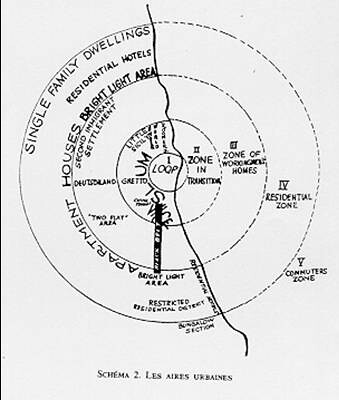
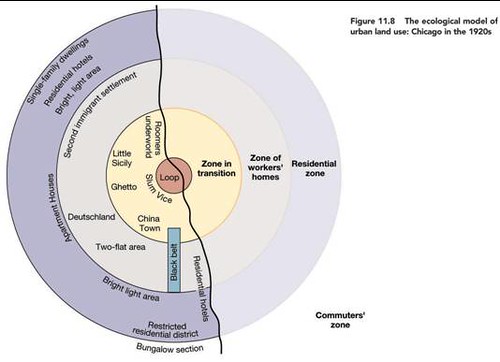
This is based on the 1920s work of the "Chicago School of urban sociologists," in particular Robert Park and Ernest Burgess. Their work was based on the idea that the well off wanted to be separate from the less well off and so they continually moved outward from the core of the city.

As neighborhoods were "abandoned" by groups as their economic situation improved, they were replaced by new immigrants and in-migrants and the process began again. This process has a number of terms to describe it, including invasion-succession theory, ecological succession, or concentric zone theory. And the 1970s housing improvement theory called "filtration" is based on this idea as well.
Ecological succession model, Chicago sociology

Ecological succession model, Chicago sociology
The first diagram is from The City by Park and Burgess, the second is a more modern rendition and might be easier to read.

Much of the study of gentrification over the past 30 years is based on the work of geographer Neal Smith and his book New Urban Frontier: Gentrification and the Revanchist City. Other work that I like (Loretta Lees' Gentrification, co-authored with Elvyn Wyly and Tom Slater, and her paper in Urban Studies Journal, "Super-gentrification: The Case of Brooklyn Heights, New York City") utilizes a similar thesis, that inner city communities, usually minority, are underinvested and this allows people with higher incomes and power to acquire property transform space, and displace the less advantaged.

The supergentrification thesis is subtly different and very much relevant to global cities. It's about how people with extranormal income, such as Wall Street financial types, reshape the market for residential real estate in desirable submarkets like Brooklyn Heights. This idea can be extended to the idea of second, third, and fourth homes in desirable cities such as Charleston, SC, Downtown Washington, South Beach in Miami Beach, San Francisco, etc.

Locals are displaced by capital flows from outside the region. Capital flows from outside the region are shaping the DC housing market at many levels.

A good overview of the academic take on gentrification is in this book chapter, "Gentrification and the City," by Tom Slater.

I think what's happening in California in Latino communities is different from what's happening in Anacostia. African-Americans of means moving to Anacostia for the most part don't have previous connections to the neighborhood, unlike the Latinos profiled in the SCPR piece.

The back to the city phenomenon on the part of African-Americans is still a pretty localized phenomenon and counter even so to the multi-decade out-migration of middle class and upper middle class blacks from DC, especially to Prince George's County (and from there to Charles and Anne Arundel Counties).

But this isn't a huge demographic wave, not yet. See the blog entries from earlier this year, "Revitalization in stages: Anacostia," and "Gentrification, neighborhood change, and wacked discourse."

My sense is that those African-Americans in-migrants who do want to live in the city are being priced out of more desirable areas and are picking Anacostia as a result. (Very much like how I chose to buy a house in the H Street NE neighborhood in 1988--although I don't live there now. Then, prices throughout the city were constantly rising, the H Street neighborhood was seen as less desirable so prices were much lower, although it was close just as close to Downtown as Capitol Hill with comparable--but smaller--housing stock date from the 1880s to the 1920s, and I thought if we didn't buy then we'd be forever priced out of the market.)

I do think as Anacostia improves and becomes more safe, it's possible that the in-migration of whites and Latinos could make the market even more competitive and over very long frames of time, the area could experience significant non-African-American in-migration.

---------------
To those of us who have been in the city for 20+ or more years, and lived in areas seen once as undesirable, we know this is a distinct possibility. I talk with my next door neighbors--they are lifelong Washingtonians and in their 60s--and we are all amazed at "seeing white people" and baby carriages or bicyclists on various blocks, say the 600 block of Orleans Place NE, which in the late 1980s was one of the city's chief distribution centers for crack and the location of dozens of murders over that time, or at 1st and M Street NW, etc.

This was completely unimaginable even 10 years ago.
----------------

Although it's probably a 30+ year process--it will take that long for significant redevelopment to occur east of the Anacostia River because it will take 20 years or so for more desirable parcels located west of the river in SE, SW, and NW to be developed although places located on subway lines will be absorbed first (Capitol Riverfront, Southwest Waterfront and Southwest, NoMA, Reservation 13, McMillan Reservoir, areas near transit stations such as Fort Totten and Brookland, and parcels near Rhode Island Metro, Takoma, the Armed Forces Retirement Home, H Street NE, lower U Street, Walter Reed, etc.).

This could speed up a bit if a more concerted effort to link the Capitol Riverfront development west of the river with the development opportunities at Poplar Point east of the river in a joint revitalization planning process and program occurs.

I think that could have more positive effect than the focus on the St. Elizabeths Campus, which is pretty much self-contained (see the old blog entry from 2006 "Enclave development won't save Anacostia") and therefore has less capability to generate "trickle down" and "trickle up" improvements.

But the point of the academic literature on gentrification is that the poor are displaced. New investment doesn't help the less advantaged all that much.

But cities need investment and in-migration in order to thrive. So the reflexive oppositional stance vis-a-vis in-migration and investment is counterproductive, at least if you want to have the money to pay for public safety, quality schools, and other municipal services.

David Harvey's paper (expanded into a book), "The Right to the City," first a lecture then published in New Left Review, makes the point that the right to the city is imbued in us as citizens, and transcends our place as defined by the market economy.

In a market economy, for this to be the case, Social Darwinism as the predominate social policy has to be supplanted by a much broader agenda, which in a time of economic privation, it's very difficult to find proponents for such an agenda.

Frankly, I don't think the issue should be preserving places for the poor as they are as much as it should be on assisting people so that through education, training, and other assistance, they are prepared, able and capable of participating in the market economy. I can't claim to have a particularly good set of policy proscriptions to do that although I have a bunch of ideas:

- a robust affordable housing policy and a robust program to maintain affordable housing stock through portfolio investment programs, new production of affordable housing, community land trusts, and cooperative housing programs
- great public schools
- year round school, extended day programs, co-operative high school programs
- free access to higher education and other training programs, including trades (e.g., "A woman who teaches men to weld provides other life lessons too" from the Los Angeles Times)
unification and synchronization of various social service programs into community centers, sometimes called "community schools," one particularly good example is the effort in the City Heights neighborhood of San Diego by Price Charities and programs described in this 2006 blog entry, "Public assets: public school buildings used for more than school"
- caseworkers assigned not to multiple families but having one or two families only as their clients (think of what this article discusses on routinization of positive health behaviors and apply it to participation in the market economy, "Gentle Nudges Work to Get People Exercising," from the Wall Street Journal).

Until we take this step, in-migration into the city and the process of improving and repositioning neighborhoods will continue to be traumatic and contested.

Labels: , ,

Tuesday, September 13, 2011

The Invention of Brownstone Brooklyn: Gentrification, Renovation and the Search for Authenticity in Postwar Brooklyn: Lecture Tuesday 9/13

(It happens I am reading this book right now. Prof. Osman is an EXCELLENT writer. Of course, the process he describes in Brooklyn is fully relevant to DC and other center cities that utilize historic preservation based strategies for neighborhood stabilization and improvement. I do intend to do a writeup soon.)

-- Oxford University Press webpage for the book

From the Latrobe Chapter of the Society of Architectural Historians:

Tuesday, September 13, 2011

6:30 P.M. – light refreshments, 7:00 P.M. – lecture
The National Trust for Historic Preservation
1785 Massachusetts Avenue, NW, Washington, DC.

Reservations are not required. $10.00 for Latrobe Chapter members, student members (full time) free with ID, $18.00 for non-members.

The gentrification of Brooklyn has been one of the most striking developments in recent urban history. Considered a “blighted” slum by city planners in the 1940s and 1950s, Brownstone Brooklyn by the 1980s had become a landscape of hip bars, yoga studios, and expensively renovated townhouses in new neighborhoods with creative names like “Boerum Hill” and “Carroll Gardens.”

Professor Osman locates the origins of gentrification in the cultural upheavals of the 1960s. Starting in Brooklyn Heights in the 1940s, a new urban middle class (or “brownstoners” as they referred to themselves) began to migrate into Brooklyn’s brownstone areas, purchasing and renovating aging townhouses.

Where postwar city leaders championed slum clearance and modern architecture, "brownstoners" sought a new romantic urban ideal that celebrated historic buildings, industrial lofts and traditional ethnic neighborhoods as source of authenticity they felt was lacking in new suburbs and downtown skyscrapers. They started new reform democratic organizations, founded block associations and joined forces with long-time residents to battle urban renewal.

But as brownstoners migrated into poorer areas, race and class tensions emerged, and by the 1980s, as newspapers parodied yuppies and anti-gentrification activists marched through increasingly expensive neighborhoods, brownstoners debated whether their search for authenticity had been a success or failure.

Labels: , , , , , ,

Saturday, September 03, 2011

Gentrification and the 'hood: continued

Petworth 5th street homes
American Prospect throws in its contribution to the gentrification of Washington discussion, with the piece, "A City Divided: September 11 was good for Washington, D.C.’s economy, but the expansion has not helped many on the bottom" More venturesome than others, instead of writing about H Street or Shaw, they discuss Petworth in upper northwest DC.

The problem with these kinds of pieces is that because their frame of reference is typically flawed, they end up not contributing very much to the discourse about urban policy and revitalization.

It's not all that interesting to me to read a description of a place as much as it is to figure out how the lessons "learned" contribute to broader understandings that I can apply elsewhere.

E.g., neighborhood change over the last 10+ years in DC is particularly interesting to me because with the exception of similar kinds of changes in Brooklyn and maybe in Center City Philadelphia, for the most part, equivalent change did not occur in other center cities with roughly similar conditions, in particular a large minority population (which takes Seattle and Portland out of the equation).

Figuring out why the changes occurred becomes important if you want to improve urban policy generally and other places specifically.

Attributing the change to post-9/11 growth of the federal government as is done in the American Prospect piece, I don't think explains what is happening.

The things that I say are key to DC's competitive advantages are more important:

1. historic residential building stock (that is attractive to people with choices), and neighborhoods proximate to the central business district;

2. pedestrian-centric urban design in the core of the city;

3. historicity, identity, and authenticity;

4. a robust transit infrastructure (in the core of the city especially), which allows for efficient and effective mobility by transit and doesn't require a car;

5. the (now relatively, but slowing) steady employment engine of the federal government.

But this pre-supposes that the local center city, in this case Washington, is relatively attractive in terms of the quality of life, public safety, and the provision of municipal services. This is key because urban neighborhoods must compete with suburban neighborhoods for residents.

What changed this equation for DC was two-fold. First, and most importantly, Marion Barry was no longer mayor of the city, with the election of Anthony Williams in 1998. As the city government refocused attention on delivering services and addressing crime, this changed the investment climate specifically for both commercial and multiunit residential development.

(To be fair other things happened during the Barry years which contributed to this improvement, such as the relocation of the professional basketball and hockey teams to Downtown DC from the Maryland suburbs, which helped to intensify redevelopment in what used to be called the city's "east end," which is now full of apartment and condominium buildings and a strong retail and entertainment center at Gallery Place, which took 20 years to develop after the opening of the subway system.)

Second, was the achievement of critical mass in terms of the willingness of "younger people" with choices choosing to live in the center city. Before, younger households still chose the suburbs over the center city. But with tv shows like "Friends" and "Seinfeld" (versus say "The Brady Bunch") perception of the center city as a choice place to live changed.

This is important because for the past 20 years (not 10 years as stated in the American Prospect article), DC's black population has been dropping--in large part as the black middle classes decamped to the suburbs, abandoning the city, just as the whites had done in the 1950s.

If not for an influx of white and Hispanic residents, DC's population would have steadily declined over the past 20 years because of black outmigration. See "The New Black Suburbs" from the New York Times Sunday Magazine, 6/14/1992, ironically featuring Jack and Leslie Johnson on the cover.

Part of this reality is captured in the Brookings report by Professor Eugenie Birch, Who Lives Downtown? and more in the work of Columbus Ohio city planner Kyle Ezell, who wrote Get Urban! and other books about the reconsumption of urban living. But they weren't the only people discussing this phenomenon.

Getting back to Petworth

What is driving the change in Petworth specifically is the presence of attractive rowhouses AND the Green Line subway station AND the building of infill multinunit housing on Georgia Avenue proximate to the subway station. Plus the influx of new population is reshaping the retail environment, an independent coffee shop, one of DC's few hip neighborhood restaurants not owned by a chainlet, Domku, a branch of the Yes Organic Market.

In response to the changes, Safeway announced they will redevelop their tired store into a mixed use housing development with a spanking new store on the ground floor ... although I worry that this plan might not go through because of the development of a Walmart store up the street, not quite 2 miles away.

Current and proposed Safeway store, Petworth
Safeway on Georgia Avenue, Petworth

Petworth Safeway rendering

The part of the Green Line serving Petworth and Columbia Heights didn't open until 1999. So it makes sense that these neighborhoods didn't begin repositioning until afterwards (not unlike how north of H Street NE became more attractive upon the opening of the New York Avenue Metro station in late 2004 and the subsequent intensification of the "NoMA" district west of the railroad tracks).

City and WMATA planning and development initiatives encouraged the creation of multiunit residential buildings at these subway stations. As closer in locations were developed in the core of the city, Columbia Heights and Petworth have become more attractive to people looking for starter housing and proximity to Downtown. What is key is that the land around these stations has been developed to support urbanism, unlike development at Fort Totten and Rhode Island station, which is why those areas have lagged compared to other improving areas in other parts of the city (note that I don't include Fort Totten in my list of 31 stations "at the core of the city.")

I wrote about this general issue in an op-ed in the Philadelphia Daily News in 2003, "An outsider's version for saving Philly," but I don't think that I truly appreciated the difficulty of changing people's perceptions about being willing to live in a declining center city.

DC, because of the historic preservation movement over the past decades, has many stable neighborhoods that have maintained their ability to attract high-income residents even in worse times.

Plus, at the core of the city, DC has about 31 transit stations (I used to say 29 stations, but in an entry not quite two years ago, a commenter argued that this list should be expanded to include the Waterfront and Navy Yard stations on the Green Line, because of redevelopment activities in those areas, and I have to agree) over a 15 square mile area. For the most part, all of these neighborhoods served by those stations are improving (with the exception of the area around Rhode Island Station).

These are key differences then, between DC and other center cities and weren't adequately captured in the American Prospect article.

In any case, it still sucks to be poorer when the market economy decides that your neighborhood is worth reconnecting to the broader residential and commercial landscape within your city and region.
Park Place Apartments, Georgia Avenue
This photo: Park Place Apartments, Georgia and New Hampshire Avenues, Park View-Petworth. Next photo: Petworth Farmers Market.
There is a new farmers market in Petworth on Friday evenings

Labels: , , , ,

Saturday, August 07, 2010

Place and the politics of belonging

Appropo of the previous entries, there is a talk on "Place and the Politics of Belonging" at the Library of Congress next week.

August 12, 2010, 12:00 noon - 1:00 pm
Mary Pickford Theater, 3rd Floor, James Madison Building

Place and the Politics of Belonging
presented by Debra Lattanzi Shutika, George Mason University.

Labels: , ,

The more things "change" the more they remain the same versus a "third way"

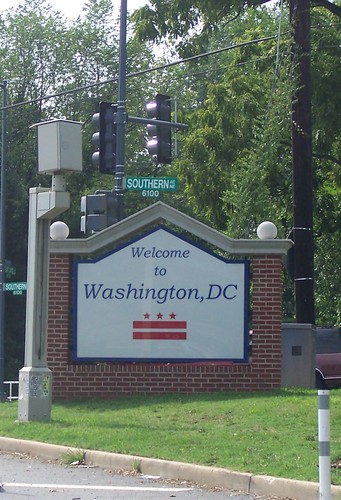
Gateway entry sign for DC, at East Capitol and Southern Avenue NE (cropped)
I guess it's just worth reprinting in its entirety the blog entry " Tom Sherwood, Duncan Spencer, Anwar Amal, and thinking about what I call the "Uncivil War"." I wanted to write the piece in 2004, but I was afraid to take the heat. When I did write it, no one responded so I guess it didn't matter.

I've written some about the current election, mostly in listservs. I don't really like the choices very much. It's not that Vince Gray is a bad person (he actually has some merits), but his candidacy is about who gets the most from city resources, and it's more about politics of the past.

My problem with Adrian Fenty is multi-fold. He thinks that people like me (I am 50 years old) as washed up and have nothing to offer, and he thinks that "the younger set" know everything, when it's pretty clear that they don't have the value of wisdom and a breadth of experiences, so what they "know" is constrained. This comes out clearly as a problem with the improvement of public schools and with various economic development issues. Then there is the problem of cui bono, or who benefits from government contracts, appointments to city boards and commissions. There have been corrupt practices with contracts ("Fenty's friend's firm got millions after D.C. ended contract" from the Post) and there are many problems with appointments to key boards such as the Zoning Commission, the Board of Zoning Appeals, the Historic Preservation Review Board, the Taxicab Commission, and the Board of Elections and Ethics, not to mention the chief of the Public Service Commission. And I am sure that I missing many other problems.

I want a third way. I don't want a return to the past as recounted in Dream City. But I think that the potential of the future is far greater than can ever be realized by Mayor Fenty and his team. So neither candidate appeals to me, and the minor candidates are minor for a reason...

So I am at the point where I don't even want to vote in the primary (and I have voted in every primary since I've lived in the city, except for one, when it was an uncontested race), except that of the two candidates in the Council Chairman election one is worse than the other, although both are unappealing, except for my wanting to vote for Phil Mendelson for an at large position (see "The Boring Charms of Phil Mendelson The wonkiest member D.C. Council faces a dynamic challenger. Again." from the City Paper).

As the Meryl Streep character says in the movie "Postcards from the Edge" when she was complaining to her mother about the quality of her childhood, and the mother (Shirley MacLaine in the movie) said it could have been worse, that she could have been like Joan Crawford, and Meryl replies "those are my choices!?" The choices we have this fall are bleak indeed.

-- This review, "Dream City: Race, Power, and the Decline of Washington, D.C., 1964 - 1994 from the Washington Monthly, is a pretty good synopsis of the book.

--------------------------------------

Thursday, July 14, 2005

Tom Sherwood, Duncan Spencer, Anwar Amal, and thinking about what I call the "Uncivil War"

Unfortunately, I can't go to the meeting tonight featuring Tom Sherwood. I'd love to go, and talk to him about what's been on my mind for awhile...

Tom Sherwood is the DC politics reporter for NBC4 (WRC-TV). He used to write for the Post (I don't know why he left) and he writes a weekly "Political Notebook" column in the Current Newspapers. He is the co-author of a very important book on understanding DC politics and the "race divide" --Dream City: Race, Power, and the Decline of Washington.

Even though I owned the book for years, I didn't read it until about 18 months ago. The book is about the city under home rule, and really it's about the Marion Barry mayoralty. (Note: it was from this book that I learned that Marshall Brown, father of City Councilmember Kwame Brown, was one of Mayor Barry's chief field organizers...)

The chapter on land use and real estate development should be required reading for any local activist concerned with these issues, and it dovetails nicely with the thesis of Logan and Molotch's Urban Fortunes: A Political Economy of Place and the "Growth Machine" thesis that all local politics is really focused on local economic development and "growth," regardless of intra-elite competition.

Speaking of the "racial divide," Duncan Spencer's column in The Hill this week has a piece that is relevant to this ongoing debate (and note: Spencer's piece starts off with a discussion very similar to something I wrote about these issues in October 2001--I guess I will dig up that posting and put it in a blog entry).

A new gentry, with old quarrels

Accelerating change has come to the section of Capitol Hill known as Near Northeast.

Ten years ago, its small, tight row houses were the logical starter homes for up-and-coming Hill rats. Now it is under siege by economic engines on all sides: Securities and Exchange Commission lawyers have moved into the giant Station Place building on Second Street. Developer Jim Abdo is building more than 300 new upscale apartments and condos at the former National Children’s Museum. H Street N.E. is rapidly turning into a shopping, arts and entertainment corridor.

The community has been energized by an incoming group of young, affluent people, many of them white, while older black families have been threatened by higher rents or have sold out at prices unimaginable 10 years ago.

Friction between the new and old of Near Northeast has coalesced around a single very public point — a long-standing block party on Father’s Day at Sherwood Recreation Center, 641 G St. N.E. It was over this issue that one of the backers of this often-raucous event, Jordan Washington, made the claim that “New Washington” does not understand (or much approve of) “Old Washington.” The clear subtext was a clash between affluent young white homeowners and longtime black residents.

Though the event occurred without serious incident, much has been made over the confrontation between activist Advisory Neighborhood Commissioner Joe Fengler (who wants the event to be limited, if not denied a public-space permit) and Washington, who has loudly defended the event as a celebration of black neighborhood culture. Exacerbating the friction is the issue of “leash free” parks in the neighborhood, something backed by “New Washington” but not by “Old Washington.”

Now that lines have been drawn and sides taken, it will only be a matter of time before another issue rises. At stake: Which culture owns the streets of Near Northeast?

What's going on here is really a fight about change and change in power and control. And it's happening all across the city.

The fact is, if you read any of the local community newspapers or listservs, articles in the District Extra section of The Washington Post, subscribe to themail@dcwatch.com, or go to a neighborhood association meeting or a meeting of one or more Advisory Neighborhood Commissions, you see that "tiffs" are everywhere -- in places like Columbia Heights (Boys-Girls Club, Giant sidewalk issues, etc.), in Brookland over the idea of creating a historic district, on U Street about the changing demographics, in the H Street neighborhood about the role of the H Street Community Development Corporation, etc.

I am not a trained sociologist, but these are termed issues of "contested space."

Part of the contest concerns what Logan and Molotch call the "use value of place"--and this influences our sense of ownership, how we manage such spaces as a community, and how we connect with others. My involvement in the issue of alcohol sales and how this contributes to disorder in the public space is one aspect of this.

Logan and Molotch would call this an interference with the use value of the "Daily Round", and reading the book (another absolute requirement for inner-city activists) made me feel somewhat guilty about this.
laymanpost

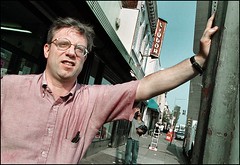
Richard Layman stands outside Family Liquors, which has had its license renewal locked in a protracted battle. "It's amazing the difference," Layman said of the neighborhood on Sundays, when law forces the store to close. "It truly is a day of rest." (Michael Williamson, The Washington Post, August 31, 2003)

BTW, the discussion of "use value" is essential to understanding how urban renewal devastated lower-income communities, by destroying the informal networks that communities built up over generations, networks that helped people survive being poor and/or being discriminated against. And it presaged the arguments in the book Root Shock by almost 20 years.

And the understanding of the "exchange value of place" is essential to understanding what the "Growth Machine" is all about.

This wrecking of city neighborhoods for urban renewal, particularly of SW, still impacts the city today, as many of today's most distressed city neighborhoods were the places where those dispossessed from SW ended up.

BTW, this is the same kind of impact that Prince George's County is experiencing, particularly with skyrocketing health care costs at Prince George's Hospital (see "Shakeup, Bailout Sought for Maryland Hospital") and an increase in violent crime and murder in parts of the county particularly close to Washington, DC. The state of the schools too...

I assert this is a result of the displacement of thousands of people from Wards 7 and 8--which I discussed in a couple blog entries about a week ago.

Ward 9 is a real issue, one of "blowback".

It's a reversal of the role that DC has traditionally played vis-a-vis the Maryland and Virginia suburbs for the past forty years--DC as the "catchment" area for the region's poorest, has had to put more money into programs for these demographics, while counties like Fairfax and Montgomery were able to put comparable amounts of money into quality of life promotion projects... I always have thought of this as a "quality of life" subsidy that DC provides to the surrounding counties.
Urban renewal

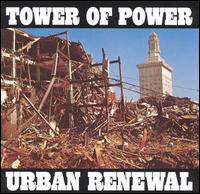
An album cover from the 1970s. Who would have thought that the repercussions of urban renewal are still so stark, 30 years later?

Many people, justifiably think of what happened with "Urban Renewal" in the 1950s to the 1970s as "Negro Removal," and it colors their attitudes about what is happening today (and often, in my opinion, leads to an overly simple, facile, and often incorrect interpretation about "current events") . But DC (and New Haven) were the pilot programs--urban "renewal" happened here first--and we still see the debilitating effects upon our community. Certainly, everything I read about New Haven communicates the same message.

In September 2004 before the primary election, I was toying with the idea of writing a piece about this topic for themail, which I intended to call "The Uncivil War." But I chickened out.

I saw the election of Kwame Brown, Vincent Gray, and the return of Marion Barry as but another salvo over the issue of the "contested space" of the streets, neighborhoods, power, and control in the City of Washington.

Many of the subsequent actions of these councilmembers can be seen in this context, such as their unwillingness to support legislation in favor of greater disclosure over donations to Electioneering Exploratory Campaigns (Gary Imhoff in themail called them "The Corruption Caucus").

Or in the Post a couple weeks ago there was an article about how these three councilmembers support a particular bid to buy the baseball team because the leader of that bid has donated money in the past to community activities in Southeast DC. ("Council Members Push Bid of Nats Suitor: D.C. Entrepreneur Would Do More to Help City, They Say.")
ME-Baseball

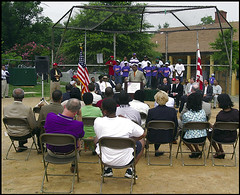
Photographer: Susan Biddle, The Washington Post. DC Council members Marion Barry, Kwame Brown, Vince Orange, former council member Frank Smith with Jon Ledecky and co-bidders for Washington Nationals, the Hidary's. They gathered on a baseball diamond outside Barry Farm Recreational Center in SE Washington.

Note: the pandering to "the seniors" and "the children" by developers and the land use lawyers that represent them, who buy off--in effect--neighborhood activists and ANC Commissioners for paltry donations to community groups and events, well, let's just say it gets to me.

Not that I think the other bidders for the baseball team are necessarily any better. Fred Malek? Speaking of Watergate and the Nixon Administration, which is in the news of late. (Yes, I know Malek wasn't involved in Watergate, but he was involved in monitoring perceived opponents of the Nixon Administration. Go Nationals!)
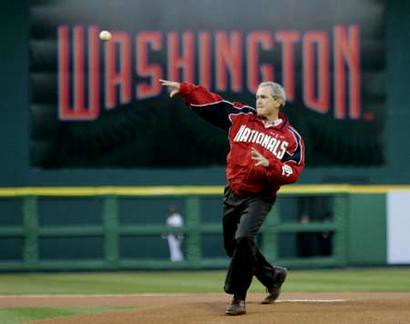
bushbaseball

Power Politics and baseball in DC. AP photo.

I used to say people took money, now I call this "green love," given libel and slander laws. It's not really payoffs, but a couple hundred dollars to a block club party shouldn't mean that you are owned for life...

Recent articles in the Post and the City Paper have discussed the ascension of Marshall Brown, and include this one: "Mendelson Faces 2nd Challenger In 2006 Race for D.C. Council Seat," which mentions that At-Large Councilmember Phil Mendelson, known as a strong community activist, is facing opposition next year from A. Scott Bolden (ex-chair of the DC Democratic Party and lawyer with the municipal (and other) bond firm ReedSmith) and David Bowers, a housing advocate.

Mendelson has faced serious opposition from the DC Development Community ever since he was elected. Twice the development community (once supported by a Post endorsement) put up Beverly Wilbourne as a candidate against him. (Plus, I never realized that Marshall was part of the "niggardly" episode that led to the firing of a DC government employee for a time...)

The space gets ever more contested.
Power, Corruption & Lies -- New Order

Labels: , , , , , ,

Sunday, May 16, 2010

Whatevvvveeeer

Today's Post has a story on the "contested spaces in the city," the article "New baby boom fosters culture clash: Parents vs. public spaces‎."

This contestation is about the right and privilege of access to urban spaces and whether or not access privileges are extended to parents and children. Parents believe that their children deserve space. Many (I would argue, younger, privileged, and selfish) non-parents do not. For the record, I don't have children.

But frankly, the story is pretty damn boring (as our most of the columns by another Post writer, Petula Dvorak, which cover similar kinds of issues). The interesting aspect of the question inadequately discussed in the Post article or some of the other venues mentioned in the article is what we might call "the infantilization of adult spaces" by the introduction of children, for example, in bars.

This comes down to young adults not knowing how to act as adults while juggling their roles as parents. Accommodating children on buses is one thing ("Circulator starts banning unfolded strollers," the Greater Greater Washington thread mentioned in the Post article), even coffee shops (see the article below). There the issues are about civility and behavior management of children. Children in bars and certain kinds of restaurants are quite another issue.
Mothers and children gathered to talk and drink at The Lucky Cat  in Williamsburg in 2004.
Hiroko Masuike for The New York Times
Mothers and children gathered to talk and drink at the Lucky Cat in Williamsburg, Brooklyn, in 2004.

The Post article is duplicative and repetitive of stories from the past ten years in the New York Times about similar complaints in both New York City and Chicago:

- Look Who's Getting Rolled Out of the Bar (2008)
- In Surge in Manhattan Toddlers, Rich White Families Lead Way (2007)
- The Park Slope Parent Trap (2007)
- At Center of a Clash, Rowdy Children in Coffee Shops (2005)
- Go Ahead and Cry. It's Happy Hour.; Mothers Find Social Outlet, and Babies Are Welcome (2004).

I wrote about the Andersonville coffee shop issue back in the first months of the blog...

Also see this article from Salon, "Everybody hates mommy - Motherhood.

Labels: , , ,