Rebuilding Place in the Urban Space

"A community’s physical form, rather than its land uses, is its most intrinsic and enduring characteristic." [Katz, EPA] This blog focuses on place and placemaking and all that makes it work--historic preservation, urban design, transportation, asset-based community development, arts & cultural development, commercial district revitalization, tourism & destination development, and quality of life advocacy--along with doses of civic engagement and good governance watchdogging.

Friday, September 05, 2014

Robberies in Northeast DC and the Code of the Streets: Bad people pay attention and watch

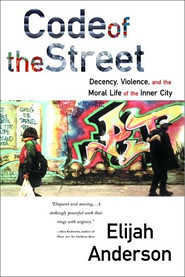
code of the streetsYesterday's Post reports ("D.C. burglaries increase in Brookland, Michigan Park") that "new residents" are concerned about a rise in burglaries that seem to be based on an understanding of when residents are not home.

I have all kinds of experiences of this kind related to when I lived in the H Street neighborhood.  I wrote about it a bunch over the years. And here:

-- Revitalizing places that are contested spaces
-- Historic preservation in low income neighborhoods
-- More on unaffordable housing (Yes, gentrification is part of the program in DC) 
-- Community Preservation and Development
-- One reason why I think the Gentrification word is over- and mis-used
-- Does change mean gentrification? Categorically?.

My joke is that when I moved to "the city" I was young (well, 27 years old) and dumb.

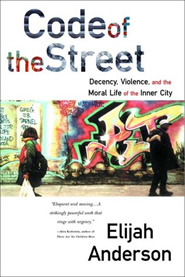
It wasn't until 2001 that I read the book Code of the Streets by Elijah Anderson.

Afterwards I joked that it's too bad I hadn't read such a book before I moved to the city, so that I could have been much better educated and prepared for what I was about to get into.

Other than moving my wallet from my back pocket to my side pocket to reduce the likelihood of pick pocketing, and not using ATMs or buying gasoline at night, I didn't do enough to harden my behavior to protect me from crime.

But today's residents have the advantage of being able to read Code of the Streets or even the "Code of the Streets" article by Anderson from The Atlantic Magazine circa 1994.

Also see this op-ed by Elijah Anderson, "Code of the street is keeping crime alive," from April 2005 in the Philadelphia Inquirer. (No longer available online.) From the op-ed:
In the code of the street, a set of informal rules governs interpersonal public behavior, including violence. The rules prescribe both a proper comportment and the proper way to respond if challenged. They supply a rationale that allows those who are inclined to aggression to precipitate violent encounters in an approved way.

In this setting, there is tremendous jealousy and envy. For a person to "have something" can be seen as disrespecting another; it can be confused with making the other feel small. So if another person has money, material things, or even simply good looks - anything that can be taken as a social good - such possession can be cause for an altercation to settle things.

On the streets, the distinction between street and decent is often irrelevant; everybody knows that if the rules are violated, there are penalties. Knowledge of the code is essential for operating in public. Families with a decency orientation often reluctantly encourage their children's familiarity with it.
2.  Generally, new residents in mixed income areas "are targeted" by those residents (or people affiliated with neighborhood households) with a propensity to commit crimes.

New residents, especially white or Hispanic, stick out in neighborhoods where most residents had been African-American.  So it's easy for people to figure out where the new opportunities are.

In 2006, Courtland Milloy wrote a column ("Violent Robberies Make It Hard to Ignore D.C.'s Vicious Side") where he made the point that the distance in DC between the haves and have-nots is not very big, which creates tremendous opportunity for crime, which waxes as wanes as neighborhoods change.

From the column:
The District has the largest disparity between rich and poor of any city in the country; the well-to-do may be enjoying their wealth too much to really notice. But the geographic distance between the two groups could hardly be smaller, and now there's apparently more resentment to go with the proximity.
I'd "forgotten about this" as then remembered as we were about to move to Manor Park in 2008, and I feared re-experiencing burglaries and street crimes.  For the most part, it didn't happen.  Although cars (we don't have one) seem to get broken into frequently enough, my rear rim was stolen off my bike (which was locked to my front porch), and Suzanne's flip flops were stolen off the porch.

... but other parts of the neighborhood have big enough problems (west of 5th Street and certain streets especially) and we heard of a terrible but sadly funny story of relatively new residents with a hot tub in their yard, very visible, who got "jacked" while in the hot tub one night.  That was in the west of 5th Street area too.  But it's all relative.  There are incidents relating to people being followed from the Metro station, and occasionally there are street crimes.

But I take that as part of living in the city, but any city.

OTOH, one of Suzanne's colleagues lives about one mile away from us, closer to Fort Totten, and they are experiencing the kind of targeting, combined with some bad luck, that I remember from H Street.  At one point they were considering leaving, but I think now they are going to stick it out.

It takes a lot out of you, especially if you aren't really prepared for it happening.  It's why I am not interested in moving to a neighborhood more like what H Street was like 15-20 years ago.

I no longer have the energy and tolerance for the pain and anguish.  But for the most part, I do know better how to protect myself and our household.

Labels: , , , , ,

Monday, December 06, 2010

Time to brush up on Elijah Anderson

code of the streets
Rob Pitingolo, in "Liberal Places," blogs about a TBD article, "In gentrifying Logan Circle, affordable housing meets hate crimes," about anti-G (gay or gentrification) violence in the 14th and R Street area of northwest DC, by "long time" residents vs. new residents, including "new" gay residents.

While progressives and cultural studies types typically don't think of "spaces of resistance" as being places for non-progressives to resist, they can be (also see "Tea Party").

Elijah Anderson's Streetwise and Code of the Street are books that I joke should be required reading for people new to the city, especially new to areas with significant income disparities, and social, cultural, and racial differences.

Given the influx of people into the city over the past few years, I guess it's time to repeat this.

Anderson had a piece, The Code of the Streets, in Atlantic Magazine six years before he published the book. (There is also a review in Washington Monthly.)

This is an extract from a blog entry from 2006 on the topic of crime:

My hypotheses would be that intensity of street-culture conflict increases with the level of social and economic exclusion, and increased economic disparities within a community. And that the current burst of violent crime coincides with a recognition of greater economic disparity. In DC at least, while certain neighborhoods are experiencing great increases in income and wealth, other neighborhoods are experiencing persistent and greater levels of poverty.

As long as a community doesn't address the deeper programmatic issues involved in addressing the culture and social and economic exclusion issues (quality of schools, safety of the neighborhood, the redevelopment of the neighborhood economy (such as outlined in the textbook Community Economic Development Handbook by Temali) it's likely that crime rates while dropping will hit a ceiling, and of course, will oscillate according to the state of the economy in a particular community.

Click here for the first chapter of Code of the Streets and here for a video illustration of the same chapter, "Down Germantown Avenue," produced by a group of students at Rutgers Unviersity.

Anderson's work is essential reading for understanding the issues involved in public safety. Another interesting take is this article from Mother Jones, "Straight Outta Boston."

----
WRT the TBD article mentioning how one of the people arrested for assault doesn't live in the neighborhood, but has ties to the neighborhood, the discussion of the use value of place in the book Urban Fortunes: Toward a Political Economy of Place explains this, how people remain connected to the informal social networks in the old neighborhood because they haven't developed new informal social networks in their new neighborhood. But the use value discussion is important in understanding how change can be resisted in practice, and the neighborhood "defended."


Informal support networks (p. 104-105)
Place of residence is the potential source of an informal network of people who provide life-sustaining products and services... Sometimes gains are achieved thorguh an informal marketplace among proximate beneficiaries... Especially for the poor, this income 'in kind' represents a crucial resource and it is made possible only by a vaiable community. Since the community of poor people is less spatially 'liberated' than that of the well-to-do, poor people's use values are particularly damaged when their neighborhood is disrupted.

Security and Trust (p. 104-107)
A neighborhood also provides a sense of physical and psychic security that comes with a familiar and dependable environment. ... Gerald Suttles (1968), in his effort to construct a general theory of urban life, or at least 'the' social structure of the slum, portrays neighborhoods as bastions 'defended' against the perceived dangers of interlopers drifting in from adjacent areas. Signs of commonality (skin color, diction, gait in walking) serve as prima facie, if imperfect, basis for categorizing others as either members or nonmembers of the neighobrhood circle of mutual trust. This process of 'categoric knowing' is reinforced by various mechanisms in daily life that maintain the distinction between insiders and interlopers.

Labels: , , , ,

Thursday, February 10, 2011

Testimony on the Winter Sidewalk Safety Amendment Act of 2011

Marina in the snow
(Note that the section on the legislation missing the mark, overstates the case. It's true that the legislation doesn't address all the issues, but DC City Councilmembers are using the legislation to push the Executive branch of both the DC Government and the Federal Government to address the issue.)

B19-0016: The Winter Sidewalk Safety Amendment Act of 2011
DC City Council
Committee on Public Works and Transportation
February 9th, 2011

Testimony by Richard Layman

Thank you Councilmember Wells, Councilmember Cheh and other members from the Committee for the opportunity to speak today on B19-0016, the “Winter Sidewalk Safety Amendment Act of 2011.” I am Richard Layman of the Citizens Planning Coalition. In the context of sustainable transportation, CPC believes that it is important for the City of Washington to develop a more wide-ranging “maintenance of way” agenda to address mobility concerns of all users of the city’s streets and sidewalks, especially during winter weather, especially concerning the removal of snow and ice.

Because DC is a walking and transit city—after all most trips start by walking, DC residents conduct 51% of their trips to work by walking, transit, and bicycling, depending on the neighborhood a preponderance of non-work trips are also conducted by these modes as well, and more than 30% of DC households do not own cars—therefore, the city must have and execute plans which ensure the mobility of people and transit (and to the extent that it is possible, bicyclists) when it snows.

It isn't enough to be satisfied with successful clearing of snow from streets, when operational systems for removing snow from sidewalks and transit shelters are not present, and for the failure to ensure transit service by prioritizing snow removal from streets used by buses, so that transit service can still be provided on the routes that normally serve the city's residents, workers, and visitors. We also note that DDOT has changed procedure for snow removal from streets, to prevent snow piles from blocking crosswalks.

Pass B19-0016: The Winter Sidewalk Safety Amendment Act of 2011

Of course CPC supports Bill B19-0016 and urges its passage. We suggest that Parking Enforcement Officers can be tasked with the responsibility for the issuance of tickets for failure to clear sidewalks. Additionally, Council should recommend that a campaign be initiated (doorhangers, etc.) promoting the idea of “safe routes to school” and “safe routes to transit” to more broadly communicate the importance of proper snow removal to public safety, community building, and strong and safe neighborhoods.

Furthermore, we suggest two additional amendments. (1) Sections §9-601 and §9-602 of the original code should be amended to shift from DC Government to adjacent property owners, the responsibility for the removal of snow and ice from curb ramps (for corner properties) and from the crosswalks of alley ways (for properties abutting alleys). (2) Section §9-602 should also be amended to specify responsibility for ensuring the removal of snow and ice from transit stops and routes.

These amendments are recommended because curb ramps and alley crossings often remain gaps in otherwise cleared sidewalk networks and because snow removal along transit routes and stops should be prioritized.

But B19-0016 misses the opportunity to address other key issues

In addition, in terms of a more expansive perspective on maintenance of way, we would like to point out that your review of the relevant sections of the DC Code (42 Stat. 846; D.C. 28 Code §9-601 et seq.) concerning the removal of snow and ice from properties in the District of Columbia remains incomplete.

It is not an overstatement to assert that DC Government and the Federal Government fail miserably with regard to their responsibilities under DC Code (42 Stat. 846; D.C. 28 Code §9-601 et seq.) . Citizens and visitors are frequently put at risk by the failure during winter of the DC Government and the Federal Government to properly maintain sidewalks and facilities adjacent to their respectively owned and/or leased properties.

In preparing this testimony, imagine my surprise when reading the relevant section of the DC Code to discover that Section §9-602 requires DC Government to remove snow and ice from properties it owns and that §9-603 imposes the same responsibility on the Federal Government, and in particular the National Park Service.

Under DC law, DC Government has legal responsibilities for snow and ice removal from sidewalks

The relevant text in §9-602 reads as follows:

It shall be the duty of the Mayor of the District of Columbia within the first 8 hours of daylight after the ceasing to fall of any snow or sleet, or after the accumulation of ice on the paved sidewalks within the fire limits of the District of Columbia, in front of or adjacent to all public buildings, public squares, reservations, and open spaces in the said District owned or held by lease by said District, to cause such snow and ice to be removed; and also to cause the same to be removed from all crosswalks of improved streets and places of intersection of alleys with paved sidewalks, and also from all paved sidewalks or crosswalks used as public thoroughfares through all public squares, reservations, or open spaces within the fire limits of said District owned or held by lease by the District of Columbia; …

The failure of DC Government generally and government agencies specifically to adhere to §9-602 is particularly acute for sidewalk abutting schools and property controlled by DC Public Schools, and for parks and reservations controlled by the Department of Parks and Recreation and/or the Department of Transportation.

Under DC law, the Federal Government has legal responsibilities for snow and ice removal from sidewalks

The relevant text in §9-603 reads as follows:

It shall be the duty of the Director of National Park Service within the first 8 hours of daylight after the ceasing to fall of any snow or sleet, or after the accumulation of ice upon the paved sidewalks within the fire limits of the District of Columbia, to remove or cause to be removed from such sidewalks as are in front of or adjacent to all buildings owned or leased by the United States, except the Capitol buildings and grounds and the Library of Congress building, and from all paved sidewalks or crosswalks used as public thoroughfares in front of, around, or through all public squares, reservations, or open spaces within the fire limits of the District of Columbia, owned or leased by the United States; …

Snow removal from NPS facilities outside of the National Mall is definitely a hit or miss proposition, in particular the plaza in front of Union Station (why Union Station doesn’t develop a memorandum of understanding with the NPS to address this is beyond my understanding given that the “new” revitalized Union Station “reopened” in 1988).

DC Council must call on the Executive Branch of DC Government to execute its duties concerning snow and ice removal from sidewalks

CPC suggests to the Committee that you look to the City of Minneapolis for guidance. Both the Minneapolis Pedestrian Master Plan and the Minneapolis Bicycle Master Plan include text, discussion, and policy guidance with regard to snow removal. [Note that I attached pages 63-66 of the Minneapolis Bicycle Master Plan to the testimony. These pages detail the recommendations in their plan concerning snow removal.]

CPC recommends when the DC Pedestrian and Bicycle Master Plans are revised, that sections relevant to snow removal policies and recommendations be added. Text on the concept of maintenance of way in a walking and transit city should also be added to other relevant transportation plans produced by DDOT and other agencies, including the Transportation Element of the Comprehensive Land Use Plan. This is relevant to Council because ultimately, all of these plans are passed into law by Council through the public hearing process and legislation.

Operational plans must be devised and performance audited, to ensure that the citizens, residents, and visitors are properly served and protected by DC Government and its agencies when it comes to the removal of snow and ice and the maintenance of way of sidewalks and facilities abutting public buildings, public squares, reservations, and open spaces under the control of the local government.

DC Council must call on the Executive Branch of the Federal Government to execute its duties concerning snow and ice removal from sidewalks

The Council Chairman sits on the National Capital Planning Commission, which is the planning body overseeing land use and transportation planning responsibilities of the Executive Branch of the Federal Government in the District of Columbia.

Council should encourage the National Capital Planning Commission to revise the Transportation Element of the Federal Elements of the District of Columbia concerning federal responsibilities for maintenance of way of sidewalks and other facilities in the context of a walking and transit city, comparable to how the City of Minneapolis addresses this issue in their planning processes.

Operational plans must be devised and performance audited, to ensure that the citizens, residents, and visitors are properly served and protected by the Federal Government and its agencies when it comes to the removal of snow and ice and the maintenance of way of sidewalks and facilities abutting public buildings, public squares, reservations, and open spaces under the control of the federal government.

Conclusion

CPC hopes that the process concerning the passage of B19-0016 will provide the opportunity to Council to address these additional matters that we have brought to your attention. We support B19-0016, with the suggested amendments that we have offered.

Thank you for the opportunity to speak to you today on this vitally important matter.

Labels: , , , , , ,

Wednesday, July 06, 2005

I don't read the Post first thing in the morning...

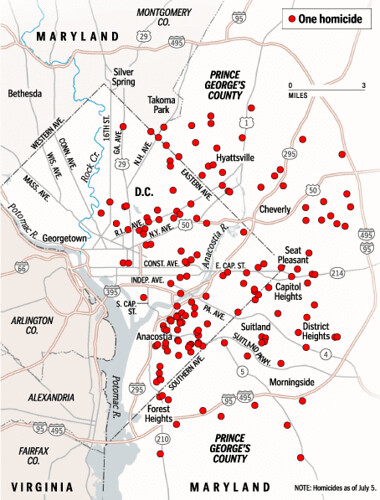
Murders on the BorderThe border between Prince George's County and the District is a high-crime area. The map shows where homicides have taken place this year in the two jursidictions inside the Capital Beltway. Graphic by Richard Furno, Nathaniel Vaughn Kelso and Tiffany Sakato, THE WASHINGTON POST.


...Or I would have known that while I was writing the previous entry about the increase in crime in Prince George's County (comparing it to a similar situation in the San Francisco Bay area), that the Post has an article in today's paper about the same subject--"Living on Edge of Violence: District-Prince George's Border Is Region's Most Dangerous Area."

I do think the article misses the point by focusing on the border, and not the demographics of the area on either side of the border, particularly those areas experiencing high-rates of violent crime.

The quote in the article from DC's MPD Chief Ramsey is closer to the truth: "But others disagree. D.C. Police Chief Charles H. Ramsey and homicide detectives said the killings do not seem to cross the boundaries as often as in the past. "Crime is a localized problem," Ramsey said. "A lot of the homicides, in particular, are about retaliation or arguments. Those things tend to happen in places you live or frequent."

The Post wrote about more about this earlier in the year, I just didn't link to those articles. The editorial, "An Epidemic of Murder", discusses the issues, as well as problems within the Prince George's Police Department:

"THE UNSETTLING spike in homicides in Prince George's County -- against a backdrop of a declining murder rate in the District -- is the subject of varying analyses and explanations, all of which may hold some truth. Many think the understaffed Prince George's police department cannot cope with the county's increasingly urban crime problems. Some believe that the District's gentrification is driving lower-income people, including criminals, across the border into the county. There are concerns, too, that the juvenile justice system is a revolving door far more likely to deposit hardened young offenders back on the street, and into a snake pit of weapons, drugs, gangs and crime, than to rehabilitate them.

Somewhere, I know that I read an analysis of the first 30 or so murders this year in Prince George's County. I can't find the article now, perhaps it was from the Gazette, which I look at only occasionally. I was struck by the report because most of the murders were not really drug-related at all, if the description of events was to be believed--most seemed to be the result of various and sundry disputes.

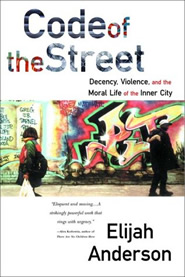
This gets back to something I mention all the time, the work (Streetwise and Code of the Streets) of Elijah Anderson, a sociologist at the University of Pennsylvania. Long before the book Code of the Streets was published, the arguments were summarized in an article in The Atlantic Magazine (May 1994 v273 n5 p80). The article is no longer freely accessible, but you can always read the book (at the MLK Library) or access the article via articles databases at the library.


code of the streets

From the article:

In this essay in urban anthropology a social scientist takes us inside a world most of us only glimpse in grisly headlines--"Teen Killed in Drive-By Shooting"--to show us how a desperate search for respect governs social relations among many African-American young men.

Of all the problems besetting the poor inner-city black community, none is more pressing than that of interpersonal violence and aggression. It wreaks havoc daily with the lives of community residents and increasingly spills over into downtown and residential middle-class areas. Muggings, burglaries, carjackings, and drug-related shootings, all of which may leave their victims or innocent bystanders dead, are now common enough to concern all urban and many suburban residents. The inclination to violence springs from the circumstances of life among the ghetto poor--the lack of jobs that pay a living wage, the stigma of race, the fallout from rampant drug use and drug trafficking, and the resulting alienation and lack of hope for the future.


Simply living in such an environment places young people at special risk of falling victim to aggressive behavior. Although there are often forces in the community which can counteract the negative influences, by far the most powerful being a strong, loving, "decent" (as inner-city residents put it) family committed to middle-class values, the despair is pervasive enough to have spawned an oppositional culture, that of "the streets," whose norms are often consciously opposed to those of mainstream society. These two orientations--decent and street--socially organize the community, and their coexistence has important consequences for residents, particularly children growing up in the inner city. Above all, this environment means that even youngsters whose home lives reflect mainstream values--and the majority of homes in the community do--must be able to handle themselves in a street- oriented environment.
__________________
In a major project that I am involved in, soon to be disclosed more publicly, a group of us are working on addressing this in a substantive manner in DC (not PG), by focusing on workforce development, growing neighborhood-based jobs, and microenterprise development (among other things) through the development of various trades-based educational development programs.

Rebuilding a Neighborhood Means Rebuilding the Neighborhood's Economy

"Next generation" community development has moved from a primary focus on the construction of housing, to a broader focus on people- and community-based economic development, as outlined in textbooks such as The Community Economic Development Handbook, by Mihalio ("Mike") Temali, director of the Neighborhood Development Center in St. Paul Minnesota.

The text identifies four points that comprise the foundation of successful neighborhood economies, which he calls pivot points:

■ developing the community work force;
■ revitalizing the commercial district/industrial base;
■ growing good neighborhood-based jobs; and
■ developing micro-businesses.

These are the economic levers that communities must change as they strive to improve where they live and work.

This vision–creating economic opportunity, reversing negative perceptions, and stimulating purchases and investments–is the vision that undergirds successful community economic development work across the country. (It is a distinctly different vision from that of most community development corporations engaged in projects in the District of Columbia.)

The vision is both simple and complex--economic progress for the entire neighborhood.

This vision is achieved through activities that focus on increasing the income and assets of local residents; through building the community up as a whole; and through continual, visible changes that make the community a better place to live.

Community economic development is about people, not just about developing buildings and businesses. At the core, it is about developing the talent, skills, and living conditions of the people who live in those buildings, the people who own those businesses and the people who work there, and the people who become their customers.
_____________
So PG County Executive Jack Johnson's proposal to raze 22 apartment complexes because they are crime-ridden misses the point in many respects--it's another example of what I call "blaming the building" rather than dealing with the etiology of crime.

Although I am a stronger proponent in some respects of the Broken Window Thesis (Kelling and Wilson) rather than the Community Efficacy Thesis (Earls) both are relevant, and must be connected in order to truly address crime issues.

People in the workforce become part of the community.

You can build all the housing you want, and if the majority of the community isn't employed, does it really matter?

Thursday, June 25, 2009

Dealing with crime (in DC and elsewhere)

Among the many good posts of late in the Washington City Paper's City Desk blog is this one, "Petworth Shootouts – Possibly Gang Related – Spark More Recriminations Over Defunct Crime Bill."

I say it's good because it calls attention to the posturing by many DC elected officials over particular crimes and the opportunities they provide to support particular claims-ideologies about how to address crime, especially over the recent Fenty "crime bill" touted by people like Harry Jaffe and Jonetta Rose Barras (columnists for the Examiner) -- "Fenty's tough new crime laws could make city safe" (Jaffe), and "Crime coddlers in D.C." (Barras).

I don't understand why most "thinking" people are so clueless when it comes to crime and related policies. I am not a "coddle the criminal" person, but I do understand that we are dealing with systems.

And if you want to understand these systems, if you are a great observer, you can go live in a neighborhood like H Street NE (which I did with about a two year gap, from 1987 to 2004) or Trinidad or Capitol Hill East or Shaw (etc.) and experience it first hand.

But if you don't want to experience multiple break ins, street assaults, and the failure of a marriage, instead you can read two great books by Elijah Anderson, Streetwise and Code of the Street.

A report from the National Institute of Justice released earlier in the year, "The Code of the Street and African-American Violence," confirms the validity of the thesis. And you can watch a video depicting the place he wrote about in Code of the Street, see Down Germantown Avenue. (When I first read it, I thought his description of how Germantown Avenue is in Mount Airy and his travels down into the rougher part of Philadelphia sounded just like H Street NW and NE in DC.)

If you don't want to read the books, how about the original article from 1994 in the Atlantic Monthly, "The Code of the Streets," or this review from the Washington Monthly, "Code Of The Street. - Review." But they do have the book in the DC Central Library, which is where I read it.

Anyway, living on the exact border line between the 1st and 5th police districts in the H Street neighborhood taught me a lot. And one of the things it taught me is that crime isn't only a police problem, something that police commissioner (in Boston, New York City, and now Los Angeles) William Bratton makes clear as well, and his work was based on the "Broken Windows" thesis (see "Broken Windows" also from Atlantic Monthly.

(If readers ever wonder why I am so fixated on eliminating graffiti, litter, and "curing" nuisance property problems not through demolition but by getting the house fixed and habitated, it is because I a strong strong proponent of the Broken Windows thesis and my first hand observation about its applicability, in fact, see one of my earliest blog entries, "Urban Health, Nasty Cities, Broken Windows, and Community Efficacy" for more, including a discussion of the competing "community efficacy" and "broken windows" theses.)

So the "Fenty Crime Bill" likely won't do squat, because it doesn't get at the systems, the root causes and processes of the problem.

From time to time I write about this in terms of the great successful program at reducing "gang" violence that was pioneered in Boston. It's written about in Mother Jones magazine, in "Straight Outta Boston." The New Yorker wrote about this in a recent issue as well, "Don’t Shoot," although the full article is only available to registered users.

And today's Seattle Times has an article about this, "Innovators visit Seattle to describe ways that work to cut gang violence," describing the two different approaches, the Boston approach and the Chicago approach (for more about the latter see "Blocking the Transmission of Violence" from the New York Times Sunday Magazine in 2008).

Both approaches, while using different language from their respective disciplines, address gang violence as if it is an epidemic and use epidemiologic processes (public health approaches) to interdict the vector of violence, focusing on taking out key carriers, either through arrest or suasion, and working to change the embrace of the code of the street.

Now a bunch of DC nonprofit groups have released a report on the problem, see "Report: D.C. must do more to stem youth violence" from the Examiner, but I haven't read the report so I don't know if it makes any decent recommendations. According to the article:

The report urges immediate action by Mayor Adrian Fenty to develop a coordinated response to high-profile youth violence, to assess the city’s capacity to handle the problem, to redirect resources to those areas highest in need and to intervene with the most at-risk youth. Graham said he would introduce emergency legislation next month to address the short-term goals.

In the long term, the report recommends establishing a high-level Gang and Crew Prevention Commission led by a gang czar of sorts, and developing a comprehensive citywide violence-prevention plan. It also suggests numerous actions in the education, health, work force development and justice areas.

Judging by past programs and the relatively incremental non-best practice approaches most typically espoused in DC municipal and nonprofit agencies, I don't expect that the report, A Blueprint for Action, says very much.

I guess I'll have to read it.

Labels: , , , ,

Friday, October 12, 2012

The market is driving neighborhood change (displacement) and changing the zoning code won't have any effect on that

Someone asked me about "Gentrification and Displacement" in the context of the proposed new Zoning Code in DC, which will "overturn" the 1958 Code, which is suburban in intent and oriented to separated uses, in favor of something more urban and more smart.

The proposed code will be passed in sections, each of which will go through a hearing process.  Some of the proposed provisions, such as eliminating parking requirements for new construction in areas that are well-served by transit, or simplifying the ability (I still have problems with many of the proposed provisions) to create accessory dwelling units on properties (carriage house type units) have enraged numbers of DC residents.

Last week there was a hearing about this at City Council (see "Mendelson wades into the zoning update with Sept. hearing" from Greater Greater Washington) where arguments counter to the proposed change to the Zoning Code "Philosophy" were proffered.

Anyway, here was my response [slightly edited]:

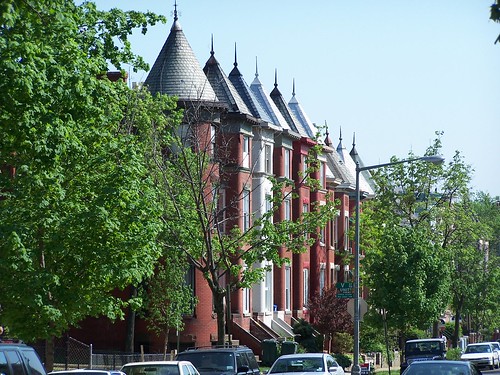
Bloomingdale RowhousesLeft: rowhouses in Bloomingdale, probably dating from the 1890s.  The inventory of such housing is relatively fixed.

in 2007, I was like the 3rd person who testified at the first zoning commission hearing on whether or not to update the code.  When Carole Mitten [the then Chair of the Zoning Commission] asked what we thought of the code and whether or not it works, George Clark [then the president of the DC Federation of Civic Associations] said it was great, and I said, "the number of overlays and requests for overlays is an indicator that the code isn't working, and doesn't generate the kinds of outcomes that people are looking for."

(Now I talk about this issue like this: "the point of planning and zoning is to improve quality of life.  When outcomes from planning and zoning processes don't do this routinely, we need to look backwards at the policies, codes, and regulations and figure out what isn't working, why it isn't working, and change the processes so that positive contributions to quality of life become routine outcomes.")

In my opinion, most of the people in favor of the current code prefer it because it's predictable and they know how it works, but they don't really think about the negative impact of many of its provisions on the city.  It's not designed for a center city, but for the suburbs.

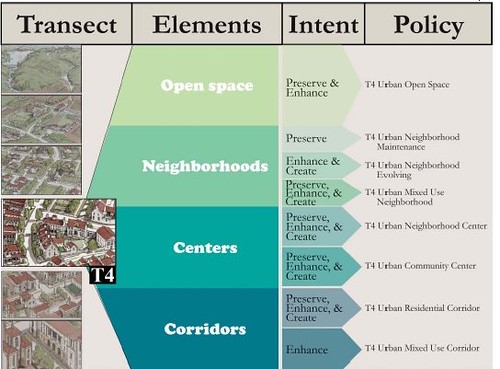
wrt the code, I argued that the "new code" should be based on the framework of the Nashville Community Character Manual.  It's based on the SG "transect"--6 land use contexts, from rural to dense urban--but has a number of subcategories for each transect "zone" depending, e.g., residential, commercial corridor, etc.

Nashville Community Character Manual: T4

That would provide, in my opinion anyway, a much finer gradient for zoning better fitted for more particular land use contexts than an overall "general zone" approach or the "let 1,000 flowers bloom" approach I've heard about that will let every neighborhood create their own overlay, but only after the new code is approved.

Every neighborhood doesn't need it's own overlay.  Most concerns can be accommodated in the more fine grained approach to zoning offered by the NCCM.

Above: this diagram from the NCCM outlines 8 different types of land use for the T4 land use context.  T4 is defined as the "general urban zone."  In DC, it is primarily residential, but is punctuated with mixed use (or at least, retail uses) in commercial strips that may be a couple blocks long (like the little cluster of shops on Upshur Street in Petworth), as a more tightly connected "commercial district" (like Old Town Takoma, which in the DC context, is actually in Maryland) or in long strips along arterial streets (like Georgia Avenue).  

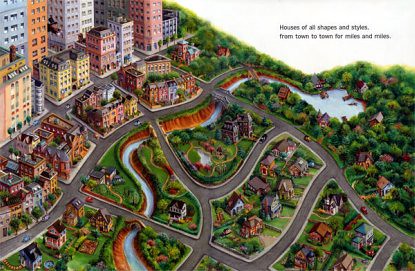
Illustration from The House Book by Keith DuQuette (resized)

Right: this visual rendition of "the transect" comes from the childrens book, The House Book, by Keith DuQuette.  (Although it doesn't really show T4 so much as jump from T2/T3 to T5.)

The Office of Planning actually explored this approach (at my instigation) but they ended up rejecting it, believing that the Advisory Committee would find it to be too radical.

That being said, displacement and neighborhood change (I don't like the G--gentrification--word) is going to happen, and happen big time, whether or not the zoning code is changed.

It's a function of the color green--money--and housing choice trends that favor cities -- money and the market -- and doesn't have much to do with bringing "old urbanism" back, other than that cities are more likely to allow people to live carless or car-lite and get around by walking, biking, and transit.

EYA housing, online ad (Trulia), promoting living by transit, "Become your own transit authority," featuring the M logo of the WMATA subway systemThe reality is that "Smart Growth" development principles are, historically, the same kinds of development principles that were applied in the city, even as the city expanded outward at least through the 1930s and early 1940s, e.g., as  discussed in the now out-of-print DC Office of Planning publication Trans-Formation: Recreating Transit-Oriented Neighborhood Centers in DC: Design Handbook.

The other way to think about this is in terms of the walking and transit city eras of city development, such as that described in this webpage about the change in cities that came about as walking and transit were replaced by the automobile as the dominant mobility mode in the United States.


Backyard garage between R and S Streets NW on the north side of Connecticut Avenue.  By adding a floor, buildings like these could easily add to the city's housing stock as rental units, providing lower cost housing options, housing close to transit service, and additional income for property owners.

I argue for the addition of mixed use residential to commercial districts and for ADUs, because I think that's a way to accommodate additional population (which has a lot of benefits, the city's increase in population is one reason why some neighborhood commercial districts are starting to improve after languishing for decades) without significantly changing neighborhoods.

One problem with monoculture residential zoning is that neighborhoods aren't very resilient and aren't very good at maintaining the inclusion of households at different income levels.

As urban neighborhoods become attractive, people with money will always be able to outbid people of lesser means, hence "gentrification."


Right: the Ellington Condominiums on U Street NW.

Especially because the city's housing supply, at least of single family detached and attached (rowhouse/duplex/triplex/flats) is pretty much fixed, with some exceptions (for example rowhouses by EYA in Brookland, being marketed by ads such as the one above, or Pulte at Fort Lincoln etc.) the city really only has the ability to add multiunit housing.

And it does this not by tearing down existing housing or residential neighborhoods, but by building multiunit housing in commercial districts or at subway stations.

To deal with displacement requires policy tools other than zoning as it's a phenomenon that is mostly a function of markets and property tax policy (as long as property tax assessments are a function of the current value of the property, in rising markets people of lesser means will eventually be priced out through rising assessments).

Labels: , , , , ,

Monday, March 02, 2009

Urban design, sprawl and the automobile

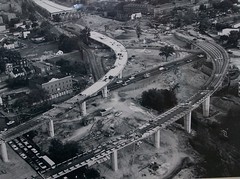
SE-SW Freeway under construction near the Marine Barracks, 1971
SE-SW Freeway under construction near the Marine Barracks, 1971. DC Dept. of Transportation photo.

The Weekend Financial Times has an article, "Highway to hell revisited," about the negative impact of the Interstate Highway Act on the country in terms of sprawl and gasoline dependence, and how President Obama has praised this act. (You'll have to register for access.)

It discusses how most highway advocacy is directly or indirectly supported by the consruction industry, and how for the most part, the Interstate Highways led the destruction of cities both in terms of cutting up neighborhoods through the construction of various routes as well as the roads serving as the way out of the city to live, but back to the city for the best jobs.
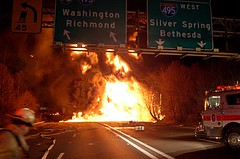
baltimoresun.com - Tanker truck burns.jpg
A tanker truck carrying 8,700 gallons of gasoline burns after exploding this morning on Interstate 95 north of Washington, D.C. The driver was able to escape unharmed after he noticed one of his rear wheels burning as he headed south from Baltimore.(AP photo)Nov 23, 2005

The article, by a columnist who is an editor for the Weekly Standard, also discusses how government projects aren't always a good thing. There is a lot to be said for this belief. We need to differentiate between projects that add value or projects that destroy value. As much value has been added by the creation of a robust freeway network, as much may have been destroyed in terms of building an economy dependent on automobiles, gasoline, and roads.

(Also see, from 2008, "On the pot-holed highway to hell," also from the FT.)
Illustration from The House Book by Keith DuQuette (resized)
From Scott Doyon--Re: the depiction of urban environments in media directed at children, my six year old daughter recently brought home a book from her school library called The House Book by Keith DuQuette. Included in it, following a lot of nice traditional home illustrations, was the attached depiction of city to country. It's so good for what it is, I was surprised it didn't have a DPZ credit at the border. My daughter understood it immediately. There is hope.

This question is also relevant to intra-city issues in the center city. David Alpert, of Greater Greater Washington, opines about opposition to significant changes to the philosophical and regulatory provisions of DC's Zoning Code, in "Zoning update opponents attack Office of Planning."

Surprisingly, the Zoning Commission is open to the idea that the Zoning Code should be supportive of urbanity, rather than a slight rewrite of the suburban oriented Zoning Code that DC first imposed in 1958, and has modified since. (this process started in response to the revision of DC's Comprehensive Plan in 2006).

This change is sparking reaction in many quarters. A lot of the reaction either directly or indirectly ends up supporting automobile-centricity, which I find incredibly ironic and sad.

Like David, I have written about what I think is the source of this reaction. Many of the city's long time and "traditional" activists took up their efforts during the many decade period when the city was in financial exigency and the population continued to shrink. These residents help stabilize and maintain neighborhoods that otherwise would have been disinvested.

This is one of the reasons by the way that I am such a fervent historic preservationist. There is no question that historic preservationists "saved" the city during those long decades when behaviors and trends did not favor urban living. The same laws about preservation that people revile today were the laws that saved many neighborhoods from possible destruction, or at the least, significant disinvestment. Those efforts should be respected and extended, by continuing to practice historic preservation by extending the provisions and protections to more places within the city.

Anyway, I think a useful way to approach how we do things _in the city_ is to be aware of how the city was constituted, on what principles. In short, the urban design and development principles that characterized the city as it was first laid out by L'Enfant in 1791 and subsequently developed through two eras, that of the Walking City (1800-1890) and the Transit-Streetcar City (1890-1920), should be respected and supported via the Land Use Plan and Zoning Code of the 21st Century.

The primary aspects of the city's livability were created in an era without automobiles, and to continue to apply automobility based land use and design principles to fundamentally urban questions is a mistake and needs to be stopped.

It is unfortunate that yesterday's activists don't understand the underlying principles of what they were doing 40 and 30 years ago, and how those principles need to pay fealty to the urban question.
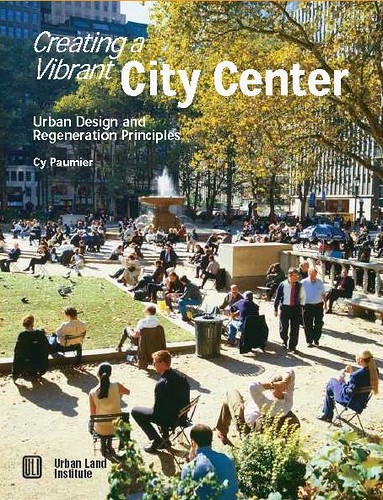
Creating a Vibrant City Center by Cy Paumier

Cy Paumier writes in Creating a Vibrant City Center that the pattern of downtowns (central business districts) developed around pedestrian-scaled streets, blocks, and buildings because of:

Concentration and Intensity of Use: "The intensity of development in the traditional central area was relatively high due to the value of the land. Maximizing site coverage meant building close to the street, which created a strong sense of spatial enclosure. Although city center development was dense, construction practices limited building height and preserved a human scale. The consistency in building height and massing reinforced the pedestrian scale of streets, as well as the city center's architectural harmony and visual coherence." (p. 11)

Organizing Structure: "A grid street system, involving the simplest approach to surveying, subdividing, and selling land, created a well-defined, organized, and understandable spatial structure for the cities' architecture and overall development. Because the street provided the main access to the consumer market, competition for street frontage was keen. Development parcels were normally much deeper than they were wide, creating a pattern of relatively narrow building fronts that provided variety and articulation in each block and continuous activity on the street." (p. 12)

The street grid, transportation practices and construction technology of the times, and the cost and value of the land led to a particular form of development on city blocks that focused attention on the streets and sidewalks, creating a human-scaled, architecturally harmonious built environment.

As construction technology advanced and taller buildings could be constructed, and as the walking and transit city was supplanted by the automobile, the scale of block development changed significantly, with a focus away from the pedestrian and towards the car.

OTOH, because TOD proponents are usually working on greenfield sites or grayfield site adaptations, it doesn't have the same kind of antecedents as the type of development described by Cy Paumier as typifying the development of downtown and the close-in neighborhoods near to downtowns.

And note, the report-publication produced by Karina Ricks (now the deputy director of transportation planning for DC's Department of Transportation) back in 2002 when she worked for the Office of Planning, Trans-Formation: Recreating Transit-Oriented Neighborhood Centers in Washington, DC, is really quite good. Frankly, it's one of the best descriptions that I've seen lately of how to (re)do infill development and build stronger neighborhoods. (I never really worked through the tome when it came out because I wasn't working very much on transit issues then.)

------
Speaking of irony, I find that some of the most ardent anti-freeway activists from the 1960s have become--even though they wouldn't think so--ardent proponents for the car, because of their unwillingness to support land use patterns that favor walking, bicycling, and transit use, rather than automobile trips for getting around.

Labels: , , , , , , ,

Friday, May 05, 2006

Richard's 2.5 Rules for City Living...

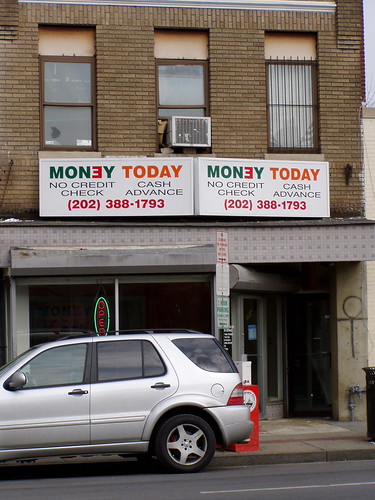
moneytoday The girlfriend of Washington Nationals baseball player Jose Guillen was robbed after cashing a $10,000 check at this storefront check cashing establishment on the 1100 block of H Street NE. Photo by Inked78.

Since coming to DC in 1987, I have read the Washington Post most every day. I don't have a photographic memory, but there is a reason that I joke that the Metro section should be retitled "Bad Things." And for years, I used to read the crime statistics every week in the District Extra section. The stories add up...

Anyway, my two rules for getting by at night in urban settings are:

1. Don't buy gas at night in the city (how many times have you read stories about people being robbed, carjacked, or killed at night buying gas in the city?);

2. Don't go to ATMs at night in the city (again, how many times have you read stories about people being robbed at ATMs at night in the city).

Rule .5 is don't go to the bank in areas where you feel uncomfortable. For example, given the lack of maintenance of the facility, the hordes of people milling about on the street, etc., frankly, I don't feel comfortable going to the banks at the intersection of 8th and H Streets NE, so I don't go there.

A corollary would be, don't cash large value checks in places like H Street NE.

If you're the girlfriend of a wealthy baseball player, have your boyfriend ask the Baseball team to call their bank to ask if they will cash the check as a courtesy.

Don't go to some storefront on H Street... see "CHECK-CASHING SERVICE: Girlfriend of Nats Player Is Robbed."

Cash such a check in a place where you're not likely to stick out like a sore thumb, and have people watching that you've been in the check cashing store for 30 minutes plus.

cf. Streetwise and Code of the Street: Decency, Violence, and Moral Life of the City by Elijah Anderson, Charles and William Day Distinguished Professor of the Social Sciences at the University of Pennsylvania.

Also see this op-ed by Elijah Anderson, "Code of the street is keeping crime alive," from April 2005 in the Philadelphia Inquirer. From the op-ed:

In the code of the street, a set of informal rules governs interpersonal public behavior, including violence. The rules prescribe both a proper comportment and the proper way to respond if challenged. They supply a rationale that allows those who are inclined to aggression to precipitate violent encounters in an approved way.

In this setting, there is tremendous jealousy and envy. For a person to "have something" can be seen as disrespecting another; it can be confused with making the other feel small. So if another person has money, material things, or even simply good looks - anything that can be taken as a social good - such possession can be cause for an altercation to settle things.

On the streets, the distinction between street and decent is often irrelevant; everybody knows that if the rules are violated, there are penalties. Knowledge of the code is essential for operating in public. Families with a decency orientation often reluctantly encourage their children's familiarity with it.

Let's just say I have learned these rules, and others, through hard experience.

code of the streets

Index Keywords:

Tuesday, July 26, 2005

Read the book, watch the movie

Hyperghetto in PhiladelphiaPhoto: TOM GRALISH / Philadelphia Inquirer. Penn professor Elijah Anderson describes this part of Germantown Avenue, where public transit and retailing join, as a “hyperghetto.”

I write a lot on e-lists and in the blog, about the work of Professor Elijah Anderson of the University of Pennsylvania, and his books Code of the Street: Decency, Violence and the Moral Life of the Inner City and Streetwise. This article from the Philly Inquirer, "Germantown Ave. from top to bottom: Video documentary shows a street of extremes," alerts us to a video made by students from Rutgers University at Camden, to illustrate the book's introduction--which is a tour of the length of Germantown Avenue, starting in the tony neighborhood of Chestnut Hill on the border of Philadelphia and the adjoining county and ending up in the heart of inner city Philadelphia.

Code of the Street is on the reading list for courses at 270 colleges across the country. (Clearly people not familiar with cities need some sort of visual presentation to understand this kind of progression.)

According to the article:

The documentary, based on Anderson's introduction, was produced this spring to assist readers of the book. The video "kind of gives you a different perspective on how the city can go from one extreme, from wealth and poverty in just five miles," said Jackson, who helped shoot the video. The video begins in Chestnut Hill, which Wood noted is often called "the suburb in the city," and ends in the Northern Liberties section. Along the way, Flatley and Wood describe the decline in the appearance of the stores, homes and factories, many of them dilapidated and abandoned.

They note that the village-like shopping district of Chestnut Hill gradually gives way to stores outfitted with burglar bars and riot gates as you move past Mount Airy and into Germantown and North Philadelphia. The premise of Anderson's book is that in communities where factories and other large employers have moved out and poverty has taken hold, a street culture develops that is characterized by a lack of faith in police protection and civil law.

As a result, Anderson writes, a code of the streets emerges, "a set of informal rules governing interpersonal public behavior, particularly violence. The rules prescribe both proper comportment and the proper way to respond if challenged, often with violence." In an interview on Germantown Avenue in Chestnut Hill, Anderson said: "This street is historic. It's hard to believe it's the same street down the way.

"We are talking about poverty that can't be laid at the feet of the people. The jobs are not here. When one is unable to find decent work there are negative consequences for communities." Anderson said the problems on Germantown Avenue are mirrored in many U.S. cities. The book, he said, has implications for understanding distressed communities around the country. Wood said that even in areas where the "code of the street" dominates, "there are pockets of resistance and renewal as well."
_____
The video is online here. The Inquirer article includes a link to a Flash photo slideshow with 29 photos at various points along Germantown Avenue.

Friday, December 15, 2006

The Florida Market bill before City Council

This is the bill modified with the addition of the redevelopment project for the Florida Market area in NE Washington DC. Underlined sections are new to the bill.

A BILL
16-812 "Workforce Housing Production Program Approval Act of 2006"
IN THE COUNCIL OF THE DISTRICT OF COLUMBIA
________________________
To approve, with modifications, a plan to design and implement a workforce housing production program in the District of Columbia
To create a public/private partnership between the District of Columbia and New Town Development, LLC for the purpose of economic, social and cultural revitalization, of creating a substantial number of workforce housing units, of creating a Project Labor Agreement with a job training program for District residents, and of preserving certain buildings and business operations presently located on the approximately twenty-four (24) acre site in Ward 5 that is bounded by Florida Avenue NE on the south, 6th Street, N.E. on the east, Penn Street, N.E. on the north, and the railroad tracks and metro rail on the west, hereinafter designated as "New Town at Capital City Market Project" in accordance with New Town at the Capital City Market: A Neighborhood Revitalization Initiative and Development Plan presented to the Government of the District of Columbia by the New Town Development, LLC, and to authorize the Mayor to use tax incentives, economic and other development initiatives that may be provided by existing laws and regulations, and other existing laws and regulations to achieve the purpose and goals of this legislation within the footprint of New Town at the Capital City Market.

BE IT ENACTED BY THE COUNCIL OF THE DISTRICT OF COLUMBIA, That this act may be cited as the "Workforce Housing Production Program Approval Act of 2006".
Sec. 2. Findings.


(a) The District of Columbia faces a severe shortage of affordable housing. Recent increases in housing prices have far outpaced the growth in wages and salaries of many workers. District government employees have not been immune from these pressures. Only 37% of the District government workforce earning more than $40,000 resides in the District.

(b) The Washington region's growth in housing prices has outpaced most other metropolitan areas in the country. It ranks second in house price increases for the 3-year period between 2002 and 2005. In July 2005, the District of Columbia had the highest average sales price in the region at about $543,700, which was higher than the richer surrounding jurisdictions of northern Virginia and suburban Maryland.

(c) The Mayor and the Council established the Comprehensive Housing Strategy Task Force in 2003 to help the city respond to the critical housing problems created by the housing boom.

(d) The Comprehensive Housing Strategy Task Force report of 2006 recommended a specific tool for solving the growing workforce housing problem. The report recommended the formation of one or more community land trusts run by public, nonprofit, or other community-based entities whose mission would be to acquire land and hold it long-term while providing long-term leases to developers of housing for both rental and for-sale units. This approach advances the important objective of creating "permanent affordability" or guaranteeing that units remain affordable indefinitely.

(e) The Deed Transfer and Recordation Emergency Amendment Act of 2006, effective August 8, 2006 (D.C. Act 16-477; 53 DCR 7068) ("emergency act") established the Mayor's Comprehensive Housing Task Force Fund. For fiscal year 2007 only, an amount of $5 million was allocated for the production of workforce housing; provided that eligibility for purchase or rental of workforce housing shall be limited to households with incomes not exceeding 120% of the area median income as defined in section 2(1) of the Housing Production Trust Fund Act of 1988, effective March 16, 1989 (D.C. Law 7-22; D.C. Official Code §42-2801(1)) ("AMI"); and, provided further, that all housing units developed with funds from the Fund shall be leased or sold on to eligible households for the life of the unit. The emergency act required the Mayor to submit to the Council, for review, a workforce housing development plan.

(f) The Office of the Deputy Mayor for Planning and Economic Development ("ODMPED") initiated work on the development plan beginning in July 2006.

(g) The District of Columbia Workforce Housing Land Trust Design and Implementation Plan ("Plan") is the product of a collaborative effort between the District government, private lenders, nonprofit housing advocates, and for-profit and nonprofit developers. The Plan was submitted by the Mayor to the Council for approval as required by the emergency act.

(h) The Plan recommends the formation of a nonprofit community land trust that will provide high leverage for subsidy dollars and create permanent affordability in 10,000 housing units in Washington, D.C., beginning with a 1,000-unit pilot program financed in part with New Markets Tax Credits.

(i) The land trust is designed to maximize unit production; leverage public and private resources; provide permanent affordability; ensure flexibility and portability; promote wealth building; and ensure efficient administration.

(j) Once approved, the Plan will efficiently support the New Communities and Great Streets Initiatives as well as instrumentalities such as the Anacostia Waterfront Corporation and the National Capital Revitalization Corporation in achieving affordable housing development objectives.

(k) The land trust shall require that all units developed under the program remain perpetually affordable.
(1) To guarantee permanent affordability, the land trust may:
(A) Utilize the long-term affordability approach outlined in the Plan,
(B) Base future price increases and return to sellers on an annual inflator index, or
(C) Any other method designed to assure permanent affordability consistent with this Act.
(2) District funds provided to the land trust are to be redistributed as loans, payable to the land trust in a manner determined by the land trust.


(l) Funds authorized for fiscal year 2007 shall be committed prior to October 1, 2007.
Sec. 3. Establishment of land trust and pilot program.
A nonprofit community land trust shall be formed pursuant to the Plan recommendation.
(a) The Office of the Deputy Mayor for Planning and Economic Development shall issue a RFP inviting 501(c)(3) organizations to submit proposals for development and administration of the nonprofit community land trust consistent with this Act and rules promulgated pursuant to this Act.
(b) The land trust shall develop a pilot program to develop 1,000 units of workforce housing within 3 years of the effective date of this act.
(c)(1) The land trust shall develop units affordable to households not to exceed 120% of AMI.
(2) The land trust’s portfolio shall have an average of 80% of AMI or less.
(3) The 80% portfolio average requirement shall be evaluated for compliance on an annual basis, beginning 12 months after the effective date of this act.
(d) The land trust shall offer the qualified housing units for sale to prospective buyers pursuant to procedures developed by the land trust and based upon the following priority list in the following order:
(1) Employees of the District of Columbia and its instrumentalities;
(2) District residents who are first-time homebuyers;
(3) Other District residents; and
(4) The general public.
(e)(1) The Mayor is authorized to take any action reasonably necessary or appropriate in accordance with this Act in connection with the preparation, execution and issuance of a trust instrument to be entered into by the District and a trustee to be selected by the Mayor, pursuant to the process as established in subsection (a) of this section.
(2) Such trust instrument shall govern the expenditure of funds authorized under this act, and shall set forth the terms and conditions precedent to such expenditure, including, by way of illustration only, evidence of firm funding commitments of private equity and debt.
(f) The Office of the Deputy Mayor for Planning and Economic Development shall be responsible for aggressively marketing the pilot program to employees of the Government of the District of Columbia.
(g)(1) Within 120 days of March 1, 2007, the Mayor shall, pursuant to subchapter I of Chapter 5 of Title 2, issue proposed rules to implement the provisions of this Act.
(2) The proposed rules shall be submitted to the Council for a 45-day period of review, excluding Saturdays, Sundays, legal holidays, and days of Council recess.
(3) If the Council does not approve or disapprove the proposed rules, in whole or in part, by resolution within this 45-day review period, the proposed rules shall be deemed approved.
(h) Within one year after the effective date of this act, the Mayor shall submit a report to the Council on the status of the workforce housing pilot program. At the conclusion of the pilot program, or within 3 years after the effective date of this Act, whichever is sooner, the Mayor shall submit a final report of the pilot program, to include recommendations for a permanent workforce housing program.
(i) For the purposes of this section, the term "household" means all the persons who occupy a housing unit, whose occupants may be a single family, one person living alone, 2 or more families living together, or any other group of related or unrelated persons who share living arrangements.


Sec. 4. Approval of the Plan.

The Plan, as amended by this act, is approved.

Sec. 5. Fiscal impact statement.
The Council adopts the fiscal impact statement in the committee report as the fiscal impact statement required by section 602(c)(3) of the District of Columbia Home Rule Act, approved December 24, 1973 (87 Stat. 813; D.C. Official Code § 1-206.02(c)(3)).


Title II.

New Town at Capital City Market Revitalization Development and Public/Private Partnership Act of 2006

Sec. 2. Definitions.
For the purposes of this act, the term:

(1) "Capital City Market" means the approximately 24-acre site bounded by Florida Avenue NE on the south, 6th Street, N.E. on the east, Penn Street, N.E. on the north, and the railroad tracks and Metro rail on the west in northeast Washington, D.C. in Ward 5.

(2) "Chief Financial Officer" means the Chief Financial Officer of the District of Columbia.

(3) "Council " means the Council of the District of Columbia.

(4) "Developer" means the New Town Development, LLC, a District of Columbia Limited Liability Company.

(5) "District" means the District of Columbia.

(6) "District Government" means the Government of the District of Columbia.

(7) "Market" means Capital City Market as defined herein.

(8) "Partnership" means the public/private partnership between the District and Developer to revitalize and develop the Capital City Market (the "Market") into a mixed-use, urban residential, retail, restaurants, entertainment, support facilities, office, government facilities, above and below-grade parking community, to create a substantial amount of workforce housing for teachers, policeman, firemen and other District of Columbia residents, to preserve specific historic buildings, and to maintain the Market's historic retail and wholesale functions on the existing site in northeast Washington, D.C.

(9) "Revitalization Initiative and Development Plan" means the Initial Conceptual Plan for New Town at the Capital City Market: "A Neighborhood Revitalization Initiative and Development Plan".

(10) "Workforce Housing" means housing units set-aside for eligible renters or purchasers as defined by the appropriate agency of the District of Columbia and who are at 50 to 120% of the Area Median Income (AMI).

Sec. 3. Findings.

(a) The Revitalization and Development Plan presented by the New Town Development, LLC can be used as a model for developing large tracts of underutilized land to create workforce housing, needed community facilities and services, jobs, and to increase the District's tax base.

(b) The Market was originally located on the National Mall where the Federal Triangle Complex now exists, and was relocated to its present site shortly after World War I upon passage of the Union Station Act of 1910 and adoption of the MacMillan Plan for the Mall.

(c) While the Market has an active retail and wholesale business of local, national, and international food and meat products, the Market now is an underutilized resource of its neighborhood and the city.

(d) The Market has deteriorated and has deteriorating structures, defective and inadequate street layout, excessive vacant land, vacant buildings, unsanitary and unsafe conditions, diversity of ownership, and is becoming an attractive place for criminal activity and homeless inhabitants.

(e) The Market is located less than 350 yards from the new Metro entrance of New York/Florida Avenues Metro station.

(f) The Market's present condition, uses, and zoning substantially impair the sound growth of an underutilized site near a metrorail station and prevent the development of new housing and much needed workforce housing.

(g) The Market is an ideal site for transit-oriented development ("TOD") that will increase pedestrian-friendly residential density adjacent to transit facilities that is consistent with the District's goals of maximizing transit usage while reducing automobile dependency.

(h) The New Town at the Capital City Market Project will accomplish neighborhood revitalization and historic preservation and provide workforce housing and jobs.

(i) The Revitalization and Development Plan will create a substantial number of workforce housing units for renters and buyers that fall between 50 to 120 percent of the Area Median Income.

(j) The Revitalization and Development Plan will create a planned community of housing, office, retail wholesale, local, national and international restaurants, entertainment, recreational and support facilities, and government facilities.

(k) The Revitalization and Development Plan will help reduce traffic congestion, enhance the environment and improve the City's air quality by better planning for and deployment of vehicular traffic, green roof development and other environmental initiatives.

(l) The Revitalization and Development Plan will allow existing property owners and/or lessees to invest in the project, become fee simple owners in the new retail and warehouse facility, allow existing property owners to do a like-kind property exchange, under section 1031 of the Internal Revenue Code of 1986 and participate in other revitalization and development options.

(m) The Revitalization and Development Plan will allow the present retailers and wholesalers to continue their businesses in the new revitalized Capital City Market.

(n) The Revitalization and Development Plan will be carried out in such a way that it will cause minimal interference to the existing operators of retail and wholesale establishments and allow them to continue to operate during construction.

(o) The Revitalization and Development Plan will preserve the original Market buildings (Union Market) bounded by 4th and 5th Streets and Morse and Penn Streets unless it is found to be impractical to do so by the Developer and the Office of Planning.

(p) The Developer has agreed to require construction contractors to enter into a Project Labor Agreement ("PLA") for the project with a training component for District residents.

(q) The construction of the project will take more than 5 years, which will allow DC residents to be trained as apprentices for jobs created by the Development, and become full fledged journeyman on the project.

(r) The Revitalization and Development Plan provides for a workforce housing set-aside of a minimum of 20 percent and a goal of 40 percent, which will have a significant impact on increasing the District's workforce housing supply by approximately 320 or 640 units, respectively.

(s) The Mayor is authorized to negotiate a land swap and/or sale with Gallaudet University and to use other means, such as property tax abatement, tax increment financing, and PILOT programs, to assist the Developer in achieving the 40% goal of workforce housing and other community needs.

(t) The Revitalization and Development Plan calls for 40% percent of the workforce housing to be set-aside for teachers, policemen, firemen and other critical District of Columbia employees and the remaining 60% to be set-aside for District of Columbia residents who are first time home purchasers and are at 50% to 120% of the Area Median Income (AMI).

(u) The Revitalization and Development Plan will relocate the retail and wholesale operations of the existing Market into modern facilities in the northeast portion of the site which will allow for convenient ingress and egress access for large trailer trucks to and from New York Avenue and Florida Avenue while screening them from residential areas and pedestrian traffic.

(v) The Revitalization and Development Plan provides that the new facilities for the existing retail and wholesale operations will be constructed as condominiums or cooperatives to allow the retailers and wholesalers to own their retail and/or wholesale facilities.

(w) The Revitalization and Development Plan will provide enhanced services for the residents of New Town, the surrounding neighborhoods and visitors, including among others, a state-of-the-art YMCA with a daycare center, teen center, programs for senior citizens, swimming pool, indoor basketball courts, and a fitness center, a state-of-the-art community health clinic; and a state-of-the-art public library branch if the District determines they are needed, an outdoor amphitheater (designed to convert to an ice skating rink in winter) to showcase local and national entertainers to DC citizens and visitors.

(x) The Revitalization and Development Plan provides that the YMCA, library and community health clinic will all operate on a 20-year lease-to-purchase agreement with ownership transferring to the leaseholders for $1 at lease expiration.

(y) The Revitalization and Development Plan will create an array of new retail and restaurant businesses, and create hundreds of new permanent jobs as well as hundreds of construction jobs.

(z) The Revitalization and Development Plan and its proposed concept is supported by the three Advisory Neighborhood Commissions in Ward 5 and the Brentwood Community Association, Inc.

(aa) The Developer is committed to enter into a First-Source Employment Agreement and a Local, Small, and Disadvantaged Business Enterprise Memorandum of Understanding with the appropriate District Government agencies.

(bb) The Capital City Market footprint area is currently zoned C-M-1 for low-density, light-industry and commercial uses and must be re-zoned as C-3-C with an overlay to allow the height and density necessary to achieve the goals of the project and to allow residential and warehouse uses to co-exist as part of New Town at the Capital City Market.

(cc) Certain alleys within the footprint of the Capital City Market will have to be closed.

(dd) The Market are and/or Revitalization and Development Plan will be designated as a renewal area sufficient to be eligible for the most favorable HUD-guaranteed financing programs.

(ee) On May 7, 2002, the Council unanimously passed R 14-440, the Request for Proposals for the Disposition of the Washington Beef Properties, 1240-1248 4th Street, N.E., Lots 5, 800, and 802 in Square 3587 Approval Resolution of 2002.

(ff) On June 11, 2002, the Department of Housing and Community Development (DHCD) issued an RFP for Parcel 129/32, Square 3587/Lot 802, Square 3587/Lot 800 and Square 3587/Lot 5 (the "Washington Beef Properties") located on the Capital City Market site.

(gg) On July 8, 2003, the Council unanimously passed R15-214, the Unsolicited Proposal Submitted by Sang Oh & Company for the Negotiated Purchase and Disposition of Surplus Property at 375 Morse Street, N.E., also known as the Ironworks Parcel, Emergency Approval Resolution of 2003.

(hh) On February 26, 2004, pursuant to that certain Land Disposition Agreement between Sang Oh & Company, Inc. and DHCD, Sang Oh & Company, Inc. was granted the development rights to Washington Beef Properties.

(ii) Working with DHCD, ANC 5B and the Ward 5 community, Sang Oh & Company, Inc. has completed architectural drawings for a proposed eleven story retail office and condominium building with a 20% percent affordable housing unit set-aside at 80% percent of the Area Median Income, and with community amenities for the Ward 5 community, that is, a 100-set community meeting room, an office for ANC 5B, and space and signage for a Metropolitan Police Department substation.

(jj) The proposed development is consistent with the purposes and goals of the Revitalization and Development Plan and with architectural designs for New Town at the Capital City Market concept.

(kk) Sang Oh & Company, Inc. has completed demolition of the structures on the Washington Beef Properties site and has submitted its PUD application to the Zoning Commission.

Sec. 4. Office of Planning.
The Developer agrees to work with the Office of Planning and other appropriate agencies prior to and during the zoning process, to ensure that the District's planning and other policy objectives and goals, to the extent that the project is not jeopardized financially, are achieved to the fullest extent possible.

Sec. 5. Authority of the Deputy Mayor for Economic Development.
The Deputy Mayor for Economic Development shall have the authority and responsibility of ensuring that the District's interests and goals, to the fullest extent possible, are achieved as set forth in this act. When the project is approved for construction, the Deputy Mayor and the Developer will develop a timetable for the development of the project and will provide detailed quarterly reports to the Mayor and Council.

Sec. 6. Development of conceptual plan.
The Council directs the Mayor through the appropriate agencies working with the Developer, the affected community (Ward 5), and the landowners and renters of the Capital City Market to develop a Final Conceptual Plan and an Agreement between the District and the Developer within 180 days of the effective date of the Act. Once the Final Conceptual Plan and Agreement have received affirmative written approval from property owners representing fifty (50) percent or more of the site of the Capital City Market, the Mayor shall submit the Final Conceptual Plan and Agreement to the Council for approval within thirty (30) days of such affirmative written approval.

Sec. 7. Eminent domain.
The Mayor shall not use eminent domain for any aspect of the revitalization or development of this site without the prior approval of the City Council.

Sec. 7. Fiscal impact statement.
The Council adopts the attached fiscal impact statement as the fiscal impact statement required by section 602(c)(3) of the District of Columbia Home Rule Act, approved December 24, 1973 (87 Stat. 813; D.C. Official Code § 1-206.02(c)(3)).

Sec. 8. Effective date.
This act shall take effect following approval by the Mayor (or in the event of veto by the Mayor, action by the Council to override the veto), and shall remain in effect for no longer than 90 days, as provided for emergency acts of the Council of the District of Columbia in section 412(a) of the District of Columbia Home Rule Act, approved December 24, 1973 (87 Stat. 788; D.C. Official Code § 1-204.12(a)).