Rebuilding Place in the Urban Space

"A community’s physical form, rather than its land uses, is its most intrinsic and enduring characteristic." [Katz, EPA] This blog focuses on place and placemaking and all that makes it work--historic preservation, urban design, transportation, asset-based community development, arts & cultural development, commercial district revitalization, tourism & destination development, and quality of life advocacy--along with doses of civic engagement and good governance watchdogging.

Thursday, September 18, 2014

Social equity is more than housing and mobility

One of my big reservations in response to the "Walkable Urban Places" conference mounted by   the GWU Center for Real Estate and Urban Analysis and the Urban Land Institute was the trumpeting by Chris Leinberger of "a new measure of social equity."

His measurement of social equity is the percentage of income spent on both housing and transportation.  The problem is that anyone outside of the real estate development community would recognize that this definition of "social equity" is a constrained or truncated definition that is inadquate to the task.

Showing this relationship graphically is not new and has been spearheaded by the Center for Neighborhood Technology (The H+T Affordability Index) and is the basis of the concept of the "Location Efficient Mortgage," which has been around for about 12 years, but hasn't been made widely available.

The point is that traditional measurements of housing affordability and underwriting guidelines for mortgage financing (that housing costs should be no more than 30% of household income) fail to take into account transportation costs.  Generally, there is an inverse relationship between housing cost and transportation, places where people may pay "significantly more" for housing tend to be locations where residents pay "significantly less" for transportation, and vice versa.

Using LEM concepts, housing costs could be up to 39% of a household's income, depending on the proximity to and utilization of sustainable mobility infrastructure.

Social access vs. social equity.  I would call the combination of (1) "how much money" people spend on housing and transportation as well as (2) the locational connectedness of where people live as two of the three elements of "social access."  The third element of social access is locational connectedness in terms of access to civic assets like schools, libraries, cultural centers, and parks as well as commercial amenties like retail and restaurants and services.

Social access is a fundamental element of social equity, but it doesn't come close to providing a complete definition or measurement of it.

The European concept of social exclusion.  Poking around in various University of Michigan libraries back in my college days, I came across work out of the UK about "social exclusion"/social inclusion.  (Also about the concept of "social audits" being applied to for profit corporations.)

Achieving social equity has the same meaning as social inclusion.

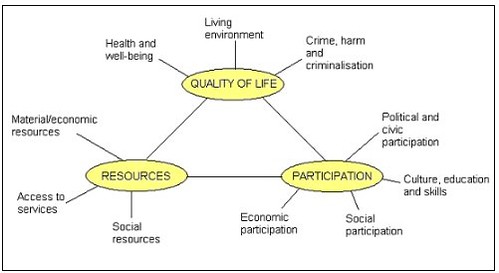
The Bristol Social Exclusion Matrix (pictured below) developed as part of the The Multi-dimensional Analysis of Social Exclusion, contains three primary elements for measuring social exclusion with ten sub-elements. Interestingly, they don't seem to separate out transportation access although "Access to public and private services" is one of the sub-elements. I'd separate out transportation/mobility as a separate sub-element.
Bristol Social Exclusion Matrix

Labels: , , , , ,

Wednesday, July 20, 2011

Why Amish buggies should be banned

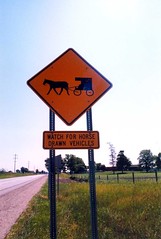
Amish Buggy Crossing Sign, Middlebury, IN
Frequently bicycle trails are opposed because people believe that improved bicycle access abets crime, even though automobiles are used to facilitate crimes far more often, and even with regard to bicycle trails, crime is higher in abutting residential neighborhoods and commercial districts (see "Sidewalks and Shared-Use Paths: Safety, Security, and Maintenance" from the University of Delaware Institute for Public Administration), recent problems in DC notwithstanding (see "Another bicyclist is robbed on popular Metropolitan Branch Trail" from the Washington Post).

My line about this is when crimes happen with automobiles, why don't people pipe up and call for banning automobiles, closing the road network and/or banning new road construction, since that is the course they recommend with regard to bikes.

The Associated Press reports, in "Amish teen with beer in buggy spurs police chase" about the use of a horse and buggy to attempt to evade police. Based on the idea of "one and done" obviously we need to ban such vehicles because their use may abet crime.

Labels: ,

Tuesday, April 28, 2009

Another illustration of why the Urban Design Element should be the guiding (primary) element of DC's Comprehensive Land Use Plan

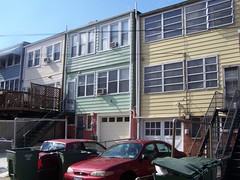
These rowhouses in Brightwood have rear entry basement garages
These rowhouses in Brightwood, probably constructed in the late 1920s or the early 1930s, have rear entry basement garages.

Is the discussion around the entry, "Ticketing of cars in public space reaches Capitol Hill" on Greater Greater Washington. Without a framework for understanding how the city is put together, or the spatial relationship between houses, blocks, and districts, and what these relationships were when particular neighborhoods were constructed, you can't come to a common understanding of how to deal with automobility vs. livability in the context of the city.

See the Urban Design Element from the 2006 Comprehensive Land Use Plan for the District of Columbia.

Also see these past entries from the last couple months:

-- Parking in historic districts
-- Urban design, sprawl and the automobile

which promotes linking urban design principles from the period of significance for particular historic districts to transportation policies, specifically parking policies and regulations in the first entry, and more generally, in the second entry.
Rear entrance basement garages, rowhouses, Brightwood

Labels: , , , , , ,

Monday, March 02, 2009

Urban design, sprawl and the automobile

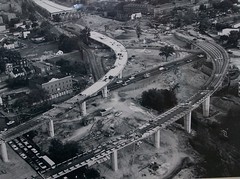
SE-SW Freeway under construction near the Marine Barracks, 1971
SE-SW Freeway under construction near the Marine Barracks, 1971. DC Dept. of Transportation photo.

The Weekend Financial Times has an article, "Highway to hell revisited," about the negative impact of the Interstate Highway Act on the country in terms of sprawl and gasoline dependence, and how President Obama has praised this act. (You'll have to register for access.)

It discusses how most highway advocacy is directly or indirectly supported by the consruction industry, and how for the most part, the Interstate Highways led the destruction of cities both in terms of cutting up neighborhoods through the construction of various routes as well as the roads serving as the way out of the city to live, but back to the city for the best jobs.
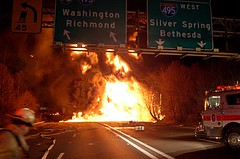
baltimoresun.com - Tanker truck burns.jpg
A tanker truck carrying 8,700 gallons of gasoline burns after exploding this morning on Interstate 95 north of Washington, D.C. The driver was able to escape unharmed after he noticed one of his rear wheels burning as he headed south from Baltimore.(AP photo)Nov 23, 2005

The article, by a columnist who is an editor for the Weekly Standard, also discusses how government projects aren't always a good thing. There is a lot to be said for this belief. We need to differentiate between projects that add value or projects that destroy value. As much value has been added by the creation of a robust freeway network, as much may have been destroyed in terms of building an economy dependent on automobiles, gasoline, and roads.

(Also see, from 2008, "On the pot-holed highway to hell," also from the FT.)
Illustration from The House Book by Keith DuQuette (resized)
From Scott Doyon--Re: the depiction of urban environments in media directed at children, my six year old daughter recently brought home a book from her school library called The House Book by Keith DuQuette. Included in it, following a lot of nice traditional home illustrations, was the attached depiction of city to country. It's so good for what it is, I was surprised it didn't have a DPZ credit at the border. My daughter understood it immediately. There is hope.

This question is also relevant to intra-city issues in the center city. David Alpert, of Greater Greater Washington, opines about opposition to significant changes to the philosophical and regulatory provisions of DC's Zoning Code, in "Zoning update opponents attack Office of Planning."

Surprisingly, the Zoning Commission is open to the idea that the Zoning Code should be supportive of urbanity, rather than a slight rewrite of the suburban oriented Zoning Code that DC first imposed in 1958, and has modified since. (this process started in response to the revision of DC's Comprehensive Plan in 2006).

This change is sparking reaction in many quarters. A lot of the reaction either directly or indirectly ends up supporting automobile-centricity, which I find incredibly ironic and sad.

Like David, I have written about what I think is the source of this reaction. Many of the city's long time and "traditional" activists took up their efforts during the many decade period when the city was in financial exigency and the population continued to shrink. These residents help stabilize and maintain neighborhoods that otherwise would have been disinvested.

This is one of the reasons by the way that I am such a fervent historic preservationist. There is no question that historic preservationists "saved" the city during those long decades when behaviors and trends did not favor urban living. The same laws about preservation that people revile today were the laws that saved many neighborhoods from possible destruction, or at the least, significant disinvestment. Those efforts should be respected and extended, by continuing to practice historic preservation by extending the provisions and protections to more places within the city.

Anyway, I think a useful way to approach how we do things _in the city_ is to be aware of how the city was constituted, on what principles. In short, the urban design and development principles that characterized the city as it was first laid out by L'Enfant in 1791 and subsequently developed through two eras, that of the Walking City (1800-1890) and the Transit-Streetcar City (1890-1920), should be respected and supported via the Land Use Plan and Zoning Code of the 21st Century.

The primary aspects of the city's livability were created in an era without automobiles, and to continue to apply automobility based land use and design principles to fundamentally urban questions is a mistake and needs to be stopped.

It is unfortunate that yesterday's activists don't understand the underlying principles of what they were doing 40 and 30 years ago, and how those principles need to pay fealty to the urban question.
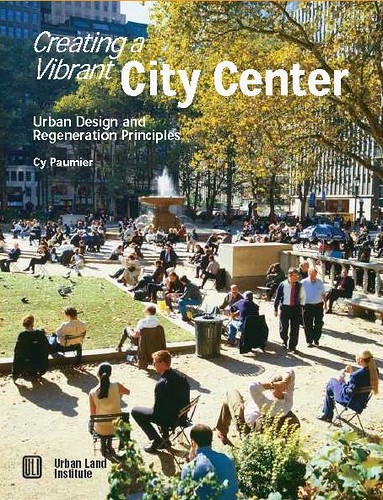
Creating a Vibrant City Center by Cy Paumier

Cy Paumier writes in Creating a Vibrant City Center that the pattern of downtowns (central business districts) developed around pedestrian-scaled streets, blocks, and buildings because of:

Concentration and Intensity of Use: "The intensity of development in the traditional central area was relatively high due to the value of the land. Maximizing site coverage meant building close to the street, which created a strong sense of spatial enclosure. Although city center development was dense, construction practices limited building height and preserved a human scale. The consistency in building height and massing reinforced the pedestrian scale of streets, as well as the city center's architectural harmony and visual coherence." (p. 11)

Organizing Structure: "A grid street system, involving the simplest approach to surveying, subdividing, and selling land, created a well-defined, organized, and understandable spatial structure for the cities' architecture and overall development. Because the street provided the main access to the consumer market, competition for street frontage was keen. Development parcels were normally much deeper than they were wide, creating a pattern of relatively narrow building fronts that provided variety and articulation in each block and continuous activity on the street." (p. 12)

The street grid, transportation practices and construction technology of the times, and the cost and value of the land led to a particular form of development on city blocks that focused attention on the streets and sidewalks, creating a human-scaled, architecturally harmonious built environment.

As construction technology advanced and taller buildings could be constructed, and as the walking and transit city was supplanted by the automobile, the scale of block development changed significantly, with a focus away from the pedestrian and towards the car.

OTOH, because TOD proponents are usually working on greenfield sites or grayfield site adaptations, it doesn't have the same kind of antecedents as the type of development described by Cy Paumier as typifying the development of downtown and the close-in neighborhoods near to downtowns.

And note, the report-publication produced by Karina Ricks (now the deputy director of transportation planning for DC's Department of Transportation) back in 2002 when she worked for the Office of Planning, Trans-Formation: Recreating Transit-Oriented Neighborhood Centers in Washington, DC, is really quite good. Frankly, it's one of the best descriptions that I've seen lately of how to (re)do infill development and build stronger neighborhoods. (I never really worked through the tome when it came out because I wasn't working very much on transit issues then.)

------
Speaking of irony, I find that some of the most ardent anti-freeway activists from the 1960s have become--even though they wouldn't think so--ardent proponents for the car, because of their unwillingness to support land use patterns that favor walking, bicycling, and transit use, rather than automobile trips for getting around.

Labels: , , , , , , ,

Thursday, October 16, 2008

New transportation campaigns

Given the election as well as the upcoming push to reauthorize transportation enhancement funding, Reconnecting America has released a report, Jumpstarting the Transit Space Race, about capital needs for fixed-rail transit. Right now there are plans (in various stages) for almost 400 new projects in 37 states totalling about $248 billion + the cost of rehabilitation of present systems as well as bus systems. At the current federal funding rate, it would take 77 years to build all these projects.

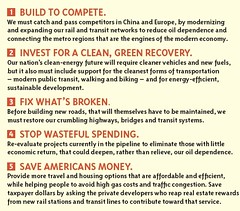
A coalition has launched the Transportation For America campaign, with a five-point plan, "Build for America" to advocate for the new US DOT bill.
Transportation For America campaign, 5 key points

Labels: , ,

Friday, August 22, 2008

Another World War II era poster

http://digital.library.unt.edu/data/rarebooks/posters/001_499/upl-meta-dc-488/wwpc179.jpg?PHPSESSID=0e161e7b667ad894f33c966fcd959f9e

Labels:

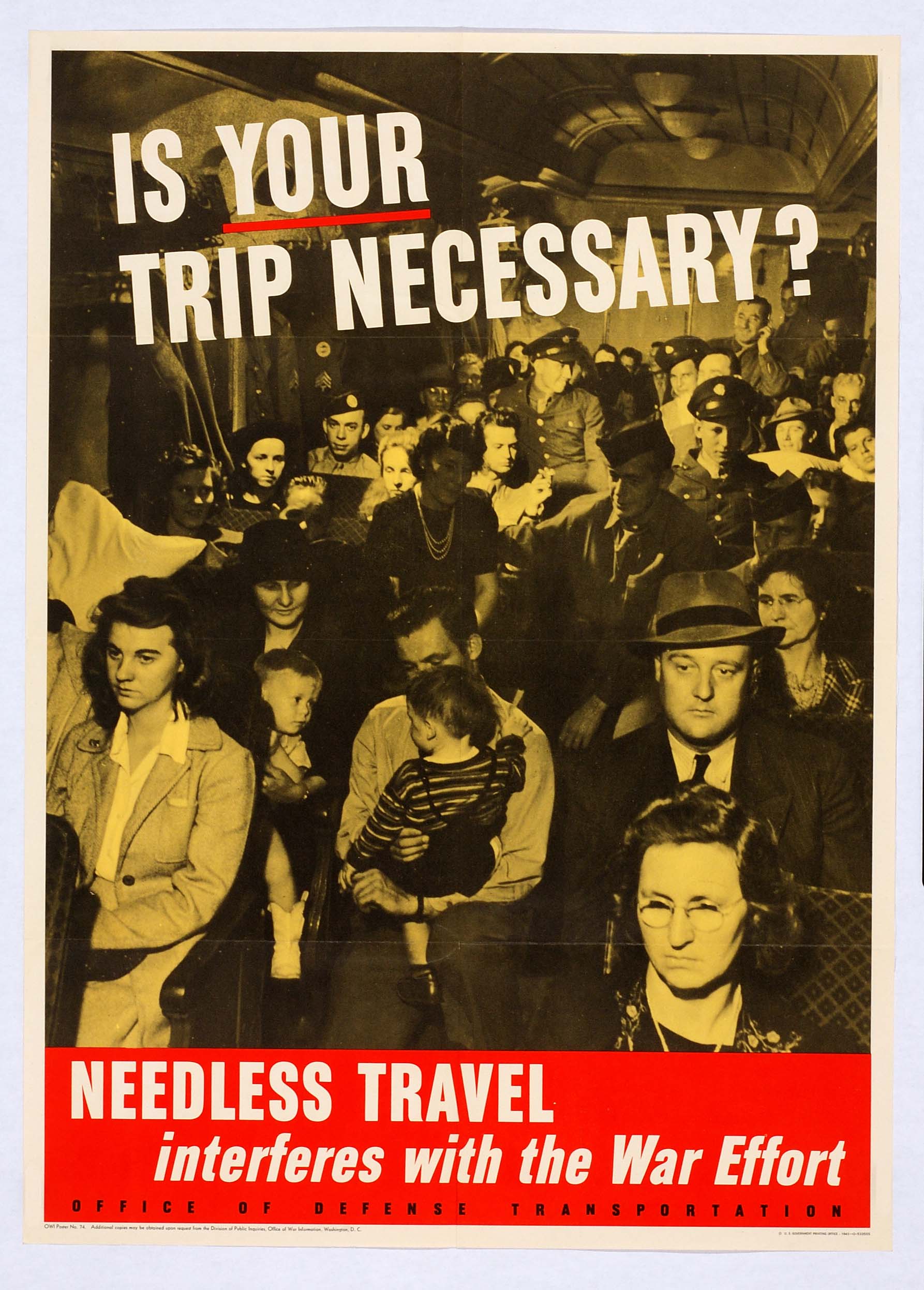
Is your trip necessary?

(You do think about this more when you walk, bicycle, or use public transit, especially when it's raining.)

Poster from the U.S. War Effort, 1941-1945
http://www.legion.org/documents/legion/posters/825.jpg

Labels:

Friday, June 27, 2008

Who is in office does matter

But it's not just an executive branch thing. The Federal Transit Administration claims (I haven't delved too deeply into it) that Congress ordered it to ensure that publicly funded transit systems don't "inordinately" compete with the private sector.

Now the reason we have public transit is that for the most part, it wasn't profitable for the private sector to do. (Most public transit systems are the result of local governments purchasing bankrupt private transit services. Now we can argue that regulation to keep fares down made profitability impossible, but still.)

There are many issues involved in delivering transit and municipal services.

For a number of years I've argued that having non-walkable school systems where students are transported by bus creates financial albatrosses for school districts. Having to buy, run, and fuel buses every year is expensive. First, you have to replace buses every so often. Second, it's harder and harder to find drivers. And now, third, it's a lot more expensive to provide the service because of major increases in the price of gasoline and diesel fuel.

So instead of having a dedicated school bus transportation infrastructure, when possible, it makes sense to use the public transit system instead. (If you want more education about this, I suggest reading up on microeconomics, opportunity costs, and marginal costs.)

But instead, the Federal Transit Administration is forcing the creation of separate bus infrastructures where they did not previously exist. BeyondDC writes about this today, in "With Friends Like This, Who Needs Enemies," using DC as an example, stating:

Does it make sense for the FTA to outlaw a practice that costs the District $5 million a year, forcing the city to accomplish the same exact objective for $20-25 million per year?

Common sense says no, it does not make sense to do those things [according to this article, "FTA proposal would bar Metrobus rides to school," from the Examiner].

Now, it is true that during the school year, there are dedicated Metrobus routes serving schoolchildren. But the public can still ride those buses. And rather than having dedicated buses sitting around, the buses can be used on other routes at different times.

(Are there laws about unfunded mandates?)

This comes out of the same initiative that I wrote about a few weeks ago, where public transit systems are now banned from offering shuttle services that aren't regularly scheduled services, such as shuttles to Redskins football games or Wolf Trap concerts, etc.

But isn't it important for transit systems to build their brands, and introduce people who might not otherwise public transit to use their services, and where possible, as well as to provide seemless and efficient transportation services?

No wonder public transit systems have it hard.

I think it's important to fire the public officials, starting with the elected officials, that produce these kinds of policies.

I find it so funny that people complain about transit subsidies without acknowledging (1) road subsidies and (2) all the various machinations by the private sector which make public transit a very difficult service to provide.

Labels: , , , ,

Friday, May 02, 2008

Transportation Roundup

1. NYC's new Strategic Plan for the New York City Department of Transportation 2008 and Beyond.

2. A couple weeks back the Toronto Star ran a massive series on mobility, "Shifting Gears: A Region in Motion":

- Part 1: Road map to recovery
- The genuinely better way
- Video: Metrolinx chair's vision
- Part 2: Where the buck meets the toll road
- London cuts traffic 20%
- Speak Out: Toll roads
- James: Don't alienate drivers
- Part 3: A model for sane transportation
- Part 4: Seattle's success
- Part 5: Time for decisions
- Part 6: Ditching the car
- Part 7: Free transit?
- Graphics Dwindling investment (.pdf)
- Creating the network (.pdf)
- Congested roads, 2001 and 2031 (.pdf)

3. You probably know about the Dulles Rail line being resuscitated and getting federal funding.

4. Thanks to Transportation Alternatives, we know that the new issue of Time Out New York's cover story is on bicycling . See "Great rides" but also "Explore Your Routes" on walking in NYC.

Ideas for the Washingtonian? Washington Post Sunday Magazine?
Bicycling in New York City
Time Out New York photo.

5. Unlike presidential candidates McCain and Clinton, Virginia Governor Kaine suggests that state gasoline taxes should be increased to fund transportation improvements in the state. See "Kaine May Float Gas-Tax Increase to Offset Shortfall" from the Post.

Labels: , , , ,

Monday, April 21, 2008

The impact of the urban vs. the suburban land use and transportation paradigm

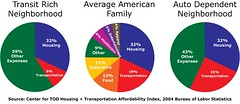
Household budget weighted according to mode dependence and access


Household budget weighted according to mode dependence and access via The Overhead Wire and other sources.

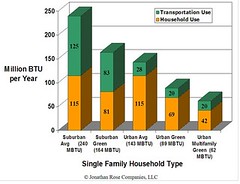
Energy consumption: Suburban Sprawl vs. Green Urban
Energy consumption: Suburban Sprawl vs. Green Urban.

(No more blogging today, and too much transportation..., but then it's not one or the other, transportation and land use planning need to be intertwined.)

The idea of "drive until you qualify (for a mortgage)," by failing to take into account the cost of transportation, is very limiting. The Location Efficient Mortgage should be the standard protocol for mortgage financing.

Labels: , , , ,

Tuesday, April 15, 2008

Jordan Flats, West Virginia Avenue NE

From "Senate Realty Entices Buyers With Free One Year Mini Cooper Lease With Purchase of Jordan Flats Condominium":

While home sales remain sluggish across the country, Senate Realty is working with its client Prism Development Company on a novel marketing approach to entice buyers back into the housing market. Through April 30, 2008, anyone purchasing a Jordan Flat condominium will receive a free year MINI Cooper lease from BMW of Sterling located in Sterling, Virginia.

To encourage homeownership and neighborhood development, Prism Development Company partnered with Thomas Moorehead, owner, BMW of Sterling and MINI of Sterling, to offer free leases through his foundation, the Sterling Automotive Group Foundation (SAGF). SAGF joined this effort, as part of its Economic Development for Working Families Initiative, aimed at reducing the cost of vehicle ownership for working families.

People who work in DC can now afford to live in DC. Affordably priced at $216,900, the Jordan Flats, developed by Barry Jordan and his wife Camille, were designed to encourage greater homeownership in Ward 5. To make the project a success, Jordan worked with Ward 5 Councilman Harry Thomas to understand the needs of the community.

Located in the Trinidad neighborhood, the Jordan Flats offer an attractive housing choice for working families, particularly policemen, firefighters, teachers and nurses who want to live in the city they serve. The Jordan Flats grand opening will be held April 12th to give prospective buyers an opportunity to tour the units.

Each unit comes with secure parking and boasts a host of amenities including: bamboo floors, granite counters, Jacuzzi bath, stainless steel appliances, spacious closets, an alarm system and more.
-----------
Regardless, promoting driving in the city is a bad thing. These buildings aren't too far from the New York Avenue and Brentwood Metro stations. Better to put money into expanded transit in this area, which is currently served by the E2 and D buses. Not that I am against driving... but it's better to spend more money on a house that is better located to transit. That way you can spend less money overall.

Did you see this article in the Post, "Mapping Transportation Costs for Home Buyers?"

From the article:

The Center for Neighborhood Technology developed a web site that takes into account household expenditures for transportation, along with home prices, to estimate whether a home is truly affordable for households with moderate incomes.

Academics at the CNT argue that a home isn't really affordable if its location forces a household to devote an excessive amount of the family budget to transportation. How much is excessive? They say 18 percent of the area's median pretax income is typical; lowering that to 15 percent would be better. That's on top of the 30 percent of pretax income that they estimate as an affordable budget for a home's mortgage principal and interest plus property taxes and homeowners' insurance, which lenders call PITI.

Labels: , , , ,

Thursday, April 10, 2008

The real commuter warriors?

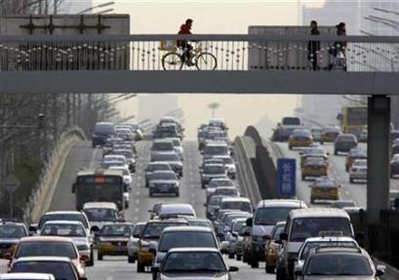
A man rides his bicycle across a pedestrian bridge as cars travel on the road below
Reuters photo.

At the Action Committee for Transit meeting a couple nights ago in Silver Spring, the chair made an announcement that Montgomery County is seeking nominees for the bicycle commuter of the year. One of the attendees commented that he had ridden to the meeting from Union Station (about an 8 mile trip). The chair commented that the County is looking for nominees of Montgomery County residents who commute to jobs within the County.

But I got to thinking about this.

The point is to promote environmental-friendly commuting more generally, isn't it? (I know, really there should be a jobs-housing balance that limits commuting, but that is an end goal. We're not at that stage now.)

What we should be doing is demonstrating that what seems to be impossible is in fact possible.

If DC has an equivalent award, I think there should be categories for commuters within the city, maybe people who commute to work by bicycle outside of the city (Washcycle rides from DC to Greenbelt...), and definitely bicyclists who commute to the city, from each of the local jurisdictions. This means that there should be an annual award to a bicycle commuter to DC from:

- Prince George's County
- Montgomery County
- Arlington County
- Alexandria
- Fairfax County
- and even further out, if such riders exist.

And that kayaker who commutes to work the old fashioned way (Navigating the River Road to Work; Annapolis Kayaker Finds Bracing Solitude During Daily Commute in the Washington Post), he'd likely win his category every year.

Labels: , ,

Thursday, August 09, 2007

New York City Parking Squat Day

(From the Transportation Alternatives e-newsletter)

Park(ing)
Streetfilms: Parking Lot Squat
Be sure to check out this Park Slope parking spot squat video.
Ever wish you had more space to relax and play on the street outside your home or office? Well, on Friday, September 21st, you'll have the opportunity to turn parking space into public space

New Yorkers from all five boroughs are organizing NYC Park(ing) Day 2007, a day where citizens trade street space dedicated to private car parking for vibrant public gathering spaces. Park(ing) Day is a fun way to bring attention to New York's need to rebalance streets in favor of uses that maximize the livability and sustainability of our urban habitat.

If you would like to set up a park in your neighborhood or would like to volunteer with a group planning a park, email lindsey@transalt.org.

-------------------
Plus another interesting thing from the e-newsletter is how they have Advocacy Committees for each borough of NYC and they have released a pro-bollard report called Rethinking Bollards, and the City of New York Transportation Department has a monthly e-newsletter for bicyclists

Labels: , , ,

Monday, July 16, 2007

Stories from the Financial Times...

not necessarily available via free online access.

1. Headline in the Tuesday paper... "World will face oil crunch 'in five years'" reporting from the world fuel outlook by the International Energy Agency. From the article:

The world is facing an oil supply "crunch" within five years that will force up prices to record levels and increase the west's dependence on oil cartel Opec, the industrialised countries' energy watchdog has warned. In its starkest warning yet, the International Energy Agency said "oil looks extremely tight in five years time" and there are "prospects of even tighter natural gas markets at the turn of the decade"...

Rex Tillerson, the chairman and chief executive of ExxonMobil, said recently that he thought non-Opec oil production was close to levelling off. He told the FT: "We still see capacity for a little more growth, but pretty modest, and then in our own energy outlook it begins to plateau. And that results then in this call on Opec."

2. Article in the Saturday paper, "Shenzhen citizens urged to stop buying cars." From the article:

The government has given enthusiastic encouragement to the car industry, whichit views as a pillar for the economy over the next two decades. However, in recent years a number of cities - most notably Beijing, the capital - have begun to suffer heavy congestion and pollution far above World Health Organisation guidelines as a result of increased traffic.

Officials in some cities have begun to worry that vehicle- related smog will deter investment. The problems related to car ownership could just be starting. Despite the already huge size of the market, only about 2 per cent of Chinese citizens own a car - around one-thirtieth of US and European levels.

3. From the Saturday Lex Column, "Chinese cars,":

But investors in Chinese carmakers need not panic. China is not about to flash a red light at the industry it has spent decades nurturing to national champion status. Auto manufacturing is a big source of investment and jobs. In spite of some flirting with various strategies to constrain traffic flows, Shanghai is the only city where related administrative measures are in place. (Its chosen weapon, auctioning licence plates for up to Dollars 5,000, is pretty draconian - in some cases, that doubles the cost of car ownership.)

Instead, China is likely to tackle the pollution issue through emissions standards and by building public transport, the lack of which is one reason that so many are jumping behind the wheel. Neither of these is a quick fix. China had been powering ahead on emissions standards, aiming to introduce Euro III-standard engines to reduce carbon dioxide this year, and Euro IV ahead of the 2008 Olympics. But that timetable does not take into account the country's low-quality fuel. The oil companies reckon it will take several years and some hefty investment to start producing the low- sulphur petrol needed to run Euro III engines effectively.

4. Tuesday column, "The world has two energy crises but no real answers" by Gideon Rachman:

The world is, in fact, facing two energy crises. The first is rooted in scarcity and traditional power politics. It involves the struggle by the world's largest and most energy-hungry economies to get hold of the natural resources they need. Just yesterday the International Energy Agency warned that the world oil market would be "extremely tight" over the next five years. Demands from China and other emerging economies are rising. But Mary Kaldor - co- author of a new book called Oil Wars (Pluto) - points out the struggle to find new oil is a familiar sort of conflict, reminiscent of the 19th century "great game" or earlier imperial clashes.

The second energy crisis is new. It is driven by climate change. It demands international co-operation rather than competition. While the first crisis leads politicians and businessmen to search out ever more oil and gas, the second demandsthat they radically reduce their economies' dependence on hydrocarbons....

The US has its own energy dilemma. It accounts for 25 per cent of the world's oil consumption, but around 9 per cent of world oil production and 2 per cent of world oil reserves. America's demand for hydrocarbons keeps rising and the economy is still utterly dependent on the stuff - 97 per cent of the US transport system is fuelled by oil.

5. From Friday, "Improve energy efficiency and demand will fall," a letter to the editor by Caroline Lucas,Green Party, South-East England,and a Member of the European Parliament:

Sir, Gideon Rachman is exactly right to highlight our economic vulnerability to unprecedented oil prices caused by both dwindling supplies and the increasing imperative to cut the carbon dioxide emissions that are fuelling climate change ("The world has two energy crises but no real answers", July 10). But nowhere in his article does he even mention one of the most glaringly obvious solutions: improved energy efficiency leading to reduced demand for energy.

According to the European Union's own figures, for example, 40 per cent of Europe's existing primary demand for energy could be met through the implementation of energy efficiency measures using existing technologies. To achieve that, however, individual actions alone won't be enough: we need the government and the EU to adopt higher energy efficiency standards on the whole range of goods and appliances, coupled with serious investment in decentralising our electricity supply, which would save much of the two-thirds of energy capacity we currently waste through transmission losses and escaping heat.

6. And not in the FT, but the reality is the necessity of focusing on urban form and the link between walkability, proximity, and automobile independence.

Labels: , , ,

Thursday, July 12, 2007

Speaking of commitment: Mexico City

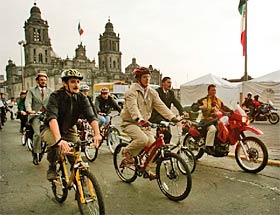
Mexico City Mayor Marcelo Ebrard (center) led a group of cyclists to work in April in the capital.
Associated Press. Mexico City Mayor Marcelo Ebrard (center) led a group of cyclists to work in April in the capital. His government's goal is to inspire the city's residents to cut gas consumption and use bicycles or public transit.

From "Mexico City's hopes riding on two wheels: Bicycle use urged to lower congestion," in the San Diego Union-Tribune:

Mayor Marcelo Ebrard delivered his shocking order to top officials from beneath a leafy tree in one of the few remaining parks in Mexico City. On the first Monday of every month, Ebrard announced, he and his handpicked team would travel to work on bicycles.

Now if we could do that here, and it extend it to more people at more levels in more government agencies.

Plus.... from "Cycle-Ride Sundays Take Off in Mexico City," on the Institute for Transportation & Development Policy (ITDP) website:

On Sunday May 13th the Mexico City government, headed by Chief of Government Marcelo Ebrard, began the Ciclo-Paseos, or “Cycle-Rides” program in designated streets of the country’s capital. The program encourages city inhabitants to walk, skate, or use bicycles to enjoy the city and promote non-polluting forms of transportation. The streets chosen consist of a circuit of 14 kilometers (8.7 miles) along the well known Reforma Avenue and others close to the historic city center so that the public can enjoy some of the cultural sites and activities along the ride. Motor vehicles are not allowed on those streets between 7:00 AM and 2:00 PM on Sundays. Many cities in the world have similar programs. Perhaps the best known is Bogotá, Colombia, with its more than 120 kilometers (74.6 miles) of streets that undergo this transformation every Sunday.

To encourage bicycling and forms of mobility other than the car, I think we need to do this kind of Ciclo-Paseo event annually, but throughout the year, held in different neighborhoods. The refamiliarity with bicycling as a legitimate travel mode has to be reconstructed at the ground level.

Labels: , , , ,

Living "green" means more than buying a Prius or agitating for LEED certification

From the Independent, in "Money talks: How concern for the planet is changing the way we shop ":

Bikes vs 4x4s
In the capital a battle is being fought between gas-guzzling 4x4s and greener-than-green cycles, and it looks as though the bikes are winning. Between 2001 and 2006, trips by bike increased by 50 per cent to 450,000 per day. There has also been a 15 per cent increase in journeys on the National Cycle Network, to 232 million journeys. In the previous year the rise was 11 per cent. And at Christmas, Ikea gave all its 9,000 UK "co-workers" folding bikes. Meanwhile, sales of 4x4 vehicles are falling, and it's happening faster in London than in the rest of the UK, according to new figures. There were 3,172 4x4s sold between January and May, down from 3,402 in the same period last year, according to the Society of Motor Manufacturers and Traders. This amounts to a 7 per cent fall in sales in London, compared with a 5 per cent drop across the country. A Mintel report also shows that 32 per cent of people nationwide are trying to cut down using their cars.


Oyster cards vs tickets
For Londoners, the paperless ticket is here to stay. More than three-quarters of all Tube and bus journeys are made using Oyster cards and the number of single journeys now paid for by cash is extremely low. According to Friends of the Earth and Transport for London, around 100,000 fewer paper tickets have been sold every day since Oyster was introduced in May 2003. But while Oyster cards may spell the end for paper tickets in the capital, another casualty is the Underground ticket office. Forty of the most lightly used ticket offices at Tube stations will close.


Trains vs planes
A survey by the research company emedia recently found that 34 per cent of responders were willing to spend more to reduce the impact on the environment of travelling, while 76 per cent were more likely to take environmental issues into account when booking their next holidays than they were the previous year. Thirty per cent were using alternative modes of transport, such as trains and coaches. Visit Britain says that coach operators are reporting an increase in bookings for 2007 from within the UK and from visitors from outside Britain for short breaks and tours in the UK and Ireland as well as to mainland Europe. Aviation is the fastest growing source of carbon dioxide emissions. According to the Government's own figures, in 2004 the UK aviation industry emitted an estimated 9.8 million tons of carbon. They project that this is likely to rise to 16-21 million tons of carbon by 2030. Since the UK is aiming to reduce carbon emission by 60 per cent by 2050, something has got to give, and it does not look like it is going to be air travel.

Labels: , , , , ,

Monday, July 02, 2007

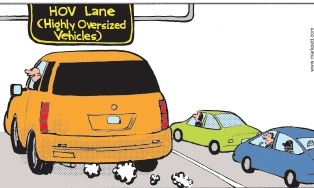
HOV = Highly Oversized Vehicles?

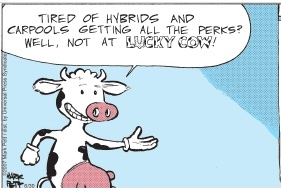
Lucky Cow by Mark Pett, 6/30/2007, frame 1

Lucky Cow by Mark Pett, 6/30/2007, frame 2

Lucky Cow is a great comic strip by Mark Pett that lamentably, no Washington area newspaper carries. This is the strip from June 30th. The strip is about a fast food restaurant but with commentary on more than the goings on within the confines of the fictional franchise operation.

Labels: ,

Thursday, June 14, 2007

Top 10 transit commuting cities in the U.S.

Will points us to this CNN story, "New Yorkers are top transit users: More than half ride subway or bus to work," about results from the Census Bureau's American Community Study.
Top 10 Commuter Cities

Labels: ,

Friday, June 08, 2007

Automobiles vs. other modes

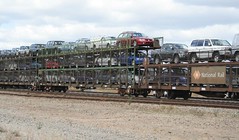
It occurred to me today, while watching a freight train go by on the old Metropolitan branch line of the B&O (now CSX) in northeast DC, that railroad automobile carrier cars demonstrate the greater efficiency of transportation modes other than the automobile.

This photo demonstrates the difference in efficiency. (Such freight cars in the U.S. have more serious screens designed to prevent people from throwing rocks and otherwise damaging the cars.)
Railroad automobile carriers
Railroad automobile carriers freight cars in Australia. (Photo from Webace.)

Labels:

Tuesday, May 08, 2007

Is a clean car that much better than a dirty car?

Isn't it better to walk, bicycle, or take transit?

More stuff from Chris Carney:

1. Say Yes to Clean Cars
9 AM, Tuesday, May 22


Arlington, VA - Tell the EPA to let California, Maryland, and 11 other states regulate global warming pollution from cars and trucks. Sign up to speak by May 15! Send written comments. More details.

2. Alternative Transportation Expo.
7:30 - 9:30 PM, Tuesday, May 15

Walter Reed Community Center, 2909 16th Street S., Arlington, VA

As we gear up for summer "code orange" and "code red" days, come learn how you can do your part to reduce air pollution from vehicle traffic! Open House featuring car-sharing demo and representatives from Washington Area Bicyclists Association, Arlington Transportation Partners, more.


Sierra Club & Arlingtonians for a Clean Environment. For more information, contact ACE on the web, or call 703-228-6427.

Labels: , ,