Rebuilding Place in the Urban Space

"A community’s physical form, rather than its land uses, is its most intrinsic and enduring characteristic." [Katz, EPA] This blog focuses on place and placemaking and all that makes it work--historic preservation, urban design, transportation, asset-based community development, arts & cultural development, commercial district revitalization, tourism & destination development, and quality of life advocacy--along with doses of civic engagement and good governance watchdogging.

Saturday, February 21, 2026

Who maintains community/cluster mailboxes in Canada?

Canada Post, to lower costs, forced a shift to group mailboxes for neighborhoods.  This was criticized for a couple reasons, one being wrt historic neighborhoods, the appurtenances aren't particularly fitting architecturally.  

Suburban and new subdivisions are outfitted with the group mailboxes and have been since the 1980s ("Super mailboxes, 'second-class citizens' and mail inequality," CBC).

Thus far, city neighborhoods still get door to door service ("An opportunity — if Canada Post chooses to take it," Winnipeg Free Press).  

Back when the change in how to deliver mail was first contemplated, wrt snow, another point was raised that one of the motivators for people to shovel their sidewalks was so that mail could be delivered ("Canadian Postal Workers Battle to Save Door-to-Door Delivery," Labor Notes, 2014).

Here, it seems that Canada Post doesn't take responsibility for snow clearance around their group mailboxes.

Image from "Canada gets cluster-boxed: Why it can’t happen here," Save the Post Office.  This article also discusses calls to create similar cluster boxes or community mailboxes in the US.

Another issue is general maintenance, such as dealing with people discarding mail at the box.  

Apartment buildings without front desks often have a mass-mess of discarded mail on the floor below the mailboxes.  This can be an issue in Canada too.

Labels: , ,

Friday, February 06, 2026

Neighborhood councils and civic engagement: snow removal as a community building activity

DC has what are called Advisory Neighborhood Commissions, which are grassroots community organizations empowered with the authority to "weigh in" on matters before DC government agencies, such as zoning, planning approvals etc.

Most of them don't work that well because not much is invested in them by the city government in terms of training and technical assistance.  Although some do well because they organize as committees and allow non-elected residents to participate as full members of the committees, expanding the human capital available to the Commission.

Past writings:

-- "National Community Planning Month | Civic Involvement," 2025

-- "DC's Advisory Neighborhood Commissions," (2012)
-- "(Even more on) ANCs (Advisory Neighborhood Commissions in DC)," (2010)
-- "Setting up DC's Advisory Neighborhood Commissions for success," (2022) (lots of links within)
-- ""Networked solutions" for some problems with ANCs in DC," (2011)
-- "Dumb... to fix bad practices, make them democratic instead of just eliminating them," (2012) (also discusses participatory budgeting)

-- "Building civic engagement systematically: Seattle's Department of Neighborhoods," (2022)
-- "Framingham Massachusetts creates Citizen Participation Officer position" (2018)
-- "Gaps in Parks Master Planning: Part Eight | Civic Engagement and Positive Promotion of Democracy," (2024)

-- "Main Street and getting schooled in politics, constituency building, and building support for your program," (2006)

Government versus self-help/DIY | top down versus ground-up solutions.  Note that Neighborhood Councils can create a couple of other problems.  First, they tend to convert every issue to one of "what government should do", reducing the willingness of people to do self-help/DIY.

Not enough engaged citizens to "staff up" multiple neighborhood organizations.  Also, they do what I call "creaming" getting the best possible community members to participate in the Councils.  I think this can come at the expense of maintaining other organizations such as community associations, friends of libraries/parks, schools and PTAs, etc.  

We need more and better participants, and a range of thriving community organizations, not fewer.  

Note that communities like Capitol Hill, Petworth, Adams-Morgan, Mount Pleasant, to some extent Georgetown, and Takoma Park (the Maryland side, which DC residents can be free riders) have a great amount of community identity, with a number of organizations, volunteers, community festivals, community foundations, various public events, etc.

Commissioners representing Single Member Districts.  Years ago I suggested some strategies and tactics for making Commissioners more accountable and active.  One was a stipend, but only if they held four meetings per year (quarterly) in their electoral district.  Later I suggested that one of the four meetings should be a public/outdoor event, like a community cleanup.

Snow clearance as a civic act.  Cities on the East Coast got zapped by the recent snow storm because snow was followed by sleet and a drop in temperature, creating what some are calling "snowcrete."  

The crust is very hard requiring sledgehammers, pickaxes and other non-plastic shovels to break through.

In DC, groups of citizens have self-organized through Reddit and other social media to go out and clear crosswalks--the city has never really taken responsibility for such even though cleared crosswalks are essential for a walking-biking-transit city ("Cities, sustainable mobility users, and snow"). 

Sidewalks and bus shelters too.

This would be a perfect activity to engage residents in the activities of their local Advisory Neighborhood Commission.  


Organized snow clearing events by transit stations, bus stops, schools, libraries, plus crosswalks, etc.  Hot chocolate afterwards?

DC Government does have a volunteer hotline for people willing to shovel snow for people in need.

But I think it could be expanded upon greatly if ANCs were a fulcrum for organizing.

Then again, supporting DIY efforts separate from ANCs is a good thing too.

Labels: , , , , , , , ,

Monday, January 12, 2026

Cities, sustainable mobility users, and snow

Snow clearance is hard, requires planning, and is maddening when you're trying to get around ("Why can’t Toronto remove snow like Montreal? The answers may surprise you," "No wonder it's taking so long to clear the snow, we planned it that way," Toronto Star).

For many years, around December and later I've written entries about snow clearance in cities that claim to prioritize walking-biking-transit. Rather than recap them, here's a list:

-- "Winter snow clearance in the Walking CIty," 2025


-- "A "maintenance of way" agenda for the walking and transit city," 2010
-- "Snow reminds us of the necessity of a "maintenance of way" agenda," 2013
-- "Testimony on the Winter Sidewalk Safety Amendment Act of 2011," 2011
-- "Level of service and maintenance requirements in planning #2: winter maintenance of bike paths," 2012
-- "Night-time safety: rethinking lighting in the context of a walking community," 2014
-- "Planning for Winter Weather," 2015
-- "Cataloging the various failures to remove snow in the walking/transit/bicycling city," 2015
-- "Who knew?: there is a Winter Cycling Federation and annual conference," 2015 
-- "Focusing on what's most important: snow on sidewalks or snow on cars?," 2016
-- "Winter preparedness, planning and the Walking/Biking/Transit City," 2019
-- "Walking City Wintertime: Snow and strollers in Toronto," 2019

People stand at a bus stop near Logan Circle in Washington in 2022. (Amanda Andrade-Rhoades/For The Washington Post)

I haven't been motivated to do so much this year because Salt Lake's Valley, and even the mountains although that's changing, has gotten so little snow that a shovel has been unnecessary.  

Although this photo from the Washington Post keeps reminding me.  

Many of Salt Lake's bus stops are just uncovered benches while Calgary and other cities like Winnipeg ("'If you're waiting for a bus, it is brutal' but should the city invest in heated shelters or service?," CBC) have enclosed bus shelters that are heated in the winter.  

Montreal has a special network of winter cycle paths that they commit to keeping clear after snow storms.  Arlington Virginia has a program promoting winter cycling. Many communities, including DC and Montgomery County for the Capital Crescent Trail, have snow clearance programs for trails.  Minneapolis was one of the first cities to include maintenance of way as an element of its bicycle master plan.  Salt Lake and many cities have a winter Bike to Work Day.

An enclosed shelter at Overlea Boulevard and Thorncliffe Park Drive. Like other aspects of the system, there’s concern that using the new facilities could pose a risk if COVID-19 case peak again in the fall and winter. Steve Russell / Toronto Star.

Toronto has introduced some heated shelters, with the justification that they make it easier for disabled users to use regular transit ("TTC installs 16 new heated and enclosed bus shelters," Toronto Star).

Apparently, Pittsburgh isn't getting a lot of snow, but like my blog entries, the mayor is trying to plan ahead after clearance failures ("Mayor outlines snow removal concerns," "One-third of Pittsburgh's plows were unavailable during weekend snowstorm: 'We have to invest in our fleet'," Pittsburgh Post-Gazette).  

Similarly, the Boston Globe editorializes, "The disappearing snowplow," in support of state legislation providing financial incentives for snowplow operators so that they continue to operate. 

Toronto failed spectacularly with snow clearance last year, and this year doesn't look to be better ("Toronto could make snow clearing significantly better, report finds. But the city says it can’t afford to," Toronto Star, 2025 Winter Storm Response and Winter Maintenance Program Review: Recommendations and Implementation Plan).

According to the new report from Oakville-based consultants Municipal VU Consulting Inc., a system that offers “the fastest cleanup and the highest level of service reliability” would be the most expensive, at $130 million a year, $94.4 million of which accounts for having extra staff and equipment on standby.

Liisa Nisula, an East York resident, struggles with snow-covered sidewalks in the Danforth-Coxwell area in Toronto, Thursday, February 20, 2025. THE CANADIAN PRESS/Eduardo Lima

A lot of the coverage on last year's problems in Toronto focused on how inadequate snow clearance makes it especially hard for the disabled and those with children to get around ("People with mobility issues struggle to navigate sidewalks as cities rush to clear snow," "The magic of the snow is gone. Now we’re left with unplowed streets, dog-yellowed piles and road salt in our hair," Toronto Star). 

Other reports state schools stay closed "longer than they need to" partly because lack of snow clearance makes it hard for kids to walk to school ("Students' choice: Walk in the road or walk on the snow-covered sidewalk," Fox13).

This year, I hope the cities to the east of Utah are doing better on snow clearance for pedestrians, bicyclists and transit users.

=======

Dealing with blizzards can be more than a matter of sustainable mobility, it can be about emergency management more generally and physical safety ("Buffalo Leaders Weren’t Ready for Blizzard That Killed 31, Report Says," NYT).

Five months after a blizzard devastated western New York, killing 31 residents of Buffalo, a report released on Friday cited multiple failures in the ci

Emergency warnings from city officials did not adequately convey how life-threatening the storm would be, the report said. City officials didn’t spread the word about the county’s travel ban for cars quickly enough and didn’t adequately stress the dangers of walking outside. And as the storm raged on, coordination between city, county and state officials became strained.

... The city’s response did not take into account the economic disparities that have existed in Buffalo for decades, they said. Those inequities meant, for instance, that many low-income residents could not afford to stock up on extra food before the blizzard, and as a result, risked driving or even walking out into the snow to get supplies for Christmas dinner.

Labels: , , , , , , , ,

Wednesday, January 08, 2025

Winter snow clearance in the Walking City

A bicycle path cleared of snow in Sweden.  Reddit photo.

I used to write yearly about this, focusing on how the sustainable mobility centric city needs snow removal policies that co-equally privilege walking, biking and transit users, not just the motor vehicle parts of roads.

Moving to Salt Lake City-one of Utah's marketing slogans is "the best snow on earth"--is that ironically it doesn't snow that much in the city.  Most of the city is flat, in the valley.  The northeast sections (I live in part there), do get more snow, but it truly varies--one mile east closer to the mountains gets 2x or 3x the amount of snow we do.  Often, within a couple days the snow melts off our driveway anyway.

Of course, the mountain canyons get much more snow than Salt Lake, have avalanche threats, etc.

The city stays on top of road snow clearance, most households shovel their sidewalks, and I don't know what the city does for separated bike lanes--which aren't close to my house, and these days I am unable to bike anyway.

An intrepid bicyclist riding on a snowy road towards Georgetown, DC.  Reddit photo.

A Reddit thread complains about the quality of snow removal in DC ("Has DC's snow removal gone downhill? "), and it covers some of the same issues that got me writing those posts starting in 2009 (also my experience then working as a bicycle and pedestrian planner for Baltimore County).  

Back then it was Mayor Fenty's Administration that failed.  Surprisingly or not so surprisingly, the Reddit thread focus is on the roads--but then even pedestrians use them, especially when sidewalks aren't cleared.

I did find that my yearly "complaints" about the issue led to year-by-year-improvements.  DDOT even swiped a photo I reprinted from the Boston Globe on the topic.  But I'm not there now... GGW focuses on "snecks" but not the overall problem of snow removal in the Walking-Biking-Transit City ("Snow reveals excess roadway").

The condition of State Line Road following the previous day’s snowstorm on Monday, Jan. 6, 2025. The Missouri side on the right, Kansas side on the left. Dominick Williams dowilliams@kcstar.com  

The Kansas City Star has an article, "Kansas City overhauled its approach to snow removal. Blizzard response shows some payoff," about how the Kansas City Missouri (the Kansas side isn't doing too well with the same snowstorm) has transformed its business processes for staying on top of snow clearance, and it's a good model for other jurisdictions.


-- "A "maintenance of way" agenda for the walking and transit city," 2010
-- "Snow reminds us of the necessity of a "maintenance of way" agenda," 2013
-- "Testimony on the Winter Sidewalk Safety Amendment Act of 2011," 2011
-- "Level of service and maintenance requirements in planning #2: winter maintenance of bike paths," 2012
-- "Night-time safety: rethinking lighting in the context of a walking community," 2014
-- "Planning for Winter Weather," 2015
-- "Cataloging the various failures to remove snow in the walking/transit/bicycling city," 2015
-- "Who knew?: there is a Winter Cycling Federation and annual conference," 2015 -- the upcoming Congress is in Montreal, February 8th-10th, 2017
-- "Focusing on what's most important: snow on sidewalks or snow on cars?," 2016
-- "Winter preparedness, planning and the Walking/Biking/Transit City," 2019
-- "Walking City Wintertime: Snow and strollers in Toronto," 2019

MOW is a term used by railroads.   And "transit city" as an urban form encompasses sustainable modes of transportation--walking, biking, and transit--based on the concepts expressed in "Transportation and Urban Form: Stages in the Spatial Evolution of the American Metropolis" by Peter Muller.

Edmonton: Winter City Strategy, Winter City Design Guidelines.  Given how much of its climate is during winter, Edmonton, Alberta has developed plans to address this.  


The strategy has four elements– Winter Life, Winter Design, Winter Economy, and Our Winter Story.

Labels: , , , , , , , ,

Tuesday, January 03, 2023

A Lime electric bicycle front wheel with the spokes iced up, Salt Lake City | Snow clearance issues and sustainable mobility

In past years, in November or December, I usually write a piece about "maintenance of way" issues concerning pedestrians, transit riders, and bicyclists in the winter.

-- "Snow, winter and the "Sustainable Mobility City"," 2019

I started this in 2010, although during the winter storms of February, when I was writing a bicycle and pedestrian plan for part of Baltimore County, and I was clued into the importance of "maintenance" elements, including deal with snow.

One thing to add is dealing with electric scooter and bicycle sharing programs, typically offered by for profits (and as mentioned, for profit transportation providers tend to not be well integrated into transportation planning, "Revisiting the need for comprehensive transportation planning at the metropolitan and regional scales | For profit services, and White's Ferry, Montgomery and Loudoun Counties").

I've seen a bunch of buried scooters and bikes in the wild.  By contrast the nonprofit GreenBike program, based around hubs or stations, doesn't have the same problem.

This is in the most successful neighborhood commercial district in Salt Lake City.

And like in the 2019 and earlier posts, inadequate snow removal in commercial districts remains a program.

Bike lanes.  While I think a lot of jurisdictions have improved in clearing snow from bike lanes, for those that don't, "Canadian man built this DIY e-bike snow plow to clear bike lanes," 

Sidewalk snow clearance.  More cities are taking responsibility for clearing snow from sidewalks ("More Cities Are Taking Responsibility for Clearing Sidewalks of Snow," Streetsblog).  One such is Winooski, Vermont ("Burlington loans Winooski plows to clear sidewalks after two break during Vermont snowstorm," Burlington Free Press).

Some cities like Salt Lake and even DC are taking responsibility for snow clearance from pedestrian walkways on bridges.

Utah Transit Authority Ski Bus service.  Has been severely cut back ("UTA Ski Bus service to Alta changes again," Salt Lake Tribune).  Part of the problem has been lack of drivers.  But this was exacerbated by an almost two year long hiring freeze during the pandemic.  

One additional problem, Little and Big Cottonwood Canyons are difficult to drive in during snowy conditions, and they only have five drivers rated to drive when conditions are challenging.

Separately, two ski resorts are offering a gas credit for carpoolers, to make up for the drop in bus service ("How to get $50 for carpooling up Little Cottonwood Canyon this winter," KSL-TV).

That's a different kind of winter service issue, but relevant.

Labels: , , , , , , , ,

Friday, February 19, 2021

Another example of a failure to plan: clearing snow in Texas

We have to cut Texas some slack on snow removal, because it doesn't snow there very often, definitely not in large amounts.  Plenty of places that get a fair amount of snow plan inadequately when it comes to "maintenance of way" in the winter.

-- "Snow, winter, and the Sustainable Mobility City," 2019 (includes links to past entries)

But why does Texarkana, Arkansas have the capacity to remove snow and Texarkana, Texas does not?

The Texas side of State Line Avenue in Texarkana is unplowed.@CharlesPeekWX via Twitter

The road has since been cleared.  But apparently Texas has only 700 major snow plows for the entire state.

Note that while DC's Eastern, Western and Southern Avenues lie fully within DC even as they border Maryland and you'd think the boundary is in the middle of the road, I have seen similar results.  For example, even though "it's in DC," the Town of Mount Rainer, Maryland does snow removal on its side of Eastern Avenue, usually many hours before DC gets around to it.

Labels: , , , ,

Friday, November 08, 2019

Snow, winter and the "Sustainable Mobility City"

After a major set of snowstorms in 2010, I started writing an annual piece on what I called "a maintenance of way agenda for the transit city."

-- "A "maintenance of way" agenda for the walking and transit city," 2010
-- "Snow reminds us of the necessity of a "maintenance of way" agenda," 2013
-- "Testimony on the Winter Sidewalk Safety Amendment Act of 2011," 2011
-- "Level of service and maintenance requirements in planning #2: winter maintenance of bike paths," 2012
-- "Night-time safety: rethinking lighting in the context of a walking community," 2014
-- "Planning for Winter Weather," 2015
-- "Cataloging the various failures to remove snow in the walking/transit/bicycling city," 2015
-- "Who knew?: there is a Winter Cycling Federation and annual conference," 2015 -- the upcoming Congress is in Montreal, February 8th-10th, 2017
-- "Focusing on what's most important: snow on sidewalks or snow on cars?," 2016
-- "Winter preparedness, planning and the Walking/Biking/Transit City," 2019
-- "Walking City Wintertime: Snow and strollers in Toronto," 2019

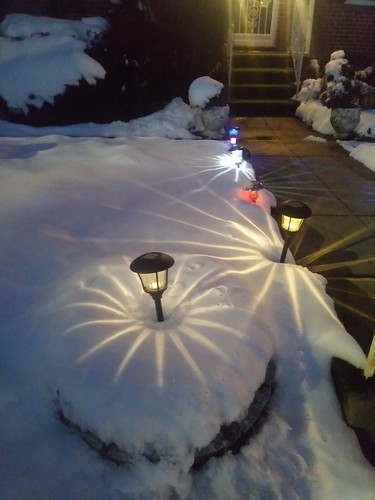
Neat color reflections of walkway lights in the snowMOW is a term used by railroads.   And "transit city" encompasses sustainable modes of transportation--walking, biking, and transit--based on the concepts expressed in "Transportation and Urban Form" by Peter Muller.

Cities still are grappling with reorienting practices of city agencies in favor of sustainable mobility, even though a majority of transportation movement in cities is likely to be by pedestrians and transit riders.

One of my indicators in change in practice was how the Takoma Recreation Center has slowly expanded its sidewalk snow removal practices over the years, something that I tend to comment on in the series of pieces.  Over ten years, now they pretty much remove snow from all the sidewalk around four blocks, which is quite good since originally they did zero clearance from the perimeter sidewalks.

I was really surprised to see the DC DPW director, in this piece the other day from WTOP-radio, "How DC is preparing for this year’s wintry ‘Polar Coaster’," acknowledge as a priority snow clearance from bike lanes, intersections, and bridges, which have been persistent problems over the decades as the snow plow practice "regime" preferences motor vehicle movement. From the article:
“Protecting bike lanes has become a higher priority as more residents use bicycles as an alternative and even primary mode of transportation. The snow teams … are dedicated to keeping the bike paths, bridge deck, sidewalks, [disabled accessible] ramps, intersections and bus shelters clear,” Geldart said.
The article includes a twitter message embed with a video demonstrating a smaller machine used for clearing bike lanes.

Something I had never seen before, DDOT presalting sidewalks on bridges in a pedestrian areaAnd I have noticed, just like with the Takoma Recreation Center, incremental improvements over the years.

E.g., last Janruary I was shocked to see DPW crews salting sidewalks on bridges across North Capitol Street in advance of a snow storm when I was at a meeting in the Bloomingdale neighborhood.

While these are great steps there are always opportunity for improvement.

Past pieces have discussed better practice such as:
  • how Rochester, New York takes the responsibility for clearing snow from all the city's sidewalks
  • how the Minneapolis Bicycle Master Plan has an element on maintenance including winter snow clearance
  • how Holland, Michigan created a system of steam/water pipes under downtown sidewalks to melt snow as it falls
  • Montreal's clearance of snow from a defined winter network of cycle paths, and how some trails, such as the Minuteman Trail in Suburban Boston, the Capital Crescent Trail in Bethesda, and DC's Metropolitan Branch Trail have snow clearance protocols
  • a Winter Cycling Federation links cities across the Northern Hemisphere on snow clearance and bicycling matters
More recently, I learned that:

Labels: , , , , , , , ,

Sunday, February 24, 2019

Walking City Wintertime: Snow and strollers in Toronto

Since 2010, I've written about snow clearance in the context of the Walking City and the creation of a "maintenance of way" agenda that goes beyond prioritization of motor vehicle movement, that is to say, sidewalks and bicycle lanes.

-- "Winter preparedness, planning and the Walking/Biking/Transit City," 2019
-- "A "maintenance of way" agenda for the walking and transit city," 2010 was the first substantive piece, in the face of "snowmageddon" when DC got about 26 inches of snow over about a week through two separate storms
-- "Testimony on the Winter Sidewalk Safety Amendment Act of 2011" 2011
-- Level of service and maintenance requirements in planning #2: winter maintenance of bike paths," 2012
-- "Agenda setting: snow clearance in the walking-biking-transit city," 2014
-- "Planning for winter weather," 2015
-- "Cataloging the various failures to remove snow in the walking/transit/bicycling city," 2015
-- "Who Knew?: There is a Winter Cycling Federation and annual conference," 2015
-- "Focusing on what's most important: snow on sidewalks or snow on cars?," 2016

Ana Bilanovic (right) gets a helping lift from sister-in-law Tamara Protic as they lift Matej, 17 months, over the ice rather than go through a puddle on the sidewalk along Gerrard St. E. (Rick Madonik / Toronto Star)


The Toronto Star has a great article, "Sidewalks turn into an urban obstacle course for parents with strollers," with wonderful photos about the difficulty of getting around while pushing a stroller on sidewalks and crosswalks that aren't adequately cleared of snow.

The photos would be great, featured in billboards and other marketing messages reminding people to shovel their walks, and to be sure they pay attention to intersections, snow along side frontages, walking paths across alleys, etc.
Bahaa Alhaj said he found it particularly difficult to push his two young children around in their stroller this winter. (Jason Miller / Toronto Star).

Of course, this can be a worse problem for the disabled, as these Star articles make cleaer:

-- "Disabled parking spots shouldn’t be dumping grounds for snow"

-- "Just deal with snow? Not so easy for some people"

This photo is from the latter article.
Lene Andersen, who uses a wheelchair for mobility, says getting around in winter weather is a big problem when sidewalks are covered with snow and snow banks block access to the street. Even getting to a grocery store can sometimes be impossible. (DAVID GOVONI)

Labels: , , , , , , , ,

Wednesday, January 09, 2019

Winter preparedness, planning and the Walking/Biking/Transit City

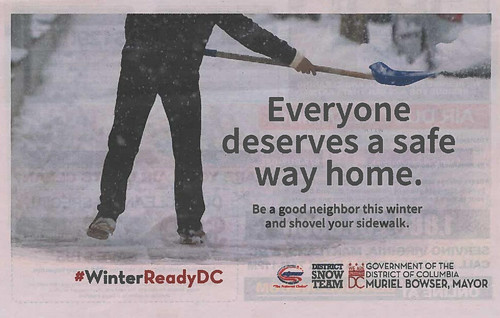
DC Department of Transportation ad in the Express promoting snow shoveling, 1/7/2019

Since last year I never used a snow shovel, because the snow that fell once or twice melted within 24 hours, and this year, with some of our rose bushes blooming into January, it's hard to think about "winter."

But weather reports say that winter is coming this weekend, and the Northeast is already getting hit, and of course in the Midwest and West, they've been dealing with snow already for months--I think it snowed as early as late October in parts of Colorado?

But this ad from the Monday Express, by DC Department of Transportation on snow clearance, reminded me that in past years I've usually published an annual piece in November/December as winter looms, on winter preparedness.

-- "A "maintenance of way" agenda for the walking and transit city," 2010 was the first substantive piece, in the face of "snowmageddon" when DC got about 26 inches of snow over about a week through two separate storms
-- "Testimony on the Winter Sidewalk Safety Amendment Act of 2011," 2011
-- "Level of service and maintenance requirements in planning #2: winter maintenance of bike paths," 2012
-- "Agenda setting: snow clearance in the walking-biking-transit city," 2014
-- "Planning for winter weather," 2015
-- "Cataloging the various failures to remove snow in the walking/transit/bicycling city," 2015
-- "Who Knew?: There is a Winter Cycling Federation and annual conference," 2015
-- "Focusing on what's most important: snow on sidewalks or snow on cars?," 2016

Three of the more interesting initiatives discussed:

1.  Rochester, NY clears sidewalks, even in residential areas, when snow reaches a certain depth;
2.  Downtown Holland, Michigan has heated sidewalks so snow melts as it falls
3.  The now annual Winter Cycling Conference.

Unshovelled side of the house, unshovelled street cornersThe biggest and repetitive point is about making snow clearance policies and practices focus equally on pedestrians, bicyclists and transit users, not just motor vehicles, especially in the context of how cities tout that they are walking, biking, and transit focused.

But riding last night after dark on Rhode Island Avenue NE in the vicinity of the Rhode Island Metrorail Station I was shocked at how "dark" the sidewalks are in the walkshed of the station, especially on Rhode Island Avenue.

Considering that this station was one of the first to open, making it 42 years old, it's amazing that in those 42 years, the lack of adequate night-time lighting on the corridor around the station hasn't been addressed.

Making my somewhat separate thread of night-time lighting equally relevant to winter preparedness matters.

-- "Night-time safety: rethinking lighting in the context of a walking community," 2014

Labels: , , , , , , , , ,

Wednesday, March 21, 2018

Winter storm management

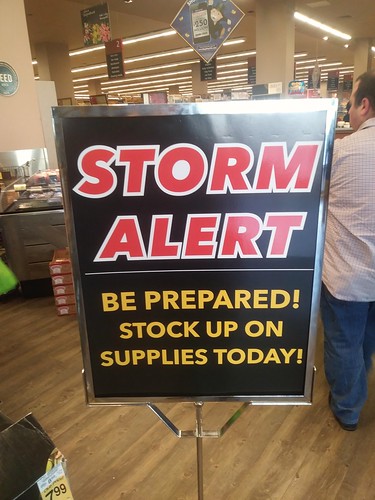
Storm Alert sign in a Safeway supermarketNormally, each year I do an advance piece in December about storm management and the impact of storms on transportation and transit, and the need for cities especially to rebalance some snow clearance efforts towards walking and bicycling routes, and facilitating safe access to transit.

I didn't do that this year, and frankly, in the DC area there hasn't been that much snow, although the Northeast has been hit hard from time to time, including today, whereas DC has a bit of snow by comparison.

-- "Preparing for winter weather in advance of winter," 2016
-- "A "maintenance of way" agenda for the walking and transit city," 2010
-- "Snow reminds us of the necessity of a "maintenance of way" agenda," 2013
-- "Testimony on the Winter Sidewalk Safety Amendment Act of 2011," 2011
-- "Level of service and maintenance requirements in planning #2: winter maintenance of bike paths," 2012
-- "Night-time safety: rethinking lighting in the context of a walking community," 2014
-- "Planning for Winter Weather," 2015
-- "Who knew?: there is a Winter Cycling Federation and annual conference," 2015

Of course, every year there can be new developments.

-- "DC lawmaker says recent snowfall caused by 'Rothschilds controlling the climate'," Washington Post

Labels: , , , , , , , , ,

Monday, December 05, 2016

Preparing for winter weather in advance of winter

This video ("Montreal buses, cars, police cruiser and even salt truck slide down hill," CBC-TV)  showing the consequences of an icy road in Montreal reminded me it's time for my annual pre-winter post on snow.

Location: Côte du Beaver Hall toward Viger Street, Montreal


I have a bunch of posts over the years about how cities should adopt a more general "maintenance of way" agenda appropriate for urban areas, with special attention to walking, biking, and transit, since those modes dominate, although most systems preference motor vehicle traffic both in terms of snow clearance and lighting. The basic point is that cities where a majority of trips are conducted not by automobiles need to better prioritize these modes in terms of maintenance generally and winter snow clearance specifically. One of the things that always comes up is snow clearance on trails, especially trails on park land.

In particular it means how we do snow clearance, maintenance of bike lanes, and night time lighting of sidewalks and walking paths. DC is committed to snow clearance on its trails. This is less true of the suburban jurisdictions.

-- "A "maintenance of way" agenda for the walking and transit city," 2010
-- "Snow reminds us of the necessity of a "maintenance of way" agenda," 2013
-- "Testimony on the Winter Sidewalk Safety Amendment Act of 2011," 2011
-- "Level of service and maintenance requirements in planning #2: winter maintenance of bike paths," 2012
-- "Night-time safety: rethinking lighting in the context of a walking community," 2014
-- "Planning for Winter Weather," 2015
-- "Who knew?: there is a Winter Cycling Federation and annual conference," 2015 -- the upcoming Congress is in Montreal, February 8th-10th, 2017

Better practice through better weather data?
Last week, Dr. Gridlock ran a story, "Highway departments preview their snow cleanup plans," discussing the late in the day snows last year and over recent years that crippled the evening commute, extending it by many hours. From the article:
Among commuters, there are dates that live in infamy. One of them is Jan. 20, 2016.

The highway departments in the D.C. region know that date, too, because many of their road crews shared the experience with the commuters. When highway officials talk about winter storm preparations, they use “Jan. 20” as shorthand for a certain set of inputs and outcomes they know everyone in their circle will react to with a shudder.

For those who have the good fortune to be mere casual observers of the daily commute, this wasn’t the date of last winter’s major event, the blizzard, which swept into the region a few days later. Jan. 20 was the day of the dusting, when the afternoon commute was crushed by a light coating of snow.
It reminded me of a recent article in the New York Times Magazine, "Why Isn't the U.S. Better at Predicting Extreme Weather?," which discusses how the National Weather Service/NOAA is so underfunded by Congress that it can't afford to buy the best software or the computers necessary to run the models.

One of the points made by the person featured in the article is that the "micro-areas" that the NWS provides weather forecasts for are too big, and it is possible, with the right software and computing power, to provide much better forecasts for smaller areas than is typical currently.  From the article:
While Mass is the most outspoken on the subject, many experts insist that if the Weather Service wants to meaningfully improve its predictions, it must employ a technique called ensemble forecasting. The basic premise is either to tweak the physics equations or to make repeated changes to a model’s variables: You might bump up the temperature slightly, for example, and then run the model again. After a half-dozen or so reruns, you get a set, or “ensemble,” of forecasts that can be compared with one another. When all the forecasts in an ensemble agree, it’s a reasonably sure bet that the predictions will pan out.

Nobody I’ve spoken to doubts the superiority of ensembles. Yet they haven’t been widely adopted in the United States at the resolution required to forecast localized, or “mesoscale,” events — specifically, thunderstorms, flash floods and tornadoes — because high-resolution ensembles require more computing power than the National Weather Service can currently provide. Higher-resolution ensembles translate to greater accuracy in the same way that HDTVs are clearer than analog sets. I met with a scientist at the National Center for Atmospheric Research in Boulder who showed me a prototype mesoscale ensemble for the United States. But at the moment, he can’t exploit its full potential because the supercomputing cluster at the Weather Service simply couldn’t handle the load. ...

In 1995, Mass founded the Northwest Regional Modeling Consortium in Seattle to create better local forecasts. At the time, the National Weather Service used models with resolutions of 80 kilometers, or about 50 square miles. In Washington State, a sample that large might encompass topography ranging from 10,000-foot-high snowcapped volcanoes all the way down to the Pacific Ocean; the resulting forecast, forced to produce sweeping overgeneralizations, renders itself essentially useless. “My first test was at 27-kilometer resolution, and then I started doing it higher and I found something absolutely magical,” Mass says. “We could actually forecast the local weather.”

Jeff Renner, the chief meteorologist for Seattle’s NBC television affiliate KING 5, who retired in April, told me, “It really allows us to see some beautiful detail.” KING pays more than $20,000 a year to buy model data from the consortium, which it incorporates into its on-air forecasts. “[Mass] was doing a much better job than the Weather Service, where you were basically getting vanilla ice cream,” Renner says. With the consortium, “it was like walking into Ben & Jerry’s.”
Reading Dr. Gridlock, I was thinking that the first thing that the MWCOG TPB should do is working with all the relevant transportation authorities, contract independently of the NWA for such detailed weather forecasting.

It could help reduce the kinds of forecasting problems that contribute to inadequate preparation for snow events, which then lead to major commute snafus.

Labels: , , , , , , , ,

Thursday, February 11, 2016

Focusing on what's most important: snow on cars or snow on sidewalks?

(I know, this is a photo from Europe...)

A number of legislators in New York State have introduced bills to institute fines on motor vehicle operators for not clearing snow off their vehicles, and then driving, with the likelihood of the snow flying off their cars.

From the Rochester Democrat & Chronicle article "Snow on car? Some lawmakers want a fine":

At least four separate bills in the state Legislature would hit motorists with a fine if they fail to clear snow and ice off their vehicles before hitting the road, following the lead of New Jersey and Connecticut, which have implemented similar policies.
Supporters of a fine say it would deter motorists from driving their snow-covered cars, which pose a danger to other drivers who could find themselves in the line of flying ice or debris. ...

Mayer's bill is the most comprehensive of the proposals, laying out a system of fines and a fund to provide for areas on the state Thruway where truckers can clean off their vehicles.

Non-commercial motorists would be hit with a fine of $150 to $800 if they are found operating a vehicle with more than 3 inches of snow or ice on it. A trucker would face a $450 to $1,250 fine. Drivers who are disabled wouldn't be subject to a fine.

The money would go into a fund, which would be used to pay for an awareness campaign, the Thruway clean-off spots and grants for trucking companies to purchase ice-clearing equipment.
While I think this initiative does show the priorities of elected officials as it relates to the transportation network amidst the general unwillingness to fine people for not clearing sidewalks ("Despite laws, progress on snow removal is uneven," Washington Post) it happens that the City of Rochester New York independently has a system for clearing sidewalks of snow throughout the city, including in residential areas. (The exclusion of disabled drivers from the requirement defeats the purpose of the bill though, as snow flying off a car happens regardless.)

-- City of Rochester | Sidewalk Snow Removal

The City of Rochester contracts for sidewalk removal, clearing to a width of 5 feet, but not exceeding that width in commercial districts.  Photo from Rochester Subway blog.

The city clears snow once it gets to 4 inches--so property owners are responsible for clearing snowfalls of less than 4 inches--and has 878 miles of sidewalks. They organize clearance by creating sidewalk snow clearance routes each 15 miles long and say it takes about 5 hours to clear each route.

The cost is covered by what the city calls an "embellishment fee," which is an add-on to property taxes, and is based on the width of the street frontage.

Although some argue that the program doesn't go far enough and should provide additional clearance to the full width of the sidewalk to the curb in commercial districts and the application of special clearance practices for bus stops ("Clearing Rochester’s Sidewalks of Snow is Not a Problem, It’s an Opportunity," Rochester Subway blog).

Note that inadequate dew removal from a car's windshield contributed to the death of a bicyclist in Maryland in 2011 ("Motorist cited in bicycle fatality: Hollywood woman's ticket charges negligent driving," Southern Maryland News). That driver ended up paying a fine around $300.  The consequences from causing death can be pretty cheap.

Labels: , , ,

Monday, December 14, 2015

Planning for winter weather

With confirmation of the El Niño weather effect occurring this winter, it is hard to say what the effects will be on the DC region.  There could be a lot of snow or not very much at all--I remember in 1998 that because of El Niño, Spring started in late January, with temperatures in the 70° range. Since weather has been that warm this weekend, I'm hopeful there won't be much snow this winter.

Local governments like that because it reduces snow removal costs ("El Nino keeps air warm, and snow removal budgets cool,"Pittsburgh Post-Gazette). Record snows last year in New England crushed the MBTA transit system and the City of Boston spent as much as $50 million on snow removal, far more than had been originally budgeted ("Budgets socked by snow costs, agency finds," Boston Globe).

That being said, I was impressed by the bus wrap ads by the Loudoun County Office of Emergency Management, placed on the commuter buses that travel between Loudoun and DC, which reminded me I ought to do my regular posting on the coming of winter.

The basic point is that if a city claims to prioritize sustainable mobility, it ought to ensure that its planning for winter weather maintenance prioritizes mobility for pedestrians, bicyclists, and transit users, not just motor vehicle operators.


I've been doing the "maintenance of way" post for going on 7 years, and I have seen some improvements, in terms of certain (not all) public facilities doing a better job maintaining their sidewalks after snow events, the city's transportation department is spending more time and money on messaging about winter snow clearance--and unlike many jurisdictions, DDOT does do snow clearance on bike trails, and the City Council has passed some legislation too.

-- "A "maintenance of way" agenda for the walking and transit city (2010)
-- "Testimony on the Winter Sidewalk Safety Amendment Act of 2011" (2011)
-- "Agenda setting: snow clearance in the walking-biking-transit city" (2014)
-- "A reminder about winter-time conditions for pedestrians, cyclists, and transit users" (2014)
-- "Cataloging the various failures to remove snow in the walking/transit/bicycling city" (2015)

That means clearing sidewalks and intersections, especially in places with high pedestrian use--to and from transit stops and stations, schools, local commercial districts, etc.

It means not using bike lanes as "snow storage" spaces.  And it means planning for snow removing on shared use paths that are used for bike commuting.

-- "Level of service and maintenance requirements in planning #2: winter maintenance of bike paths" (2012)

It should also mean renewed attention to lighting issues, because it should be safe to walk, bike and use transit at night too, and it gets dark as earlier as 5pm at some points during the winter months.

-- "Night-time safety: rethinking lighting in the context of a walking community" (2014)

A few years ago, a commenter pointed out that Rochester, NY has a system of city-provided snow clearance on sidewalks when the snowfall is greater than 3 inches.

Preparing underground piping for Holland Michigan's downtown sidewalks.  Holland DPW photo.

Heated sidewalks.  And earlier this year, I learned that the sidewalks in Downtown Holland, Michigan are heated, using the waste heat from a local power plant, which is then pumped through miles of pipes placed under the sidewalks.  It's not new though, they did it in 1988, when they were reconstructing the streetscape.

It's noteworthy for four reasons: (1) being in Western Michigan, Holland gets an inordinate amount of snow in what is called "the Lake effect" because of weather conditions in association with Lake Michigan; (2) it covers a lot of ground, over 10 acres; (3) it was constructed in association with a planned road and sidewalk replacement project, cutting the cost to do it; and (4) it is accomplished using waste heated water produced as a byproduct of electricity production.  (Waste water, which is generally at a constant temperature, could be a source for heating and cooling systems, something Arlington County has pointed out in its energy planning.)

But it was easier for the city to do this because they have a municipally-owned and operated electricity production and distribution system and water and sewer system, the Holland Board of Public Works.


A woman walks on a heated sidewalk by Willis Tower in downtown Chicago (Chris Sweda, Chicago Tribune)

It reminds me that the steps of the Michigan Union at the University of Michigan are heated in the winter months for the same reason.

And the Chicago Tribune ("Heated sidewalks a welcome amenity in brutal winter") points out that some high-value properties, such as the former Sears Tower, have heated sidewalks, as do various public facilities in the suburbs.

Winter Cycling Federation of cities.  I also learned about an association of cities dealing with biking and extreme winter weather conditions, and they have an annual conference too.

-- "Who Knew?: There is a Winter Cycling Federation and annual conference"

Labels: , , , , , , , ,

Monday, September 21, 2015

Who knew?: there is a Winter Cycling Federation and annual conference

Big biking cities like Minneapolis and Montreal work to support year-round cycling, despite winter conditions which bring a lot of snow.

For example, Minneapolis' bike master plans have sections on maintenance, including during winter conditions--with 24-hour snow clearance from major bikeways, while a couple years ago, Montreal designated a primary winter bike lane network, the Reseau Blanc, with commitments for expeditious snow clearance.

But these cities are exceptional.  Despite the focus of many cities on sustainable mobility, the commitment hasn't translated into thinking and acting differently as it relates to maintaining facilities in all weather and visibility conditions ("Night-time safety: rethinking lighting in the context of a walking community").

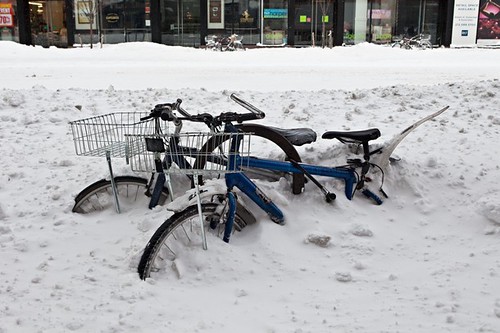
Bicycles stuck in the aftermath of a snowstormBikes are buried underneath a pile of snow on Columbus Avenue on December 27, 2010 in New York City. A blizzard pounded the East Coast of the United States delivering 20 inches of snow to New York City while snarling post-Christmas travel.  (Photo by Andrew Burton/Getty Images)

As winter approaches each year, I tend to write a couple features on the topic of snow clearance, but more toward the idea of how planning and implementing sustainable mobility practices needs to be a 24/7/365 activity, not only for rush hour or great weather.

-- A "maintenance of way" agenda for the walking and transit city (2010)
-- Agenda setting: snow clearance in the walking-biking-transit city (2014)
-- Cataloging the various failures to remove snow in the walking/transit/bicycling city (2015)

I just came across information about the Winter Cycling Federation, an organization dedicated to promoting cycling in the winter months.  The organization sponsors an annual conference, the Winter Cycling Congress for cities with winter climate issues that affect sustainable mobility/cycling.

This year, the Congress was in Leeuwarden, The Netherlands, and next year, from February 2nd-4th, 2016, it will be in Minneapolis, the first time the event will be held in the US.

Labels: , , , , , ,

Friday, January 09, 2015

Takoma Park prepares to legalize three foot width for snow clearance

According to the Gazette ("Takoma Park considers reducing fine for snow removal"), the City of Takoma Park plans a bunch of changes to its ordinance on snow removal.  From the article:
Takoma Park officials are considering changes to the city’s snow policies, including reducing the fine from $200 to $25 for those who do not shovel snow from the public sidewalk adjacent to their property. ...

Stewart joined Schultz, Male and Seamens in an informal vote Monday requiring residents and business owners to remove snow from only a three-foot-wide part of a sidewalk, rather than the entire sidewalk. Many sidewalks are in commercial areas or don’t have a strip of lawn to deposit snow, Male said.

But that width does not allow for some users, such as people in wheelchairs or cyclists, said Smith, who supported a wider swath.
However, three-feet is not wide enough for people to walk next to each other, or for people going in opposite directions to be able to pass each other, without having to step in and or walk in the ice and snow.

While this path width is less than 3-feet wide, more like 2-feet wide, it illustrates the problem well enough.
Shoveling a lane in the sidewalk, unshovelled corners


A three-feet width for snow clearance is inadequate for commercial districts.  The point is for commercial districts to be competitive through maintenance and other factors, rather than encouraging them to lag the practices in better managed commercial districts.

Inadequate snow removal in the Upshur Street commercial district
There is a portion of the sidewalk in front of these stores on Upshur Street NW in Petworth that has been cleared, but it is confusing for customers to have to figure out how to wend their way from storefront to storefront, without being forced to walk on the snow and ice.

In terms of planning for the walking-transit-bicycling city, this proposed change is a step backwards.

Takoma Park is two cities too.  Part of the problem is that Takoma Park, not unlike DC, is "two cities," the walking city in the core, although the residential lots are pretty big, where thousands of people walk each day during the work week to the Takoma Metrorail Station, which is just across the city line in Takoma and they may stop by the Old Takoma commercial district on their way home from work, and the outer city, which is a mix of automobile semi-dependent neighborhoods and strip shopping districts.
Carroll Avenue @ Eastern Avenue, Takoma Park, Maryland
"Snowmageddon, 2010," Carroll Avenue @ Eastern Avenue, Takoma Park, Maryland.

For the core, Takoma Park's "walking city," a three-foot wide requirement for snow clearance is a bad policy and regulation.

Labels: , ,

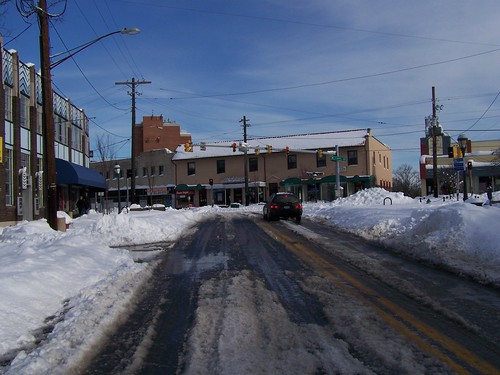
Cataloging the various failures to remove snow in the walking/transit/bicycling city

This week's snow wasn't all that, although because it came down just before and during Tuesday's morning rush, it was problematic, especially because, at least in my part of DC, it didn't appear as if there was any "pre-treating" or "salting" of the roads in advance of the snow.

Note the door on this bus shelter in Fort McMurray, Alberta.

The cold we are experiencing following the snow is worse--e.g., Metrorail had problems with cracked rails and other incidents--and although it's not all that frequent, it reminds me that some bus shelters in Minneapolis have heaters ("Heated shelters offer some relief for transit riders," Minnesota Public Radio News).

Plus I learned that the bus shelters in Fort McMurray, Alberta are fully enclosed and heated.  There it gets to 40 degrees below zero.

But the aftermath of the snow reminds me of my main pet peeves when it comes to dealing with snow and sidewalks.  (Also see "A reminder about winter-time conditions for pedestrians, cyclists, and transit users.")  And it's worth cataloging the faults.

1.  Yes, the perennial, some people don't shovel their walks.  At least on my block this seems to be declining but it's still a problem here and there.
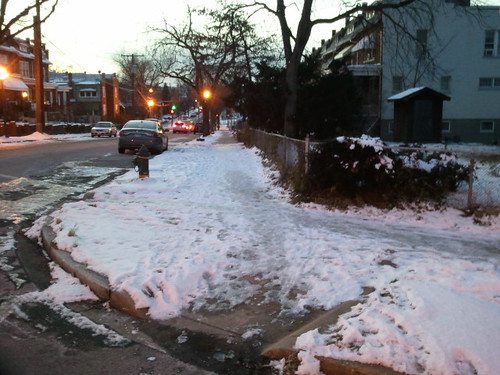
Unshovelled sidewalk and street corners

2.  Some people shovel a lane in the sidewalk, but not the entire walk.  This means that people can't walk side-by-side or past each other going in different directions, without stepping aside or walking in the ice and snow.
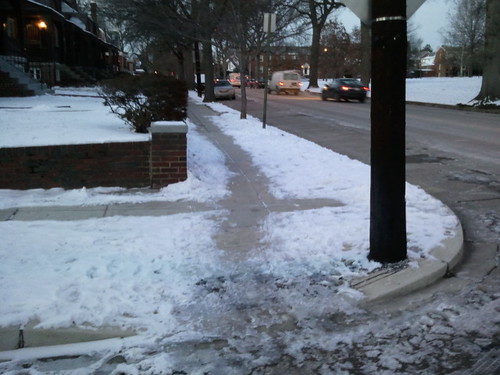
Shoveling a lane in the sidewalk, unshovelled corners

3.  People who live on corner properties often don't shovel the walk on the side of their house, even if they do shovel the front of their house, so they can get in and out unimpeded.
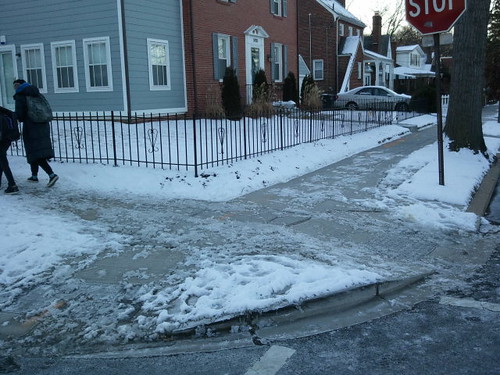
Unshovelled side of a house, unshovelled street corners
This house didn't shovel along the side of the house and neglected to shovel the corners of the sidewalk up to the street.  They also didn't even bother to shovel all of the front sidewalk, just enough to get to their driveway and a little past.  This house is along a major walk to school route.
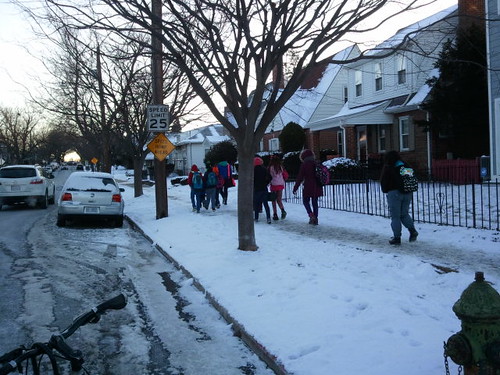
Children walking to school in the snow

4.  People who live next to alleys often don't shovel the sidewalk across the alley.
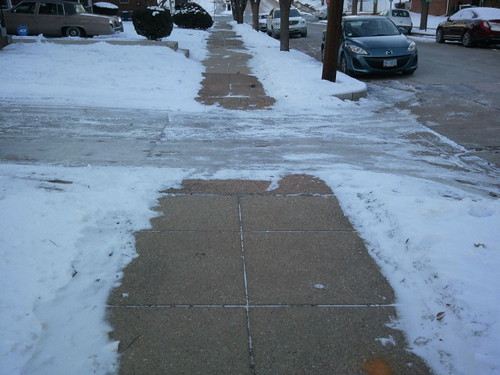
Unshovelled sidewalk across the alley

5.  People who live at corners often don't shovel the sidewalk corners all the way to the street.
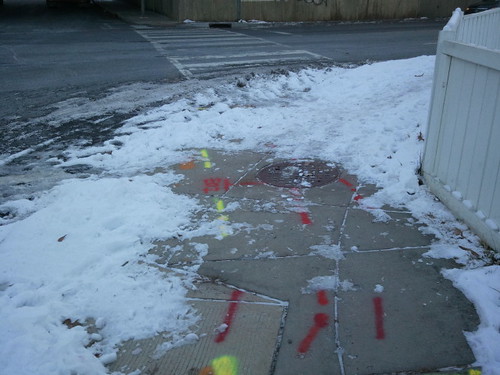
Unshovelled street corners

6.  People who live next to bus stops don't shovel the bus stop.  Each jurisdiction, in this case DC government, not WMATA, technically is responsible for bus stop maintenance.
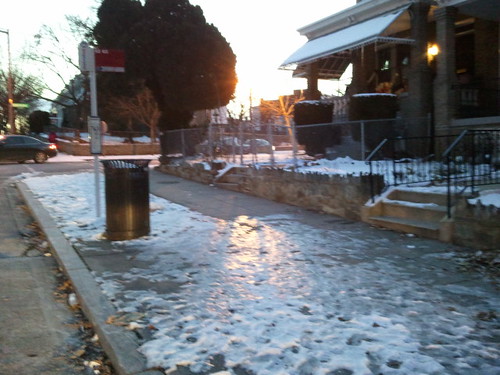
Unshovelled bus stop, Kansas Avenue NW

Note that fortunately, bus stops with shelters are maintained as part of the contract with the advertising firm that operates bus shelters.
Shovelled bus stop, Kansas Avenue NW
Kansas Avenue NW, northeast of Sherman Circle.


7.  The city doesn't remove snow from its properties.
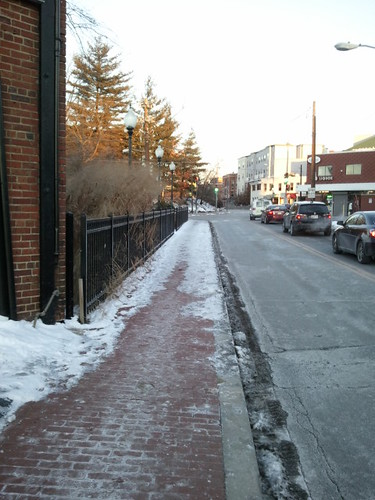
Snow removal ends as the city pocket park sidewalk begins
Pocket park at 4th Street and Blair Road NW.

8.  Or if certain city properties do make the effort to remove snow, they don't always have the right equipment.
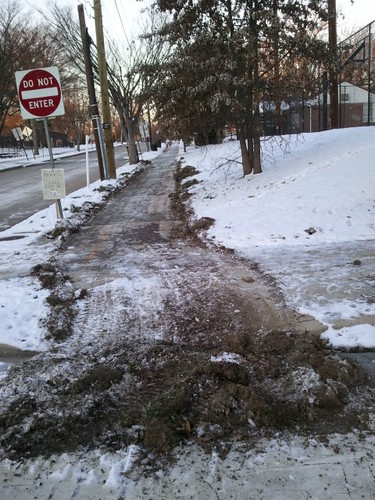
Dirt and grass upended in snow removal
Dirt and grass upended by snow removal and deposited in a crosswalk at Van Buren and 3rd Streets NW
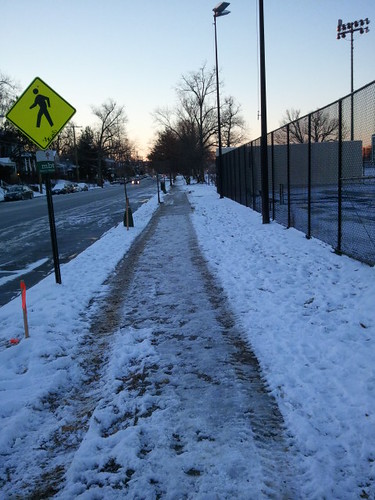
Snow removal at the Takoma Recreation Center
Probably a snow brush would work better on 5 foot wide sidewalks than a scraper, especially if the plow is wider than the sidewalk.

9.  The Federal Government, such as the National Park Service, doesn't remove snow from its properties.
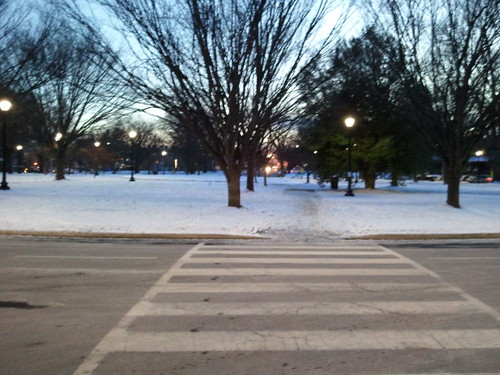
Sherman Circle, unshovelled
Sherman Circle is an NPS installation.  It's about one block from a school and along the walking route to Georgia Avenue and the Petworth Metro Station.  (Lighting was added after someone was robbed and murdered a few years ago.)

10.  Commercial property owners and retailers don't think about other properties "in their district," which might not be tended to, so customers are forced to walk across snow and ice, along with the corner and alley issues.
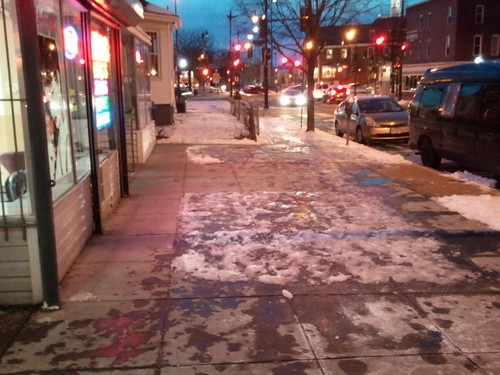
Inadequate snow removal in the Upshur Street commercial district
Upshur Street NW commercial district, Petworth.

11.  Last but not least, failure to remove snow from bike lanes.
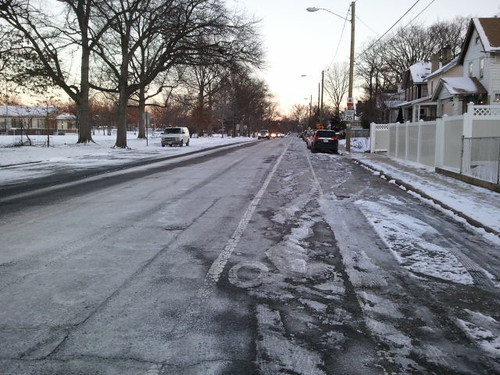
Failure to remove snow from a bicycle lane, 3rd Street NW
3rd Street NW

Labels: , , , , , ,