Rebuilding Place in the Urban Space

"A community’s physical form, rather than its land uses, is its most intrinsic and enduring characteristic." [Katz, EPA] This blog focuses on place and placemaking and all that makes it work--historic preservation, urban design, transportation, asset-based community development, arts & cultural development, commercial district revitalization, tourism & destination development, and quality of life advocacy--along with doses of civic engagement and good governance watchdogging.

Tuesday, February 21, 2017

Documentary on "transformation of public housing": "70 Acres in Chicago: Cabrini Green," premiering tonight on the WORLD Channel

World Channel is a programming service produced by WGBH, the Public Broadcasting Station in Boston, and is available in many television markets across the country, broadcast on subsidiary HDTV channels (with digital television broadcasting, each station has a main channel, and secondary channels).

Unfortunately, the World Channel isn't available in the DC-MD-Northern VA area, but it is available in many markets, and online.

(WRT the value of access to such programming, see "Culture planning at the metropolitan scale should include funding for "local" documentary film making" and the section on community media in this post, "Voting vs. civic participation | elections vs. governance.")

America ReFramed is the channel's premier documentary series and tonight, at 8 pm, is the premiere of "70 Acres in Chicago: Cabrini Green,"by Ronit Bezalei.  From the press release:
Filmed over two decades [the program] is a remarkable 20-year look at the Cabrini Green redevelopment process, starting int he mid-'90's as the demolitions begin. Concerns quickly arise over the implementation of the Plan for Transformation and the lack of input afforded to existing residents. The community fights back; they file lawsuits, march and rally. Yet many families wonder if the new housing will accommodate the old residents, or if they will be forced to find affordable housing elsewhere.
Later today I will post a review. But I didn't want that delay to forego advanced notice about tonight's broadcast and the need to plan your day.

The documentary is important because it illustrates the many (unintended?) consequences of the "public housing transformation" program dating to the mid 1990s and the Clinton Administration's HOPEVI program, which gave money to housing authorities to rebuild projects.

Not only did these redevelopments make the housing projects smaller, it incorporated market rate housing into the developments, but at the expense of the number of units made available to lower income households.

Plus, while a majority of residents were made the promise that they could return many did not.  And in the interim, the destruction of these developments and the dispersal of the residents had negative impacts on the people and sometimes, severe consequences for the broader community.

In terms of people, they lost their neighborhoods and their social networks and "social and community capital," or what Logan and Molotch in Urban Fortunes: Toward a Political Economy of Place, called "the use values of place."  People of limited means are far more reliant on use value than people with money, who can buy what they need.

While not citing Urban Fortunes, in the widely acclaimed Root Shock, Doctor Mindy Thompson Fullilove makes the same kinds of arguments on the highly negative impact on individuals, their social networks, and communities as a result of urban renewal.

Types of Use Values*

Daily Round: The place of residence is a focal point for the wider routine in which one's concrete daily needs are satisfied.

Informal Support Networks: Place of residence is the potential support of an information network of people who provide life-sustaining products and services.

Security and Trust: A neighborhood also provides a sense of physical and psychic security that comes with a familiar and dependable environment.

Identity: A neighborhood provides its residents with an important source of identity, both for themselves and for others. Neighborhoods offer a resident not only spatial demarcations but social demarcations as well.

Agglomeration Benefits: A shared interest in overlapping use values (identity, security, and so on) in a single area is a useful way to define neighborhood.

Ethnicity: Not infrequently, these benefits are encapsulated in a shared enthnicity... When this occurs, ethnicity serves as a summary characterization of all the overlapping benefits of neighborhood life.

(* From chapter four of Urban Fortunes: Toward a Political Economy of Place.)

Community effects.  But in an effect not widely studied, there were sometimes significantly negative community effects. For example, the rise in crime from the late 1990s and the economic problems of the hospital system in Prince George's County, Maryland can in part be attributed to systematic "transformation" of public housing in DC's East of the River neighborhoods, which forced many of these residents out of the city--many relocated to Prince George's County.

The now sadly defunct Suburban Gazette newspapers published a brilliant piece in 2003 about this, called "Shouldering the Burden."

Similarly, the violent crime epidemic in Chicago--which is an outlier generally because for most major cities over the last decade crime has dropped--probably is in part attributable to the massive dislocation of residents and communities that has resulted from the changes to the city's public housing communities, leading to battles over turf much more violent than the kinds of disputes discussed by Elijah Anderson in Streetwise and Code of the Street.

See the 2005 blog entry, "In a rising real estate tide, some communities get swamped."

Labels: , , , , , ,

Monday, December 06, 2010

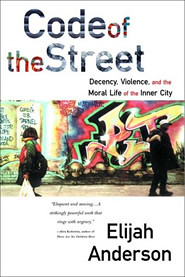
Time to brush up on Elijah Anderson

code of the streets
Rob Pitingolo, in "Liberal Places," blogs about a TBD article, "In gentrifying Logan Circle, affordable housing meets hate crimes," about anti-G (gay or gentrification) violence in the 14th and R Street area of northwest DC, by "long time" residents vs. new residents, including "new" gay residents.

While progressives and cultural studies types typically don't think of "spaces of resistance" as being places for non-progressives to resist, they can be (also see "Tea Party").

Elijah Anderson's Streetwise and Code of the Street are books that I joke should be required reading for people new to the city, especially new to areas with significant income disparities, and social, cultural, and racial differences.

Given the influx of people into the city over the past few years, I guess it's time to repeat this.

Anderson had a piece, The Code of the Streets, in Atlantic Magazine six years before he published the book. (There is also a review in Washington Monthly.)

This is an extract from a blog entry from 2006 on the topic of crime:

My hypotheses would be that intensity of street-culture conflict increases with the level of social and economic exclusion, and increased economic disparities within a community. And that the current burst of violent crime coincides with a recognition of greater economic disparity. In DC at least, while certain neighborhoods are experiencing great increases in income and wealth, other neighborhoods are experiencing persistent and greater levels of poverty.

As long as a community doesn't address the deeper programmatic issues involved in addressing the culture and social and economic exclusion issues (quality of schools, safety of the neighborhood, the redevelopment of the neighborhood economy (such as outlined in the textbook Community Economic Development Handbook by Temali) it's likely that crime rates while dropping will hit a ceiling, and of course, will oscillate according to the state of the economy in a particular community.

Click here for the first chapter of Code of the Streets and here for a video illustration of the same chapter, "Down Germantown Avenue," produced by a group of students at Rutgers Unviersity.

Anderson's work is essential reading for understanding the issues involved in public safety. Another interesting take is this article from Mother Jones, "Straight Outta Boston."

----
WRT the TBD article mentioning how one of the people arrested for assault doesn't live in the neighborhood, but has ties to the neighborhood, the discussion of the use value of place in the book Urban Fortunes: Toward a Political Economy of Place explains this, how people remain connected to the informal social networks in the old neighborhood because they haven't developed new informal social networks in their new neighborhood. But the use value discussion is important in understanding how change can be resisted in practice, and the neighborhood "defended."


Informal support networks (p. 104-105)
Place of residence is the potential source of an informal network of people who provide life-sustaining products and services... Sometimes gains are achieved thorguh an informal marketplace among proximate beneficiaries... Especially for the poor, this income 'in kind' represents a crucial resource and it is made possible only by a vaiable community. Since the community of poor people is less spatially 'liberated' than that of the well-to-do, poor people's use values are particularly damaged when their neighborhood is disrupted.

Security and Trust (p. 104-107)
A neighborhood also provides a sense of physical and psychic security that comes with a familiar and dependable environment. ... Gerald Suttles (1968), in his effort to construct a general theory of urban life, or at least 'the' social structure of the slum, portrays neighborhoods as bastions 'defended' against the perceived dangers of interlopers drifting in from adjacent areas. Signs of commonality (skin color, diction, gait in walking) serve as prima facie, if imperfect, basis for categorizing others as either members or nonmembers of the neighobrhood circle of mutual trust. This process of 'categoric knowing' is reinforced by various mechanisms in daily life that maintain the distinction between insiders and interlopers.

Labels: , , , ,

Monday, March 24, 2008

Suburbs, decline and poverty

1. From "The suburbs' grim future," in the Toronto Star:

Poverty is one thing in the city, quite another in the suburbs. Historically, cities enabled the poor to work their way up the socio-economic ladder. But what happens when low-income families are concentrated in post-war suburban communities where they are isolated and kept apart?

The prospects don't look good. "If you were poor in Cabbagetown you had access to an enormous number of services," says David Hulchanski of the University of Toronto Centre for Urban and Community Studies. "If you're poor in the suburbs, it's a constant struggle just to survive."

2. A good way to understand this is to read the chapter on the use value of place, in Urban Fortunes: Toward a Political Economy of Place. From the chapter:

Types of Use Values

Daily Round: The place of residence is a focal point for the wider routine in which one's concrete daily needs are satisfied.

Informal Support Networks: Place of residence is the potential support of an information network of people who provide life-sustaining products and services.

Security and Trust: A neighborhood also provides a sense of physical and psychic security that comes with a familiar and dependable environment.

Identity: A neighborhood provides its residents with an important source of identity, both for themselves and for others. Neighborhoods offer a resident not only spatial demarcations but social demarcations as well.

Agglomeration Benefits: A shared interest in overlapping use values (identity, security, and so on) in a single area is a useful way to define neighborhood.

Ethnicity: Not infrequently, these benefits are encapsulated in a shared enthnicity... When this occurs, ethnicity serves as a summary characterization of all the overlapping benefits of neighborhood life.

Agglomeration benefits (critical mass) of social and organizational services is the advantage of living in larger places, ranging from transit to libraries to employment services.

3. There's also "N.Va. Foreclosures Form 'Ring of Fire'," from the Post, about the number of foreclosures in the outer suburbs.

4. And Christopher Leinberger's piece about the "Option of Urbanism" in Atlantic Magazine, "The Next Slum?"

5. Plus the talk about consolidation of small towns, or at least the provision of services, in New Jersey. My sense is that there is something to be said for smaller towns. There is a greater sense of accountability in places like Hyattsville, Mount Rainier, Rockville, or Takoma Park, Maryland, whereas a bigger city like Washington, DC, it takes days to get the snow plowed, and for the most part the Mayor and the City Council are disconnected from democracy.

See "Tiny Towns in N.J. May Have to Merge," from the Post.

Labels: ,