Rebuilding Place in the Urban Space

"A community’s physical form, rather than its land uses, is its most intrinsic and enduring characteristic." [Katz, EPA] This blog focuses on place and placemaking and all that makes it work--historic preservation, urban design, transportation, asset-based community development, arts & cultural development, commercial district revitalization, tourism & destination development, and quality of life advocacy--along with doses of civic engagement and good governance watchdogging.

Wednesday, October 01, 2025

Best practice innovation and government: bottle deposit bills and DC


Everett Rogers' book Diffusion of Innovations came out of his dissertation where he studied the "diffusion of innovation" through different sectors of the economy-society.  

For example, it took 17 years for a good innovation to percolate out through K-12 education, because of how it is organized--thousands of districts across 50 states and territories.

There used to be talk about how states can be "Laboratories of Democracy" in fostering innovation that is later taken up by other states--Mitt Romney's state health insurance program in Massachusetts ("Mitt Romney Finally Takes Credit For Obamacare," NPR) is one example, another is how the Children's Health Insurance Program started out of a community program in Pittsburgh ("CHILDREN IN CRISIS: The Story of CHIP," PBS documentary).

Today I think it is a lot more difficult than we realize between the lobbying of special interests (the conservatives have an especially good one in the American Legislative Exchange Council, which gets conservative legislation passed across the country), state legislatures that pre-empt local action, and just the amount of time required to organize and get something passed.

Another example is the penny.  We know we don't need it.  But copper interests kept their hand in Congress to keep it minted.  Finally, it won't be newly minted, but will still remain in circulation ("No more pennies? Coin collectors say end of penny will have little impact on hobby," St. Cloud Times).

At the local level, an example is bag charges.  DC did it in 2009.  The Wall Street Journal was up in arms ("In Washington, a Lesson in Bureaucracy Comes in Every Bag"), but a year later said it wasn't so bad ("Capital Takes Bag Tax In Stride").  But it's taken more than a decade for neighboring jurisdictions to pass similar laws, in part because of state action.

-- "Recycling, waste streams, plastic bags, and bottle bills," 2013

I bring this up because the DC City Council is considering a bottle deposit law ("Fight gearing up over D.C. bill to recycle bottles and cans for cash," Post).  Environmental groups put this on the DC ballot in 1988!!!!!!!!!!!! and it was defeated by organizing by the beverage industry.

That was around when I first moved to DC, coming off of about 10 years of Michigan already having such a bill, where it worked well at reducing bottle and can litter from beverages ("How Does Recycling Your Bottle and Cans Help Preserve Michigan’s Environment).

A few years ago, I walked from my house in Manor Park to Columbia Heights and back, and picked up almost 500 recyclable bottles and cans (not all subject to traditional deposit laws, some were from food).

I wonder what Everett Rogers would think of a 40+ year diffusion curve for bottle deposit laws?

Labels: , , , , , ,

Monday, July 28, 2025

Trump's executive order on homelessness

I had been thinking about writing about homelessness, or at least adding to the comments in my "Quote of the day: homelessness" entry from 2022, because of the Seattle Times article, "Homeless people visited ER less after moving into King County’s hotels."

The concept of "housing first" is based on the idea that putting people in a more stable housing situation, regardless of whether or not they continue to partake in drugs and alcohol or exhibit mental illness, they are easier to help, and it saves the government money, even if it doesn't fit with moral, "you should stop," concepts about who "deserves" help and who doesn't.

Then Trump came out with an executive order ("Ending crime and disorder on America’s streets") changing federal policy on homelessness, towards the "moral" side, not the practical evidence-based policy side.  Among other elements it bans encampments on public space, something he has no control over unless it is federal property.

From the Los Angeles Daily News article "Trump’s crackdown on homelessness: What does it mean for California?," 

Trump doesn’t want to stop at banning homeless encampments and pushing people into treatment, and that’s where he and Newsom diverge: The president wants to upend two core tenets of California’s homelessness policy. 

Trump wants to abolish federal support for “housing first,” which is the idea that homeless individuals should get housing even if they are still using drugs, and “harm reduction,” which focuses on preventing overdoses and otherwise making drug use safer. Both tenets are backed by research and have been the gold standard in California — and at the federal level — for years.

Groups are concerned that their systems of program delivery for homeless services will no longer qualify for federal funds.  From the LADN:

Trump’s order also prioritizes committing more people to institutions from the street. The order seeks to make it easier to commit people with mental illness who can’t care for themselves, while also promising grants and other assistance to help ramp up commitments, and threatening to divert funding away from places that don’t push people into treatment facilities “to the maximum extent permitted by law.” It also promises to prioritize funding to expand mental health courts and drug courts. 

The likelihood of federal monies being provided to local and state governments to deal with mental illness in this way is remote given the cutbacks in other programs like Medicaid.

=====

I can't remember what article I read, but it made the point that the overall counts of homeless people done by local governments include people who are housed in domiciles in which they are guests.  While I knew that, it accounts for research finding that a majority of the homeless don't have substance abuse or mental health issues ("Here's what largest study in decades of California homelessness found," San Francisco Chronicle)..

The fact is that the etiology of street homelessness is different than homeless in temporary housing.

More seniors are homeless.  The major point of the LA Times column "Trump’s order on homelessness gets it all wrong, and here’s why," is that despite reports showing a stabilization of numbers in the homeless population, the mix is changing and that more seniors are finding themselves unhoused because of income and high housing costs, not from behavioral issues.

Labels: , , , , , ,

Wednesday, March 29, 2023

Innumeracy and the affordable housing discussion

 The Salt Lake Tribune has an article, "Utah needs 41,000 units of affordable housing. Robert Gehrke explains how the state aims to help," on how the State of Utah is increasing its commitment to addressing the lack of supply of affordable housing, by increasing the amount of tax credits available, from $1 million to $10 million per year, for the next 10 years, totaling $100 million.  From the article: 

The Legislature significantly expanded a tax credit that has been called the most important source of financing for affordable housing in history

At $200,000 per unit, to build 41,000 units requires $8.2 billion.  At $150,000 per unit, $6.15 billion.

In either case, $10 million per year doesn't go very far, especially as demand for affordable housing will continue to increase.

Labels: , , ,

Sunday, January 01, 2023

New Years Day Post #1: Solutions versus cruelty | Immigration

Border wall of containers ordered by Republican Governor of Arizona Dan Ducey.  Photo: Ivan Pierre Aguirre for the New York Times.

These days I'm pretty depressed about the state of the US, given the virulence of the divide between Republicans and Democrats and a failure to focus on improving the quality of life of US residents versus cruelty and performance.

There is no question that things are far different from the time when states were considered opportunities for innovation--laboratories of democracy.

The quality of life outcomes for states under Republican rule are decidedly negative (2022 Scorecard on State Health System Performance: How did states do during the COVID-19 pandemic?, Commonwealth Fund, "SUMMARY OF 23 QUALITY OF LIFE INDICATORS — ARE RED OR BLUE STATES BETTER?," Applied Sentience, "Blue states rank better than red in livability: What does that mean?," San Jose Mercury News).

Perhaps the easiest indicator to track is life expectancy.

And long tax revenue capture.  Generally red states get a lot more back in government spending than they pay out.  While blue states pay more and get less.  Red states are the "takers" ("Blue high-tax states fund red low-tax states," Associated Press).

Immigration.  I think one of the most important entries I've written in the past couple years is on "the border crisis" -- immigration -- which Republicans call an absolute crisis. 

 It's a policy issue where Republicans get to show their cruelty ("GOP governors with presidential ambitions court Trump's base with cruelty to migrants," NBC News).

But sadly to reduce the power of the opposition, federal government practices even under Democrats can be pretty cruel.  

It amazes me because the states on the southern border with Mexico--Texas, New Mexico, Arizona, and California--drive a significant part of their economies through trade with Mexico.  California, being a Democrat run state, acts opposite of the other states.  

For example, Texas' biggest trading partner is Mexico and when they do things like tamper with border crossings it has significant negative effect ("Texas Ends Rule That Left Trucks Waiting For Hours To Cross Mexico Border," Forbes Magazine).  It's like Brexit leading to a significant drop in the UK's economic output, something every reputable economist said would happen.

But the Republican position on immigration makes it hard for Democrats, and makes it almost impossible for policy creativity.  Obama wasn't the greatest--he thought that being tough would get Republicans to work with him, but they didn't.  And Biden has some of the same issues.

The fact is that immigrants are an important source of labor, are motivated, increase the country's diversity, and add population in the face of lower birth rates.  Immigrants can be an important source of revitalization in otherwise shrinking cities etc.

End of Policing by Alex Vitale is pretty bracing.  Eight chapters discuss how we've criminalized certain social matters, and how police response to those problems mostly makes the outcomes worse.  

One chapter is on immigration (US Border Patrol, Immigration and Customs Enforcement), and in it he suggests that the US consider dealing with immigration comparable to the European Union, which has free movement within the EU's 27 countries.

I think it's brilliant.  

Creating an American Union of the US and Central and South American countries.  What it would require is creating a kind of "American Union" with Central and South American countries.  Where citizens of participating countries could register and could immigrate/work in other participating countries, and it wouldn't require citizenship in the "receiving" country.  I think it would also allow for temporary rather than permanent emigration.  People could come to the US, make some money, go back home.

At the same time, like the EU, the US should invest in creating "cohesion" programs of investment in Central and South American countries, so that conditions of poverty, political unrest, and negative public safety could be reversed, reducing the demand to emigrate.  

-- "A solution to the immigration crisis on the Southern border, but it's too politically fraught," 2021

And a Caribbean Union.  When I wrote the piece I was focused on the border with Mexico, but the same goes for the Caribbean.  It's unjust that Cuba emigrants have special privileges in coming to the US, and proximity to the US creates the same kinds of tensions for countries like Haiti, Dominican Republic, etc.

Puerto Rico.  And we really should give statehood to Puerto Rico, and create new programs of investment and energy independence for that colony.

=====

The Salt Lake Tribune, now a nonprofit, has an initiative called the "Innovation Lab," where they focus on longer term issues with an aim of producing articles offering "solutions."

I don't think the issue is the need for solutions so much as a willingness to be focused on solutions and action.

And big time innovation is outside of the mindset of most public officials and community stakeholders.

Labels: , , , , , , , ,

Wednesday, July 17, 2019

Why expertise doesn't matter in politics? | ideology, special interests

Robert Samuelson, the economics columnist for the Washington Post, wrote about the death of "policy entrepreneur" Alice Rivlin as an illustration of the failure of knowledge to drive policy ("America has an enduring cycle of disappointment").

(Separately, there is an op-ed in the New York Times, by principal investigators of a study that looked at whether or not state legislators were interested in systematic polling information about the opinions of their constituents on issues under consideration, "Politicians Don't Actually Care What Voters Want." They found little interest on the part of legislators and limited congruence between the electorate and elected officials.)

Samuelson suggests policy entrepreneurs are failing because:
(1) It may be that the problems they attacked were tougher than expected. Eliminating poverty, combating climate change and controlling health costs are hard tasks individually, let alone together.

(2) Elected politicians, who wielded the real power, found many of these ideas too unpopular. Take climate change. Almost everyone outside the Trump administration (it seems) is against it; but there's little enthusiasm for the actual policies -- higher fossil fuel prices or energy controls -- that might have some effect.

(3) The policy entrepreneurs may have discovered that they aren't as smart as they thought they were. Put differently, they may have exaggerated their understanding of the things they were trying to change.

Whatever the cause or causes, the historical reality is unforgiving. Policy entrepreneurship hasn't and won't disappear. But the hoped-for gains have been conspicuous by their absence. There is an enduring cycle of disappointment. Solutions are rarely equal to problems. It is a sobering legacy.
Yes the problems are hard. Yes ideas are unpopular, sometimes, but that is partly because of poorly dealing with them. And yes, people often have a limited sense of "the problem."

But I think he misses the point.

We've moved from a concept of "positivism" and the development of evidence-based policy and a respect for expertise (although to be fair, for centuries policy and practice has been more about reflecting "positions" on issues, not evidence) to a much more rigid focus on ideology and an ecosystem of special interests -- wealthy funders of organizations and media that support these positions -- that pushes ideologically-based positions regardless of evidence.

Policy and practice should be about achieving "optimality" based on expertise and knowledge. It should also be about "evidence" whenever it can be adequately collected. 

Yes sometimes I feel like the focus on evidence can be misguided even though absolutely, replication in other settings is essential. The issue of "what gets measured gets done" is problematic when you're not measuring the right thing or creating measures is time consuming and difficult. But still, so many programs continue to be developed irrespective of a consideration of past outcomes.

But like with "policy entrepreneurs" maybe not being so smart, a lot of it has to do with problem definition. Like with health care you need to approach the matter in tranches. Health insurance was set up to regularize income for hospitals, not to improve health outcomes. OTOH, the National Health Service in the UK was set up to improve health outcomes.

Separating the provision of health and wellness development, the ability to go to a doctor for simple things as well as for dealing with many diseases that are partially behavior related (heart attack, hypertension, obesity, diabetes, etc.), which are called chronic conditions, requires a different approach (these elements of the health system are called primary care) from how you deal with catastrophic and emergency care needs (cancer, heart attack, accidents, etc.) which are part of the secondary care system.

But by continuing to define "health care" through "health insurance," a fundamental rethinking isn't occurring.

So it is timely that the Center for American Progress has a presentation on Monday, about how this works at the state level.  From email:
Laboratories for Corruption
How Special Interests Are Driving Harmful State Policies


July 22, 2019, 12:00 p.m. - 1:30 p.m. ET

Center for American Progress
1333 H Street NW, 10th Floor
Washington, DC 20005

RSVP

Not in D.C.? Bookmark this link to watch the live webcast

Opening remarks:
Winnie Stachelberg, Executive Vice President, External Affairs

Featured panelists:
State Sen. Dinah Sykes, (D-KS)
Lisa Graves, President, Board of the Center for Media and Democracy; Co-Founder, Documented Investigations
Naomi Walker, Director, Economic Analysis and Research Network at the Economic Policy Institute
Danielle Root, Associate Director of Voting Rights for Democracy and Government, Center for American Progress

Moderator:
Sam Berger, Vice President of Democracy and Government Reform, Center for American Progress

Federalism encourages states to act as "laboratories of democracy," wherein states experiment with untested ideas and policies to gauge their effectiveness and potential value elsewhere. This mantle of states being laboratories for democracy can be used to promote policies that advance the public good. But states can also be used as a testing ground for policies that skew political and economic power toward corporations or billionaires and away from everyday Americans.

Many harmful state policies—such as irresponsible tax cuts, deregulation, and attacks on unions and essential workplace protections—are byproducts of corporate lobbying and conservative special interest groups whose main purpose is to help the rich and powerful exploit and manipulate the lawmaking process.

Please join the Center for American Progress for a discussion on how corporations and special interest groups promote state policies that make corporations and wealthy donors richer, at the public's expense. It will also examine how lawmakers backed by these groups further corrupt democratic processes to maintain power and keep harmful policies in place.

Labels: , , , , , ,

Wednesday, June 21, 2017

Two comments on national politics

The blog focuses on urbanism, placemaking, metropolitan and regional planning, transportation, and local governance, so I try to not comment on national politics except in how it impacts these matters, but two things are worth mentioning, because of how they are portrayed in the media.

1. The Special Elections, especially in Georgia, as a thermometer of support "for the Democrats" or "for President Trump."

If the special elections were in districts where Republicans had previously been elected on very close margins, it would be reasonable to say that they are good indicators for the tenor of the electorate. Plus they are elections run on a much shorter time line than the traditional election process.

The Kansas State Legislature is about 80% Republican, so expecting a Democrat to win in a special election, on a short time frame, is unrealistic. The same with Wyoming. Georgia may be a little different, but over the last couple decades, Georgia's Sixth Congressional District has been represented by pretty conservative guys, Newt Gingrich and Tom Price. Expecting it to flip was unrealistic. That Jon Ossoff did as well as he did sets him up to run again next year.

I do say that there are things to be learned from each of these elections, especially Georgia's since that is a district in a metropolitan area, which should be going "Democratic" in theory, but isn't.

cf. Jennifer Rubin's Washington Post blog entry, "Is victory in Georgia race of great consequence, or none?"

2. Making the Congressional Budget Office out to be a political animal against Republicans is about denying factual and objective research and analysis.

The New York Times reports ("Little known agency, striving for neutrality, finds itself under withering attack") on how Republicans are attacking the CBO for telling the truth about the impact of Republican proposals for changing health care, etc.

The CBO traditionally has been seen as a nonpartisan, objective, fact-driven organization. So why should Republicans not want such an organization to be seen as credible? Because they are pushing forward legislation that is mendacious and they want to be able to deny it ("CBO Has Clear Message About Losers in House Health Bill "NYT).

Remember the Congressional Office of Technology Assessment?

I finally understand, 20 years after the fact, why the Newt Gingrich led Congress abolished the OTA ("Bring Back the Office of Technology Assessment, NYT; and "The Much-Needed and Sane Congressional Office That Gingrich Killed Off and We Need Back," The Atlantic).

It's because Gingrich, despite having a PhD and being a college professor, wasn't favoring facts and knowledge, but ideology. An independent assessor of technology and science was seen as a threat, not a capacity builder.

The same is now true of the CBO. Hopefully, the same won't happen to the Congressional Research Office.

Labels: , , , , ,

Wednesday, May 11, 2016

(Conservative) Advocacy Agenda Setting in Washington State

The Washington Policy Center is a conservative policy advocacy organization in Washington State.  Their annual "Western Washington Solutions Conference" is one week from tomorrow.

The WPC conference pushes conservative policies on health care, education, and taxation.

And it features Gov. Bobby Jindal as keynote speaker--I'd think that driving your state economy into the ground ought not to get you to be selected as a keynote speaker and to be paid for it, unless it's about 'what not to do.'"

Although, according to the New Orleans Times-Picayune, "Louisiana's budget is a hot mess: How we got here," it's not all Jindal's fault.

But constant tax cuts combined with a serious decline in oil prices--as an oil producing state a significant amount of state tax revenues comes from the oil industry and similarly states like Alaska and Texas have experienced serious revenue declines also--pushed the state to the brink financially.  His putative bid for President allowed him to foist the problems onto his successor.

Still, planning as if the future will always be good puts a state government and economy at serious risk.

Next year, the WPC could get Governor Sam Brownback of Kansas to be the keynote ("With Kansas In Crisis, GOPers Abandon Gov Brownback On Tax Cuts," Associated Press).

In any case, it behooves progressives to organize similar kinds of "solutions conferences" too, although they should truly be focused on solutions rather than bromides.

======
Note that the organization LocalProgress is a national group supporting progressive locally elected officials. Their next national conference is in July in Pittsburgh.

Labels: , , ,

Wednesday, May 07, 2014

Undeserved DC cheerleading

The Washington Post has an article ("New York Mayor Bill de Blasio takes a page from D.C.") about how NYC Mayor Bill De Blasio is "copying" various DC best practice policies.

Vivienne, DiarmaidUmm, actually, what best practice policies that "DeBlasio is copying from DC" originated elsewhere. And the article feels more like undeserved cheerleading.

Bike share bikes and the Eiffel Tower in Paris.  Flickr photo by Diarmaid Mac Aonghusa.

1.  Until NYC's launch of bikesharing, the largest implementation of bike sharing in North America was Montreal, but of course, many European cities have had much larger programs for years.  Yes, DC had a pilot version of the Clear Channel form of bikesharing, but the contract didn't include provisions for expansion.  And Paris is the city that put bike sharing on the world stage, although yes, for public officials across the United States, since they are more likely to travel to DC and less likely to Paris, herald the DC bikesharing system as a example to emulate.

Seattle streetcar in operation.  Photo from the Seattle Rentals blog.

2.  Streetcars.  Umm, DC will take about 12 years from starting to plan to having a short portion of line in operation.  By contrast, Seattle, which started planning for streetcars when DC did, in 2003, opened their first line in 2007 and have an extension underway now which should enter operation later this year.

3.  Inclusionary zoning... Montgomery County has had such a law in place since 1974 (Inclusionary Zoning's Effect on Affordable Housing, report, HUD) while DC's policy has been in effect for just a couple years and thus far hasn't generated significant amounts of lower cost housing.

That being said, DC's Housing Production Trust Fund, which uses money generated by a small tax on real estate transactions to support the development of affordable housing, is in fact a national best practice, although projects--as is the nature of the process--take awhile to come to fruition.

Sheridan Station Apartments near Anacostia Metro Station is a good example of a great project built in part with HPTF financing.  It's housing built at the same level of quality as new developments in Northwest DC, with rents at least 1/3 lower than the market rate.

4.  Pre-K in the schools.  Well, finally, that is a DC schools best practice that is quite remarkable, with mandatory free access for children beginning at the age of 30 months through the age of five.   However, it is the source of much of DC Public Schools' increase in enrollment and that can be illusory.  Once children of middle and higher income parents reach school age, many of the children leave the DCPS system and enroll in charter schools.

Labels: , , , ,

Tuesday, July 23, 2013

City transportation departments need to set up innovation units

There is a fine line between blogging about experiences as whining or as indicators of the need for change and opportunities for improvement.

There are many opportunities for improvement.

I am participating in an action-research project comparing US arts-based revitalization programs to cases in Europe, which is a great opportunity for me to learn about perceived differences vis-a-vis Europe concerning "American attitudes" towards involvement, initiation, and self-help vs. the role of the state, state action, and the respect--or not--accorded to the role of the state within these processes.... and we have had some thought-provoking discussions on the role of civil society.

I have been meaning to write about this topic, and two concurrent triggers are:

(1) a colleague sent me a link to the online journal Nautilus and the current issue, which focuses on "transit" and includes an article by Tom Vanderbilt, author of the book Traffic, on route optimization programming and the various activities of UPS in this business- and logistics-space ("Unhappy truckers and other algorithmic problems") and

UPS delivery bike, Amsterdam(2) last week there was a piece in Greater Greater Washington ("Need to pick up a UPS package? The car-free are out of luck") about how UPS routes all the packages from missed deliveries to Landover, Maryland (unless you pay a fee for a redirect to a UPS store in DC), which is very difficult to get to, especially by transit (I've done it myself at least once).

Something that bothered me about NACTO, the National Association of City Transportation Officials, is that the organization seems to be really focused on improving biking infrastructure, but not so much on taking up other necessary ideas, and translating them into policy and practice, in order to build a more robust soft and hard infrastructure for sustainable transportation.

Maybe I am wrong about that, given their upcoming Designing Cities conference.  It seems as if they are expanding their practice and focus.

But still, I don't see city departments of transportation looking at particular mobility problems in innovative ways, with an eye towards transforming certain elements of transportation practice that don't involve construction or equipment purchase (streetscape, bicycle sharing, buses, streetcars) forward in more innovative ways.  This is something that NACTO could help foster.
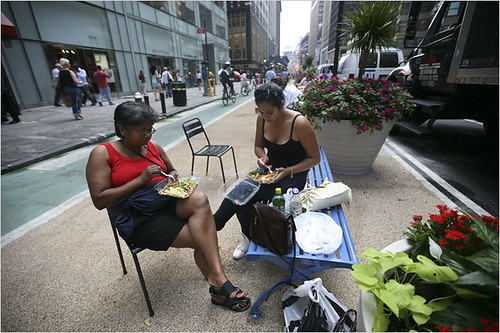
Urban design placemaking on Broadway in New York CityAnd yes, there are many great examples of transportation departments being innovative concerning streetscape and parklets programs (especially New York City and San Francisco), and with various elements of transit. 

Right: Urban design placemaking on Broadway in New York City, New York Times photo.

Right now there are no good frameworks for doing this.  There is great research conducted by transportation academics, but a lot of it doesn't percolate down to changes in practice. 

Partly this is because there is no mechanism within the transportation innovation diffusion process for most non-engineering-related elements of transportation planning so that practical implementation can occur.

This diagram from the German National Bicycle Plan can be re-conceptualized more broadly in terms of creating an integrated system for sustainable mobility
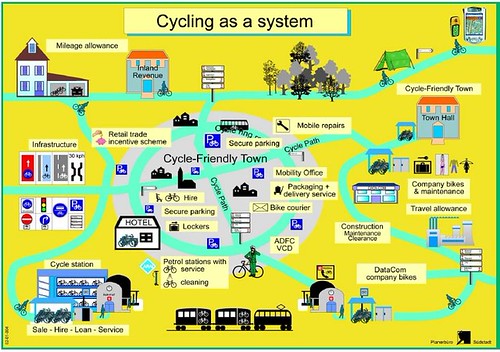
Bicycle Traffic as a system, diagram, German National Bicycle Plan, 2002-2012

Concept of the integrated public realm framework by David Barth and Carlos Perez of AECOM
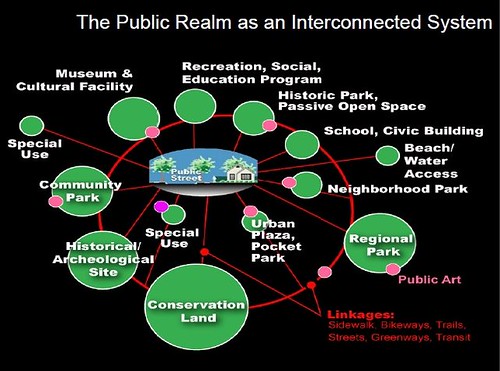
Public Realm as an Interconnected system, Slide from presentation, Leadership and the Role of Parks and Recreation in the New Economy, David Barth

For example, a few weeks ago I criticized a DDOT colleague over how DDOT basically ignored some of the more wide ranging transportation demand management ideas suggested in the ANC4B Large Tract Review Report on Walmart, 5/2011 such as:

• Walmart should provide a shuttle service between their store and the Georgia Avenue-Petworth Metro Station

• Walmart should offer delivery services for all transactions totaling at least $50.

• Walmart should make home delivery services a routine and standard part of their service offering in urban/center city store locations, not just at the Georgia Avenue location, but in all the stores in DC, and in other urban markets across the United States [they are testing this in San Jose, see "" from ]

• Walmart should agree to explore with the DC Department of Transportation setting up a shared parking situation with the on-site customer parking spaces, perhaps through the creation of a transportation management district” to manage this and other transportation demand management initiatives in both this and the Walter Reed commercial nodes on Georgia Avenue.

• Walmart should commit to shifting deliveries to overnight hours for all of the deliveries from Walmart distribution centers, and for at least 50% of the deliveries made directly by vendors.

• Walmart should agree to not receive deliveries during morning (7:00 a.m. to 9:00 a.m.) and evening (3:30 p.m. to 7:00 p.m.) rush hour traffic periods. [CVS creates some major tie ups on Capitol Hill and Dupont Circle because they get their major deliveries during evening rush hour].

Anyway, those ideas are relevant not just to Walmart but to any major retailer operating in the city.  And it doesn't appear that there is a process to bring about such improvements in a systematic and transformation way.  (Then again, bureaucracy is about system maintenance, not so much system improvement.)

Other areas deserving of innovation, besides systematic freight delivery management, include:

•  substantive research and compilation of data on car usage, car storage, etc. in the urban core of the city-- this would have been a tremendous aid in the debate in the city about parking requirements in zoning, instead, mostly we fumbled without good information and it appears that substantive and better changes to the policy won't occur (see "D.C. planners drop proposal to end minimum parking rule for developers" from the Washington Post)

Parking survey data from the Seattle Transportation Strategic Plan (I have never seen an equivalent set of data for DC neighborhoods, but I presume it exists)
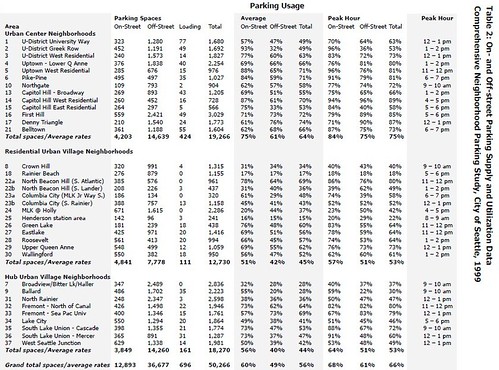
Parking survey data from the Seattle Transportation Strategic Plan

• "bracing" UPS about offering convenient in-city package pick up options for missed deliveries.  How hard could it be for UPS to set up package routing for missed deliveries to the UPS stores, or at least a package pick up depot?  Note that UPS treats DC as part of the State of Maryland for routing purposes (cf. "Chins Up, Washingtonians. The Postmark's Back" from the Washington Post), which likely contributes to the problem.

• getting UPS, FedEx, and even the US Postal Service to consider bicycle delivery (USPS image, right) as an element of their service mix, this could end up leading to more employment, which could be covered by a  reduction in parking tickets (cf. "In D.C., parking tickets are a cost of doing business from the Washington Post), note that other cities have similar programs).  UPS has used bicycle messengers in some places during peak holiday periods, and USPS does bike delivery in a couple cities.

• creating the framework for transportation management districts

• working with business districts to create "bicycle friendly business districts"

• creating frameworks for transportation planning as placemaking and civic engagement enablement

• provision of hard core data and reports on pedestrian and bicycle accidents in the city

etc.

-----
Also see my writings on "action planning."

Labels: , , , , , , ,

Friday, June 29, 2007

Quote of the day

I am proud to say that I am a co-author of a chapter that will be published by the University of Texas Press in the book Invisible City by John Gilderbloom.

I was reading the manuscript, the chapter on the "pros and cons of rent control" and this section jumped out at me, especially given the previous blog entry about the recently released Reason Foundation study on traffic congestion...

"Another major theme ... is how public policy is manufactured and disseminated by organizations that have a major financial stake in a particular outcome. Urban policy analysis is not a neutral field of study carried out by dispassionate academics. It is dominated by hack researchers whose conclusions are determined by the client paying for the study... The dominance of real estate-spnsored studies in the urban arena is shocking and demonstrates the role that ideas have in determining public-policy outcomes. Even more surprising is how influential these studies are in compelling the media, politicians, and even academics to take positions on urban policy questions based on their biased and unmerited conclusions."

Now I would have written this a little differently. It shouldn't be surprising that ideas and studies are influential. After all, that's why we do this kind of work, to influence and shape policy, implementation, and action.

What's surprising is that flawed work, flawed conclusions get so much play, without much analysis or digging into the influences. As Graham Allison wrote in the book Essence of Decision, "where you stand depends on where you sit" or who is signing or funding the paycheck.

What's even more surprising and damning is that too often, especially at the level of local government, even in "big" cities, no attention whatsoever is paid to substantive policy research, findings, conclusions, and the elucidation of best (or better) practices and policies.

The current "debate" about how to "fix" DC's public school system is a case in point.

At the University of Maryland, Professor Clarence Stone led a multi-year study of school improvement in 11 urban school systems. (The study was entitled "Civic Capacity and Urban Education" and it was funded by the National Science Foundation.) The project produced many publications and important analysis and conclusions.

I don't think this body of work was referenced at all in any of the policy and legislative decisions thus far concerning changes in governance or operation of the school system and the education functions of the city.

Instead, current reform efforts which are too new to be able to draw substantive conclusions from make up the body of work referenced in this change effort.

Labels: , , , ,