Rebuilding Place in the Urban Space

"A community’s physical form, rather than its land uses, is its most intrinsic and enduring characteristic." [Katz, EPA] This blog focuses on place and placemaking and all that makes it work--historic preservation, urban design, transportation, asset-based community development, arts & cultural development, commercial district revitalization, tourism & destination development, and quality of life advocacy--along with doses of civic engagement and good governance watchdogging.

Wednesday, November 22, 2023

Learning what not to do from the New England Patriots football team

Before I came up with the Transformational Projects Action Planning approach ("Why can't the "Bilbao Effect" be reproduced? | Bilbao as an example of Transformational Projects Action Planning," 2017), earlier I came up with a method I called Action Planning, which incorporates design thinking and social marketing into the planning process, based on best practices I observed in Arlington County and the Tower Hamlets borough of London ("Social Marketing the Arlington (and Tower Hamlets and Baltimore) way," 2008, "All the talk of e-government, digital government, and open source government is really about employing the design method," 2012).  

From "Design Thinking," American Libraries, 2008

I used action planning concepts when I did a pedestrian and bicycle plan for Baltimore County ("Best practice bicycle planning for suburban settings using the "action planning" method," 2010).

Basically, I'm interested in continuous process improvement and iterative learning ("Incrementalism as a concept of iterative improvement in government project development no longer a legitimate public administration theory," 2023) applied to government and social program improvement.

I have a bunch of posts on this for government:

-- "Big data/Machine Learning/AI as a policy savior," 2022
-- "I get tired of all the talk about rewarding "failure" because it shows people are trying, and won't be penalized for it," 2017
-- "Creating the right program vs. the hype of big data," 2013
-- "Does the focus on big data mean we miss the opportunity for better use of "little data"," 2015
-- "For a lot of "urban problems" the issue isn't knowledge about what to do, but willingness to engage that knowledge," 2017
-- "Helping Government Learn," 2009
-- "Positive Deviance and DC Public Schools," 2007
-- "Positive Deviance in New York City (public schools)," 2009
-- "3 R's of Transforming the school system," 2007

Digging deeper to learn the right lesson.  Sometimes I tell the story of the first project I did at the Center for Science in the Public Interest, a report on the presence of a potential carcinogen in alcoholic beverages.  We sold a fair number of copies through press mentions.  It happened that the chief author, editor of the newsletter, and I were eating lunch together in the basement lunchroom (it had a stove, a luxury for an office), and we ended up doing an after action analysis.

I was certain the report sold because of the policy comparisons between the US and Canada.  The newsletter editor said no, it was because of the list of test results included, and people wanted to check if what they drank was potentially tainted.  In short, it wasn't about policy it was about self-help.

It was an important lesson to me about not learning the wrong lesson from success.  But to dig deeper for the right lesson.

Learning from sports teams.  There are tons of "leadership books" and seminars and articles about leadership lessons from sports team coaches.  Then again, there's a lot written about abuse by coaches ("Beneath NCAA gymnastics’ glow, a familiar ‘toxic’ culture," Washington Post).

Because I went to the University of Michigan, a big sports school, I got turned off by large team sports. I don't watch sports on television for the most part.  I don't go to games.

It seemed futile to witness people getting in fights when Michigan lost.  I used to say "whether or not they win or lose, I still have to take my finals."  That being said, I hope they win, but I haven't watched four full quarters of football equivalent of the team over the past 40 years.

However, I find the business, politics, and societal aspects of professional sports interesting, and of course relevant to urban revitalization and policy.  And I have been reading sports stories a lot more in the past 12-18 months because the rest of the news--the US's slow but steady march to authoritarianism pushed forward by Trump ("Trump and allies plot revenge, Justice Department control in a second term," Washington Post, "Trump and Allies Forge Plans to Increase Presidential Power in 2025," New York Times)--is so depressing.

(Rory Smith of the New York Times/The Athletic, who writes about European soccer, writes many interesting stories along these lines.)

Learning from the New England Patriots: it's easy to learn the wrong lessons.  In the same vein of my lesson from CSPI, there is a great column about the decline of the New England Patriots football team ("The fall of the Patriots: An obsession with ‘value’ has led to the lowest point in 30 years," Boston Globe).

Under the coach, Bill Bellichick, the team became famed for finding "value" players, e.g., a fifth round selection for half the cost of a name player, who performed just as well or better.  The coaches all thought their success was them, not fully acknowledging the role Tom Brady, the quarterback and a diamond in the rough late draft selection, played in pulling it all together.  Since Brady left, the team has languished, really badly.  From the article:

“To be good in the business of football today — and good to me is not being good one year, but try to sustain it year in and year out — you have to understand economics and you have to understand value,” Kraft said near the end of his team’s almost-magical 2007 season. “I think every discussion I had with Bill, he understood value.”

The concept of value helped the Patriots win six championships and dominate the NFL for 20 years. On the field and on the salary-cap ledger, the Patriots were better than any team at working the margins, identifying undervalued assets, and exploiting loopholes.

It worked brilliantly when Tom Brady was leading the franchise to unprecedented heights. But “value” has since become a negative in Foxborough. The Patriots’ obsession with finding value — constantly looking for ways to spend 50 cents on the dollar — is why they are 2-8 and at their lowest point since Kraft bought the franchise 30 seasons ago. That obsession has seeped into every crevice of Gillette Stadium, weakening the core of a once-dominant franchise.

The coaches and owner learned the wrong lesson.  Value mattered and matters, but it works in a certain set of circumstances, and to keep working, a great amount of flexibility and serendipity is required.  

“If you gave us any of the top 15 [quarterbacks], we could do it. I don’t think the coaches view Tom as special as everyone else in football does.”

They thought it was them, but they were just a piece of a whole that they didn't truly understand.

Failures in Design Thinking.  The Stanford Social Innovation Review has published articles over the years about application of design thinking to social enterprises and social issues.  The current issue has an article, "Design Thinking Misses the Mark," about the failures of the applications of design thinking.  That's what I've been writing about for years, obviously, as indicated by the text above.  From the article:

However, design thinking has not lived up to such promises. In a 2023 MIT Technology Review article, writer and designer Rebecca Ackerman argued that while “design thinking was supposed to fix the world,” organizations rarely implement the ideas generated during the design-thinking process. The failure to implement these ideas resulted from either an inadequate understanding of the problem and/or of the complexities of the institutional and cultural contexts. One of Ackerman’s examples is the San Francisco Unified School District (SFUSD), which hired IDEO in 2013 to redesign the school district’s cafeterias. The five-month design-thinking process resulted in 10 recommendations, including creating a communal kitchen and using technology to reduce cafeteria lines. However, Angela McKee Brown, the consultant SFUSD hired to implement the recommendations, told Ackerman that IDEO failed to account for the operational and regulatory arrangements required for their implementation.

We reject design thinking as a singular tool kit prescribed to solve social problems. In what follows, we explain why design thinking as typically practiced has not been able to create impactful and sustainable solutions to complex social issues. Instead, we call for a critical stance on design, where critical means both discerning and important. We invite designers to adopt a continuously reflexive and questioning stance akin to what scholar and activist Angela Davis called “a way of thinking, a way of inhabiting the world, that asks us to be constantly critical, constantly conscious.”

... The social sector is inherently complex because it consists of a multitude of actors across different contexts, timelines, and political realities. Any approach that purports to easily solve for such complexity is more likely than not to be reductive and therefore ineffective. Design thinking tends toward oversimplification in at least three ways. 

  • Design thinking is formulaic
  • Design thinking is decontextualized
  • Design thinking is short-termist. 
The article goes on to provide recommendations on how to improve the approach.

Conclusion.  My form of design thinking, effectuated through the concepts of wider scopes for planning, action planning, and transformational projects action planning (also see "A wrinkle in thinking about the Transformational Projects Action Planning approach: Great public buildings aren't just about design, but what they do," 2022), aims to avoid those faults.

Labels: , , , , , , ,

Wednesday, April 26, 2023

Post columnist Colbert King says the DC Council needs to do more oversight

In "An example of oversight from the D.C. Council? More of that, please."  Duh.  He makes the point that the Council probably needs more staff to be able to do so.  One of the comments on the article made a point about a local "Government Accountability Office" function.

The article mentions Councilmember Robert White questioning at a hearing, Brenda Donald, director of the DC Housing Authority, asking about her $40,000+ bonus for the year, after the agency was ripped to shreds by a HUD inspection report ("D.C. Housing Authority’s leadership is failing, HUD report says," Post).  After the Executive branch restructured the board in ways that didn't necessarily improve functioning and oversight--the Council pretty much rolled over on that.

Speaking of oversight, how is that the DCHA, which was revitalized during the administration of Anthony Williams, has in 15 years, deteriorated to one of the worse in the country?  Doesn't say much for executive branch competence.

I've written about how to improve the legislative branch and oversight over the years, "Continued musing on restructuring DC's City Council (mostly)" (2013), is probably the most complete summation of recommended changes.

In "Outline for a proposed Ward-focused (DC) Councilmember campaign platform and agenda" (2015), I suggest more tools for ward-specific oversight.

But I realize it's yetanother post, where I reference organizations like the Municipal Research and Services Center of Washington State or the Independent Budget Office of New York City, and I never mentioned the Congressional Research Service, which besides the GAO and the Congressional Budget Office, provides such resources to Congress, along with Committee staffs.

Organizations like the MRSC or IBO provide a lot of deep research which is almost uniformly lacking when it comes to DC policy development and program practice.  Although to be fair, the same goes for plenty of other cities.

-- "For a lot of "urban problems" the issue isn't knowledge about what to do, but willingness to engage that knowledge" (2017)

DC has Inspector Generals and an Auditor who reports to Council.  The auditor, former Councilmember Kathy Patterson, has done a lot of good reporting.  But again, the Executive Branch doesn't seem to want to engage with it, and the Council doesn't push.

In some cities, more independent offices, like the New York City Comptroller--currently Brad Lander--who is elected, do this kind of work as well, and bring more attention to the ins and outs of better governance.

=====

Note that separatelly I argue for training, assistance, and capacity development systems for the city's Advisory Neighborhood Commissions and citizens groups more generally.

-- "Framingham Massachusetts creates Citizen Participation Officer position," 2018
-- "Building civic engagement systematically: Seattle's Department of Neighborhoods," 2022

And in general across the board in other cities too.

Labels: , , , , , , , ,

Monday, May 30, 2022

DC to charge big vehicles more money for registration: something similarly suggested in a neighborhood planning initiative more than 20 years ago

 When Mayor Williams was elected, he revived urban planning (although it has since degraded) including defining the city in terms of geographical "clusters" and doing action plans for each.  The process was celebrated in national planning circles, but didn't accomplish much when it comes down to it.

Each plan's vision was dependent on the planners and the residents and how visionary they were.  Plus the stated foundation of the approach--that you would direct how the various city agencies spent money in your cluster--was fatuous.  There wasn't much in the way of programmable money independent of existing programs.

SmartCars were great for cities.  But when people buy just one car they tend to buy a bigger vehicle, to accomplish more of their perceived needs.

Anyway, our cluster in the H Street neighborhood was the first one to pilot the approach.  One of the things people came up with (not me!) was charging more for residential parking permits based on the size (and I presume) number of vehicles per household.

That never came to pass.

Although about 20 years later, it seems that Councilmember Cheh is heralding a similar policy that is soon to be enacted ("DC drivers could soon pay a lot more to register big trucks, SUVs," WTOP). From the article:

The District will include new costs for registering a vehicle, and for cars that are more than 6,000 pounds, that annual fee will be $500 — that’s up from $155.... 

The cost to register cars that weigh between 3,500 and 4,999 pounds will go from $115 to $175, and cars between 5,000 and 5,999 pounds will cost $250 each year — that’s $95 more than current rates. 

Cars that weigh 3,499 pounds or less will still cost $72, when it is time to renew the registration. 

The cost of registering commercial vehicles will also go up, with trucks weighing more than 7,000 pounds paying $500 and those more than 10,000 pounds paying $700 and up. 

The increase in registration costs will bring in an additional $2.3 million to the city each year, which Cheh said will be used for the DC Safe Routes to School Program, which is aimed at improving safety for students who walk and bike to school. 

Cheh said there is a provision that will help owners of electric vehicles be able to subtract 1,000 pounds from the manufacturer’s shipping weight, when figuring out how much a car’s registration fee will be. 

According to Bloomberg, this is a first-of-its-kind effort by a local government to address “truck bloat,” a term used to label the rise of bigger trucks and SUVs on the streets. Once signed by the mayor, the new rates would take effect in October.

What's the point of citizen planning initiatives, if the good ideas never get captured, codified, and integrated in law and regulations?

And so it takes more than 20 years for a good idea to get enacted, completely independently.

Labels: , , ,

Saturday, July 25, 2020

Equity planning: an update

No, I haven't revised my post, "An outline for integrated equity planning: concepts and programs," from 2017.  I do continue to add items that I come across in the comments thread.

There was a discussion on the pro-urb list that I argued against.  Basically, a planning professor stated that categorically, placemaking investments like bike lanes and trees automatically brought about gentrification, and she implied therefore we shouldn't be making these kinds of investments in community.

I reacted, especially because right now I am reading Palaces for the People: How Social Infrastructure Can Help Fight Inequality, Polarization, and the Decline of Civic Life which is about the importance of "social infrastructure" to community development and health generally but specifically in otherwise less well resourced communities.

The point isn't to invest less, it's to invest more, while also instituting initiatives to limit displacement. And in fact, I came up with my own use of the term "social infrastructure" for this kind of investment c. 2014-2015.

But placemaking investments in "nicer communities" often are denigrated by equity advocates too, as over-investing in the better off.

My response is twofold. First, we need to be making these investments everywhere, but such investments need to be prioritized in impoverished communities.

Second, at the same time, we need to retain higher income residents too, otherwise we won't generate the property tax revenue necessary to fund the operations of the city.  (This was recognized by Hennepin County, Minnesota and justified their community investment program for Minneapolis, the county's largest source of property tax revenue.  See "A County and Its Cities: the Impact of Hennepin Community Works," Journal of Urban Affairs 30:3, 2008).)

This was especially true during the many decades when trends and preferences didn't favor urban living.

For example, while historic preservation is derided in many quarters, the fact is that it was a cheap strategy for a city as it only required some personnel, staff time and a set of laws and regulations. Otherwise the costs were borne by the homeowners. And by improving neighborhoods, it staunched the outmigration of residents, attracted new residents, and stabilized neighborhoods when otherwise the city was declining.

Anyway, especially in the face of the ongoing Black Lives Matter protests, questions of equity and urban planning are being raised more frequently.

1. Louisville police killing as a result of gentrification?  The family of Breonna Taylor' argue that her death in Louisville was the result of gentrification ("Breonna Taylor warrant was part of larger gentrification scheme," New York Daily News).

While I think that's somewhat of a facile argument, it is true that in demographically changing neighborhoods, policing patterns do change, as newer, better connected, higher income residents call the police more and demand public safety improvements.  Yes, people call in complaints on "drug houses."  The tragedy is that Louisville police went to the wrong house.

Pittsburgh.  In Pittsburgh, the neighborhood community development organization East Liberty Development Inc. developed a program targeting nuisance properties, and their successful "curing" of these nuisances led to significant public safety improvements, which in turn spurred economic and community revitalization.  Is that gentrification, or investing in the community and its social infrastructure?

The Pittsburgh Post-Gazette reported ("How did East Liberty become safer? Buying out homes that housed criminals") on this, referencing a study of the program (East Liberty Crime Data Analysis). From the article:
A map of East Liberty in 2008 shows Negley Avenue running down the length of a curious red blotch between Penn Avenue and East Liberty Boulevard.  By 2012, the red blotch had dimmed to yellow. The change signified a 49 percent drop in the incidence of crime. 
The blotch had covered much of the old residential neighborhood, including Hays, North St. Clair, Mellon and Euclid streets. In the mid-2000s, Eric Jester, then the housing development manager for East Liberty Development Inc., said his and nearby streets were “a steady drumbeat of nonsense. Not just gunfire but street fights, people screaming, hookers propositioning your dinner guests.” He said an identifiable number of properties had reduced quality of life to “an existential threat.” 
“We called the police, but as soon as the police left it started up again,” he said. “We tried code enforcement, we tried yelling, we tried shaming. 
“We finally decided it’s probably better if we owned the properties.” The result of ELDI’s strategic purchase of 200 units from slumlords between 2008 and 2012 is the subject of a 23-page report, released recently by the data analysis firm Numeritics, that reframes East Liberty’s narrative of transformation. ... 
Through the 2000s, ELDI was buying, renovating and replacing properties for mixed-income buyers, but it intensified its efforts in 2008, going after property owners who allowed criminal behavior as long as tenants didn’t complain about lax maintenance.
ELDI’s acquisition of both large and small apartment buildings led to renovations and the hiring of effective property managers and off-duty police officers. At the same time, ELDI kept the same racial composition and low rents, Numeritics reported
According to the report, ELDI acquired about 3% of the residential properties, and according to crime hot spot theory, in problem neighborhoods 3% of properties generate 50% of the crime. While the neighborhood is experiencing rising demand for residential properties and increased prices, there is still plenty of affordable housing.

Public safety is key to center city success.  People don't want to live in unsafe places. 

Murder is bad. Getting mugged/robbed sucks. Assault and rape is a really bad thing. Getting your house broken into sucks. Getting your bike or car stolen sucks. (Most of this happened to me/my household at one time or another while living in Washington, DC.)

Yes, crime is a function of social determinants, poverty, bad circumstances. But that is an explanation, not a justification.

This is the conundrum when it comes to "defunding the police" arguments.  The overall point ought to be to refocus community priorities and spending away from "warrior policing" and towards social infrastructure and more appropriate ways to respond to various social problems where police officers generally are not well positioned to be effective.

This recent Post article ("The worst case scenario") seems to be held up to show the value of officers being trained to deal with mental health matters.  Reading the article carefully, it seems more like a fluke that the lady in mental distress was not killed by the police.

2. Flood control measures in Houston/Harris County, Texas.  The New York Time reports in "A Climate Plan in Texas Focuses on Minorities. Not Everyone Likes It.," about how Harris County is changing how it prioritizes new flood control projects.

Graphic: Christine Walsh, Rice University Speed Center.

In response to massive damage resulting from Hurricane Harvey, the County passed a bond issue for these projects, in advance of the 2018 election.

But the election brought a Democratic majority to the County Commission and a progressive "County Judge" (what other places term the political leader of a county the County Executive or County Mayor, in Texas they are called "Judges"), the 29 year old (!!) Hispanic Lina Hidalgo (profile: "Top Houston-area official: 'We've got to fundamentally rethink strategy' in dealing with coronavirus," The Hill), and among the changes was to direct flood control infrastructure to the most vulnerable defined not just in terms of physical threat, but in social and economic terms as well, rather than the previous method that only considered property value--which ended up prioritizing wealthy communities.

From the article:
In Harris County, like elsewhere, the emphasis on prioritizing higher-value property led to different levels of protection not just from big federally funded flood projects, but also basic infrastructure.

Wealthy neighborhoods got sidewalks and curbs with gutters and underground drainage, while poorer areas still rely on open ditches in front of their houses, according to Tracy Stephens, a former project inspector for Houston’s public works department who now works with Ms. Murray at a community development group called Achieving Community Tasks Successfully.

Mr. Stephens recalled crews being sent to upgrade gutters in upscale neighborhoods simply to accommodate the extra runoff as more people installed backyard swimming pools. “That money could have been spent doing jobs everywhere else,” he said.

Environmental policy experts say it makes no sense to decide which people get protection based on which property is more valuable. That approach reinforces historical discrimination, which contributed to minority neighborhoods having lower property values in the first place. And it doesn’t address the deeper question of who needs the most help, or why.
Increasingly, GIS tools are being used to map poverty and infrastructure needs in interesting ways, such as vulnerable areas within watersheds in Harris County.  Also see, "Can a $2.5 Billion Bond Deal Fix Harris County's Inequitable Flood Control," Texas Observer, 2019.

3. Elected officials in Boston call for a equity lens being applied to planning and other government-related decision making on development ("Boston needs to adopt a planning equity standard" and "Amid push for systemic change, city councilor wants equity proof from BPDA," Boston Globe). From the second article:
Amid the push to dismantle systems that have perpetuated racial inequality, a Boston city councilor is demanding proof from the city’s powerful planning agency that it prioritizes racial and economic equity as it shapes the city’s neighborhoods through housing and commercial development.

Councilor Lydia Edwards is asking for documents that show whether staff at the Boston Planning & Development Agency focus on things like equitable development, racial justice, and planning that prevents residents from being displaced by new building projects. She wants to see if the agency conducts an analysis of ethnic impact and racial disparities of proposals before it.

“This is basically a moment in time for BPDA to show the receipts, and that’s what I’m asking for,” said Edwards at this week’s City Council meeting. “This is a time when we need to plan differently and we need to look at how they have been planning.”
I haven't looked into this more deeply. I don't know the extent of the city's "community benefits" requirements in development planning.

Typically, most cities have "matter of right zoning" which sets up what is allowable. Projects that are matter of right have zero community benefits requirements. And that covers the majority of development projects.

But when zoning considerations are required (exceptions, variances, density increases) usually community benefits are triggered.

Communities may have good processes for extracting benefits--Arlington County, Virginia is exemplary on this score when it comes to transportation and cultural benefits in particular; but most do not. I argue this is because as a "Growth Machine" matter, they want to limit the costs to developers.

-- "Community benefits agreements, revised (again)," 2008
-- "What community benefits are supposed to be versus what people think they are about," 2011
-- "(Over)Focusing on community benefits agreements does not substitute for economic revitalization planning: Atlanta; Chicago," 2017

Another way to address this is through "impact fees," although typically such fees cover infrastructure needs in response to increased demand, they don't cover equity-related issues.

Community benefits are tricky. I have come to realize they are more about "buying into a community" in a community ties/anthropological kind of way ("In lower income neighborhoods, are businesses supposed to be "community organizations" first?," 2012).

4.  Trailer parks as affordable housing.  Threats to convert the trailer park properties into higher value housing comes up from time to time.  As demand for housing rises in areas, trailer parks are vulnerable to conversion to higher value uses.

Trailer homes are a much cheaper way to have a home, and are a relatively efficient use of land.  But they are a hybrid form of ownership.  They own the trailer, but rent the land.  As a renter, they have no property rights, but as an owner of the trailer, they aren't treated as tenants in terms of landlord-tenant law, so they have no renters rights either.

A trailer park community in Centerville, Utah currently faces this threat ("Centerville residents facing eviction in the middle of a pandemic, but not without a fight," Salt Lake Tribune).

A similar threat in another community was averted ("A Murray mobile-home park once facing closure is now expanding," SLT) when a firm specializing in this type of property bought  the property with a commitment to continue the use.

I argue that housing plans for communities should address trailer parks, if they are present and the potential for conversion in a proactive manner, to be prepared especially if the community values affordable housing, rather than reactively in response to a threat.

5.  Predatory housing practices.  Other items that should be addressed systematically in housing planning, items which often differentially impact BIPOC include predatory mortgages, land contract house purchases,  ("Why a housing scheme founded in racism is making a resurgence today," Washington Post)  Land Installment Contracts: The Newest Wave of Predatory Home Lending Threatening Communities of Color, Boston Federal Reserve Bank) and underlying ground rent ("Sun series: On shaky ground," Baltimore Sun).

And reverse mortgages ("Seniors face foreclosure in retirement after failed reverse mortgages" and "Advocates push for reverse mortgage reform," USA Today).

6.  Equity in sustainable mobility planning.  Recent initiatives to convert street space to walking and biking uses in communities across the country often has been justified in terms of equity, such as in Oakland, California ("Cities Close Streets to Cars, Opening Space for Social Social Distancing," New York Times), even if more recently similar measures are more about 'increasing spaces of consumption" for restaurant patios.

A few years ago I came across some really pathbreaking analysis in trails planning for Cuyahoga County, Ohio.

They used GIS mapping to show how trails can  provide greater access to activity and employment centers, and parks, alongside equity goals ("County planners seek the public's help in designing Cuyahoga's proposed Eastside Greenway," Cleveland Plain Dealer).

The earlier initiative focused on a single (but long trail), the Eastside Greenway.

More recently, they extended this approach county-wide and regionally. The Cuyahoga Greenways plan proposes 240 miles of new trails, 151 miles of trails focused on eliminating gaps in the current system, and 571 miles of "local," supporting trails and multi-use paths providing connections to an expanded regional system.

-- presentation

bos
It too laid out the proposals in terms of providing access to jobs and a larger proportion of the county's population, along with economic development elements, which I thought was pretty innovative.

They also promote the health aspect of bicycling, although that isn't a new approach (although health is one of the primary reasons I cycle).

While this type of analysis is more common to transit planning, it needs to be extended outward to sustainable mobility planning more generally.

This approach more widely applied could go a long way towards justifying investments in walking and biking infrastructure especially. 

Labels: , , , , , , ,

Friday, December 15, 2017

An outline for integrated equity planning: concepts and programs

This comes up not just because of mentions in comment threads, but an email thread on the Pro-Urb e-list, which Interesting, on a theoretical basis I have been thinking about this since 2013, when I spent 3 months on grand jury duty and realized that DC spends about $4 billion/year (criminal justice, police, fire, medical, health care, welfare, schools) on the most impoverished parts of the city, but just to keep them "the same."

I came up with the idea of "a Marshall Plan" for wards 7 and 8 in DC, as well as the Latino-dominated Takoma Langley Crossroads area in Montgomery and Prince George's Counties in nearby Maryland, although I haven't fully articulated it.

It's based on the "Signature Streets" concept I have been developing since 2010, originally for transportation, in terms of integrating civic assets and programming into one system. I think it's the root or foundation for integrated equity planning.
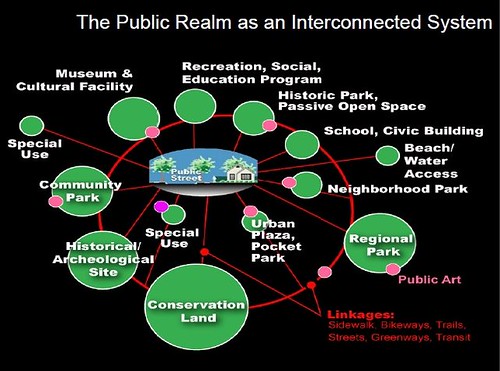
Public Realm as an Interconnected system, Slide from presentation, Leadership and the Role of Parks and Recreation in the New Economy, David Barth

I haven't yet aimed to develop this into a massive position paper. And I need someone great at graphic design to help me express it graphically. David Barth gave me permission to use/modify his "integrated public realm framework" and I want to add to it "subway style iconography" for the linkages.

His linkages are just transportation. For me they are also civil society and organizations; media and communications; education; social services; politics and governance; etc.

While Mayor Bowser didn't execute this concept the way I suggested, she did create a new position "Deputy Mayor for Greater Economic Opportunity," based on my conversations with her campaign people.

The program (Woodlawn, Birmingham, Alabama) mentioned in the Pro-Urb thread is interesting. Here and there are similar efforts, such as Price Philanthropies focus on the City Heights neighborhood in San Diego (responded to by the city's Jacobs Foundation with an effort in another neighborhood). But even though the City Heights effort is cool and smart to focus all its efforts and monies on one neighborhood, when I went to check it out, I did wonder "that's all you get for a couple hundred million dollars?"

I haven't addressed the concept for awhile, but I have strung a bunch of best practices that are models. The thing is that most of these best practices are one offs, and need to be integrated into a more overarching and complete program. Here goes:

Conceptual underpinnings
- integrated public realm framework/Signature Streets as the foundation of integrated equity planning
- social urbanism concept in Medellin, Colombia, creating new civic assets in neighborhoods (Library Parks) and better transit connections in topographically challenged areas (escalators, gondola systems, etc.). They've experienced serious decrease in crime/murder. It's funded in part from monies from the publicly owned utility ("'Social urbanism' experiment breathes new life into Colombia's Medellin" Toronto Globe & Mail; "Medellín's 'social urbanism' a model for city transformation," Mail & Guardian) - citizenship culture concept of Antanas Mockus (Former Mayor of Bogota)
- positive deviance model (see the Harvard Business Review article "Your Company's Secret Change Agents," 2005)
- the five point framework in Community Economic Development Handbook by Mihalio Temali
- Main Street commercial district revitalization model
- Social capital/community capital
- Asset Based Community Development (ABCD Institute, Chicago)
- Transformational Projects Action Planning (blog entry)
- Broken Windows Policing (as opposed to Zero Tolerance Policing), ("The state of "broken windows" versus "problem oriented policing" strategies in 2016: Part 1, theory and practice)
- Building Neighborhood Confidence, by Rolf Goetz
- special service districts as funding mechanisms

Policing
- Community Safety Partnership, Los Angeles
- Operation Ceasefire, Boston ("Straight Outta Boston," Mother Jones Magazine)
- High Point, NC program focusing on domestic violence ("How High Point, N.C., Solved Its Domestic Violence Problem," Governing Magazine)

Neighborhood
- United Way Toronto repositioning, spending all its resources on specific targeted neighborhoods (Building Strong Neighborhoods)
- immigrant integration program in Marseille
- "Elm Street" neighborhood revitalization approach -- adapted from Main Street model by State of Pennsylvania, program has since been deemphasized under later administrations
- settlement house model
- Neighborhood Centers Inc., Harris County, Texas
- neighborhood housing improvement programs  including by Mercer University in Macon and the Neighborhood Housing Services program more generally
- Toronto Tower Renewal Program
- East End initiative, Richmond, Virginia
- Grow South initiative, Dallas
- City Heights Initiative, Price Philanthropies, San Diego

Environment
- Toronto's programs dealing with multunit buildings
- San Francisco Green Benefits District
- environmental justice programs generally ("Environmental injustice is rising in the US. Minorities and the poor pay the price," Guardian)
- Push Buffalo Green Development Zone

Health
- proposal for social and community programs integrated into St. Anthony Hospital in Chicago (Focal Point Chicago)
- integrated public health clinics and hospital system in Denver
- community health clinics in DC

Schooling
- schools as combined community centers
- year round school
- enhanced "summer school"
- special assistance programs for Title I schools (Virginia, Montgomery County, Maryland, etc.)
- cooperative high school (a concept of mine)
- various programs with schools including models dealing with immigrants, the Family Resource Center at Rothenberg School in Cincinnati ("Below the Line in Over the Rhine," WCPO-TV)
- the Tacoma Housing Authority's work with elementary schools
- IB as a way to reposition low performing public schools (Rainer Beach High School, Seattle)
-- "Lessons for locals on the power of parents in schools," Seattle Times
-- "More thoughts about connecting communities to schools," 2006

Libraries/Continuing Education/Community Centers
- libraries as combined community centers (Drumbrae Library in Scotland) including as a premier example
- the IdeaStore concept in Tower Hamlets borough, London (combines library + adult education and locates them in highly visible locations in high use districts)
- multi-community centers (Pound Healthy Living Centre, Hampshire County, UK)
- extended hours for libraries and rec/community centers
- "A local community center is helping people conquer inequality," Los Angeles Times

Business development/jobs
- Main Street commercial district revitalization approach
- Community Economic Development Handbook points on microenterprise development and growing good neighborhood jobs
- Evergreen Cooperatives, Cleveland, business and jobs development
- PUSH Buffalo (New York) green jobs program
- West Philadelphia Skills Initiative of the University City District
- supported job settings for people who can work but need support along the way (I wrote about this as a concept)
- food halls/markets as a typology for developing locally owned businesses (Midtown Exchange, Minneapolis; Mercado, Portland; Thai Town Marketplace, LA)
- and incubators
- UpLift Solutions consulting group, Philadelphia on addressing "food deserts"
- community grocery store (Fare & Square, Chester, PA; Mariposa Food Cooperative, Philadelphia; Richmond East End Initiative)

Housing
- SRO housing (lots and lots of it)
- DIY/self-help/civic engagement programs in public housing to build social and community capital

Transportation
- programs to support take up of biking
- improved transit access ("Largest urban cable car soars over 'desperate' commuters of La Paz," Guardian)
- area improvements to improve access to stations
- discounted transit passes based on income (NYC, San Francisco, Edmonton)

Nonprofits/Arts
- shared spaces for organizations (Nonprofit Centers Inc.)
- shared spaces for arts organizations (many examples)

Etc.

Labels: , , , , , ,

Friday, July 21, 2017

For a lot of "urban problems" the issue isn't knowledge about what to do, but willingness to engage that knowledge

I can't help but laugh at the WAMU-Radio (local NPR) article ("From Rats To Confusing Forms, D.C. Recruits Scientists To Find New Solutions To Old Problems") about how DC Government got a grant to hire "scientists" to address urban problems. From the article:
Scientists and researchers working at think tanks will often offer their educated opinions on whether government programs are actually working. But a new initiative in D.C. is turning those outside experts inside the government, where they’re being tasked with finding new solutions to old problems.

It’s called The Lab, and it was funded through $3.2 million grant from the Texas-based Laura and John Arnold Foundation, which paid for similar “policy labs” in Houston, Michigan and Rhode Island.

The earlier labs focused on working with experts at local universities. D.C.’s is the only one where they are embedded in the government itself, creating an in-house think tank of sorts.

“It’s really groundbreaking work for us,” said City Administrator Rashad Young. “They have a set of skills that are uncommon in government.”
One of the reasons those skills are uncommon in government is that governments tend to not want to hire or keep around people who have those skills.  (I know this from personal experience.)  Critical analysis is uncomfortable for the people who are analyzed.

For example, with urban planning, the point I make is that outcomes from planning and zoning are supposed to improve quality of life, the local economy, etc., and when outcomes don't do this routinely that is an indicator that the processes that generate the outcomes are flawed.  So then I look backward and analyze the processes, and identify those elements which produce the undesirable outcomes.

The knowledge to solve many--not all--urban problems is already out there.  ... although the money may not be.

The problem is that we aren't using knowledge-based responses as a matter of course, and previously created programs ("solutions") are painted with the brand of the other party or predecessors, so that when the other other party gets elected, or chief executives (Presidents, Governors, Mayors) change, "old policies and programs" get junked in favor of "new policies and practices."

A perfect example is how Republican Governors in Maryland want to junk Smart Growth practices because they were initiated and developed by Democrats, and it is the opposite in Massachusetts.  Democrats want to junk Smart Growth practices because they were initiated and developed by Republicans.  The fact is Smart Growth principles are universal.  But they are political, in that their execution reflects different philosophies about government action and resource use.

But there are many examples of this in DC with the transition from Mayor Williams to Mayor Fenty, Mayor Fenty to Mayor Gray, and Mayor Gray to Mayor Bowser--and they're all Democrats.

The issues are:

- acknowledging knowledge, let alone caring about knowledge/evidence-based approaches
- being open to other approaches
- focusing on delivering programs through agencies rather than focusing on addressing the problem
- being willing to acknowledge failure
etc.

This piece, "All the talk of e-government, digital government, and open source government is really about employing the design method" (2012), made the point that the issue isn't "open data" or "digital solutions," but about openness to ideas and the design method more generally, regardless of the way of doing so is "analog" or "digital."

That's why I get frustrated reading articles about how "big data" will save us. Don't get me wrong, I'm all for analysis of big data sets and applying innovative solutions as a result of nuanced analysis.

But when we aren't even looking at what we might call the nuggets of "little data," what's the point?

-- "Does the focus on big data mean we miss the opportunity for better use of "little data"," 2015
-- "Creating the right program vs. the hype of big data," (2013)

Executive Branch Government tends to be incredibly hermetic. Critical analysis is seen as "personal criticism." People want cheerleaders, not alternatives. It's a joke whenever people point out the value of "telling truth to power."  That's the last thing people want to hear.

-- "Helping Government Learn," 2009

For a variety of reasons, elected officials aren't too interested in policy analysis, and government officials can be very constrained and parochial in their analytical frameworks too. Often, governments repeat the mistakes they've made before, or refuse to learn from other experiences.

For example, one of my favorite quotes is from Bismarck:
"Fools learn from experience. I prefer to profit from the experience of others."
People in government--at least elected officials and the people who work for them directly--tend to focus on "people" and individuals, not "the system" and structural conditions. I wonder if this is a problem endemic to elected officials, the kinds of people who are most likely to be successful at getting elected. Structural approaches generally tend to elude them. 

And so, many projects and initiatives fail.

-- "I get tired of all the talk about rewarding "failure"," (2017)

When an Executive Branch Government doesn't value critical analysis, it's hard to believe that a program like The Lab has a long term future.

But Legislative Branch Government isn't necessarily better.  DC would be better served if we had a unit comparable to New York City's Independent Budget Office, to provide critical analysis of budget and programs,

Although the DC Auditor, renewed under the tenure of former Councilmember Kathy Patterson, has moved that office forward in many ways.

-- "Why inspector generals don't often seek the whole truth," 2013
-- "Strengthening DC's political systems and structures: The Inspector General and DC Auditor positions should be abolished and replaced by an elected Public Advocate, 2014 (written before the DC Auditor office was revitalized, but I still believe the office should independent of either the executive or legislative branch)

There are other examples of similar kinds of capacity building and analytics initiatives focused on improving local government, from the "Grand Jury" process in California--citizen "juries" review government programs and agencies to the Municipal Research and Information Service in the State of Washington.

Not having such organizations functioning that way in DC hurts the quality of local government.

Labels: , , , , , , ,

Thursday, May 04, 2017

I get tired of all the talk about rewarding "failure" because it shows people are trying, and won't be penalized for it

So much failure in innovation is unnecessary.  It comes from hubris and a failure to acknowledge and learn from previous programs and best practices developed in other iterations.

I write about this a lot, from discussions about "positive deviance" and "pre-mortems."

I bring this up because of a conversation with some city planners at a conference last week.  It's really tiring.

It's why I am fond of the quote attributed to Bismarck:
"Fools learn from experience.  I prefer to learn from the experience of others."
From a 2007 blog entry:

Pre-mortems.  From "Analyzing Failure Beforehand," in the New York Times:
Post-mortems, trying to figure out why a new idea failed, are a common business process. But wouldn’t “pre-mortems” make more sense?

They would, argues Gary Klein, chief scientist at Klein Associates, a division of Applied Research Associates, which works with companies to show them how to conduct pre-mortems and “identify risks at the outset.”

“A pre-mortem in a business setting comes at the beginning of a project rather than the end, so the project can be improved rather than autopsied,” Mr. Klein explains in The Harvard Business Review.

In the pre-mortem, company officials assume they have just learned that a product or a service they are about to introduce has “failed spectacularly.” They then write down every plausible reason they can think of to explain the failure. The list is then used to eliminate potential flaws before the new idea is actually introduced into the marketplace.

While companies frequently engage in risk analysis beforehand, employees are often afraid to speak up, fearing they will be seen as naysayers or will suffer the political consequences of objecting to an idea that is popular internally. < An exercise that assumes the new idea fails frees people to be more candid, and can, Mr. Klein writes, serve as a check on the “damn-the-torpedoes attitude often assumed by people who are overinvested in a project.”
Positive deviance.  I have also written a lot about "positive deviance." See the past blog entries "Positive Deviance and the DC Public Schools" and "Positive deviance in NYC school system remains unrecognized."

The idea of positive deviance is that even low performing organizations have pockets of excellence.

Unlike opposition expressed to importing "best practices," members of the organization can't ascribe the difference in outcomes to different organizational conditions.  Instead of working to import best practices, positive deviance is sort of like the Chrysler commercials -- "imported from Detroit -- stressing the excellence already present in the organization and "exporting" it to other sites across the organization.

-- "Your Company's Secret Change Agents," Harvard Business Review, May 2005, is the article that introduced me to the positive deviance concept.

Big data and pattern recognition.  In the past few weeks, I have realized that my reticence about jumping on the big data train is that it makes people like me obsolete.

I am good at pattern recognition, structural analysis and process design.  Most people aren't.  But using analytical tools and big data sets, people who aren't good at pattern recognition have computer applications generate interesting results that they can then address.

I wrote about this a few years ago, somewhat derisively, about an Arlington County initiative focused on battling student truancy.  See "Creating the right program vs. the hype of big data."  I wrote:
I regularly laud Arlington County's government here, and get some sniping in the comments.  But I have to admit that I laughed out loud when I saw an article in the Sunday Washington Post, "Arlington schools tap 'big data' to reduce dropout rate," stating that ArCo is offering a $10,000 prize for using "big data" to figure out the school truancy program.

Big data--mining massive data sets with specialized programming tools and algorithms--is like "Apps for Democracy", not the real issue (see "All the talk of e-government, digital government, and open source government is really about employing the design method")

The issue is process design, creating the right programs, devoting the necessary resources, and staying committed for the many years it will take to right the problem.

I don't know if there is tons of waste in government, but there is a great deal of focusing resources on the "wrong" problem and mis- and dis-coordination of programs and resources.

My approach to planning is to start from the endpoint, "what are your preferred outcomes?," figure out if you are achieving preferred outcomes as a matter of course--routinely--and if not, looking backwards at the processes that produce the outcomes.

Based on a wide variety of analyzes (best practice review, program evaluation, etc.), figure out why preferred outcomes aren't being generated routinely, and change the processes accordingly, taking into account potential "unintended consequences" in advance, rather than not considering them at all.

It comes up again with a recent article ("Cities Are Having a Data and Analytics-Driven Moment, and It's Likely to Stay") in Government Technology about an initiative in  New Orleans, where the firefighters decided to be proactive in distributing smoke alarms in neighborhoods with a higher rate/risk of fires. From the article:
In New Orleans, the city has been saving lives by using data to predict which of the city’s buildings need to be equipped with fire alarms. Using data collected by the Census and New Orleans Fire Department, the city identified building age, building inhabitant income, and building inhabitant occupation length as strong predictors for determining if a structure may not have a smoke alarm installed. It then mapped this information along with fire risk calculated from resident age data and fire data over the previous five years. The program’s results now inform NOFD’s door-to-door program to install free smoke alarms.
To me the issue isn't big data, but first, the decision (1) to be proactive in distributing smoke alarms, (2) not willy-nilly, but in those neighborhoods with a higher risk for fires.

I find it hard to believe that the Fire Department doesn't analyze runs and fires already to know what types of properties and situations are high risk.

Labels: , , , , , ,

Wednesday, February 24, 2016

DC streetcar is opening on Saturday and the opportunity to reflect on the 14 year long process to get there

Passengers board a streetcar on Irving Street NW in Washington on Dec. 1, 1961 Ellsworth Davis/The Washington Post.

The Dave's Railpix website is a good source for historical photos of streetcars and trolleys.

Greater Greater Washington has a magisterial post ("The DC Streetcar starts service on Saturday. It took a wild ride to get here") on the events that have transpired from the beginning of streetcar planning to the opening of the streetcar this weekend ("DC Streetcar Will Start Passenger Service on February 27" Washingtonian) to passenger service.

When it was first proposed, as part of a planning process called the DC Alternatives Analysis in 2003, I was strongly favorable.  But since then the project hasn't been particularly smooth.

What should the city's transit priority be: streetcars or Metrorail expansion?  And over time I came to believe despite the fact that streetcars are a superior mode compared to buses--better, smoother ride and will carry more people--and will attract more choice riders compared to buses, it would be better for DC to focus on expansion of Metrorail service within the city, specifically what was once called the separated blue line.

Streetcar service was conceived by top officials at the time as a way to extend better transit service because they had no hope that Metrorail would ever be extended within the city.

Failures in execution threaten the entire streetcar enterprise.  But despite the focus on streetcars over Metrorail expansion, the process has been marked by problems.

First Hill Seattle Streetcar shelter, map inset, and map of station stops.

My joke is that DC and Seattle started planning for streetcars the same year, 2003, and Seattle opened its first streetcar line in 2007.

Seattle's second line opened a couple weeks ago and would have opened earlier except for delays on the part of the manufacturer.

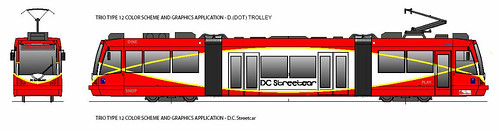
DC Streetcar vehicle proposed paint scheme
Over the years, thinking more granularly about what DC's transit priorities should be, and the many failures in planning, design, engineering, and construction to build it, not to mention the financing and priorities of the city's elected officials which have waxed and waned, I am not nearly as supportive now.

-- "A crisis in confidence and the capacity of local government to execute transit projects," December 2014

At times I wonder if it is even worth pursuing streetcars given the animus that arises.  Until you propose streetcars, it's hard to understand the strength of the privileging of the personally-owned automobile in our land use and transportation planning paradigm and the lengths that supporters will go to keep it that way.

The failures in DC had fallout locally too.  Eventually, with a change in political leadership in Arlington County, the plan for streetcars there couldn't withstand the continued drumbeat of opposition, and couched in cost--not automobility--the program was cancelled.

Note too that failures in execution of the streetcar in DC are used by opponents in other communities to justify scuttling streetcar programs there.  

It's a reverse example of "world class cities" and best practice. "Worst practice" has negative consequences too, because it doesn't go unnoticed, especially by the anti-transit and pro-automobility crowd.

The arguments by opponents.  Streetcars are dated technology.  Interestingly, a lot of the opposition trots the line that "streetcars are dated technology--from the 19th century," failing to acknowledge that cars too date to the 19th century, and both streetcars and motor vehicles have been significantly improved since.

Personal vs. mass transportation.  The reality is that opposition to streetcars is not about "old technology," but about a preference for personal transportation--the car, and riding by yourself, versus mass transit and riding with others.

Only good for tourists. The other grouping of arguments calls streetcars not useful and more of a toy or attraction best to serve tourists. The entry "Frankly MARTA, I don’t Give a Tram," from the Trip Planner blog argues that streetcars only work as tourist attractions. I disagree.  Tell that to Toronto, Philadelphia, or Melbourne, among others.

Even though San Francisco's heritage streetcar line is seen as serving tourists primarily between Fisherman's Wharf and the Ferry Building, it simultaneously serves as a key element of the city's everyday transit network serving Downtown and Market Street.

Nevertheless, the H Street streetcar is already a big success, economically.  From the standpoint of spurring new development, the streetcar is already an incredible financial success having triggered close to $800 million in new construction (finished or underway) on the H Street NE corridor in the past couple years

-- "DC and streetcars #4: from the standpoint of stoking real estate development, the line is incredibly successful and it isn't even in service yet, and now that development is extending eastward past 15th Street," December 2015

including multiple projects east of 15th Street, an area not otherwise likely to experience development for decades to come.

Although in terms of transit related development, H Street possesses certain locational advantages and pre-conditions that are easily leverageable where other locations are not so easily able to spur development along:

-- "If you build it (streetcars) does economic development magically happen?," July 2008 (about Anacostia).
-- "Purple line planning in suburban Maryland as an opportunity to integrate place and people focused initiatives into delivery of new transit systems," March 2014

On the pending launch for passenger service, it's worth revisiting some of my past posts on streetcars and DC.

1.  I have written scads of entries about H Street and urban revitalization--it's where I made my bones--but we can't discuss the pending launch of passenger service for the streetcar without acknowledging Joe Fengler.

Despite all those who take credit for the streetcar and will during speech time at the launch, without Joe the streetcar wouldn't be opening for business this Saturday.

During the time when the H Street Streetscape and Transportation Study planning process was underway (2003-2004), Joe Fengler, then chair of Advisory Neighborhood Commission 6A, realized that it would be more efficient to install streetcar tracks when the streetscape was being reconstructed, rather than tearing it up again for rails.

But at the same time that he used the "efficiency argument" he had a hidden agenda--recognizing that with rails in the street H Street would be much more likely to get streetcar service--especially if obstacles arose in Ward 8, where streetcar service was once expected to launch as early as 2007 (as proclaimed so confidently by a DDOT employee at the Regional Bus Conference in Fall 2006).

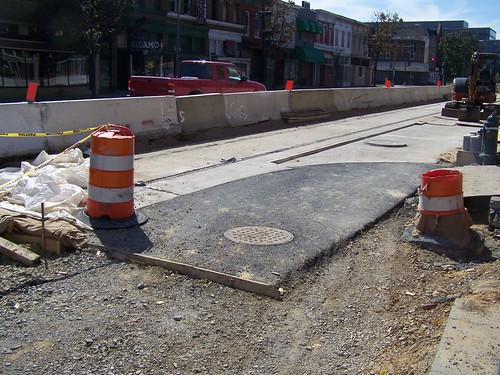
Streetcar tracks being installed at 5th and H Street NE
Construction of the railtrack bed on the 500 block of H Street NE.

Joe organized a campaign to get DDOT to install the tracks and reconstruct the streetscape simultaneously, getting other ANCs in the H Street-Benning Road corridor to sign on in support, and eventually DDOT made the commitment.

Too bad they didn't start planning for the electricity infrastructure and access to Union Station at the same time, which ended up delaying the project for at least two years, and resulted in the failure to connect the streetcar more directly to Union Station.

-- "Capturing best practices/the process and promise of urban revitalization (in strong markets)," October 2011
-- "The community development approach and the revitalization of DC's H Street corridor: congruent or oppositional approaches?," March 2013
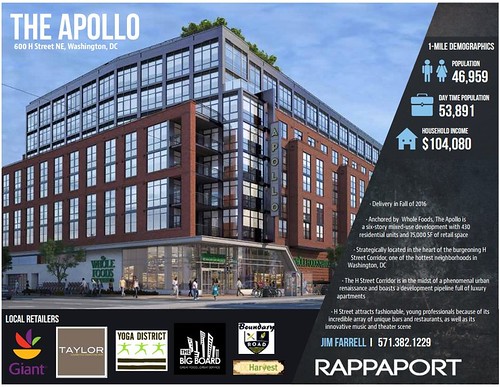
-- "360 Apartment building + Giant Supermarket vs. a BP gas station, which would you choose?," May 2013

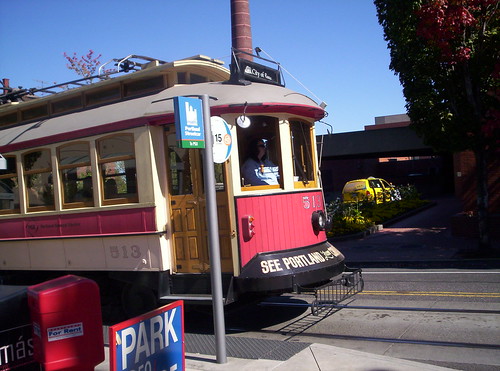
2.  This 2006 post suggested that like the Market Street Railway in San Francisco, DC could integrate heritage streetcars into the service mix, perhaps in conjunction with the National Capital Trolley Museum.

Portland historic replica streetcarI was inspired in part by seeing a heritage streetcar running in Portland--it used to run on the light rail tracks and this helped draw publicity to the creation of the original modern streetcar line in Portland, which connected Downtown and Portland State University to the new Pearl District and the venerable Nob Hill neighborhood.

Lee Rogers, now deceased, a longtime streetcar advocate and historian, also spurred the idea.

-- "Adding cultural heritage dimensions and expanded service capabilities within commercial districts to DC Streetcar planning" January 2006

3. In response to many articles about streetcars that failed to adequately distinguish between types of transit and what streetcars are good at, I wrote this piece, distinguishing between inter-city and intra-city transit, not just about streetcars but about circulators and other forms. It built on earlier writings about how to think about transit networks and what I call the "transit shed" of transit networks and "mobility sheds" centered on transit stations.

-- "Making the case for intra-city (vs. inter-city) transit planning," October 2011

4. In response to articles either criticizing streetcars for being more about economic development, or in favor of it for the same reason but therefore accepting it as a substandard form of transit, I wrote a couple pieces further distinguishing the point of difference between inter-city transit and intra-city transit.

The H Street streetcar line addresses intra-district transit west from H Street eventually to Georgetown and Rosslyn and eastward into Ward 7, and in fact, the old 10/12 line traveled this route, between Deanwood and Rosslyn.

-- "STREETCARS ARE ABOUT TRANSIT, just in a different way from how most people are accustomed to thinking about it," January 2014
-- "The argument that streetcars are "good enough" but "imperfect transit" is flawed," October 2014 (sadly this was in response to a piece by GGW among others)
-- "DC and streetcars #3: More discussion (from almost 2 years ago)," December 2015

5.  This piece suggests focusing on a crosstown route, because of the problems getting Congress to sign off on allowing wires.  Building on the original line proposed between the Woodley Park and Brookland Metrorail stations, it proposed an extended line, with legs serving AU and Georgetown Universities on the west and service beyond Brookland to the University of Maryland in College Park.

-- "Will streetcars really return to the Capital City?," April 2009

6.  These are a few of the entries discussing problems with city's planning and implementation of the streetcar.

-- "Streetcar and capital planning in the Washington metropolitan area," September 2010
-- "Looking backwards vs. looking forwards, tradeoffs, constraints and urban revitalization in the 21st century city," April 2010
-- "Blaming the mode: faulting DC's streetcar because of massive failures by DC Government in planning and execution," March 2015

7. A couple years ago I suggested creating a separate heritage streetcar system combined with integrated visitor services to provide tourist-focused transportation functions around the National Mall.

It's modeled after the F Line/Market Street Railway service in San Francisco.

The original piece proposed a system with major nodes at Union Station and Jefferson Memorial, integrated with a new Yellow Line station at the Jefferson Memorial, visitor centers at Union Station and Jefferson Memorial, and even visitor parking under the National Mall.

Washington DC trolley in front of the Ferry Building in San Francisco
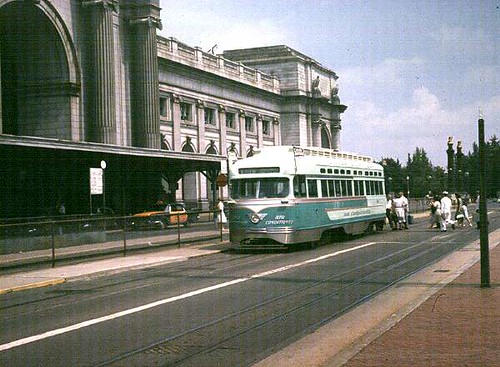
PCC Streetcar painted in the livery of the DC Transit streetcar system in front of the Ferry Building in San Francisco.  Flickr photo by Greg Goodman.

Silver Sightseer streetcar, Union Station
Silver Sightseer streetcar, Union Station.

Later I realized that this system should be extended further west with connections to Georgetown and across the Potomac River to Arlington Cemetery.  Like many people, I missed the importance of visitor transportation needs being both from west to east, not just east to west, and focused on serving the visitor with an integrated system, seamlessly across jurisdictions.

-- "A National Mall-focused heritage (replica) streetcar service to serve visitors is a way bigger idea than a parking garage under the Mall," August 2013
-- "New DC Circulator route serving National Mall reminds us that we are neglecting connections from west to east and fail to adequately connect Georgetown to the National Mall," June 2015

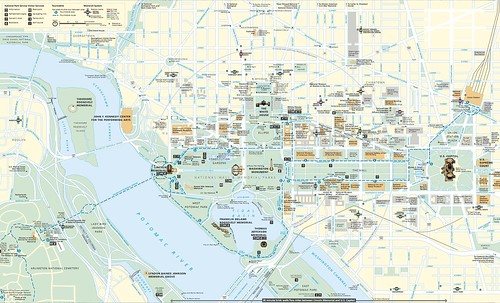
The National Park Service manages the "National Mall" as a unit spanning the Potomac River, primarily located in DC but also including sections of Arlington County, Virginia.  Transit delivered by each jurisdiction fails to serve the National Mall as an integrated unit.  And special tourist-focused transit services are very expensive and don't serve local audiences.
The National Mall and Smithsonian Museums, map

Inekon-built streetcar in Portland, Oregon, USA, on the Portland Streetcar system. Train is stopped at SW 11th and Clay with The Old Church on the right.

8.  Joe Fengler was right!  What I thought of as spurious opposition to the streetcar on the part of residents in Anacostia has delayed implementation there by many many years, so the streetcars the city has have been diverted to H Street, which has tracks in the ground.

Similarly, a church downtown has expressed opposition to streetcar service passing their church, as a kind of abomination.

-- "Whither Light rail in Anacostia?," May 2005
-- "When seeing isn't believing, how do you correct for vision impairment?," November 2005 (this entry discusses my shock that people went on a site visit to Portland and then came back and argued that DC streets in Anacostia couldn't accommodate a streetcar)
-- "Streetcars, street widths, and Anacostia," July 2006
-- "The co-existence of streetcars and churches elsewhere," December 2014

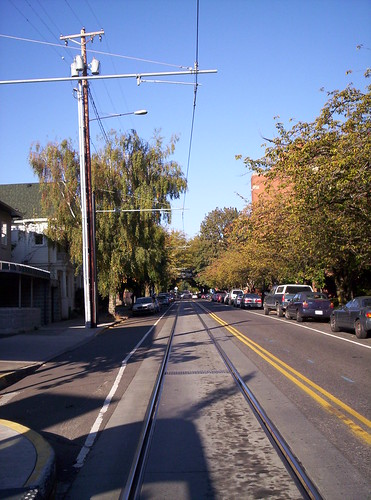
Streetcar track in Nob Hill, Portland
Streetcar route in the Nob Hill neighborhood of Portland.  I think this is NW Northrup Street.  The roadway is narrow enough to demonstrate that streetcars can be accommodate on most DC streets.

9.  Another argument that opponents make is that rather than spend the money on streetcars, it's cheaper to upgrade bus services.  The argument for streetcars over buses is threefold:

(1) higher quality service;
(2) more capacity; and
(3) will result in increased ridership from "choice riders" switching from cars.

The unanswered question is whether or not it is in fact possible to attract a much greater ridership of buses from focused improvements.  At a 30% to 40% increase that would mean 4,000 to 5,200 new daily riders.

I don't think it would happen, the research is pretty clear about the economic stratification of mode choice when multiple modes are available, but I think it's worth testing the implementation of a high quality regular bus service, modeled on the kinds of improvements implemented as part of true Bus Rapid Transit service.

-- "The need for a double decker bus vs. streetcar comparison study," January 2014
-- "Making bus service sexy and more equitable," September 2012

Labels: , , , , , , , ,