Rebuilding Place in the Urban Space

"A community’s physical form, rather than its land uses, is its most intrinsic and enduring characteristic." [Katz, EPA] This blog focuses on place and placemaking and all that makes it work--historic preservation, urban design, transportation, asset-based community development, arts & cultural development, commercial district revitalization, tourism & destination development, and quality of life advocacy--along with doses of civic engagement and good governance watchdogging.

Wednesday, April 26, 2023

Post columnist Colbert King says the DC Council needs to do more oversight

In "An example of oversight from the D.C. Council? More of that, please."  Duh.  He makes the point that the Council probably needs more staff to be able to do so.  One of the comments on the article made a point about a local "Government Accountability Office" function.

The article mentions Councilmember Robert White questioning at a hearing, Brenda Donald, director of the DC Housing Authority, asking about her $40,000+ bonus for the year, after the agency was ripped to shreds by a HUD inspection report ("D.C. Housing Authority’s leadership is failing, HUD report says," Post).  After the Executive branch restructured the board in ways that didn't necessarily improve functioning and oversight--the Council pretty much rolled over on that.

Speaking of oversight, how is that the DCHA, which was revitalized during the administration of Anthony Williams, has in 15 years, deteriorated to one of the worse in the country?  Doesn't say much for executive branch competence.

I've written about how to improve the legislative branch and oversight over the years, "Continued musing on restructuring DC's City Council (mostly)" (2013), is probably the most complete summation of recommended changes.

In "Outline for a proposed Ward-focused (DC) Councilmember campaign platform and agenda" (2015), I suggest more tools for ward-specific oversight.

But I realize it's yetanother post, where I reference organizations like the Municipal Research and Services Center of Washington State or the Independent Budget Office of New York City, and I never mentioned the Congressional Research Service, which besides the GAO and the Congressional Budget Office, provides such resources to Congress, along with Committee staffs.

Organizations like the MRSC or IBO provide a lot of deep research which is almost uniformly lacking when it comes to DC policy development and program practice.  Although to be fair, the same goes for plenty of other cities.

-- "For a lot of "urban problems" the issue isn't knowledge about what to do, but willingness to engage that knowledge" (2017)

DC has Inspector Generals and an Auditor who reports to Council.  The auditor, former Councilmember Kathy Patterson, has done a lot of good reporting.  But again, the Executive Branch doesn't seem to want to engage with it, and the Council doesn't push.

In some cities, more independent offices, like the New York City Comptroller--currently Brad Lander--who is elected, do this kind of work as well, and bring more attention to the ins and outs of better governance.

=====

Note that separatelly I argue for training, assistance, and capacity development systems for the city's Advisory Neighborhood Commissions and citizens groups more generally.

-- "Framingham Massachusetts creates Citizen Participation Officer position," 2018
-- "Building civic engagement systematically: Seattle's Department of Neighborhoods," 2022

And in general across the board in other cities too.

Labels: , , , , , , , ,

Monday, December 06, 2021

Firefighter vaccine refusal as a reorganization opportunity

In the past I've written about how fire departments these days mostly respond to medical calls, but most departments haven't reorganized to reflect this fact, in part a result of labor contracts which mandate stasis.

-- "Rationalizing fire and emergency services," 2011
-- "Fire department issues in municipalities," 2014
-- "DC's fire department is in the same situation as WMATA in terms of the necessity of a redesign of culture and behavior through a human factors approach," 2015

A column in the Los Angeles Times, "To anti-vax firefighters, bye-bye. Now let's build back better at the LAFD," suggests that the Los Angeles Fire Department has an opportunity to do some reorganization in view of the likelihood that 300-400 firefighters will be put on permanent leave for refusal to get vaccinated.  From the article:

That’s why Andrew Glazier, a former member of the Board of Fire Commissioners, sees a potential mass departure as an opportunity rather than a problem. 

“If you lose several hundred people, and you refuse to change your operating model, then, yeah, you’ll have a big problem,” said Glazier. “But … if they were willing to add single-function paramedics to the department, you can hire them up and have them in the field in six weeks or less, and you can continuously hire them as needed.”

About 85% of the calls for the fire department are medical.  The Firefighters Union represents firefighters not paramedics, and firefighters get paid more.  So the union continues to advocate for firefighters being cross-trained as paramedics, rather than hiring paramedics specifically and reorganizing services to focus on paramedics.  

Although cross-training makes sense too, the reality is that fewer firefighters and related equipment are required to serve the average city today than in the past.

And as it is, comparable to crime analysis approaches in police departments, if fire departments put some resources into "fire suppression" by providing assistance to communities and households where buildings have characteristics indicating the potential for catastrophe, house fires especially would be less of a problem.

As I wrote in 2017, in "I get tired of all the talk about rewarding "failure" because it shows people are trying, and won't be penalized for it":

... [the] article ("Cities Are Having a Data and Analytics-Driven Moment, and It's Likely to Stay") in Government Technology [describes] an initiative in  New Orleans, where the firefighters decided to be proactive in distributing smoke alarms in neighborhoods with a higher rate/risk of fires. From the article:

In New Orleans, the city has been saving lives by using data to predict which of the city’s buildings need to be equipped with fire alarms. Using data collected by the Census and New Orleans Fire Department, the city identified building age, building inhabitant income, and building inhabitant occupation length as strong predictors for determining if a structure may not have a smoke alarm installed. It then mapped this information along with fire risk calculated from resident age data and fire data over the previous five years. The program’s results now inform NOFD’s door-to-door program to install free smoke alarms.

To me the issue isn't big data, but first, the decision (1) to be proactive in distributing smoke alarms, (2) not willy-nilly, but in those neighborhoods with a higher risk for fires.

I find it hard to believe that the Fire Department doesn't analyze runs and fires already to know what types of properties and situations are high risk.

====

I do note that DC Fire Department has recently undertaken such an initiative ("Neighbors offer support for family of 7-year-old who died in D.C. rowhouse fire," Washington Post).  But likely such efforts could be more systematic.  From the article:

As the investigation continued into what caused the blaze, D.C. fire officials and firefighters returned to the neighborhood Wednesday morning in hopes of preventing future fires. They arrived with free smoke alarms in hand and printed sheets of fire safety tips, and were welcomed by neighbors, who said they are making efforts to help the family moving forward. 

 “Any time something happens to any of the neighbors, it affects all of us,” said Geoffrey Tate Sr., 65, who has lived in the community for nearly 50 years.... 

Visiting nearly 200 homes Wednesday, groups of fire officials talked to residents on Quebec Place, Rock Creek Church Road, Princeton Place and Warder Street NW. Fire Inspector Celina C. Primus went door-to-door on a block of homes, making sure residents checked for working smoke detectors and had a fire escape plan. 

“When a tragedy like this happens, they want to know someone outside of immediate family cares for them,” Primus said. “We care.”

Labels: , , , , , , ,

Wednesday, June 02, 2021

Closing investigations without resolving them: the Nashville bomber

Photo: DC Fire and Emergency Services.

In 2019, there was a terrible fire at an illegal rooming house on Kennedy Street in DC, killing 2 people.  The thing is that a police officer had responded to an incident there, and reported the conditions to DCRA.  

An inspector went there three times, couldn't get in, so he "closed" the complaint.  He had the legal authority to get a warrant for entry, but he didn't take that step.

It remained unresolved and dangerous.

The inspector was fired for "dereliction of duty" but says it wasn't his fault because he wasn't trained ("DCRA investigator speaks out about fatal Kennedy Street fire: 'People died in that place. It didn't have to happen'," WUSA-TV).

The city came up with a convoluted way to "deal" with this failure, creating a personalized process relying on people, not systems..

I countered saying the solution was simple ("Unresolved versus Closed as a determination in handing City inspection/service matters").

1.  Instead of having police officers call a supervisor who then was supposed to call DCRA, create a category for the complaint in the city's 311 "complaint" system.

2.  Don't allow complaints to be closed without being resolved.

A row of historic buildings damaged by the the detonation of an R.V. packed with explosives in downtown Nashville on Christmas morning.Credit: Alex Kent/Getty Images.

The same thing happened with the Nashville bomber ("Suspect in Christmas Day bombing in Nashville acted alone and was driven by 'paranoia,' FBI says," ).  

A complaint was filed, police went there, never got in, and closed the investigation without doing anything other than knocking on a door once or twice.

A report analyzing what happened said they could do more ("As Nashville Bomber Plotted, Police Investigation Into Warning Sat Dormant," New York Times).  From the article:

But a report released on Wednesday found no documentation of any attempts to reach Mr. Warner after officers knocked on his door and got no response. The report added that the police should have acted more aggressively, keeping closer tabs on Mr. Warner and trying to establish the probable cause needed to search his home. Instead, the case sat open for months, as Mr. Warner stewed in conspiracy theories and plotted the attack.

The report emerged from an inquiry into the police investigation conducted by a panel that included senior officials from the Metropolitan Nashville Police Department and others from outside the agency. The panel concluded that there was “no way to know for sure if the suicide bombing on December 25, 2020, could have been prevented.” Yet it identified ways in which the Police Department had failed to conduct a robust investigation into the earlier warning.... 

... the Police Department began drawing scrutiny as an incident report surfaced showing that a friend of Mr. Warner’s had called the police in distress more than a year earlier. She had told officers that he was building bombs in the R.V. parked beside his house; her lawyer, who also knew Mr. Warner, told the police that he was capable of building explosives.

The officers went to Mr. Warner’s home in August 2019 and tried to follow up, police officials said, but they had no probable cause to search the home or R.V. 

Yet the panel said that the officers should have taken advantage of legal resources available to them to determine probable cause and gone further in pursuing the investigation...  

The report ends with the police department saying they could have done better.

Duh.

Labels: , , , , ,

Friday, July 21, 2017

For a lot of "urban problems" the issue isn't knowledge about what to do, but willingness to engage that knowledge

I can't help but laugh at the WAMU-Radio (local NPR) article ("From Rats To Confusing Forms, D.C. Recruits Scientists To Find New Solutions To Old Problems") about how DC Government got a grant to hire "scientists" to address urban problems. From the article:
Scientists and researchers working at think tanks will often offer their educated opinions on whether government programs are actually working. But a new initiative in D.C. is turning those outside experts inside the government, where they’re being tasked with finding new solutions to old problems.

It’s called The Lab, and it was funded through $3.2 million grant from the Texas-based Laura and John Arnold Foundation, which paid for similar “policy labs” in Houston, Michigan and Rhode Island.

The earlier labs focused on working with experts at local universities. D.C.’s is the only one where they are embedded in the government itself, creating an in-house think tank of sorts.

“It’s really groundbreaking work for us,” said City Administrator Rashad Young. “They have a set of skills that are uncommon in government.”
One of the reasons those skills are uncommon in government is that governments tend to not want to hire or keep around people who have those skills.  (I know this from personal experience.)  Critical analysis is uncomfortable for the people who are analyzed.

For example, with urban planning, the point I make is that outcomes from planning and zoning are supposed to improve quality of life, the local economy, etc., and when outcomes don't do this routinely that is an indicator that the processes that generate the outcomes are flawed.  So then I look backward and analyze the processes, and identify those elements which produce the undesirable outcomes.

The knowledge to solve many--not all--urban problems is already out there.  ... although the money may not be.

The problem is that we aren't using knowledge-based responses as a matter of course, and previously created programs ("solutions") are painted with the brand of the other party or predecessors, so that when the other other party gets elected, or chief executives (Presidents, Governors, Mayors) change, "old policies and programs" get junked in favor of "new policies and practices."

A perfect example is how Republican Governors in Maryland want to junk Smart Growth practices because they were initiated and developed by Democrats, and it is the opposite in Massachusetts.  Democrats want to junk Smart Growth practices because they were initiated and developed by Republicans.  The fact is Smart Growth principles are universal.  But they are political, in that their execution reflects different philosophies about government action and resource use.

But there are many examples of this in DC with the transition from Mayor Williams to Mayor Fenty, Mayor Fenty to Mayor Gray, and Mayor Gray to Mayor Bowser--and they're all Democrats.

The issues are:

- acknowledging knowledge, let alone caring about knowledge/evidence-based approaches
- being open to other approaches
- focusing on delivering programs through agencies rather than focusing on addressing the problem
- being willing to acknowledge failure
etc.

This piece, "All the talk of e-government, digital government, and open source government is really about employing the design method" (2012), made the point that the issue isn't "open data" or "digital solutions," but about openness to ideas and the design method more generally, regardless of the way of doing so is "analog" or "digital."

That's why I get frustrated reading articles about how "big data" will save us. Don't get me wrong, I'm all for analysis of big data sets and applying innovative solutions as a result of nuanced analysis.

But when we aren't even looking at what we might call the nuggets of "little data," what's the point?

-- "Does the focus on big data mean we miss the opportunity for better use of "little data"," 2015
-- "Creating the right program vs. the hype of big data," (2013)

Executive Branch Government tends to be incredibly hermetic. Critical analysis is seen as "personal criticism." People want cheerleaders, not alternatives. It's a joke whenever people point out the value of "telling truth to power."  That's the last thing people want to hear.

-- "Helping Government Learn," 2009

For a variety of reasons, elected officials aren't too interested in policy analysis, and government officials can be very constrained and parochial in their analytical frameworks too. Often, governments repeat the mistakes they've made before, or refuse to learn from other experiences.

For example, one of my favorite quotes is from Bismarck:
"Fools learn from experience. I prefer to profit from the experience of others."
People in government--at least elected officials and the people who work for them directly--tend to focus on "people" and individuals, not "the system" and structural conditions. I wonder if this is a problem endemic to elected officials, the kinds of people who are most likely to be successful at getting elected. Structural approaches generally tend to elude them. 

And so, many projects and initiatives fail.

-- "I get tired of all the talk about rewarding "failure"," (2017)

When an Executive Branch Government doesn't value critical analysis, it's hard to believe that a program like The Lab has a long term future.

But Legislative Branch Government isn't necessarily better.  DC would be better served if we had a unit comparable to New York City's Independent Budget Office, to provide critical analysis of budget and programs,

Although the DC Auditor, renewed under the tenure of former Councilmember Kathy Patterson, has moved that office forward in many ways.

-- "Why inspector generals don't often seek the whole truth," 2013
-- "Strengthening DC's political systems and structures: The Inspector General and DC Auditor positions should be abolished and replaced by an elected Public Advocate, 2014 (written before the DC Auditor office was revitalized, but I still believe the office should independent of either the executive or legislative branch)

There are other examples of similar kinds of capacity building and analytics initiatives focused on improving local government, from the "Grand Jury" process in California--citizen "juries" review government programs and agencies to the Municipal Research and Information Service in the State of Washington.

Not having such organizations functioning that way in DC hurts the quality of local government.

Labels: , , , , , , ,

Thursday, May 04, 2017

I get tired of all the talk about rewarding "failure" because it shows people are trying, and won't be penalized for it

So much failure in innovation is unnecessary.  It comes from hubris and a failure to acknowledge and learn from previous programs and best practices developed in other iterations.

I write about this a lot, from discussions about "positive deviance" and "pre-mortems."

I bring this up because of a conversation with some city planners at a conference last week.  It's really tiring.

It's why I am fond of the quote attributed to Bismarck:
"Fools learn from experience.  I prefer to learn from the experience of others."
From a 2007 blog entry:

Pre-mortems.  From "Analyzing Failure Beforehand," in the New York Times:
Post-mortems, trying to figure out why a new idea failed, are a common business process. But wouldn’t “pre-mortems” make more sense?

They would, argues Gary Klein, chief scientist at Klein Associates, a division of Applied Research Associates, which works with companies to show them how to conduct pre-mortems and “identify risks at the outset.”

“A pre-mortem in a business setting comes at the beginning of a project rather than the end, so the project can be improved rather than autopsied,” Mr. Klein explains in The Harvard Business Review.

In the pre-mortem, company officials assume they have just learned that a product or a service they are about to introduce has “failed spectacularly.” They then write down every plausible reason they can think of to explain the failure. The list is then used to eliminate potential flaws before the new idea is actually introduced into the marketplace.

While companies frequently engage in risk analysis beforehand, employees are often afraid to speak up, fearing they will be seen as naysayers or will suffer the political consequences of objecting to an idea that is popular internally. < An exercise that assumes the new idea fails frees people to be more candid, and can, Mr. Klein writes, serve as a check on the “damn-the-torpedoes attitude often assumed by people who are overinvested in a project.”
Positive deviance.  I have also written a lot about "positive deviance." See the past blog entries "Positive Deviance and the DC Public Schools" and "Positive deviance in NYC school system remains unrecognized."

The idea of positive deviance is that even low performing organizations have pockets of excellence.

Unlike opposition expressed to importing "best practices," members of the organization can't ascribe the difference in outcomes to different organizational conditions.  Instead of working to import best practices, positive deviance is sort of like the Chrysler commercials -- "imported from Detroit -- stressing the excellence already present in the organization and "exporting" it to other sites across the organization.

-- "Your Company's Secret Change Agents," Harvard Business Review, May 2005, is the article that introduced me to the positive deviance concept.

Big data and pattern recognition.  In the past few weeks, I have realized that my reticence about jumping on the big data train is that it makes people like me obsolete.

I am good at pattern recognition, structural analysis and process design.  Most people aren't.  But using analytical tools and big data sets, people who aren't good at pattern recognition have computer applications generate interesting results that they can then address.

I wrote about this a few years ago, somewhat derisively, about an Arlington County initiative focused on battling student truancy.  See "Creating the right program vs. the hype of big data."  I wrote:
I regularly laud Arlington County's government here, and get some sniping in the comments.  But I have to admit that I laughed out loud when I saw an article in the Sunday Washington Post, "Arlington schools tap 'big data' to reduce dropout rate," stating that ArCo is offering a $10,000 prize for using "big data" to figure out the school truancy program.

Big data--mining massive data sets with specialized programming tools and algorithms--is like "Apps for Democracy", not the real issue (see "All the talk of e-government, digital government, and open source government is really about employing the design method")

The issue is process design, creating the right programs, devoting the necessary resources, and staying committed for the many years it will take to right the problem.

I don't know if there is tons of waste in government, but there is a great deal of focusing resources on the "wrong" problem and mis- and dis-coordination of programs and resources.

My approach to planning is to start from the endpoint, "what are your preferred outcomes?," figure out if you are achieving preferred outcomes as a matter of course--routinely--and if not, looking backwards at the processes that produce the outcomes.

Based on a wide variety of analyzes (best practice review, program evaluation, etc.), figure out why preferred outcomes aren't being generated routinely, and change the processes accordingly, taking into account potential "unintended consequences" in advance, rather than not considering them at all.

It comes up again with a recent article ("Cities Are Having a Data and Analytics-Driven Moment, and It's Likely to Stay") in Government Technology about an initiative in  New Orleans, where the firefighters decided to be proactive in distributing smoke alarms in neighborhoods with a higher rate/risk of fires. From the article:
In New Orleans, the city has been saving lives by using data to predict which of the city’s buildings need to be equipped with fire alarms. Using data collected by the Census and New Orleans Fire Department, the city identified building age, building inhabitant income, and building inhabitant occupation length as strong predictors for determining if a structure may not have a smoke alarm installed. It then mapped this information along with fire risk calculated from resident age data and fire data over the previous five years. The program’s results now inform NOFD’s door-to-door program to install free smoke alarms.
To me the issue isn't big data, but first, the decision (1) to be proactive in distributing smoke alarms, (2) not willy-nilly, but in those neighborhoods with a higher risk for fires.

I find it hard to believe that the Fire Department doesn't analyze runs and fires already to know what types of properties and situations are high risk.

Labels: , , , , , ,

Tuesday, December 17, 2013

Creating the right program vs. the hype of big data

I regularly laud Arlington County's government here, and get some sniping in the comments.  But I have to admit that I laughed out loud when I saw an article in the Sunday Washington Post, "Arlington schools tap 'big data' to reduce dropout rate," stating that ArCo is offering a $10,000 prize for using "big data" to figure out the school truancy program.

Big data--mining massive data sets with specialized programming tools and algorithms--is like "Apps for Democracy", not the real issue (see "All the talk of e-government, digital government, and open source government is really about employing the design method").

The issue is process design, creating the right programs, devoting the necessary resources, and staying committed for the many years it will take to right the problem.

I don't know if there is tons of waste in government, but there is a great deal of focusing resources on the "wrong" problem and mis- and dis-coordination of programs and resources.

My approach to planning is to start from the endpoint, "what are your preferred outcomes?," figure out if you are achieving preferred outcomes as a matter of course--routinely, and if not, looking backwards at the processes that produce the outcomes.

Based on a wide variety of analyzes (best practice review, program evaluation, etc.), figure out why preferred outcomes aren't being generated routinely, and change the processes accordingly, taking into account potential "unintended consequences" in advance, rather than not considering them at all.

Another way to look at it is what the Harvard Business Review called a "pre-mortem" analysis, to evaluate projects before they start rather than after they fail (see "Artificial Intelligence" which in part reprints "Helping Government Learn").  Also see "'Little data' matters too" from the Strategy & Business blog.

A cursory analysis of school truancy would identify the key problems pretty quickly.

-- Tool Kit for Creating Your Own Truancy Reduction Program, National Criminal Justice Reference Service
-- Best Practices Review: Truancy Reduction Efforts  (this is from the Wisconsin State Government and the nature of the report illustrates that it can be difficult for government to focus on what matters)

It helps to start with a thorough review of "current conditions," which when I started reading plans, all plans seemed to start out with this, but increasingly plans seem to skip over this, or at least, aren't very thorough about it.

After all, as stated in "Truancy Prevention in Action: Best Practices and Model Truancy Programs Executive Summary" from the National Center for School Engagement:
Utilizing best practices is a sound investment strategy:
• By studying those programs that have been proven to reduce or prevent truancy, practitioners and policy-makers avoid recreating the wheel and have more time to spend on implementation and evaluation issues.
• By taking advantage of the research and development efforts of others, staff has more time to spend on adapting a strategy to meet the demands of the local community.
• By financially supporting practices that have demonstrated success, public and private funders engage in prudent expenditure of limited monies.
Truancy is the dependent variable.  It's caused by "something else," primarily disintegrating or chaotic familial situations.

For example, the Boston Globe's analysis of the Tsarnaev Family finds that its likely they weren't part of a terrorism scheme directed from abroad, but were troubled--the older brother may have been indicating signs of schizophrenia--and angry, see "The Fall of the House of Tsarnaev".

Similarly, reports on DC schools (e.g., "Study shows significant midyear turnover among D.C. students," Post) determined that the schools serving the poorest areas of the city have the biggest churn in enrollment on a week-to-week basis, which is another indicator of familial chaos.

Failure to thrive scholastically is for the most part a dependent variable, a function of other factors.

You figure out the grouping of problems, what the best way is to deal with each group, categorize the students ("truants") accordingly, and move forward with the right programs and the right approaches.

E.g., earlier this year I blogged, "Criminalizing truancy versus focused programs to address truant behavior,"  about how DC's efforts to criminalize parents for student truancy was misguided, that in all likelihood the students and families need help and assistance, that punishment just makes a bad situation even worse.

That entry didn't really discuss problematic household situations, it focused more on "not liking school."

From the entry:

People don't go to school because "they don't like school."

Likely, they don't like school because they're not good at it.

Likely they're not good at reading (and writing) and math, so of course they don't like school.

Criminalizing their dislike doesn't make it go away.  Addressing their ability to read, write, and do arithmetic, combined with other initiatives will combat truancy far more successfully. 

That entry discusses a program for high school students.

Similar kinds of best practice family support programs exist as well.  Actually, DC Public Schools has some of these types of program, as does Montgomery County and probably many other places, and they are making a difference for some families.  But the resources required to move one family up the ladder to stability are significant and far greater than people expect.

Labels: , , , , , , , ,

Tuesday, February 08, 2011

Artificial intelligence


There was an op-ed in the Wall Street Journal last week on artificial intelligence. AI is the process of making machines (software and hardware) intelligent so that they can make decisions independent of specific human direction.

I laughed at the headline though, thinking that "artificial intelligence" is what we do mostly as elected officials and advocates, when we make recommendations for how to improve things, when we don't really know what's going on, what the fundamentals are of the issue, what the real problem is, and how to respond, not to mention how to implement.

One current example is the Walmart issue in DC, which I have been writing about.

Another is a recent hearing on improving bicycle and pedestrian safety in DC. At least as rendered in a piece in TBD, it sounds like it was mostly incoherence ("Blogging the D.C. pedestrian and bicycle safety hearing"). I wasn't able to go--clearly I should have testified and I will submit a position paper on the topic--but it would have driven me bat-sH** if I stayed there and listened to all the drivel.

But I could probably come up with a dozen more examples easily.

For example, I get sick and tired of reading articles about new books on the topic of making mistakes such as Not So Sorry: Kathryn Schulz, 'Being Wrong,' at Politics & Prose" from the Express or about how failure is essential to making good entrepreneurs and for future success.

Yes, it's ok to make mistakes. Yes, you should admit when you're wrong.

No, it's not ok to not learn from mistakes.

But it's downright stupid to not learn the right lesson from mistakes, because it means that you have learned nothing.

Speaking of quotes, I am fond of Bismarck's apt point:

"Fools learn from experience. I prefer to learn from the experience of others."

His point is that by you yourself paying attention to what others have done, it's not necessary to make the same mistakes, thereby being more successful.

So I will reprint this blog entry, which is relevant to all people, regardless of where they work, what they do, or how they are involved:

Helping Government Learn, March 23, 2009

Michael Skapinker of the Financial Times, in the column "Managers must listen before disaster strikes," calls our attention to the report from the UK National Audit Office, "Helping Government Learn." Also see the Executive summary (PDF - 238KB), Press notice (HTML), and Literature Review (PDF - 606KB).

From the column:

In 1999, newspapers were full of pictures of would-be British holidaymakers queuing in the rain because a new processing system at the UK Passport Agency had failed to produce their passports.

By contrast, the 2006 roll-out of “e-passports” – passports with electronic chips – proceeded without a bump. Why the difference? The leadership of the agency adopted new strategies. They talked about possible risks at the beginning of every meeting rather than at the end. Managers had a commitment to “knowledge transfer” – learning from others and teaching them – written into their contracts. The e-passports team also made regular contact with passport agencies involved in similar programmes in five other countries.

People at the top began with an assumption that they did not know everything – that front-line staff and customers probably knew more. Several of the report’s examples of listening managers were in departments that had, like the Passports Agency, previously suffered catastrophic setbacks.

The real challenge will be finding leaders who listen before disaster strikes. That will be harder. It is self-confidence that propels people to the top, not openness to criticism.

His piece is about organizations generally, and he starts by discussing the financial crash. He asks "Will employees who dissent always be ignored or harassed?"

I think yes. Too often, people see analysis as criticism and as personally directed. I find two past articles from the Harvard Business Review to be particularly relevant to this issue, "Performing a Project Premortem" which is summarized as:

In a premortem, team members assume that the project they are planning has just failed--as so many do--and then generate plausible reasons for its demise. Those with reservations may speak freely at the outset, so that the project can be improved rather than autopsied.

and this article, "The Experience Trap," which is pretty damning. Rather than analyze issues and problems, most managers just expect that problems will occur, they take this for granted, dooming themselves to repetitive failure rather than the development of robust systems designed to capture learning and apply it to increase the likelihood of future success. From the article:

Why Learning Breaks Down

When anyone makes a decision, he or she draws on a preexisting stock of knowledge called a mental model. It consists largely of assumptions about cause-and-effect relationships in the environment. As people observe what happens as a result of their decisions, they learn new facts and make new discoveries about environmental relationships. Discoveries that people feel can be generalized to other situations are fed back, or “appropriated,” into their mental models. On the face of it, the process seems quite scientific—people form a hypothesis about a relationship between a cause and an effect, act accordingly, and then interpret the results from their actions to confirm or revise the hypothesis. The problem is that the approach seems to be effective only in relatively simple environments, where cause-and-effect relationships are straightforward and easily discovered. In more complex environments, such as software projects, the learning cycle frequently breaks down. In the experiments we carried out with our study participants, we identified three types of real-world complications that were associated with the cycle’s breakdown.


What I try to do through the writings in this blog is to capture and disseminate knowledge, to suss out the reasons for success or failure, and figure out how to capture that learning into the development of robust change programs:

1. Indicate -- identity the particulars of processes and structures of success and failure
2. Duplicate -- figure out how to duplicate (repeat) success.
3. Replicate -- develop the systems, structures, frameworks to apply programs to different situations and communicate them throughout innovation networks.
4. Accelerate -- figure out how to speed up successful innovation and programs.

Transformation and innovation and creative problem solving is the goal.

But most people aren't too interested in dealing with challenges to their world-view. Especially higher-up officials, and often people in "think tanks."

Labels: , , ,

Thursday, January 20, 2011

Government's good at some things and really bad at other things

Matt Yglesias has a response, "What Do You Need To Do To Start a Business in The District of Columbia?," to the City Paper's Housing Complex interview with the new director of DC's Dept. of Consumer and Regulatory Affairs, "Meet the New Boss: DCRA’s Nicholas Majett." Matt speculates about the agency's personnel helping with the seemingly simple inquiry of how to open a business.

My response (augmented from my original blog comment):

While I consider myself a progressive leftist, I jokingly call myself an inner city progressive, where my former knee jerk tendencies have been mediated by the reality of observing and experiencing hyper-dysfunctional municipal institutions.

This is an issue of culture and I don't think it can ever truly be fixed. DCRA is a regulatory body. They see regulations and laws as the answer for everything. A perfect example is the vending initiatives. Despite all the talk, mostly DCRA looks at promoting vending as a licensing and revenue matter, not about making the city more vital and interesting, building the opportunity for business, etc.

This came up in the back and forth in my blog about DCRA shutting down a food market on the grounds of the Historical Society. DCRA has swallowed the perspective of FRESHFarm Markets about how markets should be operated--producer only, no nonfood items--and it's reflected in their regulations, which by the way, I pointed out the defects in that approach in my comments to the proposed regulations years ago.

-- When "temporary urbanism" really is temporary
-- The Liberty Market response to DCRA

Note too that my typology of why "farmers markets" (outdoor markets) are created is much more expansive than how DC's regulations for markets are conceived. In my typology, business development for commercial districts as well as for entrepreneurship are some of the possible reasons. That's not really part of what DCRA is focused upon and isn't incorporated into what the regulations allow.

Similarly, legislators like Mary Cheh--remember that most legislators are lawyers and think that you need laws and regulations for everything--believe that laws and regulations fix everything, such as for how to catch rodents humanely, and then kill them.

Over time, I've become a lot more concerned about "self help," civic engagement, deliberative democracy, empowered participation and building the capacity of citizens to better shape their communities without being vassals of the state, without looking at government to solve every problem or do everything for people, or at least for government to build frameworks whereby people can do more for themselves*.

Changing government agency attitudes about what is their purpose and therefore how to go about doing their work is a job of major proportions, one that even exceeds my goodwill about the opportunity and majesty of government to do the right thing.

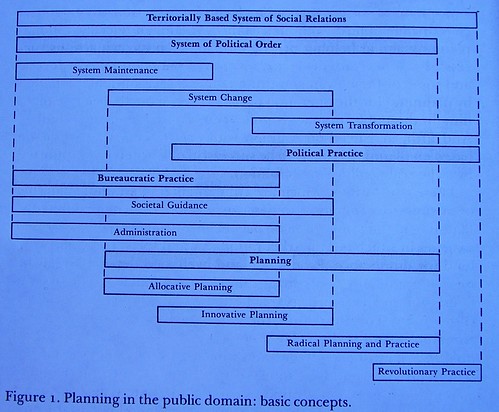
You might be interested in reading John Friedmann's Planning in the Public Domain which is turgid, but makes some very good points about how govt. is set up to regularize and standardize, not to innovate, and not really about helping.

The book is about radical planning practice and how to do it. It contrasts radical vs. revolutionary practice in terms of how the latter challenges the legitimacy of the political system while the former accepts it, but works to build in the capacity of innovation and transformation.
Basic Concepts, Planning in the Public Domain
Basic concepts from Planning in the Public Domain with regard to opportunities for planning-initiated change within the political and government system and bureaucracy.

* There is an irony that people who work for government in theory are the most capable of "teaching" people on how to participate in society, because they have "the luxury" of being paid to focus on these kinds of issues. Technically and philosophically, civic education and participation ought to occur in part outside of the formal structures of government, in social spaces controlled by the people, spaces that aren't overly shaped by government actors.

Labels: , , , , ,

Tuesday, March 24, 2009

Helping Government Learn (Knowledge Capture) Part 2

In the 1990s, the concept of knowledge capture and management was the rage. The issue with institutions, government,nonprofit, or for-profit, has to do not just with capturing knowledge, but using it to bring about necessary changes.

So, today's Post gives us three lessons for knowledge capture for helping both DC and the Federal Government to learn:

1. If a tow truck does a "courtesy tow" for streetcleaning, don't park the car in a metered space. (See "You Can Fight City Hall. You Can Even Make It Apologize.") In other words, the event described in Marc Fisher's column should never happen to begin with.

2. Ask key questions about throughput and set up adequate systems to bring it about for Inauguration activities. Do this early in the planning phase. See "Report Cites Planning, Crowd Size in Ticket Mess " from the Post. It sounds like the review panel hasn't quite learned the right lessons. "Monitor twitter..." Sounds lame.

3. In the letter to the editor, "Marathon Nightmare on Capitol Hill," Geoffrey Lane makes a good point, that "marshals" and police officers posted to the routes ought to be provided with information about which streets _are not closed_, so that people "stuck" can get out.

(I do have to say that I was impressed this year that on the Marathon route, notice was posted on signs affixed to street signs and other standards, and information was passed out house to house. I have photos but they aren't uploaded yet.)

------
I don't feel any of these pieces have described situations where the government has fully learned, where planning and implementation processes have been changed to limit, if not eliminate, these problems from occurring again.

Labels: , , ,

Monday, March 23, 2009

Helping Government Learn

Michael Skapinker of the Financial Times, in the column "Managers must listen before disaster strikes," calls our attention to the report from the UK National Audit Office, "Helping Government Learn." Also see the Executive summary (PDF - 238KB), Press notice (HTML), and Literature Review (PDF - 606KB).

From the column:

In 1999, newspapers were full of pictures of would-be British holidaymakers queuing in the rain because a new processing system at the UK Passport Agency had failed to produce their passports.

By contrast, the 2006 roll-out of “e-passports” – passports with electronic chips – proceeded without a bump. Why the difference? The leadership of the agency adopted new strategies. They talked about possible risks at the beginning of every meeting rather than at the end. Managers had a commitment to “knowledge transfer” – learning from others and teaching them – written into their contracts. The e-passports team also made regular contact with passport agencies involved in similar programmes in five other countries.

People at the top began with an assumption that they did not know everything – that front-line staff and customers probably knew more. Several of the report’s examples of listening managers were in departments that had, like the Passports Agency, previously suffered catastrophic setbacks.

The real challenge will be finding leaders who listen before disaster strikes. That will be harder. It is self-confidence that propels people to the top, not openness to criticism.

His piece is about organizations generally, and he starts by discussing the financial crash. He asks "Will employees who dissent always be ignored or harassed?"

I think yes. Too often, people see analysis as criticism and as personally directed. I find two past articles from the Harvard Business Review to be particularly relevant to this issue, "Performing a Project Premortem" which is summarized as:

In a premortem, team members assume that the project they are planning has just failed--as so many do--and then generate plausible reasons for its demise. Those with reservations may speak freely at the outset, so that the project can be improved rather than autopsied.

and this article, "The Experience Trap," which is pretty damning. Rather than analyze issues and problems, most managers just expect that problems will occur, they take this for granted, dooming themselves to repetitive failure rather than the development of robust systems designed to capture learning and apply it to increase the likelihood of future success. From the article:

Why Learning Breaks Down

When anyone makes a decision, he or she draws on a preexisting stock of knowledge called a mental model. It consists largely of assumptions about cause-and-effect relationships in the environment. As people observe what happens as a result of their decisions, they learn new facts and make new discoveries about environmental relationships. Discoveries that people feel can be generalized to other situations are fed back, or “appropriated,” into their mental models. On the face of it, the process seems quite scientific—people form a hypothesis about a relationship between a cause and an effect, act accordingly, and then interpret the results from their actions to confirm or revise the hypothesis. The problem is that the approach seems to be effective only in relatively simple environments, where cause-and-effect relationships are straightforward and easily discovered. In more complex environments, such as software projects, the learning cycle frequently breaks down. In the experiments we carried out with our study participants, we identified three types of real-world complications that were associated with the cycle’s breakdown.


What I try to do through the writings in this blog is to capture and disseminate knowledge, to suss out the reasons for success or failure, and figure out how to capture that learning into the development of robust change programs:

1. Indicate -- identity the particulars of processes and structures of success and failure
2. Duplicate -- figure out how to duplicate (repeat) success.
3. Replicate -- develop the systems, structures, frameworks to apply programs to different situations and communicate them throughout innovation networks.
4. Accelerate -- figure out how to speed up successful innovation and programs.

Transformation and innovation and creative problem solving is the goal.

But most people aren't too interested in dealing with challenges to their world-view. Especially high-up officials, and often people in "think tanks."

Labels: , , ,

Wednesday, June 13, 2007

System transformation or people vs. systems and structures

One of the things that has bugged me for 20+ years within government, including universities, is a focus on people or jobs rather than systems and structures. E.g., as an involved student, for some reason it always bothered me that the administration office for the Office (or Division) of Student Services was labeled "Office of the Vice President of Student Services," rather than the Office of Student Services.

Similarly, the announcement yesterday(?) that the new State Board of Education is being labeled the Office of the State Superintendent of Education -- again, a focus on the person in the job, albeit the title, rather than on the system and office.

I think there is a belief within the local government that agencies (systems) are so flawed that transformational leadership (amazing people) is required. But too often, leaders don't understand how to truly bring about and implement change.

I think that is an issue in DC Government today. True, the issue is in part about leaders, but more importantly it is about getting thousands of people committed to creating and implementing change. This is true for any government agency.

My interest, especially lately, is in creating robust systems and structures and processes that transcend individual leaders. Otherwise, you don't have much in the way of fundamental improvement.

Of course, I am bringing this up in regards to the appointment of a new Chancellor of the DC Public School System. See:

-- "Janey Leaves With Plans Unfinished," subtitled "After Less Than 3 Years on the Job, Schools Chief Is Negotiating for a Buyout" (Post)
-- "More Criticism Over Fenty's Secrecy," subtitled "Rhee's Selection as Schools Chief, a Shock to Many, Draws Scrutiny" (Post)
-- "Fenty's Picks Have Ties to System, And Its Reforms" (Post)
-- "His own boss, Fenty names a chancellor" (Examiner)
-------------
This entry, "Stultified vs. Flat Organizations, Democracy vs. Autocracy," is reprinted from last month.
-------------
There is an interesting article in a back issue of the National Journal comparing Gov. Schwarzenegger to President Bush. ("Yes, He's Back," by John Maggs in the 2/17/2007 issue.)

The major thesis is that Arnie focuses on a flat organizational structure--promoted by business types such as Jack Welch--and capturing the knowledge and leadership within (in the case of politics, regardless of political stripe, at least to some extent), while President Bush believes in democracy and participation as far as the election is concerned, and then autocracy afterwards.

This comes closest to describing my discontent with how government and civic engagement works in Washington, DC at the local level. Democracy during the election cycle; autocracy afterwards.

So a lot of ability and insight ends up being ignored, and the achievement of excellence, best practices, innovation, and transformation appears to be more and more remote.

From the article:

...the nature of leadership shouldn't change just because of the size and complexity of an organization... As organizations become vastly more complex, the need for flatness actually increases... To avoid being strangled by bureaucracy, complex, "networked" organizations must simplify management. (34)

According to the prevailing management theory, two conditions are crucial for running a large organization through delegation--fostering debate and holding subordinates responsible. (35)

There is an article in the New York Sun about the Community Education Councils, like DC's Advisory Neighborhood Commissions, but for the school system, and how it is proving to be difficult to find people to participate. From "Community Education Councils Struggling To Attract Parents" :

Many council members say they are often consulted only after major decisions are made and have little influence on policy-making. Others complained that the training they receive is not sufficient for even experienced members to grasp the procedures and analysis — often of complicated policy — required of the councils.

"We're asking ourselves now, Where do we come in? And there's not a real complete picture," a member of District 14's council in Brooklyn, Mario Aguila, said. "I think people don't really see the role of the CEC."

This doesn't surprise me. Without allowing for substantive, real involvement, people don't participate. On the other hand, an ANC like ANC6A proves that able, committed people can make a difference.

The thing is that people need to be trained in order to be able to get the most out of their participation. The reason that many ANCs fail in DC is that fundamentally, there is no training infrastructure at all--even though there are many examples across the United States of best practice citizen training in civic affairs.

From the National Journal article:

But the trend in management theory is to exalt process over policy. Put another way, modern management says that without the right process, you won't be able to implement any policy, and you might even choose the wrong policy. Get the process right, and you'll end up with the right policy. Welch [Jack Welch, Chair and CEO of General Electric] delivered spectaular profit numbers, but most of his time was devoted to an endless quest to improve management at GE. He spent more time teaching at GE's famous management academy than he did attending board meetings... (34)

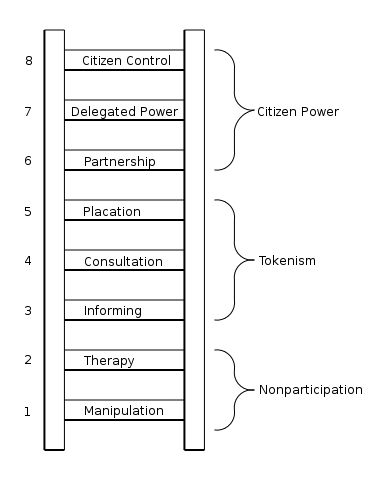
Also see the books Empowered Participation and Deliberative Democracy, authored or co-authored by Archon Fung, and the Neighbourhoods & Social Capital blog from the UK (among others -- I have dozens of links on civic engagement in the right sidebar).
A Ladder of Citizen Participation, Sherry Arnstein
From Arnstein, Sherry R. "A Ladder of Citizen Participation," Journal of the American Institute of Planners, 35: 4, July 1969.
----------------
Also see this blog entry from March, "Personalization vs. systems and structures in government."

Labels: , , , , ,