Rebuilding Place in the Urban Space

"A community’s physical form, rather than its land uses, is its most intrinsic and enduring characteristic." [Katz, EPA] This blog focuses on place and placemaking and all that makes it work--historic preservation, urban design, transportation, asset-based community development, arts & cultural development, commercial district revitalization, tourism & destination development, and quality of life advocacy--along with doses of civic engagement and good governance watchdogging.

Monday, October 06, 2025

Definition of insanity, National Parks/federal government shutdown

One definition of insanity is doing the same thing over and over, expecting different results.

=========

For almost 15 years, I've written entries about how local governments need to do scenario planning vis a vis state and federal government installations in their cities, similarly states vis a vis the federal government.

This was spurred by federal government shutdowns leading to the closure of national parks, the impact on states and local governments, and their plaintive calls for opening the parks.  But also because of the impact on parks in DC, where the National Park Service runs a majority of the city's parks.

-- "Contingency planning in parks planning: Montgomery County Maryland edition," 2013
-- "Federal shutdown as another example of why local jurisdictions should have more robust contingency and master planning processes," 2013

This comes up with the SF Chronicle article, "Tourists from around the world blindsided by Muir Woods closure."

On any given year, Muir Woods National Monument draws hundreds of thousands of visitors from all over the world to take in the pristine views, trails and wildlife that make up one of the last ancient redwood forests left in the Bay Area.

On Wednesday, however, tourists were greeted by an unexpected sight at the entrance: a sign informing them the Marin County park was “closed due to a lapse in appropriations” after the federal government shutdown went into effect at 12:01 that morning. A ranger on duty stood in front of a growing line of cars and tried to offer alternative nearby parks for them to visit, but there was no way around the disappointment. The reservations many of the visitors had booked months in advance had been cancelled.

The thing is, there is a system where states (or local) governments can pay to keep parks open.

It's not like this hasn't happened before.

Tourists might be blindsided by this.  Local and state governments have no excuse.

Just like in 2013, the State of Utah is stepping in to fund national parks ("Utah will fund national parks amid government shutdown. Here’s what it will keep open," Salt Lake Tribune).  

Visitors may have better luck accessing information soon, though. The state of Utah is stepping in to keep national parks open, including visitor centers, which act as central hubs of information.

The Governor’s Office of Economic Opportunity is dedicating funds to cover visitor center costs in Utah’s five national parks, as well as Cedar Breaks National Monument, according to a Friday news release. “Utah’s National Parks will remain open,” said Natalie Randall, director of the Utah Office of Tourism and Film. “We are committed to supporting visitors in planning and preparing for their best trip to Utah, preserving our parks, and ensuring Utah communities and businesses that rely on national park visitation are supported.”

The National Park Service has estimated that it costs $8,000 per day to operate visitor centers at Utah’s five national parks and Cedar Breaks National Monument, according to a statement from Randall. “This is a fiscally responsible decision and we will continue to evaluate, as national parks visitor centers serve as an essential hub for visitor safety, sanitation, and public security,” she said.

Not California.

According to the SLT article, the daily cost to keep multiple parks open isn't very much.  So there isn't really an excuse except for lack of planning.

Note that the Republicans understand that closing parks is bad for them, given how "front facing" they are as public assets and places where citizens go to recreate.  So they try to keep them open, skating on the law ("National Parks Told to Remain Open During Shutdown Despite Risks," Bloomberg).

Labels: , , , , , , , ,

Wednesday, September 21, 2022

Weird intra-governmental spat in DC over the Washington Nationals stadium

Events DC is a DC government instrumentality.  

-- board of directors
-- staff

Technically it's independent of the city government, but its top officer and board members are appointed by the Mayor and City Council.  It holds the city's financial interest in facilities like Washington Nationals stadium, the Wizards practice facility, the RFK complex, the Convention Center, etc.

It's not particularly forward thinking when it comes to its facilities and urban planning ("The time to plan for retail in and around the Convention Center was long before it opened in 2003 and certainly before 2015," 2015, "Yes, modify and extend the RFK Campus lease; No, don't do it for the Washington Redskins football team," 2018), but then again, the city government's commitment to planning is constantly shrinking and diminishing too.

Flickr photo.

The Washington Post reports ("D.C. threatens to shut down Nationals Park, putting events at risk") that the Department of Consumer and Regulatory Affairs, which is responsible for building regulation, is threatening to not renew the certificate of occupancy for Washington Nationals stadium--which is owned by the city and rented by the Washington Nationals baseball team--because Events DC hasn't followed through on providing related retail and commercial space development that was part of the original agreement.  From the article:

The District is playing hardball in a dispute with the owner of Nationals Park, effectively threatening to shut down the stadium if Events DC fails to develop the commercial and retail space it promised before the ballpark’s 2008 opening.

Under its original agreement with the city, Events DC had pledged to build 46,000 square feet of commercial and retail space around Nationals Park, located along the Anacostia River in the Navy Yard neighborhood. But the company — arguing that the “extremely unique circumstances” of the pandemic and other business factors have made those initial plans unworkable — now is seeking to be released from that responsibility.

If no deal is reached, the dispute could threaten games, concerts and other events scheduled to be held at the ballpark.

This is very interesting because it's one department of the city arguing with another department, both within the executive branch.  I mean, it's not like the arguing that is typical between the Executive and Legislative branches, this is an intra-government tiff.

Clearly the Mayor isn't happy with Events DC--I don't know why because I am increasingly distant from day in, day out intra-city happenings--because this wouldn't be happening otherwise.

Obviously, Events DC isn't doing what the Mayor wants.  And an attempt to deny a C/O is a very public way of saying so.

It might not even be about the Nationals Stadium specifically, but that this is the best "point of entry" in the Mayor executing her best leverage.

And it could be about the director, who is new and interim.  I guess that Greg O'Dell, long time CEO, left for the private sector a couple years ago ("Greg O’Dell Named OVG360 President for Venue Management," SportsTravel).  He's now with Oak View Group, which was created by people who had worked for years at AEG--OVG is involved in facilities for the Seattle Kraken and the New York Islanders among others.

FWIW, EventsDC is probably right that the market doesn't support adding that space, and that it would be better for the private sector spaces to be activated.  Plus, they are crappy at managing non-sports functions in their spaces.

And the Mayor probably believes she made her point, since DCRA is issuing a temporary C/O) while negotiations continue ("D.C. backs off threat to close Nationals Park," Post).

====

Certificate of occupancy and sports facilities.  I didn't realize that DC didn't issue permanent C/O for sports stadiums and arenas.  NYC issues sports facilities (or at least Madison Square Garden) C/Os with a ten year term, which allows for revision of agreements and gives the city leverage.  But those facilities are all privately owned.

I like the idea of ten year terms to be able to "force" transportation demand management agreements on teams ("Framework of characteristics that support successful community development in association with the development of professional sports facilities").  But that only works if the facility is owned by the team.  In DC, only the Capital One Arena is privately owned.  

When the government owns the facility, TDM agreements need to be part of the lease with the tenant--the sports team.

Labels: , , , , , , ,

Wednesday, June 02, 2021

Closing investigations without resolving them: the Nashville bomber

Photo: DC Fire and Emergency Services.

In 2019, there was a terrible fire at an illegal rooming house on Kennedy Street in DC, killing 2 people.  The thing is that a police officer had responded to an incident there, and reported the conditions to DCRA.  

An inspector went there three times, couldn't get in, so he "closed" the complaint.  He had the legal authority to get a warrant for entry, but he didn't take that step.

It remained unresolved and dangerous.

The inspector was fired for "dereliction of duty" but says it wasn't his fault because he wasn't trained ("DCRA investigator speaks out about fatal Kennedy Street fire: 'People died in that place. It didn't have to happen'," WUSA-TV).

The city came up with a convoluted way to "deal" with this failure, creating a personalized process relying on people, not systems..

I countered saying the solution was simple ("Unresolved versus Closed as a determination in handing City inspection/service matters").

1.  Instead of having police officers call a supervisor who then was supposed to call DCRA, create a category for the complaint in the city's 311 "complaint" system.

2.  Don't allow complaints to be closed without being resolved.

A row of historic buildings damaged by the the detonation of an R.V. packed with explosives in downtown Nashville on Christmas morning.Credit: Alex Kent/Getty Images.

The same thing happened with the Nashville bomber ("Suspect in Christmas Day bombing in Nashville acted alone and was driven by 'paranoia,' FBI says," ).  

A complaint was filed, police went there, never got in, and closed the investigation without doing anything other than knocking on a door once or twice.

A report analyzing what happened said they could do more ("As Nashville Bomber Plotted, Police Investigation Into Warning Sat Dormant," New York Times).  From the article:

But a report released on Wednesday found no documentation of any attempts to reach Mr. Warner after officers knocked on his door and got no response. The report added that the police should have acted more aggressively, keeping closer tabs on Mr. Warner and trying to establish the probable cause needed to search his home. Instead, the case sat open for months, as Mr. Warner stewed in conspiracy theories and plotted the attack.

The report emerged from an inquiry into the police investigation conducted by a panel that included senior officials from the Metropolitan Nashville Police Department and others from outside the agency. The panel concluded that there was “no way to know for sure if the suicide bombing on December 25, 2020, could have been prevented.” Yet it identified ways in which the Police Department had failed to conduct a robust investigation into the earlier warning.... 

... the Police Department began drawing scrutiny as an incident report surfaced showing that a friend of Mr. Warner’s had called the police in distress more than a year earlier. She had told officers that he was building bombs in the R.V. parked beside his house; her lawyer, who also knew Mr. Warner, told the police that he was capable of building explosives.

The officers went to Mr. Warner’s home in August 2019 and tried to follow up, police officials said, but they had no probable cause to search the home or R.V. 

Yet the panel said that the officers should have taken advantage of legal resources available to them to determine probable cause and gone further in pursuing the investigation...  

The report ends with the police department saying they could have done better.

Duh.

Labels: , , , , ,

Thursday, September 19, 2019

Unresolved versus Closed as a determination in handing City inspection/service matters

How DC deals with nuisance and unsafe property inspections is in the news because of two deaths resulting from a fire at an illegal rooming house.

 It turns out that months before, after responding to a call, a police officer informed the city's building department of the likely illegality but for various reasons the property was not inspected, because the person assigned to do an inspection couldn't get in, and after the third attempt, instead of seeking a warrant to demand entry, he "closed" the case.

But the case was closed because he wasn't able to take action. Not because it was "resolved." In fact, the matter remained unresolved.

-- "'A failing of the systems': In rowhouse fire, D.C. missed many chances to save lives," Washington Post

Cases that are unresolved shouldn't be deemed closed, they should remain pending, because they are unresolved.


I have written from time to time about this generally, in terms of 311 responses by "the city," performed after I have made calls (or website entries) about problems I've come across, inclding stolen and abandoned cars, broken water pipes, dead animals, broken tree branches, and a loose board on the bike gutter at the foot of the Metropolitan Branch Trail that still hasn't been fixed. (I reported that and something else while scheduling a bulk pickup, which is easier to do on the phone, than online.)

-- DC 311 informational webpage
-- 311 Online

A big problem for a long time is that you get an email notice of "closed" but with no information about what happened.  I wrote about it at some point.

A few years later, after receiving notice with more explanation, I waxed about the change ("Improvements in 311 response: still has a ways to go," 2018) but a commenter made the point that cases are often closed because for whatever reason, the person sent out to check can't find the problem, or because the system still isn't set up super well to deal with certain places, such as on bridges.

(This came up with a call I'd made about a dead animal on the street. The person assigned couldn't find it, so he knocked on our door. It turns out that it had been pushed out of the travel lane into the gutter. So clearly, not every person assigned to a matter may exhibit perserverence and a willingness to investigate a bit.)

The new process devised by the city to deal with such reports by police officers -- immediately notify a particular supervisor who will then liase with the building department is flawed because it still relies on individuals.

What should happen is that the 311 system of problem reporting be extended to include these kinds of notifications of problems.

The 311 system does not include an option for reporting a potentially illegal rooming house.

In 2017, I was somewhat dismissive about the city's touting its use of a grant to fund a center on innovation in public services on "form redesign."

-- "Five new forms: is that all you've got?

It's important, but I realize what would have been more important is a focus on investigating and improving "processes" and how "forms" are the fulcrum that you can use to work and improve the process.

Basically, when I do plans, (1) I look at what are the preferred outcomes; (2) determine whether or not preferred outcomes are generated routinely by present processes; (3) then look "backwards" at the system and process that produces unpreferred outcomes and determine why this is the case; (4) making recommendations for changes in the process so that preferred outcomes can be generated routinely.

For example, dealing with renting out our house legally, that is filing for a business license, finding out what items are necessary to be included in a single family house for health and safety reasons, getting those tasks acoomplished, but also dealing with the various other necessary processes (exemption from rent control, providing certain documents to the tenants to be signed, providing the right forms to the right city agency afterward, is very complicated, often with conflicting information.

Actually, DCRA which has been criticized for the failure to deal with the house that burned, was pretty helpful to us. I went down to the inspection office and met with someone who went over the checklist with me, answered my questions, etc. Unfortunately for us, you have to do certain things when you're renting that you wouldn't have to do if the property is owner occupied (e.g., balustrade around attic stairway, storm windows on all windows for habitable spaces, even the basement) which cost us a few thousand dollars extra that we hadn't counted on.

But because we had that consultation, we knew what we had to do. And because we did everything that the form asked for, even more (extra fire extinguishers) we had no problem with the actual inspection was performed.

But then dealing with filing papers about the exception from rent control, with a different city agency, we got conflicting information, were given forms that one person said we didn't need to file, and another person never mentioned the necessity of particular forms, etc.

Clearly there's a need there for "process improvement" in many areas of activity provided by government agencies, and this is hardly a problem unique to DC.

Recommendations:

1.  More information should be provided to the reportee about the disposition of a matter reported to the city.


2.  The city should change the language marking performance of service calls from "CLOSED" to either "RESOLVED" or "UNRESOLVED."

3.  A process should be developed to further investigate and address matters that remain unresolved in normal response processes.

4.  Evaluate workflow processes on an ongoing basis, changing them as necessary, with the aim of continuous process improvement.

5.  Unify problem reporting systems within the rubric of the 311 system to capture reports of illegal housing matters too.  Require city employees to use the 311 system to report problems*.

This reminds me of an incident in Seattle where a bicyclist died because there wasn't warning signage about upcoming stairs ("
City warned of stair hazard before bicyclist died
," Seattle Post-Intelligencer).

It had been reported, but to an individual's voicemail box, not to a general 311-type system.  It's better to rely on systemic processes that capture reports of service outages, problems, and failures, rather than calling individuals -- yes it can work when you reach them, but not if you can't.


====
From a business literature standpoint, the book by Thomas Davenport, Process Innovation: Reengineering Work Through Information Technologyhas been very influential on my thinking.

And Jakob Nielson's writings on "usability." 

But I haven't really read much on UX or "user experience."

Clearly these kinds of approaches need to be adopted by local governments concerning workflow processes and the way they organize their work and generate preferred outcomes.

And not just by people who work in IT.

Labels: , , , , ,

Tuesday, June 11, 2019

Innovative US Mayors, has their time passed?

Charlie calls our attention to the Financial Times special section on Cities published last week and the article "Why city mayors are stepping up to tackle global problems: Urban leaders are challenging populist positions on climate change and migration." From the article:

[using Milan as the example] Since City mayors confront everyday management problems — such as how to handle traffic or waste disposal — their offices are focused on pragmatic problem solving, not ideology. More important, cities tend to be on the winning side of technological innovation, at least compared with the hinterland. It is no surprise that the political tenor of mayors is more progressive than elsewhere. “Everyone keeps talking about populism versus non-populism, but I think the key label is cities versus countryside,” says Mr Sala. “In the countryside voters are going to the right, but in the cities they are more progressive.”

Whatever the reason for the trend, it is unlikely to disappear soon. Moreover, as city leaders spread their (relatively more competent) policy wings, they are rising in visibility and ambition.

But what is equally notable is that even when mayors are not vying for national leadership, they are increasingly flexing their muscles to move into policymaking areas that used to be the preserve of national governments. In the US, for example, the Democrat mayors of cities such as Los Angeles, New York, San Francisco and Chicago have pushed an aggressive “green” agenda — in contradiction to President Donald Trump’s policies.

Indeed, the cities have been so united in this direction that some quietly lobbied to join the Paris Climate Change Accord in their own right, as quasi partners — although the accord is supposed to be between nation states (and the US has withdrawn).

US cities have also collectively defied Mr Trump on immigration policy, and taken a different stance on internet regulation, too (San Francisco, for example, became the first city to ban facial recognition technology in May). Some cities are also trying to set their own export and investment strategies. In London, Mr Khan has made no secret of his desire to remain in the EU, and has called for special exemptions for London from the Brexit rules if the UK eventually leaves the EU.
This is important stuff, but in some sense it's more social policy than programmatic, although environmental policies (buying green energy, promoting transit) are both social and programmatic.

But I feel like the earlier period of "innovative mayors" has peaked.

There is always talk in the US about how "states and localities" are "laboratories for democracy" in that innovations can be "piloted" at a level below that of the national government, and in turn influence the federal government in terms of creating new programs and helpful policies.

A great example of this is how the "Obamacare" program is based on a program created by a then Republican Governor of Massachusetts, Mitt Romney--later a presidential candidate and now Senator from Utah.

Governing Magazine is a trade publication featuring these kinds of best practice stories.

One-way "innovation" when it's supportive of deregulation.  However, these days this opportunity is often "trumped" by ideology.  It seems that Republicans are fine with devolving authority to states when it supports deregulation and conservative policy making and not supportive when states and localities aim to strengthen regulatory oversight and progressive policy.

For example, one of the reasons that the EPA was "out to lunch" on water problems in Flint, Michigan is because for all intents and purposes, regulation of sub-state water and sewer authorities has been delegated to states, and many states are somewhat lackadaisical about this.

Another example is King George County, Virginia.  It happens they've been out of compliance with water and sewer regulations for years, the system is now on the point of bankruptcy, and somehow the State of Virginia never really noticed ("King George paying a price for years of neglect of water and sewer systems," Fredericksburg Free Lance-Star).

Then again, there is California, a national leader on energy ("California, the clean energy leader," San Diego Union-Tribune; "U.S. Climate Change Policy: Made in California," New York Times), although this is an illustration of the space created by progressive national leadership, but also the ability to have strong regulations.

States vs. localities.  Of course, plenty has been written about how many state legislatures pre-empt actions by cities.  For example, before tobacco regulation became much more prevalent, pro-tobacco business legislatures like Virginia's forbade cities from passing anti-smoking ordinances.  These days many states are passing laws pre-empting cities and counties from passing "plastic bag bans," etc.

Term limits make it hard to embed innovative practice.  A big problem is that most mayors seem to last from one to three terms maximum (of course there are exceptions).  And two terms for Governors.  And successors tend to define "innovations" not as supra-superior policies deserving of continuation, but as "something that my predecessor did and instead, I need to create my own policies and programs and hype them."

Smart growth land use policy is a great example.  In Maryland, it was introduced by a Democratic Governor, so the Republican successors have de-emphasized it whenever possible.  In Massachusetts, it was introduced by a Republican Governor (again, Mitt Romney) so it was repudiated by his Democratic successor.

In DC, programs and practices are regularly reversed, scuttled or left to sputter by Mayoral successors, such as the public housing rebuilding program New Communities or the separately created Anacostia Waterfront Development Corporation--programs initiated by Mayor Williams.  Mayor Fenty absorbed all city-initiated development corporations into the Deputy Mayor's Office of Planning and Economic Development and New Communities has never had much support by Williams' successors.  Each mayor puts forth their own "commercial district" initiatives.  One mayor supported streetcars, his successors not so much, etc.

Another example is how during the Obama Administration, many cities were creating new positions of "innovation officers" and units, often around information technology, but not only. Philadelphia was a prominent example and the function no longer really exists. The same is true for many other cities.

It seems like the innovation officer position and office time has passed, although Mayor Garcetti in Los Angeles did hire Christopher Hawthorne, then the architecture writer for the Los Angeles Times, to serve as the city's design director.

-- "Christopher Hawthorne, LA Times architecture critic to become Chief Design Officer for the City of Los Angeles" 2018
-- "All the talk of e-government, digital government, and open source government is really about employing the design method ," 2012

Mayors want the credit. The thing is, to have innovative programs, you need good staff, especially directors, and there are many instances where Mayors don't like to spread credit around. A perfect example is the policing innovations in New York City implemented by William Bratton. Both Bratton and Mayor Guiliani wanted the media attention, accolades, and credit for the successes. But ultimately Bratton reported to Guiliani, who fired him.

It's hard to be innovative when you're broke.  Many cities are pressed by legacy infrastructure which costs a lot to fix and maintain and have pension costs that usually are unmanageable, and lack the ability to significantly grow revenue streams.  Big cities also have to deal with the rising cost of dealing with "the homeless."

The tail wags the dog.  Some "innovation" especially in the mobility space like ride hailing or autonomous vehicles, is being spearheaded by the private sector, forcing cities to catch up, but often they aren't leading the process.  And at the end of the day, how transformational is the practice, and does it create more value rather than less?

Maybe best practice is being embedded as standard procedure?  Smart city initiatives, resilience in the face of climate change (although the Rockefeller Foundation just junked its 100 Resilient Cities initiative), "apps for democracy," open source government -- New York City recently created an online app that automatically checks for eligibility for government programs ("New York City Demystifies Social Service Benefits Screening," Government Technology), rather than having people go to various offices ("Police rip toddler from mother's arms at benefits office," AP News)"), clean energy initiatives, stormwater initiatives, etc.

Mayors as systems integrators.  One of the ways I think about this is how in a city or county government, where myriad agencies are responsible for various goals and objectives, and perform in what many term "silos", mayors and county executives have the ability to be "systems integrators" and bring the various actors and programs together to cut through the knot and create something more transformational.

It's easier in small places?  West Sacramento, California ("Small City, Big Goals: How an Unconventional Mayor …," Governing), Carmel, Indiana (The GOP Mayor Pushing Climate Change Policies," Governing), Greensboro, NC and Spokane, Washington (past blog entry), Charleston, SC, etc.

It's easier in big places?  All the stuff that Mayor Bloomberg did in New York City.  Or maybe that was just 'cause he was rich?

-- The Bloomberg Legacy (website)
-- "Bloomberg's Bruised Legacy," New York Times

Maybe we should be focusing on the design method?

-- "Social Marketing the Arlington (and Tower Hamlets and Baltimore" way," 2008
-- "Best practice bicycle planning for suburban settings using the "action planning" method," 2010
-- "All the talk of e-government, digital government, and open source government is really about employing the design method," 2012
-- "Illustration of government and design thinking: Boston's City Hall to Go truck," 2013
-- "World Usability Day, Thursday November 9th and urban planning," 2017

Labels: , , , , ,

Tuesday, February 05, 2019

WMATA service and fare changes for FY2020

WMATA has done extensive communication about proposed fare and service changes for FY2020, printing a brochure with a survey in English and five other languages, and collecting these results at stations, and online survey and comment forms.

... one problem I do have with the new methods is that they are now anonymous, unless you choose to identify yourself.

Comments are due today by 5pm.
WMATA train car and Metrobus toys
Anyway, by and large, the proposed changes are excellent:
  • changing Yellow Line service to Fort Totten all the time
  • reducing the price of the 7-day bus pass
  • adding free bus service to the 7-day rail pass
  • a flat Metrorail fare of $2 for weekends (which is kind of like something I've suggested in the pass, based on special evening and/or weekend fare programs in Melbourne, Hamburg, and Montreal)
One I am indifferent to:
  • making all Red Line trains end at Glenmont
And one I have serious reservations about:
  • expand weekday peak service times, changing the hours of peak service to 5am to 10am -- 30 additional minutes -- in the a.m. and from 3pm to 8:30 pm in the evening -- 90 additional minutes.
1. It's not that I don't favor more frequent service.

2.  It's that in the past, WMATA has charged peak service fares during these time periods, while at the "shoulders" of each period providing less than frequent service.

3.  Charging more for less service is unreasonable.

4.  For WMATA to add peak service fares, by extending rush periods in the morning and evening, they should be required to guarantee they will provide additional service.

Labels: , , , , , , ,

Friday, December 07, 2018

Oops, forgot to mention President Bush and the Clean Air Act | The Clean Air Act as a "framework element" for government agency practice

In an e-mail discussion, I have been harping on "framework elements" in master plans (land use, transportation, etc.).  For example, DC's Framework Element in its Comprehensive Plan treats all the policies as equal.

By contrast, the equivalent element in Arlington County's Master Transportation Plan treats its goals as overarching, and each subsequent element is both internally consistent and consistent with the framework element.  Since the Framework Element's primary goal is to promote mobility throughput and reduction of single occupancy vehicle trips, the whole plan aims to do that.

Similarly, San Francisco's "Transit First" policy, enshrined in the City Charter, prioritizes and privileges sustainable mobility policy over motor vehicles ("Transit First Mobility Policies and Planning Paradigms," 2006).

. EPA Administrator William Reilly watches as President George H.W. Bush signs the Clean Air Act Amendments. EPA photo.

During the Administration of President George H.W. Bush, Congress passed the Clean Air Act ("We can breathe easier — literally — thanks to George H.W. Bush," Washington Post) and President Bush was actively involved in getting the bill passed.  From the article:
It is difficult to overstate the importance to the nation’s health and welfare of the 1990 Clean Air Act Amendments, and Bush played a pivotal role in their passage. The legislation was hopelessly mired in Congress until Bush used presidential muscle to break a logjam and get it passed. The updating of the 1970 law remains the most sweeping and comprehensive environmental statute on the books. It created the first “cap and trade” program, which ultimately ended the industrial air pollution causing “acid rain” that had blighted large parts of the country. The program’s use of market mechanisms provides a blueprint for controlling all air pollution that contributes to global warming.

The law also paved the way for the requirement for cleaner-running cars and clean fuels that have radically reduced pollution from smog in the United States. And it provided the government with the ability to control 189 toxic substances that had poisoned the air and to require permits from individual sources of pollution. Citizens were empowered to bring lawsuits seeking penalties against violators to ensure the law’s enforcement.

-- "George H.W. Bush understood that markets and the environment weren't enemies," PBS News Hour
-- "Clean Air Act Revamp, Climate Part of George H.W. Bush's Legacy," Bloomberg Businessweek

The Federal Clean Air Act does many things.  For cities and urbanism, it has two specific impacts that support better air quality.

First, to improve air quality (and note that the widespread use of diesel gasoline in Europe means that air quality is bad in many cities there) it sets the stage for emissions controls on motor vehicles.  It also sets the stage for the support of transit, as a different method for reducing motor vehicle traffic, especially in the cores of metropolitan regions.

Theoretically, it should mean continued concern about fuel efficiency standards for automobiles, since indirectly that drives demand for electric vehicles, which have reduced emissions comparatively speaking.  But the Trump Administration has lifted further tightening of these standards.

It means that Federal policy and practice should be supportive of transit generally, and extension of transit in ways that support greater ridership.  But the Trump Administration has instituted bureaucratic barriers that make it much harder to release funds for transit projects, even though Congress continues to appropriate money for these projects.

Granted, it's much harder for the Federal Government to think in terms of master plans and framework elements, because it's so big, and there are so many conflicting policies and concerns and changes in political positions.

But if we were take 10-20 key federal acts, and reconceptualize them as a kind of framework plan or element for government operation, and require that administrative action conform, it could make for much different operation and practice across the executive branch.

Labels: , , , ,

Friday, November 16, 2018

Retiring SF MUNI CFO Sonali Bose appears to be a dream hire from the standpoint of transit riders

The San Francisco Chronile reports ("Muni CFO Sonali Bose departs, creating another challenge for SF’s transit agency") on the retirement of Sonali Bose, the Chief Financial Officer of the SF MUNI transit system, one of the most highly used city-only transit systems in the US.  From the article:
The woman who doubled the budget of the San Francisco Municipal Transportation Agency — replacing the junked buses of the past with a splashy new fleet — is heading out the door, creating a new challenge for an agency that is struggling to gain public trust. ...

Some call her a political fixer: the rare transit bureaucrat who urged her allies to chair commissions and lined up votes for the policies she wanted. Others deem her a truth-teller: the woman in a blazer and a cotton dress who gamely criticized mayors and department heads when she thought they made bad decisions. Most people praise her for fixing the budget of a $1 billion agency that was in disarray before she arrived.

Sonali Bose was inspired to “get into (SFMTA) and figure out what the hell is going on” after buses passed her while she waited at a stop one day in 2003. Photo by Lea Suzuki / The Chronicle

“When I walked in, I went, ‘Whoah,’” Bose, 60, said. “It was 2006, and the agency was starved of talent and resources. The budget was about half what it is today.”

Over the next 12 years, she raised the SFMTA’s credit rating to be the highest of any transit agency in the country. She oversaw a new parking program that adjusts rates at meters and garages to match demand. She helped fund the biggest increase in Muni bus and rail service that San Francisco has ever seen and increased the revenue from the agency’s advertising contracts from $400,000 to $30 million. ...

“She wasn’t just a CFO — she was this tireless, in-your-face advocate for the SFMTA,” said Supervisor Aaron Peskin, chair of the Transportation Authority, the body that makes decisions on sales tax spending and some projects.

“She was the kind of person who would text me in the middle of a Transportation Authority meeting, either berating me or provoking new thoughts,” Peskin said. “She did not allow her behavior to be boxed in politically or financially.”

He and others called Bose a “guiding force” who fought relentlessly to improve the financial situation at the SFMTA, and who saw results.

Labels: , , , ,

Thursday, November 08, 2018

Canada has a "Municipal Benchmarking Network"

-- Municipal Benchmarking Network Canada
-- 2017 MBNCanada Performance Measurement Report

Its most recent report draws attention to the fact that Montreal spends a lot more money on roads than other cities, yet the quality of the roads does not match the spending.

===
I point out frequently that municipal dashboards in many cities aren't particularly robust, don't provide actionable information, and lack comparison information so that one can figure out whether or not the functioning of a particular agency is better or worse.

Labels: , , , , ,

Wednesday, October 24, 2018

10 Principles of Strategic Leadership from Strategy+Business

"10 Principles of Strategic Leadership," Strategy+Business.

According to the article, only 7% of managers are "strategic leaders."

1. Distribute responsibility.
2. Be honest and open about information.
3. Create multiple paths for raising and testing ideas.
4. Make it safe to fail.
5. Provide access to other strategists.
6. Develop opportunities for experience-based learning.
7. Hire for transformation.
8. Bring your whole self to work.
9. Find time to reflect.
10. Recognize leadership development as an ongoing practice.

The article discusses each of these elements with examples.

Governments, like DC with its Capital Fellows Program, often have "management development programs," primarily for newer hires. Although I haven't always been impressed with the projects they work on or the "insights" that are generated. Deeper focus on strategic leadership development is required.

Labels: , , , ,

Saturday, October 20, 2018

New York Times online video about the decline of the NYC Subway system


Nigel, our e-correspondent from NZ, calls our attention to this video, which is a good little primer in advance of tomorrow's piece on "60 Minutes." Basically it makes these points:

- underfunding
- New York State taking MTA monies away for use on nontransit purposes
- and ripping off the MTA by charging it when it issues bonds, to the tune of $325 million
- and other financial engineering moves
- not investing in maintenance
- it doesn't exactly say they need newer equipment
- except signaling systems, which would allow faster trains closer together
+ the effects of Superstorm Sandy
+ along with an increase in ridership
= system breakdown

They did miss one big problem, a story brought to light by the now defunct Village Voice, a systematic reduction in train speeds, instituted after a crash, which makes it impossible for trains to make up time when needed, and slows down the system generally, which isn't so great when ridership increases.

-- "The trains are slower because they slowed the trains down"

The Voice made a great point in another article, "Maybe We Didn't Need the Second Avenue Subway," that an equivalent investment in signals instead of building the short section of "Second Avenue Subway" would have had a lot more impact on throughput and service improvement.

It's great that the Times did the video, and also that they put it on youtube and allow others to embed it--most newspapers seem to restrict the ability for their video content to be reposed.  I wish that a media outlet would do something similar here concerning transit generally and WMATA specifically.

I saw Jarrett Walker, the transit consultant and author of the blog and book Human Transit, speak a couple weeks ago. In contrasting the success of bus transit in Seattle, he ascribed it to municipal leadership.

But it's not just municipal leadership there, it's citizen commitment too, in terms of passing tax increases for transit. And that's Seattle specifically, not King County generally.

Seattle has taxed itself to increase transit service, even when King County failed to pass similar taxes. And it allowed Seattle to separate itself from previous political decisions by King County elected officials, who heretofore had dictated that increases in service in Seattle had to be matched by increases elsewhere in the county, irrespective of demand.

The NYT video does discuss how Rudy Giuliani cut the city's contribution to MTA significantly. Mayor Bloomberg cared about the subways but was more interested in expansion. Mayor De Blasio is pretty much not interested in sustainable mobility issues outside of the ferries, the only mode that the city directly controls.

=====
On a totally unrelated note Alon Levy in Pedestrian Observations ("Rapid Transit on the LIRR") discusses how to make the Long Island RR function as "rapid transit" within the city, in response to a report released by City Comptroller Scott Springer, Expanding access in one swipe: opening commuter lines to Metrocards.

The thing is, once you ride a system where trains and subway are truly integrated, like London, Paris (I presume), Hamburg, Berlin, etc., you completely understand how this can be done. In London and Hamburg it's quite seamless. That being said, for it to happen in London, the local transit authority had to be given the right to take over the operation of various intra-city train lines, which it did, and rebranded them as London Overground, along with the institution of a whole lot of other changes, including fare readers (not fare gates) ("One big idea: Getting MARC and Metrorail to integrate fares, stations, and marketing systems, using London Overground as an example," 2015). It works brilliantly.

Labels: , , , , , ,

Friday, August 10, 2018

An example of using vehicles as a way to market public services: Park City Transit, Salt Lake City GreenBike

In the vein of my writings ("Part 7 | Using the Purple Line to rebrand Montgomery and Prince George's Counties as Design Forward" and "Orange County Registrar of Elections uses their vehicles to promote voting | branding") on the design method and design and marketing for local governments and transit, specifically concerning sustainable mobility...

I was briefly in Park City, Utah, known for skiing, other outdoor recreation activities, the 2002 Winter Olympics, and the annual Sundance Film Festival.  (They're gearing up to bid for another Winter Olympics--"Winter Olympics: What if Park City's weather is as mild as 2018," Park Record.)

In transit terms, Park City is noteworthy as an example of a "resort area transit system" that is free to ride, because it is designed to encourage tourists to not drive as well as to assist residents and employees in getting around.  The choice to offer free transit is a transportation demand management-based decision, along with air quality issues.  (That said, plenty people there drive.)

It's also cool because it's the only ski resort town where the ski lift goes from the town center up one of the mountains, so it's highly visible.  It made me think of the opportunity of the proposed gondola system in GeorgetownBut unlike the transit system, it's not free.
Ski lift, Park City, Utah

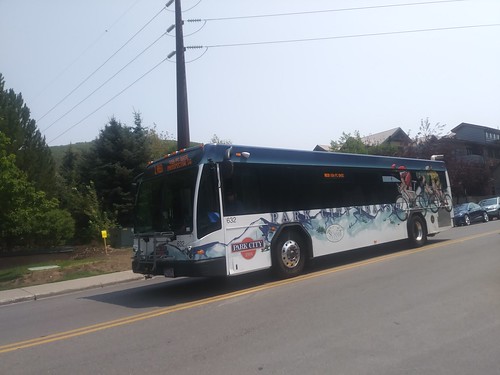
Park City Transit has visually forward liveries for the buses, promoting the city's outdoor recreation assets.  One of the graphics employed features cyclists, either road racing or riding, or mountain biking.
Park City Transit, Utah

Inset of bicyclists on the bus livery, Park City Transit, Utah

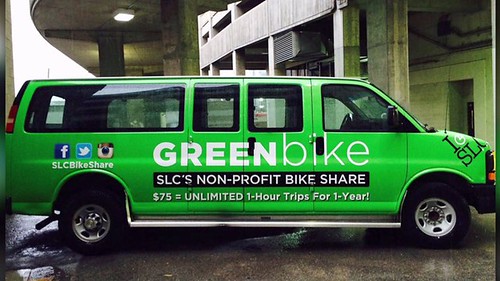
Similarly, while not nearly as aesthetically attractive, the bike share system in Salt Lake City at least promotes using the system, with a marketing message promoting bike share on the vans used in getting around to service the system.
GreenBike bike share van, Salt Lake City

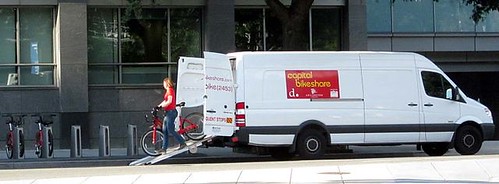
By contrast, DC's Capital Bikeshare vans fail to use the opportunity they have to promote use of the system through attractive messaging.
Capital_Bikeshare_van

By contrast, DC's Circulator buses do employ "ads" on the back, promoting transit and sustainable mobility. And one of these ads promotes bike share. In fact, the bike share vans could just use that as an ad on the van's sides, combined with a bit more text.
Ad for bicycle sharing on the back of a DC Circulator bus

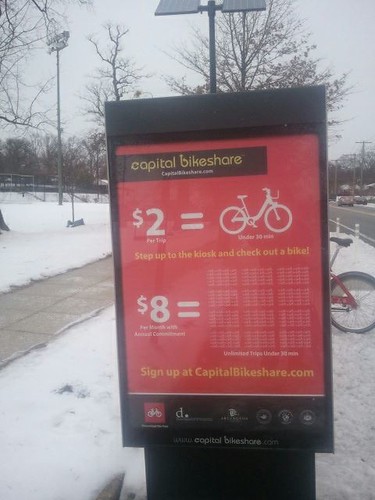
Capital Bike Share kiosk with an ad promoting the bike share program.
Bicycle sharing station on 3rd Street NW, adjacent to the Takoma Recreation Center, DC

Labels: , , , , , ,

Monday, August 06, 2018

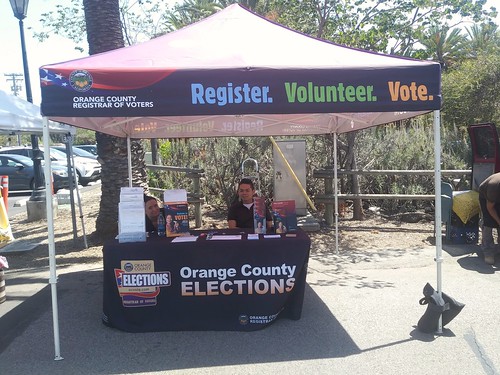
Orange County Registrar of Elections uses their vehicles to promote voting | branding

Orange County Registrar of Elections uses their vehicles to promote voting

Orange County Registrar of Elections voter registration booth


By population, Orange County, California is the sixth largest county in the US. It's suburban sprawl sure. But full of cities that have a minimum population of 100,000.

I write a fair amount about how local governments can and do employ branding and identity systems to promote what they do.  This particular piece, "Using the Purple Line to rebrand Montgomery and Prince George's Counties as Design Forward," comprehensively lists many of those posts.

Many governments fail to take advantage of the resources they have, such as the opportunity to utilize vehicles as rolling billboards.  Some communities use their "garbage trucks" to promote environmental messages, but most don't.

DC Water (WASA) misting tent, Adams Morgan Day Street FestivalDC Water (WASA) misting tent, Adams Morgan Day Street Festival

Here and there agencies stand out, using branding, clever logos, and identity programs to promote what they do, such as "DC Water," the rebranded DC Water and Sewer Authority.

But typically, even if one agency stands out in this way, this kind of approach to design and identity, unified through branding, doesn't extend across a government.

Sometimes too, there is criticism that this approach makes it harder to understand what government does.

For example, when the Portland Development Corporation, the redevelopment agency for the City of Portland, Oregon, renamed itself "Prosper Portland," Carl Abbott, a prominent urban historian criticized the move ("Public agencies shouldn't hide behind feel-good words," Portland Oregonian). From his op-ed:
The Portland Development Commission, a public agency whose name has lasted since 1958, is renaming itself "Prosper Portland." This is one more example of a perplexing trend. Public agencies in Oregon have been going stealth by adopting new names that mask their basic character.

Once we had an Oregon Department of Economic Development. Now we have "Business Oregon." It used to be clear that it was part of state government. Now it is easy to confuse with the private Oregon Business Council, which I assume is the reason for the name change.

Once we had a Housing Authority of Portland. Now we have "Home Forward," a name that doesn't conjure much of anything in the way of an image.

And now comes PDC turning itself into "Prosper Portland." I've been trying to figure out the grammatical implications. Is this an imperative statement that commands Portland to move forward: "Prosper Portland! Or else!" Get your act together and get moving. Or is it a fragment of a larger phrase like "Prosper Portland Style," which makes someone of my age think of the classic cinema comedy "Marriage Italian Style" starring the incomparable Sophia Loren?

Seriously, the pattern here is disturbing. What is lost in the name change is any acknowledgment that these organizations are parts of the apparatus of democratic government. Gone are "administration," "commission" and "department." Public agencies are hiding behind feel-good words like "progress" and "home" and trying to avoid the nation's testy anti-government mood.
The OC Registrar of Elections has a consistent identity-branding system across their vehicles, brochures and other materials, and their community outreach program such as booths like this one at a farmers market in San Juan Capistrano.

They have a special election this week, which is one of the reasons they were out promoting voter registration.

Probably because it is increasingly difficult to get poll workers, they have a program where high school students can staff voting activities.

Labels: , , , ,

Saturday, March 24, 2018

"Innovations gap" as a concept both for the economy and for understanding adoption of or not adopting best practice

Simon Wren-Lewis is an economist at Oxford and among his activities, he writes the blog Mainly Macro. A current entry,"The Output Gap is no longer a sufficient statistic for inflationary pressure," discusses what he calls the "innovations gap."
what I call the innovations gap: the difference between actual output and the level of output that firms could achieve if they started using the best technology available to them. Because there is currently a large innovations gap, firms are likely to meet additional demand not be raising prices but by investing in these more efficient techniques. ...

Why have most firms not been investing in the most productive equipment and techniques since the GFC [Global Financial Crisis]? I think the simple answer is fixed costs and demand. Investment projects almost always involve a large fixed cost element (disruption, retraining), and with static demand those fixed costs may exceed any efficiency gain. But in a normal recovery from a recession, where demand is growing rapidly, firms are happy to incur that fixed cost because they need to expand capacity anyway to meet growing demand. In a weak recovery, on the other hand, many firms may not need to expand capacity, with any modest increases in demand going to leading firms, firms that do invest in the latest technology. Hence the divergence noted above.
It's a great term, very succinct, which usefully describes the difference between adopting best or leading practice, adopting better than what you're doing but still laggard practice, or changing nothing, when it comes to government operations.

It's the flip side of what Alexander Gerschenkron called "the economic advantages of backwardness," which Wren-Lewis calls the "fixed costs" of current operations--the investments in the technology and practice you have versus the cost to adopt new practices and technology and the retraining that is required.

Labels: , , , , , ,

Wednesday, February 21, 2018

Congressional dysfunction isn't battering the Washington area economy, it's the anti-government perspective of the Republicans

Washingtonian Magazine has an article, "Congress’s Dysfunction May Already Be Battering the DC Area’s Economy," about how the metropolitan economy is being diminished because of "Congressional dysfunction."

While the magazine is right that the Washington economy is collateral damage, they are wrong to attribute this to Congress.

Government shrinkage is a deliberate strategy emanating from anti-government policies of the Trump Administration.

Sure, the Tea Party types in Congress keep attacking government, but they can't knee-cap the agencies the way the Executive Branch can. Although maybe the headline is right in some respects because with a Republican controlled (albeit dysfunctional) legislative branch there are no checks on the Executive Branch.

It happens today I am doing some "processing" of stuff I clipped back in 2011, like the Republican House's attempt to cut the budget of the Corporation for Public Broadcasting or to eliminate the National Endowment of the Arts and the National Endowment of the Humanities. The headlines of the articles are comparable to the headlines today.

The difference then was you had a Democratic majority in the Senate and a Democratic President.

Today, an anti-government party in control of the Executive and Legislative branches has few checks. As the Wall Street Journal wrote recently about the director of the Office of Management and Budget, "Mulvaney's Real Target: Government, Not Deficits." From the article:
In fact, Mr. Mulvaney is not really a deficit hawk. He is a spending hawk, motivated less by an abhorrence of debt than of big government. Small government is a longstanding and principled goal of Republicans. But big government is not why deficits are about to explode. Republicans have already shrunk government quite a lot. And much of the remainder is now off limits: defense, homeland security, veterans, the elderly.

... In 2011, he helped take the federal government to the brink of default on its obligations by opposing a higher debt limit. To resolve that crisis, Republicans forced Mr. Obama to accept tight caps over discretionary spending (the sort Congress must approve each year, unlike open-ended entitlements such as Social Security and Medicare). And in 2013 those caps were tightened even further with across-the-board spending cuts called a sequester.

Congress first loosened those caps later in 2013, and again last week, drawing plenty of finger-wagging from deficit scolds across the political spectrum. Mr. Mulvaney says he probably would have voted against it. Mr. Trump blamed it on Democrats insisting on more domestic spending in return for a bigger military budget.

There is something surreal about the angst. Even with the higher cap, domestic discretionary spending in fiscal 2019 will be less than in 2012, without adjusting for inflation. At less than 3% of GDP, it would be near the lowest in at least 50 years. This category encompasses almost everything other than defense and entitlements, from environmental protection to education and research grants. In that narrow sense, the federal government is getting smaller. Its civilian workforce today is the smallest as a share of total employment since World War II.

So where is the federal government getting bigger? The safety net did grow under Mr. Obama, but mostly because of the Affordable Care Act. Food stamps, welfare and other programs targeted at the poor, sick and unemployed consume the same share of GDP today that they did under Bill Clinton and George W. Bush.

The real growth has been in the big entitlements: Social Security, Medicare and Medicaid, and the ACA, and much of this is the unavoidable consequence of an aging population. Mr. Trump, like Mr. Obama before him, has ruled out cutting Social Security and Medicare benefits. ... 
with taxes and most federal spending off the table, the room for Mr. Mulvaney to meaningfully cut the deficit is small. But talking about the deficit helps keep the pressure on those parts of the government that aren't off limits.
Even if it becomes impossible to cut social programs, it's always possible to cut government agencies, especially if Congress is inclined to go along. 

And that has major impact on the Washington area economy.

The Republicans have been fighting investing in government agencies for a long time, see this 2014 blog entry about the slowdown in federal agency property development, "New Year's Post #3: an illustration of the decline of the federal role in DC's real estate market (at least right now)."

But today with a Republican President who is anti-government, somewhat of a figurehead, but who has empowered anti-government zealots like Mick Mulvaney and Scott Pruitt, and put into power people who are willing to carry out directives for cutting agencies such as Betty DeVos, Rick Perry, and Rex Tillerson, agencies are getting "thinned out."

The Department of Energy is cutting units and employees ("Trump aims deep cuts at energy agency that helped make solar power affordable," Washington Post).

So is the Department of Education ("Inside Betsy DeVos's efforts to shrink the Education Department," Post).

The State Department ("State Department to Offer Buyouts in Effort to Cut Staff," New York Times).

The Department of Labor, the Environmental Protection Agency ("Success: EPA set to reduce staff 50% in Trump's first term," Washington Examiner), the Department of Agriculture ("Dismantling the USDA from within," Federal News Radio), the Department of Interior ("Interior chief wants to shed 4,000 employees in department shake-up," Post).

Etc.

The various downsizing efforts across government agencies emanates from the Administration, not Congress, although the Republican controlled House and Senate are happy to smite what they think of as the Leviathan.

Labels: , , ,

Saturday, January 20, 2018

Quote of the day: Federal Government Shutdown

From the Guardian column "With government shutdown, Republicans reap what they sow":
During previous shutdowns, calm heads ultimately prevailed: people who cared about good government, or at least worried about the polls that pointed to widespread public disgust. But this is now Donald Trump’s Washington and there are no calm heads to be found.During previous shutdowns, calm heads ultimately prevailed: people who cared about good government, or at least worried about the polls that pointed to widespread public disgust. But this is now Donald Trump’s Washington and there are no calm heads to be found.
====
In any case, it seems unbelievable that Congress is incapable of doing one of the only things they are mandated to do, which is to pass an annual budget for government operations.

Still, while I concede the idea of a "swamp" as it relates to lobbying, especially in favor of the interests of capital, the reality is that "Washington" isn't created in or by "Washington" but by the electoral choices they make when voting who to represent them in their House Districts and as their state's Senators.

DC government.  Because DC is a federal district, local government gets mixed up in the crosshairs of shutdown.  With the last shutdown, DC carved out its locally-generated monies and made the argument that spending local monies shouldn't be held hostage to the federal budget, and it continued to operate and function.  Mayor Bowser is taking the same course this time ("'DC is open' If Federal Government Shuts Down, Mayor Says," NBC4).

DC also plans to step in and maintain NPS properties that will go unmaintained during the shutdown.  From the article:
If the government shuts down, crews with the D.C. Department of Public Works (DPW) will pick up trash from 126 federal properties in the city, including the National Mall, Pennsylvania Avenue and Dupont Circle. If it snows, the same crews will clear roads the National Park Service usually would clear.

"People from across the nation and around the world come to visit our nation's capitol, and we take great pride in our city and want to ensure it looks clean and its best, regardless of what's happening at the federal level," DPW director Christopher Shorter said.

The work will cost an estimated $100,000 per week. D.C. could request reimbursement from the federal government for costs incurred during the shutdown, or could include these costs in federal payment budget requests.
Federal shutdowns and national parks.  In the past I've written about the impact of the shutdown of national parks on local economies, but this time, Republicans aimed to allow parks to be open to the public but without staff ("What Does the Government Shutdown Mean for National Parks and Park Visitors?," National Parks Conservation Association). T

hey're doing this because parks shutdowns seemed to generate the most negative reaction on the part of communities and the electorate (along with cutbacks of TSA personnel at airports).

According to the
US Travel Association ("Shutdown Would Cost U.S. Travel Economy At Least $185M per Day"), a federal government shutdown would cost the U.S. travel sector at least $185 million per day in economic output due to lost activity and affect 530,000 travel-related jobs due to temporary layoffs, reduced wages and fewer hours worked.

Local residents complain about the closing of the Grand Canyon National Park
Protest: Locals complain about the Grand Canyon National Park closure which is costing the community in lost tourism.  Image via the Daily Mail.

In those parts of the country with federal parks and public lands that are key elements of local tourism, there are more specific and hard felt effects on local economies from shutdowns.

This is why for some time I have argued that local and state parks and tourism planning needs to include contingency planning for federal shutdowns, and state and federal budget cutbacks ("Federal shutdown as another example of why local jurisdictions should have more robust contingency and master planning processes" and "Contingency planning in parks planning: Montgomery County Maryland edition").

According to the NPS report Effects of the October 2013 Government Shutdown on National Park Service Visitor Spending in Gateway Communities:

• A 7.88 million decline in overall NPS October visitation resulting in a loss of $414 million NPS visitor spending within gateway communities across the country;
• Gateway communities near forty five parks experienced a loss of more than $2 million in NPS related October visitor spending;
• Five states experienced a decline of over $20 million in NPS October visitor spending;
• Each dollar of funding for the 14 parks opened with state funding before the end of the shutdown generated an estimated $10 in visitor spending.
It turns out that the National Park Service does allow states to step in and pay for operation of facilities during shutdowns ("Feds will let states pay to reopen national parks," Associated Press).

But it's best to plan ahead and have those agreements in place before a shutdown, not once a shutdown is underway.  Which is what DC is doing in terms of committing to providing trash pick up and snow clearance.

Labels: , , , ,

Wednesday, February 25, 2015

Social impact bonds

I had a hard time wrapping my head around these financial instruments, but they are merely a way for financially-pressed governments to get loans.

They work like "tax increment financing," where bonds are sold against a presume rise in property tax revenues beyond a base line number, in response to various infrastructure investments, such as in transit.

But instead of being sold against a property tax revenue stream, social impact bonds are sold against future spending on particular government programs.  Here, the new investment enabled by the bonds is supposed to improve outcomes and reduce costs.  The "reduced costs" are monetized as a way to pay off the bonds.

Another comparable financing instrument are "green infrastructure bonds," which do the same kind of thing, focused on reductions in energy or other utility costs.

One example of a social impact bond is Salt Lake County's use of this form of financing to support the creation of Pre-K schooling programs for lower income children, in the belief that earlier investments in education will reduce other social and economic costs--paid out by various program services of the County---down the road.

Labels: , , , , ,

Friday, January 16, 2015

A worrisome trope in DC: as the city grows in population, local government will have to get bigger (the implication being significantly)

DC's major economic development priority is to add population.  When DC's population was under 580,000 at the start of the Williams Administration, the Mayor expressed a goal to add 100,000 people to the city's population.  I wrote about it at DC Watch and reprinted it a couple years ago.

It's only been the last few years where the city has hit critical mass in terms of adding population, mostly in multiunit buildings, and our previous Mayor, Vincent Gray, set an even more ambitious goal, to achieve a population of up to 850,000--about the same population as San Francisco.

Although with the reduction in local federal spending, last year the population addition dropped a couple thousand compared to 1,000 new residents per month for a couple years.
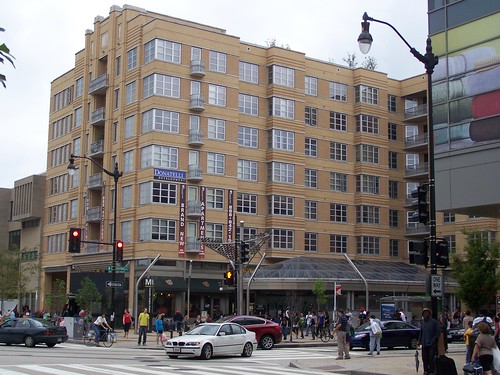
Multiunit housing (residential) building abutting a subway entrance, Columbia HeightsColumbia Heights, DC.

However, while today's population is about 650,000, DC had a population of almost 900,000 in 1946 according to Census estimates, although the highest population officially was 802,500 as of the 1950 Census.

As a result, for the most part, the city is already built out and organized to provide services to about 850,000 people, which is the flip side of the problem in cities like Detroit, which built out the capacity to serve 1.8 million residents and now has fewer than 700,000 residents.

At the same time, commensurate with a population increase, government officials are arguing that the city government will have to grow its staff significantly.  I was at a presentation about a DC-related issue earlier in the week (more about that next week), and as an aside, one of the speakers made the point (relevant to the presentation) that as the city grows in population, it will have to add more staff and equipment etc. to service more residents.

I've been hearing this more and more.

Another example is a recent email by a community gadfly who repeatedly runs for various City Council positions discussed this. Among other things he said we needed to hire 15,000 more teachers (that would support a new student population of almost 300,000 students!), and thousands more fire fighters and police officers.

As crime has dropped, the police force has stayed big.  This idea that the number of DC government employees will have to grow started in 2013 with the Chief of Police, Cathy Lanier, saying that the city will need to add more police officers as the city grows in population, in the belief that more population will trigger more demand for their services.  I responded, "DC already has the most police per capita of any city in the US: should we hire more police officers, rashly, without a plan? (I say no.)."

The reality is that the city's crime rate has dropped significantly from the 1990s, but the size of the police force has remained the same.  Note that I do think we could focus police resources better than we do, to address what are called "pattern crimes."  See "Crime time revisited" and "Night-time safety: rethinking lighting in the context of a walking community."  And it is not out of the question that we'll need some more officers, but I don't think so.

As it happens, DC has 80% more police officers than Boston--not even counting the various federal police agencies operating in the city, like the US Park Police and the US Capitol Police--and the cities have roughly the same population.

Demographic trends that influence DC's budget and operations.  The great thing about adding young and high income earning adults as residents is that they don't consume much in the way of city services.  They generate positive revenue cash flow to the city.  This is especially important as demographically speaking, the population of the city's existing residents gets older.

For all the talk of keeping families in the city, educating children is very expensive.  The average cost for the DC Public Schools system is $11,000 per student, while special services (not special education) can push the average up to $19,000.  Extending pre-K services to 3- and 4- year olds, while desirable from a policy perspective, add two years of expensive education and child care to the city's budget for each child that participates.

Most households with children consume far more in public services than they pay for in income, property, and sales taxes.

As the population gets older, they consume different services, needing more transit (WMATA's budget is being crushed in part by the increased demand for paratransit services), shopping less (therefore reducing support for local businesses and generating less sales tax revenues) and senior care.

At the same time, "aging in place" initiatives promote "overconsumption of housing" or "overhousing."  Initiatives to exclude seniors completely from property taxes will make neighborhoods more static and overhousing will persist and increase.

It was the aging of neighborhoods and the minimal inmigration of new resident and younger households which contributed to neighborhood and commercial district decline and stagnation in the city in the 1980s and 1990s.

This accentuates the cost of the loss in income tax revenue from senior households as people retire and the increased cost of services (although the federal government pays for a significant proportion of services to aging populations).

Taxation:  DC is North American's only city-state.  Regardless of the argument for statehood, DC functions as a city-state already, and unlike any other city in the United States, it retains 100% of income, sales, and property taxes collected within the city's borders.

On the other hand, the city is forbidden from taxing non-resident wage earners.  Note that the percentage of jobs based in DC and held by DC residents is increasing.  For years only 30% of the jobs were held by DC residents.  Now it is 45%, which improves the "yield" of income tax revenue within the city.

The city-county-state argument and the size of government.  On the one hand, defenders of the growth of the city's government argue that as a "state" compared to a typical "city" it has to provide more functions and meet various requirements of the federal government (such as a plan for transportation) that cities don't normally operate, or the public health function, which is typically provided by counties, etc.

On the other hand, you can argue that integrating city, county, and state functions in one entity can generate efficiencies, and while the overall employment for these functions is somewhat higher "for the city," overall the number of employees is less compared to the city-county-state alternative.  I'm inclined to support this interpretation, although the city hasn't demonstrated it is particularly innovative in providing such efficiencies.

"Smart growth" as a principle ought to be applied to local government too. My point in the piece about the police department is that we need to think intelligently about city functioning and being smart AND PLANNING when it comes to questions concerning growing the government in extendable to the other agencies in the city.

Note that this is an issue that comes up from time to time during recessions, and the impact on government from reductions in revenues.  My first experience with this was a program to reduce the number of academic programs at the University of Michigan in 1982, when the then president introduced an initiative he called "smaller but better."

Reinventing government/Business Process Redesign.  And I remember a book on cost containment in the human services published by Jossey-Bass, which I can't ever seem to find, which was my first introduction to what was later called "re-engineering" or "business process redesign."

When I came to DC, during the Clinton Administration "Reinventing Government," was all the rage and the primary public activity pursued by Vice President Gore.  Reinvention was supposed to be about changing processes to be more efficient.

Being introduced to writings by Thomas Davenport, in particular Process Innovation: Reengineering Work Through Information Technology was especially important as he made the point that organizations had the opportunity to redesign their processes for new efficiencies, in association with the introduction of information technology, rather than merely convert existing processes without change.

Process redesign remains at the heart of my approach to analyzing the function of organizations and places.  I now call my approach "action planning" which integrates program delivery and branding with planning.

Also see "All the talk of e-government, digital government, and open source government is really about employing the design method" and "Social Marketing the Arlington (and Tower Hamlets and Baltimore) way."

Even if the population increases, the city remains the same size.  While it would be nice to get back the City of Alexandria and Arlington County, which total 33 square miles, DC won't be getting any bigger, it will stay 67 square miles in size.

So while the demand for some services and infrastructure support will increase, the ability to consume more services will be constrained by the city's size.

Use of publicly controlled land and buildings.  Rather than each agency doing its own thing, agencies ought to be required to co-locate facilities and be more efficient in delivery of programs and services.  See "Public assets: public school buildings used for more than school" as an example.

Advisory Neighborhood Commissions.  The current law has an advisory neighborhood commissioner for about 1,800 residents.  Commissioners are organized by ward into Commissions (map at left),  There are 37 across the city.

As the population increases, the number of commissioners and ANCs will increase unless the population number per single member district is changed.

Building regulation.  We will need more personnel and improvements in processes and procedures, although process redesign is already underway.

Business regulation.  We will probably need some more personnel.

EMS.  We probably will need more EMS personnel, but they could be better deployed and managed. To achieve such an outcome, we'll need to remove EMS from the purview of the Fire Department.

Fire fighters.  We probably won't need more fire fighters. The number of fires is pretty insignificant. See "Rationalizing fire and emergency services."  Work schedule changes could provide more work hours for about the same amount of money.

Hospitals, health care and wellness.  The trend is to move away from inpatient services, and because DC is the center city, we have more hospitals and inpatient beds per capita than the surrounding jurisdictions.

We're probably ok, although judicious redesign and creation of an actual integrated public health and wellness focused system along the lines of Denver ("Revisiting an example of a real need for regional planning: hospital and wellness services") and the St. Anthony Hospital in Chicago is necessary. Also see "Disruptive innovation once again."

This course of action could result in reduced expenditures and better health outcomes.

Human/Senior/Social Welfare services.  Presumably, as the average income of households increases, the demand for social welfare services will decrease.  At the same time, equity concerns and advocacy will increase demand for such services for those populations, such as for "solving the homeless crisis" (which is insolvable because the population in need of housing is not static).

Senior service demands will increase as residents age and live longer.

However, gains from service integration and innovation are possible, although only over long periods of time.   My concept for a "Marshall Plan for East of the River," which would focus on poverty alleviation and economic development in Wards 7 and 8, with a focus on breaking the cycle of poverty is a way to move forward.  This would cost more in the short and intermediate term, and reduce costs and increase revenues in the long term.

And some nonprofits and local and state governments are innovating service delivery for impoverished populations in welfare and health care.

Libraries.  We're probably ok.  Although as I have written we need to reposition libraries as community cultural and civic assets, which would expand their programming and slightly increase personnel demands.

Parking/enforcement.  For example, the city will have the same number of streets and probably the same, or fewer in fact, parking spaces, so we won't need more parking control officers or more vehicles for the parking control officers. So we won't need more space and parking for more vehicles.  (Although if parking control officers were given additional duties, comparable to the "neighborhood wardens" in the UK, that could change.)

DC Government Vehicle Management facility, West Virginia Avenue NE.

Similarly, adopting more modern parking management systems could reduce the number of personnel needed because the system would know which spaces are expired.

The city could shift more parking control officers to electric bikes and smaller vehicles, reducing the size of the current vehicle fleet.

However, probably there will need to be better planning, engaging the private sector as well, and maybe the city will need to build/fund some parking structures here and there.  However, developing "transportation management districts," and better coordinating mobility within activity centers could reduce motor vehicle traffic and the demand for parking.

Parks and recreation.  We will need some more staff, although if we moved to a partial citizens as service delivers model and engaged citizens as service providers (Baltimore County does this), staff needs will decline.

A rehabilitation and expansion of the Takoma Playground and the creation of facilities for different age groups increased the number of patrons on a busy day by a factor of 50 to 100.  

Smart investment in existing facilities can increase their load without requiring more personnel or more or new space.

A few more facilities and park spaces will be needed, although part of it could be accomplished by better coordinating access and provision of services across city, federal, and other institutional facilities and spaces in the city.  Some is investing in facilities we already have.

Planning.  I'd say we need some more heft in planning.  As importantly, a Planning and Transportation Commission, comparable in scale to the Zoning Commission, should have oversight over planning functions for other DC Government agencies, and the planning office should be more involved in those efforts.

Police.  See above.

Public housing.  Tough issue.  We'll need to finance and build more.  But the city has already allocated lots of money to do this.

Schools.  Yes, we'll need more schools and teachers.  There are projections out there by the Office of Planning.  I don't know all the details.

A streetcar in testing on H Street NE.

Transit.  We will need more and better transit services.

That means more buses, more streetcars, and more Metrorail, upgrading Union Station, and maybe adding more railroad stations to other places in DC.

It also means working more closely with Montgomery and Prince George's County especially to develop better cross-border services with the aim of reducing motor vehicle traffic.

That will cost a lot more money to build, to acquire, maintain, and replace transit vehicles, and personnel will have to be hired and trained.

How to do it--should DC operate it?, would WMATA operate it? is an open question.

Transportation.  The road network is built out, although it does need to be maintained.  But this doesn't require more staff.  Maybe we need a few more people and vehicles to perform other functions.  But some processes could be better automated which would allow personnel to accomplish more tasks in the same amount of time.

To achieve DC's Sustainability Plan goal of 75% trips via sustainable means, we'll have to invest in more transit as discussed above.  We'll also have to invest in the expansion of the bikeway network and significant improvement and expansion of bike parking and related support services.

Trash collection.  DC only provides trash collection to buildings with three or fewer units. For the most part, that number of buildings is fixed, unless there is a concerted program to add accessory dwelling units.  Which would end up requiring a few more trucks and people, but not large numbers.

Plus, for the most part, the new sections of the city that add single family houses, like the Comstock project on New Hampshire Avenue NE or the Chancellor's Row rowhouses in Brookland, are required to set up HOAs, and pay for their own trash collection which is not provided by the city.

However, at least in the outer city, by improving recycling recovery rates (which would increase the need for recycling collection) and yard and food waste diversion on site, the average amount of "trash" generated by households could drop by 90%, allowing trash collection to shift from once/week to twice/month, cutting significantly the demand for trucks and personnel, and reducing tipping fees.

Portland shifted to once every two weeks "trash" collection in 2011.  (DC's rowhouse neighborhoods have trash pick ups twice/week--they are given small trash cans, because of limited space to store trash.  Areas in the outer city, usually bigger lots and detached houses, get trash picked up once/week.)

Water and sewer infrastructure.  The infrastructure will need to be expanded somewhat, which will be costly.  However, advances in reduction of water consumption such as in Germany ("Too Much Water Doesn't Damp Germans' Thrifty Habits," Wall Street Journal) demonstrate that per capita usage of water could be significantly reduced even with an increase with population.

=========

Special innovation in government operation here and elsewhere

In her inaugural speech, new Mayor Bowser has promised DC government will be "creative, risk taking, and innovative," but those aren't characteristics that have typified her performance as City Councilmember.  She is renewing focus on the city's Citistat/metrics program, which is modeled after what Baltimore did under Mayor O'Malley (cf. "Show us the data").

DC's water department and transportation agency have done some good branding.  DC Water does innovative programming promoting tap water consumption as opposed to buying bottled water.  DC Water also recently installed equipment that better utilizes waste in the water treatment system to generate one-third of the electricity required to operate the waste treatment plant and has significantly reduced the production of left over solids (directed to composting).

Montgomery County appointed community activist Dan Hoffman as the county's "chief innovation officer," and he moves a variety of innovation efforts forward.

Similarly, Los Angeles hired as Deputy Mayor Rick Cole ("Cole: Successful Placemaking Arises From Dynamic Pedestrian Environments, Not 'Starchitecture'," Planning Report), who has extensive experience throughout California as an elected official and city manager, to push innovation and better government performance.

Austin has been a leader in management by metrics and putting data of significance for all to see.

Other cities like New York ("What a Hundred Million Calls to 311 Reveal About New York City," Wired) seem to do a better job with 311 services as a way to identify systemic problems and the data is used to direct activities towards process redesign.

Governments such as Allegheny County, Pennsylvania are creating integrated records and service delivery systems to provide services to clients needing social and human services across multiple agencies.

And Arlington County's Mobility Lab pushes innovation forward in the transportation sphere, already having "spun out" at least one digital transit information company.

Oakland County Michigan's award-winning IT department provides contracted services to local governments across the U.S.

Helsinki's information technology operation, Forum Virium Helsinki, is run as a business unit which does innovative projects for the public and private sector.

Similarly, Helsinki's municipal research office, called Helsinki Urban Facts, is incredibly wide ranging in their analysis of city government.  Vienna's housing department has a best practice research unit as well, that produces internationally significant work.

Helsinki's public library system is also responsible for running libraries in local schools.

Liverpool and Vienna have refashioned their economic development units as development organizations with highly developed branding and identity systems, run on business plans that are rigorous, transparent, and accountable.  Vienna also positioned its support of the creative industries in a similar fashion (although I am told the latest government has de-emphasized this agency and its operation).  Liverpool is working to organize its culture functions along comparable lines.

Some jurisdictions do a great job with co-location of facilities, which is something I've written about for years.  Arlington County is a good example with cultural facilities integrated with libraries or schools.  Baltimore County does co-location too.  For example, the Pikesville Library was built along with the Senior Center,

And Baltimore County's Parks and Recreation Department has had an MOU for more than 60 years with the School system to co-locate facilities.  Recreation facilities are open past normal school hours, and schools may be constructed with various features, like auditoriums, that are bigger than the school would normally need, because the facilities also serve the broader community simultaneously through the management by the Parks Department.

Whereas in DC we have senior cities in every ward, so that's eight in total, the Ward 1 and Ward 4 senior centers are located within a couple miles of each other.  The facilities are closed at night.  If they were integrated with recreation centers, operation could be better maximized.

Austin has a big community facilities campus including a library and school in an impoverished area. Seattle co-locates libraries with other functions.

West Hollywood's library includes a cafe, bookstore, children's theater and the City Council chambers. Portland's Hollywood branch library has a coffee shop on the ground floor and affordable housing above.  In Drumbrae, UK, the new library includes a day care facility and a teen center.

Portland works closely with various academic and research units of the College of Urban and Public Affairs at Portland State University to promote innovation and higher quality government outcomes.

Mostly out of budget concerns, more local governments are merging certain functions with others. That's harder for DC to do because we are separate from the States of Maryland and Virginia, but it is a trend, albeit mostly in places like Michigan or Ohio, which face shrinking populations and budgets.

Labels: , , , ,