"A community’s physical form, rather than its land uses, is its most intrinsic and enduring characteristic." [Katz, EPA] This blog focuses on place and placemaking and all that makes it work--historic preservation, urban design, transportation, asset-based community development, arts & cultural development, commercial district revitalization, tourism & destination development, and quality of life advocacy--along with doses of civic engagement and good governance watchdogging.
Saturday, March 24, 2018
"Innovations gap" as a concept both for the economy and for understanding adoption of or not adopting best practice
what I call the innovations gap: the difference between actual output and the level of output that firms could achieve if they started using the best technology available to them. Because there is currently a large innovations gap, firms are likely to meet additional demand not be raising prices but by investing in these more efficient techniques. ...
Why have most firms not been investing in the most productive equipment and techniques since the GFC [Global Financial Crisis]? I think the simple answer is fixed costs and demand. Investment projects almost always involve a large fixed cost element (disruption, retraining), and with static demand those fixed costs may exceed any efficiency gain. But in a normal recovery from a recession, where demand is growing rapidly, firms are happy to incur that fixed cost because they need to expand capacity anyway to meet growing demand. In a weak recovery, on the other hand, many firms may not need to expand capacity, with any modest increases in demand going to leading firms, firms that do invest in the latest technology. Hence the divergence noted above.
It's a great term, very succinct, which usefully describes the difference between adopting best or leading practice, adopting better than what you're doing but still laggard practice, or changing nothing, when it comes to government operations.
It's the flip side of what Alexander Gerschenkron called "the economic advantages of backwardness," which Wren-Lewis calls the "fixed costs" of current operations--the investments in the technology and practice you have versus the cost to adopt new practices and technology and the retraining that is required.
(Still) tired of mis-understanding of the potential for e-bikes
Updated: because (1) I came across an article ("Riide - Gift Guide") on the founders of the Riide e-bike in the GW Magazine for alumni, which has a quote worth citing and mentions the cost of the bikes as about $2,000, when I said the typical cost for an e-bike is double that; (2) plus my earlier point in the comment thread about aging cyclists as another market segment.
From the article:
Sweat—lots of it—dampening summer styles and spirits, drip by drip. It's one of the chief obstacles D.C. commuters name when it comes to biking to work, says Amber Wason, BBA '07. With an eye toward easing the effects of the heat and humidty on bikers, she and Jeff Stefanis co-founded Riide, a company that makes a sustainable, single-speed electric bike.
It has the effect, she says, of "flattening the city."
I love the line "flattening the city." It's brilliant.
But unfortunately as discussed below, they miss the point of where "the city needs help becoming flat."
In the core of the city it's already flat and an e-bike doesn't make it any flatter. It's places farther from the core and in hilly areas and for older people, where "flattening assistance" becomes the killer app.
That being said, the Riide bike is attractively designed, especially in how they integrate the battery apparatus into the frame.
=============
Yesterday's Post has an article ("Are electric bikes the wheels of the future or just the new Segways?") about e-bikes above the fold in the Style section. It's about how some local entrepreneurs have created an e-bike, which can go up to 20 mph, and you can "cycle" without getting sweaty.
I heard a presentation by one of the principals a couple years ago, and my sense then was that they didn't have a good sense about mobility as a market and that they were focused on alternatives to the car, rather than on mobility technologies and products that are most appropriate for "center city applications."
Sweat seemed like the biggest point of differentiation for him--riding a bike gets you sweaty. Using a e-bike, since you don't have to pedal, means you won't sweat.
He was thinking of e-bikes capturing trips by people who normally drive a motor vehicle. But most trips in the city center made by residents are not performed by car.
Sweat isn't the deal-killer for transportational biking. Even in DC, where it is hot and humid from about June 15th to September 15th, sweating isn't an issue much of the time when you cycle.
There is a place for e-bikes in cycling for transportation. But I don't think it is for short trips in a city's core, especially at 20 mph.
It's for trips in places that are hilly, for longer distance trips, and for medium distance trips that some people are willing to cycle by traditional means but others won't.
Five years ago, when I came across a series of articles, "The parable of the electric bike" on e-bikes by Alan During of the Sightline Institute, I wrote this:
I don't think electric bikes will save the world. I do think that they can make bicycle commuting much more attractive to larger segments of the population. Maybe, over time, it could lead to as much as 10% of work trips by bicycle, or more. And that would be a significant contribution.
The Sightline articles discuss whether or not the electric bike will take off, why they are more efficient than electric cars, and whether or not they should be subsidized as electric cars have been (he argues no).
The Segway comparison. The Post article compares the e-bike featured in the story to the Segway, which didn't live up to the hype that was made about the product. Instead of transforming transportation, the Segway is mostly used to patrol campuses and large buildings like malls and airports, and in more narrow applications, such as tours for tourists.
But the Post journalist doesn't get why the Segway failed. It was because it was a product in search of a problem--which I argue is the same issue for e-bikes in urban cores ("A Lesson in Innovation – Why did the Segway Fail").
The people most likely to travel on trips of the distances for which a Segway is seemingly efficient--pedestrians, bicyclists, and transit users--didn't see much benefit from changing. Not to mention the cost--today a Segway can be bought for about $6,500.
For motor vehicle operators, while a Segway is a lot cheaper than a car, it fails to satisfy most of the demands for trips a typical user satisfies by car, including protection from the elements.
Hills. Most cities are flat in their cores (topography and proximity to rivers and ports being the primary reasons for cities locating where they did). For example, the core of DC is pretty flat. The fall line starts around W Street and the hills can be pretty steep. Riding home can be difficult. Some people find hills they don't mind riding (e.g. Georgia Avenue or 14th Street vs. 13th Street or 15th Street or 16th Street), others may choose not to ride.
But if you could get a boost from an electric motor up one or more hills, that might make the difference between choosing to cycle regularly as your primary mode of transportation.
Long distances. I am willing to ride 10 to 15 miles to get somewhere, and budget time accordingly. Beyond that distance, it takes too long to cycle, at least for me, because I am not a fast rider. An e-bike could be the difference from commuting to Downtown DC from White Flint or Rockville vs. taking public transit.
Trips of such distances are when being able to ride 20 mph, and not having to stop every few blocks at a stop sign or traffic signal, makes a big difference. But I do wonder how much of the time is spent pedaling the bike vs. riding the bike as it is propelled by its electric motor--a big reason why I cycle is for the health benefits of exercise. You lose that with e-biking.
Medium distance. While I am willing to ride 10+ miles for a single trip, most people aren't. While about 51% of all trips in the United States are 3 miles or less--an easy distance on a traditional bike--13% of trips are 3 to 5 miles, which is a distance that seems long to many, so they drive rather than bike.
Having the option of an e-bike could be the difference for a larger segment of people being willing to cycle for transportation. People less willing to cycle more generally. And while I haven't tested this empirically, I think it might be possible to coax people onto an e-bike when they may be less willing to cycle more generally. Maybe. [This section has been added.] Enabling cycling as you age/biking for senior citizens. In one of my pieces about the outer city as suburban in mobility paradigm ("DC as a suburban agenda dominated city") I made the comment about how sustainable mobility is possible in the outer city based on the experience of my own household. We live eight-tenths of a mile from a Metro station and about 3 blocks from a bus stop--during morning and evening rush the bus goes Downtown, outside of rush it travels between the Petworth and Takoma Metrorail stations.
I cycle for most trips, including grocery shopping. Suzanne and I walk and Suzanne uses transit to get to and from work. We also use car share (both one-way and two-way) and occasionally rent cars.
In a comment on my piece on a listserv in Chevy Chase, the mobility lifestyle I describe was said to be achievable only by younger people. The woman who said so is a couple years younger than I.
While I do think that it will be harder to do this as I age because of the uphill climb from Downtown and the hills around where we live, e-biking could be a way towards maintaining cycling as a primary form of transportation as we age.
Caveat: cost. You can buy a new city bike for $400 or less (of course you can spend a lot more too). Electric bikes cost ten times that, around $2,000 and up, although kits to add a motor to an existing bike can be purchased for much less.
The Riide people featured in the article are leasing the bikes to people for $79/month. While that is potentially worth it for long distance cycling, it's a waste of money compared to the cost of a traditional bike capable of satisfying the biking needs of the typical city resident.
Bike share as a cost-efficient alternative. One month's e-bike rental is almost the same cost as a year's membership in bike share. For residents in the core, a bike share membership is a great way to add biking to their portfolio of trip options without having to own a bike.
Caveat: weight and parking. E-bikes are heavier than regular bikes, weighing between 50 and 60 pounds versus less than 20 pounds for a traditional bicycle.
Depending on where you live and where you park your bike, this can be a problem, if you have to take the bike inside your house or apartment in order to park. Plus, many multiunit buildings provide bike parking that is insecure--while it sucks to have your $400 bike stolen, it would really suck to have your $4,000 bike stolen.
Marketing. The reason that I think e-bikes have failed to take off in the market segments where they make the most sense is because of a failure to market e-bikes appropriately.
In marketing, textbooks always cover the "4 P's of marketing"--product, promotion, price, and place. Product: as discussed above, for the transportation need most typically suggested, short in-city trips, e-bikes are "overengineered." Promotion: E-bikes are being marketed for in-city use when in most cases, for trips up to 5 miles in mostly flat places, e-bikes are overkill Price. Compared to alternatives--owning a bike or using bike share, the price for an ebike is significantly higher. A lease cuts the monthly cost, but it is still financial overkill to use an e-bike to accomplish trips in the core.
Place is where the product is sold. E-bikes are most likely to be useful in the suburbs. Most e-bike shops end up being opened in city cores. Many urban e-bike shops have failed, such as an e-bike shop in the Fells Point neighborhood of Baltimore, which got some start up funding from the Abell Foundation. That's because they are not located proximate to their "natural" base of customers.
To be successful, e-bike shops ought to be placed in suburban centers--e.g., in the DC region in places like Rockville/White Flint, Reston, Tysons Corner--where trip characteristics are more likely to be congruent with the advantages of e-bikes over human-powered bicycles.
For example, there is a bike shop in Takoma Park, Maryland, The Green Commuter, which focuses on e-bikes and it has been open for more than 5 years. That being said, I have seen an e-bike on the Metropolitan Branch Trail in DC only once, and I can't say I see a lot of people on electric bikes, even though I live within a couple miles of this store.
Conclusion. Despite the arguments above, there's likely to be a niche segment of the mobility market in the city where the Riide bikes will satisfy their needs, and that's fine. But it won't change the world or even the city.
And there is nothing substantive online about the initiative, other than a press release.
It happens that I am delving into this literature some, because a project that I am working on has the opportunity to organize around the idea of a "Creative Rural Economy," a concept and organizing framework that has been pioneered in Prince Edward County, Ontario.
In honor of the NC reaction to the planning meeting last night, I am reprinting this entry from September 2007 (with a couple edits) --------------------
From "Summer in the City" by the Lovin' Spoonful:
Hot town, summer in the city Back of my neck getting dirty and gritty Been down, isn't it a pity Doesn't seem to be a shadow in the city
All around, people looking half dead Walking on the sidewalk, hotter than a match head
But at night it's a different world Go out and find a girl Come-on come-on and dance all night Despite the heat it'll be alright And babe, don't you know it's a pity That the days can't be like the nights In the summer, in the city In the summer, in the city
---------------------------------------
What do you think about the creative economy and the potential to innovate within DC?
A couple days ago I went to a "Creative Economy Summit," which is supposed to kick off a new initiative within the city. For the most part my time was wasted (although there was continental breakfast).
Think Saxenian and her work comparing the innovation ecologies between Silicon Valley and Route 128 in Boston. The latter, derived from the military-industrial complex and seeded by Draper Laboratories, is oriented to larger firms, big contracts, and is less innovative in comparison to the consumer and business-to-business market orientation in the Silicon Valley. And in the long term, SV is much more successful and vibrant economically.
One of the unfortunate happenstances of being located at the bullseye center of big government in the United States is that the big government and managed economy approach shapes government and policy at the local level, although both the NoVA telecommunications and computing innovation cluster and the biotech innovation cluster in MontCo, now are a couple generations removed from being overly constrained by limiting risk taking type thinking.
Government is all about systematizing and bureaucratizing and reducing risk. It is not about change, transformation, and innovation.
(cf. I know, someone will bring up DARPA and NIH and NSF, but still, look at "industrial policy," in the U.S. And I am still shocked by how the Congress under Newt Gingrich eliminated the independent minded and excellent Office of Technology Assessment, which provided independent analysis to Congress. And still, Congress will not let the reports produced by the Congressional Research Service be made available to the public in an open and transparent way. But yes, the whole concept of programmed innovation diffusion was seeded by the U.S. government in the 1850s and 1860s by the creation of the Agriculture Extension Service and land grant universities focused on improving agricultural productivity.)
Creative economy initiatives are "merely" applied Jane Jacobs. Maybe people think that her point that to thrive cities need "a large stock of old buildings" was about historic preservation. Nope. It's about the availability of cheap space for business and people. Because really cheap space makes it easier to take risks. (Also see Cities and the Wealth of Nations and Economy of Cities.)
The reality is that most arts-based revitalization efforts are driven by the need to stimulate demand in undervalued areas where there is a great deal of available leaseable space that is not otherwise able to be absorbed (used/utilized/rented). Some of the presenters were talking about buying property that was leasing for $1/square foot. In DC, even 20 years ago you couldn't get significant space anywhere for under $10/s.f.
Many years ago I compared places like Pittsburgh and Baltimore and their arts-based initiatives to DC, saying that those other places have "a desperate willingness to experiment" that isn't present here.
DC doesn't have cheap space. And it doesn't have a lot of space either. Or big buildings. Except some along the railroad tracks. Which are being held off the market for higher revenue uses sometime down the road.
So a strategy in part has to be built around creating spaces where people and organizations can be incubated.
And it means retaining city owned property to do this.
Not selling it off.
E.g., a few years ago in the H Street area (in 2003), I suggested keeping properties like the old fire station on Maryland Avenue NE, the old school building on the grounds of Miner School, and the old police precinct station on 9th Street NE to use as arts incubators, to complement the idea of developing an arts-oriented entertainment district with anchors like the H Street Playhouse and the Atlas Performing Arts Center. In fact, I suggested that buildings on Florida Avenue, including the property just purchased by Conner Contemporary Arts (see "A Shifting Landscape For Conner Gallery") could be used similarly. Let's see what happens to Jimmy's Tire.
Instead, for the most part the government-owned buildings are going to be sold off... and underutilized school buildings will continue to be underutilized.
And interestingly enough, while presenters were brought in from Brooklyn and Boston and Minneapolis, there are if not "world class" at least best practice examples within 1 and 40 miles of DC:
2. One of these districts is immediately across the DC border in Prince George's County, Maryland, in the communities along Route 1 up to Hyattsville. And what they've accomplished with by comparison to DC almost no resources should embarrass us. See: Gateway Arts District plan and the Gateway Community Development Corporation. Note that the Washington Glass School ended up there, after being displaced by the construction of the Washington Nationals baseball stadium...
3. Two other districts are across the DC line too: in Silver Spring (they have Pyramid Arts Center, the AFI at the Silver Theatre, and the Roundhouse Theatre); and Bethesda. Plus there is one in Wheaton.
4. Baltimore has two such districts: Station North and Highlandtown. The latter has some similarities to DC's H Street. But the Creative Alliance in Highlandtown is more about supporting ground up creative innovation than are the places on H Street (even though I love dearly the people who have created the places on H Street).
5. And compare the Baltimore Office of Promotion & The Arts to DC's Commission on the Arts and the Humanities. Speaking of the difference between having a more ground up vs. a top down orientation. I won't even tell you about something that one of the latter's commissioners told me about a project idea of his, which is so top down in orientation it is amazing...
6. And Arlington County is probably 1000 times better than DC about harnessing public assets to accomplish multiple objectives, especially in the arts. Arlington provides space to various arts projects, and even does co-location projects, such as having the Signature Theater complex as part of the Shirlington branch of the County Library system. (See this article from 2005 from the Post, "Making Shirlington a Magnet.") Shirlington!
--------------- I almost laughed out loud when the presenter from Boston said how important it is for cities to support festivals.
In DC, at least 60% of the cost of producing a local festival goes to paying for services to DC Government agencies--for permits, police services, DPW towing and trash collection services, fees for "constructing" (putting up) tents, etc.
Increasingly it makes it difficult to even do a festival. People think that the Adams Morgan Day Festival makes a lot of money, but the cost of permits and services are scaled to attendance. They net very little from their very great event, which is this Sunday by the way...
Five years ago, suspensions abounded at Webster Elementary. Fights regularly erupted during recess and teachers feared violent outbursts from gang-involved 6th graders. New principal Jennifer White was shocked to learn that Webster had 70 suspensions the year before she arrived, and 80 the year before that. ...
Fast forward to 2008. Students cheerfully greet their teachers by name, line up quickly, and listen respectfully to each other in class. The endless procession of kids to the principal's office has stopped. White now spends her mornings ranging freely between classrooms to observe teachers and videotaping their best lessons to share."
It's a changed school, I'm telling you," said Lydia White, no relation to Jennifer, a guidance assistant who has worked 30 years at the school. Her eyes suddenly welled. "They've blossomed. It amazes me."
Teachers chalk up the turnaround to a homegrown program that explicitly teaches students how to behave in class. Building on Buguey's initial efforts to improve discipline, Jennifer White and her teachers crafted the Webster Way, which teaches "scholarly behaviors" such as eye contact, cleaning up your trash, and greeting teachers by name. Such skills are usually expected but not actively taught, White said.Teachers at Webster devote 10 to 20 minutes daily to role-playing those behaviors and discussing why they matter. Throughout the day, they invoke the Webster Way.
"Schools assume that a student will come in, and just know what to do," school psychologist Steve Franklin said. "At Webster, teaching a student how to be a student is really important. We don't expect them to already know how to read, to do math or write. So why aren't we teaching these things, too?"
It sounds elementary, and hardly radical. Yet the results have been dramatic. Webster has seen suspensions plummet and test scores surge since instilling the Webster Way. Only 10 students were suspended last year. Test scores ranked Webster in the top echelon of demographically schools statewide.similar schools statewide.
It's taken me 25 years to come to terms with the reality that just because change, improved theoretical models (like the ones I create), corrected and improved systems and processes, and corrections for economic/market distortions in pricing to improve optimal behavior makes sense and "would improve things*" if enacted, people aren't jumping up and down clamoring for change.
(* Hopefully. Without using the design methodology, prototyping, and getting and responding to feedback and improving systems before launch, traditionally planned interventions produced through a very static development and planning processes are likely to fail, or at least, not accomplish what was intended.)
Last year, my experience as a commercial district revitailzation manager in a DC neighborhood commercial district disabused me of typical notions about improving society--that experts can expound, that people will listen and adopt right off the bat.
You have to build the base of understanding, and that can take years. Especially when the proposed change significantly challenges the way things are done. Especially when approval is required by higher bodies before the change can be introduced.
In short, one year was way too short a period to make the case, to build the coalition of support, to bring about approval for a test of congestion pricing in NYC. Hence, failure.
Maybe the DC Public School "system" should just be shut down
Not because I don't believe in public education, or that the system can be fixed. I believe in public education and I believe that the system can be fixed (although probably not by the people charged with the fixing right now).
One of the things I suggested early on was a moratorium on the creation of new charter schools (a chaotic system, most of which don't do "better" than traditional schools, but because parents have more access to the school, and they "choose" the school, they feel a greater sense of empowerment and efficacy when it comes to charter schools versus public schools, which, face it, for the most part have been immune and disconnected from parents and the community for awhile) to provide some base level of stability as the traditional system works to improve.
But proposals for and the creation of new charter schools is surging.
It could be that the traditional school system moves to a point comparable to a fibrillating heart, and it can't be fixed, so long as new schools keep opening and the system keeps hemorraging students, teachers, and funding.
See "12 organizations seek approval for new charter schools" from the Examiner. While not all applicants are likely to be approved, they are seeking authority to open 18 new schools (although 7 are rebadging Catholic elementary schools into publicly funded charter schools). Meanwhile the city plans to close 23 schools, and that probably wasn't even taking into account the enrollment impact of even more schools.
Planning: is it looking forward or looking backward, or is it merely a matter of paying attention?
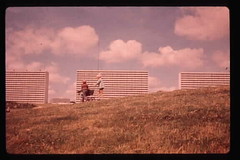
Towers in the Park, Denmark. Photo source unknown.
From Ken:
Yesterday in Planning History class the instructor made the point that for most of the 20th century planning looked to the future. Now, it is more looking to the past. What do you think?
Me:
That's a very interesting point, but I don't think it's the only way to look at this. The other way to think about it is to look at the characteristics that make up a successful city.
In good part it is physical -- urban design, architecture.
But architectural design is about style too, and yes, most of the styles are "in the past."
The components and characteristics of quality urban design were developed over millennia, and in the U.S., from the start of the founding of the country, through the Walking City (1800-1890) and Transit City (1890-1920) eras. After the introduction of mass produced cars, cities began to be developed in favor of accommodation of automobiles. In the DC region, and in DC proper, you can see the difference in how the core of the city was developed, versus the outer parts of the city, such as in Brookland or Woodridge.
But it's a mistake to consider the focus on urban design -- zero setback lot lines, small blocks, smaller houses, connected street network, density, etc. -- to be some kind of nostalgic return to the past. Since New Urbanists are found of older architectural styles, people often look to the style rather than to the underlying physical design of the community, at macro and micro levels, from the streets and the provision of public facilities, amenities, and the quality of the public spaces, to lot sizes, house sizes, placement of houses on lots, and how the house is presented and connects to the street and to the area around it.
Another way to think about this is to look at the work of the Project for Public Spaces, which doesn't focus on historic preservation or architectural style at all, except in the context of livability, what they call placemaking. Same goes with Dan Burden, the walkability guru -- I've never ever heard of him being referred to as a new urbanist. But his work is also essential in helping to refocus land use and transportation planners towards design for livability rather than for automobility.
Corbusier was wrong about tower in the park, and focusing on the car... if you want to make places that are great for people, you have to focus on people, rather than having people be afterthought, the occupants of habitable sculpture.
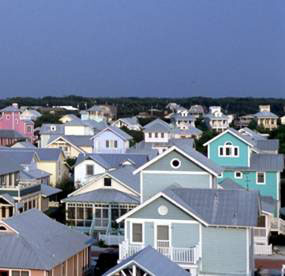
Lots of planners and architects, especially professors, make a big mistake when considering new urbanism (their conference is going on right now in Austin, Texas) almost solely in terms of the "traditional neighborhood design" as expressed through architectural style. The construction of Seaside, the first "New Urbanist" community on the Florida coast, began in 1982. Photo source unknown.
It's about urban design first and foremost. The styles of the building are something else. There are even a couple somewhat modernist style versions of New Urban communities.
Zero setback design, for subdivisions moving accommodation of the automobile to the rear of the property through alleys, focusing on walkability, small blocks, street grid, etc., this has nothing to do, really, with "the past" and everything to do with the characteristics of successful communities.
I militantly call myself an old urbanist, committed to the revitalization and repopulation of center cities, in counter to the fact that most new urbanists work on large greenfield subdivisions, I mean "traditional neighborhood design" developments in far suburbs. (Of course, that's where the available land is, and developers tend to work with large tracts.)
But I think it is fair to say that New Urbanists have been key to the reviving of the recognition of the value of traditional urban design principles.
Maybe professors are somewhat miffed that they didn't make the change, or make the change happen, but watch and observe. After all, architecture and planning schools think of themselves as practitioners, not just observers.
Speaking of a great book produced not by a professor, Cy Paumier's (he is a consultant for the Downtown DC BID) Creating a Vibrant City Center, is a great place to start with in terms of understanding the principles of great urban design.
Alley dwellings, garages, and such are the kinds of buildings people use to foster innovation, because they are cheap to rent. (Jane Jacobs wrote about the value of a "large stock of old buildings" being that low running costs allow cheap rent, and entrepreneurs, artists, and such need low rents in order to experiment with their new ideas.)
Can you imagine mayoral candidates arguing about which is more committed to bicycling?
I don't write about bicycling all the time because I bicycle. It's because support of bicycling is a kind of symbol for how a community looks at mobility and urbanism.
Today's Independent has a story about the plans for instituting a bikesharing program in London, "Livingstone plan for street-corner cycle hire stands," plans that are quite ambitious (at least compared to DC), but interestingly, the Conservative Party candidate for Mayor of London finds issues with the proposal--not that people are being forced to bicycle, like some of the crazy Republicans in Congress or Mary Peters, the pro-automobile Secretary of the Department of Transportation--but that it doesn't go far enough. From the article:
But Boris Johnson, the Conservative candidate for Mayor of London, said that Mr Livingstone had been "stampeded" into his announcement and insisted that the proposed London bike hire scheme was only a fraction of the size of the operation in Paris.
He said: "There is no doubt that the Mayor has been stampeded into this measure because he faces a cycling opponent. Some of the proposals sound like waffle. For example, why do Londoners deserve a bike-hire scheme that is a third the size of Paris?
Imagine, candidates competing on the quality of bikesharing programs, rather than roadbuilding programs?
Still, the way that Paris or London deals with mobility far outspans how we do it locally. It's about transformation of behavior and systems in fundamental, paradigm changing ways. One way to see this is by looking at the Transport for London website. It's not just about taking a bus or riding the subway. It's about mobility, and efficient mobility at that.
From the article:
Mr Livingstone said he aimed to ensure that one journey in 10 was made by bicycle in London, a shift in transport habits that would save 1.6 million tonnes of carbon dioxide emissions each year.
The Mayor, who is also expected to announce a crackdown on 4x4s today, said: "The aim of this programme is nothing short of a cycling and walking transformation in London. We will spend something like £500m over the next decade on cycling, the biggest investment in cycling in London's history, which will mean that thousands more Londoners can cycle in confidence on routes that take them quickly and safely where they want to go."
Sure we care about non-automobile based mobility, but we aren't focused on how to make such mobility an integral part of our daily lives.
Of course, it's much easier to do this in places like London, Paris, or New York City, because compared to DC they are much denser, larger places, with far more amenities available at the neighborhood level, and with a transit system that is both deeper and wider than that present in the DC region.
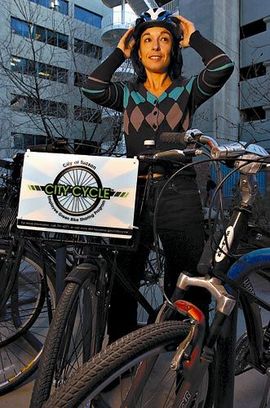
NORMA JEAN GARGASZ/Tucson Citizen. Transportation planner Melissa Antol uses a bicycle from City Cycle, a bicycle sharing program for city employees. She said she uses the program as often as she can. The City Cycle fleet has 23 bicycles.
While these days it's sometimes hard to believe, historically, government has been ahead of the curve and implemented new techniques and technologies to move innovation forward. Most cities have extensive automobile fleets (and granted many trips require the ability to transport materials), but not all trips need to be made by car.
Of course, for these kinds of systems to work, agencies need to be relatively close (say within 2 miles). This then is further support for agglomeration, or keeping agencies reasonably close, rather than moving them around the city willy-nilly, furthering what I call intra-city sprawl.
The online article has a sidebar listing of a number of resources including a link to Paul DeMaio's Bike Sharing blog.
Cities that have bike fleets
Ithaca, N.Y. Portland, Ore. Eugene, Ore. Davis, Calif. Madison, Wis. Burlington, Vt. Boulder, Colo. Cambridge, Mass. Toronto, Ont. Redmond, Wash. San Jose, Calif. Carrboro, N.C. Santa Barbara, Calif. Palo Alto, Calif. Tucson New York San Antonio San Francisco Houston Louisville, Ky. Teton County, Wyo. Edmonton, Alberta
In line with the idea of HealthyDC "stores" to provide initial medical, public health, management of chronic conditions, and fitness service delivery in DC neighborhoods, you could take the "Curves" concept (or Weight Watchers or TOPS--Taking Pounds Off Sensibly) to combine self-help, community building, and fitness training and regimens as a way to deliver weight management services within this concept.
DC1974 and I discuss the "design" approach. But if you look at the diagram of the design approach, it's not a lot different from the traditional "rational planning" framework.
Design methodology. (From Putting People First blog.)
The difference is around perspective. Rational planning tends to be highly "bounded" or constrained by thinking within traditional service delivery models.
I have written about my take on John Friedmann's work, that "Planning in the Public Domain" is focused on system maintenance for the most part, that innovation and definitely transformation, is not normally part of the consideration process, and that civic engagement processes tied into government processes are therefore constrained from the outset. (And you can see this with the techniques of public process consultants such as America Speaks, but also others, including those engaged by DC Government agencies.) Basic Concepts from Planning in the Public Domain by John Friedmann.
If you want transformation, or world class ideas, these come at a price. They come with disruption and difficulty and challenges to traditional ways of doing things.
The difference between designers and rational planners is that designers are trying to come up with the best solution to a problem. Sure in later stages solutions are tested, and choices have to be made with regard to cost, practicality, etc. And early innovators are not always the winners in the end, i.e. Netscape, Yahoo, Sun Microsystems, etc.
Getting back to Arlington. Their primary goal in transportation planning is to reduce single occupancy vehicle trips. Sure they manage and fund infrastructure, and they do a lot of other things. But what they are trying to do is produce an environment of the most efficient mobility possible. That's a lot different goal than merely facilitating the movement of people, goods, and services.
------ Part of this entry, and the title comes from a 1/16/2007 blog entry. ------
At the MinuteClinic inside a CVS pharmacy in Potomac, Rachel Herman, 6, checks in with nurse practitioner Anne Pohnert. Rachel's sore throat is typical of problems seen at retail-based clinics, which are gaining in popularity. (By Preston Keres -- The Washington Post).
1. Ever since the quick health centers have been discussed in the trade press starting in 2005, I have been mentioning them as a model for rethinking how to provide community-based health services on the part of government agencies, similar to school-based clinics.
On 1/16/2007, the Washington Post had an article about Minute Clinic and other limited, quick care health services offered by pharmacies such as CVS. See "Is 'Quick' Enough?," subtitled "Store Clinics Tap a Public Need, but Many Doctors Call the Care Inferior."
Extend the model to government. (Compare to the recent blog entries on Arlington County, Virginia.)
The point is to think about these clinics in terms of providing limited care, and wellness services, but not thinking of the clinics as full replacements for doctors or emergency care services.
There's an article in the December 2006 issue of Harvard Business Review about this kind of thinking, and I was having a hard time fully understanding it. This idea is a perfect illustration. See "Disruptive Innovation for Social Change."
The response ought to be to rethink the provision of health care, at least for wellness and chronic conditions. Create "HealthyDC" "stores" in neighborhoods, especially where the need is greatest, with hours like a store, at least til 9 pm a few nights per week.
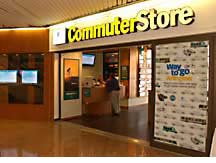
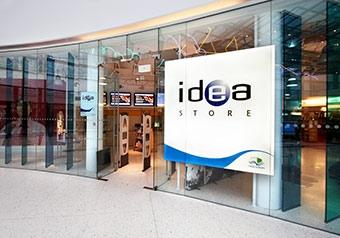
Think about this in terms of the IdeaStore repositioning of libraries as in the Tower Hamlets borough of London or the CommuterStore "transit" stores in Arlington County.
Make the HealthyDC store not just a place for the provision of health care, but also for health and wellness information and services.
Coordinate the provision of this service with other DC Government services, such as the WIC program for mothers and children, and the Senior Nutrition program.
The HealthyDC store could promote fitness, just as the FitArlington program does, and walking and bicycling.
There could be demonstration capacity. Do things like offer yoga classes. Teach healthy cooking. Make connections with neighborhood-based farmers markets. You could even connect them to libraries, and have expanded health information centers in these places (comparable to how the Wheaton Regional Library in Montgomery County is the designated library in that system possessing a deeper collection of health and wellness resources).
The same old, same old isn't working.
If you want to change behavior, to improve outcomes, you have to focus on the intended audience (the output public), not the traditional system and way of providing services (the throughput public) [although the input public--the public that provides resources, elected officials, and local and federal governments--too often isn't focused on the right levers for change].
From the Arlington blog entry:
1. The Design method;
2. Social marketing principles for behavior change -- A focus on transformation -- not merely "change" or "innovation" (not to mention "system maintenance");
3. Development and execution of complete and strategic campaigns;
4. Built upon the creation of complete identity systems and brands. (Logos aren't brands. They are part of a branding-identity system.)
I am all for self-help, rather than expecting the government to take care of us. Speaking of Arlington, I was talking with someone there vis-a-vis DC's transportation planning, and this person avered that DC is so focused on "what the federal government wants" and is reactive, rather than telling the US DOT and its various agencies (FHWA and FTA and FRA) what it intends to do, being proactive.
I think that's a good point. Compare the Transportation Plan from Arlington vs. the Transportation Element in the DC Comprehensive Plan and you'll see a world of difference.
It's the difference between leading and following.
In DC, more and more I think that our problem is around how big government -- the federal government -- has shaped the thinking and responsiveness and vision of the little government -- the local government, the District of Columbia government, at all levels.
So in DC, the first response is to create some law or regulation to do something, rather than to encourage that something, especially something of excellence or "world class" be done, and figure out how to do it first.
The perfect example is the hullabaloo over the DC Attorney General. After the AG resigned because of interference from the Mayor's Chief Counsel (who is now serving as Acting Attorney General), the first response by DC City Council was to craft legislation putting strictures on how the Mayor's Office could deal with the AG's Office.
LAW IS "OWNED" BY THE PEOPLE.
You want an open, transparent, fair Attorney General?
Convert the AG into an elected position, just as it is in most states across the country, and in many many counties across the country.
Social Marketing the Arlington (and Tower Hamlets and Baltimore) way
Okay, the Commuter blog mentioned that I wrote about the Alrington Car Free Diet Expo, and said there might be more to come. That goosed me, because I wouldn't normally be able to get to it for awhile, and I still haven't uploaded any of my own photos. But here goes...
I am not sure that Arlington fully understands exactly why they are doing so great (maybe they do, and I have never met Diana Sun, the Communications Director for the County) but here is my interpretation. Besides starting with important values and vision, and getting all County agencies committed and executing on the same page with the same philosophy, they have figured out a way to lead change by using social marketing and "design" principles. They combine
1. The Design method; 2. Social marketing principles for behavior change -- A focus on transformation -- not merely "change" or "innovation" (not to mention "system maintenance"); and 3. Development and execution of complete and strategic campaigns; 4. Built upon the creation of complete identity systems and brands. (Logos aren't brands. They are part of a branding-identity system.)
DC1974/Inaudible Noise and I have been discussing the Design Method for some time now.
Recently I went through a great book Designing Brand Identity and I came across another, WorldBranding, that I saw at the Rizzoli bookstore--the Library of Congress doesn't even have that book yet. Plus I've picked up some others, including Wayfinding: Designing and Implementing Graphic Navigational Systems. and Festival Graphics. The other day he sent me a link to this piece, "How a design thinking approach can help librarians" from the Putting People First blog (which I am going to have to add to my very short list of must read blogs -- Commuterblog, Washcycle, Streetsblog, maybe CEO for Cities, Frozen Tropics). This graphic is from that entry. The Design Process.
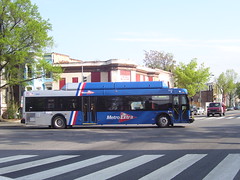
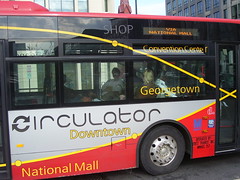
-------------------- NOTE: VERY IMPORTANT. Note the "Evaluate" and "Refine" stages. Governments rarely prototype. (Not to mention aren't usually great at marketing or graphic design and as importantly, "verve" -- I mean, compare DC's "Metro Extra" bus design to the "Metro Rapid" design in Los Angeles. Or the awful "America's Metro" logo proposed for the "next generation" subway cars. Although the DC Circulator has decent graphics.)
I would probably change this schematic a little, and include prototyping and testing within a combined "Prototype, Test, and Refine" stage. --------------------
Then you add to that social marketing, as pioneered by Porter, Novelli, and others. There are good books on the subject by Fine, one co-authored by Philip Kotler, plus Lauffer's out-of-print Marketing for Not-for-Profit Organizations and Kotler and Andreasen's Marketing for Nonprofit Organizations.
And they encapsulate this into "brands" and campaigns such as "The Commuter Store" "Walk Arlington" "Fit Arlington" "Bike Arlington" and now the "Car Free Diet."
I guess you could argue that social marketing has antecedents in direct marketing, which is testable. A particularly good, but old book on the subject is Maximarketing by Stan Rapp, and I've always liked The Marketing Imagination by Ted Leavitt.
The Commuter Store was started not by Arlington County but by the Ballston Partnerhip (or a precursor), but that set the stage for this deeper emphasis. A problem with the Commuter Store" as strong as a brand as it is, it emphasizes transit as being mostly for commuting, not transit as a way of life, as part of your lifestyle. Nonetheless, the concept is strong and has been adopted in other jurisdictions around the region. Rosslyn Commuter Store photos from the Commuter Page website.
I think the brand can be better extended with a good tagline linking other forms of mobility--biking, walking, etc.
Plus, biking and walking need to be given their own dedicated sections within the "stores" to emphasize their importance, as well as the emphasis that Arlington County does give to walking and mobility.
Arlington does something that I always emphasize with nonprofits, that each thing you do needs to accomplish multiple objectives. So Walk Arlington promotes mobility, promotes fitness, and on tours of neighborhoods promotes community building as well as communication about cultural and other resources, not to mention focuses on improving the physical environment (urban design) for walking.
Single-track thinking and doing is unaffordable by any municipality, given ever constrained resources and increasing demands.
Two other places that use the same kinds of organizing principles are:
more than just a library or a place of learning. As well as the traditional library service, Idea Stores offer a wide range of adult education classes, along with career support, training, meeting areas, cafes and arts and leisure pursuits.
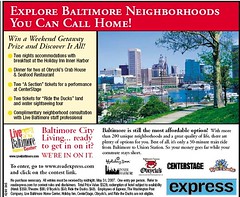
Arlington is more focused directly on behavior change when compared to the Idea Store, but Live Baltimore too is very focused, on attracting residents.
One of the problems of union-management relations is that often each sector thinks of its issues and perogatives in very parochial ways. (Not that this is all that surprising, maybe every group does this.)
And I do understand unions being concerned that when they bring up issues, the response isn't to fix things to make it better, but about control and overspecificity.
This by the way is a problem too with activism and government, we hesitate to bring things up because typically city agencies think in terms of control, regulation, licensing, and revenue generation through licensing, rather than how to have policies that make a better city.
Anyway, I am still somewhat shocked by this story in the Examiner, "Police review the basics," where the Police Union claims that a review of police procedure--because 1 in 5 arrests are thrown out by the U.S. Attorney's Office, rather than attempting to try the case--would have a chilling effect on police officers doing their job.
Evaluation for improvement is always a good thing.
Still, DC's MPD has maybe gone overboard in terms restrictions on officers, and I can understand the union's concern about this further increasing. At the same time, it's a bit of lazy journalism to always rely on the director of the Police Union for a response in articles, because the bias he represents is never adequately explained or disclosed.
(Plus the police and fire fighters unions are very much involved in donations to Council and Mayoral campaigns, which then makes it harder for politicians to do the right thing when it comes to dealing with these departments when it comes to governance matters.)
Why cities and place are more important than ever:
A central paradox of the twenty-first century is that declining communication and transportation costs have made cities more vital than ever. In the developing world, cities are the intellectual gateways between the human capital of India and China and the markets of the West. In the developed world, cities have enjoyed a remarkable resurgence over the last 25 years as the density that once made it easier to move hogsheads onto clipper ships now serves to spread knowledge in finance and new technology. Globalization and the death of distance increased the returns for being smart, and you become smart by hanging out with smart people. As such, cities remain important because they create the intellectual connections that forge human capital and spur innovation.
-- Edward Glaeser, professor of economics at Harvard and director of the Taubman Center for State and Local Government at the Kennedy School of Government
... divorce is a "terrible thing" for people to go through. "But for real estate agents, we do really well because we sell them the apartments they both lived in before they get together, then they get married and buy a bigger apartment or house, and we sell them that. Then when they split up, inevitably, five years later, we sell the house or condo, and they buy two more. "In a matter of five years, you are doing six or seven transactions, as opposed to 20 years ago, [when] you'd be doing just one."
Economics measures the amount of economic activity. Use of resources is economically positive because it represents a transaction, even if the resources are being depleted.
So even though energy prices are increasing, and crowding out certain types of consumption, for the most part the way this is measured shows an improving economy (if there are no other simultaneous negatives present).
I was reading the Good Practice Guide on Planning for Tourism from the UK Department of Communities and Local Government yesterday and in discussing market studies and projections of economic activity, one of the case studies made the point that a full, not a partial, economic analysis is required:
Outputs from the analysis include estimates of the:
• gross economic impact, based on the additional number of visitors that Tate St Ives will attract, over and above current numbers. The development’s impact is measured by the employment created and income generated in the area of impact and throughout the supply chain.
• net additional economic impact, including leakage, deadweight, displacement and multiplier effects.
• financial benefits, based on expenditure of the additional visitors on admissions, shop and café and the additional on-site employment it supports; and
• wider economic benefits, including expenditure on suppliers, off-site spending by day visitors, off-site spending by overnight holiday makers drawn to the area specifically to visit the Tate, supply spending by tourism related businesses and the income induced/multiplier effect.
Too often, "deadweight" and "displacement" impacts are not being adequately covered.
Deadweight is economic activity that would have occured regardless of the investment. Displacement is "the degree to which the outputs of the project have occurred at the expense of outputs elsewhere."
The book The Future Once Happened Here by Fred Siegel of Cooper-Union is considered within the academy to be quite a conservative tome. The book discusses the decline of center cities, using DC, NYC, and Los Angeles as examples. It came out it 1997. It countered mayors like Giuliani and Riordan, and Rendell in Philadelphia, vs. the mayors that presided over and perhaps accelerated decline.
I don't think of the book as conservative, just descriptive. (There are a couple concepts in there, the "riot ideology" and "dependent individualism" that I see expressed all the time within the city.)
Yet, there is no question that the decline of American cities was fueled by outmigration and federal policies and financing systems that favored suburban development, at the same time demands for resources to support people unemployed as a result of declining industries increased dramatically.
But there is a need to move forward regardless, especially when you can't count on the federal government to step up and reconcile policies and planning practices that continue to degrade center cities at the expense of other parts of metropolitan regions.
I used to joke in the early 1990s that I became an "inner city progressive" because my liberalism had been ameliorated by witnessing the scheleroticism of municipal dysfunction, and I didn't want to be tolerant of failure.
I think the City of Washington is on the upswing, but the fact is that much of the elite, and in DC the financial elite are the real estate development industry, are far more concerned about profit and profitmaking than they are "civic pride" and quality of life. So it makes it tough to muster real change.
Especially when government for the most part is committed to system maintenance, not change and not transformation. Cities need transformation.
I used to be somewhat derisive of the small municipalities that ring DC on the Maryland side. Yes, most of the elected positions aren't contested and the turnouts are small. Maybe the City of Takoma Park doesn't have contested races this year, but for leadership positions that really matter, hey, check out the election for the board of directors for the Takoma Park-Silver Spring Co-op...
Seriously though there are some reasons that these communities, such as Mt. Rainier, Brentwood, Takoma Park, Hyattsville, etc., have low turnouts and participation. There isn't a lot of education and training for civic activity. I guess the U.S. still favors skilled amateurs... And most small municipalities have their elections in off years or at off times (elections in communities in Prince George's County are in April).
Face it, most people don't think about local governance all that much, unless they have specific problems, want a speed bump installed on their street, they have crime problems, or children in schools.
So having elections not at the "normal times" means low turnouts and minimally contested races. If you don't agree with me, look at the elections for the County Councils. Granted they are "higher" positions, full-time, with salaries and benefits, but they are contested.
People say that it's better to have local elections at off times, so that people focus on the requirements of the local situation. That may be the case, but then you're going to have to accept that there will be low participation in most dimensions, including the number of candidates, the number of contested elections, and the turnout.
I have come around on the value of smaller municipalities because it means that governance and more local needs are likely to be congruent.
E.g., in places like Takoma Park, the City sponsors festivals, they don't charge lots of fees for putting them on, unlike in DC. In places like Mt. Rainier or Hyattsville, the snow is removed immediately from all streets, including residential areas, when in the big city or in county areas without incorporated cities or towns, it takes much longer, if ever, for snow to be removed from residential streets.
Mt. Rainier has "trash" pick up three times/week. One day for yard waste (and every so often for bulk items), another for trash, and yet another for recycling. Etc.
In theory, Advisory Neighborhood Commissions could function similarly in a center city like Washington, but for many reasons they fail to do so. For one, it is almost impossible for a big city to be concerned enough to make its policies congruent with the needs at the neighborhood level. (Commercial district revitalization is a perfect example. Most DC government agencies do things that aren't supportive of neighborhood improvement and it's almost impossible to change such policies and actions. I have written about that plenty, so I won't go into it now.)
For another, I think that civic and social and community capacity in DC has been "poisoned" by being home to the national government. The idea of government as the solution for any and all problems has trickled down, even to the block level of the community. The idea and practice of self help and community organizing is weak in the city. (I suppose it was different in pre-Home Rule times.) When you become the government, you get co-opted just as revolutionaries do when they become the government in power. Maybe Jefferson was right...
On the other hand, the Brookings Institution produced a paper opining that part of the problem in Pittsburgh is that there are more than 400 different municipal and special districts in the multi-county region, dissipating attention, direction, and money. See "Pittsburgh: The Road to Reform."
When your resources decline, you have to streamline. Many townships and municipalities around the country, especially in the Detroit area, where tax revenues are declining and will continue to do so, are consolidating various services. This trend will likely continue, and here and there, there will be more examples of the center city combining with the county government (such as Indianapolis, Lexington, Louisville) in a consolidated government. In part to reduce the cost of services, in part to balance tax revenue capacity.
More of the same isn't likely to work, at all levels of government.
Location: Salt Lake City, UTAH (UT), United States
I am an urban/commercial district revitalization and transportation/mobility advocate and consultant. I was a principal in BicyclePASS, a bicycle facilities systems integration firm, based in Washington, DC. Now I'm in Salt Lake City for family reasons. Urban economic competitiveness is dependent on efficient transit and mixed use, compact places. Therefore, I end up writing a lot about mobility and urban design. I still own a house in DC, so I write a lot about Washington, DC issues. I try to write so that "universal lessons" are evident in the entries, regardless of the place.