Rebuilding Place in the Urban Space

"A community’s physical form, rather than its land uses, is its most intrinsic and enduring characteristic." [Katz, EPA] This blog focuses on place and placemaking and all that makes it work--historic preservation, urban design, transportation, asset-based community development, arts & cultural development, commercial district revitalization, tourism & destination development, and quality of life advocacy--along with doses of civic engagement and good governance watchdogging.

Wednesday, October 19, 2022

It's not the age of the housing stock, but the ability of property owners to maintain it: Disinvestment in Pittsburgh

Vacant house and lots in the Larimer neighborhood.  PPG photo.

The Pittsburgh Post-Gazette has an article, "Pittsburgh’s neighborhoods pay the price for abandoned and decrepit homes," about how Pittsburgh's lower income neighborhoods suffer from serious housing disinvestment.  

The story focuses on the Larimer neighborhood ("Larimer and Orphan," Places Journal), but there are many neighborhoods with similar conditions.

And that's pretty typical of cities that are weak markets overall but with pockets of success.

From the article:

... just blocks away are the signs of a neighborhood in distress: empty, boarded-up buildings, shuttered brick churches, fire-ravaged homes and weedy, barren lots on street after street.

"Look around here. Do you see any businesses?" said Demond Braddy, 49, who has spent nearly all of his life in that neighborhood: Larimer. “The neighborhood ate itself."

Houses with crumbling roofs, collapsed porches and peeling exteriors line many of the streets, where the vast majority of housing was built decades ago. These decrepit, blighted properties — many devoid of residents — are relics of another time and, some say, another place.

The homes in Larimer are emblematic of an aging housing stock that dominates the entire city, according to the latest data from the U.S. Census Bureau. Half of all housing units in the city were built before 1940 — the third oldest stock among major cities in the nation, a Post-Gazette analysis found. ...

While the numbers point to a rich history and a host of architectural styles that have been preserved in all their splendor, they also highlight the critical urban problems that continue to plague Pittsburgh’s oldest neighborhoods: abandoned homes and communities in dire need of revitalization.

Aged housing stock isn’t inherently problematic, showcasing a city’s historic character while sheltering its residents. For instance, in Manchester-Chateau, the median age of homes is nearly a century, according to the city, and the neighborhood, which encompasses Pittsburgh’s largest historic district, is touted by the city as a prime example of urban preservation.

But in many of the neighborhoods beyond, preservation and age don't go hand in hand. The numbers are striking: Residential properties built prior to 1940 garnered over eight times more housing code violations than homes that went up in later years, according to a Post-Gazette analysis of city data.

PPG photo.

Disinvestment is a matter of income.  More than anything, the issue is income of the residents.  

Better off segments have the money to maintain aging houses.  

A perfect example are the historic districts in DC or Brooklyn or the controversial rehabilitation of Harlem, which has been led by people with money not necessarily African-Americans.

If residents lack the necessary income to maintain aging houses, then communities need to step in with extranormal support.

Aging cities usually lack the money to take on this issue at the scale it requires.  But they need to be way more purposeful about it.

Pittsburgh has an incredible history in successful community development.  Ironically, while Pittsburgh was an early innovator in "urban renewal," perhaps in response, the city has also been a leader in preservation- and ground up community-based improvement initiatives, with a number of transformational organizations such as:

  • the Pittsburgh History and Landmarks Foundation, which didn't just advocate for improvements, but became a developer and took on major projects, and was a leader in the development of loan revolving funds
  • Allegheny Conference on Community Development and the Northside Leadership Conference, community development collaborative organizations
  • the Design Center of Pittsburgh, which I think is defunct, which provided technical assistance and guidance to residents renovating their aging houses
  • rehabilitation loan programs supported by local banks and the city providing lower cost funding, at a time when interest rates were more than double the rates
  • Community Technical Assistance Center, also defunct, which provided support to community-initiated planning programs

  • Pittsburgh Cultural Trust owns cultural facilities at scale ("How the Arts Drove Pittsburgh's Revitalization," Atlantic Magazine)
  • Penn Avenue Arts Initiative -- a joint effort of two neighborhood groups who recognized that artists were already "colonizing" their communities and so they decided to leverage it. They gave one of best ever community tours I've been on at a conference ("Artists bring flourish to Penn Avenue," Pittsburgh Post-Gazette, "A Transformed Penn Avenue," Pittsburgh Magazine, Vacancy to Vitality in Pittsburgh’s East End: Penn Avenue Arts Initiative, case study, Metris Arts Consulting).
  • urban commercial district revitalization initiatives across the city's neighborhoods, East Carson Main Street is one of the first urban Main Street programs
  • Manchester-Bidwell Corporation, a community development organization in the Manchester neighborhood
  • Sprout Fund -- a seed fund for grassroots projects
  • Heinz History Center -- a great local history museum
  • The Heinz Endowment and other foundations have been committed to funding revitalization efforts
  • and others...

Those initiatives have influenced me greatly and taught me a lot.  I wrote a few pieces, one even was re-tweeted by Richard Florida.

-- "Urban economic development strategies: do you invest in people or places? ... yes," 2010
- "Economic restructuring success and failure: Detroit compared to Bilbao, Liverpool, and Pittsburgh," 2014
-- "One hidden element of the revitalization of Pittsburgh's East Liberty neighborhood," 2015
-- "Why do Rust Belt rivals Cleveland and Pittsburgh have diverging economies?," 2021

It is a shame that many of those programs seem to have fallen by the wayside, but that shouldn't be surprising as it's difficult to maintain organizational momentum, and after awhile funders are interested in the new thing, not organizations doing the day in, day out slog.

Purposeful neighborhood revitalization.  In 2020, I wrote a series of articles about creating systematic neighborhood revitalization planning and implementation systems to address disinvestment in large and small communities, focused at the scale of the neighborhood.

Ironically one of the influences is a program developed in Pennsylvania by the State government, called Elm Street.  The idea was to use the same concepts and approaches developed for the Main Street commercial district revitalization program, but applied to neighborhoods. It was never really implemented on a large scale--I think it was probably created at the tail end of one administration and never really got picked up by successors.

-- "The need for a "national" neighborhood stabilization program comparable to the Main Street program for commercial districts: Part I (Overall)"
-- "To be successful, local neighborhood stabilization programs need a packaged set of robust remedies: Part 2"
-- "Creating 'community safety partnership neighborhood management programs as a management and mitigation strategy for public nuisance programs: Part 3 (like homeless shelters)"
-- "A case in Gloucester, Massachusetts as an illustration of the need for systematic neighborhood monitoring and stabilization initiatives: Part 4 (the Curcuru Family)"
-- "Local neighborhood stabilization programs: Part 5 | Adding energy conservation programs, with the PUSH Buffalo Green Development Zone as a model," 2021

Pittsburgh needs to go back to its revitalization roots, and should create and implement an Elm Street neighborhood revitalization program that focuses on neighborhoods and the state of the housing stock, whereas the programs today focus more on larger projects that have impact, but over many years, and not on the average state of housing.

Not unlike how I recommended that Montgomery County Maryland needs to have an East County revitalization program, because that section of the county lags the economic and social success enjoyed by West County.  

-- "East County, Montgomery County, Maryland: Council redistricting spurs ideas for revitalization," 2021

Or how Oakland County Michigan needs to do something similar for Pontiac, a economically laggard majority black city in one of the nation's richest counties.

-- "Pontiac Michigan: a lagging African American city in one of the nation's wealthiest counties," 2022
-- "The rise of Oakland County is built upon Detroit's fall," 2014

And St. Louis:

-- "St. Louis: what would I recommend for a comprehensive revitalization program? | Part 1: Overview and Theoretical Foundations"
-- "St. Louis: what would I recommend for a comprehensive revitalization program? | Part 2: Implementation Approach and Levers"

======

A little different but one of the best resources on thinking about stoking revitalization in the face of disinvestment is the long out of print book Building Neighborhood Confidence by Rolf Goetze.

It makes the point that government housing rehabilitation programs aren't supposed to breed dependency, but to rebuild confidence, so that residents will begin re-investing on their own.  That momentum from the program will be continued by independent actions by property owners.

Early on, reinvestment in the H Street NE corridor ("The community development approach and the revitalization of DC's H Street corridor: congruent or oppositional approaches?," 2013) was actually spurred by fewer than 10 property owners who fixed up properties with little help from others, and fortunately all were committed to doing aesthetically supportive repairs to undesignated but eligible for historic designation buildings.

It's the same principle.

=======

-- "100000 tulip bulbs to be planted on South Side vacant lots," Chicago Sun-Times

Titled “Redefining Redlining,” the work aims to spark conversation around the disempowerment of Black neighborhoods that followed from banks refusing to lend to residents.

A team of graduate students from the Illinois Institute of Technology is still researching what stood on the land. So far, they know it was a mix of single-family homes and apartment buildings, like the one still standing on the northeast corner of the block.

The full impact of the project won’t be seen until the tulips bloom in the spring.

“Around April, May it’s gonna be a sea of red, and it’s going to let us have conversations about what we want for our communities,” said Ghian Foreman, the president and CEO of Emerald South, a South Side development group.


Labels: , , , , , , ,

Wednesday, August 31, 2022

Reversing the social costs of the pandemic: rebuilding community networks and social capital

Danny Westneat, columnist for the Seattle Times, "Seattle's awful August shows the city continues to backslide on crime," complains that people seem to be taking, shootings, murders, and overdose deaths for granted, asking where is the outrage and involvement.  He mentions how Mayor Harrell held a "Day of Service" event where 4,000 people participated, but that one day isn't enough, which I think is a good point.  From the article:

I know I sound like old man shouting at clouds, but here goes anyway: When is Seattle going to rouse itself from its comfortable numbness and acknowledge it’s got a serious crime problem?

I recall communitywide outrage and mobilization about a decade ago when Seattle first started seeing an average of one shooting per day. Now there are two shootings daily — up 100% from before the pandemic. But there’s no similar rallying to action. The shootings — even the killings — are becoming background noise.

I fear the same is happening with drug overdoses and deaths. August has been the cruelest month on that front, too. The city’s 911 system has recorded 53 drug casualty calls just this month, more than double the average from the spring.

King County tracks all overdose calls. In August, so far, paramedics have attended to 141 opioid overdoses just in downtown Seattle. That’s five overdoses per day in that one neighborhood.

A year ago it was less than half that. Most of these are nonfatal, but the number of deaths due to fentanyl overdoses is about to exceed last year’s grim record — and again, it’s only August. 

There needs to be an event every month, as a way to rebuild the idea of community and people working together to address common problems.  From the article:

To move in a more positive direction, maybe one effort Seattle could try now is a citywide push to “reverse the pandemic.”

What happened during the pandemic? We separated. Schools and other institutions closed; programs went dark; mentoring stopped. It seems to me that this rending of social networks was quietly very damaging, but hasn’t gotten much of a repair effort.  ...

How about a citywide drive to “reverse the pandemic” with tutoring, volunteering, block watching, mentoring?

As discussed in the pieces on revitalization in St. Louis, there is a lot of opportunity in strengthening civic engagement networks more generally for community improvement.

-- "St. Louis: what would I recommend for a comprehensive revitalization program? | Part 1: Overview and Theoretical Foundations"
-- "St. Louis: what would I recommend for a comprehensive revitalization program? | Part 2: Implementation Approach and Levers"

Also the series on community-engaged commercial district revitalization:

-- "Basic planning building blocks for urban commercial district revitalization programs that most cities haven't packaged: Part 1 | The first six," 2020
-- "Basic planning building blocks for urban commercial district revitalization programs that most cities haven't packaged: Part 2 |  A neighborhood identity and marketing toolkit (kit of parts)," 2020
--  "Basic planning building blocks for urban commercial district revitalization programs that most cities haven't packaged: Part 3 | The overarching approach, destination development/branding and identity, layering and daypart planning," 2020
-- "Basic planning building blocks for "community" revitalization programs that most cities haven't packaged: Part 4 | Place evaluation tools," 2020

And community-engaged neighborhood improvement:

-- "The need for a "national" neighborhood stabilization program comparable to the Main Street program for commercial districts: Part I (Overall)," 2020
-- "To be successful, local neighborhood stabilization programs need a packaged set of robust remedies: Part 2," 2020
-- "Creating 'community safety partnership neighborhood management programs as a management and mitigation strategy for public nuisance programs: Part 3 (like homeless shelters)," 2020
-- "A case in Gloucester, Massachusetts as an illustration of the need for systematic neighborhood monitoring and stabilization initiatives: Part 4 (the Curcuru Family)," 2020
-- "Local neighborhood stabilization programs: Part 5 | Adding energy conservation programs, with the PUSH Buffalo Green Development Zone as a model," 2021

And social urbanism and social infrastructure:

-- "Equity planning: an update," 2021

Labels: , , , , , , ,

Tuesday, May 31, 2022

Interesting community initiative in Detroit: Marygrove Conservancy

The Detroit News reports in "How partnerships revitalized Detroit's McNichols corridor," about commercial and neighborhood revitalization initiatives in the 6 Mile Road corridor--also named McNichols. (Subscription required).  From the article:

A decade ago, a stretch of storefronts along McNichols on the city's west side were in disrepair, open to the elements and left to deteriorate. 

During the past few years, developers have either revitalized or made plans to rehab several of the buildings to provide amenities to the community: restaurants, a brewery taproom, apartments and retail. Geneva Williams, executive director of Live6 Alliance 

“We are thrilled, delighted and walk with those developers hand in glove as they do some incredible work,” said Geneva Williams, executive director of the Live6 Alliance, a nonprofit serving communities surrounding the McNichols and Livernois area. “You know, this whole aspect of having Brown and Black developers working in neighborhoods that they have connections to — many of them were born and raised in the area. ...

Several of the development projects are funded in part through Invest Detroit and the city of Detroit's Strategic Neighborhood Fund, the public-private partnership with the goal of improving 10 neighborhoods in the city. Among the projects are the Enclave at 7400 McNichols, which will house the brewery taproom, two restaurants and a small business incubator space after a $3.4 million renovation.

It's relevant to two different blog series from 2020 on commercial district revitalization

-- "Basic planning building blocks for urban commercial district revitalization programs that most cities haven't packaged: Part 1 | The first six"
--  "Basic planning building blocks for urban commercial district revitalization programs that most cities haven't packaged: Part 2 |  A neighborhood identity and marketing toolkit (kit of parts)"
--  "Basic planning building blocks for urban commercial district revitalization programs that most cities haven't packaged: Part 3 | The overarching approach, destination development/branding and identity, layering and daypart planning"
-- "Basic planning building blocks for "community" revitalization programs that most cities haven't packaged: Part 4 | Place evaluation tools"

and neighborhood revitalization:

-- "The need for a "national" neighborhood stabilization program comparable to the Main Street program for commercial districts: Part I (Overall)"
-- "To be successful, local neighborhood stabilization programs need a packaged set of robust remedies: Part 2"
-- "Creating 'community safety partnership neighborhood management programs as a management and mitigation strategy for public nuisance programs: Part 3 (like homeless shelters)"
-- "A case in Gloucester, Massachusetts as an illustration of the need for systematic neighborhood monitoring and stabilization initiatives: Part 4 (the Curcuru Family)"
-- "Local neighborhood stabilization programs: Part 5 | Adding energy conservation programs, with the PUSH Buffalo Green Development Zone as a model," 2021

The article is more about commercial districts than neighborhoods, but it does both. It's part nostalgia that I list it, because when I was a child in Detroit (early 1960s) when my father was still alive, we lived a couple blocks from McNichols Avenue, although the area mentioned in the article is a few miles away from where we lived.

In my day the major Detroit arterials like 6 Mile, 7 Mile, Greenfield, Livernois, etc. were lined for miles with block after block of small retail stores. Today many of the buildings have been demolished.  So it's hard for me to give credence to today's efforts at revitalization, because they will never bring back the city I remember.

From an urban revitalization standpoint, I've had to sluff off those memories, because that kind of revival is not possible.  Detroit had almost 1.7 million residents then, now it has fewer than 700,000.  The thing is that the city was in decline even then, but we didn't realize it.  Now the point is to rebuild based on the opportunities present today.

A noteworthy element mentioned in the article is the "Marygrove Conservancy," which is separate from the efforts to revive the commercial corridor.

 It's a nonprofit with foundation and corporate support ("PNC Bank and Kresge Foundation Fund $57.3M for Marygrove Conservancy Renovation") that has taken over the deaccessioned Marygrove College campus ("Conservancy builds a place for community, learning on site of former Marygrove College," Detroit Free Press).

The school shut down (I don't know why they didn't try to merge with the University of Detroit Mercy, where earlier the UD merged with Mercy College, all three are Catholic related schools of higher education), but instead of redeveloping it (not that there is that much demand to do so), the campus was turned into a community-serving nonprofit.

The Conservancy is focused on a variety of community focused initiatives including housing a charter school and community development programs.  From the Detroit News article:

Allen said the conversancy’s involvement goes beyond the campus. For example, it has art projects planned along the McNichols corridor and plans to partner with the Enclave on its business incubator. 
The sprawling, 53-acre campus includes The School at Marygrove, a high school that opened in 2019. There's also an early education center that opened in 2021, and an elementary school will open in the fall. 
The campus is also home to 60 organizations, including nonprofits and small businesses. For example, the owners of the Detroit Pizza Bar occupied space on the campus while construction for the restaurant was underway, Allen said. Other organizations on campus include the Detroit Youth Choir and Shakespeare in Detroit. 
“We provide space and access to our facilities, but we also aim to be a convener, a resource for the businesses and for the residents of the community as a way of really just leveraging our resources in ways that benefit the community,” Allen said. “And that's a unique role for us.


Another initiative, Neighborhood HomeBase, is relevant to the entry yesterday on community space and facilities planning:

-- "Community facilities: it's not just building them, it's making the program better when you do so"

where the McNichols-Livernois improvement group has created a storefront community space.  From the article:

The Live6 Alliance recently reopened its Neighborhood HomeBase, a storefront community space at 7426 W. McNichols, following a two-year closure due to COVID-19. The space first opened in 2019 and down the street from the Detroit Sip coffee shop that opened in 2017.

-- "Neighborhood HomeBase: A new model for collaborative community revitalization," Medium

There are equivalent efforts here and there, but they aren't very frequent.  I need to start keeping a list.

Labels: , , , ,

Monday, January 17, 2022

Follow up: Washington Post op-ed on affordable housing, the priming role of foundations and Washington's weak philanthropic community | Enterprise Community Partners could be a leader

Bradley Fennell of W.C. Smith talks with David Bowers of Enterprise Community Partners, Inc. at a development on 21st Street in Northeast Washington. (Jeffrey MacMillan/The Washington Post)

After writing, "Op-Ed in Washington Post about preserving affordable housing in the Purple Line corridor," which discusses the need for a bi-county community development corporation where as part of its mission it would buy, hold, maintain, operate, fund and/or build affordable housing in the catchment area of the forthcoming Purple Line light rail line in Montgomery and Prince George's Counties in Maryland, as well as how I've been making that point for 13 years, it occurred to me that I neglected to make a key point: what about Enterprise Community Partners?

Enterprise Community Partners, a CDC and foundation prominent in Maryland and the Mid-Atlantic (founded by James Rouse),  and the organization that David Bowers, author of the op-ed, works for, could have stepped up years ago to put forward the concept in the first place, that they are one of the only Maryland organizations with the kind of heft that is required to get such a concept off the table from vision to implementation ("With project near H Street, Enterprise Community Partners offers vision for affordable housing," Washington Post, 2012).  From the article:

Renovation of Fairway Park, the 33-building cluster of apartments named for views of Langston Golf Course, aims to preserve 396 apartments at rental rates affordable to families making well below the area’s average. But for David Bowers, head of the local office of the nonprofit Enterprise Community Partners, the project is also another chance to demonstrate an evolving vision of what the term “affordable housing” means.

Now in its 30th year, Columbia-based Enterprise operates in dozens of communities nationwide and has grown its focus from just creating and preserving low-income housing to addressing transportation and energy costs for poor and working class residents. ... 

With housing prices on the rise again in the region, Enterprise has been aggressively locking up similar deals. In 2011, it provided $51 million in financing for the preservation of 1,200 units, and Bowers said he expects to close on $95 million in financing this year toward 1,400 units. He is developing new housing in partnership with churches in some of the poorest parts of Southeast D.C., including Matthews Memorial Baptist Church and Allen Chapel African Methodist Episcopal. 

Bowers said the deals are a start, but that if the District wants to remain a place where low-income residents can remain, broader changes are needed. “When it comes to our city leaders, there really needs to be a sense of urgency for funding changes, policy changes and more coordination when it comes to preserving affordability,” he said.

DC area philanthropy is weak.  A problem in the DC area is that its philanthropic community is relatively weak.  That's what sets apart affordable housing initiatives in concert with transit in cities like Minneapolis, Denver, and Phoenix.

Philanthropy is weak here because in past generations, there wasn't a lot of wealth in the area--instead the major business was (and is) government.  So you don't have legacy foundations in DC the way that you do even in Baltimore, where they have the Abell and Weinberg Foundations, and later foundations like the Casey Foundation, investing a lot in the local community.

Or not oriented to serving low income communities.  And today's wealth (the Rales brothers, Bezos, Reynolds' and others) isn't into what we might call social justice initiatives, they are more self-interested and/or focused on high profile donations to national institutions: Jeff Bezos in robotics; Mitchell Rales has his semi-private museum ("Glenstone, a Private Art Xanadu, Invests $200 Million in a Public Vision," New York Times); the Reynolds' wanted to dictate their gifts in narrow ways ("Catherine Reynolds, The Giver Who Gave Up," Washington Post); David Rubinstein's incredible donation streak, but to national organizations ("Rubenstein Discusses Philanthropy, Failure at Business School," Harvard Crimson); etc.

For awhile you had the Fannie Mae Foundation, which did locally-serving projects but while it had some high profile projects ("Howard U. in Washington Looks to Its Neighbors," New York Times), in terms of substantive structural change, it didn't accomplish much.  Now the FMF no longer exists because of its takeover by the federal government after the 2008 crash.

ECP, with a national footprint but home in Maryland is in a unique position to shape the environment for affordable housing preservation in Maryland.  In short, in the Washington area, there likely is no better organization than Enterprise Community Partners to start a CDC to preserve affordable housing in the Purple Line corridor, to create an organization, provide start up funding, and lay the groundwork to create a large scale bi-county tax increment financing district to do just that.

From the Baltimore Sun article "Enterprise Community Development plans $5 million investment to form partnerships with minority developers":

Enterprise Community Development, the nation’s sixth-largest nonprofit affordable housing developer and among the largest African American-led affordable housing developers, seeks partners who are proposing affordable housing of 60 units or more as well as mixed-use developments, retail, multifamily communities or senior communities. Projects can be proposed anywhere in Enterprise’s footprint from Pennsylvania to Virginia.

In some respects, too much time has passed.  It's probably "too late" to have the kind of impact that such an initiative could have had 8 years ago, but at least with the Purple Line now being delayed until 2026 ("Purple Line will open 4½ years late and cost $1.4 billion more to complete, state says," Washington Post), and the lagging housing market in Prince George's County, there are still opportunities, if this course of action were to be pursued.

There are best practice affordable housing initiatives in the area, but not at the scale needed for the Purple Line corridor.  Note that there are a number of groups active in the area that could participate in such an initiative including Montgomery Housing Partnership ("A call to action on affordable housing," Post), Arlington Housing Partners ("Arlington nonprofit expands to Montgomery as region responds to affordable housing crunch," Post), the Community Preservation and Development Corporation, Manna CDC, Jubilee Housing of DC--they are focused on DC, were the model for Jubilee Housing of Baltimore ("Jubilee: A Partnership in Housing The Poor Can Afford," Washington Post, 1987), for profits like WC Smith Company ("At Villages at Parklands, A Community Reborn," Post) and Jonathan Rose Companies ("$43M DC Affordable Community to Open Next Spring," Multi Housing News), etc.

(The Prince George's County Housing Authority has about 400 units of housing!!!!!!)

But these groups need a leader.  To move forward, the affordable housing, community development, and revitalization community in Suburban Maryland need a convenor, seed funding, and strong advocacy for the creation of a "Transportation Renewal District" TIF program, which is a natural role for ECP.

======

Also see:

-- "Building stronger community support for public/social housing," 2012
-- "East County, Montgomery County, Maryland: Council redistricting spurs ideas for revitalization | Part 1 -- Overview," 2021
-- "Affordable housing: it's not just one element, it's many elements," 2013

From the 2013 blog entry, listing an agenda for preserving existing housing:

A balanced policy for producing and maintaining affordable housing involves at least seven policies: 

  1. portfolio investment in existing multiunit buildings
  2. support for community land trusts and cooperatives to extract land from the market to maintain affordability
  3. putting easements on apartment buildings so that a certain proportion of the units remain affordable
  4. providing density bonuses and other incentives for the production of affordable housing as part of new developments
  5. allowing accessory dwelling units and accessory apartment units in single family houses and lots
  6. monitoring privately owned multiunit buildings and stepping in when necessary to ensure that properties are maintained and that housing doesn't become decrepit or vacant
  7. stepping in and taking properties over through receivership, when they are mismanaged.
Applied to the Purple Line, you'd need additional policies:

-- funding the construction of new affordable housing projects and related social infrastructure  
-- adding affordable housing to existing properties
-- land use intensification
-- adding an SRO housing element as part of the mix ("One of the "solutions" to the crisis of homelessness is a lot more SRO housing")

With regard to the checkered track record of CDCs in Washington, see:


which is why it's important to have strong accountability measures:

Labels: , , , , , , ,

Saturday, January 15, 2022

BTMFBA: arts uses in Greater Boston/Somerville, Massachusetts

There is an article in the Boston Globe, "‘Tension is everywhere’: In Somerville, a tech cluster emerges with hope and worry: Around Boston, tech grows at the expense of artists and small businesses," about the displacement of arts uses in Somerville, a suburb of Boston, as tech uses especially biotechnology continue to expand.  Somerville is also complicated by a rise in demand due to improvements in transit service.  From the article:

When it came time to renew the Asylum’s lease on 42,000 square feet of warehouse space it rented in an envelope plant off Somerville Avenue, Hasselblad Torres wanted a long-term deal. He said he offered to pay roughly $900,000 a year — a roughly 50 percent hike — but the building’s new owner, Boston-based developer Rafi Properties, didn’t show “much enthusiasm” for the offer. Later, a Rafi spokeperson said, the landlord offered a two-year extension at the Asylum’s existing, lower, rent, but said the Asylum was “not able to provide a guarantor” and could not move forward in negotiations.

Either way, talks fizzled. Artisan’s Asylum found a new home in Allston. And in December, The Engine, an MIT-backed venture capital fund with far deeper pockets, moved in to its old space. ... 

It’s a question that has played out in neighborhood after neighborhood across Greater Boston in recent years as historic levels of investment have flooded the city’s tech scene, promising good jobs and more customers to small businesses but often pricing out some of the institutions that make a place thrive. 

From Fort Point to Jamaica Plain to once-forlorn pockets of Cambridge, enclaves of artists and low-cost creative endeavors have been transformed by soaring rents for both housing and commercial space. Now Somerville is in the throes of it. “Tension is everywhere,” said Jessica Eshleman, executive director of Somerville’s Union Square Main Streets, in an interview. “The excitement and the optimism and the concerns and the worry — it’s all at the same time. It exists in the same moment, and in the same breath.”

A letter to the editor ("Artists can’t expect perpetually cheap real estate") in response says, well if you want to maintain uses, buy the properties, don't expect it to be given to you.  He's right, stating:

Now is the time for artists to go to Holyoke, North Adams, Lawrence, and other places where real estate is more reasonable than hot Somerville. They could form co-ops, condo associations, or partnerships, and buy old mill spaces, old shopping centers, or even an old mall in Lanesborough, and divvy it up and use it for their needs.

If you want to control your future, you buy your space. Most other tenants understand this. Artists create things that inspire or challenge us or bring beauty into our lives. But to demand that private property owners be legally obligated to rent to them at a loss is not part of the deal.

but misses the point some, in that an average groups of artists and creatives usually lack the means to be able to raise such funds.  They need help to do so.

That's why I argue for the creation of arts-use focused community development corporations operating at the scale of a city or a county, to take on such projects, to buy, hold and operate arts facilities including housing, to maintain their uses in the face of property price appreciation and displacement.

In a more cryptic way, I refer to this as "Buy The M***** F****** Building Already."

-- "BTMFBA: the best way to ward off artist or retail displacement is to buy the building," 2016
-- "BTMFBA: Baltimore and the Area 405 Studio," 2021
-- "When BTMFBA isn't enough: keeping civic assets public through cy pres review," 2016
-- "BMFBTA revisited: nonprofits and facilities planning and acquisition," 2016
-- "BTMFBA: artists and Los Angeles," 2017
-- "BTMFBA Chronicles: Seattle coffee shop raises money to buy its building," 2018
-- "Dateline Los Angeles: BTMFBA & Transformational Projects Action Planning & arts-related community development corporation as an implementation mechanism to own property," 2018
-- "Seattle preservation: Pike Place Market, Neptune Theater, and the Cinerama," 2021
-- "A wrinkle on BTMFBA: let the city/county own the cultural facility, while you operate it (San Francisco and the Fillmore Heritage Center)," 2021

The BTMFBA argument extends writings about how artists, arts disciplines, and organizations need to "make their own plans" to represent their own interests.  

The initial piece in 2009 didn't mention in a direct way the need to have community development corporations, although I'd written about such groups in Cleveland and Pittsburgh.

-- "Arts, culture districts and revitalization," 2009

-- "The Howard and Lincoln Theatres: run them like the Pittsburgh Cultural Trust/Playhouse Square Cleveland model," 2012

I updated the piece in 2018 to include that point.

-- "Revisiting stories: cultural planning and the need for arts-based community development corporations as real estate operators"

Labels: , , , , , , ,

Friday, November 19, 2021

A wrinkle on BTMFBA: let the city/county own the cultural facility, while you operate it (San Francisco and the Fillmore Heritage Center)

There's an interesting article in The Grio, "Black residents demand San Francisco give center as reparations after destroying Fillmore neighborhood," about how residents and community organizations in the Fillmore district of San Francisco are advocating for the city to give residents the Fillmore Heritage Center, to own and operate. 

The FHC is a ground floor space, 50,000 s.f., with an adjacent 112 space parking lot, that is connected to a separate 12-story condominium building.

FHC has languished for many years, after its main and opening tenant, Yoshi's jazz club, went through bankruptcy in 2012 and shut down for good in 2014, which in turn led to the closure of the adjacent restaurant, 1300 on Fillmore, a couple years later.   

Two nonprofits were given control of the space, which is the ground floor of a building with housing above, and programmed it aggressively, but a shooting and the pandemic have combined to leave the facility empty.

Fillmore Heritage Center is seen on the corner of Fillmore and Eddy Streets on Thursday, November 2, 2017 in San Francisco. Lea Suzuki / The Chronicle 2017.

The nonprofits estimate it will cost about $420,000 per year to operate ("Will new plan for S.F.’s Fillmore Heritage Center revive long-shuttered jazz club and community hub?," San Francisco Chronicle).

Reparations argument.  The advocates are calling on the city to give them the facility as a form of reparations for planning and policy decisions over the decades that have harmed the predominately black neighborhood.

Reparations is a misguided argument: they need plans and implementation mechanisms.  I think the reparations argument is misguided, or at least, aren't well-focused.  

Graphic/map of the Chicago Loop from a Wall Street Journal travel article illustrates the concept of "cultural mapping" at the neighborhood scale.  Illustration by John S. Dykes.

The issues are two-fold: (1) creating viable revitalization/equity ("Social urbanism and equity planning as a way to address crime, violence, and persistent poverty")  and cultural plans for the neighborhood; and (2) creating a viable operating plan and implementation mechanism for the Fillmore Heritage Center. 

Why did Yoshi's and the restaurant fail/Arts as consumption.  Another question that doesn't seem to be asked is what happened? ("1300 on Fillmore Closed," Eater SF, "The Addition, Formerly Yoshi's in San Francisco, to Abruptly Close," KQED/PBS, "How the Yoshi's Deal Went Down," New Fillmore).

I think the problem is the "heritage center" was really a concert facility and restaurant, focused on "arts as consumption" (""Arts district planning" in Arlington County | Many communities don't know the difference between arts as production and arts as consumption").

The large facility--28,000 s.f.--needed a lot of people to fill it up, multiple days a week, and the market for jazz is small compared to other genres.  

Plus, the firm took out many millions of dollars of loans to pay for outfitting the facility and revenues weren't strong enough to both operate the business and pay down debt.   

The adjoining but separately owned restaurant was dependent on concert attendees for a significant amount of its business, and when the facility shut down, they lost almost 40% of their business.

This project, while laudatory, was probably inadequately considered in terms of overall demand and the cultural offer within the Fillmore neighborhood, and when costs to develop it ballooned, it was set up to fail.

Buying/Controlling buildings.  My BTMFBA--Buy the M.F. Building Already-- writings focus on how cultural organizations and disciplines to have more control over their future and economic sustainability, need to own (or at least control for the long term) their own buildings.  

The primary recommendation is to do this through culture/arts-based community development corporations, acting at the scale of a city or county, to buy, hold, build, and operate such facilities.

-- "BTMFBA: the best way to ward off artist or retail displacement is to buy the building," 2016
-- "BTMFBA: Baltimore and the Area 405 Studio," 2021
-- "Revisiting stories: cultural planning and the need for arts-based community development corporations as real estate operators," 2018
-- "When BTMFBA isn't enough: keeping civic assets public through cy pres review," 2016
-- "BMFBTA revisited: nonprofits and facilities planning and acquisition," 2016
-- "BTMFBA: artists and Los Angeles," 2017
-- "BTMFBA Chronicles: Seattle coffee shop raises money to buy its building," 2018
-- "Dateline Los Angeles: BTMFBA & Transformational Projects Action Planning & arts-related community development corporation as an implementation mechanism to own property," 2018

Now, it doesn't have to be a CDC specifically, sometimes smaller scale efforts work just fine.

Colleges might do this, for example Emerson College in Boston owns and operates significant theater buildings, as do other colleges, Seattle has a couple of different nonprofits running multiple performing arts/theater facilities, ("Seattle preservation: Pike Place Market, Neptune Theater, and the Cinerama"), while in Greater Philadelphia, there is a theater management company, Renew Theaters, that operates community theaters which are each owned individually. 

My writing on cultural planning has been sparked in part by the financial failure of cultural facilities and institutions "going it alone" ("Cultural resources planning in DC: In the land of the blind, the one-eyed man is king," 2007; "Cultural organizations in financial exigency," 2020).

And even though I recommend CDCs with more heft as the primary actors, like the Playhouse Square CDC in Cleveland, the Pittsburgh Cultural Trust, the Brooklyn Academy of Music CDC, and Takoma Arts in Washington State, there are plenty of one-off nonprofits successfully running cultural facilities.

I wonder if the Fillmore Heritage Center "idea" is a bit misguided in that the community likely lacks the financial capacity to own, maintain, operate and program the facility. 

If they had that capacity, they would have picked up the management contract for the facility by now, and would be operating the FHC already. 

Although it's possible that the FHC Equity Partners initiative has the capacity, as it includes a couple of community development organizations with the experience and track record of developing, owning and operating a significant property portfolio.

But the group of people and organizations agitating for ownership of the Fillmore Heritage Center ought to think long and hard about what they want and how best to accomplish it.

1.  Why not let the city continue to own and maintain the facility?, thereby off-loading the expense, which will only get bigger as the building ages.

2.  How about focusing on creating a robust nonprofit with the mission and capacity to operate it?

3.  And the demonstration of the ability to deliver a great and successful program of events and activities.

Miami's Liberty City and Overtown districts as models.  There are many models, including some interesting organizations in Miami, in the Liberty City district ("Social infrastructure in the Liberty City neighborhood of Miami") and Overtown.  From the blog entry:

The original theater has been expanded into a cultural complex with the addition of a new building immediately adjacent.  

In Overtown, another historically black Miami neighborhood, one remarkable civic asset is the Black Archives, History & Research Foundation of South Florida.  

In addition to its ever expanding archives on the Black experience in South Florida, the organization also operates the Historic Lyric Theater, the city's first theater building dedicated specifically to the Black community when it opened in 1915.

Leimert Park, Los Angeles.  Another example is the Leimert Park Village district in Los Angeles, which is seen as the cultural heart of the city's black community ("Los Angeles's Black Pride Taking In the Retro Vibe of Leimert Park," Washington Post, Slideshow, Los Angeles Times).  

The Vision Theatre building is a fabulous example of art deco architecture ("Leimert Theater: Envisioning a Neighborhood Landmark," KCET/PBS).  Photo: Luis Simco, Los Angeles Times.

Historically it has been a great scene for music, from blues to hip-hop.

The city is restoring the Vision Theatre and repositioning it as a community arts and performance facility, which will reopen next year (Vision Theatre / Manchester Junior Arts Center, LA Department of Cultural Affairs).  

Note that the Vision Theatre will be operated the way I suggest for the Fillmore Heritage Center.  The city will own the building, and a third party community-focused organization will operate it ("LA seeks proposals to operate Vision Theatre in Leimert Park," Hey SoCal).

-- RFP webpage and document 

Other cultural elements include the annual
Leimert Park Village Book Fair, featuring more than 200 authors, the open air Destination Crenshaw cultural interpretation walk ("Destination Crenshaw art project aims to reclaim the neighborhood for black L.A.," Los Angeles Times, Destination Crenshaw webpage, Perkins+Will), and the annual Juneteenth street festival.

Concept for Destination Crenshaw, Perkins+Will

Labels: , , , , , , ,

Friday, June 25, 2021

Social infrastructure in the Liberty City neighborhood of Miami

There is an article in the Miami Herald about "climate gentrification" ("Another study finds climate gentrification in Miami, this time in the rental market") but it's behind a paywall so that you have to access it through a library articles database.  

Doing the search on that site, there were links to other articles on the topic within the paper, including "Liberty City is rapidly transforming. Residents are split on who will benefit." 

Artist Kyle Holbrook of Moving Lives of Kids created the nine-story ‘Liberty City Mural’ for the Liberty City Pinnacle Art in Public Places program. Photo: EILEEN ESCARDA.  "Mural depicts leaders, positive changes in Liberty City," Miami Herald.

Liberty City is a historically black neighborhood of about 28,000 residents.  Its black population is dropping, its Hispanic population is increasing, and in part because of its location, but also its relatively high elevation in the face of climate change and the expected rise in sea levels that will devastate most South Florida neighborhoods, it's experiencing new development and an influx of higher income residents.

I've discussed "social infrastructure" in the context of equity planning ("An outline for integrated equity planning: concepts and programs," 2017) and even within managing  and programming public spaces as a network ("The layering effect: how the building blocks of an integrated public realm set the stage for community building and Silver Spring, Maryland as an example," 2012) although I didn't refer to the concept of anchor programming as a kind of "social infrastructure."  I should have.

Community, social, and civic organizations are part of the civic asset network in communities, which is discussed in Eric Klinenberg's book about social infrastructure, Palaces for the People: How Social Infrastructure Can Help Fight Inequality, Polarization, and the Decline of Civic Life.  His study of death and the Chicago heat wave, found thatwhen comparing equally impoverished neighborhoods, those neighborhoods with a greater array of community organizations and civic and retail amenities had fewer deaths.

The organizations listed in the Herald article that I found particularly interesting are:

The original theater has been expanded into a cultural complex with the addition of a new building immediately adjacent.  

In Overtown, another historically black Miami neighborhood, one remarkable civic asset is the Black Archives, History & Research Foundation of South Florida.  
In addition to its ever expanding archives on the Black experience in South Florida, the organization also operates the Historic Lyric Theater, the city's first theater building dedicated specifically to the Black community when it opened in 1915.

Labels: , , , , , , , ,

Wednesday, December 18, 2019

Rebuilding civil society through "political rewilding"

Guardian columnist George Monbiot ("There is an antidote to demagoguery – it’s called political rewilding") suggests that the rise of authoritarian populism could be staunched by re-engaging people and local governments in taking action and dealing with matters in a more subsidiarity fashion.  From the article:
The much bigger change is this: to stop seeking to control people from the centre. At the moment, the political model for almost all parties is to drive change from the top down. They write a manifesto, that they hope to turn into government policy, which may then be subject to a narrow and feeble consultation, which then leads to legislation, which then leads to change. I believe the best antidote to demagoguery is the opposite process: radical trust. To the greatest extent possible, parties and governments should trust communities to identify their own needs and make their own decisions.

... When you try to control nature from the top down, you find yourself in a constant battle with it. ... The same applies to politics. Mainstream politics, controlled by party machines, has sought to reduce the phenomenal complexity of human society into a simple, linear model that can be controlled from the centre. The political and economic systems it creates are simultaneously highly unstable and lacking in dynamism; susceptible to collapse, as many northern towns can testify, while unable to regenerate themselves. They become vulnerable to the toxic, invasive forces of ethno-nationalism and supremacism.

But in some parts of the world, towns and cities have begun to rewild politics. Councils have catalysed mass participation, then – to the greatest extent possible – stepped back and allowed it to evolve. Classic examples include participatory budgeting in Porto Alegre in Brazil, the Decide Madrid system in Spain, and the Better Reykjavik programme in Iceland. Local people have reoccupied the political space that had been captured by party machines and top-down government. They have worked out together what their communities need and how to make it happen, refusing to let politicians frame the questions or determine the answers. The results have been extraordinary: a massive re-engagement in politics, particularly among marginalised groups, and dramatic improvements in local life. Participatory politics does not require the blessing of central government, just a confident and far-sighted local authority.


There are other examples of capacity building and community-driven action, including the Asset Based Community Development Approach, less radical citizen involvement programs in Calgary, Minneapolis, and Seattle ("Framingham Massachusetts creates Citizen Participation Officer position"), various citizen-engaged planning systems (Atlanta, San Diego), etc.

And while more top-down, social urbanism in Medellin, Colombia ("Social urbanism and Baltimore") and Antanas Mockus' "Citizenship Culture" approach in Bogota ("Citizenship Culture: Nudging urban residents to get along & give back," Big Bold Cities) are also relevant approaches to re-engaging citizens.

In college I came across the work of the now defunct Citizen Involvement Training Project and the community organizing approach in the field of Social Work ("Building Citizen Support for Planning at the Community Level," The Journal of Sociology & Social Welfare) which influenced me greatly.

Labels: , , , ,

Monday, July 30, 2018

Framingham Massachusetts creates Citizen Participation Officer position

From the Boston Globe article, "Job position opens in Framingham to connect politicians to locals":
The creation of the position was provided for in the new city charter adopted in 2017. Whoever is selected will be responsible for helping community members influence public decisions.

The Citizen Participation Officer’s specific duties will include working with city departments, boards, and commissions to use communication and outreach to enhance public engagement, process citizen complaints and inquiries, and comply with public notice requirements. The officer will also be charged with analyzing data on citizen engagement, complaints, and inquiries, and to prepare reports on that data.
The headline isn't fully accurate. The job is to connect residents to the government. Government is led by elected officials--"politicians"--but is effectuated mostly by staff, organized through agencies, which deliver programs.

Many cities have this kind of position. In bigger cities there are many people tasked with this responsibility, across the various agencies.

The big problem is that there is no consensus about how to "train" citizens to be better at and independent in participating.

One of my complaints about the system of neighborhood engagement by the Executive Branch and the various Councilmembers is that there isn't a general system of support and training and technical assistance. Things are more loose and in my opinion, designed to foster incumbency and dependence rather than knowledge, skill, capacity and independence.

Some best practice examples of citizen capacity building

Seattle's Department of Neighborhoods is an example of creating a unit of the government that provides technical assistance and financial support to citizen initiatives that is somewhat independent of politics and incumbency protection.

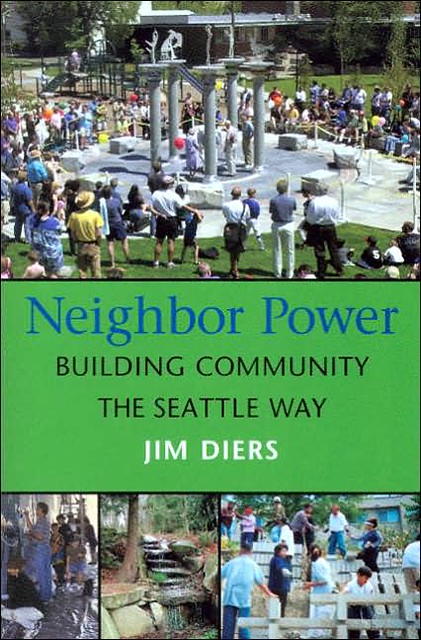
Neighbor Power by Jim DiersThe book Neighbor Power: Building Community the Seattle Way is authored by the first director of the program, Jim Diers.

The now no longer extant Neighborhood Revitalization Program in Minneapolis provided technical assistance and training to citizen groups initiating neighborhood improvement projects which were funded through a long term bond program. The city created the funding stream but then realized that the citizen organizations often didn't have the skills to bring projects forward.

The Urban Information Center at the Dallas Public Library provides a focused collection of resources relevant to municipal matters.

Massachusetts has the Citizen Planner Training Collaborative to provide training and assistance to community planning boards which are comprised of citizens, many of whom are not planning professionals.

The National Main Street Center provides what is called the "Four Point" training in the precepts of the Main Street Approach to commercial district revitalization.  The national training is one half-day for each: economic development; urban and store design; marketing; and organization/fundraising.

Calgary has a strong system of neighborhood associations and a city-wide support organization called the Federation of Calgary Communities providing technical assistance, even having urban planners on staff to provide support to the neighborhood groups ("Community association planning committees a hidden gem?," Calgary Herald).

The Asset Based Community Development Institute conducts trainings, publishes a wide variety of workbooks, and provides support to national and international practice networks following the model.

Park People in Toronto publishes guides for people organizing events in parks:

-- Park Friends Group Guidebook
-- Adopt-a-Park-Tree-Manual
-- How-to Host a Campfire in the Park
-- How-to Host a Movie in the Park
-- How-to Host a Picnic in the Park

Community Design Centers. Many cities have "urban" or "community design centers," which may be independent or affiliated with a university ("A New Voice in Town: Urban Design Centers," Urban Land Magazine).  Baltimore's Neighborhood Design Center is independent, while Cleveland's Urban Design Center is a unit of Kent State University.  There is a national association for these groups, the Association for Community Design.

New York City has a wide range of groups, in keeping with their status as the nation's largest city. The Municipal Arts Society does more than historic preservation and is complemented by other groups such as the Center for an Urban Future, the Gotham Foundation, Drum Major Foundation, the Historic Districts Council, and the Regional Plan Association among others. Most of them have conferences, publish reports, do tours, etc. Boroughs often have a full complement of groups as well. Separately the City Council funds the Independent Budget Office to provide information and review of the city's budget by an independent source.  And Transportation Alternatives is a national leader in sustainable mobility initiatives.

In Chicago, the Center for Neighborhood Technology is a national organization very involved locally. The Chicago Reporter is an advocacy reporting organization publishing a monthly periodical. It spawned Catalyst Chicago is their initiative on local schools issues. They used to publish a special newsletter but no longer do.

Pittsburgh's Community Technical Assistance Center provided assistance to low income communities, but it dissolved and its activities have been picked up by an organization called Neighborhood Allies. Pittsburgh's Sprout Fund is a grant fund for small and innovative community projects.

San Francisco has SPUR, the San Francisco Bay Area Planning and Urban Research Association.  In Seattle, Feet First is an exemplary example of a sustainable mobility organization, although Walk Boston, Walk Denver, Starkville in Motion (Mississippi) are others.

In historic preservation, some city organizations are particularly robust and stand out, including the Pittsburgh History and Landmarks Foundation, Landmark Society of Western New York (Rochester), Preservation Resource Center of New Orleans and the Cleveland Restoration Society.

Working as networks.  My biggest criticism in cities like DC is that there are lots of neighborhood organizations, or Main Street programs, or historic preservation groups, but for the most part they don't work together or leverage the capacity and capability present by operating at the network scale.  That's why the Federation of Calgary Communities model is so interesting.

Labels: , , , ,

Monday, October 10, 2016

Community Development Week in DC

The Coalition for Nonprofit Housing and Economic Development has declared this week to be "Community Development Week" in DC.

The concept of the community development corporation grew out of work done by the Ford Foundation in the 1960s.  There are great CDCs and lousy ones.

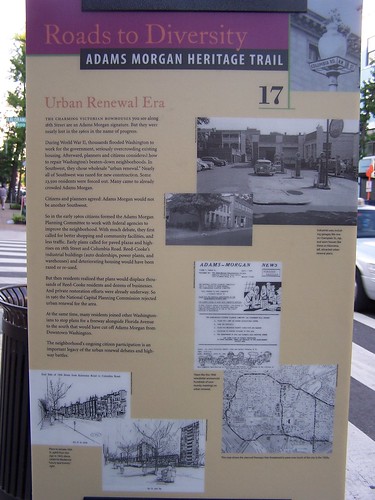
Urban renewal, Adams-Morgan Heritage Trail Sign
The difference comes down to support and opportunities, but a big problem generally is that CDCs mostly focus on creating better housing for the impoverished--and while this is a worthy, necessary goal, in and of itself it doesn't improve broken micro-economies.

To fix local micro-economies a broader focus on microenterprise development, and neighborhood and commercial district revitalization is required.

Some CDCs, such as Bethel New Life CDC in Chicago or the Famikos Foundation in Cleveland, the portfolio investments of the Abyssinian Development Corporation in Harlem, those of the Community Preservation and Development Corporation in DC, or the various efforts involving Mihalio Temali in Minneapolis-St. Paul are particularly impressive.  (Temali is the author of an excellent textbook, Community Economic Development Handbook.)

That being said, CDCs have a tough environment to work within, a lot of barriers, etc., as this paper from the late 1990s by Professor Randy Stoecker (now at University of Wisconsin) illustrates "The Community Development Corporation Model of Urban Redevelopment: A Political Economy Critique and an Alternative."

When I read it the first time, it explained a lot.

My thinking is that there is a difference between the traditional big project real estate development approach and "community economic development."

I'd forgotten that I had been involved in trying to create such an approach in the Ivy City neighborhood (draft document), but it didn't proceed for various reasons--that's one of the examples of my line about community organizing and community development, that "you are only as strong as your weakest link."

I have a bunch of pieces on the topic as it relates to DC.

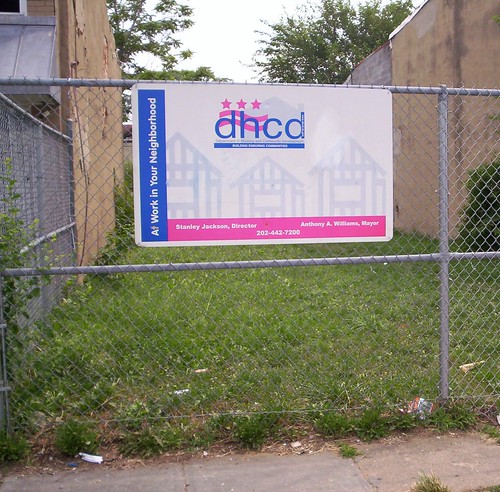
DHCD sign, Florida Avenue NWIn fact, you could argue I am "blowback" from CDCs because I finally became a "community activist" trying to figure out why after spending more than $100 million (including lease payments) via the H Street Community Development Corporation and related efforts (two senior housing developments, restructured housing, a strip shopping center, Hechinger Mall), the H Street NE commercial district remained "under-improved."

This piece from three years ago, "The community development approach and the revitalization of DC's H Street corridor: congruent or oppositional approaches?," was a response to a self-congratulatory op-ed ("The seeds of the H Street ‘miracle’") by the director of the DC branch of the Local Initiatives Support Corporation, about how today's success of the H Street neighborhood, written about in newspapers like London's Financial Times and the New York Times, and called by Forbes Magazine one of the hippest neighborhoods in the U.S., is because of the long time involvement of the H Street Community Development Corporation in post-riot (1968) efforts to fix the declining neighborhood.

Just as some CDCs are better than others, it is also the case that some LISC offices--the Local Initiatives Support Corporation, a kind of capacity building and technical assistance operation for CDCs created by the Ford Corporation--are better than others.  DC has failed in both categories.

Needless to say, I disagree/d, "vociferously."

But I have been writing about this for a long time, for example in 2005, I wrote a blog entry about how a few years after the Washington Post ran a detailed series of failures on the part of some of DC's community development corporations, the DC Building Industry Association gave some of these same organizations awards.  ("Falling up -- Accountability and DC Community Development Corporations").

Plus this "follow up" piece from 2011, also in response to a Post series, "(Some) Community Development Corporations still screwing up."

This piece originally from 2006, "The five periods of urban revitalization since WWII," is reasonably authoritative but due for an update because of
Commercial district revitalization is still tough ("Ground up commercial revitalization and the Skyland Town Center project") and I think it needs to shift to better focus on creating viable retail ("Why it's hard to holiday shop in DC's neighborhood retail districts" and "The long term shake out of local retailers and independent commercial districts").

406 H StreetAfter 30 or more years of being vacant, this building has been renovated and a third floor added.

The struggle in historic preservation now isn't promoting stabilization in the face of shrinking cities and lost population and businesses, but how to respond to opportunities for urban growth and the need for more housing to accommodate demand ("Historic preservation continued").

Meanwhile cities are still having time casting off the yoke of public funding of sports facilities ("An arena subsidy project I'd probably favor: Sacramento") and the urban renewal tradition of big projects ("Urban planning and the difference between "economic development" and "building a local economy"").

There is limited  movement to improving options for funding local government ("The real lesson from Flint, Michigan is about municipal finance").

And there is still resistance to adopting sustainable mobility strategies in the face of the primacy of the oil and automobile manufacturing industries (Quote of the day: "it isn't the place of the government to push people out of their cars and into alternative transportation").

Maybe the biggest problem is that even in the best circumstances, revitalization is a multi-decade process ("360 Apartment building + Giant Supermarket vs. a BP gas station, which would you choose?").  People aren't patient.  And it's hard to be patient in the face of neglect.
__________________
*  From "Economic restructuring success and failure: Detroit compared to Bilbao, Liverpool, and Pittsburgh":

The six components of a successful broad ranging revitalization program.  In writing about the various [revitalization] efforts [in European cities especially], I drew the conclusion that successful revitalization programs, especially in those cities that were working to overturn serious disadvantages, were comprised of these elements:
  • A commitment to the development and production of a broad, comprehensive, visionary, and detailed revitalization plan/s (Bilbao, Hamburg, Liverpool);
  • the creation of innovative and successful implementation organizations, with representatives from the public sector and private firms, to carry out the program.  Typically, the organizations have some distance from the local government so that the plan and program aren't subject to the vicissitudes of changing political administrations, parties and representatives (Bilbao, Hamburg, Liverpool, Helsinki);
  • strong accountability mechanisms that ensure that the critical distance provided by semi-independent implementation organizations isn't taken advantage of in terms of deleterious actions (for example Dublin's Temple Bar Cultural Trust was amazingly successful but over time became somewhat disconnected from local government and spent money somewhat injudiciously, even though they generated their own revenues--this came to a head during the economic downturn and the organization was widely criticized; in response the City Council decided to fold the TBCT and incorporate it into the city government structure, which may have negative ramifications for continued program effectiveness as its revenues get siphoned off and political priorities of elected officials shift elsewhere);
  • funding to realize the plan, usually a combination of local, regional, state, and national sources, and in Europe, "structural adjustment" and other programmatic funding from the European Regional Development Fund and related programs is also available (Hamburg, as a city-state, has extra-normal access to funds beyond what may normally be available to the average city);
  • integrated branding and marketing programs to support the realization of the plan (Hamburg, Vienna, Liverpool, Bilbao, Dublin);

Labels: , , , , , ,