Rebuilding Place in the Urban Space

"A community’s physical form, rather than its land uses, is its most intrinsic and enduring characteristic." [Katz, EPA] This blog focuses on place and placemaking and all that makes it work--historic preservation, urban design, transportation, asset-based community development, arts & cultural development, commercial district revitalization, tourism & destination development, and quality of life advocacy--along with doses of civic engagement and good governance watchdogging.

Tuesday, June 13, 2023

School district wide retention and improvement initiatives: Kalamazoo Promise

I have written about how in the 1980s, Hennepin County, Minnesota realized that population shrinkage in Minneapolis was costing it significant property tax revenue, and the reductions would put the county's finances at risk.

What they did is look at the places in Minneapolis that weren't losing population and they realized they were rich in natural amenities--parks, lakes, rivers--and they figured out that if they aimed to reproduce those conditions in more places in the city, they could add population instead of lose it.

They created the Hennepin Works initiative as an infrastructure investment program to do just that ("A County and Its Cities: the Impact of Hennepin Community Works," Journal of Urban Affairs, 2008).  

Later they added light rail transit to the program.  And later and separately, Minneapolis created its own neighborhood investment program called the Neighborhood Revitalization Program, which invested in schools, parks, and other neighborhood-based infrastructure.

Central city school districts have similar issues.  First, as the nature of households change there are fewer children anyway.  Second, but as options for schooling grow--private, parochial, charter--school districts are capturing a smaller percentage of the student population in their cities, especially higher income families.

Charter schools.  Some cities, like Milwaukee and Washington, DC, created a parallel system of charter schools to provide a greater array of choices to parents, keeping the families in the city, but at the cost of planned decline of the traditional school system, which lost enrollment and funds, as well as social and community capital as families shifted to charter schools.

Maps4Kids, Oklahoma City.  Oklahoma City is very large, almost 600 square miles, with urban and suburban sections, with more than 20 school districts serving parts of the city.  The urban section is served primarily by the Oklahoma City School District, and the facilities had languished, especially by comparison to the suburban areas.

The city's Metropolitan Area Projects (MAP) program invests in infrastructure as amenities projects.  The second phase invested in school buildings, focused mostly on the urban section of the city, but with monies also going to the suburban school districts.

While the facilities improved significantly and this helped to improve neighborhoods, attract new residents and students along the lines discussed in "The bilingual Key Elementary School in Arlington County as another example of the "upsidedownness" of community planning," MAPS4Kids didn't invest simultaneously in programs, curriculum improvements, etc., so the benefits were muted.

Special/magnet schools.  Other cities kept the focus on the traditional system, but added a handful of magnet or special schools and programs, as a way to attract or retain families with choices.  Philadelphia, in association with the University of Pennsylvania, created special schools in the vicinity of the university.

These efforts can be criticized as inequitable because they aren't focused on improving the entire system, but only schools likely to be attended by high income students.

The Transformation Program in Dallas counteracts this by focusing on larger geographies with a deliberate process for enrolling low income children, and seems to be doing quite well ("Dallas parents flocking to schools that pull students from both rich and poor parts of town: School districts see success with ‘Transformation Schools’ that offer a socioeconomically mixed student body," Hechinger Report).

Kalamazoo Promise.  Kalamazoo is a second tier Michigan city.  Home to Western Michigan University and private colleges, it had been the headquarters city of Upjohn Pharmaceuticals, and the firm contributed significantly to the city's success.  Also, less successful, it is the site of the first Downtown pedestrian mall in the US.

The school district had been shrinking in enrollment for more than a decade, and in 2006 they introduced a new program, free college tuition for graduates.  In the 17 years since, student enrollment has stabilized and increased, while in the other districts in Kalamazoo County, student enrollment has decreased uniformly.  The same is true compared to other Michigan second tier cities--Kalmazoo's school district grows in enrollment, while the others shrink.  

The school system captures 84% of potential enrollment.  And is racially diverse.

-- "Biggest success of The Kalamazoo Promise? It’s a magnet," Kalamazoo Gazette
-- "17 years later, The Kalamazoo Promise has changed lives. But it hasn’t been a cure-all," KG

From the second article:

Starting with the KPS Class of 2006, The Promise has paid about $200 million in college tuition for more than 7,600 students. Not including the most recent round of college graduates, 2,954 Promise-eligible students have earned a higher-education degree or certification, including 2,350 with at least a bachelor’s degree, Promise data shows.

So it's not cheap.  But at $12 million per year, it's a relatively cheap stabilization measure.  On the other hand, some involved argue that improvements within the school system are elusive.  That doesn't surprise me as the MAPS4Kids program proved you need to have simultaneous investments in programs, curricula, etc.  From the article:

That said, Jorth and others agree that The Kalamazoo Promise is still a work in progress. There have been challenges along the way. The idea The Promise would transform Kalamazoo has proven illusive. “We’re better off as a community,” said Brad Hershbein, an Upjohn Institute senior economist and deputy director of research. “The district is better off. But there are still a lot of problems that remain. “It’s not a panacea. It hasn’t solved everything,” he said. “In fact, it hasn’t solved that much of anything.”

Conclusion: you have to go big.  I think the solution is to pair a complementary neighborhood and city revitalization program to the schools initiative.

For links to past writings a city-wide revitalization programs, see:

-- "Revisiting St. Louis revitalization planning in the face of population shrinkage" (2023)

Labels: , , , , ,

Sunday, June 11, 2023

Linda Lenz, founding editor of Catalyst Chicago, dies at 77 | Technical assistance for local schools advocates

This entry is in keeping with the two previous entries which are schools related, especially:

-- "School closure and consolidation planning needs to focus on integration planning at the outset as a separate process"  

Linda Lenz (obituary, Chicago Tribune, Chicago Reporter obituary) who died in May, was the founder of Catalyst Chicago, which was a news reporting and technical assistance organization focused on Chicago schools issues.  From the article:

a state law decentraliz[ed] the Chicago school system and giving parents and educators the power to review school budgets and hire principals. The publication put a spotlight on schools where reform efforts were working, as well as those where reform efforts were running aground. Catalyst also published opinion columns, studied education experiments in other cities and surveyed students, teachers and principals on certain issues.

Lenz, had an extensive background in local news reporting, including on the education beat, realized that advocates needed focused information to better help them carry out their responsibilities wrt school management and oversight.

It was somewhat comparable, although independent of government, to how Minneapolis created the Neighborhood Revitalization Program to train residents and provide technical assistance and training to undergird their participation in significant neighborhood capital projects.  They realized, once they started the program, that most participants lacked the right skills and knowledge to carry out the project.

I've written about other kinds of systematic citizen support efforts that impress me here, "Framingham Massachusetts creates Citizen Participation Officer position."

Interestingly, Chicago had at least two other similar publications on local issues, the Chicago Reporter, and a publication by the Center for Neighborhood Technology, which later became much more nationally focused, and those might have influenced the creation of Catalyst.  The same organization that publishes CR published Catalyst, which ceased operation in 2016, after publishing for 26 years.  For awhile, a sister publication also operated in Cleveland.

School reform and how can communities respond.  I bring this up because of the two related previous entries on schools issues, and the issue of "school reform."  I wrote many entries about it.  

-- "Schools #2: Successful school programs in low income communities and the failure of DC to respond similarly," 2017

-- "Missing the most fundamental point about urban educational reform," 2009

DC was a national example of the movement, centered around Michelle Rhee, a charter school proponent who became Chancellor of DC schools, and who mostly blamed "bad teachers" for the problems, not acknowledging that (1) "bad" teachers were produced by the system, and (2) charter schools usually had more resources, more time on task, and fewer school and legal requirements than "traditional schools."

Plus, because she couldn't take credit, basically she was against programs that were already successful before her arrival like language immersion and Montessori--when those kinds of programs are ways for traditional public schools to distinguish their programs.

Mostly the DC reform effort failed, but the Washington Post sure was all in.

-- Fawning coverage of DC school "reform" doesn't push better practice forward," 2017

Advocates need a solid narrative.  I was on an e-list on DC schools issues, and my complaint to the advocates and "opponents" to the reform program was that they failed to develop a counter narrative to Rhee.  They were inchoate.  Without a narrative you lose by default.

And so like my belief in civic engagement training for people participating in planning issues, I believe the same is true for schools.  There aren't a lot of available resources.

Sure there are PTAs and PTOs, and theoretically the two main teachers unions, but none of these organizations have provided the kinds of resources I think people need to have to be better informed and able to articulate alternatives.

Printed resources.  For publications there is the newsweekly Education Week, which I think all main branches of public libraries should get.  For alternative publications, I can only think of Radical Teacher and Rethinking Schools.  I guess there are others, like K12 Digest, and blogs.  

That's why Catalyst Chicago was so innovative.

For years I've recommended that main branch libraries create collections comparable to the Urban Information Library at the Dallas Public Library, along with programming which I don't think they do, but I never suggested adding schools-related publications to the mix.

There are probably others.  Plus decent academic journals, of which there are many.  At the same time there need to be trained professionals available to help advocates, because they can't be expected to assimilate all the information and apply it.

While speed bumps do suck, what's being proposed are raised crosswalks, and the way they are implemented in Salt Lake they don't "hinder" traffic, but they do provide visual, aural and physical cues to not drive as fast.

Safe routes to school is a good example. (See the end of this entry on walk and bike to school).  It ought to be noncontroversial.  

But even in my neighborhood, some residents are fighting a proposal to add raised crosswalks to an arterial serving two schools that have a high percentage of students walking to school.  

There should be resources and technical assistance aimed at helping bring people together.  

Especially since walking improvements for students also improve neighborhoods for everyone.  Interestingly, though our greater neighborhood is T4 in the New Urban transect it's pretty walkable, except when people do walk--other than to school--it's mostly recreational.

Conclusion.  Then again, we could provide all the civic engagement and technical assistance in the world and maybe the outcomes would be the same.  However, I do know that doing things the way we are doing them--even if by omission--isn't working, so it's obvious that alternatives are in order.

Labels: , , , , , ,

Sunday, February 16, 2020

EU best practice capitals 2020

One of the things that really impresses me about the European Union is its programs to promote best practice, culture, etc.

Capital of Culture program.  One of the earliest programs, designed to promote both individual countries as well as the idea of the European Union is the Capital of Culture program.

Originally, one city was designated.  Now, each year there are two capitals.  Countries in the EU sphere but not actual EU members are occasionally part of the program, such as Norway and Turkey.

There is a rolling schedule where countries are designated to participate and then within the designee there is a process and competition for final selection.  The UK went on to create their own version of the program, "City of Culture", which runs on a four year schedule.

This year, the cities are Rijeka (Croatia) and Galway (Ireland).

-- European Capital of Culture 2020 - City of Rijeka
-- Galway 2020 European Capital of Culture

The overarching program has commissioned a number of studies evaluating the program.   More recently, cities have begun commissioning research programs associated with their hosting of the event, such as the five-year Impacts08 study for Liverpool, which was commissioned at the outset of the city’s winning the hosting slot for 2008, and/or local academic institutions have engaged in separate research programs for more focused study on the impact of this event in their community on their own and through the specially created University Network of the European Capitals of Culture.

Such studies complement the incredibly rich academic literature generated on the program (and the various regeneration projects in the cities studied in this series).  In addition to a wide variety of one-off articles, special issues of journals such as International Journal of Culture Policy (2004), Local Economy (2004), Urban Studies Journal (2005), and the Nordic Journal of Cultural Policy (2010) have addressed the program both generally and specifically with evaluations and explorations of the various program years and successes and failures.

Extension of the concept: the Green Capital.  In 2008, the EU created the Green Capital program, to call attention to best urban environmental practices.  The first city designated, Stockholm, inaugurated the program in 2010.

The 2020 designee is Lisbon.

-- Lisbon Green Capital 2020

Youth Capital Program
. Modeled also after the Culture Capital, the European Youth Forum created the European Youth Capital program, making in 2009 Rotterdam the first capital chosen.

-- European Youth Capital: 10 Years of boosting vibrant, youthful cities 

In 2014, the Congress of Local and Regional Authorities of the Council of Europe became an official endorsing partner.

-- The 2020 Youth Capital is Amiens, France
-- Program brief in English

Labels: , , , , ,

Wednesday, December 18, 2019

Rebuilding civil society through "political rewilding"

Guardian columnist George Monbiot ("There is an antidote to demagoguery – it’s called political rewilding") suggests that the rise of authoritarian populism could be staunched by re-engaging people and local governments in taking action and dealing with matters in a more subsidiarity fashion.  From the article:
The much bigger change is this: to stop seeking to control people from the centre. At the moment, the political model for almost all parties is to drive change from the top down. They write a manifesto, that they hope to turn into government policy, which may then be subject to a narrow and feeble consultation, which then leads to legislation, which then leads to change. I believe the best antidote to demagoguery is the opposite process: radical trust. To the greatest extent possible, parties and governments should trust communities to identify their own needs and make their own decisions.

... When you try to control nature from the top down, you find yourself in a constant battle with it. ... The same applies to politics. Mainstream politics, controlled by party machines, has sought to reduce the phenomenal complexity of human society into a simple, linear model that can be controlled from the centre. The political and economic systems it creates are simultaneously highly unstable and lacking in dynamism; susceptible to collapse, as many northern towns can testify, while unable to regenerate themselves. They become vulnerable to the toxic, invasive forces of ethno-nationalism and supremacism.

But in some parts of the world, towns and cities have begun to rewild politics. Councils have catalysed mass participation, then – to the greatest extent possible – stepped back and allowed it to evolve. Classic examples include participatory budgeting in Porto Alegre in Brazil, the Decide Madrid system in Spain, and the Better Reykjavik programme in Iceland. Local people have reoccupied the political space that had been captured by party machines and top-down government. They have worked out together what their communities need and how to make it happen, refusing to let politicians frame the questions or determine the answers. The results have been extraordinary: a massive re-engagement in politics, particularly among marginalised groups, and dramatic improvements in local life. Participatory politics does not require the blessing of central government, just a confident and far-sighted local authority.


There are other examples of capacity building and community-driven action, including the Asset Based Community Development Approach, less radical citizen involvement programs in Calgary, Minneapolis, and Seattle ("Framingham Massachusetts creates Citizen Participation Officer position"), various citizen-engaged planning systems (Atlanta, San Diego), etc.

And while more top-down, social urbanism in Medellin, Colombia ("Social urbanism and Baltimore") and Antanas Mockus' "Citizenship Culture" approach in Bogota ("Citizenship Culture: Nudging urban residents to get along & give back," Big Bold Cities) are also relevant approaches to re-engaging citizens.

In college I came across the work of the now defunct Citizen Involvement Training Project and the community organizing approach in the field of Social Work ("Building Citizen Support for Planning at the Community Level," The Journal of Sociology & Social Welfare) which influenced me greatly.

Labels: , , , ,

Monday, February 18, 2019

Here's a program every city needs to do: NYC's Municipal Arts Society's Livable Neighborhoods program

2019 Livable Neighborhoods Program!
MAS is seeking applications from community-based partners for the 2019 Livable Neighborhoods Program.

Selected groups will work with MAS staff to develop and deliver public workshops that will help educate their neighbors on planning basics, including regulations and processes that govern land use in New York City, and community advocacy tools.

Successful applicants have included community leaders of many varieties such as staff and volunteers from community-based organizations, neighborhood and block associations, and Community Boards. Please consider applying, and help spread the word to your networks!

Deadline to Apply: Friday, February 22, 2019

========
PPS How to Turn A Place Around workshop.  Similarly, years ago I used to suggest that the old Project for Public Spaces workshop, "How to Turn A Place Around," should be offered every year as a training exercise in DC, both to focus attention on a particular neighborhood as well as to be a training program for city employees and residents from elsewhere in the city.

I participated in an abbreviated example for the Eastern Market Metro Plaza in 2004 ("From Eastern Market Metro Plaza to Capitol Hill Town Square") as well as the full workshop in NYC.

I also have suggested the HTTPA workshop model could be used by elementary schools as a way to build stronger connections between the school and area residents, many of whom do not have children or children in the particular school.
(PPS doesn't offer this particular workshop anymore, but here is an old webpage.)

Main Street commercial district revitalization training.  The Main Street "Four Points" training is another good model to offer organizations and neighborhoods as a way to focus people's attention on developing better and more successful practice.

Charrettes, etc.  Charrettes and other design workshop models from planning, landscape architecture, cultural tourism development, and architecture function similarly.

Labels: , , , ,

Thursday, September 13, 2018

September 22nd is DC Historic Preservation Community Day

Without much notice, DC Preservation League has called attention to a new event it is sponsoring called, "Historic Preservation Community Day." Ironically, just had a water problem in the basement and one of the items that was destroyed was the agenda/handout from a Preservation Expo that I went to in Philadelphia about 7 years ago. I've been advocating for years that the preservation community do such an event in DC.

Capitol Hill Restoration Society has done an expo for the last couple years. I went last year but was disappointed. (One reason is that they had a band playing in the same hall where the exhibits were and the band was too f*ing loud. You couldn't talk to the exhibitors without having to scream. As Suzanne points out, groups have music at events when they aren't confident enough in believing that what they offer on view doesn't need to be augmented by music or something else other than the content at hand.)

We'll see how this one works out. (The space is pretty small, that's a knock...)

Of course, it'd be most logical to do something like this during National Historic Preservation Month in May...

From email:
September 22nd is Historic Preservation Community Day

Morning lectures include architectural history of DC, history of the preservation movement, city regulations for historic districts and historic landmarks with information on the homeowner grant program.

Afternoon technical discussions include how to research your house history and historic window rehabilitation, maintenance and replacement.

Afternoon preservation stations will feature vendor consultations and local and neighborhood preservation organizations. Sample stations include: restoring historic windows, repointing, roof repair, and more!

ASL and Spanish Language Interpretation Provided!

Saturday, September 22, 2018
10:00am – 4:00pm

All Souls Church
1500 Harvard Street NW
Washington, DC
(Columbia Heights)

Free and Open to the Public!

Registration is not required, but encouraged to assist us with planning for the day!

Labels: , ,

Monday, July 30, 2018

Framingham Massachusetts creates Citizen Participation Officer position

From the Boston Globe article, "Job position opens in Framingham to connect politicians to locals":
The creation of the position was provided for in the new city charter adopted in 2017. Whoever is selected will be responsible for helping community members influence public decisions.

The Citizen Participation Officer’s specific duties will include working with city departments, boards, and commissions to use communication and outreach to enhance public engagement, process citizen complaints and inquiries, and comply with public notice requirements. The officer will also be charged with analyzing data on citizen engagement, complaints, and inquiries, and to prepare reports on that data.
The headline isn't fully accurate. The job is to connect residents to the government. Government is led by elected officials--"politicians"--but is effectuated mostly by staff, organized through agencies, which deliver programs.

Many cities have this kind of position. In bigger cities there are many people tasked with this responsibility, across the various agencies.

The big problem is that there is no consensus about how to "train" citizens to be better at and independent in participating.

One of my complaints about the system of neighborhood engagement by the Executive Branch and the various Councilmembers is that there isn't a general system of support and training and technical assistance. Things are more loose and in my opinion, designed to foster incumbency and dependence rather than knowledge, skill, capacity and independence.

Some best practice examples of citizen capacity building

Seattle's Department of Neighborhoods is an example of creating a unit of the government that provides technical assistance and financial support to citizen initiatives that is somewhat independent of politics and incumbency protection.

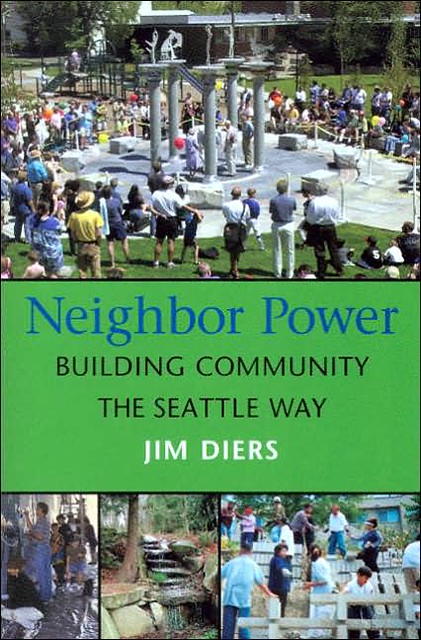
Neighbor Power by Jim DiersThe book Neighbor Power: Building Community the Seattle Way is authored by the first director of the program, Jim Diers.

The now no longer extant Neighborhood Revitalization Program in Minneapolis provided technical assistance and training to citizen groups initiating neighborhood improvement projects which were funded through a long term bond program. The city created the funding stream but then realized that the citizen organizations often didn't have the skills to bring projects forward.

The Urban Information Center at the Dallas Public Library provides a focused collection of resources relevant to municipal matters.

Massachusetts has the Citizen Planner Training Collaborative to provide training and assistance to community planning boards which are comprised of citizens, many of whom are not planning professionals.

The National Main Street Center provides what is called the "Four Point" training in the precepts of the Main Street Approach to commercial district revitalization.  The national training is one half-day for each: economic development; urban and store design; marketing; and organization/fundraising.

Calgary has a strong system of neighborhood associations and a city-wide support organization called the Federation of Calgary Communities providing technical assistance, even having urban planners on staff to provide support to the neighborhood groups ("Community association planning committees a hidden gem?," Calgary Herald).

The Asset Based Community Development Institute conducts trainings, publishes a wide variety of workbooks, and provides support to national and international practice networks following the model.

Park People in Toronto publishes guides for people organizing events in parks:

-- Park Friends Group Guidebook
-- Adopt-a-Park-Tree-Manual
-- How-to Host a Campfire in the Park
-- How-to Host a Movie in the Park
-- How-to Host a Picnic in the Park

Community Design Centers. Many cities have "urban" or "community design centers," which may be independent or affiliated with a university ("A New Voice in Town: Urban Design Centers," Urban Land Magazine).  Baltimore's Neighborhood Design Center is independent, while Cleveland's Urban Design Center is a unit of Kent State University.  There is a national association for these groups, the Association for Community Design.

New York City has a wide range of groups, in keeping with their status as the nation's largest city. The Municipal Arts Society does more than historic preservation and is complemented by other groups such as the Center for an Urban Future, the Gotham Foundation, Drum Major Foundation, the Historic Districts Council, and the Regional Plan Association among others. Most of them have conferences, publish reports, do tours, etc. Boroughs often have a full complement of groups as well. Separately the City Council funds the Independent Budget Office to provide information and review of the city's budget by an independent source.  And Transportation Alternatives is a national leader in sustainable mobility initiatives.

In Chicago, the Center for Neighborhood Technology is a national organization very involved locally. The Chicago Reporter is an advocacy reporting organization publishing a monthly periodical. It spawned Catalyst Chicago is their initiative on local schools issues. They used to publish a special newsletter but no longer do.

Pittsburgh's Community Technical Assistance Center provided assistance to low income communities, but it dissolved and its activities have been picked up by an organization called Neighborhood Allies. Pittsburgh's Sprout Fund is a grant fund for small and innovative community projects.

San Francisco has SPUR, the San Francisco Bay Area Planning and Urban Research Association.  In Seattle, Feet First is an exemplary example of a sustainable mobility organization, although Walk Boston, Walk Denver, Starkville in Motion (Mississippi) are others.

In historic preservation, some city organizations are particularly robust and stand out, including the Pittsburgh History and Landmarks Foundation, Landmark Society of Western New York (Rochester), Preservation Resource Center of New Orleans and the Cleveland Restoration Society.

Working as networks.  My biggest criticism in cities like DC is that there are lots of neighborhood organizations, or Main Street programs, or historic preservation groups, but for the most part they don't work together or leverage the capacity and capability present by operating at the network scale.  That's why the Federation of Calgary Communities model is so interesting.

Labels: , , , ,

Sunday, April 01, 2018

Working capital loans through crowdfunding

A record store, Exile on Main Street in Champaign, Illinois, lacking enough money to buy inventory for "Record Store Day," a nationally coordinated shopping promotion for independent record stores--this year it's on April 21st-- has set up a crowdfunding program to help them buy inventory, because they don't generate enough sales to put money aside for particularly large purchases of stock ("Exile on Main Street launches GoFundMe to save their Record Store Day," Smile Politely).

The funds are treated as store credit, not donations.

Labels: , , , ,