"A community’s physical form, rather than its land uses, is its most intrinsic and enduring characteristic." [Katz, EPA] This blog focuses on place and placemaking and all that makes it work--historic preservation, urban design, transportation, asset-based community development, arts & cultural development, commercial district revitalization, tourism & destination development, and quality of life advocacy--along with doses of civic engagement and good governance watchdogging.
Friday, June 14, 2019
Why microtransit isn't likely to be a source of great profits for private firms: labor
In doing filing, I came across a columnist writing about autonomous vehicles back in 2017. She made the point that new technologies and ways of doing things are often oversold in the short run, but have great influence over the long run.
What is now called "microtransit" isn't new. For example, for many years I've written about free neighborhood shuttle bus routes in Tempe, Arizona and "shared taxi services" at the outskirts of transit service zones in Montreal.
Microtransit is the "new" term for shuttle buses and the like, including services such as UberPool, Via, and various failed services like Bridj.
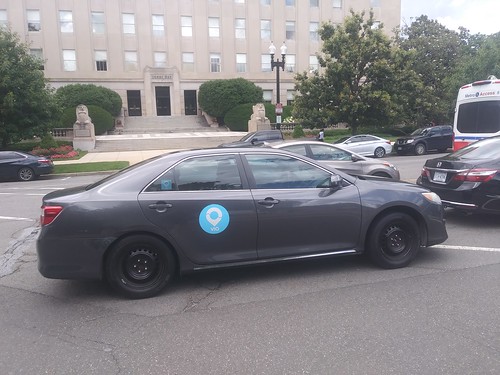
Anyway, this ad I saw on the back of a Metrobus for Via, which is a semi-fixed route "shuttle" aiming to move people within districts, usually focused on getting people to and from rail transit stations, communicates the reality of why microtransit is not likely to be financially viable for private sector service.
Labor costs a lot. Fares are comparatively low. And there aren't a lot of riders.
If you paying $200/8-hour shift for 14 shifts/week, that's almost $3,000/week. Plus the cost and depreciation of the vehicle, insurance, and variable expenses to gas up and maintain the car, soft infrastructure to run the service, etc.
The Fort Lauderdale service is free, paid for by local governments and a combination of ad and sponsorship sales. From the Ft. Lauderdale article:
Partnering with local governments and private advertisers, several companies are building fleets of low-speed street-legal six-seat electric shuttles to ferry the permanently or temporarily car-less over short distances within congested urban zones.
Pedestrians in busy sections of Fort Lauderdale, Palm Beach and West Palm Beach can use smartphone apps to summon rides from two growing services: Freebee, in the middle of a pilot program in a square-mile section of downtown Fort Lauderdale, and Circuit (formerly The Free Ride), which serves Fort Lauderdale’s beachfront resort area and last week began shuttling tourists and commuters in the core area of Hollywood.
...
Jason Spiegel, a University of Miami grad who started Freebee in 2011 with fellow Hurricane alum Kris Kimball, said his company can make money giving away free rides by pursuing three business models:
One model calls for cities to fund the entire operation as if it was their own.
Under the second, the city pays a contracted rate that gets reduced as advertising is sold. Prior to its current deal with Freebee, Coral Gables agreed to pay $300,000 a year and saw that amount reduced to $110,000 after Baptist Health came on board as sole sponsor. But when the contract came up for renewal, Coral Gables decided it didn’t want outside advertising and agreed to pay $486,000 to expand from three to five vehicles and keep its service self-branded, Spiegel said.
Under the third model, ad revenues fund the entire operation. Riders are greeted with ads not only wrapped around the outside of the vehicles, but inside and on mounted tablets. Often drivers pass out product samples provided by the advertisers. Riders can take selfies with the tablets, send them to their friends and even listen to their requested music, Spiegel said.
But it must be recognized that success at advertising is likely to be in tourist areas and downtowns, not in "the average neighborhood."
Note that I define intra-neighborhood services like these, which include standard shuttles serving private organizations, as part of a community/metropolitan area's "tertiary" transit network.
But getting back to autonomous vehicles, which in the long run (at least 10 years down the road) are more likely, eliminating the cost of direct labor for such a service will significantly change the cost structure and then perhaps such a microtransit service could be a viable for profit venture.
A comment on the Army Futures Command: it's not enough to be innovative, the challenge is to implement and diffuse the innovation
=====
This isn't exactly about urbanism, but the reality is that the overarching theme of the blog is about change management and how organizations function, this is still relevant.
=====
There was a big competition between cities for landing the Army Futures Command, a new unit of the Army focused on innovation, technology, telcommunications etc., and bringing new ways of doing things to "The Big Army."
The Army chose Austin, Texas ("Why the Army picked Austin for Futures Command," Defense News), home to a big chunk of the IT industry, the University of Texas, and other forward firms and events like the South by Southwest Festival. From the article:
The Army focused on six major criteria to choose Austin: proximity to science, technology, engineering and mathematics workers and industries; proximity to private sector innovation; academic STEM and research and development investment; quality of life; cost; and civic support.
“I laid out the six variables. Austin scored the highest,” McCarthy said.
Additionally, the Army looked beyond those metrics and envisioned “how each city ecosystem would support our modernization efforts and priorities vertically from concept to capability to solution,” McCarthy said. “We do not have time to build this ecosystem; it needs to be ready immediately.”
The Army found Austin had access to academia, industry and mature entrepreneurial incubator hubs “to give our leaders placement and access to talent, ideas, collaboration and willingness to help us build the culture we need,” McCarthy said.
It's going to be a small unit, 500 people tops, led by a General.
But I wonder how effective can it be given that it will be so separated from the Defense Department establishment?
People argue that this is necessary so it can be innovative.
But at the same time, speaking of "the diffusion of innovations," they have to be in a position where the technologies and innovations can be introduced to, integrated within, and diffused throughout the organization.
Distant outposts of large organizations can be innovative. But their ability to shape the future of the parent organization is limited.
Two counter-examples of (mostly) failure. The first is the famous example of the Xerox Palo Alto Research Center. This unit of Xerox pioneered the development of many computing technologies that we take for granted today, such as visual computing displays and the mouse (which has since mutated into the touchpad).
But none of these technologies were introduced into the market as successful products by Xerox, which was headquartered far away, in Rochester, New York, and where the corporation continued to be primarily focused on the copy machine ("Big Companies Can't Innovate Halfway," Harvard Business Review).
Ford Motor Company moves division headquarters to California. In the late 1990s, to be more innovative and less hidebound by remaining based in Detroit, and in recognizing the value of big Western state markets, Ford moved the headquarters of Lincoln-Mercury from its Dearborn Michigan complex to Irvine, California ("Ford Moving Main Office of Lincoln Mercury to Irvine," Los Angeles Times).
Two years later, the "Premier Automotive Group" the division made up of recently acquired foreign manufacturers Aston-Martin, Volvo and Jaguar, joined them ("Ford to Move Luxury Lines Offices to Irvine," LAT).
Ford's PAG marques were sold off later, as plans and opportunities changed, the Mercury division was dissolved, and Lincoln's leadership moved back to Dearborn.
Another example of one-off innovation. Another example I frequently mention is the Carl English Botanical Gardens at the Chittenden (Ballard) Locks at Lake Washington in Seattle. The locks connect the Lake and River system to the Puget Sound. All locks in the US are run by the Army Corps of Engineers.
The Army doesn't create arboretums. But because this installation is 2,400 miles from Washington, and was no priority for the Army generally, 20 years after the locks were built, a "groundskeeper," horticulturalist Carl English, Jr., was able to begin adding distinctive plantings because there wasn't close supervision to prevent him from doing so.
Now there's a great one-off arboretum there. But it didn't influence or reshape the ACE going forward to add parks and botanical gardens to locks (although yes, it runs recreation areas as an incidental part of running dams and hydroelectric generation activities).
The challenge isn't just innovation, it's diffusion of the innovation. And because of that, location and the ability to influence and shape the rest of the organization does matter. How do you develop a feedback loop that connects into the parent organization? Disconnected innovation becomes what I call "stranded best practice."
(Kroger's failure to systematically develop a subset of premium stores across their banners, or to make convenience stores be way better than a typical gas, beer, and tobacco store are examples. See "Problem solvers versus possibility thinkers.")
This goes back to counter-insurgency units and "the Green Berets" and Ranger units developed in Vietnam, but not really integrated into Big Army thinking, much to the chagrin of the Army after they ran aground in Iraq, and rediscovered what was learned before.
While it will be great for the winning city, Austin, to have 500 more highly paid workers in a new high profile Army building, the challenge will be to make this move pay off for the Army and the Department of Defense.
The Layman approach to best practice development and diffusion: Indicate; Duplicate; Replicate; Communicate; Accelerate. From "Revitalization planning vs. positive thinking* as planning" (2018) and "Helping Government Learn," (2009). My own take on innovation theory and the development, replication, and the diffusion of innovation is along these lines.
First develop a new practice and figure out if it works. Duplicate it to see if it is more than a one-off thing. Continue to scale it up and figure out all the elements. Once you've one that, communicate out so it can be and is successfully diffused.
1. Indicate -- identity the particulars of processes and structures of success and failure
2. Duplicate -- figure out how to duplicate (repeat) success.
3. Replicate -- develop the systems, structures, frameworks to apply programs to different situations and communicate them throughout innovation networks.
4. Communicate -- push out the final product to communities of practice for more widespread adoption, recognizing that other places will bring new elements to the model
5. Accelerate -- figure out how to speed up successful innovation and programs.
what I call the innovations gap: the difference between actual output and the level of output that firms could achieve if they started using the best technology available to them. Because there is currently a large innovations gap, firms are likely to meet additional demand not be raising prices but by investing in these more efficient techniques. ...
Why have most firms not been investing in the most productive equipment and techniques since the GFC [Global Financial Crisis]? I think the simple answer is fixed costs and demand. Investment projects almost always involve a large fixed cost element (disruption, retraining), and with static demand those fixed costs may exceed any efficiency gain. But in a normal recovery from a recession, where demand is growing rapidly, firms are happy to incur that fixed cost because they need to expand capacity anyway to meet growing demand. In a weak recovery, on the other hand, many firms may not need to expand capacity, with any modest increases in demand going to leading firms, firms that do invest in the latest technology. Hence the divergence noted above.
It's a great term, very succinct, which usefully describes the difference between adopting best or leading practice, adopting better than what you're doing but still laggard practice, or changing nothing, when it comes to government operations.
It's the flip side of what Alexander Gerschenkron called "the economic advantages of backwardness," which Wren-Lewis calls the "fixed costs" of current operations--the investments in the technology and practice you have versus the cost to adopt new practices and technology and the retraining that is required.
Note that I didn't use Brooklyn and Queens as an example, even though Car2Go is operative there today. When asked about this by I colleague, I wrote:
My reservation is that it's not best to try to do something innovative but difficult in a place where it is already extraordinarily difficult to do anything. In other words, try to pick a place to start off with where you can be wildly successful and where opposition is likely to be muted.
E.g., DC tried to do streetcar in Anacostia but the area has pretty contentious if not noxious thinking about politics, "the neighborhood," transit, and public resources. So that area has zero streetcar and DC shifted to H Street NE. It delayed launch, but East of the River, by at 6 years. I was at a WMATA conference in Nov. 2006, where a DDOT person confidently said they'd be starting streetcar service in Anacostia the next year.
I should have said this about NYC:
After figuring this out in places where the constraints are fewer, like DC and Seattle, then take on a space with extraordinarily difficult infrastructure challenges like NYC, specifically Brooklyn and Queens where Car2Go operates.
OTOH, you could counter with Autolib, which was launched in Paris, which is just as tough a place to do it.
The difference though between NYC today and Paris then at the launch of Autolib is the support of the top elected officials, and the overall greater commitment in Europe towards dealing with the environment and climate change.
Autolib was an initiative of the then mayor. And today the Paris mayor is just as committed to the environment and clean air. Did you see that Paris will be giving incentive payments towards the purchase of bikes, cargo bikes, and e-bikes to people who agree to give up their cars, as part of clean air initiatives. That's an indicator of the difference between Paris and today's NYC.
These days, the current mayor of NYC doesn't seem to be particularly engaged when it comes to sustainable mobility generally, and he's not a rah rah kind of person on stuff that isn't social justice related.
But I don't think it's an example that is quantumly different at a system scale because it's pretty small when it comes down to it, but a bit more marginally interesting because the transit agency is adding a solar farm to power it--even though it seems somewhat duplicative as the region is known for cheap hydroelectric. From the article:
The Chattanooga Area Regional Transportation Authority (CARTA) is constructing an 80-kilowatt solar farm, the installation of 64 electric-vehicle charging ports spread across 22 sites and a car-sharing program powered by battery-electric Nissan LEAFs. ...
“With interest from an electric-vehicle car-share operator, CARTA entered into a funding agreement with TVA in February 2014 to provide for a minimum of 40 charging ports and a 20-vehicle car-share program ...
The car-share portion of the project is operated by Green Commuter, a membership-based car-sharing platform based in Los Angeles. Members rent the car for the time they need it, while the company pays for electricity to recharge the vehicles, as well as maintenance, parking and insurance costs. Rates are $7 an hour or $45 a day.
20 cars isn't that big a deal, almost not big enough to even acknowledge, although it is significant from the standpoint of smaller cities, as Chattanooga has about 180,000 residents.
The BlueIndy program has 230 vehicles. Granted, Indianapolis has five times the population of Chattanooga, but still, a program with 230 electrically powered vehicles is of a size that's significantly noticeable.
In DC, Car2Go has a 600 car fleet, albeit none are electric.
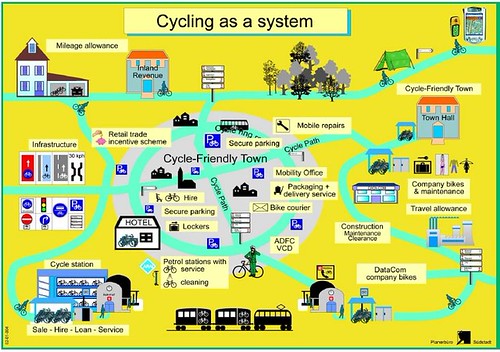
Multimodal vs. the concept of the sustainable mobility platform. The other thing that I don't think is as useful is to think about this in terms of "multimodalness." Yes, different modes are multiple. But the issue is to integrate the sustainable modes into a system.
Some refer to this as "transportation as a service" or "mobility as a service," although they aren't necessarily focused on all the services being "sustainable."
Bicycle Traffic as a system, diagram, German National Bicycle Plan, 2002-2012
Sustainable Mobility Platform Elements
I continue to work out where to place the various rungs on the ladder. It's easier if you split it out according to trip distance. These are the elements:
--Walking -- Scooters/Skateboards --Cycling ---- secure bike parking, air pumps, repair stands ---- access to trailers ---- tandems ---- cargo bikes ---- e-bikes ---- special populations ("Two men leading an effort to provide bikes to homeless," WLOX-TV) -- Bicycle sharing ---- community system ---- building/campus (e.g., hotel, office building, university, office complex) ---- special populations ("New bike share program gives One80 Place's homeless a way around the city," WCIV-TV) -- Segways/electric wheels -- Delivery services (e.g., Dolly; UPS, FedEx, etc.) and package pickup points --Transit ---- various bus, streetcar, light rail, heavy rail, railroad services ---- network scale (regional, metropolitan, city; primary, secondary, tertiary) ---- intra-district(Baltimore Circulator, Circulators, San Diego FRED Shuttle); tertiary network (Tempe Orbit) ---- shuttle services (school, employer, residential) ---- microtransit either private (Bridg, Chariot, Israeli sheruts) or public (AC Transit FLEX pilot project, "The newest battleground between public transit and Uber, Lyft is an unlikely one," San Jose Mercury News) ---- van pools (longer distance) (vride) ---- shared taxi type services at edges of the transit system (taxi collectif in Montreal) or intra-district (Via, UberPool, Lyft Line) either publicly subsidized ("Mass transit gets boost from ridesharing," USA Today; "Uber and Lyft Want to Replace Public Buses," Bloomberg) or not -- Taxis/Ride hailing ---- single trips (equivalent of "single occupant vehicle trips") -- Car sharing ---- one-way (car2go) ---- two-way (Zipcar, Enterprise) ---- inclusion of a variety of vehicles in fleets to accommodate multiple uses (Zipcar) ---- electric car sharing systems -- Scooters ---- scooter sharing (Scoot in SF) --Car pooling -- Car rental
Somehow too the system support elements need to be woven into the framework, such as the charging stations, IT services, intelligent transportation systems, apps, etc.
Another way too to think about this is that the enabling infrastructure of a city's mobility system: streets and sidewalks; is the operating system for mobility but also placemaking and quality of life.
In 2014, I wrote a piece "Electric vehicles and critical mass," about the general issue of how to support the more widespread adoption of electric cars. The article discussed electric vehicle associations as promoters as well as Portland's "Electric Avenue," a street block remade over with e-charging infrastructure.
Since 2014 there have been many advancements concerning e-cars making the need for the development of a more widespread charging infrastructure within cities:
Tesla announced that the creation of a "mass market" car the Model 3
GM introduced the Chevrolet Bolt, a car designed from the ground up as an electric car and has announced a huge program to develop a produce a wide range of electric vehicles ("GM races to build a formula for profitable electric cars," Reuters)
One of the policy drivers emphasizing electric cars is it reduces demand for oil sales and the impact on countries often at odds with the United States foreign policy establishment, like Russia, Iran, Saudi Arabia, and Venezuela ("The electric car industry could take a bite out of oil demand," CNBC).
But I hadn't really thought about more wide spread car sharing programs as a way to drive the propagation of an e-vehicle charging network across a city, especially given the failure of Car2Go's electric vehicle program in San Diego ("Car2Go switching electric cars to gas in San Diego" and "Car2go ceases San Diego operations," San Diego Union-Tribune). Note that I drove an E-Car2Go in San Diego and it was a dream to drive.
In my 2011 blog entry I wrote:
If you study the diffusion of innovation (see Diffusion of Innovations by Everett Rogers), in response to the Fox News story about Ecotality, I'd argue that it takes time to introduce new technologies, and it takes time to develop the critical mass of users and support services to make using the new, in this case mobility, technology, practical. (In fact, biking as transportation has some of the same issues.)
With the auto industry, it took about 30 years to truly scale up, and in that time a network of roads had to be created, a system of garages/repair facilities, gas stations, a dealer network, places to stay if you traveled (motels), road maps, etc. in order to be able to get around beyond your immediate neighborhood. Relatedly, the technology of the automobile had to be improved so that you didn't need to be a mechanic yourself in order to keep it running.
The problem doing e-car share in a place like Indianapolis is that it doesn't have a well developed platform for sustainable mobility. Transit is a hard sell there. Car sharing, let alone using electric vehicles, is that much harder to promote. My sense is that Bolloré Group chose to go there because they were invited, not because they were thinking "what is the best place we can go to in the U.S. to launch our system in the best possible way there is to accelerate adoption of this program?"
Even San Diego probably lacks the right density and relatively short distances between residential areas and activity centers to make car sharing (or bike sharing) work, even though the city has a widespread rail and bus based transit network.
On the other hand, there are cities like DC which have deeper sustainable mobility platforms as well as experience with and success in car sharing.
I happen to be a fervent believer in the Car2Go one-way car sharing program because the small cars are particularly easy to park a definite plus in constrained parking situations.
Does that mean that in the future the small car2go vehicles will be discontinued, making the car2go car share "competitive advantage" of being able to park in space constrained places go away?
Electric Car2Go in Stuttgart. Could e-car sharing be a way to push the development of e-charging, but in a city with better conditions supporting e-car adoption. To keep small cars as part of the Car2Go car sharing fleet, the company could switch to the electric versions, if a city has the charging network necessary to support it.
The reality is that no city has a widespread charging network capable of supporting 600 (DC), 750 (Seattle),or 1,100 (Vancouver) cars, each requiring a charge at least a couple times/week, needing to access electricity charging in public spaces.
Why not use such a car sharing network of vehicles as a way to drive improvements to the e-charging infrastructure across a city?
Car2Go cities like Portland, Seattle, and Washington would be the best place to try this, although Car2Go has already removed SmartCars from the fleet there. New York is probably too tough and Columbus and Denver, like San Diego or Indianapolis, don't have the right support conditions although Columbus is just starting to provide free bus passes to downtown workers ("45,000 Downtown Columbus Workers Eligible for Free Bus Passes," Associated Press).
Interestingly, this idea is comparable to how the electricity generation industry got started. It was expensive to wire individual houses, so instead companies focused on getting large industrial customers. One such customer was streetcar firms, which is why electricity companies often owned streetcar companies too, until the practice was outlawed.
Having large customers led to the installation of basic utility infrastructure, and once that was in place, it became much cheaper to provide electricity connections to the housing districts that lay in between power plants and large industrial customers.
This likely is the right model for the creation of widespread e-vehicle charging systems, with larger (relatively speaking) customers, car sharing firms maybe complemented by other business users, driving the development of e-charging networks ("From Firm to Networked Systems," Thomas P. Hughes, The Business History Review, Vol. 79, No. 3 (Autumn, 2005), pp. 587-593).
There is a good discussion about the different types of chargers, what cities are doing, and yes, that car sharing can be a way to drive e-car use forward, using Indianapolis as an example.
Streetlight modernization programs as a way to drive e-charging network development. Many cities are looking to modernize streetlights to save energy and add other features such as wifi, public safety elements, traffic monitoring, etc. The Environment America report mentions London and Los Angeles as examples of using streetlights for e-charging.
The Urbicity equipment in use in London. The London program has been developed by a German firm Ubitricity, which is working with various boroughs to install charging equipment in streetlights, paid for in part through simultaneous upgrades to the lights with LEDs, and the anticipated cost savings ("London street lamps are being turned into electric car charging points," Independent).
Let's face it, the charging points on the street can be somewhat ungainly. From the article:
Owners of hybrid and electric cars can order a charging cable with an in-built electricity meter and will be able to charge their vehicles using lampposts in areas of Barnes, Hounslow, Twickenham, Kensington and Westminster.
The charging points offer a solution to the challenges of installing dedicated EV parking bays and removing parking spaces from the general supply, by giving residents who do not have access to off street parking the opportunity to charge their cars locally. However, the sockets offer lower power charging.
The early car sharing service Flexcar which was merged into Zipcar had a similar program, rewarding users for putting gas in the car, etc. When Zipcar took Flexcar over, they dropped the perks.
E-car sharing operations could train a set of members as ambassador-chargers empowered with the ability to take cars to locations where they can be charged, to aid system up-time, in return for similar kinds of rewards. This makes it cheaper for a company to deploy the cars, which require more careful monitoring and refueling to stay charged. And paying people to do that costs a lot of money--and increases the cost to use the service.
Such a network in DC would also include Arlington. The DC Car2Go system includes Arlington County, Virginia. I don't know if the 600 car number refers to both DC and Arlington, or DC only. The license in Arlington allows for a total of 100 vehicles, but cars in DC can be driven to and left in Arlington and vice versa.
Ideally an electric car based Car2Go network could be extended to the Bethesda and Silver Spring town centers in Montgomery County and Alexandria as well, creating a more extensive "platform" for sustainable mobility but in terms of the one way car sharing element and for a public e-charging network.
The reality is that such services aren't revolutionary, and build on forms that have been around for decades (Operational Experiences with Flexible Transit Services, Transit Cooperative Research Program, 2004), as shared taxi services (taxi collectif) such as in "exurban" Montreal, or shuttles, jitneys or van pools.
What's happened is that cloud computing and wireless communications systems make providing this kind of service a bit cheaper and easier, including making it easier to "recruit" riders, called "ride matching," just as similar technologies have enabled car sharing systems like Zipcar and Car2Go.
In my transit network model ("The Meta Regional Transit Network") and concept of the mobility shed/sustainable mobility platform, such services can be either secondary longer distance options (like van pools, such as vRide) or "tertiary" transit, providing service within sub-districts of an area, using a transit station as a hub.
BRINGING BRIDJ TO Kansas City seemed like a no-brainer to transit officials. For just $1.50, anyone could use an app to summon a ride downtown in van that would follow a route calculated on the fly by an algorithm. No one within the service area was ever more than a 10 minute walk from a stop, and as an added incentive, your first 10 rides were free.
It flopped. Just 1,480 people rode on a Bridj van, a laughably small figure in a city of 2 million people. The city launched the program with the Boston mobility startup in March 2016, and in the past six months just one-third of riders took more than 10 rides. The one-year, $1.3 million project ended Friday. You might call it a failure.
Government officials and transit researchers call it a success. “I’ll be honest: The ridership was not the top priority,” says Jameson Auten, who leads the innovation division of the Kansas City Area Transportation Authority. “The top priority for us was learning who uses on demand. Really, the big goal for us was learning itself.”
There, it seemed most users thought of the service somewhat like a taxi, and they were younger than typical transit riders. But at $1.50 per ride it wasn't economically sound. And while the transit agency learned stuff it could have learned by reading some reports and talking to other transit agencies providing similar services, in this case it was at Bridj's expense, and ultimately at the expense of the firms funding the company.
Innovation theories. The way I think about new technologies and services, such as Uber and other taxi services, car sharing, or driverless cars, is in terms of theories about innovation adoption using the diffusion of innovation theory of Everett Rogers (while not really credited, this is the theoretical basis of Malcolm Gladwell's Tipping Point, where Gladwell extends theory is in discussing how to advance innovation more quickly) or the disruptive innovation concept by Clayton Christensen:
A disruptive innovation is an innovation that creates a new market and value network and eventually disrupts an existing market and value network, displacing established market leading firms, products and alliances.
Creating new markets or tinkering with existing markets. The reality is that mobility services like Uber and Lyft are taxi services, reliant on people who need work and already have access to cars that are underutilized, connected by a digital application. Other than the ability to use venture capital to subsidize the cost of a ride (and "surge pricing") there is no fundamental difference between "transportation network companies" and taxi companies. Similarly, Bridj was and Chariot is the equivalent of a shuttle bus service.
"The Learning." I don't think it takes a lot of analysis to figure out that microtransit isn't likely to be profitable because the market segments are small, labor is comparatively expensive, and vehicles cost money to purchase and maintain.
IT and telecommunications and "crowdsourcing" routes may have helped these services generate more ridership and gross revenue compared to previous service iterations, but the services still require subsidy.
That's why such trips are typically captured by higher priced services--taxis, or covered by institutions providing the service (shuttles) because of transportation demand management requirements. Similarly, a long distance van pool doesn't pay the driver directly, other than covering their cost of the vehicle and expenses.
When the graphical World Wide Web was introduced, most people started calling "interactive" anything using graphics, even when there was nothing two-way or interactive about it. What they meant was that the webpage was "multimedia," no longer static text.
Similarly, adding IT and telecommunications capabilities to tertiary transit network services are "evolutionary" not revolutionary, and not enough in and of themselves to create a market.
Whether or not the firms entering the transportation/mobility space can last long term is still an open question. Vehicles and labor are expensive. How much people are willing to pay for a trip is comparatively low.
How much they want to be able to multitask (read, using computer/wireless communication device) instead of drive and how much they are willing to pay for this is key to the long term success of such services.
Mobility or Transportation as a Service/Sustainable Mobility Platform. There is a lot of discussion about what is called "mobility as a service" (The rise of mobility as a service: Reshaping how urbanites get around," Deloitte). Basically it's about people getting around without owning or operating a car, with various types of interconnected services.
The problem is that mass transit makes economic sense at large numbers, and "mobility as a service" is hard to provide cheaply, especially without subsidy.
One example is car sharing. It works because it costs $9 to $15/hour to use, and the "member" is the vehicle operator. Even so, it's not likely to capture the bulk of mobility market, but it can be an important component. How profitable it will be for the private sector is an open question.
An illustration from Boston of the Jane Jacobs point that successful cities have "the need for aged buildings"
Death and Life of Great American Cities by Jane Jacobs is a foundational text for understanding from the ground up those qualities that support urban social and economic life.
The point about "the need for aged buildings" isn't that Jacobs was a historic preservationist, although that was one of her interests.
It has to do with the fact that "aged buildings" -- remember she was writing in the days before it was common to keep refinancing buildings, back then they paid them off -- were paid off and with fewer bells and whistles and "old" so they were much cheaper to rent by comparison to new buildings.
As she wrote:
If a city area has only new buildings, the enterprises that can exist there are automatically limited to those that can support the high costs of new construction. ... enterprises that support the cost of new construction must be capable of paying relatively high overhead ... To support such high overheads, the enterprises must be either (a.) high profit or (b) well-subsidized. ...
Perhaps more significant, hundreds of ordinary enterprises, necessary to the safety and public life of streets and neighborhoods, and appreciated for their convenience and personal quality, can make out successfully in old buildings, but are inexorably slain by the hgh overhead of new construction.
As for really new ideas of any kind--no matter how ultiately profitable or otherwise successful some of them might prove to be--there is no leeway for such chancy trial, erroa and experimentation in the high-overhead economy of new construction. Old ideas can sometimes use new buildings. New ideas must use old buildings.
Again, she was writing in a time when venture capital didn't exist in the same way or with astounding amounts of money as today, so there are plenty of examples of new ventures going into new/expensive buildings. (p. 187-188)
There is an article in the Boston Globe, "Sustaining startups in a no-frills building (manual elevator included," about Kendall Square in Cambridge, Massachusetts. The business district is a hotbed of biotechnology and information technology firms and plenty of startups and other firms attracted to proximity to MIT and Harvard, and the other companies already there.
This has pushed rents very high, which can be sustainable in the face of lots of venture capital sloshing around seeking extranormal home runs.
The Kingston Building (right) is attracting firms being pushed out of Kendall Square by high rents. Photo: Suzanne Kreiter, Boston Globe.
But even so there are "aged buildings" still around, with rents one-half of the $60+ in the newer buildings, providing access to the "agglomeration economies" of the district for those start ups and firms that are not venture funded.
From the Globe:
In Kendall, you can rent a swell office for $60 and up per square foot; on Kingston Street, when startups began migrating across the Charles, some found space for less than $15 per square foot, though today’s prices are closer to $30.
Buildings like the Kingston Building “really sustain the startup scene,” says Matt Bellows, chief executive of Yesware, a Boston company that creates software for salespeople. “It’s got a great location, nice open space, windows on three sides, and it’s cheap.” After spending two years in the building, Bellows says, “we only moved out when we got over 50 people, and the lines for the two tiny bathrooms became too long.”
Although while the building's owner is happy with the way things are, as land values rise and the building and site's "intensification value" continues to rise concomitantly, the building could be lost in favor of a new and larger building, with much higher rents, and a loss of support for early stage business development.
Interestingly, while economists like Edward Glaeser deride historic preservation protections as a hindrance to economic development and growth, the reality is that in strong markets, the buildings preserved as a result of preservation protections enable economic development, at its earliest stages when it is seemingly invisible and overshadowed by bigger businesses that seem more successful in large part because they are at later stages in their growth cycle.
Rather than being a hindrance, historic preservation protections -- the Kingston Building is not protected by the way -- support the maintenance of a more diverse business economy by ensuring access to low cost and well located office space, which start ups need especially at their earliest stages when higher cost space is too expensive and funds for investment in the business are at a premium.
However, this is complicated by today's real estate practices, which tend to keep buildings encumbered with mortgages, therefore rents are higher than when Jane Jacobs was writing.
Furthermore, I do recognize that in the highest demand real estate markets, all buildings end up being highly valued, and rent differentials between old and new buildings end up narrowing significantly.
In most of the other markets, preservation provides all the benefits that Jane Jacobs wrote about for businesses, as well as for residents seeking ways to stabilize otherwise declining communities (e.g., "This building is not empty, it's full of opportunities," Laredo News).
(Still) tired of mis-understanding of the potential for e-bikes
Updated: because (1) I came across an article ("Riide - Gift Guide") on the founders of the Riide e-bike in the GW Magazine for alumni, which has a quote worth citing and mentions the cost of the bikes as about $2,000, when I said the typical cost for an e-bike is double that; (2) plus my earlier point in the comment thread about aging cyclists as another market segment.
From the article:
Sweat—lots of it—dampening summer styles and spirits, drip by drip. It's one of the chief obstacles D.C. commuters name when it comes to biking to work, says Amber Wason, BBA '07. With an eye toward easing the effects of the heat and humidty on bikers, she and Jeff Stefanis co-founded Riide, a company that makes a sustainable, single-speed electric bike.
It has the effect, she says, of "flattening the city."
I love the line "flattening the city." It's brilliant.
But unfortunately as discussed below, they miss the point of where "the city needs help becoming flat."
In the core of the city it's already flat and an e-bike doesn't make it any flatter. It's places farther from the core and in hilly areas and for older people, where "flattening assistance" becomes the killer app.
That being said, the Riide bike is attractively designed, especially in how they integrate the battery apparatus into the frame.
=============
Yesterday's Post has an article ("Are electric bikes the wheels of the future or just the new Segways?") about e-bikes above the fold in the Style section. It's about how some local entrepreneurs have created an e-bike, which can go up to 20 mph, and you can "cycle" without getting sweaty.
I heard a presentation by one of the principals a couple years ago, and my sense then was that they didn't have a good sense about mobility as a market and that they were focused on alternatives to the car, rather than on mobility technologies and products that are most appropriate for "center city applications."
Sweat seemed like the biggest point of differentiation for him--riding a bike gets you sweaty. Using a e-bike, since you don't have to pedal, means you won't sweat.
He was thinking of e-bikes capturing trips by people who normally drive a motor vehicle. But most trips in the city center made by residents are not performed by car.
Sweat isn't the deal-killer for transportational biking. Even in DC, where it is hot and humid from about June 15th to September 15th, sweating isn't an issue much of the time when you cycle.
There is a place for e-bikes in cycling for transportation. But I don't think it is for short trips in a city's core, especially at 20 mph.
It's for trips in places that are hilly, for longer distance trips, and for medium distance trips that some people are willing to cycle by traditional means but others won't.
Five years ago, when I came across a series of articles, "The parable of the electric bike" on e-bikes by Alan During of the Sightline Institute, I wrote this:
I don't think electric bikes will save the world. I do think that they can make bicycle commuting much more attractive to larger segments of the population. Maybe, over time, it could lead to as much as 10% of work trips by bicycle, or more. And that would be a significant contribution.
The Sightline articles discuss whether or not the electric bike will take off, why they are more efficient than electric cars, and whether or not they should be subsidized as electric cars have been (he argues no).
The Segway comparison. The Post article compares the e-bike featured in the story to the Segway, which didn't live up to the hype that was made about the product. Instead of transforming transportation, the Segway is mostly used to patrol campuses and large buildings like malls and airports, and in more narrow applications, such as tours for tourists.
But the Post journalist doesn't get why the Segway failed. It was because it was a product in search of a problem--which I argue is the same issue for e-bikes in urban cores ("A Lesson in Innovation – Why did the Segway Fail").
The people most likely to travel on trips of the distances for which a Segway is seemingly efficient--pedestrians, bicyclists, and transit users--didn't see much benefit from changing. Not to mention the cost--today a Segway can be bought for about $6,500.
For motor vehicle operators, while a Segway is a lot cheaper than a car, it fails to satisfy most of the demands for trips a typical user satisfies by car, including protection from the elements.
Hills. Most cities are flat in their cores (topography and proximity to rivers and ports being the primary reasons for cities locating where they did). For example, the core of DC is pretty flat. The fall line starts around W Street and the hills can be pretty steep. Riding home can be difficult. Some people find hills they don't mind riding (e.g. Georgia Avenue or 14th Street vs. 13th Street or 15th Street or 16th Street), others may choose not to ride.
But if you could get a boost from an electric motor up one or more hills, that might make the difference between choosing to cycle regularly as your primary mode of transportation.
Long distances. I am willing to ride 10 to 15 miles to get somewhere, and budget time accordingly. Beyond that distance, it takes too long to cycle, at least for me, because I am not a fast rider. An e-bike could be the difference from commuting to Downtown DC from White Flint or Rockville vs. taking public transit.
Trips of such distances are when being able to ride 20 mph, and not having to stop every few blocks at a stop sign or traffic signal, makes a big difference. But I do wonder how much of the time is spent pedaling the bike vs. riding the bike as it is propelled by its electric motor--a big reason why I cycle is for the health benefits of exercise. You lose that with e-biking.
Medium distance. While I am willing to ride 10+ miles for a single trip, most people aren't. While about 51% of all trips in the United States are 3 miles or less--an easy distance on a traditional bike--13% of trips are 3 to 5 miles, which is a distance that seems long to many, so they drive rather than bike.
Having the option of an e-bike could be the difference for a larger segment of people being willing to cycle for transportation. People less willing to cycle more generally. And while I haven't tested this empirically, I think it might be possible to coax people onto an e-bike when they may be less willing to cycle more generally. Maybe. [This section has been added.] Enabling cycling as you age/biking for senior citizens. In one of my pieces about the outer city as suburban in mobility paradigm ("DC as a suburban agenda dominated city") I made the comment about how sustainable mobility is possible in the outer city based on the experience of my own household. We live eight-tenths of a mile from a Metro station and about 3 blocks from a bus stop--during morning and evening rush the bus goes Downtown, outside of rush it travels between the Petworth and Takoma Metrorail stations.
I cycle for most trips, including grocery shopping. Suzanne and I walk and Suzanne uses transit to get to and from work. We also use car share (both one-way and two-way) and occasionally rent cars.
In a comment on my piece on a listserv in Chevy Chase, the mobility lifestyle I describe was said to be achievable only by younger people. The woman who said so is a couple years younger than I.
While I do think that it will be harder to do this as I age because of the uphill climb from Downtown and the hills around where we live, e-biking could be a way towards maintaining cycling as a primary form of transportation as we age.
Caveat: cost. You can buy a new city bike for $400 or less (of course you can spend a lot more too). Electric bikes cost ten times that, around $2,000 and up, although kits to add a motor to an existing bike can be purchased for much less.
The Riide people featured in the article are leasing the bikes to people for $79/month. While that is potentially worth it for long distance cycling, it's a waste of money compared to the cost of a traditional bike capable of satisfying the biking needs of the typical city resident.
Bike share as a cost-efficient alternative. One month's e-bike rental is almost the same cost as a year's membership in bike share. For residents in the core, a bike share membership is a great way to add biking to their portfolio of trip options without having to own a bike.
Caveat: weight and parking. E-bikes are heavier than regular bikes, weighing between 50 and 60 pounds versus less than 20 pounds for a traditional bicycle.
Depending on where you live and where you park your bike, this can be a problem, if you have to take the bike inside your house or apartment in order to park. Plus, many multiunit buildings provide bike parking that is insecure--while it sucks to have your $400 bike stolen, it would really suck to have your $4,000 bike stolen.
Marketing. The reason that I think e-bikes have failed to take off in the market segments where they make the most sense is because of a failure to market e-bikes appropriately.
In marketing, textbooks always cover the "4 P's of marketing"--product, promotion, price, and place. Product: as discussed above, for the transportation need most typically suggested, short in-city trips, e-bikes are "overengineered." Promotion: E-bikes are being marketed for in-city use when in most cases, for trips up to 5 miles in mostly flat places, e-bikes are overkill Price. Compared to alternatives--owning a bike or using bike share, the price for an ebike is significantly higher. A lease cuts the monthly cost, but it is still financial overkill to use an e-bike to accomplish trips in the core.
Place is where the product is sold. E-bikes are most likely to be useful in the suburbs. Most e-bike shops end up being opened in city cores. Many urban e-bike shops have failed, such as an e-bike shop in the Fells Point neighborhood of Baltimore, which got some start up funding from the Abell Foundation. That's because they are not located proximate to their "natural" base of customers.
To be successful, e-bike shops ought to be placed in suburban centers--e.g., in the DC region in places like Rockville/White Flint, Reston, Tysons Corner--where trip characteristics are more likely to be congruent with the advantages of e-bikes over human-powered bicycles.
For example, there is a bike shop in Takoma Park, Maryland, The Green Commuter, which focuses on e-bikes and it has been open for more than 5 years. That being said, I have seen an e-bike on the Metropolitan Branch Trail in DC only once, and I can't say I see a lot of people on electric bikes, even though I live within a couple miles of this store.
Conclusion. Despite the arguments above, there's likely to be a niche segment of the mobility market in the city where the Riide bikes will satisfy their needs, and that's fine. But it won't change the world or even the city.
In looking at the Mira Uncut blog, I discovered that there was a "TEDx" conference in Detroit, to bring together the region's innovators, to help jumpstart the regional economy there, which for the most part is devastated.
The TED conference is a national conference on ideas and innovation. The TedxDetroit conference was a licensed, regional version. It was open by application and invitation, so it wasn't a free for all.
I thought this was pretty interesting. Because of the Takoma Theatre issue, I was thinking about my paper, "Arts, culture districts, and revitalization," which I have to say is pretty good (then again, it's it's derived from the work of other very very good people), and the points it makes about consumption versus production of art.
Much of the DC arts agenda is focused on arts consumption and what we would call presenting institutions like the Smithsonian Museums, the National Gallery, or the Kennedy Center.
There isn't a lot of support for the nurturing and development of artistic disciplines and artists themselves.
The same goes for DC's creative economy. For a long time I've made the joke that in DC, "big government trickles down and shapes little government, that is the local government, in its image."
And the federal government, Stephen Chu excepted maybe, is not nimble, and especially these days, not forward thinking.
This shapes the city in negative ways.
I was reading an essay by the now deceased Tony Judt in the New York Times, "My Endless City" about New York City and World Cities, and he mentions why he thinks that New York City, even in twilight, is truly a world city.
It's because the city itself is focused outward, not inward.
He wrote:
And yet, New York remains a world city. It is not the great American city — that will always be Chicago. New York sits at the edge: like Istanbul or Mumbai, it has a distinctive appeal that lies precisely in its cantankerous relationship to the metropolitan territory beyond. It looks outward, and is thus attractive to people who would not feel comfortable further inland. It has never been American in the way that Paris is French: New York has always been about something else as well.
He also mentions that Washington was "the Brasilia of its time" which I have to admit is true and puts DC's disconnection in some perspective perspective.
A TedxLocalWashington conference related to the development and emergence of a more local creative/innovative/knowledge economy is in order, recognizing that the local creative economy does have to link to and engage with what we might call the "national" creative economy that does exist somewhat within the federal government.
Location: Salt Lake City, UTAH (UT), United States
I am an urban/commercial district revitalization and transportation/mobility advocate and consultant. I was a principal in BicyclePASS, a bicycle facilities systems integration firm, based in Washington, DC. Now I'm in Salt Lake City for family reasons. Urban economic competitiveness is dependent on efficient transit and mixed use, compact places. Therefore, I end up writing a lot about mobility and urban design. I still own a house in DC, so I write a lot about Washington, DC issues. I try to write so that "universal lessons" are evident in the entries, regardless of the place.