Rebuilding Place in the Urban Space

"A community’s physical form, rather than its land uses, is its most intrinsic and enduring characteristic." [Katz, EPA] This blog focuses on place and placemaking and all that makes it work--historic preservation, urban design, transportation, asset-based community development, arts & cultural development, commercial district revitalization, tourism & destination development, and quality of life advocacy--along with doses of civic engagement and good governance watchdogging.

Sunday, December 08, 2019

Package receipt devices for houses

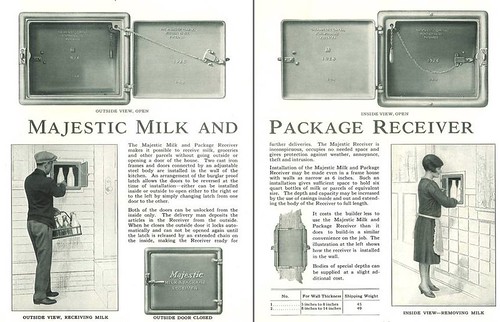
Add for Majestic Mile and Package Retriever

I remember in the early days in discussions concerning e-commerce and secure package delivery, there was talk about creating/installing package delivery devices for houses, including even the capacity of refrigeration.

Someone sent an article about this to the Takoma e-list, and it included the above image.

Something like this, maybe even these particular versions, was installed in many houses on Warwick Street in the Rosedale Park neigthborhood in Detroit, where I lived from about 5 years old to 8 years old.  I used to crawl through them for neighbors who locked themselves out.

We called them "milk chutes."

Even a door-based device like a doggy door, but code activated could work (exception for the refrigeration part).

Labels: , , ,

Tuesday, June 04, 2019

While Harris-Teeter Supermarket is committed to center city markets, they haven't refigured their promotions to accommodate sustainable mobility

Harris-Teeter Supermarket is a chain based in North Carolina, but over the past 15 years they've aggressively moved into the Mid-Atlantic market, with stores in Virginia, DC, and Maryland.

Many of their stores are in mixed use developments, may incorporate two stories so a smaller overall footprint, and during a period when Giant was quiescent concerning the city and Safeway was beginning to revive and improve their urban stores, alongside Whole Foods they've aggressively built stores in DC proper, with four stores--plans for more (such as in Brookland and at the DC-Montgomery County border) were scuttled by resident opposition to the developments that would have incorporated their store, but the firm is likely to open more stores in the city.

Stores like the one at 1st and M Streets NE or in Kalorama have a preponderance of customers arriving on foot or bicycle.

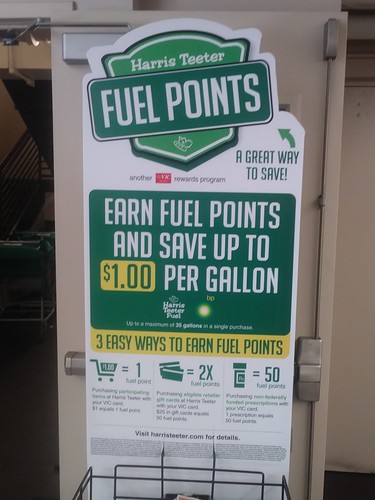
But other than price, the firm's major loyalty promotion involves earning points towards discounts on gasoline.
Harris-Teeter Supermarket gasoline savings promotion

Granted, Safeway and Giant do the same thing, as do supermarket firms across the US.  I shouldn't be harder on H-T, but they are more aggressive in marketing this promotion using in-store items like this one, shelf tags, etc., along with regular promotion in their weekly newspaper inserts.

But it would be nice to see them figure out some form of discount promotion that promotes sustainable mobility.

Even "merely" taking people home if they arrived on foot and they purchase a minimum amount.

That's what the Latino-oriented supermarket firm Megamart does.  (And what I have recommended that Eastern Market do for the 12 years I've been on its "community advisory committee.")
Megamart Supermarket delivery vehicle
The livery on this Megamart vehicle says "Le Llevamos a su casa gratis" -- "we take you home for free."

Although I have been seeing more people using cargo bikes at the Harris-Teeter store at 1st and M Streets NE in NoMA.
Groceries, cargo bicycle at Harris-Teeter Supermarket, 1st and M Streets NE, D.C.

======
Note: a comparable complaint I have is that library activists clamor for free parking, but fail to recognize that they then should be advocating for free transit to and from the library as well.

Labels: , , ,

Sunday, March 11, 2018

Chattanooga as an e-car platform

Last week, I suggested Car2Go car sharing as a way to drive the development of an e-car charging system across a city ("Electric vehicles and city charging infrastructures: could car sharing be a way to drive changes more quickly?"). 

Note that I didn't use Brooklyn and Queens as an example, even though Car2Go is operative there today.  When asked about this by I colleague, I wrote:
My reservation is that it's not best to try to do something innovative but difficult in a place where it is already extraordinarily difficult to do anything. In other words, try to pick a place to start off with where you can be wildly successful and where opposition is likely to be muted.

E.g., DC tried to do streetcar in Anacostia but the area has pretty contentious if not noxious thinking about politics, "the neighborhood," transit, and public resources. So that area has zero streetcar and DC shifted to H Street NE. It delayed launch, but East of the River, by at 6 years. I was at a WMATA conference in Nov. 2006, where a DDOT person confidently said they'd be starting streetcar service in Anacostia the next year.

I should have said this about NYC:

After figuring this out in places where the constraints are fewer, like DC and Seattle, then take on a space with extraordinarily difficult infrastructure challenges like NYC, specifically Brooklyn and Queens where Car2Go operates.

OTOH, you could counter with Autolib, which was launched in Paris, which is just as tough a place to do it.

The difference though between NYC today and Paris then at the launch of Autolib is the support of the top elected officials, and the overall greater commitment in Europe towards dealing with the environment and climate change.

Autolib was an initiative of the then mayor. And today the Paris mayor is just as committed to the environment and clean air. Did you see that Paris will be giving incentive payments towards the purchase of bikes, cargo bikes, and e-bikes to people who agree to give up their cars, as part of clean air initiatives. That's an indicator of the difference between Paris and today's NYC.

These days, the current mayor of NYC doesn't seem to be particularly engaged when it comes to sustainable mobility generally, and he's not a rah rah kind of person on stuff that isn't social justice related.
Anyway, like the BlueIndy program in Indianapolis and the GreenSpot program in Jersey City, it seems as if Chattanooga is developing a similar program, according to GovTech ("Chattanooga pushes multimodal to solve its transportation problems").

But I don't think it's an example that is quantumly different at a system scale because it's pretty small when it comes down to it, but a bit more marginally interesting because the transit agency is adding a solar farm to power it--even though it seems somewhat duplicative as the region is known for cheap hydroelectric.  From the article:
The Chattanooga Area Regional Transportation Authority (CARTA) is constructing an 80-kilowatt solar farm, the installation of 64 electric-vehicle charging ports spread across 22 sites and a car-sharing program powered by battery-electric Nissan LEAFs. ...  
“With interest from an electric-vehicle car-share operator, CARTA entered into a funding agreement with TVA in February 2014 to provide for a minimum of 40 charging ports and a 20-vehicle car-share program ...

The car-share portion of the project is operated by Green Commuter, a membership-based car-sharing platform based in Los Angeles. Members rent the car for the time they need it, while the company pays for electricity to recharge the vehicles, as well as maintenance, parking and insurance costs. Rates are $7 an hour or $45 a day.
20 cars isn't that big a deal, almost not big enough to even acknowledge, although it is significant from the standpoint of smaller cities, as Chattanooga has about 180,000 residents.

The BlueIndy program has 230 vehicles. Granted, Indianapolis has five times the population of Chattanooga, but still, a program with 230 electrically powered vehicles is of a size that's significantly noticeable.

In DC, Car2Go has a 600 car fleet, albeit none are electric.

Multimodal vs. the concept of the sustainable mobility platform
.  The other thing that I don't think is as useful is to think about this in terms of "multimodalness." Yes, different modes are multiple.  But the issue is to integrate the sustainable modes into a system. 

Some refer to this as "transportation as a service" or "mobility as a service," although they aren't necessarily focused on all the services being "sustainable."

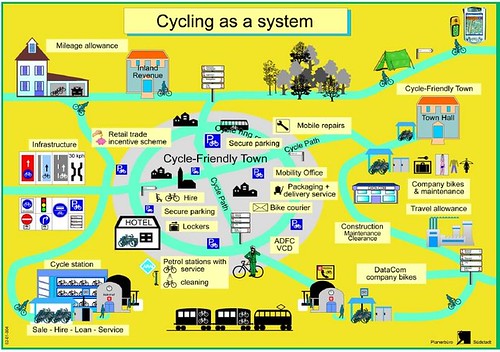
I prefer to call this the sustainable mobility platform ("Dolly micro-move app as an element of the Sustainable Mobility Platform" and "Free access to cargo bikes/e-cargo bikes as part of a mobility hub/sustainable mobility platform"), extending the concept from a diagram from an old national bicycle plan for Germany.
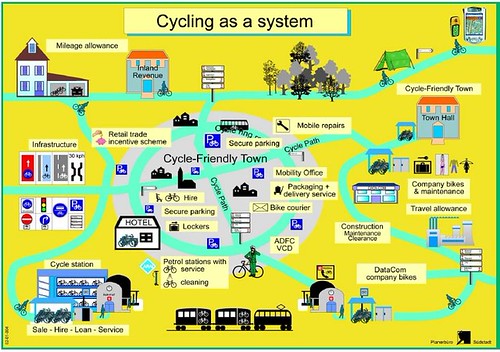
Bicycle Traffic as a system, diagram, German National Bicycle Plan, 2002-2012

Sustainable Mobility Platform Elements

I continue to work out where to place the various rungs on the ladder.  It's easier if you split it out according to trip distance.  These are the elements:

-- Walking
-- Scooters/Skateboards
-- Cycling
---- secure bike parking, air pumps, repair stands
---- access to trailers
---- tandems
---- cargo bikes
---- e-bikes
---- special populations ("Two men leading an effort to provide bikes to homeless," WLOX-TV)
-- Bicycle sharing
---- community system
---- building/campus (e.g., hotel, office building, university, office complex)
---- special populations ("New bike share program gives One80 Place's homeless a way around the city," WCIV-TV)
-- Segways/electric wheels
-- Delivery services (e.g., Dolly; UPS, FedEx, etc.) and package pickup points
-- Transit
---- various bus, streetcar, light rail, heavy rail, railroad services
---- network scale (regional, metropolitan, city; primary, secondary, tertiary)
---- intra-district(Baltimore Circulator, Circulators, San Diego FRED Shuttle); tertiary network (Tempe Orbit)
---- shuttle services (school, employer, residential)
---- microtransit either private (Bridg, Chariot, Israeli sheruts) or public (AC Transit FLEX pilot project, "The newest battleground between public transit and Uber, Lyft is an unlikely one," San Jose Mercury News)
---- van pools (longer distance) (vride)
---- shared taxi type services at edges of the transit system (taxi collectif in Montreal) or intra-district (Via, UberPool, Lyft Line) either publicly subsidized ("Mass transit gets boost from ridesharing," USA Today; "Uber and Lyft Want to Replace Public Buses," Bloomberg) or not
-- Taxis/Ride hailing
---- single trips (equivalent of "single occupant vehicle trips")
-- Car sharing
---- one-way (car2go)
---- two-way (Zipcar, Enterprise)
---- inclusion of a variety of vehicles in fleets to accommodate multiple uses (Zipcar)
---- electric car sharing systems
-- Scooters
---- scooter sharing (Scoot in SF)
-- Car pooling
-- Car rental

Somehow too the system support elements need to be woven into the framework, such as the charging stations, IT services, intelligent transportation systems, apps, etc.

Another way too to think about this is that the enabling infrastructure of a city's mobility system: streets and sidewalks; is the operating system for mobility but also placemaking and quality of life.

Labels: , , , , , , ,

Wednesday, March 22, 2017

Free access to cargo bikes/e-cargo bikes as part of a mobility hub/sustainable mobility platform

The post "Dolly micro-move app as an element of the Sustainable Mobility Platform," from last November updated my mobility shed concept (which others call a mobility hub) towards what I am now calling the "sustainable mobility platform."

But the SMP is more about thinking about mobility in terms of what are called "product-service-systems" or what others call either "Mobility as a Service"/MaaS or "Transportation as a Service"/TaaS.

Nigel, our e-correspondent from New Zealand, calls our attention to changes to an already interesting service in Freiburg, Germany, LastenVelo, which is a crowdfunded cargo sharing program for cargo bicycles ("Why you can hire a load wheel free of charge in Freiburg," Badische Zeitung).

The system is a little clunky in how the rentals work--in whole day rather than fractional increments, but it is free, with voluntary donations requested.

The service sells ad space on the bikes, and aims to use the revenue, up to per year, to fund the program.

VAG, the area transport association and the regional motorist association (comparable to the American Automobile Association) bought two e-cargo bikes to add to LastenVelo Freiburg, in return for keeping their ads on the bikes permanently ("Freiburg offers electric cargo bike hire," Metro Report International).

Mobility Shed Service Elements
Sustainable Mobility Platform centered on a Mobility Hub 
(typically a transit station)

I continue to work out where to place the various rungs on the ladder.  It's easier if you split it out according to trip distance.  These are the elements:

-- Walking
-- Scooters/Skateboards
-- Cycling
---- secure bike parking, air pumps, repair stands
---- access to trailers
---- tandems
---- cargo bikes
---- e-bikes
---- special populations ("Two men leading an effort to provide bikes to homeless," WLOX-TV)
-- Bicycle sharing
---- community system
---- building/campus (e.g., hotel, office building, university, office complex)
---- special populations ("New bike share program gives One80 Place's homeless a way around the city," WCIV-TV)
-- Segways/electric wheels
-- Delivery services (e.g., Dolly; UPS, FedEx, etc.) and package pickup points
-- Transit
---- various bus, streetcar, light rail, heavy rail, railroad services
---- network scale (regional, metropolitan, city; primary, secondary, tertiary)
---- intra-district(Baltimore Circulator, Circulators, San Diego FRED Shuttle); tertiary network (Tempe Orbit)
---- shuttle services (school, employer, residential)
---- microtransit either private (Bridg, Chariot, Israeli sheruts) or public (AC Transit FLEX pilot project, "The newest battleground between public transit and Uber, Lyft is an unlikely one," San Jose Mercury News)
---- van pools (longer distance) (vride)
---- shared taxi type services at edges of the transit system (taxi collectif in Montreal) or intra-district (Via, UberPool, Lyft Line) either publicly subsidized ("Mass transit gets boost from ridesharing," USA Today; "Uber and Lyft Want to Replace Public Buses," Bloomberg) or not
-- Taxis/Ride hailing
---- single trips (equivalent of "single occupant vehicle trips")
-- Car sharing
---- one-way (car2go)
---- two-way (Zipcar, Enterprise)
---- inclusion of a variety of vehicles in fleets to accommodate multiple uses (Zipcar)
---- electric car sharing systems
-- Scooters
---- scooter sharing (Scoot in SF)
-- Car pooling
-- Car rental

Labels: , , ,

Monday, March 06, 2017

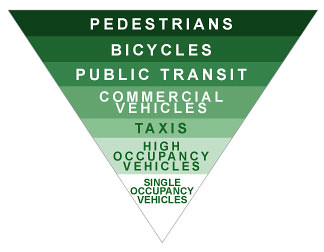
Reverse Traffic Pyramid by the Bicycle Innovation Lab

Over the weekend WalkArlington tweeted the Reverse Traffic Pyramid by the Bicycle Innovation Lab of Copenhagen.

It's cool, sure, but it isn't perfect.

It doesn't have a rung for bicycle sharing.   And should e-biking have its own run too?, for long distance trips.

Transport/delivery should be separated out from taxis.  And I would rename the taxi rung to taxi/ride hailing.

In terms of ordering, I'd reverse the order of taxi and car sharing, putting car sharing before taxi/ride hailing.

Since airplanes are on the diagram, representing very long distance travel, the Reverse Traffic Pyramid should probably separate out local transit, represented in the public transport rung, from long distance transit, which would include bus and railroad passenger service, requiring the addition of a new rung before flying.

But, it's still cool.

Clearly, it builds on  the sustainable mobility pyramid created by Transportation Alternatives of New York City.

And it's a graphic illustration of the concept of the mobility hub ("Dolly micro-move app as an element of the Sustainable Mobility Platform").

Labels: , , , ,

Wednesday, December 21, 2016

Why not set up transit stations to be "access points" for package delivery

The newest apartment buildings have special set ups in their accommodations for "mail" for packages, enabling various size packages to be put into special lockers accessible through the use of one-time codes ("Package locker industry lifts off," Multifamily Executive).

A few years ago, I suggested that local transportation master plans should consider package delivery as a matter for the plan ("City transportation departments need to set up innovation units"). From the blog entry:
  • "bracing" UPS about offering convenient in-city package pick up options for missed deliveries.  How hard could it be for UPS to set up package routing for missed deliveries to the UPS stores, or at least a package pick up depot?  Note that UPS treats DC as part of the State of Maryland for routing purposes (cf. "Chins Up, Washingtonians. The Postmark's Back," Washington Post), which likely contributes to the problem.
Taking up that idea on their own, UPS and FedEx are creating "access point" networks where people can have packages delivered, to stores, UPS and FedEx stores, and other locations ("UPS using neighborhood stores to fight off USPS, Amazon, Fedex," Fortune Magazine).

An Amazon delivery locker in the back of a 7-Eleven. The convenience store chain is still offering this new way of picking up stuff ordered from the world's largest etailer, but Staples or RadioShack are not. Photo: Ariel Zambelich/Wired ("Stores boot Amazon lockers").

Many transit stations, especially in the WMATA system, have unused space, and in the context of thinking of "transit stations as entrypoints to neighborhoods" and as nodes in what I am now calling the "sustainable mobility platform," why not set up locker systems where people could have packages delivered to transit stations, where they can pick them up on their way home from the station?
Lots of empty space suitable for lockers at the Largo Town Center Metrorail station in Prince George's County, Maryland.  Photo from Clark Construction.

Many stations have similar types of empty spaces that could be used for lockers or inside the gates bike parking.

Well, one reason to not consider this would be the potential for terrorism, although presumably the packages get checked at various points in the process, before they would be delivered by a UPS, FedEx, or USPS driver.

GeekWire graphic based on a Shutterstock image.

Amazon has proposed delivering packages to transit vehicles ("Amazon envisions package pickups on public transit, using lockers on buses, trains and subways," GeekWire), but that seems inordinately complex to me.

Why not just set up package lockers at a transit station, and open up their use to any of the legitimate carriers, rather than to one specific firm and blocking out the others.

Alternatively, while it would make more sense to have a universal system, that would require management time and resources that a transit system doesn't normally have.

Maybe it's just a matter of setting up space and renting it out to UPS, Amazon, FedEx, etc., but those firms would have to create smaller locker systems, or at least a variable set of sizes, to fit into different spaces, especially tighter in-city locations.

UPS package locker system outside of a 7-11 in Dallas, Texas

Labels: , ,

Friday, November 18, 2016

Dolly micro-move app as an element of the Sustainable Mobility Platform

I have moved beyond discussing what I call the mobility shed ("Updating the mobilityshed / mobility shed concept") to thinking more about what I am calling the Sustainable Mobility Platform.  Although I need a top notch graphic designer to express it graphically.

The concept is influenced by a graphic from an older version of the German National Bike Plan and the Sustainable Transportation Hierarchy graphic produced by Transportation Alternatives.

Cycling as a system (of Traffic)
Bicycle Traffic as a system, diagram, German National Bicycle Plan, 2002-2012
German National Bicycle Plan, 2002-2012

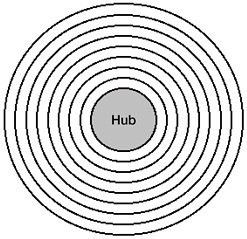
Mobility shed concept.  Note that the bands should vary in width depending on their catchment area.  The core point/hub is a transit station, commercial district, or major activity center.
Mobility shed diagram

Sustainable transportation hierarchy
transportation hierarchy

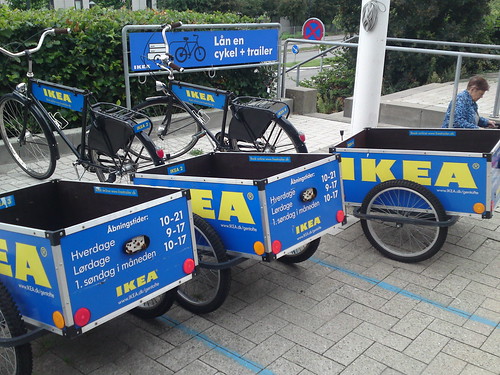
Some Ikea stores in Denmark provide bikes and trailers to get purchases home.
DSC09612

What I say is that the idea of the sustainable mobility hierarchy is to support a lifestyle where owning a car is not required but car use can still be an element within it, for those trips where it makes the most sense.

It's a "car light" lifestyle, and there are many reasons for communities to support it from the standpoint of transportation demand management and optimal utilization of the throughput capacity of the transportation system.

These are the elements:
  • walking
  • cycling
    • access to trailers
    • cargo bikes
  • transit
  • bicycle sharing
  • car sharing
    • one-way car sharing
    • two-way car sharing
  • scooter sharing (there's a program in San Francisco)
  • e-bikes
  • taxi type services
  • delivery services
  • car rental
Of course, most of the elements, like the car sharing or bicycle examples, can be further divided and sub-categorized, depending on rider demographics, trip characteristics, etc.  I separated out e-bikes because to my way of thinking, they are more about serving longer trips (3-20 miles) for demographics unwilling to make such trips on a regular bike.

Dolly move and delivery service.  Anyway, I just learned about Dolly, an "on-demand moving service" for a limited number of items.  It's like "Uber" for delivery. From the website:
Dolly is a marketplace that allows background-checked Helpers with pickup trucks, vans, and large SUVs to connect with people who need help with micro-moves in the city. ...

We provide a price that's determined by distance, item count, and specific details about your item(s), with the choice of Curbside delivery for a discounted price. The minimum price is $30.
Right now Dolly operates in Chicago, Denver, Salt Lake City, Seattle, and San Diego ("Meet Dolly: A new way to move bulky items (without bugging friends," GeekWire).

Granted, Zipcar car sharing is also an option, as most of the vehicle fleets have a variety of vehicles including SUVs, pick ups, and vans. I've used Zipcar a bunch of times to move a large item (bookcases, file cabinets, outdoor grill) from where I've found or purchased them.

But Dolly is a good option when you need an extra pair of hands because of the size and/or weight of the item.

Labels: , , ,

Monday, March 19, 2007

Not free rides, offer a delivery service!

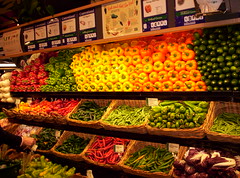
Peppers in the Produce Department, Whole Foods on Union Square
Peppers in the Produce Department, Whole Foods on Union Square, Manhattan, NYC.

From "New Downtown NYC Whole Foods to Offer Free Rides," in Progressive Grocer:

To celebrate its 192nd store nationwide and fourth location in New York City -- this time on the corner of Houston and the Bowery in Manhattan's Lower East Side -- Whole Foods is offering New York customers a zippy promotion: Shoppers who show up for the grand opening on Thursday, March 29, between 3 and 9pm will be offered a free ride home by Zipcar.

Cambridge, Mass.-based Zipcar, which bills itself as "the largest car-sharing company in North America" on its Web site, will ferry shoppers and their groceries anywhere in Manhattan below 42nd Street.

Urban grocery stores should provide delivery services to accommodate those without cars, or those who don't want to drive, or to schlep their groceries on public transit (or a bicycle).

Labels: , , ,