Rebuilding Place in the Urban Space

"A community’s physical form, rather than its land uses, is its most intrinsic and enduring characteristic." [Katz, EPA] This blog focuses on place and placemaking and all that makes it work--historic preservation, urban design, transportation, asset-based community development, arts & cultural development, commercial district revitalization, tourism & destination development, and quality of life advocacy--along with doses of civic engagement and good governance watchdogging.

Thursday, July 23, 2026

I hadn't thought about SNAP cuts significantly impacting inner city groceries

This article is inspired in part by the Washington City Paper article, "Oh, SNAP: How Program Cuts Are Impacting Food Access in the DMV." From the article:

“The number of people receiving SNAP has fallen in D.C., Maryland, and Virginia,” says Katie Bergh, senior policy analyst at the Center on Budget and Policy Priorities, which tracks the impact SNAP cuts are having. Bergh, citing USDA data, tells City Paper that the number of people receiving SNAP in D.C. dropped by almost 7,500 between the law’s July 2025 enactment and March—a roughly 6 percent decrease.

Numbers are steeper in our neighboring states: “In Maryland, state data show the number of people receiving SNAP fell by more than 39,000 people between July 2025 and April 2026,” also about a 6 percent drop, says Bergh. “More than 17,000 were children.” Virginia has seen the worst with a roughly 13 percent decrease—that’s 111,000 people who are no longer receiving benefits—between July 2025 and May 2026. The federal government is also shifting a higher cost burden to states, which is making it harder for states—and D.C.—to balance their budgets.

It's always a struggle to have supermarkets, either full line or with a smaller set of items, operating in inner city neighborhoods.  

The costs are higher, including employee retention and losses due to stealing and fraud.  

Places without stores are called food deserts or food insecure places.  But this is deceiving because since people have to eat, they come up with ways to get to grocery stores, even if they have to go out of their neighborhood to do so.  

But this is something I noticed living in the H Street NE neighborhood back in the 1980s and 1990s.  People had ways to buy groceries.  Even though an independent opened in the neighborhood called MegaFoods, many didn't think it served them well enough, so they either protested, or continued to shop outside of the neighborhood.

Of course, many people use transit to grocery shop.  I hated using the bus for groceries.  Mind the subway less.  But mostly shopped by bike, putting the bags on my handlebars, and using my backpack--sadly it took me 20 years to figure out I could put my backpack on the handlebars too--imagine riding uphill from Capitol Hill to Manor Park with a watermelon in your backpack, not fun.

(Separately, the Chronicle of Philanthropy has an article on DC Central Kitchen, which is a social enterprise that in part addresses food access issues: "How DC Central Kitchen Keeps Expanding While Other Nonprofits Shrink")

Also see:

-- "Grocery stores in cities: the failure of the "15 minute grocery store"" (2023)

=======

Gross profit margins on groceries are minimal.  As it is, the average grocery store only makes 1.5% that is a penny and a haf per dollar of sales.  That doesn't leave a lot of room for error, or provide the ability to react when there are scalar changes in economic conditions.  Tariffs are making it worse.  Same with increased transportation costs because of the Trump Iran War.

This is why supermarkets would rather donate food to events and organizations and not money (I tried to get the grocery store cooperative in Salt Lake to fund grills at Sugar House Park and they said they had no money to give.).

Chicago: Yellow Banana's Sav-A-Lot stores on the brink of closure.  Yellow Banana is a grocery "start up" from a few years back that bought a bunch of Sav A Lot stores--a discount low number of items store operating primarily in low income areas.  Sav A Lot is a chain that has company stores and franchised stores.  

SAL was owned by Supervalu which sold it off to private equity before being acquired by UNFI.  The current owner is trying to sell off the stores, and function as a wholesaler/franchisor.  That's how YB got the stores they operate.

YB has/had seven stores in Chicago.  And they received money from the city to do so.  They had a lot of problems getting going, and the stores have to be operated for 10 years for the company to get the full amount awarded.

In the last year, the company's president died unexpectedly of a stroke, without anyone to replace him, and the "One Big Beautiful Bill" cut funding for the federal Supplementary Nutrition Assistance Program, which provides a modicum of money to poor people to buy food--the amount provided is paltry, it's a crime.  Most people getting benefits get less than $200/month.

Customers shop at Save A Lot’s remodeled West 63rd Street store in West Lawn on April 9, 2025. (Eileen T. Meslar/Chicago Tribune)

According to the Supermarket News article "Yellow Banana ready to close 7 Chicago stores, loses tie with Save A Lot":

SNAP money at the six stores accounted for almost 50% of revenue, and SNAP sales have declined about 27% year over year.

Projections at the start of the year showed the stores were getting close to breaking even but would still lose in the range of $500,000, a figure the source said was not insurmountable. Then the SNAP cuts kicked in.

SAL, which had been providing the company with inventory on credit, pulled the rug and cancelled the franchise agreement.  

The company has been crushed by the loss of SNAP-related sales.

It's not news that the Trump bill has had a lot of negative effects, including one they think is positive, which is reducing the tax rate on rich people and corporations.

Sadly, this is not an unintended consequence.  It was intended.  And this is but one of the many fallouts from the Act.

(There used to be a SAL on Chillum Road in nearby Maryland, and on occasion I would bike there to buy groceries.  It's long since closed although they still have other stores in Prince George's County.  When you're buying shortening, why pay a lot more for it at a mainline grocery when you can get it at a store like SAL or Aldi?)

Also see:

-- "Save A Lot grocery stores could shutter abruptly this week," Chicago Tribune
-- "Save A Lot grocery operator gets an extension on City Hall-funded deal amid missed deadlines, lawsuits," Chicago Sun-Times

=====

Thoughts.  The margin issue is real.  That, plus lack of management expertise is why government owned groceries aren't likely to be successful.  And the least bit of problem in getting the store up and running and then operating--such as community opposition for any reason--makes it that much harder to succeed.

Recently, a more upscale grocer in Cleveland, Heinen's, closed its downtown store.  They said they lost $18 million over 11 years ("Heinen’s Cleveland location was losing millions," Supermarket News). And they sold alcohol too, which has higher margins.

Grocers in hard pressed areas probably need more subsidy than people realize, considering that 1.5% margin.  I know a cooperative in Connecticut had to close because they foolishly signed a lease requiring a percentage of gross revenue be paid to the property owner, even though $1 of additional revenue yields only 1.5 cents.

One such subsidy, and I'd have been against it before, is probably, "zero property tax" until the store shows a profit.

Labels: , , , , ,

Wednesday, May 13, 2026

Market on the Green nonprofit supermarket from ProMedica Health System, Toledo

Market on the Green is located in the ProMedica Ebeid Institute building, which is in a low income neighborhood, separate from but near some of the system's hospitals.

I was re-reading a past blog entry on hospital planning in the Salt Lake City area ("Hospitals as urban anchors/revitalization levers, not usually, but with great potential to serve communities in important ways: Examples are two forthcoming projects by Intermountain Health and University of Utah Health") and among the best practices it mentioned for activating the first and second floors beyond traditional medical series, I listed the "Market on the Green" supermarket in Toledo.  

I must have found out about it from this Wall Street Journal article, "Take Two Aspirin—and a Serving of Kale." 

Given that supermarkets run by cities--proposals in Chicago, New York City, and DC--are all the rage it's important to look at what works and what doesn't.  This piece discusses the failure of urban markets ("Grocery stores in cities: the failure of the "15 minute grocery store"").  Also the opportunity of food cooperatives as an alternative model ("Revisiting Takoma Junction and the Takoma Co-op development issue | A chance to start over").

Yard sign announcing a household's support for the Wasatch Community Food Co-op.

Food coops do need initial capital and that can be hard to raise.  

The Wasatch Community Food Co-op finally opens this month--they've spent 15+ years organizing, raising capital, and finding and building out a space.

And there is the public market model ("Eastern Market DC's 150th anniversary last weekend | And my unrealized master plan for the market").  

In distressed areas I think that model is adaptable and adoptable as a way forward because you divide the various functions into departments, called "market stands," and from an entrepreneurial standpoint they can be run by individuals rather than "the city," and with fewer capital requirements compared to running a grocery store as a single operator.

City-run supermarkets.  I am skeptical about city-run markets because the profit margins are so low--I tried to get a creative donation from the supermarket business cooperative in the Intermountain States, along with some of their local affiliates, and they lamented their extremely low margins of 1.5% or less, and that was before the effect of tariffs and now the War with Iran which impacts both transportation costs and consumer spending even more.

And because cities aren't known for innovative management in governmental matters.  Running a retail business is a stretch beyond that, although it can be addressed by hiring people with industry experience.  But letting people with a retail background act like retailers is still a tough decision for a city government.

Public markets are a truly rare form of public-nonprofit management.  Most public markets are owned  by the city but operate with independent management.  For those that don't, half are probably successful and dynamic, like Reading Terminal Market and Lancaster Central Market, and the others, and I would include Eastern Market DC where I served on the board for 13 years, static--even though Eastern Market seems to always be rated highly in consumer voting contests ("Shop, savor, and stroll these 10 must-visit public markets," USA Today).

Managerially, one of my favorite examples is the Milwaukee Public Market.  

It was built by the city and run by a nonprofit, but the nonprofit was overwhelmed and management shifted to the Milwaukee Downtown Business Improvement District, and it gets high ratings ("Milwaukee Public Market gets back to business," "From one market to another: Milwaukee Public Market’s advice for Brookfield," Milwaukee Business Journal).

Reading the second article, archive.ph version for those without access, you can tell they really get it.

"I think taking this as a model and plopping it anywhere, it's not always going to work in every setting, every environment, every city," Schwartz said. "These are not always easy operations."

We've had the benefit of time, reputation and experience. We've also developed this into not just a place where people can get food, but we can host regular events and cooking classes. We embrace an outdoor element for experiences, whether it's the Palapa at St. Paul Fish Co. or a beer truck outside. So, I think you have to be multi-dimensional.

At Eastern Market in DC there is zilch innovative design associated with the individual stands.  
Not so for St. Paul Fish Company at Milwaukee Public Market.  
Brand promise is communicated and strengthened by a strategic choice of seafood creature sculptures.

Turnover and new tenants is not always a bad thing. It's sometimes a mutual, "Hey, I'm gonna do this for a few years, experience it, and then I'm gonna concentrate on another brick-and-mortar." There's a level of rotation that adds freshness and newness. It can be beneficial. Probably 34% of our tenants are originals. We always try to find a mix of not only the right food products, but also ownership, representation and businesses that will help add something from the neighborhood, not just the market.

If you are a true destination for residents and people from out of town, I think you need to embody as many types of experiences as possible and cast a wide net, whether it's for families who are coming in from out of town or somebody who lives in a condo that's popping over here to have a glass of wine, grab a steak and make it at home.

One of the problems with ratings is the tension between selling prepared food, more typical of what are called food halls, and fresh food to prepare at home, and maybe with some prepared food vendors.  A lot of the other markets do fresh food better, and most that specialize in it, like Reading Terminal Market in Philadelphia or Grand Central Market in Los Angeles, do way better.  And Pike Place Market in Seattle didn't even make the top 10!

Why has Market on the Green been successful, when similar ventures fail?  

Compared to many nonprofit grocery initiatives, it's still standing after years, when many have failed long before that kind of tenure.  

It's not a grim space.  It has positive design qualities.  While it's one tenth the size of a for profit supermarket, it offers the same array of goods, even beer and wine.

It was funded by a donation from the lead philanthropist supporting the ProMedica System.  It's located in the Uptown neighborhood which is defined by USDA as a "food desert" and where they started their community development program ("Seaway standing strong," Toledo Blade). 

Originally the market didn't have a more traditional (and hopefully outdoor sign.  Now they do.

The building is owned by the health system, and the second floor has a teaching kitchen, other community services, and workforce training (two more floors for other stuff).  

They support local vendors and stock and market their products ("Farmers First Coffee release party at Market on the Green" and "Beer Sampling at Market on the Green," Toledo City Paper)--the beer sampling up in the teaching kitchen with better access controls.  

And they're innovative, unlike a lot of public markets, they offer online ordering and delivery ("Market on the Green offers online shopping and delivery," Toledo City Paper).  

I tried to have that done at Eastern Market and you wouldn't believe the pushback--"Eastern Market is all about the face-to-face experience" they said.  For some it is, for others it isn't.  Maximizing your ability to reach multiple market segments in the face of ever increasing competition is key.

The store has been open for 11 years, which is a great run so far.--and it's still going.

But it may have taxed managerial resources, because in 2023 outsourced management to a local grocery store operator ("ProMedica grocery store in UpTown Toledo gets new local management," Toledo Blade).  

As a whole the hospital system has run some  deficits and this saves them not just money, but "managerial burden," involved in running the store ("ProMedica scraps new Monroe hospital as losses mount," Toledo Blade).  Since they've cut back on plans for new buildings, sold off their nursing home division, and ended event and venue sponsorships.

Success factors for Market on the Green.  I think the key elements are (1) philanthropic donation to provide capital, (2) and to buy the building, (3) which means they can be patient, (4) because they have "patient capital" to support the business, (5) without interest fees (6) and probably no rent, (7) so, as long as it doesn't lose money on operations, (8) because of the high degree of management and board commitment separately (9) and as a key element of their place-based community development initiative, Ebeid Neighborhood Promise.

Initiatives at other hospitals include food stands within the hospital's first floor, food pantries offering free food to people in need ("Micro-markets inside health centers could be just what the doctor ordered," Grocery Dive), community gardens, and farmers markets held on campus.  St. Joseph Mercy Hospital in Ypsilanti, Michigan goes even further, allotting 25 acres on its campus to a local produce farmer, using some of the food in their food service program, donating to food banks, etc.

Social determinants of health.  The justification is what are called "social determinants of health," how lifestyle and other factors like place contribute to people's health/problems and providing food access reduces income hindrances that can make it hard to buy healthier and fresh foods.

According to Next City ("Why Health-Care Systems Are Funding (Or Building) Grocery Stores") such stores funded by, supported by, or run by hospital systems support both personal and community health, so it may help them when preparing their Community Health Assessment Plans required as one element of Obama Care.  From the article:

There’s been a lot of talk and research about the importance of access to healthy food as a social determinant of health. Obesity, diabetes, heart disease — all are linked to diet. So putting a full-service grocery store in the heart of low-income, under-resourced neighborhoods, where health disparities are high and persistent, seems like a sensible thing.

City incentive programs.  Rather than open and operate stores, many cities like DC and even states, like Pennsylvania (although it's not much money, especially when you consider how big the state is) have tax incentives and other programs to subsidize the cost of putting stores in less economically well off areas. This Reddit entry is great, listing the five incentive programs in DC.

There are also programs to expand the array of healthy foods available in corner stores and bodegas, who might not normally carry such products because of spoilage and other concerns, and familiarity as they mostly sold non-fresh foods.  

In NYC Shop Healthy NYC, formerly the Healthy Bodegas Initiative, is a city program.  In Philadelphia and Camden, New Jersey programs are coordinated by the nonprofit Food Trust.  In a study of bodegas in New York City:

Most consumers shopped at the bodega because it was close to their home (52%). The majority (68%) reported shopping at the bodega at least once per day. The five most commonly purchased items were sugary beverages, (29.27%), sugary snacks (22.34%), coffee, (13.99%), sandwiches, (13.09%) and non-baked potato chips (12.2%). Nearly 60% of bodega customers reported their purchase to be healthy.

It would have been even cooler, but more expensive if the outdoor sign rendered the more detailed logo, in neon.

Conclusion.  While I think these initiatives are great, as the Milwaukee Public Market director said:

"I think taking this as a model and plopping it anywhere, it's not always going to work in every setting, every environment, every city," Schwartz said. "These are not always easy operations."

pertains here too.  The reason(s) for success of Market on the Green rather than failure is because the factors that are key to their success are usually opposite the conditions faced of other ventures, for example:

  • patient capital versus impatient capital
  • no interest on financing versus interest on financing
  • no rent versus paying rent
  • knowledge and skill in operations versus good intentions
  • organizational commitment versus bottom line focus
are all key factors.  Government can be a source of patient capital, but they definitely lack operational expertise.  And government grant programs come with lots of strings and reporting requirements, and usually have more demand than funds.

ProMedica has tapped Summit Foods and owner Ed Beczynski to manage its Market on the Green grocery store in UpTown.  Mr. Beczynski is a local restaurateur whose family has run Summit Foods for 25 years.  Toledo Blade photo.

Because people have to eat, whether or not a store is immediately close by, even in food store deprived areas, people have developed ways to provide access and a means to travel to existing supermarkets (Lack of access doesn't deter shoppers from visiting large grocery stores," FoodDive,  "The Influence of Foodstore Access on Grocery Shopping and Food Spending," Economic Research Service, USDA).

Retail trade areas.  Plus people's complaints of lack of immediately accessible food stores runs into the retail trade area issue--an RTA radius for a supermarket in a city is up to 5 miles, even more for specialty stores.

Granted it presumes use of a car.  But an RTA of say 3 mile radius is still an area of 28 square miles.  That's almost half the size of Washington, DC.

A three mile radius or retail trade area, drawn with 6500 Piney Branch Road NW as the central point.

During our unsuccessful fight against Walmart entering DC ("Walmart closing one of its three DC stores," with links to 11 other blog entries, and my op-ed in the Washington Business Journal, "Temper Walmart Glee With Planning") the then planning director talked about the areas they wanted to locate being food deserts.  

They weren't except in SE DC, and they ended up not even opening that store even though they "promised."  

At that time, within the radius of the store for Georgia Avenue, there were at least four Giants, three Safeways, multiple ethnic markets (I used to cycle to them at University Boulevard and New Hampshire Avenue to the great Latino market), a Save-a-Lot (since closed), at least two Shoppers Food Warehouse stores, two Aldis, a Price Rite (the cheap brand for Shoprite), and one Whole Foods.  Plus others on the west side of Georgia Avenue, and on the east further into Prince George's County.

There are even more options now, including an Aldi at Fort Totten, Lidl in Columbia Heights, a Whole Foods at Walter Reed, Wegman's on Wisconsin Avenue NW.

15 Minute City.  The reason the "15 Minute [Walking] City" concept bugs me isn't the aspiration--that most everything you want is within 3/4 mile walking distance which for able bodied people is about 15 minutes--it's because the provision of retail and services don't work, at least if you want them to be cost competitive at such distances.

Note that a "15 Minute Bicycling City" makes way more sense.  That's a 2.5 mile area radius riding at 12mph and an area of 19 square miles.  Pushing it out just a bit further, our Manor Park house is accessible to so many places, not just in DC, but across the border in Maryland like Silver Spring, University Boulevard, and the University of Maryland College Park, and 5 or so miles to Downtown DC, Union Station, etc.

About food stores on the nonprofit side, there are at least five motivations, a lack of stores (without regard to retail trade area), campaign promises, ideology, good intentions, and market reality.

Balancing amongst them, and creating a store that remains successful in the long term is tricky.

Labels: , , , , , ,

Thursday, July 17, 2025

Urban grocery stores round up

DC is overstored for grocery stores, at least west of the river, while supermarkets in the poorest area ("east of the river") are minimal.  There are so many stores that it's hard to find tenants for all the proposed spaces.  

The Washington Post article, " A developer promised a supermarket for a new neighborhood. Now it can’t deliver," describes how a developer in Greater Brookland wants to cut the size of a previously approved supermarket space by half--likely for a specialty grocer, like Sprouts, rather than a full line store like Safeway or Giant.

NYC proposes city-owned stores in "food deserts" ("New York might experiment with city-run grocery stores. How do they work?," Washington Post). Chicago has proposed something similar. I think that's insane.  Governments lack the capacity to run an operation like a supermarket which requires a lot of skill and ability to pivot--I think of DC's Eastern Market, under management by the local government real estate office as a perfect example because of their failure to act with alacrity.  

OTOH, some public markets like in Baltimore seem to be reasonably well managed.

In Seattle the large multi-store cooperative PCC has reopened a store it closed in Downtown, but with a much greater focus on grab and go and prepared foods ("PCC back in downtown Seattle with a smaller store and downsized ambitions," Seattle Times).

The PCC Corner Market, as it’s called, is roughly a third the size of its 20,000-square-foot predecessor, with a much narrower selection that the co-op hopes will outperform the original store, which closed less than two years after opening after lackluster sales. 

The new format, which focuses on deli, lunch and breakfast items, and lots of grab-and-go selections, essentially replicates what was generating most sales in the first store. Although that store’s deli did a brisk trade, it couldn’t cover the expenses of a full-sized store in the middle of downtown still missing much of its pre-pandemic workforce, Srinivasan said. “It just didn’t pencil.”

The new downtown format, by contrast, is tailored to a lunchtime worker-and tourist-crowd. There is a plethora sandwiches, hot pizza and a salad bar, but fewer dry goods and PCC staples like fresh produce and meat.

“I think this model makes a lot of sense,” added Maria Diamond, who works nearby, as she emerged from the store Tuesday. “I think the full store was a lot for this community to support.” PCC’s smaller format, its first, may also reflect moderating expectations for downtown recovery. In June, downtown worker foot traffic hit its highest level since March 2020, when COVID-19 emptied out downtown offices, but is still 66% of what it was in June 2019, according to cellphone data posted by the Downtown Seattle Association. PCC signed the lease for the original store in 2018.

(The Downtown Alliance) Rendering of a new building proposed at Salt Lake City's Pioneer Park, designed to house portions of the Downtown Farmers Market and activate the downtown green space year-round.

Salt Lake proposes a public market building at Pioneer Park ("Finally, a solution for Pioneer Park? SLC, Downtown Alliance to make it a year-round home for the farmers market," Salt Lake Tribune), home to one of the nation's best Saturday farmers markets held during the spring and summer, with an abbreviated winter market following.  

For the same reason that PCC shut their original store, customers wanting prepared foods, not foods they need to prepare. I don't think it will work.

Blocks downtown are big and a lot of the residential buildings are a ways away, so walking won't be that convenient.  

Another indicator of failure being more likely is that is food halls in Greater Downtown only have marginal success ("Food hall in SLC development closes after not getting enough customers, manager says," SLT).

The standalone location of Ruby Snaps cookies, which are sold from the shop and also wholesale.  Photo: Fransico Kjolseth.  Salt Lake Tribune).

For people not living downtown, they will have to pass dozens of grocery stores to get there--there are at least 20 supermarkets within a 3-5 mile radius of where we live plus lots of specialty stores (Hispanic, Middle Eastern, Indian, Japanese, Chinese). 

I do think a plan could work if focused on artisanal food producers like Ruby Snaps cookies ("Dough Girl's new name is a "Snap") or kolaches ("At this Sugar House spot, selling cupcakes then sandwiches then brownies have all failed. Here’s what’s next," SLT).  I say this as one standalone store focusing on brownies shut down about a year ago.

I understand the need for activation, but this isn't the solution.  I do think it could be okay on the day that the farmers market operates, but that's for a few Saturdays per year.

A kind of salvage store chain in Boston, focused on providing lower cost food for lower income patrons shut down ("Local nonprofit grocery store chain Daily Table to close all locations," WGBH/NPR).

Daily Table, a nonprofit local grocery chain in Boston, Cambridge and Salem, is closing its four locations in the coming days. With federal cuts to hunger relief programs, along with the rising prices of food and other challenges dating back to the COVID-19 pandemic, its board of directors decided to shutter the remaining locations after shrinking its footprint earlier this year.

“It’s a very sad day for us because for 10 years we’ve been able to serve communities,” Doug Rauch, Daily Table’s founder and chair of the board of directors, told GBH News. “They counted on us for truly affordable fresh fruits and vegetables — and not just fresh fruits, vegetables, but prepared meals, too.”

For the past 10 years, Daily Table has served neighborhoods across Greater Boston by working alongside each community to make affordable, nutritious food accessible to all. More than three million customers went to the grocery stores, the board of directors wrote in an email to customers.

Also see: 

-- "Grocery stores in cities: the failure of the "15 minute grocery store"," (2023)
-- "Eastern Market DC's 150th anniversary last weekend | And my unrealized master plan for the market," (2023)

Labels: , , , , , , ,

Tuesday, January 17, 2023

Grocery stores in cities: the failure of the "15 minute grocery store"

For the last few years, the concept of the "15 minute city" has been touted, the idea that you can meet most of your needs in a 15 minute walkshed--a radius of about three quarters of a mile ("How '15-minute cities' will change the way we socialise," BBC).

Conceptually, I think it's a great approach, especially in terms of the urban design, placemaking, concentration and communitarian elements, and the provision of the necessary transit levels of service to backstop it. 

But it doesn't work in terms of how the retail sector and the delivery of entertainment at the local scale is organized, especially for grocery stores and pharmacies. 

Sure you could have corner stores. Then again, I was looking at a convenience store yesterday wrt testimony I'm preparing for a matter in Salt Lake City, and they were selling milk for $6.09 per gallon, when it's about $3.50 at supermarkets. 

From a retail standpoint, the 15 minute city works best in dense very high income areas.

Photo: Trent Nelson, Salt Lake Tribune.

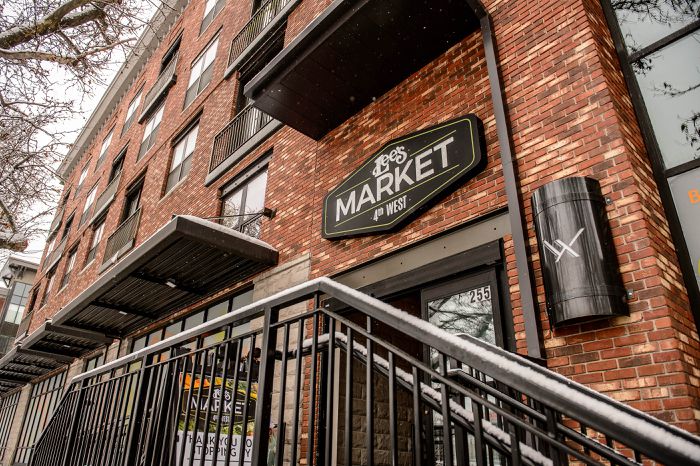
Salt Lake.  Last fall, less than two years after opening, a small grocery store closed in the Marmalade district of Salt Lake, on the city's near westside ("Lee’s Market to close its 400 West location in Salt Lake City on Friday," Salt Lake Tribune).  

Lee's Marketplace was opened by a small supermarket group that is a member of the Associated Food Stores cooperative.  They operate a number of regularly sized stores outside of Salt Lake City proper.

This store, on the ground floor of an apartment building, was small, but well stocked, and the firm extended sales prices on featured items to this store as well--many companies that have a mix of larger and smaller stores don't extend special pricing to the small stores.  

It opened just before covid and that stunted it ("Salt Lake City’s Marmalade neighborhood get its first grocery store in decades," SLT).

Salt Lake also has the Harmon's chain, which is upscale and has three stores, one in the city, that are significantly smaller than a traditional supermarket.  There is another firm, the Corner Store, which has two small stores in the area, with a branch nearby in the Gateway development.

There are other mainline (large) supermarkets nearby--within a couple miles, including Smith's owned by Kroger, Lucky's, a Rancho--Hispanic, and the Downtown Harmon's, which is an exquisite store--smaller than a normal store, but large enough, with premier bakery, meat, and seafood departments, along with a cooking school, grill for eat-in, and other features, a form of which are present in most of the other Harmon's locations.  Plus the area isn't that far from the corridor with a Target, Walmart, Costco, and a restaurant supply store open to the public.

Even though the Lee's was outside of our neighborhood, we shopped there occasionally because it is a couple blocks from the house of close friends.

People commented that the store closed because rents must have increased, or because of shoplifting from students at West High School across the street.

I responded, it's obvious they didn't have enough business and that's why they closed.  From the article:

Badger wrote that the “decision to close the store is the result of the lack of volume coming into the store from the surrounding areas, the COVID-19 pandemic, and public accessibility.”

The market was employing “the urban store format you would find a high-density city like, New York, Chicago, or Boston was a test for our company,” Badger wrote. “Unfortunately, we found this style of shopping is not yet conducive to the Salt Lake City area.”

First, even though the immediate neighborhood didn't have a supermarket, it's not like people didn't eat, and therefore, already had relationships with existing grocers.  So the market needed to do ongoing, serious marketing.  I was thinking back to when I was a child in Detroit 50+ years ago--back then, stores didn't insert weekly circulars in the local newspapers, they delivered them door-to-door.  Lee's probably needed to do something like that. 

Second, the store wasn't particularly well located.  The neighborhood has a nascent commercial district, although it's disjoint and not set up for success from an urban design standpoint, and that's not where the Lee's was located.

Third, opened in anticipation of lots of new multiunit buildings and residents, the construction and renting of such units hasn't moved fast enough to boost the patronage of Lee's, if people even knew they were there.

Basically, to survive Lee's needed minimal even zero rent for years, until the customer base built up to the point where the store could survive.

As it is, I am amazed at how many grocery stores there are here, in part a function maybe of people eating in more than the national average.  There are 20 grocery stores within a five mile radius of where we live, and even more slightly outside that distance.  Including ethnic and specialty stores, major discounters, a restaurant supply store that sells to the public, etc.  So many more options than we had in DC (although I do miss Aldi).

Lesson: as much as people like me advocate for expanded urban grocery options, the reality is that to make stores work requires a lot to go right.  And this is true in all of the other examples below.

Wrigleys was one of the supermarkets that existed during my childhood in Detroit.  Except for Kroger, based in Cincinnati, all those stores--Wrigleys, Packers, Great Scott, Chatham, Farmer Jack's--have closed.

The kind of intense door to door marketing I remember from my childhood is necessary these days to alert area residents that a store even exists, given that most people don't read local newspapers and other forms of local media that would inform them that such a store exists.

Salt Lake Food Coop initiative.  Similarly, for a number of years, at least five, there's been an effort to  create a food coop in the city.  I don't see how it can succeed given the high level of grocery store penetration and the failure of small artisan food businesses here ("Small businesses closing in Salt Lake," KSL).    Although an issue with the food businesses is the rising cost of ingredients.

Interestingly, there already is a cooperative in suburban Murray, I don't see why they aren't working on just opening a branch in the city.

Like with the Good Food stores mentioned below, from the outset, food cooperatives tend to focused on a niche audience.  That being said the success of cooperatives in Minneapolis-St. Paul, and the upscale Coopertunity Market in Culver City ("Revisiting Takoma Junction and the Takoma Co-op development issue | A chance to start over") shows success is possible.  

Richmond, Virginia: Market @25th is unprofitable too, but has a deep pocketed investor.

I think I've mentioned the small for profit market, Market@25th in Richmond, created by a philanthropist.

Like the stores in DC and Salt Lake, it's part of a mixed use development.  And like the DC example, it's part of an urban revitalization effort.

It's a social enterprise-like store, but it's funded by a philanthropist, with the aim of being profitable ("Richmond’s Market At 25th Shaped By History, Needs Of Church Hill Residents," Virginia Public Media).  

Which is a good thing because it's lost tons of money ("Church Hill's new grocery store has lost millions in 6 months, but owners are committed to 'the market with a mission'," Richmond Times-Dispatch).  From the article:

[Steve] Markel, vice chairman of the Henrico County-based specialty insurer Markel Corp., and his wife, Kathie, announced in 2016 that they would bankroll the construction of a grocery store in the city’s East End.

The area is home to some of the city’s poorest families. Residents have lower life expectancies than in wealthier parts of the city, a disparity Markel said necessitated investment aimed at improving health outcomes.

To that end, Markel helped finance the mixed-use development at 25th Street and Nine Mile Road. It includes 42 apartments, retail and office space and a new culinary school that J. Sargeant Reynolds Community College plans to open in 2020.

The 25,000-square-foot grocery store is the centerpiece of what Markel said this past spring was a “philanthropic” venture.

“The grocery store is really a symbol of creating a healthy neighborhood and a vibrant neighborhood,” he said. “Not only was it about food and vegetables and fruit, it was about jobs.”

If the store were fully nonprofit, or super undecapitalized, it's likely that it would have closed.  Typically, nonprofits don't have the funding to be able to make it through the long period of losses before profitability is attained.

Oakland, California.  Last year, an independent community grocery store closed on the Westside of Oakland ("Why West Oakland’s only full-service grocery store closed after less than 3 years," Oaklandside).  

It was undercapitalized and didn't have enough business to sustain the slow period of growth associated with opening.  Like for the Lee's, the pandemic provided extra hurt.

Photo: Michelle Gomez, DCist/WAMU-NPR.

Washington, DC.  Good Food Market stops selling unprepared food ("Good Food Markets Closes Ward 8 Grocery Store As It Pivots To Prepared Food," DCist).  

Over the years, the nonprofit Good Food Market has opened stores in DC and Prince George's County ("Good Food Markets Open Location in Prince George’s County," Washington Informer), including in DC's Anacostia neighborhood ("Mayor Bowser Celebrates Grand Opening of Good Food Markets in Ward 8," press release).  

They've just stopped selling groceries and are only selling prepared foods, defeating the purpose of opening stores in so called food deserts, as prepared foods cost a lot more than perishable and nonperishable food stuffs.

Opening stores in low income communities.  Many years ago, I wrote this, "In lower income neighborhoods, are businesses supposed to be "community organizations" first?" (2012), in response to an earlier failure of a grocery store attempt in DC's East of the River, by the area's Yes Market Natural Grocery group. 

FWIW, I am an advocate of social enterprise focused efforts in such communities, but they need to be well capitalized and it must be understood that achieving profitability will be very difficult.

Grocery shopping routines.  One of the problems with how advocates think about grocery shopping is they forget that we eat every day.  While it may suck to have to travel to a store, most people have developed patterns and practices of food shopping to accommodate their needs and situations.

Just because a store opens doesn't mean that people change their shopping patterns to patronize it.  And in a city like DC, it may make more sense to provide shuttle services to residents in understored areas to be able to go to the stores in nearby areas--for example on H Street, primarily in NE DC, in a two mile distance, albeit some off the corridor, there is a Walmart, Giant, Whole Foods, Safeway, Aldi, Trader Joes, Harris-Teeter, Streets--an independent upscale market, and a market district.

Rather than funding an undercapitalized minimarket, sometimes, at least initially maybe just provide shuttle services to existing grocery stores?

Labels: , , , , , ,

Thursday, October 13, 2022

A tale of three supermarket companies and innovation: Kroger; Safeway; Albertsons

There was an article in my newsfeed that Kroger, the largest supermarket company, is going to buy Albertsons, the second largest supermarket company ("Albertsons merger with Kroger could be announced this week," CNBC.

A few years ago, Albertsons bought Safeway and its banners.

Kroger.  While Kroger is an impressive company, I have an entry about how they are a great example of what I call "stranded best practice" in that, with a couple of exceptions, they aren't very good at transferring and adapting best practice from one chain to another.

-- "Problem solvers vs. possibility thinkers (and Kroger) ," 2017

Photo: Dave Rossman for the Houston Chronicle.

Besides loyalty programs, the primary exception is the Marketplace format ("Big or small? Retailers take different tacks on store size," Supermarket News), based on Fred Meyer, and like Target and Walmart, which adds general merchandise to the grocery store.  It's not necessarily "every day" low price, as the image of Walmart and Target is, and the range of items isn't quite as large, but they have frequent sales which makes it a viable competitor.

But I think the primary purpose is to make it harder for Walmart and Target to open stores in areas where Kroger operates. (It also helps that your general merchandise purchases can tally up points to save money on gasoline.)

They also bought the New York City based Murray's Cheese store and ported it as the specialty cheese section to their stores across the country.

Kroger is also a leader in store brands--we prefer for example their store brand beans or chicken broth to other store brands, and to national brands.

But while some of their divisions have augmented stores with specialty departments, like "Fresh Fare" in Texas slowly being ported to other markets but seemingly only for banners named Kroger ("Kroger opens another Fresh Fare store in Ohio," Drug Store News, 2008), or the store by their headquarters in Cincinnati ("Inside Kroger’s New Downtown Grocery Concept and Eatery," Cincinnati Magazine) which has a food hall featuring locally owned restaurants, and they bought more upscale chains like Harris-Teeter and Mariano's (Chicago), those practices don't end up in other chains, definitely not the way that Giant-Eagle (Market District) and HEB (Central Market) have a small set of upscale stores, and Giant-Eagle has branded its convenience store-gas stations as GetGo, featuring Market District and Giant-Eagle brands.  (In fact, Kroger had a massive set of convenience stores, didn't learn from Giant-Eagle, and sold most of them off).

Some people report that under Kroger, Mariano's is even being "dumbed down," becoming less special.

Safeway.  To me, Safeway is most impressive for its destruction of shareholder value.  It bought chains in Chicago ("How Dominick's Lost its Way in Chicago," Chicago Business Journal) and Philadelphia, running them out of business, and chains in Texas (Randall's and Tom Thumb) are less successful than when they bought them.  From the article:

Perhaps the key reason why Dominick's ultimately was doomed is something much trickier to quantify — a failure of zestful imagination across the boards. To put it bluntly, Dominick's had become an immensely boring grocery shopping experience. Nothing in the way management designed or merchandised the stores made them distinctive enough to engage shoppers and build loyalty. Any sort of "wow factor" was totally absent.

It cost the company billions of dollars.  How did that not end up with the CEO getting fired?

But they've been very successful with their private brands, like what was called Safeway Select, now Signature Select.  I miss some of those products, like Asian Stir Fry frozen vegetables and seltzers here.  Plus, their loyalty program and coupon doubling (they probably don't do that now).

Petworth, DC.

And earlier than some of their competitors, they began opening new stores in center cities, starting with Portland in 2003. DC has a couple of those stores, Downtown at CityVista, and the Petworth store, which became the ground floor of a multiunit apartment building, which they repeated in Capitol Hill.

The company always remained committed to DC proper, having the most stores of any chain in the city (although they closed small neighborhood stores in favor of larger stores serving multiple neighborhoods to which residents "had" to drive.)

Albertson's today isn't really the same company it was 20 years ago.  It went through an iteration of independence, then it was bought by Supervalu--now no longer in existence itself, a wholesaler and supermarket chain owner, but they sold off a huge amount of stores to private equity (Cerberus) and then the private equity company fixed those stores and bought the rest.

One of their moves was to buy United Supermarkets in Texas, a small company, but one with two specialty divisions, a Hispanic oriented market, and an upscale market, like HEB's Central Market, called Market Street.

Then they bought Safeway, allegedly for their management prowess, but really for their private brands.  They took off the Safeway name--now it's Signature Select, etc. and ported them to all the Albertson's chains, the way that Kroger uses the Kroger brand across chains (although maybe not at H-T and Mariano's).

One of the amazing things Albertson's has done is to take the Market Street format and slowly apply it to other banners.  

For example, there are two stores in Boise--where the company is headquartered, and I guess one now in Montana that are basically Market Streets, super stores.  

Patio furniture displayed in the parking lot of the Broadway Albertson's, Boise.

I was blown away by the one in Boise, next to Boise State University and Downtown, except for the high prices ("Albertsons Market Street Store is a Food Paradise" Progressive Grocer).  It has a second story bar, a ground floor cafe, grass fed beef featuring ranches from the region, creative displays even outside the store.

Conclusion.  So unlike Kroger with what I call stranded best practice, and unlike Safeway in how they destroyed store banners they bought losing billions in the process, the latest iteration of Albertson's under private equity shows innovation.

If Kroger buys Albertson's my sense is that the innovativeness of Albertson's will be left to die.  And I doubt that Kroger will adopt Signature Select instead of the Kroger brand, thereby destroying lots of value and brand equity there.  Although it's possible they'd let those brands continue being offered in the Albertson's banners.

I don't think the acquisition will result in better choices and options for grocery patrons.  But it probably won't hurt.  And outside of some markets, like California and Texas, they don't really compete.

It's possible, with Kroger as the buyer, that they will reduce prices in Albertson's chains, which tend to be higher than Kroger chain pricing.

Labels: , , ,

Saturday, January 29, 2022

Revisiting Takoma Junction and the Takoma Co-op development issue | A chance to start over

The Washington Post reports that the Montgomery County Planning Board has rejected the development proposal for the Takoma Junction parking lot site in Takoma Park, Maryland ("Montgomery planners reject Takoma Park development").

The Planning Board decided thusly because the project wasn't able to receive approval from the State Highway Administration for a layby for delivery access.  The SHA has jurisdiction because the site abuts a state arterial 

I wrote about this project in 2018 ("The lost opportunity of the Takoma Food Co-op as a transformational driver for the Takoma Junction district").

I lamented that the project is extraordinarily contentious because it involves the Takoma Co-op, the parking lot next door which is owned by the city, the general anti-development sentiment of "Tako-manians" (this was what someone I met calls residents of Takoma Park), and the ability of the member-based Co-op to mobilize its members to oppose what it wants to be opposed.

Currently the site is a parking lot, which has been used by many of the Co-op's shoppers, and also as a site for community events.

Takoma anti-development attitudes that are behind the times. Attempts to develop the site have meandered for 20+ years, comparable to the Takoma Metrorail site ("The Takoma Metro Development Proposal and its illustration of gaps in planning and participation processes," 2014) and the two sites share similar issues:

-- historical anti-development sentiment which resulted in key victories, shaping for 50 years  the ethos and attitudes of involved Takoma residents 

Note that these successes were key--fighting off proposals for urban freeways, and later, development proposals that were inappropriate for the Takoma Metrorail site, but those successes have led many people to reflexively oppose everything, rather than to be judicious in what they support as well as what they don't support.

- an unwillingness to acknowledge that anchor sites in commercial districts have different development conditions than residential areas typified by one and two story houses

Non profit food cooperatives can be part of mixed use developments. The 2018 piece lists a number of mixed use projects around the country with food co-operatives on the ground floor--Seattle, Minneapolis, Rochester, Minnesota, Brattleboro, Vermont, and Great Barrington, Massachusetts--with mostly housing above.  

Of course, the DC area, including Suburban Maryland and Northern Virginia, has plenty of examples of mixed use grocery projects involving for profit supermarkets, including Giant, Safeway, Harris-Teeter, the small independent Streets (three stores in DC and one in Arlington), Walmart, Aldi, and the smaller Yes Market Natural Grocery--in another project developed by the Neighborhood Development Company nearby on Georgia Avenue in the Petworth neighborhood of DC.

Takoma Junction is underpowered.  As a commercial district, Takoma Junction isn't particular successful, other than the Food Co-op, because it doesn't have a lot of nearby population.

Takoma Park is mostly single family residential with comparatively big lots, so other than the Co-op, a gas station and auto repair place, there isn't a lot going on there, and quality retailers don't tend to last.

Likely most of the Co-op's customers drive.

Ideally the parking lot site would be developed in conjunction with the Takoma Co-op, by incorporating its current site/building (and even the abutting Takoma Fire Station), allowing for a larger mixed use project, using as models the projects I mentioned in the 2018 piece.  

Instead because of the Co-op's intransigence, the parking lot project was designed to be separate from the Co-op, and because of residents reflexive opposition to buildings taller than two stories, not particularly transformational.

The Takoma Junction MC project adds space, albeit more modern, in an area where space isn't the problem, the problem is the attractiveness of the retail offerings and whether or not they are attractive enough to draw customers from a larger area.   

Not including housing is a significant opportunity cost, because of the clear demand for housing in the Washington Metropolitan Area, the almost zero availability of build out opportunities in the core of Takoma Park, and the fact that the site is within reasonable walking distance of the Takoma Metrorail Station.

On the far left is the Takoma Co-op, 
the buildings to the right are the proposed TakomaJunctionMC project

The best possible project would create an awesome co-op grocery, and a bit more retail space, while adding housing--2-3 floors of apartments, to add housing and broaden the range of housing types available in Takoma Park.  Ideally 3, even 4 stories of apartments, would be best, although it would be taller than other buildings in the Junction.

Examples of nearby projects as models would be the Takoma Central apartments on Carroll Avenue in DC, which peak at about four stories; the Gables Apartments on Blair Road, or the smaller Willow + Maple "garden apartments."

Gables Apartments

The Takoma Central apartments use different types of bricks mixed with modern elements.
Design wise it's not particularly, great, but it wouldn't have been difficult to make it better.

Rainer Square Tower, Seattle.  Wikipedia photo.

Puget Consumers Cooperative, Seattle. Last week the PCC Co-op in Seattle just opened its newest store ("‘Our city’s not dead yet’: PCC opening highlights promise of, and challenges to, downtown Seattle’s recovery," Seattle Times, press release) and while I haven't visited the store, I have visited others.  

It's part of a Downtown skyscraper,  58 stories, with other retail, offices, and apartments.  

Now PCC has five stores in Seattle that are part of mixed use developments.  There is also the Central Co-op in Capitol Hill, which is topped by apartments too.

The other co-operative + housing projects mentioned in the previous entry are all much smaller, and more typical of a site like the one in Takoma Park.

PCC is a top notch operation that would be a great model for the Takoma Food Co-op, as a way to reposition and expand.

The rejection by the  Planning Board provides an opportunity to start over.  The rejection of the development proposal by the Montgomery County Planning Board gives the stakeholders in Takoma Junction the chance to start over and create an awesome project.

The project as proposed was a waste of an opportunity to do something great.  Once a site is developed, it becomes much harder to redevelop, so better that the project not go forward at this particular time.

If Takoma Park is capable of breaking out of its narrow ways, the City, the Co-op (as a member of the National Cooperative Grocer Association, the Takoma Co-op should be familiar with best practice and mixed use cooperatives around the country), Neighborhood Development Company, and interested residents could start over, work together jointly, and develop a project they could be proud of, one that would improve: (1) the Co-op, (2)  Takoma Junction, and (3) Takoma Park, while (4) adding a significant number of housing units.

Another best in class example: Co-Opportunity Co-op in Culver City, California.  A year after I wrote the 2018 piece, in 2019, riding the Expo Line in LA, I noticed this co-op, and got off the train--a short walk from the Culver City stop--to check it out.  

While the exterior's architectural design doesn't appeal to me, the Co-op is part of the Access Culver City mixed use project, which includes the Co-op at 19,000 s.f., another 12,000 s.f. of retail, and 115 apartments.  The building is fronted by an outdoor patio, which extends"eat in" space for the Co-op.

The grocery is super attractive, with prepared foods and an eat-in area.

The Culver City site is bigger than the Takoma Junction site, unless they could include the adjoining fire station.

By going to four or even five stories, there's an opportunity to add 80+ housing units, as well as build an amazing new co-operative grocery store, and have underground parking.

A Takoma Junction project comparable to the Access Culver City project would be a win-win-win becoming a more significant anchor for Takoma Junction.

Takoma Co-op has to ask itself some hard questions.  First, do they want to be part of a great project, resulting in a better store?  Second, are they willing to work with others in a joint venture?  Third, are they willing to create a better store, by measuring their operation against best practice cooperatives operating elsewhere, and change to be better and more competitive?

WRT the third question, the Co-op has to consider whether or not it's willing to expand its product offerings to be able to appeal to a wider audience.  Beyond merely increasing the size of current, underpowered departments like produce, dairy, beer and wine.  Adding prepared foods and a cafe and selling meat should be on the table too.

Kelly Kawarchi is the head butcher at Blackbelly Market.  Photo: Boulder Weekly.

Takoma Junction as a food district. If the Takoma Co-op is willing to do some things and not others, but still participate in a bigger project as a joint venture, the city should consider trying to make the area a small "food district," recruiting other businesses to fill the holes in the current product offering.

This would attract patrons from beyond the immediate area.

There's already a great bread bakery across the street, Spring Mill Bread Company.  But the Co-op could add an in-house bakery operation too, with a broader range of goods.

If the co-op isn't willing to offer meat products, a high quality artisan independent butcher could be recruited.  In the DC area, Red Apron, the butcher operated by the Neighborhood Restaurant Group is one example.  But there are plenty of examples of such butchers across the country

Kaldi's Coffee House in nearby Silver Spring is an amazing experience and a good model for a great coffee shop.  

I don't know why the nearby, but not at Takoma Junction, Capital City Confectionary closed.  It was up the street on Carroll Avenue (albeit in a space where the businesses come and go).  If it were part of a bigger food district anchored by an amazing food co-op, it would have had a better chance of surviving.

Labels: , , , , , , ,

Tuesday, February 18, 2020

Two interesting examples of supermarket firms bucking traditional political forces

1.  In Texas, the supermarket chain HEB (ranked #1 in the country by some evaluators) challenged an electricity rate increase petition by the state's major utility, because they said it was undeserved given the level of frequent power outages.

Because it is a respected firm and "not some wooly-eyed anti-business advocacy group" they were taken seriously and the rate increase was mostly denied, in turn providing benefits to Texas residents independent of the firm ("How H-E-B helped reduce CenterPoint’s request for electricity price hike," Houston Chronicle).  At the end, the rate increase allowed was less than 10% of what the CenterPoint utility originally asked for.

But the reality is that HEB didn't buck the system that much. It is typical for "industrial" users of electricity to challenge utility rate schemes.  At the end of the day, HEB was just another utility customer challenging rates.

2. What Harmon's Supermarkets, a 19 store independent grocery chain in Greater Salt Lake City that manages to hold its own against one of Kroger Company's strongest divisions, did in December and January was a much greater challenge to good old boy politics.

Gay Pride flag flying at Salt Lake City Hall, 2013I was shocked one year to see the Gay Pride flag flying at the City Hall in Salt Lake. While many cities have solid bona fides when it comes to LGBTQ issues, I've never seen the flag flying in front of city facilities, which is a very direct communication.

While Salt Lake City is an increasingly progressive city--even in otherwise conservative states, metropolitan areas tend to vote Democratic--Utah is a very conservative state politically.

The Republican Party has a super majority in the Legislature, Legislators are mostly white men, and 90% of the Legislature members practice the Mormon religion.

Last year, after a special session that wasn't particularly deliberative, the State Legislature passed a tax reduction plan that (1) reduced income taxes, which by law are the sole source of school funding; (2) increased sales taxes on food without overhauling the sales tax revenue stream, which funds other government operations; (3) said that by changing the tax structure of school funding it would force school districts and cities to work together to increase local property taxes to fund schools, with no guarantee that school funding would be maintained.

Utah has certain referendum laws that in some cases, allow for petition campaigns to challenge actions by the Legislature, although petitioners are only provided a very short time, maybe 45 days maximum, and there are complicated requirements for a certain number of signatures from a majority of counties, tabulated by county, etc.

Rarely do such referenda work, and the pundits all said the referendum effort would fail.

Petition table inside a Harmon's Supermarket. Photo:  Ben Winslow, Fox13 SLC.

Then Harmon's Chairman, Bob Harmon, stepped in out of belief that an increased sales tax on groceries would be hardship to its customers and Utahns generally, and in early January let the petition campaign set up tables in each of their stores to gather signatures ("Harmons grocery stores join tax referendum effort," Salt Lake Tribune).  From the article:
“Food is essential and should be affordable,” Bob Harmon, the company’s chairman, said in a prepared statement. “Increasing the tax on food hurts everyone, but especially those in our community who are already struggling.”
In turn, this led their supplier, Associated Food Stores, a grocery business cooperative operating in the Intermountain States, to do the same at their corporately owned stores, and many of the independent store groups supplied by the chain ended up providing similar support.

Harmon's was roundly criticized by elected officials, including the Governor.   From the article:
The Governor’s Office issued a statement saying it was “disappointed in Harmon’s actions.… As a corporate citizen in the state, they have a right to engage in the political process, but they also have the responsibility to do so in a way that elevates the public’s discourse and is based on facts and not emotion."

Herbert’s Office then went on to suggest that Harmons’ opposition, like that of other tax reform critics, was based on lack of understanding.

“Harmon’s has not contacted the governor to express their concerns. If they took the time to meet with the governor and/or legislative leadership, they would understand both the need for tax reform, and the viability of the policy enacted by the Legislature and signed into law by the governor,” the statement said.
But by the end of the month, the petition campaign secured enough signatures ("Tax referendum signature validation rate at 94%, stunning elections officials," Fox13) and in only 3 of Utah's 29 counties were not enough signatures collected to meet statutory requirements ("After Success Of Tax Referendum, Summit and Wasatch Counties Still Lag Behind In Signatures," KCPW/NPR).

Rather than go through the process of a public vote on the referendum, the Governor and the Legislature caved, and repealed the changes ("Utah Legislature repeals tax reform in pair of overwhelming votes," SLT).

Elected officials continue to criticize opponents of the measure, while failing to acknowledge that the process was poorly handled and executed, and the measure incompletely addressed the structural problems within the current tax system.

Conclusion.  Arguably, both firms made "business decisions" not moral-ethical decisions, to take the position that they did on these issues.  But still, both companies deserve recognition for standing up in the face of what they considered to be negative actions by other actors, for acts that would not only affect their businesses, but their customers as well.

But at least for Harmon's, they took heat for not going along, not being a good "corporate citizen" at least according to the definition of the state's leading elected officials.


As it happens, both companies are market leaders in the supermarket profession.  One interesting thing about this though is that both companies are leaders in their respective markets.

Selling AuthenticityIn the very competitive Texas market, HEB is #1 for grocery sales and they are quite innovative ("Why are HEB flour tortillas so dang good?," Bon Appetit) with a supercenter offering, Central Market, an upscale offering, great branding, a focus on selling local products, etc. ("HEB: The Smartest Supermarket You've Just Heard Of," Forbes Magazine).

Harmon's has differentiated the company by shifting away from competing on price and instead offering quality, an emphasis on local products, great branding, differentiated store sizing, offering a wide array of prepared foods, an impressive loyalty program (the rewards are based on how much you buy, not so much focused on providing discounts on purchases), Cooking schools in many of their stores, and supermarket dietitians covering all of their stores and offering programming (see the entry for Harmon's in "Wonder Filled," Progressive Grocer).

There is no real equivalent of Harmon's in the DC area.  And none of the major supermarket chains in the DC area operates with the agility and innovativeness of HEB.

Labels: , , , , ,