Rebuilding Place in the Urban Space

"A community’s physical form, rather than its land uses, is its most intrinsic and enduring characteristic." [Katz, EPA] This blog focuses on place and placemaking and all that makes it work--historic preservation, urban design, transportation, asset-based community development, arts & cultural development, commercial district revitalization, tourism & destination development, and quality of life advocacy--along with doses of civic engagement and good governance watchdogging.

Friday, June 14, 2019

Why microtransit isn't likely to be a source of great profits for private firms: labor

In doing filing, I came across a columnist writing about autonomous vehicles back in 2017.  She made the point that new technologies and ways of doing things are often oversold in the short run, but have great influence over the long run.

What is now called "microtransit" isn't new.  For example, for many years I've written about free neighborhood shuttle bus routes in Tempe, Arizona and "shared taxi services" at the outskirts of transit service zones in Montreal.

Microtransit is the "new" term for shuttle buses and the like, including services such as UberPool, Via, and various failed services like Bridj.

-- "Where's the revolution?: Bridj microtransit service shuts down (a/k/a "Mobility as a Service")," 2017

Anyway, this ad I saw on the back of a Metrobus for Via, which is a semi-fixed route "shuttle" aiming to move people within districts, usually focused on getting people to and from rail transit stations, communicates the reality of why microtransit is not likely to be financially viable for private sector service.
Ad on a Metrobus promoting driving for the Via microtransit service

Labor costs a lot.  Fares are comparatively low.  And there aren't a lot of riders.

If you paying $200/8-hour shift for 14 shifts/week, that's almost $3,000/week.  Plus the cost and depreciation of the vehicle, insurance, and variable expenses to gas up and maintain the car, soft infrastructure to run the service, etc.

It's not that this kind of what I call "intra-neighborhood" service isn't important to provide, depending on the situation ("Carlsbad to launch innovative ‘first-last mile’ program to boost transit ridership," San Diego Union-Tribune; "They’re like Uber but free: New electric shuttles popping up all over South Florida," Fort Lauderdale Sun-Sentinel).  The San Diego County service will be free to riders of the commuter train, and costs $2.50 for others to ride.

The Fort Lauderdale service is free, paid for by local governments and a combination of ad and sponsorship sales.  From the Ft. Lauderdale article:
Partnering with local governments and private advertisers, several companies are building fleets of low-speed street-legal six-seat electric shuttles to ferry the permanently or temporarily car-less over short distances within congested urban zones.

Pedestrians in busy sections of Fort Lauderdale, Palm Beach and West Palm Beach can use smartphone apps to summon rides from two growing services: Freebee, in the middle of a pilot program in a square-mile section of downtown Fort Lauderdale, and Circuit (formerly The Free Ride), which serves Fort Lauderdale’s beachfront resort area and last week began shuttling tourists and commuters in the core area of Hollywood.
...
Jason Spiegel, a University of Miami grad who started Freebee in 2011 with fellow Hurricane alum Kris Kimball, said his company can make money giving away free rides by pursuing three business models:

One model calls for cities to fund the entire operation as if it was their own.

Under the second, the city pays a contracted rate that gets reduced as advertising is sold. Prior to its current deal with Freebee, Coral Gables agreed to pay $300,000 a year and saw that amount reduced to $110,000 after Baptist Health came on board as sole sponsor. But when the contract came up for renewal, Coral Gables decided it didn’t want outside advertising and agreed to pay $486,000 to expand from three to five vehicles and keep its service self-branded, Spiegel said.

Under the third model, ad revenues fund the entire operation. Riders are greeted with ads not only wrapped around the outside of the vehicles, but inside and on mounted tablets. Often drivers pass out product samples provided by the advertisers. Riders can take selfies with the tablets, send them to their friends and even listen to their requested music, Spiegel said.
But it must be recognized that success at advertising is likely to be in tourist areas and downtowns, not in "the average neighborhood."

Note that I define intra-neighborhood services like these, which include standard shuttles serving private organizations, as part of a community/metropolitan area's "tertiary" transit network.

-- "Intra-neighborhood (tertiary) transit revisited because of new San Diego service," 2016

But getting back to autonomous vehicles, which in the long run (at least 10 years down the road) are more likely, eliminating the cost of direct labor for such a service will significantly change the cost structure and then perhaps such a microtransit service could be a viable for profit venture.
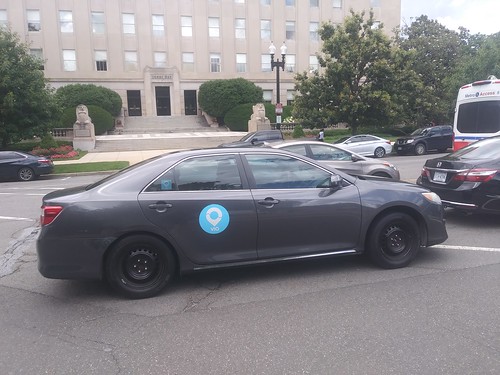
Via microtransit vehicle

Labels: , , , , , ,

Tuesday, May 02, 2017

Where's the revolution?: Bridj microtransit service shuts down (a/k/a "Mobility as a Service")

(Apologies to Depeche Mode: "Where's the Revolution?")

Yesterday, the Boston Globe reported ("Boston-based startup Bridj is shutting down after 3 years of operation") that the microtransit service Bridj is going out of business, after failing to land an agreement with a major auto company.

DC was one of the markets in which the firm operated (somewhere I have a couple photos from seeing their vehicles on 3rd Street NW).

Microtransit.  Services like Bridj have been touted as a revolution in transit.

Uber and Lyft have also been active in this market (e.g., UberPool), and last September Ford Motor Company bought Chariot, a firm similar to Bridj, based in the San Francisco region ("Ford Motor Company as a transportation company not a "car" company: bike share and small scale transit").

The reality is that such services aren't revolutionary, and build on forms that have been around for decades (Operational Experiences with Flexible Transit Services, Transit Cooperative Research Program, 2004), as shared taxi services (taxi collectif) such as in "exurban" Montreal, or shuttles, jitneys or van pools.

What's happened is that cloud computing and wireless communications systems make providing this kind of service a bit cheaper and easier, including making it easier to "recruit" riders, called "ride matching," just as similar technologies have enabled car sharing systems like Zipcar and Car2Go.

-- Shared Mobility: Definitions, Industry Developments, and Early Understanding, Berkeley Transportation Sustainability Research Center
-- New Mobility Discussion Paper, Metrolinx, Toronto

In my transit network model ("The Meta Regional Transit Network") and concept of the mobility shed/sustainable mobility platform, such services can be either secondary longer distance options (like van pools, such as vRide) or "tertiary" transit, providing service within sub-districts of an area, using a transit station as a hub.

Bridj.  The company received lots of publicity for working with the Kansas City transit agency to provide a kind of fixed route "micro" transit service, but the agreement didn't last ("How Bridj's failed experiment in Kansas City Could Still Be the Future of Public Transit," Wired Magazine). From the article:
BRINGING BRIDJ TO Kansas City seemed like a no-brainer to transit officials. For just $1.50, anyone could use an app to summon a ride downtown in van that would follow a route calculated on the fly by an algorithm. No one within the service area was ever more than a 10 minute walk from a stop, and as an added incentive, your first 10 rides were free.

It flopped. Just 1,480 people rode on a Bridj van, a laughably small figure in a city of 2 million people. The city launched the program with the Boston mobility startup in March 2016, and in the past six months just one-third of riders took more than 10 rides. The one-year, $1.3 million project ended Friday. You might call it a failure.

Government officials and transit researchers call it a success. “I’ll be honest: The ridership was not the top priority,” says Jameson Auten, who leads the innovation division of the Kansas City Area Transportation Authority. “The top priority for us was learning who uses on demand. Really, the big goal for us was learning itself.”
I'd call what they were doing in Kansas City an intra-district transit service ("Intra-neighborhood (tertiary) transit revisited because of new San Diego service").

There, it seemed most users thought of the service somewhat like a taxi, and they were younger than typical transit riders.  But at $1.50 per ride it wasn't economically sound. And while the transit agency learned stuff it could have learned by reading some reports and talking to other transit agencies providing similar services, in this case it was at Bridj's expense, and ultimately at the expense of the firms funding the company.

(Via is another firm providing fixed route intra-district services, in NYC, Chicago, and DC.  The DC fare is $2.95. The DC Department of For Hire Vehicles is subsidizing a similar service, at $3.50 per ride, in certain neighborhoods with a high number of seniors or people on limited incomes, called Neighborhood Ride Service by Taxi.)

Innovation theories.  The way I think about new technologies and services, such as Uber and other taxi services, car sharing, or driverless cars, is in terms of theories about innovation adoption using the diffusion of innovation theory of Everett Rogers (while not really credited, this is the theoretical basis of Malcolm Gladwell's Tipping Point, where Gladwell extends theory is in discussing how to advance innovation more quickly) or the disruptive innovation concept by Clayton Christensen:
A disruptive innovation is an innovation that creates a new market and value network and eventually disrupts an existing market and value network, displacing established market leading firms, products and alliances.
Creating new markets or tinkering with existing markets.  The reality is that mobility services like Uber and Lyft are taxi services, reliant on people who need work and already have access to cars that are underutilized, connected by a digital application.  Other than the ability to use venture capital to subsidize the cost of a ride (and "surge pricing") there is no fundamental difference between "transportation network companies" and taxi companies.  Similarly, Bridj was and Chariot is the equivalent of a shuttle bus service.

"The Learning."  I don't think it takes a lot of analysis to figure out that microtransit isn't likely to be profitable because the market segments are small, labor is comparatively expensive, and vehicles cost money to purchase and maintain.

IT and telecommunications and "crowdsourcing" routes may have helped these services generate more ridership and gross revenue compared to previous service iterations, but the services still require subsidy.

That's why such trips are typically captured by higher priced services--taxis, or covered by institutions providing the service (shuttles) because of transportation demand management requirements.  Similarly, a long distance van pool doesn't pay the driver directly, other than covering their cost of the vehicle and expenses.

When the graphical World Wide Web was introduced, most people started calling "interactive" anything using graphics, even when there was nothing two-way or interactive about it.  What they meant was that the webpage was "multimedia," no longer static text.

Similarly, adding IT and telecommunications capabilities to tertiary transit network services are "evolutionary" not revolutionary, and not enough in and of themselves to create a market.

Whether or not the firms entering the transportation/mobility space can last long term is still an open question.  Vehicles and labor are expensive.  How much people are willing to pay for a trip is comparatively low.

How much they want to be able to multitask (read, using computer/wireless communication device) instead of drive and how much they are willing to pay for this is key to the long term success of such services.

Mobility or Transportation as a Service/Sustainable Mobility Platform.  There is a lot of discussion about what is called "mobility as a service" (The rise of mobility as a service: Reshaping how urbanites get around," Deloitte). Basically it's about people getting around without owning or operating a car, with various types of interconnected services.

The problem is that mass transit makes economic sense at large numbers, and "mobility as a service" is hard to provide cheaply, especially without subsidy.

One example is car sharing.  It works because it costs $9 to $15/hour to use, and the "member" is the vehicle operator.  Even so, it's not likely to capture the bulk of mobility market, but it can be an important component.  How profitable it will be for the private sector is an open question.

Labels: , , , , , ,

Sunday, May 08, 2016

Uber/Lyft lose referendum in Austin, Texas

Austin passed legislation imposing rules on e-taxi services like Uber and Lyft that are comparable to the regulations followed by regular taxi services.  Uber and similar companies funded a referendum to overturn the rules.  From the Austin American-Statesman article, "Prop 1 goes down as activist proclaims: ‘Austin made Uber an example'":
The results keep in place the ordinance that the City Council approved in December, which requires drivers with ride-hailing apps to undergo fingerprint-based background checks by Feb. 1, 2017. The city’s ordinance also prohibits drivers from stopping in traffic lanes for passenger dropoffs and pickups, requires “trade dress” to identify vehicles for hire, and imposes a variety of data reporting requirements on the ride-hailing companies.
The problem with "sharing" services like airbnb and Uber isn't that they are ways to monetize slack resources, it's that they try to do it market by market in ways that undercut for profit services engaged in the same industry.  They are seeking special privileges to undercut existing businesses, rather than seeking to compete "on a level playing field."  This has absolutely nothing to do with e-commerce and that the are e-based platform and not "brick and mortar" businesses provides no justification for getting to play by different rules.

Mykle Tomlinson, left, and Fred Lewis, right, put together yard signs Saturday to distribute at the anti-Prop 1 group headquarters, Our City, Our Safety, Our Choice. Austin American-Statesman photo.

I have no problem with vacation rental e-commerce platforms like Airbnb--although we don't use it, we do use VRBO. But it seems reasonable that properties participating, even if renting a spare room as opposed to a full unit or apartment (the type of property we prefer to rent ourselves) that users pay the same lodging taxes that visitors pay when staying in a hotel.

Similarly, with taxi services, for the most part, the demand for taxis is met by available service, with some exceptions, service to impoverished areas, but the reality is that services like Uber aren't much better at serving these areas either, although the way the service is structured, with a kind of prepayment helps to ward off some of the problems taxi drivers often experience taking or picking up fares in such areas.

But the only reason Uber can charge below taxi rates is because pricing is subsidized by capital investment and most of the real costs are borne by the drivers. And drivers, like taxi drivers, mostly take such jobs out of desperation not out of choice, so they will continue to drive even in the face of declining revenues.

In any case, why shouldn't e-taxi service providers be required to meet the same standards as traditional taxi services

Like Airbnb's successful opposition to a referendum-proposed change in San Francisco's regulations, which would have further limited the number of days someone could rent their property in a calendar year, and the company's aim to create political support organizations across the country ("Airbnb flexes new political muscle with plans for 100 home-sharing clubs," USA Today), Uber and Lyft wanted to defeat Austin's legislation to put on notice other communities, exactly how Walmart browbeated San Diego and other cities by threatening to overturn through referendum the city's legislation calling for mitigation of Walmart's negative effect on local business districts and businesses.  Rather than pay for the cost of a special election, the City Council capitulated ("City Council Votes To Repeal Big-Box Ordinance," San Diego Channel 10).

Instead, in Austin these companies lost, despite spending 50 times the amount of the community effort organized to keep the legislation in place.  From the Statesman article:
Uber and Lyft opened the money gusher in Austin as they attempt to beat back similar regulations in major cities across the country, including Chicago, Los Angeles and Atlanta. The giant sums left many observers convinced the companies were using the Austin referendum to send a message to those cities and others that might be eyeing tougher rules.

Ratcheting up the pressure further, Uber recently threatened to leave Houston, which requires drivers to be fingerprinted, drug-tested and undergo a physical before they can drive for the service — requirements far beyond those imposed by the Austin City Council in its December ordinance that Prop 1 would have overturned. Lyft does not operate in Houston.

“They’re operating at a much bigger scale than Prop 1 in Austin,” James Henson, the director of the Texas Politics Project at the University of Texas at Austin, recently told the American-Statesman. “This is not just about Austin, this is about how they assert themselves in regulatory markets in every market they’re in.
It is important that communities come up with a strong narrative that justifies an equal playing field for such firms, although it can mean that equal playing field may mean different things in different situations (e.g., "Supporting car sharing vs. privileging car owners and the use of the public space").

Especially because the companies are seeking to overturn local regulation through the passage of more favorable legislation at the state level.

"Level playing field" is as strong a sound bite and justification as "free market" or "competition."  It's not competition if you're asking for special privileges.

Labels: , , ,




