Rebuilding Place in the Urban Space

"A community’s physical form, rather than its land uses, is its most intrinsic and enduring characteristic." [Katz, EPA] This blog focuses on place and placemaking and all that makes it work--historic preservation, urban design, transportation, asset-based community development, arts & cultural development, commercial district revitalization, tourism & destination development, and quality of life advocacy--along with doses of civic engagement and good governance watchdogging.

Sunday, August 31, 2025

Big Ideas for a Better Pittsburgh | and a point about world class cities

I did some work in Pittsburgh in 2008 and got a good sense of some of the revitalizing neighborhoods there, in particular Lawrenceville, the Strip District, and East Liberty, and the city dynamics.  A couple years later, I responded to a Richard Florida piece when he was at Carnegie Mellon, calling out what I saw as Pittsburgh's advantages, which he re-tweeted.

-- "Urban economic development strategies: do you invest in people or places? ... yes," 2010 

Pittsburgh is considered one of the cities that did urban renewal, at least downtown, right (people say it failed in the Hill District, and it did; some developments on Penn Avenue towards East Liberty were torn down later.

Because "de-"vitalization started earlier there with the decline of the steel industry, they've had longer to decline, and also to experiment.  So it's a good city to pay attention to for programming.

For example, one of the first urban Main Street programs was on East Carson Street.  When we lived in DC, we vacationed there a bunch.  Etc. So I've written a bunch of pieces on it, including:

-- "Economic restructuring success and failure: Detroit compared to Bilbao, Liverpool, and Pittsburgh" 2014
-- "One hidden element of the revitalization of Pittsburgh's East Liberty neighborhood," 2015
-- "Revisiting Pittsburgh," 2019
-- ""Why do Rust Belt rivals Cleveland and Pittsburgh have diverging economies?," 2021
-- "Revisiting Pittsburgh and Allegheny County as an opportunity for city-county consolidation: The "RiversCity" proposal," 2023
-- "It's not the age of the housing stock, but the ability of property owners to maintain it: Disinvestment in Pittsburgh," 2022

Pittsburgh has strengths.  I like Pittsburgh a lot, and given the relatively un-innovative nature of DC, I think they do a lot with the resources that are present.  Local foundations really invest in the community and there are strong grassroots networks.  They have world class medical facilities and universities like Carnegie Mellon which help to cluster business development.  I mention within broader entries best practice arts initiative there, including the Pittsburgh Cultural Trust and the Penn Ave. Arts Initiative (one of the best conference tours I've ever been on!).   The Allegheny Regional Asset District is a national best practice for arts and culture funding.

The Post-Gazette seems, at least online, to do a pretty good job covering the city and region.  The city, for its size, has decent transit, including a "free fare" zone Downtown. They've got good visitor centers, a great local history museum, the Carnegie Library system, Schenley Plaza, the rivers and outdoor activities.  Stadiums on the river.  Great historic building stock from the rowhouse era.  Strong historic preservation programs.  Besides "eds and meds" there are advanced business clusters developing, even though it's a much smaller city. Etc.

A desperate willingness to experiment.  I used to say that cities like Pittsburgh have a desperate willingness to experiment because they have no other choice. From afar, it seems like an innovative place, when all is said and done, but without enough resources in an overall conservative state.

So I, not being there all the time, am less negative that the chief editorial writer for the Pittsburgh Post-Gazette but I sure do appreciate his insight, and I figure he's probably right.

"Big Ideas for a Better Pittsburgh" is a new series for the paper's editorial section.

Which reminds me of a great past feature in the newspaper, on Sundays, on big ideas, called "The Next Page.  One author, Robert Firth, wrote a bunch on mobility and transit.

• The Long Squiggly Line That's Killing Our Transit System (and News of a Brazilian Cure), January 28, 2007 (on Circulator buses)
• The Big Leap in Transit We Didn't Get -- But Could, June 28th, 2009
• "Ditch the Port Authority"), March 12th, 2012

Big Ideas.  The new series builds from some columns by Brandon McGinley, "How Pittsburgh’s delusions of grandeur hold it back," "McCormick summit shows that leaders matter, and that Pittsburgh needs more of them," and "What Pittsburgh progressives got right — and how Corey O’Connor can accomplish what they couldn’t."  From the last article:

There was a time when Pittsburgh’s political-corporate-philanthropic leadership was united and, if not cutting edge, at least innovative and creative. But that time has passed.

This isn’t meant as a personal criticism, but as an observation about the lifecycle of institutions and leadership cohorts: They necessarily become stale without an infusion of fresh talent and purpose — and those usually come from external challenges and competition. It is neither the 1970s nor the 1990s nor even the 2010s any longer. The strategies that worked then, from the nonprofit sector to the nitty-gritty of economic development, don’t work as well, or at all, today.

The Mayor of Pittsburgh can’t fashion the region’s leadership all by himself, but he can set the tone — one of openness to new ideas and new people, including ideas and people considered beyond the narrow range of respectability defined by the existing establishment. He can also take the lead by empowering people, both in government and through his influence beyond government, who represent a new generation and who have the ambition to challenge incumbent leaders by forging a new establishment, or co-opting the current one.

Interestingly, when I read those columns (I tend to look at the newspaper once/month, and review the backfile of local coverage) and it spurred a still in draft blog entry about visionary campaigning/transformational projects action planning as a positioning device for Mayoral elections.

So I think this is a great idea.

From the article:

Losing ground. One of the most noticeable trends in Pittsburgh in recent years has been a steady retreat from ambition. Nascent plans for maglevs and gondolas from years past are remembered scornfully today as vain and unrealistic — which they may have been! — but they also represented a willingness to swing for the fences, to think about how Pittsburgh could make a splash in the Allegheny rather than hit a few singles here and there.

At the same time, the biggest projects regional leaders have taken on have been increasingly abstract, such as eliminating inequities based on class, race and gender. These are very real problems worthy of significant attention, but they are also largely beyond the scope of a city or county to solve.

Further, we believe that Pittsburgh can make greater progress in mitigating inequities, especially in resource-intensive areas like affordable housing, if the region is more economically dynamic. That won’t just mean more tax dollars to deploy, but also more opportunities for everyday people to find jobs with family-sustaining wages and to start businesses of their own, and more chances for people to begin community projects.

Squandering Potential. This should be Pittsburgh’s time to shine. Yet generating enthusiasm about Pittsburgh’s present and future, and a plan for deploying the region’s assets in a strategic way, has proved challenging. 

We believe this is due in part to confoundingly complex institutional structures (both governmental and nongovernmental), in part to a relative lack of savvy and inspiring leaders who can organize competing interests and in part to a habit, related to the first two, of thinking small rather than thinking big.

Thinking Big. Big Ideas for a Better Pittsburgh will present proposals for improving life in southwestern Pennsylvania that go beyond the usual policy tweaks and small-time building projects. They will generally be speculative, which means we don’t plan to endorse ongoing projects but rather to introduce something new to the conversation, and plausible, which means there’s potentially a real path toward funding and completion. 

Sometimes they will reflect ideas that are in circulation, but are considered to be politically risky, and therefore never progress beyond conversation. But that’s exactly why needed changes never happen.

 =====

Cities must keep striving to improve, but innovation is risky.  At a conference, Martin O'Malley--then mayor of Baltimore and later governor of Maryland--made a joke that cities want to adopt something new, but only after it has been proven elsewhere.  Because there is almost no room for error, and that any mistake or hurdle in a project is immediately excoriated, making them extremely resistant to risk and failure.

World class cities give rise to innovation in other places.  Riffing from a presentation by arts-based revitalization writer Charles Landry, I came up with the belief that "world class" cities don't just take from elsewhere, "they give to other cities," in how once they adopt and/or scale best practices, other cities adopt the ideas for improvement.

The two best cases in the west are Paris and London.  

While not necessarily the first, Paris introduced bike sharing at a massive scale, leading to adoption in hundreds of cities across the globe.  It has probably the most ambitious transit program of any major city outside of Asia--although the cost of transit hasn't led to widespread adoption.  

It is a leader in sustainable mobility programming, to the point where the result of less driving is cleaner air.  They've made the River Seine swimmable.  And these are only some of Paris' accomplishments.

London, like what O'Malley said, isn't necessarily first, but its adoption of a couple motor vehicle control mechanisms put them on view internationally in a manner that the earliest adopters couldn't.  

A key example is the congestion zone, introduced in 2003 (finally adopted by NYC 22 years later), and a newer zone banning higher polluting vehicles, called the Ultra Low Emissions Zone.  It also has big investments in bike sharing and sustainable mobility.  Has a world class transit system, and was one of the earliest adopters of a transit card, called Oyster.  Has the double deck buses.  Wayfinding signage.  The London Underground map and history of marketing. Etc.

The other lesson, and this pertains to Pittsburgh's Big Ideas Initiative, is that you can never stop striving to improve (my point about "continuous process improvement").  Other cities leapfrog, technologies improve superseding older programs, etc.  

I'm not into sports, but read articles as a way to not think about Trump.  Years ago, there was an article about why the Washington Football Team didn't improve the next year over the previous.  They thought they were fine, and didn't need to improve.

You can always improve.

Also see "Michelle Wu stands up for cities, not just for Boston," Boston Globe.

Labels: , , , , ,

Thursday, May 29, 2025

DC makes yet another bad decision about streetcars: will replace the one line with a so called "fancy" bus | The Vision Thing

I got an email from a pr person about a conference in September about good ideas for urban revitalization, aimed at grassroots and neighborhood types.  I will write about it but I responded saying the problem isn't lack of ideas, it's how to get them implemented, amidst all the barriers that exist to hamper change as well as the long times to deliver a finished project.

I bring this up because DC Mayor Muriel Bowser announced that the city is going to replace the streetcar with the next generation streetcar--A BUS!!!!!! ("Bowser to replace D.C. Streetcar with ‘next generation streetcar.’ It’s a bus.," Washington Post).

Funding for the streetcar ends after two more years in Bowser’s budget plan. City Administrator Kevin Donahue said at the announcement that the new streetcar would be “essentially buses that utilize” the streetcar system’s existing cables for power. It would make it possible “to more nimbly and quickly expand the streetcar line out beyond where we currently are,” he said.

Local leaders have been pushing buses as the future of the city and regional transportation network, a lower-cost and more flexible alternative to rail in a time of federal cuts that limit transit funding. The single D.C. Streetcar line, which runs from Union Station to the edge of the RFK Stadium site, took far longer to build than planned and cost $200 million. A lack of separation from car traffic means double-parkers can block the tracks, making bus service more reliable. The streetcar carries a fraction of the number of riders of the express buses that travel the same route. Planned as the beginning of a 40-mile network, it was the only two miles built.

Washington Commanders owner Josh Harris, D.C. Mayor Muriel E. Bowser and NFL Commissioner Roger Goodell pose with a Commanders helmet at a news conference on April 10. (John McDonnell/for The Washington Post) 

JFC.  It illustrates the point that Mayor Bowser has no vision ("Social urbanism and equity planning as a way to address crime, violence, and persistent poverty: (not in) DC," 2021), other than maybe a football stadium ("Questions on the Commanders stadium deal," Washington Post).

OTOH this is but one administration's failure after the failure of two others (Fenty and Gray).  I joke that DC and Seattle started streetcar planning the same year, but Seattle's first leg opened in 2007, and DC's in 2014.  

DC's failure led Arlington County to drop their streetcar planning even though Fairfax County was all in ("Arlington officials halt efforts on streetcars for Columbia Pike, Crystal City," "Arlington streetcar demise sends message to poorer residents: Keep riding the bus," Washington Post, 2014).

I used to say that were I to have pursued a PhD in planning my dissertation would have been on best (and worst) practices in civic engagement, since land issues "outside of schools, are the issues that that are most likely to get the average citizen involved and participating in local civic affairs."

Now--especially given the relative success of the area's Metrorail heavy rail system (problems there too, since 2009, but initially it was wildly successful)--I think it'd have to be transit planning failures in DC:  But that's way more topics than you can fit into a single dissertation!  

  • WMATA's operation and financial issues
  • Purple Line planning and construction failures, leading to a 40+ year period from when I first read about the idea in a Washington City Paper cover story in 1987, to operation in 2027.
  • DC Streetcar planning within the city ("Velocity of change, streetcars, and H Street," 2011)
  • and its effects on streetcar planning elsewhere, not just in nearby Arlington, but it other cities where transit opponents used it as a reason to rail against transit proposals.
Note: FWIW, Seattle has messed up with streetcar planning, expansion and operation too, but for different reasons.  Its primary supporter, Paul Allen of Microsoft fame was the major developer of the SoDo district, wanted it  as an activation device to push development, even with minimal ridership projections ("Seattle’s South Lake Union streetcar is an empty monument to money," Seattle Times).

Seattle streetcar lines active, and proposed (Mark Nowlin, Fiona Martin / The Seattle Times)

From a ridership perspective, the major problem with the streetcar is that they never built it beyond a short segment of the proposed H Street-Benning Road line, when it was supposed to be part of a network ("Irony of ironies: District Might Fast Track Georgia Avenue Streetcar to Walter Reed," 2011).  It's frequency isn't all that and the route is duplicated by the less upscale X2 bus line.

Map of proposed DC streetcar lines and bus rapid transit routes.  Washington Post graphic.

Many people complain/ed about how the line isn't grade separated, sharing right of way with motor vehicles, so the trips are slow.  But I argued those critics missed the point, that the streetcar is about intra-district transportation, not longer point to point trips, like from H Street to Union Station or to Downtown or Downtown to Georgetown, etc. ("Making the case for intra-city versus inter-city transit planning,," 2011, "STREETCARS ARE ABOUT TRANSIT, just in a different way from how most people are accustomed to thinking about it," 2014).

From a induced demand real estate development perspective, DC Streetcar has been a wild success, generating about $1 billion in development that likely wouldn't have occurred without the streetcar as a new anchor and development inducement.("Update/revision of H Street transit oriented real estate development table," 2016).  H Street NE has the highest density of any part of the city without a Metrorail station (it has stations on the edge, but not directly within the corridor).

That learning should have been applied to streetcar planning for other parts of the city:
  • Georgia Avenue
  • Kennedy Street/Riggs Road (not a planned line)
  • Rhode Island Avenue from Laurel to Dupont Circle (much more truncated in planning)
  • East of the River, etc.
Just on the basis of the likelihood of significant induced real estate generated economic development.


Buses don't have the same ability to generate extranormal and successful economic development compared to fixed rail transit done right (The New Real Estate Mantra, APTA, "NoMa: The Neighborhood That Transit Built," Urban Land Magazine).

Conclusion.  A streetcar network in DC is a way better economic development inducement than a minimally used football stadium ("Arguments in defense of a stadium at RFK fall short of a first down," Greater Greater Washington).

========

1.  When I first got involved in urban revitalization in DC, I thought that that the city economic planners were really smart.  It was merely a stitch in time.  At the time I didn't know much about economic development and they did.  With each year of involvement my knowledge base grew while theirs remained static.

2.  And I don't understand the opposition to other fixed rail transit modes in the DC area given the relative success of Metrorail.  It's as if Metrorail never existed.

3.  The Vision Thing was a quote by George H.W. Bush.  There's also a Sisters of Mercy song.

4.  One of my longest posts during the Gray Administration was my critique of the city sustainability plan.  I made the point that adopting practices not as good as the various best practice cities was not a way to be a national leader.  If you achieved those results you were still behind.  The same goes here, with streetcars.

Maybe the Williams Administration was the last one with some vision.

Labels: , , , , , , ,

Friday, March 24, 2023

Transit as a formula for local economic success and improvements in regional quality of life: Salt Lake's Rio Grande Plan

There is an article at Building Salt Lake, "Why isn’t Utah Transit Authority supporting the Rio Grande Plan?," opining about why the Utah Transit Authority isn't all in on the concept of reviving Rio Grande Station as the "central station" for Downtown railroad and transit service.

In the late 1990s, they moved railroad service from the Rio Grande Station to a little building a few blocks behind it.  That's where the Trax light rail main station is too.  Later they built an Intermodal Center, providing at the time a bike shop and inter city bus connections too.  But it failed for a bunch of reasons, not just the homelessness issue, but mostly because it is located where people aren't.  Now the Intermodal Center just houses intercity bus services.

-- Rio Grande Plan

The plan proposes a tunnel to redirect the railroad passenger services back to the station, as well as a rerouting of the Trax Green Line, with railroad service in a tunnel  behind the station and light rail service in front of the station.

I think it's a visionary concept along the lines of "transformational projects action planning" especially in advance of Winter Olympics in Salt Lake in 2030 or 2034, would be a catalyst to further drive transit improvements across the region and state, ideally shifting the transportation paradigm more towards sustainable mobility (meanwhile the Utah DOT wants to widen the I-15 freeway through Salt Lake City).

For links on TPAS applied to transit service, just look at the discussion and links in "Florida's Brightline passenger rail as an opportunity to rearticulate and extend transit service in cities like Orlando."

In fact, light rail here in Salt Lake was spurred by the 2002 Olympics, it's a small system and doesn't go to all the places it should, but it's complemented by a developing commuter rail program, a dinky streetcar line on the south side of Salt Lake and South Salt Lake, and a decent enough bus system.  All in all, if it goes where you want to go, it works reasonably well.

I was thinking about it, that it's because transit agencies don't think much or focus on how what they do improves places, adds to economic development, reduces motor vehicle use, etc.  

Sure they talk about it, in fact all the time, but the reality is maybe if they own some land promote transit oriented development--more intensive use--around stations, which increases transit use.

I was watching Japan Railway Journal yesterday morning, and the program was about the Chōshi Electric Railway in Chiba prefecture--about 55 miles from Tokyo--and all that the railroad is doing to promote itself, pay for itself, and increase ridership, in the face of rising automobile use and population shrinkage.  It's only about 4 miles long, connecting to JR, with a few trains each day, but a lot of creative marketing.

-- "Choshi Electric Railway: Turning Creative Ideas into Profit," video

One of the things that the president of the railroad said is that "when the community economy does well, so does the railroad, and when the railroad does poorly, so does the community" [paraphrase].

Frankly, this is not a new argument.  When streetcar systems were first created, usually they were associated with real estate development, in fact they were often owned by the developers (and later by utilities, because electric streetcars were their biggest customers).

Railroads too were active in promoting economic development, especially the recruitment of manufacturing plants, the growing of crops, etc., in their region, to boost use of their freight and passenger system, but also to build up the communities they served.  They produced reports, advertisements, brochures, guides, and all kinds of materials promoting their business development functions. 

Advertisement

poster
 
 publications
 
railroad postcards, distributed on passenger trains, promoted tourism and economic development too, 
printing specific messages on the back of the card

and of course, the tourism posters

I have mentioned how the VIA transit agency in San Antonio has an urban design unit ("VIA urban planner wants to build a better San Antonio," San Antonio Express-News) nd that city transportation departments should have a "chief thoroughfare architect" to focus on the design and placemaking qualities of streets.  

Admittedly, many transportation agencies are investing a lot in urban design, livable streets, sustainable mobility, etc.  But even in the best agencies, a lot of the time sustainable mobility and urban design elements are overlooked, or removed from plans because of the cost.

Probably the best expression of this idea is this piece, "Planning for place/urban design/neighborhoods versus planning for transportation modes: new 17th Street NW bike lanes | Walkable community planning versus "pedestrian" planning," where I make the point that in planning by mode, we often miss the point when it comes to place qualities, that instead of doing pedestrian planning, we should be planning for walkable communities.  From the entry:

A walkable community plan would incorporate other treatments or elements besides sidewalks such as intersections, plazas, pedestrian "malls," parklets, laneways and alleys, walking as an element of commercial districts, "safe routes to school," night time lighting issues,  wayfinding signage, the walking element of trails/shared use paths and transit, bus shelters and stops, street furniture, events and programming ("Events and programming in a systematic manner," 2017, "The layering effect: how the building blocks of an integrated public realm set the stage for community building and Silver Spring, Maryland as an example," 2012), etc.


Some communities like San Francisco and now Salt Lake City are moving to integrate urban design and multi-modal planning (like my Signature Streets concept) into their pedestrian-focused programs, sometimes called Livable Streets.  Parklet and other initiatives are related.

-- "Salt Lake wants its streets to evolve," Building Salt Lake

This presentation has been superseded, but when I first saw it eleven years ago, I was impressed.

-- Sustainable Mobility & Climate Action Strategy, San Francisco Municipal Transportation Agency
 
Walk (and Bike) to School initiatives can be a good way to bring walking focused improvements to neighborhoods in ways that improve the walk to school experience for children and the neighborhood more generally, and simultaneously.   


Advocacy groups like Feet First of Seattle and Starkville in Motion (Mississippi) have utilized walk to school initiatives as a way to drive pedestrian improvements more broadly across their respective  

Safety is a key element.  It's important that the plans also acknowledge the issue of safety, loitering, homelessness, camping in public spaces, noxious uses, etc. ("Los Angeles Goes to War With Itself Over Homelessness," New York Times).

And that's the issue with transit agencies.  They need to be thinking about and planning for how transit strengthens and improves communities, rather than just thinking about transit in terms of modes or engineering or budgets.

There is an article on how the Dean of Engineering at the University of Michigan is becoming the Provost of Duke University and I like what he said about encouraging change and innovation:

Gallimore said as dean, he is most proud of the culture he was able to be a part of, which focused on being highly collaborative and collegial while maintaining a focus on education and research.

“We also have a, ‘how do we get to yes?’ attitude and a can do attitude,” Gallimore said. “We don’t have to make a huge amount of fanfare with what we do, we just get the work done, and do it with excellence and with grace. I saw that in my 10 or 12 years as academic leader here at the College of Engineering.”

To me, government is more about denying, saying no.  I joked that under the Trump Administration, Brand America became: Can't Do. Won't Do. You Do.  F*** You.

And I've written about what I call a "bias for inaction."  From "Revisiting Vision Zero in DC and NYC":

Government has a bias for inaction*.  A big issue is that transportation agencies (and government agencies more generally), even very good ones like NYCDOT, aren't always that proactive, and tend to not have "a sense of urgency" when it comes to action.  

It varies depending on the mayor.  It's fair to say that in NYC Mayor De Blasio cares a lot less about this than former Mayor Bloomberg ("A Playbook on the Politics of Better Streets," Bloomberg), and in DC, most elected officials are from "the outer city" where the automobile remains dominant ("DC as a suburban agenda dominated city," 2013).

That's why too often, improvements are implemented after someone dies rather than systematically addressing problems beforehand ("Salt Lake City paints crosswalk where children were struck on way to school," Salt Lake Tribune).

A key point in the iterative improvement of my writings on Vision Zero is focusing initiatives in terms of the "6 E's" of sustainable mobility planning ("Updating Vision Zero approaches," 2016). 

 One of the reasons for failures in improvement resulting from Vision Zero "initiatives" is the lack of a systematic approach.

* A bias for inaction is a riff on the "bias for action" element of forward-looking corporations as discussed in the book The Search For Excellence.("Putting a Bias for Action into Planning Agency Management: A Practitioner's Perspective," Public Administration Review, 1986).

The Rio Grande Plan should be seized upon by UTA and state officials, alongside local officials, as a way to strengthen, extend, expand, and improve transit, in a generationally transformational manner.

(I have been preparing on what Utah should do from a transformational projects action planning perspective vis a vis the Olympics, with this being one of the projects, and unfortunately Blogger "ate" the draft, so I have to re-create it.)

Mayors as systems integrators.  Years ago I had a conversation with Jeff Tumlin, a transportation planner, author of Sustainable Transportation Planning: Tools for Creating Vibrant, Healthy, and Resilient Communities, then a principal of Nelson Nygard, an innovative planning consulting firm, and now director of transportation for the City of San Francisco, and we were talking about cities as platforms for innovation.  

(This when I was trying to do bike sharing systems, and integrating other services into it, like parking management and electric vehicle charging.)

He thought that mayors are the would be systems integrators, the agent that has the ability to bring agencies together, to force them to do things, etc.

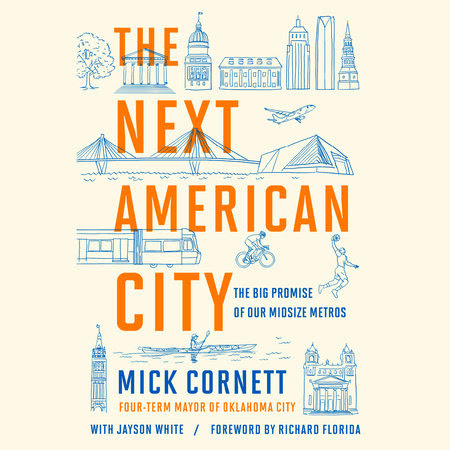
And while it is a more collaborative process, the Metropolitan Area Projects infrastructure development process in Oklahoma City, as discussed in the book The Next American City: The Big Promise of our Midsize Metros, has some of those elements.

But I wonder if the problems of the here and now, and the unplanned things that come up like earthquakes, pandemics, etc., make it almost impossible for mayors to play that role. 


Labels: , , , , , ,

Friday, February 14, 2020

Racialized social control and risk management: Baltimore

I am reading The New Jim Crow and while I am not sure how I feel about the book, the author Michelle Alexander makes a compelling argument about mass incarceration being the current stage of racialized social control (after slavery and the Old Jim Crow).

There is an article in the Baltimore Business Journal, "Real estate leaders say Baltimore's poor public image is 'exhausting'," where the real estate industry is complaining about the impact of the post-Freddie Gray riots on the city's image, business climate, and current economic success. From the article:
Baltimore real estate executives are weary from fighting a tidal wave of negativity and shaky city leadership that have hampered leasing, retail and tourism efforts around town. ...

"The business community needs to step up and challenge the city leadership and create an environment where people want to live and work in our city," Deering said. "We can’t just complain, we’ve got to get them involved, and we have to hold them accountable."

Deering said no elected city officials attended the forum. Also absent were representatives from the Baltimore Development Corp., the city's quasi-public economic development agency, and the Downtown Partnership of Baltimore, a nonprofit that oversees the central business district, in part through funds collected from businesses.

Tom Fidler, executive vice president at MacKenzie, said the discussion ranged from Baltimore's positives to its negatives, which included a poor national and regional image problem.

"The word of the night was exhausting," Fidler said on Friday. "We're all exhausted with the constant battle of changing the perception of our city on the national and regional level. It hurts, and none of us can sugarcoat it."
For the past few years, I've been thinking about these issues in terms of municipal asset and risk management ("Town-city management: 'We are all asset managers now'") and as key responsibilities of a city's political and economic leaders--elected, appointed, and stakeholders.

I have written about this also in terms of policing and year after year settlements totaling tens if not hundreds of millions of dollars in cities like Chicago being an indicator of systemic problems ("Managing the brand promise of cities in the face of corruption").  Instead of taking the cost as a given, address the process that generates unpreferred outcomes.

But I haven't always been thinking about this in terms of "racialized social control" or at least not in such stark terms.

-- "An outline for integrated equity planning: concepts and programs"

I do think it's reasonable to draw such conclusions about the policing, court, and prison system.

After all, my basic lesson from serving on grand jury duty was that the city spends billions of dollars each year on criminal justice, emergency services, human services and other social programs just to keep the city's low income households "the same."

That's doubly true for Baltimore.

-- "Social urbanism and Baltimore"
-- "The Tragedy of Baltimore," New York Times Magazine

Greater St. Louis has similar issues post-Ferguson, and for different reasons, so does the University of Missiouri ("Long After Protests, Students Shun the University of Missouri," New York Times).

=====
Creating a transit network as a fulcrum for Baltimore revitalization.  One thing that would make a huge difference is the creation of a city-focused transit network, because two relatively poorly placed transit lines that don't really connect--one a light rail, the other a truncated subway--aren't enough to spark substantive in-migration to neighborhoods across the city.

This piece, based on a paper I wrote for the Baltimore County master plan update process in 2009/2010, outlines a program equally focused on both jurisdictions, although the paper is a bit more focused on the County since that's where I was working.

-- "From the files: transit planning in Baltimore County"

Looking back at the original program for planning a transit network in Baltimore City, dating to the 1960s, would provide a template for a more complete system.

Also see "A "Transformational Projects Action Plan" for a statewide passenger railroad program in Maryland") and "Revisiting the Purple Line (series) and a more complete program of complementary improvements to the transit network" where I suggested that Baltimore City should leverage the PL project to get more modern light rail vehicles.

Labels: , , , , , ,

Saturday, January 04, 2020

Missing the point about tragedy as a call for action: Texas Governor Abbott, President Donald Trump

In the articles about the tragic attack with a machete on a group of Orthodox Jews in Suburban New York, the mother of the perpetrator lamented how more than anything, her son is mentally ill, and there is no real system to help such people.

The point then, in responding to such events, isn't necessarily to term them "domestic terrorism" but indicators of a tragic failure to provide mental health care. Police departments and prisons have by default become the country's "community mental health care system," a much different one than was prophesied as part of mental health care "reforms" in the late 1960s.

Some of the murders in DC this past year were random acts by mentally ill people ("Killings in District reach decade high as leaders struggle to reduce gun violence," Washington Post). According to the Austin American-Stateman, the response by the governor to a random killing in Austin was "‘I bet you’ll learn that the killer was a homeless man’." From the article:
Hours after a person stabbed a man to death Friday in South Austin, Gov. Greg Abbott speculated on Twitter that the suspect was homeless.

"When all facts are revealed I bet you’ll learn that the killer was a homeless man with prior arrests," Abbott tweeted. "If so Austin’s reckless homeless policy puts lives in danger to murders like this. Austin leaders must answer for their perilous policies."
Probably. But ultimately this problem is much bigger than Austin.

 A homeless man who is mentally ill and hasn't received the care he needs to be sane--both because of too strong "individual protections" so that people have a right to be crazy more than the public has a right to be safe and because of a failure by the State of Texas to provide adequate services--providing this kind of care should be a state function, not a local function.

Talk about lack of understanding and lack of leadership.

Of course, the same goes for President Trump in the way that he calls Chicago ("Trump calls Chicago 'embarrassing to nation' during first visit," Guardian) and Baltimore ("Trump calls Baltimore 'disgusting ... rodent infested mess," Baltimore Sun) cesspools and threatens to step in on California homeless issues (""California's homeless: Trump policy has state officials wary," USA Today) or wildfire in California, completely ignoring climate change ("California wildfires: Trump threatens to cut funding to fight fires," USAT), Puerto Rico ("Trump's Vendetta Against Puerto Rico Is Still Going Strong," Vanity Fair).

Ideally, the federal government would be motivated to "help" rather than to rail.

 E.g., cities need more funding in the modern era than antiquated property tax revenue systems generate. Lax federal gun laws with no interest in changing them contributes to high rates of murder in cities like Baltimore and Chicago. Homelessness is a function of failed mental health care systems as well as a failure to build more public housing, and the constant decrease in federal funding to help provide it.  Puerto Rico's wrecked economy is largely a function of various changes in federal policies.  Etc.

Labels: , , , ,

Monday, December 03, 2018

The Vision Thing and DC's Night Mayor appointment

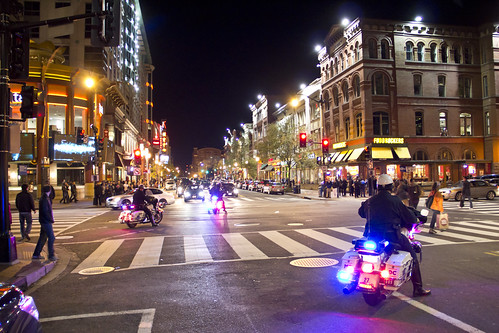
Adams MorganA few weeks ago it was announced that DC was seeking to hire a "Night Mayor."  There was a bunch of breathless media coverage ("Want to deal with D.C.’s after-hours noise? The District is looking for its first ‘night mayor.’," Washington Post).

I considered applying myself, until I remembered that it would be working in the Office of the Mayor, and that it would be unlikely I'd get an interview let alone the job. From the article:
The new director of the District’s inaugural Office of Nightlife and Culture will be in charge of “the after-hours economy” and all that goes along with it — after-hours noise complaints, crime, street cleanup, traffic congestion and, of course, rats.

“This job, man. People are excited about it. Around the country, across the oceans,” said Lindsey Parker, Bowser’s deputy chief of staff. “We’ve received a very diverse group of résumés.”

The concept of having an after-dark government official whose job it is to create order from the chaos of nightlife is not a new one.

Other cities — New York, London, Orlando, even smaller ones like Iowa City — have created such positions. They vary in title (night mayor, night czar, night manager) and responsibilities. Some, like London’s night czar, work only part time.

In the District, it will be a full-time job — with odd hours.
I've been writing about these issues for a long time and have a bunch of insightful points, ranging from

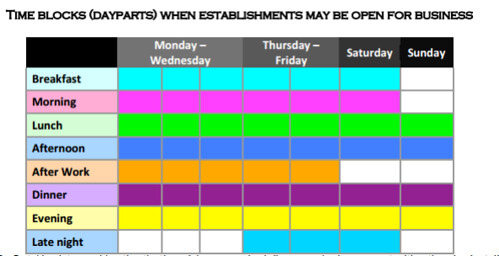
1.  "daypart planning" to include evening and night hours in a planning framework based approach ("Planning programming by daypart, month, season: and Boston Winter Garden, DC's Holiday Market, etc." and "Daypart and age-group planning in mixed use (commercial) districts")

2.  Lighting ("Night-time safety: rethinking lighting in the context of a walking community") and

3.  Restructuring the alcoholic beverage licensing process to take into account land use context--in this case the type and nature of the setting, so that a licensee in a regionally serving nightlife district is treated differently from a location in a neighborhood-embedded commercial district, and rather than force all licenses to be "challenged" build in a certain way of operating from the outset, depending on the nature of the commercial district/setting.

Dayparts as a planning concept for commercial districts
Dayparts as a planning concept for commercial districts.


It's been reported that DC made its hire, Shawn Townsend, formerly of the DC Alcoholic Beverage Regulation Administration ("D.C. Names Shawn Townsend 'Night Mayor'," Washington City Paper).

2011 11 04 - 5534 - Washington DC - Occupy DCThey hired a regulator.  Not a planner.

I shouldn't be surprised.

Labels: , ,

Wednesday, October 24, 2018

10 Principles of Strategic Leadership from Strategy+Business

"10 Principles of Strategic Leadership," Strategy+Business.

According to the article, only 7% of managers are "strategic leaders."

1. Distribute responsibility.
2. Be honest and open about information.
3. Create multiple paths for raising and testing ideas.
4. Make it safe to fail.
5. Provide access to other strategists.
6. Develop opportunities for experience-based learning.
7. Hire for transformation.
8. Bring your whole self to work.
9. Find time to reflect.
10. Recognize leadership development as an ongoing practice.

The article discusses each of these elements with examples.

Governments, like DC with its Capital Fellows Program, often have "management development programs," primarily for newer hires. Although I haven't always been impressed with the projects they work on or the "insights" that are generated. Deeper focus on strategic leadership development is required.

Labels: , , , ,

Tuesday, September 25, 2018

Car culture and automobility in Anne Arundel County: Part 1 | A cycletrack on Main Street in Annapolis

I started using the term "car culture and automobility" more than a decade ago after seeing the terms used separately.  I just found out that the phrase "systems of automobility" was coined by John Urry, but I don't know if he was "the first."

It was at a conference in Annapolis, Maryland in 2005 at the Preservation Maryland conference, on a walking tour led by the city's chief planner, when I got more nuanced insight into reflexive resident opposition to new development on the grounds of increased traffic.

In a place like Annapolis, which does have some bicyclists and a small bus-based transit system, virtually every trip to a destination is performed in an automobile.

So you can get a sense that opposition to new projects over traffic isn't necessarily reflexive, but a recognition of reality.

By contrast, in a walkable-bikeable-transit city, a majority of the trips, depending on how proximate the new development is to transit and/or its WalkScore or BikeScore, a majority of the trips to and from the site are likely to be conducted by sustainable modes.

Opposition to existing light rail service.  I still haven't finished another post about how residents in Anne Arundel County, Maryland, close to the Linthicum light rail station, have been calling for its closure because they don't use it much and they think the people who do are likely to be criminals ("Fight over light rail in Anne Arundel takes to the streets in rallies," Annapolis Capital-Gazette).

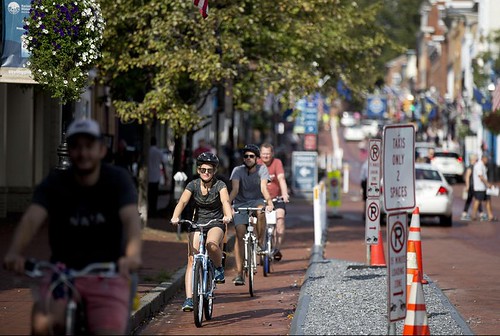
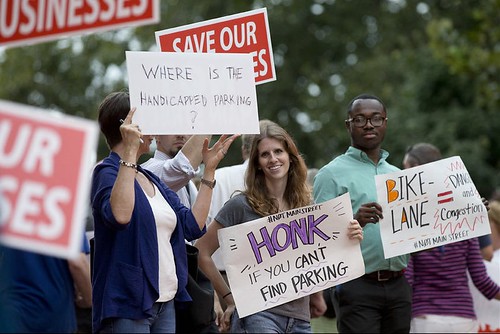
Controversy, mostly against, a bicycle lane on Main Street in Annapolis.  Separately, in Annapolis, the county seat, some residents and business owners are fighting the insertion of a cycle track on Main Street, saying it makes it harder to park, hurts business, etc.

The mayor has initiated a temporary bike lane on the street, which will be up through most of October.

-- "Coverage and commentary: The Annapolis bike lane program," Capital-Gazette

Obviously, I disagree, but it's true that the likelihood of a high number of bike riders there, at least currently, isn't that high.  And the average resident is likely to be wed to the automobile and has a difficult time imagining anyone getting around by any mode other than the car.

Annapolis Bike Day ride, September 22, 2018
Photo: Jen Rynda / Baltimore Sun Media Group. Bikers make their way down Main Street during Annapolis Bike Day bike ride in Annapolis on Saturday, September 22, 2018.


Annapolis lighted bike ride in support of Main Street cycletrack (bicycle Annapolis lighted bike ride in support of Main Street cycletrack (bicycle lane), with protesterslane), with protesters
Jen Rynda / BSMG. Protestors Erin George of Centreville and Yaw Obeng Sarkodie, right, of Beltsville gather on Main Street before the Lighted Bike Parade in Annapolis on Friday, September 21, 2018.


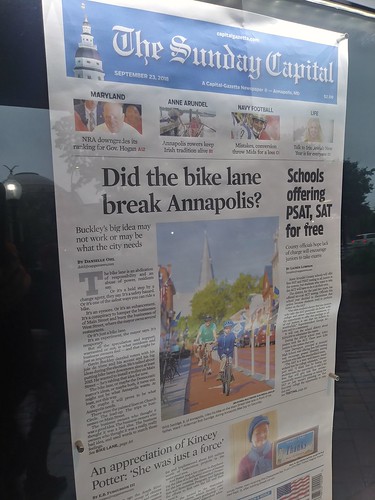
Front page of the Annapolis Capital newspaper, Sunday September 23, 2018, featuring an article on bicyclingSunday's front page of the Capital featured this article, "Did Buckley's bike lane break Annapolis."

But as I wrote last week ("Parking isn't "the third rail" of local politics, it's the car and automobility") the reality is that Annapolis has thousands of parking spaces in the vicinity in public and private parking garages and lots, and giving up a few parking spots on the street in favor of supporting sustainable modes, urban design, and placemaking is a plus.

But people, imprinted with the automobility paradigm, disagree, such as this letter writer:
Move to Europe
For those of us who work in downtown Annapolis, the new bike path on Main Street is a bad idea, to say the least.

Since the implementation, I haven't seen one biker use the path. Parking downtown is a headache most of the time and to take away 36 parking spaces on Main Street is abominable.

As a Realtor at Long & Foster, I can tell you that we get a lot of walk-in traffic because people love Annapolis and want to move here. This bike path won't generate more business for the shops or restaurants. If anything it will hurt these businesses.

Has Mayor Gavin Buckley given any thought about the problems we incur when the boat shows are here or when the legislature is in session? If I wanted a European atmosphere, I would move to Europe. What's next tearing down old Historic buildings?

MARY CLARE HOLDER
Annapolis
Getting elected officials and stakeholders on board with innovation. I argue that for the best results in trying to adopt new sustainable mobility infrastructure, it's a waste of breath to discuss examples from Europe. People can't relate.

They even have a hard time with other examples elsewhere across the continent. Montreal, Portland, Minneapolis, Boulder, etc. seem too distant and irrelevant and they can always come up with reasons about why those examples aren't relevant "to my city."

Elected officials can usually accept similar examples from elsewhere in the state although there remains the urban-center city-suburban/exurban divide. That's the basis of the concept of "positive deviance" as a way to move change forward (see links in this entry, "I get tired of all the talk about rewarding "failure" because it shows people are trying, and won't be penalized for it" ) in uncongenial environments.

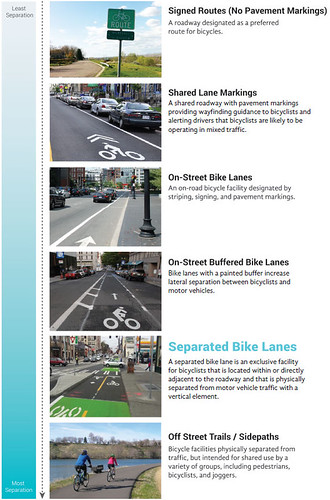
Types of bicycle infrastructure, graphicThat's why I argue that state departments of transportation need to focus on the installation and demonstration of infrastructure in highly visible locations in the state, and use that as an example with jurisdictions across the state.

Producing graphics like this, but with state-specific examples, would be a good step forward.  (Image People for Bikes.)

I thought I convinced a top Maryland transportation planner on this in 2010/2011, but I guess not because a few years later when I interviewed for a job they lacked the courtesy to tell me I didn't get it, I just never heard from them again.

 (Although a paper I wrote influenced their decision to incorporate bicycle infrastructure in parts of the Purple Line routing where it doesn't already exist.)

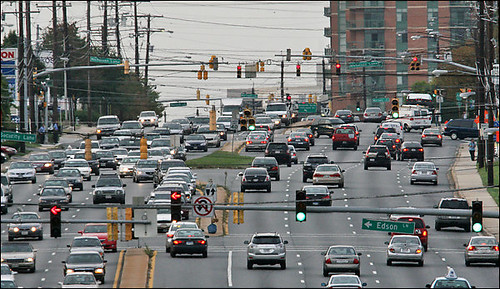
In talking, I suggested that Wisconsin Avenue-Rockville Pike in Montgomery County would be a perfect example. If you can make it work there, no one would be able to talk against such infrastructure. (See the discussion here, "PL #5: Creating a Silver Spring "Sustainable Mobility District": Part 1: Setting the stage.")
Rockville Pike, looking north, which Montgomery planners want to transform into a network of urban villages.
Rockville Pike. Washington Post photo.


Maybe Annapolis could serve as that sustainable mobility demonstration site for Maryland?
But now that I think about it, maybe Annapolis would be better, because so many of the state's elected officials and stakeholders go to Annapolis to meet with legislators and government officials. When there they would see such infrastructure with their own eyes, and consider adopting it in their hometowns.

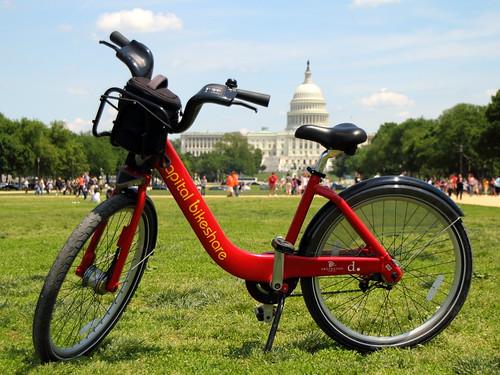
This would be comparable to the impact of DC's Capital Bikeshare on local elected officials across the country. They come to DC, see it in operation, and go back home primed with the idea of installing similar systems.
Capital Bikeshare on the Mall

In the meantime, Annapolis Mayor Gavin Buckley is doing his best to move the project forward.  (It reminds me some of the example of the now former mayor of Columbia, Missouri.  See "A Free-Wheeling City," Parade Magazine; "The age of Hindman," Columbia Daily Tribune.)

From the "Break Annapolis" article:
Sandwiched between protests organized by the angriest of the anti-bike lane community members Friday night and Saturday afternoon, Buckley rallied about 100 bikers Saturday morning for a Bike Day ride down Main Street.

Before the ride, he gathered bikers on West Street for a rallying cry.

Mayor Gavin Buckley leads a bike ride from Whitmore Park to Susan Campbell Park followed by a Children's Bike Rodeo to reinforce safety habits and teach basic biking skills in Annapolis on Saturday, Sept. 22, 2018. (Staff Photos by Jen Rynda / BSMG)
“Cars own our town,” he told the crowd. “We have a historic town, and cars own the best real estate. They own the City Dock, they own both sides of Main Street.

“I don’t think that’s right, but that’s just my opinion. We’re all entitled to our opinion. But when we look around the country, our cities are investing in bike infrastructure and putting people before cars — other cities that we go to and say, ‘How amazing is this?’ ”

He joked about protesters and bike lane-opposers, thanking riders for their bravery.

“I’m not sure what’s going to happen on the other side, if it will be torches and pitchforks. We’ll just kill ‘em with kindness and go down to City Dock to enjoy this city the way it’s meant to be enjoyed.”

=====
From ""The age of Hindman," written on the retirement of Darwin Hindman as Mayor of Columbia, Missouri:
In his 15 years of active service, Hindman has taken many bold stands, some infuriating to certain people. His undying promotion of parks, trails and alternative transportation is an example. But without his pushiness, consider our bereavement.

Hindman might fairly be remembered as the father of the Katy Trail.

In an effort to exploit the new opportunity provided by Congress with passage of the so-called Rails to Trails Act, the newly elected mayor of Columbia planned a trip to lobby then-Gov. John Ashcroft for support of a plan to convert abandoned railroad rights of way into a public, cross-state trail that would become one of Missouri’s most popular state parks.

Hindman says Ashcroft was for the idea but recognized the strong opposition it would face, mainly from rural interests. The mayor figured his entreaty would have more weight if he took along a well-known person from the business community. He knew that the president of an investment firm bearing his family name was interested in public recreation, so he asked Ted Jones. With typical lack of hesitation Jones quickly agreed, and the two set off for Jefferson City.

Gov. Ashcroft thanked the two solicitors for their civic-minded interest but reminded them the state had no money for such a project, at which time Jones quickly said he would pay for restrooms all along the trail, a kickoff gesture typical of Jones’ leadership style.

With strong support from Ed Stegner of the Conservation Federation of Missouri, the fight began in the General Assembly. Not much state startup money was needed -- a few hundred thousand dollars -- but getting the state behind the transition of the rail rights of way required a formidable fight over the dead bodies of the Farm Bureau and other conservative rural interests. Finally, by one vote as Hindman recalls, the legislature approved the deal, and the battle over implementation was launched, peppered with court battles to resolve issues regarding legal authority and ownership of the land. ...

The point of this story is to describe Darry Hindman’s style. When something is worth promoting, he is off his duff and on the road, going for it. Without him and cohort Jones, we might not have a cross-state trail. Certainly, we would not have one as comprehensive or quickly developed.

Since then, Hindman and Columbia have become known nationally for development of trails and the federally funded GetAbout Columbia project to enhance nonmotorized transportation.

The mayor put himself in the perfect position to catch flak for every new stripe on a city street or a redirected lane at a busy intersection. Amid this flurry of slings and arrows he has remained receptive and even ebullient, testing the program’s progress on his own bicycle, dedicated to making it work rather than fighting with detractors. Another “leader” would have hunkered down in thoughtful contemplation about bike and trail ideas, avoiding trouble and accomplishing nothing.
Note that "Ted Jones" mentioned above was "Edward Jones" of the investment firm Edward Jones...

Labels: , , , , ,

Thursday, January 17, 2013

DC style: falling up, principal leadership edition

Years ago, I wrote a blog entry about how a few years after the Washington Post ran a detailed series of failures on the part of some of DC's community development corporations, the DC Building Industry Association gave some of these organizations awards.  ("Falling up -- Accountability and DC Community Development Corporations").

Today's Post has a not dissimilar article, "D.C. principals, Georgetown launch leadership program."

DC Public Schools leaders, including Chancellor Kaya Henderson, are setting up a principal leadership masters degree program with Georgetown University. Yet, DCPS has a record of abject failure with regard to instructional leadership development and training.

And how is it possible for Kaya Henderson to NOT BE FIRED FOR NOT DEALING WITH SERIOUS ALLEGATIONS OF TEST-RELATED CHEATING IN AT LEAST ONE DOZEN SCHOOLS? See "D.C. Cheating Scandal: A Conspiracy of Silence" from the American Thinker blog and "Michelle Rhee: Reformer, Zealot, Both or Something Else?" from PBS.

That's certainly a leadership example that is deserving of analysis within a graduate education program.  But ought not to sanction being picked to develop the curriculum.

Why would anyone pick these people to set up a best practice graduate education program?

 Why not instead work with school systems that already have exemplary leadership development programs, as judged by the success of principals and schools in those systems.

For example, I'd go ask Montgomery County Public Schools and Arlington County Public Schools to help develop this program and of course, Kathleen Cashin from New York City (see "Bucking School Reform, a Leader Gets Results" from the New York Times).  Not DC people, especially Kaya Henderson.

From the article:

A group of 25 principals of D.C. public schools this week began a master’s-degree program at Georgetown University, part of an effort to improve the quality of leadership in the city’s schools.

D.C. Schools Chancellor Kaya Henderson — who earned an undergraduate degree at Georgetown and later a leadership degree there in 2007 — helped launch the program after she determined that principal training programs were lacking what she believed are the essentials needed to elevate the school system. The program, which runs through the calendar year, mirrors Georgetown’s Executive Master’s in Leadership program in the McDonough School of Business.

Henderson, working with academic leaders at Georgetown, created a curriculum that includes such topics as how to deal with uncertainty and how to lead tough conversations.

Labels: , , ,

Saturday, December 29, 2012

Most innovative US mayors, according to Newsweek

-- the article

1.  Education, New Orleans, charter schools, Mitch Landrieu;  Umm, charter schools aren't a solution, really, to poorly functioning school systems, but that's another argument for a later date.

2.  Public Safety, New York City, Michael Bloomberg and Ray Kelly, Police Commissioner; Interestingly, the NYC police department has received a great deal of criticism for their stop and frisk tactics, especially the arrest of residents (not visitors to) in public housing projects.  However there is no question that the continued drop in murder in NYC and the greater sense of security on the streets of New York City is a significant and stellar achievement.  Although the recent murders of people pushed onto the subway tracks in front of oncoming trains is quite disturbing.

It demonstrates, along with the governmental response to various public safety and public health issues in the post-Superstorm Sandy environment, that safety isn't just about crime, and that we need to consider the issue of "public safety" more broadly.  Certainly, the subway killings are an illustration that our system for dealing with the mentally disturbed is quite faulty.  (Not that this fact is new.)

But we need to figure out what's truly behind the reduction in crime--really the murder drop, because other crimes may be rising, or if not rising, may be more violent.  And the drop isn't uniform.  For example, while Chicago's mayor is lauded below, Chicago's murder rate is escalating significantly.  (Oakland, California, Philadelphia, and other cities are equally troubled on this measure as well.)  DC's murder rate has dropped as has the rate in many cities.  In some cities, violent crime and gun-related crime hasn't dropped, but emergency medical care has significantly improved, leading to murder rate reductions, while gun crime is still in fact a problem.

3.  Digital Government, Chicago, Rahm Emanuel;  Umm, the issue isn't using data, creating apps, etc., since CompStat under William Bratton (who deserves, maybe more than most public officials, including the mayors listed in this blog post, much of the credit for the revitalization of center cities more recently, because more police departments are changing their tactics toward reducing crime rather than just merely responding to it), more city governments have been doing data-based analysis.  I've been writing about this for almost 10 years, or more recently pointed out in "All the talk of e-government, digital government, and open source government is really about employing the design method," the real issue is whether or not governments are willing to empower residents and open up the process of governance in a variety of ways, including through participatory budgeting and similar methods, and open source applications related to government.

A long time ago, someone criticized my use of the term "civic engagement."  I was pretty shocked because of course, we want citizens to be able to be more involved in their communities.  But the respondee I think was more focused on how typically, civic "engagement" initiatives are top-down endeavors that don't "empower" citizens.

I guess I have to agree.  I am trying to speed read a tome about civic engagement in Toronto in advance of a New Year's Day post on what the city's agenda should be for 2013, so I have been thinking about this a bunch.  Most of DC's efforts on engagement, e.g., the Mayor's "Office of Neighborhood Engagement" are top-down rather than being focused on building the capacity of individuals, organizations, and neighborhoods to help themselves.

4.  Entrepreneurial Infrastructure, Kansas City and the "Silicon Prairie," Sly James; actually I've been intending to write about this example in with my intended "review" of DC's economic development plan and the approaches most local governments take up with regard to "economic development."  In short, I think this is interesting. press release, Think Big Partners and the Greater Kansas City Chamber of Commerce Announce “IgniteKC” as Kansas City’s New Innovation and Entrepreneurship Conference

5.  Quality of Life, Oklahoma City, Mick Cornett;  the Republican Mayor is focused on rebuilding his city's attractiveness through urban design and walkability.  Initiatives include school building renovations, the building of a 77 acre downtown park, a community wellness initiative including a weight loss campaign resulting in people collectively losing more than one million pounds of weight, attracting a professional basketball team (ugh...), etc.  Governing Magazine interview; "Oklahoma City Mayor Mick Cornett plugs city's success at Republican National Convention," Oklahoma City Daily Oklahoman.

Labels: , , ,